


These Christmas decorating ideas cover ten different spaces without treating every surface as a display. The plans begin with exit paths, tree position, electrical load and reusable storage, then assign a 2026 allowance to the tree, lights, greenery, textiles and table pieces.
Set the Working Budget Before Choosing a Style
Inventory working lights, hooks, stands, storage boxes and reusable greenery before shopping. Separate replacement items from new decorative purchases. A clear inventory prevents buying another set of objects that already exists in the attic.
Measure the tree location from floor to ceiling and from the trunk center to the walking path. Include the stand and top ornament in the height. On a porch, check exposure to rain and use only products rated for that location.
A stable tree, sound electrical products and clear exits come first. Choose one focal area in each room, then let ordinary surfaces continue serving meals, books and daily storage.
1. Front Porch Greenery
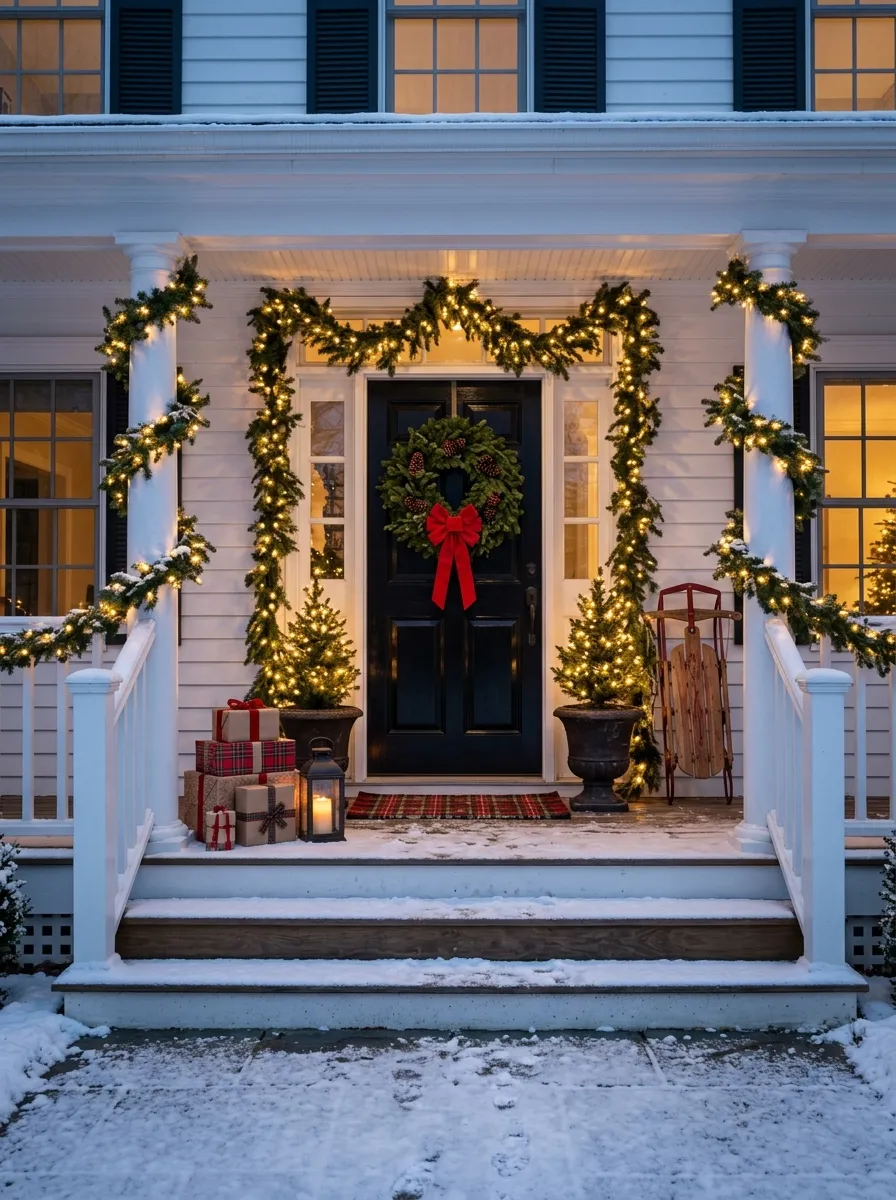
Garland follows the rail and door while warm lights mark the steps. The arrangement gives a weather aware welcome from the sidewalk. The strongest purchase is outdoor rated lights and secure greenery, because it establishes scale and handles the most daily use.
In the rendering the lit garland frames the black front door and climbs both columns, two small trees stand in dark urns on either side of the door, and a stack of wrapped boxes, a lantern and an old wooden sled fill the corners. All of that sits to the sides, leaving at least 36 inches of open tread down the middle of the steps, which is the width to protect when the boards are wet or covered in snow.
Materials and Layout
On a porch, spend first on outdoor rated lights and secure greenery. Indoor strings are not built for rain, and garland that is not tied down ends up on the steps after the first windy night. Evergreen, metal, outdoor ribbon and warm light make up the scheme, all chosen to survive the weather.
The aim is a weather aware welcome from the sidewalk that reads from the street. Keep a clear route that protects the doors, the stairs, any heating equipment and the tree, so planters and cords stay off the steps.
We priced the porch at $820–$1,370 in 2026 dollars. Main tree or focal decoration at $330–$480 covers the door garland, the wreath and the two potted trees, and Textiles and floor layer at $160–$280 pays for the plaid doormat and outdoor ribbon; between them they take about 55% of the high-end figure. The rest splits into $110–$190 for lighting and hardware, $140–$250 for storage and small pieces and $90–$180 for art, plants and finishing pieces. Settle the focal line first, since its spread moves the total more than any other.
Every total in this guide is a decorating and furnishing allowance, not a construction quote: it assumes the porch or room already has sound flooring, working outlets and its major built ins. Reusing the largest piece that is still in good shape, such as last year's wreath or a pair of urns, can bring a total down by roughly one third in many of the ten plans.
Leaf green (#526B4E) belongs to the garland and the potted trees, Linen (#E6DDCF) to the painted siding and trim behind them, Terracotta (#A95F45) to the red bow and the plaid doormat, and Dark bronze (#3A3831) to the urns and the lantern.
Linen is what ties the porch to the house, so let it show again in the ribbon on the boxes or the candle in the lantern instead of wrapping every white post in green. Keep the sled and the gift stack tight against the columns, well away from the line people take when they climb.
2. Traditional Red Living Room
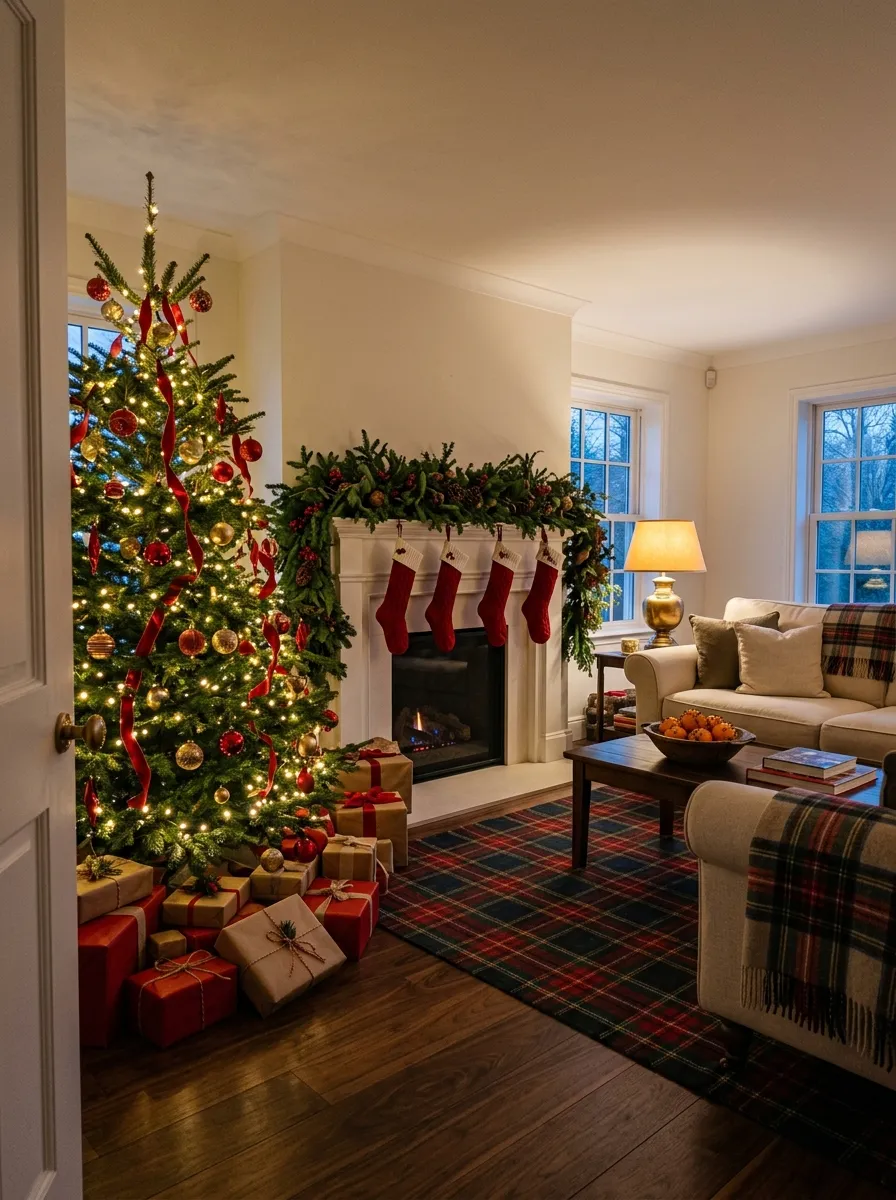
A full tree, red accents and mantel garland create a familiar family setting. The arrangement gives gifts, seating and clear paths around the tree. The strongest purchase is a stable tree stand and safe light plan, because it establishes scale and handles the most daily use.
The tree here stands in the corner beside the fireplace, hung with red and gold baubles and wide red ribbon, with wrapped gifts spilling across the floor in front of it. A route of at least 36 inches should run from the door past that pile to the sofa, which usually means trimming the gift heap back before guests arrive. The brass lamp beside the sofa shows the right lighting logic: the light sits where people read and talk, not wherever the nearest outlet happens to be.
Materials and Layout
Before any ornament, buy a stable tree stand and set out a safe light plan: how many strings, which outlets and where cords run. Evergreen, wool, cotton and warm metal carry the traditional red scheme, with wool and cotton softening the brighter accents.
The room has to hold gifts, seating and clear paths around the tree during the busiest weeks of the year. Keep a clear route that protects the doors, the stairs, the heating equipment and the tree, and leave the area behind the tree free of cords.
At $1,180–$1,960, the traditional room is the most expensive of the living rooms in this guide. The full tree with its ornaments and lights falls under Main tree or focal decoration at $480–$690, and the tartan rug and throws under Textiles and floor layer at $230–$400; the two make up about 56% of the upper figure. Lighting and hardware runs $150–$280, storage and small pieces $200–$350, and art, plants and finishing pieces $130–$250. Get a firm price on the tree before anything else, because its range is the widest in the room.
Soft white (#F0EEE8) covers the walls, ceiling and fireplace surround, Warm wood (#8A6446) runs through the floorboards and the coffee table, and Iron (#343633) is the dark firebox. Historic blue (#506477) is the quietest note, picked up only in the navy squares of the tartan rug and the throw on the armchair.
Because the blue is so faint, repeat it at least once more, in a cushion or a ribbon on the gifts, so it reads as part of the plan and not as an accident of the rug. Leave the tree where it is: it is the tallest object in the room, and the open door beside it marks the narrowest point.
3. Modern Farmhouse Christmas
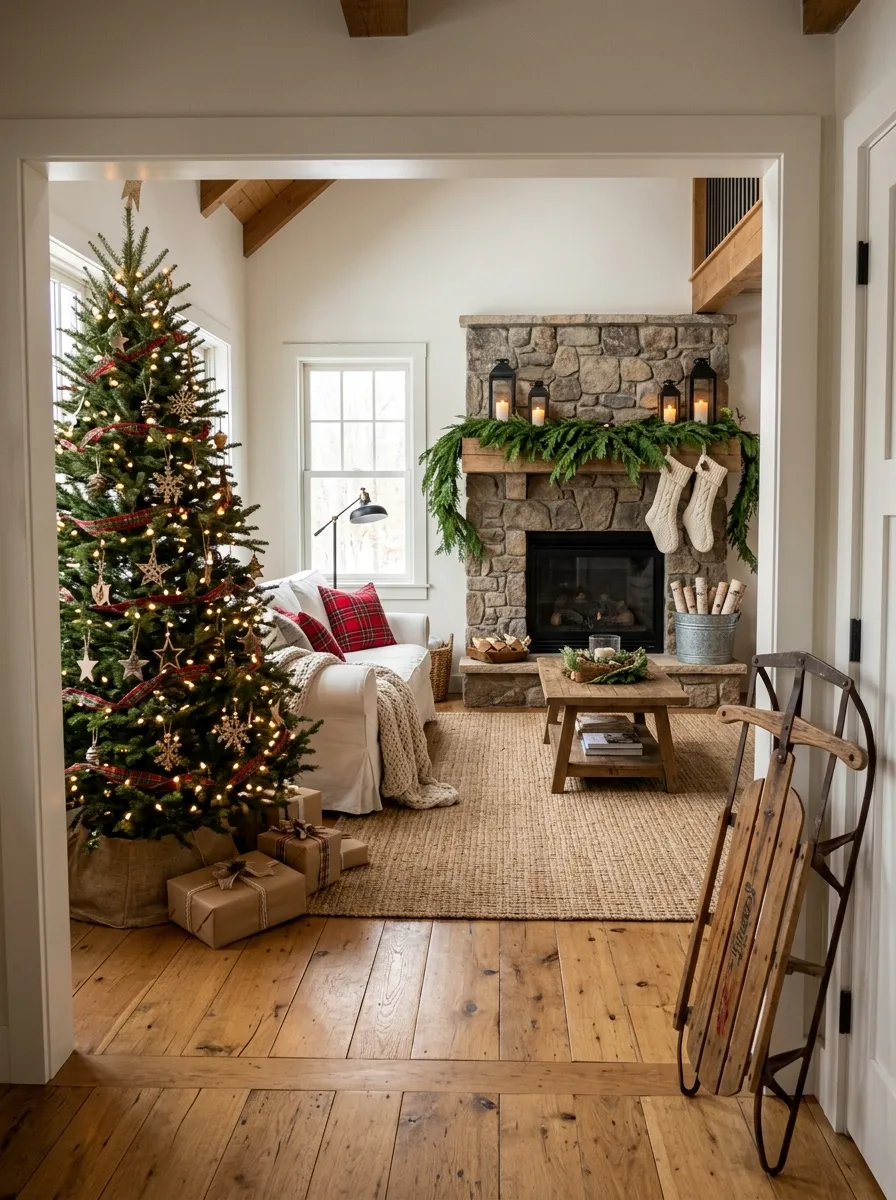
Natural garland, wood ornaments and restrained red work with stone and oak. The arrangement gives a relaxed gathering room. The strongest purchase is the tree scale and a simple mantel line, because it establishes scale and handles the most daily use.
This view is framed through a wide cased opening: a tall tree in a burlap skirt on the left, a white slipcovered sofa with red plaid cushions, a jute rug, and a stone fireplace with a timber mantel, black lanterns and two knit stockings. An antique sled leans against the opening itself, which looks charming in a picture and becomes a trip hazard in daily life, so give the passage its full 36 inches and stand the sled against a wall nobody walks past.
Materials and Layout
The farmhouse version is decided by the tree scale and a simple mantel line. A tree sized to the ceiling and one garland on the mantel do more here than a crowded display. Wood, evergreen, linen and iron keep the look plain and sturdy.
The goal is a relaxed gathering room where people can sit, eat and move around without minding the decorations. Keep a clear route that protects the doors, the stairs, the heating equipment and the tree, especially when extra chairs come out.
Modern Farmhouse Christmas comes in at $1,060–$1,770 for everything shown. Roughly 55% of the top figure sits in two lines, Main tree or focal decoration ($430–$620) and Textiles and floor layer ($200–$360), the second covering the jute rug, the chunky throw and the plaid cushions. Smaller amounts go to lighting and hardware ($140–$250), storage and small pieces ($180–$320) and art, plants and finishing pieces ($110–$230). Price the tree and the mantel garland first, because that line carries the biggest spread.
Soft white (#F0EEE8) is the walls and the sofa, Warm wood (#8A6446) the wide plank floor, ceiling beams, mantel and coffee table, and Iron (#343633) the lanterns, the firebox and the sled runners. Historic blue (#506477) belongs to this palette but does not appear in the rendering; if you bring it in, keep it to one surface such as a painted door or a single cushion so it does not fight the red plaid.
The stone and oak do most of the decorating here, which is why the restraint works: one garland on the mantel, two stockings, and lanterns where another room would add more ornaments. The lantern candles sit directly above the greenery, so battery candles are the better choice if the fireplace is used through the season.
4. Scandinavian Christmas
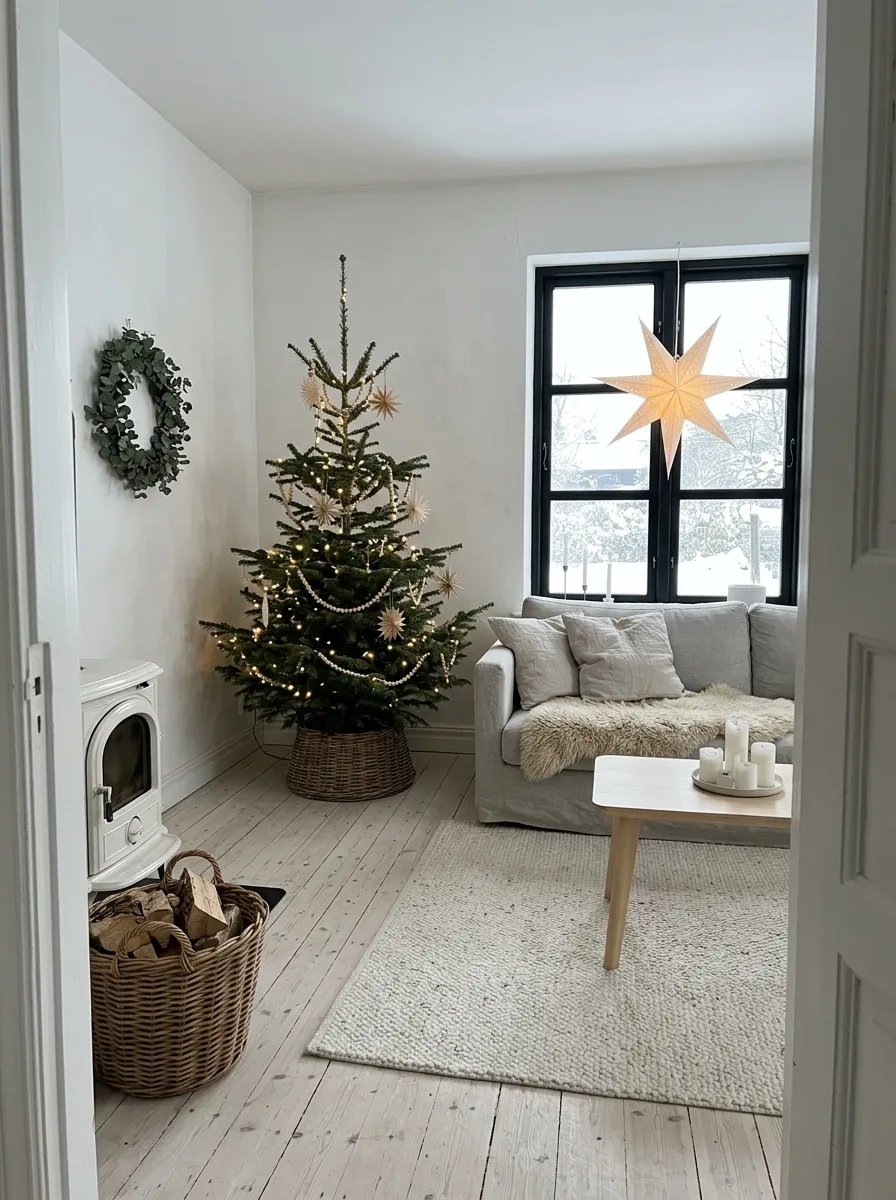
A tree in a woven basket, paper stars and pale textiles keep a bright room open. The arrangement gives simple seasonal light in a compact plan. The strongest purchase is warm lamps and reusable paper decor, because it establishes scale and handles the most daily use.
Materials and Layout
A Scandinavian Christmas depends on warm lamps and reusable paper decor. Warm lamp light does most of the work, and paper stars and garlands pack flat for the next year. Paper, wool, pale wood and evergreen keep the scheme light and simple.
This approach gives simple seasonal light in a compact plan, without a large tree taking over the room. Keep a clear route that protects the doors, the stairs, the heating equipment and the tree, and keep paper decor well away from any heat source.
This scheme costs $880–$1,470. About 56% of the higher figure goes to two lines: Main tree or focal decoration at $360–$520, for the tree, its basket and the paper star, and Textiles and floor layer at $170–$300, for the wool rug and the sheepskin. What remains is $110–$210 for lighting and hardware, $150–$260 for storage and small pieces and $90–$190 for art, plants and finishing pieces. With so few objects in the room, the tree is the purchase to get right and the one to quote first.
The walls and ceiling are Warm white (#EFECE3), the pale floorboards and coffee table Pale oak (#C7A77D), and Mist blue (#C8D8DA) sits in the grey blue linen of the sofa. Soft navy (#354B5E) is the darkest tone in the scheme, close to the black window frames that outline the snow outside.
The rendering shows a full size tree rather than a tabletop one, trimmed only with a wooden bead garland, straw stars and warm lights, while a large paper star hangs in the window and a eucalyptus wreath hangs on the bare wall. The white wood stove is the piece to plan around, so give the tree a wide berth from it. Repeat mist blue once more in a cushion or a throw so the sofa does not carry it alone.
5. Cottage Christmas
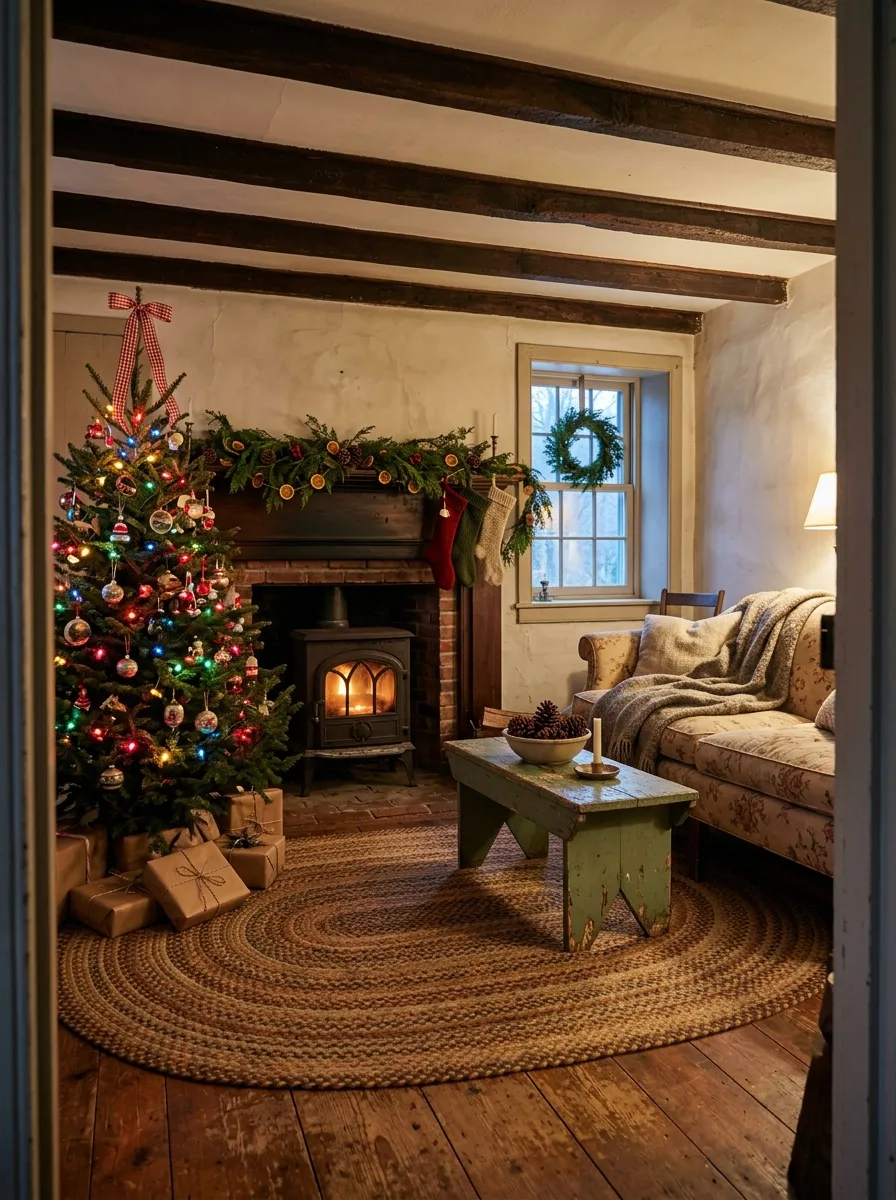
Plaid, a hearth, a smaller tree and handmade shapes suit a beamed room. The arrangement gives evening reading and low key gathering. The strongest purchase is washable textiles and a secure tree, because it establishes scale and handles the most daily use.
Materials and Layout
Cottage decorating starts with washable textiles and a secure tree. Throws and cushion covers get heavy use over the holidays, and a well anchored tree matters in rooms with children or pets. Pine, wool, cotton and aged brass give the look its homemade character.
The room is set for evening reading and low key gathering, with lamps and candles kept in safe places. Keep a clear route that protects the doors, the stairs, the heating equipment and the tree, and keep the tree clear of the reading chair.
The 2026 estimate for the cottage room totals $1,000–$1,670. Most of the money sits with Main tree or focal decoration at $400–$580 and Textiles and floor layer at $190–$340, together about 55% of the upper end; in this room the textile line pays for the braided rug, the knit throw and the three stockings. Lighting and hardware takes $130–$230, storage and small pieces $170–$300, and art, plants and finishing pieces $110–$210. Ask for the tree price before the rest, since its range swings furthest.
The rough plaster walls are Cream (#F1E5D2), the brick around the stove is Clay (#A75C45), Sage (#8C9A79) is the worn green bench used as a coffee table, and Dusty rose (#B98278) comes through in the faded floral sofa.
The rendering shows a low beamed room with a brick hearth and a lit wood stove, a tree with old fashioned coloured lights and a red gingham bow on top, a dried orange garland on the mantel and a wreath hung inside the window. Dusty rose appears only on the sofa, so bring it back once in a cushion or a ribbon on the gifts. The stockings hang right beside the stove, and they belong at the window end of the mantel on evenings when the stove is lit.
6. Christmas Dining Table
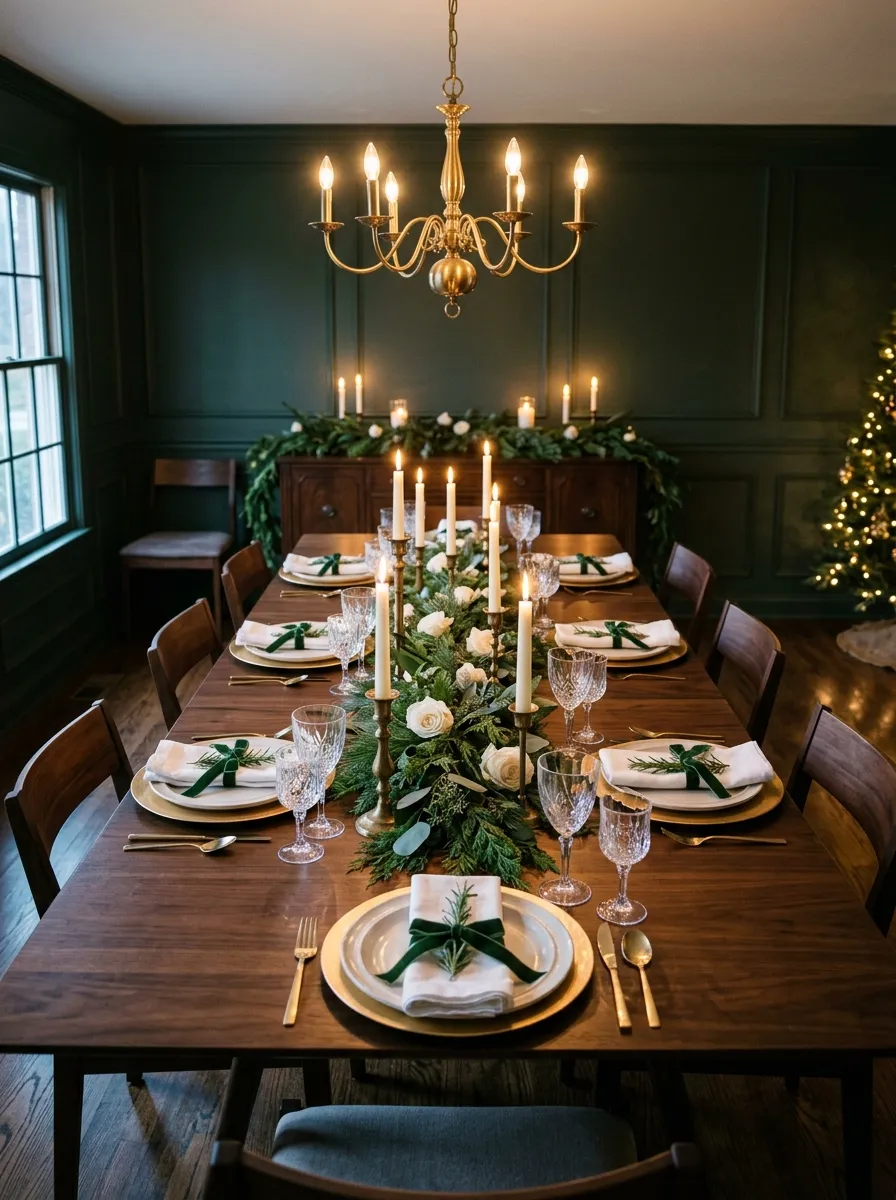
Evergreen, candles and simple place settings run along a dark table. The arrangement gives a meal with sight lines kept clear. The strongest purchase is safe low centerpieces and stable candle holders, because it establishes scale and handles the most daily use.
The table in the rendering is a long walnut piece under a brass chandelier, set with gold chargers, crystal glasses and napkins tied with green velvet ribbon, and the dark green panelled walls make the candlelight carry. Allow at least 36 inches between the table edge and the wall or sideboard so a seated guest can push back while someone walks behind. The centerpiece of cedar, eucalyptus and white roses stays low, so faces remain visible across the table even though the thin tapers rise above it.
Materials and Layout
On the table, the essentials are safe low centerpieces and stable candle holders. Tall arrangements block faces across the table, and narrow holders tip when a dish is passed. Linen, evergreen, glass and brass set a festive table without crowding it.
The goal is a meal with sight lines kept clear, so guests can see each other and the serving dishes have room. Keep a clear route that protects the doors, the stairs, the heating equipment and the tree, with space to pull every chair out.
The dining table carries the largest 2026 allowance in the guide, $1,290–$2,160. Main tree or focal decoration, which on a table means the runner, candlesticks and centerpiece, is $520–$760; Textiles and floor layer, covering napkins, ribbon and any rug under the table, is $250–$440. Those two account for about 56% of the high figure. The other lines are $170–$300 for lighting and hardware, $220–$390 for storage and small pieces and $140–$280 for art, plants and finishing pieces. Fix the centerpiece specification first, because it has the broadest allowance.
Warm plaster (#E7DED0) shows up in the napkins, roses and candles rather than on the walls, which are a deep green, a few shades darker than Moss (#61705A). Charcoal (#343735) is the grey upholstered seat in the foreground. Light oak (#C49D72) is the one listed tone the rendering does not bear out: the table, chairs and sideboard are dark walnut, so light oak only fits if your own table is a paler wood.
Real tapers standing among cut greenery need heavy bases and someone keeping an eye on them; battery tapers in the same brass holders keep the look with far less risk. Leave a hand's width of bare table at each place setting so serving dishes can land without anyone moving the runner.
7. Christmas Mantel
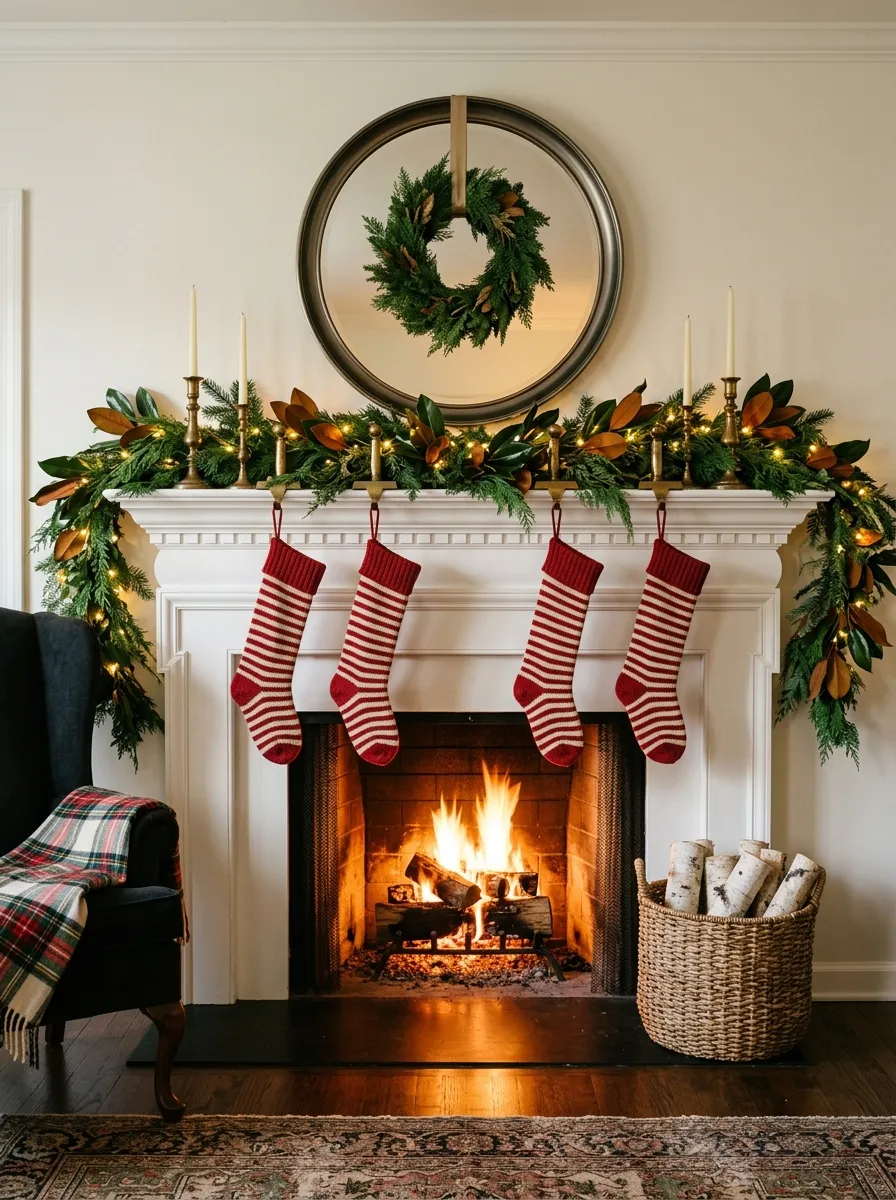
Garland, stockings and a round mirror make the fireplace the focal point. The arrangement gives a layered hearth display without blocking use. The strongest purchase is noncombustible clearances and secure hooks, because it establishes scale and handles the most daily use.
Materials and Layout
A mantel display starts with noncombustible clearances and secure hooks. Greenery and ribbon must stay well clear of the firebox, and stockings need hooks rated for their weight once filled. Evergreen, wool, wood and warm metal make up the display.
The aim is a layered hearth display without blocking use, so the fireplace can still be lit safely if you plan to use it. Keep a clear route that protects the doors, the stairs, the heating equipment and the tree, with nothing hanging into the hearth opening.
A mantel on its own is one of the smaller budgets here, $760–$1,280 in 2026 prices. Main tree or focal decoration is the garland and wreath at $310–$450, and Textiles and floor layer for the stockings, the throw and the hearth rug adds $150–$260; between them they use about 55% of the higher number. Lighting and hardware, which includes the stocking holders, is $100–$180, storage and small pieces $130–$230, and art, plants and finishing pieces $80–$160. The garland line has the widest range, so decide its length and whether it is fresh or reusable before buying anything else.
Behind the display the wall is Warm plaster (#E7DED0). Light oak (#C49D72) is picked up by the bronze backs of the magnolia leaves and the wicker log basket, Moss (#61705A) runs through the cedar garland and the wreath, and Charcoal (#343735) frames the round mirror and covers the wingback chair beside the hearth.
In the rendering the wreath hangs on the round mirror, four striped knit stockings hang from brass holders, and the garland drapes down both sides of a white mantel above an open wood fire. One detail would need changing in a real home: the taper candles stand inside the garland, among leaves that dry out quickly beside a fire. Battery tapers in the same candlesticks solve it without changing the look.
8. Small Space Christmas
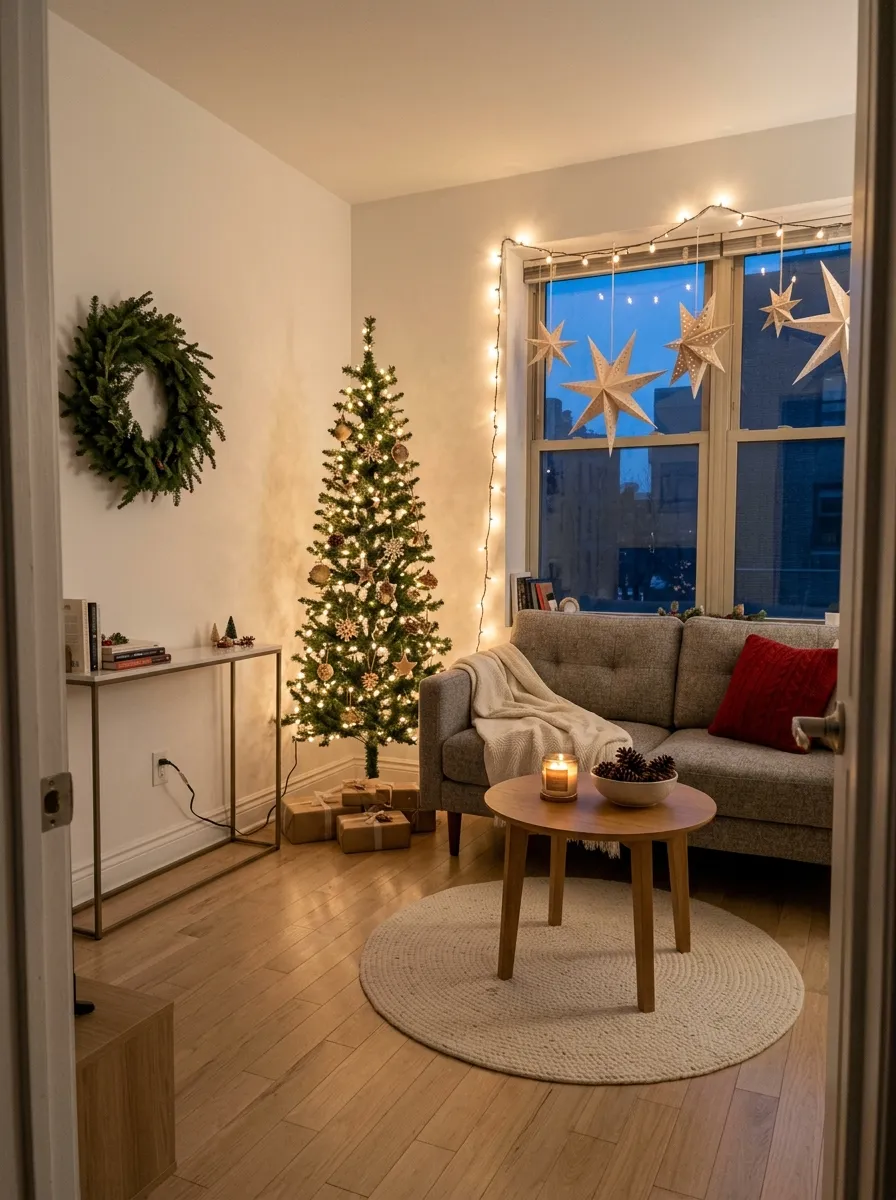
A narrow tree, paper stars and one wreath fit a compact living room. The arrangement gives seasonal atmosphere without blocking circulation. The strongest purchase is a slim tree and wall mounted light decor, because it establishes scale and handles the most daily use.
A pencil tree stands against the wall in this rendering, with paper stars and string lights hung across the window, a wreath on the bare wall and a small grey sofa facing a round wooden table. In a room this size, 36 inches of clear floor between the sofa, the console and the door is worth more than another ornament. The tree's cord runs along the baseboard to the outlet behind the console, which is the right route; a cord laid across the walking line is not.
Materials and Layout
In a small space, start with a slim tree and wall mounted light decor. A narrow tree keeps floor free, and lights on walls or windows add atmosphere without taking any footprint. Paper, evergreen, cotton and light wood keep the scheme bright and easy to store.
The aim is seasonal atmosphere without blocking circulation, which in a small room means checking every addition against the walking path. Keep a clear route that protects the doors, the stairs, the heating equipment and the tree.
Small Space Christmas is the least expensive plan, $650–$1,080. The slim tree with its lights and ornaments is Main tree or focal decoration at $260–$380, and the round rug, throw and cushion are Textiles and floor layer at $120–$220, together about 56% of the top of the range. Lighting and hardware comes to $80–$150, storage and small pieces $110–$190, and art, plants and finishing pieces $70–$140. The tree is still the line to settle first, because the price of a slim tree changes a lot with its height and the number of lights.
Warm plaster (#E7DED0) is the wall colour, Light oak (#C49D72) the floor and the round table, Moss (#61705A) the wreath and the tree, and Charcoal (#343735) the deepest grey in the sofa's tweed.
The red cable knit cushion is the only strong colour in the room, and in a small space that restraint keeps it calm. Before adding anything, take a photo from the doorway; a picture shows more clearly than standing in the room whether the tree and the stars crowd the window.
9. Christmas Bedroom
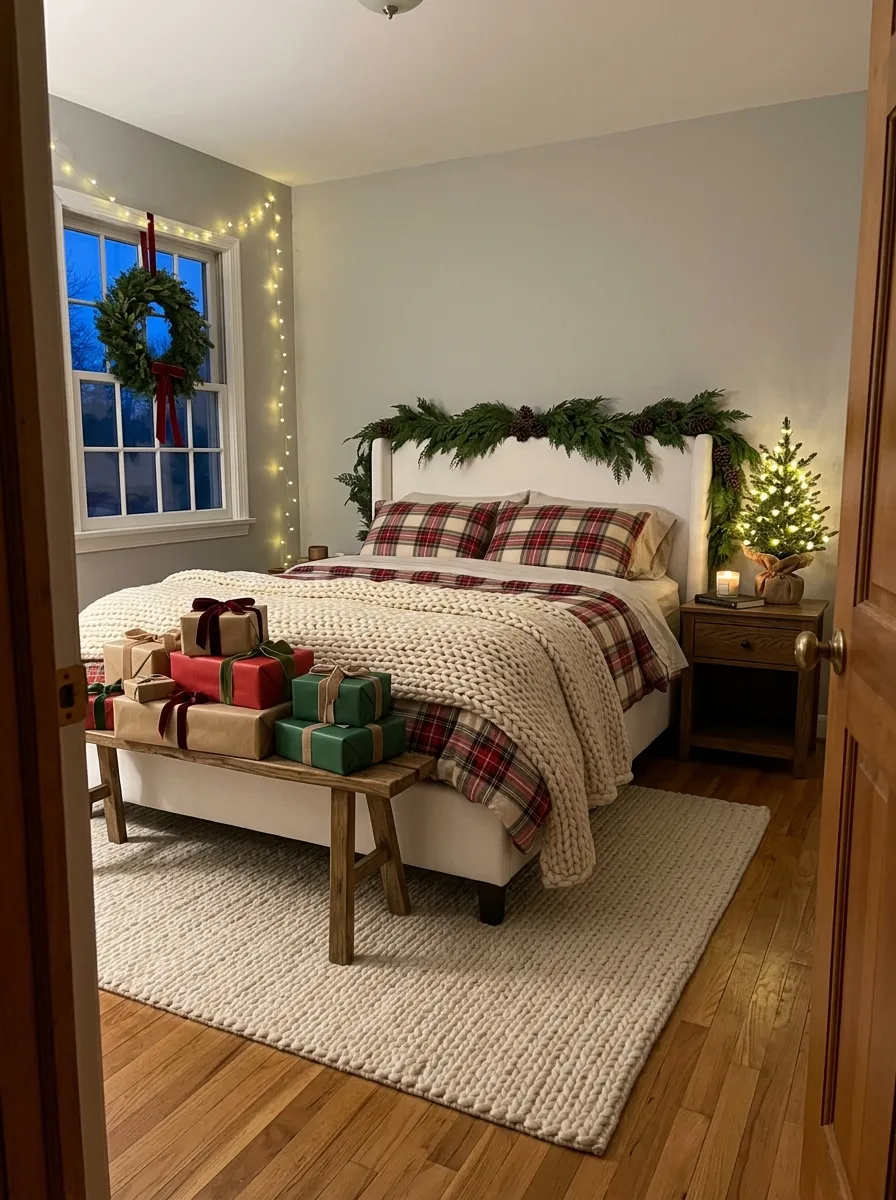
A small tree, plaid bedding and window lights add seasonal color away from the main room. The arrangement gives soft light without sleep disruption. The strongest purchase is low output lights on a timer, because it establishes scale and handles the most daily use.
The bedroom in the rendering keeps the floor nearly empty: a garland with pinecones runs along the white headboard, a tabletop tree glows on the nightstand, and fairy lights outline the window around a wreath with a red ribbon. Keep 36 inches along the open side of the bed, and check that the bench of wrapped gifts at the foot does not force a detour on the way to the door at night.
Materials and Layout
In a bedroom, the first rule is low output lights on a timer. Bright strings disturb sleep, and a timer means they switch off on their own. Cotton, wool, evergreen and warm light keep the look soft, and the warm tone helps the room wind down at night.
The goal is soft light without sleep disruption, with decorations placed away from the pillows. Keep a clear route that protects the doors, the stairs, the heating equipment and the tree, so nobody trips on a cord at night.
For the bedroom the allowance is $820–$1,370, the same total as the porch but spent very differently. Main tree or focal decoration, here the headboard garland and the tabletop tree, takes $330–$480, while Textiles and floor layer, the plaid bedding, chunky throw and rug, takes $160–$280. That is about 55% of the higher figure. Lighting and hardware gets $110–$190, enough for a timer and the window lights; storage and small pieces $140–$250; art, plants and finishing pieces $90–$180. The focal line has the broadest range and is the first to pin down.
Warm plaster (#E7DED0) appears in the headboard, the cream knit rug and the throw, since the walls themselves read as a pale grey. Light oak (#C49D72) is the floor and the nightstand, Moss (#61705A) the garland, the wreath and the little tree, and Charcoal (#343735) only the dark legs of the bed.
A fresh garland over the pillows sheds needles onto the bedding as it dries, so a good faux garland is the practical choice here, with a few real pinecones tucked in. Put the window lights and the nightstand tree on the same timer so the room goes dark without anyone getting up.
10. Bohemian Christmas
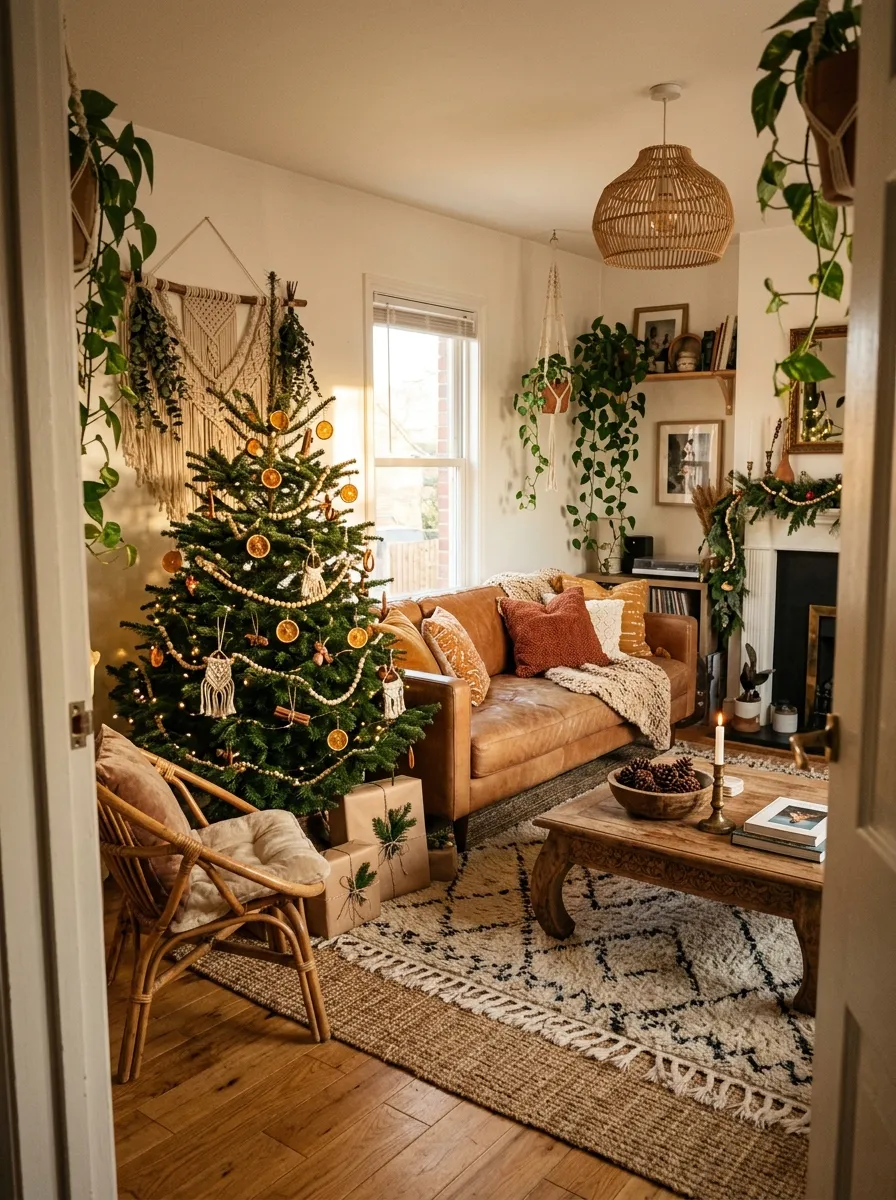
A tree shares the room with plants, woven ornaments and layered textiles. The arrangement gives informal gathering with handmade detail. The strongest purchase is a stable tree base clear of floor cushions, because it establishes scale and handles the most daily use.
Materials and Layout
A bohemian room calls for a stable tree base clear of floor cushions. Floor seating moves around, and a cushion pushed against the tree stand can topple it. Rattan, wool, wood and evergreen give the layered, handmade look that suits the style.
The room suits informal gathering with handmade detail, such as paper or fabric ornaments and wreaths made at home. Keep a clear route that protects the doors, the stairs, the heating equipment and the tree, and leave a margin around the tree when guests sit on the floor.
This room shares its $1,000–$1,670 total for 2026 with the cottage scheme, though the money goes to different things. The tree and its dried orange, bead and macrame ornaments fall under Main tree or focal decoration at $400–$580; the layered rugs, cushions and throws under Textiles and floor layer at $190–$340. Together they are about 55% of the high end. Lighting and hardware is set at $130–$230, storage and small pieces at $170–$300, and art, plants and finishing pieces at $110–$210, a line that matters more here than anywhere else because the houseplants are part of the decoration. Quote the tree first; its range is the widest.
Warm plaster (#E7DED0) is the background on every wall, Light oak (#C49D72) the floorboards, the rattan chair and the woven pendant, Moss (#61705A) the trailing pothos and the tree, and Charcoal (#343735) the fireplace opening and the zigzag lines of the rug.
The rendering packs a lot into one corner: a macrame hanging behind the tree, planters hanging from the ceiling, a rattan chair beside the gifts and a cognac leather sofa with rust and mustard cushions. That density works because the floor in front of the sofa stays clear. If floor cushions come out for guests, keep them on the far side of the coffee table from the tree stand, and keep the lit candle well away from the dried orange slices.
Lighting, Scale and Daily Maintenance
Follow the light manufacturer's connection limits and inspect cords before use. Keep cords out of pinch points, doorways and rugs. Use outdoor rated products outdoors.
Keep combustible decorations away from open flame, hot lamps and heating equipment. Battery candles offer a useful alternative on tables and shelves.
Store decorations by zone rather than by object type. A labeled porch box or mantel box makes the next installation faster and reveals which pieces are missing.
A Purchase Order That Protects the Budget
Mark on a rough sketch where each outlet, heating vent and door swing sits in the rooms you plan to decorate. Most of the layout problems in these ten renderings, from the sled in the farmhouse doorway to the tapers inside the mantel garland, would show up on that sketch before anything is bought.
Buy in the order the rooms need it: the tree or main focal piece first, then the lights and outdoor rated cords that power it, then rugs and textiles, and ribbon and ornaments last, once you can see what the larger pieces already provide. For anything shipped, check the boxed dimensions and the return terms, because a tall tree that will not fit up the stairs is an awkward return in December.
Hold back a small line for the things renderings never show: spare bulbs, cable clips, stocking weights, adhesive hooks and the delivery charge on a heavy tree. If decorating starts early in the season, live with the rooms for two weeks before adding more; the gaps that still feel obvious after that are the only ones worth filling.
Keep receipts, light string specifications and care notes in one folder, together with a photo of each finished display. Next year the photos make setup quicker, and the specifications help match a replacement string to the colour temperature already on the tree.
Cost Saving Strategies That Keep the Layout Intact
Repeat the same ribbon, warm light color and natural material across rooms. A limited kit looks connected and needs fewer pieces.
Use real pruned greenery only where cleanup and moisture are manageable. Reusable garland can carry the main shape, with small fresh branches added near eye level.
Move existing throws, baskets and brass objects into the seasonal scheme before buying single use decor.
Questions Readers Ask
How much should Christmas decorating cost?
A focused room can cost $250 to $800 using some existing pieces. A tree, lights, mantel, porch and table may total $1,000 to $3,000 depending on reuse.
How many Christmas colors should one room use?
Two main colors plus the room's existing neutral and greenery are usually enough for a connected plan.
Where should a Christmas tree be placed?
Choose a stable level area away from exits, heaters and direct traffic. Confirm nearby power without running cords under rugs.
How can a small room be decorated for Christmas?
Use a slim tree, one wreath, window or wall lights and a repeated textile. Keep floor and table surfaces working.
Are real candles safe in holiday decor?
Open flame increases risk around greenery, paper and textiles. Battery candles are a safer option in many displays.
Can indoor lights be used outside?
Only use products marked for outdoor use in exposed locations and follow the manufacturer's connection instructions.
How should holiday decor be stored?
Group it by room or display, protect fragile ornaments and label cords with location and tested condition.
Sources and Pricing Notes
Each holiday budget above is a 2026 planning allowance in US dollars, worked out from current retail prices for the lights, greenery, textiles and decorations that space's rendering shows. Unless a section mentions them, sales tax, delivery, permits and unusual site conditions are extra.
- U.S. Consumer Product Safety Commission: holiday decoration safety guidance.
- National Fire Protection Association: winter holiday fire safety guidance.
- U.S. Bureau of Labor Statistics: Consumer Price Index notes for household furnishings.
- The Home Depot: project calculators and current material categories.
- IKEA US: current furniture and storage categories.
Keep Planning
holiday room guide, party decor budgets, living room decor guide.
Styling & Living Desk
The Layered Homes editorial teamThe Styling & Living Desk produces the room-by-room guides, outdoor and garden pieces, celebration ideas and design solutions, each with an itemised cost estimate, and the Home Files essays.
More from the Styling & Living Desk →
Reader notes