


These living room decor ideas treat the room as a working plan. Each direction names the largest purchase, shows how seating connects, records a four color palette and gives a 2026 furnishing allowance instead of presenting a finished image without numbers.
Set the Working Budget Before Choosing a Style
Separate the budget into seating, floor layer, lighting, storage and finishing pieces. The sofa and rug control most of the scale, so reserve money for them before buying side tables or small decor. Include delivery and any assembly charge in the same line as the product.
Measure the room, doors and stair turns. A sofa that fits the wall can still fail at the entry. Mark the sofa depth, table edge and chair movement with tape, then keep the main route open through the entire seating group.
If the room already has sound seating, direct the budget toward correct lighting and one properly sized rug. If the seating is worn or uncomfortable, postpone decorative purchases and solve the daily use first.
1. Bohemian
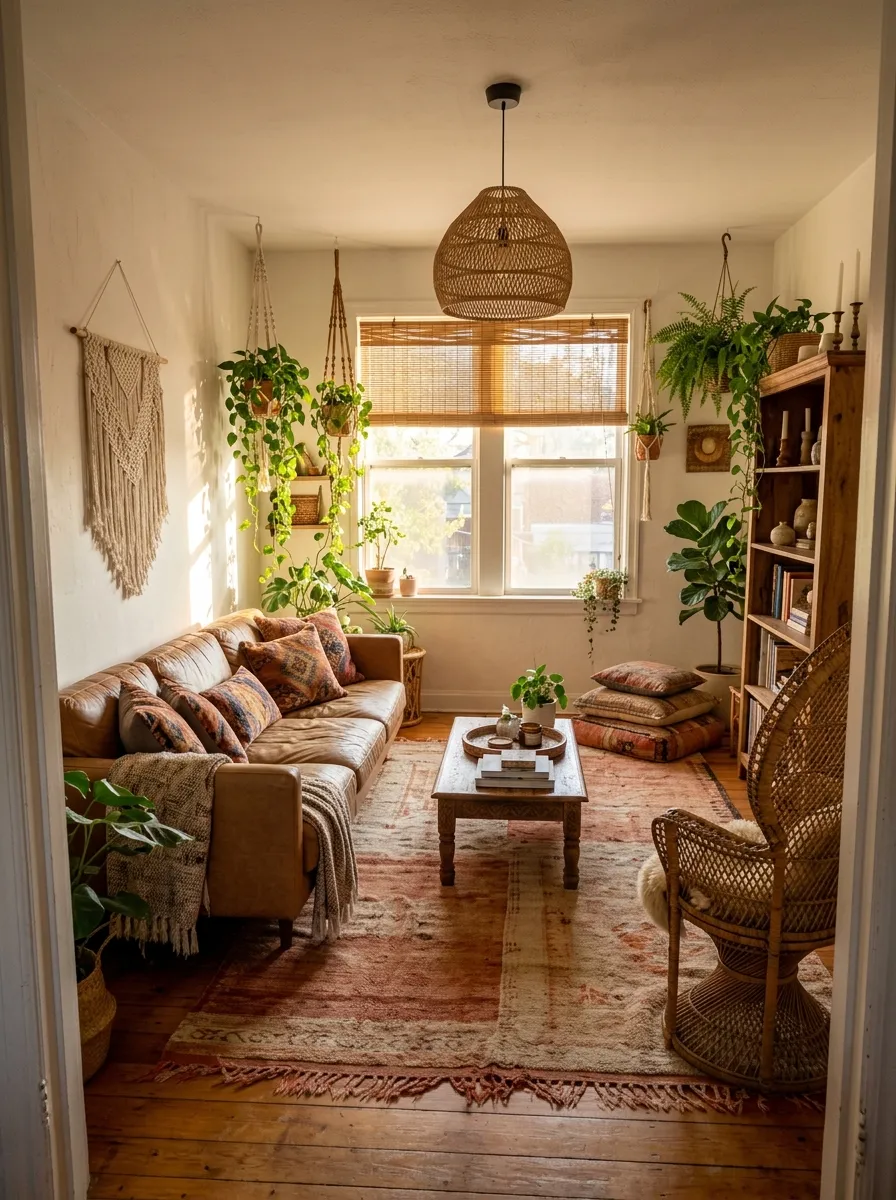
Plants, layered rugs and mixed wood make a personal room without relying on a matching set. The arrangement gives an easy conversation circle. The strongest purchase is a comfortable sofa with a durable frame, because it establishes scale and handles the most daily use.
Materials and Layout
Put the first money into a comfortable sofa with a durable frame. It sets the scale of the room and takes the hardest daily use. The palette of rattan, wool, warm timber and washable linen then carries the bohemian mood on its own, which lets the small accessories stay few.
Arrange the seating as an easy conversation circle, close enough that people can talk without raising their voices. Keep a clear route that protects the doorway, the windows and the path around the coffee table; a floor cushion or pouf that drifts into that line is the first piece to move.
Our estimate for this bohemian room runs $3,060–$5,110. The leather sofa accounts for $1,240–$1,790 of that, and the textile layer (the faded rose rug, kilim cushions, stacked floor pillows and throws) for $590–$1,040, so those two lines make up about 55% of the top figure. Lighting and hardware, which here means the woven rattan pendant and its fitting, sits at $390–$720. Storage and small pieces, chiefly the open timber bookcase and the carved coffee table, come to $520–$910, and $330–$650 covers the plants, hanging planters, macrame and other finishing pieces. Get the sofa quote in writing first, because its range is the widest and every other choice is scaled to it.
These figures furnish a room that already works. They assume the floorboards, wiring and any built in shelving are sound, so they are a furnishing allowance and not a construction quote. A good sofa or bookcase that stays can take roughly a third off the total, and in a room like this one, where nothing is meant to match, keeping an older piece costs the look nothing.
Warm plaster (#E7DED0) is the wall color, and it lets the afternoon light turn the whole room gold. Light oak (#C49D72) runs through the bookcase, the coffee table and the cane of the peacock chair, while Moss (#61705A) comes almost entirely from the plants: vines trailing from the macrame hangers, the fern over the shelves and the broad leaved plant beside the bookcase. Charcoal (#343735) is used sparingly, mainly in the ceiling fitting of the pendant, which keeps it from muddying the warm scheme.
Plants are the main accessory in this room, so plan them like furniture. Hanging planters need ceiling anchors rated for the weight of wet soil, and a drip tray under every pot protects the old boards. Keep the tallest plant and the peacock chair, the widest piece here, out of the line between the doorway and the window.
2. Warm Minimalist
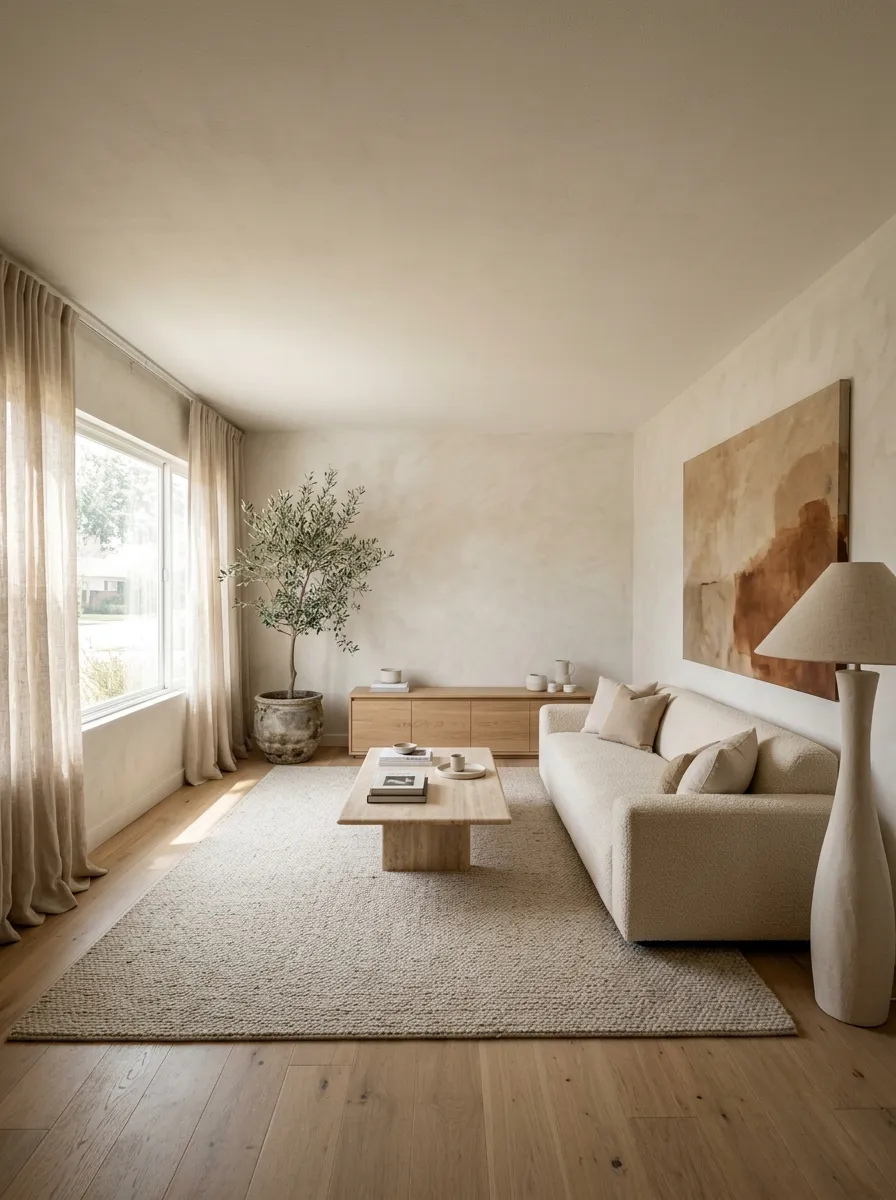
A pale sofa, low table and broad quiet rug keep visual traffic low. The arrangement gives clear floor and simple cleaning. The strongest purchase is a well proportioned sofa, because it establishes scale and handles the most daily use.
Materials and Layout
The priority purchase here is a well proportioned sofa, sized to the wall and the rug rather than to a showroom. A minimal room has little else to hide a wrong scale. Oak, wool, linen and warm plaster supply the texture that keeps the scheme from feeling cold.
The layout aims for clear floor and simple cleaning, with fewer legs on the ground and fewer surfaces to dust. Hold a clear route that protects the doorway, the windows and the path around the coffee table, so the open floor stays usable.
This minimalist room is estimated at $2,480–$4,140. The boucle sofa is the biggest line at $1,000–$1,450, followed by $470–$840 for the chunky wool rug and linen curtains, and together they take about 55% of the high figure. A plaster floor lamp and the curtain hardware fall under lighting and hardware at $320–$580; the low oak console and the block coffee table under storage and small pieces at $420–$740; the abstract canvas, the potted olive tree and a few ceramics under art and finishing at $260–$530. With so few objects in view, differences in quality show, so the sofa quote deserves the most scrutiny.
In the rendering, Warm white (#EFECE3) covers the textured plaster walls and the boucle upholstery, and Pale oak (#C7A77D) runs from the floorboards to the console and coffee table. Mist blue (#C8D8DA) and Soft navy (#354B5E) belong to the palette but do not appear in the image; the rust and caramel canvas over the sofa supplies the only strong color. If the blues are wanted, keep them to one cushion and a ceramic or two so the room stays this calm.
Choose the large painting before anything small. One canvas of this size gives the long wall its focus and removes the urge to fill the console with objects, and the bare surfaces are part of what makes this room work. Look for a tightly woven boucle, ideally with a removable cover, because the pale fabric will show every mark.
3. Modern Farmhouse
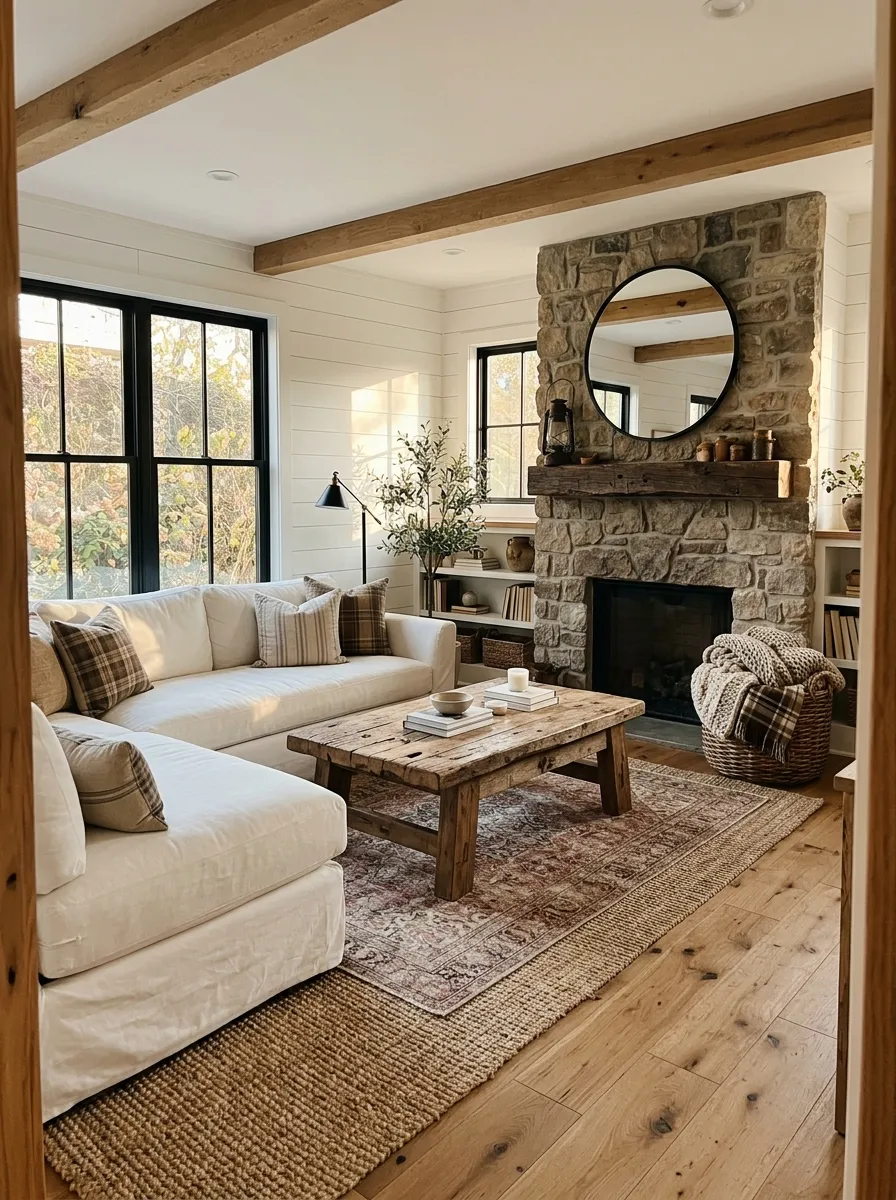
A stone hearth, beam and generous upholstery give the room a practical rural reference. The arrangement gives family seating around the fireplace. The strongest purchase is the main sofa and correctly sized rug, because it establishes scale and handles the most daily use.
Materials and Layout
Two pieces decide this room: the main sofa and a correctly sized rug. Buy them together so the front legs of every seat rest on the rug. Oak, stone, iron and cotton give the farmhouse character in materials that tolerate children, pets and muddy boots.
The plan is built for family seating around the fireplace, with the sofa and chairs facing the hearth rather than a wall. Keep a clear route that protects the doorway, the windows and the path around the coffee table, so nobody has to squeeze between the fire and a knee to reach the other side.
Furnishing the farmhouse room comes to an estimated $2,910–$4,870. The slipcovered sectional takes $1,180–$1,710, and the layered rugs (a jute base under a faded patterned rug) with the plaid cushions and throws take $560–$990; those two lines are about 55% of the upper total. Lighting and hardware, mainly the black task floor lamp and the lantern on the mantel, is set at $370–$680. Storage and small pieces at $500–$870 covers the reclaimed wood coffee table, the baskets and what goes on the open shelving, and $310–$620 pays for the round mirror, the potted olive and the remaining finishing pieces. The beams, stone chimney breast and shiplap are architecture and sit outside this budget. Price the sectional before anything else; a heavy cotton or linen slipcover costs more but outlasts several cheaper ones.
Soft white (#F0EEE8) is on the shiplap walls and the slipcovered sectional, Warm wood (#8A6446) on the ceiling beams, the mantel and the coffee table, and Iron (#343633) on the black window frames, the floor lamp and the round mirror. Historic blue (#506477) is the accent of the palette but barely registers in this image, since the plaid and the patterned rug read brown and plum rather than blue. To bring it in, use it on the knitted throw in the basket or a pair of cushions, not on a wall.
Fireplace seating needs clearance from the heat as well as a view of the flames. Keep upholstery and the throw basket well back from the firebox opening, follow the appliance instructions and local code, and stop the rug short of the hearth so the jute cannot catch a stray ember.
4. Mid Century Modern
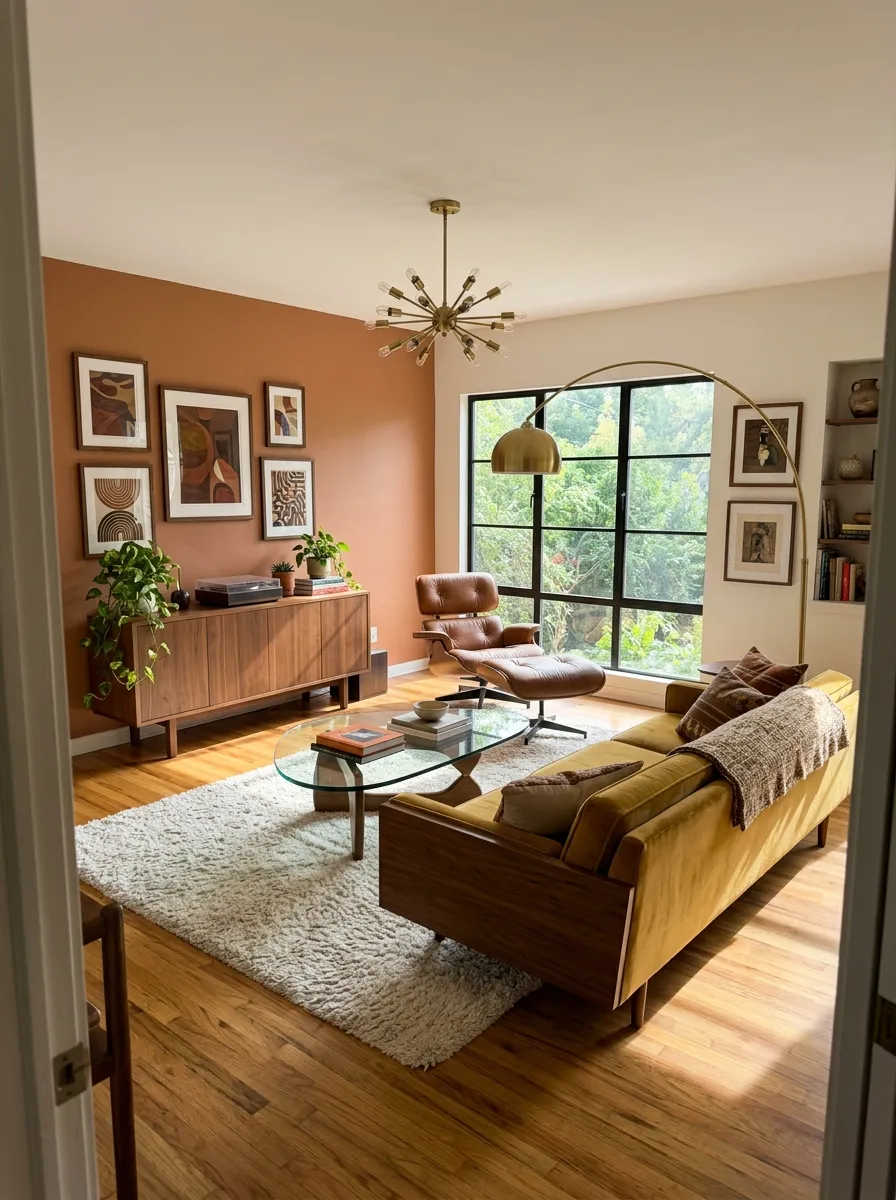
Low walnut furniture and one clay wall keep sight lines open. The arrangement gives flexible seating with visible legs. The strongest purchase is a correctly scaled vintage or reproduction sofa, because it establishes scale and handles the most daily use.
Materials and Layout
Start with a correctly scaled vintage or reproduction sofa. Original mid century pieces often run lower and shallower than modern upholstery, so measure seat height and depth before falling for a frame. Walnut, leather, wool and brass carry the period look, and they age well enough that the room improves with use.
The arrangement favors flexible seating with visible legs, which keeps the floor readable and makes a smaller room feel larger. Chairs can be pulled into a group for guests and pushed back afterward. Keep a clear route that protects the doorway, the windows and the path around the coffee table while you move them.
Only the traditional and loft schemes cost more than this mid century room, budgeted at $3,210–$5,350. The mustard sofa on its walnut plinth accounts for $1,300–$1,880, and the shaggy wool rug with the cushions and throw for $610–$1,090, together about 56% of the upper figure. The brass sputnik chandelier and the arc floor lamp sit in lighting and hardware at $410–$750, a fair allowance for reproductions but not for period originals. Storage and small pieces at $550–$950 covers the walnut credenza and the glass topped coffee table, and $340–$680 is left for the framed prints, the plants and the record player corner. If the leather lounge chair is a licensed design rather than a lookalike, budget it on its own, since its price can approach the whole seating line.
Warm plaster (#E7DED0) is the off white on the window wall and ceiling, which keeps the terracotta accent wall from closing the room in. Light oak (#C49D72) is the honey colored strip floor, Moss (#61705A) arrives through the plants and the garden beyond the glass, and Charcoal (#343735) outlines the steel framed window. The clay wall and the mustard velvet are not in the named palette; they sit on top of it as the two strong colors this style is known for.
Measure the arc lamp before ordering. Its reach decides where the sofa can go, and the heavy base needs a spot where nobody will catch a foot on it; in this plan it stands behind the end of the sofa, clear of the walk to the window. Keep the gallery wall over the credenza tight, with even gaps between frames, so the six prints read as one piece.
5. Coastal
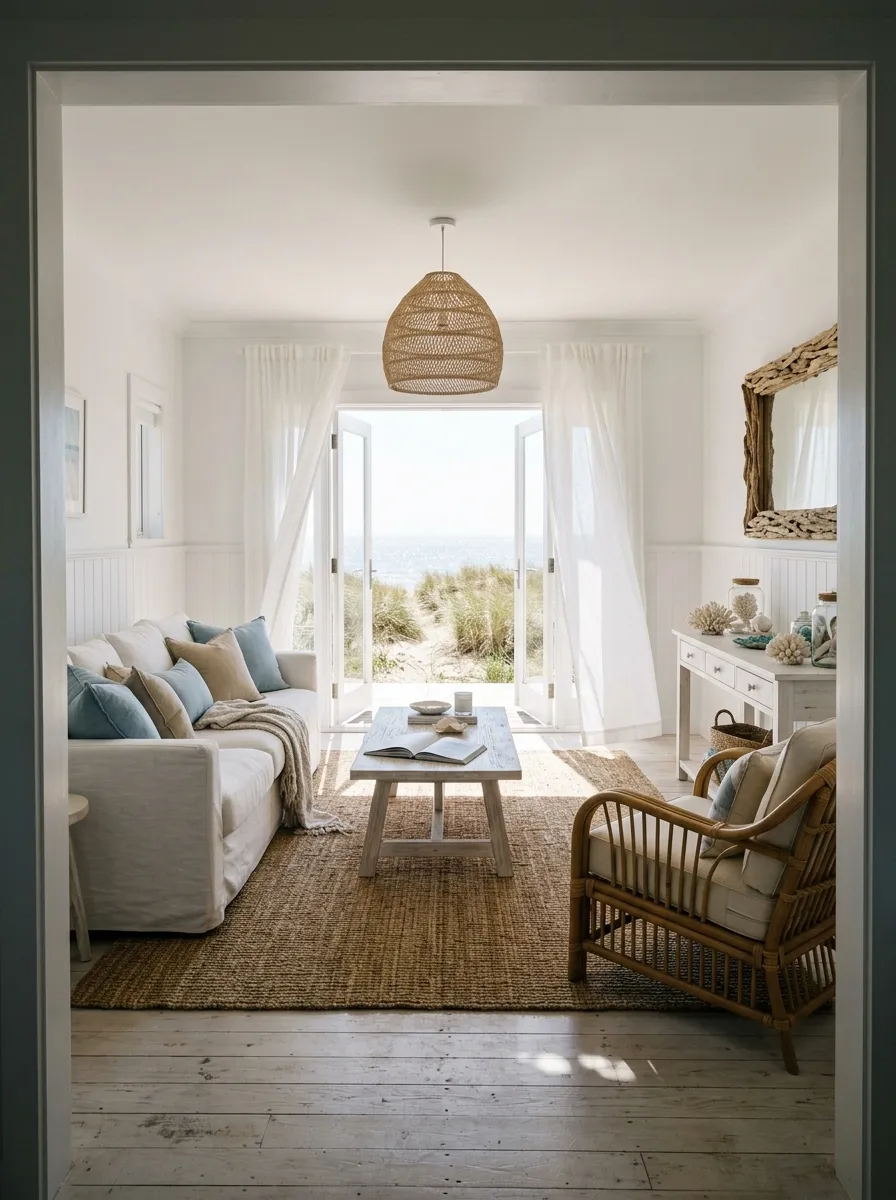
Slipcovered seating and woven texture support a bright room near strong daylight. The arrangement gives washable relaxed seating. The strongest purchase is a washable sofa cover system, because it establishes scale and handles the most daily use.
Materials and Layout
In a coastal room the smartest first purchase is a washable sofa cover system. Sand and sunscreen are part of the brief, and machine washable covers keep a pale sofa usable for years. Linen, jute, pale timber and muted blue carry the look, so the coral and shells on the console can stay a small group on one surface instead of spreading to every shelf.
Plan for washable relaxed seating that people can sit on straight from the beach. Keep a clear route that protects the doorway, the windows and the path around the coffee table; in a room that opens to a deck or porch, that route is also the traffic line for everyone coming in from outside.
We put this coastal room at $2,770–$4,620. The slipcovered sofa is $1,120–$1,620 and the textiles, here the jute rug, the sheer curtains and the blue and sand cushions, are $530–$940, about 55% of the upper estimate between them. The woven pendant and the curtain rods fall under lighting and hardware at $350–$650. The painted console and the whitewashed trestle coffee table belong to storage and small pieces at $470–$820, and the driftwood mirror and the coral pieces to the $290–$590 finishing line. Add a second set of sofa covers to the seating quote at the start, since a spare set is what keeps a white sofa white.
Warm white (#EFECE3) is on everything structural: the beadboard, the trim, the sofa covers and the curtains. Mist blue (#C8D8DA) appears in three of the sofa cushions and, through the open doors, in the sea, which is exactly why it works. Pale oak (#C7A77D) shows in the rattan armchair, the woven pendant and the jute. Soft navy (#354B5E) is the dark painted door frame in the foreground and never enters the room itself, which suits a scheme this light.
Doors that open straight onto the dunes bring sand in on every trip, so the rug nearest them should be a flatweave jute that can be shaken out, and the floor finish should tolerate grit. Sheer curtains on a sea facing wall also fade quickly; buy washable ones and expect to replace them.
6. Japandi
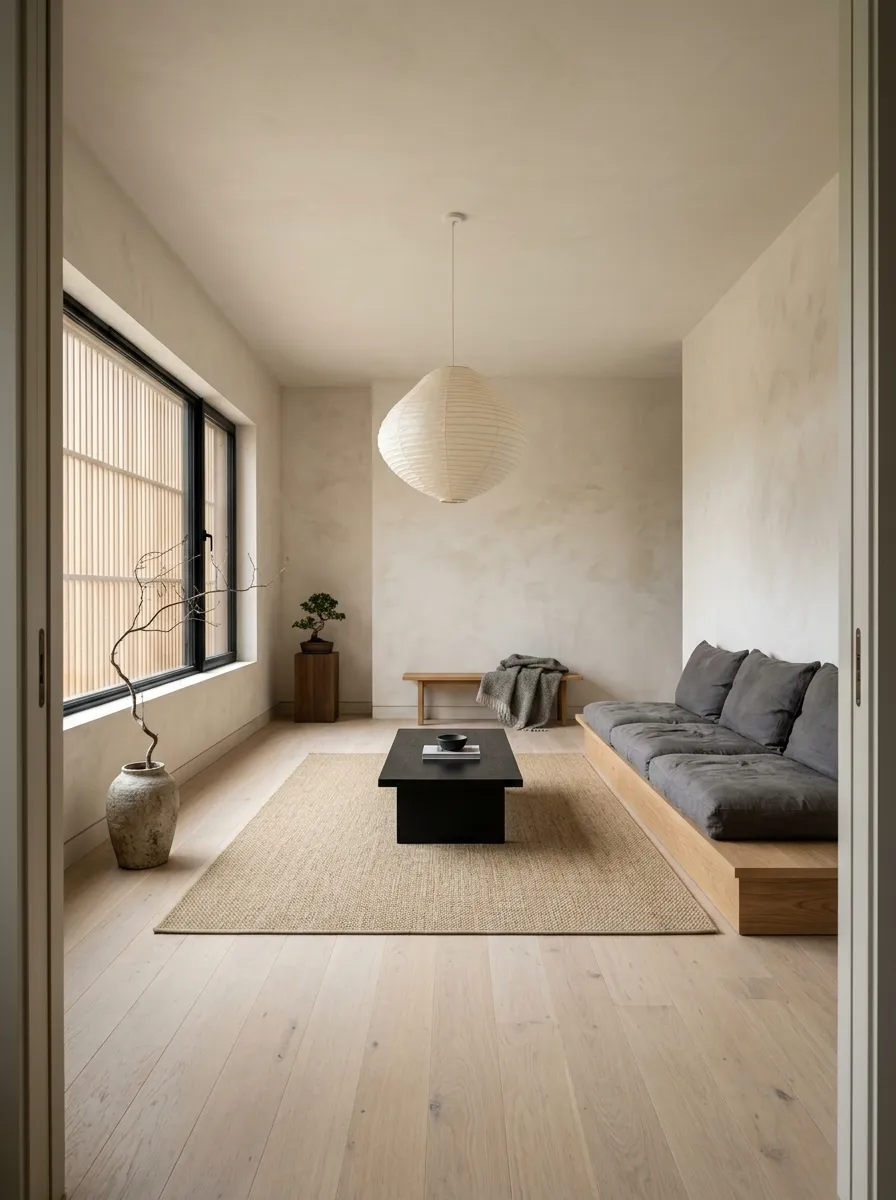
Low furniture, paper light and a narrow palette reduce distraction. The arrangement gives quiet seating with useful empty space. The strongest purchase is a supportive low profile sofa, because it establishes scale and handles the most daily use.
Materials and Layout
Japandi rooms sit low, so the key purchase is a supportive low profile sofa. Low seats that are too soft become hard to rise from, which is why support matters more here than in a standard frame. Oak, paper, wool and charcoal linen carry the calm.
The room is meant for quiet seating with useful empty space, where the open floor is part of the design and not a gap waiting for furniture. A clear route that protects the doorway, the windows and the path around the coffee table keeps that emptiness working as circulation as well as composition.
In 2026 prices, Japandi lands at $2,910–$4,870 in our estimate. In the rendering the seating is a built in oak platform with loose charcoal linen cushions rather than a freestanding sofa; either version draws on the $1,180–$1,710 seating line, while the sisal rug, cushions and throw take $560–$990, about 55% of the high figure together. The paper lantern is the only fixture shown, so the $370–$680 lighting and hardware line leaves room for a low floor lamp or a plug in wall light for evenings. The black coffee table and the small oak bench fall under storage and small pieces at $500–$870, and $310–$620 covers the bonsai on its plinth, the branch in the stoneware jar and similar finishing pieces. If the platform is built by a carpenter, get that quote first, since custom joinery moves more than any catalog price.
Warm plaster (#E7DED0) covers every wall in a soft trowelled finish, and Light oak (#C49D72) carries the floor, the seating platform and the bench. Charcoal (#343735) is concentrated in the cushions, the coffee table and the window frame, while Moss (#61705A) comes only from the bonsai. That small amount of green is enough; more plants would start to crowd the empty floor the room depends on.
Low seating changes the right height for light too. A shade hung at the usual height will glare into the eyes of someone sitting close to the floor, so hang the paper lantern lower than normal and keep any table lamp short. The slatted screen over the window already filters daylight well, so keep it rather than adding curtains.
7. Traditional
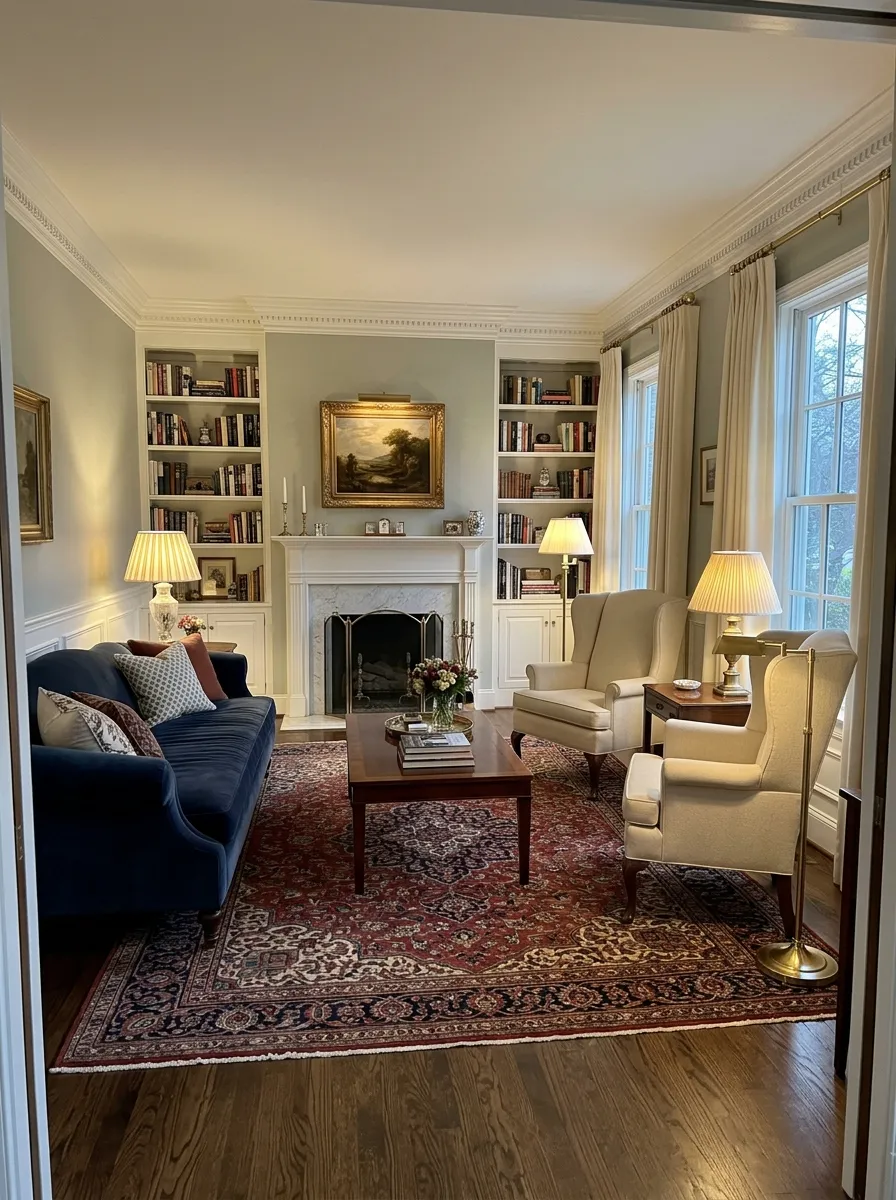
Paired chairs, a central hearth and dark wood create a balanced plan. The arrangement gives formal conversation and reading. The strongest purchase is the main rug that connects every seat, because it establishes scale and handles the most daily use.
Materials and Layout
Here the main rug that connects every seat matters more than any single chair. Traditional rooms gather sofa, armchairs and side tables into one composition, and a rug large enough to hold all of them is what makes it read as a group. Mahogany, wool, linen and aged brass supply the depth and patina the style depends on.
The room is arranged for formal conversation and reading, with a lamp beside each chair and seats that face one another. Keep a clear route that protects the doorway, the windows and the path around the coffee table, since formal layouts tend to fill in with extra side tables over time.
The traditional room is the most expensive of the twelve, with a 2026 budget of $3,500–$5,840. The navy velvet sofa sits at $1,410–$2,050, and the textile line at $670–$1,190 has to cover a large patterned wool rug as well as the cream drapes; those two lines are about 55% of the high end. Three brass lamps and the drapery rods make up lighting and hardware at $450–$820. The mahogany coffee table and side table fall into storage and small pieces at $600–$1,040, and $370–$740 goes to the gilt framed landscape, the mantel pieces and fresh flowers. The two wingback chairs have no line of their own, so price them together with the sofa when the seating quote is requested.
Historic blue (#506477) does the most work here: it is the color of the walls above the panelling and, in a deeper shade, of the velvet sofa. Soft white (#F0EEE8) picks out the crown molding, the bookcases, the marble surround and the two wingbacks. Warm wood (#8A6446) is the mahogany of the tables and the stained floor, and Iron (#343633) shows in the fireplace opening and its screen, a dark note that grounds all the brass.
Each reading chair here has its own lamp at shoulder height, and that is the detail worth copying. Pleated shades over brass bases give a warm, contained pool of light. Plan an outlet near each seat, or a floor outlet under the rug, so cords never stretch across the carpet to the wall.
8. Small City Apartment
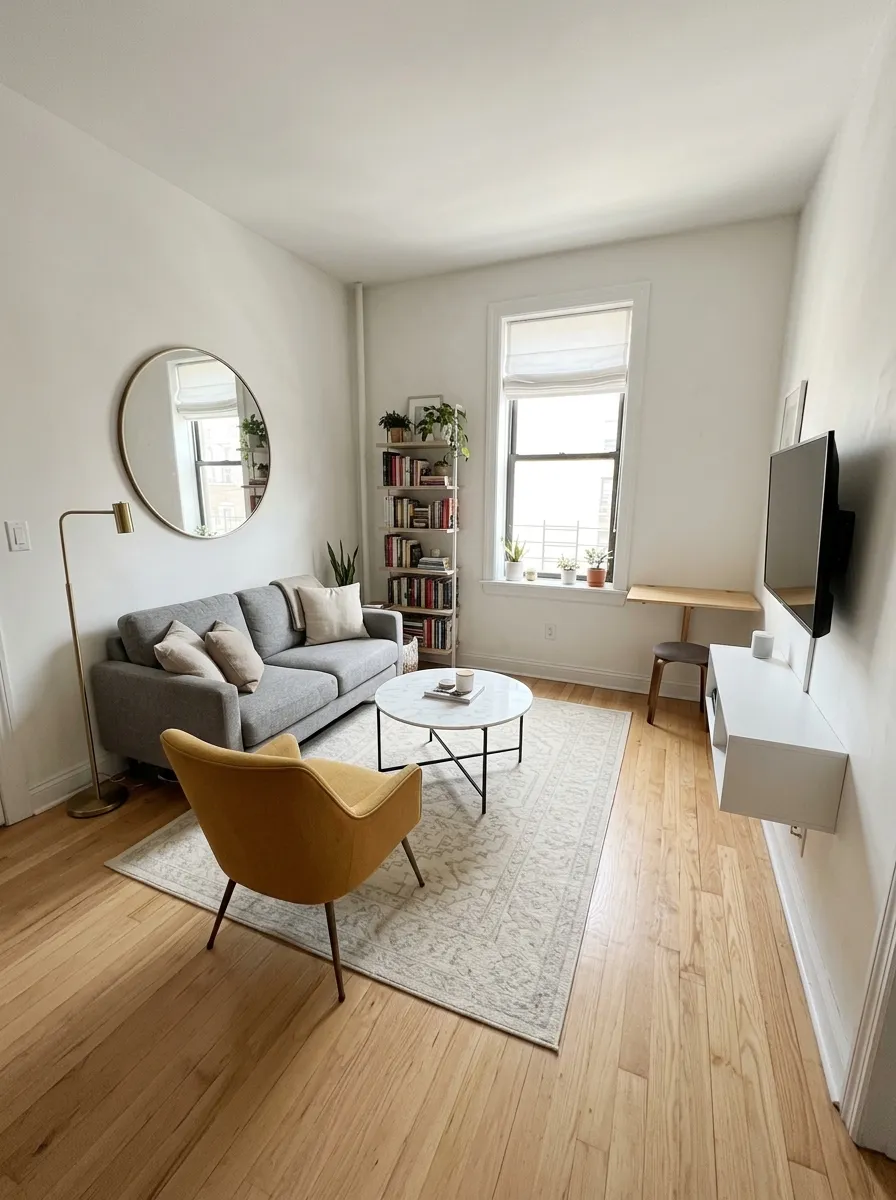
A compact sofa, open leg chair and wall mounted storage protect a tight path. The arrangement gives daily seating without blocking the window. The strongest purchase is a sofa under 84 inches wide, because it establishes scale and handles the most daily use.
This rendering is a useful lesson in floor space. The sofa sits against the long wall, the mustard chair angles in from a corner of the rug, and the television hangs on the opposite wall above a floating cabinet, so the walk from the door to the window keeps the 30 to 36 inches a main route needs. The fold down desk by the window and the slim bookcase use wall height instead of floor area, and the brass floor lamp stands in the corner where it lights the sofa without blocking anything.
Materials and Layout
In a small city apartment the decisive number is the sofa width: keep it under 84 inches. That leaves space for a side table and a walking path in a typical apartment living room, and it still seats three. Light oak, performance fabric, marble and black metal keep the room light and practical, and the round marble top on slim black legs lets the eye pass straight under the table.
The plan supports daily seating without blocking the window, which is often the only source of daylight. Keep a clear route that protects the doorway, the windows and the path around the coffee table; in a compact room a nesting or round table helps keep that path open.
Furnishing the small apartment is estimated at $2,330–$3,890, the lowest total in this guide. The grey sofa takes $940–$1,360 and the rug, cushions and window shade take $450–$790, together about 55% of the high figure. Lighting and hardware at $300–$550 covers the brass floor lamp and the television wall mount. The floating media cabinet, the wall desk with its stool and the narrow bookcase fall under storage and small pieces at $400–$690, and $250–$500 is left for the round mirror, the plants on the sill and other finishing pieces. In a room this size the width of the sofa matters more than its price, so confirm dimensions before comparing quotes.
Warm plaster (#E7DED0) is close to the plain white of the walls, and Light oak (#C49D72) is the honey colored strip floor and the desk top. Moss (#61705A) is limited to the pots on the sill and the bookcase, and Charcoal (#343735) to the television, the coffee table legs and the window sash. The mustard chair and the brass of the lamp and mirror frame are the warm accents laid over that base.
The round mirror on the sofa wall reflects the window back into the room, the cheapest way to add daylight to a one window apartment. Hang it with its center near standing eye level, and check from the sofa that it shows the sky rather than the television.
9. Scandinavian
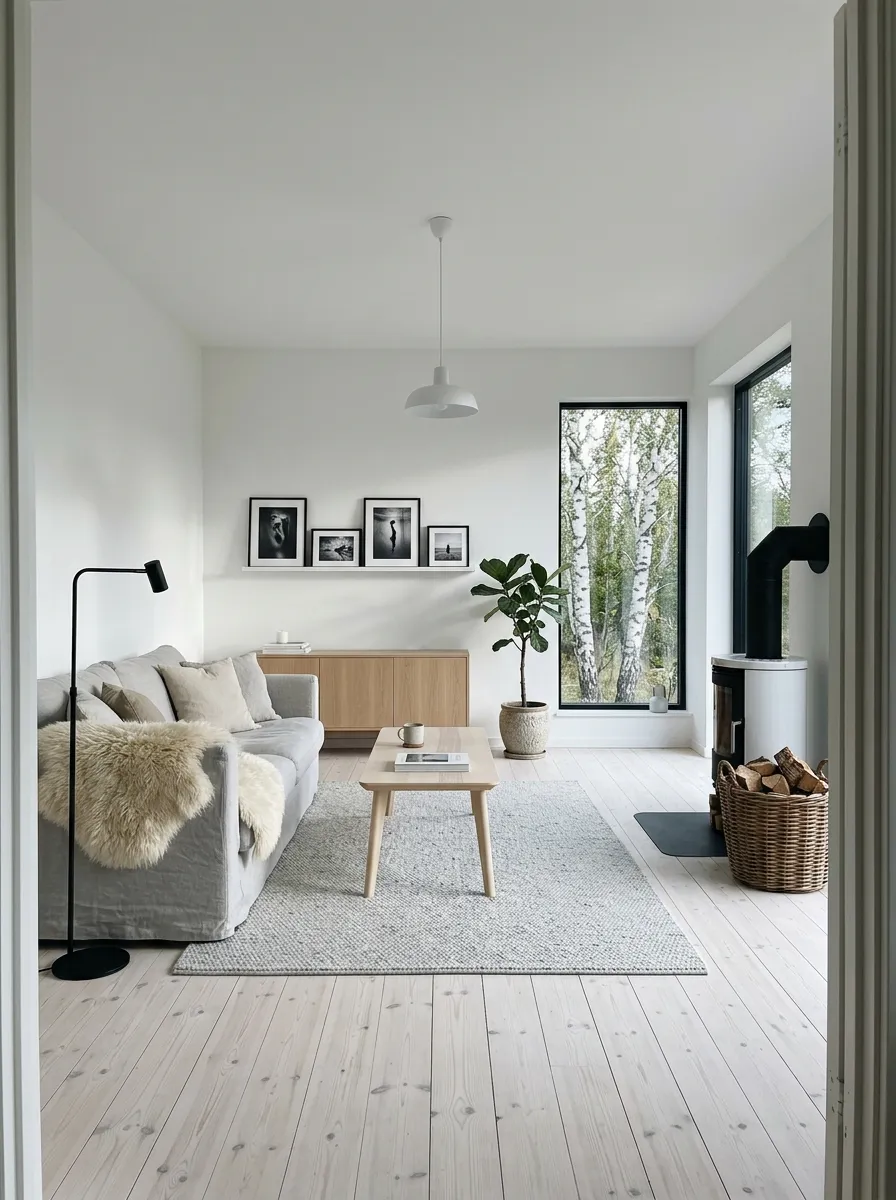
Pale floors, a slipcovered sofa and practical lamps make a bright family room. The arrangement gives comfortable use with little visual weight. The strongest purchase is a compact sofa or sectional with washable covers, because it establishes scale and handles the most daily use.
Materials and Layout
Spend first on a compact sofa or sectional with washable covers. A sectional gives more seats per square foot than a sofa and two chairs, while a straight slipcovered sofa like the one in the rendering suits a narrower room; either way, removable covers suit the pale fabrics a Scandinavian room tends to use. Birch, wool, cotton and white painted wood keep the palette light and easy to refresh.
The goal is comfortable use with little visual weight: raised legs, slim arms and furniture that does not crowd the windows. Keep a clear route that protects the doorway, the windows and the path around the coffee table, and resist adding a second rug or extra pouf that would break up the open floor.
The Scandinavian room is priced at $2,620–$4,380. Seating takes $1,060–$1,530, a range that covers either the slipcovered three seat sofa shown or a compact sectional. The grey wool rug, the sheepskin and the cushions account for $500–$890, and those two lines together are about 55% of the upper total. Lighting and hardware at $330–$610 covers the black floor lamp and the white enamel pendant. The oak sideboard, the picture ledge and the coffee table belong to storage and small pieces at $450–$780, and $280–$560 covers the black and white prints, the fig tree and the log basket. The wood stove is an installed appliance and is not part of these figures.
Warm white (#EFECE3) covers the walls, the ceiling and the body of the stove, and Pale oak (#C7A77D) is the sideboard and coffee table, a shade warmer than the whitewashed pine floor. Mist blue (#C8D8DA) is the nearest palette name for the cool grey of the sofa cover and rug. Soft navy (#354B5E) does not appear; the dark notes in this image are black, in the floor lamp, the stove flue, the window frames and the photographs. Swapping a few of those black accents for navy is the simple way to bring the room in line with the palette.
The wood stove sets the furniture plan. Respect the clearances in the stove instructions for the sofa and the log basket, keep the floor plate in front of it free, and run the main path between the coffee table and the stove rather than squeezing it behind the sofa.
10. Soft Contemporary
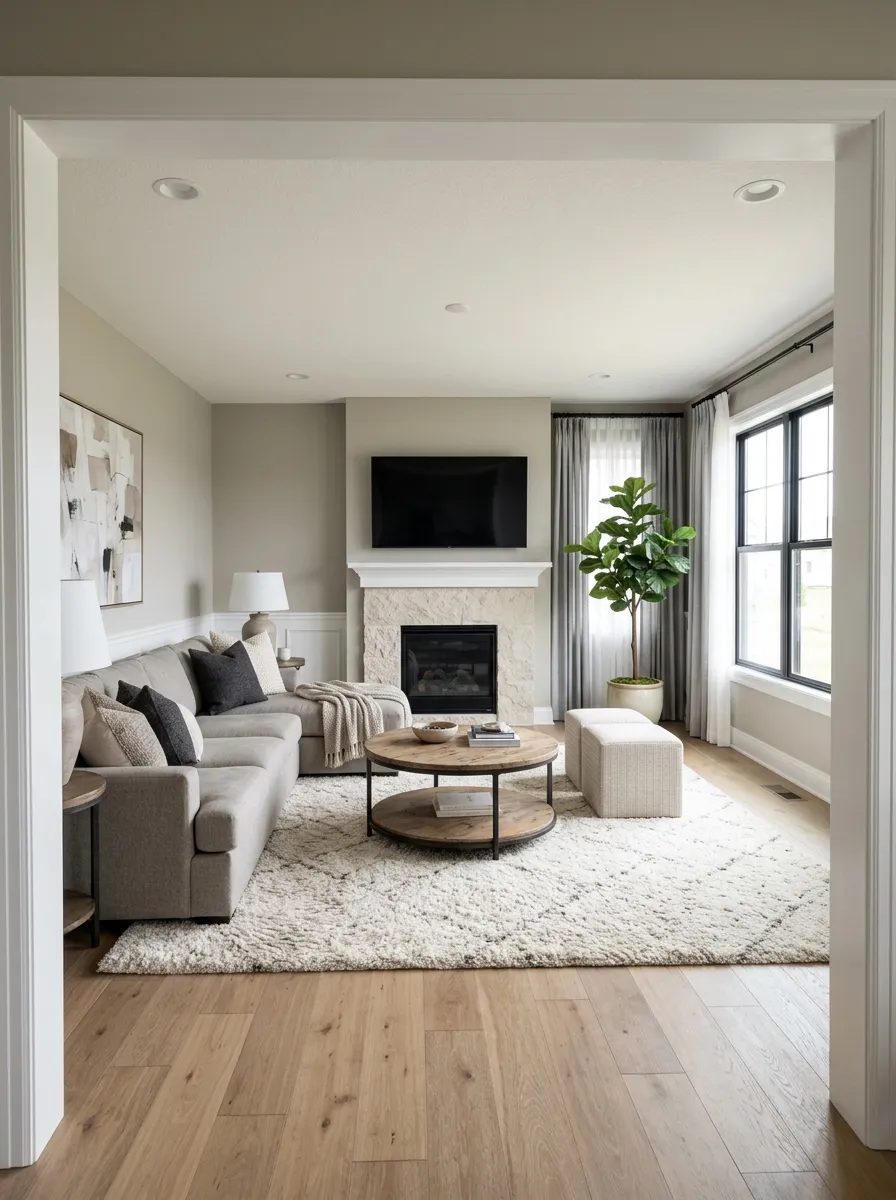
Rounded tables and quiet upholstery update a conventional fireplace room. The arrangement gives flexible family seating. The strongest purchase is a modular sofa sized to the wall, because it establishes scale and handles the most daily use.
Materials and Layout
The anchor purchase is a modular sofa sized to the wall. Modules can be measured to the exact run between a door and a corner, then extended later. Boucle, oak, wool and dark metal give soft contemporary its texture, with the dark metal keeping the softness from turning shapeless.
The room is planned for flexible family seating, with modules that face the screen one evening and break apart for guests the next. Keep a clear route that protects the doorway, the windows and the path around the coffee table, whichever layout the modules are in.
At 2026 prices, soft contemporary is estimated at $3,060–$5,110. The grey sectional is the largest line at $1,240–$1,790, and the shaggy cream rug, cushions and curtains add $590–$1,040, about 55% of the top figure between them. The lamps on the side tables and the curtain rods form the $390–$720 lighting and hardware line. The round two tier coffee table, the pair of upholstered cubes and the side tables fall under storage and small pieces at $520–$910, and $330–$650 is left for the abstract canvas, the fig and the accessories. Modular seating is usually priced per unit, so add up the corner, arm and armless pieces before comparing it with a fixed sectional.
Warm plaster (#E7DED0) is the greige wall color above the white panelling, and Light oak (#C49D72) is the wide plank floor and the top of the round coffee table. Charcoal (#343735) shows up in the cushions, the black window frames and the television, while Moss (#61705A) comes only from the fiddle leaf fig. With the stone fireplace surround in cream, every large surface stays within a narrow warm range.
A television over the fireplace is common in rooms like this, but it sits high for anyone sunk into a deep sectional. Check the mantel height against the seated eye line before mounting, and confirm the fireplace manufacturer allows electronics above it. The two cubes by the window can slide over to the coffee table when more seats are needed, which is the flexibility this plan relies on.
11. Industrial Loft
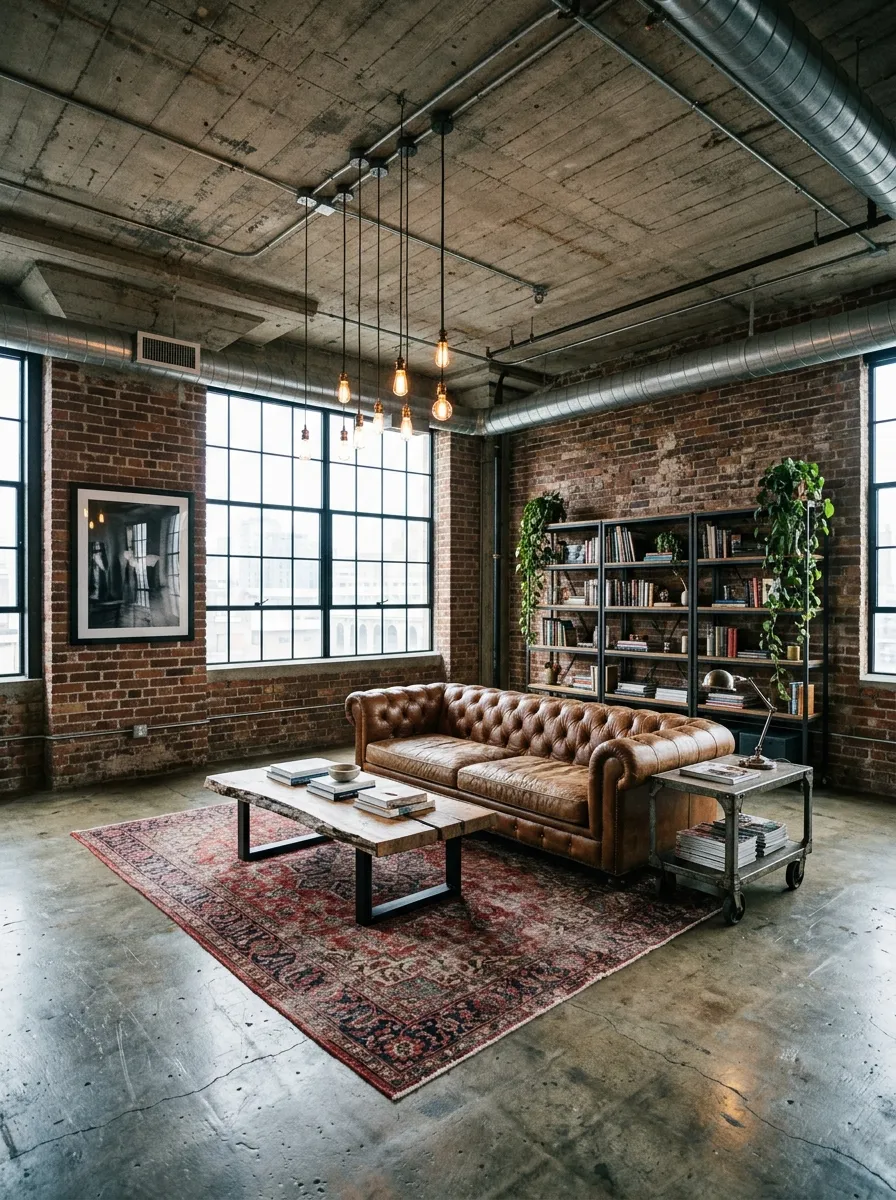
Leather and steel sit against brick and large factory windows. The arrangement gives durable seating in a large open volume. The strongest purchase is a sofa with enough weight for the scale, because it establishes scale and handles the most daily use.
Materials and Layout
A loft needs a sofa with enough weight for the scale. A slim apartment sofa disappears under high ceilings and long walls, so look for a deeper seat, a solid base and arms that hold their own. Leather, black steel, brick and dense wool fit the industrial shell and stand up to hard use.
The layout calls for durable seating in a large open volume, grouped on a rug so the living area reads as a room within the space. Keep a clear route that protects the doorway, the windows and the path around the coffee table, because open plans make it tempting to let furniture drift into the walkway.
Our 2026 estimate for the loft is $3,350–$5,600, mostly because large rooms need larger pieces. The tufted leather Chesterfield takes $1,350–$1,960, and the worn red rug with throws takes $640–$1,140, together about 55% of the upper figure. The cluster of bare bulb pendants and the desk lamp on the cart sit in lighting and hardware at $430–$780. Storage and small pieces at $570–$1,000 covers the steel and wood shelving, the slab coffee table and the metal cart, and $360–$710 goes on the large framed photograph, the plants and the books. Leather quality varies more than almost any other upholstery, so ask whether a quote is for full grain or corrected grain before comparing.
Brick, concrete and steel define this room, so the named palette works differently here. Warm plaster (#E7DED0) has no wall to cover and survives only in the mat around the framed print and the glow of the bulbs. Light oak (#C49D72) is the slab coffee table and the shelf boards, Moss (#61705A) the trailing plants on the shelving, and Charcoal (#343735) the steel window frames, the shelf uprights and the table legs.
Bare concrete and high ceilings make a loft echo. The rug under the seating group is doing acoustic work as well as marking out the living area, so choose a dense one at least as wide as the sofa, and let the full bookcase soak up some of the sound. Exposed bulbs also glare at night; putting the pendants on a dimmer makes evenings far more comfortable.
12. Cottage
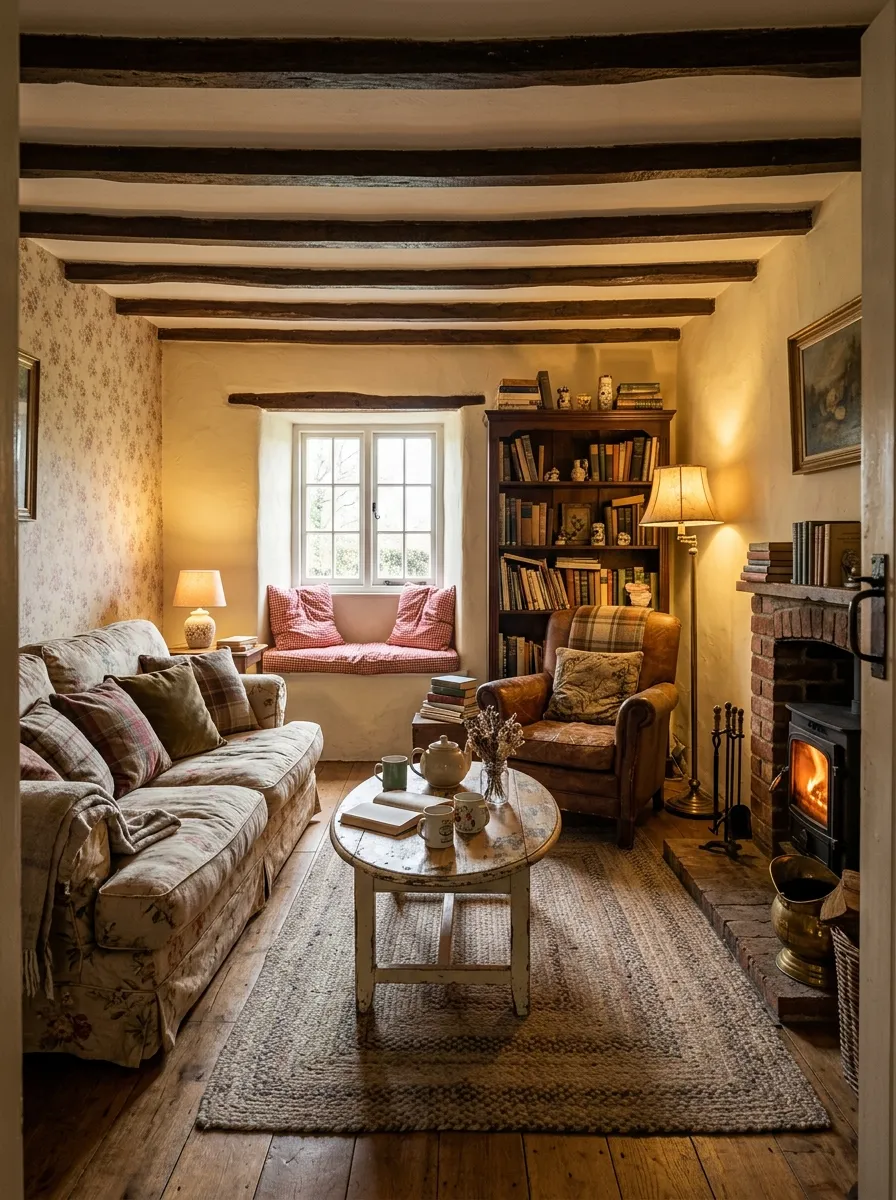
Painted furniture, books and layered small patterns suit a compact room. The arrangement gives reading and everyday conversation. The strongest purchase is a sofa with a washable fitted cover, because it establishes scale and handles the most daily use.
Materials and Layout
Cottage rooms get daily, close use, so the first purchase is a sofa with a washable fitted cover. A fitted cover keeps the tailored line while still coming off for the laundry. Painted pine, cotton, wool and warm brass build the cottage character, and the painted pieces can be touched up rather than replaced.
The room is set up for reading and everyday conversation, with a lamp at each seat and chairs angled toward one another. Keep a clear route that protects the doorway, the windows and the path around the coffee table, which matters even more in older houses where doors and windows sit close together.
This cottage room comes to an estimated 2026 total of $2,620–$4,380. The floral slipcovered sofa is $1,060–$1,530, and the textile line at $500–$890 covers the braided rug, the gingham window seat cushions and the plaid throws, about 55% of the high figure together. Lighting and hardware, here two lamps with fabric shades, is $330–$610. The painted round table, the bookcase and the side table fall under storage and small pieces at $450–$780, and $280–$560 covers the framed oil painting, the brass scuttle and the china on the table. The leather armchair looks like an older piece, and keeping one like it is the easiest saving in this scheme.
Cream (#F1E5D2) is the limewash on the walls and between the dark beams. Dusty rose (#B98278) is spread through the faded florals of the sofa and wallpaper and the red gingham cushions in the window seat, and Sage (#8C9A79) through the green cushion and the plaid. Clay (#A75C45) is the brick around the wood stove, which is why the warm reds in the fabrics feel connected to the hearth.
Pattern makes this room, and too much of it would spoil it. Three patterns share the space, a small floral, a gingham check and a plaid, and they hold together because each is small in scale and they share the same faded reds and greens. Add a fourth only if it repeats one of those colors, and keep the coffee table out of the path from the doorway to the window seat, which in a room this narrow is the only route through.
Lighting, Scale and Daily Maintenance
Use at least three light sources in a full size living room: general light, reading or task light, and a softer accent. Put reading light beside the seat rather than behind it, and check for television glare after sunset.
Choose the rug after the seating layout is fixed. At minimum, front legs should reach the rug. Side tables should remain level and the main walking line should not track directly along a raised rug edge.
Plan for cleaning access. Heavy tables need enough clearance for a vacuum head, washable covers need a realistic laundry method and plants need saucers that protect the floor.
A Purchase Order That Protects the Budget
Before buying for any of these twelve rooms, draw the room to scale and note what stays. Photograph it from each doorway, write down the usable wall lengths and mark outlets, vents, radiators and door swings. That drawing is what stops a sale price on a deep sectional or a wide sideboard from turning into a piece that blocks the route around the coffee table.
Order the seating first, after checking the delivery path, assembly space, return freight and warranty. Lighting and the rug come next, because they decide whether the room works at night and whether the seats read as one group. Small decor waits until the end, when its scale can be judged against everything already in place.
Hold a line in the budget for the unglamorous items: delivery, anchors for hanging planters or a mounted television, felt pads, bulbs, cord covers and wall patching. None of them shows in a rendering. Once the room works, live in it for two weeks before buying more; the gaps that still bother you then are the real ones.
Keep receipts, fabric names, paint codes and care labels together in one folder. Replacing a slipcover or touching up painted furniture is much easier when the exact finish is on record.
Cost Saving Strategies That Keep the Layout Intact
Keep the sound sofa and change its surroundings first. A larger rug, correctly placed lamps and edited art can alter the room without replacing every seat.
Buy pairs only when the layout needs symmetry. Two unmatched side tables at compatible heights can serve different seats and cost less than a complete furniture suite.
Use paint for a large field of color and reserve costly material for touch points. A wood table, wool pillow or metal lamp can carry texture without adding fragile objects to every surface.
Questions Readers Ask
How much should living room decor cost?
A focused refresh can start near $1,500, while a room with a new sofa, chairs, rug, lighting and storage often falls between $3,000 and $9,000 before delivery.
What should be bought first for a living room?
Fix the layout, then buy the main seating and correctly sized rug. Lighting, tables, window treatment and art follow.
How far should a coffee table sit from a sofa?
About 16 to 18 inches works for many sofas, but test reach and knee room for the people using it.
How many lamps does a living room need?
Most rooms need more than one. Combine general light with at least one reading light and a softer accent source.
Should living room furniture match?
No. Match scale, wood temperature or repeated color rather than buying a complete suite.
How can a small living room feel less crowded?
Use fewer full function pieces, preserve the main route and select furniture with visible legs where storage is not needed.
What rug size works in a living room?
An 8 by 10 foot rug is a common start for a medium living room. Larger seating groups often need 9 by 12 feet.
Sources and Pricing Notes
Every living room figure above is a 2026 planning allowance in US dollars, built from current retail prices for the furniture, rugs, lighting and finishes each of the twelve renderings shows. Expect to add sales tax, delivery, permits and any unusual site conditions on top, unless a room section says otherwise.
- U.S. Bureau of Labor Statistics: Consumer Price Index notes for household furnishings.
- The Home Depot: project calculators and current material categories.
- IKEA US: current furniture and storage categories.
Keep Planning
rug size guide, interior design styles, living room design study.
Styling & Living Desk
The Layered Homes editorial teamThe Styling & Living Desk produces the room-by-room guides, outdoor and garden pieces, celebration ideas and design solutions, each with an itemised cost estimate, and the Home Files essays.
More from the Styling & Living Desk →
Reader notes