


In the weeks before a big birthday, engagement dinner, or holiday gathering, most hosts land on some version of the same question: how do we make this feel memorable without it reading like a corporate event? The answer, for a dinner in Mount Pleasant, Daniel Island, or Sullivan's Island as much as for a standing-room-only housewarming in downtown Charleston, is that memorable parties engage all the senses, not just the eye. Visual ambiance matters, but smell is the sense that anchors a memory, sound is the sense that sets a mood, and touch is the sense that makes a guest actually sit down and stay. This guide walks through ten zones we would specify in a real event plan for a serious home hosted party: each with the materials, brands, and fixtures we would source, a Charleston 2026 cost range based on typical local estimates, and the detail we would call out so the zone lands rather than looks good only in photos.
Table of Contents
- The Fragrant Welcome: Entryway
- The Jewel-Toned Bar: Cocktail Station
- The Grand Dining Experience: Seated Dinner
- The Audiophile's Lounge: Vinyl Listening Corner
- The Al Fresco Evening: Patio at Dusk
- The Sophisticated Gallery: Transition Space
- The Quiet Retreat: Reading Nook
- The Jewel Box Powder Room
- The Party Pulse: DJ & Dance Zone
- The Chill Zone: Floor Seating Lounge
- Pro Tips for Every Host
- Where to Cut Without the Party Knowing
- Regional Fit Across Five Southeast Markets
- Frequently Asked Questions
- Sources & References
- Commit to Fewer Zones, Fully
1. The Fragrant Welcome: Entryway
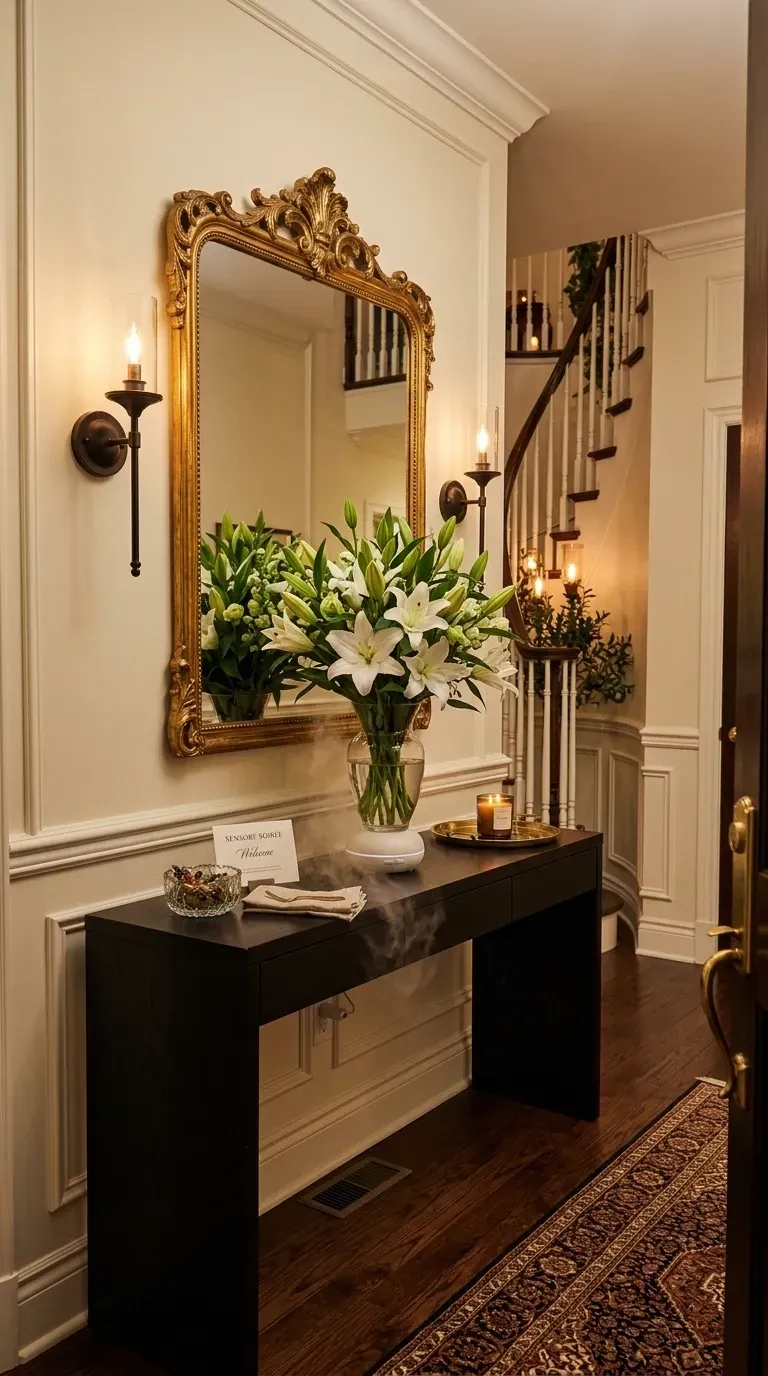
The first fifteen seconds of a party happen in the entryway, and scent sets the tone in that window faster than anything guests see. For an engagement dinner where the aim is for guests to smell the house before they take in the room, layer an ultrasonic Aera diffuser loaded with Ivory Gardenia (the plug-in Aera Mini runs roughly $120 and holds scent for 400 hours) with a lit Cire Trudon Cyrnos or Diptyque Feu de Bois pillar on a small brass tray. The ornate gold mirror above the console earns its place by extending the sight line: it doubles the perceived depth of a narrow hall and throws the sconce light back toward the stair. Fresh-cut white Casa Blanca lilies from a local florist carry visual weight and a second note of scent. The rendering shows slim dark candle-style sconces; for a brass version we would specify the Visual Comfort Bryant or Rejuvenation Puget in hand-rubbed antique brass, with 2700K bulbs on dimmers pre-set to 40% for the arrival window.
The furniture is simple and dark. A console in walnut or rift-sawn oak, the Pottery Barn Chelsea or a local Charleston build, sits under an ornate gold mirror of 24 by 36 inches, either leaning or wall-mounted (RH Antiquité or Anthropologie Gleaming Primrose). A patterned wool or flatweave runner from Annie Selke Dash & Albert or Jaipur Living leads guests in.
Everything listed for the entryway comes to $1,555–$2,970 in 2026 dollars, and almost half of the high figure (about 47%) sits in two pieces: the 60" dark wood console, a Pottery Barn Chelsea or a local build, at $380–$780, and the 2 Bryant or Puget wall sconces at $320–$620. The console also has the widest spread, because a maker's quote can land well above or below the catalog piece, so it is the one to price in writing first.
The mirror is next at $280–$520 for a 24" x 36" ornate gold frame from RH Antiquité or Anthropologie Primrose. Scent and flowers cost less than most hosts expect: $120–$220 for a lily arrangement delivered on the day, $140–$200 for an Aera Mini with a single fragrance capsule, and $90–$140 for the Cire Trudon or Diptyque pillar. A brass tray from Williams Sonoma Home or Pottery Barn adds $45–$110, and a 2.5 x 8 ft patterned wool runner like the one leading to the stair $180–$380.
Choose one signature scent and commit to it for the whole event. Scent the entryway, then let the same fragrance family (not the same candle) carry through to the powder room and the dining table florals. The lilies need timing: cut them 48 hours before the event so the stamens open just as guests arrive, and remove the anthers so pollen does not stain anyone's clothes. Pre-dim the sconces to 40% at call time, since full brightness reads as an office lobby rather than a soirée.
2. The Jewel-Toned Bar: Cocktail Station
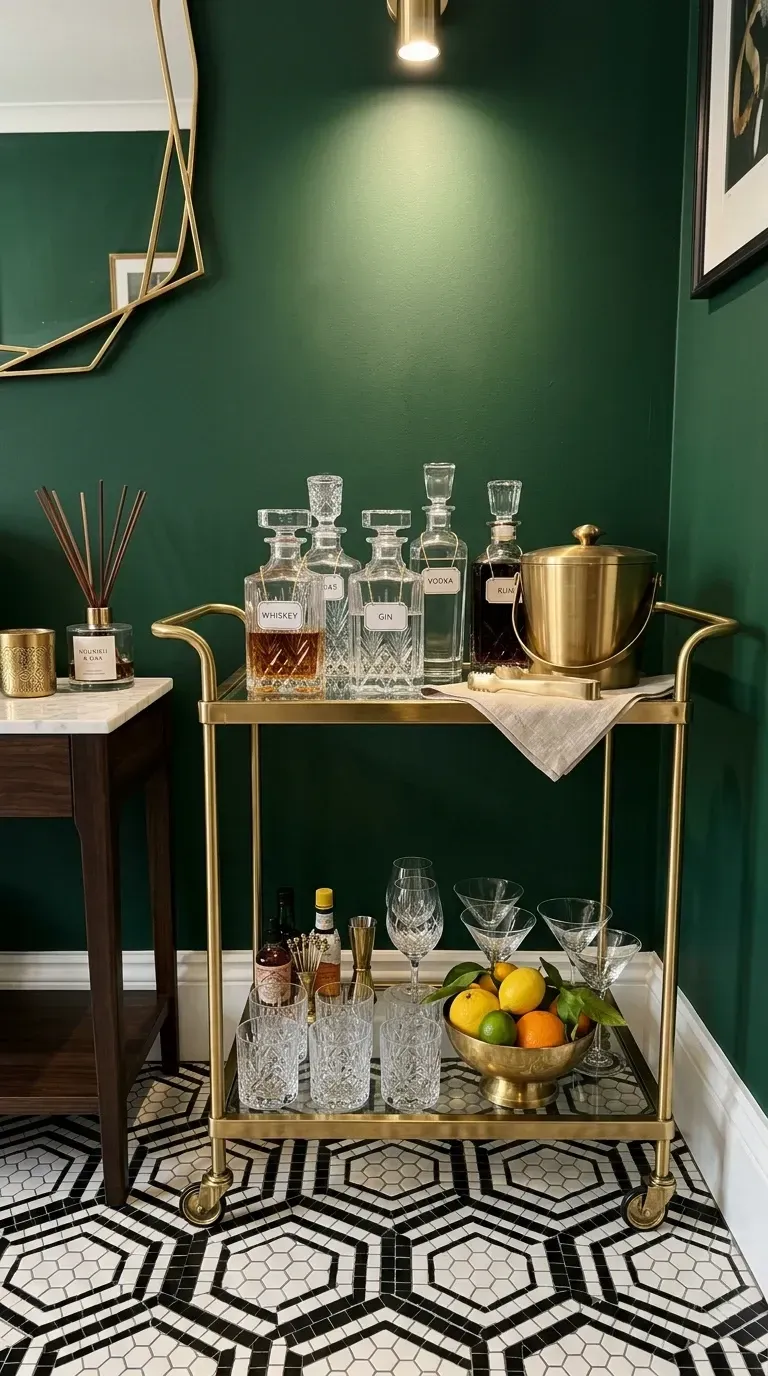
A bar station has two jobs: it has to look spectacular from across the room and keep moving when five people arrive at once. The emerald accent wall (Benjamin Moore Essex Green HC-188 or Farrow & Ball Studio Green No. 93) is the backdrop that makes the brass register, in person and on a phone camera. For the cart we would specify the Williams Sonoma Home Terrace in brass, or the CB2 Gwyneth for a sharper silhouette. The decanters are Richard Brendon Cut Crystal or Waterford Lismore with silver neck tags, bought ready-made from Crate & Barrel or hand-engraved. For glassware, 12 Nude Savage coupes for cocktails and 8 Schott Zwiesel Pure rocks glasses cover a normal evening's flow. A reed diffuser (Diptyque Figuier or Nest Moroccan Amber) set on the top tier adds a quiet scent that stays out of the way of the cocktail aromatics, and the bowl of lemons, limes and oranges on the lower shelf, in a Heath Ceramics coupe or a brass bowl, works as garnish supply and as color.
An accent wall in Benjamin Moore Essex Green HC-188 or Farrow & Ball Studio Green No. 93 gives the bar its jewel tone. In front of it, a two-tier gold bar cart, the Williams Sonoma Home Terrace or the CB2 Gwyneth, holds a set of 5 decanters in Richard Brendon Cut Crystal or Waterford Lismore, each with an engraved tag, plus a gold or brass ice bucket and tongs from West Elm (Cross Base) or Williams Sonoma.
Glassware is a mixed set of 20: Nude Savage coupes with Schott Zwiesel Pure rocks glasses. A Diptyque Figuier or Nest Moroccan Amber reed diffuser adds a background scent, and the floor is geometric marble or encaustic tile, Clé Tile Cement Dot or Ann Sacks Hex.
The bar comes to $1,295–$2,750 in 2026 dollars, and the glass on top of the cart is where most of it goes. The set of 5 Richard Brendon or Waterford Lismore decanters runs $380–$820 and the Williams Sonoma Terrace or CB2 Gwyneth gold bar cart $320–$680, roughly 55% of the top figure between them. The decanters swing the most, since cut crystal is priced piece by piece, so settle how many you really need before ordering anything else.
Around them the smaller pieces add up quickly: $240–$480 for 20 pieces of mixed Nude and Schott Zwiesel glassware, $80–$180 for a gold ice bucket and tongs from West Elm or Williams Sonoma, $60–$120 for 5 engraved silver tags from Crate & Barrel or a custom engraver, and $60–$140 for the citrus vessel. The green wall itself costs $90–$220 for 2 coats of Essex Green or Studio Green with supplies, and the Diptyque or Nest reed diffuser $65–$110.
Pre-batch one signature cocktail in the largest decanter. Guests who would otherwise stand around waiting for a bartender will pour themselves a drink in seconds, and the visible, pre-labeled decanter explains itself. The citrus display should stay to three colors at most (lemons, limes, blood oranges); a full rainbow bowl reads as a cafeteria, not a soirée. Place the cart so guests can pour from three sides, because a cart pushed against a wall creates a bottleneck at the second drink.
3. The Grand Dining Experience: Seated Dinner
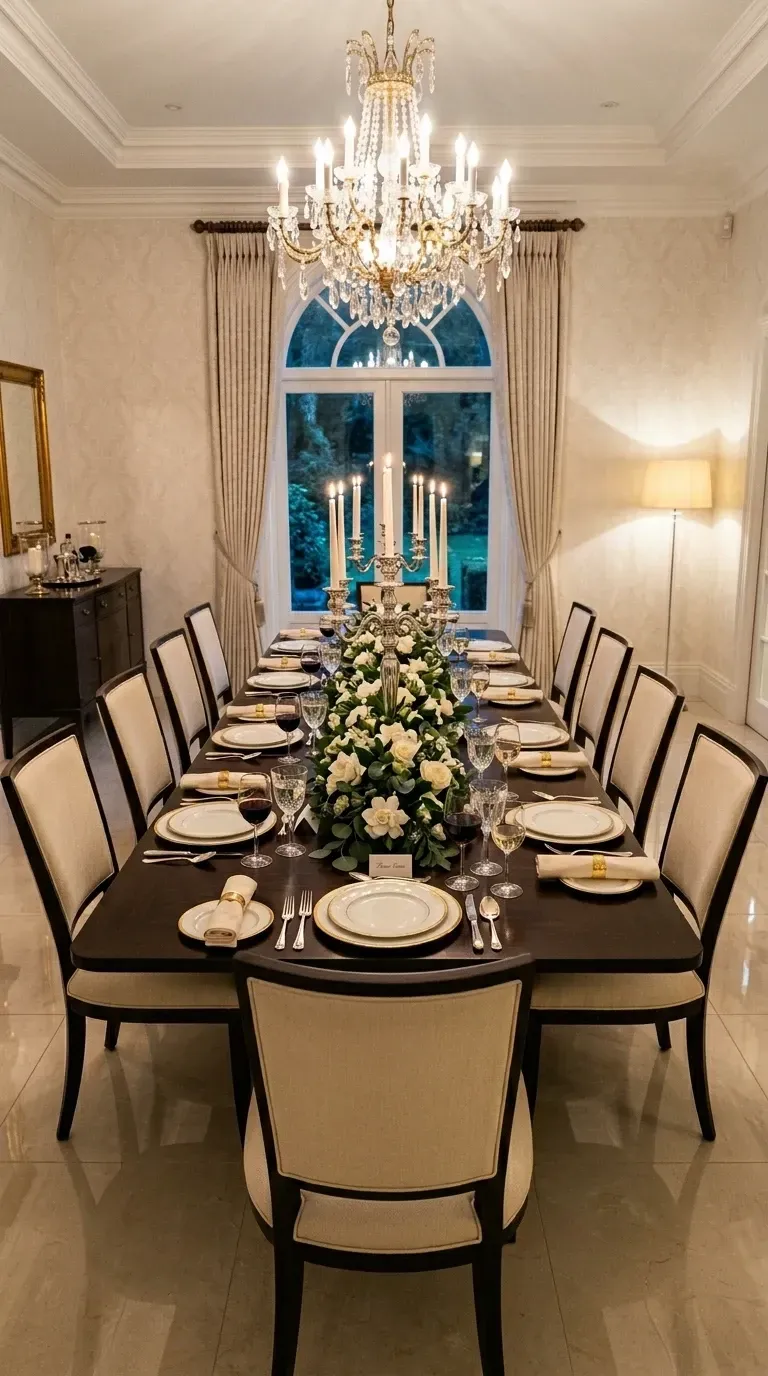
A seated dinner is the most expensive zone to specify properly, and the one where cutting corners shows fastest. The crystal chandelier (Visual Comfort Camille, Schonbek Heritage, or the more approachable Pottery Barn Clarissa) should hang 32–36 inches above the tabletop on a dimmer pre-set to 25% during service, because it is ambient decoration here rather than the working light. Paired tall silver candelabras (Michael Aram Olive Branch or the Williams Sonoma Home Adrien) holding 12-inch unscented beeswax tapers from Honey Candles carry the actual dinner light; paraffin blends tend to smoke within 20 minutes. Down the center, a low floral and greenery runner made by a local florist as a same-day install alternates white blooms with eucalyptus or olive branches, kept to a maximum of 8 inches tall and typically 8 feet long for a 96-inch table. Gold-rimmed chargers (Mode Living Athena or Deborah Rhodes Beaded) sit under the plates, and the cream upholstered chairs we would specify are Bernhardt Interiors frames covered in a Crypton Home or Romo Linara performance linen that shrugs off spills.
Each place gets a gold-rimmed charger (Mode Living Athena or Deborah Rhodes Beaded) within a complete dinnerware and glassware service for 12 from Heath Ceramics or Juliska. The chairs are upholstered Bernhardt Interiors pieces in a Crypton Home performance linen, and floor-to-ceiling Belgian linen drapes from The Shade Store soften the room's edges.
The seated dinner carries an itemized 2026 allowance of $8,345–$17,760, the largest in this guide outside the DJ rig. Seating and the table account for about 56% of the high end: 12 Bernhardt upholstered chairs in performance linen at $3,200–$6,400 and a 96" dark wood table, custom or RH Salvaged Wood, at $1,800–$3,600. The chairs have the widest range, so they are the first number to pin down with a written quote, and for a once-a-year dinner they may not need buying at all (see the rental notes further down).
Light is the next layer. The Visual Comfort Camille or Schonbek Heritage chandelier is budgeted at $1,200–$3,200, 2 silver candelabras from Michael Aram or Williams Sonoma (the Adrien) at $340–$680, and 2 dozen 12" unscented beeswax tapers from Honey Candles at $85–$160. The 8 ft floral and greenery runner, installed the same day, is $380–$780. On the table, 12 gold-rimmed chargers from Mode Living or Deborah Rhodes take $180–$340 and a full Heath Ceramics or Juliska service for 12 $680–$1,400, while floor-to-ceiling linen drapes with rod and installation, like the pair framing the arched window, add $480–$1,200.
Keep centerpieces low: 8 inches of bloom height is the cap, so guests can see each other across the table. Choose beeswax tapers over paraffin every time, since paraffin smokes and drips and its scent fights the food. Before service, dim the chandelier to 25% and let the candles light the plates; that single change moves a dining room from corporate to cinematic. Music should be instrumental and at conversation volume, 60–65 dB measured at table height, with no vocal tracks competing with the talk.
4. The Audiophile's Lounge: Vinyl Listening Corner
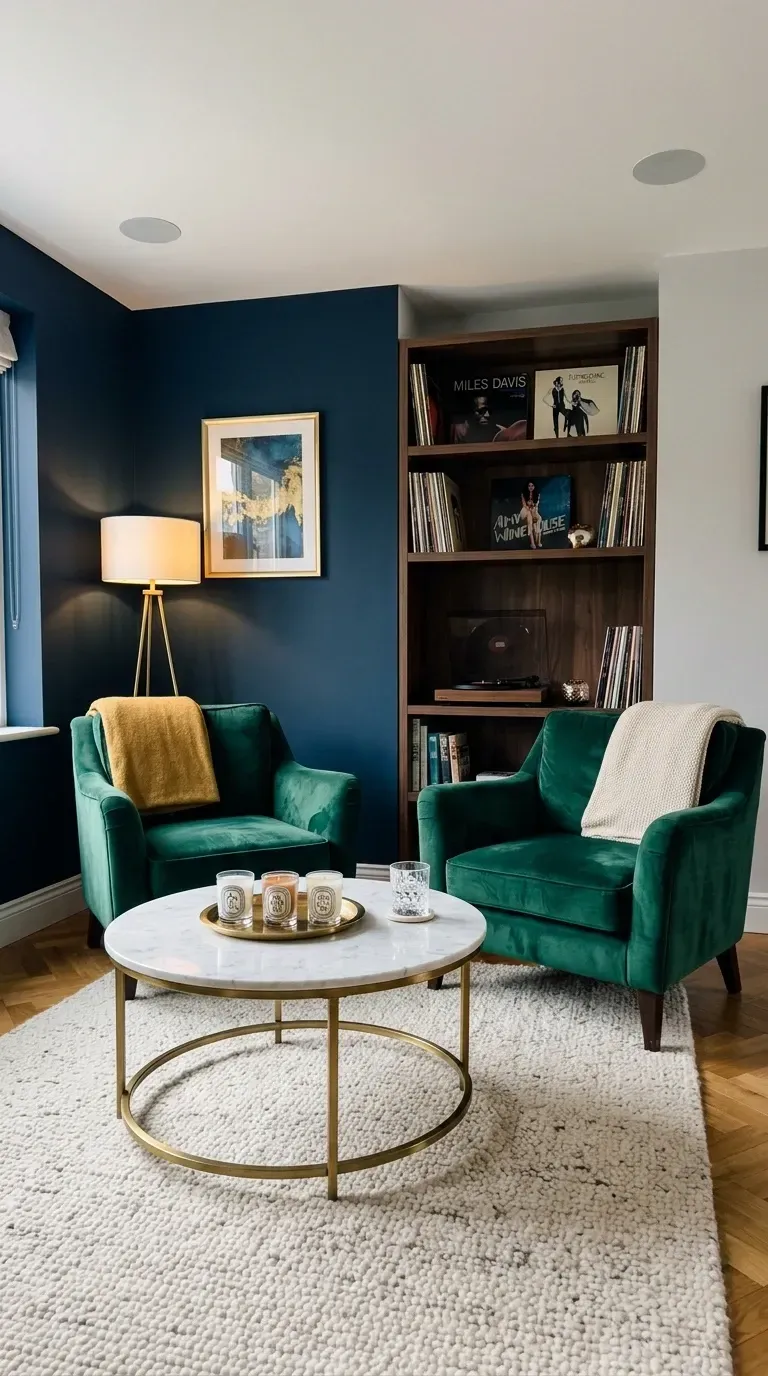
Most hosts who take music seriously end up wanting a dedicated listening corner: a spot where three or four guests can sit, hear each other, and treat the records as more than background. Here two emerald velvet armchairs (Article Sven in Forest Green or RH Modena in Perennials Performance Velvet) sit at a slight angle to each other rather than squared off, which keeps them turned toward conversation, and a round marble-and-brass coffee table (CB2 Odyssey or RH Travertine Drum) holds the drinks tray between them. The rendering parks the turntable on a middle shelf of the bookcase; for a party we would bring a Pro-Ject Debut Carbon EVO with an Ortofon 2M Red cartridge down to the coffee table, paired with KEF LSX II wireless speakers or Klipsch The Sevens for a warmer sound. The tall bookshelf (IKEA Billy with Semihandmade fronts, or RH Churchill) holds 80–120 records rotated by event theme. The wall behind is Farrow & Ball Hague Blue No. 30 or Benjamin Moore Hale Navy HC-154, and a tripod floor lamp (RH Riveted Metal or West Elm Industrial) on a dimmer at 2700K lights the corner.
Seating is a pair of velvet armchairs in emerald or forest green, from Article (the Sven) or RH (the Modena), around a round marble and brass coffee table, the CB2 Odyssey or RH Travertine Drum. A textured wool rug from Loloi (Ingrid) or Armadillo (Malawi) sits underneath, and the wall behind takes Farrow & Ball Hague Blue No. 30 or Benjamin Moore Hale Navy HC-154.
The music setup is compact. A Pro-Ject Debut Carbon EVO turntable with an Ortofon 2M Red cartridge plays through KEF LSX II wireless bookshelf speakers or Klipsch The Sevens powered speakers, and a tall bookshelf holds a selection of vinyl, either IKEA Billy with Semihandmade fronts or the RH Churchill. A tripod floor lamp on a dimmer with a 2700K bulb (RH Riveted Metal or West Elm Industrial) lights the corner.
The listening corner totals $3,660–$8,140. About 52% of the upper figure goes to the things guests sit in and listen to: 2 velvet armchairs, from the Article Sven up to the RH Modena, at $980–$2,400, and a pair of KEF LSX II or Klipsch The Sevens powered speakers at $800–$1,800. The chairs carry the wider spread, so choose the fabric and tier before the smaller pieces are ordered.
The turntable is a narrow line, $580–$780 for the Pro-Ject Debut Carbon EVO with its Ortofon cartridge, because the model is fixed. Furniture spreads wider: $320–$680 for the marble and brass coffee table, $380–$1,100 for shelving that runs from IKEA Billy with Semihandmade fronts to the RH Churchill, and $180–$420 for a tripod floor lamp with a dimmer. A textured Loloi Ingrid or Armadillo Malawi wool rug adds $340–$780, and the Hague Blue or Hale Navy wall with supplies about $80–$180.
Angle the chairs 20–25 degrees toward each other rather than squaring them off, because conversation happens in that angle. The turntable belongs at coffee-table height so guests can flip a record without ceremony; waist-high turntables on shelves look good and never get used during parties. Keep the records visible and loosely sorted by mood rather than alphabetically, since guests at an event browse by mood, not artist. The speakers should sit at seated ear height, toed in toward the conversation point.
5. The Al Fresco Evening: Patio at Dusk
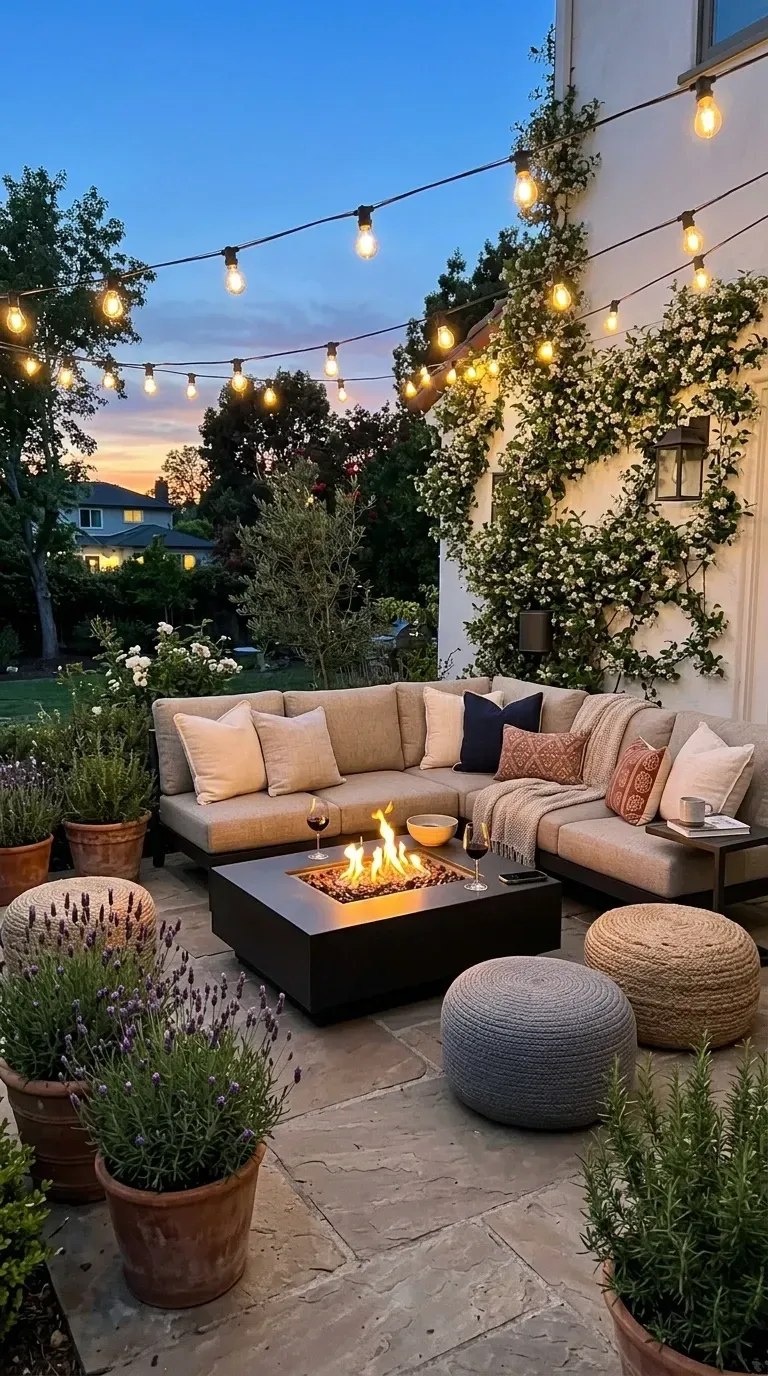
A Charleston patio between 6:30 and 10 pm in late spring or early fall already does most of the work, and the common mistake is to over-engineer it. For the sectional we would specify the RH Sonoma in teak or the Loll Designs Nisswa in recycled poly, both of which tolerate humidity and salt air on a James Island or Sullivan's Island lot. The fire feature anchors the sound as much as the light. The rendering shows a low rectangular fire table, which is the Brown Jordan Fires Parallel end of the budget, while a Solo Stove Yukon propane setup covers the lower end; either gives the soft hiss and moving flame that hold a group outdoors. The bistro string lights are Hometown Evolution or Brightech Ambience Pro with warm 2200K filament bulbs, never the cool-white contractor strings that flatten a dusk sky. Confederate jasmine on a hidden trellis (well suited to zone 8b) brings the evening scent, and three terracotta planters of English lavender from Campo de' Fiori or Terrain add a second fragrance and color for the bees.
The seating is an outdoor sectional set in teak or recycled poly, the RH Sonoma or the Loll Designs Nisswa, gathered around a Solo Stove Yukon propane fire pit or a Brown Jordan Fires Parallel rectangular fire table. Jute poufs from Serena & Lily or Lulu and Georgia add flexible seats, and outdoor throw pillows in Sunbrella performance fabric plus lightweight wool blankets cover the cooler Charleston shoulder seasons.
Overhead, bistro string lights with warm 2200K filament bulbs (Hometown Evolution or Brightech Ambience Pro) set the glow. Fragrance comes from Confederate jasmine climbing a hidden trellis, a plant ideally suited to zone 8b, and from 3 terracotta planters of English lavender from Campo de' Fiori or Terrain.
The patio's total allowance is $4,100–$9,560, and it is the most top-heavy zone in the article: about 77% of the high figure is the RH Sonoma or Loll Designs Nisswa sectional set at $2,400–$5,200 and the propane fire feature, Solo Stove Yukon to Brown Jordan Fires, at $680–$2,200. The sectional's spread decides the final number, so choose between teak and recycled poly before anything else.
Everything that makes the patio feel finished is cheap by comparison. A 50 ft run of bistro lights with 2200K filament bulbs costs $80–$180, the jasmine with its hidden trellis $140–$280, 3 live lavender planters in terracotta $160–$320 and 2 jute poufs $180–$380. Sunbrella throw pillows run $220–$480, and 4 lightweight wool blankets for the cooler shoulder-season evenings $240–$520.
Hang the string lights high enough to clear heads, at 8 feet minimum, and let them drape in a visible sag so they read as festive; tight, taut lines look like tent poles. Have the fire pit ready before anyone arrives, with the tank attached and tested, because nothing spoils a dusk arrival faster than a host crouched over a propane coupling while the first guests walk in. Keep the blanket basket visible and clearly on offer. Charleston spring dusk drops 12–15 degrees between 7 and 9 pm, and guests will stay twice as long with a throw in reach.
6. The Sophisticated Gallery: Transition Space
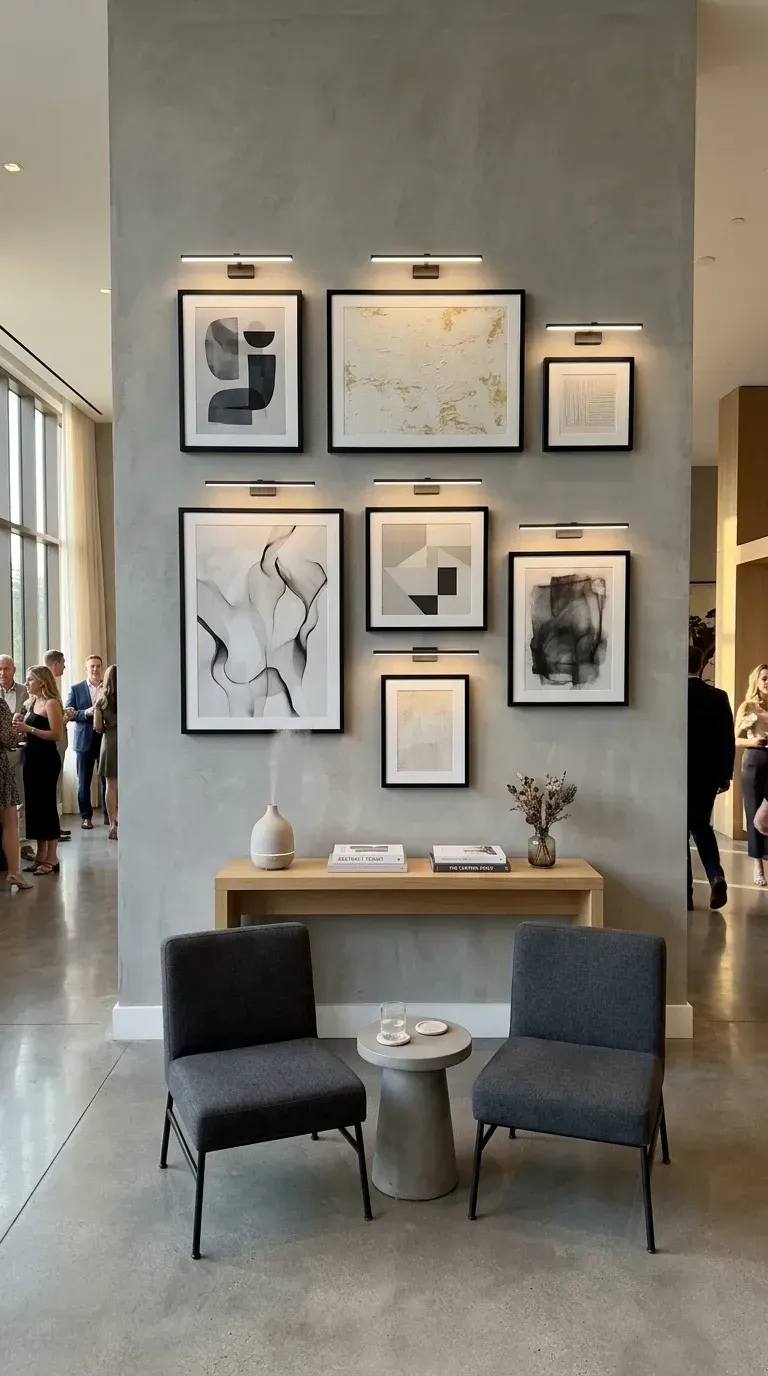
A gallery transition between the entry and the living area makes good use of a long hallway or a stretch of circulation that otherwise does nothing, and it photographs well. The wall finish is the reason it works: Roman Clay or Portola Paints Terra 3D, applied with a true Venetian plaster technique, gives a soft mineral texture that flat paint cannot imitate, at roughly $8–$14 per square foot installed by a qualified decorative painter. The rendering hangs seven framed abstracts in black, white and a touch of gold; the plan budgets for a set of eight from Artfully Walls or Minted with coordinated matting, each under a museum-style picture light from Juno Tech or Cocoweb that is individually switchable, dimmable and 2700K. Two charcoal upholstered side chairs (Kardiel Scandinavian or Article Ceni) in a textured boucle or wool give guests a place to pause without taking over, with a concrete pedestal table (West Elm Industrial or CB2 Apex) between them. The Aera Mini diffuser sits in plain view at one end of the oak console, beside a short stack of books, and carries the quiet secondary scent.
The wall carries the zone: a floor-to-ceiling Roman clay or Portola Paints Terra 3D concrete-texture finish. The plan specifies 8 framed abstract prints from Artfully Walls or Minted with coordinated matting, each under its own dimmable 2700K LED picture light from Juno Tech or Cocoweb, which makes 8 lights in all once the full set is hung.
Furniture stays light. A console table in rift-sawn oak or maple holds a Heath Ceramics vessel or another sculptural object, a pair of modern upholstered side chairs (Kardiel Scandinavian or Article Ceni) gives guests a place to pause, and a concrete side table from West Elm Industrial or CB2 Apex sits between them. An Aera Mini diffuser adds a subtle complementary fragrance.
Plan on $3,040–$6,080 for the gallery, with most of the money in the wall and what hangs on it. The professionally applied Roman Clay or Portola Terra 3D finish is $680–$1,400 and the set of 8 framed prints at Artfully Walls or Minted pricing $520–$1,100, together about 41% of the upper figure. The plaster has the wider range because it depends on the wall's height and the painter's day rate, so measure the wall and get that quote before ordering frames.
Lighting the prints costs nearly as much as the prints: $420–$840 for 8 dimmable 2700K picture lights from Juno Tech or Cocoweb. The rift-sawn oak console is $380–$780, the 2 Kardiel or Article side chairs $580–$1,100, and the concrete side table $140–$280. An Aera Mini with a fragrance capsule adds $140–$200, and a Heath Ceramics vessel with a light edit of books and objects $180–$380.
Hang the gallery so the centerline of the grid lands 58–60 inches above the finished floor, which matches eye level for the average adult. Wire the picture lights individually rather than on a shared switch, so each one can be dimmed for night photography. The console takes three objects and never more, because a gallery zone fails the moment someone treats the console as a storage shelf. The Aera fragrance here should complement the entryway's scent family without repeating the same scent.
7. The Quiet Retreat: Reading Nook
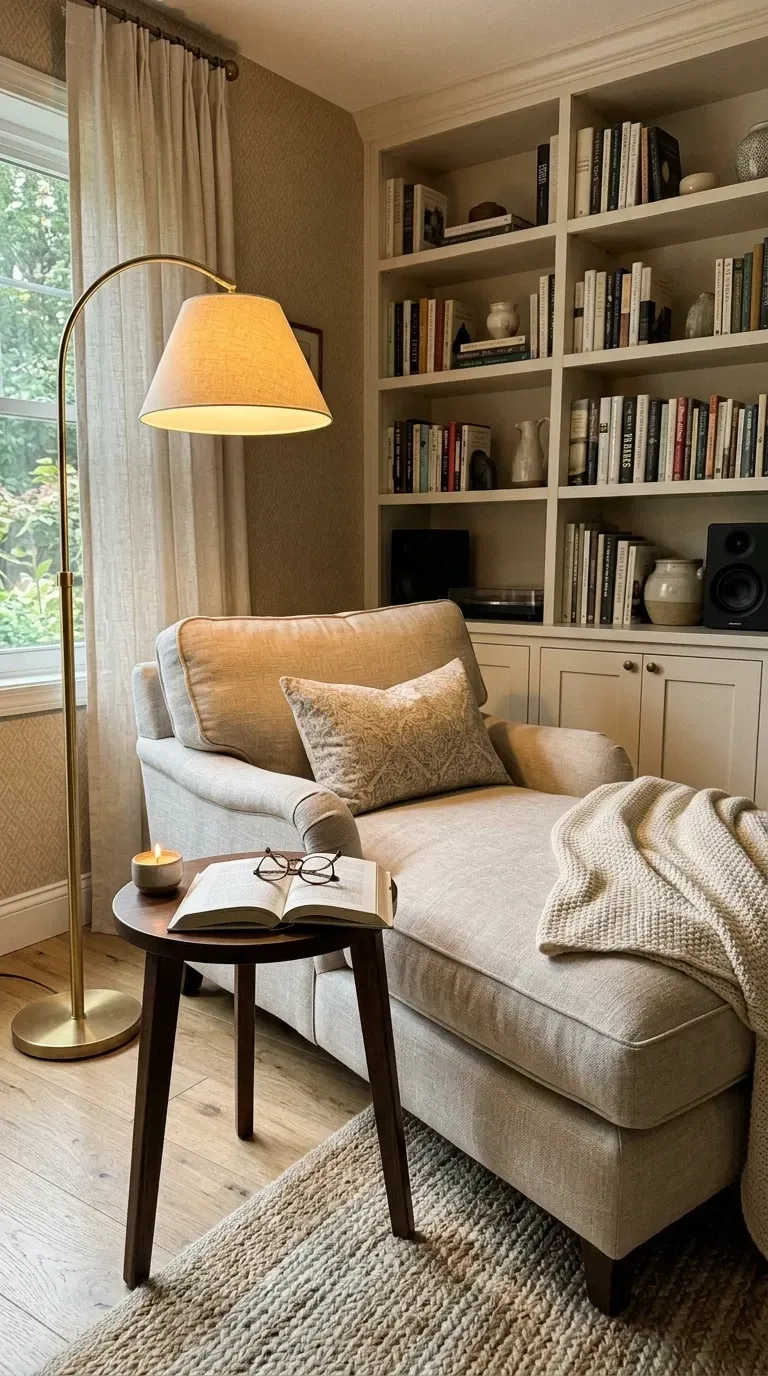
Every serious party needs an escape zone: a space where a single guest can step away from the volume, recharge, or have a quiet one-on-one. A floor-to-ceiling built-in bookshelf (custom Charleston cabinet shop, painted Benjamin Moore Cheating Heart 1617 or F&B Pigeon No. 25) creates the architectural envelope. The upholstered chaise lounge is the hero: Restoration Hardware's Lucca Shelter or Anthropologie's Willoughby in a neutral Crypton Home performance linen (for party spills); the chaise-plus-ottoman profile is more comfortable than a classic armchair for a guest who wants to lean back and disappear for ten minutes. Brass arc floor lamp (Regina Andrew Sydney or Arteriors Pacific) with a linen shade and 2700K dimmer provides the reading-corner light. A small round walnut side table (Rejuvenation Nichols or CB2 Odyssey). Subtle Schumacher or Thibaut wallpaper in a muted botanical. Throws in oatmeal linen-cashmere (Coyuchi or Cultiver).
Floor-to-ceiling custom built-in shelves, painted Benjamin Moore Cheating Heart or Farrow & Ball Pigeon, frame the nook, styled with a selected collection of roughly 75% books and 25% sculptural objects. The remaining walls take a subtle Schumacher or Thibaut botanical wallpaper.
The chaise is the seat: an upholstered lounge in performance linen, the RH Lucca Shelter or the Anthropologie Willoughby, with an oatmeal linen-cashmere throw from Coyuchi or Cultiver. Beside it stand a brass arc floor lamp with a linen shade on a dimmer (Regina Andrew Sydney or Arteriors Pacific) and a small round walnut side table from Rejuvenation (Nichols) or CB2 (Odyssey). A jute or wool rug, Fibreworks Almond or Armadillo Malawi, completes the corner.
Most of the nook's $5,240–$11,900 working budget for 2026 is carpentry. A 12-ft run of custom built-in shelving, with materials, labor and paint, accounts for $2,800–$6,400, and the chaise in Crypton Home performance linen for $780–$1,800; together that is about 69% of the high end. The shelving range is wide because cabinet shops price by the linear foot and by the paint finish, so collect that quote first, and keep a freestanding bookcase in mind as the substitute if it comes in high.
The rest is furnishing. The brass arc floor lamp (Regina Andrew Sydney or Arteriors Pacific) is $240–$480, the small walnut side table $120–$280, the Schumacher or Thibaut wallpaper with professional installation $320–$720, and a 6x9 jute or wool rug $220–$480. An oatmeal linen-cashmere throw from Coyuchi or Cultiver runs $180–$340, and filling the shelves with a selected mix of books and objects can take $580–$1,400 if you are buying rather than borrowing from the rest of the house.
Set the single lamp to warm 2700K and dim it to 60%; anything brighter reads as a library rather than a retreat. On the shelves, hold the 75% books and 25% objects ratio firmly, stacking books horizontally more often than vertically. Leave coasters out of this zone, which is the quiet signal that it is a place to rest rather than an extension of the bar. A small stack of monographs on the side table sets the expected behavior better than any sign asking for quiet.
8. The Jewel Box Powder Room
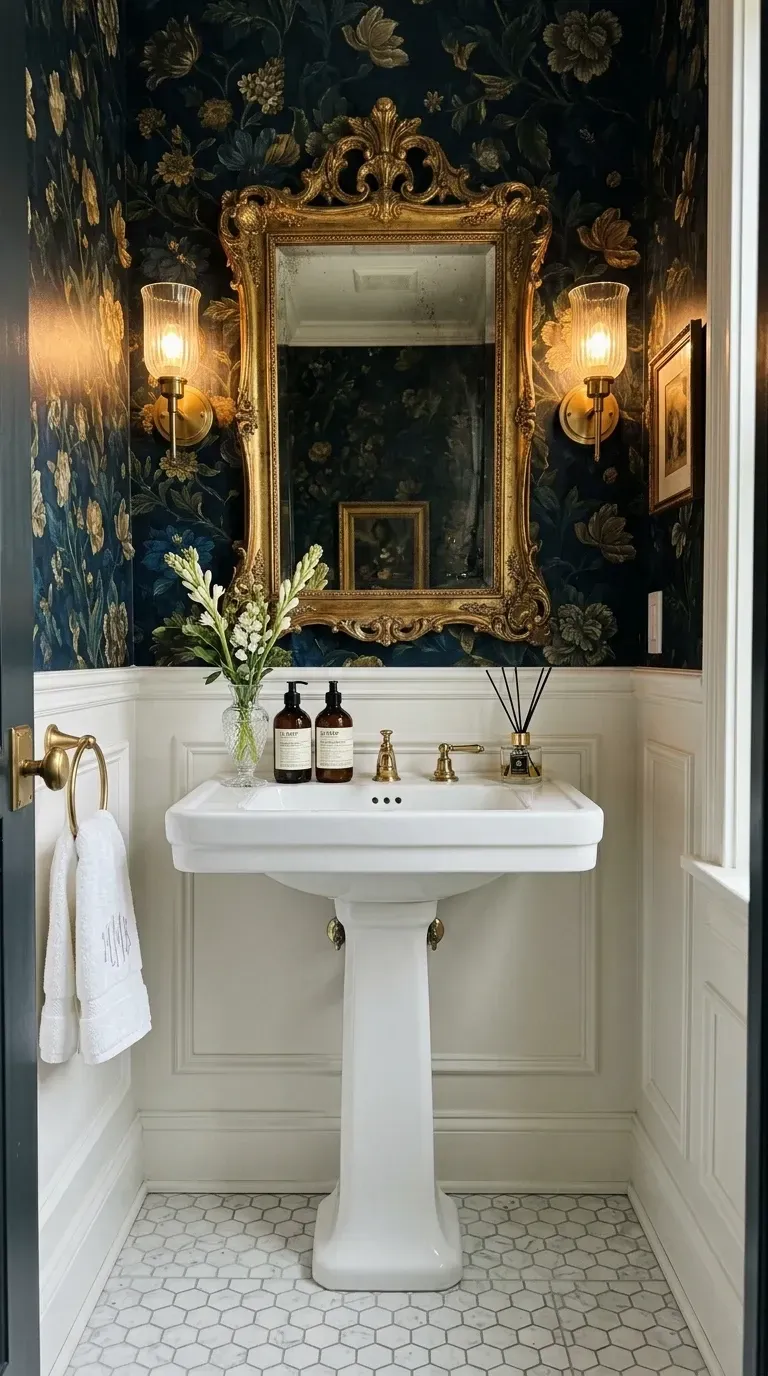
A powder room is the guest zone where hosts can actually deliver drama without committing to it across the whole house, and we would push every host to go bolder here than anywhere else. Dark floral wallpaper is the move: de Gournay Japonica (at top tier) or the more accessible Cole & Son Hummingbirds or Schumacher Pyne Hollyhock. The lower third of the wall gets classic white wainscoting to ground the pattern. Ornate vintage gold mirror (1stDibs antique finds or Anthropologie's Gleaming Primrose at accessible tier). The pedestal sink is Kohler Memoirs Stately or Porcher Lutezia; both read classic without signaling one era too strongly. Brass faucet: Waterworks Easton or Kohler Artifacts in unlacquered brass. Visual Comfort Bryant wall sconces flank the mirror. The scent move is a reed diffuser in a scent that's intentionally different from the entryway: think Aesop Aganice or Nest Moroccan Amber. Luxury liquid soap: Aesop Resurrection or Molton Brown Delicious Rhubarb.
Dark floral wallpaper does the work here, from de Gournay (Japonica), Cole & Son (Hummingbirds) or Schumacher (Pyne Hollyhock), above white wainscoting on the lower third of the wall. A classic white pedestal sink, the Kohler Memoirs Stately or Porcher Lutezia, takes an unlacquered brass faucet from Waterworks (Easton) or Kohler (Artifacts).
An ornate vintage gold mirror, an antique from 1stDibs or the Anthropologie Gleaming Primrose, hangs between 2 Visual Comfort Bryant wall sconces in hand-rubbed brass. Marble hexagon tile from Ann Sacks or Clé Tile in Carrara covers the floor, and luxury liquid soap with a reed diffuser (Aesop Resurrection, Nest Moroccan Amber) finishes the room.
Budget $2,735–$6,640 in 2026 dollars for the powder room. The two surfaces carry about 48% of the top figure: floral wallpaper with professional installation, from Schumacher Pyne up to de Gournay, at $480–$1,800, and Ann Sacks Carrara marble hexagon floor tile with installation at $620–$1,400. The wallpaper range is the widest in the room because a hand-painted de Gournay panel and a printed roll are not the same purchase; decide which one you are buying before the fixtures are ordered.
Around those two, the fixtures add up steadily. White wainscoting with installation is $480–$980, the ornate gold mirror (an antique from 1stDibs or the Anthropologie piece) $280–$620, the Kohler Memoirs Stately or Porcher Lutezia pedestal sink $340–$620, and an unlacquered brass Waterworks Easton or Kohler Artifacts faucet set $220–$580. The 2 Visual Comfort Bryant sconces in hand-rubbed brass that flank the mirror add $220–$420, and the Aesop or Molton Brown soap with a reed diffuser $95–$220.
The powder room is where guests spend two uninterrupted minutes alone during every party, and that is when they form their strongest opinion of the host's taste, so spend here out of proportion to the room's size. The hand towel matters: specify monogrammed Matouk linen in a color that complements the wallpaper, changed between guests if you have the help. Dim the sconces to 50% at the start of the event, because a too-bright powder room at the three-hour mark feels like an interrogation room rather than a jewel box.
9. The Party Pulse: DJ & Dance Zone
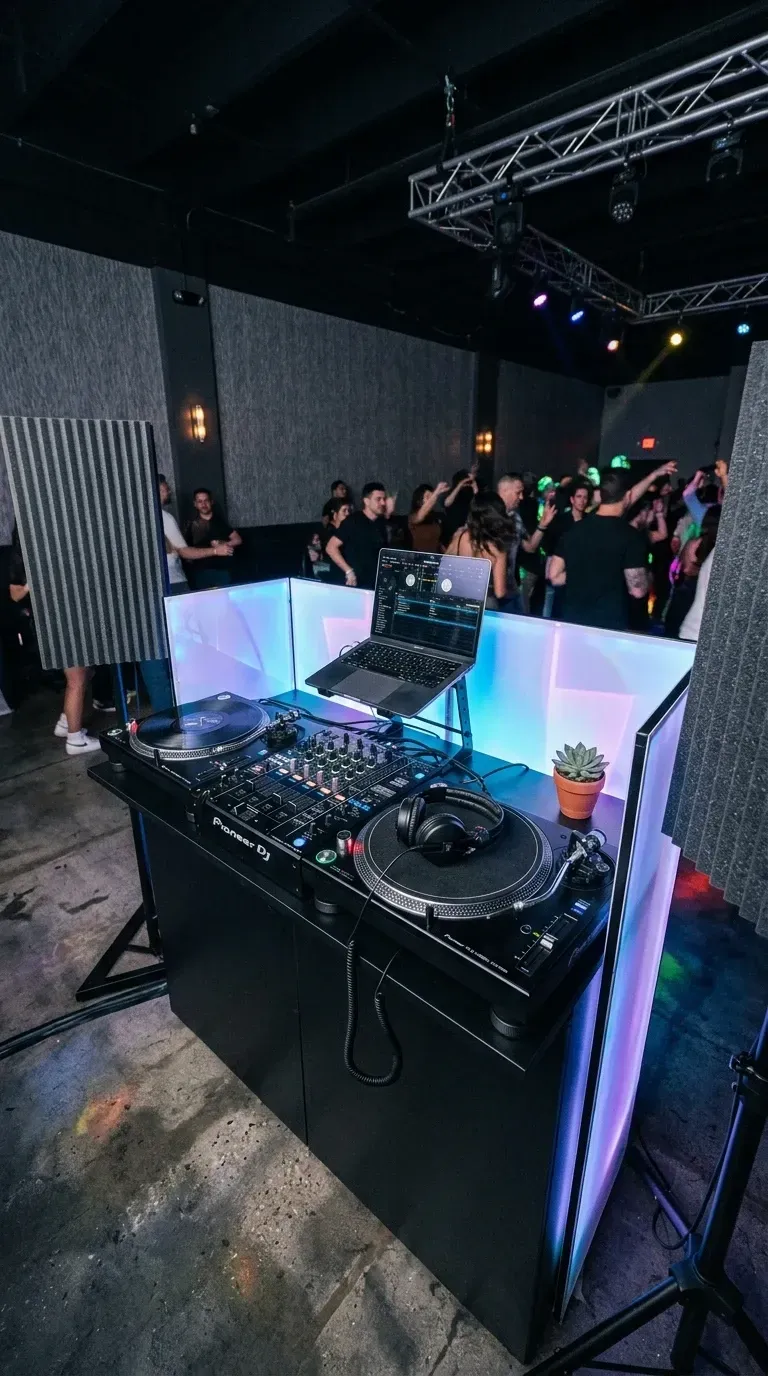
For larger milestone events (a 40th birthday, a reception-style housewarming), a dedicated DJ zone is what turns a gathering at home into a night out. The equipment choice matters. We would start from a Pioneer DJ DDJ-FLX6 controller, or the step-up DDJ-1000, paired with 2 QSC K12.2 speakers: 12-inch tops that stay clean up to 132 dB, with a QSC KS118 subwoofer when bass matters. The rendering shows a pair of turntables and a mixer with a laptop, and a controller does the same job in less space. The illuminated booth fronts (LED strip panels behind translucent plexi) are a custom build that a local AV shop can produce for roughly $800–$1,800. The overhead truss carries four Chauvet Intimidator Spot moving heads, which event AV rental companies supply at a day rate, and acoustic foam panels on stands (Auralex Studiofoam or GIK Acoustics 242) handle the first-reflection points. The glowing booth is the visual center, and the truss supplies the energy.
The rig centers on a Pioneer DJ DDJ-FLX6 or DDJ-1000 controller with a professional Rekordbox license, feeding a pair of QSC K12.2 powered speakers and a QSC KS118 subwoofer. A custom illuminated DJ booth front from a local AV shop in Charleston gives the zone its focal point, and an overhead truss with 4 rented Chauvet Intimidator Spot moving heads supplies the movement.
The room needs some preparation to handle it. Auralex Studiofoam or GIK Acoustics 242 acoustic foam panels on stands control reflections, the floor is industrial-style concrete or a polished-concrete overlay, and an optional fog and haze machine (the Chauvet Hurricane Haze 2D) adds depth to the light. Behind the scenes, XLR cable runs and power distribution need a 20A circuit at minimum.
Bought outright, the DJ zone runs $6,040–$15,440 in 2026 dollars; renting the heavy equipment for one event brings it to $3,640–$10,840. The speakers are the swing line: a QSC K12.2 pair with a KS118 subwoofer costs $2,400–$5,800 to buy but $580–$1,200 to rent for the day. With the Pioneer controller and Rekordbox license, DDJ-FLX6 up to DDJ-1000, at $780–$2,400, those two lines make up about 53% of the high purchase figure. Decide whether you are buying or renting the speakers before anything else, since that single choice moves the total by thousands.
The build-out around the rig is where labor shows up: $900–$2,200 for custom illuminated booth fronts from a local AV shop, $480–$1,400 to rent 4 Chauvet Intimidator Spot moving heads, $680–$1,800 for truss, rigging and setup labor, and $340–$780 for 6 Auralex or GIK 242 acoustic panels on stands. The Chauvet Hurricane Haze 2D is optional at $180–$380, but the $280–$680 for professionally installed power distribution and cable runs is not, given the dedicated circuit the rig needs.
Hire a DJ. A well-programmed set beats a playlist the host assembled on Spotify by a wide margin, and a local event company or wedding-DJ roster is the quickest route to referrals. Check the local noise ordinance before the night: many residential codes tighten after 11 pm, and 65 dB at the property line is a sensible ceiling to plan around. Face the booth into the deepest corner of the room so bass spreads out rather than stacking up, and reserve a 20-amp circuit for the rig alone.
10. The Chill Zone: Floor Seating Lounge
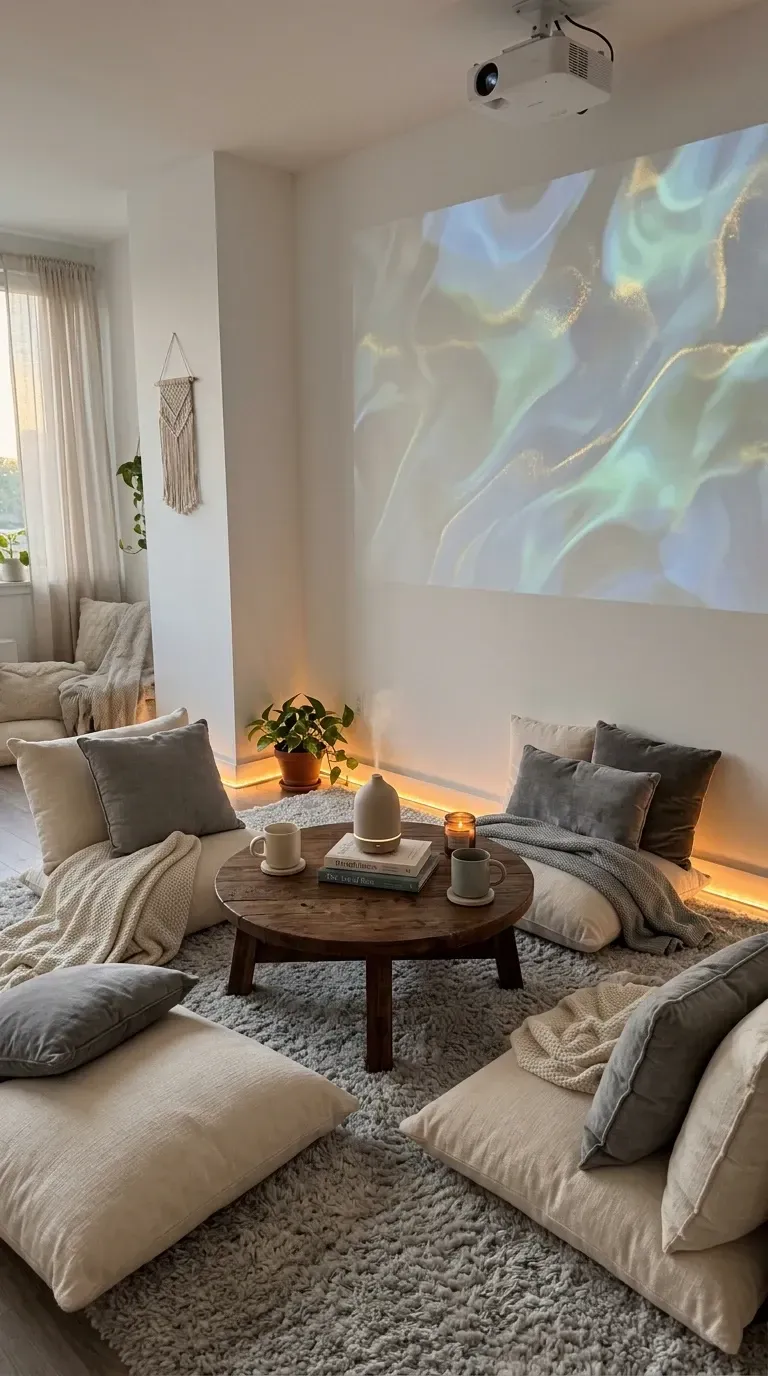
The chill zone is what carries the late hours. By 11 pm most guests are done standing with a cocktail and want to sink into something, and floor seating is the invitation. Six to eight large floor cushions (Sabai Design in performance velvet or the Lulu and Georgia Agatha) gather around a low round walnut coffee table (West Elm Industrial Pedestal or Vitra Pebble) on a high-pile rug (Loloi Ingrid Shag or CB2 Kaia). The rendering uses a ceiling-mounted projector to throw slow, smoky abstract visuals onto the blank wall; a portable Anker Nebula Capsule 3 Laser, or the XGIMI Halo+ at a higher tier, does the same from the table with no installation. A Philips Hue Lightstrip Plus along the baseboard at 2200K gives the low glow visible behind the cushions. Scent comes from an Aera or a simmering pot of cloves, cinnamon and orange peel, and throws in chunky alpaca or Mongolian wool finish the comfort.
Seating is on the floor: 6–8 large floor cushions in performance velvet from Sabai Design or the Lulu and Georgia Agatha, set on a high-pile rug (Loloi Ingrid Shag or CB2 Kaia) around a low round walnut coffee table, the West Elm Industrial Pedestal or the Vitra Pebble. Throws, 3 of them in chunky alpaca or Mongolian wool from Viso Project or CB2, stay within reach.
Light and image set the mood. An Anker Nebula Capsule 3 Laser or XGIMI Halo+ portable projector plays a selected generative ambient visual stream from VSQ, Shima or a custom source, while a Philips Hue Lightstrip Plus at 2200K runs along the baseboard. A simmering scent pot of cloves, cinnamon and orange peel, or an Aera diffuser instead, adds warmth.
The chill zone comes in at $1,820–$4,020 in 2026 dollars, with about 42% of the upper figure in the Anker Nebula Capsule 3 Laser or XGIMI Halo+ projector ($380–$920) and the set of 6–8 large floor cushions and pillows from Sabai or Lulu and Georgia ($420–$780). The projector has the broadest spread, since a small portable laser unit and a brighter living-room model are different purchases, so choose the model before buying the rest.
The remaining pieces are soft and individually inexpensive: $220–$480 for the low round walnut coffee table, $160–$280 for a Philips Hue Lightstrip Plus kit with its bridge, $280–$680 for 3 chunky alpaca or Mongolian wool throws, and $320–$680 for the Loloi Ingrid Shag or CB2 Kaia high-pile rug. Scent costs as little as $40 for a simmer pot and its ingredients, or up to $200 with an Aera Mini.
The projector content matters. A party can fall flat with a looping yule log and come alive with generative abstract visuals; ambient is the right register, and actual movies kill conversation. Turn the overhead lighting off completely and let the projector and LED strip do 100% of the work, because any overhead light weakens the effect. The scent pot needs no equipment at all: a stovetop pot of water with six cloves, three cinnamon sticks and the peel of half an orange, held at a bare simmer, gives two hours of the most universally warm scent in residential design.
Pro Tips for Every Host
Scent works in families, not contrasts. Pick one family for the evening (woody, floral, citrus or gourmand) and stay inside it from room to room: lilies at the door, rosemary in the dining florals and amber in the powder room read as one house, while lilies, then citrus, then vanilla feel like three different parties. The dining table is the one place to stay unscented, and the beeswax tapers named in the dinner section, from Honey Candles or Big Dipper, give an 8-hour burn with nothing to compete with the food.
Light and sound need the same planning as the furniture. Dim everything to 40–60% for arrival and drop to 25% for the seated dinner, which means every circuit in the party zone needs a dimmer, set and tested 48 hours before. A brightly lit party says office; the same rooms at 40% say occasion. Music should be zoned rather than flooded through the house: three separate audio zones (instrumental at dinner, mid-tempo vinyl with cocktails, higher BPM on the dance floor) set the mood far better than one playlist everywhere, and a Sonos multi-zone system handles that natively, with a hardwired whole-house installation as the higher-tier answer. About 30 minutes before the start, walk to the property line with a decibel meter app; if it reads above 65 dB, turn it down then rather than at 11 pm, when the neighbors are trying to sleep.
Audit the power circuits before the event. Map the amp draw of every lighting, audio, projector and heating device and confirm the breakers can carry it; a tripped breaker in the second hour of a party kills the mood, and a one-hour pre-event consult with an electrician ($80–$140) prevents it. Provide a quiet zone even if no one seems to use it, because the invitation to step away is what keeps introverts at the party into the third hour rather than leaving after the first, and the chaise lounge zone pays for itself in retained guests. Finally, over-invest in the powder room. Spending out of proportion on the one space every guest visits alone is the highest-return choice in event design: monogrammed hand towels, luxury soap and a premium candle or diffuser all land in the pause when guests form their strongest impression.
Where to Cut Without the Party Knowing
Scent and light offer the easiest savings. A stovetop simmer pot of water with cinnamon sticks, citrus peels and cloves gives two hours of rich scent for under $8 in ingredients, and it beats any $220 diffuser at making a house feel like a welcome home. Candles work the same way: one $90 Diptyque on the entryway console plus fifty $12 Illume or CB2 unscented tea lights scattered through the rooms delivers the glow at a fraction of the price of scented pillars.
The big-ticket equipment is better rented than owned. Pioneer DDJ-1000 controllers, QSC speakers, Chauvet moving heads and even Sonos arrays all rent by the day from event AV companies, and a one-event rental of a $4,500 speaker pair runs $400–$600. Chairs follow the same logic: party-rental companies price sit-down dinner chairs at roughly $6–$14 each, while owning 12 upholstered dining chairs for one night a year rarely makes sense.
A few substitutions finish the list. For the bar cart, a pair of vintage crystal decanters from a flea market or antique mall runs $20–$60 each, and with a $15 set of engraved brass tags from Etsy they pass for $400+ of new Williams Sonoma crystal. After dinner, a French press with good beans (Metropolis or Second State, for instance) looks as deliberate as any La Marzocco espresso machine. In the gallery zone, Framebridge's Mercer Slim in black with a 4-inch linen mat comes as close to a $400 custom-cut frame as most eyes can detect.
Regional Fit Across Five Southeast Markets
Pricing in this article reflects Charleston 2026 benchmarks, and the wider Southeast moves away from that base in fairly predictable ways.
Charleston and Savannah set the base pricing for this article. Coastal humidity pushes outdoor zones toward powder-coated aluminum, Sunbrella, teak and recycled poly, and florals lean toward magnolia, Confederate jasmine and camellia so the arrangements match what grows outside; both cities have a well-supplied event-rental market. Atlanta comes closest in cost, with labor comparable to Charleston, a large design-trade showroom district that makes Visual Comfort, Kravet and Schumacher pieces easy to see in person, and event rental on a much larger scale.
Two markets come in cheaper. Nashville runs roughly 6–10% lower on furnishings and 10–15% lower on custom AV installation labor, its drier winters widen the use of real marble and limestone for indoor floors, and seasonal outdoor tent rentals are easy to find. Asheville prices furnishings 8–12% lower and custom cabinetry and millwork 15–25% below Charleston for comparable quality; mountain-fall events there build around a stone hearth rather than making the patio the main zone. Austin and Dallas go the other way, with custom work 10–15% higher because of labor rates, though both have a deep AV-rental market, and the dry climate suits real marble and limestone in every application, outdoors included.
Frequently Asked Questions
How many of these zones should you actually build for a single party?
Between three and five, depending on headcount. For a 12-guest seated dinner: entryway + dining + powder room + quiet retreat is the right set. For a 30–50 guest cocktail party: entryway + bar + audiophile lounge + al fresco + powder room. For a 60+ milestone event: add the gallery transition, the DJ zone, and the chill zone for late-night. Trying to build all ten for one event spreads the budget too thin and the guest flow gets confused.
What's the single most cost-effective sensory investment?
Scent. An Aera Mini diffuser at $140 or a pair of Diptyque candles at $180 total delivers more atmospheric transformation than any $400 piece of decor. The second-most-cost-effective is warm lighting: swap all 3000K/4000K bulbs in the party zone for 2700K dimmable LEDs ($60–$120 total) and every room photographs and reads dramatically different.
Can a full sensory soirée work on a $2,000 total decor budget?
Yes, with discipline. Skip the DJ zone entirely; use Sonos or borrowed speakers. Rent instead of buying dining chairs and glassware. DIY the bar cart with vintage finds. Invest in a signature Diptyque candle ($100), an Aera Mini diffuser ($140), a pair of fresh florist arrangements ($240), and one hero piece per zone; the total lands close to $1,800–$2,200 for a 20-guest cocktail event that reads considered rather than budgeted.
What's the biggest sensory mistake hosts make?
Overloading scent. Two diffusers plus three candles plus fresh florals plus a simmer pot plus room spray is a migraine, not an experience. Scent works additively: less than you think, in families that complement each other, with one hero source per zone. The second-biggest mistake is cool-white lighting; 4000K bulbs in a residential party kill atmospheric warmth regardless of how good the rest of the styling is.
Is professional AV worth hiring for a dance-floor party?
For anything over 40 guests where dancing is expected, yes. A Charleston AV rental with DJ support runs $1,200–$3,500 for the evening; that's the same price as two Pioneer controller purchases and includes technical support during the event. For smaller parties (under 30), a Sonos Five pair running from a phone-driven playlist covers the need. Match the audio scale to the guest count.
How do you manage sound bleed between zones?
Physical separation helps more than acoustic treatment. Put the DJ zone in a finished basement, outbuilding, or enclosed garage if possible; the quiet retreat and dining should be two rooms removed from the bass. For open-plan homes where separation is not possible, run the dance zone at 75–80 dB (energetic but not overwhelming) and use Sonos zoning to keep the dinner audio at a contrasting instrumental track rather than fighting the bass.
Real candles or LED candles for a seated dinner?
Real, specifically unscented beeswax tapers, never paraffin. The flicker reads as warm; the LED alternative always reads as plastic-adjacent regardless of price point. Fire safety: use bobeches (glass drip-catchers) under each taper, keep candles 24 inches from drapery, and extinguish via a snuffer rather than blowing them out to avoid hot wax spatter.
How early should setup start for a sensory-scaped event?
Big events: 48 hours out for shopping, prep, rental delivery, and test runs. 24 hours out: run all systems (audio, lighting, scent, projectors) for 30 minutes each to catch failures. 4 hours out: florals arrive and install. 90 minutes out: first candles lit, diffusers active, lighting dimmed to pre-set levels. The first diffused scent should be in the air 60 minutes before the first guest rings the bell, because scent molecules need time to diffuse into upholstery and drapes.
Sources & References
- International Fragrance Association (IFRA), Standards 51st Amendment: safety concentration guidance for home diffuser and reed diffuser use.
- Illuminating Engineering Society (IES), Recommended Practice for Lighting Interiors: color temperature and dimming guidance for residential entertaining.
- Natural Stone Institute, Marble & Dimension Stone Sealant Specifications: for powder-room hexagon flooring and wet-zone applications.
- National Fire Protection Association (NFPA), NFPA 1: Fire Code: open-flame candle clearance guidance in residential settings.
- City of Charleston, Noise Ordinance Sec. 21-61: 65 dB residential property-line cap after 11:00 pm.
- Mount Pleasant Zoning Ordinance, Title 156.213 Noise Regulations: quiet-hour decibel standards.
- QSC Audio Products, K Series Professional Powered Speaker Specification Sheet: power output and distortion ratings.
- Pioneer DJ, DDJ-FLX6 & DDJ-1000 Operating Manual: voltage, cable, and circuit requirements.
- Chauvet DJ, Intimidator Spot 260 Professional Specification Sheet: truss-rigging and power-draw data.
- Visual Comfort & Co., Professional Specification Binder: dimmer compatibility for brass sconce and chandelier lines.
- Farrow & Ball, Colour Consultation & Technical Guide: deep-saturation color behavior under candlelight.
- Diptyque Paris, Candle Burn Time & Scent Throw Technical Notes: pillar and reed diffuser dispersal characteristics.
- Crypton Home Fabric, Performance Testing Data: stain release on upholstered dining chairs for event use.
- Published 2025–2026 price lists from event rental companies: chair, table, AV, and lighting rental benchmarks.
- The Layered Homes editorial estimates: 2026 line-item costs for home entertaining in the Charleston area, compiled from retail and rental price lists.
Commit to Fewer Zones, Fully
A memorable party is engineered, not accidental. Hosts whose evenings guests remember tend to commit fully to three or four sensory zones rather than spreading across ten half-executed ones, and they understand that scent, light, and sound work harder than any single piece of furniture or floral arrangement. The real discipline of sensory design is subtraction: the party feels layered because no single element is trying to do the work of the whole event.
The sign of a fully-specified sensory-scaped event is a host who can say afterward: "Nobody noticed how much was being done in the background until someone asked what the smell was at the door." That's the definition of a sensory soirée done right. The engineering is invisible; the feeling is what lingers.
For readers thinking about the broader residential canvas that makes hosting memorable, our related pieces on 12 living room transformations into calm retreats, a patio's transformation from black hole to luminous living, 12 bathroom makeovers including jewel-box powder rooms, a Nordic makeover into a calm Scandi room, and 11 spare-room makeovers into quiet retreats cover the spaces where the same discipline of layered sensory design pays the same returns every time you host.
Styling & Living Desk
The Layered Homes editorial teamThe Styling & Living Desk produces the room-by-room guides, outdoor and garden pieces, celebration ideas and design solutions, each with an itemised cost estimate, and the Home Files essays.
More from the Styling & Living Desk →
Reader notes