


This rug size guide turns the usual label on a product page into a floor plan decision. We cover standard dimensions, the amount of rug that should remain visible, furniture leg placement and the clearance that doors and chairs need.
The Short Answer
Choose a rug from the furniture footprint, not from the empty patch of floor. Living rooms usually need at least the front legs of each seat on the rug. Bedroom rugs need useful exposure at both sides and the foot. Dining rugs need about 24 inches beyond the table so pulled out chairs stay supported.
Standard sizes are convenient, but the room decides. Baseboards, vents, doors, hearths and furniture frames can reduce the usable area. Tape the complete outline before ordering and check it during normal use.
Quick Rug Size Chart
As a starting point, a medium living room usually takes an 8 by 10 ft rug, with the check being that the front legs of the seating sit on it. A large living room moves up to 9 by 12 ft, sized so all the seating stays connected on one rug.
In bedrooms, a queen bed works with 8 by 10 ft, leaving 18 to 24 in of rug at the sides, while a king bed calls for 9 by 12 ft and 24 to 30 in at the sides. A six seat dining table also needs 9 by 12 ft so the chairs stay on the rug when pulled out. In a hall, a runner of 2.5 by 8 to 12 ft is the useful range, and the main check is an even border of floor on both sides.
Measure the Furniture Footprint First
Draw a simple plan of the room and mark every fixed interruption. Include door swings, vents, hearth extensions and the point where a cabinet or closet opens. Then draw the furniture at its real dimensions. The remaining outline is the largest practical rug, not necessarily the size to buy.
Painter's tape gives a better answer than a mental estimate. Place tape at the four corners, connect the edges and move chairs through their full travel. In a bedroom, walk around the bed in the dark. In a dining room, pull each chair back as a guest would.
A rug pad changes the final height and grip. Select the rug and pad as one assembly, especially near doors. Natural rubber suits many hard floors, but the flooring manufacturer's care guidance takes priority because some backings can discolor a finish.
Living Room Rug With Front Legs On
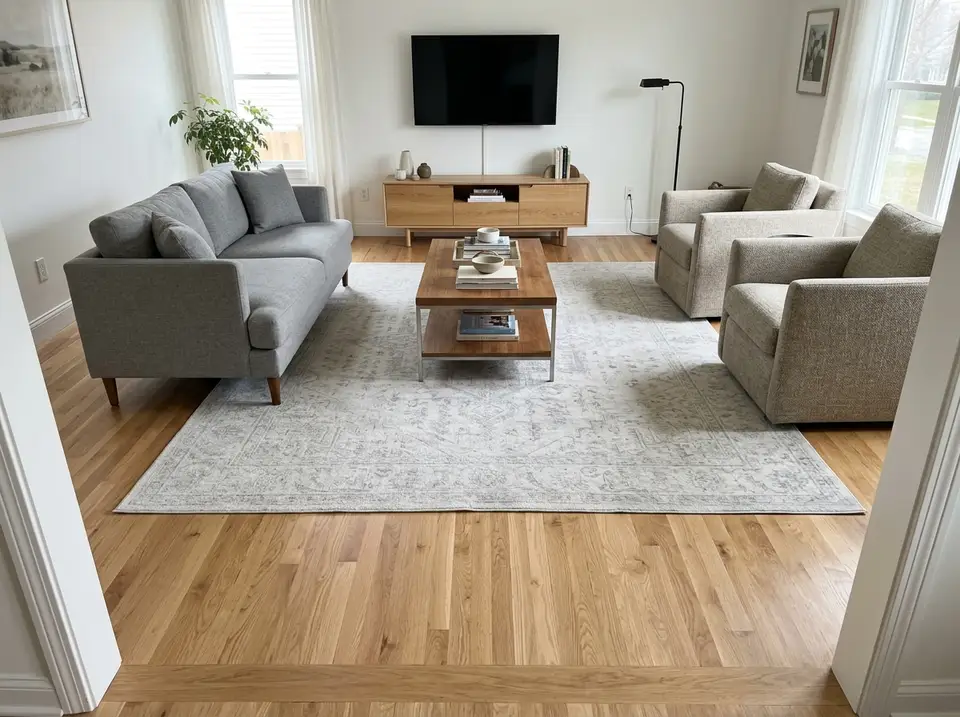
In this concept rendering a gray sofa and a pair of oatmeal armchairs face each other across a pale, washed out medallion rug, and only their front legs reach the pile. The rug runs well past the coffee table at both ends, so the seats read as one group even though their back legs stand on the oak boards.
Front legs on is the economical way to tie separate seats together, because a rug sized for it is usually one standard step smaller than one that holds every leg. It also leaves the media console and the route in from the doorway on bare floor, which is exactly where this room needs it.
What to Check
Keep 6 to 10 inches of rug under each front leg so the sofa and chairs feel anchored to the same piece. Leave a clear floor border around the room rather than running the rug wall to wall, and center it on the seating group itself, not automatically on the wall or the window.
Size the rug from the whole seating group rather than the coffee table, taking the distance from the front of the sofa to the front of the farthest chair. Add the overlap each piece needs and the right size falls out of that sum, not out of the open floor between the pieces.
A Practical Specification
For most medium rooms, an 8 by 10 foot outline is the first one to test, and in a layout like this one it usually catches the front legs with a little to spare. Keep the label or receipt with the fiber and exact size noted, since a matching runner or a replacement pad is far easier to order with that record in hand.
Where the armchairs turn and shift every evening, specify a low pile wool blend or a performance fiber; a deep shag would hold dents from the chair feet and fray along the edge they drag across.
Two Runners Beside a Full Bed
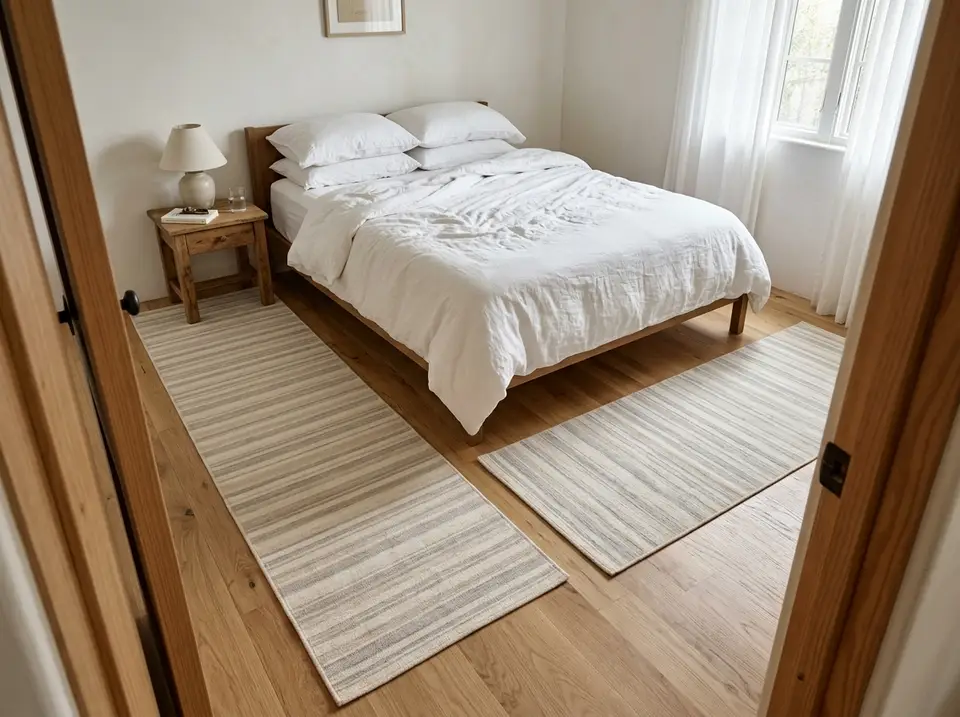
Two striped flat weave runners in gray and cream lie along both sides of a wooden bed frame and carry on beyond the foot of the bed. They give each side a soft first step in the morning while leaving the doorway and the floor between them clear.
Paired runners suit a compact bedroom where a large rug would vanish under the mattress and show only a thin border. Here the bed fills most of the floor, so the budget goes into the two strips people actually step on.
What to Check
Runners 2 to 3 foot wide suit most halls and kitchen aisles. Place each one so it stays clear of the door swing, and lay a nonslip pad cut slightly smaller than the rug underneath so the edges sit flat and do not catch a foot.
Cut both runners to the same length and line up their top edges so the pair reads as a set. In the rendering one begins near the nightstand and the other well down the bed, which is the kind of mismatch worth fixing on paper before ordering.
A Practical Specification
Leave the headboard end bare and start each runner roughly level with the nightstand, so the pile sits where feet land rather than under the pillows.
A washable flat weave makes sense if pets sleep in the room, because both strips can be laundered instead of being spot cleaned for months.
Dining Room Rug That Holds Pulled Out Chairs
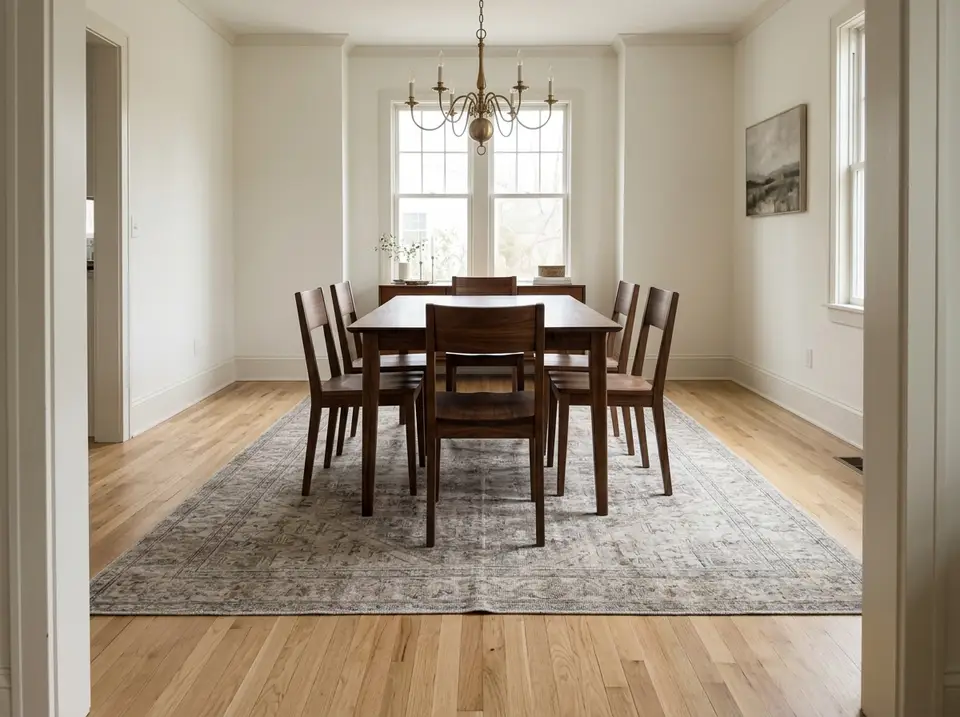
A walnut table with six matching chairs stands on a faded gray rug with an ornamental border, and every chair sits well inside the edge. The depth of rug behind each chair back is the point of the image, since that strip is what catches the back legs when someone pushes away from the table.
When the back legs drop off the edge during a meal, the chair rocks and the rug border starts to curl from being caught. The sideboard, the window wall and the floor vent in this room all stay outside the rug, which keeps the layout centered on the table rather than on the walls.
What to Check
For a dining room, add at least 24 inches beyond every table edge, which is the room a chair needs to slide back without dropping off the rug. A low pile helps chairs slide too, and before ordering, check that the rug clears the floor vents.
Take the table length at its longest extension, with any leaves fitted, before choosing a size. A rug that suits the table closed can leave the end chairs hanging over bare floor at a holiday dinner.
A Practical Specification
For a common six seat table, a 9 by 12 foot rug is often the first size to test, and it is the size that gives the clearance shown here.
Specify a stain resistant fiber and a dense pad that stays flat, since a soft pad bunches under chair legs that are dragged back and forth at every meal.
Hallway Runner With an Even Floor Border
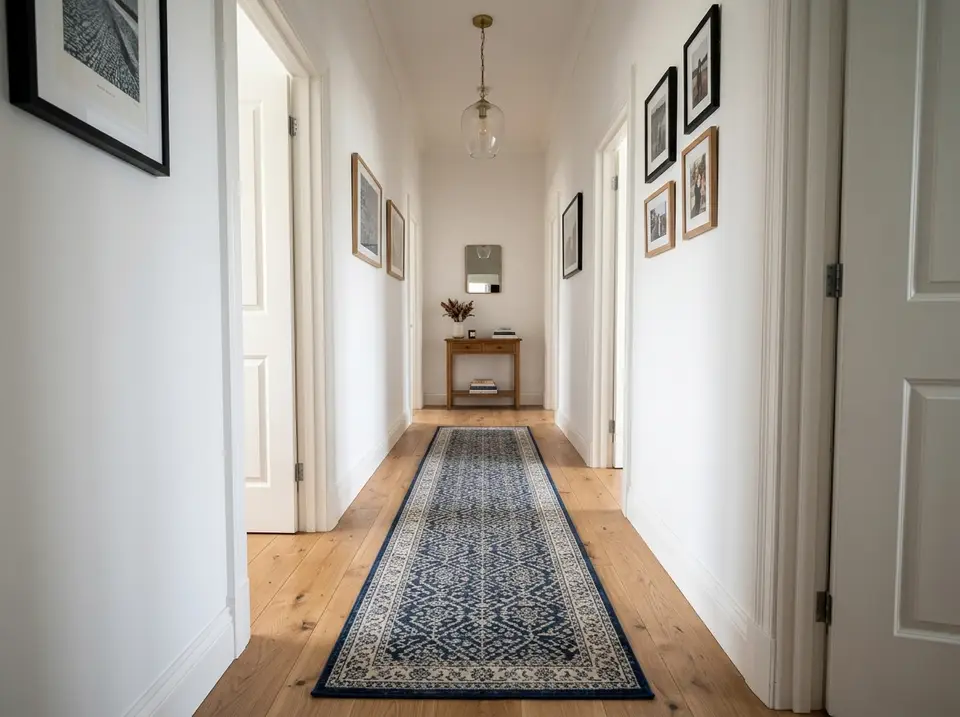
A navy and cream runner with a small geometric field is centered down a long white hall lined with framed photographs. Wide strips of oak flooring stay visible along both sides, and the runner ends before the console table at the far wall.
Centered like this, a runner quiets footfall and protects the main traffic lane while the full width of the hall still reads. The dark navy border also hides the scuffing that a pale edge would show.
What to Check
A hall runner should leave about 3 to 6 inches of floor at each side, so the border looks deliberate. Stop it short of the door thresholds, and use a full length nonslip pad, since this is the rug people walk on fastest.
Find the narrowest point between baseboards, which in an older hall is often at a door casing or a radiator rather than mid span, and size the runner width from that figure.
A Practical Specification
Choose the longest standard runner that still leaves some floor at both ends, and keep those ends clear of the door openings along the way.
Flat weave wool and washable synthetics hold up best where a hall meets the entry, since grit from shoes travels a long way down a runner like this one.
Round Rug Under a Round Table
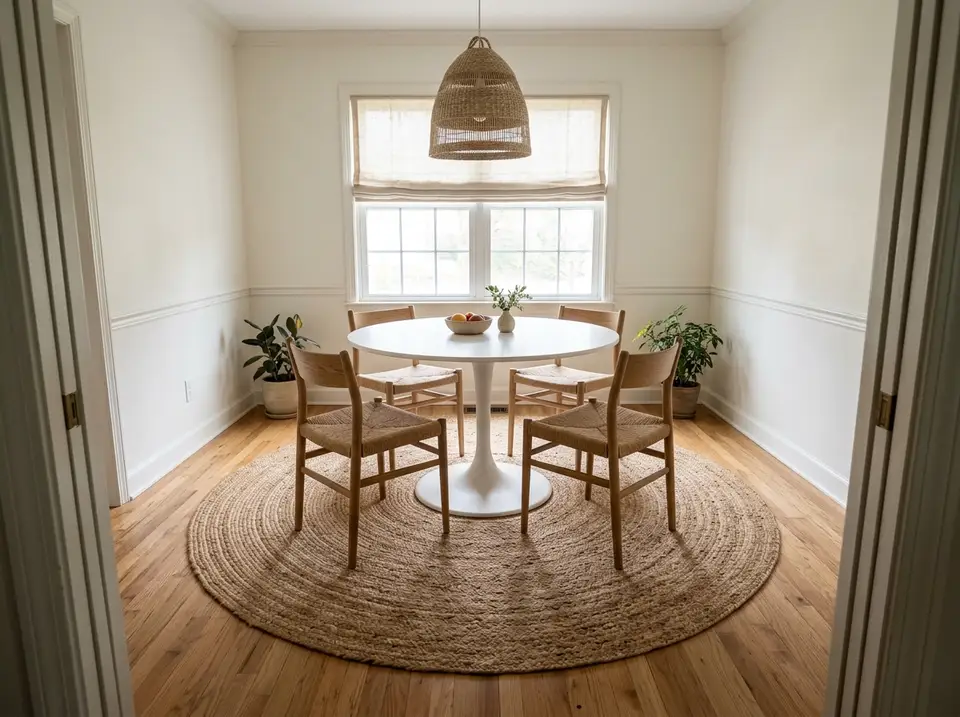
A white pedestal table and four oak chairs with woven rush seats sit on an eight foot round braided jute rug beneath a woven pendant. The circle repeats three times, in the tabletop, the rug and the lamp, and the chairs stay on the rug even when pushed back.
Echoing the table shape can make a small nook feel settled rather than crowded, and a pedestal base helps by leaving the rug open underfoot with no corner legs to trip over.
What to Check
Under a round table, add about 48 inches to the table diameter to find the rug size. Center the pendant, table and rug together on one point, and confirm that every chair leg stays on the rug when the chair is occupied.
Start from the table diameter and add the chair pullback on both sides; the 48 inch allowance above is simply that pullback counted twice.
A Practical Specification
An eight foot round rug works for many 42 to 48 inch tables with four chairs, which is the arrangement in this rendering.
Use a firm, thin pad so the chair legs do not sink, particularly under a chunky jute weave that already has some give of its own.
Entryway Rug That Clears the Door
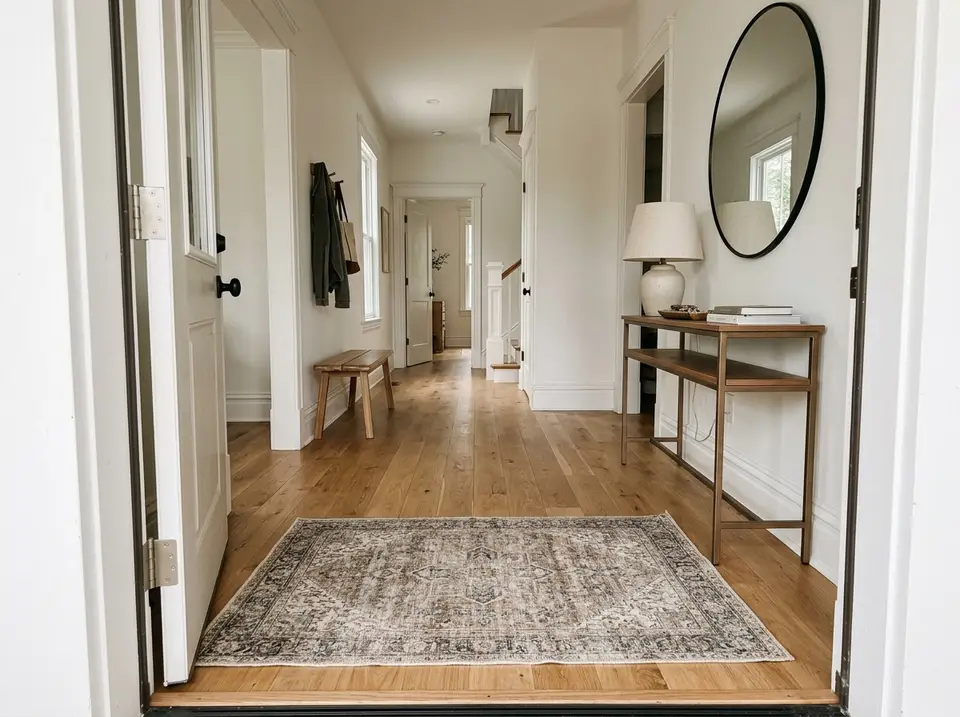
A low pile rug with a faded medallion pattern lands just inside the front door, between the door swing and a slim console with a lamp and round mirror. The door opens over the floor beside it without touching the rug, and the hall beyond stays bare oak.
Inside the door, a rug has to trap grit without turning into a trip point. That is why this one is thin and flat at the edges and stops short of the threshold strip.
What to Check
At an entry, open the door fully over the test outline before you buy; a rug that catches the door gets kicked aside within a week. Keep it clear of the threshold, and choose a pad rated for the floor finish underneath.
Check the gap under the open door as carefully as the floor area, with the pad included, because a rug and pad a fraction too tall will scrape on every swing.
A Practical Specification
A 3 by 5 or 4 by 6 foot rug suits many entries, but the door clearance decides which of the two will actually fit.
Favor a dark midscale pattern that hides tracked soil, which the muddy taupe and charcoal tones in this rug manage well.
Kitchen Runner Between Cabinets
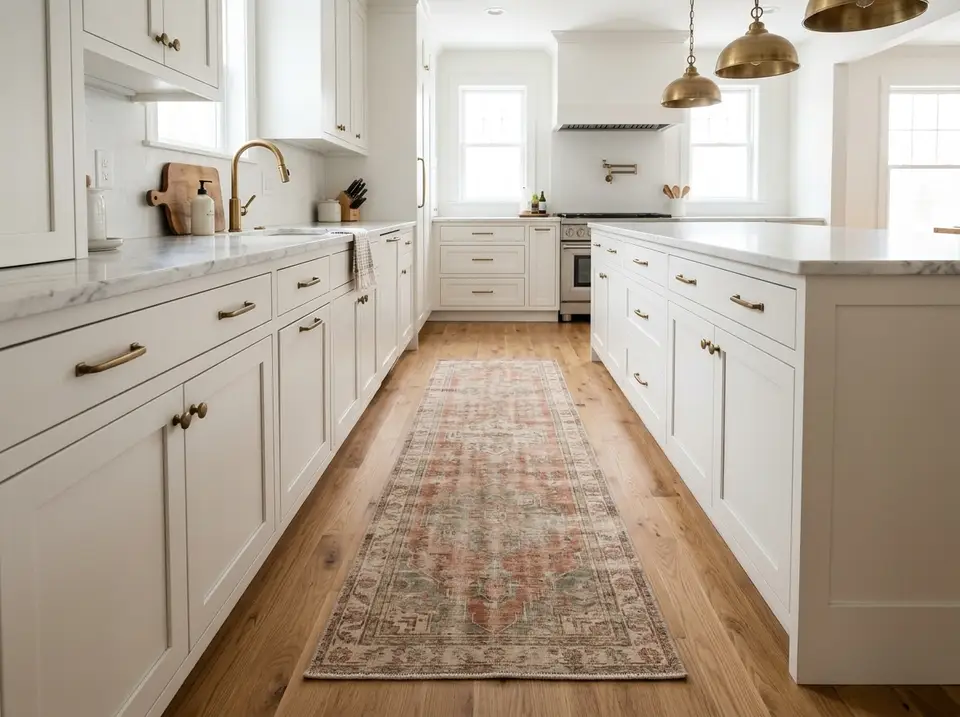
A washable runner with a faded terracotta and sage medallion lies in the work aisle between a run of white perimeter cabinets and a long island. An even strip of oak floor shows on both sides, and the runner stops well short of the range at the far end.
Here the runner cushions the sink side of the prep zone without reaching under the cabinet doors, the dishwasher or the island drawers.
What to Check
In a kitchen, leave 4 to 8 inches of floor at each side of the rug. Keep its edges away from the oven door so nothing catches when it opens, and choose a washable, low profile construction that survives spills.
Measure the clear aisle with every door and drawer open at once, since that crowded moment, not the empty aisle, sets the width.
A Practical Specification
Center the runner on the longest uninterrupted cabinet run, which in this layout is the sink wall facing the island.
A grippy pad matters because the turns between sink and island are quick and often made carrying something hot or wet.
What 5 by 8, 8 by 10 and 9 by 12 Look Like
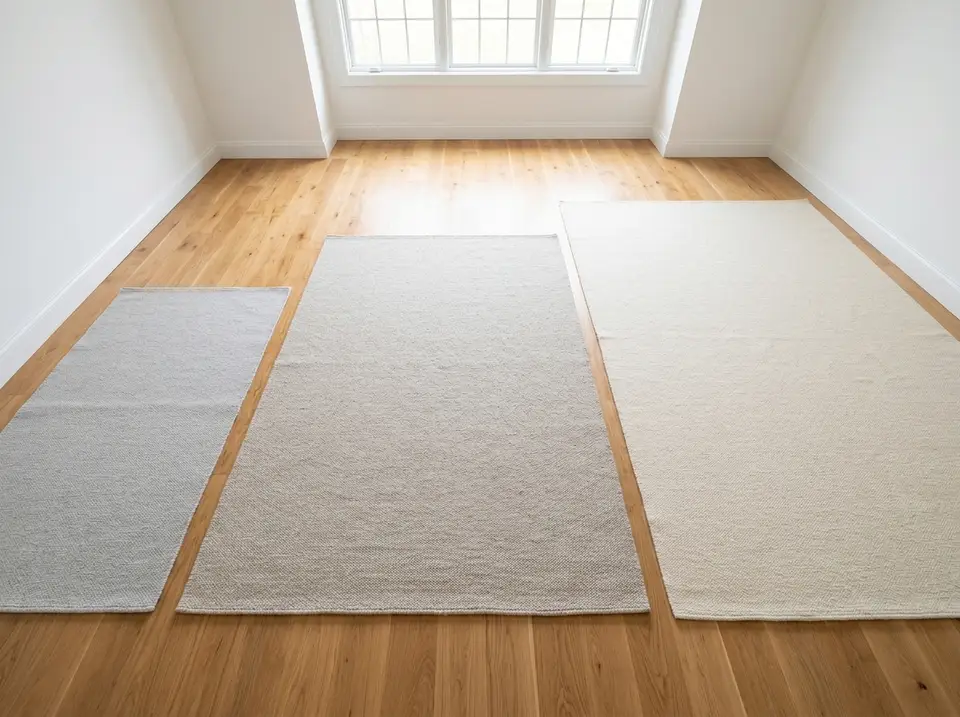
Three plain flat weave rugs in light gray, mid gray and ivory are laid side by side on an empty oak floor below a wide window. Seen together, the step between each standard size looks far larger than the label numbers suggest.
A size printed on a label stays abstract until it is marked at full scale, which is why an empty room is the easiest place to compare candidates before the furniture comes in.
What to Check
The area figures make the jump between sizes clear. A 5 by 8 covers 40 square feet, an 8 by 10 covers 80 square feet, double the smaller rug, and a 9 by 12 covers 108 square feet, which is why it can hold a whole seating group.
Compare area as well as length and width. One extra foot on a side looks trivial on a label, yet the 9 by 12 covers about a third more floor than the 8 by 10.
A Practical Specification
For a size test like this one, tape the outline of each candidate in a different color so all three can be judged in the actual room at once.
Record the chosen size in both feet and inches before ordering, since some listings round a slightly smaller rug up to the nearest standard size.
Layering a Patterned Rug Over Jute
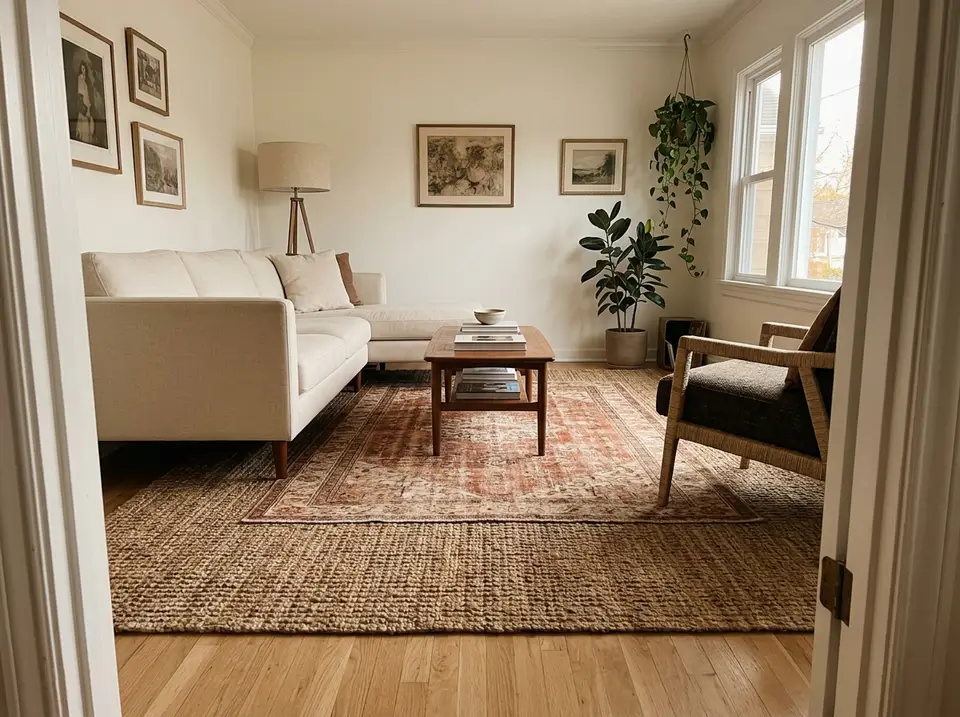
A faded terracotta rug sits over a much larger chunky jute base in a small living room, with the sofa and a woven armchair resting on the jute. The base shows as an even band all round the patterned rug, which keeps the layering looking intentional.
Two layers succeed when the bottom rug sets the furniture footprint and the top rug brings the pattern. Here the jute carries the size and the patterned piece carries the color, so neither has to do both jobs.
What to Check
When layering, expose 8 to 18 inches of the base rug around the top one so both read clearly. Use pads that prevent both layers from moving, and keep the top rug clear of door swings, where a double thickness catches most easily.
Lay the larger rug first, square to the sofa, then align the smaller one with the center of the seating rather than the center of the room.
A Practical Specification
Choose a thin top rug so the combined edge does not turn into a step, particularly where the patterned layer crosses the walking path from the doorway.
Vacuum the layers separately several times a year, because grit works through the top rug and settles in the open jute weave below.
Living Room Rug With Every Leg On
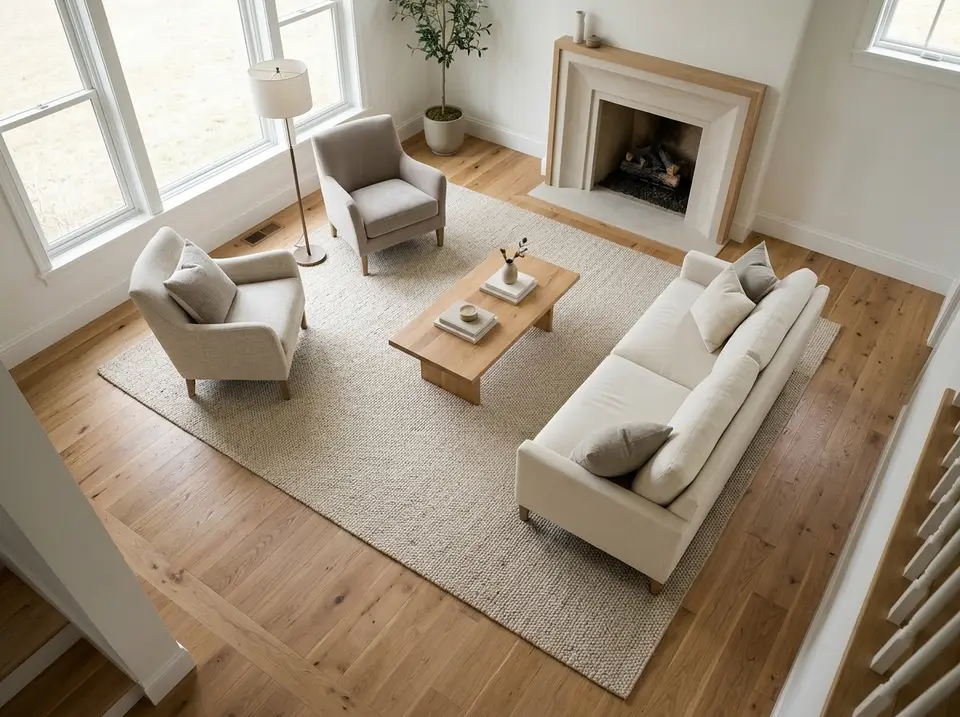
Seen from above, a large chunky wool rug holds a cream sofa, two armchairs and an oak coffee table with all their legs on it. A generous band of oak floor is left between the rug and the walls, the fireplace hearth and the floor register under the window.
With every leg on, the large room calms down because each seat belongs to the same field, and the fireplace becomes the clear focus at one end of it.
What to Check
Keep a consistent border of floor near the walls so the rug looks planned for the room. Avoid covering the floor registers, and check that side tables remain level, whether they sit fully on the rug or fully off it.
Measure the outer footprint of the furniture, from the back of the sofa to the back of the far chairs, and add several inches so no leg sits right on the binding.
A Practical Specification
A 9 by 12 foot rug is a common starting point for a full size seating group like this one; a longer sofa may push the room to the next size up.
Wool handles compression well under heavy upholstery, and a dense loop like the one shown tends to recover from sofa feet better than a soft cut pile.
Rug Size for a King Bed
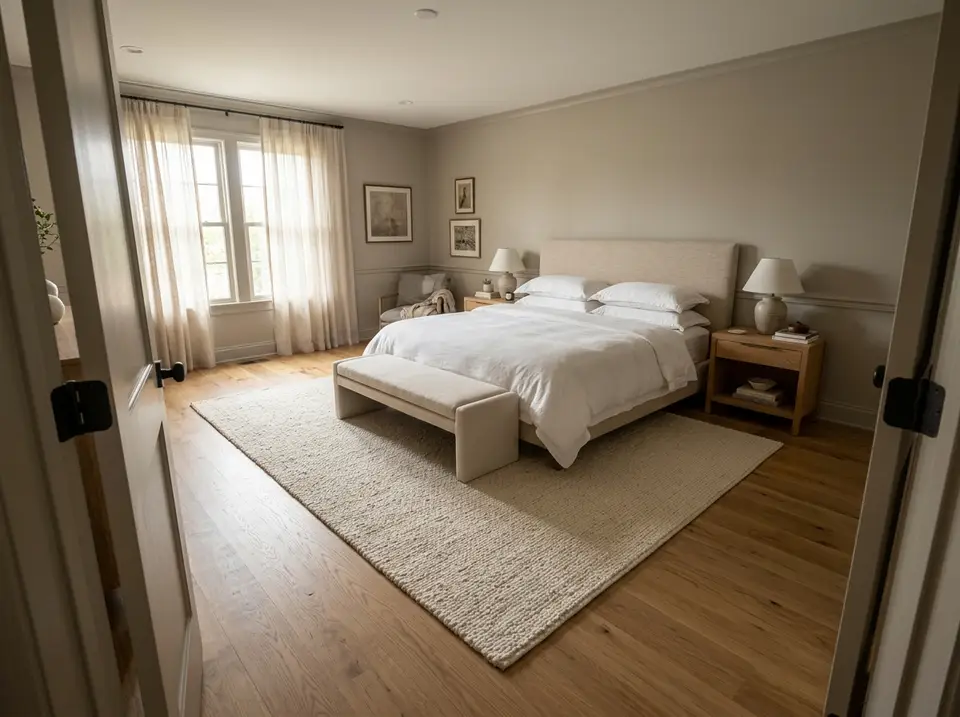
A king bed with an upholstered headboard sits on a large textured ivory rug, with a long bench at the foot also on the rug. The nightstands stand off the rug on the oak floor, and wide strips of rug show beyond both sides of the mattress.
Both sleepers should step onto pile, and with a king that takes a broad rug, because the mattress alone covers much of a medium size.
What to Check
Under a bed, aim for roughly 24 to 30 inches of rug at each side, enough to land on when you get up. Place the nightstands off the rug when possible so they stay level, and extend the rug beyond the bench at the foot of the bed.
Measure the bed frame rather than relying on the mattress label, since an upholstered headboard and side rails like these can add several inches to the width.
A Practical Specification
A 9 by 12 foot rug is the dependable full coverage choice for many king rooms, and it leaves room at the foot for a bench as in this rendering.
Choose a pad that will not mark hardwood under the concentrated weight of the bed legs.
Why a Small Living Room Rug Looks Wrong
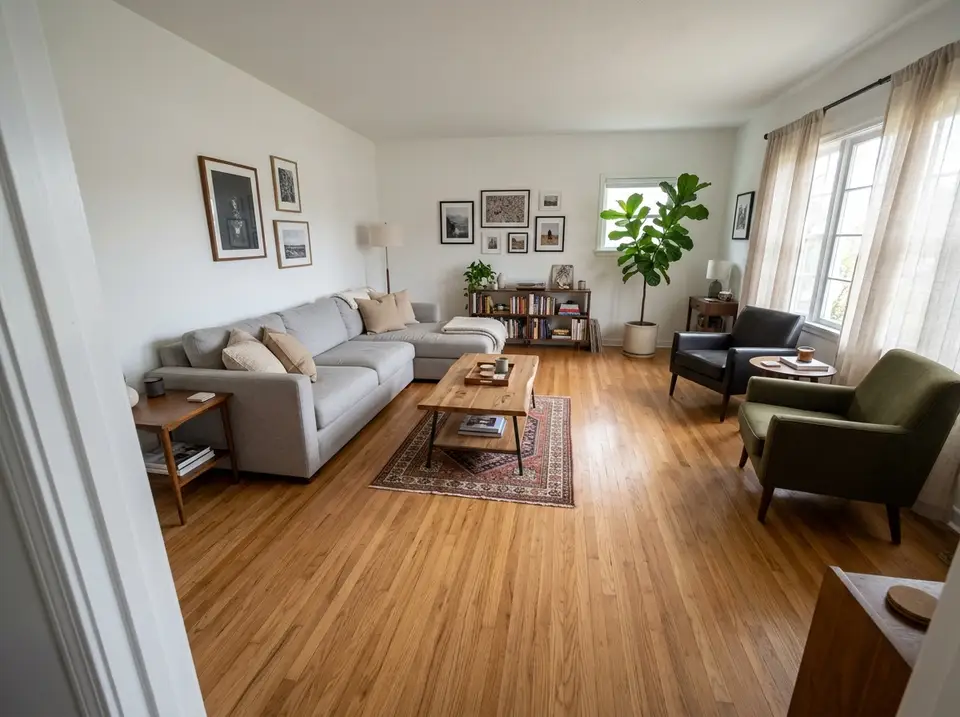
A small red patterned rug sits under the coffee table of a long living room, while the gray sectional, a leather chair and a green armchair all stand on bare floor around it. The gap between the rug and every seat is what makes the arrangement feel scattered.
Nothing is missing in the way of furniture; the trouble is that a small center patch cannot connect it, so the eye reads four separate islands instead of one conversation area.
What to Check
At minimum, the front legs should reach the rug, which is what ties a seating group together. Keep walking paths outside the rug edge so it does not become a trip line, and if the size feels borderline, use tape to test the next standard size up.
Judge the rug against the seating footprint rather than the open floor. In this room that footprint runs from the sectional to the two chairs by the window, far beyond the coffee table.
A Practical Specification
Moving the same small rug to a reading corner is often better than forcing it into the main group, and under the two window chairs it would suit its size.
Put the budget into size first; fiber and pattern can be refined later.
Rug Size for a Queen Bed
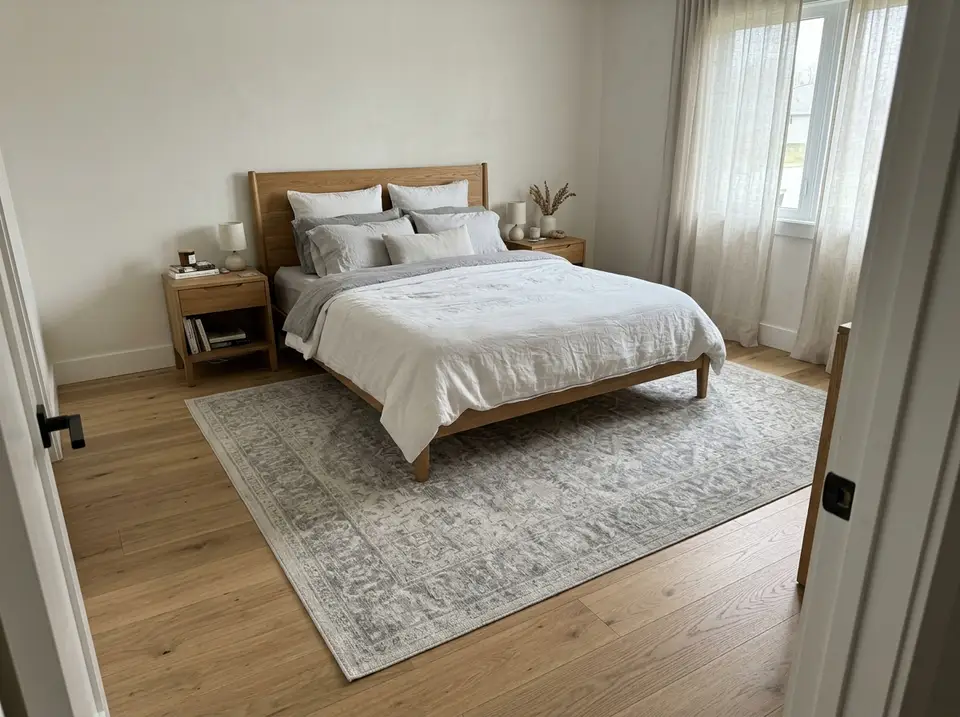
A queen bed with an oak frame rests over a gray and ivory distressed rug, and the nightstands sit just off its top edge. The rug shows evenly beyond both sides and well past the foot, so each sleeper gets a soft landing.
A queen allows more flexibility than a king, but a narrow rug still looks pinched once the duvet hangs over the sides and hides part of it.
What to Check
For this bed, aim for about 18 to 24 inches of rug at both sides, enough for bare feet in the morning. Keep the top edge near the nightstands rather than far down the room, and check the foot clearance with a bench in place before you settle on the size.
Measure from the outside of the bed frame, including any side rails that project past the mattress.
A Practical Specification
An 8 by 10 foot rug fits many queen rooms; a 9 by 12 creates a broader border and suits a room as open as this one.
Use a medium scale pattern so much of the design remains visible around the bed, as the faded medallion border does here.
Materials, Pads and Maintenance by Room
Wool is resilient under sofas and beds, sheds less after the first months and can be spot cleaned, but the upfront cost is higher. Polypropylene and washable polyester are practical in entries, kitchens and family rooms. Jute adds dry texture, yet it dislikes repeated moisture and can feel rough beside a bed.
Pile height matters as much as fiber. Dining chairs move better over a flat weave or short pile. A thick bedroom rug feels soft but may stop a closet door. A robot vacuum also needs a clean edge transition, so confirm its stated threshold capacity before combining a rug and pad.
Rotate a rug every six months where sunlight or traffic is uneven. Vacuum without an aggressive beater bar when the maker recommends it. Blot spills from the outer edge toward the center, and use a professional cleaner for fiber specific treatment rather than soaking the backing.
Budget for the pad, delivery and return freight. A larger standard size in a simpler weave often gives a better room result than a smaller premium rug. Size establishes the composition. Pattern and hand feel refine it afterward.
Questions Readers Ask
What is the most common living room rug size?
An 8 by 10 foot rug is a common starting point for a medium living room, while a 9 by 12 foot rug usually fits a larger seating group. Tape the footprint before ordering.
Should a rug go under the sofa?
At minimum, place the sofa front legs and the front legs of nearby chairs on the rug. Large rooms often look calmer with every furniture leg on one rug.
What rug size works under a king bed?
A 9 by 12 foot rug gives useful coverage beside and beyond most king beds. An 8 by 10 may work across the lower two thirds if the room is tight.
What rug size works under a queen bed?
An 8 by 10 foot rug is the usual starting point. Check for 18 to 24 inches of visible rug at both sides.
How far should a dining rug extend?
Plan for about 24 inches beyond each table edge, and add more where large chairs need extra pullback.
Do hallway runners need a pad?
Yes. A pad reduces sliding and rippling. Choose one approved for the floor finish and cut it slightly smaller than the runner.
Can rugs be layered?
Yes. Use a large, flat base rug and a thinner patterned rug above it. Secure both layers so the upper rug cannot creep.
Sources and Pricing Notes
No prices appear in this guide, since 2026 US rug pricing swings too widely with fiber, construction and pad to give one useful allowance per room. Sales tax, delivery and return freight are worth confirming before ordering, because a large rug is costly to send back.
- Pottery Barn: room based rug sizing guidance.
- The Home Depot: current area rug dimensions and retail categories.
- U.S. Bureau of Labor Statistics: Consumer Price Index notes for household furnishings.
- The Home Depot: project calculators and current material categories.
- IKEA US: current furniture and storage categories.
Keep Planning
room styling cost guide, dining room design guide, mudroom storage ideas.
Styling & Living Desk
The Layered Homes editorial teamThe Styling & Living Desk produces the room-by-room guides, outdoor and garden pieces, celebration ideas and design solutions, each with an itemised cost estimate, and the Home Files essays.
More from the Styling & Living Desk →
Reader notes