


Entryway decor ideas have to work while hands are full. These eleven layouts start with door swing, shoe volume, coat capacity and the route into the home. Each one includes a palette and a 2026 allowance for the visible storage, rug and lighting.
Set the Working Budget Before Choosing a Style
Count the daily pairs of shoes, bags and coats before choosing furniture. A narrow console does not solve a high volume storage problem. Reserve money for the storage that matches the load, then add a mirror, runner and light.
Measure the door at its full swing and the narrowest point between walls or furniture. Tape the depth of a bench or cabinet. Walk through with a bag in each hand and check that a second person can pass.
Hooks, a shoe boundary and a small landing surface solve most entries. Build ins are valuable when the volume is real, not because every hall needs cabinetry.
1. Mid Century Entryway
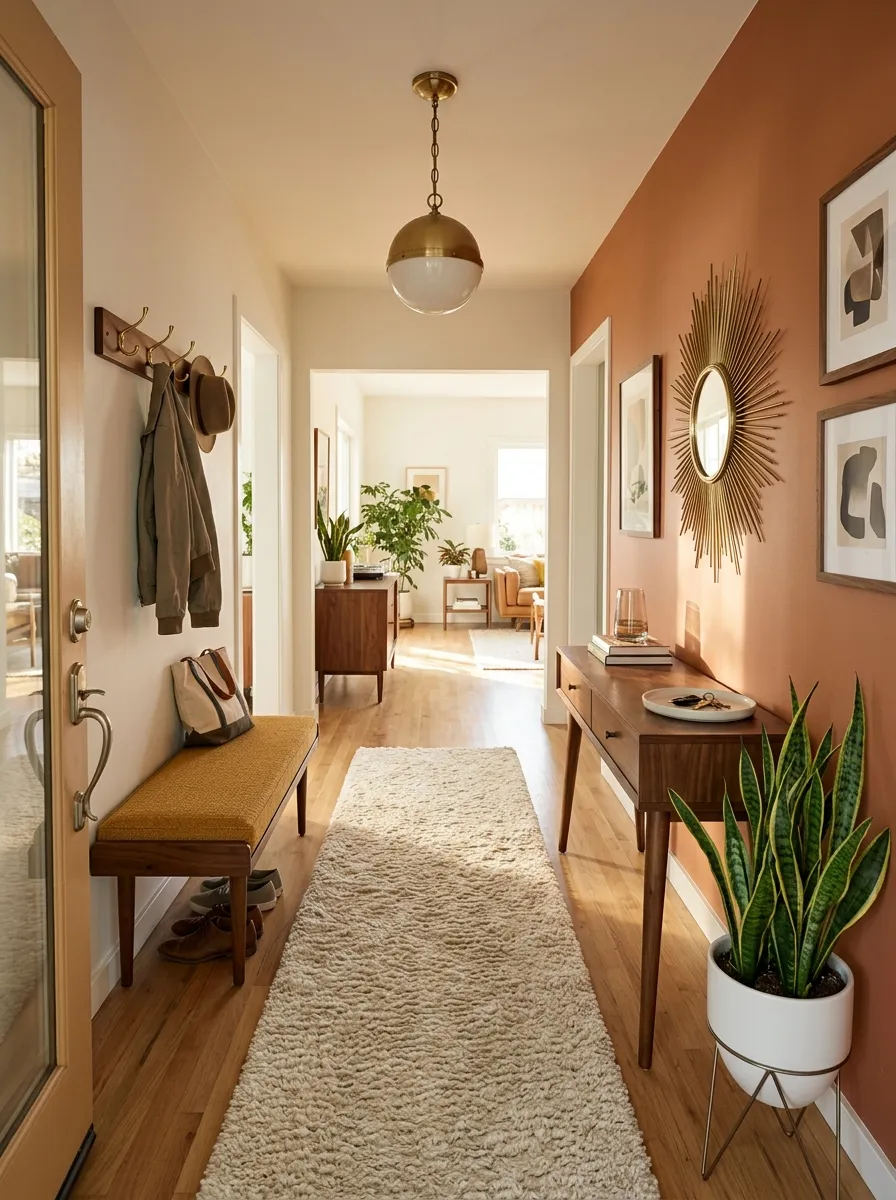
A slim walnut console, bench and clay wall fit a long hall. The arrangement gives keys, shoes and a brief seat. The strongest purchase is a console shallow enough for the path, because it establishes scale and handles the most daily use.
In the rendering the hall runs straight from the glazed front door toward the living room, with a mustard upholstered bench and a brass hook rail on the pale left wall and the walnut console against the clay wall opposite. The runner lies between them, and that gap is the measurement to protect: aim for at least 36 inches of clear floor on the main walking line where the hall permits. A brass globe pendant hangs over the middle of the run, but hands are busy at the console and the bench, so a small lamp or sconce near the console earns more than a brighter ceiling fixture.
Materials and Layout
The key piece is a console shallow enough for the path. Many mid century consoles run deep, so measure the hall and choose one that leaves the walking line at full width. Walnut, wool, brass and clay paint give the entry warmth from the first step inside.
The arrangement handles keys, shoes and a brief seat, which covers most daily arrivals. Keep a clear route that protects the door swing, the stair and the path into the home, so the console never stops the door short.
We price this hall at $1,200–$2,000. The walnut console sits in the Main storage piece line at $480–$700, the widest single range here, and the shaggy wool runner falls under Textiles and floor layer at $230–$410; those two lines take about 56% of the high figure. The rest is smaller: $150–$280 for Lighting and hardware such as the globe pendant and hook rail, $200–$360 for Storage and small pieces, and $130–$260 for Art, plants and finishing pieces, which in this hall means the sunburst mirror, the framed prints and the snake plant.
These allowances cover furnishing and finishing a hall whose floor, wiring and any built ins already work; they are not a construction quote. If a sound console or bench is already in the house, reusing it can take roughly a third off the total, and that holds for most of the layouts below.
Set the clay feature wall aside and the colour logic is simple. Warm plaster (#E7DED0) covers the door side of the hall and the ceiling, Light oak (#C49D72) runs the full length of the floor, Moss (#61705A) shows up only in the snake plant and the olive jacket on the hooks, and Charcoal (#343735) is held to the abstract shapes inside the framed prints.
Because the floor is the only place light oak appears, a picture frame or a tray in the same tone on the console would tie it back into the furniture. The sunburst mirror and two prints already fill the clay wall; a third object there would start to compete with them.
2. Classic American Entry
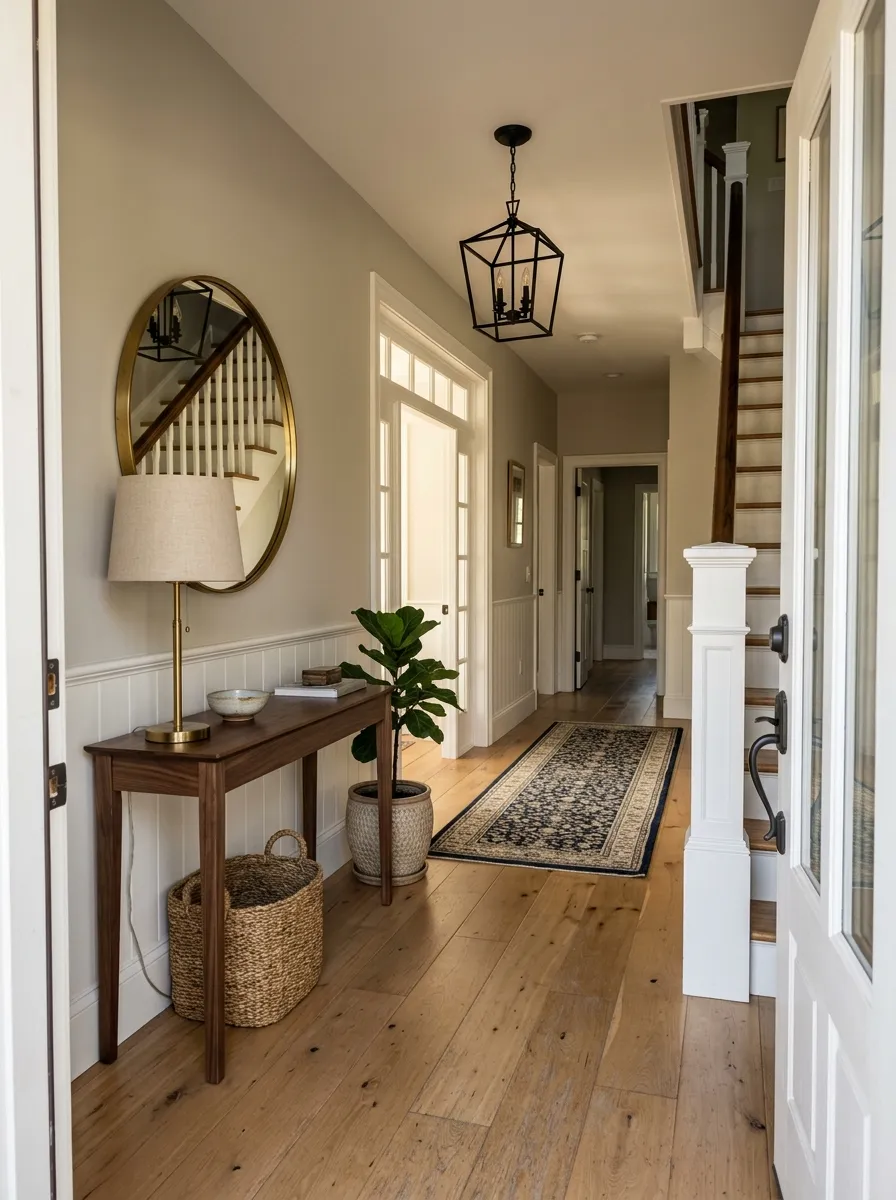
A wood console, round mirror and runner balance a conventional stair hall. The arrangement gives daily landing space within formal architecture. The strongest purchase is the runner and correctly scaled console, because it establishes scale and handles the most daily use.
Here the front door opens straight into a stair hall: newel post and white balusters on the right, the walnut console with a brass lamp and a round brass mirror on the left, and a dark patterned runner leading down the hall. White wainscoting below a greige wall keeps the scuff zone tough, and the oak floor between console and newel should stay at 36 inches clear or more. A seagrass basket under the console takes the overflow of shoes or scarves, and the iron lantern overhead lights the foot of the stair as well as the console.
Materials and Layout
Spend first on the runner and a correctly scaled console. In a classic American entry they set the proportions, and a console too small for a formal hall looks lost. Oak, wool, glass and dark metal suit the traditional architecture without dating it.
The goal is daily landing space within formal architecture: a tray for keys, a lamp and a place for mail. Because the console faces the newel post, its depth is the dimension that matters most, since anyone coming down the stair with an armful of laundry steps straight into that gap.
For this stair hall the full 2026 allowance is $1,410–$2,360. Most of it goes to the console, listed as Main storage piece at $570–$830, and to the runner, under Textiles and floor layer at $270–$480, which between them make up about 56% of the upper estimate. A traditional lantern and lamp sit in Lighting and hardware at $180–$330; baskets and boxes under Storage and small pieces run $240–$420; the mirror, plant and last accessories under Art, plants and finishing pieces come to $150–$300. Ask for the console price first, since a solid wood piece at the right length is where the total swings most.
In this hall Soft white (#F0EEE8) belongs to the wainscoting, the door and the stair trim, Warm wood (#8A6446) to the console and the handrail, and Iron (#343633) to the lantern and the door hardware. Historic blue (#506477) appears only in the dark field of the runner, so it reads as chance until it turns up a second time, perhaps in a lamp base, a stair runner or the inside of the front door.
The fiddle leaf fig is the tallest loose object in the scene, and it stands at the pinch point between the console and the doorway. In a real hall it belongs at the far end of the run, where a passing shoulder will not knock its leaves off.
3. Modern Farmhouse Hall
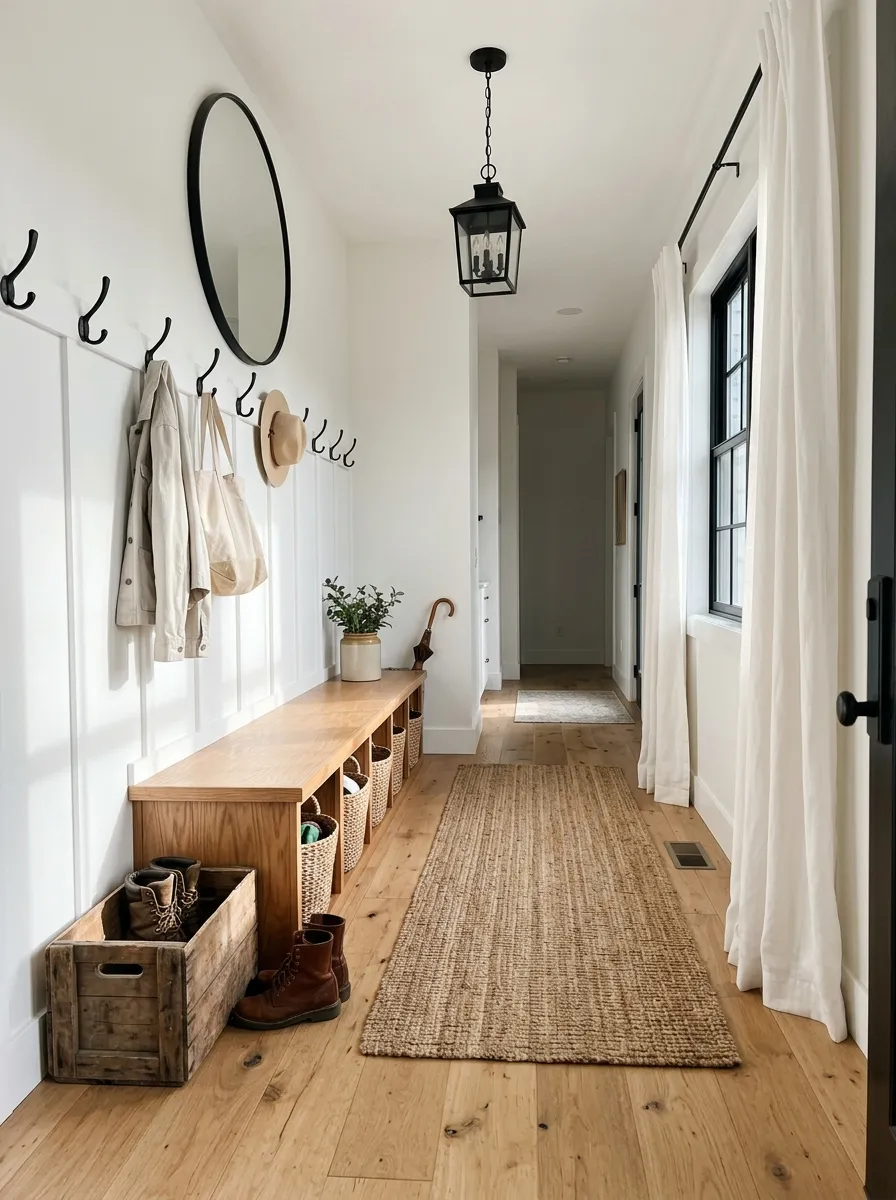
A long bench, hooks and baskets turn one wall into open storage. The arrangement gives coats, shoes and bags for a family. The strongest purchase is the bench and wall mounted hook rail, because it establishes scale and handles the most daily use.
The rendering lines one long wall with board and batten and a row of black hooks above an oak bench with open cubbies, each holding a seagrass basket. Boots wait in an old wooden crate at the end of the bench, a jute runner covers the middle of the wide oak boards, and linen curtains soften the window wall opposite. A single black lantern hangs over the centre of the run, and with the bench pushed to the wall the hall keeps well over 36 inches of open floor.
Materials and Layout
The working pieces of a farmhouse hall are the bench and a wall mounted hook rail. The bench is for pulling boots on and off, and the rail keeps coats off the floor. Oak, jute, iron and cotton suit a space that sees mud, rain and constant traffic.
The plan is sized for coats, shoes and bags for a family, with a hook or two per person. Keep a clear route that protects the door swing, the stair and the path into the home, so a full rail of coats does not narrow the passage.
Our estimate for this hall is $1,270–$2,120. The bench with its cubbies is the Main storage piece at $510–$740, and the jute runner and curtains belong to Textiles and floor layer at $240–$430; roughly 55% of the high end goes on those two. The hook rail and lantern fit in Lighting and hardware at $160–$300, the baskets and crate in Storage and small pieces at $220–$380, and the mirror and potted greenery in Art, plants and finishing pieces at $140–$270. Board and batten, if the wall does not have it yet, is carpentry outside these numbers.
Soft white (#F0EEE8) does most of the work here, on the panelled wall, the ceiling and the curtains. Warm wood (#8A6446) is the bench, the crate and the leather boots, and Iron (#343633) repeats in the hooks, the lantern, the mirror frame and the window mullions. Historic blue (#506477) is not in the rendering at all; if the plan calls for it, a painted front door or blue ticking on a bench cushion would bring it in without breaking the white shell.
A full rail of coats sticks out several inches from the board and batten, so choose the bench depth with winter coats on the hooks rather than against a bare wall.
4. Tiny Apartment Landing
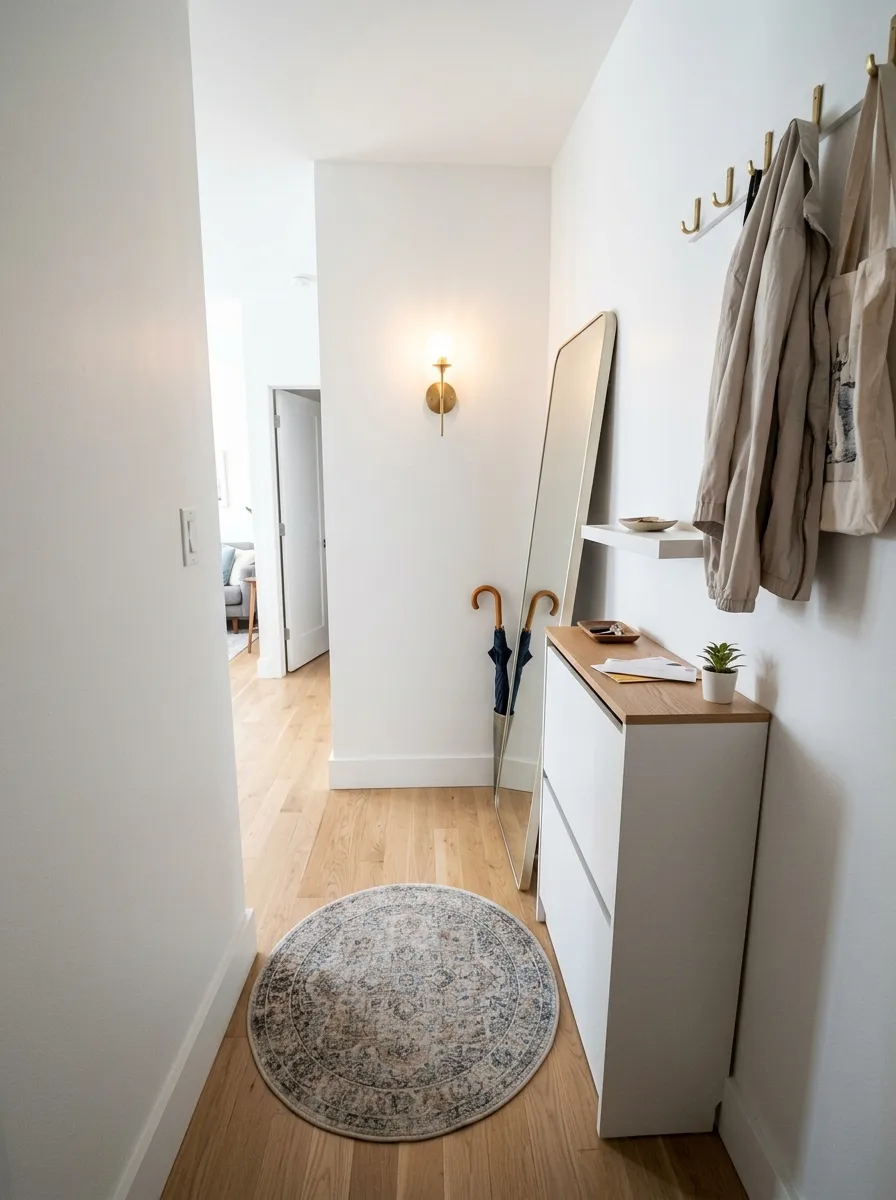
A slim white shoe cabinet with an oak top, a floating shelf and a full length mirror leaning on the end wall use the few feet beside the door. Together they hold shoes and pocket items in minimal depth. The cabinet is the purchase to get right, and it has to be tip resistant, because a shallow box of that height is easy to pull over.
In the rendering the landing is little more than a corridor: the shoe cabinet carries a tray for keys and the day's mail, brass hooks above it hold a jacket and a tote, a round rug marks the arrival point, and a brass sconce lights the end wall. Even here the walking line should stay at 36 inches or close to it, which is why every storage piece sits flat against one wall.
Materials and Layout
In a tiny landing the essential piece is a tip resistant slim cabinet, anchored to the wall because shallow cabinets tip easily. Painted wood, glass, steel and wool keep the corner light, with glass and slim steel taking up little visual room.
The aim is to hold shoes and pocket items in minimal depth, which suits a landing with almost no floor. Keep a clear route that protects the door swing, the stair and the path into the home; a few inches of depth saved here matter.
The landing is the least expensive plan in the guide at $850–$1,410. The slim cabinet, Main storage piece, takes $340–$500, and the round rug with any other soft goods, Textiles and floor layer, takes $160–$290, about 56% of the top figure together. Then come Lighting and hardware at $110–$200 for the sconce and hook rail, Storage and small pieces at $140–$250 for the shelf, tray and umbrella holder, and Art, plants and finishing pieces at $90–$180, which in this plan mostly means the mirror and a small plant.
The palette is almost all background. Warm plaster (#E7DED0) sits close to the off white of the walls and cabinet, Light oak (#C49D72) shows in the floor and again in the cabinet top, so the wood already repeats, Moss (#61705A) is limited to the small succulent, and Charcoal (#343735) appears only in the faded pattern of the rug.
The leaning mirror is the tallest thing in the landing, and it rests exactly where the walking line narrows beside the cabinet. Fix it to the wall with a cleat or a strap, or hang it outright, so a bag swung off a shoulder cannot bring it down.
5. Built In Locker Wall
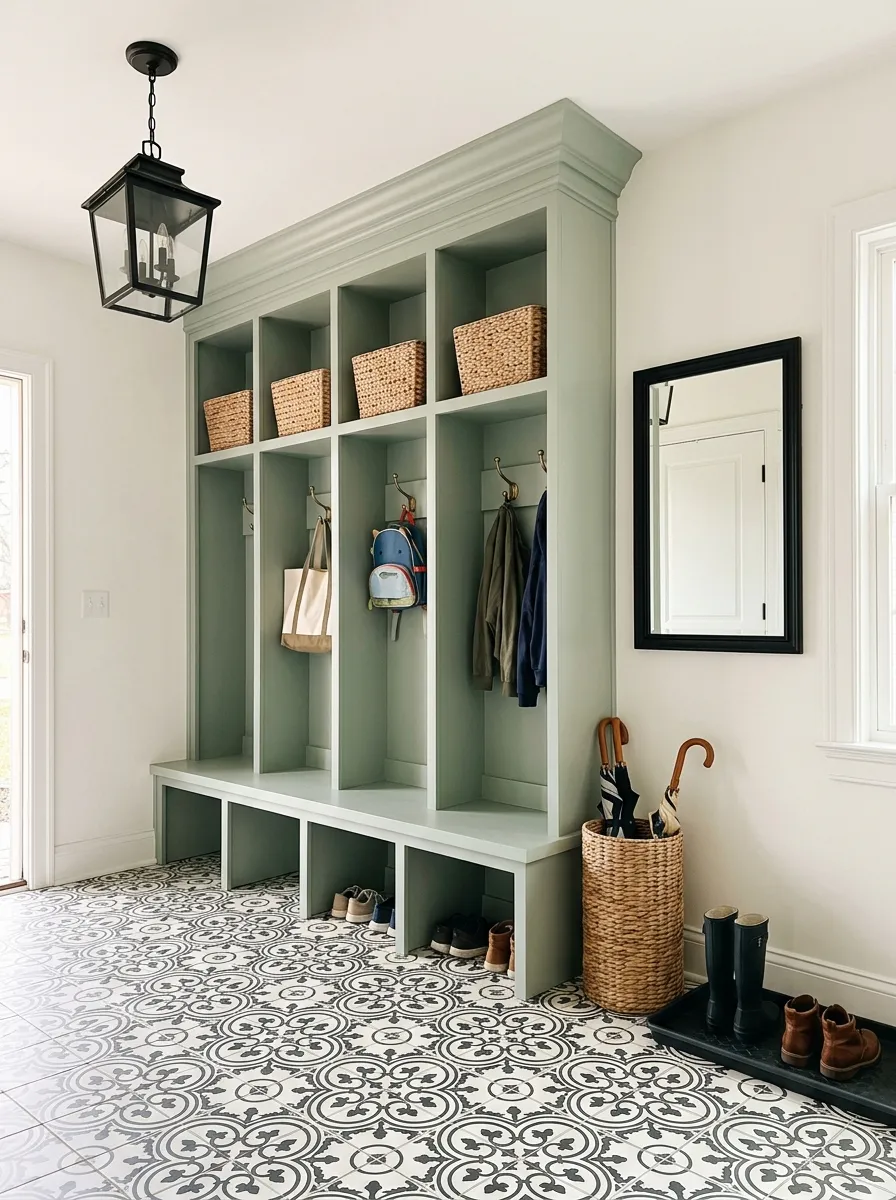
Tall painted cubbies give each household member a defined bay. The arrangement gives high volume coat and bag storage. The strongest purchase is secured cabinetry sized to the wall, because it establishes scale and handles the most daily use.
The rendering shows a run of four sage green lockers under a crown moulding, each with an open bay, a double hook, a basket cubby above and a shoe slot below the bench seat. The floor is black and white patterned cement tile, a black lantern hangs to one side, and a rubber boot tray and a woven umbrella basket sit beside a black framed mirror. Measured from the front of the bench seat, 36 inches of open tile is a sensible minimum for this room.
Materials and Layout
A locker wall depends on secured cabinetry sized to the wall: built to the exact length and fixed to studs, since full height units carry real weight once filled. Painted wood, tile, wicker and iron make the wall durable, with tile underfoot to take wet boots.
The design handles high volume coat and bag storage for a busy household. The bays in the rendering are open, with no doors, which keeps the aisle simple: plan for someone sitting on the bench with legs stretched out, and leave the rest of the floor clear for the front door swing and the route into the house.
Built cabinetry pushes this plan to the top of the guide in 2026 at $2,120–$3,530. The lockers themselves, Main storage piece, are budgeted at $860–$1,240, and Textiles and floor layer at $410–$720 covers the boot tray, cushions and any rug; together that is about 56% of the upper estimate. Hook hardware and the lantern sit in Lighting and hardware at $270–$500, the baskets and umbrella holder in Storage and small pieces at $360–$630, and the mirror and finishing touches in Art, plants and finishing pieces at $230–$450. A written cabinetry price for the locker run should come before anything else is ordered, since that line moves the total more than any other.
Moss (#61705A) leads here, carried by the whole locker unit in a lighter sage cast, while Charcoal (#343735) repeats in the tile pattern, the lantern, the mirror frame and the boot tray. Warm plaster (#E7DED0) is the wall and trim colour around them. Light oak (#C49D72) has no surface yet; an oak bench top in place of the painted one would add it where hands and bags touch most.
Painted bench seats chip quickly where shoes are pulled on and off, so specify a hard enamel or a clear coat over the paint on the seat, and keep a small jar of the exact green for touch ups.
6. Scandinavian Entry
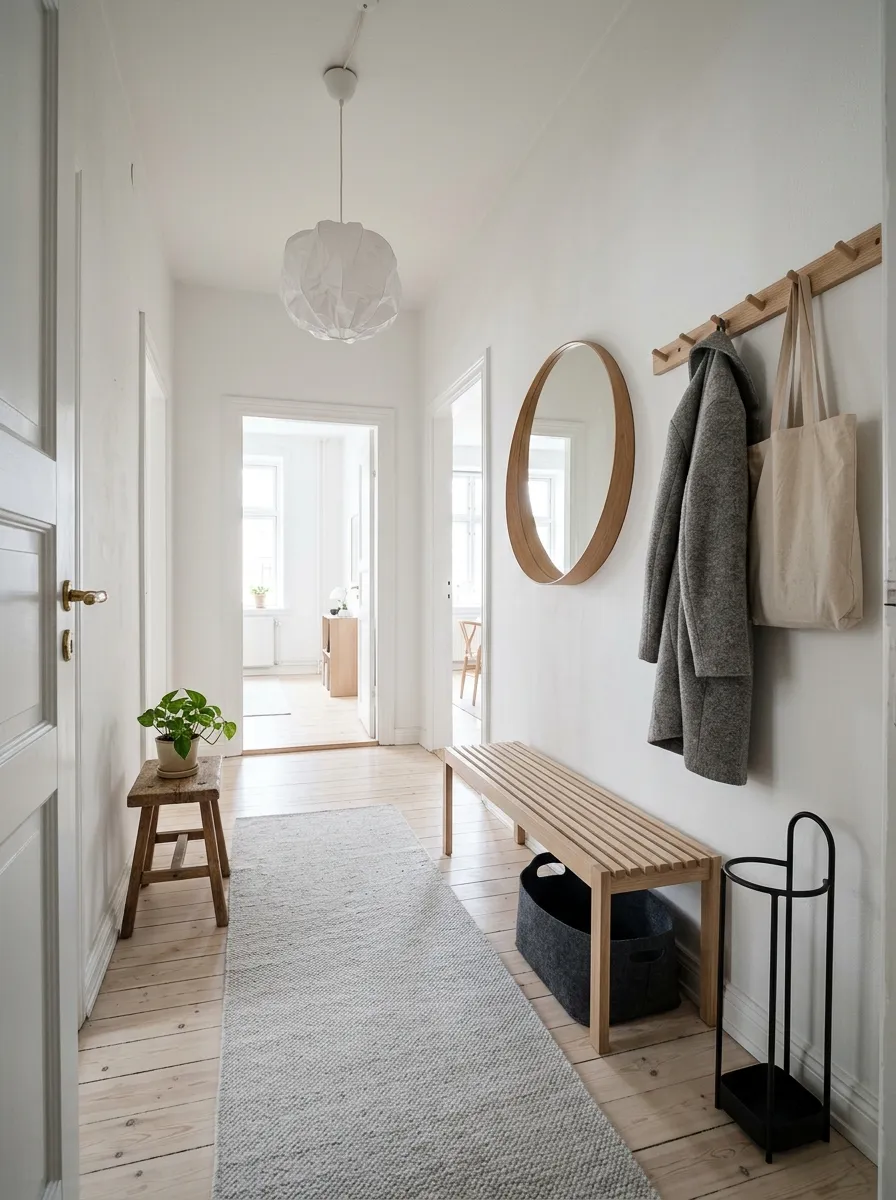
A simple bench, peg rail and pale runner leave the hall open. The arrangement gives a small daily load with easy reset. The strongest purchase is the bench and limited hook count, because it establishes scale and handles the most daily use.
Almost nothing stands in this hall: a slatted pale wood bench with a felt basket beneath, a wooden peg rail holding a grey coat and a canvas tote, a round oak framed mirror, a pale grey runner, a black steel umbrella stand and a small stool with a trailing plant by the door. A paper pendant hangs from the high ceiling, and the bleached floorboards stay bare at the edges. The runner is narrow enough that the walkway beside the bench stays near 36 inches.
Materials and Layout
A Scandinavian entry keeps things simple: the bench and a limited hook count. Fewer hooks means less clutter on the wall, which keeps the light look intact. Birch, wool, cotton and white paint keep the entry bright.
This works for a small daily load with easy reset, where coats and bags go back in their place each evening. Keep a clear route that protects the door swing, the stair and the path into the home, so the open floor that makes the style feel calm stays clear.
In 2026 terms we put the Scandinavian hall at $1,060–$1,770. The bench is the Main storage piece line at $430–$620, the wool runner and felt basket fall into Textiles and floor layer at $200–$360, and those two account for about 55% of the higher number. The paper pendant and peg rail come under Lighting and hardware at $140–$250; the umbrella stand and stool under Storage and small pieces at $180–$320; the mirror and plant under Art, plants and finishing pieces at $110–$230. A plain solid birch or ash bench is the price to pin down first.
Warm white (#EFECE3) covers walls, doors and ceiling, and Pale oak (#C7A77D) runs through the bench, peg rail, mirror frame and floor. Mist blue (#C8D8DA) and Soft navy (#354B5E) are the planned accents, yet in the rendering they barely register, and the cool grey of the coat and runner stands in for them. Painting the inside of the front door in mist blue and choosing a navy tote or cushion would make the two blues part of the scheme rather than a note on paper.
The peg rail has only a handful of pegs, and that limit is the point of the style: once it fills, the overflow belongs in a closet, not on a second rail.
7. Dark Formal Entry
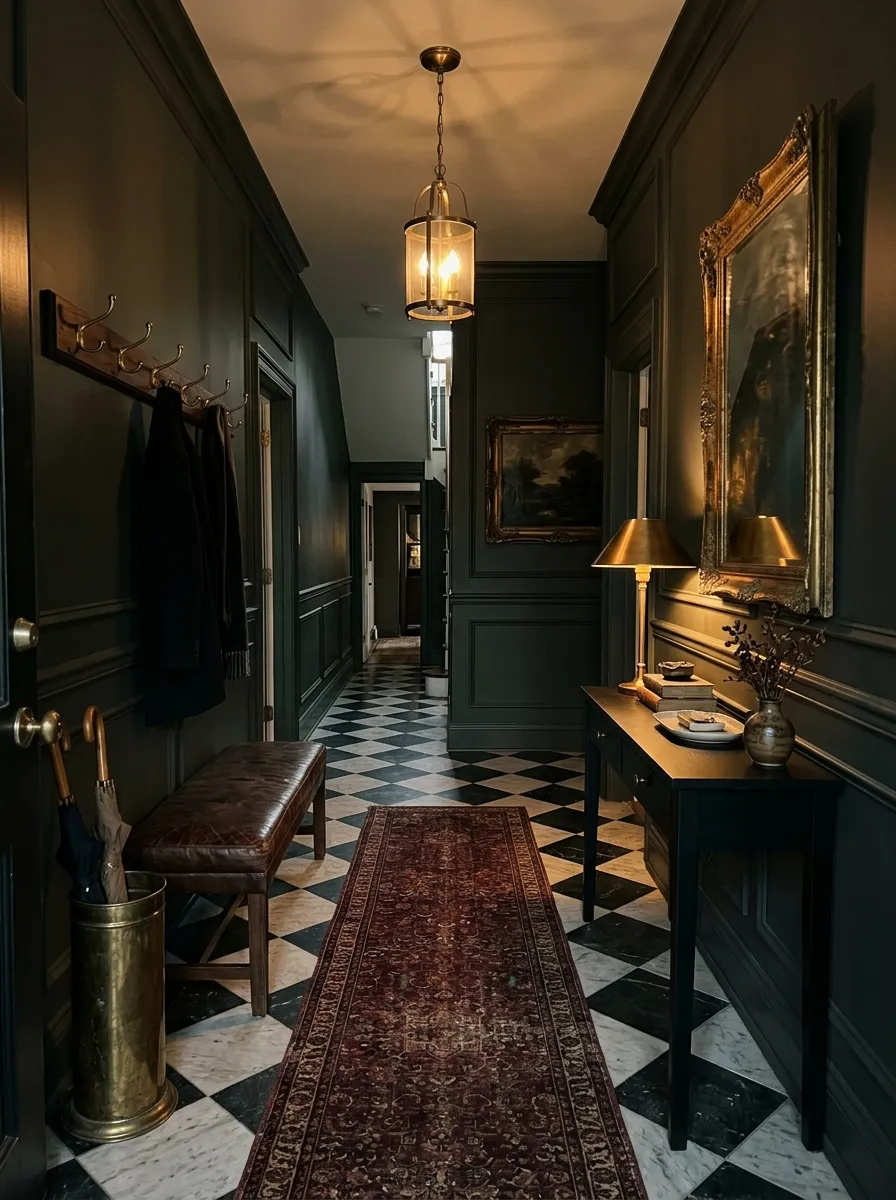
Deep walls, patterned floor and warm pools of light create a strong arrival. The arrangement gives an evening entry with controlled storage. The strongest purchase is good lighting and a durable runner, because it establishes scale and handles the most daily use.
The rendering paints walls, panelling and trim in one near black green, lays a black and white marble checkerboard floor and runs a faded burgundy rug down the centre. A leather bench and a brass umbrella stand sit on the left beneath a hook rail of heavy coats; on the right a slim black console carries a brass lamp, books and a vase of dried stems under a large gilt framed painting. A glass lantern hangs overhead, and the bench and console face each other, so the 36 inch walking line has to be measured between them.
Materials and Layout
Good lighting and a durable runner come first in a dark formal entry. Deep wall colors need enough light to read well at night, and the runner takes most of the wear. Dark paint, brass, wool and stone set the mood, with brass catching the light at the door.
This is an evening entry with controlled storage. In the rendering, storage is limited to the console's shallow drawers, the hook rail and the umbrella stand, so a household with more shoes than that needs a closed cabinet somewhere nearby. Keep the path from the door past the bench well lit, because on a high contrast checkerboard the edge of a dropped bag is hard to read in dim light.
The dark formal entry is budgeted at $1,620–$2,710. Its two heaviest lines are Main storage piece at $660–$950, which covers the console and bench, and Textiles and floor layer at $310–$550 for a runner that will take the wear, together near 55% of the top estimate. Brass lamp, lantern and hooks fall within Lighting and hardware at $210–$380, a thin line for a scheme that depends on light; Storage and small pieces takes $280–$480, and Art, plants and finishing pieces takes $170–$350, a range that buys a framed print rather than an oil painting in a gilt frame.
Deep charcoal (#252725) is the wall, the panelling and the console, with a green undertone in the rendering. Ink blue (#263747) is meant as its companion but shows only in shadow; a second dark tone on the doors or the ceiling would make the shift visible. Walnut (#6B4F3A) belongs to the leather bench and the hook board, and Aged brass (#A98252) to the lantern, lamp, umbrella stand and picture frame, which is where the eye lands first.
One large painting does more on these walls than a cluster of small frames, because dark panelling swallows small objects. The gilt frame here is sized close to the width of the console below it, which is a good rule to borrow.
8. Coastal Hall
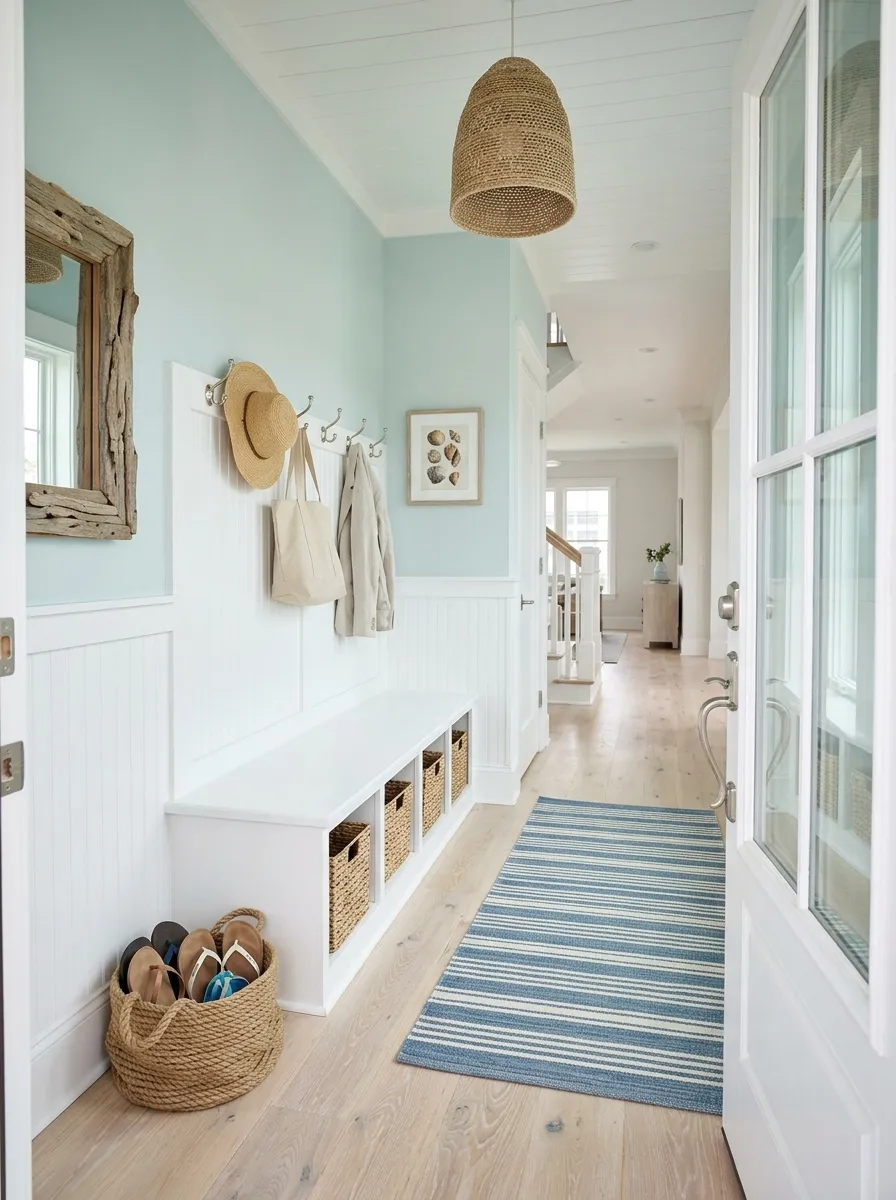
Blue walls, painted storage and a striped runner handle sandy shoes. The arrangement gives washable storage near an outdoor route. The strongest purchase is easy clean floor and shoe baskets, because it establishes scale and handles the most daily use.
The rendering pairs pale aqua walls with white beadboard wainscot, a white bench with four woven basket cubbies, and nickel hooks holding a straw hat, a canvas tote and a linen jacket. A rope basket of flip flops sits on the floor, a blue and white striped runner leads in from the glazed door, and a woven pendant hangs from a white planked ceiling. A driftwood mirror and a framed shell print finish the wall. The bench is shallow enough to leave about 36 inches of floor for someone carrying a cooler.
Materials and Layout
A coastal hall needs an easy clean floor and shoe baskets first, because sand and water come in with every visit to the beach. Painted wood, cotton, jute and pale oak keep the look relaxed and forgiving of a damp towel.
The goal is washable storage near an outdoor route, with baskets and cotton liners that can go straight in the wash. Keep a clear route that protects the door swing, the stair and the path into the home, and leave space for a wet umbrella beside the door.
Pricing for the coastal hall comes to a 2026 range of $1,130–$1,880. The cubby bench is the Main storage piece at $460–$660, the widest range on the list, and the striped runner sits in Textiles and floor layer at $220–$380, roughly 55% of the top figure between them. The woven pendant and hooks take $140–$260 under Lighting and hardware; baskets, including the rope one for sandals, take $190–$340 under Storage and small pieces; the driftwood mirror and shell print take $120–$240 under Art, plants and finishing pieces. A flatweave cotton runner that fits in a washing machine is a better buy in this hall than a decorative wool one.
Of all eleven halls, this is where the palette lands most literally. Mist blue (#C8D8DA) is the upper wall, Warm white (#EFECE3) the beadboard, bench, door and ceiling, Pale oak (#C7A77D) the wide limed floorboards, and Soft navy (#354B5E) the stripes in the runner. The lighter stripes echo the wall colour, so the scheme needs no extra blue accessories.
Beadboard up to chair rail height takes knocks from wet bags and folding beach chairs, so a satin or semi gloss paint on the panelling wipes clean far more easily than the flatter finish on the blue wall above it.
9. Japandi Entry
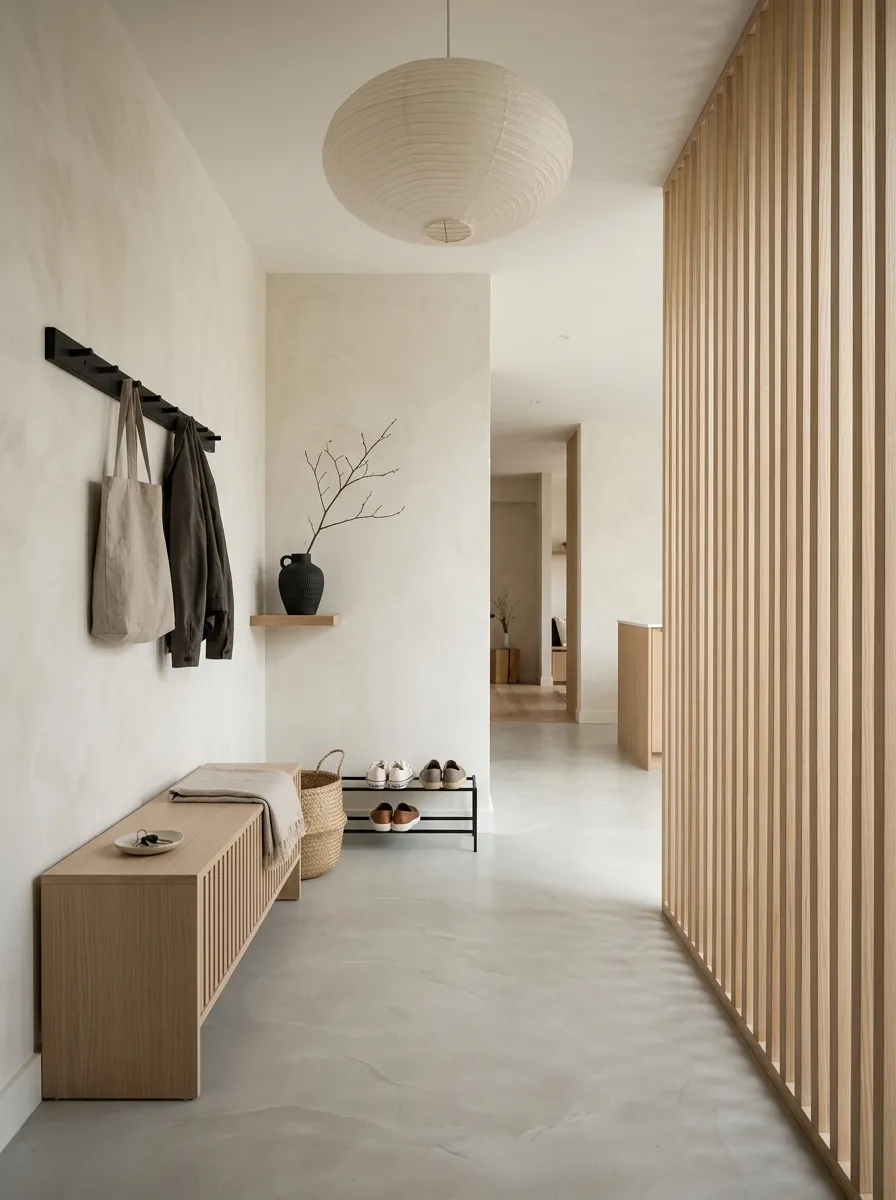
A slatted screen, low bench and one branch keep the path quiet. The arrangement gives small item storage with open floor. The strongest purchase is closed shoe storage under the bench, because it establishes scale and handles the most daily use.
The rendering sets a plaster wall against a full height oak slat screen, with a pale polished concrete floor between them. A low oak bench with a slatted front holds a folded throw and a key dish, a black peg rail carries a linen tote and a dark jacket, a short black metal rack holds a few pairs of shoes, and a single bare branch stands in a black jar on a small floating shelf. A paper lantern hangs above. With the bench against the plaster and the screen opposite, the open floor between them should be held at 36 inches or more.
Materials and Layout
A Japandi entry depends on getting shoes out of the way. Taking shoes off at the door is part of the style; the rendering parks them on an open black rack beside the bench, which suits three or four pairs, while a household with more should build closed shoe storage into the bench itself. Oak, charcoal, paper and plaster give the restrained palette, with the paper shade softening the light.
The plan supports small item storage with open floor: the key dish on the bench and the single shelf take everything that comes out of a pocket, and nothing stands in the middle of the concrete. The slat screen defines the hall without a solid wall, but its edge is still a line not to crowd with baskets or bags.
The Japandi hall comes in at $1,200–$2,000. The oak bench, Main storage piece, takes $480–$700, and the soft layer of throw and any runner, Textiles and floor layer, takes $230–$410; about 56% of the upper figure sits in those two lines. Lighting and hardware at $150–$280 covers the paper lantern and peg rail, Storage and small pieces at $200–$360 the shoe rack and basket, and Art, plants and finishing pieces at $130–$260 the jar, branch and dish. The slat screen is joinery and sits outside this allowance.
Warm plaster (#E7DED0) is the textured wall itself, and Light oak (#C49D72) appears at full scale twice, in the slat screen and the bench, then again in the small shelf. Charcoal (#343735) is held to the peg rail, shoe rack and jar, and Moss (#61705A) only to the dark olive jacket, so a moss linen cushion on the bench or a living plant in place of the branch would make it a deliberate part of the scheme.
A sealer on the concrete and a small washable mat right at the door keep wet soles from marking a floor this pale.
10. Bohemian Entry
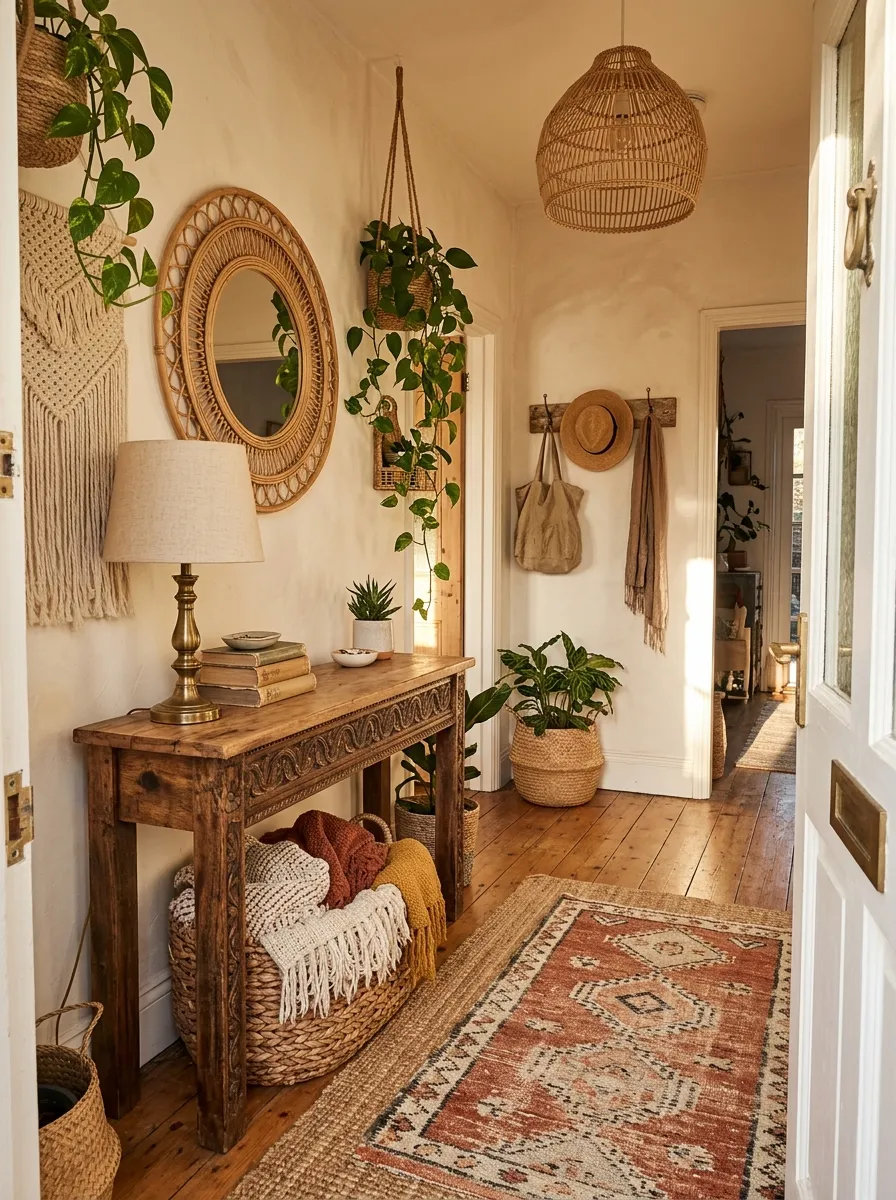
A carved console, patterned runner and plants warm a compact hall. The arrangement gives a personal landing point with useful surface. The strongest purchase is the rug and wall secured console, because it establishes scale and handles the most daily use.
This is the busiest hall in the guide: a carved reclaimed wood console with a brass lamp and stacked books, a large basket of knitted throws beneath it, a rattan framed round mirror, a macrame hanging, trailing pothos in hanging planters and more plants in seagrass baskets on the floor. A terracotta and cream patterned rug lies over a larger jute mat on worn pine boards, and a rattan pendant lights the whole corner. With this many baskets on the floor, check that the console side still leaves 36 inches to walk past.
Materials and Layout
In a bohemian entry the two pieces to get right are the rug and a wall secured console. The rug sets the color and pattern, and the console needs anchoring because bags get dropped on it. Wood, wool, rattan and aged brass bring the layered look.
The aim is a personal landing point with useful surface, room for keys and mail as well as a few collected objects. Keep a clear route that protects the door swing, the stair and the path into the home, and tape or grip the rug so it does not slip.
For this layout we allow, at 2026 prices, $1,270–$2,120. The carved console in Main storage piece runs $510–$740, the layered rugs in Textiles and floor layer run $240–$430, and the pair accounts for roughly 55% of the top of the range. Lighting and hardware is set at $160–$300 for the lamp, pendant and hook board; Storage and small pieces at $220–$380 for the baskets; and Art, plants and finishing pieces at $140–$270, which has to stretch across many plants and the macrame. Vintage and reclaimed consoles vary widely in price and condition, so this is the line to settle before buying anything else.
Warm plaster (#E7DED0) is the cream wall that lets all the objects read, and Light oak (#C49D72) is closest to the rattan of the mirror and pendant rather than to any timber. Moss (#61705A) arrives with the plants, which repeat it at every height, and Charcoal (#343735) is reserved for the fine lines in the rug pattern. The terracotta of the rug and the mustard throw are the warm accents that the colour list leaves out.
Hanging planters over a console drip water and drop leaves onto whatever is set down below, so put a waterproof liner inside each hanging pot and screw its hook into a ceiling joist rather than plasterboard alone.
11. Hidden Shoe Storage Wall
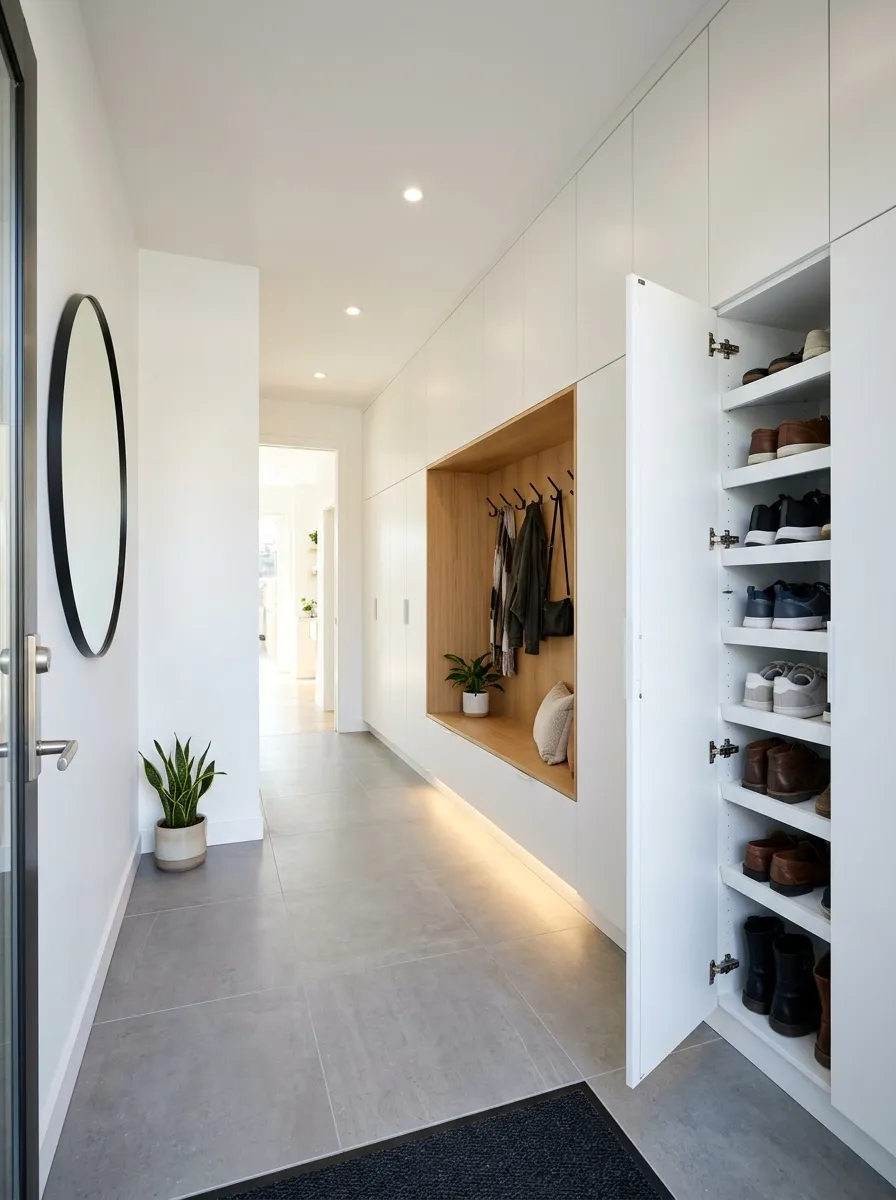
Flush white cabinetry holds shoes while a wood recess catches keys and bags. The arrangement gives large storage with little visual depth. The strongest purchase is ventilated full height cabinetry, because it establishes scale and handles the most daily use.
The rendering runs flush white handleless cabinets from floor to ceiling along one side of the hall, with one door open to show angled shelves of shoes and boots. A recess lined in oak breaks the run at bench height and holds hooks for coats and bags, a cushion and a small plant. A strip of light under the cabinets washes the large grey floor tiles, and a black framed round mirror hangs on the opposite wall by the door. When a cabinet door swings open, the aisle should still leave 36 inches of clear tile.
Materials and Layout
A hidden shoe wall depends on full height cabinetry that lets shoes dry and air out. The doors in the rendering are plain flush panels, so the ventilation has to come from a gap at the plinth, vented backs or slotted shelves inside. Painted wood, oak, stone and concealed light keep the wall quiet, and the hidden light helps it read as architecture.
The result is large storage with little visual depth, so a full wall of cabinets looks like paneling. Keep a clear route that protects the door swing, the stair and the path into the home, and check that cabinet doors clear the front door when both are open.
We estimate the shoe wall at 2026 prices of $1,830–$3,060. The cabinetry, Main storage piece, is the line to settle first at $740–$1,070, and Textiles and floor layer at $350–$620 covers the door mat and the recess cushion; together they make up about 55% of the high figure. The strip light and hooks sit within Lighting and hardware at $230–$430, interior shelving and organisers within Storage and small pieces at $310–$550, and the mirror and plants within Art, plants and finishing pieces at $200–$390. A fully custom run of this height can cost more than the cabinetry line allows; the figures fit a wall assembled from ready made tall units.
The plan's colours sit on very few surfaces in this hall. The cabinets and walls are a cleaner white than Warm plaster (#E7DED0), so warming the cabinet paint toward that tone would soften the long run. Light oak (#C49D72) lines the recess and nowhere else, which makes the niche the focal point. Moss (#61705A) comes from the plants, and Charcoal (#343735) from the mirror frame, the door mat and the grout lines.
Push latch doors collect fingerprints on flat white paint around the latch point; a washable eggshell or a lacquer finish keeps the run clean without adding handles that would break its flat face.
Lighting, Scale and Daily Maintenance
Mount hooks into suitable structure and place them at heights that match the users. A lower row can serve children or bags without overloading one high hook.
Use a low pile runner with a proper pad. Check the threshold and door clearance. Dark midscale patterns hide grit better than a pale solid field.
Provide light at the lock and storage, not only at the center of the ceiling. A lamp or wall light can soften the hall, but it must not narrow the path.
A Purchase Order That Protects the Budget
Before buying, draw the hall to scale with the front door at full swing, the bottom stair if there is one, and any radiator, vent or switch on the wall that will take storage. Note what is staying, such as an existing bench or a coat closet. A sale price on a console means little if its depth eats the space between the door and the stair.
Order the storage piece first, whether that is a shoe cabinet, a bench or a locker run, and check that it fits through the front door and up any steps before paying. The runner and lighting follow, because both depend on where the storage ends. Mirrors, baskets and plants come last, sized against what is already on the wall. Before the return window closes, stand in the open doorway and take a photo down the hall; a console that is too deep or a mirror hung too low shows up more clearly in a picture than in person.
Keep a small line for the parts a rendering never shows: wall anchors and anti tip straps, a rug pad, warm bulbs, a cord cover for the lamp and filler for old hook holes. Then use the hall for a couple of weeks before buying more; the gap that keeps getting in the way, often a spot for wet umbrellas or a lower row of hooks, is the one worth filling.
Keep the paint colour names, the cabinet model and the runner size in one folder on a phone. Entry halls take more scuffs than any other room, and touching up a door or replacing a bent hook is easier with the exact finish name to hand.
Cost Saving Strategies That Keep the Layout Intact
Start with a secured shoe cabinet and a commercial hook rail. A full built in can wait until the storage pattern is proven.
Cut a washable runner to the correct length rather than forcing a decorative size that blocks the door.
Use one mirror to return light and check appearance. Several small wall pieces create visual work in a space that is already busy.
Questions Readers Ask
How much does entryway storage cost?
A small refresh can cost $400 to $1,200. A bench, shoe cabinet, runner, mirror and lighting often total $1,200 to $3,500. Built ins cost more.
How deep should entryway furniture be?
Slim pieces around 10 to 16 inches deep suit many halls, but the remaining path and door swing decide.
What belongs in an entryway?
Daily shoes, current season outerwear, keys and incoming small items. Long term and off season storage should move elsewhere.
How can a tiny entryway gain storage?
Use a shallow secured shoe cabinet, wall hooks and one small tray. Keep floor depth for the walking path.
What rug works at a front door?
Choose a low pile durable rug that clears the door and has a nonslip pad approved for the floor.
Does an entryway need a console table?
No. A shelf, shoe cabinet or wall tray can provide a landing point with less depth.
Are open hooks or closed cabinets better?
Open hooks are fast for a small daily load. Closed cabinets control a larger load, but need ventilation and enough door clearance.
Sources and Pricing Notes
The cost figures for these 11 entryway layouts are 2026 planning allowances in US dollars, built from current retail prices for the furniture, storage and lighting each rendering shows. For the entryways, budget tax, delivery and permits separately, along with any wall or floor repair found on site.
- U.S. Bureau of Labor Statistics: Consumer Price Index notes for household furnishings.
- The Home Depot: project calculators and current material categories.
- IKEA US: current furniture and storage categories.
- U.S. Consumer Product Safety Commission: furniture anchoring guidance.
Keep Planning
Styling & Living Desk
The Layered Homes editorial teamThe Styling & Living Desk produces the room-by-room guides, outdoor and garden pieces, celebration ideas and design solutions, each with an itemised cost estimate, and the Home Files essays.
More from the Styling & Living Desk →
Reader notes