


Decluttering works when it reduces the number of decisions a room asks for every day. The goal is not an empty house. It is a home where useful objects have limits, storage sits near the point of use and resetting a room takes minutes rather than an afternoon.
The Short Answer
Choose one small, visible zone. Remove everything from that zone, group like items, discard or donate what is no longer useful, then return only what fits the space and the routine. Finish the removal step the same day by taking donations and recycling out of the room.
The room by room plan below separates editing from organizing. Buying containers before reducing the volume usually preserves the problem in neater boxes.
Use Four Decisions, Not Dozens
Create four destinations: keep here, move elsewhere, donate and recycle or dispose. A repair box is useful only when it has a deadline. Write the deadline on the box and place it near the tools needed for the repair.
Work within a physical boundary such as one drawer, one shelf or one table. Stopping at a clear edge protects the rest of the day and gives the session a visible finish. Large piles across the floor create fatigue before decisions are complete.
Set a container limit after sorting. The shelf, drawer or basket is the boundary. When it fills, compare the least useful item already inside with the new one. This turns future decluttering into a small choice.
Living Room Before
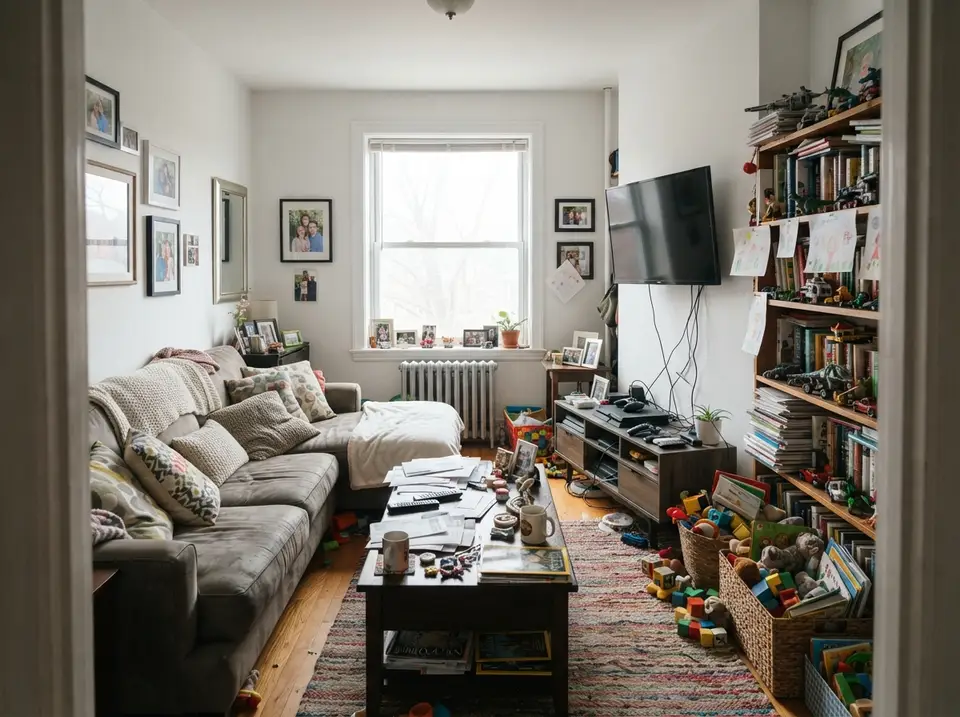
Paper fans across the coffee table, toy bins spill blocks onto the striped rug, and a knot of cables drops from the wall-mounted television to the media console. Count the cushions on the sofa too: there are more than two people could use, and each one is a small decision nobody has made yet.
None of this is dirt or neglect. It is ordinary family overflow in a narrow room, and the sofa, the window with its radiator and the tall bookcase are fixed, so the editing has to happen around them rather than by moving furniture.
What to Check
From the doorway, count the unfinished decisions you can see: the paper stack, the mugs, the toy overflow beside the shelves, the spare remotes. Each needs a yes or no rather than a new container. Clear the walkway from the door to the window first, since that strip is what makes the room usable tonight.
A Practical Specification
This room needs very little new equipment. A lidded basket for the toys that live downstairs, a single tray or file for incoming mail and a cable sleeve or clip strip behind the console would cover most of what is visible. Measure the depth of the bookcase shelves before buying bins, because books and toys share them at present.
Living Room Reset
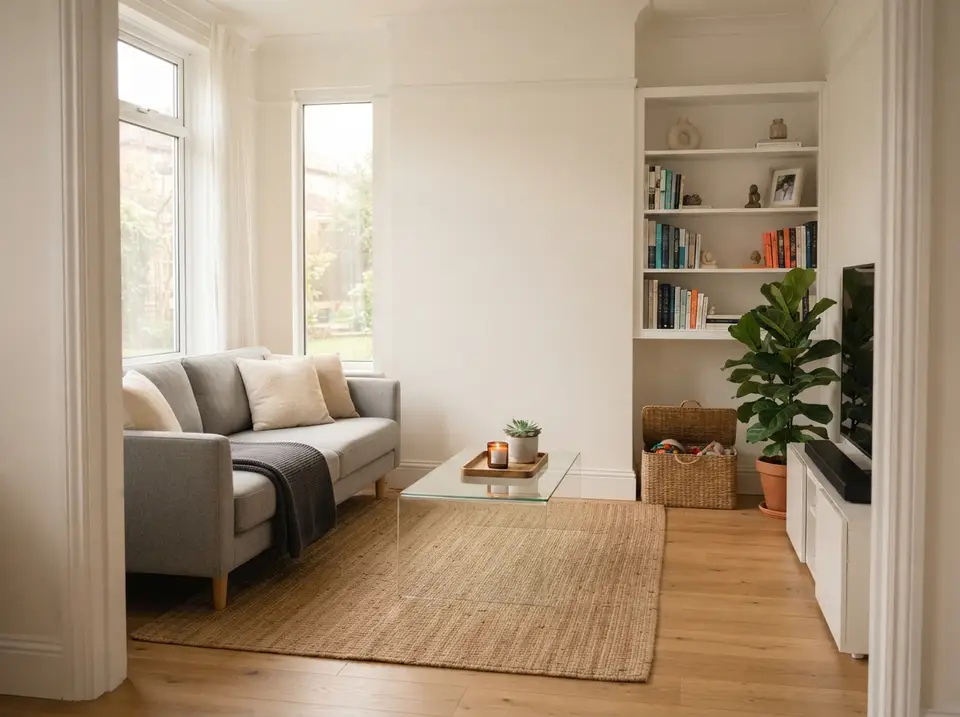
In the reset, the glass coffee table holds a single tray with a candle and a small succulent, one lidded wicker basket by the alcove takes the toys, and the built-in shelves carry books and a few objects rather than everything the family owns. Closed storage sits within reach of the sofa, so a blanket or a remote has somewhere to go.
Each container sits where its contents are used. The toy basket is on the floor where play happens, and the low white media unit under the television keeps chargers and controllers behind doors.
What to Check
Test the living room with one question: can remotes, blankets and chargers be put away from a seated position? If not, the clutter will drift back to the coffee table within a week, however tidy it looks on day one.
A Practical Specification
A see-through coffee table is a sensible pick for a small room, since it shows the floor beneath and makes any pile on top obvious. The lidded basket and the closed media unit do the heavy work, while the open alcove shelves are kept for books and a handful of pieces chosen for display. A lamp near the sofa lets the room work after dark without adding another surface.
Kitchen Counter Before
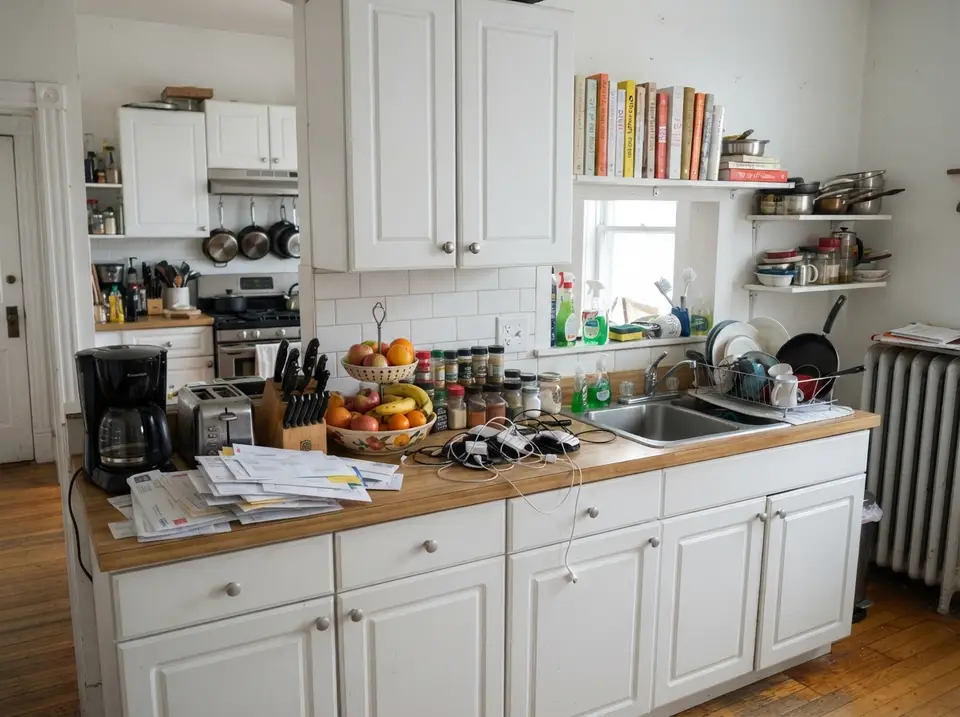
Here the counter beside the sink carries a coffee maker, a toaster, a knife block, a tiered fruit bowl, a spread of spice jars, a pile of opened mail and a nest of charging cables, while cleaning sprays line the window ledge. There is no stretch of bare worktop long enough to set down a cutting board.
The strain comes from categories that have nothing to do with each other sharing one surface. Paperwork and phone chargers belong at the entry or a desk, not beside food, and moving them out is the quickest win in the room.
What to Check
Look for the longest run of counter that could be cleared and win that back first. In this kitchen it is the stretch between the toaster and the sink. Take the mail and cables out of the room entirely, then decide which appliances are used often enough to stay out.
A Practical Specification
The open shelves above the window already hold cookbooks and pans, so the spice jars could move to a drawer insert or a shelf riser inside the upper cabinet, and the sprays to the cupboard under the sink. Keep the coffee maker out if it runs every morning; the toaster can live in a lower cabinet and come out when needed.
Kitchen Counter Reset
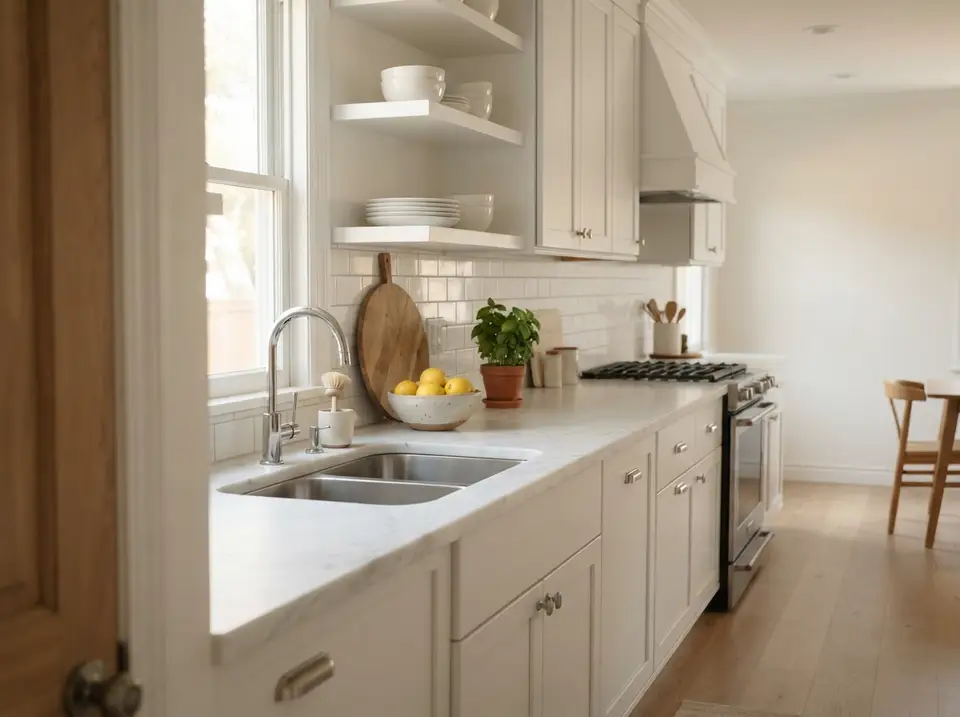
After the edit, the worktop holds one wooden board leaning on the tiled backsplash, a bowl of lemons, a potted basil plant and a crock of wooden spoons near the range. The appliances have gone into cabinets, leaving a clear preparation strip beside the sink.
What remains supports daily cooking. A board, a herb that gets snipped and utensils by the hob earn counter space; a gadget used twice a year does not.
What to Check
To hold this version, glance at the strip next to the sink at the end of each day. Anything there that is not used for chopping, rinsing or serving goes back to its home, even if that home is only the next cabinet along.
A Practical Specification
White shaker cabinets, a pale marble-look top and open shelves of stacked white bowls show how a short list of finishes keeps a cleared counter calm. Open shelving only stays tidy when it holds things used every week, so plates and bowls go there and occasional serving pieces stay behind doors. Good light over the sink run makes the cleared surface useful in the evening.
Bedroom Before
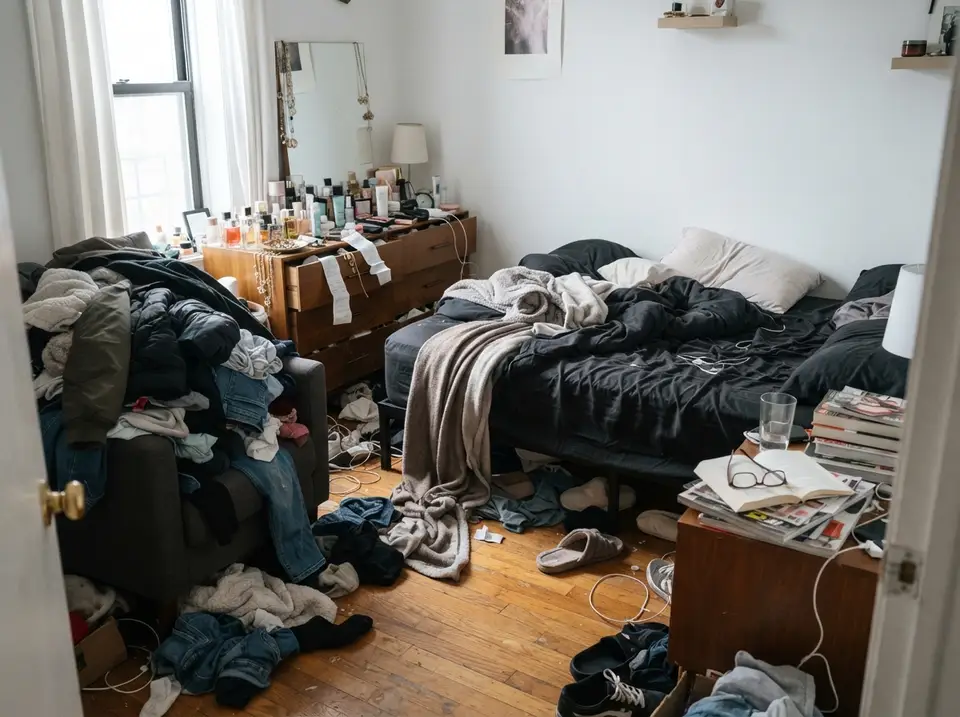
Clothes are heaped over the armchair and onto the floor around it, the dresser top is crowded with bottles and jewelry, receipts hang from a drawer, and the bed is a tangle of dark bedding, throws and charger cables. Books, magazines and a water glass bury the bedside table.
The chair has turned into a wardrobe because dropping clothes there is easier than hanging or folding them. That is a design problem rather than a character flaw: the evening routine has no final step, so items stop wherever the person stops.
What to Check
Find the things that get put down rather than put away: worn clothes, shoes, jewelry, the day's receipts. Each one needs a destination closer than the closet, such as a hamper beside the chair for laundry and a hook for clothes that will be worn again.
A Practical Specification
A lidded hamper sized for a week of laundry, two or three wall hooks and a small tray for the dresser would absorb most of what is on the floor in this room. Before buying anything, clear the dresser top and count the bottles in daily use; the rest can go into a drawer or the bathroom cabinet.
Bedroom Reset
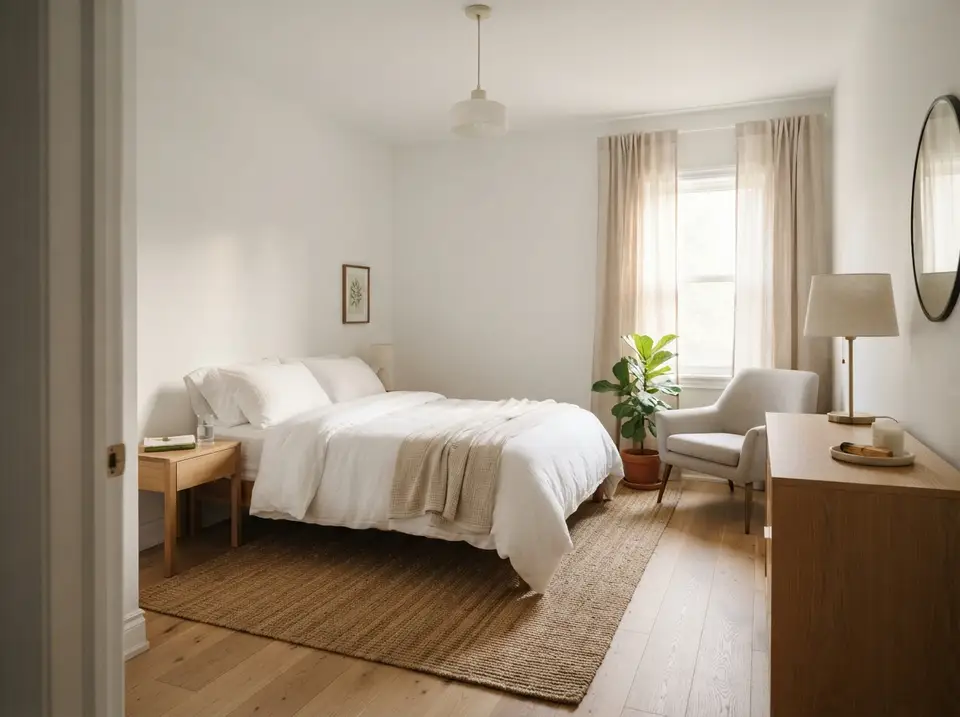
In the reset, the armchair by the window is empty, the white bedding is made with a knitted throw across the foot, and the oak dresser holds a lamp and a small tray with a candle. Pocket items now have one landing place, which spares the morning search for keys.
Nothing personal has been stripped out. A framed print, a plant and a round mirror stay, and the surfaces simply have room to be used again.
What to Check
Choose the single landing spot for keys, wallet and phone before anything else, and make it the dresser tray rather than the bedside table. Then look at the chair each night; if clothes start collecting on it again, the hamper or hooks are in the wrong place.
A Practical Specification
The finishes are few: light oak for the bedside table, dresser and floor, white bedding, a jute rug and linen curtains. Repeating oak and natural fibre in two or three spots is enough to tie the room together, and the table lamp on the dresser gives evening light without relying on the ceiling pendant.
Closet by Category
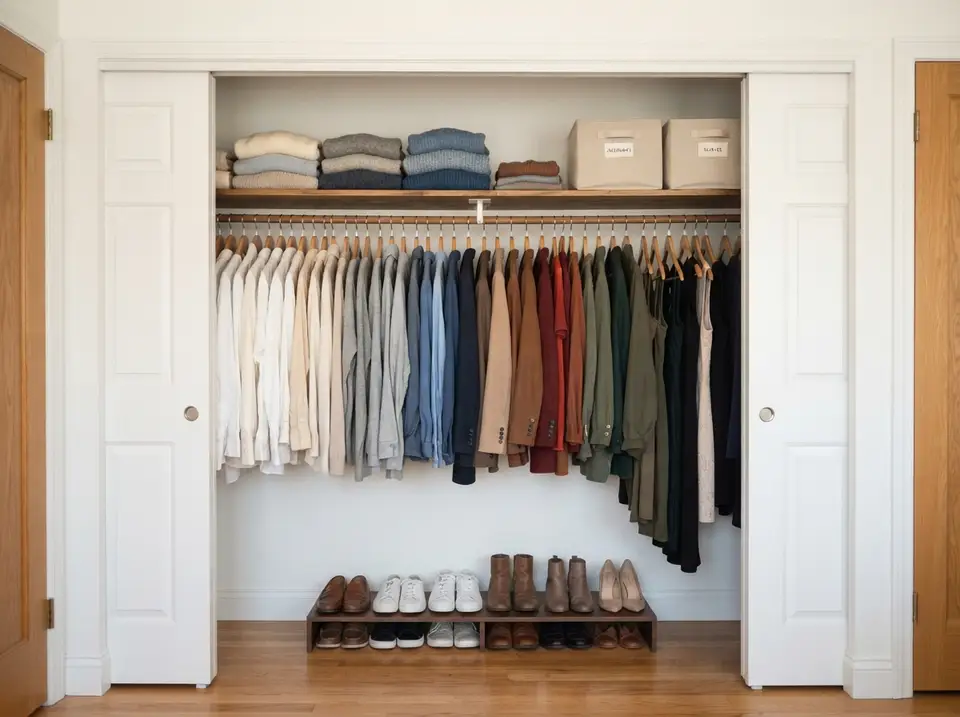
Matching wooden hangers, clothes grouped from whites through greys, blues, browns and greens to black, folded knitwear on the shelf and two lidded boxes above make it easy to see how much of each type is owned. A low rack keeps shoes off the floor in two rows.
Every category here has a visible limit, and garments still slide along the rod. When a new jacket would crowd the rail, one of the existing jackets is the first candidate to leave.
What to Check
In a closet, check for open space between categories and for a gap at the end of the rod. Hangers pressed tightly together mean the closet is over capacity, whatever the organizers look like. The shoe rack should hold only the pairs worn this season.
A Practical Specification
Slim hangers of one type save rod space and keep the hem line even. Lidded fabric boxes on the upper shelf suit out of season items and should be labelled on the front, as they are here. Measure the gap between shelf and ceiling before buying boxes so they slide in without catching.
Keep, Donate and Recycle Session
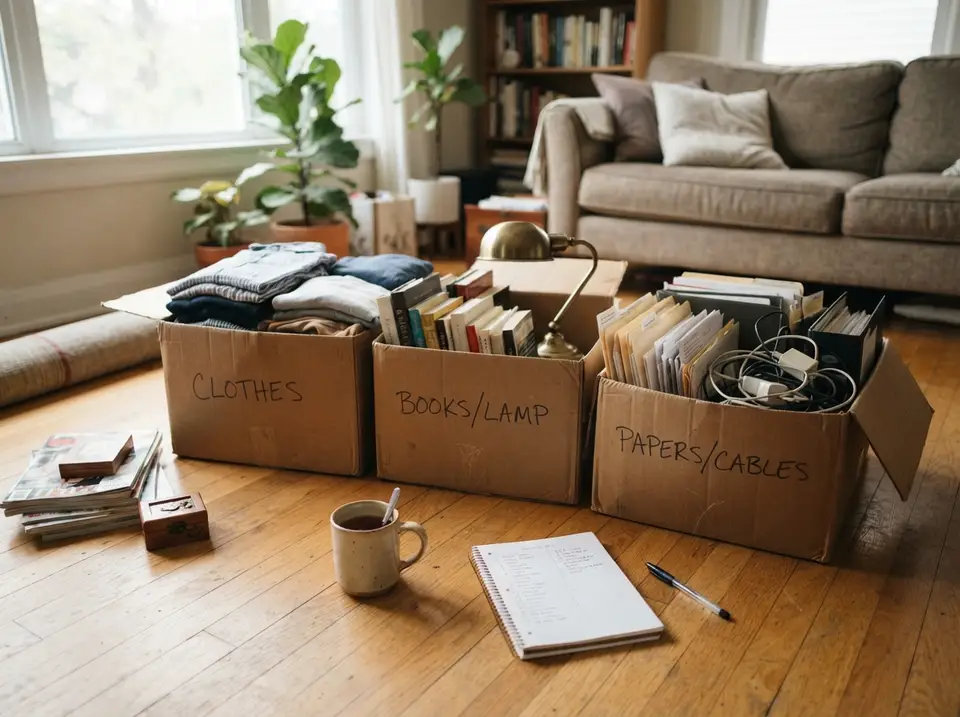
Three cardboard boxes on the living room floor are marked Clothes, Books/Lamp and Papers/Cables, with a notebook, a pen and a mug of tea beside them. The notebook matters as much as the boxes, because it records what is leaving and where each box will go.
Labels only help if the boxes leave the room promptly. A sorted box left in a corner for a month becomes one more pile, so fix the drop-off date before the first item goes in.
What to Check
During the session, make sure each item is moving toward its final destination rather than into another holding pile. Cables need a verdict too: keep those that match a device still in use and send the rest to electronics recycling.
A Practical Specification
Sturdy boxes and a marker are enough; special sorting bins add nothing. Keep the work to one patch of floor, as the rendering does, so the sofa and the walkway stay usable while the boxes fill.
Entryway Before
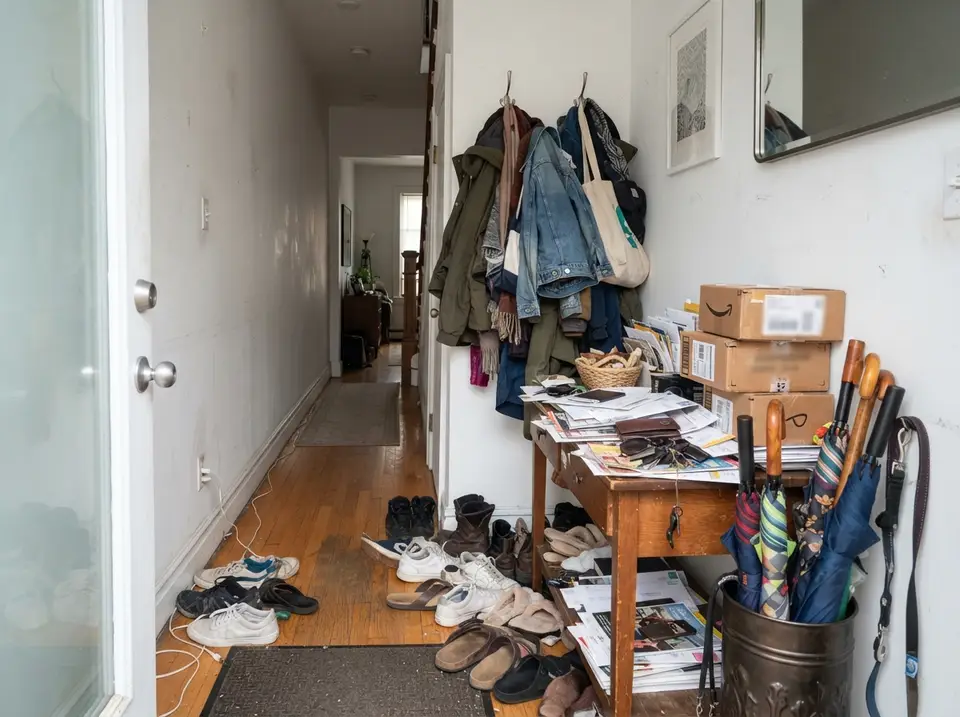
Coats and bags hang several deep on two hooks, shoes are scattered along the hallway floor, delivery boxes are stacked on the side table, and mail, a wallet and sunglasses cover its top. An umbrella stand and a dog leash crowd the last bit of wall by the door.
Everything in an entry arrives when hands are full, which is why storage there has to work in one move. A hook, a tray or an open rack beats a drawer or a lidded box.
What to Check
In this narrow front hallway, the clash is between outdoor gear and household paperwork. The table under the coats is doing two jobs badly, holding shoes below and mail above. Split them so shoes get a rack and paper goes straight to its own station.
A Practical Specification
Before buying, measure the hallway width and keep the door swing clear. A two-tier shoe rack, a hook rail with no more hooks than there are people in the household, and a plan for flattening delivery boxes on the day they arrive cover the main sources of clutter visible here.
Entryway Reset
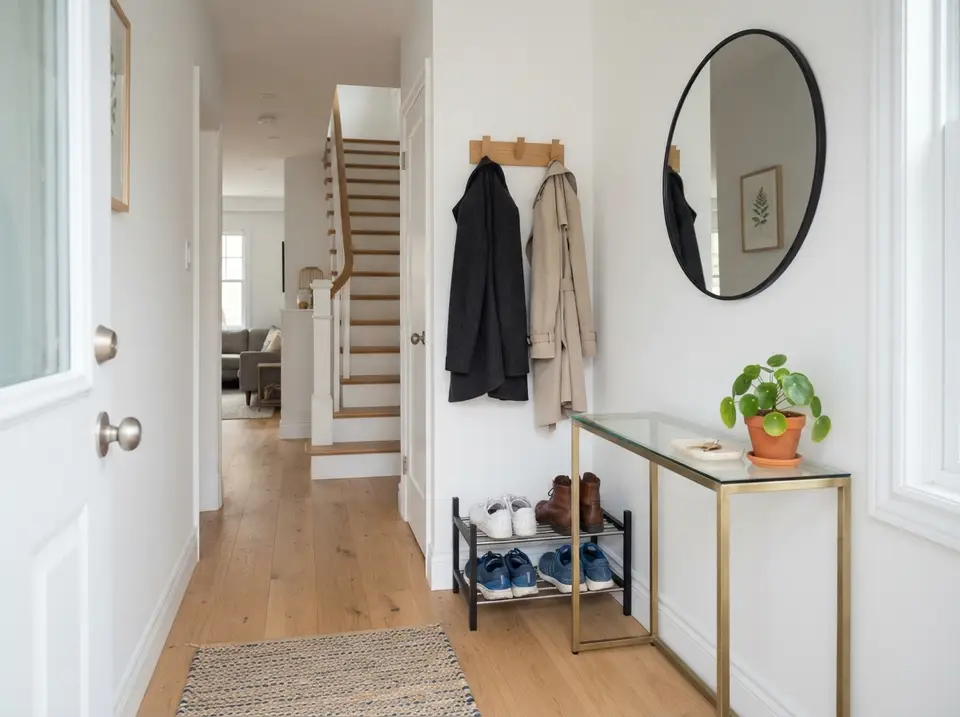
The reset uses a short wooden peg rail with two coats, a slim black two-tier shoe rack, a narrow glass and brass console with a key dish and a plant, and a round mirror. Storage is sized for what the household wears this week rather than every coat and pair it owns.
Seasonal overflow belongs in a second location away from the door, such as a bedroom closet or a bin under the stairs. That keeps the hallway clear enough for two people to pass with bags.
What to Check
Count the coats and shoes actually worn in the last week and size the hooks and rack to that number. Anything beyond it moves to the overflow spot before the next season starts.
A Practical Specification
A glass-topped console like this one has no drawer, so it works only if paper never stops there; the key dish is its single job. Hooks fixed into studs or with suitable anchors take the weight of wet coats, and a washable runner inside the door catches grit before it reaches the wood floor.
Paper and Mail Station
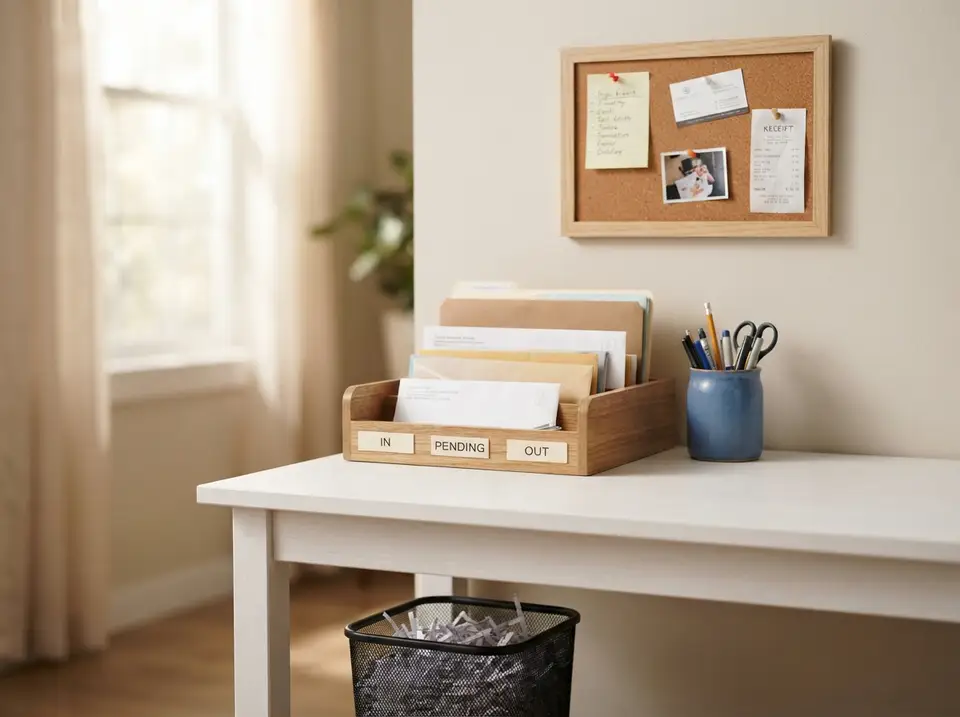
A wooden desktop sorter with slots labelled In, Pending and Out, a cork board holding a list, a receipt and a photo, a pot of pens and scissors, and a wire bin of shredded paper under the desk put every paper decision in one place.
One defined route stops mail from spreading across kitchen and dining surfaces. Envelopes go into In on arrival, anything awaiting action sits in Pending, and Out holds what needs posting or filing.
What to Check
Set the station near the door or kitchen where mail is actually opened. Empty the In slot weekly; if Pending keeps growing, it needs a date on the calendar rather than a bigger tray.
A Practical Specification
A three-slot sorter, a shredder or shred bag for documents with account numbers, and a pin board for the few items that must stay visible are all this station requires. Keep the board small, since a large one turns into a second pile.
Toy Storage Children Can Reset
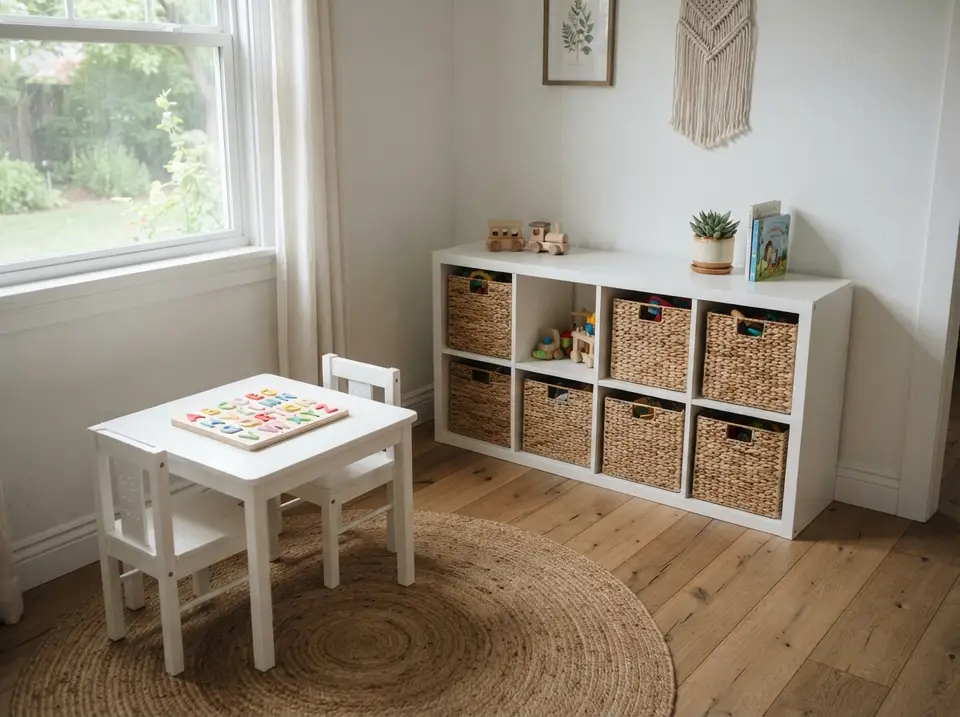
Woven baskets slot into a low white cube unit with a few wooden toys and a book standing on top, and a small white table with two chairs sits on a round jute rug. Every basket is within a child's reach.
A system fails when children need adult help to put every item away. Broad groups such as blocks, vehicles and puzzles, one per basket, are easier for a small child to sort than finely divided bins.
What to Check
Check whether a child can reset the corner alone. The baskets in this rendering carry no labels, and a photo or drawing of the contents on the front helps children who cannot read yet.
A Practical Specification
A cube unit no taller than the child's shoulder, open baskets without lids and a table at the right height are the practical core. Anchor the unit to the wall even though it is low, and rotate part of the toy collection into storage elsewhere so the baskets never overflow.
A Quiet Corner With a Job
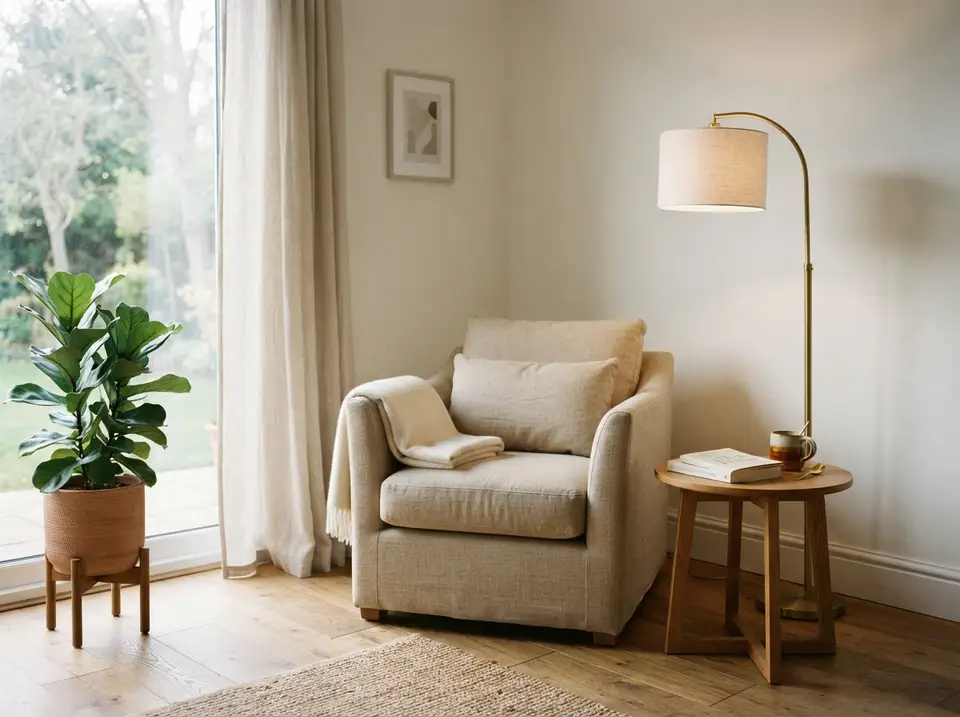
A linen armchair with a folded throw, a brass arc floor lamp, a small round wooden side table with a book and a mug, and a fiddle leaf fig on a stand make this corner ready for reading.
The empty floor and bare wall around the chair are part of the design. That space leaves room for the activity instead of filling up as display.
What to Check
Name the single purpose of the corner and remove anything that does not support it. Here that means a seat, light to read by and a surface for a cup; a second table or a basket of magazines would start the pile again.
A Practical Specification
Set the lamp so its shade sits just behind the reader's shoulder, and pick a side table big enough for one book and a mug but too small for stacks. A rug under the front legs of the chair marks out the zone without adding furniture.
Why the Reset Has to Match the Routine
Clutter is often described as a source of stress, but it is not a moral diagnosis. Space, money, health, caregiving and housing conditions shape what is possible. A useful method reduces friction without turning the home into a performance.
Place storage where the action ends. Laundry needs a hamper where clothes come off. Mail needs a decision point near entry. Toys need broad categories where play happens. Asking people to carry an item through three rooms creates a step that will often be skipped.
Use reset times tied to existing events. Clear the kitchen while water heats, return living room items before an evening program and empty the entry tray before taking out trash. A ten minute repeatable reset is more reliable than a monthly rescue session.
Donation bags are not finished until they leave the home. Put the next transfer date on the calendar, check the receiving organization's current acceptance list and avoid moving unusable items into a charity's disposal stream.
Photograph sentimental collections before reducing them if memory is the main value. Keep the best representative pieces in an acid free box or active display. The aim is access and care, not a number that suits another household.
Questions Readers Ask
Where should decluttering start?
Start with one visible, low emotion zone such as an entry surface, bathroom drawer or kitchen counter section. A clear boundary makes completion easier.
Should storage containers be bought first?
Usually no. Reduce and group the items first, then measure the remaining volume and the available shelf or drawer.
How long should a decluttering session last?
Twenty to forty five minutes is enough for a drawer, shelf or small surface. Stop only after donations and waste have a next destination.
What should happen to sentimental items?
Separate them from everyday clutter, choose representative pieces and store them in conditions that protect paper, fabric or photographs.
How can a family keep shared rooms clear?
Use broad categories, visible limits and storage that every household member can reach and operate.
What if an item might be needed later?
Compare replacement cost, storage cost and likelihood of use. Keep high consequence items, but set a review date for low value uncertain items.
Does a decluttered home need to look minimal?
No. Collections, color and tools can remain visible. The practical goal is access, maintenance and enough clear space for the room's work.
Sources and Pricing Notes
The storage and organizing costs in this decluttering guide are 2026 planning allowances in US dollars, built from current retail categories for the scope each room rendering shows. Tax, delivery, permits and unusual site conditions come on top unless a room section says otherwise.
- PubMed: research on home descriptions, mood and cortisol patterns.
- U.S. Environmental Protection Agency: reduction and reuse guidance.
- IRS: records and rules for eligible charitable contributions.
- U.S. Bureau of Labor Statistics: Consumer Price Index notes for household furnishings.
- The Home Depot: project calculators and current material categories.
- IKEA US: current furniture and storage categories.
Keep Planning
entryway storage budgets, home office planning, mudroom design study.
Styling & Living Desk
The Layered Homes editorial teamThe Styling & Living Desk produces the room-by-room guides, outdoor and garden pieces, celebration ideas and design solutions, each with an itemised cost estimate, and the Home Files essays.
More from the Styling & Living Desk →
Reader notes