


Good home office design starts with the body, screen, light and cable route. The ten workspaces below range from a closet nook to a detached garden room, with the purchase priority and 2026 allowance stated for each one.
Set the Working Budget Before Choosing a Style
Reserve the first part of the budget for a chair, correctly sized work surface and monitor support. Shelves and background decor can follow. If calls are frequent, add acoustic control and a reliable wired connection before display objects.
Measure seated elbow height, monitor distance and the chair travel behind the desk. Include the depth of plugs and cable bends. A desk pushed tightly against a wall can crush connectors or prevent a monitor arm from clamping.
The best looking room still fails if the screen is too low or daylight creates glare. Set the working position first, then build the visible scheme around it.
1. Bohemian Studio
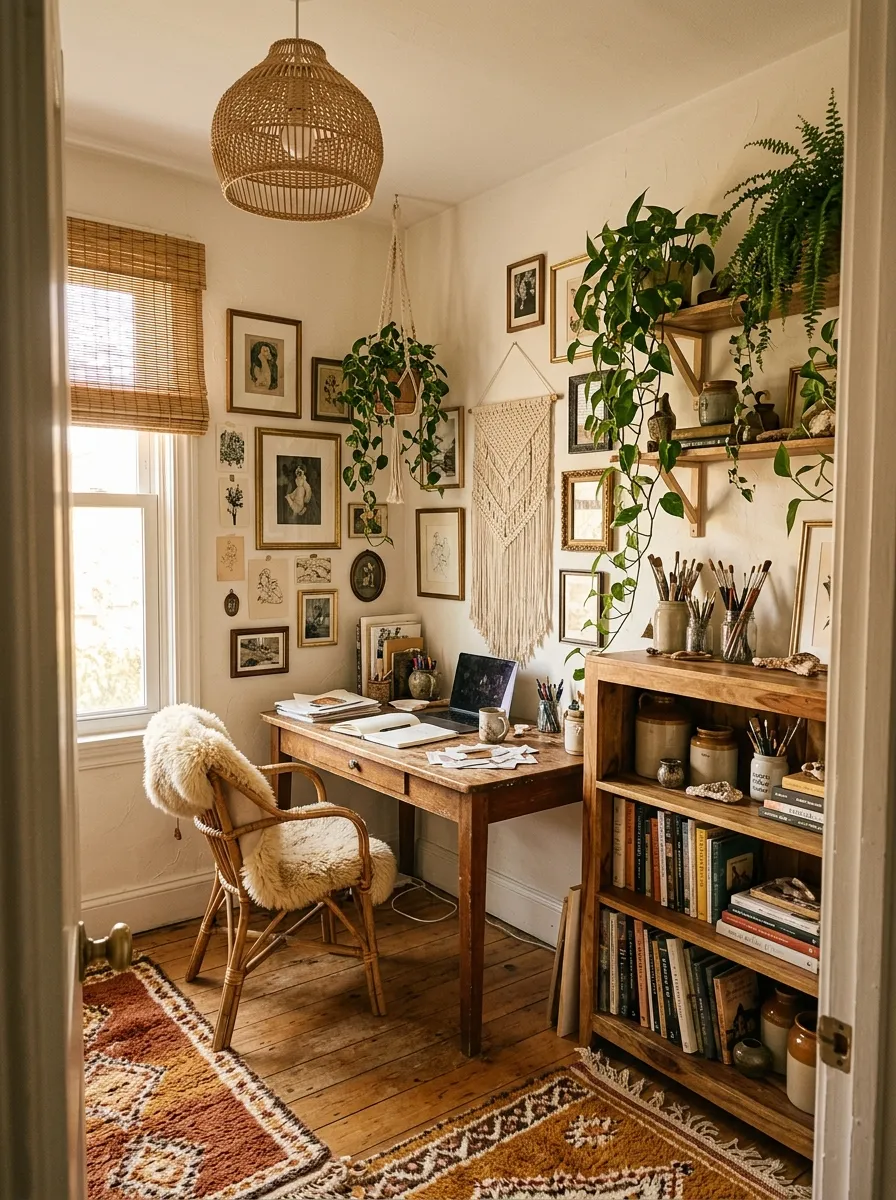
Plants, framed prints and a macramé hanging cover the walls around an old wooden desk, with a rattan chair softened by a sheepskin and two patterned wool rugs underfoot. This is a room for creative work that keeps reference material in sight: brushes in jars, papers spread on the desk and books on a low open bookcase within reach of the chair.
Behind the desk in this rendering there is little room before the chair meets the bookcase and the rug edge, so aim for at least 36 inches of clear floor there if your room allows it. The rattan pendant lights the middle of the room, not the page; a lamp on or over the desk is what makes evening work possible. Wood, rattan, wool and sheepskin already carry plenty of texture, which frees the shelves to hold working tools rather than more ornaments.
Materials and Layout
Buy an ergonomic chair before decorative storage. A bohemian studio invites baskets and open shelves, but hours at the desk depend on the chair. Wood, rattan, wool and painted metal give the room its relaxed character.
Pinned sketches, swatches and open books are part of this look, so keep a strip of the desk permanently clear for them. Baskets parked by the desk legs are the first thing the chair catches when it is pushed back, and they belong under the bookcase instead.
Our estimate for the bohemian studio is $1,860–$3,110. Most of it sits in two lines, Main desk or chair at $750–$1,090 and Textiles and floor layer at $360–$630, about 55% of the high end between them, which suits a room carried by two wool rugs, a sheepskin and a solid desk. Smaller sums go to Lighting and hardware at $240–$440 for the pendant and a desk lamp, Storage and small pieces at $320–$550, and Art, plants and finishing pieces at $200–$400, a modest figure for walls this full, so collect frames and plants slowly.
Main desk or chair has the broadest allowance, $750–$1,090; confirming its specification first will make the final total more reliable.
Every total in this guide assumes the room already has sound flooring, working electrical outlets and any built ins it needs, so treat the figures as furnishing and finish allowances, not construction quotes. Keeping a good desk, chair or bookcase you already own is the quickest saving, and in many of the schemes below it trims roughly one third from the total.
Warm plaster (#E7DED0) on the walls and Light oak (#C49D72) in the floorboards, desk and bookcase give the studio its honey-coloured base. Moss (#61705A) arrives through the pothos and fern rather than paint, and Charcoal (#343735) is kept to thin frames and the laptop, so the darkest note never crowds a small room.
Light oak already repeats across floor, desk and bookcase, which is why the room hangs together despite the busy walls. If you copy it, put the bookcase on the wall away from the door so the entry stays open, and choose one larger print to anchor the gallery before adding more small frames.
Look at the room from the doorway once both rugs are down. Two patterned rugs side by side can tip into clutter, and swapping one within a return window is far easier than living with it for a season.
2. Traditional Study
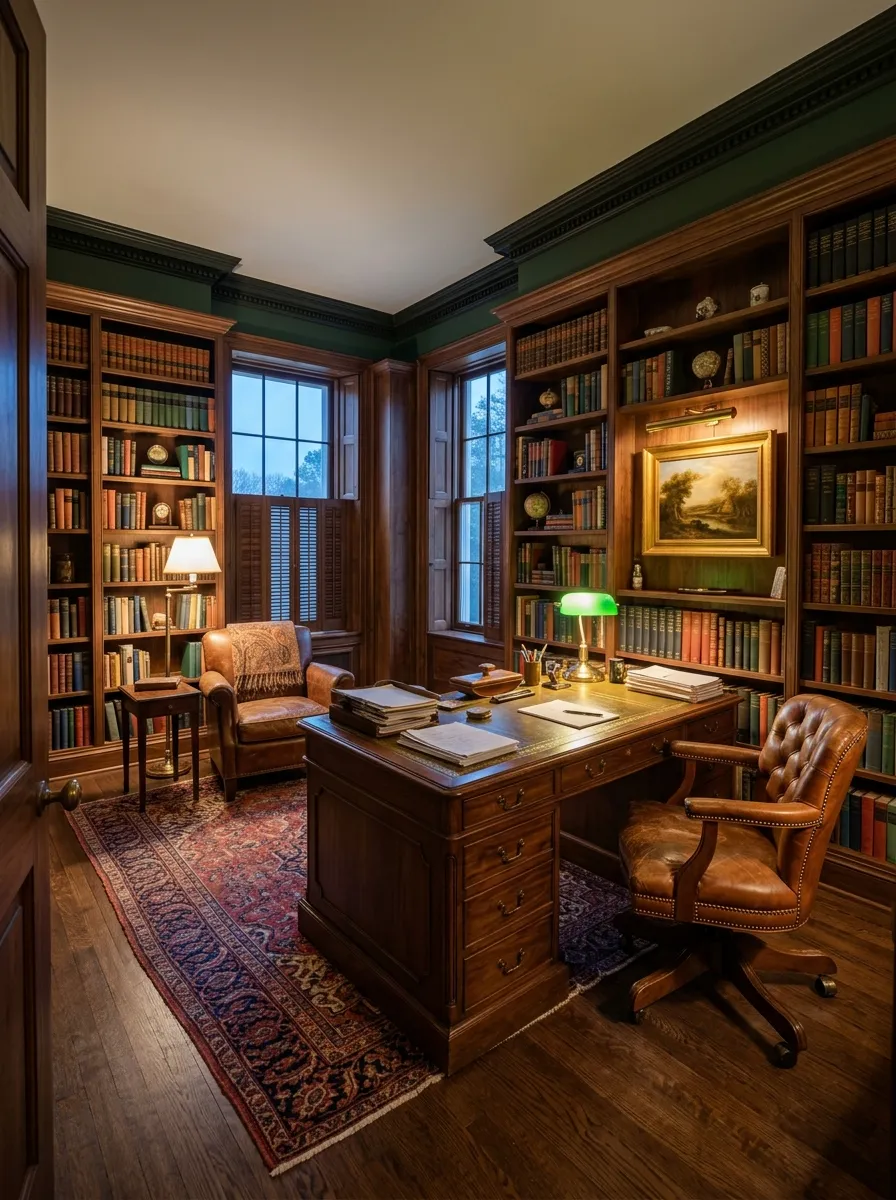
Walnut-toned bookcases wrap this study beneath a deep green wall band and black crown molding. A pedestal desk sits on an oriental rug under a green banker's lamp, a picture light hangs over a landscape painting, and a leather armchair waits by the window for reading. The room serves paper work and reference storage, where long reading sessions count as much as screen time.
The pedestal desk stands out on the rug with floor on every side, and the tufted leather chair needs at least 36 inches behind it so its casters can roll without snagging the rug. Each light belongs to a task: the banker's lamp on the desk, the floor lamp beside the armchair and the brass picture light over the painting. Walnut, leather, wool and brass give the room its weight.
Materials and Layout
The first investment is a desk chair fitted to the user: seat height, arm height and lumbar support adjusted to the person who sits there daily. Walnut, leather, wool and brass give the traditional study its depth and age gracefully under constant handling.
Shelving lines nearly every wall, so books and files stay within a turn of the chair. Keep the drawer side of the pedestal desk clear of the armchair, or the lowest drawers will not open fully.
In 2026 prices this study comes to $2,900–$4,840, the second highest total in the guide. Main desk or chair takes $1,170–$1,690, enough for a solid pedestal desk or a good leather task chair but seldom both at full price, and Textiles and floor layer takes $550–$990, which a wool oriental rug of this size uses quickly. Those two make up about 55% of the high end. Lighting and hardware needs $370–$680 for the banker's lamp, floor lamp and picture light, Storage and small pieces gets $490–$860, and Art, plants and finishing pieces gets $310–$620, with the bookcases treated as existing built ins.
Because Main desk or chair spans $1,170–$1,690, it is the line most likely to move the final spend and deserves the first supplier check.
Historic blue (#506477) shows in the rug border and a run of cloth book spines, while Soft white (#F0EEE8) is saved for the ceiling, which stops a dark room from closing in overhead. Warm wood (#8A6446) covers shelving, desk and floor, and Iron (#343633) is the near-black crown molding. The green wall band and lamp shade are not in the listed palette, yet they are what the rendering reads as, so treat green as a fifth colour if you build this room.
For historic blue to look planned rather than borrowed from the book spines, repeat it in at least two deliberate places, say the rug and an upholstered seat. The armchair and floor lamp are the bulkiest loose pieces, and they belong by the window, out of the line between door and desk.
3. Minimal Home Office
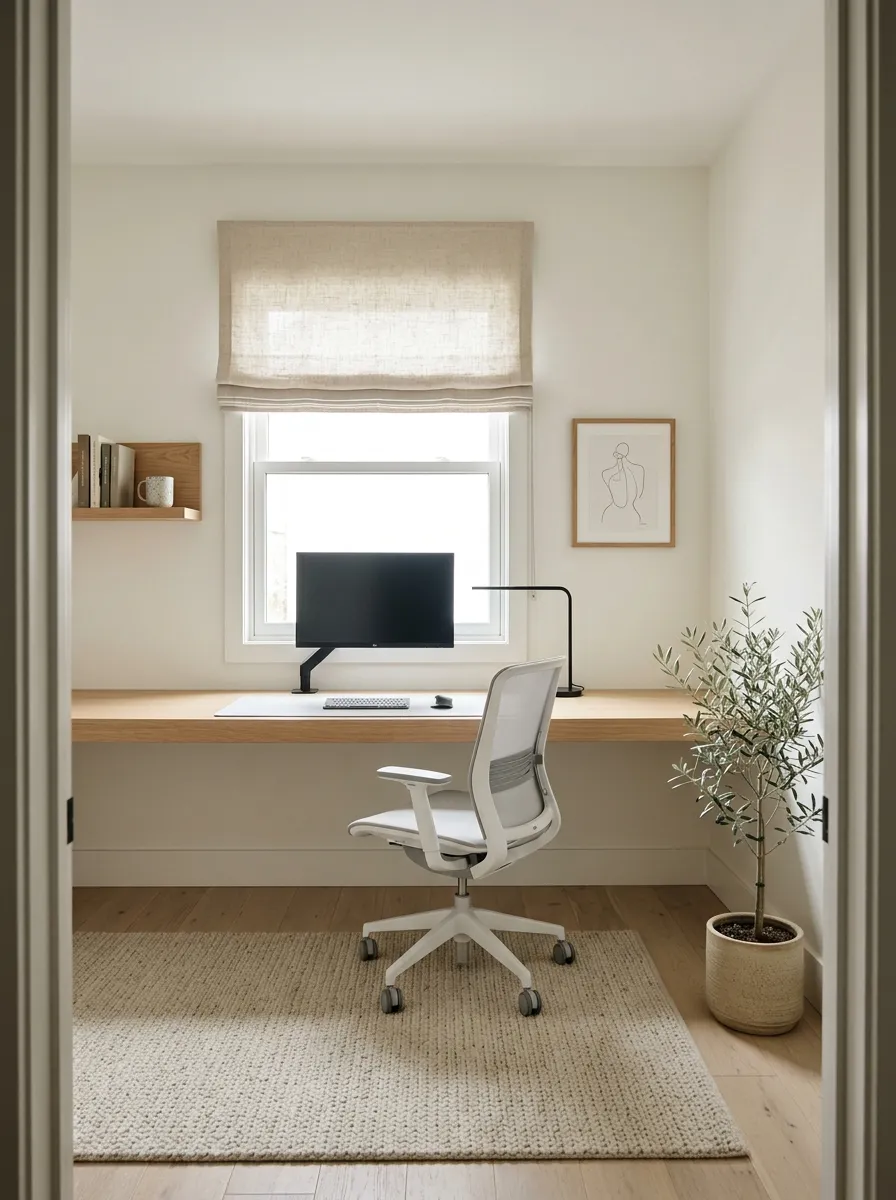
An oak shelf runs wall to wall as a floating desk beneath the window, holding a monitor on an arm, a slim black task lamp and little else, with one small open shelf for books. No drawers or cabinets are in view, which is why the room stays so quiet for computer work with few distractions; a linen Roman shade, a textured wool rug and a potted olive tree soften it.
A wall-length desk turns the whole width of the room into the chair zone, but still leave at least 36 inches between desk edge and door frame so the chair can swing out. The monitor faces straight into the window, a setup that invites glare by day; the linen shade softens it, and the task lamp to the right covers evening hours. Oak, wool, white paint and black metal are the only materials this room asks for.
Materials and Layout
Get the chair and monitor position right first. In a minimal office the screen at eye height and a chair that supports a neutral posture matter more than any object on the desk. Oak, wool, white paint and black metal keep the palette quiet.
There is no closed storage in this version, which is much of its calm. If the work produces paper, add a slim drawer unit under one end of the desk rather than shelving on the open wall, and keep the floor between chair and door free of baskets.
Minimal costs less than most schemes here at $1,550–$2,590 in 2026 dollars. Main desk or chair runs $630–$910 and Textiles and floor layer $300–$530, together about 56% of the high end, and in this room the first line should favour the chair: a fully adjustable mesh chair matters more than the oak plank it faces. Lighting and hardware at $200–$360 covers the task lamp and monitor arm, Storage and small pieces is $260–$460, and Art, plants and finishing pieces at $170–$330 is enough for one framed line drawing and the olive tree. Settle the desk and chair line first, since its range is the widest.
The rendering itself sticks to Warm white (#EFECE3) walls and Pale oak (#C7A77D) in the desk, shelf and floor. Mist blue (#C8D8DA) and Soft navy (#354B5E) do not appear in this image; they are the colours we would add if the room wants one more note, perhaps mist blue as a shade lining and soft navy on a desk mat or chair cushion.
Should mist blue go in, give it two places at least so it reads as intended. The olive tree is the tallest object here and already sits where it should, in the corner beyond the chair's swing.
4. Closet Office Nook
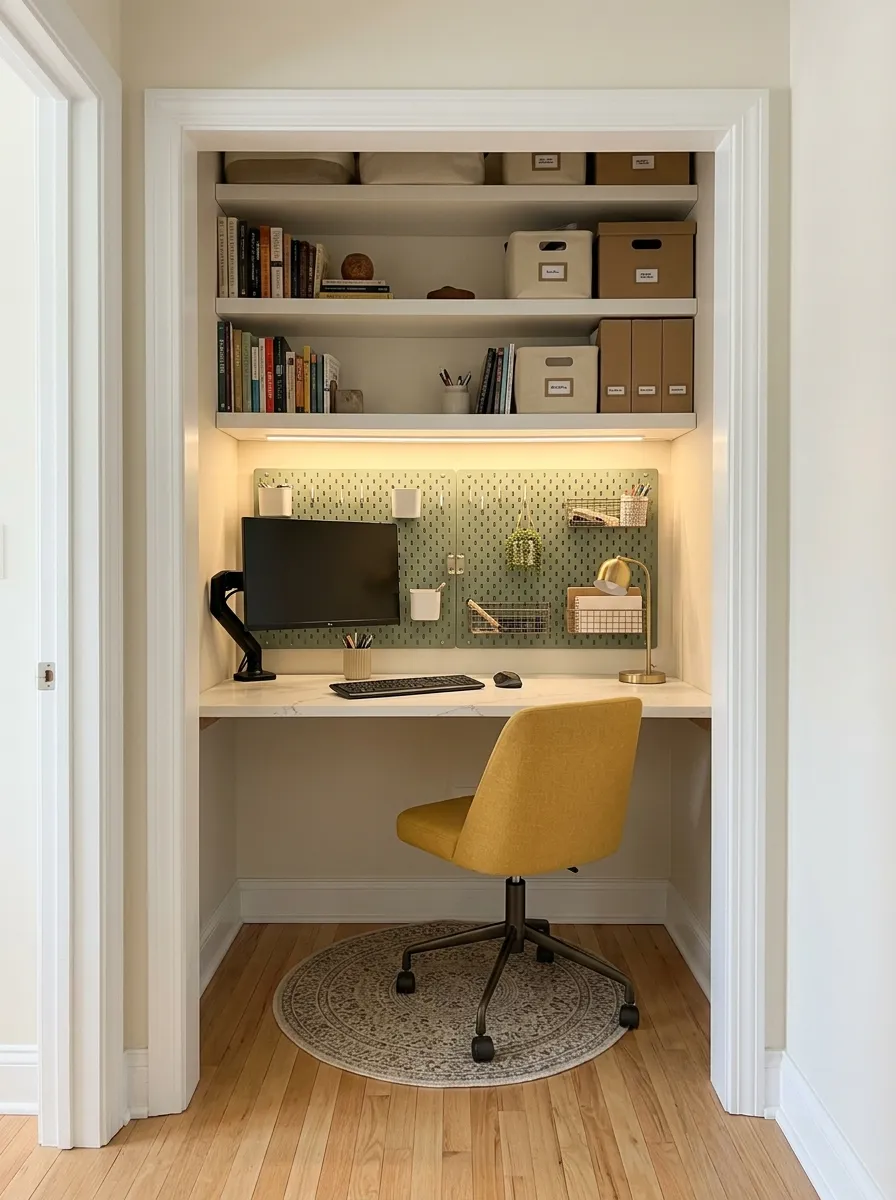
With the closet doors removed, the opening frames a built in workstation: two white shelves of books and labelled boxes above, a sage pegboard behind the monitor, a light strip under the lower shelf and a pale stone-look desktop. A mustard upholstered chair on a small round rug rolls in for occasional work in a very small footprint.
A closet desk has no floor of its own, so the 36 inches of clearance behind the chair has to come from the room or hallway outside the opening; make sure the chair can roll back without blocking a door. The strip light under the shelf is the right call, putting light on the work surface instead of relying on a ceiling fixture out in the room, and the brass desk lamp adds a second source.
Materials and Layout
A closet office lives or dies on task light and a chair that can move away. Closets rarely get good light, so the under shelf strip comes first, and the chair should roll clear of the opening when work is done. Painted wood, a metal pegboard and wool suit the tight space, and the pegboard holds cups, wire baskets and a small plant without drilling more holes in the wall.
With so little floor, the chair is the only thing that moves. Keep the boxes you use weekly on the lower shelf, reachable while seated, and keep the round rug small enough that the casters stay on it.
This is the lowest total in the guide at $1,340–$2,250. Main desk or chair gets $540–$790 and Textiles and floor layer $260–$460, about 56% of the high end between them; in a closet the textile line is mostly the round rug and chair upholstery, so part of it can move to the desktop if a stone-look surface is wanted. Lighting and hardware at $170–$310 pays for the strip light, desk lamp and pegboard fittings, Storage and small pieces at $230–$400 for the boxes, and Art, plants and finishing pieces at $140–$290.
Main desk or chair has the broadest allowance, $540–$790; confirming its specification first will make the final total more reliable.
Warm plaster (#E7DED0) covers the walls and closet interior, Light oak (#C49D72) is the hallway floor, and Moss (#61705A) is the pegboard, the one colour that makes the nook look like a deliberate room. Charcoal (#343735) stays on the monitor arm, keyboard and chair base.
The floor already supplies light oak, so a second oak touch inside the closet, such as a shelf edge or desk tray, would tie the two together. Boxes on the top shelf should stay light enough to lift down while standing, since that shelf sits above head height.
5. Scandinavian Office
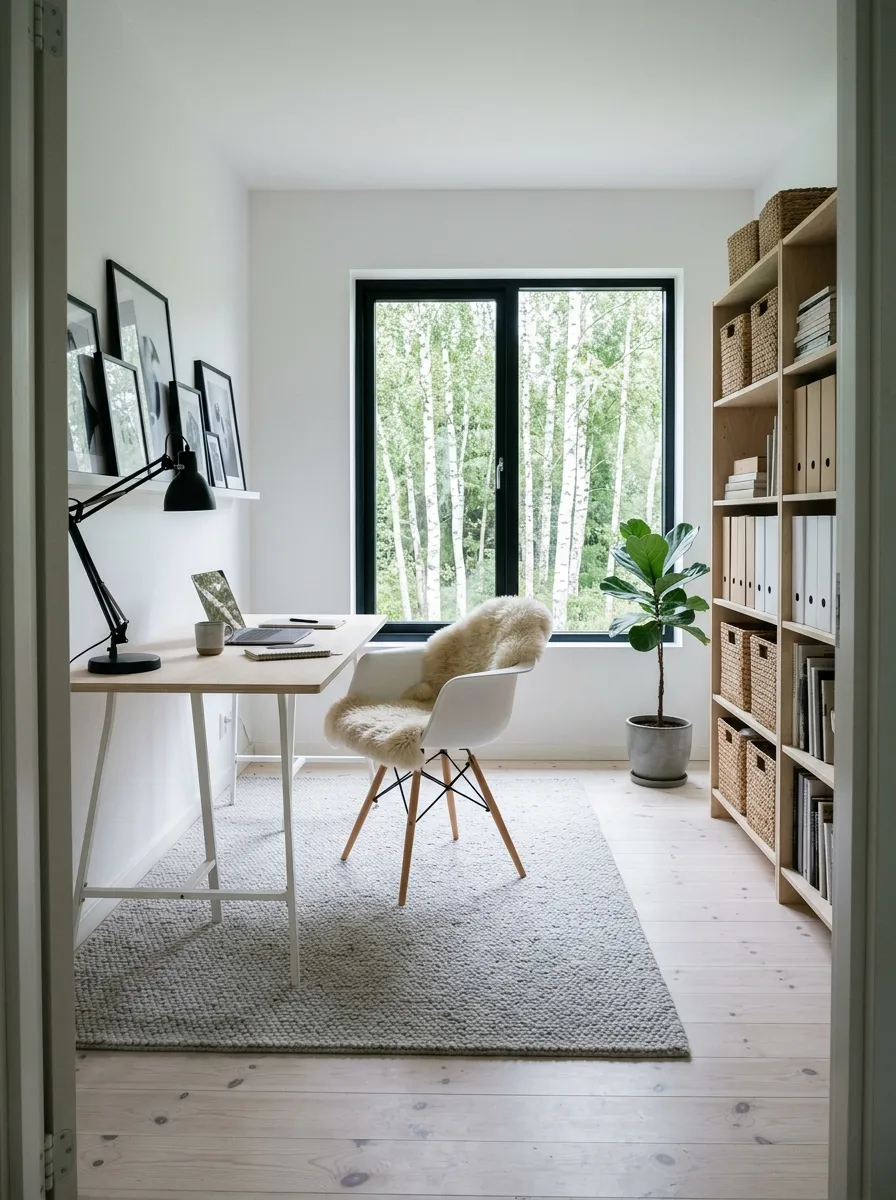
A pale wood top on white trestle legs, a white shell chair draped with a sheepskin and a black swing-arm lamp sit beside a tall black-framed window onto birch trees. Open pine shelving with baskets and box files holds modest storage for focused daily work, and a grey wool rug marks the desk zone.
The desk is pushed against the left wall, leaving a wide clear floor; keep at least 36 inches behind the chair as the rendering does, and note that this shell chair has no casters, so it needs the room to be lifted back. The black arm lamp clamps to the desk end where the hands are, and daylight arrives from the side rather than from behind the screen. Birch, wool, cotton and black metal make up the material list.
Materials and Layout
Choose a height appropriate desk and chair before anything else. A standard desk can be too tall for a shorter user, and the chair has to suit both the person and the desk. Birch, wool, cotton and black metal give the Scandinavian look, with black metal adding definition to the pale wood.
Storage gathers on one tall shelf unit so the other walls can stay bare. Keep its baskets at heights you can reach and leave enough floor in front of it to pull one out without moving the chair.
The Scandinavian office comes to $1,760–$2,940. Main desk or chair is $710–$1,030, and a classic shell chair can swallow much of that, so check whether the chosen model adjusts enough for full working days. Textiles and floor layer is $340–$600; those two lines make up about 55% of the high end. Lighting and hardware takes $220–$410, Storage and small pieces $300–$520 for the shelving, baskets and files, and Art, plants and finishing pieces $190–$370 for the framed prints and fig tree.
Warm white (#EFECE3) is the wall colour and Pale oak (#C7A77D) shows in the shelving, floorboards and desk top. Mist blue (#C8D8DA) sits close to the cool grey of the rug and the birch bark outside, and Soft navy (#354B5E) is a gentler substitute for the black window frame and lamp if you want less contrast.
Mist blue needs a second appearance indoors, a cushion or a set of box files, before it counts as part of the scheme. The tall shelf unit stands at the far end of the right wall, clear of the door, which is exactly where the tallest piece should go.
6. Dark Library Office
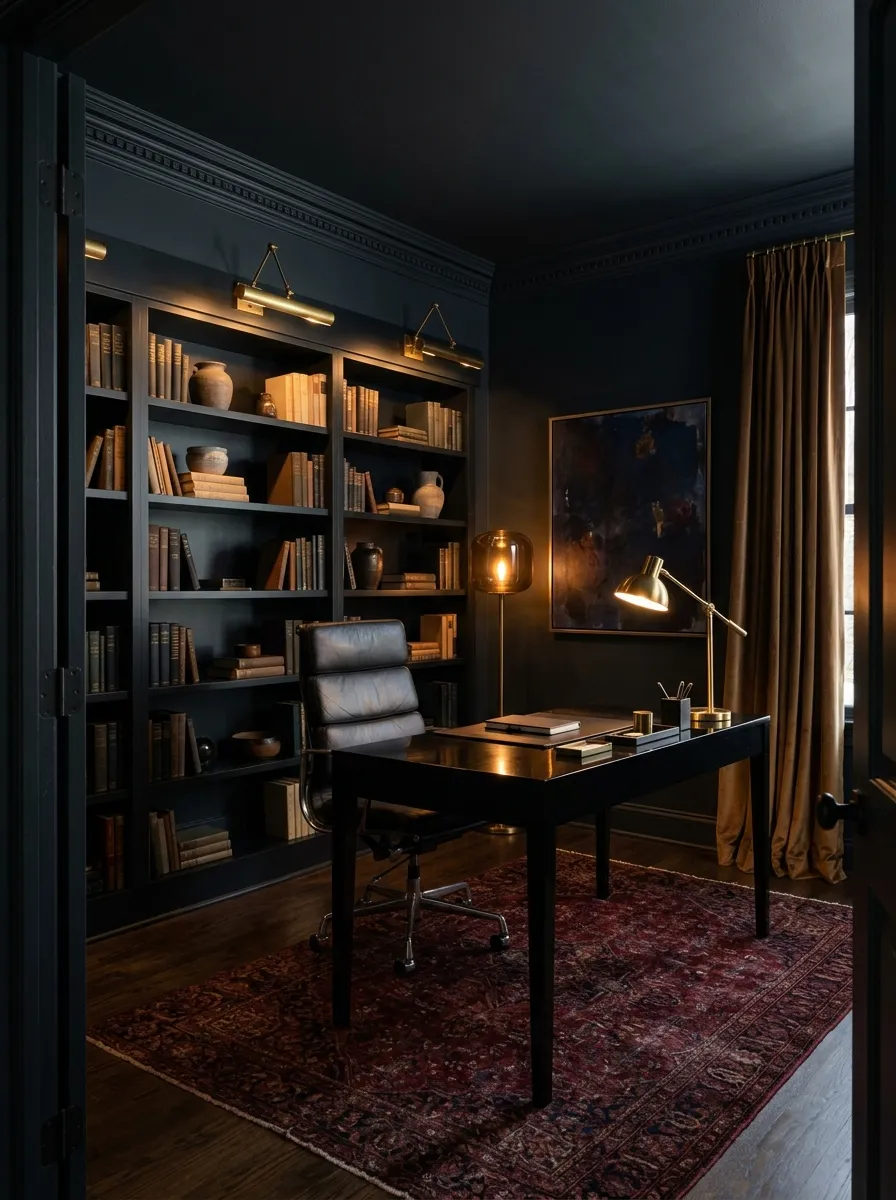
Walls, shelving and ceiling are painted close to black, brass picture lights wash the bookshelves, and a brass arm lamp and a glass globe floor lamp light the desk. A black desk on a deep red rug, a leather chair and bronze velvet curtains complete a room meant for evening work and book storage.
Every light here sits where something happens: picture lights over the shelves, the arm lamp angled onto the desk and the globe lamp beside it. That matters more in a dark room than a pale one, because the walls return almost nothing. Leave at least 36 inches behind the chair, which backs toward the shelving. Dark paint, a walnut-toned floor, wool and bronze make up the materials, and the desk itself is black rather than walnut.
Materials and Layout
A dark library office needs layered task and shelf lighting before paint or furniture. Dark walls absorb light, so a desk lamp, picture or shelf lights and a general source must work together. Dark paint, walnut, wool and bronze make up the palette, and bronze reflects warm light back into the room.
Because the chair backs onto the bookcase, the lowest shelves are awkward to reach while seated. Store the least used books down there and keep current references at desk height.
For 2026 the dark library office is estimated at $2,480–$4,140. Main desk or chair is $1,000–$1,450 and Textiles and floor layer $480–$840, roughly 55% of the high end, with velvet curtains and a large wool rug taking most of the textile money. Lighting and hardware at $320–$580 deserves a careful look, since two picture lights, a floor lamp and a desk lamp are what make this scheme work at all. Storage and small pieces is $420–$740 and Art, plants and finishing pieces $260–$530. Fix the desk or chair price first, as it carries the widest range.
Deep charcoal (#252725) and Ink blue (#263747) are so close in value that walls, shelving and ceiling read as one dark shell, with the blue surfacing only where lamplight falls. Walnut (#6B4F3A) comes through the floorboards and leather, and Aged brass (#A98252) is every light fitting, which is why brass reads as the room's only bright metal.
Repeat ink blue somewhere it can be seen in daylight, such as the desk chair or a cloth binding, or it will vanish into the charcoal. The globe floor lamp is the tallest loose object, and it stands beside the desk rather than in the walk from the door.
7. Shared Office
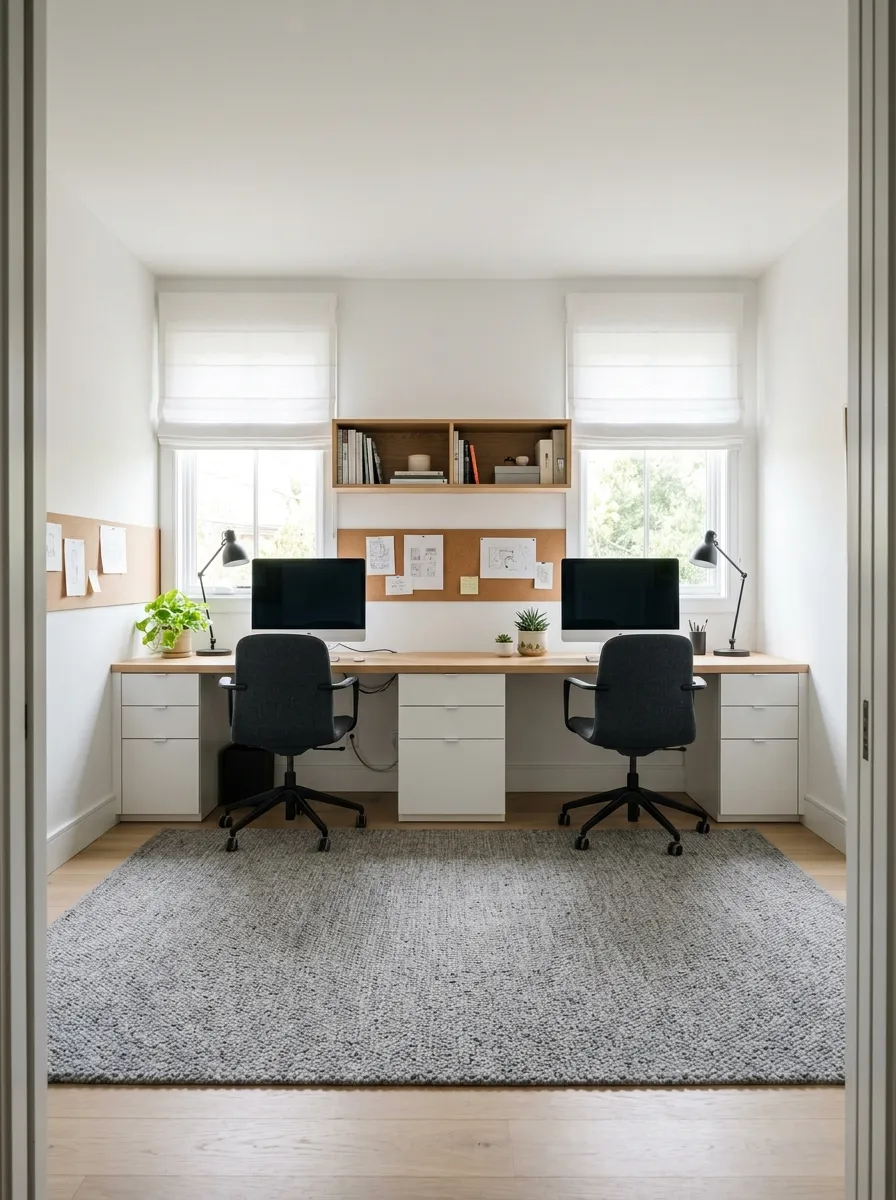
One long oak desktop runs across the back wall on three white drawer pedestals, giving two workstations with matching chairs, monitors and black arm lamps, plus a strip of cork above each place. The chairs move on separate paths, so two people can work simultaneously without cable conflict.
Two chairs side by side need two clearance zones: allow at least 36 inches behind each one, and let the centre pedestal act as a divider so neither chair drifts into the other. Each desk has its own lamp under its own window, which serves two people far better than a single overhead fixture.
Materials and Layout
A shared office needs two complete ergonomic setups, each with its own adjustable chair, monitor height and task light. Sharing one good chair and one makeshift seat does not work for daily use. Oak, steel, cork and dense carpet help with sound, which becomes the main issue once two people take calls.
Cables in this rendering drop behind the desk between the pedestals. Give each workstation its own outlet and data run there so one person's charger never crosses the other's footwell, and keep the shared wall shelf reachable from both chairs.
Furnishing two complete stations brings the shared office to $2,380–$3,970 at 2026 prices. Main desk or chair is $960–$1,390 and Textiles and floor layer $460–$810, together about 55% of the high end; with two chairs to buy, the first line goes less far than it seems, and a long top on pedestals is a fair place to save. Lighting and hardware runs $300–$560, Storage and small pieces $400–$710 for the pedestals and wall shelf, and Art, plants and finishing pieces $250–$510. Get a written quote on the desk and chair line before anything else, since its range is the widest.
Warm plaster (#E7DED0) walls and the Light oak (#C49D72) desktop and floor do nearly all the visual work. Moss (#61705A) is limited to a few desk plants, and Charcoal (#343735) goes to the two chairs and lamps, which gives the room its crisp outline.
Light oak appears in the desktop, the floor and the open shelf, so it already repeats more than twice. Any bookcase added later belongs on the entry wall, not the side walls, where it would squeeze the space behind the chairs.
8. Garden Office
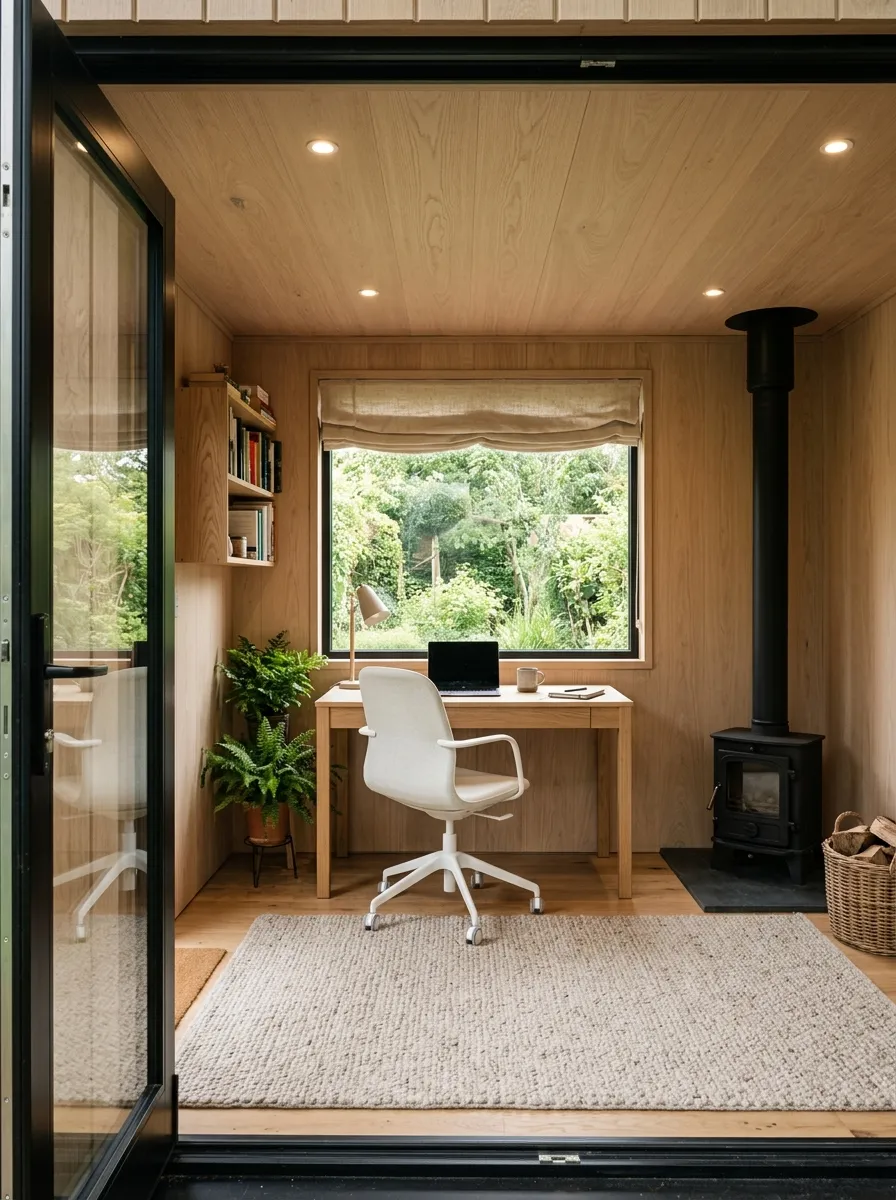
Oak-lined walls and ceiling, recessed lights, a broad window toward the garden and a glass door define this detached room. A small oak desk, a white swivel chair, a wool rug and a wood stove with a log basket set it up for focused work separated from household noise.
The stove claims a corner on its own hearth, so check the stove maker's clearances before placing the desk, and still keep at least 36 inches behind the chair. Recessed lights give general light, and a small lamp on the desk handles close work, which is enough while the window faces the desk. Timber, wool, steel and durable flooring suit a building people walk into straight from the lawn.
Materials and Layout
A garden office starts with insulation, power and a dependable desk setup. Without insulation the room is too hot in summer and too cold in winter, and without proper power the work has nowhere to plug in. Timber, wool, steel and durable flooring then handle the traffic from the garden.
Leave a mat zone inside the glass door for wet shoes, as the rendering does, and keep the log basket on the stove side so the walk to the desk stays clear.
The garden office allowance is $2,790–$4,660, and the assumption about existing services matters most here: the building, its insulation and the power feed are not in this figure. Main desk or chair is $1,130–$1,630 and Textiles and floor layer $530–$950, about 55% of the high end together. Lighting and hardware is $360–$650, Storage and small pieces $480–$830 and Art, plants and finishing pieces $300–$590. The desk and chair line has the widest spread, so price it before the smaller orders.
Linen (#E6DDCF) is the Roman shade and the rug, Leaf green (#526B4E) is the garden through the window and the ferns inside, and Terracotta (#A95F45) turns up only in the fern pot. Dark bronze (#3A3831) belongs to the stove, flue and window frames, the heaviest elements in a light timber room.
Linen already shows twice, on the shade and the rug, which keeps the pale oak from looking unfinished. The stove flue is the tallest object and rises in the corner opposite the door, well out of the walking line.
9. Executive Home Office
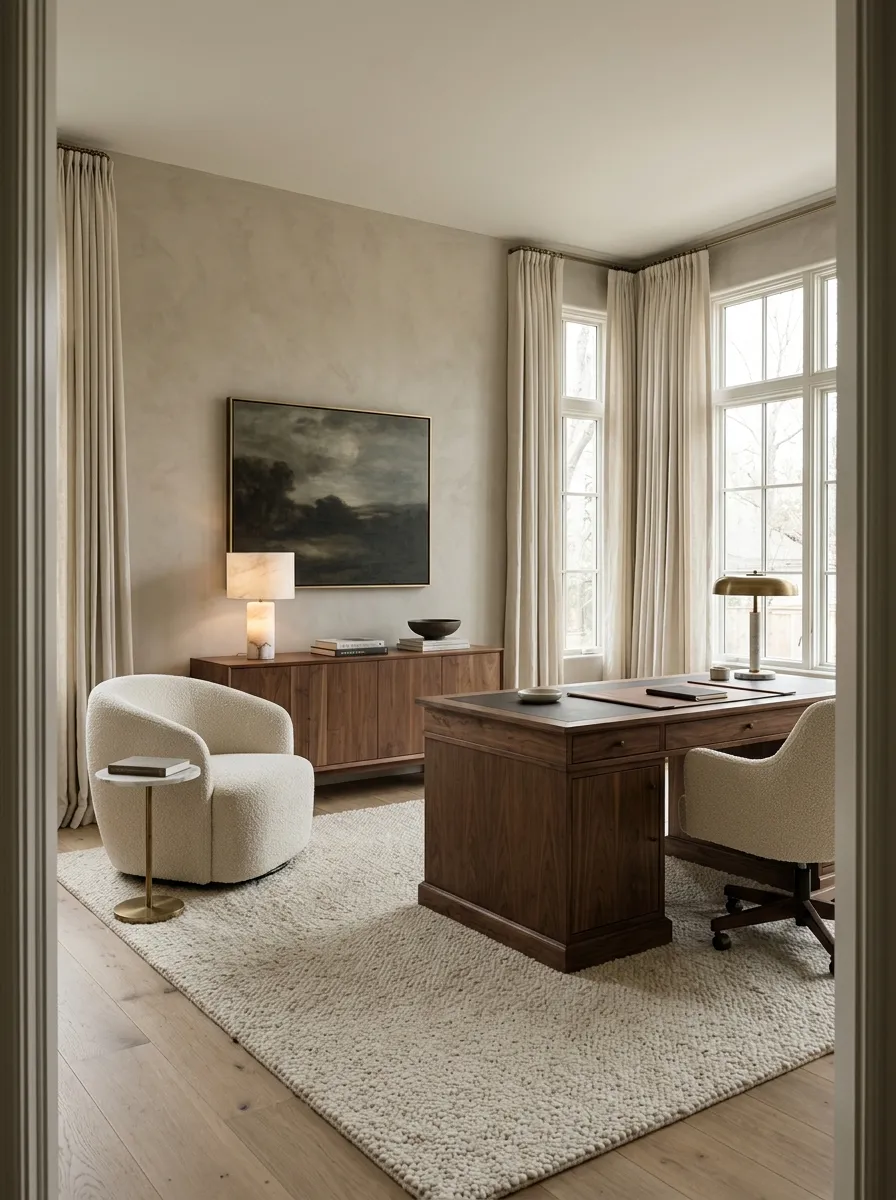
A walnut pedestal desk with a leather top, a matching walnut credenza, limewashed walls and floor-length linen drapes give this room a formal calm. A bouclé desk chair and a bouclé swivel armchair for visitors share one large wool rug, a setup for private work plus short meetings.
The desk sits out toward the corner windows, so the chair has open floor behind it; keep at least 36 inches there and a separate path to the armchair so a visitor never squeezes past. Light follows activity: a brass lamp on the desk, an alabaster lamp on the credenza and daylight from the side. Walnut, wool, leather and stone, in the alabaster lamp and the small side table, carry the material story.
Materials and Layout
The executive office spends first on the desk chair and acoustic window treatment. The chair is used every day, and heavy drapery cuts the echo that hard surfaces create on calls. Walnut, wool, leather and stone set a formal tone.
The guest armchair sits beside the credenza with its own small side table, so a visitor has somewhere to set a cup without reaching across the desk. Keep the walk from the door to that chair free of cables and lamp cords.
At $3,310–$5,530, the executive office is the most expensive scheme here. Main desk or chair takes $1,340–$1,940 and Textiles and floor layer $630–$1,130, together about 56% of the high end; floor-length linen across several windows and a large wool rug explain the textile figure. Lighting and hardware is $420–$770, Storage and small pieces $560–$990, mostly the credenza, and Art, plants and finishing pieces $350–$700 for the landscape painting and desk objects. The desk or chair line is the one to fix first.
Warm plaster (#E7DED0) is literal here, a limewash finish on the walls, while Light oak (#C49D72) is the wide-plank floor under the rug. Moss (#61705A) and Charcoal (#343735) both live in the landscape painting over the credenza, so the darkest colours hang at eye level instead of weighing down the floor.
Light oak needs one more touch above floor level, perhaps a frame or desk tray, to keep the walnut from dominating. The drapes are the tallest elements, and they hang on the window walls, clear of the route between door and desk.
10. Mid Century Office
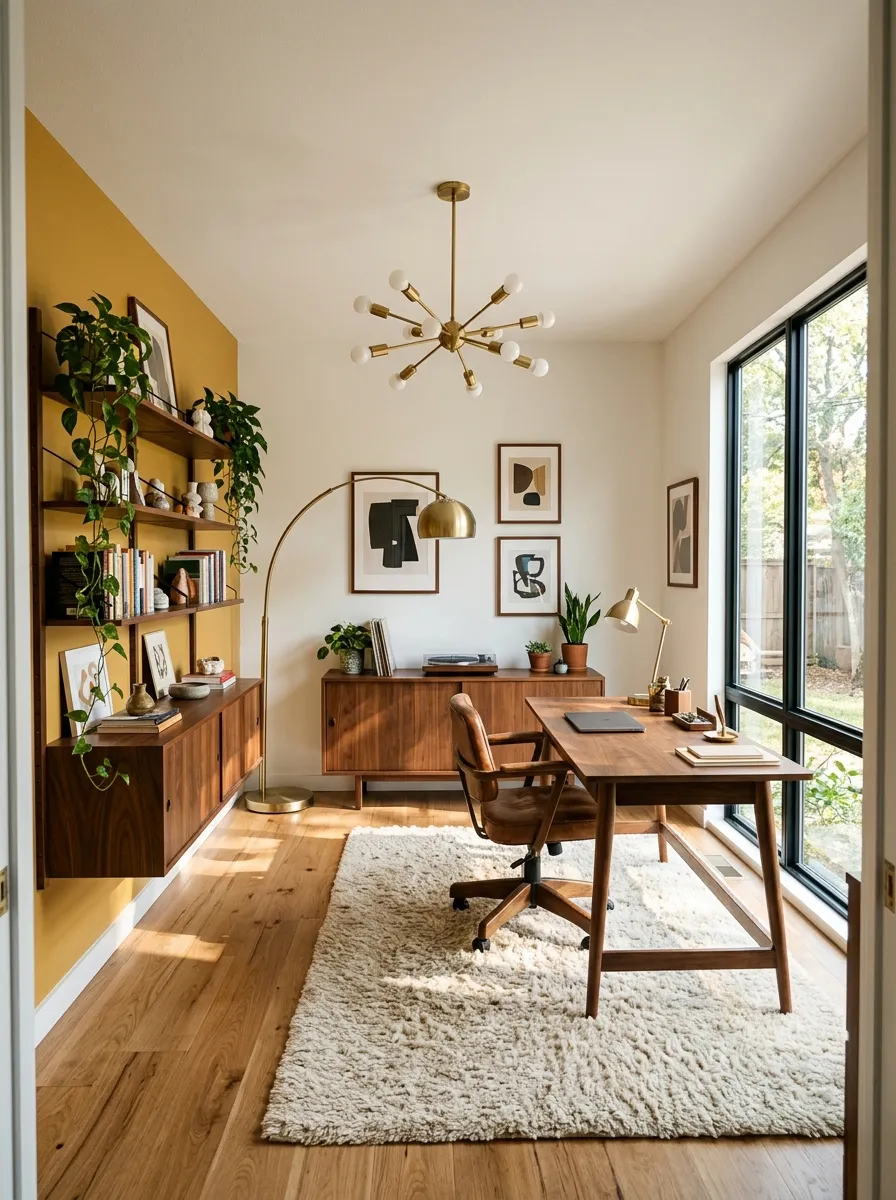
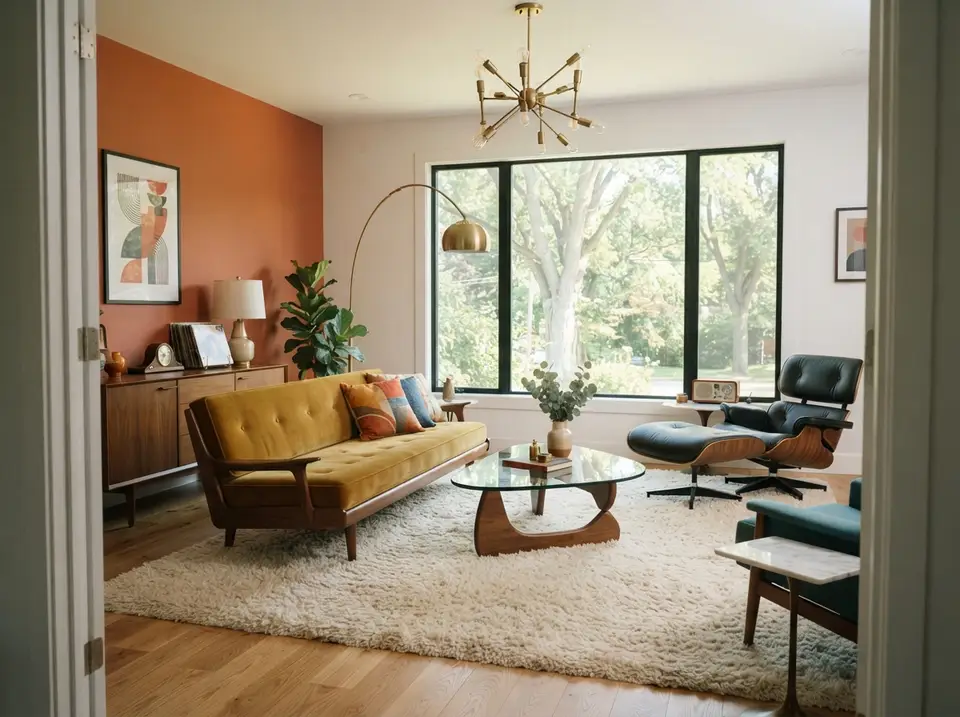
A mustard accent wall carries a walnut wall unit with open shelves, and a walnut credenza and an open-leg walnut desk keep the room light on its feet. A brass arc lamp, a brass sputnik pendant, a shaggy cream rug and a leather desk chair complete a room for computer work and small reference storage.
The desk stands in the middle of the floor parallel to the tall window, which brings side light and leaves space behind the chair; hold at least 36 inches there and between the desk and the wall unit. Lighting is layered by task, with the brass lamp on the desk, the arc lamp over the side of the room and the pendant for general light. Walnut, wool, brass and painted plaster are the materials.
Materials and Layout
Start with a well sized desk with cable access. Mid century desks are often slim and elegant, but a modern setup needs depth for a monitor and a grommet or tray for wires. Walnut, wool, brass and painted plaster set the period character.
Storage comes from a wall unit and a credenza rather than full bookcases, which suits a small reference collection. Leave the space under the desk empty so its slim legs stay visible.
The mid century office is budgeted at $2,170–$3,630 for 2026. Main desk or chair runs $880–$1,270; a vintage walnut desk may fit inside it, though most need a cable grommet added. Textiles and floor layer runs $420–$740, and the two lines account for about 55% of the high end. Lighting and hardware at $280–$510 has to cover an arc lamp, a pendant and a desk lamp, so watch it closely; Storage and small pieces is $370–$650 and Art, plants and finishing pieces $230–$460. Pin down the desk and chair before the rest.
Warm plaster (#E7DED0) covers the white walls around the window and Light oak (#C49D72) is the floor. The mustard accent wall is not in the listed palette, yet it sets the mood more than any other surface. Moss (#61705A) comes from the trailing plants on the wall unit and Charcoal (#343735) from the abstract prints and the window frames.
Light oak repeats only in the floor, so a light oak frame or tray would help it look chosen. The arc lamp is the tallest loose piece and leans in from the wall unit side, outside the path from door to desk.
Lighting, Scale and Daily Maintenance
Place the monitor roughly at an arm's length as a starting point and adjust for screen size and vision needs. The top of the active screen is commonly near or slightly below eye level.
Use window light from the side where possible. A shade should control direct glare without turning the office dark all day. Add a task light with a shielded source for paper work.
Separate power, data and loose charging cables. Secure a power strip off the floor, leave ventilation around equipment and label both ends of cables in shared setups.
A Purchase Order That Protects the Budget
Before buying anything for an office, measure the room and sketch where the chair has to roll, where the door swings and where the outlets and network port are. Note what stays, because an existing bookcase or a good chair changes every budget above. That sketch is what stops a discounted desk from blocking the chair path or a closet door.
Buy in the order the work needs it. Chair and desk come first, checked for delivery size, assembly space and return terms; lighting and the rug follow, because glare and a chair that sticks are the next problems you notice. Prints, plants and desk objects come last, once you can see what scale the wall and desk can take.
Hold back a small sum for the things renderings never show: cable trays, a power strip, bulbs, felt pads and wall repair after mounting a monitor arm. Then work in the room for two weeks before buying more, and add only what real working days show is missing.
Keep receipts, finish names and care instructions in one folder. Office chairs and monitor arms have parts that wear, and a record makes ordering a spare caster or matching a desk finish far simpler.
Cost Saving Strategies That Keep the Layout Intact
A plain commercial desk with the correct depth can outperform a decorative console. Spend on fit and add character through paint, one lamp and art.
Reuse closed storage from another room if the depth does not narrow the chair path. Add drawer dividers only after paper and equipment categories are known.
Improve a basic chair with correct adjustment before replacing it. If support remains poor after adjustment, direct money toward the chair rather than a new shelf wall.
Questions Readers Ask
How much does a home office cost?
A practical desk and chair setup can start near $700. A complete room with storage, lighting, rug and upgraded equipment often falls between $2,000 and $6,000.
How deep should a home office desk be?
About 24 to 30 inches suits many computer setups. Large screens, monitor arms and paper work may need more.
Where should a desk face?
Choose the direction that controls glare and keeps the door and main route comfortable. Side light from a window is often useful.
What is the best lighting for a home office?
Combine general room light, a focused task light and controlled daylight. Avoid a bright window directly behind the screen.
Can a closet become an office?
Yes, if there is enough desk depth, ventilation, power and chair clearance. Keep the option to close it only when equipment can cool safely.
How do two people share a home office?
Give each person a full chair zone, separate cable route and some acoustic control. Shared storage should not require crossing behind the other chair.
Does a home office need a rug?
No, but a rug can reduce echo and define the work zone. Use a low pile surface that lets the chair move safely.
Sources and Pricing Notes
The workspace allowances above are 2026 planning figures in US dollars, built from current retail prices for the desk, chair, lighting and storage pieces each home office rendering shows. Tax, delivery and permits are not in these home office figures, and neither is any repair the room turns out to need.
- OSHA: computer workstation evaluation guidance.
- U.S. Bureau of Labor Statistics: Consumer Price Index notes for household furnishings.
- The Home Depot: project calculators and current material categories.
- IKEA US: current furniture and storage categories.
Keep Planning
paint color guide, decluttering system, home office design study.
Styling & Living Desk
The Layered Homes editorial teamThe Styling & Living Desk produces the room-by-room guides, outdoor and garden pieces, celebration ideas and design solutions, each with an itemised cost estimate, and the Home Files essays.
More from the Styling & Living Desk →
Reader notes