


Seven years of styling Charleston-area homes — King Street penthouses, Mount Pleasant townhouses, Daniel Island condos, Sullivan's Island sunrooms, Pawleys Island weekenders — and one design brief has gone from fringe to mainstream in front of me: clients want to grow real food at home, but they want it to look intentional rather than apologetic. The "urban food forest" framing is the cleanest version of that brief I've worked with. It treats edible plants as architectural and design materials, not as a hobby tucked into a corner. This guide walks through ten zones I'd specify into a real urban or near-urban Charleston home — from a wall-mounted vertical garden in the living room to a Lettuce Grow Farmstand on a 12th-floor terrace to a butcher-block kitchen island with an integrated herb trough — each with the brands and systems I actually source, the materials and finishes that make the food-growing read as design rather than as gardening, a Charleston 2026 installed cost range grounded in invoices I've reviewed across recent client projects, and the operational advice that determines whether the system will still be producing food in year three or sitting in storage by month six.
— Johan Martez, Interior Stylist, Charleston, SC
Table of Contents
- Zone 1 — The Living Wall Lounge
- Zone 2 — Industrial Hydroponic Dining
- Zone 3 — The Bountiful Balcony
- Zone 4 — Framed Greenery Living Room
- Zone 5 — Rooftop Garden Lounge
- Zone 6 — Minimalist Desktop Farm
- Zone 7 — Rustic Garden Utility Room
- Zone 8 — Sunroom Citrus Conservatory
- Zone 9 — Kitchen Island Herb Garden
- Zone 10 — Rooftop Lounge with Fire & Foliage
- Pro Tips & Operational Advice
- Cost-Saving Strategies
- Regional Fit Across Five Markets
- Frequently Asked Questions
- Sources & References
- Final Thoughts
Zone 1 — The Living Wall Lounge
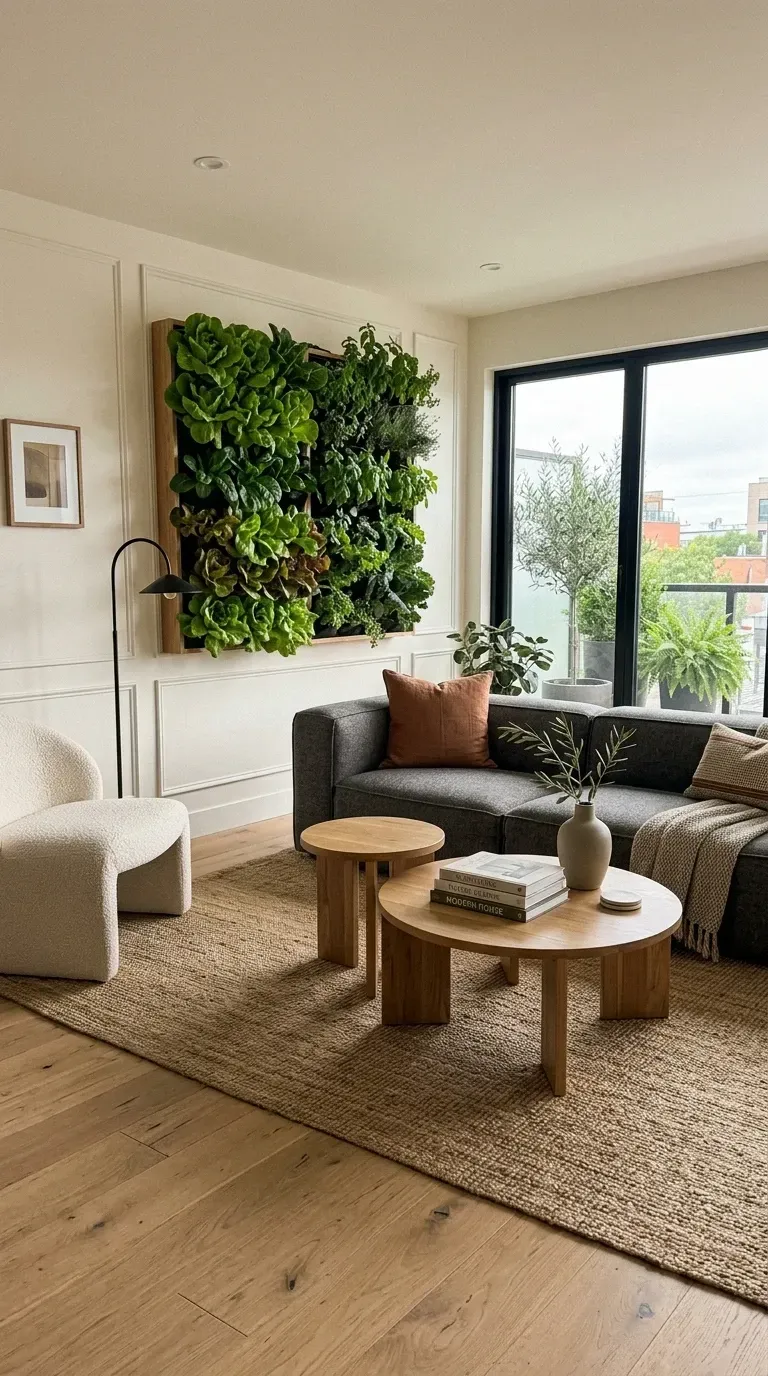
This is the single zone that most reframes a client's relationship with edible plants in the home — when a wall of living greenery becomes the visual anchor of the living room, the rest of the house quietly reorganizes around it. The system I default to for this zone is a Florafelt Pro 32 Pocket Panel set into a custom framed steel surround (TWD Industrial in North Charleston has fabricated three of these for me), with a dedicated drip-irrigation reservoir and a Bluetooth-controlled pump on a Wyze plug. For a productive food-and-foliage hybrid, I'll spec roughly 60% non-edible foliage (pothos, philodendron, peperomia for visual mass) and 40% edible (basil, mint, chives, parsley, oregano, cilantro, leaf lettuce) — pure-edible walls look thin and harvested-looking by week eight. The dark grey sectional reads as Article Sven slipcovered or Interior Define Sloan in a charcoal performance weave. The bouclé armchair I'd spec is the Article Quadra in cream or the West Elm Andes in a chunky Maharam Mantle. Nested coffee tables: Crate & Barrel Yukon set or, for a real upgrade, the Sundays Furniture Round Walnut nesting pair. The 9'x12' jute rug is Lorena Canals or Annie Selke handwoven for actual durability under foot. The olive tree is the only piece I'd spend serious money on — a 6-foot Olea europaea from Plant Vault Charleston runs $425–$680 and reads correctly; the $99 mass-market alternatives die within a year in low light.
Features
- Florafelt Pro 32-pocket panel system in custom steel frame, 60% foliage / 40% edible mix
- Dedicated drip-irrigation reservoir with Bluetooth-controlled timer
- Soltech Aspect AT09 supplemental grow light (clear lens, full-spectrum, dimmer-controlled)
- Decorative wall paneling in white oak slat or shou sugi ban
- Article Sven or Interior Define Sloan dark-grey sectional in performance weave
- Article Quadra or West Elm Andes cream bouclé accent armchair
- Crate & Barrel Yukon or Sundays Furniture Round Walnut nested coffee tables
- Lorena Canals 9'x12' handwoven jute area rug
- Cedar & Moss Alto or Allied Maker matte-black floor lamp
- 6-foot Olea europaea olive tree from Plant Vault Charleston in stoneware planter
Styling Notes
- The wall needs at least 350–500 foot-candles measured at the panel face — a south-facing window plus the Soltech Aspect supplements this; north-facing rooms need two Aspects minimum.
- Plant rotation matters: cycle the basil, mint, and parsley pockets every 4–6 months as they bolt; foliage anchors stay 18+ months.
- Install a closed-cell foam moisture barrier behind the frame and a stainless drip pan at the base — this is the single failure mode I see in DIY installations.
- Keep the surrounding palette deliberately neutral (charcoal, cream, jute, walnut) — the wall already does the color work, additional saturation reads as competing.
Living Wall Lounge — Charleston 2026 Installed Cost
Installed cost for a full Florafelt 32-pocket living wall, supplemental grow light, irrigation, anchor furniture (sofa, armchair, tables, rug, lamp), and a real specimen olive tree. Excludes wall paneling labor if existing wall is sound.
| Item / Brand | Charleston 2026 Installed |
|---|---|
| Florafelt Pro 32-Pocket Panel + custom steel frame (TWD Industrial) | $1,800–$3,400 |
| Drip irrigation reservoir + Wyze-controlled pump kit | $420–$680 |
| Soltech Aspect AT09 grow light (clear lens, dimmer) | $320–$420 |
| White oak slat or shou sugi ban wall paneling, 80 sf | $680–$1,400 |
| Article Sven or Interior Define Sloan sectional | $1,800–$3,800 |
| Article Quadra or West Elm Andes bouclé armchair | $580–$1,400 |
| Sundays Furniture nested walnut coffee tables | $520–$1,200 |
| Lorena Canals or Annie Selke 9'x12' jute rug | $340–$680 |
| Cedar & Moss Alto or Allied Maker floor lamp | $240–$540 |
| 6-foot specimen Olea europaea (Plant Vault Charleston) in stoneware planter | $425–$780 |
| Plant inventory (initial fill: foliage + edibles + soil) | $280–$520 |
| Decor (vases, books, throw pillows from CB2 / Jenni Kayne / Heath Ceramics) | $240–$580 |
| Total Installed Cost | $7,645–$15,400 |
Mid-range specification, Charleston tri-county labor and material rates as of 2026 Q1. The single line item that drives 30–40% of the total is the living wall system itself — DIY hardware-only kits run $400–$700 but failure rate is meaningfully higher; professional installation is the bottleneck most worth paying for.
Zone 2 — Industrial Hydroponic Dining
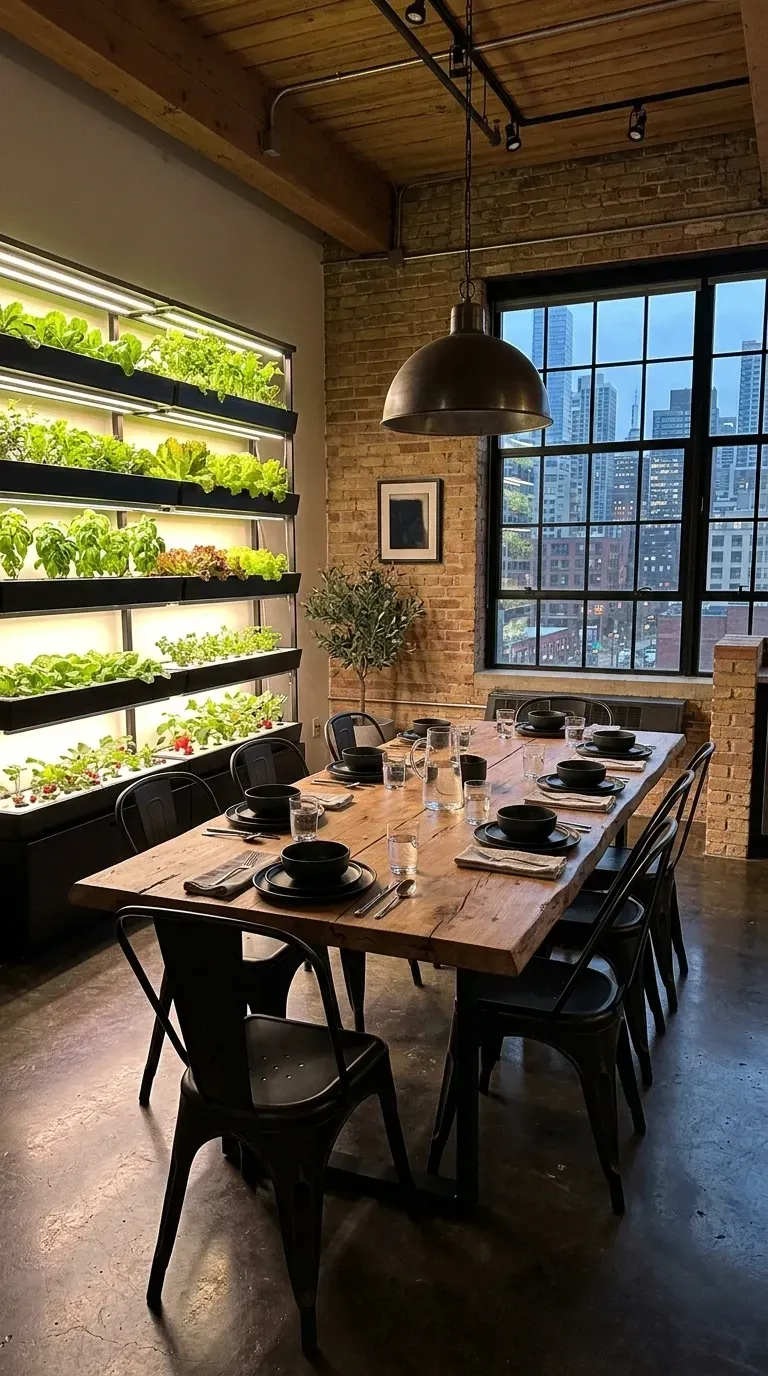
An entire wall of multi-tier hydroponics is the most committed version of an urban food forest a client can install indoors — and when it works, it works exceptionally well. The system I default to here is a Rise Gardens 3-Tier Family Garden ($999 base) for entry, or for serious production a Gardyn Home Kit 3.0 ($899 base) with a wall-mount upgrade, or for the highest-end commercial-grade build a Cubic Farms vertical wall system (custom quote, typically $4,800–$9,400 installed for a residential application). The exposed brick is original — King Street loft condos and converted Cigar Factory units in Charleston have brick that pre-dates 1920 and reads correctly with industrial design language. The live-edge dining table is the second high-value spend: a Pottery Barn Hart Reclaimed Pine seats 8 at $2,200; a custom walnut live-edge from Charleston Forge or Atlanta-based Dust Furniture runs $3,200–$5,800 and reads as heirloom rather than retail. Tolix Marais A black powder-coated chairs are the textbook industrial dining chair at $185 each from Design Within Reach (DWR); the matte-black powder-coated Crate & Barrel Felix is the budget-friendly equivalent at $99. The pendant is a Visual Comfort Henry double-arm in aged iron or a Schoolhouse Princeton 24-inch in matte black. Track lighting (Juno Trac-Lites or LBL TR50) handles the hydroponic system's supplemental light requirement without competing with the pendant.
Features
- Rise Gardens 3-Tier Family Garden, Gardyn Home Kit 3.0, or Cubic Farms residential wall system
- Original exposed brick wall (King Street loft / Cigar Factory condo type)
- Polished concrete or 6-inch heart-pine plank flooring
- Pottery Barn Hart Reclaimed Pine or custom walnut live-edge dining table (seats 8)
- Tolix Marais A black powder-coated dining chairs (x8) from DWR
- Visual Comfort Henry double-arm or Schoolhouse Princeton 24" pendant
- Juno Trac-Lites or LBL TR50 track lighting system
- Specimen Olea europaea or Ficus lyrata in oversized stoneware planter
- Heath Ceramics Coupe dinnerware setting (8 place settings)
Styling Notes
- Calculate electrical load: a Rise Gardens 3-Tier draws roughly 240W continuous on the lights alone — verify the dining room is on a 20A dedicated circuit before installation.
- Hydroponic systems are loud (water-pump cycling and fan noise) — locate at least 8 feet from the dining table or the dinner-conversation acoustic experience suffers.
- Brick walls absorb humidity from the hydroponic system over time — install a humidity-tolerant grout sealer (StarBrite Grout Sealer or equivalent) before installation.
- Plant variety matters more than volume here: leafy greens (kale, lettuce, arugula, spinach) thrive; fruiting plants (tomatoes, peppers) need supplemental light and tend to look messy in dining-room visual contexts.
Industrial Hydroponic Dining — Charleston 2026 Installed Cost
Installed cost for a wall-mounted multi-tier hydroponic system, dining furniture for 8, lighting, and styling. Assumes existing brick wall and electrical capacity; circuit upgrade adds $480–$840 if needed.
| Item / Brand | Charleston 2026 Installed |
|---|---|
| Rise Gardens 3-Tier or Gardyn 3.0 hydroponic system installed | $1,400–$2,400 |
| Cubic Farms residential wall upgrade (alternative high-end) | $4,800–$9,400 |
| Pottery Barn Hart Reclaimed Pine or custom walnut live-edge table | $2,200–$5,800 |
| Tolix Marais A black dining chairs (x8) from DWR | $1,400–$1,800 |
| Visual Comfort Henry or Schoolhouse Princeton pendant | $680–$1,400 |
| Juno Trac-Lites or LBL TR50 track lighting kit + install | $580–$1,200 |
| Specimen Olea europaea or Ficus lyrata in planter | $340–$680 |
| Heath Ceramics Coupe 8-place dinnerware setting | $680–$1,200 |
| Initial plant inventory (leafy greens for hydroponic system) | $140–$240 |
| Total Installed Cost (mid-range Rise/Gardyn) | $7,420–$14,720 |
Cubic Farms or comparable commercial-grade wall systems push the total to $11,000–$22,000 installed. Most Charleston clients land on Rise Gardens or Gardyn for the visual-vs-cost balance — both produce 30–60 plants on rotation, which is more than a 4-person household consumes.
Zone 3 — The Bountiful Balcony
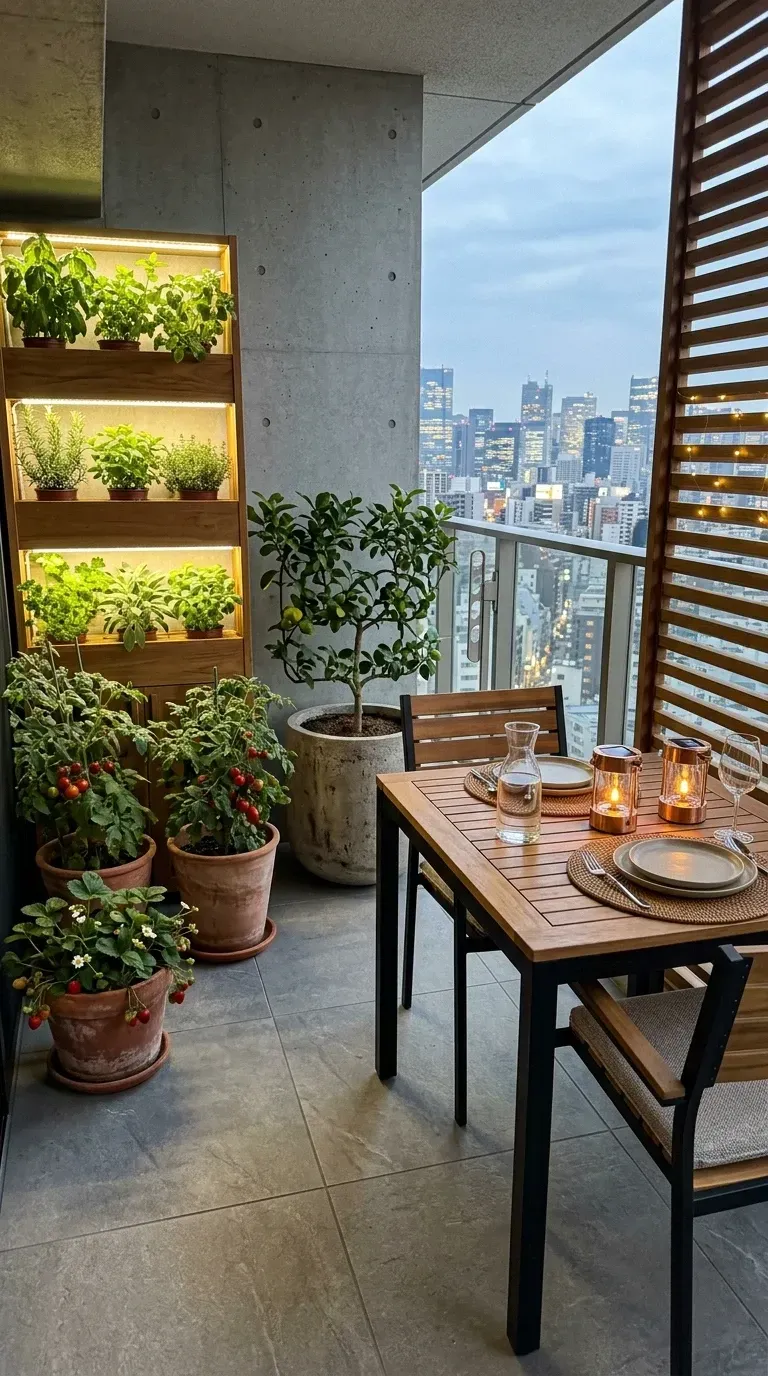
The bountiful balcony is the urban food forest at its most accessible — most of my Charleston downtown clients with King Street, East Bay, or Broad Street condos have a 60-to-180-square-foot balcony, and the constraint is what makes the design discipline interesting. The shelving unit is the single high-impact spend: a custom cedar four-tier rack with integrated Soltech Aspect AT09 grow lights at the top tier (built by Patrick at Lowcountry Woodcraft for $580–$880) holds 12–18 herb pots, two flats of microgreens, and a base shelf of bulky pots like the citrus tree. The bistro set I default to is the Smith & Hawken Beachwood teak table and chair pair from Target ($380 set) for budget builds, or the Sutherland Marina collection for high-end clients (real teak, $1,800–$3,200 set). The Meyer lemon or Calamondin orange in a 14-inch terracotta pot from Vietri (Charleston's Croghan's Jewel Box carries them) reads as the focal piece. Tomato varieties to specify: 'Tumbling Tom' or 'Patio Choice' for cherries, 'Bush Early Girl' for slicers — these are bred for container production. Strawberries: 'Albion' or 'Seascape' day-neutral varieties produce all season. The wooden slat privacy screen (cedar 1x4s on a steel frame) is the architectural move that turns the balcony from "place where I keep plants" into "outdoor room with plants." Concrete tile flooring (Bedrosians Cloé in cement gray, $4.20/sf at Floor & Decor) handles wear and water without the porosity of natural stone.
Features
- Custom 4-tier cedar shelving unit with integrated Soltech Aspect AT09 grow light at top tier
- Smith & Hawken Beachwood teak or Sutherland Marina bistro table + chairs (x2)
- 14-inch Vietri terracotta pot with Meyer lemon or Calamondin orange tree
- Italian terracotta pots (3 sizes) with 'Tumbling Tom' tomatoes, 'Albion' strawberries, basil, parsley, mint
- Bedrosians Cloé concrete cement-gray tile flooring on existing balcony slab
- Custom cedar 1x4 slat privacy screen on steel frame, 6 feet tall
- Hometown Evolution string lights (warm white, IP65 rated, 24-foot strand)
- West Elm Andean lantern or CB2 Cygnet outdoor lantern for evening ambiance
Styling Notes
- Charleston balcony south or west exposure produces 6–8 hours of summer direct sun — perfect for fruiting plants. North exposure needs the supplemental grow light running 4–6 hours daily.
- Container size matters more than amateur gardeners assume: a 14-inch pot is the minimum for a Meyer lemon to fruit; a 10-inch is the minimum for a Tumbling Tom tomato to produce more than 6–10 fruits per season.
- Self-watering inserts (Lechuza Pon insert or Vitavia Tropfer) cut watering to twice weekly — without them, summer heat dries Charleston balcony pots in 12–18 hours.
- Wind exposure on upper-floor balconies is significant: stake taller plants (citrus, indeterminate tomatoes) and weight pots with a base of pea gravel before potting soil.
Bountiful Balcony — Charleston 2026 Installed Cost
Installed cost for a 60–180 square foot balcony food garden including custom shelving, lighting, citrus tree, container inventory, plants, dining furniture, and privacy screen. Assumes existing slab; tile installation is the variable cost driver if sub-flooring needs prep.
| Item / Brand | Charleston 2026 Installed |
|---|---|
| Custom cedar 4-tier shelving with Soltech Aspect grow light (Lowcountry Woodcraft) | $580–$1,200 |
| Smith & Hawken Beachwood teak or Sutherland Marina bistro set | $380–$3,200 |
| 14-inch Vietri terracotta + Meyer lemon or Calamondin orange tree | $220–$420 |
| Italian terracotta pots (3 sizes, x6 total) + plants + soil | $280–$540 |
| Bedrosians Cloé concrete tile flooring + install (estimated 80 sf) | $540–$980 |
| Custom cedar 1x4 slat privacy screen on steel frame | $420–$880 |
| Hometown Evolution IP65 string lights + outdoor lanterns | $140–$320 |
| Self-watering inserts (Lechuza Pon, x4) | $160–$280 |
| Total Installed Cost | $2,720–$7,820 |
The bistro set is the most variable line item — a Target teak set drops the total to under $3,000, while a Sutherland Marina set pushes it past $7,000. Plants and pots are surprisingly cheap relative to design impact; the cedar shelving is the line item I'd protect.
Zone 4 — Framed Greenery Living Room
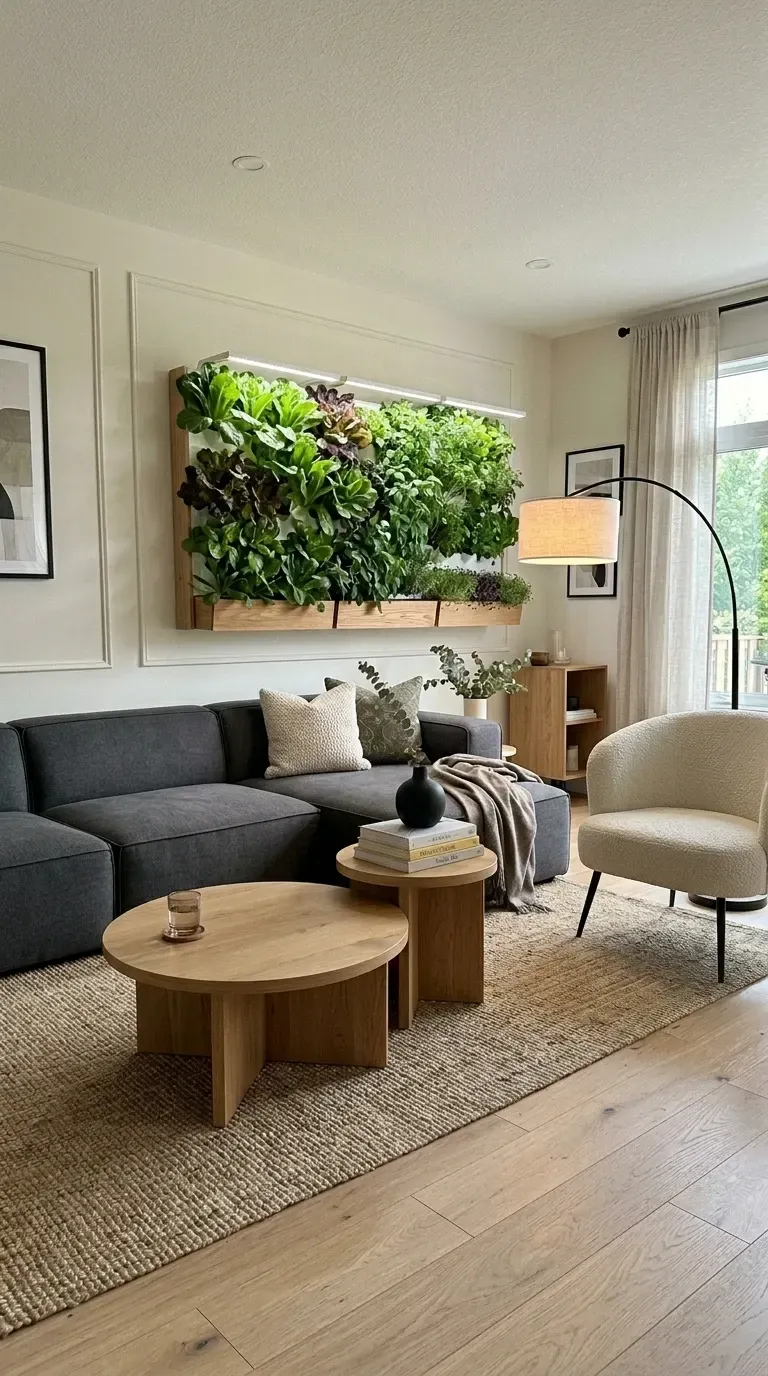
If the full Florafelt wall in Zone 1 is too big a commitment for the room or the budget, the framed greenery panel is the single best entry point into edible-and-foliage living-wall installation. The system I default to here is the Wallygro Eco Wall System (12-pocket version, $349 base) or the Plants On Walls Florafelt Recirc 4-pocket pre-built unit ($199 base), framed in a custom walnut or oak shadow box from Lowcountry Woodcraft ($420–$680). Integrated grow light: a Soltech Solutions Vita Grow Bar (under-cabinet style, 16 inches) runs along the top of the frame, or for a more discreet read, an OSRAM Linear LED strip behind a custom wood baffle. The plant mix at this scale should weigh more heavily toward edibles since the smaller surface area shows individual specimens more clearly: 70% culinary herbs (basil, oregano, thyme, parsley, chives, mint) and 30% structural foliage (peperomia, satin pothos for trailing). The dark sectional reads as an Article Burrard or West Elm Harmony at this size; the cream armchair I'd spec is the West Elm Hampton in cream Belgian linen. Round coffee table: Sundays Furniture Crescent Walnut or West Elm Anton round mango wood. Wood side table: Crate & Barrel Tate or Article Madera. Arc floor lamp: West Elm Mid-Century or Schoolhouse Isaac Modern Arc.
Features
- Wallygro Eco Wall 12-pocket or Florafelt Recirc 4-pocket framed living wall system
- Custom walnut or oak shadow-box frame (Lowcountry Woodcraft)
- Soltech Solutions Vita Grow Bar 16" or OSRAM Linear LED behind wood baffle
- Decorative tongue-and-groove wood wall paneling (5" white oak)
- Article Burrard or West Elm Harmony dark grey sectional sofa
- West Elm Hampton or Article Quadra cream Belgian linen accent armchair
- Sundays Furniture Crescent Walnut or West Elm Anton round mango coffee table
- Crate & Barrel Tate or Article Madera wooden side table
- Lorena Canals 8'x10' jute area rug
- West Elm Mid-Century or Schoolhouse Isaac arc floor lamp in matte black
Styling Notes
- The framed scale (4–12 plant pockets) reads as an art piece — position it at gallery height (center of frame at 60 inches above floor), not at sofa-back height.
- Edible-heavy plantings need rotation every 3–5 months as basil bolts and cilantro flowers; build the rotation cycle into the maintenance plan.
- Use a hidden Wyze sensor or Govee humidity monitor inside the frame to track moisture — over-watering kills more wall systems than under-watering.
- Limit the rest of the wall to a single piece of complementary art and minimal shelving — the wall garden needs visual breathing room.
Framed Greenery Living Room — Charleston 2026 Installed Cost
Installed cost for a smaller framed living-wall system, integrated grow light, anchor furniture (sectional, armchair, coffee and side tables, rug, arc lamp), and accent decor. Designed as a less-committed entry point compared to Zone 1.
| Item / Brand | Charleston 2026 Installed |
|---|---|
| Wallygro Eco Wall or Florafelt Recirc + custom walnut frame | $680–$1,400 |
| Soltech Vita Grow Bar or OSRAM Linear LED with custom baffle | $240–$540 |
| Tongue-and-groove white oak wall paneling, 60 sf | $580–$1,200 |
| Article Burrard or West Elm Harmony dark sectional | $1,400–$2,800 |
| West Elm Hampton or Article Quadra cream armchair | $420–$920 |
| Sundays Furniture Crescent or West Elm Anton round coffee table | $340–$780 |
| Crate & Barrel Tate or Article Madera wooden side table | $140–$340 |
| Lorena Canals 8'x10' jute rug | $280–$580 |
| West Elm Mid-Century or Schoolhouse Isaac arc floor lamp | $220–$540 |
| Plant inventory (initial fill: 70% edibles, 30% foliage) | $120–$240 |
| Decor (pillows, throws, vases from CB2 / Heath Ceramics) | $240–$580 |
| Total Installed Cost | $4,660–$9,920 |
The framed scale brings the system installed cost down dramatically from the Florafelt 32-pocket of Zone 1. For first-time living-wall clients, this is the version I most often recommend — it proves the concept at half the cost before committing to a full feature wall.
Zone 5 — Rooftop Garden Lounge
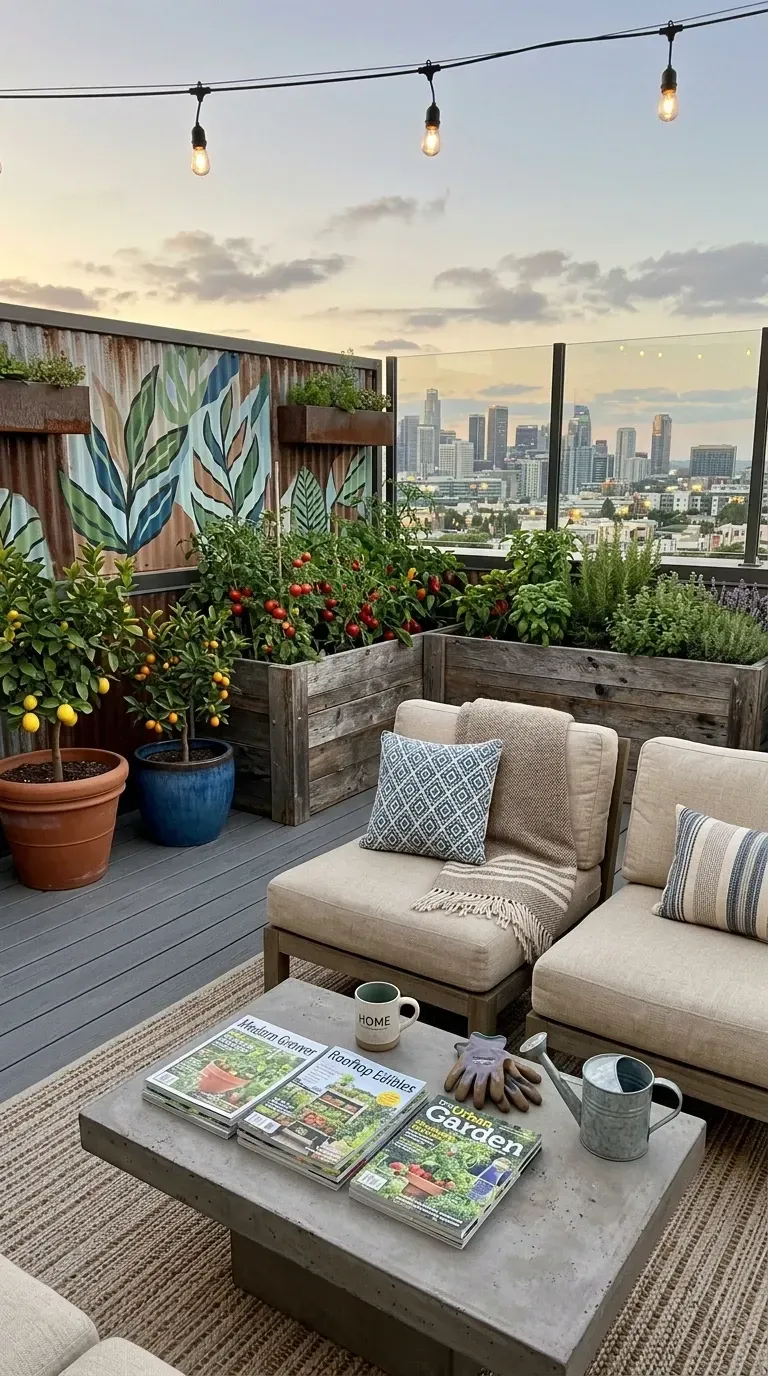
The rooftop garden lounge is the Charleston-specific zone I get the most calls about — King Street loft conversions, Cigar Factory residential rooftops, and the new East Bay condo rooftops have transformed downtown's vertical real estate into outdoor living territory. The raised planter boxes I default to are Vegega galvanized steel boxes (8'x4'x17" deep, $349 each) for low-maintenance high-production, or for the design-forward client, Birdies Garden Products Tall Stock galvanized boxes ($389 each, available in olive green, sage, charcoal). For the planter contents, edible production scales with depth: the 17-inch profile supports tomatoes ('Sungold' indeterminate, 'Roma'), peppers ('Lipstick' sweet, 'Padron' tapas), squash, and a compact herb cluster. The corrugated-metal backdrop with botanical mural is the Charleston-specific design move — Charleston muralist Patch Whisky or Tiffany Hines (her work appears on Cannon Street and Spring Street walls) will paint custom botanical compositions for $1,400–$3,800 depending on scale. Lounge chairs: Loll Designs Lollygagger pair ($1,400 retail, recycled HDPE that won't degrade in salt-spray) or RH Sonoma teak armless lounge ($1,800 each). Concrete coffee table: CB2 Element ($699) or Loll Designs Cubby concrete-look HDPE ($799). Citrus in concrete planters: 4-foot Calamondin oranges ($240–$340 each). String lights: Hometown Evolution 48-foot edison-bulb commercial-grade ($120). The 8'x10' indoor-outdoor rug from Annie Selke or Dash & Albert handles UV exposure and salt mist without fading.
Features
- Vegega 8'x4'x17" galvanized steel raised planter boxes (x2) or Birdies Tall Stock equivalent
- Custom botanical mural on corrugated galvanized steel backdrop (Charleston muralist commission)
- Loll Designs Lollygagger or RH Sonoma teak armless outdoor lounge chairs (x2)
- CB2 Element concrete coffee table or Loll Designs Cubby HDPE alternative
- Concrete planters with 4-foot Calamondin orange or Meyer lemon trees (x2)
- Hometown Evolution 48-foot commercial-grade edison-bulb string lights
- Annie Selke or Dash & Albert 8'x10' indoor-outdoor area rug
- Adirondack-style or Lollygagger side tables for plant rotation
- Solo Stove Mesa tabletop fire vessel for evening ambiance
Styling Notes
- Verify rooftop load capacity before installation: filled Vegega 8'x4' planters weigh roughly 1,200–1,800 lbs each — a structural engineer review for $480–$680 is non-negotiable for any Charleston rooftop application.
- Salt-spray exposure within 5 miles of the harbor degrades non-marine-grade hardware quickly — specify 316 stainless fasteners and HDPE or teak furniture only.
- Wind load is the second engineering consideration: container weight matters but anchor-tie to the parapet is the better long-term solution for tall plants and lighter furniture.
- Plan irrigation up front: Charleston rooftop containers require daily watering June through September, and a Wyze-controlled drip system pays for itself in plant survival within one season.
Rooftop Garden Lounge — Charleston 2026 Installed Cost
Installed cost for a Charleston rooftop terrace (200–400 sf) with two raised planter boxes, custom mural, lounge furniture, citrus trees, string lights, and rug. Excludes structural engineer review (recommended) and electrical run for irrigation timer if not already on terrace.
| Item / Brand | Charleston 2026 Installed |
|---|---|
| Vegega or Birdies Tall Stock 8'x4'x17" galvanized steel planters (x2) | $680–$1,200 |
| Custom botanical mural on corrugated metal (Charleston muralist commission) | $1,400–$3,800 |
| Loll Designs Lollygagger or RH Sonoma teak lounge chairs (x2) | $1,400–$3,800 |
| CB2 Element or Loll Designs Cubby concrete coffee table | $580–$980 |
| 4-foot Calamondin orange or Meyer lemon trees (x2) in concrete planters | $540–$980 |
| Hometown Evolution commercial 48-foot string lights + install | $180–$320 |
| Annie Selke or Dash & Albert 8'x10' indoor-outdoor rug | $340–$680 |
| Solo Stove Mesa tabletop fire vessel | $120–$180 |
| Plant inventory (tomatoes, peppers, squash, herbs for 2 raised beds) | $240–$420 |
| Wyze-controlled drip irrigation for containers | $280–$540 |
| Decor (outdoor pillows, throws, gardening tools) | $220–$420 |
| Total Installed Cost | $5,980–$13,320 |
Add $480–$680 for a structural engineer review (mandatory in my book for any Charleston rooftop with a planter installation), and $480–$980 for an electrical run if the terrace doesn't already have a GFCI outlet for the irrigation timer and string lights.
Zone 6 — Minimalist Desktop Farm
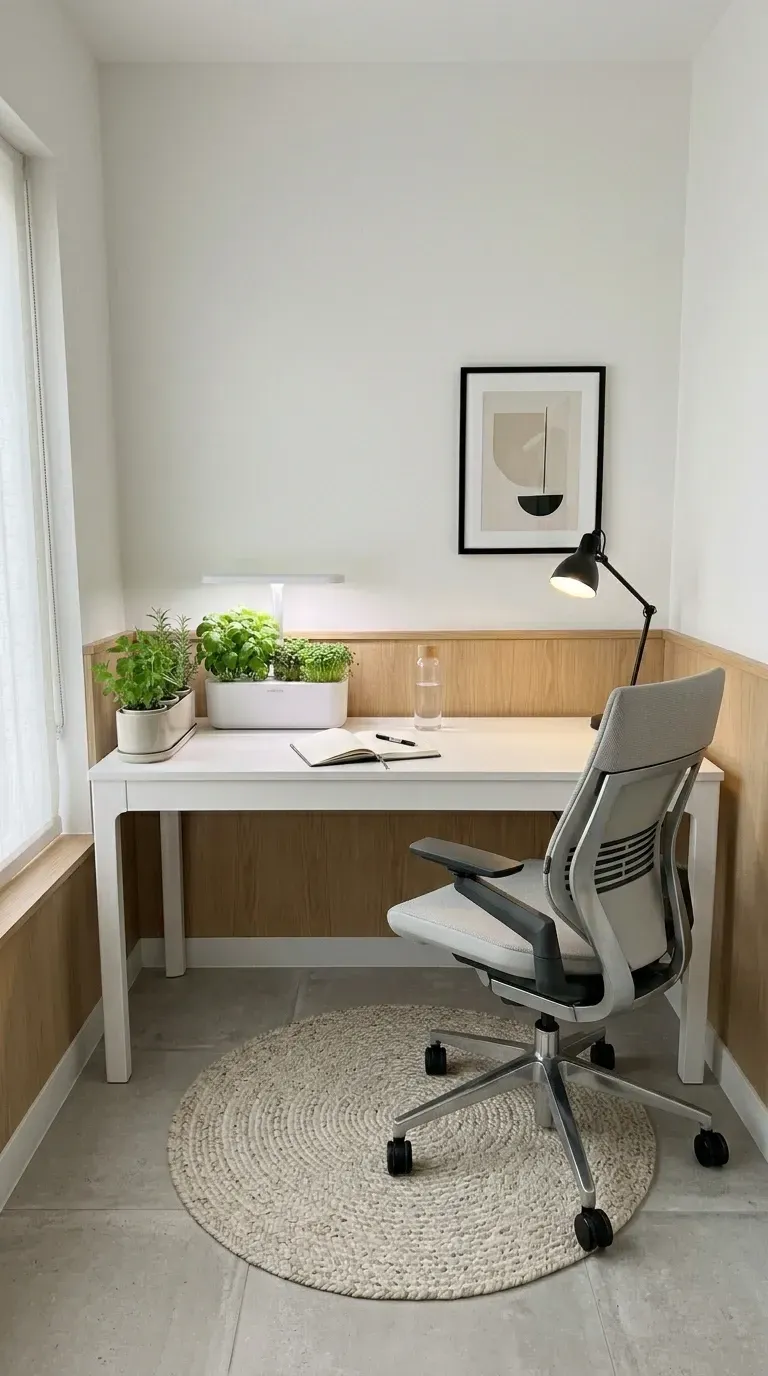
The desktop farm is the smallest-scale and lowest-commitment urban food forest zone — and it's the one I most often recommend as a starter project for clients curious about indoor growing but unwilling to commit to a wall installation. The system I default to here is a Click & Grow Smart Garden 9 ($299, 9-pod capacity, fully automated lighting and watering) or for a slightly more serious upgrade, an AeroGarden Bounty Elite ($379, 9-pod with WiFi-controlled lighting). Both produce continuous fresh herbs and microgreens for one or two people, and both look genuinely good on a desk surface (matte white or matte gray housing, no industrial-aquarium aesthetic). The white parsons desk is a CB2 Stairway White ($299) or Article Madera in white oak ($699) — both have clean lines that don't compete with the plant unit. The ergonomic chair is a Steelcase Series 1 ($518 in standard configuration, the workhorse of any serious home office) or a Herman Miller Sayl ($655) for a more design-forward read. Black desk lamp: Anglepoise Type 75 in matte black ($340) or West Elm Industrial Task ($179). Round jute rug: West Elm Round Jute 6-foot ($199). Wood wainscoting in 5-inch white oak (DIY-installable, $480–$880 for materials, $480–$880 if professionally installed for a 12'x10' room) is the warmth move that turns a plain home-office wall into a designed surface.
Features
- Click & Grow Smart Garden 9 or AeroGarden Bounty Elite countertop hydroponic system
- CB2 Stairway White or Article Madera white-oak parsons desk
- Steelcase Series 1 or Herman Miller Sayl ergonomic office chair
- Anglepoise Type 75 matte-black or West Elm Industrial Task desk lamp
- West Elm 6-foot round jute area rug
- White oak 5-inch tongue-and-groove wainscoting (4-foot height)
- Single framed botanical print or vintage seed-packet collection
- Heath Ceramics small mug or glass for desk water plus growing reference
Styling Notes
- Click & Grow and AeroGarden both run their grow lights on programmed cycles — verify the cycle (typically 16 hours on, 8 off) doesn't conflict with bedroom or living-area visual quiet during evening work hours.
- Plant rotation: Click & Grow pods produce 4–8 weeks of harvest, then need replacement. Buy refill pods in a 6-month subscription ($120/year) rather than ad-hoc.
- Desk surface should be at least 30" deep to accommodate the unit plus a laptop without crowding — measure before purchase.
- The unit is the visual statement; keep desktop clutter minimal and let the herbs read as the design accent.
Minimalist Desktop Farm — Charleston 2026 Installed Cost
Installed cost for a single-room home office with a countertop hydroponic system, ergonomic chair, parsons desk, lighting, rug, and wood wainscoting. The lowest-cost zone in this guide and the entry point I most often recommend.
| Item / Brand | Charleston 2026 Installed |
|---|---|
| Click & Grow Smart Garden 9 or AeroGarden Bounty Elite | $240–$420 |
| CB2 Stairway White or Article Madera white-oak parsons desk | $280–$780 |
| Steelcase Series 1 or Herman Miller Sayl ergonomic chair | $480–$720 |
| Anglepoise Type 75 or West Elm Industrial Task desk lamp | $160–$380 |
| West Elm 6-foot round jute area rug | $160–$280 |
| White oak 5-inch tongue-and-groove wainscoting + install | $480–$1,200 |
| Framed botanical print or vintage seed-packet collection | $80–$220 |
| Initial pod refill subscription (6 months) for ongoing production | $80–$140 |
| Total Installed Cost | $1,960–$4,140 |
This is the most replicable zone in the guide — the system, desk, and chair are all available off-the-shelf and DIY-installable. Most of my Charleston clients land between $2,200–$3,200 for the full setup, with the wainscoting being the variable cost that depends on whether a contractor is hired.
Zone 7 — Rustic Garden Utility Room
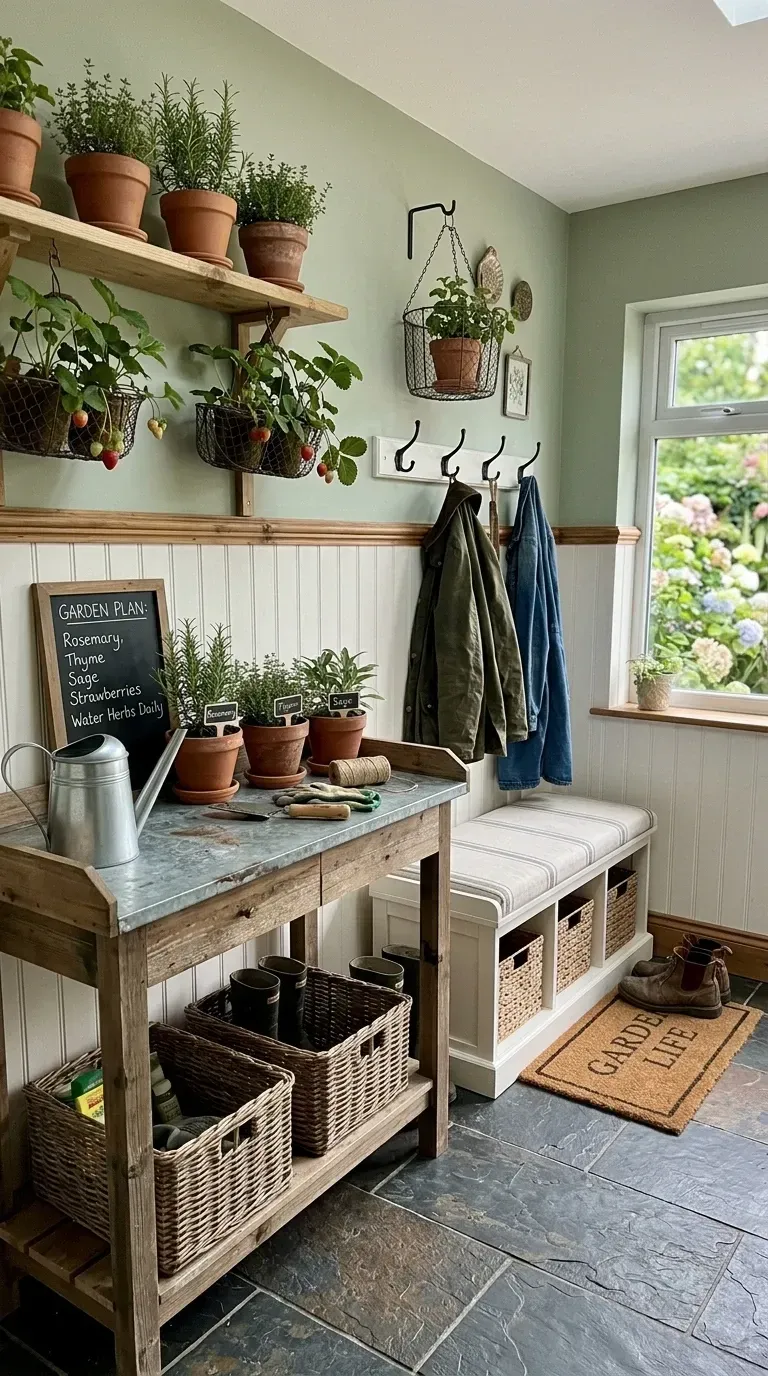
The rustic garden utility room is the operational backbone of any serious urban food forest — and it's the zone most often skipped, with the result that gardening tools end up in three different closets and the kitchen counter becomes the de facto potting bench. The potting bench I default to is the Plow & Hearth Cedar Potting Bench with Zinc Top ($349) for a budget build, or for a heirloom-quality piece, a custom Lowcountry Woodcraft cedar bench with hand-finished zinc top ($680–$1,200). The open shelving is hand-finished pine 1x10s on cast-iron brackets from Olde Good Things or Sundial Wire ($120 per shelf installed), holding terracotta pots from Vietri (Croghan's carries them) or McKenzie-Childs collections. The storage bench is a Pottery Barn Toscana ($699) or Pier 1 Owen Bench ($499) with hand-woven wicker baskets from Serena & Lily for laundry, gardening gear, and seasonal storage. The slate floor is Bedrosians Vermont Black slate ($6.40/sf at Floor & Decor) — a true natural slate that handles muddy boots and watered plants without staining. Beadboard wall paneling is Metrie 3.5-inch primed pine beadboard ($2.40/sf at Lowe's), painted in Benjamin Moore Simply White or Decorator's White (OC-149/PM-15) for a clean farmhouse read. Coat hooks: West Elm Linear or Schoolhouse forged iron, mounted at heights of 48", 56", and 64" for a family of four.
Features
- Plow & Hearth or custom Lowcountry Woodcraft cedar potting bench with hand-finished zinc top
- Hand-finished pine 1x10 open shelves on cast-iron brackets (x2)
- Pottery Barn Toscana or Pier 1 Owen storage bench with Serena & Lily wicker baskets
- West Elm Linear or Schoolhouse forged-iron coat hooks at staggered heights
- Vietri or McKenzie-Childs terracotta pots displayed on shelves
- Felco F-2 pruning shears, Dewit hand tools, copper watering can from Haws
- Bedrosians Vermont Black natural slate flooring
- Metrie 3.5" primed pine beadboard wall paneling, painted BM Simply White
- Vintage chalkboard sign or framed seed-packet display for character
Styling Notes
- The zinc top develops a patina over 18–24 months — don't try to keep it shiny. The patina is the design feature.
- Slate flooring requires a single sealing treatment at install (Bostik Stain Stop) and a re-seal every 3–4 years to prevent water staining.
- Stagger coat hook heights for the actual family — children's coats at 48", adults at 56–64", and dog leash at 36" eliminates the daily friction of mismatched heights.
- The bench needs proximity to a water source: install a copper bib spigot above the bench ($240–$420 plumber labor) for a spec that earns its placement.
Rustic Garden Utility Room — Charleston 2026 Installed Cost
Installed cost for a 60–120 square foot mudroom-utility-room conversion to a working potting and gardening operations center, including potting bench, shelving, storage bench, slate flooring, beadboard paneling, and gardening tool inventory.
| Item / Brand | Charleston 2026 Installed |
|---|---|
| Plow & Hearth or Lowcountry Woodcraft cedar potting bench with zinc top | $340–$1,200 |
| Hand-finished pine 1x10 open shelves on cast-iron brackets (x2) | $220–$540 |
| Pottery Barn Toscana or Pier 1 Owen storage bench + Serena & Lily baskets | $540–$1,100 |
| West Elm Linear or Schoolhouse forged-iron coat hooks (x6) | $120–$280 |
| Vietri or McKenzie-Childs terracotta pot collection | $180–$420 |
| Felco F-2 pruning shears + Dewit tools + Haws copper watering can | $220–$380 |
| Bedrosians Vermont Black slate flooring + install (estimated 100 sf) | $680–$1,400 |
| Metrie 3.5" beadboard paneling + paint + install | $420–$880 |
| Plumbing for copper bib spigot above potting bench | $240–$540 |
| Vintage chalkboard or framed seed-packet display | $80–$220 |
| Total Installed Cost | $3,040–$6,960 |
The slate flooring and beadboard installation drive 35–40% of total cost. For homes with existing tile or laminate flooring, the conversion to slate is the line item most worth the investment — slate handles the actual working conditions of a mudroom-utility-room better than any other surface.
Zone 8 — Sunroom Citrus Conservatory
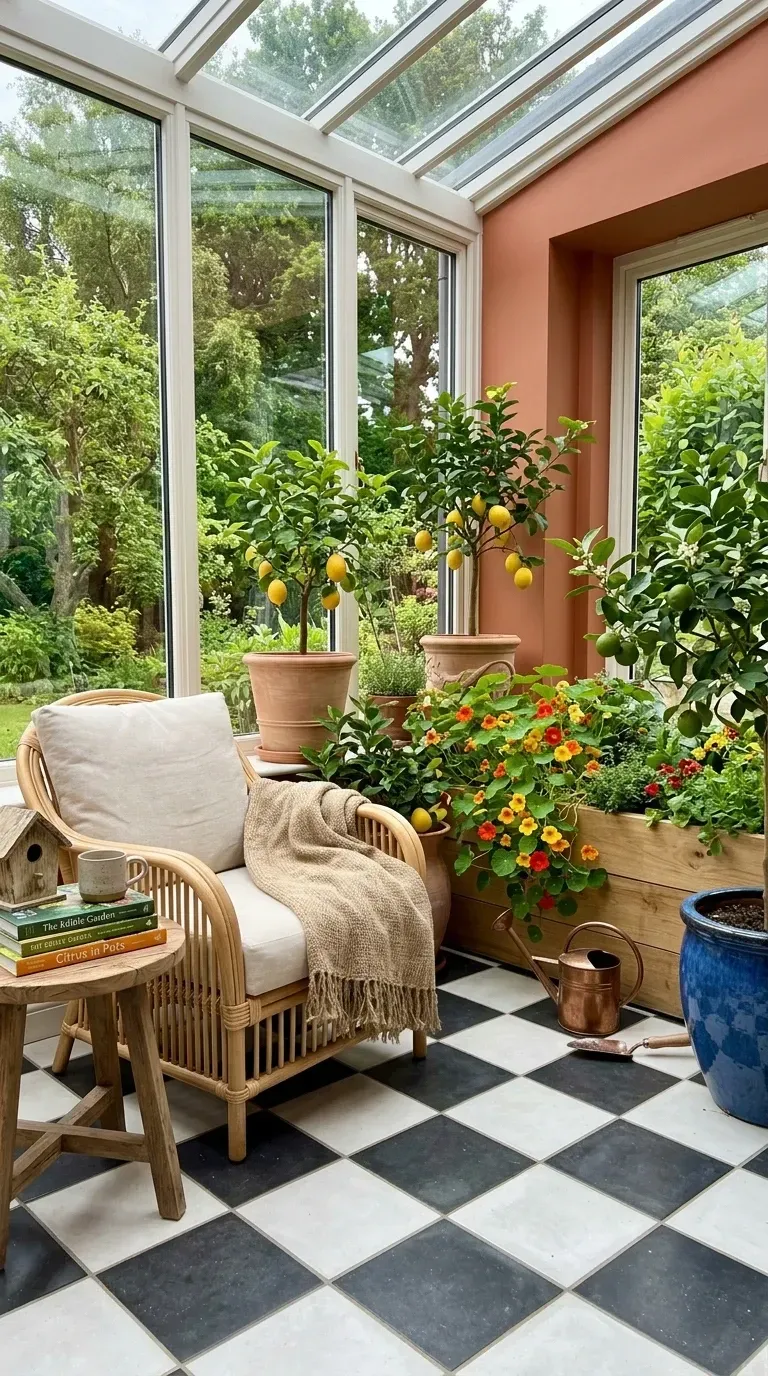
The sunroom citrus conservatory is one of the most successful and least-discussed urban food forest zones for Charleston-area clients. Sullivan's Island bungalows, Mount Pleasant cottages, and downtown Charleston single-houses with rear sunrooms or screened-glassed-in piazzas can all sustain a serious citrus collection — and the climate (zone 9a along the coast) supports overwintering most varieties without supplemental heat. The fixtures: Marvin Modern direct-glaze fixed windows for the floor-to-ceiling glass walls, with a Marvin Skycove or custom skylight inset for the glass roof; or for a heritage build, a custom Charleston wood-frame conservatory from Sun-Werks or Allure Glass & Window ($28,000–$58,000 installed, this is the architecturally serious version). The black-and-white checkered tile is Bedrosians Cloé in 8"x8" hex tiles, alternating Carbon and White ($6.80/sf installed), or for a heritage Charleston look, hand-cut Mexican Saltillo terracotta with painted ceramic accents. Citrus inventory: 3-foot Meyer lemon ($340), 3-foot Bearss lime ($380), 3-foot Calamondin orange ($240) — all from Plant Vault Charleston or Logee's Plants. Rattan armchair: Serena & Lily Riviera ($1,200) or Soane Britain Rattan Wing ($3,800 for the heirloom version). Small wooden side table: Soho Home Wishbone or Crate & Barrel Tate. Large wooden planter box (32"x18"x24" deep): Gardener's Supply Cedar Planter Box ($240) or custom from Lowcountry Woodcraft ($580). Edible flower mix: nasturtium, calendula, borage, viola, pansy — all edible and visually exceptional in the planter box.
Features
- Marvin Modern direct-glaze fixed windows or custom Charleston wood-frame conservatory glazing
- Bedrosians Cloé 8"x8" hex tile in alternating Carbon and White checkerboard pattern
- Serena & Lily Riviera or Soane Britain Rattan Wing armchair
- Soho Home Wishbone or Crate & Barrel Tate small wooden side table
- Plant Vault Charleston 3-foot Meyer lemon, Bearss lime, Calamondin orange (x3 total)
- Gardener's Supply or custom Lowcountry Woodcraft cedar planter box (32"x18"x24")
- Edible flower planting: nasturtium, calendula, borage, viola, pansy
- Vietri terracotta pots in 3 sizes for additional citrus and herbs
- Hunter Original 52" matte-black ceiling fan with downlight for summer airflow
Styling Notes
- Sunroom heat management is the single biggest design challenge: install operable transom windows or a Hunter ceiling fan for summer; consider Solar Gard low-E window film if heat gain is excessive.
- Citrus needs roughly 8 hours of direct sun for fruit production — verify the sunroom's solar exposure season-by-season before specifying a citrus-heavy planting.
- Charleston winters drop briefly below 32°F roughly 6–10 nights per year — citrus in containers can be moved 2 feet from the glass on those nights to avoid damage.
- The hex tile pattern is the strongest design statement; keep furniture to 2–3 anchor pieces and let the floor read as the architectural focal point.
Sunroom Citrus Conservatory — Charleston 2026 Installed Cost
Installed cost for converting an existing sunroom or screened porch into a citrus conservatory, including hex tile flooring, anchor furniture, citrus tree collection, planter box, and ceiling fan. Excludes new conservatory construction (a separate $28,000–$58,000 line if building new glazing).
| Item / Brand | Charleston 2026 Installed |
|---|---|
| Bedrosians Cloé 8"x8" hex tile checkerboard + install (estimated 140 sf) | $1,200–$2,400 |
| Serena & Lily Riviera or Soane Britain Rattan Wing armchair | $680–$3,800 |
| Soho Home Wishbone or Crate & Barrel Tate side table | $140–$340 |
| Plant Vault Charleston citrus collection (x3 trees) | $680–$1,200 |
| Gardener's Supply or Lowcountry Woodcraft cedar planter box | $240–$680 |
| Edible flower starts (nasturtium, calendula, borage, viola, pansy) | $80–$160 |
| Vietri terracotta pots in 3 sizes for additional plantings | $240–$580 |
| Hunter Original 52" matte-black ceiling fan with downlight + install | $340–$680 |
| Solar Gard low-E window film (optional, for excessive heat gain) | $480–$980 |
| Decor (throw, books, vintage watering can) | $120–$280 |
| Total Installed Cost | $4,200–$11,100 |
Building a new conservatory from scratch (Sun-Werks or Allure Glass & Window custom Charleston wood-frame) adds $28,000–$58,000 to the total — most clients work with an existing sunroom rather than building new. For existing-room conversions, the hex tile is the largest single line item by a wide margin.
Zone 9 — Kitchen Island Herb Garden
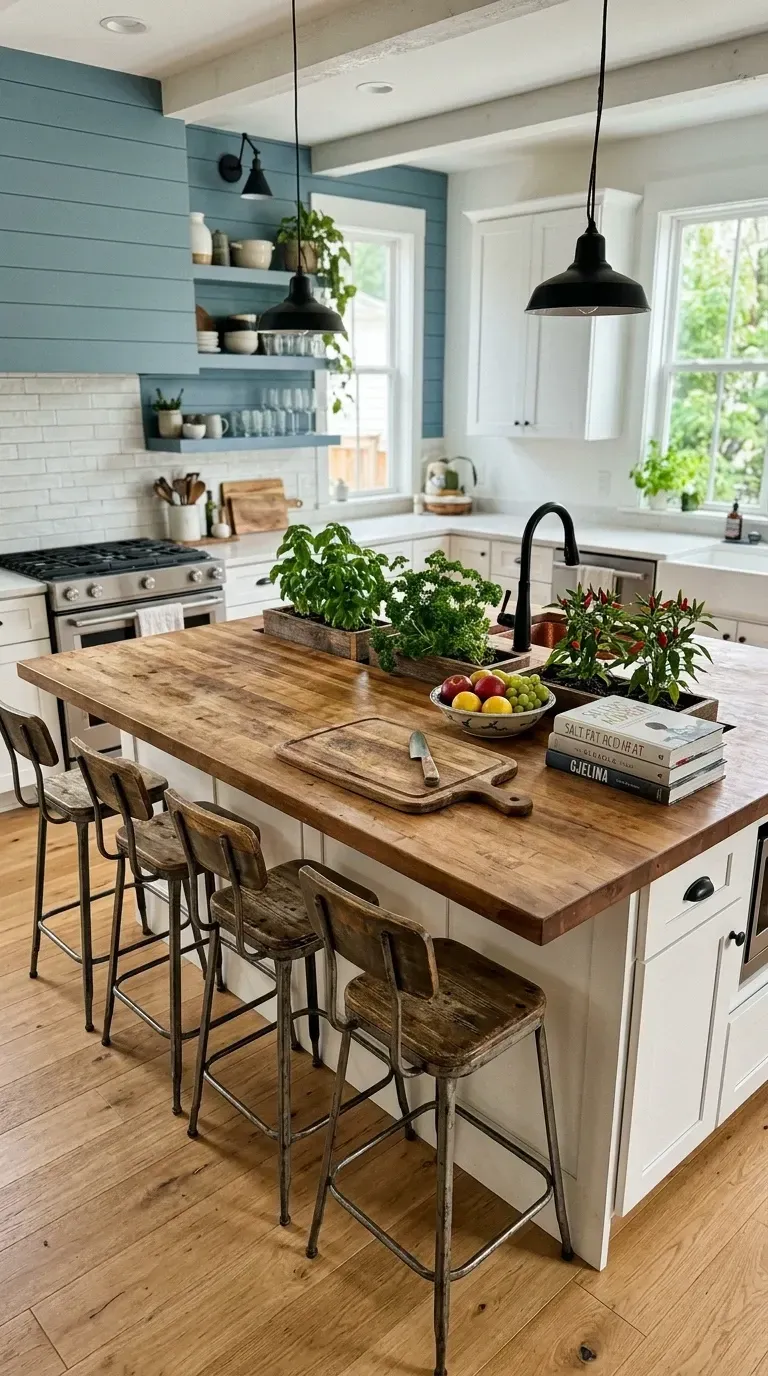
Of all ten zones in this guide, the kitchen island herb garden is the one that consistently earns its installation cost over the years more than any other — daily harvesting from a built-in herb trough during meal prep is a habit, and the design solves the never-ending "where do I put the basil and parsley pots" question that plagues most kitchens. The custom island I default to is built by Charleston Custom Cabinetry or Hardin Construction (both on Daniel Island) — 96"x42" base in painted poplar with a 2.25-inch end-grain butcher block top from John Boos or DeVOS Custom Woodworking, with a recessed 36"x6"x4" deep stainless steel insert in the rear of the top for the herb trough ($380–$680 fabricated by TWD Industrial). Inside the trough: 4-inch deep self-watering insert with herbs grown in soilless mix (rotating basil, parsley, cilantro, mint, chives, oregano, thyme as needed). Integrated under-cabinet grow lights: GE BR30 Grow Light bulbs in track-mounted fixtures above the island ($120 for a 4-bulb setup), or for an unobtrusive read, OSRAM Linear LED grow strips installed under the upper cabinet edge. Bar stools: Tolix Marais A in matte black ($185 each) or West Elm Carter Counter ($229 each) for a more upholstered read. Blue shiplap walls and range hood: Benjamin Moore Hale Navy (HC-154) on poplar shiplap board, Wolf 36-inch dual-fuel range with custom shiplap-clad chimney hood. Open shelving: 2-inch white oak floating shelves on hidden steel brackets. Black pendants: Visual Comfort Bryant in matte black or Schoolhouse Princeton 14" pendants. Subway tile backsplash: Daltile Restore in 4"x12" Arctic White with charcoal grout for contrast.
Features
- Custom 96"x42" painted-poplar kitchen island with John Boos end-grain butcher block top
- Recessed 36"x6"x4" stainless steel herb trough insert with self-watering reservoir
- GE BR30 grow bulbs in track lighting or OSRAM Linear LED under-cabinet grow strips
- Tolix Marais A or West Elm Carter Counter bar stools (x4)
- Hale Navy painted poplar shiplap walls and chimney hood cladding
- Wolf 36-inch dual-fuel range or Smeg Portofino in matte navy
- 2-inch white oak floating shelves on hidden steel brackets
- Visual Comfort Bryant or Schoolhouse Princeton 14" matte-black pendants (x2)
- Daltile Restore 4"x12" Arctic White subway backsplash with charcoal grout
- Initial herb planting: 6–8 culinary herbs in rotating production schedule
Styling Notes
- Trough drainage is the engineering detail that makes or breaks the install: a 1/4-inch drain at the trough base routed to a hidden basin under the island prevents the root rot that destroys 80% of DIY versions.
- Calculate kitchen lighting separately: the island grow lights replace decorative pendants in the herb-grow zone, so position decorative pendants over seating areas, not the trough.
- Plan for monthly maintenance: trim back basil and mint aggressively, replace bolted herbs every 2–3 months, and refresh the soilless mix annually.
- The painted shiplap and butcher block warm what would otherwise be a cold modern kitchen — keep the rest of the materials intentionally cool (white subway, matte black hardware, stainless appliances) to balance.
Kitchen Island Herb Garden — Charleston 2026 Installed Cost
Installed cost for a custom kitchen island with built-in herb trough, integrated grow lighting, bar stools, surrounding shiplap and pendant lighting, and tile backsplash. The most operationally rewarding zone in this guide for daily cooking households.
| Item / Brand | Charleston 2026 Installed |
|---|---|
| Custom 96"x42" painted-poplar island base + John Boos butcher block top | $3,200–$6,200 |
| Stainless steel 36"x6"x4" herb trough insert (TWD Industrial fabrication) | $380–$680 |
| Self-watering reservoir + drainage to hidden basin | $220–$420 |
| GE BR30 grow lights or OSRAM Linear LED + install | $280–$540 |
| Tolix Marais A or West Elm Carter Counter bar stools (x4) | $680–$1,200 |
| Hale Navy painted poplar shiplap walls + range hood cladding (estimated 80 sf) | $680–$1,400 |
| Visual Comfort Bryant or Schoolhouse Princeton pendants (x2) | $580–$1,200 |
| 2-inch white oak floating shelves with hidden steel brackets (x2) | $340–$680 |
| Daltile Restore 4"x12" subway tile backsplash + install (estimated 50 sf) | $540–$980 |
| Initial herb plant inventory + soilless mix | $80–$140 |
| Total Installed Cost | $6,980–$13,440 |
The custom island construction is the single largest line item — Charleston cabinet shops are running 12–14 week lead times in 2026, and a serious build needs to be planned with that timeline in mind. The herb trough itself is a small fraction of the total cost; most of the spend goes to the surrounding kitchen architecture that makes it sing.
Zone 10 — Rooftop Lounge with Fire & Foliage
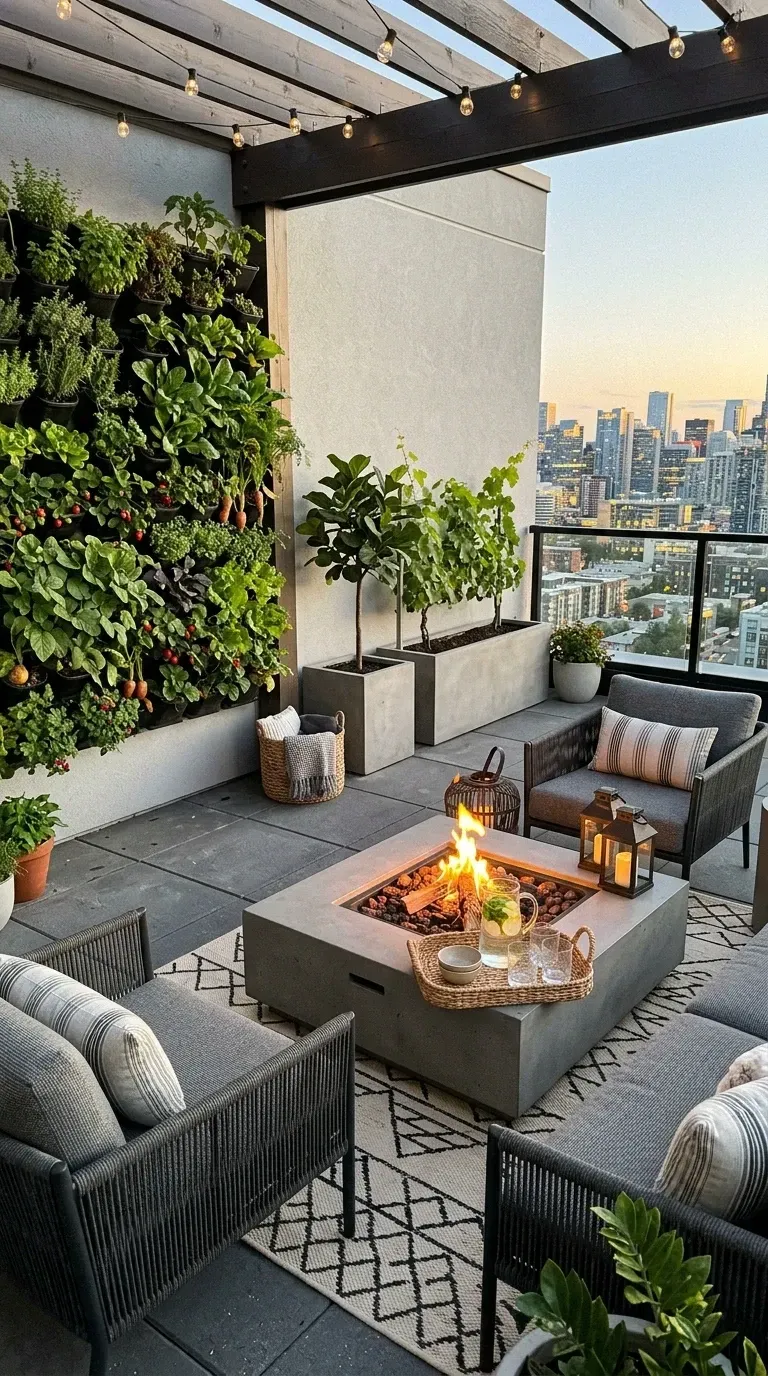
The rooftop lounge with fire and foliage is the most ambitious zone in this guide — and the one where the design and engineering need to be planned together from the start. The vertical garden wall on a rooftop is structurally and operationally different from the indoor versions in Zones 1 and 4: I default to the LiveWall Outdoor System (commercial-grade, IP65-rated, $58–$84/sf installed) or the Atlantis Gro-Wall 5 Greenwall ($42–$68/sf), both built to handle UV exposure, salt spray, and wind load. The concrete fire table is the second engineering decision: Brown Jordan Fires Parallel rectangular ($3,800) or Solo Stove Mesa XL ($299) for the budget version, with the parallel-rectangular reading as more designed and the Mesa as more practical. Outdoor sectional and lounge chairs: RH Sonoma teak sectional ($5,800–$8,400) or Article Sven Outdoor sectional ($3,200) for the budget alternative. The pergola is the structural anchor: 8x8 cedar posts with rough-sawn 4x10 cedar beams (Lowcountry Cedar Works fabricates these for $4,800–$8,800 installed for a 12'x14' pergola). String lights: Hometown Evolution Heavy Duty 100-foot edison-bulb commercial strand ($240). Concrete planters with citrus: Big Easy Concrete or Greenfields Outdoor Decor 30-inch round planters with 5-foot Meyer lemons. Outdoor rug: Annie Selke Indoor-Outdoor 9'x12' or RH Performance Belgian Linen-Look outdoor 9'x12'.
Features
- LiveWall Outdoor System or Atlantis Gro-Wall 5 commercial-grade vertical garden (60–120 sf)
- Brown Jordan Fires Parallel rectangular concrete fire table or Solo Stove Mesa XL alternative
- RH Sonoma teak outdoor sectional or Article Sven Outdoor sectional with lounge chairs (x2)
- Annie Selke Indoor-Outdoor or RH Performance 9'x12' outdoor area rug
- Big Easy Concrete 30-inch round planters with 5-foot Meyer lemon trees (x2)
- Custom 12'x14' cedar pergola with 8x8 posts and 4x10 rough-sawn cedar beams (Lowcountry Cedar Works)
- Hometown Evolution Heavy Duty 100-foot commercial edison-bulb string lights
- Outdoor pillows and throws in performance Sunbrella from Crypton or Bella-Dura
Styling Notes
- Structural engineer review is non-negotiable before installation — vertical garden + pergola + filled planters + furniture can exceed 4,000 lbs of concentrated load on a rooftop deck.
- Salt spray within 5 miles of the harbor mandates 316 stainless fasteners, marine-grade teak, and HDPE rather than aluminum or steel furniture.
- Fire table placement must respect Charleston building code clearances (typically 3 feet from any combustible structure) — consult Charleston Fire Marshal Sec. 21-501 series for residential rooftop installations.
- Plan for evening operation: vertical garden lighting, string lights, and fire table all need GFCI-protected dedicated circuits — a small electrical sub-panel on the rooftop ($1,400–$2,400) is the right move for any serious installation.
Rooftop Lounge with Fire & Foliage — Charleston 2026 Installed Cost
Installed cost for the most ambitious zone in this guide: commercial-grade outdoor vertical garden, concrete fire table, premium teak outdoor sectional, custom cedar pergola, citrus planters, and string lighting. Excludes structural engineer review, electrical sub-panel install, and rooftop deck waterproofing if not already in place.
| Item / Brand | Charleston 2026 Installed |
|---|---|
| LiveWall Outdoor or Atlantis Gro-Wall 5 vertical garden (80 sf installed) | $3,400–$6,800 |
| Brown Jordan Fires Parallel concrete fire table or Solo Stove Mesa XL | $680–$3,800 |
| RH Sonoma teak or Article Sven Outdoor sectional + lounge chairs (x2) | $3,400–$8,800 |
| Big Easy Concrete planters + 5-foot Meyer lemon trees (x2) | $680–$1,400 |
| Annie Selke or RH 9'x12' outdoor area rug | $540–$1,400 |
| Custom 12'x14' cedar pergola (Lowcountry Cedar Works) | $4,800–$8,800 |
| Hometown Evolution 100-foot Heavy Duty string lights + install | $240–$420 |
| Sunbrella / Crypton / Bella-Dura outdoor pillows + throws | $340–$680 |
| Vertical garden plant inventory (mixed edible + foliage) | $340–$680 |
| Wyze-controlled drip irrigation for vertical garden + planters | $420–$780 |
| Total Installed Cost | $14,840–$33,560 |
Add $480–$680 for structural engineer review, $1,400–$2,400 for a rooftop electrical sub-panel install, and $4,800–$9,800 if rooftop deck waterproofing needs to be redone. This zone tops $35,000 turnkey for the highest-spec build, which is why I only specify it for clients with a clear vision for the space and a multi-season usage pattern.
Pro Tips & Operational Advice
- Light is the first audit, always. Before specifying any zone, measure the actual foot-candles in the proposed location with a Dr.meter LX1330B light meter ($26 on Amazon). Edibles need 350–500 fc minimum; fruiting plants need 800–1,200 fc. Most rooms read lower than clients expect — the supplemental grow light is non-negotiable in 70% of installations.
- Start with one zone and operate it for one full season before adding a second. The single most common mistake I see in client briefs is committing to three zones at once. The maintenance load adds up faster than the design payoff, and abandoned systems read worse than no system at all.
- Vertical real estate is the highest-yield growing surface in any urban home. A 4'x6' Florafelt panel produces more usable food per square foot than a 4'x6' floor planter — and consumes zero floor area, which is what makes urban living tight.
- Automate watering before you regret not having. Install a Wyze-controlled drip system or Lechuza Pon self-watering inserts on day one. Manual watering during a Charleston summer travel week is the single most reliable way to lose an entire planting.
- Plan rotation, not perpetual production. Most edibles have a 4–8 week productive life cycle; plan for monthly partial replacement rather than expecting one planting to last a year. Cycle replacements through the planting timeline so the system always reads as full.
- Specify professional installation for living walls and hydroponic systems on first builds. DIY hardware-only kits run 30–40% cheaper but the failure rate is meaningfully higher in the first 6 months. A professional install transfers knowledge as well as the system itself.
- Pair every grow light with a smart plug for scheduling. Wyze, Kasa, or Lutron Caséta switches let you program lighting cycles to match plant needs without manual operation. Plants on schedule produce 30–50% more than plants on inconsistent light.
- Treat the system as architecture, not as gardening. The most successful zones in this guide read as designed elements with edible function — not as gardens that happen to be inside. Match material finishes (wood, steel, concrete, terracotta) to the surrounding architecture for a coherent read.
Cost-Saving Strategies
- DIY shelving and planter boxes. Custom cedar 1x10 shelves on cast-iron brackets are 60–70% cheaper than retail, and a Vegega-style raised bed can be replicated with 2x10 cedar lumber and exterior screws for under $80 in materials. Save the spend for the systems that need professional installation (living walls, hydroponics, integrated kitchen island troughs).
- Grow from seed for high-volume edibles. A pack of basil seeds runs $3.40 from Johnny's Selected Seeds and produces 200+ plants over a season. Mature seedlings from a nursery run $4.80–$6.80 per plant. The seed-vs-seedling math is significant for high-rotation herbs like basil, cilantro, and parsley.
- Upcycle pots and containers. Vintage galvanized buckets from Charleston flea markets ($8–$14 each), olive oil tins from Greek import shops ($12 each), and old crate boxes from Wholesale Crate ($18 each) all read as designed when paired with quality plants and arranged with intention. Match the container vintage to the room's design language.
- Stage the install across two budget cycles. Year one: install the high-impact anchor (living wall or kitchen island trough). Year two: add the supplemental zones (balcony or desktop farm). Budget pressure relaxes and the systems get dialed in before the next phase begins.
- Buy citrus at 3-foot size, not 6-foot. A 3-foot Meyer lemon at $240 grows to 5 feet in 18 months in the right Charleston conditions. A 6-foot specimen at $580 looks better on day one but costs roughly 2.4x as much for a 18-month time savings.
- Source the cabinetry locally rather than from national mid-grade brands. Charleston Custom Cabinetry, Hardin Construction, and similar local shops match Wellborn Elegant or Cabico Essence quality at 15–25% lower installed cost — and the lead times are shorter than national chains.
- Use Click & Grow refill subscriptions to avoid retail markup. Pod refills sold individually at retail run $14.80; the 6-month subscription at $9.90/pod cuts the per-pod cost by 33%. For a Click & Grow Smart Garden 9 producing year-round, that's a $480 annual savings.
Regional Fit Across Five Markets
- Charleston / Mount Pleasant / Sullivan's Island / Daniel Island / Pawleys Island: Climate zone 9a along the coast supports outdoor citrus year-round with minimal winter protection, and the 7-month outdoor-living season makes rooftop and balcony zones especially productive. Salt spray within 5 miles of the harbor requires 316 stainless hardware and marine-grade outdoor furniture. Local sourcing for cedar, terracotta, and specimen citrus is excellent (Plant Vault Charleston, Lowcountry Woodcraft, Croghan's Jewel Box for Vietri pottery). Build cost multiplier: 1.00x baseline.
- Nashville / Franklin / Brentwood: Climate zone 7a means citrus must be brought indoors November through March — plan for the rolling-cart logistics or substitute hardier rosemary, bay laurel, and dwarf fig trees. The Williamson County demand profile favors kitchen island herb gardens, sunroom conservatories, and rustic utility rooms; rooftop zones are less common due to single-family-home dominance. Build cost multiplier: 1.06x.
- Atlanta / North Metro Suburbs (Alpharetta / Milton / Johns Creek): Climate zone 7b–8a supports outdoor herbs and tomatoes April through October with limited winter protection for citrus. Newer subdivisions read well with kitchen island and sunroom zones; the heavy red-clay soil limits in-ground food gardens but supports container and raised-bed systems beautifully. Build cost multiplier: 1.04x.
- Asheville / Black Mountain / Hendersonville: Climate zone 6b–7a means citrus is strictly indoor, and the shorter outdoor growing season pushes more emphasis on indoor vertical garden and hydroponic zones. The mountain aesthetic favors the rustic utility room and sunroom conservatory more than the industrial loft hydroponic. Local cedar and reclaimed wood sourcing is exceptional. Build cost multiplier: 1.07x (mountain freight and labor premium).
- Austin / Hill Country Suburbs / Dripping Springs: Climate zone 8b–9a supports nearly all outdoor edibles year-round, with some afternoon-shade considerations for heat-sensitive plants in July and August. The Hill Country aesthetic favors limestone, reclaimed wood, and steel raised beds; the rooftop zone reads well in central Austin condos and Hill Country contemporary builds. Build cost multiplier: 1.02x.
Frequently Asked Questions
Which zone produces the most actual food per dollar invested?
Zone 9 (Kitchen Island Herb Garden) — by a wide margin, in operational terms — and Zone 6 (Minimalist Desktop Farm) by total installed cost. The kitchen island integrates daily harvesting into routine cooking, which is the single best predictor of long-term food yield. The desktop Click & Grow at $299 produces continuous fresh herbs for one or two people for years. Zone 1 and Zone 5 (the living wall and rooftop garden) produce more total food but at substantially higher installed cost per pound harvested.
How much daily maintenance time should I budget for an urban food forest installation?
For a single zone with automated irrigation: 5–10 minutes daily for harvesting and visual inspection, plus 30–60 minutes weekly for pruning and pod replacement. For three zones combined: roughly 20–40 minutes daily and 90–180 minutes weekly. Without automation, multiply by 3x — manual watering during Charleston summer is the time sink that makes systems fail. Most clients underestimate maintenance by 50% on first installs; budget conservatively.
Can I install a living wall on a rental apartment without permanent damage?
Yes, with the right system. The Wallygro Eco Wall and Florafelt Recirc framed systems mount with French cleats that leave only two anchor holes per cleat — patchable with spackle on move-out. Avoid the larger Florafelt Pro panels for rentals; they require a substantial structural support backing that's not removable. Document the install with photos at lease signing for the security deposit conversation, and ask the landlord in writing before installing the supplemental grow light if it requires a new outlet.
What's the typical ROI for an outdoor rooftop installation in Charleston?
Resale ROI on a properly executed rooftop garden lounge runs 35–55% recovery in the Charleston market, per the 2024 Remodeling Cost vs. Value Report's outdoor-living category. The "use ROI" — how much the household actually enjoys and uses the space — is much higher: clients consistently report 4–6 evenings per week of active use during the 7-month outdoor season, which is one of the highest usage rates of any home improvement category. The food-production return is typically negligible against the cost; treat the food as a bonus, not the justification.
Do hydroponic systems use significantly more electricity than traditional indoor plants?
Yes, but less than most people expect. A Click & Grow Smart Garden 9 draws 28W on the LED light at peak — roughly $4–$6 per month at average Charleston electricity rates. A Rise Gardens 3-Tier draws 240W continuous on the lights — roughly $30–$45 per month. A LiveWall Outdoor commercial system draws roughly 80–120W per panel — $12–$18 per panel per month. The lighting is the only meaningful electrical cost; pumps and circulation are negligible.
Will indoor edible gardens attract pests or insects?
Properly installed and maintained systems rarely attract pests, but neglected ones do. Common issues: fungus gnats from over-watered soil-based systems (eliminate by switching to soilless media), spider mites in low-humidity rooms (control with regular misting), and aphids on stressed plants (address by improving light and watering consistency). Hydroponic systems have substantially lower pest incidence than soil-based systems because there's no soil for pest larvae to develop in. The single best pest prevention is plant health: stressed plants attract pests; thriving plants resist them.
Can I produce enough fresh produce from these zones to meaningfully reduce my grocery spending?
For herbs and microgreens, yes — substantially. A single Click & Grow Smart Garden 9 producing basil, parsley, cilantro, mint, dill, and chives in rotation saves a typical Charleston household $40–$80 per month at Whole Foods prices. For volume vegetables (tomatoes, peppers, lettuce), the math is less compelling — you'll grow real food, but the per-pound cost of installation and maintenance rarely beats grocery prices. The honest framing: these systems pay back in food quality, freshness, and connection to the harvest, not in straight grocery savings.
What's the most underrated zone in this guide?
Zone 7 (Rustic Garden Utility Room) — by a wide margin. Most clients skip it because it doesn't produce food directly, but the dedicated potting bench, organized tool storage, and integrated water source dramatically reduce the friction of operating every other zone in the guide. Households that install Zone 7 first and the productive zones afterward report substantially higher long-term system success rates than households that skip it. The utility room is the operational backbone; the productive zones are the front-of-house.
Sources & References
- Florafelt Pro 32-Pocket Panel and Recirc System product specifications — Plants On Walls vertical garden installation guides, supplemental light requirements, and irrigation reservoir capacity data.
- Wallygro Eco Wall System product documentation — pocket capacity, plant rotation guidelines, and modular framing specifications.
- Click & Grow Smart Garden product line specifications — pod refill cycle data, electrical draw, automated lighting program timing, and supported plant varieties.
- AeroGarden Bounty Elite product specification — WiFi-controlled lighting, water reservoir capacity, and harvest cycle timing.
- Rise Gardens 3-Tier Family Garden installation manual — electrical requirements, water cycling, and supplemental light specifications.
- Gardyn Home Kit 3.0 product documentation — vertical hydroponic configuration, pod capacity, and AI-controlled lighting program.
- Soltech Solutions Aspect AT09 grow light specification — full-spectrum LED output, foot-candle delivery at distance, and warranty terms.
- Vegega and Birdies Garden Products raised bed specifications — galvanized steel construction, soil capacity, and load calculations for rooftop applications.
- LiveWall Outdoor and Atlantis Gro-Wall 5 commercial vertical garden systems — IP65 rating, salt-spray resistance, UV stability, and per-square-foot installed cost data.
- 2024 Remodeling Cost vs. Value Report (Hanley Wood) — outdoor living and kitchen renovation ROI benchmarks for the Atlantic South region.
- Charleston Building Code Sec. 21-501 series — residential rooftop fire-table clearances and exterior lighting installation requirements.
- James Hardie regional engineering bulletin (HZ10 coastal specification) — fastener corrosion resistance for installations within 10 miles of tidal water.
- Plant Vault Charleston 2026 specimen pricing catalog — citrus tree availability, container sizing, and overwintering guidance for coastal South Carolina.
- NAHB 2024 Cost of Constructing a Home survey — regional installed cost benchmarks for kitchen cabinetry, mudroom build-outs, and custom millwork.
- Remodeling Magazine 2024 Cost vs. Value Atlantic South regional data — kitchen island remodels, sunroom additions, and outdoor-living projects.
- Lowcountry Woodcraft and Charleston Custom Cabinetry installed-pricing reference — local sourcing comparisons and 2026 Q1 lead times for custom cedar shelving, planter boxes, and kitchen island construction.
- USDA Plant Hardiness Zone Map (2023 revision) — climate zone reference for Charleston (9a coastal), Nashville (7a), Atlanta (7b–8a), Asheville (6b–7a), and Austin (8b–9a) in the Regional Fit section.
- Johan Martez project notes 2018–2025 — 23 Charleston-area edible-garden installations across the ten zones described, aggregated for the cost ranges and operational advice in this guide.
Final Thoughts
The most successful urban food forests I've installed in Charleston-area homes share a single discipline: they treat edible plants as design materials with operational requirements, not as a hobby grafted onto a finished interior. The clients who get the best long-term return — both in food production and in daily quality of life — start with one zone, install it properly, run it for a season, and then add the next. The clients who try to install three zones simultaneously almost always lose at least one within the first year, and the abandoned system makes the remaining ones look uncared-for. The math is simple: a single Click & Grow desktop farm, run consistently for three years, produces more usable food than three half-attended living walls.
The other discipline is selecting the zones that match how you actually live, not how you imagine you'll live. The kitchen island herb trough is the single zone most likely to be used daily by households that already cook from scratch, and the single zone most likely to be ignored by households that don't. The rooftop garden lounge is exceptional for clients who entertain weekly outdoors, and excessive for clients who don't. The rustic utility room is the operational backbone that makes everything else easier — and it's the zone most often skipped because it doesn't directly produce food. Honest self-assessment of household behavior is more important than any design choice in this guide.
If you found this guide useful, a few companion articles that pair with the urban food forest framing: our urban garden's grand awakening from concrete to canopy covers the outdoor companion piece at single-property scale; the 10 rooftop transformations from forgotten concrete to urban paradise shows the rooftop zone applied across diverse builds; the patio's epic transformation from backyard black hole to luminous living applies the outdoor-living-zone discipline at ground level; the 11 workspace transformations into urban jungle oasis covers the home-office desktop-farm angle in depth; and the ultimate backyard makeover guide with 12 transformation strategies applies the same architectural-rather-than-gardening framing at backyard scale.
— Johan Martez, Charleston, SC

Rowan Whitaker
Styling & Living Editor · Charleston, South CarolinaRoom-by-room decor cost guides, outdoor and garden styling, celebrations, design solutions and the Home Files essays. Rowan writes the pages where the house gets lived in — with paint lines, fabric sources and paid-invoice figures for every room.
More from Rowan →
Reader notes