


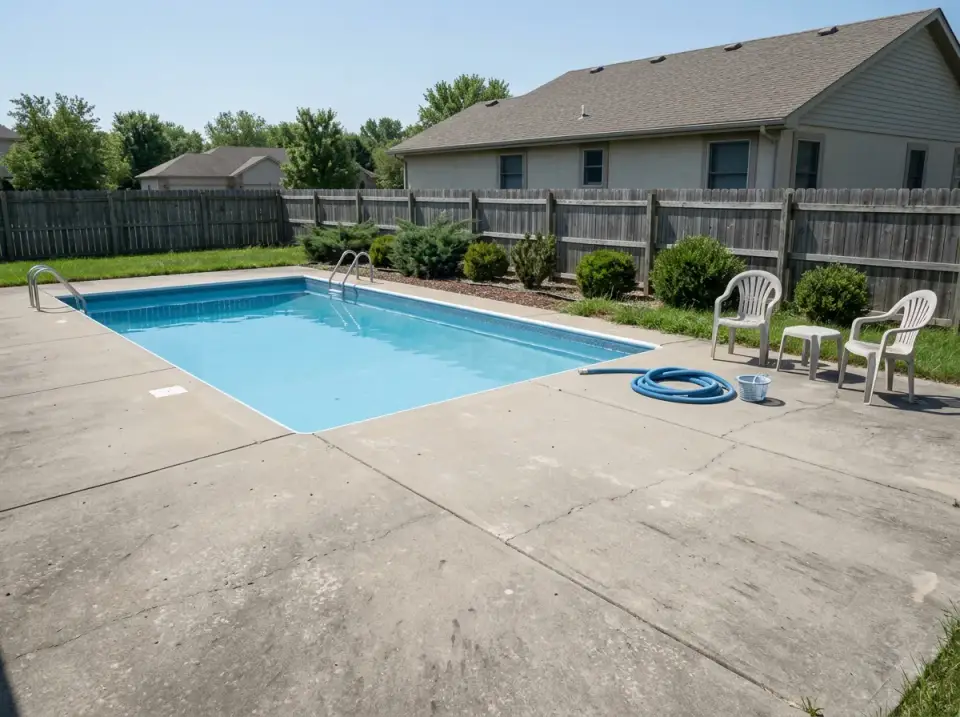
Many homeowners with an older pool don't have a pool problem; they have a pool-deck problem. The water is fine. The cracked concrete apron, the sun-bleached plastic chairs, and the chain-link fence are what make the backyard read tired. The good news is that the pool itself rarely needs to change. Below are twelve makeover concepts worth keeping on hand. Each one starts from the same dated concrete-and-plastic baseline and lands somewhere completely different. Read them as a menu of design directions, not a hierarchy. Pick the one that fits your house, your climate, and how much of the year you actually use the pool.
1. Tropical Resort: Teak Decking and Bamboo Privacy
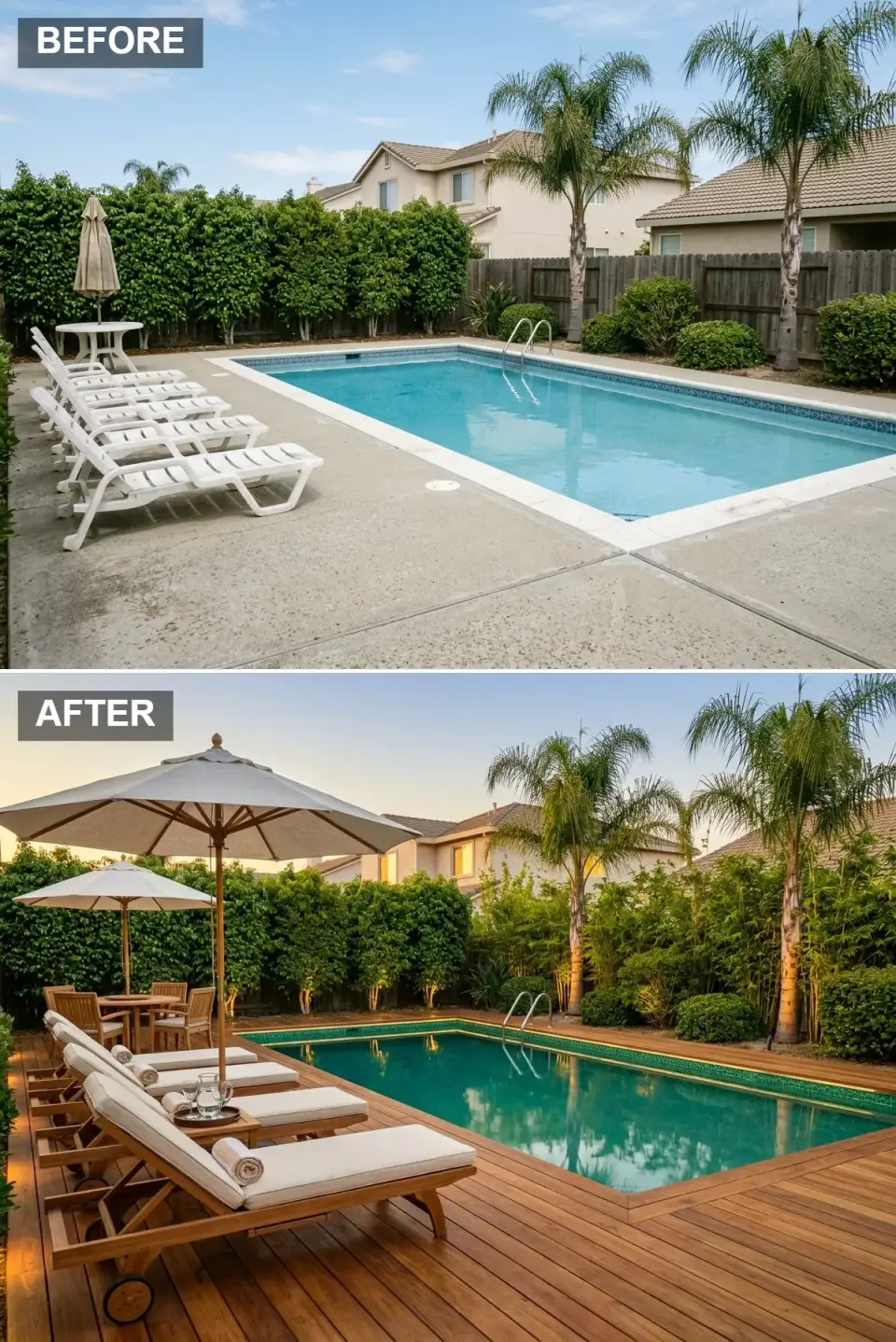
This is a strong makeover for Naples and Charleston when budget allows real wood. The plain concrete apron is decked over with rich teak, installed on sleepers above the slab so it doesn't trap moisture against the existing concrete. The white plastic chairs go out, replaced by teak loungers with high-density foam cushions in white Sunbrella. A large canvas-cream umbrella over the loungers and a second, smaller one over a round teak dining set carve the space into a lounge zone and a meal zone. The fence line is densified with clumping bamboo and palms, which both increase privacy and turn the back boundary into a backdrop instead of an edge. The rendering also swaps the old blue waterline tile for a green glass mosaic, a separate pool job worth pricing apart from the deck.
Almost everything in this rendering is wood. The new deck boards carry the deepest tone, Teak Wood at #A36F40, and the lounger cushions are plain Crisp White (#FFFFFF), so the lounge row reads as a run of bright rectangles laid on warm brown.
Both umbrellas share a Canvas Cream canopy (#F0EAD6), pale enough to glow against the dusk sky without glare. The round table and its chairs are a lighter Honey Teak (#C19A6B), related to the deck but a step brighter, so the dining set does not sink into the floor.
Real teak ages to a soft silver if you let it. If you would rather keep the warm honey color, plan on oiling it once every spring. The cushions deserve the same forethought: invest in foam-core cushions with Sunbrella covers, because cheaper polyester cushions fade and chalk quickly under coastal Florida sun.
Shade and privacy finish the resort read. Two well-sized umbrellas, one per zone as in the rendering, look more intentional than a cluster of small ones, and each throws enough shade to be useful. Along the fence, use a clumping bamboo variety such as Bambusa textilis 'Mutabilis' for privacy that stays put, instead of a running bamboo that will take over the yard.
2. Palm Springs Color: Painted Geometric Concrete
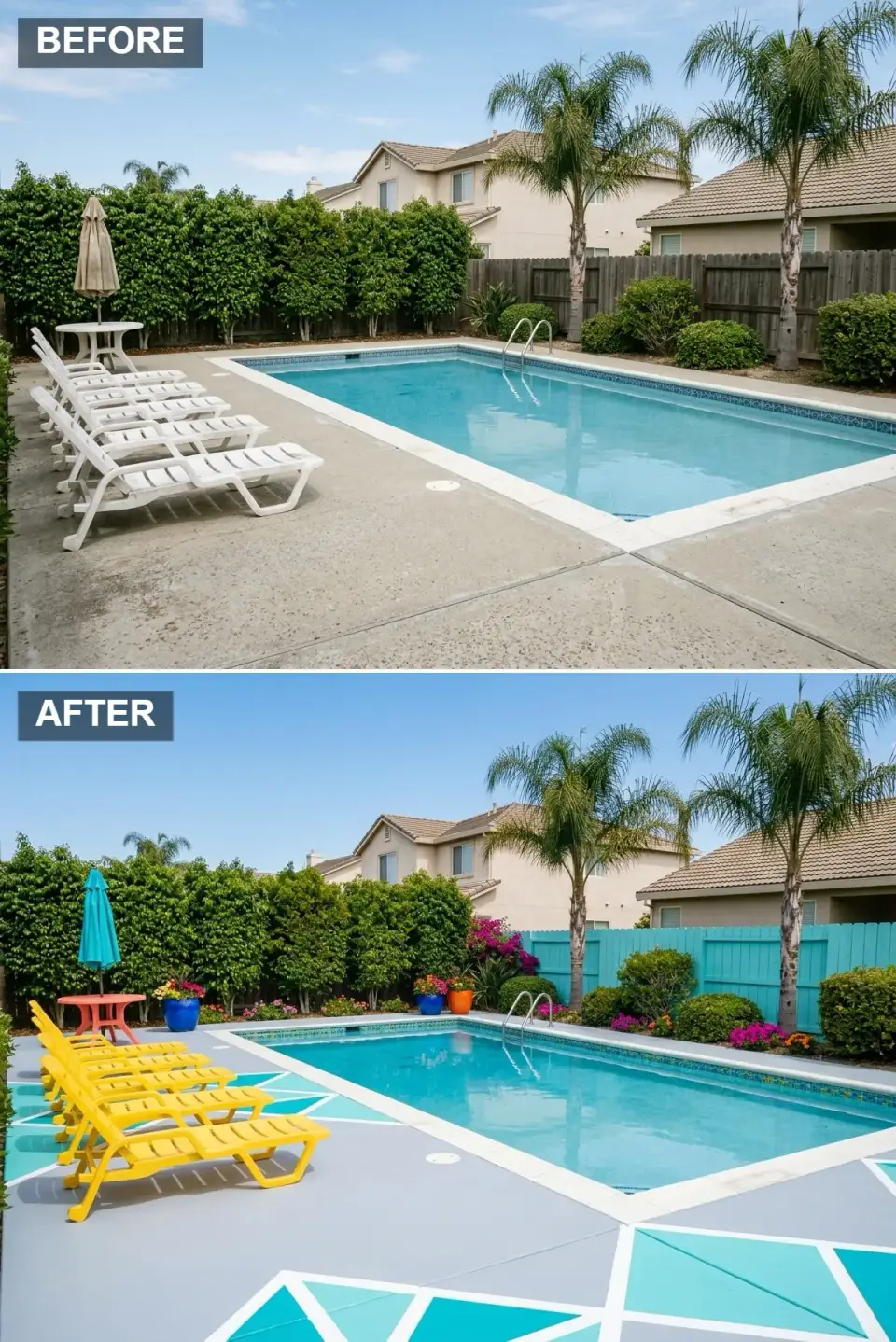
This is the lowest-budget makeover on the list and one of the most fun. The existing concrete apron was masked off and painted directly with a large-scale turquoise-and-white geometric pattern (concrete porch enamel, two coats, plus a clear sealer). Bright yellow lounge chairs read as art objects against the painted floor. A small red side table breaks the cool palette. Even the wooden privacy fence was repainted turquoise to bring the back boundary into the scheme. The room is essentially a Palm Springs cabana built from paint and inexpensive furniture.
Look closely and the deck is mostly a pale grey field. The drama comes from large triangles of Turquoise (#40E0D0) outlined in Bright White (#FFFFFF) bands, which is why the pattern reads crisp from the far side of the pool rather than busy.
Against that floor, the Sunshine Yellow loungers (#FFD700) are the loudest thing in the yard, and the coral side table and teal umbrella next to them keep the yellow from standing alone. The back fence was specified as Cyan Blue (#00FFFF); in the rendering it lands as a softer aqua, and that softer version is the one to sample, since pure cyan boards would outshout the deck.
The painted pattern itself depends on prep. Use 1.5" to 2" painter's tape and a porch-and-floor enamel rated for slabs, apply two coats minimum, and finish with a clear non-slip sealer so the deck stays safe when wet.
Furniture in bright primary or jewel tones keeps the painted floor from doing all the work, and painting the privacy fence into the same scheme is what makes the whole yard look intentional rather than simply colorful. Set honest repaint expectations, though: even with sealer, the brightest sections will need a touch-up every two to three seasons in heavy-use Southern yards.
3. Hollywood Regency: Black-and-White Marble Patio
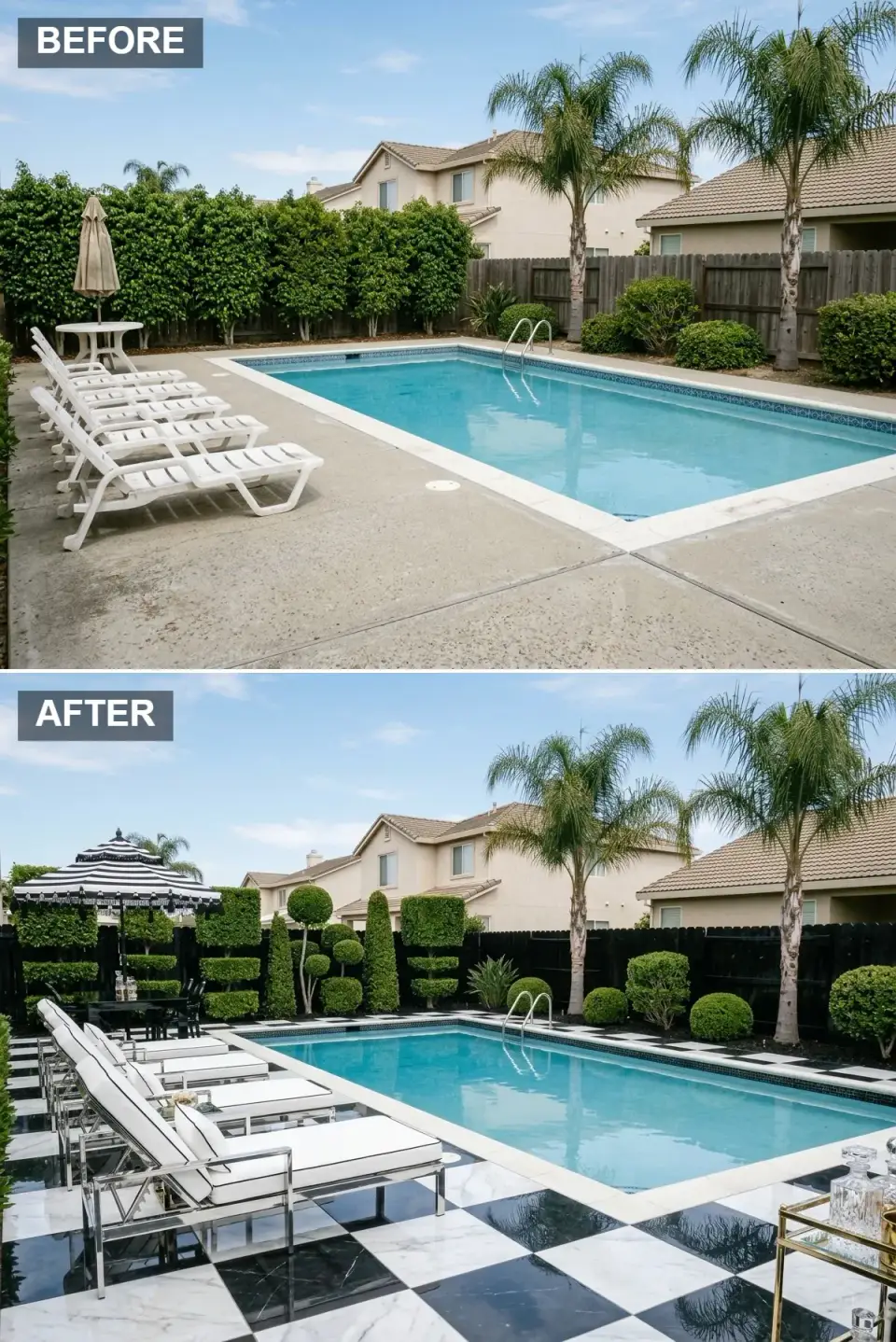
Pure 1940s Beverly Hills, scaled to a residential pool. The concrete was overlaid with a black-and-white checkered marble tile (porcelain look-alike works fine here and shrugs off poolside chemicals better than real marble). Plastic furniture was replaced with chrome-framed loungers, white cushions piped in black. A bold black-and-white striped umbrella anchors the lounge zone, and a small black bistro dining set defines the meal zone. The fence was painted matte black to function as a backdrop for the manicured boxwood topiaries, a move that takes the eye off the boundary and onto the planting.
The checkerboard does all the color work at ground level: squares of Black Marble (#000000) alternate with White Marble (#FFFFFF), both with soft grey veining, so the floor looks like stone rather than a vinyl kitchen and catches the sky in its polish.
Above it, the lounger frames are Polished Chrome (#C0C0C0) with white cushions piped in black, and the old board fence has gone Matte Black (#282828), a softer black than the tile, so the clipped topiary spirals and globes stand out as green sculpture. A brass bar cart at the edge of the frame is the one warm metal in the scene.
The checkerboard should be porcelain tile rated for outdoor use and pool surrounds, since real marble etches under chlorine splash and acidic pool water. For the loungers, chrome frames stay cooler than black-painted aluminum in direct Southern sun, which matters on bare legs.
Planting has to stay crisp to hold the Regency line. Manicured boxwood, podocarpus or eugenia topiaries keep their shape in Southern humidity; ornamental grasses read too casual for this look, so leave them out. Pattern belongs in the textiles, in the umbrella stripe or a striped towel stack, where it reinforces the theme without crowding the floor pattern.
4. Layered Boho: Jute Rugs, Peacock Chairs, Lanterns
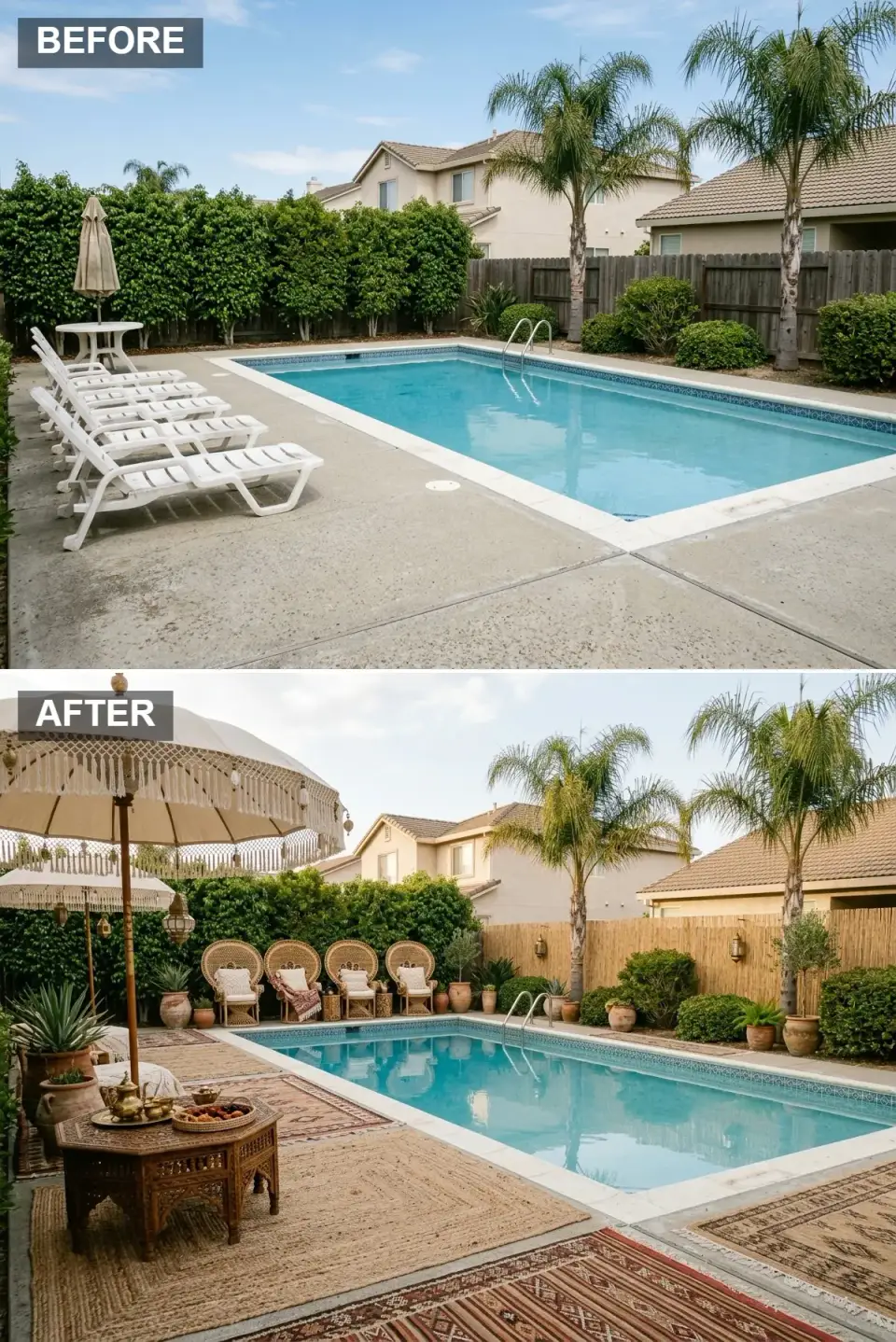
This is the makeover for anyone who wants their pool deck to feel like it grew over a decade rather than getting installed in a weekend. The slab is covered with layered indoor-outdoor rugs (a large jute base, smaller patterned rugs at the pool edge and lounge zone), which softens the foot-feel and visually warms the concrete. Plastic chairs are swapped for a row of four rattan peacock chairs and a low carved octagonal table set with brass tea service. The existing fence gets a bamboo-reed roll-screen for a softer enclosed feel. Fringed parasols, Moroccan lanterns, and terracotta pots full of agave and olive finish it.
The floor here is textile rather than hardscape. Broad Natural Jute rugs (#D2B48C) cover most of the slab, and smaller kilim-style runners in a Terracotta Pattern (#A0522D) overlap them at the pool edge and under the table, so the red reads as a second layer rather than a border.
The reed screen fixed to the old fence is a Bamboo Reed tone (#E3CBA7) only a shade lighter than the jute, which is why the boundary seems to continue the floor. The fringed parasols and the seat cushions in the peacock chairs are Creamy Off-White (#FFFDD0), the quiet neutral that leaves the carved wood and the patterned rugs to carry the detail.
The rugs should be polypropylene "outdoor jute" lookalikes. They handle pool splash and rain far better than real jute, which mildews fast in a humid Southern yard. Peacock and oversized rattan chairs photograph beautifully, but keep them under the umbrella, because UV breaks natural rattan down quickly in full Southern sun.
For the evening, cluster lanterns at varied heights along the fence line so the light feels designed rather than purely functional. Terracotta pots follow the same logic: group them in odd numbers, 3 or 5, at varied heights, and the eye reads them as collected rather than staged.
5. Zen Garden: Gravel, Stone, and Shoji Screens
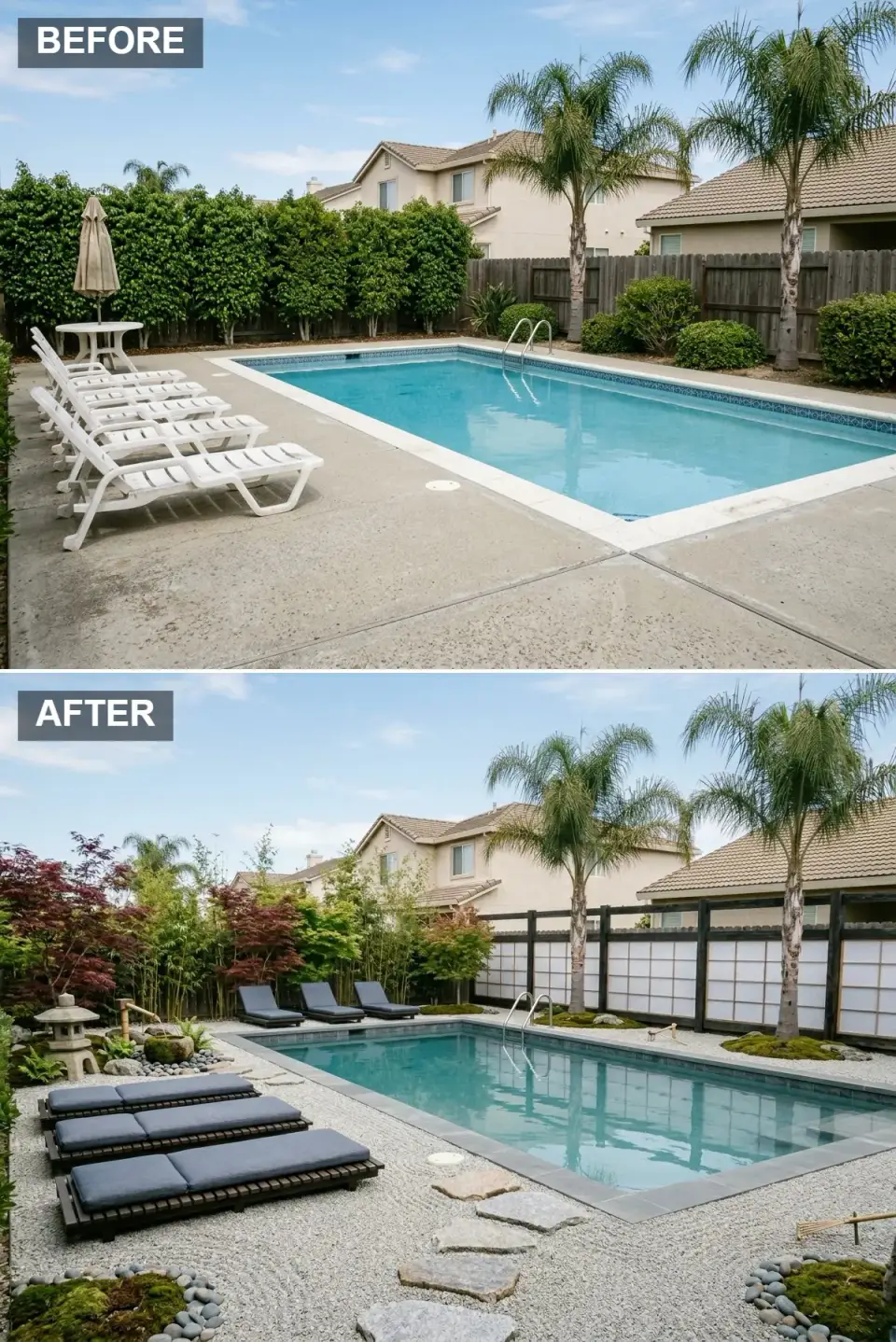
Of every makeover on this list, this is the one that suits the fewest houses, and the one that rewards commitment most. The concrete apron is almost entirely replaced with raked light grey 1/2-inch gravel and large flat, irregular stepping stones, which slow your walk down on purpose. Plastic furniture goes out for low, slatted dark espresso wood lounge platforms with simple cushions. The fence is rebuilt in a Japanese shoji style with white-rice-paper-look polycarbonate panels in black timber frames. A stone lantern, a bamboo water feature (shishi-odoshi), moss islands ringed with river stones, and a planting of bamboo and red-leaf Japanese maples carry the rest.
Raked Light Grey Gravel (#B0B0B0) now covers the ground where the concrete was, and the loungers are low platforms in Dark Espresso Wood (#3B2F2F), the darkest element in the yard and the thing that keeps all that pale stone from washing out.
The pads on those platforms were specified in Charcoal Grey (#555555); the rendering pushes them toward a cool slate blue, which still works because it echoes the darker coping tile now framing the pool. The translucent panels behind are Shoji White (#F2F2F0), the brightest surface in the scene, while the red maples on the left supply the only strong color.
The ground plane is 1/2-inch decomposed granite or pea gravel laid over a stabilizer, which stays in place underfoot and rakes back to flat after a party. Stepping stones should sit 18 to 22 inches apart, center to center, to match a natural stride.
For shoji-style fence panels in a humid Southern climate, use polycarbonate or HDPE panels instead of actual rice paper; the look is the same and there is no annual replacement. Beyond the materials, restraint is the real design move in a Zen yard. If you find yourself adding a fourth element, take one back out.
6. Modern Minimalist: Large-Format Pavers and Cedar Slats
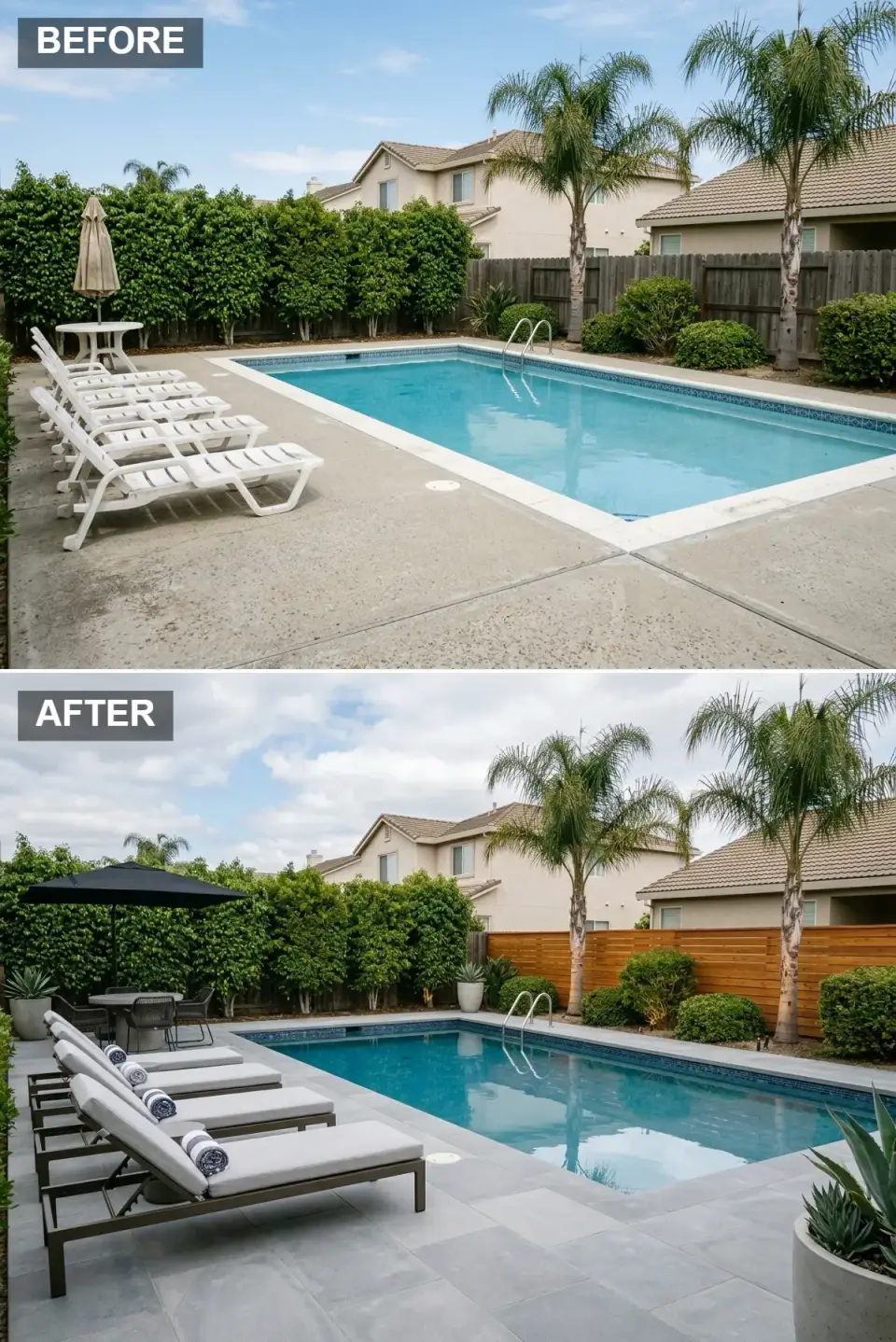
A clean contemporary direction that ages very well. The dated concrete was overlaid with large-format dove grey porcelain pavers in 24"x48": fewer grout lines, instant calm. Lounge chairs with slim dark frames and pale grey cushions replaced the plastic, and a single black umbrella shades a round dining table ringed with black woven chairs for graphic punctuation. The wooden privacy fence along the back was rebuilt in horizontal cedar slats with a 1/2" reveal, which immediately reads architectural rather than utility. Pale concrete planters with sculptural agave finish the room without needing flowers.
The pavers are Dove Grey (#8F979D), a cool mid-tone that looks lighter under the rendering's overcast sky, and the lounger frames were chosen in Mid-Grey (#707070) to sit one notch darker than the floor. In the image those frames come out closer to dark bronze, which gives the row a firmer outline than a near match would.
Matte Black (#000000) appears on the umbrella and the woven dining chairs, while the planters stay pale concrete so the agaves read as sculpture. The one warm note is the horizontal fence in Warm Cedar (#C88A65), which runs only along the back where the old pickets stood; the hedge on the left was left in place.
Large-format pavers, 24"x24" or larger, are the single biggest upgrade over a plain slab, and the reduced number of grout lines alone makes the deck read as more expensive. The cedar fence holds up well in coastal Southern climates when Western red cedar is laid in horizontal slats and left to weather to silver. Sealing it locks in the warm color, but it doubles the maintenance.
Planting in a modern scheme works best as repetition: one sculptural variety, such as agave, yucca or sago palm, repeated down the line has more impact than a mixed bed. Keep the palette to three colors plus one warm accent. Push past that and the deck drifts away from "modern minimalist" and toward "incomplete."
7. Mediterranean Rustic: Terracotta Brick and Cobalt Cushions
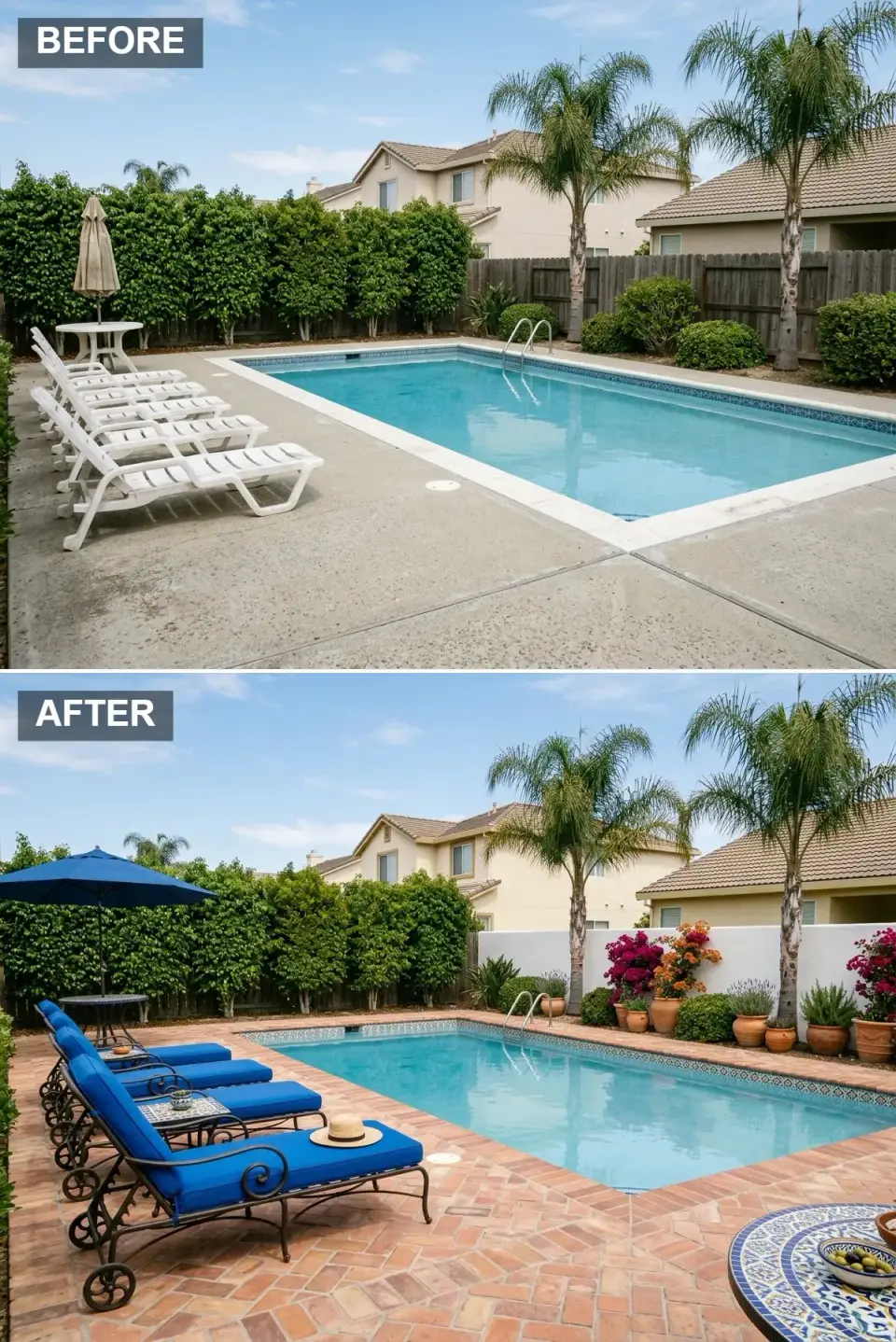
This is the right makeover for homes in the Naples / Ft. Myers axis with a Spanish-influenced or Mediterranean-revival house, though it works on a Lowcountry single just fine. Concrete is overlaid with terracotta-brick pavers in a herringbone pattern. Plastic chairs go out, replaced by black wrought iron loungers with deep cobalt cushions. The back fence is rebuilt as a stucco wall painted bright white, which makes the bougainvillea and terracotta pots look almost Provençal. A small mosaic-tiled side table adds the artisanal moment that ties everything to the source.
The brick floor is specified as Terracotta Brick (#B94E48), and in strong sun the rendering shows it a shade pinker and lighter than that chip, the way unsealed clay pavers do. Set against it, the Cobalt Blue (#0047AB) on the lounger cushions and the umbrella is the complementary color, and that pairing makes the yard feel Mediterranean before any pot or tile is noticed.
The new wall is Stucco White (#FDFDFD) and runs along the back boundary only; the green hedge on the left stays, which keeps the yard from feeling walled in. The loungers' scrolled frames are Wrought Iron Black (#1A1A1A), close enough to true black to outline the blue cushions, and the mosaic tops of the side tables and the round table in the foreground repeat the cobalt in small doses.
Lay the brick pavers in a herringbone pattern; it reads as a Mediterranean villa, while a basic running bond reads as a patio kit. The cushions need Sunbrella in true cobalt. Most outdoor blues lean too navy, which feels nautical, or too sky, which feels beachy, and this look depends on that ultramarine punch.
The supporting materials need climate planning. White stucco walls in Southern humidity call for a quality elastomeric exterior paint and an honest sealcoat, or you can expect mildew within a year. For furniture, powder-coated wrought iron survives coastal salt spray, while raw wrought iron will rust within a season near the water.
8. All-White Sculptural: Curved Loungers on a Liquid Floor
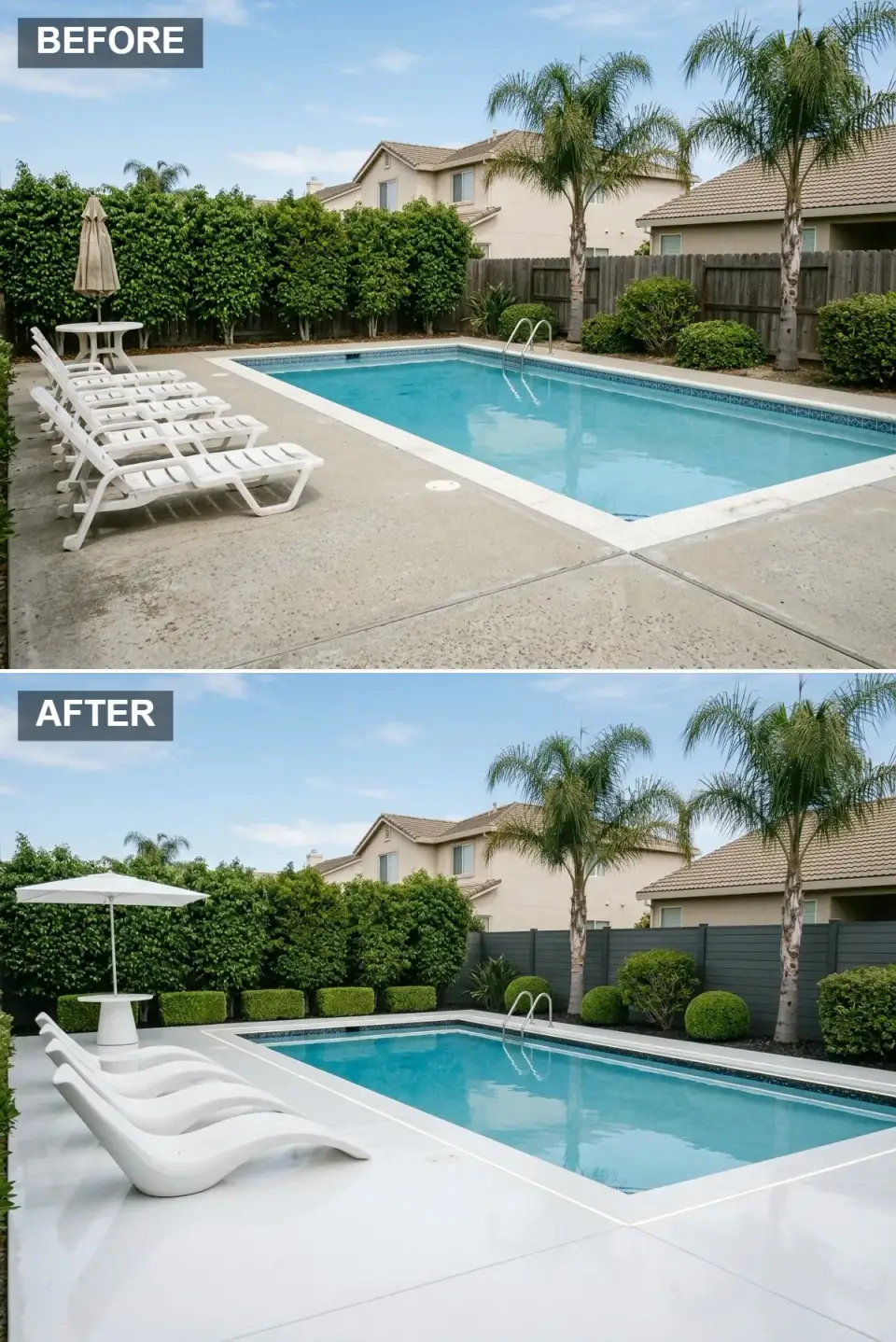
Of the twelve, this makeover is the most architectural and the hardest to keep looking right, but on the right modern house it is remarkable. The deck was poured in a self-leveling white epoxy that reads almost liquid. Plastic chairs went out for curved white loungers shaped like shells, and a white umbrella over a white pedestal table keeps the monochrome rule. The old board fence was rebuilt in horizontal slats painted slate grey to give the white something to push against, and the planting is cut back to clipped boxwood blocks and globes, because anything floral would fight the architecture.
Floor and furniture share one Pure White (#FFFFFF), so the loungers seem to grow out of the deck rather than sit on it. The Slate Grey fence (#4A4F55) is the counterweight, dark enough that the curved chairs read as objects in front of it.
Two smaller notes refine the white. A thin Silver Trim line (#C0C0C0) was specified for the pool coping, though in the rendering the coping stays white and the edge is drawn mostly by the dark waterline tile. The umbrella pole and pedestal table are a White Minimalist finish (#FAFAFA), a hair off pure white, which keeps them visible against the deck instead of vanishing into it.
An all-white deck is gorgeous in photos and demanding in real life, so plan on a power-wash and respray every 18 months in pollen-heavy Southern climates. The loungers should be sculptural fiberglass pieces (Vondom, Slide), which hold up to UV and pool chemicals far better than painted MDF or wood.
On the cushions, use a slightly off-white such as porcelain or oyster. Pure white against pure white reads flat, and a half-tone difference reads intentional. The geometric hedges only work if someone actually trims them quarterly; left to grow out, they undermine the whole architectural premise of the yard.
9. Desert Southwest: Flagstone, Adobe, and Cacti
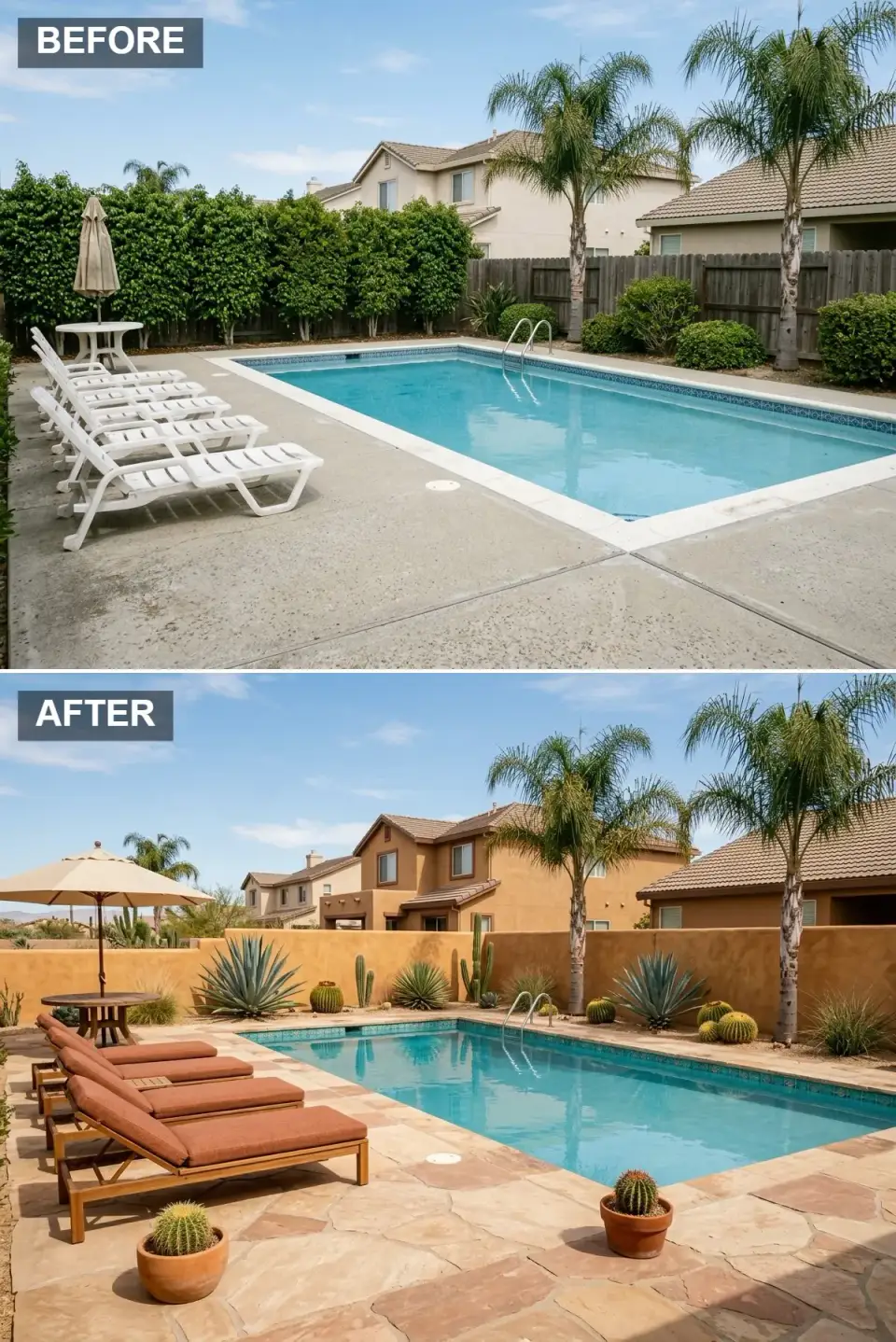
This direction is most natural in the high-desert markets, but a Lowcountry-friendly version of it works for Naples and Charlotte homes, swapping cacti for drought-tolerant native plants like yucca, agave, and muhly grass. The concrete is overlaid with irregular sandstone flagstone in a dry-laid pattern. Plastic chairs go out for sturdy wood loungers with rust-terracotta cushions. The wood fence is rebuilt as adobe-style stuccoed walls in a warm earth tone. Landscaping is redone with cacti, agaves, and ornamental grasses, which read rugged rather than manicured.
Irregular Sandstone Flagstone (#C2A07D) covers the old slab in pieces of mixed size and tint, some pinker, some buff, and the new perimeter wall is an Adobe Brown stucco (#A57C5B). The rendering warms that wall toward ochre in full sun, so judge a sample outdoors at midday before ordering the color.
The loungers bring the deepest tones: cushions in Rust Terracotta (#9E4D32) on frames of Rustic Pine (#8B5A2B), with clay pots of barrel cactus picking up the cushion color at the pool corners. The tan umbrella and round wood table on the left stay close to the flagstone, so the cushions remain the one strong accent.
Dry-laid flagstone over a compacted base is faster and more affordable than mortar-set stone, and a piece can be reset if it shifts over time. The planting needs translation for the Southeast: standard cacti rot in humid summers, so substitute yucca, sotol, agave and ornamental grasses for the same desert silhouette without the moisture problem.
The adobe-look walls need an integral-color stucco finish in the Southeast, because surface-painted stucco peels under summer humidity within two seasons. For the loungers, choose teak or ipe over pine if you want them to survive more than three Southern summers without warping.
10. Travertine Luxury: Oversized Daybeds and Olive Trees
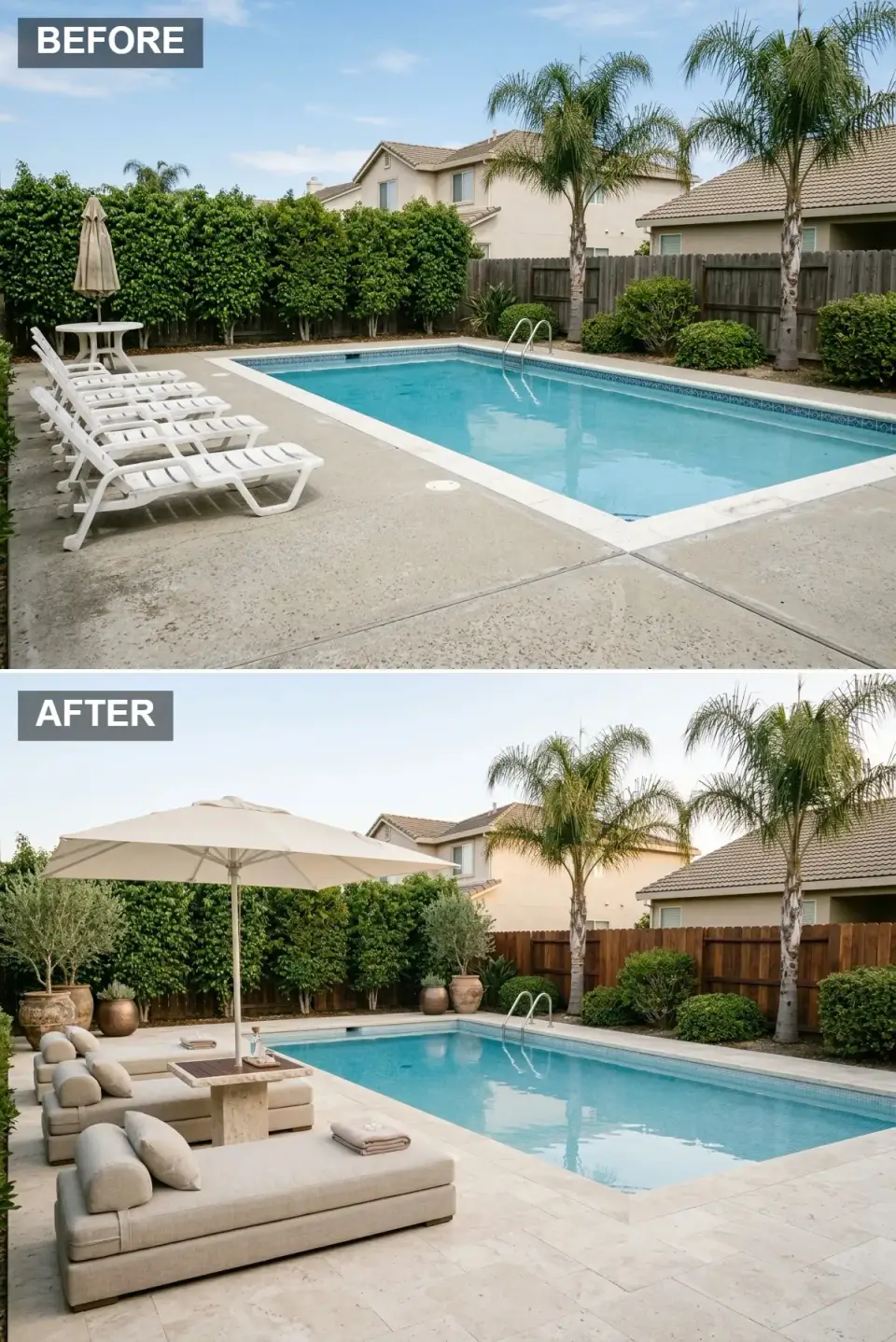
This is the highest-budget direction on the list and the one that ages most gracefully. The concrete apron was replaced (not overlaid, fully replaced) with large-format ivory travertine pavers in an unfilled, honed finish. Plastic chairs went out for oversized upholstered daybeds in oatmeal Sunbrella linen, the kind you can actually nap on, each with its own bolsters. A large cream market umbrella covers the lounge zone. The fence along the back was rebuilt in vertical boards stained dark walnut. Mature potted olive trees in heavy clay urns add immediate Mediterranean weight without waiting years for an in-ground tree to mature.
Ivory pavers and oatmeal upholstery sit only a step apart: the floor is Ivory Travertine (#E8E0D5) in a mix of rectangles, and the daybeds and bolsters are covered in Oatmeal Linen (#D4CDBF), so the furniture reads as a soft extension of the stone.
Between the daybeds stands a pedestal table in Honed Stone (#CFC5B5) topped with dark wood. The rebuilt fence is stained Dark Walnut (#4A3328), the only deep tone in the scene, and its vertical boards give the pale palette a firm edge to stop against.
Specify the travertine in a honed finish, not polished, for pool surrounds. Honed stone is grippier when wet and reads more residential. The oversized upholstered daybeds need fully removable, washable cushion covers, and if you do not use a pool cover, plan a winter storage spot for those covers too.
Shade works better as one piece than two: a single large cream umbrella sized to cover the daybeds looks more luxurious than two smaller ones. The olive trees should be mature potted specimens, 4 to 6 feet tall, in heavy stone or terracotta planters, which give you the Mediterranean weight now instead of after a decade of ground-planted growth.
11. Cozy Rustic: Weathered Deck and Adirondack Chairs
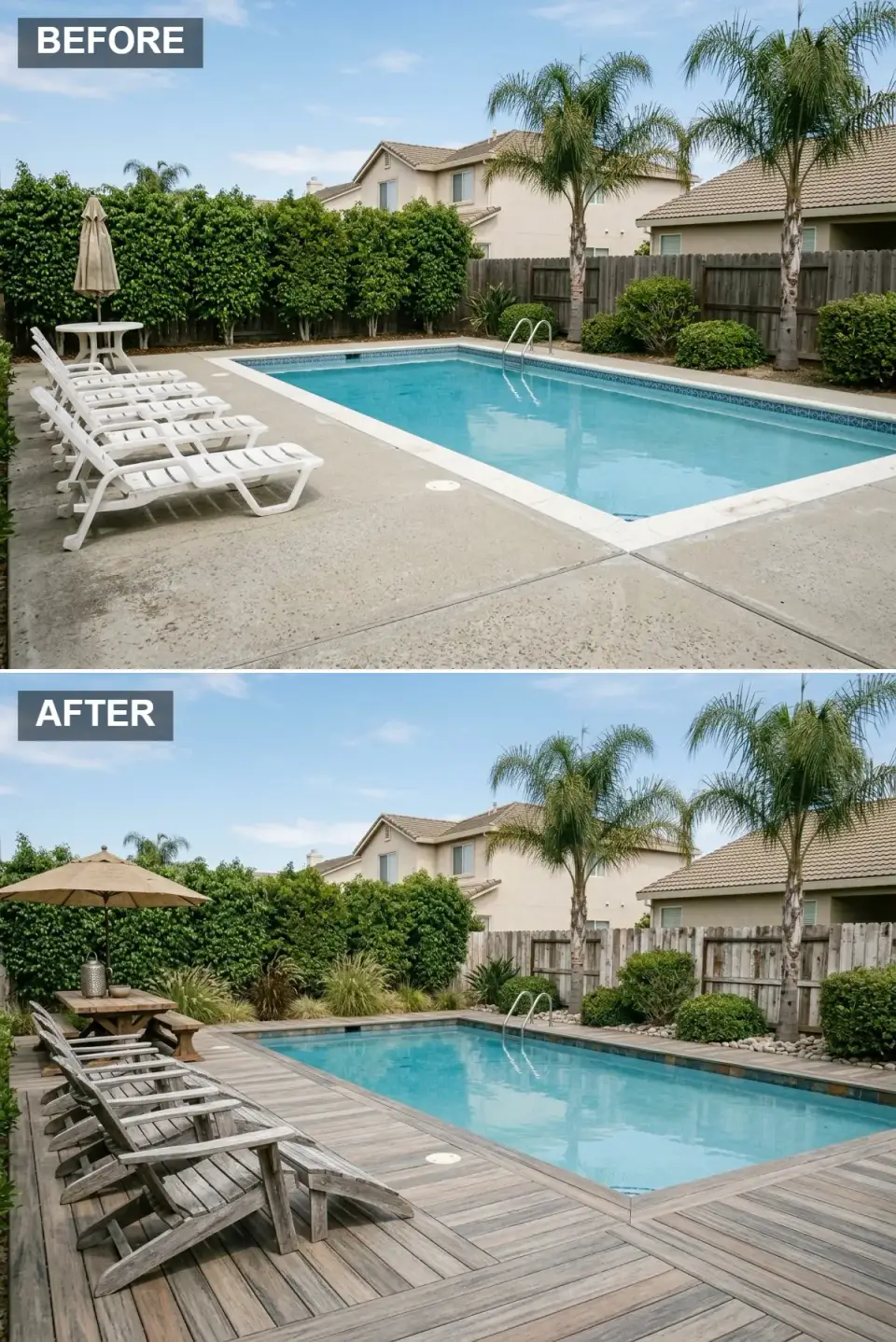
Pick this one if the pool should feel less like an outdoor room and more like part of the yard. The concrete is decked over with weathered grey oak, already silvered, so there is no waiting and no oil maintenance. Plastic chairs give way to classic Adirondack-style loungers and a rough-sawn pine picnic table with benches, sized for casual family meals. Ornamental grasses (muhly grass, fountain grass) fill the bed along the hedge, and river-rock borders blur the hard line between deck and planting. The effect is a lake house on a weekend.
Deck and chairs share one Weathered Oak grey (#8C8279), a brown-tinged silver that keeps the Adirondacks from standing out as furniture; they read as part of the boardwalk. The River Rock Grey stones (#7A7A7A) sit a touch cooler and darker, edging the beds along the fence.
Warmth comes back at the table end of the deck. The picnic table is Rough Sawn Pine (#A68B6C), browner than the decking, and the umbrella above it is a Tan Canvas (#C2B280) that picks up the dry tips of the grasses behind.
For the silver-grey deck without two years of waiting, use a pre-weathered or thermally modified wood such as Kebony or Accoya. Adirondack chairs read instantly relaxed, and in HDPE recycled plastic they need no maintenance at all; modern HDPE versions look nearly identical to wood from 4 feet away.
Ornamental grasses are the right planting call for this yard. They read as natural, soften hard edges and need almost nothing beyond a once-a-year cut-back. A river-rock border between the deck and the lawn finishes the edge and keeps the string trimmer from chewing up the deck over time.
12. Crisp Nautical: Driftwood Grey Deck and Navy Stripes
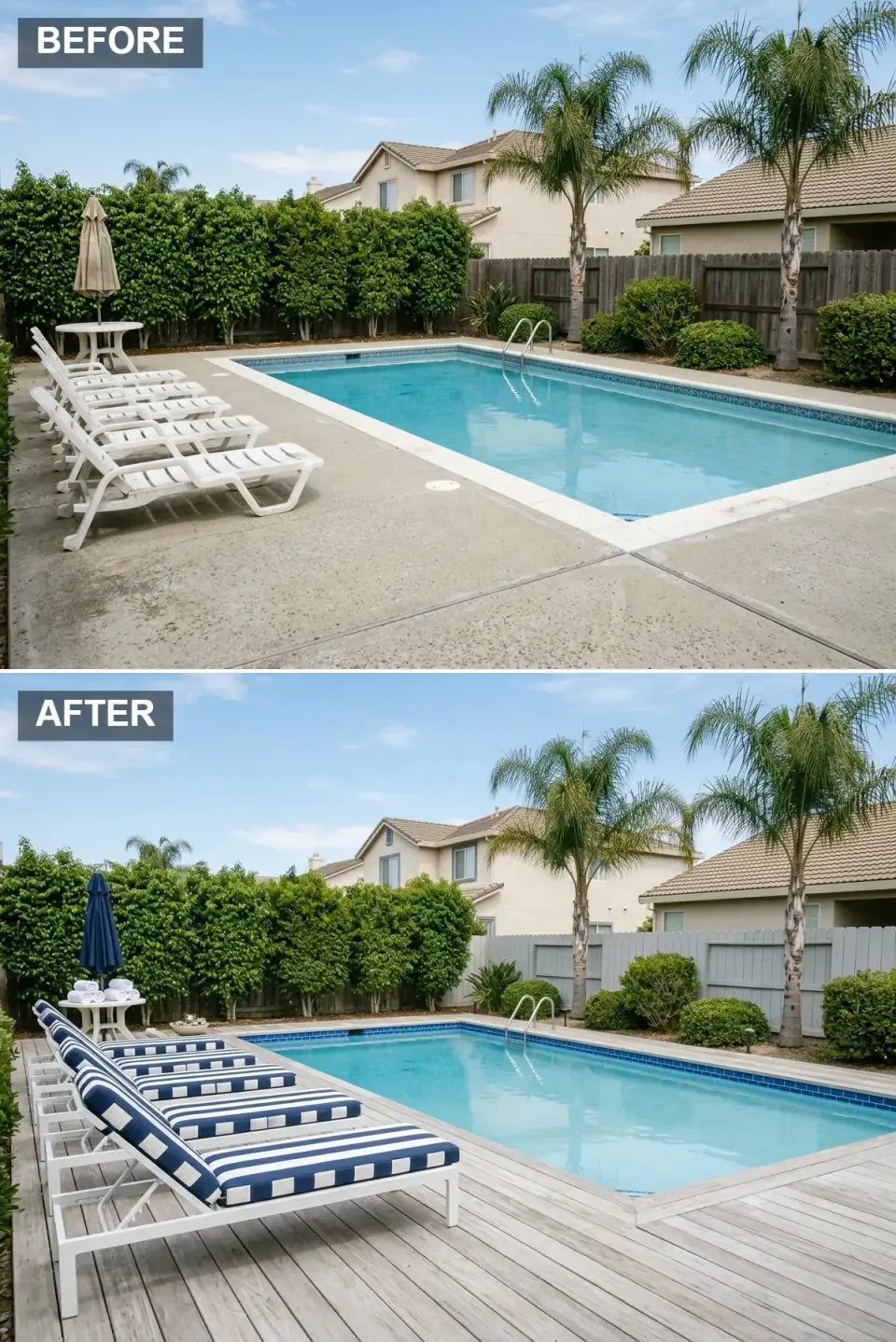
This is the safe default for Charleston and the Outer Banks: it never looks dated and it always feels like the right answer for a coastal house. The concrete was decked over with a driftwood-grey composite, which gives you the silvered-dock look without splinters. Plastic chairs went out for white-powder-coated aluminum loungers in cushions striped navy and white. The faded beige umbrella was replaced with a deep navy one, and the board fence was painted a pale grey. Add stacks of crisp white towels and woven navy beach baskets and the room is finished.
The Driftwood Grey boards (#B0B7B8) are pale and cool, close in value to the repainted fence, so deck and boundary read as one weathered dock. Color arrives only in the cushions, wide stripes of Navy Blue (#000080), echoed by the furled umbrella and a new navy waterline tile.
The other half of each stripe is Pure White (#FFFFFF), and the lounger frames are a White Powder Coat (#F5F5F5), just soft enough that frame and stripe do not merge into one block. A small white side table stacked with rolled towels finishes the row.
Composite decking from Trex or TimberTech in driftwood grey gives you the weathered look without the splinters or refinishing of real wood, which matters on a deck people cross barefoot. Navy and white stripes are the canonical nautical pattern; vary the stripe widths from piece to piece, wider on the umbrella and narrower on the cushions, so the deck does not look like a uniform.
Frames in white powder-coated aluminum outlast painted iron in salt air, a critical detail anywhere within a few miles of the coast. Then hold back on the theme. One striped umbrella, striped cushions and some rope detailing read as committed; add anchors and ship's wheels and the deck tips into theme-park.
Pro Tips That Show Up in Every Pool Deck Project
The flooring change does most of the heavy lifting. Overlay with wood decking, paint a pattern, lay travertine or pour epoxy: in every case, the floor swap is what changes the read of the entire space. Furniture and plants reinforce the choice, but the floor sets it. Close behind is seating, because cheap plastic chairs are doing more damage to the look than you think. Even in a budget makeover, replacing the loungers with something one notch better (powder-coated aluminum, treated wood, recycled HDPE) is a bigger visual upgrade than most planting changes.
The fence line counts as a fifth wall. Paint it, screen it with bamboo, slat it or stucco it, but treat the boundary as part of the design; raw cedar pickets undo much of the work done at deck level. And plan for the climate honestly. Coastal Southern humidity destroys natural rattan, raw wrought iron and surface-painted stucco, so specify Sunbrella, powder-coat, treated wood and integral-color stucco from the start, and the deck still looks good in season three.
Last comes light, the move that turns a pool deck into a night-use room. Add string lights, lanterns at varied heights and a few low landscape uplights at the planting beds. Even a basic deck reads as designed once it is lit.
Frequently Asked Questions
What's the cheapest meaningful pool deck makeover? Painting the existing concrete in a pattern (the Palm Springs makeover above) is the lowest-cost direction by a wide margin: typically a single-weekend project for one person with porch enamel, painter's tape, and a non-slip clear sealer. Pair it with replacement furniture (powder-coated aluminum loungers from any big-box store) and you've changed the entire feel of the space without touching the slab structurally. Total budget can stay under $1,500 for an average suburban deck. Wood, stone, or tile: what holds up best around pool water? For a humid coastal Southern climate, our preferred ranking is: travertine pavers (best, but expensive), porcelain large-format pavers (nearly as good for half the cost), composite decking (low-maintenance and barefoot-friendly), real teak or ipe decking (good-looking but high-maintenance), brick (high-character but slippery wet), and painted concrete (fine for a few years). Avoid flagstone with deep texture in a heavy-use family deck; it's brutal on bare feet and traps debris. How do you make a small backyard pool feel like a resort? Three moves carry most of the resort feel: a single oversized umbrella (always larger than you think you need), a planting line on the back fence that obscures the boundary completely (clumping bamboo, podocarpus, or a hedged camellia line work in the South), and one larger-than-necessary lounge piece (a daybed instead of two chaises). Density of detail beats square footage. What kind of outdoor furniture survives sun, chlorine, and salt air? For frames: powder-coated aluminum, teak, ipe, or recycled HDPE all hold up well. For cushions: Sunbrella fabric over high-density quick-dry foam is the specification to look for near the coast. For finishes: avoid raw iron, painted MDF, untreated softwoods, and natural rattan in any pool-adjacent placement. The price difference between budget and durable furniture pays back in two to three seasons of not replacing things. Do you need a contractor, or can you DIY most of this? A surprising amount is DIY. Painting concrete, installing composite or wood decking over an existing slab on sleepers, swapping furniture, building an outdoor rug layer, replacing or painting a wood fence, and most planting work are all within a confident DIYer's range. Things to hire out: travertine and natural stone installation, epoxy floor pours, removing the existing concrete slab, building stucco walls, and any electrical work for landscape lighting. The All-White Sculptural and Travertine Luxury directions are the most contractor-heavy on this list. How do you keep the pool deck usable in shoulder seasons? Add an outdoor heat element (a freestanding propane heater for a small zone, or a wall-mounted infrared unit if you have a covered seating area) and use heavier-weight cushions in shoulder-season months. A retractable shade sail above the lounge zone extends comfort by a couple of weeks on each end of the season in Southern climates. None of these are expensive add-ons, but together they turn a 4-month deck into a 7-month one.Sources & References
- Pool & Hot Tub Alliance (PHTA): industry guidance on pool deck slip resistance, coping standards, and material selection around residential pools.
- Architectural Digest, Outdoor Pool Design: long-form features on residential pool deck design that informed the high-end direction notes (travertine, all-white, Hollywood Regency).
- This Old House, All About Pool Decks: comparative review of concrete, wood, composite, stone, and tile deck materials for residential builds.
- Sunbrella, Outdoor Performance Fabrics: performance specifications on fade, mildew, and chlorine resistance that drove the cushion and umbrella recommendations above.
- The Spruce, Best Outdoor Furniture: consumer-facing reference on frame materials and finishes that hold up under sun, salt, and chlorine exposure.
- U.S. Department of Energy, Swimming Pool Covers: efficiency-focused guidance on pool covers, evaporation, and water conservation for the shoulder-season usage notes.
Pick One Direction and Carry It Through
The throughline across all twelve makeovers is the same: the pool itself is rarely the problem. The deck, the furniture, the fence line, and the planting are. Pick one of the twelve directions above as a starting point, commit to it across all four of those layers, and the result will read as designed instead of accumulated. You don't need a custom build or a six-figure budget to land any of them; even the highest-end directions on this list (travertine luxury, all-white sculptural) are achievable in stages over two or three seasons.
If you're sketching a broader backyard project, a couple of related guides on the site are worth a look: our walkthrough of eleven backyard transformations covers what happens when the makeover extends beyond the pool surround, and thirteen backyard transformations uses a similar before-after format from a different starting condition. For the planting and landscape side specifically, ten outdoor garden design ideas is the companion piece to pair with this one.
Transformations Desk
The Layered Homes editorial teamThe Transformations Desk produces the before-and-after design studies: one imagined starting space (a room, a facade, a backyard) shown in several design directions, each with a palette and a cost estimate.
More from the Transformations Desk →
Reader notes