


A 20-by-30-foot square of compacted clay behind a Mount Pleasant ranch — rotting fence, a stump where a water oak used to stand, and drainage that ran straight into the neighbor's yard every time it rained. The owners were deciding between thirteen directions across a spring and summer of design conversations, and I rendered each one to force the question. What you see below is the same corner in thirteen different finishes, with honest notes on what each direction actually costs to execute, which ones survive a Lowcountry summer, and which ones photograph beautifully but fall apart in year three. Use it as a planning document, not a catalogue.
Contents
- 1. Tuscan-Inspired Terrace
- 2. Sleek Modern Lounge with Media Wall
- 3. Industrial Chic with Gabion Walls
- 4. Cozy Bohemian Retreat
- 5. Enchanting Cottage Garden
- 6. Minimalist Zen Sanctuary
- 7. Functional & Green Potting Area
- 8. Modern Geometric Garden
- 9. Multi-Level Deck & Fire Feature
- 10. Sleek Outdoor Kitchen & Dining
- 11. Tranquil Japanese Zen Garden
- 12. Rustic Fire Pit & Garden Lounge
- 13. Bold Minimalist Courtyard
- Pro Tips from the Field
- Frequently Asked Questions
- Sources & Further Reading
- Final Thoughts
1. Tuscan-Inspired Terrace
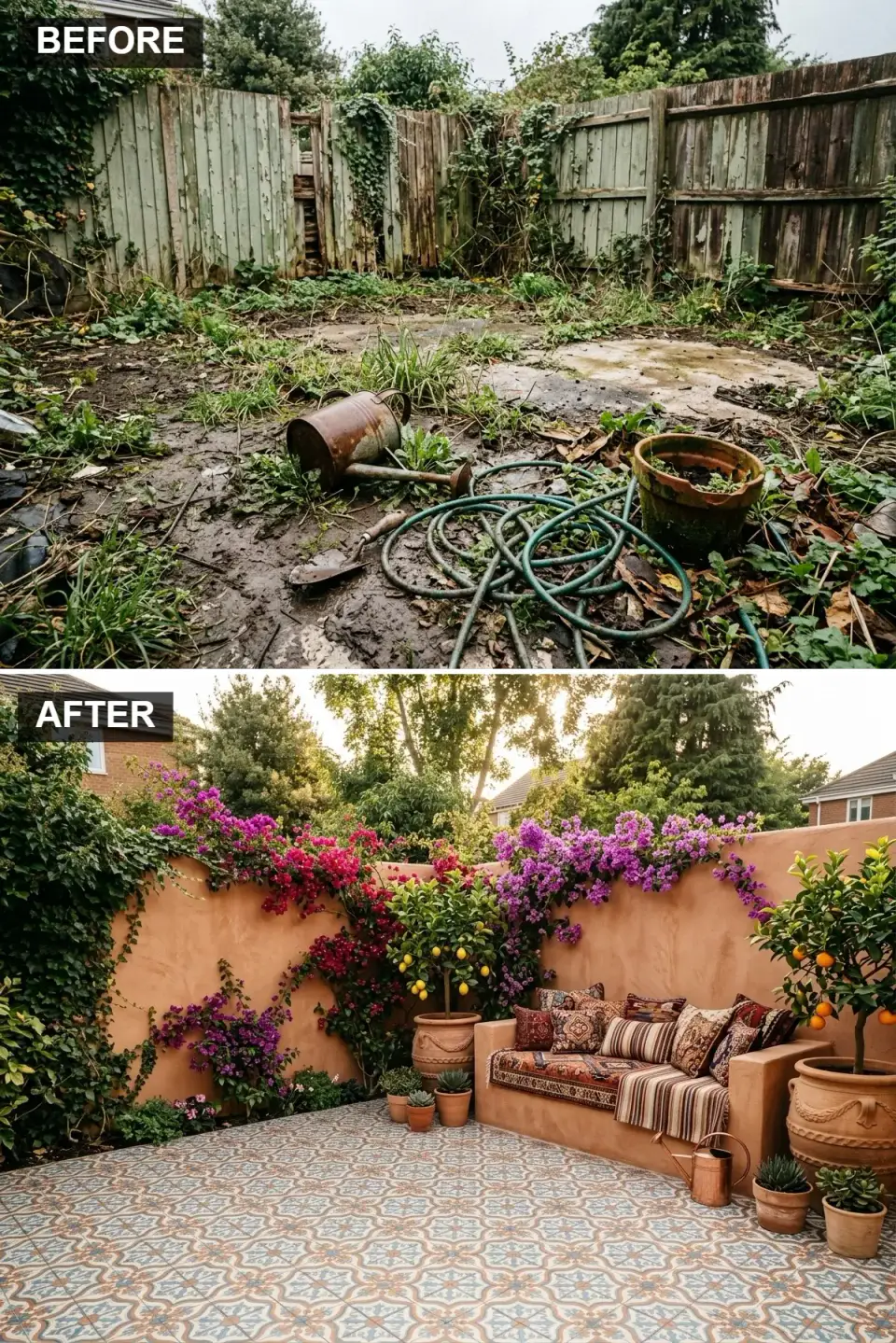
A warm-beige-to-terracotta stucco wall with climbing bougainvillea is a genuinely beautiful direction — and one that works better in Charleston than most people expect. Bougainvillea survives Lowcountry summers reliably if planted against a south-facing wall with protection from the worst winter freezes (which means pulling it back from hard stone bases that radiate cold at night). The patterned encaustic tiles are the detail that sells the whole composition; specify real encaustic cement tiles, not printed porcelain mimics — the cement tiles age with foot traffic into something that printed tiles never achieve. A lemon tree in a large terracotta pot is correct for zone 8b if you're willing to wheel it into a garage during the two or three hard-freeze nights per winter. If you won't do that, substitute a dwarf Meyer lemon in the ground against the south wall — the microclimate protects it.
Color Palette
Wall Terracotta
#C17A5B
Integral-color stucco in a warm terracotta. Reapply a breathable sealer every 7–10 years.
Tiles Encaustic Cement
#A69C94
Real encaustic cement tiles, hand-pressed. Age into patina rather than wearing thin.
Adobe Bench
#D9B391
Stucco-rendered masonry bench, integrated with the wall. Outlasts freestanding furniture.
Aged Copper
#B87333
Real copper pots and accessories — patina adds warmth as they age outdoors.
Styling Notes for This Look
- Encaustic cement tiles need sealing every 18–24 months in Southeast humidity. Budget for it or switch to a glazed porcelain if the maintenance isn't realistic.
- Bougainvillea wants lean soil and restricted water — overfed, it grows lush greenery and no flowers. Under-improve the planting hole deliberately.
- Integrated masonry bench wins over freestanding — no dragging furniture during hurricane prep, no wood rot where the back meets the wall.
2. Sleek Modern Lounge with Media Wall
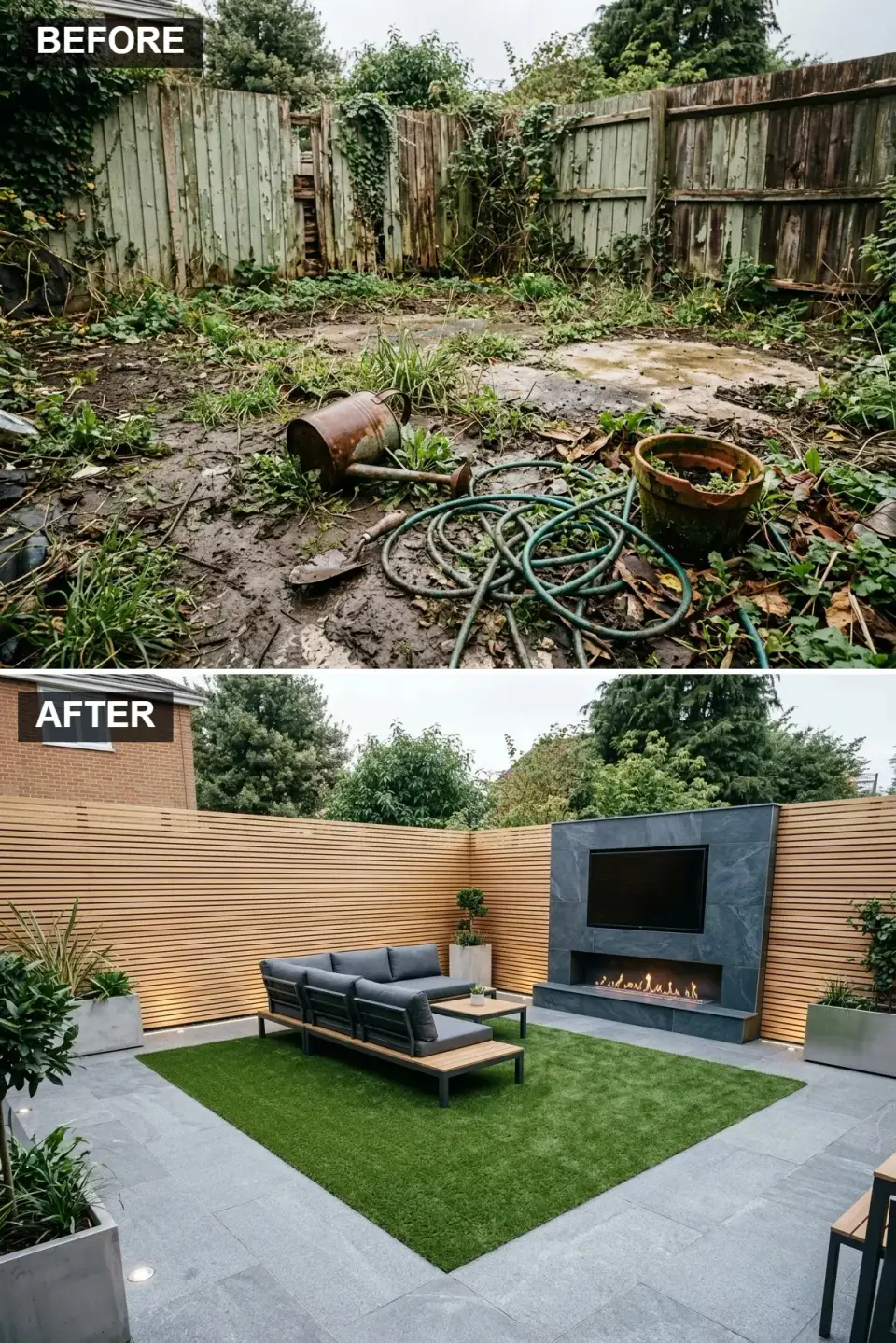
Outdoor media walls are one of the biggest growth categories in Lowcountry residential work — I've specified four of them in the past 18 months. The honest caveat: this direction is expensive to execute correctly. A properly weatherized outdoor TV (full outdoor-rated, not a regular TV in a cabinet) runs $3,000–$9,000 alone; a real linear gas fireplace with gas line and proper venting adds $8,000–$18,000; the dark stone cladding is another $3,500–$8,000 in materials plus installation. The artificial grass rug is the detail most clients want to reconsider after a season — high-quality outdoor polypropylene turf reads well for about three years before the sun fades it unevenly. If you're committed to low-maintenance green, specify a real zoysia sod in this zone instead — it's softer, cooler, and biodegradable.
Color Palette
Slat Fence Light Oak
#D0A883
Horizontal oak slats over a concealed frame. Clear-seal annually or accept graceful silvering.
#3C4145
Real split-face slate panels, dry-stacked over a concealed structural substrate.
Concrete Grey
#9DA1A4
Large-format (24x24 minimum) architectural concrete pavers with sharp butt joints.
#4F8F4F
Either high-grade polypropylene turf (3-year visual life) or real zoysia sod (softer, cooler, requires mowing).
Styling Notes for This Look
- Outdoor-rated TVs only. A regular TV in a weatherproof cabinet is a one-season solution in our humidity.
- Linear gas fireplaces require proper permitting and a gas line run; factor both into timeline. This isn't a weekend install.
- Zoysia sod outperforms synthetic turf on every metric except mowing — consider it before committing to synthetic.
3. Industrial Chic with Gabion Walls
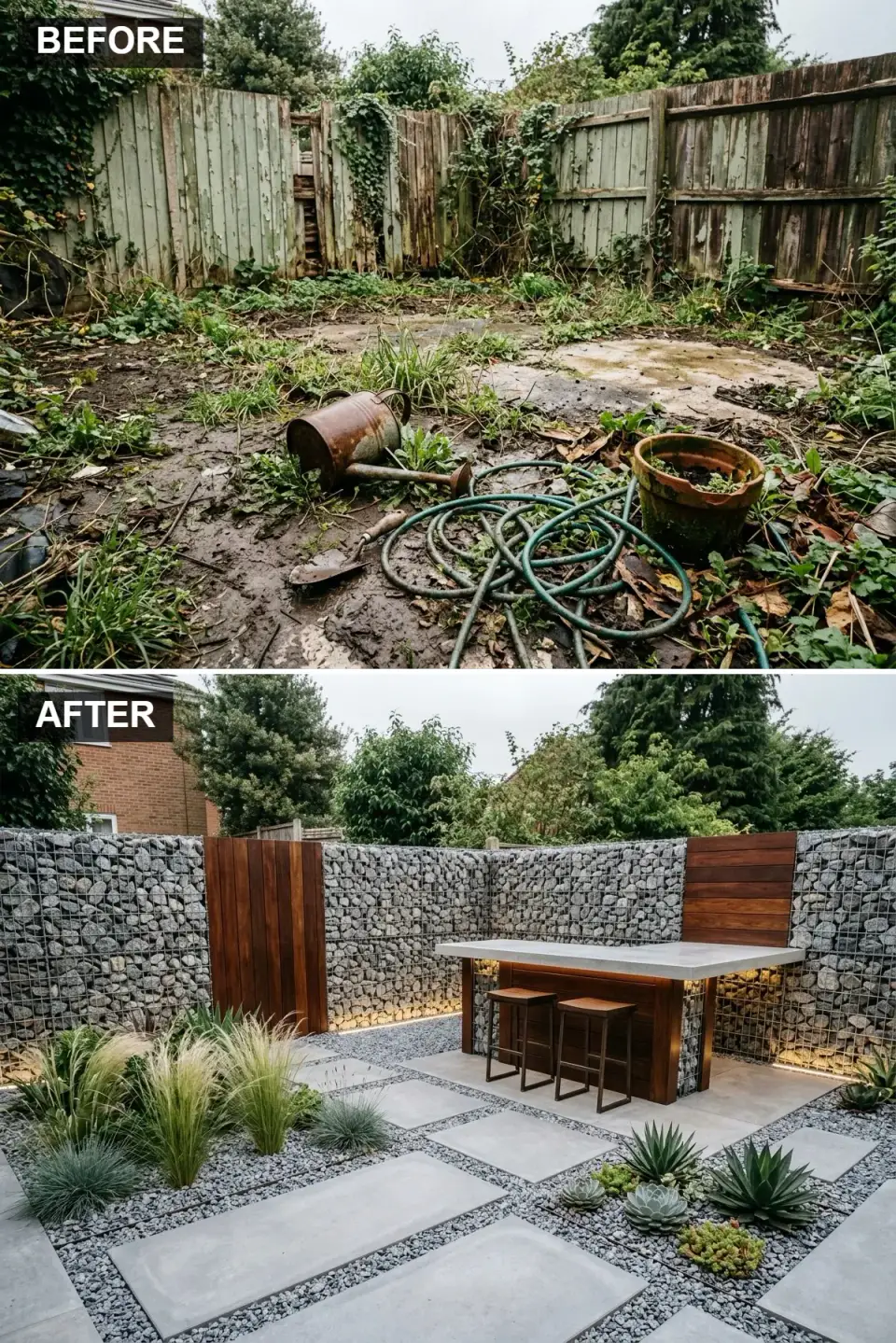
Gabion walls are having a genuine moment in Southeastern residential design — and for good reason. They're structurally substantial, they age without maintenance, they handle hurricane wind loads better than most fencing alternatives, and they read as intentional design rather than a privacy-fence afterthought. The honest caveat: sourcing the right stone matters. Cheap quarry fill looks like gravel at the curb; properly specified granite or local fieldstone in graded sizes reads as sculpture. Budget the stone fill at $4–$8 per cubic foot; the gabion cages themselves are $18–$45 per linear foot installed. A custom concrete bar with integrated lighting is a $6,500–$14,000 line item depending on length and finish. In the Lowcountry, seal the concrete bar top with a food-safe penetrating sealer or stain damage from wine and acidic fruits becomes visible within a year.
Color Palette
#8C8C8C
Graded granite or fieldstone in 3–6 inch pieces. Avoid undersized quarry fill — reads as gravel.
Panels Dark Walnut
#5C4033
Thermally-modified walnut or ipe for outdoor longevity. Avoid stained pine in this position.
Top Polished Concrete
#B0B0B0
Cast-in-place concrete with integral pigment. Seal with food-safe penetrating sealer.
Light Grey Concrete
#D3D3D3
Large-format architectural concrete pavers with pea-gravel interstitials.
Styling Notes for This Look
- Gabion stone fill grade matters more than anything else — undersize the stones and the whole direction collapses into industrial noise.
- Integrated lighting at the bar needs a weatherproof transformer in an accessible location. Build it into the design, not as an afterthought.
- This direction ages better than any other on the list — gabions, granite, and concrete look better in year ten than year one. Budget accordingly if the payoff timeline matters.
4. Cozy Bohemian Retreat
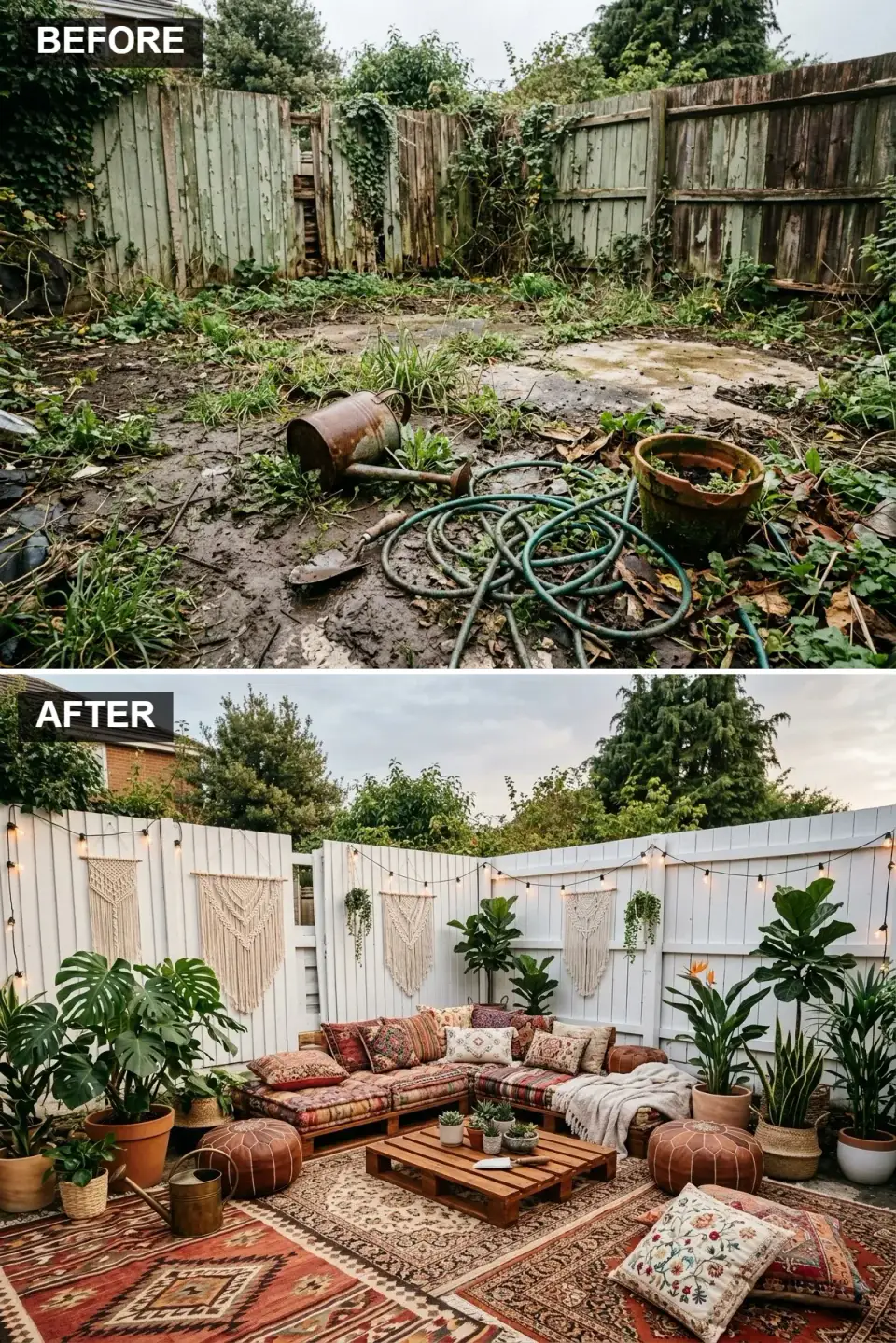
The boho direction photographs beautifully and is probably the lowest-budget of the thirteen — the pallet sofa is genuinely $200 in materials plus a weekend. The honest caveats are exactly what they sound like. Pallets in the Southeast are termite bait; the raw pine attracts them within a year, especially in Charleston, Savannah, and coastal Georgia. If you're committed to this direction, use cedar or heat-treated pallets (marked HT) and set them on concrete pavers, never directly on soil. The layered outdoor rugs are a beautiful styling move that you will hate after the first summer thunderstorm; use an indoor-outdoor polypropylene base rug that reads like kilim but actually survives rain. Monstera and fiddle leaf figs are not hardy in zone 8b — they'll winter-kill unless brought inside from November through March. Every rendering shows them; every client ends up replacing them by year two. Substitute elephant ears and banana plants for the same tropical foliage silhouette and genuine climate fit.
Color Palette
#FFFFFF
Exterior-grade acrylic in a soft warm white. Specify mildew-resistant additive.
#C9A68C
Heat-treated pallets only — untreated pine pallets attract termites in the Southeast.
Pouf Tan Leather
#A0522D
Full-grain leather pouf. Unprotected leather stains at first rain; bring indoors during weather.
#B25948
Base rug should be polypropylene indoor/outdoor. Real wool kilims are indoor-only.
Styling Notes for This Look
- Heat-treated pallets only in the Southeast. Untreated pine is termite food within 18 months.
- String lights need a dedicated GFCI circuit — don't run them off an extension cord long-term.
- Substitute elephant ears, banana plants, or Southern magnolia in containers for monstera and fiddle leaf fig. Same foliage, genuine zone 8b hardiness.
5. Enchanting Cottage Garden
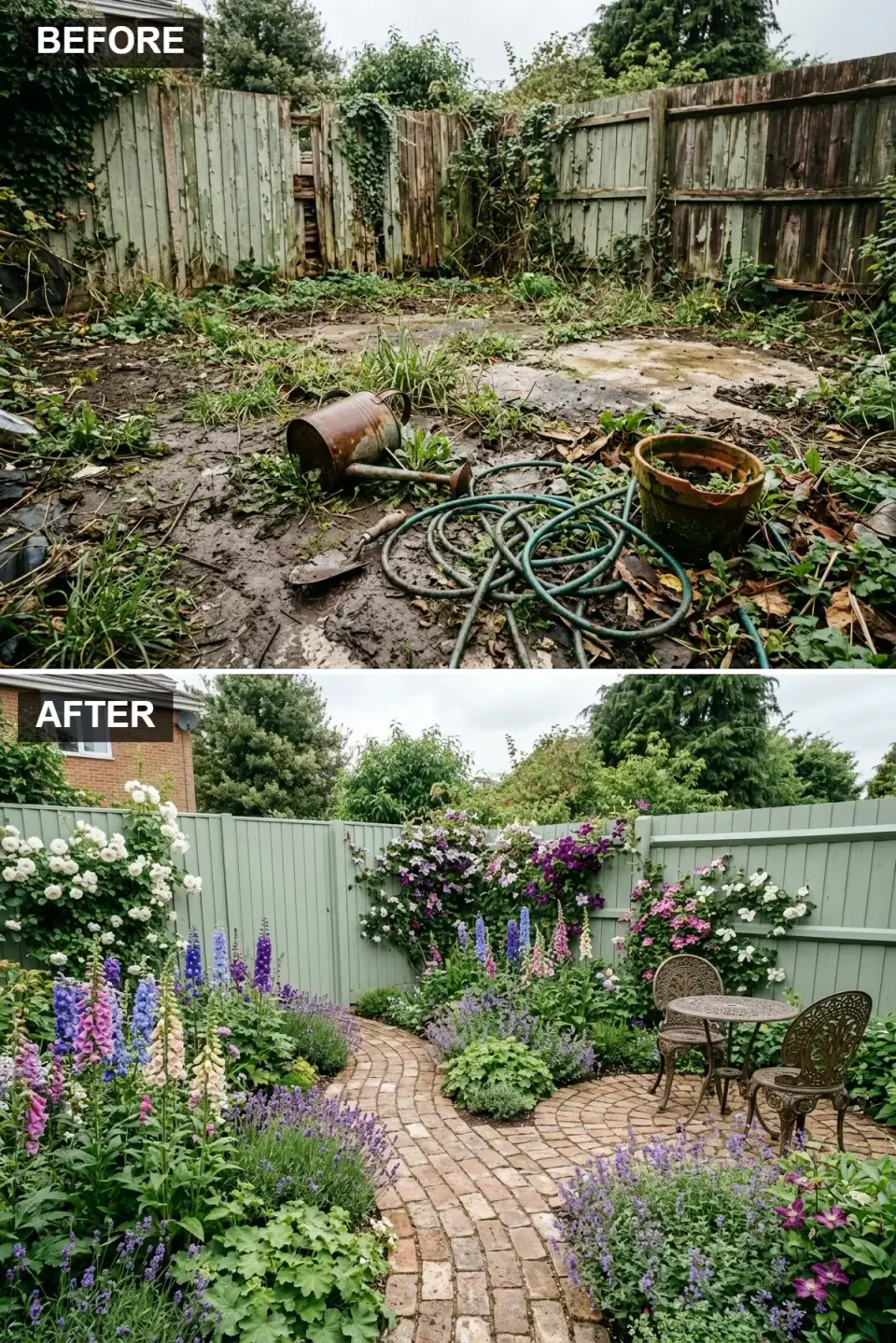
English cottage gardens are one of the hardest directions to execute honestly in the Southeast, and I'll explain why so the client isn't blindsided by the rendering. Foxgloves and delphiniums are cool-climate plants; they bolt and die in a Charleston summer within six weeks of planting, and the literature that sells them here is dishonest. If cottage garden is what you want, substitute with the Southeast analogs: Southern indigo spires (Salvia), purple coneflower, bee balm, and dwarf hollyhocks. They give the same vertical density and flower profusion but actually survive July. The sage-green painted fence is the correct move — specify a mildew-resistant exterior-grade paint with a breathing additive, and plan to repaint every 5–7 years. The bronze bistro set will patina beautifully if it's real cast iron; powder-coated steel substitutes do not age gracefully and start showing rust at joints within two seasons.
Color Palette
Sage Green
#8F9F8F
Exterior acrylic with mildew-resistant additive. Repaint every 5–7 years in our climate.
Path Aged Brick
#A66E5C
Reclaimed or tumbled brick laid in running bond over a proper gravel and sand base.
Bronze Metal
#6B5B4C
Real cast iron with a bronze finish. Powder-coated steel substitutes rust at joints.
#F0EAD6
Specify a disease-resistant Southeast-bred rose variety ('Peggy Martin' handles heat and humidity).
Styling Notes for This Look
- Foxgloves and delphiniums are not Southeast summer plants. Substitute with salvia, coneflower, and dwarf hollyhock for the same visual density.
- 'Peggy Martin' and 'New Dawn' climbing roses are the disease-resistant choices here — David Austin English roses struggle with Lowcountry black spot.
- Real cast iron bistro sets over powder-coated steel, always. The upfront premium pays back on the first season the steel shows rust.
6. Minimalist Zen Sanctuary
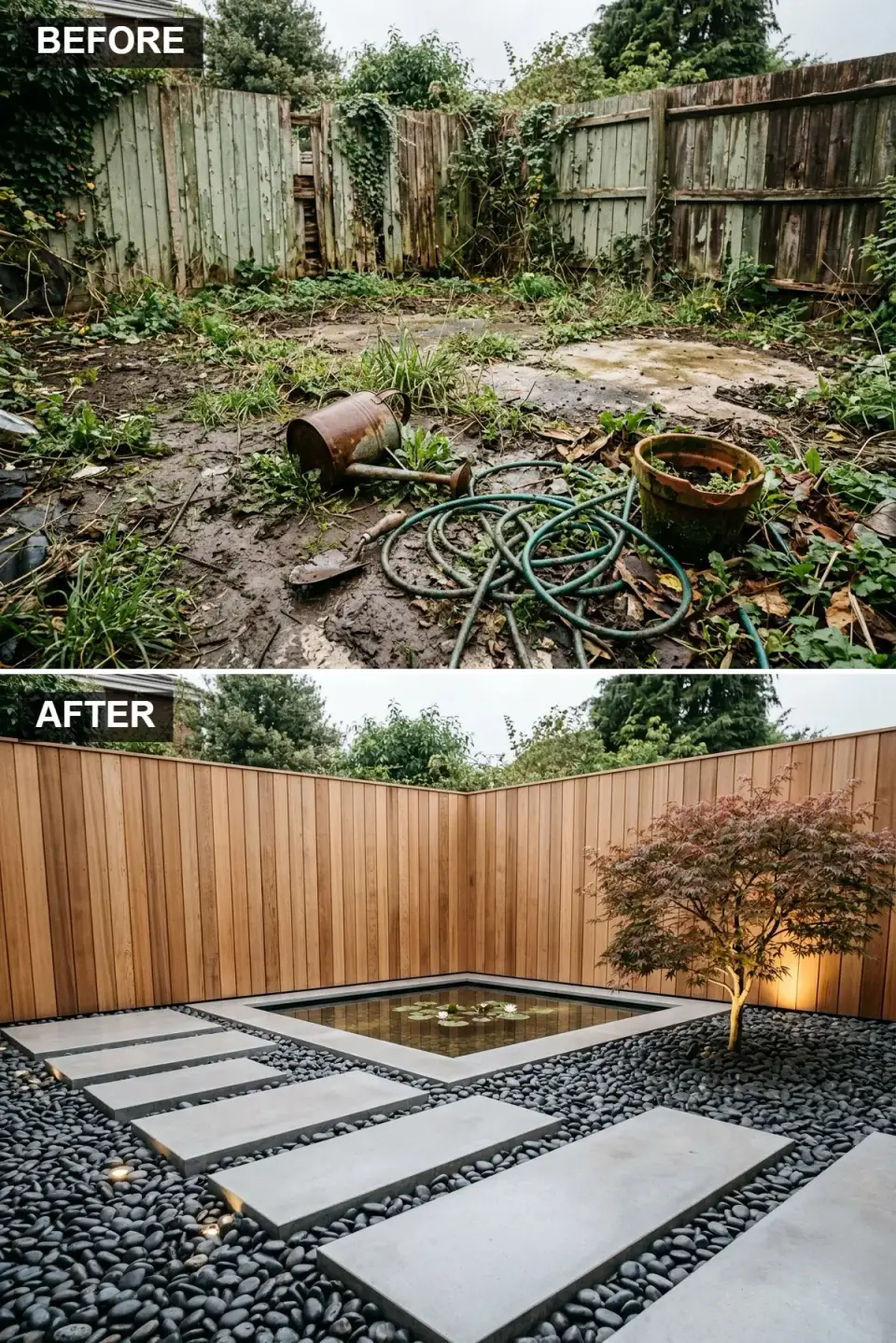
A reflecting pool with water lilies and a Japanese maple is one of the most contemplative directions on the list and, executed well, one of the most genuinely peaceful. The practical considerations are real: a 6x6-foot reflecting pool at 18-inch depth is a $4,500–$9,500 line item including liner, edging, pump, and skimmer, and it needs regular algae management in Southeast summer heat — UV clarifier and a fine-pore sponge filter, not just a pump. Water lilies handle our climate well if the pool gets at least six hours of direct sun; in more shade, substitute with lotus or pickerelweed. Japanese maples are a famous disappointment in zone 8b; they leaf-scorch badly in our summer sun unless planted in dappled afternoon shade and mulched thickly. 'Bloodgood' and 'Crimson Queen' are the most heat-tolerant varieties. Vertical cedar plank fencing ages to a beautiful silver-grey in our climate if left to weather naturally.
Color Palette
#B88A68
Vertical clear cedar planks. Let it silver naturally or reseal every 3 years to hold warm tones.
Border Concrete
#999999
Cast-in-place concrete coping with a smooth-trowel finish. Sealer required to prevent staining.
Black River Stones
#2C2C2C
Polished Mexican beach pebbles or local river stones. Spec 1.5–3 inch size for the scale to read.
#E0E0E0
Large architectural slabs set on concealed concrete piers for the "floating" illusion.
Styling Notes for This Look
- Japanese maples scorch in Charleston direct afternoon sun. Plant in dappled shade with heavy mulch or choose 'Bloodgood' specifically for heat tolerance.
- Reflecting pools need skimmers and UV clarification in summer humidity. Budget $450–$850 for a proper filtration setup.
- Floating pavers require concealed concrete piers, not just sand bedding — otherwise they shift within a season.
7. Functional & Green Potting Area
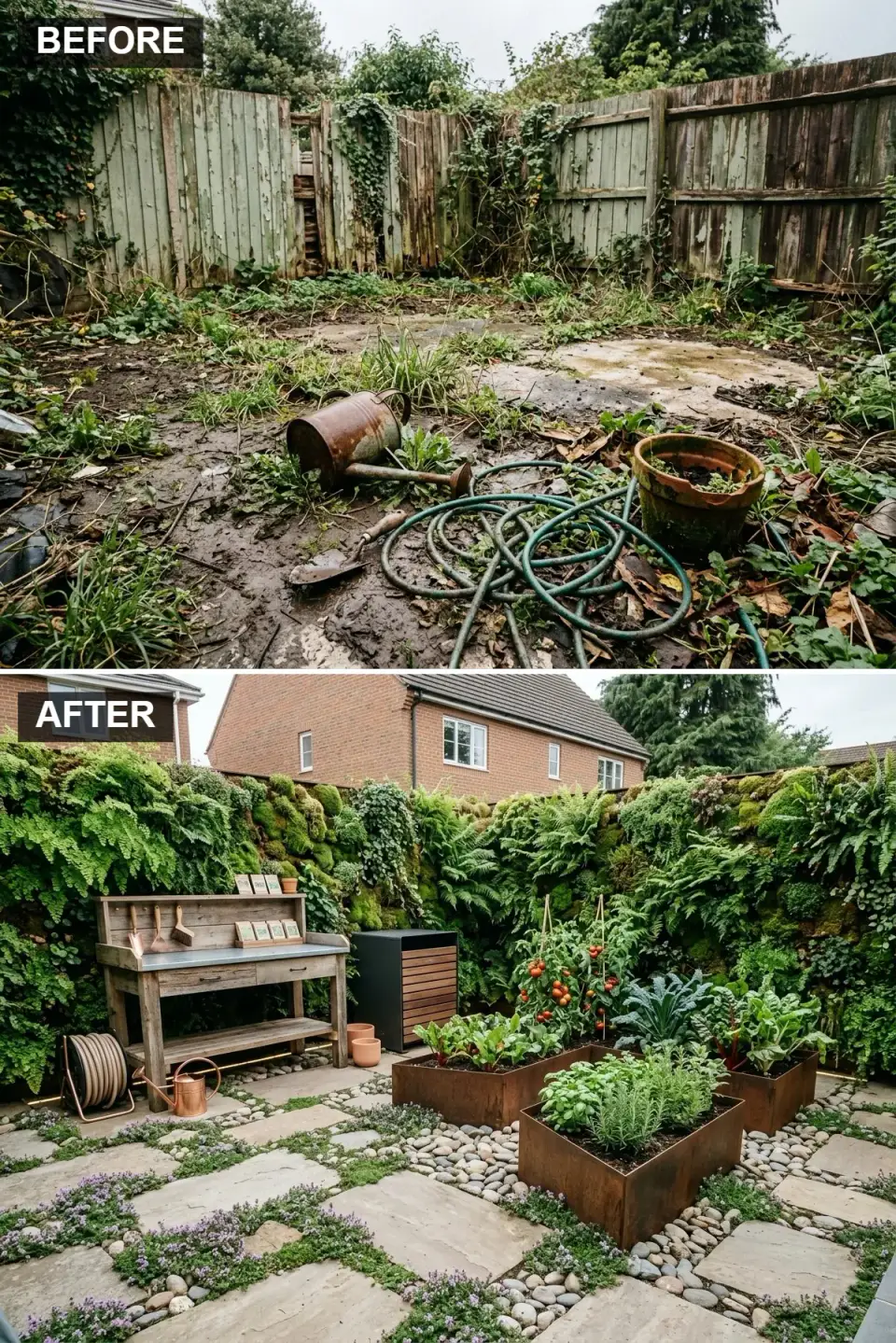
The potting-area direction is the only one on this list I'd call objectively practical rather than aesthetic — and it's the one I specify most often for clients who actually want to use their yard rather than just look at it. Corten steel raised beds are genuinely excellent here: they hold heat, drain well, resist rot indefinitely, and develop a warm rust patina that complements Southeast planting palettes. Budget $800–$2,200 per 3x6-foot bed depending on wall height. The living wall of ferns is beautiful but maintenance-heavy in our climate — ferns need consistent irrigation from a drip system and shade from Southeast afternoon sun. Without both, the wall browns out by August. A more forgiving substitution is a mix of native ferns (Christmas fern, autumn fern) with Lenten rose and heuchera for color variation. Creeping thyme between flagstones handles our heat beautifully and rewards light foot traffic with scent.
Color Palette
#8B7355
Solid white oak or reclaimed timber. Seal the work surface annually with mineral oil.
Corten Steel
#A85C37
Weathering steel, 16–24 inch wall height. Rust run-off stains adjacent stone in the first 18 months.
Path Sandstone
#C2B280
Natural flagstone dry-laid over a gravel and sand base. Creeping thyme or blue star creeper between.
#4A4A4A
Aerated dual-chamber bin. Critical in humid climates — single-chamber bins go anaerobic fast.
Styling Notes for This Look
- Corten steel beds bleed rust onto adjacent stone for 12–18 months. Set them on gravel or expect the staining to be part of the look.
- Living fern walls need drip irrigation and afternoon shade. Skip either and the wall fails by late summer.
- Dual-chamber aerated compost bins are the right spec in our humidity. Single-chamber bins turn anaerobic and smell.
8. Modern Geometric Garden
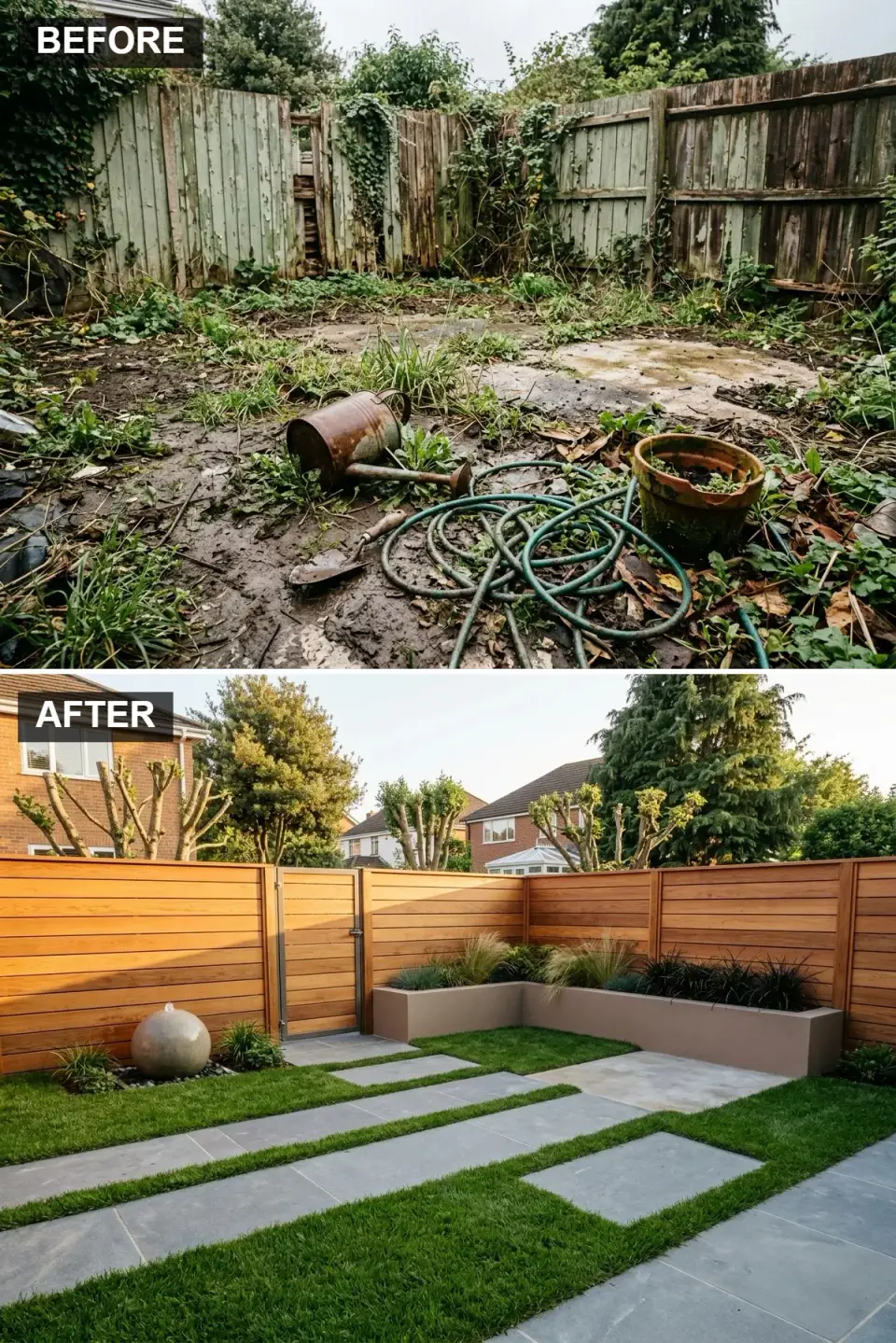
Geometric modern gardens are harder to pull off than they look, and this is the direction where I see the most client disappointment after installation. The issue isn't the materials — it's the maintenance cadence. Precise geometry depends on perfectly clean edges between lawn and hardscape; within one growing season, bermuda grass or St. Augustine (both common Lowcountry lawn turf) will creep across paving joints and blur the geometry. The fix is a proper concealed edging system installed with the original build — steel landscape edging set flush with the paver surface — not a spray edge annually. The spherical concrete water feature needs regular freshwater top-off and an algicide management plan; budget $80–$150 quarterly if you want it running clear. Ornamental grasses in concrete planters are climate-appropriate and require only annual late-winter cutback.
Color Palette
Cedar Planks
#C9935C
Horizontal cedar planks over a concealed aluminum frame. Clear-seal annually.
Taupe Concrete
#AFAEAE
Pigmented rendered concrete over a CMU core. Breathes properly to avoid efflorescence.
Grey Limestone
#8C9296
Honed limestone slabs, 24x24 minimum. Sealed with a penetrating limestone-specific sealer.
Concrete Sphere
#7F7F7F
Pre-cast concrete sphere with internal recirculating pump and concealed reservoir.
Styling Notes for This Look
- Install concealed steel edging between lawn and paving during the original build. Retrofit edging is twice the labor for the same result.
- Spherical water features need weekly water top-off in Lowcountry summer. Budget the reservoir size for at least three days of evaporation.
- Muhly grass, little bluestem, and sweetgrass all handle our climate as the ornamental grass choice — avoid northern specimens like Karl Foerster in planters.
9. Multi-Level Deck & Fire Feature
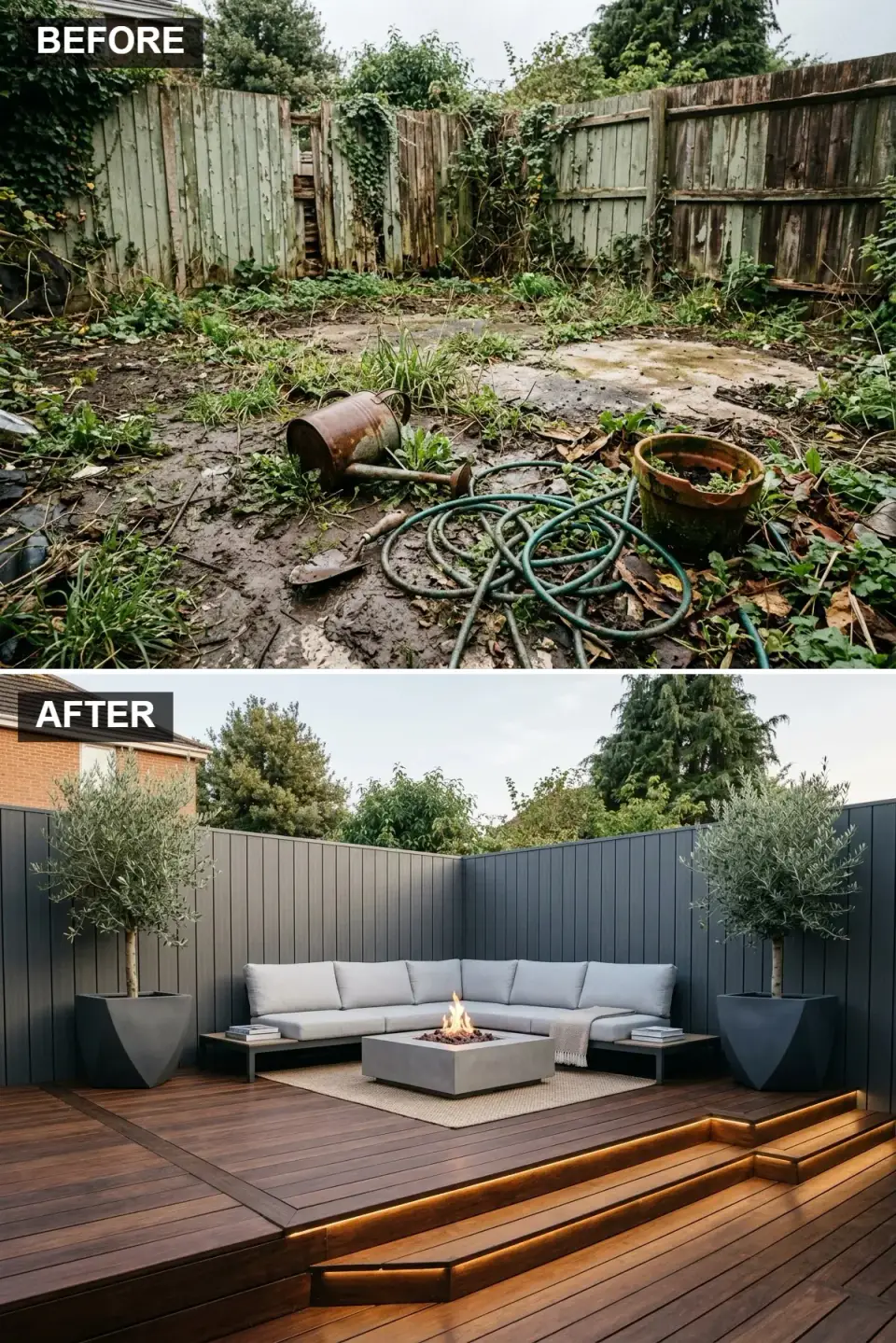
Multi-level decks are a strong direction for Lowcountry lots because our climate rewards defined outdoor zones — and the level change itself becomes the zoning device without a visual barrier. The material spec matters enormously here. Real teak ($28–$45 per square foot installed) is the gold standard and ages to beautiful silver-grey without sealing. Ipe ($18–$28 per sq ft) is the next-best step and holds warm tones longer. Composite decking ($12–$18 per sq ft) looks convincing for the first three to four years and then shows wear patterns that differ from real wood. Integrated LED strip lighting under the steps is one of the best value adds you can specify — budget $18–$28 per linear foot installed — and it transforms evening use. Olive trees are climate-fragile in zone 8b; substitute with potted southern magnolia or sweet bay for the same silhouette and real winter hardiness.
Color Palette
Cladding Charcoal Grey
#363636
Pre-finished fiber cement or aluminum-composite vertical cladding. Holds color 20+ years.
Dark Teak
#5D3A26
Real teak or ipe. Composite substitutes read convincingly for 3–4 years before showing wear.
Concrete Square
#A0A0A0
Pre-cast or cast-in-place concrete fire pit with a gas insert. Never wood-burn on a wood deck.
Geometric Pot
#4F5B66
Fiber-clay or fiberglass pots over cast stone. Real stone planters at this scale are too heavy for most decks.
Styling Notes for This Look
- Never wood-burn on a wood deck — fire pits on decking must be gas inserts, no exceptions. Ember pop will burn a wood deck from below.
- Real teak or ipe lasts decades unsealed. Composite reads well for 3–4 years and shows fade patterns differently from wood.
- Olive trees winter-kill in zone 8b below about 22°F. Substitute sweet bay or bay laurel in pots for the same silhouette and reliable hardiness.
10. Sleek Outdoor Kitchen & Dining
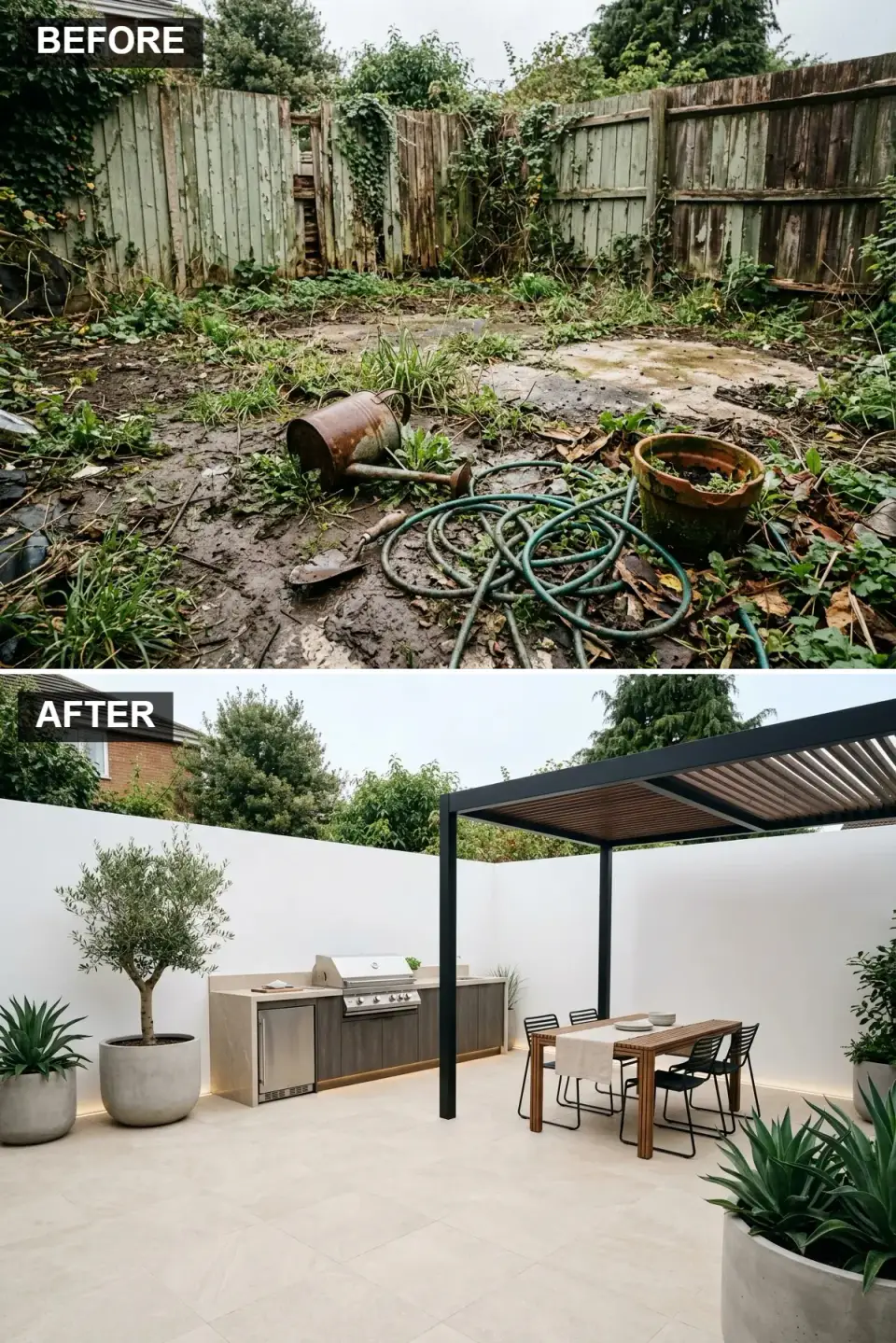
A proper outdoor kitchen is the highest-ROI direction on this list for the Southeast — Remodeling Magazine's 2024 South Atlantic figures show 72–81% cost recovery, and daily-use value is substantial because the Lowcountry climate lets you cook outside April through October. The honest numbers: a full built-in kitchen with gas grill, refrigerator, sink, and cabinetry runs $18,000–$48,000 installed depending on appliance level; a proper metal-and-wood pergola adds $8,000–$22,000. Skip nothing structural — the plumbing and gas rough-in during the original build is the leverage point. Pristine white stucco is beautiful in rendering but shows algae within 12–18 months in our humidity; budget annual soft-wash cleaning or use a warm-beige integral stucco for the same composition with less maintenance. Large-format porcelain tiles are the right flooring choice — beige porcelain reflects less heat than concrete and doesn't fade.
Color Palette
Wall Warm White
#F5F5F5
Integral-color stucco. Warm white shows algae less than pure white — specify accordingly.
Frame Black Metal
#212121
Powder-coated steel or aluminum frame. Avoid painted pine structural members — short lifespan.
Tiles Beige Porcelain
#E3D5C3
Large-format (24x24+) through-body porcelain. Rectified edges for narrow grout joints.
Cabinetry Grey Marine Veneer
#6D6D6D
Marine-grade stainless or HDPE cabinetry. Standard kitchen cabinets fail outdoors within 2 seasons.
Styling Notes for This Look
- Marine-grade stainless or HDPE cabinetry only — standard kitchen cabinets rot outdoors within two seasons in our humidity.
- Gas grills require a dedicated gas line, not a tank connection, if you want clean aesthetics. Include the line in the rough-in phase.
- Warm-white or beige stucco hides algae streaking better than pure white in Southeast humidity — worth the palette shift.
11. Tranquil Japanese Zen Garden
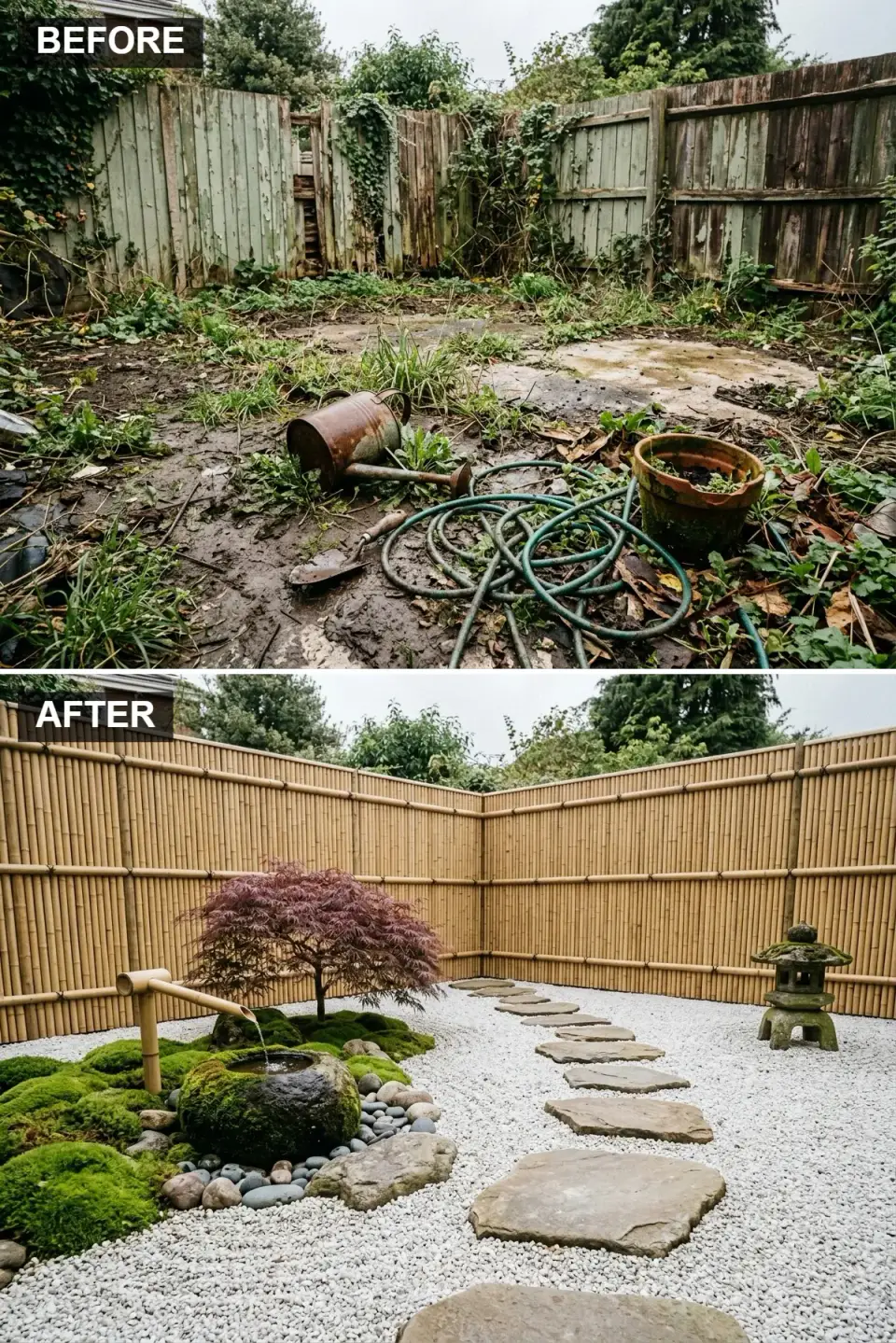
A full traditional Japanese garden is the most committed direction on this list — and also the most fragile without ongoing care. The raked white gravel is the single element that determines whether the space reads as contemplative or as unmaintained; expect to rake the patterns back into it every two to three weeks in the Southeast because wind and rain displace them. Bamboo fencing is authentic but brings a real warning: running bamboo (Phyllostachys) is invasive in Lowcountry soil and spreads aggressively via rhizomes. Either specify a clumping variety (Bambusa multiplex is the closest Southeast-hardy clumping bamboo) or contain it with deep root barriers set at least 30 inches into the ground. Moss for the tsukubai mound works only with significant shade and consistent moisture — sweet woodruff or Irish moss substitutes handle our summer better. The stone lantern is the signature piece and worth specifying in real carved granite, not cast concrete; the patina difference is visible from across the yard within three years.
Color Palette
#D2B48C
Clumping bamboo variety (Bambusa multiplex) or contained running bamboo with deep root barrier.
White Granite
#F0F0F0
Crushed white granite over a proper weed barrier and compacted base. Rake biweekly.
Native Moss Substitute
#556B2F
Sweet woodruff or Irish moss; true moss requires more shade and irrigation than our climate provides.
Lantern Aged Granite
#7A7A7A
Real carved granite lantern. Cast concrete substitutes don't age — the patina difference is visible.
Styling Notes for This Look
- Use clumping bamboo, not running bamboo, in the Southeast. Running bamboo will invade neighboring yards within three years.
- White gravel requires a proper weed barrier underneath. Without it, weeds punch through and the composition fails.
- Raked gravel patterns fade in 2–3 weeks from wind and rain. Accept the maintenance cadence or choose a different direction.
12. Rustic Fire Pit & Garden Lounge
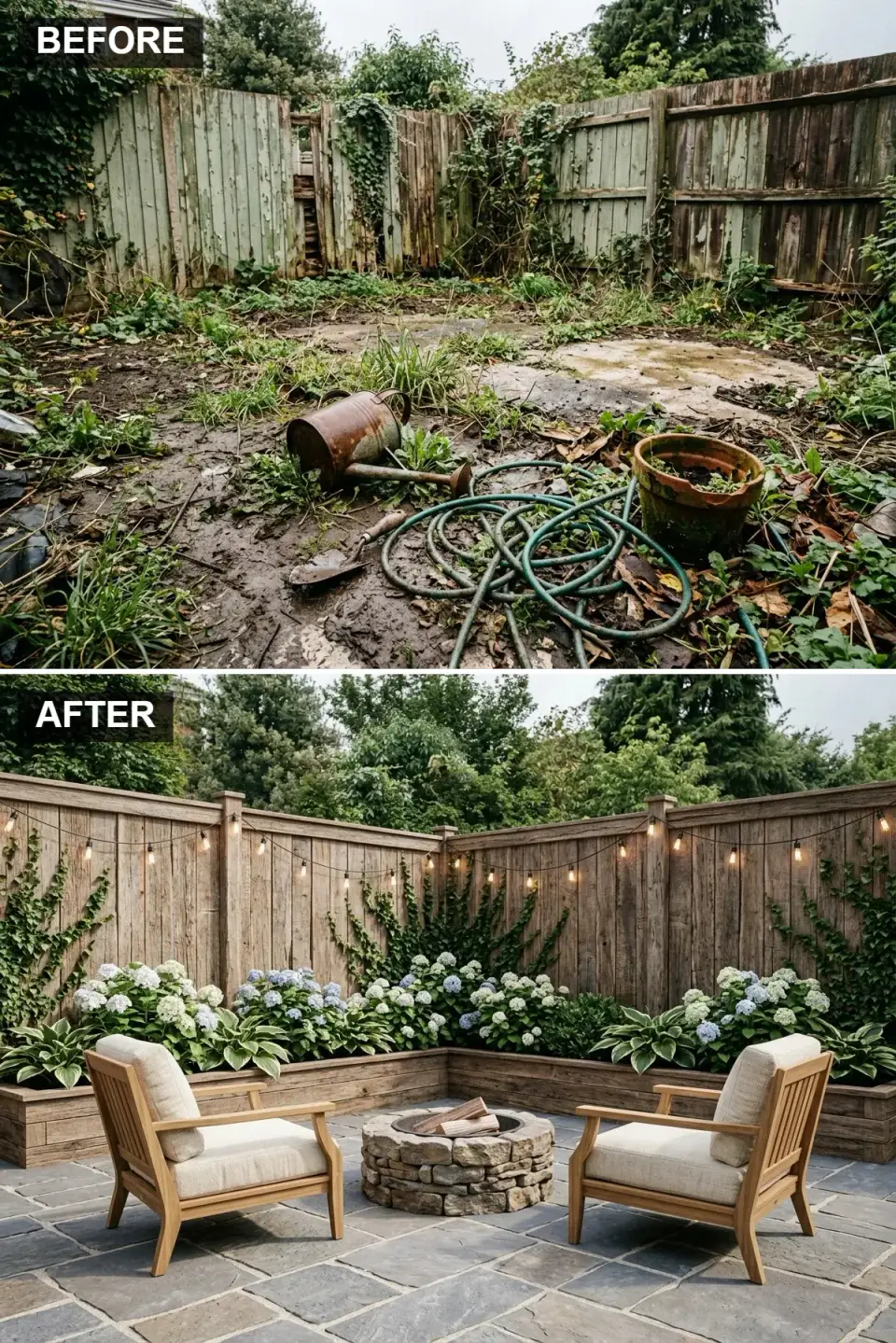
This is the direction I specify most often for Lowcountry clients who want an outdoor living space that just works — low drama, honest materials, and a long use life. Weathered cedar fencing is beautiful and climate-appropriate; the grey silvering happens naturally within 18 months and requires no maintenance after year one. The circular stacked stone fire pit is the easiest upgrade on the list — a properly built dry-stacked fieldstone pit with a fireproof core runs $1,800–$4,500 and lasts indefinitely. Teak armchairs are the right seating spec for durability; budget $1,200–$2,800 per chair for a grade that survives our climate for a decade unsealed. Hydrangeas and hostas are both good Lowcountry choices with one caveat: hydrangeas need morning sun with afternoon shade, and oakleaf hydrangeas (native) handle our summer better than French hydrangeas. String lights need a proper junction box on a GFCI circuit, not a permanent extension cord — this matters during hurricane prep, when you want to easily unplug everything.
Color Palette
#8B7D6B
Untreated cedar allowed to silver naturally. Requires no maintenance after year one.
Stacked Fieldstone
#9C9C9C
Dry-stacked local fieldstone over a fireproof core. 36-inch diameter is the right scale for two chairs.
Blue-Grey Slate
#707A85
Slate flagstone laid in random broken pattern over a proper base.
Teak Armchair
#C19A6B
Grade A teak — silvers gracefully without maintenance, lasts decades.
Styling Notes for This Look
- Dry-stacked fieldstone fire pits need a proper fire-brick core — local fieldstone spalls if it contacts direct flame.
- Oakleaf hydrangeas over French hydrangeas in the Southeast. Native, heat-tolerant, still gorgeous in bloom.
- String lights need a GFCI outlet and a proper junction box, not a cord running from an interior outlet. Code compliance and easy hurricane disconnect.
13. Bold Minimalist Courtyard
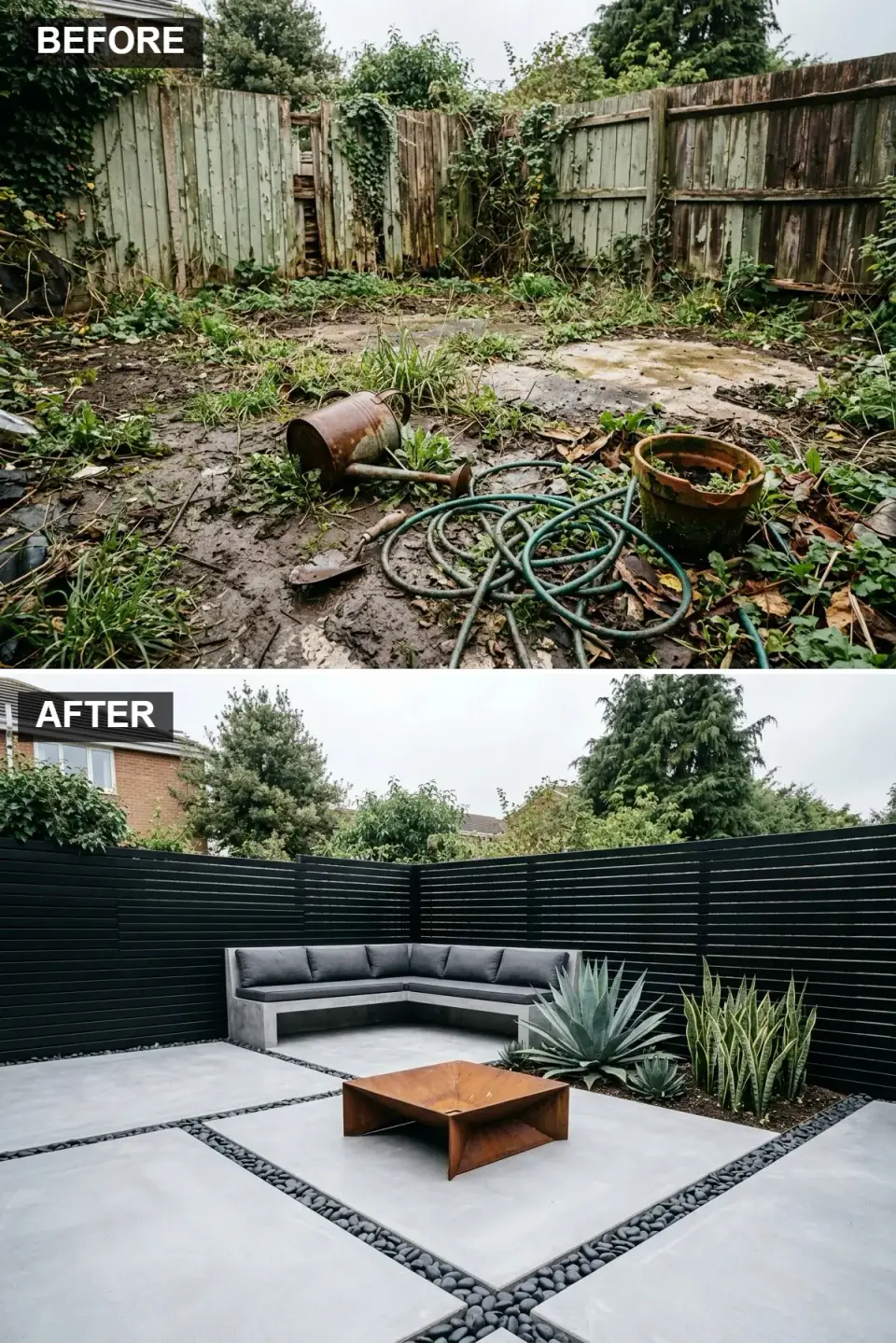
The most graphic and committed direction on the list, and the one I'd choose last for a family with children or frequent guests. Matte-black fencing is beautiful and thermally aggressive — surface temperatures on black wood in July afternoon sun reach 150°F and will stress the underlying material faster than any other color. Specify aluminum-clad wood or a powder-coated metal slat system instead of painted wood to avoid a five-year repaint cycle. Built-in concrete bench seating is a lasting commitment — once cast, it's not moving — and that permanence reads as intentional design only if the layout is right the first time. A corten steel fire pit is a strong feature piece at $1,800–$4,500. Agave and snake plants are the climate caveat: agaves can handle our summer but winter-kill in a hard freeze below 20°F; snake plants are interior plants and must come inside from November through March. Substitute yucca (native, hardy, same silhouette) and sotol for the same architectural texture with real Lowcountry hardiness.
Color Palette
Matte Black
#1A1A1A
Powder-coated metal slats or aluminum-clad wood. Avoid painted solid wood — 5-year repaint cycle.
& Pavers Light Grey Concrete
#BDBDBD
Cast-in-place concrete, sealed with a breathable penetrating sealer.
Corten Steel
#A35E33
Weathering steel, gas insert. Rust bleed onto pavers stabilizes after 12–18 months.
Black Polished Stones
#292929
Polished Mexican beach pebbles or black river stones, 1.5–3 inch size for scale.
Styling Notes for This Look
- Black surfaces in Southeast afternoon sun reach 150°F. Specify aluminum-clad wood or metal slats, not painted solid wood.
- Substitute yucca and sotol for snake plant and tender agave. Same architectural silhouette, real zone 8b hardiness.
- Built-in concrete bench seating is permanent. Mock up the layout with cardboard or plywood for a full weekend before the pour.
Pro Tips from the Field
- Solve drainage before you design. The single most common reason backyard transformations fail in their second year is unresolved drainage. Before any paving, seating, or planting goes in, make sure water has somewhere to go during a Southeast summer thunderstorm. A $2,500 French drain at the design stage beats a $12,000 retrofit.
- Zone your yard like an interior floor plan. A 600 sq ft backyard with one seating zone reads as a patio; the same 600 sq ft with three distinct zones (lounge, dining, planting) reads as a series of rooms. Level changes, flooring changes, and planted dividers all do the zoning work without walls.
- Outdoor lighting is the highest-ROI upgrade in this category. Budget 10–15% of the total project cost for lighting: warm-white LED string lights, up-lighting on signature plants, low pathway lights, and task lighting at any cooking surface. Day-to-night transformation is the ROI nobody talks about.
- Specify climate-appropriate plants, not rendering-appropriate plants. Three of the thirteen directions above include plant lists that fail in zone 8b. Cross-check every plant against the USDA zone map before committing — the rendering doesn't care when the fiddle leaf fig freezes in January.
- Hurricane-anchor every freestanding element. Planters, pergolas, umbrellas, pots over 18 inches, fire pits. Category 1 winds move anything not physically secured. A $40 ground anchor set costs less than one replaced planter.
- Plan irrigation before plants go in. Drip irrigation at the original build costs $1,800–$4,500 depending on yard size; retrofitting after plantings are established costs 2.5x because of access issues. The cheapest time to install it is before the first plant arrives.
- Keep one element from the original yard if you can. The existing oak, a mature hydrangea, a usable concrete pad. Preserving one element gives the renovation a relationship to the lot that a full teardown never achieves — and it shaves real money off the total scope.
Frequently Asked Questions
How much does a full backyard transformation actually cost in the Southeast?
Wide range by direction. A budget-conscious transformation with existing bones (Direction 4 Bohemian, Direction 5 Cottage Garden) lands $8,000–$22,000. A mid-budget hardscape renovation with new paving, fencing, and planting (Directions 1, 6, 12) runs $28,000–$65,000. Full-build directions with custom concrete, outdoor kitchens, or built-in features (Directions 2, 3, 9, 10, 13) are $65,000–$180,000+ depending on finish level. Always get three written bids from licensed landscape contractors before committing.
Which of these directions is the most climate-appropriate for the Charleston / Lowcountry region?
Direction 7 (Potting Area), Direction 8 (Modern Geometric), Direction 10 (Outdoor Kitchen), and Direction 12 (Rustic Fire Pit) are the four that hold up best in the Lowcountry across material longevity and plant list. Direction 6 (Zen Sanctuary) works beautifully if the client is willing to accept the gravel-raking maintenance. Direction 11 (Japanese Zen Garden) requires more active care than most clients are ready for.
Can these transformations be done in stages, or does it have to be all at once?
Most can be staged, with one caveat: drainage and any built-in structural elements (concrete benches, pergola footings, outdoor kitchen gas lines) should be done first. Staging in order: drainage → hardscape → fencing → built-ins → planting → furniture → lighting. Clients staging over 2–3 seasons save roughly 15–25% versus all-at-once execution because they can self-project-manage labor across seasons.
How long does a backyard transformation take from start to finish?
Smaller directions (budget boho, cottage garden) are 2–5 weeks of work. Mid-scope hardscape projects are 6–12 weeks including permitting. Full-build projects with outdoor kitchens, pergolas, and custom concrete run 12–22 weeks. Always add 3–6 weeks to the contractor's first quote for Southeast permitting, HOA approvals, and weather delays.
Do I need a landscape architect or is a good landscape contractor enough?
For paint-and-plant directions, a landscape contractor plus a stylist consultation is enough. For directions involving structural elements (built-in benches, outdoor kitchens, fire features, drainage work), bring in a licensed landscape architect or at minimum a civil engineer for the drainage plan. Design fees for a licensed landscape architect on a residential project typically run $3,500–$12,000 — often the best-spent dollars in the whole project.
How do I handle Southeast summer humidity in material selection?
Specify mildew-resistant stucco additives, pressure-treated or heat-treated lumber for any ground-contact framing, marine-grade stainless or HDPE for outdoor cabinetry, breathable sealers on concrete, and clumping (not running) bamboo if bamboo is in the plant list. The standard residential material spec that works in drier climates fails faster in our humidity; the regional material adjustment is roughly a 10–18% premium and pays back within five years.
How much does landscaping add to a home's market value?
Per NAHB and Remodeling Magazine data, a well-executed backyard transformation in Charleston, Savannah, and similar Southeastern markets returns roughly 68–78% of project cost at resale — competitive with mid-range interior renovations. More importantly, the daily-use value over the ten-plus years the clients typically live in the home usually exceeds the eventual resale premium.
Sources & Further Reading
- Remodeling Magazine, 2024 Cost vs. Value Report — South Atlantic regional figures for outdoor kitchen, deck, and hardscape ROI.
- USDA Plant Hardiness Zone Map (2023 update) — zone 8b/9a specifications for Lowcountry and coastal plant selection.
- NAHB Economics, What Home Buyers Really Want, 2024 Edition — survey data on outdoor-living priorities and Southeast buyer preferences.
- Clemson Cooperative Extension, South Carolina Home Landscape Plant Guide — climate-appropriate residential plant selection.
- International Residential Code (IRC) 2021 — Sections R324 (coastal wind anchoring), R701 (wood framing exterior), and G2422 (outdoor gas appliances) for hurricane-zone and gas-feature compliance.
- ASHRAE Handbook — HVAC Applications, residential outdoor systems chapter, for outdoor-kitchen ventilation guidance.
- Western Red Cedar Lumber Association — species guidance on fencing, decking, and rainscreen assemblies in humid climates.
- Author's consulting notes, Lowcountry and Carolina backyard transformation projects, 2019–2026.
Final Thoughts
Thirteen directions for one backyard is intentionally more than any single client will seriously consider — and that's the point of the exercise. The renderings force an honest conversation about what you actually want to do outside: cook? gather around fire? garden? meditate? Once that question is answered, most of the thirteen directions fall away as obvious non-starters and the real decision narrows to two or three. For the Mount Pleasant couple whose backyard was the starting point for this study, the answer ended up being a hybrid of Directions 7 and 12 — corten steel raised beds from the potting plan paired with the stone fire pit and teak seating from the rustic lounge — with a real drainage plan installed before a single paver went down. They chose against the outdoor kitchen (would not use it enough), against the Japanese zen garden (maintenance), and against the industrial concrete bar (too permanent for two people who change their minds). It was the hybrid, not any single rendering, that survived the decision process.
Two companion pieces are worth reading alongside this one. My ultimate backyard makeover guide covering 12 ways to transform a neglected space approaches the same question from a different starting lot and works through the planning sequence more rigorously. The eleven neglected-yard before-and-after transformations piece walks a similar exercise on a different base condition. For a finished and lived-in version of the patio-focused direction, our patio transformation from backyard black hole to luminous living space is the useful reference. And if the urban-small-lot variant is closer to your situation, the urban garden transformation piece works through the same decision logic on a genuinely tight site.
— Johan Martez, Charleston, SC

Elise Marchetti
Transformations Editor · Charleston, South CarolinaBefore-and-after projects with the invoices attached. Elise runs the Transformations desk — interiors, exterior facades and outdoor spaces across the Lowcountry and the wider South — and writes up what actually changed, what it cost, and which three decisions moved the room.
More from Elise →
Reader notes