


The first lesson of outdoor living in the Lowcountry is that the South does not have an "outdoor season." It has nine months of usable porch time and three months of "drag the cushions inside before the squall." The second lesson is that an outdoor room either earns its keep year-round or becomes the most expensive storage area on the property. Every space below was designed around that test: a place to actually live, not a styled photograph that survives one cocktail party and then sits empty.
The nine outdoor rooms below are design concepts for the household that says "we want to use this space." Each one is built around a specific use (morning coffee on a balcony, lunch under a pergola, an actual outdoor kitchen, a Zen meditation court) with real material specs and realistic cost ranges for 2026.
A note on the numbers: the ranges below cover the furniture and the architectural shell. They do not include landscaping, drainage, lighting design fees, or the soft-costs of permits. In Charleston, Savannah, Naples, and any historic-district market, add 15-25% to the hardscape lines for permitting and review.
1. Modern Balcony Lounge with City Views
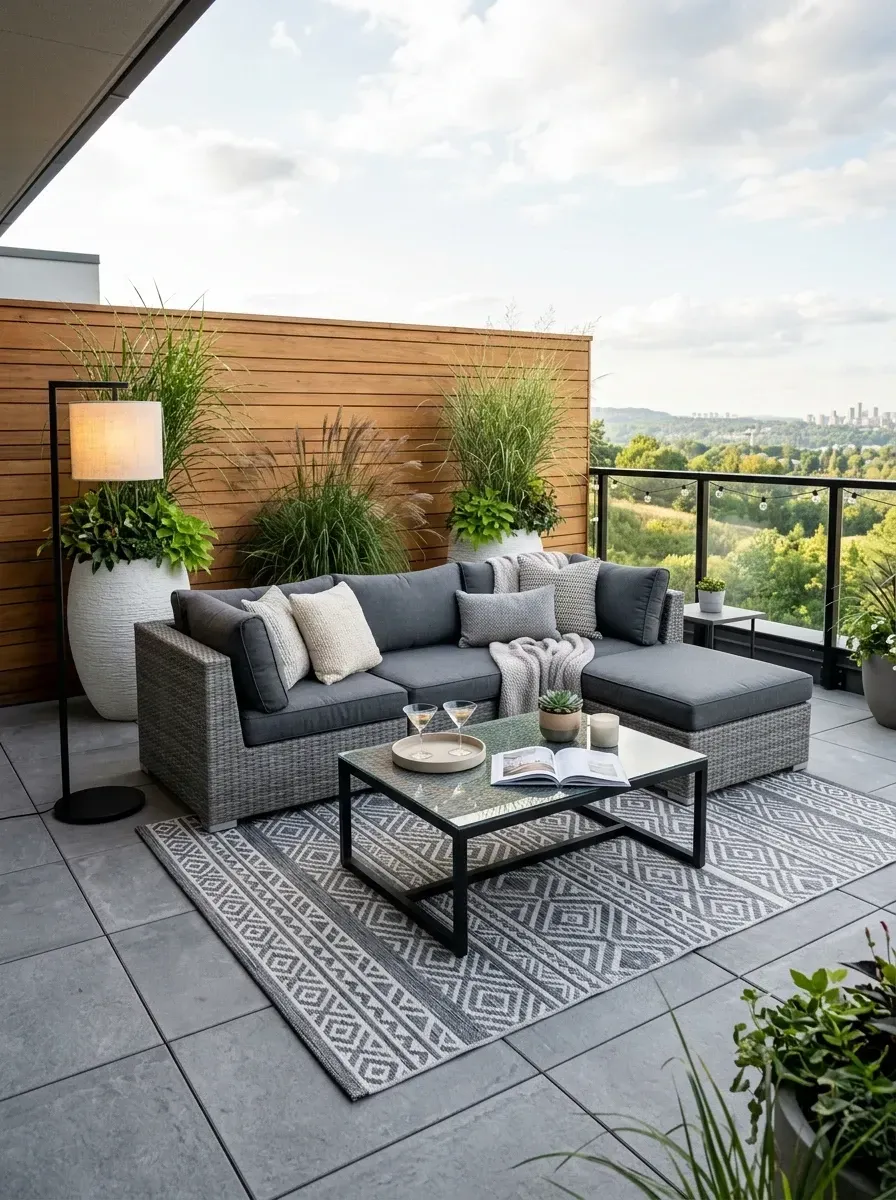
A Charlotte high-rise scenario (22nd floor, south-facing, 9-by-22 balcony) calls for a room that reads as an extension of the living room rather than a leftover slab. The move is to ignore that it is a balcony and design it like a room. Sectional is the Article Corvos U-Sectional in Charcoal Polywood Wicker ($3,499). Cushions are upgraded to Sunbrella Cast Charcoal performance weave; Article will swap the standard fill for an extra $400 and it's worth every dollar in Charlotte's afternoon thunderstorms. Coffee table is the CB2 Smart Round Glass & Black Iron 36" ($499). Rug is the Loloi II Tahari Geometric Indoor/Outdoor 8x10 in Charcoal/Ivory ($358). Privacy wall is a custom horizontal slat run in pressure-treated western red cedar 1x4s on 1/2" gaps, sealed annually with TWP 1500 honey-tone ($3,800 for an 8-foot tall, 22-foot long screen, installed). The rendering shows the floor in large grey porcelain pavers; interlocking Bison Innovative IPE Wood Tile over the existing concrete deck is the warmer alternative ($14/sq ft DIY, $22/sq ft installed). Floor lamp is the Sutherland Vivara Aluminum Outdoor Floor Lamp in Black ($1,290).
Color follows the materials here. The horizontal slat wall in Western Red Cedar (#C19A6B) is the only warm surface in the frame, and it screens the neighbors while leaving the long view past the black-framed glass railing open. Underfoot, the big pavers sit in a cool weathered slate grey (the IPE Wood Tile / Slate swatch, #8C8C8C) that stays cooler in afternoon sun than a dark deck would. The wicker sectional carries Sunbrella Cast Charcoal (#4A4A4A) cushions picked to hold their color through a summer of direct south light, while Ivory Linen (#F5F5DC) on the throw pillows, the knit throw and the lamp shade lifts all that charcoal without tipping into stark white. Tall white planters of switchgrass and ornamental bamboo soften the cedar, and the charcoal and ivory geometric rug pulls the seating zone together.
Our 2026 estimate for this balcony runs $14,150–$26,250, and more than half of the top figure goes to two lines that have nothing to do with furniture: Porcelain Paver / IPE Tile Floor at $4,000–$7,500 and the Glass and Aluminum Railing System at $3,500–$6,500, together about 53% of the high end. The floor also has the most room to move, depending on whether porcelain or IPE goes down, so price it before anything else.
The Custom Cedar Slat Privacy Wall adds $2,500–$5,000, and the Outdoor Wicker Sectional with Chaise takes $2,800–$4,500. Everything else is modest by comparison: $400–$800 for the Glass-Top Metal Coffee Table, $200–$450 for the Geometric Outdoor Area Rug, $300–$600 for the Oversized Ceramic Planters (x2), $180–$350 for the Outdoor Floor Lamp, $150–$300 for Performance Pillows & Throw and $120–$250 for the Rectangular Metal Side Table.
Start with the slab, not the catalog. Charlotte high-rise decks max out at 60 psf live load, and a large terracotta pot full of saturated soil passes that quickly, which argues for fiberglass planters along this wall rather than clay. Every cushion should be Sunbrella, Outdura or Crypton Outdoor instead of the generic import "outdoor fabric" sold at big-box stores; the real thing keeps its color and resists mildew through five Charlotte summers, while the generic version fades to grey in eighteen months.
The cedar screen needs an annual coat of TWP 1500 or Sikkens Cetol. Skip a year and it silvers fast, which some owners like and others do not, so settle that question before the boards go up. For the floor, interlocking deck tiles that float over the existing concrete beat building a new substructure: Bison and Wagner both make systems that let water drain underneath and lift off again when you move.
2. Mediterranean Garden Dining Room
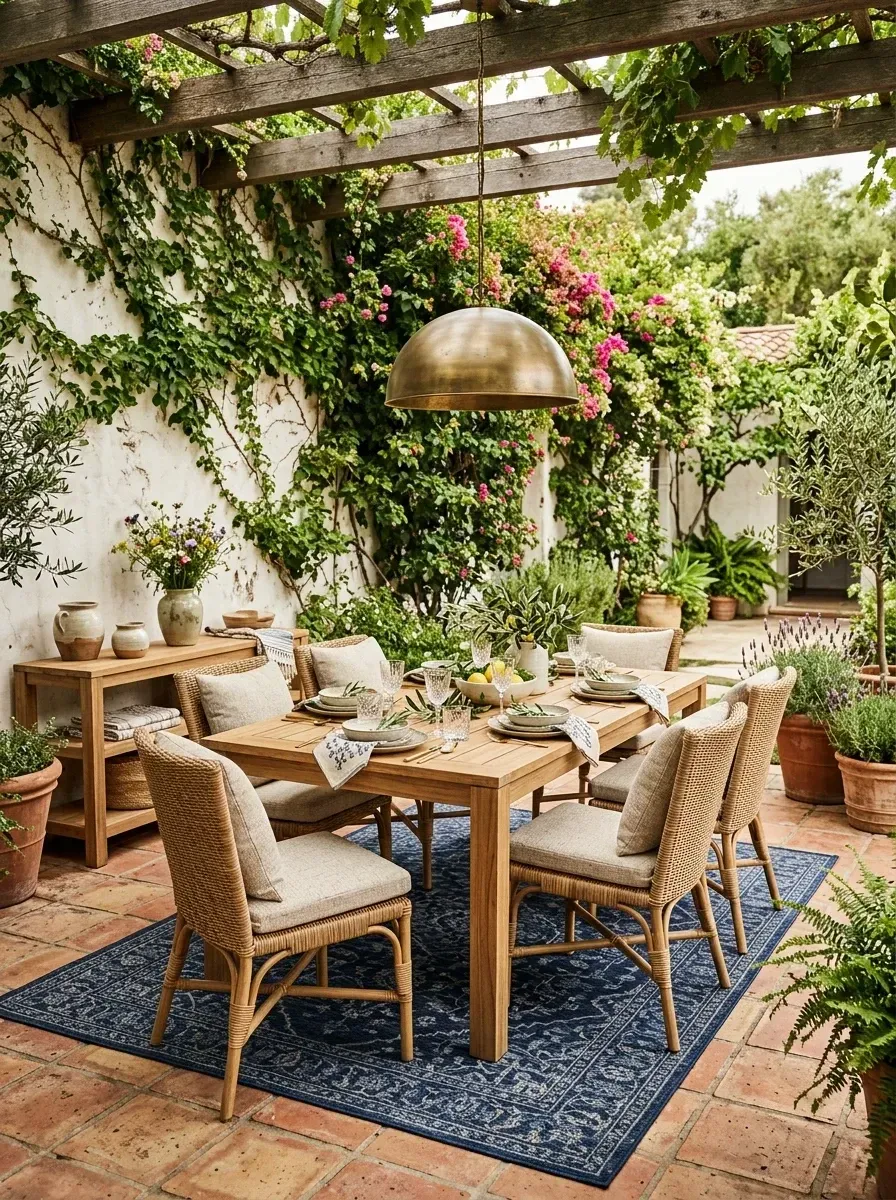
Take an old Naples stucco house with a 16-by-22 garden courtyard and the wish for a dining room outside, used for real, six nights a week, October through May. The pergola is the make-or-break. The concept replaces a builder-grade aluminum kit with a custom western red cedar 6x6 post-and-beam structure (about $7,800 installed by a timber-frame crew) and trains Bougainvillea Barbara Karst from existing planted vines along the rafters. Table is a Sutherland Great Lakes 96" Rectangular Teak Dining Table ($6,900); the price reflects FSC-certified Burmese teak that will outlast the pergola itself. Chairs are eight Brown Jordan Avignon Side Chairs in Reverse Stitch Tan with Sunbrella Canvas Cushions ($1,290 each). Rug is the Lulu & Georgia Aliki Indoor/Outdoor 8x10 in Indigo ($798). Pendant is the Visual Comfort O'Brien Hicks Pendant Large in Antique Brass, rated for damp locations ($1,890). Floor is existing saltillo paver tile, refreshed with Aldon Sealer LX-100 annually.
The palette works from the ground up. Saltillo Terracotta (#E2725B) covers the floor in warm clay pavers that darken with age, and the Whitewash Stucco (#F5F5DC) wall behind the console catches the afternoon light and gives the bougainvillea and climbing vines a pale ground to show against. The table in Sutherland Natural Teak (#C19A6B) sits at the honey end of its range before the sun silvers it, and Indigo Blue (#2A4B7C) arrives in the patterned rug and the napkins, the one cool note against all that clay. Overhead, the weathered pergola beams and the big brass dome pendant define the table as a room, and the woven chairs with canvas cushions keep the setting light.
Priced as a whole, the courtyard comes to $13,800–$27,600. The Custom Cedar Pergola + Vine Training line, at $4,000–$8,000, is both the largest and the least predictable, since timber-frame crews price post-and-beam work very differently, so get that quote first. Terracotta Paver Flooring follows at $3,000–$6,000, and the two together account for about 51% of the high-end figure. The Whitewashed Stucco Wall adds another $2,000–$4,000.
On the furnishing side, the Teak Dining Table is allowed $1,500–$3,000 and the Wicker Dining Chairs with Cushions (x6) $1,800–$3,600, so the seating costs more than the table it serves. The Brass Dome Pendant Light takes $400–$800, the Outdoor Indigo Rug $300–$600, the Wooden Console Table $600–$1,200, and Ceramic Vases & Pottery $200–$400.
Vines are the slow part of this room. Bougainvillea, jasmine or wisteria should be trained onto the rafters from plants already established in the ground, never from cuttings set the same season the pergola goes up, because the roots need a full year before they can carry weight overhead. The table asks for the opposite kind of patience: FSC-certified Burmese or African teak handles year-round exposure, while lower-grade plantation teak from Vietnam and Indonesia tends to check and crack within five Florida summers.
The pendant over this table hangs under an open pergola, so it has to be damp-rated. Visual Comfort and Hubbardton Forge both make suitable fixtures, and an indoor pendant can short out in its first humid season from thunderstorm mist alone. The saltillo also needs a yearly coat of Aldon LX-100 or Stonehenge SLX, since unsealed clay soaks up spilled wine, cooking oil and pet stains for good.
3. English Cottage Garden Nook
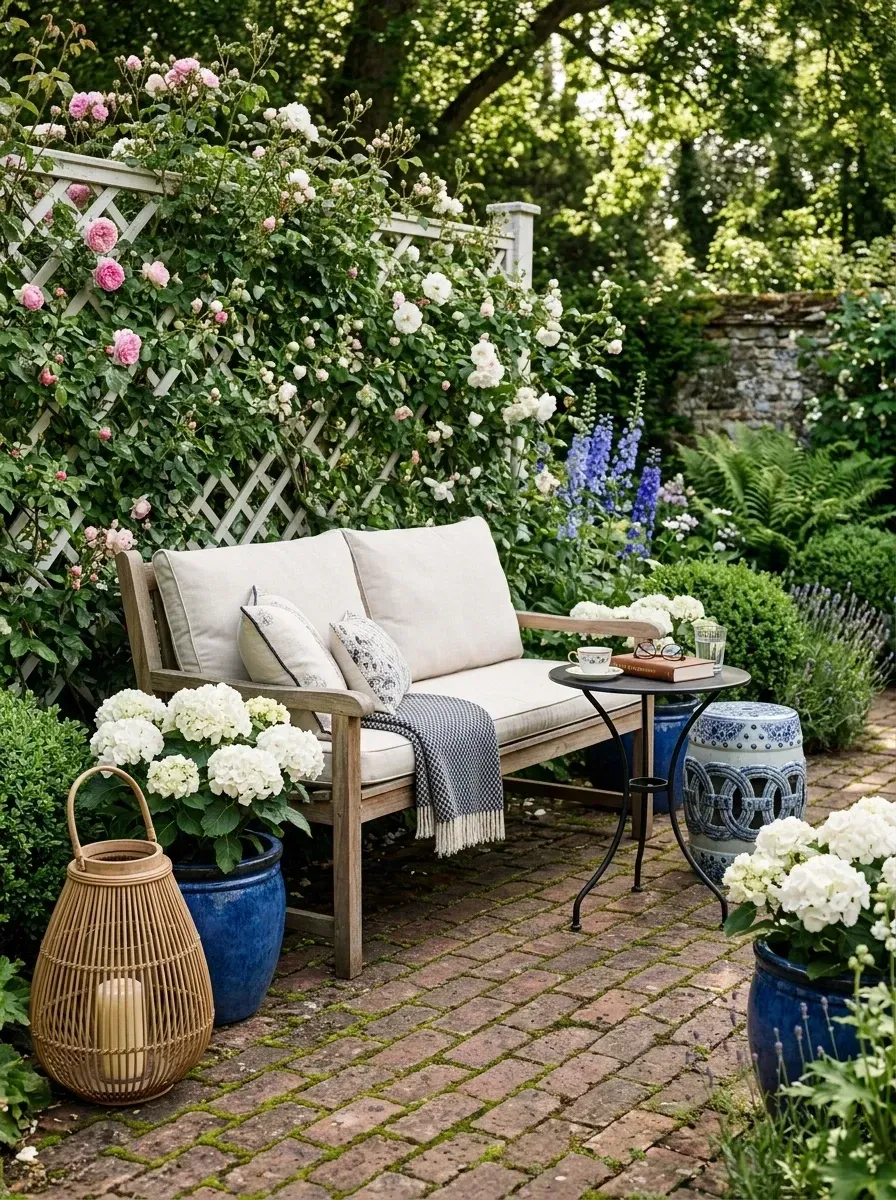
A Charleston single-house garden that has been hedged into oblivion: the concept clears the boxwood, keeps the antique brick path, and builds a real seating moment in what has become a forgotten corner. Bench is the Crate & Barrel Regatta Teak 60" Bench ($899), worth choosing in the same Burmese teak as the deck so the silvering matches. Cushion is custom-made in Sunbrella Canvas Antique Beige by a local upholsterer ($340). Trellis is built from pressure-treated 1x2 cedar lattice, painted Benjamin Moore Simply White OC-117 in two coats of exterior eggshell, trained with Eden's Climbing Rose from David Austin Roses ($79 per bare-root cane). Cobalt planters are Anduze antique-reproduction French olive jars in cobalt-glaze ceramic ($349 each from Detroit Garden Works). The drum stool is the Pottery Barn Ceramic Drum Side Table in Cobalt ($249). Iron bistro table is the Anthropologie Wrought Iron Lemon Round 22" ($178). Brick pavers are existing antique Charleston commons brick, re-seated with sand-set joints that allow moss to fill naturally.
Underfoot is the oldest material on the site, Charleston Commons Brick (#A0522D) with moss filling the joints, the kind of patina a garden path picks up over 125+ years. The bench reads as Silvered Teak (#8B7D6B), left untreated through three Lowcountry summers, and its linen-colored cushion and the white lattice behind it share BM Simply White (#FAF0E6), which keeps the corner bright under heavy shade. Anduze Cobalt (#0047AB) is the one strong color: glazed planters of white hydrangeas on either side of the bench, with the blue and white patterned garden stool repeating it next to a small black iron bistro table. Pink and white climbing roses cover the trellis, and a wicker hurricane lantern by the path handles the evening.
At $3,890–$7,730 in 2026 prices, the nook is the least expensive room in this guide, and most of the money goes into the ground. The Antique Brick Paver Patio carries $2,000–$4,000 and the Teak Garden Bench with Cushion $800–$1,500, together about 71% of the high-end total. Reclaimed brick prices depend on what salvage stock is available, so the patio is the quote to pin down before buying anything smaller.
The planting and accessories cost little by comparison. The Large Cobalt Ceramic Planters (x2) run $300–$600, the Cobalt Ceramic Drum Stool $150–$300, the Round Iron Side Table $100–$250 and the Wicker Hurricane Lantern $40–$80. The White-Painted Lattice Trellis is allowed $400–$800, and Throw Pillows & Wool Throw another $100–$200.
Roses establish best as bare-root canes planted in late winter, which in zone 8 means January in Charleston. David Austin and Heirloom Roses ship them dormant, and container roses from a nursery cost about twice as much while starting the season no further ahead. For the brick, set the joints in sand rather than mortar so moss can move in; mortar stays tidy but looks suburban, while sand-set joints finished with hand-swept polymeric sand give the old English garden look shown here.
Pick one recurring accent and let it repeat. Here it is cobalt; faded coral or sage would work the same way, but three or more competing accents in a 100-square-foot vignette start to look like a flea market. Leave the teak bench alone as well. The annual teak oil so often recommended traps moisture and speeds up checking, so a gentle pressure wash once a year is enough to let the silver patina develop.
4. Coastal Poolside Retreat
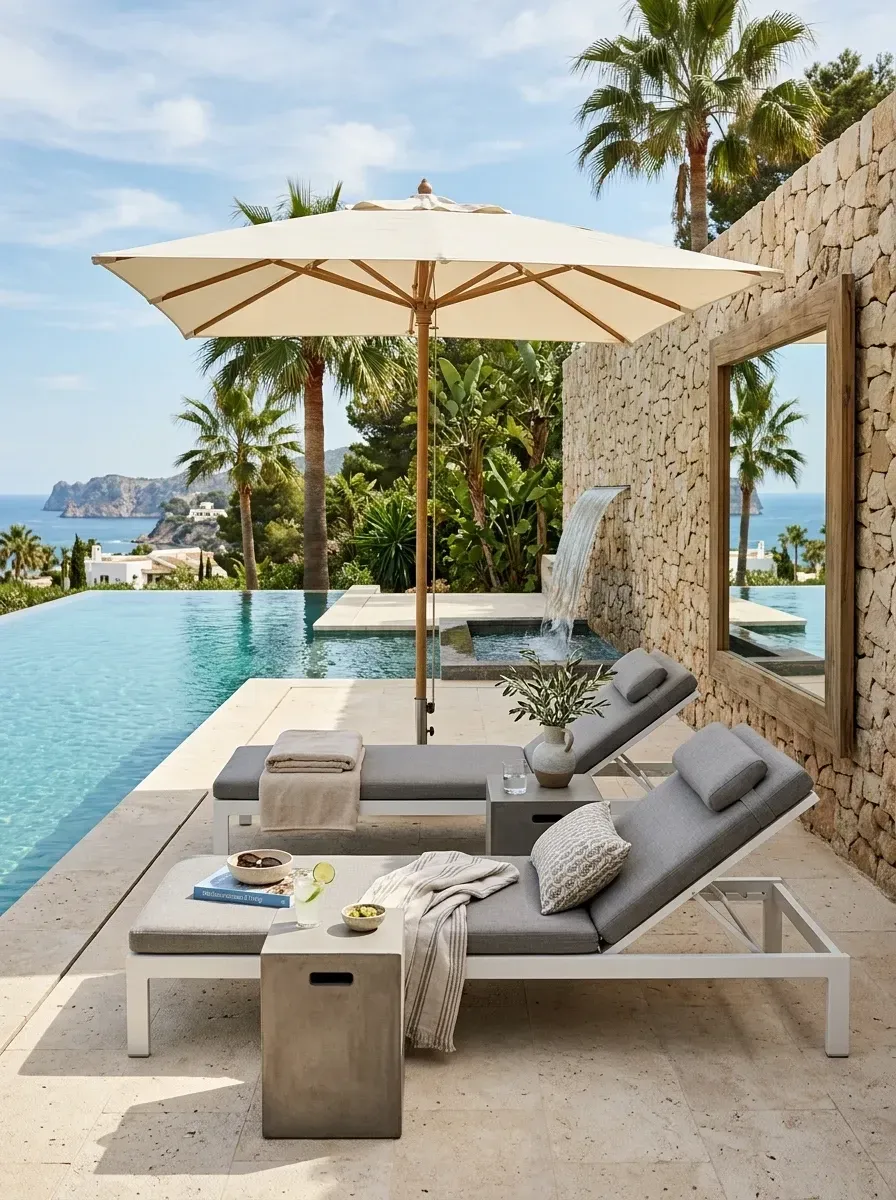
For a Gulf-facing infinity pool of the Naples Park Shore kind, the goal is a poolside that reads as resort rather than family-pool-with-noodles. The hardscape is the given; the work is selecting furniture that could survive both pool chlorine and salt-air corrosion. Chaises are two Sutherland Aluminum Vivara Chaise Lounges in High Gloss White with Sunbrella Canvas Cushions ($3,290 each). Side tables are RH Aviara Cast Concrete Square 18" ($395 each). The rendering shows a simple center-pole market umbrella with a hardwood pole; for a permanent installation the concept upgrades to the Tuuci Ocean Master Mega Max Single Cantilever with FSC-certified Cumaru pole ($4,890). Within five miles of saltwater, check that any cantilever umbrella has a hub and hardware rated for salt air, which is what Tuuci builds for. Deck is large-format Anatolian Travertine 24x24 unfilled and brushed with French pattern ($26/sq ft installed). Stone accent wall is Eldorado Stone Sequoia Cliffstone veneer with a large rectangular mirror inset, about 60 inches tall in a weathered wood frame, that repeats the palms and the sea; the mirror is tempered glass with marine-grade backing. The waterfall feature is a 2-foot sheer-descent spillway from Aquatic Source ($2,400 plus pump install).
Two pale stones do most of the work. The deck is Anatolian Travertine (#E8DCC4), unfilled and brushed so it stays cool underfoot in full Florida sun and slowly deepens to a richer cream, while the rough stacked wall beside the spa is Sequoia Limestone Veneer (#D6C6B0), a shade darker and far more textured. Against them, the chaise frames in High-Gloss White Aluminum (#FFFFFF) draw a crisp outline, and the cushions in Sunbrella Slate Grey (#708090) are the darkest note in the picture, a fabric chosen because it shrugs off chlorine, salt and full sun. Cast concrete cubes between the chaises hold a book and a drink, striped cotton towels soften the loungers, and the spillway pours into the raised spa to give the corner its sound.
The poolside retreat is priced at $25,550–$48,600 for 2026, and nearly everything depends on the wall. The Natural Stone Wall + Mirror Inset alone is budgeted at $12,000–$22,000, the widest spread in the estimate, so the mason's quote comes first; Travertine Deck Paving adds $6,000–$12,000, and those two lines make up about 70% of the high end. The Sheer-Descent Waterfall Feature is the third large item at $4,000–$8,000.
The furniture is a small share of the total. Powder-Coated Aluminum Chaises (x2) are allowed $2,500–$4,500, Cast Concrete Side Tables (x2) $500–$1,000, the Market Umbrella with Hardwood Pole seen in the rendering $400–$800, and Poolside Towels & Accessories $150–$300. The cantilever upgrade described above sits outside these lines.
Salt air sets the rules for metal. Within five miles of the coast, every metal part should be powder-coated marine-grade aluminum or 316 stainless steel; plain steel rusts in a single Gulf-coast season, and even powder-coated mild steel corrodes at the welds. The deck follows the same logic. Filled travertine looks perfect the day it arrives, then the fill starts popping out under bare feet and pool traffic, while unfilled stone keeps its natural texture and ages honestly.
The mirror in the stone wall needs marine-grade backing, because an ordinary bathroom mirror will mottle and oxidize within two years of coastal humidity. Umbrella placement deserves a look at different times of day: set it by the actual sun arc over the chaises, not by how the scene photographs, since moving an anchored cantilever base after installation is a $400 mistake.
5. Classic Coastal Front Porch
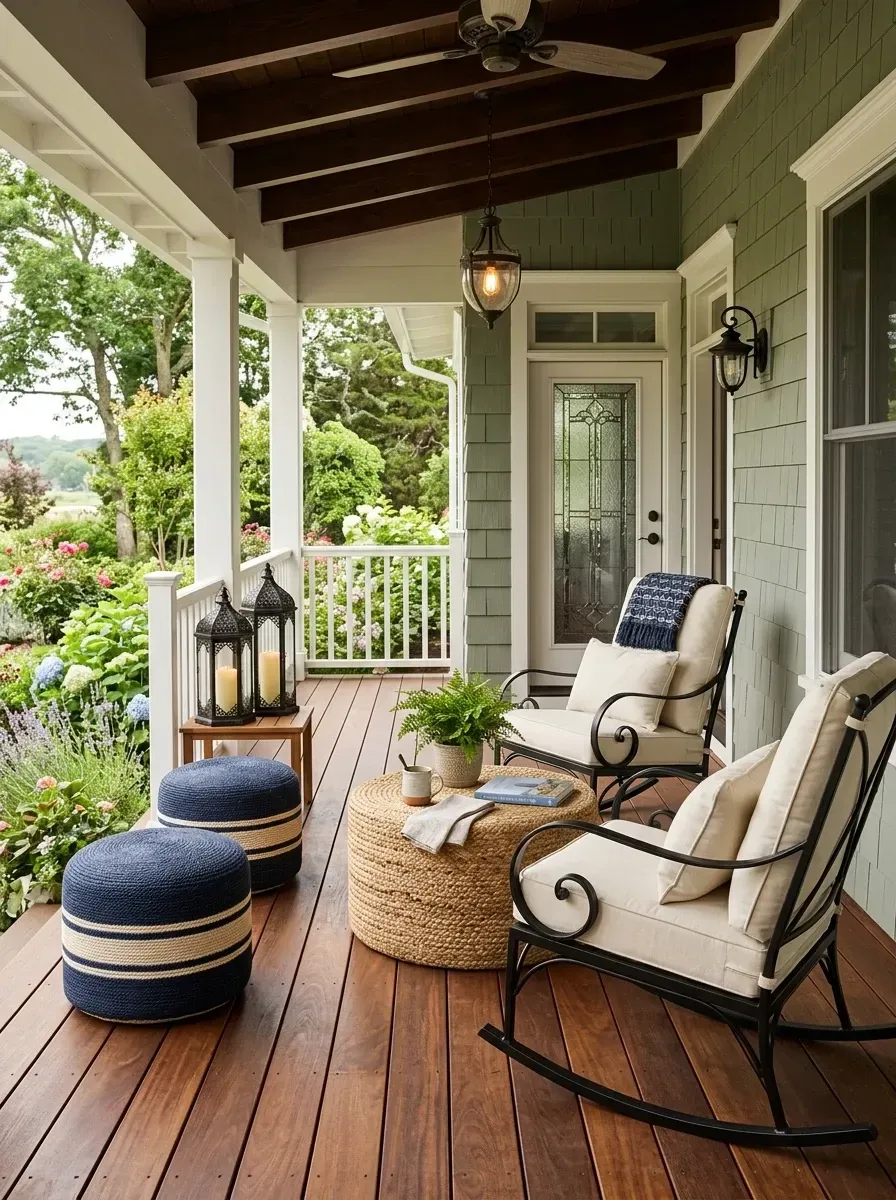
A Beaufort, South Carolina renovation concept: a 1920s tabby-foundation cottage with a 28-foot front porch that was screened in (badly) in the 1980s. The concept pulls the screens, restores the original cedar shake siding, and treats the porch as a real outdoor living room. Siding goes to Sherwin-Williams Evergreen Fog SW 9130 on the cedar shakes (specified in SW Emerald Exterior Acrylic Latex satin for the salt-air durability). Trim and railings are SW Pure White SW 7005 in semi-gloss. Floor is tongue-and-groove mahogany decking, refinished in Sikkens Cetol Mahogany 1 Plus ($14/sq ft sand-and-recoat). The rendering shows black wrought-iron rockers with scrolled arms; the lower-maintenance alternative is the Polywood Jefferson Rocking Chair in Black ($429 each). Either way, the seats take Sunbrella Canvas Cream cushions in custom ties ($240 per chair). Round coffee table is the Pottery Barn Adams Woven Rope 36" ($699). Poufs are the Serena & Lily Riviera Striped Outdoor Pouf in Navy/Cream ($248 each). Wooden side table is a vintage Charleston cypress crate sourced at a local architectural salvage yard, refinished ($120). Ceiling fan is the Hunter Brunswick 52" Outdoor Damp-Rated in Matte Black with Cane blades ($349). Pendant lantern is the Schoolhouse Princeton Outdoor Pendant in Black ($389).
The shingles set the tone. SW Evergreen Fog SW 9130 (#9CAE7F) on the cedar shakes is a muted sage that lets the house sit back into the live oaks and marsh greenery, with crisp white trim, columns and railings framing it. Underfoot, Sikkens Mahogany (#6E3C22) on the refinished tongue-and-groove boards gives the porch its warmth, picked up again by the dark stained ceiling beams. The black of the iron rockers and the two lanterns matches the Polywood Black swatch (#2C2C2C) the HDPE alternative comes in, and Sunbrella Canvas Cream (#FDF5E6) on the seat cushions and pillows softens those frames and bounces light back under the roof. Between them sit a woven rope coffee table and a pair of navy and cream striped poufs, with a glass pendant lantern and a damp-rated ceiling fan overhead.
The porch estimate totals $11,650–$21,100. Carpentry leads: Porch Columns and Railings at $4,000–$7,000, the widest range here and the first quote worth getting, and Stained Tongue-and-Groove Decking at $3,000–$5,500, roughly 59% of the high end between them. Repainting the shakes and trim (Exterior Sage Paint + White Trim) adds $2,500–$4,500.
Furnishing the porch is comparatively light. The Wrought Iron / Polywood Rockers (x2) take $1,000–$2,000, the Woven Rope Coffee Table $300–$600, the Striped Outdoor Poufs (x2) $200–$400 and the Metal Lanterns + Wooden Side Table $150–$300. Overhead, the Outdoor Ceiling Fan is allowed $200–$400 and the Hanging Pendant Light $150–$300, with Pillows, Throw & Decor at another $150–$300.
The rockers decide how much upkeep the porch needs. Wrought iron, as drawn, gives the scrolled silhouette but wants touch-up paint in salt air. Polywood is the practical call for a busy Lowcountry porch, because recycled HDPE holds its color in direct sun, never splinters and comes through hurricane-grade rain without warping; a wood rocker is the romantic choice, but a Polywood one will likely still be in service in 2040. The shakes need a premium coating within five miles of saltwater, either Sherwin-Williams Emerald Exterior or Benjamin Moore Aura Exterior, since standard exterior paint chalks and fades within three Gulf or Atlantic seasons.
Hang the fan at least 9 feet above the floor and 18 inches below the ceiling; any lower and it cools less and becomes a head-strike hazard for tall guests. The mahogany boards want a fresh coat of Sikkens Cetol Mahogany 1 Plus every 24-30 months. Missing a cycle lets them gray unevenly, and the sand-and-recoat that fixes it costs three times what regular maintenance would have.
6. Tuscan Courtyard with Stone Fountain
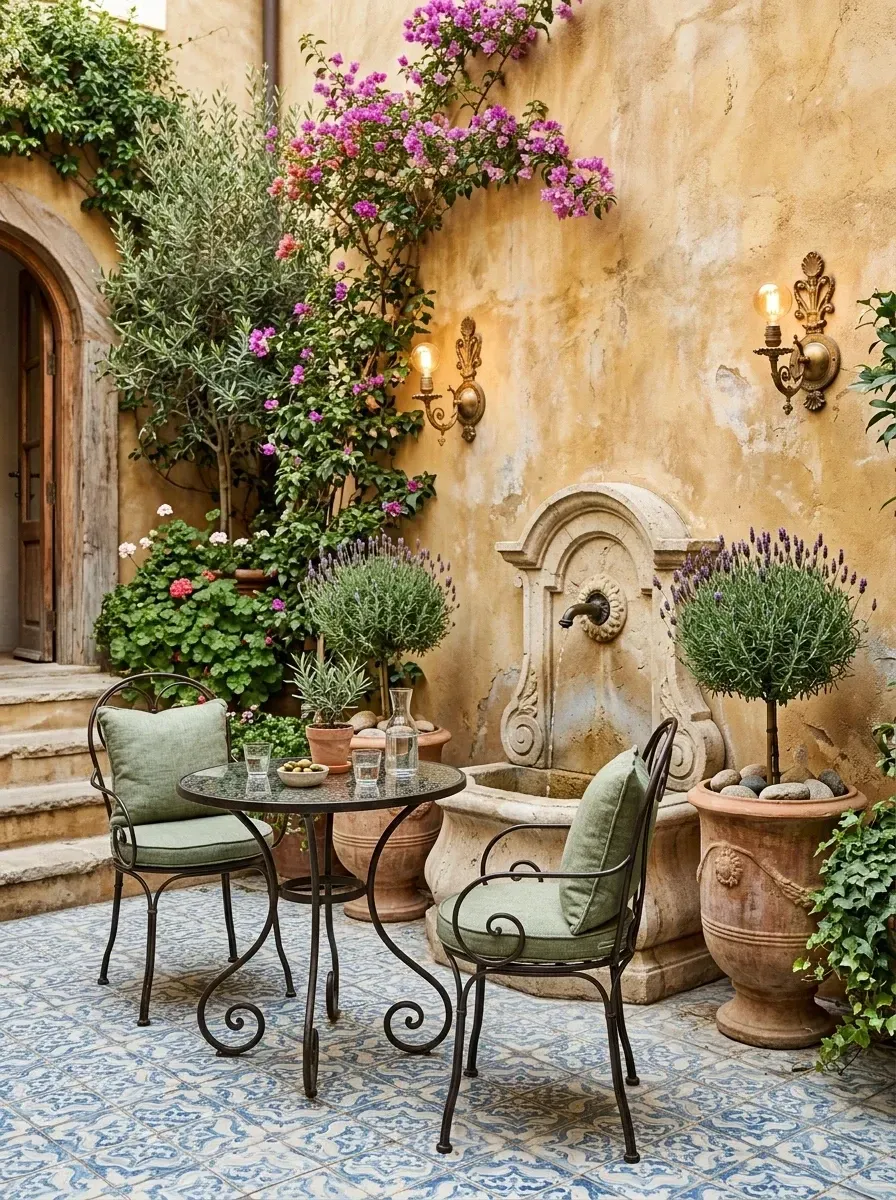
This concept is a courtyard that reads as if it had been transplanted from a Tuscan hill town: moss, patina, the cooling sound of water. Stucco walls go to Parex USA hand-troweled stucco over rigid foam board, finished in a custom ochre tint in the spirit of Pienza. Fountain is a Campania International Tuscany Wall Fountain Large in cast limestone with antique patina finish ($3,890), plumbed to a 1/4 HP submersible pump in a hidden basin. Pavers are Portuguese hand-painted azulejo tiles sourced through a specialist tile importer ($26/sq ft installed). Bistro set is the Smith & Hawken Tuscan Wrought Iron 3-Piece in Aged Black with custom green Sunbrella cushions ($890). Terracotta planters are Italian Impruneta jars from a garden pottery importer ($580 each for 24-inch), planted in the rendering with lavender standards top-dressed with river stones; clipped boxwood spirals from Wilson Bros Gardens are the evergreen alternative. Sconces are Vaughan Designs Tudor Brass Outdoor Wall Lantern ($890 each); the rendering shows ornate brass sconces with bare bulbs in the same spirit.
The walls carry this room. Custom Tuscan Ochre Stucco (#D4A76A) is hand-troweled with deliberate irregularity, patched and water-stained the way 200-year walls in a hill town look, and bougainvillea spills down one side of it. Underfoot, Portuguese Azulejo Blue (#5B7C99) runs through the hand-painted tile in a blue and white pattern, the only cool surface in the courtyard. The bistro set in Aged Wrought Iron (#2F2F2F) draws its scrolls against both, chosen for patina rather than a fresh powder coat, with sage green cushions on the chairs. Carved Limestone (#E5E1D0) ties it together in the wall fountain and the worn steps by the arched door, while two big terracotta jars flank the basin under the lit brass sconces.
The courtyard is estimated at $10,500–$21,000. Two pieces carry it: the Carved Stone Wall Fountain at $3,500–$7,000 and Hand-Painted Tile Flooring at $3,000–$6,000, about 62% of the top figure. The fountain has the widest range, since carving quality, size and the hidden basin all vary, so it is the first supplier conversation to have. The Aged Stucco Wall Finish takes $2,500–$5,000 on top.
The furnishings are a smaller share. The Wrought Iron Bistro Table is allowed $400–$800 and the Wrought Iron Bistro Chairs (x2) $600–$1,200, while Large Terracotta Planters (x2) come to $200–$400 and Ornate Brass Wall Sconces (x2) $300–$600. Those planter and sconce lines assume reproduction pieces rather than the imported jars and lanterns named above.
Insist on hand-troweled stucco rather than spray-applied. The irregular hand finish is what separates a Tuscan wall from a tract-house wall: a specialist crew costs roughly $14-$18/sq ft installed, while spray application at $4-$7 reads flat up close. The fountain should run off a hidden basin with a circulating pump instead of a free-flowing supply line, recycling the same 20-30 gallons, cutting out evaporation refills and letting it run untended for weeks.
The rendering plants the terracotta jars with lavender standards. If you prefer the clipped boxwood spirals named in the specification, train them yourself from young hedge plants over three years: pre-shaped spirals from a Georgia nursery run $400-$700 each, while young plants cost $40-$80 apiece and look much the same by the 3-year mark. Mount the sconces 64-72 inches above the paving so their light falls on the fountain rather than into guests' eyes; set higher, they start to look like commercial path lighting.
7. Bohemian Garden Bedroom Retreat
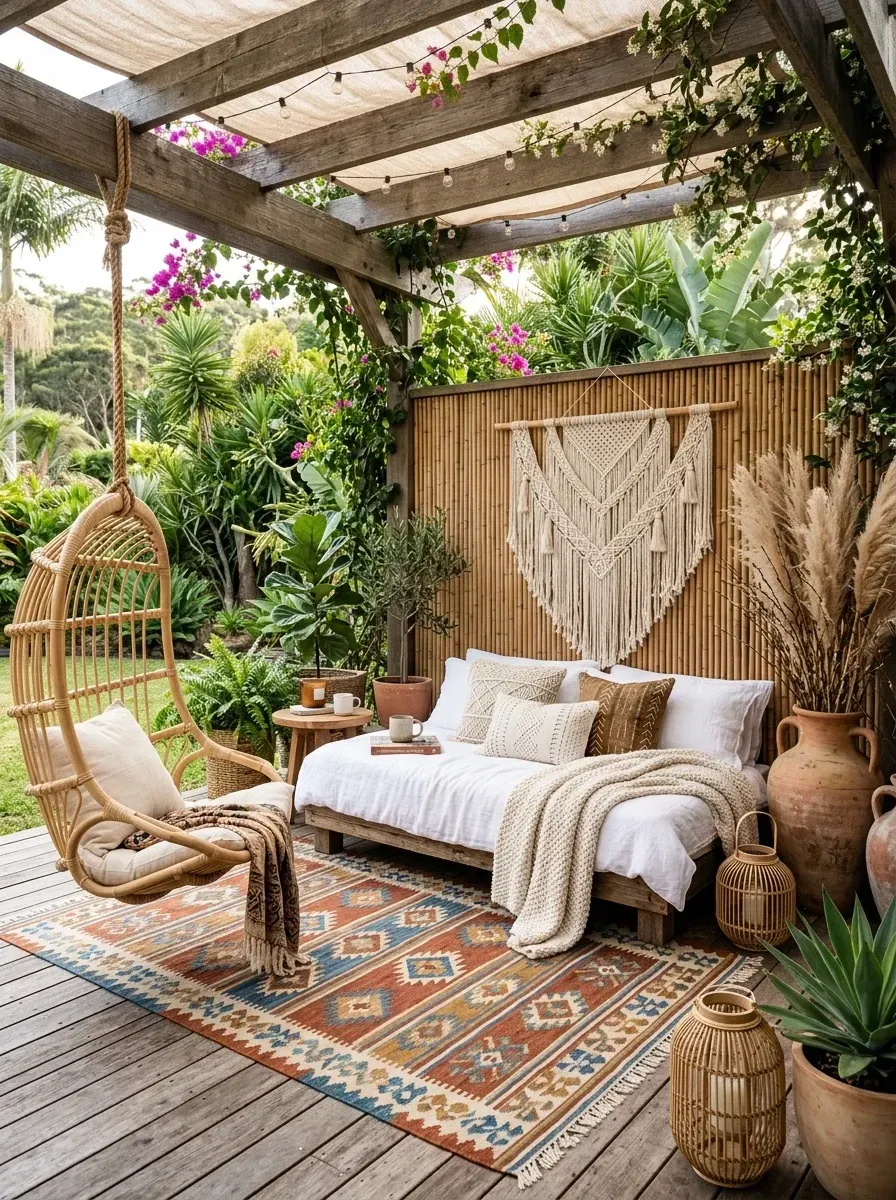
For a guest cottage on a Savannah back garden lot, this concept is an outdoor sleeping room (a real bed, real linens, real intention) for guests who want the romance of a Savannah night porch but with the convenience of a private retreat. Pergola is built from cypress 6x6 posts and 2x10 rafters by a timber crew (about $5,200 installed) with a Sunbrella canvas canopy on a retractable track for rain and full sun protection. Daybed is the Sungod Premium Outdoor Daybed in solid acacia ($1,890), dressed in Brooklinen Linen Coverlet in Bone (Brooklinen is happy to ship the linen-only set without the sheet stack) and a Garnet Hill Outdoor Pillow Collection in mixed kilim patterns ($580). Swing chair is the Serena & Lily Hanging Rattan Chair in Natural ($998). The rug is a vintage flat-woven kilim 8x10 in rust, blue and cream, sourced from Salam Hello ($2,400). Bamboo privacy screen is the Forever Bamboo Pacific Reed 6x8 panel installed on metal posts ($420 per panel, three panels). Lighting is Brightech Ambient Pro Plus G40 commercial-grade string lights, 96-foot run ($249).
Weathered decking in Silvered Cypress (#9E9E88) gives a cool grey floor under the daybed, and the reed fence behind it in Pacific Bamboo (#D2B48C) filters the light and closes the room without becoming a solid wall; a large macrame hanging on the bamboo works as the headboard. Warmth comes from Vintage Kilim Rust (#C1785C), which runs through the flat-woven rug and a couple of the pillows and connects to the terracotta urns beside the bed. The bedding stays in Brooklinen Linen Bone (#FFF8E7), as do the chunky knit throw and the cushion in the hanging rattan chair, so the layered textiles never get heavy. String lights along the pergola beams and woven lanterns on the deck take over in the evening.
Our 2026 estimate for the garden bedroom is $7,250–$14,650, and the structure takes most of it. The Custom Wood Pergola with Canopy is budgeted at $3,500–$7,000, the widest range in the list and the quote to settle first, and the Bamboo Reed Privacy Screen Wall at $1,500–$3,000; together they come to about 68% of the high-end figure.
The sleeping and lounging pieces come next. Wooden Daybed Frame + Mattress + Bedding is allowed $1,200–$2,500, the Rattan Hanging Swing Chair $400–$800, and the Patterned Kilim Outdoor Rug $250–$500. The smaller decorative lines are the Small Wooden Side Table at $100–$200, the Macrame Wall Hanging at $100–$250 and Woven Lanterns & Terracotta Vases at $200–$400.
The mattress decides whether this room survives its first year. Use a QuickDry foam outdoor cushion or a Sleep Number Performance Outdoor rather than an indoor mattress, which soaks up humidity within one Savannah summer and grows mildew by the second. Overhead, the retractable Sunbrella canvas canopy is the right compromise: an open pergola drops leaves and bird debris on the bed, while a fixed solid roof traps heat and sends rain runoff where nobody wants it.
For the lights, choose commercial-grade strands with weather-rated G40 bulbs; big-box patio lights are usually rated only for occasional outdoor use and tend to fail after two seasons of real Lowcountry weather. The rug needs similar thought. A wool kilim copes with life under cover but not with direct rain, so keep it at least two feet inside the pergola drip line.
8. High-End Stone Outdoor Kitchen
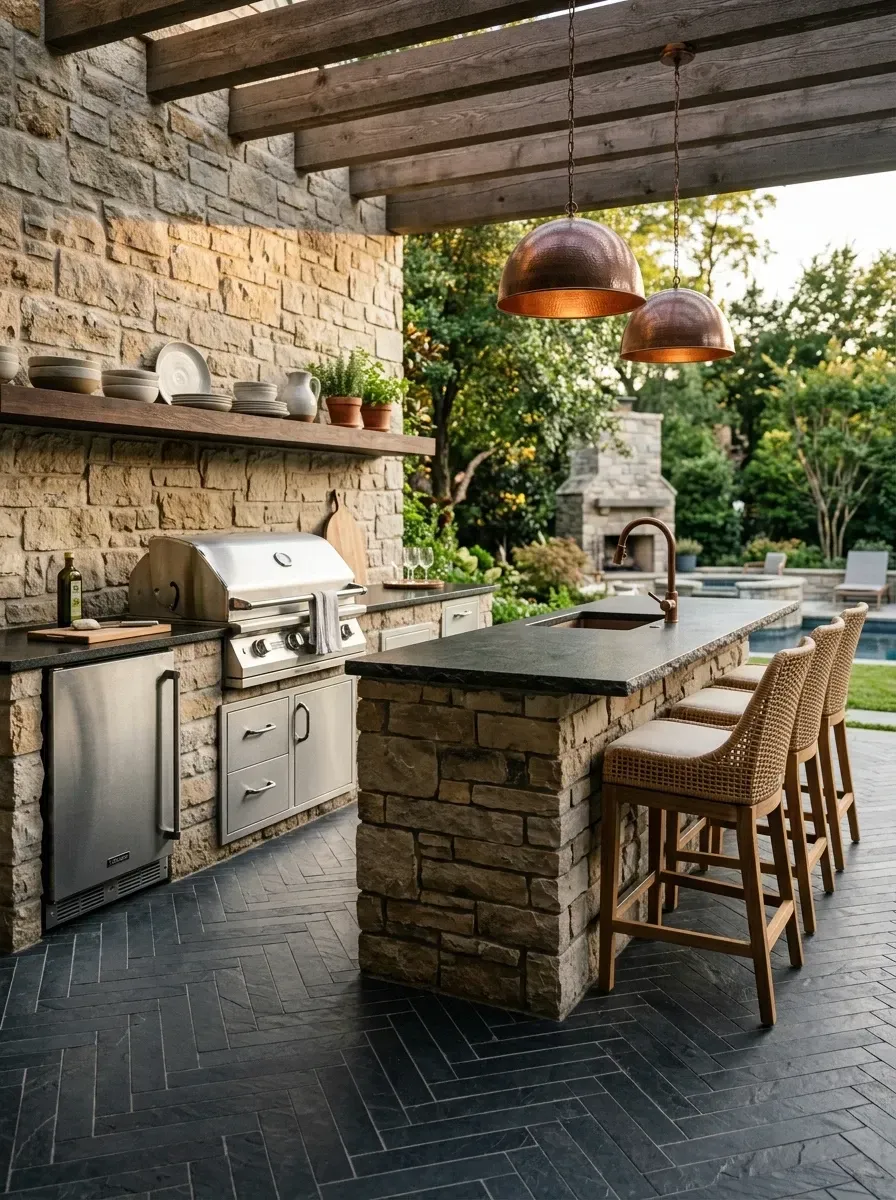
This concept is a real outdoor kitchen: not a freestanding grill with a counter, but a cooking and entertaining wing that works for forty-person Sunday gatherings and Tuesday-night family dinners alike. Grill is a Hestan 36" Aspire Built-In Gas Grill in stainless ($4,990). Refrigerator is the U-Line ADA Outdoor Refrigerator 24" in stainless ($2,890). Stone is real Eldorado Stone Sequoia Cliffstone veneer on the bar island and back wall, set by a mason ($28/sq ft installed). Soapstone counter is the Vermont Verde Antique Soapstone ($72/sq ft fabricated and installed). Soapstone is the only surface we would specify for outdoor kitchens, because it does not stain, does not require sealing, and patinas to a deeper black with use. Bar stools are three Article Lumen Counter Stools in Teak, drawn in the rendering with woven backs and pale seat pads ($349 each). Pendants are Cedar & Moss Hawthorne Outdoor Dome in Antique Copper, rated for damp locations ($589 each). Floor is herringbone Marazzi Brushed Slate 12x24 porcelain ($14/sq ft installed). Pergola beams are rough-sawn western red cedar 6x10, oil-finished.
Stone wraps the whole cooking zone. Eldorado Sequoia Cliffstone (#B8A88A) runs full height on the back wall and around the bar island in warm buff blocks with real depth, and the dark soapstone counters sit on top of it. The floor drops to Marazzi Brushed Slate (#36454F), a charcoal slate-look porcelain laid in herringbone that hides grease and anchors all that masonry. Antique Copper (#B87333) arrives in the two dome pendants over the island, which throw a warm light on faces at the counter, and Hestan Stainless Steel (#B0C4DE) on the grill, drawers and refrigerator front reads cool against the stone. A thick walnut shelf holds everyday dinnerware, and the rough-sawn cedar beams overhead give the kitchen its ceiling line.
The full kitchen estimate is $27,550–$53,200, spread more evenly than any other room in this guide. Its two biggest lines, the Stone Bar Island + Soapstone Top at $6,000–$12,000 and the Stacked Stone Veneer Back Wall at $5,000–$9,000, account for only about 39% of the high end. The island also has the widest range, so fix its size and counter area before ordering anything else.
Behind those, the Stone Base Cabinets with Drawers run $4,000–$8,000. Appliances are the Built-in Stainless Gas Grill at $2,500–$5,000 and the Outdoor-Rated Refrigerator at $1,200–$2,500, and the Wicker / Teak Bar Stools (x3) are allowed $900–$1,800.
The herringbone floor is a bigger line than it looks: the Slate-Look Porcelain Floor Install comes to $4,000–$7,500, and the Cedar Pergola Beams overhead to $3,000–$5,500. The finishing pieces are lighter, with Copper Dome Pendants (x2) at $600–$1,200, the Floating Wood Shelf + Brackets $200–$400, and Dinnerware & Accessories $150–$300.
For the counters, soapstone beats granite and quartz outdoors. Quartz yellows under UV within three seasons of full sun and granite stains from oil and wine, while soapstone simply darkens with use and never needs sealing. Utilities belong in the slab pour: the gas line, water supply and dedicated 240V circuit cost three to four times as much to retrofit into a finished stone island.
Built-in grills are a separate category. Hestan, Lynx and Kalamazoo build grills meant for permanent installation; a grill sold as a freestanding cart is a different product, so read the warranty terms before setting any grill into masonry. The copper pendants must be damp-rated too; Hawthorne, Cedar & Moss and Hubbardton Forge all make outdoor-rated domes, and indoor versions fail quietly in the first humid season, simply going dark one evening.
9. Minimalist Zen Garden Court
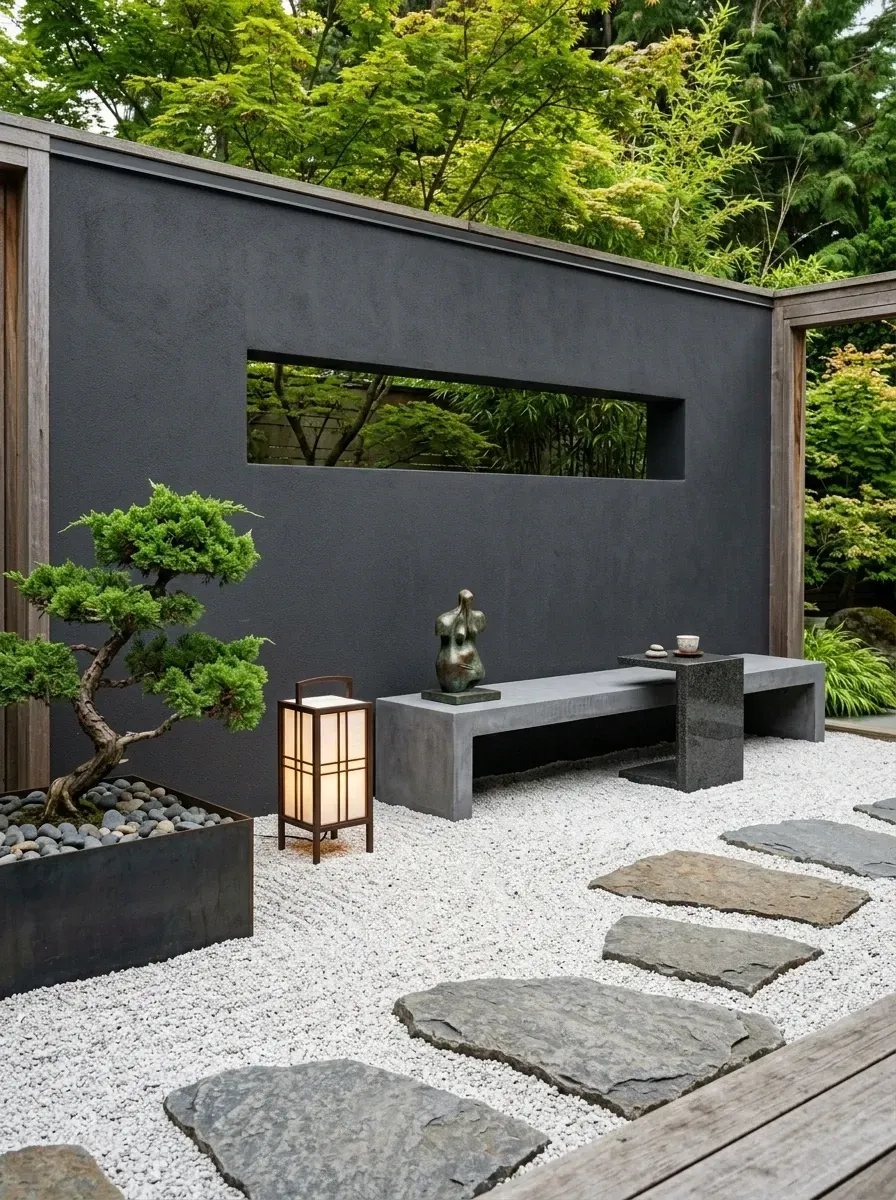
For a 14-by-18 walled courtyard between a townhouse and its carriage house, this concept is a meditation court: quiet, intentional, almost no plants. The brief is Japanese rather than English, and the design pulls from Marc Peter Keane's published guidelines on Western contemporary karesansui dry gardens. Concrete wall is custom poured-in-place with a 3-inch horizontal slit window at eye level, framing a neighboring mature dogwood like a living scroll painting. Wall is finished in Modern Masters Matte Concrete Sealer in Charcoal Tint. Bench is the Loll Designs Lollygagger Bench in Charcoal (recycled HDPE that mimics cast concrete at half the weight; $1,290). Bronze sculpture is a commissioned piece from a Baltimore foundry ($600-$2,800 depending on scale). Lantern is a Kichi Japanese Stone Garden Lantern in cast bronze ($340). Steel planter is a custom Cor-Ten weathering steel 60x18x14 fabricated by a local welder ($1,400), planted with a 15-year Juniperus chinensis bonsai from Bonsai Empire. Gravel is 3/8" Mexican beach pebble in white, weed-barriered, raked weekly. Stepping stones are natural Pennsylvania bluestone irregulars from a regional stone yard.
The palette is almost monochrome. Matte Charcoal Concrete (#36454F) covers the tall wall, a quiet backdrop cut by the long horizontal opening that frames the trees beyond, and the ground is Mexican Beach Pebble White (#E8E8E8), raked into lines that stand in for water as dry gardens traditionally do. The planter on the left in Cor-Ten Weathered Steel (#4A4A4A) is still dark and unrusted in the rendering, a hard rectangle under the twisting juniper bonsai, and Weathered Cypress (#8B7D6B) on the doorway posts and the deck edge in the foreground is the only warm material. Within that frame sit just a concrete-look bench, a dark stone pedestal table, a small bronze figure, a shoji-style lantern and irregular bluestone stepping stones.
The court is estimated at $13,600–$25,600, and the wall is most of that. The Charcoal Concrete Wall + Slit Window takes $8,000–$15,000, the widest range in the list, and the Wood-Framed Doorway + Deck Edging adds $2,500–$4,500; the pair make up about 76% of the high end. Settle the wall's dimensions and finish before ordering the smaller pieces.
What sits inside the walls is comparatively inexpensive. The Cast Concrete / HDPE Garden Bench is allowed $800–$1,500, the Stone Pedestal Side Table $300–$600, the Abstract Bronze Sculpture $400–$800 and the Japanese Wooden / Bronze Garden Lantern $150–$300. On the ground, White Pea Gravel Installation runs $1,000–$2,000, Slate / Bluestone Stepping Stones $200–$400, and the Rectangular Steel Planter with Bonsai $250–$500.
Rake the gravel every week. A dry garden is a practice rather than a finished installation: the raked pattern is the art, and gravel left alone looks like a neglected bed within a month. The slit window matters just as much, because it borrows the view beyond the wall (the Japanese shakkei); without it, a 5-foot concrete wall is a privacy fence, and with it the wall becomes a picture frame.
Restraint holds the composition together: one sculpture and one specimen plant, here the juniper bonsai. More than one of either breaks the grammar of a Japanese garden and starts to look like a showroom. The Cor-Ten planter takes 18-24 months to develop its rust patina and looks mill-fresh and industrial until then, as it does in the rendering, so order it 18 months before installation if you want the rust on day one, or accept the gradual change.
Practical Tips for Any Outdoor Room
Specify outdoor-rated everything. Sunbrella, Crypton Outdoor, Outdura and Perennials are the four upholstery fabrics worth trusting. Metals should be powder-coated marine-grade aluminum or 316 stainless, and electrical fixtures damp-rated or wet-rated only, because generic "outdoor" labeling fails within two seasons. Once the materials are right, build vertical elements first, then furnish within that envelope. Pergolas, privacy walls, fountains and stone features define the room, and the furniture follows. Furniture-first planning leads to walls and pergolas that don't match the seating layout.
Lighting and layout make the room usable. Layer three types of lighting: overhead, task and ambient, drawing on string lights, sconces, path lights, lanterns and fire pits. A single overhead floodlight on a deck reads as a commercial parking lot, while the same deck with a Cedar & Moss pendant, sconces and string lights reads as a designed room. Plan traffic flow with at least 30 inches between seating and dining pieces. Tighter spacing makes the outdoor room feel cramped and limits guest circulation during the parties the room exists to host. It also helps to echo interior materials outside for a cohesive transition between home and garden. If the kitchen has a slate floor, the porch reads better in slate-look porcelain than in cedar; if the living room has linen drapery, the porch reads better with linen cushions than with synthetic ones.
Timing and approvals are the last pieces. Always quote a 15–25% permit-and-review premium in historic markets. Charleston, Savannah, Naples and DC all have meaningful design-review boards for visible exterior modifications, so build the timeline and budget for them from the first conversation. And schedule outdoor projects for the shoulder seasons. March to May and September to November are the right windows in the Southern markets. Summer installs get delayed because masons and carpenters refuse to pour or work in 95°F humidity, and winter installs get delayed because materials don't cure correctly below 50°F.
Where to Cut the Budget Without Losing the Look
Hard surfaces are where the largest savings sit. Use concrete pavers or gravel in place of natural stone decking. A poured concrete patio with a stamped pattern runs $14–$22/sq ft installed, against $36–$48 for travertine or bluestone. From across the yard the visual cost is roughly 20%, while the budget cost is roughly 60% lower. Walls follow the same logic: DIY a stucco or limewash wall finish rather than hiring a mason for stone cladding. Romabio Classico Limewash in Pearl Grey runs $89/gallon and applies with a $14 brush, and the same wall that runs $5,000 in Eldorado Stone veneer can come in at $400 in limewashed stucco.
Structures and furniture offer the next tier. Build a simple wood pergola from pressure-treated lumber rather than custom cedar. A 12x14 PT pergola runs $1,800–$2,600 in materials and a weekend of labor, while the same frame in clear-grain cedar runs $4,800–$6,400; stain the PT in a warm tone after a 90-day weathering period and the visual gap closes substantially. For seating, choose Polywood, Loll Designs or Yardbird rather than Restoration Hardware or Sutherland. Recycled HDPE construction holds color, never warps, never needs paint, and runs roughly 40–60% of the comparable luxury brands.
The smaller pieces reward patience. Source vintage terracotta and ceramic planters from estate sales, local architectural salvage yards and 1stDibs Direct Seller listings. The same Italian Impruneta jar that runs $580 new can land at $180–$320 with provenance from a Charleston estate. And opt for outdoor rugs in recycled polypropylene rather than hand-woven natural fiber. Loloi, Ruggable and Anji Mountain all make polypropylene rugs that read as natural fiber from six feet away and survive rain.
Regional Fit Across Southern Markets
These nine rooms are concepts, and what it costs to build one depends heavily on where you live. The multipliers below reflect labor, masonry availability and delivery overhead; the list prices of the products themselves barely change from one market to the next.
Charleston, SC sets the 1.00x baseline, and the cottage garden nook and the coastal front porch suit it best. The cheaper markets sit in a tight band below it. Nashville, TN is lowest at 0.91x, where the coastal front porch and cottage garden nook again lead. Charlotte, NC follows at 0.92x with a preference for the modern balcony lounge and the outdoor kitchen, and Savannah, GA, at 0.94x, leans toward the garden bedroom retreat and the cottage garden nook. Atlanta, GA comes closest to baseline at 0.97x, with the outdoor kitchen and the Tuscan courtyard as its best fits.
Two markets cost more than Charleston. Naples / Ft. Myers, FL runs 1.08x and favors the coastal poolside retreat and Mediterranean garden dining. The Washington DC metro is the most expensive at 1.12x, where the Zen garden court and the modern balcony lounge fit best. The spread from Nashville to Washington is wide enough that the same outdoor room should be priced against its local multiplier before you commit to a direction.
Multipliers draw on the RSMeans 2026 City Cost Indexes for residential masonry, carpentry and outdoor electrical work. The style preferences noted for each market are our editorial reading, not survey data.
Questions Worth Asking
Which of these nine outdoor rooms is the most beginner-friendly to recreate?
The cottage garden nook and the coastal front porch are both achievable in a long weekend with a paint sprayer, a teak bench, and a Polywood rocker order. The outdoor kitchen, the poolside retreat, and the Zen garden require licensed gas, masonry, and concrete trades respectively and should not be DIY projects.
Can a balcony actually support a stone planter or water feature?
Most residential balcony slabs are rated for 40-60 psf live load. A 24-inch terracotta planter with saturated soil exceeds that, and a stone fountain certainly does. Always check the load limit on the building documents before specifying anything heavier than fiberglass planters with bagged lightweight soil mix.
What's the most-overlooked cost in outdoor design?
Drainage. A patio that pools water in heavy rain is a patio that grows mildew, breeds mosquitoes, and fails the masonry within three years. Budget for proper grading, French drains, or permeable paving systems as a hard project line item; this typically runs 8-12% of the total hardscape cost in any flat-grade Southern market.
How long do outdoor furniture pieces actually last in Southern climates?
Polywood and recycled HDPE: indefinite (the manufacturer warrants 20 years). FSC teak: 25-40 years with annual gentle pressure washing. Powder-coated aluminum: 10-15 years coastal, 20+ inland. All-weather wicker on aluminum frame: 8-12 years. Standard wrought iron: 3-7 years before significant rust without aggressive maintenance.
Do you need permits for any of this?
Not for the movable pieces: furniture, rugs, planters and pottery never need one. Hardscaping over 200 square feet usually does, a gas line for an outdoor kitchen always does, and a pergola taller than 12 feet often does. In the Charleston, Savannah and Naples historic districts, any visible exterior change goes through design review, so allow an extra 4-8 weeks for the permit cycle.
Which outdoor room is the most year-round usable in Southern markets?
The coastal front porch and the Mediterranean garden dining room both work nine months a year in zones 8 and 9 without modification. The outdoor kitchen extends to year-round with the addition of patio heaters and a windscreen. The Zen garden and the balcony lounge are usable year-round because they're observation spaces rather than active-cooking spaces.
Are the specific brands the only options that work?
No. Product lines change, models get discontinued, and the best equivalent in your area may carry a different name. We cite these brands for 2026 because they combine quality, reasonable lead times and weather tolerance, so treat them as a benchmark for what a good outdoor piece looks like rather than as a shopping list.
What's the single most-common mistake people make in outdoor design?
Buying indoor-rated fixtures and fabrics and hoping they'll survive. Pendant lights that say "for damp locations" can be installed outdoors; pendants that don't say it cannot. Pillows in pure cotton or linen mildew; pillows in Sunbrella, Outdura, or Crypton Outdoor do not. The price difference between indoor and outdoor-rated is usually 15-25%; the lifecycle difference is 5-10x.
Sources & References
- Sherwin-Williams: Evergreen Fog SW 9130 and Pure White SW 7005 paint codes, light reflectance values, and Emerald Exterior Acrylic finish recommendations.
- Benjamin Moore: Simply White OC-117 and Aura Exterior finish-line specifications.
- Article: Corvos U-Sectional, Lumen Counter Stool, and outdoor cushion upgrade specifications.
- Restoration Hardware (RH): Aviara cast concrete side table and Mallorca outdoor specifications.
- Sutherland Furniture: Great Lakes teak dining table, Aluminum Vivara chaise, and Burmese FSC teak grading.
- Brown Jordan: Avignon Side Chair dimensions and Sunbrella Canvas cushion specifications.
- Tuuci: Ocean Master Mega Max Single Cantilever Umbrella construction and salt-air tolerance ratings.
- Polywood: Jefferson Rocking Chair recycled HDPE construction and 20-year residential warranty.
- Loll Designs: Lollygagger Bench HDPE construction and load specifications.
- Visual Comfort & Co.: O'Brien Hicks Pendant Large and Hubbardton Forge damp-rated pendant specifications.
- Cedar & Moss: Hawthorne Outdoor Dome Pendant in Antique Copper and damp-rated installation guidance.
- Hestan, Lynx, Kalamazoo Outdoor: built-in gas grill specifications and warranty coverage for permanent installation.
- U-Line: ADA Outdoor Refrigerator 24" power and water-resistance ratings.
- Eldorado Stone: Sequoia Cliffstone Veneer installation guide and substrate requirements.
- Vermont Soapstone: Vermont Verde Antique soapstone exterior installation and patina guidance.
- Sunbrella: Cast Charcoal and Canvas Cream performance weave specifications and 10-year color warranty.
- Bison Innovative Products: interlocking IPE wood tile load and drainage specifications.
- Campania International: Tuscany Wall Fountain cast limestone and basin pump requirements.
- RSMeans 2026 City Cost Index: regional labor and material multipliers for residential masonry and outdoor trades.
- The Layered Homes design notes: outdoor concept notes for Charleston, Savannah, Atlanta, Charlotte, Nashville, Naples, and the DC metro, 2022–2026.
Designing Outdoor Rooms That Get Used
None of these nine outdoor rooms is the right outdoor room. They are nine answers to nine different questions: where do you drink coffee, where do you eat dinner, where do you read, where do you swim, where do you greet visitors, where do you meditate, where do you cook for forty people. Get the question right and the room nearly designs itself; get it wrong and the pergola, the travertine, and the cast-stone fountain are all decoration in search of a purpose.
Each of these rooms gets a longer treatment elsewhere on the site. For more garden directions there are ten outdoor garden design ideas broken down by style; the porch and balcony rooms connect to ten patio and deck design directions; twelve backyard before-and-after concepts apply the same thinking to tired yards; eleven rooftop transformations cover outdoor space that sits up high; and ten sunroom directions suit the shoulder-season rooms between house and garden.
The Layered Homes editorial team
Styling & Living Desk
The Layered Homes editorial teamThe Styling & Living Desk produces the room-by-room guides, outdoor and garden pieces, celebration ideas and design solutions, each with an itemised cost estimate, and the Home Files essays.
More from the Styling & Living Desk →
Reader notes