


For outdoor rooms anywhere from Charleston, Savannah, and Naples to Charlotte and the DC metro, the central question is usually the same: can we make this feel like a real room instead of a leftover slab? The ten outdoor spaces below are ten answers: Mediterranean terrace, cedar lounge, English cottage nook, Southwest courtyard, Japanese balcony, nautical pool deck, Moroccan riad, Nordic dining deck, urban fire pit, French garden patio. Each one is documented with the materials we would actually specify in 2026 and realistic cost ranges.
This guide comes from The Layered Homes editorial team. Our approach across all ten directions is the same: build the architectural shell to last 20 years, layer the textiles and lighting like an interior room, and let the regional climate decide the material details. Below is the full breakdown (image, palette, real brand sourcing, full cost range) and the styling moves that actually hold up after the first thunderstorm.
A note on the numbers: the totals cover furniture plus the architectural shell. They do not include irrigation, drainage engineering, lighting design fees, or historic-district review costs. In Charleston, Savannah, Naples, and any historic market, plan to add another 15–25% to hardscape figures for permits and inspector cycles.
1. Mediterranean Terrace Dining with Ocean Views
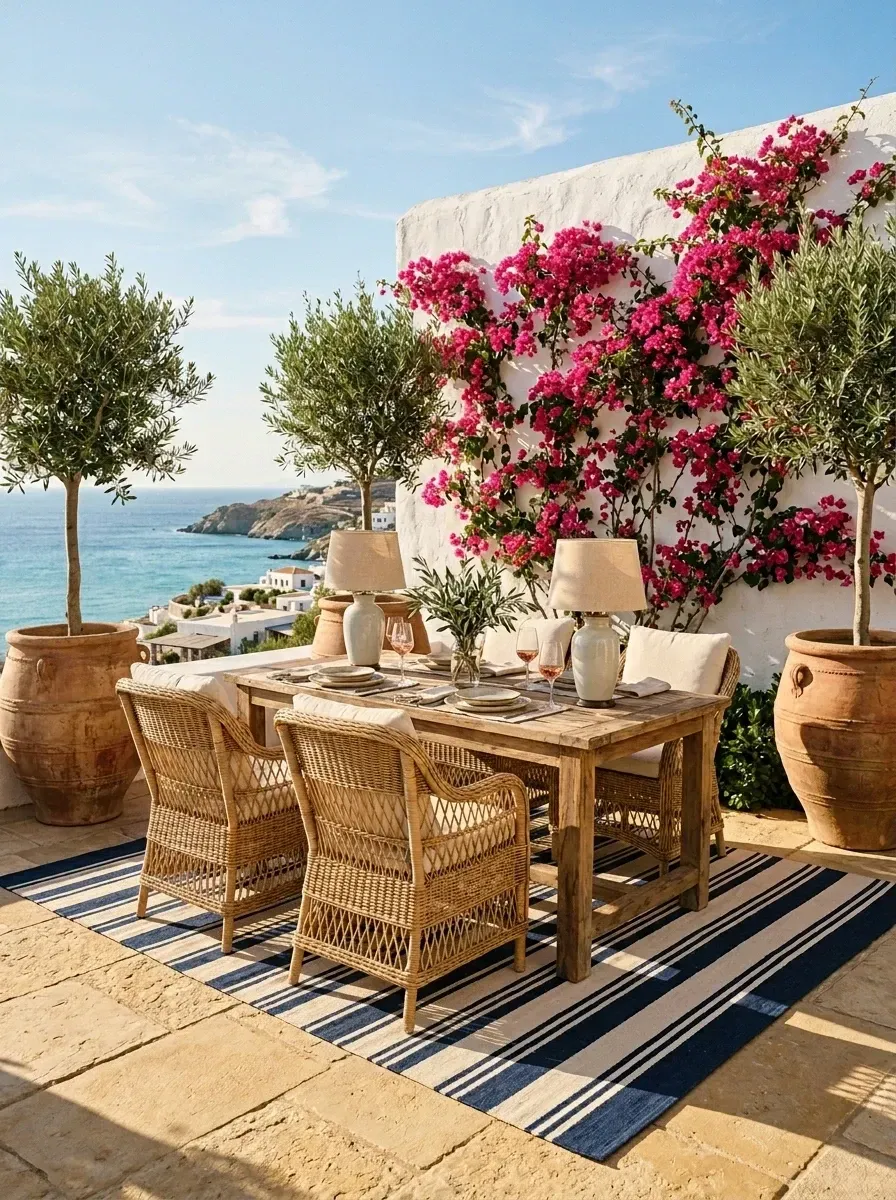
For a Naples-style limestone terrace with a view of the Gulf, this concept is the dining moment that finally pulls a family outside for the season: six chairs, the right table, and no umbrella fighting the breeze. The shell is the starting point, a whitewashed, hand-troweled stucco privacy wall and natural limestone flagstone flooring. Table is the Sutherland Great Lakes 84" Reclaimed Teak Dining Table ($2,890), specified in salvaged teak so it patinas to silver under the year-round Florida sun. Chairs are six Serena & Lily Riviera Outdoor Side Chairs in a natural honey rattan ($598 each), with cushions in Sunbrella Canvas Natural performance weave. Rug is the Dash & Albert Salem Stripe Indoor/Outdoor 8x10 in Navy/Ivory ($448); it anchors the table and reads from the second-floor balcony above. Terracotta urns are vintage Italian Impruneta sourced through 1stDibs ($420–$680 each, age-and-provenance dependent). Lamps are the Visual Comfort Crystal Bottle Table Lamp in glazed ceramic with outdoor-rated cord upgrade ($389).
The white of the wall is Whitewashed Stucco (#F2F0E6), a hand-troweled plaster that throws the late Gulf light back onto the table and makes the magenta bougainvillea climbing it look even brighter. Against it, the woven armchairs carry Honey Rattan (#C4A77D), close to the warm tan of the terracotta urns holding the olive trees, while the rug's Nautical Navy (#1E3A5F) stripe repeats the sea beyond the parapet. Underfoot, Limestone Sand (#DDD0B4) pavers keep the base pale and cool enough for bare feet.
In the rendering, the stucco wall closes one side of the terrace and the other stays open to the water, so the table sits in the corner where the two meet. Three tall Impruneta urns planted with olive standards frame the group, the rattan armchairs pull up to a plank-top table in reclaimed FSC teak, and two glazed ceramic lamps with linen shades stand on the table itself, which is why their cords need an outdoor rating. The navy and ivory flatweave runs far enough past the chairs that no back leg drops off its edge.
Our 2026 estimate for this terrace runs $10,700–$22,450, and most of it goes into the hard surfaces: Natural limestone terrace flooring at $4,000–$8,000 and the Whitewashed stucco privacy wall at $3,000–$6,000 account for about 62% of the upper figure. The limestone also carries the widest spread on its own, so a written paving quote is worth having before any furniture is ordered.
Furniture and accessories are smaller, separate decisions. Allow $1,500–$3,500 for the Reclaimed teak outdoor dining table, $1,200–$2,800 for Woven rattan dining armchairs (x4–6), $500–$1,000 for the Oversized terracotta urn planters (x2), $300–$700 for the Outdoor-rated ceramic table lamps (x2) and $200–$450 for the Navy striped flatweave outdoor rug. The rendering shows three urns rather than two, so copying it exactly means one more pot on that planter line.
Two details decide whether this terrace looks like the picture. The first is the rug: an oversized striped flatweave marks out the dining zone and carries the navy of the water onto the stone, and polypropylene versions from Dash & Albert, Lulu & Georgia and Annie Selke tolerate coastal salt spray. The second is urn size. Buy them as matched pairs and go big, because a 24-inch Impruneta or Anduze pot reads as part of the architecture while an 18-inch one looks like an ordinary plant container; the larger pot costs about twice as much and does far more for the terrace.
Because the lamps sit on the table rather than on a wall, order them with outdoor-rated cord. Visual Comfort, Currey & Company and Cedar & Moss sell that swap as a $30–$50 upgrade, and it keeps one humid evening from tripping the GFCI. Resist adding another color to this scheme. Whitewash, rattan and one strong stripe are plenty when the Gulf or harbor view serves as the artwork, and the bougainvillea already supplies all the extra color the terrace can take.
2. Modern Cedar Deck Lounge
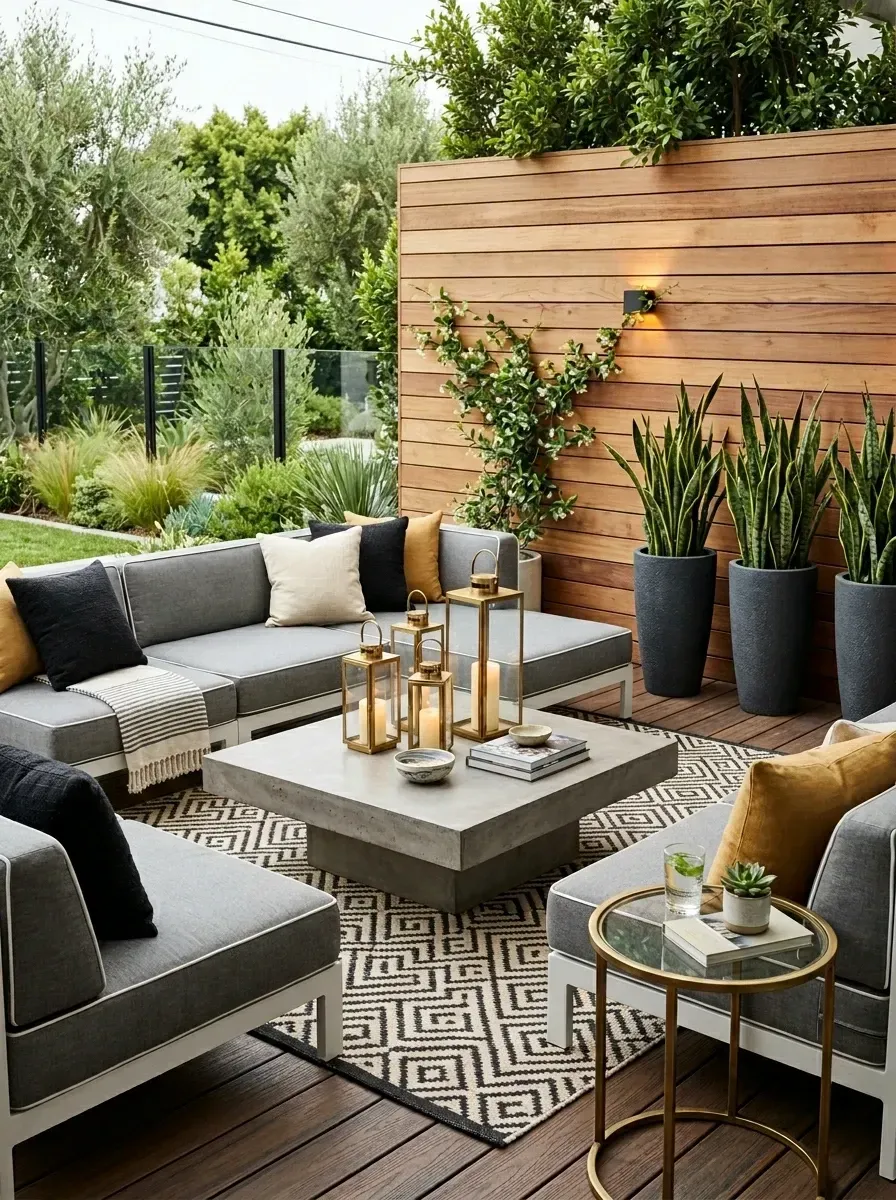
For a Charlotte backyard that opens onto a lawn and planted borders, this concept makes the deck read as a continuation of the living room, not the leftover concrete pad that came with the house. The architectural move is the cedar slat privacy wall: 1x4 western red cedar on 1/2-inch reveal gaps, eight feet tall, sealed with TWP 1500 honey-tone annually ($4,200 installed by a local carpenter). Decking is TimberTech AZEK Vintage Collection in Dark Hickory ($14/sq ft installed) over the existing slab. Sectional is the RH Aviara Aluminum L-Sectional 3-piece in White with Sunbrella Cast Charcoal cushions ($5,990, discount via RH Members Program). Coffee table is the CB2 Fuze Concrete Square Coffee Table ($899). Lanterns are three Pottery Barn Malta Indoor/Outdoor Recycled Glass Lanterns in antique brass ($169 each). Rug is the Loloi Hagen Indoor/Outdoor 8x10 in Charcoal/Ivory ($398). Planters are West Elm Tall Hourglass Outdoor Planters in matte black ($199 each) planted with sansevieria.
The cedar slat wall supplies the warm half of the scheme, a honey-toned Western Red Cedar (#C49A6C) that glows under the small wall sconce, while the sectional cushions in Cast Charcoal Sunbrella (#6B7280) give the cool half and hold their color through Charlotte's south-facing summer light. Antique Brass (#B8983E) appears on the three lanterns and the base of the round glass side table, and Concrete Stone Grey (#A8A29E) is the square coffee table, a heavy block that keeps the seating group from looking like lightweight patio furniture.
What the rendering shows is a corner arrangement: horizontal 1x4 western red cedar slats along the back, TimberTech AZEK boards in Dark Hickory underfoot, and a white-framed aluminum sectional wrapping two sides of the cast concrete table. The geometric charcoal and ivory rug sits under all of it, three tall charcoal cylinders of sansevieria stand in a row against the cedar, and a glass fence and garden planting fill the view beyond.
The full scope comes to $14,400–$29,300 in 2026 dollars, and two built items, the Custom cedar slat privacy wall at $5,000–$10,000 and Composite decking over existing slab at $4,000–$8,000, make up about 61% of the top number. The cedar wall has the wider range of the two because carpentry labor varies so much from crew to crew, so it is the first price to pin down.
Loose furniture is spread across smaller lines: $3,500–$7,000 for the Powder-coated aluminum L-sectional (3pc), $800–$1,600 for the Cast concrete square coffee table, $350–$900 for Brass outdoor lanterns (x3), $200–$450 for the Geometric outdoor rug 8x10, $250–$600 for the Brass and glass round side table and $300–$750 for Tall cylindrical planters (x3).
Set the cedar slats on 1/2-inch reveal gaps rather than butting them tight. The gaps let evening light through and make the wall read as a screen instead of a fence. Decide on sealing before the crew leaves, too: without its annual coat the cedar silvers noticeably within eighteen months, which some owners like and others regret. On the coffee table, stagger the three lanterns in height, as the rendering does, so they look placed by someone who lives there rather than lined up like a hotel lobby display.
The three matching planters against the cedar work as a living screen and add a vertical beat to the horizontal slats. Sansevieria suits a deck like this because it tolerates full sun, neglect and a missed week of watering. The rug's high-contrast charcoal and ivory pattern is the piece that links the warm wall with the cool grey decking; an all-grey rug would simply vanish against the boards.
3. English Cottage Garden Reading Nook
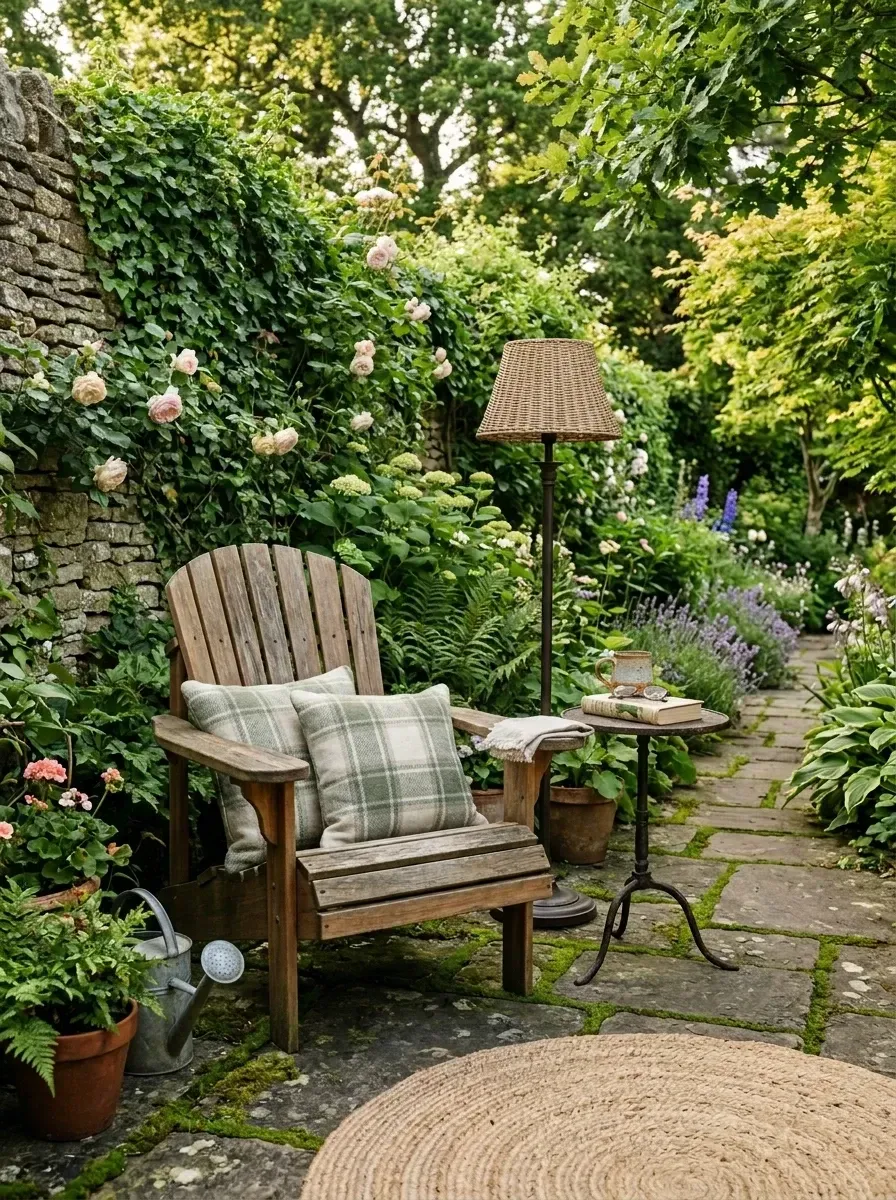
For a back garden behind a Savannah single house, this concept is one perfect reading chair, somewhere coffee actually gets finished instead of going cold on the kitchen island. The architectural setting does most of the work: a dry-stacked Tennessee limestone wall, climbing Eden roses trained over several seasons, and moss-jointed flagstone paths. Chair is a Sutherland Westport Teak Adirondack in unfinished grade-A teak ($890), which silvers to driftwood grey within two Lowcountry summers. Pillows are Pendleton Glacier National Park Plaid in outdoor-grade poly-cotton ($79 each). Floor lamp is the Roost Wicker Cone Floor Lamp ($420); it is designed for covered porches, but a buried 12V landscape wire makes it work for full-garden use. Side table is the Anthropologie Cast Iron Bistro Side Table in matte black ($148). Rug is a 6-foot round Anji Mountain Natural Jute Rug ($189).
Stone, wood, iron and fiber make up this corner. The wall is Mossy Limestone (#8E928A), grey with a green cast that lets it disappear into the ivy and roses, and the Adirondack has already weathered to Weathered Teak (#8B6F47), a silvery brown. Wrought Iron Black (#2D2D2D) turns up on the lamp stand and the spindly bistro table, and the round rug's Natural Jute (#D6C8B0) picks up the paler flagstones on the path.
The picture is built around one chair. The teak Adirondack sits with its back to the dry-stacked Tennessee limestone wall, two green and cream plaid cushions on the seat, and the wicker-shaded floor lamp on its 12V landscape feed rises just behind the arm. A small cast iron table holds a mug and a book, a galvanized watering can and terracotta pots fill the space at the chair's left, and the moss-jointed flagstone path leads off past lavender and delphiniums toward the back of the garden.
This is the least expensive room in the guide, estimated in 2026 dollars at $5,720–$12,780, and nearly all of that is hardscape. The Dry-stacked stone wall section at $2,500–$5,500 and the Moss-jointed limestone pavers at $2,000–$4,500 together account for about 78% of the high estimate, and the wall, with the widest spread, is the quote to settle first.
Everything you sit on or touch costs far less: $500–$1,000 for the Weathered teak Adirondack chair, $100–$250 for Plaid outdoor throw pillows (x2), $250–$600 for the Wicker outdoor floor lamp, $150–$350 for the Cast iron bistro side table, $120–$280 for the Natural jute round rug 6' and $100–$300 for Garden accessories (pots, watering can).
Plant for the long game. Roses, jasmine or honeysuckle on a stone wall should start from existing planted vines rather than first-season cuttings, and even then the cottage effect takes three to five years of growth. A David Austin Eden, New Dawn or Cécile Brünner from a one-gallon nursery pot in the first spring is the realistic starting point. For the chair, one unfinished grade-A teak Adirondack is a better buy than two painted-pine versions: the teak silvers on its own, while painted pine flakes within two humid Lowcountry summers and needs sanding and repainting every other year.
Run a buried 12V landscape wire to the lamp position before the pavers go down. Trenching for outdoor power after the stone is set runs $400–$800, against about $80 for wiring laid in advance. Then give the chair soft goods, plaid pillows and a small wool throw over the arm as in the rendering, so it reads as a seat someone actually uses rather than a garden sculpture.
4. Southwest Desert Courtyard Retreat
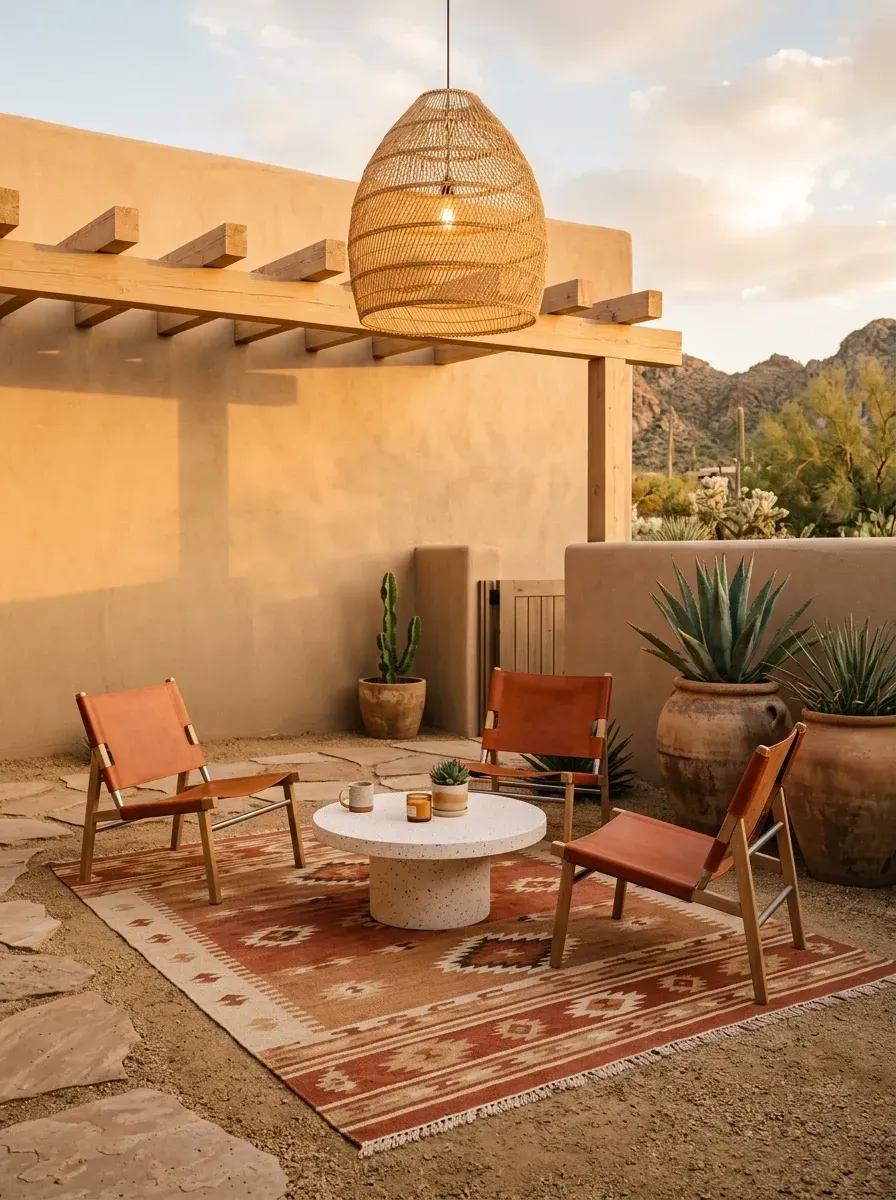
For a second home in the foothills outside Asheville, this concept is a courtyard that reads more Sedona than Smoky Mountain: a place to take coffee at golden hour. The shell is adobe-style plaster over CMU block (a mason crew specializing in stucco veneer would run the work at about $42/sq ft including the integral pigment). Pergola is rough-sawn cedar 6x8 rafters with a clear UV sealer ($6,400 installed). Pendant is the Serena & Lily Coronado Woven Rattan Pendant 36" ($698) hardwired with a Cedar & Moss damp-rated junction. Chairs are three RH Castelle Sling Lounge Chairs in saddle leather over teak ($1,290 each; the saddle patinas to deep cognac under sun). Coffee table is the Lulu & Georgia Concrete Drum Side Table 24" in terrazzo finish ($998). Rug is a Lulu & Georgia Aliki Kilim Indoor/Outdoor 8x10 ($798). Planters are large Pottery Barn Italian Terracotta Pots with mature agave americana, sourced from a local nursery.
Golden hour is when this palette makes sense. The walls are integral-pigment stucco in Adobe Clay (#D8C0A0), which turns almost apricot in low sun, and the three sling chairs carry Saddle Leather (#B65C3D), a burnt cognac that will darken further with exposure. Overhead, the rough-sawn rafters add Cedar Pergola (#C19A6B) and a ladder of afternoon shadow, while the drum table in Terrazzo Cream (#EDE8E0) is the one pale, cool surface among the earth tones.
In the rendering the courtyard is enclosed by thick adobe-style walls over CMU block, with a slatted wood gate in the corner and desert mountains beyond. The rough-sawn cedar 6x8 rafters extend from one wall to carry the large woven rattan pendant, which hangs over the terrazzo drum table. Three leather and teak sling chairs face each other across a red and cream kilim, two big terracotta pots of agave anchor the far corner, and a smaller pot holds a column cactus against the wall.
Expect $16,850–$34,700 for the whole courtyard. Masonry and carpentry dominate: Adobe/stucco perimeter walls at $6,000–$12,000 and Cedar pergola rafters and posts at $4,500–$9,000 represent about 61% of the high figure, and the walls carry more budget risk than any other line, so settle their quantity and finish before ordering anything smaller.
The ground plane is the third big cost, with $2,500–$5,500 for the Flagstone and decomposed-granite base. After that come $1,800–$3,600 for the Teak and leather sling chairs (x3), $900–$1,800 for the Terrazzo drum coffee table, $350–$800 for the Southwestern kilim outdoor rug 8x10, $500–$1,200 for the Oversized woven rattan pendant light and $300–$800 for Large terracotta planters (x2).
Ask the mason for integral pigment in the stucco instead of painting grey CMU an adobe color afterward. Pigment mixed into the finish does not fade or chalk, and it ages with the wall; the upcharge is roughly $4/sq ft, against repainting every five years. Put the pendant on a damp-rated junction even though it hangs under the pergola, because summer storms in the mountains of western North Carolina drive rain sideways, and the mist that follows will ruin an indoor-rated cord within one humid season.
Buy agave or yucca as mature specimens. A five-year plant in one of those big pots reads as a sculptural element, where a one-year nursery plant looks like a placeholder, and specialty nurseries typically price mature specimens at $180–$340 each, which beats waiting years for a small one to fill out. For the floor, the hybrid in the rendering, decomposed granite poured between large flagstone slabs, costs 30–40% less than solid flagstone, looks the same from five feet away and drains properly through afternoon thunderstorms.
5. Minimalist Japanese-Inspired City Balcony
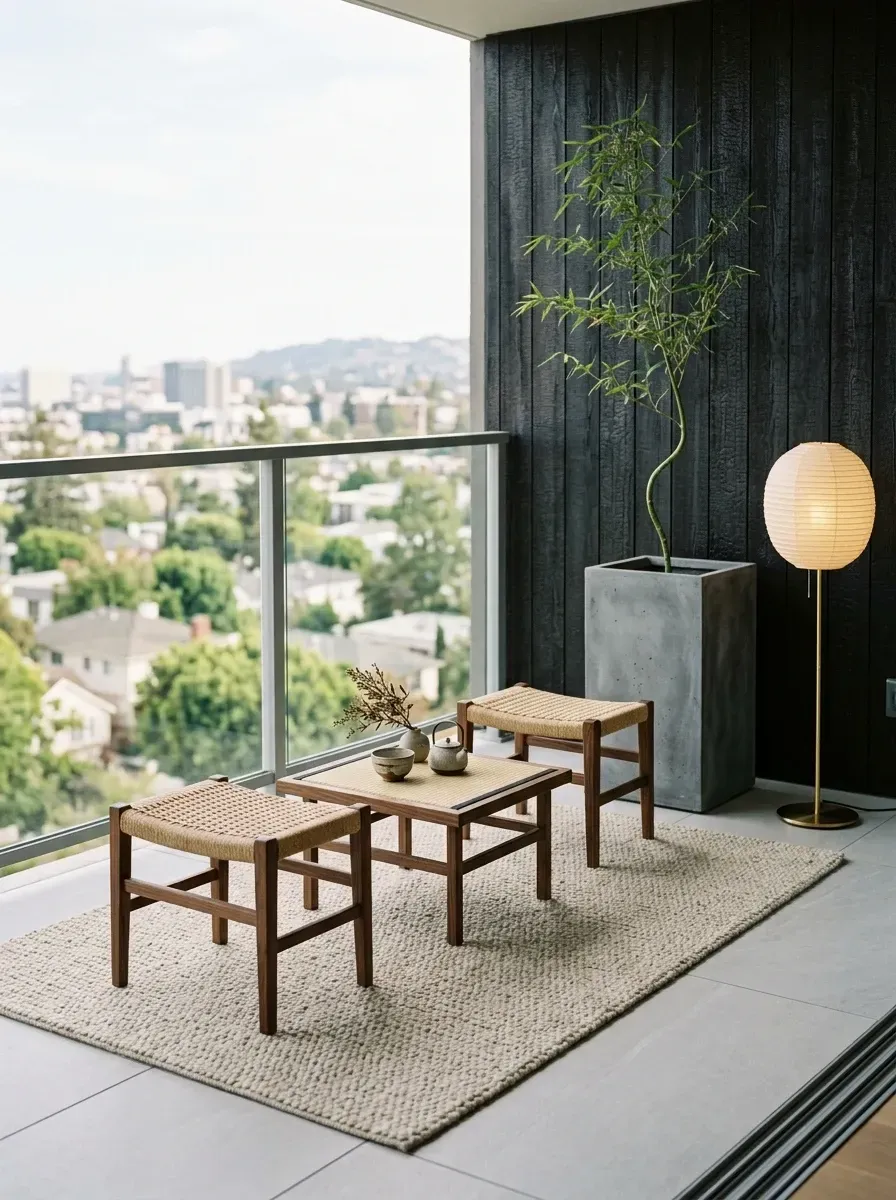
For a high-rise balcony of the Bethesda kind, this concept is a meditation space: 6 by 14 feet, north-facing, looking out over rooftops and trees rather than a skyline, but ten feet of usable width once the AC condenser moves to a side closet. The architectural move is the shou sugi ban wall: cypress 1x6 planks burned with a hand torch, brushed, and sealed with Penofin Hardwood Formula (about $3,900 installed by a carpenter who specializes in the technique). Flooring in the rendering is pale grey large-format porcelain over a pedestal system ($16/sq ft installed); a wood-look plank such as the Daltile Emerson Wood 6x24 porcelain plank in Walnut sits on the same pedestals if a warmer floor is wanted. Stools are two Crate & Barrel Tess Walnut and Woven Stools ($349 each, used outdoors with a clear sealer). Coffee table is the Article Madera Walnut Low Coffee Table 30" ($499). Planter is the West Elm Tall Concrete Rectangular Planter 30" ($229) with golden bamboo (Phyllostachys aurea) sourced from a local nursery. Lamp is the Rejuvenation Rice Paper Globe Floor Lamp ($359) with outdoor-rated cord upgrade. Rug is a thick Armadillo Cordillera Wool 5x7 in unbleached natural ($890).
The balcony runs dark to light from back to front. The shou sugi ban wall is Charred Ebony (#2B2B2B), and against it the stool and table frames in Walnut Brown (#6B4423) are the only warm wood. The tall planter adds Cool Concrete (#8C8C8C), close in tone to the floor tiles, and the chunky rug and the paper globe share Unbleached Wool (#E6E0D4), the oatmeal that keeps a black wall from closing the space in.
Only five objects furnish the balcony in the rendering. A tall rectangular concrete planter with a single golden bamboo stands against the charred cypress, the rice paper globe lamp rises beside it on a slim brass stem, and a pair of walnut and woven rush stools face each other across a low walnut table on the wool rug. The glass railing, held by slim metal posts, leaves the view over the neighborhood open.
At $7,050–$15,000 in 2026 terms, the balcony budget is mostly two surfaces. The Shou sugi ban charred wood wall at $3,500–$7,000 and the Large-format porcelain balcony tile at $2,000–$4,500 make up about 77% of the high estimate, and the charred wall, with the larger swing, should be the first written quote you request.
The furnishings are modest by comparison: $500–$1,000 for the Walnut and woven rush stools (x2), $350–$800 for the Low walnut outdoor coffee table, $250–$600 for the Textured wool flatweave rug 5x7, another $250–$600 for the Tall rectangular concrete planter and $200–$500 for the Rice paper globe floor lamp.
Shou sugi ban needs the right species. Cypress, sugi or Accoya char evenly and hold up; softwood pine burns unevenly and can rot within three seasons. A carpenter with documented shou sugi ban work is safer than letting a general carpenter experiment on your wall. Keep the furniture low, as the rendering does with a knee-high table, 18-inch stools and no high-backed chairs, so sightlines run over the railing and a six-foot-deep balcony feels closer to eight.
One tall plant does more here than three medium ones. A 6-foot bamboo in a deep planter pulls the eye up the black wall and makes the ceiling feel higher, while several small pots on a balcony this size just look cluttered. The rug is wool rather than polypropylene on purpose: under the building overhang the balcony stays dry, and real wool warms the porcelain in a way synthetic outdoor rugs cannot. Bring it inside in November.
6. Nautical Poolside Chaise Lounge
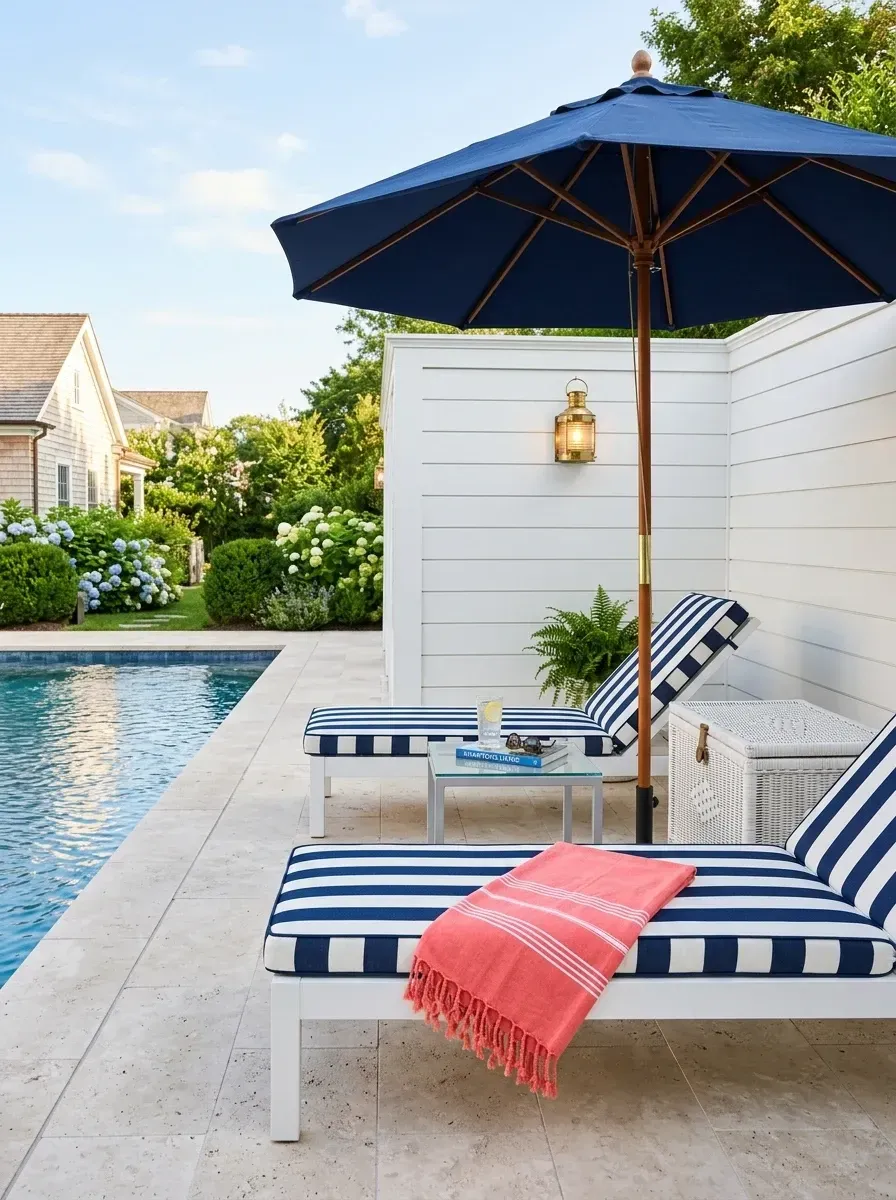
This Charleston Harbor-side concept has the pool deck read like a classic coastal resort: crisp white, navy stripes, polished brass, no compromise on the materials. The deck is honed silver travertine 16x24 pavers ($18/sq ft installed) over a mortar-set base. The horizontal-board fence is 1x6 painted Hardie plank in Benjamin Moore Simply White with stainless fasteners (about $42/linear foot installed). Chaises are two Brown Jordan Aurora Aluminum Chaise Lounges in Glacier White ($1,490 each) with custom Sunbrella Yacht Stripe in Navy/White cushions ($380 per chaise from a local upholsterer). The rendering shows a navy center-pole market umbrella on a wood pole with a brass collar; for shade that can follow the sun across both chaises, the upgrade we priced is the Tuuci Ocean Master Mega Max 11' Cantilever in Navy with polished-brass details ($3,890). Storage trunk is the Ballard Designs Suzanne Kasler Cane Trunk in white ($598). Sconce is the Hinkley Saybrook Wall Sconce in polished brass ($289), rated for wet locations. Side table is the CB2 Smart Round Glass Side Table with polished chrome ($249).
White and navy do almost all the work. Simply White (#F9FAFB) covers the horizontal-board fence, the chaise frames and the cane trunk, and Sunbrella Navy Yacht (#1B3A5F) comes in through the striped cushions and the umbrella canopy. Small touches of Polished Brass (#D4AF37) on the lantern sconce and the umbrella collar catch the afternoon sun, and the Honed Travertine (#E6DCC8) deck gives everything a warm ivory base that stays cool underfoot in Lowcountry heat.
Two chaises with navy and white Yacht Stripe cushions sit side by side on the 16x24 honed travertine, a glass side table between them and a white cane storage trunk tucked against the fence for towels and floats. The painted Hardie-board screen wraps the corner, the wet-rated brass sconce is mounted on it above the chaises, and the umbrella stands between the two loungers, a center-pole model in the picture rather than the 11-foot cantilever in the spec. A potted fern and the hydrangea borders beyond supply the only green, with the pool running along the left edge of the deck.
The 2026 estimate for the pool deck totals $9,950–$20,250. Paving is the biggest single expense: Travertine pool deck pavers run $5,000–$10,000, and with the White horizontal-board privacy screen at $2,500–$5,000 the two account for about 74% of the high estimate. Fix the travertine quantity and finish in writing before the furniture orders go in, since it carries the most budget risk.
The remaining lines are furniture and light: $1,400–$2,800 for White aluminum chaise lounges (x2), $400–$900 for a Navy market umbrella, $200–$450 for the Glass-top outdoor side table, $250–$600 for the White cane / wicker storage trunk and $200–$500 for the Brass nautical outdoor sconce. That umbrella allowance covers a standard market umbrella like the one pictured; the Tuuci cantilever sits well above it.
Build the fence in Hardie plank rather than solid wood. Painted wood in coastal humidity checks, swells and needs repainting about every three years, while Hardie holds its white through 12–15 seasons without touch-up. Have the cushions made to order in Sunbrella Yacht Stripe by a local upholsterer instead of buying striped cushions off the rack; ready-made stripes are usually printed and fade unevenly, while Sunbrella's solution-dyed stripes carry a 10-year color warranty.
The rendering uses a center-pole umbrella, and with two chaises side by side it shades one lounger well and the other only partly. A cantilever (Tuuci, Frankford and Galtech all make them) lets the canopy slide with the sun through the afternoon. Mount the brass lantern at 64 inches above the finished deck rather than the 60-inch height used indoors; light bouncing off the pool needs that extra height, and a lower fixture looks cramped against the fence.
7. Moroccan Riad Courtyard Lounge
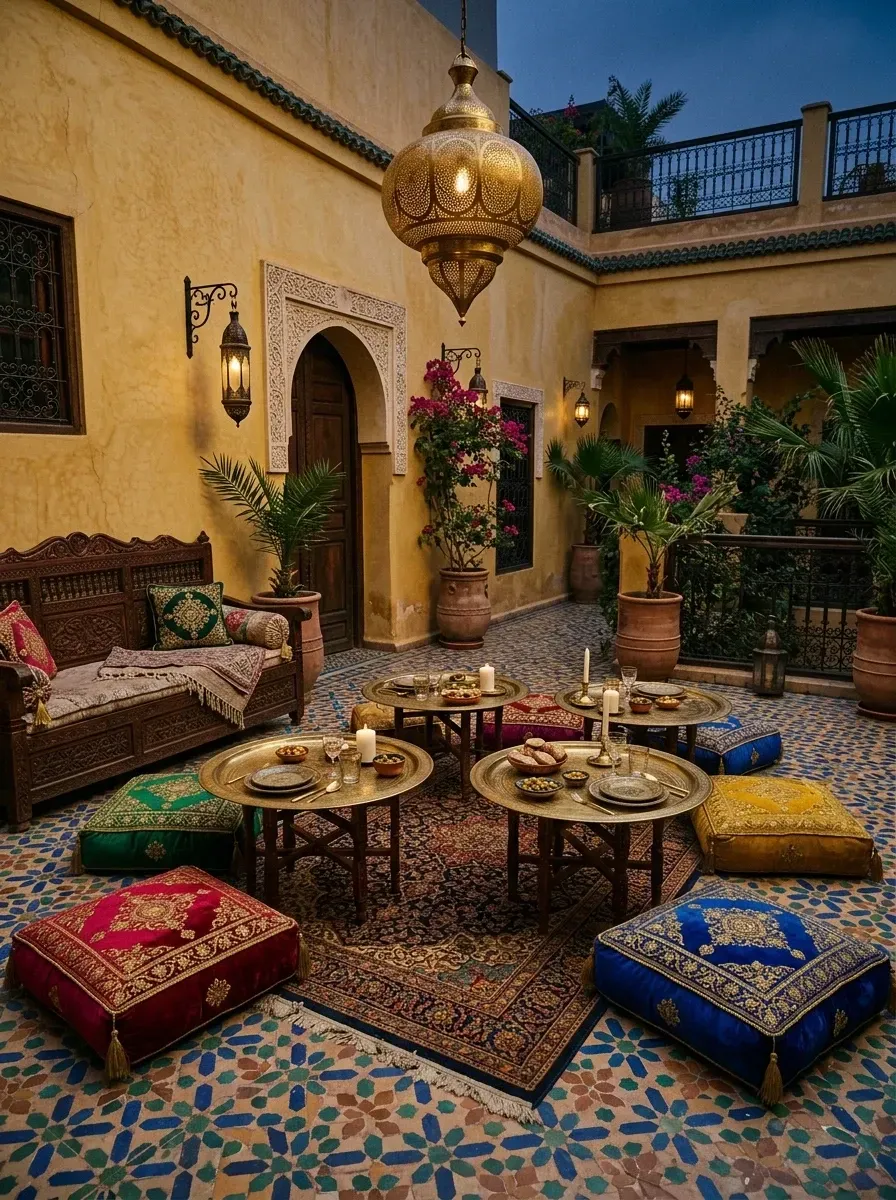
A courtyard between two Charleston single-house wings offers the rare gift of a fully enclosed outdoor room, and this concept leans fully Moroccan. The walls are authentic tadelakt in Moroccan ochre, a lime-and-pigment plaster that's burnished with a river stone, applied by a North African-trained artisan (about $14,000 for the courtyard's 240 square feet). Floor is Zia Tile Zellige in a 4x4 mosaic, blue, terracotta and ivory star pattern ($28/sq ft installed). Daybed is a sourced piece, a vintage Indian carved walnut daybed with new mattress and bolsters (about $4,800 through an importer). Brass trays are vintage Mamounia hammered brass from a rug and antiques importer ($380–$680 each). Lantern is the Pottery Barn Khan Brass Pierced Pendant ($899) on a Cedar & Moss damp-rated junction. Floor cushions are St. Frank Embroidered Silk Floor Pillows ($248 each). Rug is a hand-knotted vintage Persian-style piece in deep crimson with a dark border, from 1stDibs ($1,890); a cream Beni Ourain is the lighter alternative if the courtyard feels too dark.
Ochre and brass carry this courtyard after dark. The tadelakt walls are Moroccan Ochre (#D4A03D), and the carved daybed and the arched door share Carved Walnut (#5C3A21), the darkest note in the space. Antiqued Brass (#C8A951) runs through the hanging lantern, the wall lanterns and the four round tray tables, so candlelight is repeated at every height, and Persian Crimson (#7C2D3B) is the rug at the center of the floor seating, picked up again by the red cushions.
The rendering arranges everything for low seating. The carved walnut daybed with its bolsters runs along the left wall, four hammered brass Mamounia trays on folding wooden stands are grouped on the rug, and embroidered floor cushions in red, green, gold and blue ring the trays. The pierced brass pendant hangs high in the center on its damp-rated junction, iron wall lanterns light the ochre tadelakt, and the blue and terracotta Zia Tile zellige shows around the rug's edges. Potted palms and bougainvillea in terracotta jars fill the corners.
The riad is the most expensive room here, with a 2026 estimate of $18,600–$39,500. Two artisan surfaces drive it: Zellige mosaic tile flooring at $6,000–$12,000 and Ochre tadelakt plaster walls at $5,000–$10,000, about 56% of the high estimate between them. The zellige has the widest single range, so get that quote settled before smaller pieces are bought.
Much of the rest goes to the furnishings that make the courtyard usable: $3,000–$6,000 for the Hand-carved walnut daybed with mattress, $1,200–$3,000 for Hammered brass tray tables (x4), another $1,200–$3,000 for Embroidered silk floor cushions (x6), $800–$2,000 for the Pierced brass Moroccan pendant, $400–$1,000 for Antique brass wall sconces (x2) and $1,000–$2,500 for the Vintage oriental / Beni Ourain wool rug.
Tadelakt is a specialist trade. Real tadelakt is lime and pigment burnished with a river stone, while generic stucco is cement and acrylic and looks like drywall once dry, so the work belongs with a North African-trained artisan; those are rare in the South, so ask to see finished tadelakt work before hiring. Buy the daybed and trays vintage rather than as new reproductions. Importers in Charleston and Atlanta bring pieces back from the souks of Marrakech and Fes, and a vintage piece looks collected where a reproduction looks like a costume.
Every fixture in an open-air courtyard needs a damp rating, even with walls on four sides. Hinkley, Hubbardton Forge and Cedar & Moss make pierced-brass damp-rated fixtures that suit this style and survive the first wet season. The rendering also shows why the lighting works: the pendant glows overhead, lanterns sit on the walls at roughly door height, and candles stand on the trays at seat level, so the courtyard is lit from three heights at once. Drop either of the lower layers and the space goes flat.
8. Scandinavian Woodland Dining Deck
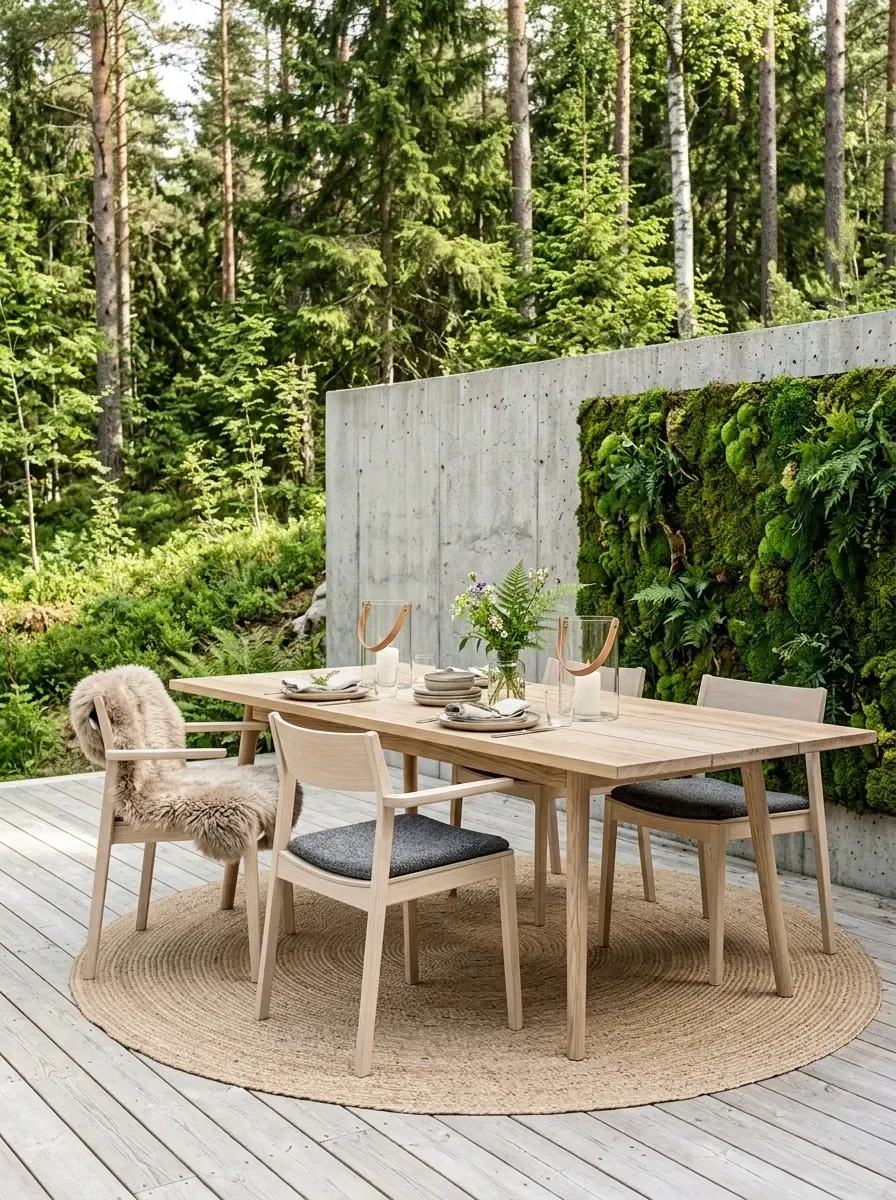
For a weekend cabin in the woods outside Nashville, this concept is a dining moment that feels Nordic: cool, quiet, dropped into the trees. The concrete wall is the architectural anchor: board-formed cast-in-place concrete with cedar-board impressions, integrated with a Garden on the Wall preserved live moss panel at center ($12,500 for the wall, $4,800 for the moss installation). Decking is bleached western red cedar 5/4x6 planks finished with Penofin Verde Bleach ($14/sq ft installed). Table is the Crate & Barrel Big Sur Natural 86" Extension Dining Table in solid white oak ($2,499). Chairs are six Crate & Barrel Big Sur Dining Chairs in oak ($499 each) with Sunbrella Charcoal seat cushions custom-made ($120 each). Throw is a Stokmark Genuine Sheepskin ($289). Rug is the Anji Mountain Round Braided Jute 6' ($229). Candle holders are CB2 Camille Glass Hurricanes with sealed bases ($79 each).
Grey and pale wood dominate this deck. The wall is Board-Formed Concrete (#9A9A9A), raw against the birches and pines, with the moss panel set into its right side, and the table and chairs are Bleached White Oak (#E3D5C0), sanded almost blond. The seat pads in Charcoal Sunbrella (#4B5563) give the only dark note and hide spills after dinner, and the Bleached Cedar Deck (#D1D5DB) is a soft silver-grey that matches the birch trunks behind.
In the rendering, the oak table sits on a round braided jute rug laid over the 5/4x6 bleached cedar boards, with chairs on both sides, each with a charcoal seat pad and one with a sheepskin thrown over its back. Two glass hurricanes with leather handles flank a jar of ferns and wildflowers on the table. Behind, the board-formed concrete wall runs the length of the deck and the preserved moss panel fills its right-hand end, with forest on every other side.
The total for the woodland deck is $17,350–$32,750, and the wall is the expensive part: the Board-formed concrete wall + live moss insert alone runs $9,000–$16,000, and with Bleached cedar plank decking at $4,500–$9,000 the two make up about 76% of the high estimate. The concrete and moss line also has the largest swing, which makes it the first written quote to get.
Furnishing the deck takes $1,800–$3,500 for the Light oak outdoor dining table, $1,600–$3,200 for Oak dining chairs with cushions (x4–6), $150–$350 for the Genuine sheepskin throw, $200–$450 for the Round braided jute rug 6' and $100–$250 for Glass hurricane candle holders (x2).
Use preserved moss for the wall insert rather than living moss. Garden on the Wall, MossPure and Moss Acres all sell panels stabilized with glycerin that need no water or light, whereas living moss needs irrigation and partial sun and rarely makes it past year two. For the decking, apply Penofin Verde Bleach in two passes a week apart and finish with a clear UV topcoat; one pass tends to look streaky, and two give the even silvered cedar seen in the image.
Treat the sheepskin as a dinner prop, not an outdoor textile. Drape it over one chair for the meal, as in the rendering, and put it away in a covered teak box afterward, because one thunderstorm will ruin it. The round jute rug is centered under the rectangular table on purpose: the curve breaks the strict symmetry of table and chairs, a very Nordic move, where a rectangular rug would make the setting look like a standard suburban patio.
9. Urban Rooftop Fire Pit Lounge
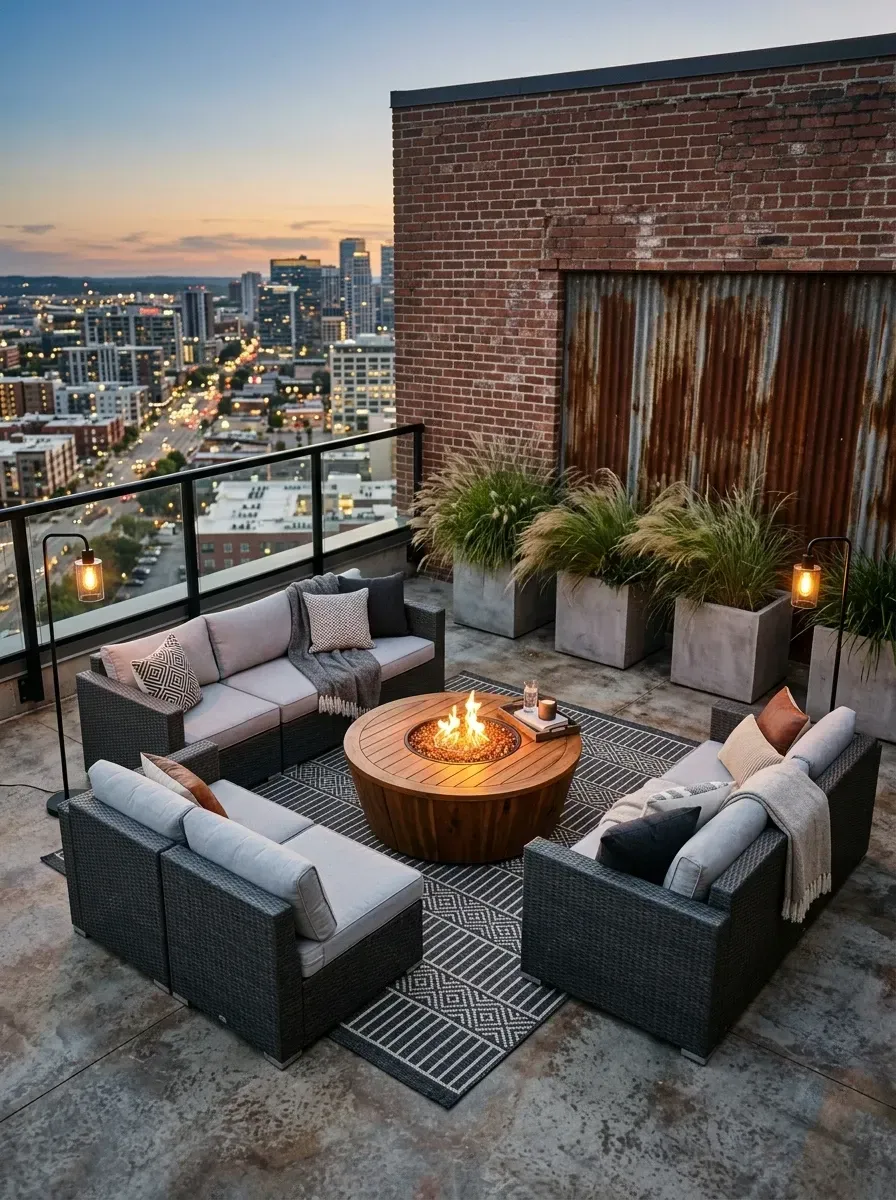
Take a converted Atlanta warehouse loft with a 600-square-foot rooftop slab and a skyline view that never gets used. The architectural move is the Corten partition: corrugated weathering steel panels on a galvanized steel frame, allowed to oxidize naturally for six months before sealing with Permalac NT Matte (about $6,800 installed by a metal fabricator). Floor is the existing concrete slab, polished and stained with Brickform Cobblestone color hardener ($8/sq ft, a weekend job). Sectional is the Ballard Designs Suzanne Kasler U-Sectional in Espresso Polywood-style resin wicker ($5,890) with Sunbrella Cast Slate cushions. Fire pit is the Outland Living Mega Gas Fire Pit with Teak Base ($1,890), with a natural gas line tied into the building's roof manifold (about $1,400 in plumber labor). Rug is the Surya Hagen Charcoal/Ivory Indoor/Outdoor 8x10 ($398). Planters are three Crescent Garden Madison Tall Concrete ($389 each) with ornamental switchgrass. Lamps are two Schoolhouse Electric Cage Edison Outdoor Floor Lamps ($389 each).
The rooftop takes its colors from what was already there. The warehouse wall is Exposed Brick (#9C5A3C), and the sectional's resin weave is Espresso Wicker (#374151), which in the rendering reads as a dark slate grey that hides city grime. The corrugated partition adds Corten Rust (#B54133) streaked against the brick, and the floor is Stained Concrete (#9CA3AF), mottled enough that wear and water marks blend in.
Seating forms a U around the round gas fire pit: three pieces in dark resin wicker with pale grey cushions, all on a black and white geometric rug. Behind them the original brick wall holds the corrugated Corten panel, with tall concrete planters of ornamental switchgrass lined up in front of it. Two lantern-style floor lamps stand at the outer corners, one beside the glass railing that looks out over the skyline.
This rooftop is estimated at $13,000–$27,100. Unusually, the biggest single line is furniture: the U-shaped resin wicker sectional (7pc) at $4,500–$9,000, followed by Stained concrete rooftop flooring at $3,000–$6,000, together about 55% of the high figure. The sectional's range is also the widest, so compare suppliers on it before anything else.
The fire and the screen come next, with $2,000–$4,000 for the Round gas fire pit with teak base and $2,500–$5,500 for the Corten corrugated privacy partition. Smaller lines cover $250–$600 for the Geometric outdoor rug 8x10, $450–$1,200 for Tall concrete planters (x3) and $300–$800 for Industrial cage Edison floor lamps (x2). The rendering shows four planters, so budget for one more if you copy it exactly.
Before any of this goes up, get the roof's load rating from the building engineer. Older Atlanta warehouse roofs are often rated around 60–80 psf live load, which resin wicker handles easily, but concrete planters full of wet soil and a heavy fire pit add up quickly. Run the fire pit on the building's natural gas line instead of propane: propane tanks on a roof violate code in most metro areas, and a visible tank spoils the setting. Allow $1,200–$2,000 for the gas tie-in.
Let the Corten weather for at least six months before sealing, since sealing early fixes the color at a pale orange instead of the deep rust in the image. Once the color settles, Permalac NT Matte is the topcoat to use; cheap clear sealers yellow. The floor lamps should have damp-rated wiring and shatterproof bulbs, because decorative Edison bulbs without a UL outdoor rating crack in temperature swings and can fail early.
10. French Country Garden Patio
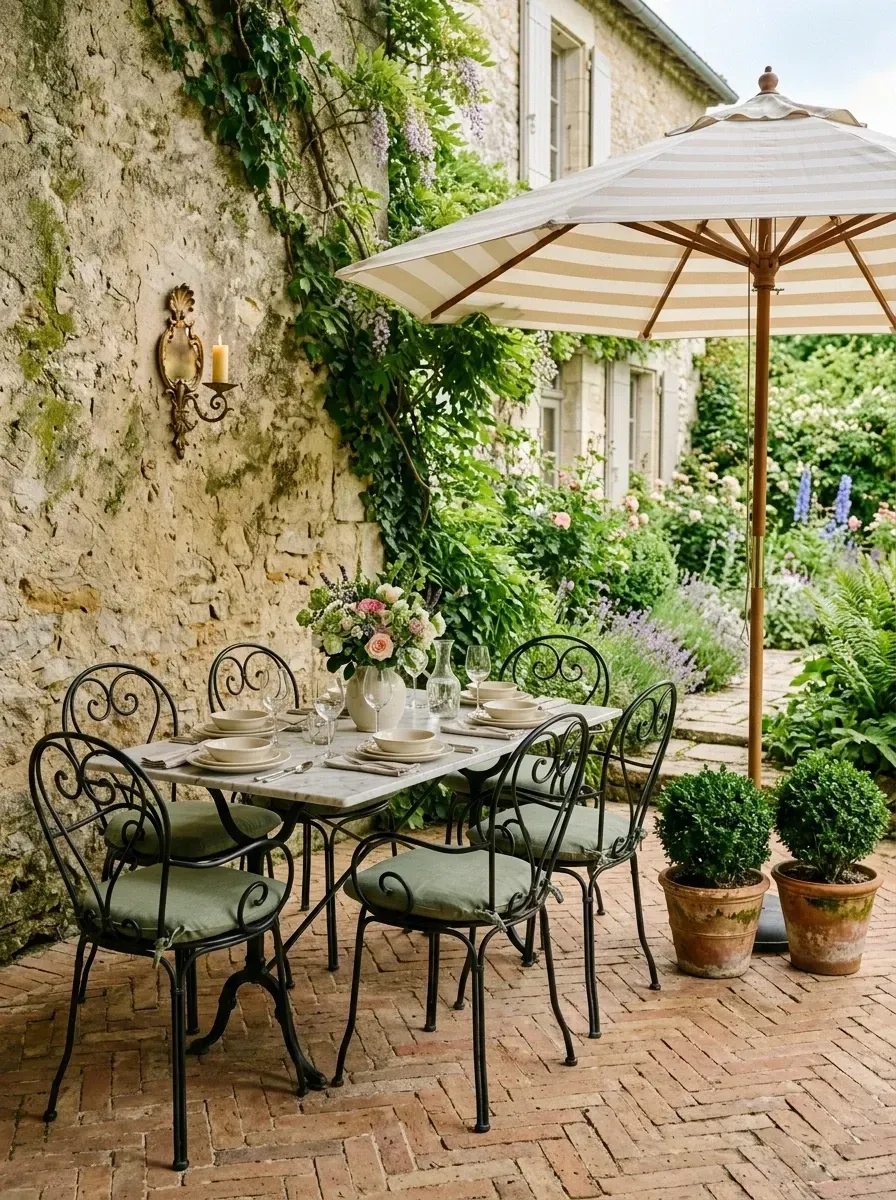
For a Georgetown-style townhouse with a 14-by-22 walled rear garden, this concept is a French country dining moment: provincial, slightly worn, set to host a Sunday lunch for six. The architectural shell does most of the heavy lifting, an aged limestone wall with climbing English ivy and wisteria. Flooring is handmade Pine Hall Pathway Brick in Autumn laid in herringbone over a sand-set base ($14/sq ft installed by a brick mason). The table in the rendering is a rectangular carrara marble top on a wrought iron base; the round option we priced is the Restoration Hardware Antibes Wrought Iron Round Dining Table 60" with carrara marble top ($1,890), paired with six RH Antibes Side Chairs ($389 each). Cushions are custom in Sunbrella Sage ($85 each). Umbrella is a Frankford Beach Umbrella 9' Octagon in a taupe and cream stripe on a wood pole ($590). Sconce is the Hubbardton Forge Saratoga Outdoor Candle Wall Sconce in dark brass ($589). Planters are vintage terracotta from estate sales ($120–$240 each) with mature boxwood spheres.
The wall sets the mood: Aged Limestone (#C6BFA8), a soft greige rubble stone with patches of moss and decades of weathering. The scrolled chairs and table base are Forged Iron Black (#2F2F2F), drawn as fine dark lines against that stone, and their cushions in Sunbrella Sage (#8A9A7B) match the boxwood balls and the ivy. Underfoot, Herringbone Brick (#C17A53) gives a warm terracotta base that keeps all the grey and green from going cold.
The setting in the rendering is a walled corner beside a limestone house: ivy and wisteria climb the stone, an ornate brass candle sconce hangs on the wall above the table, and a striped canvas market umbrella shades one end. The table is a rectangular marble top on an iron base, ringed by six scrollwork chairs with sage cushions, and two vintage terracotta pots of clipped boxwood sit at the umbrella's foot. The brick runs out to a path edged with roses, lavender and delphiniums.
The French patio comes to $7,850–$16,450. The Herringbone brick patio at $3,500–$7,500 and the Wrought iron dining chairs (x4–6) at $1,800–$3,600 make up about 67% of the high estimate, and the brick, with the largest pricing swing, is where an early written quote from a mason pays off.
The table costs nearly as much as the chairs, at $1,800–$3,500 for the Wrought iron dining table with marble top. The rest is small: $300–$700 for the Striped canvas market umbrella, $150–$400 for the Antique brass candle wall sconce, $150–$400 for Weathered terracotta boxwood planters (x2) and $150–$350 for Outdoor tableware and floral arrangement.
The brick matters more than anything else in this design. Handmade brick from Pine Hall Pathway, Old Carolina Brick or Glen-Gery has slight irregularities that look old, whereas machine-extruded brick looks like a 1995 builder spec, and the difference is roughly $3/sq ft. Lay it in true herringbone, as shown, with a 1.5-inch sand-set joint and a full mortar perimeter. Stack bond and basketweave both look more modern, and herringbone is the pattern with the historic weight French country needs.
Choose real wrought iron over powder-coated aluminum made to look like it. Aluminum weighs about 60% as much, light enough that winter wind can carry chairs off an empty patio, and it chips where iron simply patinas. Find the planters vintage at estate sales, where French country terracotta often sells well below retail. Fill them with mature boxwood balls like the pair in the rendering, which look established from the first day.
Practical Tips for Any Outdoor Room
Invest in the architectural shell first, furnishings second. A $3,500 cedar slat wall, a $6,000 stucco perimeter or a $9,000 pergola will outlast every piece of furniture you buy, and it is what makes the photograph compelling. Spend the architectural budget at the start and rotate the cushions and rugs over time. Within that shell, scale up the outdoor lighting. A pendant or lantern that looks oversized indoors looks correctly sized outdoors, because the eye reads exterior scale against the sky, not a ceiling, so a 24-inch pendant indoors becomes a 36-inch fixture in an outdoor room. Visual Comfort, Hubbardton Forge and Cedar & Moss all publish damp-rated versions of their interior lines. Plan the lighting in three layers as well: overhead (pendant or string lights), eye-level (wall sconces or lanterns) and surface (table lamps, hurricane candles or tealights on trays). Hit all three planes and the room comes alive after sunset; hit only one and it reads like a porch light.
Materials decide whether the room lasts. Always specify outdoor-rated fabrics and finishes, with no exceptions. Sunbrella, Outdura and Crypton Outdoor are the only performance fabrics we would spec on exterior cushions, since indoor cottons and linens mildew within one Southern summer. Sealed teak, powder-coated aluminum and HDPE resin are the only frame materials that survive 10+ years; everything else is on a five-year clock. For variety, mix four material families: concrete, wood, metal and textile. Outdoor rooms feel flat when they are all one material. The Mediterranean terrace works because it pairs stone (paver), wood (table), rattan (chair), terracotta (urn) and stripe (rug); the cedar deck works because it pairs cedar (wall), composite (floor), aluminum (sofa), concrete (table) and brass (lantern).
Finally, define functional zones with outdoor rugs, even on decks and patios. A polypropylene rug under a dining table or in front of a sectional creates the same intentional flow as an interior room. Without one, even excellent furniture floats and reads as patio furniture on concrete.
Where to Cut the Budget Without Losing the Look
The largest saving is underfoot. Use concrete pavers or stamped concrete in place of natural stone or custom tile. A stamped concrete patio runs $14–$22/sq ft installed versus $36–$48 for travertine or bluestone; the visual difference from across the yard is small, while the budget difference is roughly 60%. Walls and screens come next. Build cedar or pressure-treated pine privacy screens instead of custom masonry or board-formed concrete: a 14-foot PT pine screen with stain runs $1,400–$2,100 in materials and a weekend of labor, and the same length in board-formed concrete runs $5,500–$8,000. For green walls, train fast-growing climbers (Eden roses, Confederate jasmine, English ivy, Boston ivy) to cover walls naturally rather than installing preserved-moss or living-wall systems. A $42 nursery vine that fills a 60-square-foot wall in three seasons is functionally equivalent to a $4,800 preserved-moss panel.
Furniture is the second place to save. Choose Polywood, Loll Designs or Yardbird over Restoration Hardware, Sutherland or Brown Jordan. Recycled HDPE construction holds color through the warranty period, never warps, and runs roughly 40–60% of the luxury-line equivalents. If the existing set is sound, buy outdoor-safe slipcovers from Sunbrella's licensed makers (Ballard, Sailrite custom shops) to dress existing furniture rather than buying a full new weatherproof set; a $400 set of slipcovers extends an existing patio set by 6–8 seasons.
Accents reward patience. Source vintage wrought iron, brass and terracotta from estate sales, architectural salvage yards and auction liquidations. Vintage Lutyens benches, antique Italian Impruneta urns and French zinc planters land at 30–50% of retail.
Regional Fit Across Southern Markets
Each of these ten rooms is a design concept, and what it costs to build depends on where you live. The multipliers that follow cover labor, masonry availability and delivery overhead, since product list prices barely change between markets, and the style notes are our read of which directions suit each city.
Charleston, SC is the 1.00x baseline, and the directions that suit it best are the Mediterranean terrace, nautical poolside and Moroccan riad. Below it, Nashville, TN is the least expensive market at 0.91x, with the Scandinavian woodland deck and the English cottage nook as its strongest fits. Charlotte, NC sits at 0.92x and leans toward the cedar deck lounge and the Japanese balcony. Savannah, GA comes in at 0.94x, favoring the English cottage nook and the French country patio, and Atlanta, GA runs closest to baseline at 0.97x, where the cedar deck lounge and the rooftop fire pit are the strongest fits.
The two markets above baseline differ in taste. Naples / Ft. Myers, FL runs 1.08x and shares Charleston's appetite for the Mediterranean terrace and nautical poolside, adding the Southwest courtyard. The Washington DC metro is the most expensive at 1.12x, and its best fits are the Japanese balcony and the French country patio. The same design priced in Washington will cost noticeably more than it does in Nashville, so apply the local multiplier before you set a budget.
Market multipliers are drawn from the RSMeans 2026 City Cost Indexes for residential masonry, carpentry and outdoor electrical work; the style preferences are an editorial judgment, not survey data.
Questions Worth Asking
Which of these ten outdoor rooms is the most beginner-friendly to recreate?
The English cottage garden nook and the French country garden patio are the most achievable for a homeowner over a long weekend: a teak Adirondack or a wrought-iron table, a brick or stone hardscape that already exists, and the climbers plus pots. The Moroccan riad, the Scandinavian deck (with the moss wall), and the Southwest courtyard all require licensed masonry, framing, or specialty plaster trades and are not DIY projects.
What's the most-overlooked cost in outdoor design?
Drainage. A patio that pools water in heavy rain becomes a mildew, mosquito, and masonry failure problem within three years. Budget for proper grading, French drains, or permeable paving as a hard line item: typically 8–12% of the total hardscape cost in any flat-grade Southern market, and closer to 15% in Charleston and Naples where the water table is high.
How long do outdoor furniture pieces actually last in Southern climates?
Polywood and recycled HDPE: 20+ years (manufacturer warranty). FSC grade-A teak: 25–40 years with annual gentle pressure washing. Powder-coated aluminum: 10–15 years on the coast, 20+ years inland. All-weather wicker on aluminum frame: 8–12 years. Real wrought iron: 12–20 years with annual touch-up paint. Sunbrella, Outdura, and Crypton Outdoor cushion fabrics: 10-year solution-dyed color warranty.
Do you need permits for any of this?
Loose items such as furniture, rugs, planters and pots need no permit. Hardscape over 200 square feet usually does, any new gas line for a fire pit does, and a pergola over 12 feet tall or any roofed structure typically does. In the historic districts of Charleston, Savannah, Naples and Georgetown, visible exterior changes also go before the Board of Architectural Review, which can add 4–8 weeks to the schedule.
Can a balcony or rooftop actually support a stone fire pit or large planter?
Most residential balcony slabs are rated for 40–60 pounds per square foot live load; converted-warehouse rooftops are usually 60–80 psf. A 24-inch terracotta planter with saturated soil exceeds 60 psf, and a stone fire pit certainly does. Pull the building's structural drawings and check with the engineer before specifying anything heavier than fiberglass planters with lightweight soil mix.
Which of these directions is the most year-round usable in Southern markets?
The Mediterranean terrace, the French country patio, and the nautical pool deck all work nine months a year in zones 8 and 9 without modification. The Moroccan riad and Southwest courtyard extend to year-round with the addition of patio heaters. The Japanese balcony and Scandinavian dining deck are the most weather-sensitive; they read best in spring, fall, and mild summer mornings.
Are the specific brand recommendations the only options that work?
No. Product lines change and get discontinued, and a store near you may carry an equivalent under another name. We named these pieces because in 2026 they strike a reasonable balance of quality, lead time and weather resistance; treat them as a benchmark for each price level and substitute freely.
What's the single most-common mistake people make in outdoor design?
Buying indoor-rated fixtures and fabrics and hoping they'll survive outdoors. Pendant lights stamped "for damp locations" can be installed under a covered pergola; pendants without that rating cannot. Pillows in pure cotton or linen mildew within one season; pillows in Sunbrella, Outdura, or Crypton Outdoor hold for ten years. The price difference between indoor and outdoor-rated is usually 15–25%; the lifecycle difference is 5–10x.
Sources & References
- Sutherland Furniture: Great Lakes Reclaimed Teak Dining Table specifications and Burmese FSC teak grading.
- Brown Jordan: Aurora Aluminum Chaise dimensions and Sunbrella Canvas cushion compatibility.
- Restoration Hardware (RH): Aviara aluminum L-sectional, Castelle sling chair, and Antibes wrought iron dining set construction.
- Article: Corvos and Madera outdoor line specifications and Sunbrella cushion upgrades.
- Crate & Barrel: Big Sur outdoor oak dining table and chair construction notes; Tess walnut and woven stool material guide.
- CB2: Fuze concrete coffee table and Smart Round side table outdoor ratings.
- Serena & Lily: Riviera outdoor chair rattan grade and Coronado rattan pendant damp-rated installation guidance.
- Pottery Barn: Malta recycled-glass lantern and Khan pierced-brass pendant installation details.
- Ballard Designs: Suzanne Kasler Cane Trunk and Suzanne Kasler U-Sectional resin wicker specs.
- West Elm: Tall Hourglass and rectangular outdoor planter UV ratings.
- Polywood, Loll Designs, Yardbird: recycled HDPE construction, 20-year residential warranty terms, and color fastness data.
- Visual Comfort & Co.: Crystal Bottle table lamp, O'Brien Hicks pendant, and damp-rated cord upgrade procedures.
- Hubbardton Forge: Saratoga outdoor candle wall sconce wet-location rating.
- Cedar & Moss: damp-rated junction box specs for retrofitting indoor pendants for outdoor use.
- Hinkley Lighting: Saybrook polished brass wall sconce wet-location rating.
- Sunbrella: Yacht Stripe, Cast Charcoal, Canvas Natural, and Sage performance weave specifications with 10-year color warranty.
- Pendleton: Glacier National Park outdoor-grade pillow fabric construction.
- Anji Mountain: natural jute and braided round rug durability ratings for covered outdoor use.
- Dash & Albert and Lulu & Georgia: Salem Stripe and Aliki Kilim indoor/outdoor polypropylene rug construction.
- Loloi II: Tahari and Hagen geometric indoor/outdoor rug warranty and fade-resistance specs.
- TimberTech AZEK: Vintage Collection Dark Hickory composite deck installation guide and ASTM E84 fire rating.
- Bison Innovative Products: interlocking IPE wood tile load and drainage specifications.
- TWP 1500 and Penofin Hardwood Formula: exterior cedar and cypress sealing and maintenance intervals.
- Pine Hall Brick: Pathway Brick handmade clay paver line and herringbone installation guide.
- Daltile: Emerson Wood porcelain plank balcony pedestal installation.
- Zia Tile: handmade zellige mosaic installation specifications and grout compatibility.
- Garden on the Wall and Moss Acres: preserved live moss panel construction and zero-maintenance guidance.
- Tuuci: Ocean Master Mega Max cantilever umbrella construction and salt-air tolerance.
- Frankford Umbrellas: striped canvas market umbrella construction and brass pole hardware.
- Outland Living: Mega Gas Fire Pit teak base and natural-gas line tie-in specifications.
- RSMeans 2026 City Cost Index: regional labor and material multipliers for residential masonry, carpentry, and outdoor electrical trades.
- The Layered Homes editorial team: 2026 outdoor concept notes and cost estimates for Charleston, Savannah, Atlanta, Charlotte, Nashville, Naples, and the DC metro.
Making an Outdoor Space Read as a Room
None of these ten outdoor rooms is the right outdoor room. They are ten answers to ten different questions: where do you host Sunday lunch, where do you read in the morning, where do you meditate after work, where do you gather around a fire after dinner. Get the question right and the room nearly designs itself; get it wrong and the pergola, the travertine, and the carved walnut daybed are all decoration in search of a purpose.
The thread that runs through every direction above is the same: design the outdoor room with the same architectural rigor you'd give a living room. Build the shell to last twenty years, layer the textiles like furniture, light it in three planes, and treat the climate as a co-designer rather than an obstacle. That's the difference between a patio that gets used six times a year and an outdoor room that becomes the favorite room in the house.
For more outdoor ideas, see ten outdoor garden design ideas broken down by style, our backyard before-and-after concepts, thirteen more backyard transformations, including some of the toughest starting points, and eleven rooftop transformations if your outdoor space is up on a roof.
The Layered Homes editorial team
Styling & Living Desk
The Layered Homes editorial teamThe Styling & Living Desk produces the room-by-room guides, outdoor and garden pieces, celebration ideas and design solutions, each with an itemised cost estimate, and the Home Files essays.
More from the Styling & Living Desk →
Reader notes