


Outdoor spaces across the Southeast range from Charleston single-house courtyards to deep wraparound porches in Beaufort and small Atlanta in-town gardens. The lesson worth repeating: the most photographed outdoor rooms online were not built for the Southern climate. Stucco molds, white gravel greens over by August, Pinterest-favorite olive trees freeze inland of Charleston, and pergola wood that looks beautiful in California needs a maintenance schedule in the South. This guide walks through ten layered outdoor directions we would genuinely recommend (covered patios, fire-pit decks, courtyards, balconies, and pool lounges) with honest cost ranges and the Southern adjustments worth making before you buy a single piece of furniture.
What's in This Guide
- Serene Japanese Zen Garden
- Modern Farmhouse Covered Patio
- Layered Backyard Cinema with Cabana
- Sleek Contemporary Patio Lounge
- Rustic Mediterranean Courtyard
- Cozy Boho Garden Nook
- Panoramic Luxury Deck with Fire Pit
- Tropical Resort Poolside Lounge
- Minimalist Japanese Tea Garden
- Vibrant Urban Balcony Garden
- Pro Tips for Every Outdoor Space
- Real Cost-Saving Moves
- Frequently Asked Questions
- Sources & References
- Start Small and Edit Over a Season
1. Serene Japanese Zen Garden
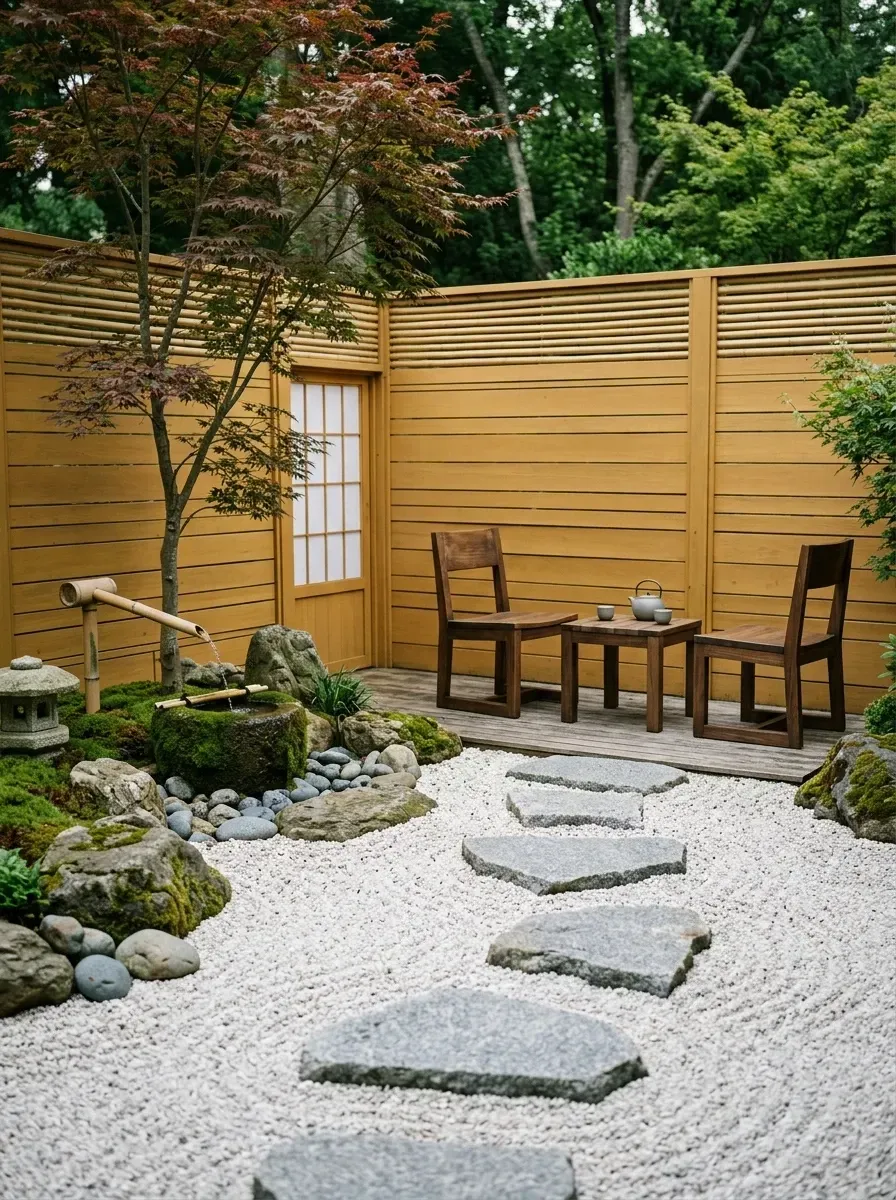
A meditative side yard built around raked white gravel, granite stepping stones, and a bamboo spout that drips into a moss-covered stone basin. The bamboo-topped wooden fence, shoji-style door, and small wooden deck create the enclosure that makes this style feel like a real room rather than a landscape gesture. Two honest Lowcountry adjustments: the white gravel will green over within one humid summer unless you choose a tighter-grained crushed marble and refresh the surface every spring; and a true Japanese maple (Acer palmatum) needs morning sun and afternoon shade in Southern heat, otherwise the leaves crisp by July. Substitute a coral bark maple for the same architectural silhouette with better heat tolerance.
What Makes the Zen Garden Work
The garden is defined at its edges by bamboo panel fencing, with a shoji-style door for the enclosure that tells you, before you step in, what kind of space this is. Inside, a raked white gravel field with granite stepping stones forms the quiet center.
Living and moving elements sit around that field: the bamboo spout and its stone basin for sound, a granite lantern at the edge of the moss, and a moss garden with a Japanese maple specimen for softness and seasonal color. A small wooden deck with two dark wood chairs and a low tea table gives you a place to sit and take it all in.
Priced line by line, this garden comes to $4,880 to $10,550, and most of that money goes into the enclosure and the planting rather than the furniture. Bamboo panel fencing & installation (~30 linear ft) runs $1,500 to $3,000 and Landscaping (moss, ferns, specimen maple) another $1,000 to $2,500, about 52% of the high figure between them. The fence also carries the widest spread, so a written fencing quote is what will tell you which end of the range you are on.
The built pieces come next: the Custom shoji-style door at $800 to $1,500 and the Small wooden deck platform at $500 to $1,000, which is the only level surface in the garden and the reason the chairs look placed rather than parked. Seating is modest by comparison, with $300 to $700 for the Minimalist wooden chairs (×2) and $80 to $200 for the Small wooden side table that holds the tea set in the rendering.
Stone, water and gravel cost less than they look. The Granite stone lantern (tōrō) is allowed $250 to $600, the Bamboo water feature (shishi-odoshi) & basin $150 to $350, the Large granite stepping stones (×8) $200 to $400, and the White landscape gravel (bulk) only $100 to $300, though gravel is also the line you pay for again each spring when the surface is topped up.
Four colours do all the work here. Warm Bamboo (#D9A864) covers the fence boards and the deck, a honey tone that wraps the yard on two sides, and Clean White (#F0F0F0) is the raked gravel standing in for water. Natural Grey (#808080) belongs to the granite stepping stones, boulders and lantern, while Dark Wood (#4B3621) shows up in the two chairs and the tea table, the only dark note against all that pale timber.
Rake the gravel in curves around the moss islands and boulders rather than in straight rows, since the curves are what make it read as water, and plan on a yearly refresh in a humid Southern yard. Keep the furniture to the two chairs and one low table shown; the empty gravel field is the design, and a third seat starts to turn the garden into a patio.
2. Modern Farmhouse Covered Patio
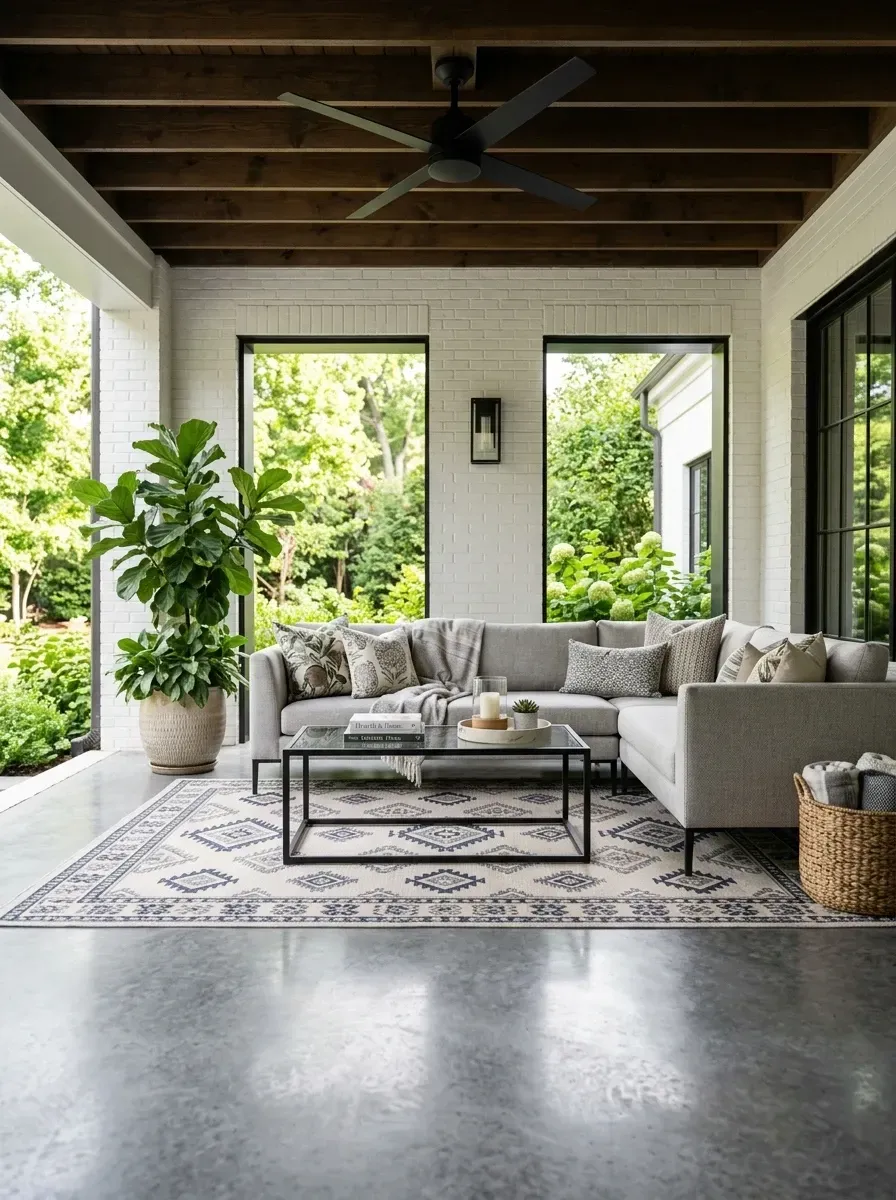
A genuinely livable covered patio: white painted brick walls, a dark wood plank ceiling with a slim-blade fan, a large L-shaped sectional, and a patterned rug over polished concrete. This is the outdoor room that suits homes in places like Mount Pleasant, Greenville, and Nashville: covered enough to use through Lowcountry summer storms, open enough to feel like exterior space. The fiddle leaf fig in the renderings will struggle outdoors below about 50°F overnight; for the same dramatic vertical green, use a fiddle leaf only for warm-season styling and rotate in a Southern magnolia or a tall Sago palm for year-round structure. Specify the rug as 100% solution-dyed olefin or polypropylene, because natural fiber rugs mildew within one humid season under a covered patio.
What Makes the Covered Patio Work
The shell does most of the work here. White painted brick perimeter walls keep the patio bright even under a roof, and the dark stained wood plank ceiling above them, fitted with a low-profile fan, gives the space a lid that feels like a real room rather than a carport. Underfoot, a polished concrete floor shrugs off rain blown in sideways and cleans with a hose.
Inside that envelope, a large L-shaped outdoor sectional sets the seating plan and defines the conversation corner. Black-framed windows or screens tie the patio back to the modern farmhouse language of the house, and one statement potted plant supplies the vertical green that keeps all that white and dark wood from reading flat.
Furnishing this covered patio is estimated at $2,860 to $6,990 in 2026 dollars, and the sectional decides most of it. The Large L-shaped sectional sofa alone is $1,500 to $3,500, and with the Large patterned outdoor area rug (olefin) at $300 to $800 the two pieces make up about 62% of the upper total. Because the sectional's range is also the widest, its size and fabric grade are the first things to pin down with a supplier.
Around the sofa, the Metal-frame coffee table with glass top is allowed $200 to $500 and the Large statement plant in planter $150 to $400, a sum that covers the fiddle leaf fig in the rendering or one of the hardier substitutes. Overhead and on the brick, the Modern outdoor-rated ceiling fan takes $250 to $600 and the black lantern-style Outdoor wall sconce $80 to $200.
Softer pieces finish the room for comparatively little: $210 to $560 for the Assorted throw pillows (×7) in grey, cream and botanical prints, $30 to $80 for a Throw blanket, $40 to $100 for the Woven storage basket beside the sectional, and $100 to $250 for Coffee-table styling (tray, books, candle, plant).
The colour plan follows the architecture. Crisp White (#FFFFFF) on the painted brick bounces light back under the roof, and Dark Walnut (#3D2B1F) on the plank ceiling gives the room its weight overhead. Between them sit the Polished Concrete Grey (#9E9E9E) floor, glossy enough in the rendering to mirror the sofa, and the Light Greige (#C0B2A6) upholstery that keeps the sectional from looking either cold or yellow next to the concrete.
Two details decide whether this room works. The rug matters more than it seems, because without a defined footprint the sofa floats on a sheet of grey concrete, so size it to run under the front legs of the whole L. The fan should be a slim-blade, outdoor-rated model, since interior fans corrode within two years in coastal humidity, and the mix of painted brick, stained wood, black metal and the woven basket is what keeps a neutral scheme from going flat.
3. Layered Backyard Cinema with Cabana
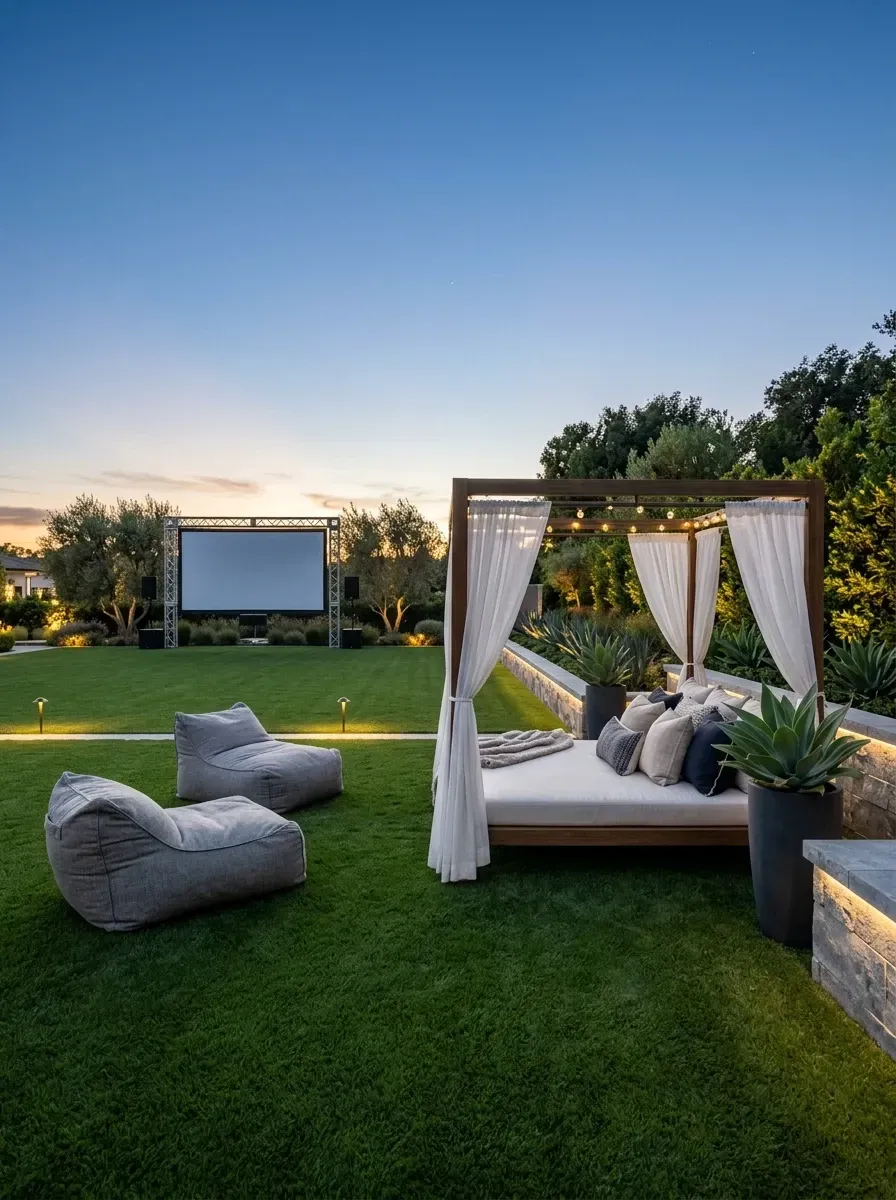
A wooden cabana with a deep daybed, flowing white curtains, an outdoor projection screen on a truss frame, and bean bag loungers on the lawn. This is the highest-end version of the backyard cinema and it earns its budget if you actually entertain; it suits households that host at least two parties a season around it. Practical notes: outdoor projectors lose visible contrast under any light pollution, so site the screen with the longest dark sightline available; LED retaining-wall strip lighting needs an outdoor-rated, IP67-sealed driver, not the indoor strip sold for shelves and kitchen cabinets; and the cabana curtains should be UV-stable solution-dyed acrylic or olefin, because cotton turns pink in three months under Southeast sun.
What Makes the Backyard Cinema Work
Everything in this cinema points at the large outdoor movie screen on its truss frame, so the screen is the first thing to place and the lawn follows from it. A manicured lawn footprint serves as the viewing zone, which means the grass itself is part of the seating plan and has to be kept level and mowed short.
The wooden cabana with a built-in daybed is the premium seat, softened by flowing UV-stable outdoor curtains that also block stray light from the house. Bean bag loungers fill in as flexible secondary seating for guests who arrive late or bring children. Behind it all, a stone retaining wall with integrated LED strip lighting holds the slope and gives people enough light to find their way without washing out the picture.
Priced from what is visible in the rendering, the cinema lands between $9,650 and $22,450. Two built elements account for about 56% of the upper figure: the Custom wooden cabana structure at $3,000 to $7,000, the canopy frame that holds the daybed and its curtains, and the Stone retaining wall with IP67 LED lighting (~30 ft) at $2,500 to $5,500. The cabana carries the widest swing of any line, so a written quote for it should come before anything else is ordered.
On the viewing side, the Outdoor movie screen on truss frame is set at $1,500 to $3,500, and the seating that faces it splits between the Outdoor daybed mattress & cushions at $800 to $1,500 and the Outdoor bean bag loungers (×2) at $400 to $900. The UV-stable outdoor curtains (×4), one panel per post of the canopy, are a modest $200 to $500.
The Outdoor projector & sound system is budgeted at $1,000 to $3,000, a range that depends mostly on how bright a projector your sightline demands. Small finishing lines follow: $150 to $300 for the Path lights (×3) along the lawn edge and $100 to $250 for the Large planter with agave or yucca, the black pot of agave at the corner of the daybed.
Medium Oak (#8B6946) is reserved for the canopy frame and daybed base, the only wood in a scene that is otherwise lawn and stone, and Soft White (#F8F8F8) runs through the sheer curtains and the mattress so the cabana glows faintly at dusk. Out on the grass, Textured Grey (#7E8285) on the bean bags hides dew and grass stains, and Light Stone (#C5C6C1) on the retaining wall gives the LED strip a pale face to wash across.
Plan the lighting around the film rather than the party. The retaining wall LEDs and the low path lights let guests find the daybed in the dark, but nothing should shine toward the screen once the projector is running. Keeping the bean bags movable also means the lawn can switch from cinema seating to open space for a standing crowd, while the cabana stays put as the fixed anchor opposite the screen.
4. Sleek Contemporary Patio Lounge
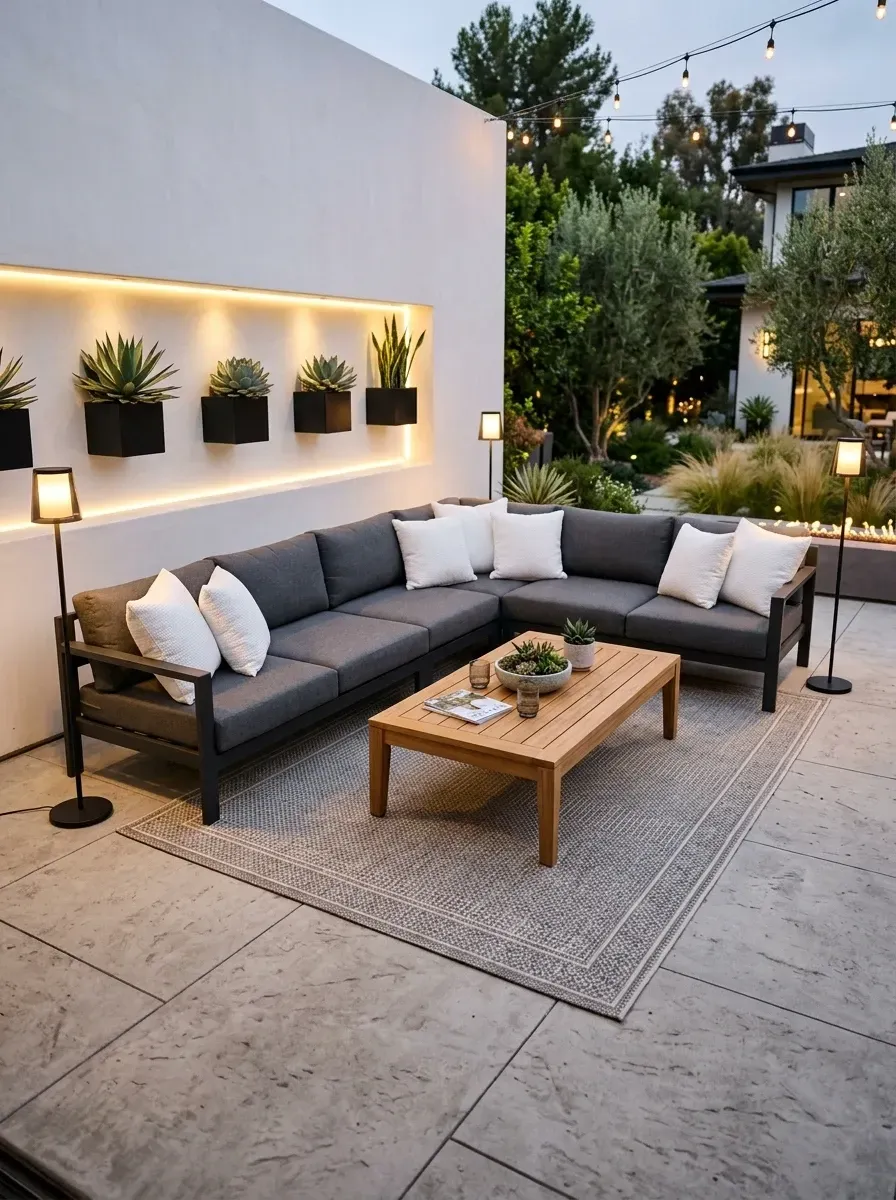
A long white stucco wall with a recessed, warm-lit LED niche holds a row of black cube planters filled with agave and succulents, facing a charcoal aluminum sectional, a teak coffee table, and stamped concrete underfoot. Of the ten directions here, this one leans hardest on architecture: the recessed niche turns a feature wall into a piece of evening lighting design. Two practical notes: stucco walls in the South need an open rainscreen detail and breathable paint or they trap moisture and stain within a year; and aluminum-frame outdoor furniture should be powder-coated for marine environments (look for AAMA 2604 or 2605 spec) if you are within 10 miles of the coast.
What Makes the Stucco Lounge Work
The architecture leads in this lounge. A recessed wall niche lit with a warm IP-rated LED strip gives the stucco a focal point after dark, and wall-mounted modern cube planters add greenery without taking up floor space on a patio that depends on clean lines.
The furniture is a deliberate pairing of materials: a powder-coated aluminum sectional that stands up to coastal air, set against a teak outdoor coffee table that brings the only warm wood into the scheme. A stamped concrete floor carries the modern texture underfoot, and outdoor floor lamps combined with overhead string lights give the space two layers of evening light instead of one.
Itemized, the lounge comes to $4,460 to $10,510, and two lines take about 67% of the top figure: the Aluminum-frame outdoor sectional at $2,000 to $4,500 and the Recessed wall niche construction & LED lighting at $1,000 to $2,500. The niche is building work rather than shopping, so it belongs in the stucco contractor's scope from the start. The sectional has the widest range and is worth specifying in detail (frame finish, cushion fabric, number of modules) before anything smaller is bought.
The Teak outdoor coffee table is allowed $400 to $900, enough for a solid slatted piece like the one in the rendering rather than a veneer. A flat-woven grey Outdoor area rug takes $200 to $500, the Modern wall-mounted cube planters (×4) $200 to $480, and the Modern outdoor floor lamps (×2) with their lantern shades $300 to $700.
The rest is small: $100 to $250 for Commercial-grade string lights (~50 ft) strung over the seating, $210 to $560 for Assorted throw pillows (×7), white against the charcoal cushions, and $50 to $120 for the Coffee table styling (bowl with succulents).
Most of this scene is white and charcoal. Stucco White (#EFEFEF) on the long wall acts as a screen for the niche lighting, and Matte Black/Dark Grey (#333333) on the sectional frames and cube planters draws hard graphic lines against it. Natural Teak (#B38B6D) on the coffee table is the one warm surface, and the stamped Light Concrete Grey (#B0B0B0) floor sits quietly between the two extremes.
Specify the niche strip at 2700K; a cooler white turns the stucco blue-grey and harsh after dark. The string lights above and the lantern-style floor lamps at the sofa ends then give overlapping pools of light instead of a single flat wash. Hold the furniture to the two materials already shown, powder-coated aluminum and teak, because a third finish starts to compete with the wall.
5. Rustic Mediterranean Courtyard
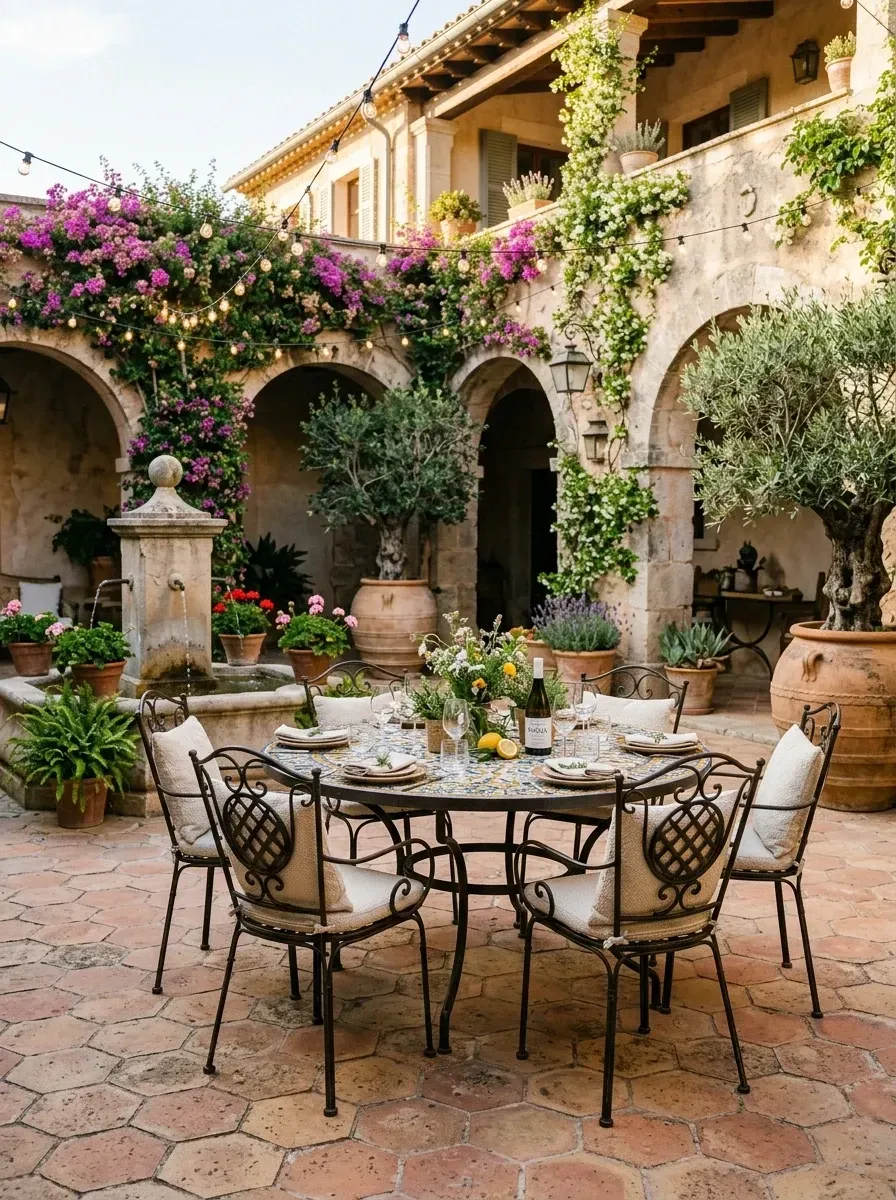
A romantic enclosed courtyard with a mosaic tile dining table, wrought iron chairs, aged stone walls and arches, a stone pillar fountain spilling into a basin, terracotta pots and climbing bougainvillea. Of the ten directions, this is the one that translates best to historic Charleston peninsular courtyards, certain Naples FL builds, and old Savannah carriage-house gardens. The plant note matters here: bougainvillea is genuinely showy but cold-tender. It freezes back at 30°F and dies at 25°F. In Charleston (zone 8b/9a) it is reliable; inland past Columbia, treat it as an annual or substitute confederate jasmine for the same scent and silhouette. Wrought iron rusts; budget a rust-converter primer plus marine enamel topcoat every 3–4 years on coastal lots.
What Makes the Mediterranean Courtyard Work
A mosaic tile dining table is the centerpiece of this courtyard, and the wrought iron dining chairs around it, finished with cushions, keep the meal at the heart of the plan. The stone courtyard walls and arches enclose the space and give it the old-world weight the style depends on, while the stone pillar fountain, with spouts running into a raised basin, adds sound as well as a second focal point.
Planting softens all that masonry. Multiple terracotta planters in graduated sizes step the greenery up and down the walls, and climbing bougainvillea or confederate jasmine covers the stone with color or scent depending on your climate. Bistro string lights overhead finish the room and make it usable for long dinners after sunset.
This courtyard carries an itemized 2026 allowance of $4,320 to $10,600. Water and seating cost the most: Tiered stone fountain & installation at $1,000 to $3,000, a line that also covers a simpler pillar fountain like the one rendered, and Wrought iron dining chairs with cushions (×6) at $1,200 to $2,400, together about 51% of the upper total. The fountain has the widest range because plumbing, a pump and a level footing vary so much from yard to yard, so it deserves the first quote.
The Mosaic tile outdoor dining table, round and tiled in blue, yellow and white in the rendering, is set at $800 to $2,000. Terracotta is split into two lines, $300 to $750 for the Large terracotta planters (×3) that hold the olive trees and $450 to $1,000 for the Medium/small terracotta pots & plants (×15) around the fountain and walls, while Bistro string lights (~60 ft) across the courtyard need only $120 to $300.
The planting that makes the walls feel old, Mature climbing plants (bougainvillea, jasmine, ivy), is allowed $300 to $800; buying them established rather than as starter pots is what saves years of waiting. A Table setting (plates, glasses, centerpiece) at $150 to $350 completes the list.
Here the palette comes almost entirely from the materials. Aged Terracotta & Stone (#C48A69) describes the hexagonal floor tiles, the big jars and the sandy limestone arches together, and Iron Black (#1A1A1A) traces the scrolled chair backs and the table base. The colour lives on the tabletop, where Mediterranean Mosaic (#F4D03F) stands for a pattern of yellows, blues and whites, and Creamy Off-White (#FDF5E6) cushions keep the iron chairs comfortable enough for a long dinner.
Put the money into the table, because the mosaic top carries the whole look and a plain top would leave the courtyard reading as an ordinary patio. Group the terracotta in mixed sizes the way the rendering does, big jars with olive trees beside small pots of geraniums and lavender, so it looks gathered over years. Hang the bistro lights low, around 8–9 ft above the tabletop, to keep the light close to the people eating.
6. Cozy Boho Garden Nook
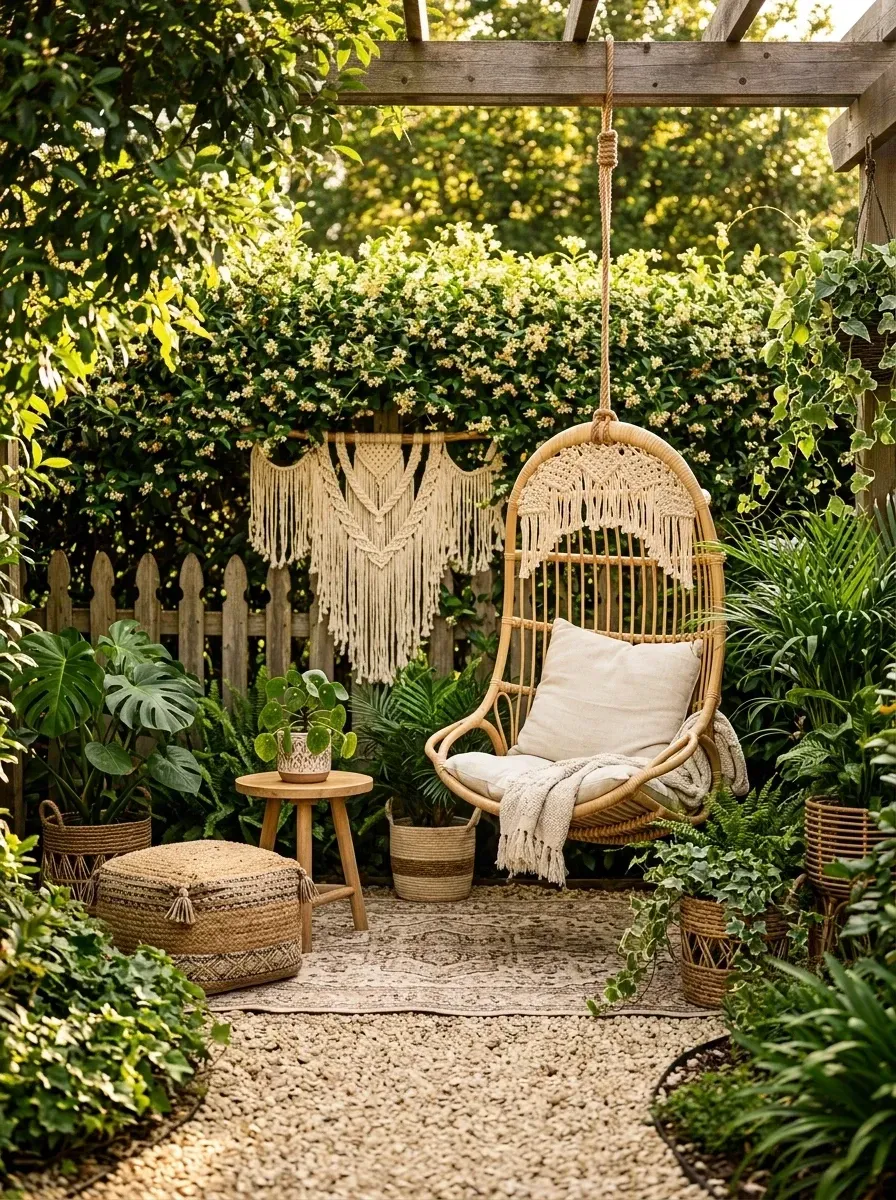
A rattan hanging egg chair as the focal point, roped to the pergola beam and draped with a throw and a linen cushion; a macrame wall hanging on a weathered picket fence; a flat-woven rug over pea gravel; a jute pouf; and an abundance of potted plants under a wooden pergola. This is the easiest direction on this list to execute on a small budget, and one of the hardest to maintain looking good. The macrame and the rug need to come inside or under cover during heavy rain, because they molder fast in Southern humidity. The pothos and philodendrons that fill out the photographed version drop leaves below 50°F, so plan for an indoor migration each November in the Carolinas. For a more durable Lowcountry version, substitute autumn ferns, cast iron plant, and dwarf Loropetalum into the same vessels.
What Makes the Boho Nook Work
This nook is built around a single seat: a rattan hanging egg chair suspended by a rope from the pergola's crossbeam, so that beam has to be sized and fastened for a person's weight, or the chair moved onto a freestanding stand. A large macrame wall hanging behind it gives the corner a backdrop, and a jute pouf offers a footrest or a second perch for a visitor.
The ground plane is handled with a flat-woven outdoor rug laid over pea gravel, an inexpensive way to turn a gravel corner into something that feels furnished. A wooden pergola provides partial shade overhead, and abundant potted plants in mixed vessels fill the edges so the nook reads lush and collected rather than staged.
For the whole nook the listed scope comes to only $1,200 to $2,870 in 2026 dollars. More than half of that is the chair and the greenery: the Rattan hanging egg chair with stand at $350 to $800 and the Assorted potted plants in baskets/pots (×12) at $360 to $800, about 56% of the upper figure. The chair line includes a stand; hanging it from the pergola as the rendering does drops that part but adds a check of the beam, and its range is wide enough to settle first.
Around the chair, the Large macrame wall hanging is allowed $80 to $200, the Jute pouf/ottoman $60 to $150 and the Small wooden side table that holds a potted pilea in the rendering $50 to $120. Layered outdoor rugs (×2) take $150 to $400, though the rendering gets by with a single one.
The floor itself is the cheapest part: Pea gravel flooring (small area) costs $50 to $150, and the Throw blanket & pillows for chair another $100 to $250.
Everything in this corner is a shade of natural fibre. Natural Rattan & Wood (#C7A985) covers the egg chair, the side table and the woven baskets, and Cream & Off-White (#F2EBD5) repeats in the macrame, the seat cushion and the fringed throw. Lower down, Natural Jute/Tan (#BFA888) on the pouf and rug adds a slightly darker band, and Light Gravel (#DCDCDC) underfoot drains quickly after rain and keeps the whole floor pale.
Let the hanging chair be the single star and keep every other piece low and plain. Texture does the decorating in place of colour, so mix jute, macrame, basketweave and linen rather than adding patterned cushions. Group the pots in odd numbers (3, 5, 7) at different heights, the way the monstera, ferns and ivy step up around the chair here, and the corner reads as jungle without a single expensive specimen.
7. Panoramic Luxury Deck with Fire Pit
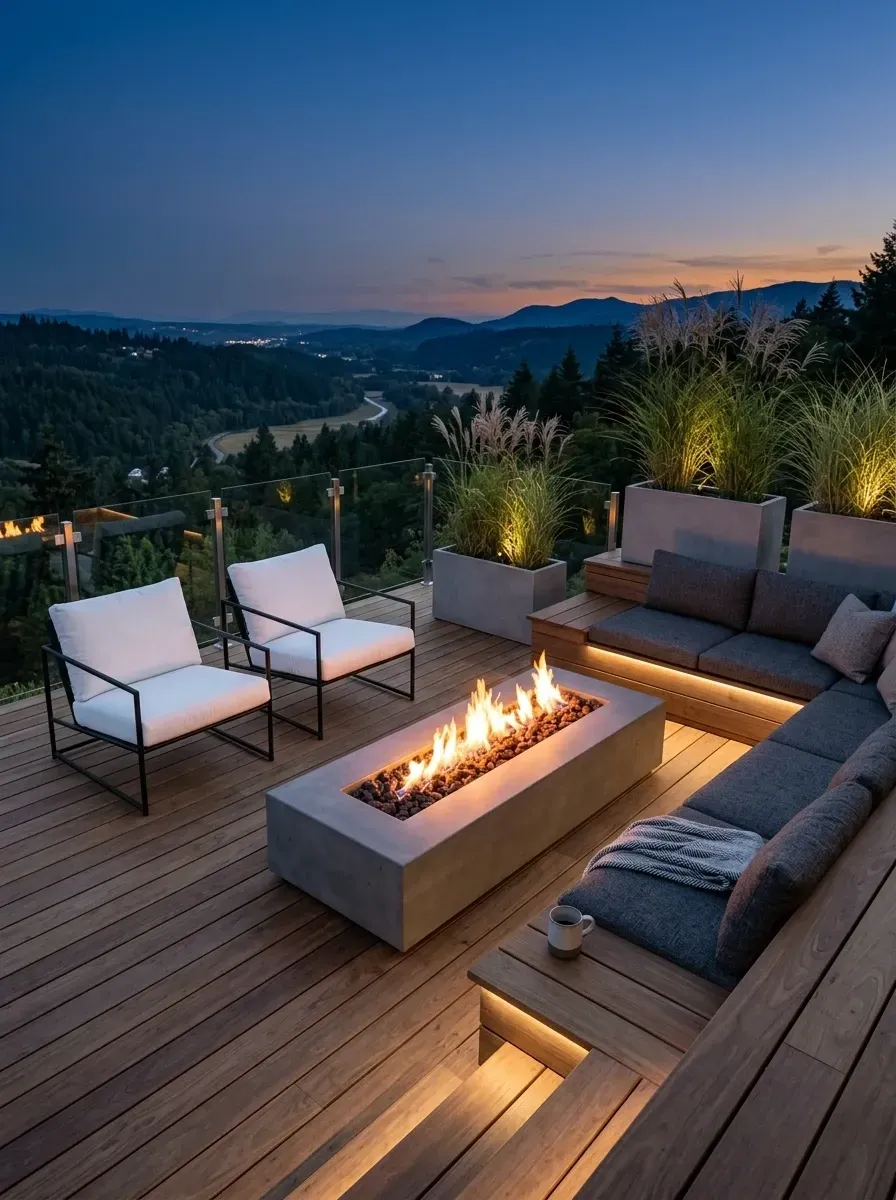
A modern hardwood deck designed for view: a long built-in bench with integrated LED lighting and cushions wraps around a rectangular concrete fire pit table, two armchairs anchor the opposite side, glass railings keep the sightlines uninterrupted, and ornamental grasses soften the planters at the perimeter. This is the highest-cost direction on the list, suited to view lots like those on Sullivan's Island or Lake Burton, GA. Specifications matter: hardwood decking should be Ipe or thermally-modified ash for our climate (Brazilian Ipe holds up 25–30 years; pressure-treated pine gives 10–12); per IRC R324 and most municipal codes, gas fire pits must be at least 10 feet from any combustible structure; and any glass railing must meet IRC R312.1 height (42") and load (200 lb) requirements with tempered or laminated glass.
What Makes the Fire Pit Deck Work
The fixed elements carry most of the cost and most of the effect on this deck. Ipe or thermally-modified ash hardwood decking sets a premium surface, and a built-in hardwood bench with integrated LED strip lighting gives the deck permanent seating that glows at its base after dark. A code-compliant glass railing system keeps the panoramic view open, which is the whole reason for building here.
The rectangular concrete fire pit table, fueled by gas or propane, anchors the seating group, with modern metal-frame armchairs pulled around it. Large concrete or metal planters filled with ornamental grasses soften the corners and move in the wind, adding life to a palette that is otherwise wood, glass and concrete.
In 2026 dollars, the full listed scope for this deck is $19,900 to $42,000. The structure is the cost: Hardwood decking install (~400 sq ft, Ipe) at $8,000 to $16,000 and the Glass railing system, IRC-compliant (~50 linear ft) at $5,000 to $10,000 account for about 62% of the upper total. Decking has the widest spread, driven by species, framing and the stair runs, so it is the quote to secure before furniture enters the conversation.
The built bench costs more than the fire feature: Built-in wood bench with integrated LEDs (~20 ft) at $3,000 to $6,000 against $1,500 to $4,000 for the Rectangular concrete fire pit table (gas/propane). Softening it all, the Custom bench cushions & throw pillows in charcoal take $1,000 to $2,500 and the Modern metal-frame armchairs (×2) $800 to $2,000.
Last on the list, $600 to $1,500 covers the Large concrete or metal planters (×3), the uplit concrete boxes of feather grass that screen the bench from the slope.
The scheme is wood, concrete and two neutrals. Warm Hardwood (Ipe) (#8F5E38) runs across the decking, bench and steps, and Sleek Concrete (#AFAFAF) on the fire pit and planters supplies the cool counterweight. Dark Charcoal (#363636) on the bench cushions hides soot and dew, while the armchairs pair Crisp White & Black (#FFFFFF), white cushions in thin black frames, so they read clearly against the darkening view.
A perimeter bench seats more people than loose chairs and leaves the middle of the deck open around the fire. Run the LED strip under the bench overhang and the stair noses as the rendering does, with IP67-rated drivers only, so the edges glow at night and the steps stay visible. For the railing, low-iron tempered glass keeps the faint green tint of standard glass out of a long view.
8. Tropical Resort Poolside Lounge
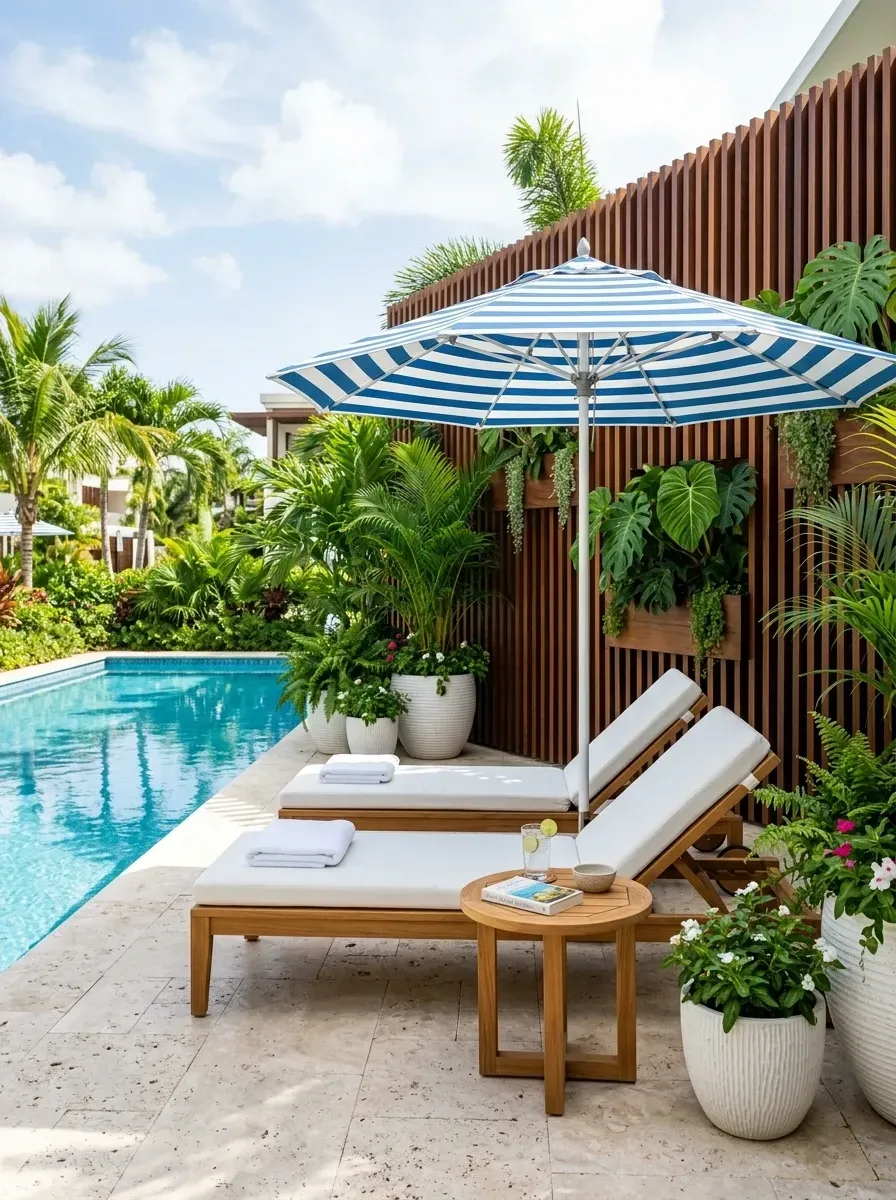
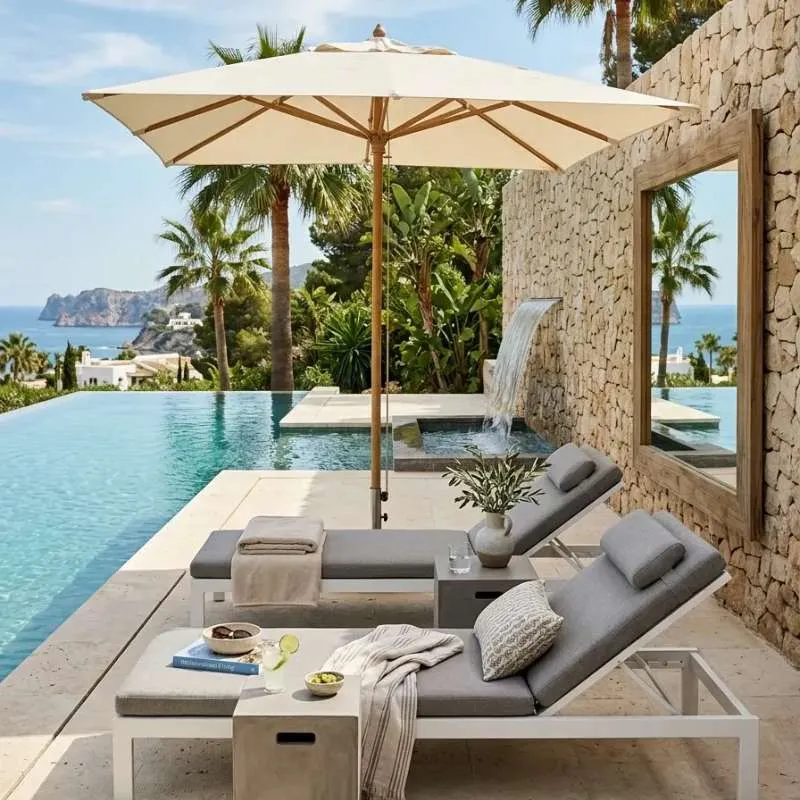
Two teak chaise lounges with white cushions, a classic blue-and-white striped umbrella, a travertine paver pool deck, a wood slat privacy wall with mounted planters, and lush tropical foliage. This is the resort-grade poolside that translates well to Naples and Ft. Myers, Sullivan's Island, and Hilton Head builds. Travertine is the right paver choice for the Southern coast: naturally cool underfoot, slip-resistant when honed, and improves with age. Teak is the safest wood to leave out by a pool, because it grays evenly and resists staining. The wood slat privacy wall should be specified in cedar, cypress, or pressure-treated pine sealed with a UV-stable penetrating oil; raw redwood will silver nicely but check it annually for splitting.
What Makes the Poolside Lounge Work
The pool deck sets the tone: travertine pavers in a honed finish stay cooler underfoot than concrete and give the space its resort feel. On that surface sit teak chaise lounges with white cushions, shaded by a striped patio umbrella with a weighted base so it stays put when the afternoon wind picks up.
The back edge is enclosed by a wood slat privacy wall treated with a UV-stable sealant, with wall-mounted planters hung on it for vertical interest. Lush tropical landscaping (palms, philodendron and bird of paradise) wraps around the deck and does as much as the furniture to make the lounge feel like a getaway rather than a backyard.
The 2026 estimate for this poolside lounge runs from $7,550 to $16,650, and the stone is most of it. The Travertine paver pool deck (~300 sq ft) is $4,500 to $9,000 and the Teak chaise lounges with cushions (×2) $1,200 to $3,000, about 72% of the upper total together. Travertine also has the broadest range, since thickness, finish and whether old concrete must come out all move the price, so settle that quote first.
The Wood slat privacy screen/wall (~15 linear ft) is the largest of the remaining lines at $1,000 to $2,500, with the Wall-mounted wooden planters (×2) that hang on it at $100 to $250. Shade and a surface for a drink come next: $300 to $800 for the Striped patio umbrella with weighted stand and $150 to $350 for the round Teak side table between the chaises.
The ribbed Large white floor planters (×3) holding palms and flowering annuals along the screen add $300 to $750.
Golden Teak (#B68D5D) ties the chaise frames, side table and slatted wall into one warm family, and Creamy Travertine (#E3D5C3) under them stays pale and cool in full sun. The umbrella and cushions bring in Classic White (#FFFFFF), and the stripes add Ocean Blue (#005B96), a deeper version of the pool water that makes the canopy the brightest object in the frame.
Buy genuine teak rather than shorea or eucalyptus sold under the same name; real teak can last 20–30 years beside a pool without rotting. The slatted wall works twice, as privacy and as a frame for hanging planters, so the green climbs rather than crowding the narrow deck. The blue and white stripe is the quickest resort cue there is, and it is worth keeping even if every other choice changes.
9. Minimalist Japanese Tea Garden
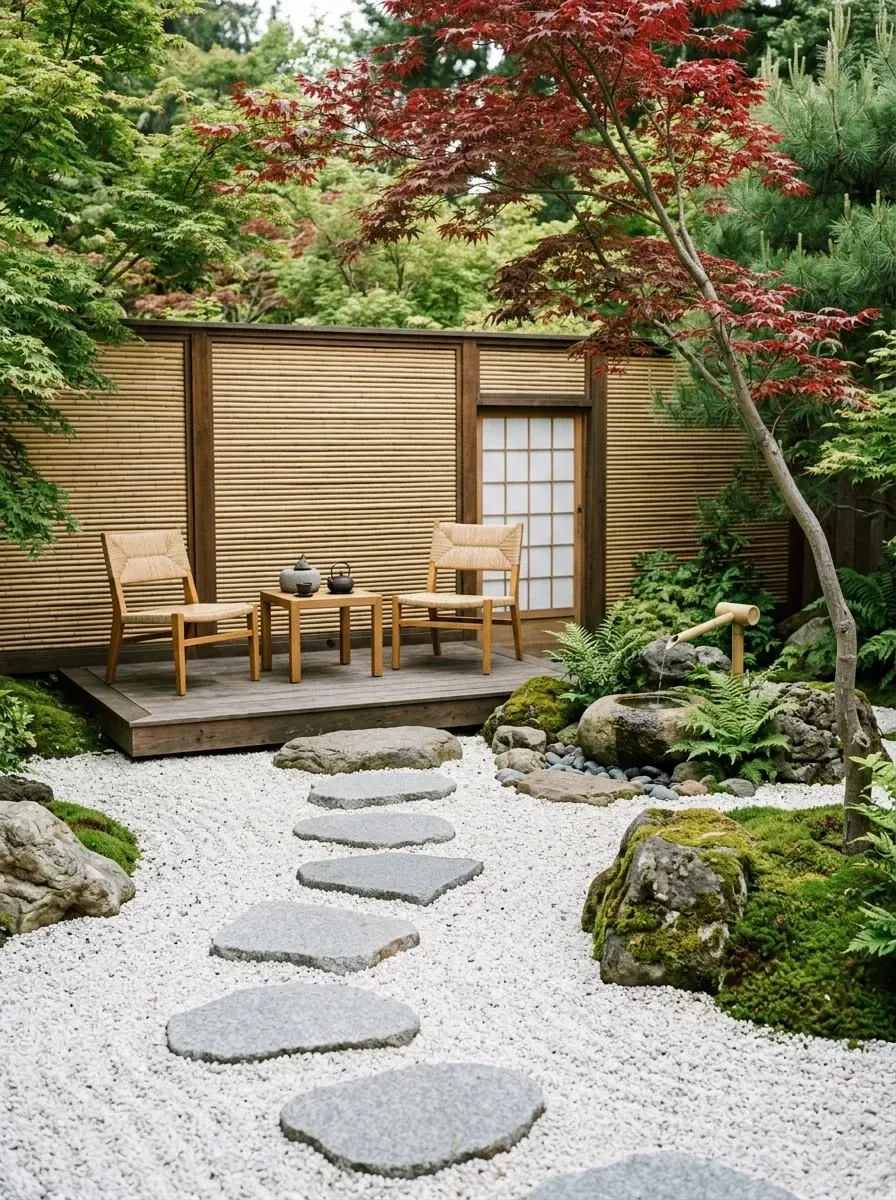
Where the first Zen garden was about meditation and gravel discipline, this version is built around tea ritual. A raised wooden deck holds two minimalist chairs with woven seats and a small table; a traditional stone tsukubai water basin with a bamboo spout sits ground level; stepping stones cross white gravel under a Japanese maple. The functional difference matters: this is a sitting garden, designed around an actual practice, while a Zen garden is fundamentally a contemplative composition. Both work well; choose the one that matches how you actually plan to use the space. The tsukubai requires a small recirculating pump and a basin reservoir; allocate around $200–$400 for a low-flow outdoor pump and an annual freeze-protection drain in the upper South.
What Makes the Tea Garden Work
The tea garden rests on a raised wooden deck for seating, and two minimalist chairs with woven seats are all the furniture it needs. Restraint is the point, so the money and attention go to the few elements that carry meaning: a stone tsukubai water basin with a bamboo spout, and stepping stones set in white gravel that slow the walk to it.
Bamboo roll fencing encloses the space and screens neighbors at a modest cost. Planting stays quiet and green, with a Japanese maple, ferns and moss landscaping supplying texture and seasonal color without competing with the stone and water.
Line by line, the tea garden totals $3,530 to $7,950. Planting leads: Landscaping (moss, ferns, maple specimen) is $800 to $2,000, depending mostly on the size of maple you buy, and the Shoji-style door in the fence is $800 to $1,500, about 44% of the upper total between them. The landscaping range is the widest, so price the maple before locking in the smaller pieces.
The structure is shared between the Bamboo roll fencing/panels (~25 linear ft) at $400 to $1,000 and the Raised wooden deck platform at $600 to $1,200. Furniture is limited to the Wooden chairs with woven seats (×2), light wood with rush seats in the rendering, at $400 to $900 and a Small wooden side table for the teapot at $80 to $200.
Water and stone cost less than the door: the Stone tsukubai & bamboo spout (with pump) is $200 to $500, the Natural stepping stones (×8) $150 to $350 and the White landscape gravel (bulk) $100 to $300.
Compared with the first Zen garden, this palette is lighter and cooler. Natural Bamboo / Light Wood (#D2B48C) covers the rolled bamboo screens, the chairs and the table, and Pure White (#F5F5F5) gravel fills the ground in front of the deck. Aged Granite Grey (#777777) belongs to the stepping stones, boulders and the round tsukubai, while Dark Wood Trim (#5C4033) frames the bamboo panels and the shoji door, the lines that give the fence its structure. The red-leaf maple is the only strong colour, and it comes from the planting rather than any paint.
Raise the deck even 6 to 8 inches; that small step is what turns a corner of gravel into a place to sit. A carved stone tsukubai is worth its line item over a generic birdbath-style basin, because the low height of a real one is what makes crouching to the water part of the ritual. Keep the materials to wood, stone, gravel and green, and let the maple supply the colour.
10. Vibrant Urban Balcony Garden
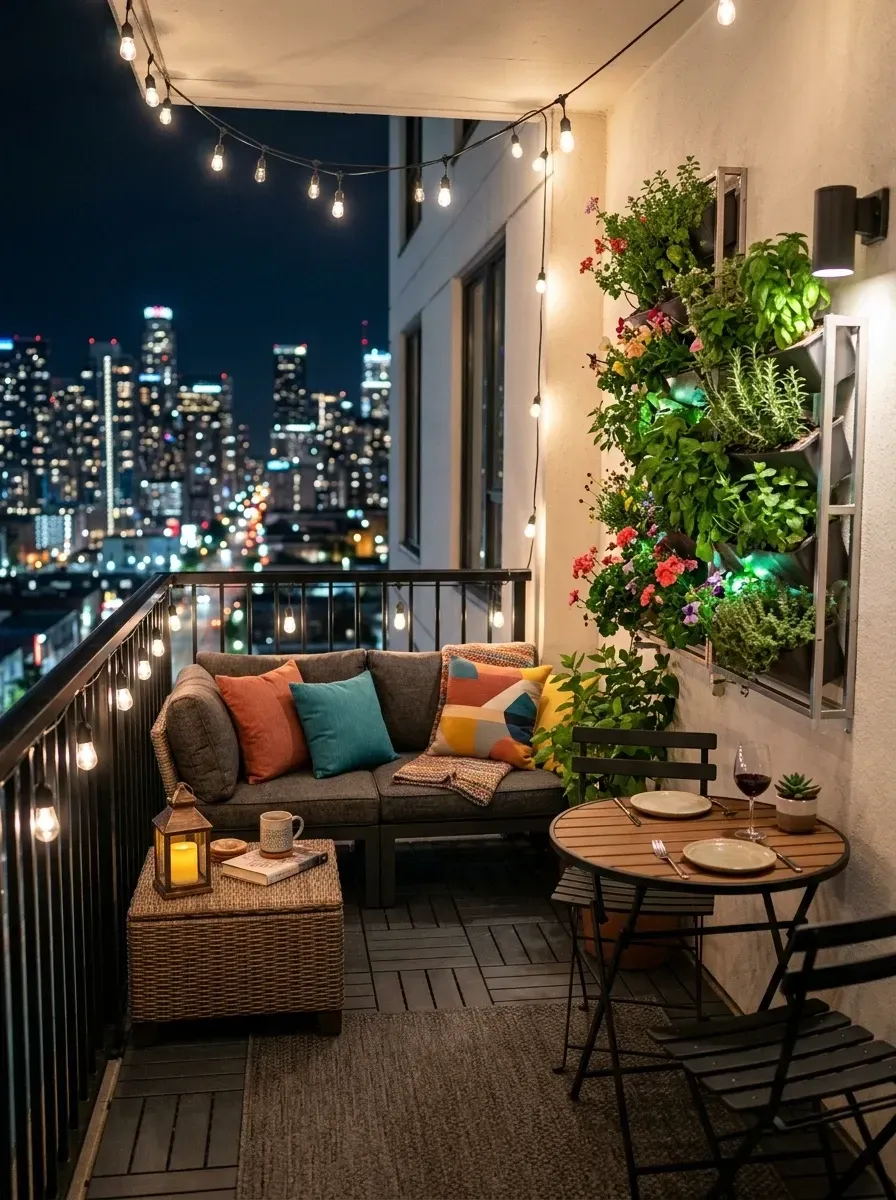
A small city balcony built up rather than out: vertical living wall, compact sectional, bistro table for two, interlocking deck tiles over the existing concrete, string lights, and colorful textiles against the city. This is the only direction on the list that genuinely works on a 60-square-foot balcony. Three details to get right: most living-wall planter systems need a drip-irrigation feed and a drainage catch (your downstairs neighbor will thank you), interlocking deck tiles must be lifted twice a year to clear leaf litter or they trap moisture against the concrete, and HOA covenants in most Charleston, Atlanta, and DC condo buildings restrict permanent attachments, so clamp-on or freestanding is the safe specification.
What Makes the Balcony Garden Work
On a balcony, every square foot has to earn its place, so the plan goes vertical first. A living wall garden with drip irrigation puts the planting on the wall instead of the floor and waters itself. The furniture is split between lounging and eating: a compact two-seat sectional or loveseat for evenings, and a three-piece bistro table and chair set for coffee and small meals.
Interlocking wood deck tiles laid over the concrete change the feel underfoot without any permanent attachment. Bistro string lights overhead stretch the hours the balcony is usable, and colorful pillows, throws and an outdoor rug add the softness and color that make a small outdoor space feel lived in.
The balcony comes to an itemized 2026 allowance of $1,280 to $2,940. The Small outdoor sectional/loveseat at $400 to $900 and the Interlocking wood deck tiles (~50 sq ft) at $200 to $400 make up about 44% of the upper figure. The loveseat carries the most risk, so measure the balcony depth and the door opening before choosing its size and finish.
The 3-piece bistro set (table + 2 chairs) at $150 to $350 is the dining half of the plan, folding black chairs around a slatted round top. The Wall-mounted vertical garden planter system costs $100 to $250, the Bistro string lights $50 to $120, and the grey Outdoor area rug $60 to $150.
Smaller lines complete it: $50 to $120 for the Woven side table or storage box that holds the lantern in the rendering, $120 to $250 for Colorful throw pillows (×4) & blanket, and $150 to $400 for Plants for vertical wall & pots, the herbs and geraniums that refill the frame each season.
Dark tones keep this balcony from fighting the skyline. Matte Black (#222222) on the railing and bistro chairs recedes into the night view, and Charcoal Grey (#555555) on the loveseat cushions is forgiving of city grime. Vibrant Multi-Color (#E69F00) arrives in the orange, teal and yellow pillows, and Dark Wood Tiles (#4A3B30) underfoot warm the floor and lift it off the concrete slab.
Treat the wall as floor space: the vertical planter frame holds more plants than the deck could, and the string lights looped along the railing and ceiling add depth without taking an inch. Covering the concrete with interlocking wood or composite tiles changes how the balcony feels underfoot more than any furniture purchase. For the lights themselves, pick warm white (2700K) bulbs on commercial-grade weatherproof strands, since the balcony is used mostly after dark.
Pro Tips for Every Outdoor Space
Define zones, even on a small footprint. Rugs, planters, level changes or a simple rug pad can draw a line between dining, lounging and pass-through, and without those cues an outdoor room reads scattered. The same thinking applies to light, which works best in three planes: overhead (string lights, pendants or an integrated soffit), task light near a grill, reading chair or stairs, and accent light such as uplights on a tree or an LED strip behind a bench. One flat ambient layer always feels institutional.
Bring the indoor-room mindset outside as well. Weather-resistant rugs, throw pillows, candles, side tables and styled trays are what make an outdoor space feel inhabited rather than landscaped. Then specify for the climate, not the photograph: coastal hardware should be 316 stainless or marine-grade powder-coated, humid covered patios need synthetic rugs in olefin or polypropylene rather than wool or cotton, and full-sun lots need UV-stable upholstery such as Sunbrella, Outdura or solution-dyed olefin.
Real Cost-Saving Moves
The biggest savings come from labor you can do yourself. Build planters instead of buying them: a 24" cedar planter costs about $40 in lumber and an afternoon, while the same piece retails for $200–$400, and the wood weathers identically. Plants can be multiplied the same way. Pothos, philodendron, jasmine and hydrangea all root easily from cuttings, so a single 4" nursery pothos becomes ten in eight months.
Hardscape and furniture offer the larger dollar gaps. A 200 sq ft DIY paver patio runs $800–$1,400, while the same area in poured concrete with a contractor runs $2,400–$4,200, and the paver version is more interesting to look at. For furniture, timing matters: end-of-season markdowns on teak can reach 40–60%, so it often pays to plan the project in fall and build it in spring.
Frequently Asked Questions
What is the most durable outdoor flooring for a Southern climate?
For a covered patio, polished or sealed concrete is hard to beat: it shrugs off humidity, stays cool, and takes a rug well. For an uncovered patio in the Lowcountry or Florida, travertine or bluestone pavers are our first choice; both stay cooler underfoot than concrete pavers and improve visually as they age. For a raised deck, Ipe or thermally-modified ash hardwood gives 25–30 years of service if sealed every 24–36 months.
How do you keep outdoor furniture and rugs from mildewing in Southern humidity?
Three rules. First, specify solution-dyed olefin or polypropylene rugs and acrylic-fiber upholstery (Sunbrella is the benchmark); natural fibers are not viable below the Mason-Dixon line under cover. Second, hose down rugs and cushions monthly with a 1:10 white vinegar solution to halt mildew before it visibly takes hold. Third, store cushions in a dry storage box during long absences, because even covered patios cycle moisture overnight.
Can a wooden pergola survive a Southern summer?
Yes, with the right wood and a maintenance schedule. Cedar and pressure-treated pine are the practical options; cedar looks better and silvers gracefully but needs a UV-stable penetrating oil reseal every 24–36 months. Pressure-treated pine is cheaper and lasts longer structurally but should be painted to look intentional. Skip raw redwood and Douglas fir; both rot fast in Southern humidity.
Which outdoor lighting holds up best in heat and humidity?
Look for IP65-rated fixtures at minimum (IP67 for ground-level or wash-prone locations), and 2700K warm white bulbs, because anything cooler reads clinical at night against natural materials. For string lights, commercial-grade UL-listed weatherproof strands (the kind sold for restaurant patios) generally outlast residential-grade strands by a wide margin. Avoid relying on solar fixtures for primary lighting; their small panels and batteries tend to dim on short winter days and wear out early.
What is the smallest balcony where a vertical garden actually works?
About 40 square feet, with at least one wall of 6 ft × 5 ft for the planter system. Below that, the planter visually overwhelms the floor space. Confirm three things before installing: HOA permission for wall attachment, drip-irrigation drainage path that does not soak the unit below, and morning or filtered afternoon sun for at least four hours daily.
Sources & References
- Clemson Cooperative Extension: South Carolina-specific planting guides, plant selection by hardiness zone, and pest/mildew prevention guidance referenced for the Lowcountry plant substitutions in this guide.
- USDA Plant Hardiness Zone Map (2023 update): primary reference for zone-based plant selection across Charleston (8b/9a), Atlanta (8a), Nashville (7b), and Naples (10a).
- International Residential Code (IRC) R324 and R312.1: code references for outdoor gas fire feature clearances and railing height/load requirements cited in the luxury deck section.
- Sunbrella & Outdura Performance Fabric Specifications: UV-stability and mildew-resistance data for solution-dyed acrylic fabrics referenced for outdoor upholstery and curtain recommendations.
- Forest Products Laboratory, Wood Handbook: durability ratings for Ipe, thermally-modified ash, cedar, pressure-treated pine, and teak in outdoor applications.
- AAMA 2604 / 2605 Aluminum Finish Specifications: referenced for marine-grade powder-coat requirements on aluminum outdoor furniture in coastal environments.
Start Small and Edit Over a Season
The ten directions above span almost every common footprint and budget, from a $1,200 boho garden corner to a $42,000 hardwood deck on a view lot. What every successful outdoor space shares is honesty about climate and use: choose plants that survive your zone, fabrics that survive your humidity, and finishes that survive your sun. If a particular vignette caught your eye, see similar thinking applied in our first outdoor garden roundup with ten more directions, our eleven backyard before-and-after transformations, and our thirteen neglected-yard rescues. For raised and rooftop projects, our rooftop retreats roundup covers the structural and waterproofing context this article does not. The single most useful piece of advice: build the smallest, simplest version of your favorite direction first, live with it for a season, then iterate. The best outdoor rooms are the ones the owner edits over time, not the ones delivered finished on day one.
Styling & Living Desk
The Layered Homes editorial teamThe Styling & Living Desk produces the room-by-room guides, outdoor and garden pieces, celebration ideas and design solutions, each with an itemised cost estimate, and the Home Files essays.
More from the Styling & Living Desk →
Reader notes