


Designing outdoor rooms in the Lowcountry is a different sport. Sunbrella is the “outdoor-rated” fabric we trust most; Polywood and powder-coated aluminum outlive teak in unprotected salt air; and the wrong plant choice will give you a hurricane-shredded mess by July. Below are nine outdoor room concepts designed for Charleston single-house piazzas, Sullivan's cottages, Mount Pleasant suburban backyards, and a Daniel Island rooftop, broken down by what they would cost in 2026, the brands we would specify (and the ones we would avoid), and the plants that survive a real Lowcountry summer. Same format as our interior-room guides: spreadsheet next to the room, no aspirational fluff.
The Nine Outdoor Rooms
- 1. Romantic Rose-Covered Cedar Pergola: A Park Circle Cottage Garden
- 2. Classic Charleston Piazza in Brick, White and Navy
- 3. Sleek Louvered-Pergola Dining on Daniel Island
- 4. Cozy Fire-Pit Conversation Lounge in Mount Pleasant
- 5. Rustic Mediterranean Courtyard South of Broad
- 6. Minimalist Zen Garden Retreat in East Cooper
- 7. Sophisticated Rooftop Lounge with a City Skyline View
- 8. Boho Hanging-Chair Nook for a Sullivan's Island Garden or Porch
- 9. Resort-Style Poolside Chaises at a Kiawah Beach House
- Practical Tips for Lowcountry Outdoor Rooms
- Cost-Saving Strategies That Don't Read Cheap Outside
- Regional Fit Across Southern Markets
- Frequently Asked Questions
- Sources & References
- Designing Outdoor Rooms for Lowcountry Weather
1. Romantic Rose-Covered Cedar Pergola: A Park Circle Cottage Garden
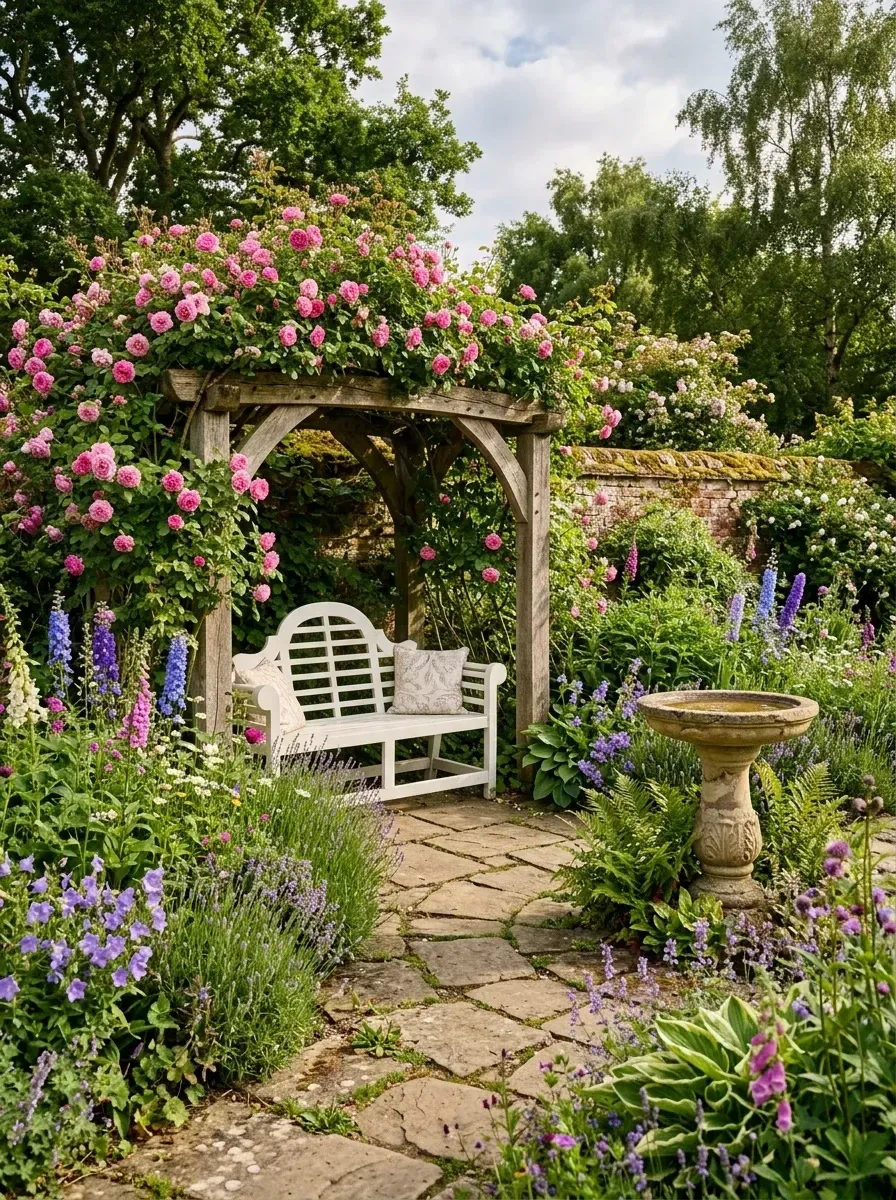
A small backyard concept for a lot typical of Park Circle, North Charleston, meant to feel like “the garden behind a Sussex pub.” The plan calls for a pergola of locally milled Atlantic white cedar rather than big-box pine, with two 'New Dawn' climbing roses trained up the posts. New Dawn suits the Lowcountry: it blooms in June, July and again in October, and it shrugs off the humidity that defeats most David Austin roses on the coast. The bench is a Polywood Vineyard 60-inch in classic white, because HDPE outlives painted wood by a decade in salt air. The rendering lays the path in worn flagstone; the written plan swaps that for crushed oyster shell, the regional alternative, at about $4 per square foot installed. The birdbath is a cast-stone piece of the kind architectural salvage dealers carry.
Why the Cedar Pergola Garden Works
The structure is a locally milled Atlantic white cedar pergola, a wood that handles Charleston humidity without the twisting that pressure-treated pine shows; in the rendering its posts and knee braces have already weathered to a soft grey. Two 'New Dawn' climbing roses smother the top beam; they tolerate heat and humidity, which is why they make the list over more delicate climbers. Seating is the Polywood Vineyard 60" HDPE bench in classic white, a material that will outlast any painted bench in salt air.
Underfoot, the written plan specifies a crushed oyster-shell path, which ties the garden to Lowcountry building tradition and costs less than stone, even though the image shows irregular flagstones with gravel joints. The final piece is a salvaged cast-stone birdbath set among ferns and hostas at the edge of the path, an aged focal point that new cast pieces take years to match.
Two siting decisions decide whether this garden ever looks like the picture. Pressure-treated pine pergolas tend to rot or twist within three Charleston summers, so the 30% premium for Atlantic white cedar is money well spent. The roses belong on the south or southeast face of the frame; climbers planted against north-facing posts stretch for light and flower only at the top.
If oyster shell replaces the flagstone drawn here, expect a surface lighter than gravel that drains fast after a summer storm and bleaches to a soft white as it ages. The birdbath matters more than its size suggests: one vintage focal piece, whether a salvaged birdbath or an old urn, is what makes a new planting read as an established cottage garden.
Charleston Median (2026) $5,800 $3,500 to $8,550For the visible scope of this cottage garden, the 2026 allowance runs $3,500 to $8,550. Two lines dominate it: the custom Atlantic white cedar pergola, built and stained, at $1,500 to $3,500, and the crushed oyster-shell path of roughly 80 sq ft at $1,000 to $2,500, which between them make up about 70% of the upper figure. The pergola also carries the widest spread, so its quote should be in hand before anything smaller is ordered.
Everything else is modest by comparison. The Polywood Vineyard 60" HDPE bench in classic white is estimated at $300 to $800, the salvaged cast-stone birdbath at $150 to $400, and a pair of Sunbrella outdoor pillows (x2) at $50 to $150. The planting, 'New Dawn' roses plus a cottage underplanting of the lavender, delphinium and foxglove kind seen in the rendering, takes $500 to $1,200.
A custom cedar pergola from a Charleston millwork shop runs $80–$120 per square foot in 2026. The big-box pressure-treated kit at $1,200 looks identical on day one and embarrassing by year three.
Most of the color in this garden comes from the flowers, so the built pieces keep to quiet tones. The bench is Polywood Classic White (#FFFFFF), a clean break against all that green, and the pergola is Weathered Cedar Brown (#8B7355), a tone the rendering already shows drifting toward the silver-grey that cedar reaches within two summers.
Lower down, the path is listed as Aged Stone Grey (#9E9E9E), which suits the flagstone in the image and would lighten toward white if oyster shell goes down instead. The pillows on the bench are Sunbrella in Natural Beige Cream (#F5F5DC), picked because the acrylic holds that pale shade through ten Lowcountry summers of sun.
2. Classic Charleston Piazza in Brick, White and Navy
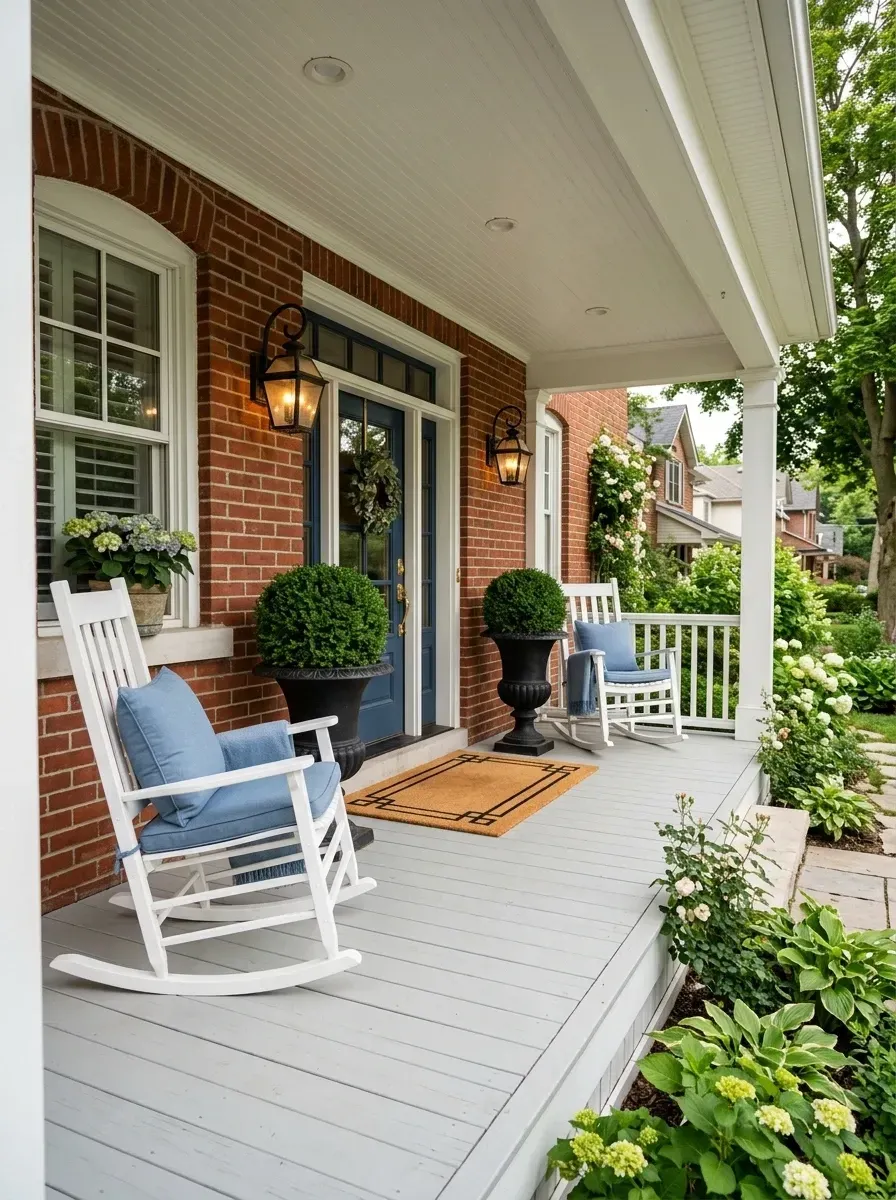
The south-facing piazza of a Wagener Terrace single house, exactly the room a Charleston summer was made for. The plan paints the ceiling SW Watery 6478, the modern equivalent of the haint-blue tradition (the soft blue was once believed to confuse mosquitoes and ward off ghosts); in the rendering the blue is so pale that the beadboard reads almost white. The decking is heart-pine, painted BM Boothbay Gray HC-165. The rockers are Polywood Jefferson in Classic White, an HDPE rocker that stands up to salt air. Cushions are specified in Sunbrella Canvas Indigo, custom-cut by an upholsterer, although the image shows a lighter chambray blue. The boxwoods are 'Wintergreen' Japanese boxwoods in Bergs Potter Tuscan matte-black terracotta, drawn here as classic urns; Japanese boxwoods handle coastal humidity far better than English. For the door, the plan uses BM Hale Navy HC-154.
Why the Brick-and-Navy Piazza Works
The piazza is designed from the ceiling down, with SW Watery 6478 giving the porch its cool cast overhead. Below it, heart-pine decking painted BM Boothbay Gray HC-165 makes a soft, weathered base that does not compete with the blue. Polywood Jefferson rockers in Classic White provide the seating, and custom-cut Sunbrella Canvas Indigo cushions add the one strong color the porch needs without fading in the sun; the paler cushions in the rendering show how much quieter a lighter blue reads.
The remaining pieces frame the door. A pair of 'Wintergreen' Japanese boxwoods in Bergs Potter matte-black pots sets up the symmetry, and the BM Hale Navy front door, flanked by Visual Comfort wall lanterns, gives the whole composition its anchor and its evening light.
Symmetry carries a Charleston piazza, and the rendering shows why: a rocker at each end, a boxwood urn on each side of the door, a lantern above each urn. Break one pair and the porch looks unfinished. For the ceiling, SW Watery is a close modern match for traditional haint blue, while BM Atmospheric AF-500 is the cooler, greyer alternative.
Two small specifications finish the entry. English boxwood tends to suffer blight in Lowcountry humidity within about three seasons, which is why the urns hold Japanese 'Wintergreen' instead. The coir mat should be sized to the door opening, as the bordered mat in the image is, rather than bought in the standard small rectangle.
Charleston Median (2026) $2,650 $1,530 to $3,830Pricing the visible scope of this piazza gives a range of $1,530 to $3,830. Painting the door, floor, ceiling and railing is the largest line at $500 to $1,200, followed by the Polywood Jefferson rockers (x2) in Classic White at $300 to $700; together they come to about 50% of the high estimate. Paint is also the line most likely to drift, since the condition of an old heart-pine deck sets how much prep it needs, so that quote comes first.
The rest is furnishing and planting in pairs: $150 to $300 for Sunbrella Canvas Indigo custom cushions and throws (x2), $200 to $500 for the Bergs Potter Tuscan matte-black terracotta planters (x2), $150 to $400 for the 'Wintergreen' Japanese boxwoods (x2), and $150 to $500 for Visual Comfort Bryant outdoor wall lanterns (x2). A custom-sized coir mat and a seasonal wreath, both visible at the door, add $80 to $230.
A high-quality piazza repaint with a haint-blue ceiling runs $1,800–$2,500 in Charleston in 2026 if you hire it out. Doing the ceiling alone yourself is one of the highest-impact DIY moves in this whole article.
The brick of the house, listed as Aged Charleston Brick (#A0522D), is the largest and warmest surface in the picture, so the porch colors stay cool against it. The floor is BM Boothbay Gray, described as Light Deck Grey (#D3D3D3), a pale porch paint that tolerates salt air and hides the yellow film of spring pollen.
The blues do the rest. Hale Navy, given as Classic Navy Blue (#000080), is assigned to the door and the cushions; in the image only the door carries it, while the cushions sit several shades lighter. SW Watery, the Haint Blue (#B0D4D6), is a soft blue with a hint of green that belongs on the ceiling, where a stronger coat than the rendering shows would make the tradition legible from the street.
3. Sleek Louvered-Pergola Dining on Daniel Island
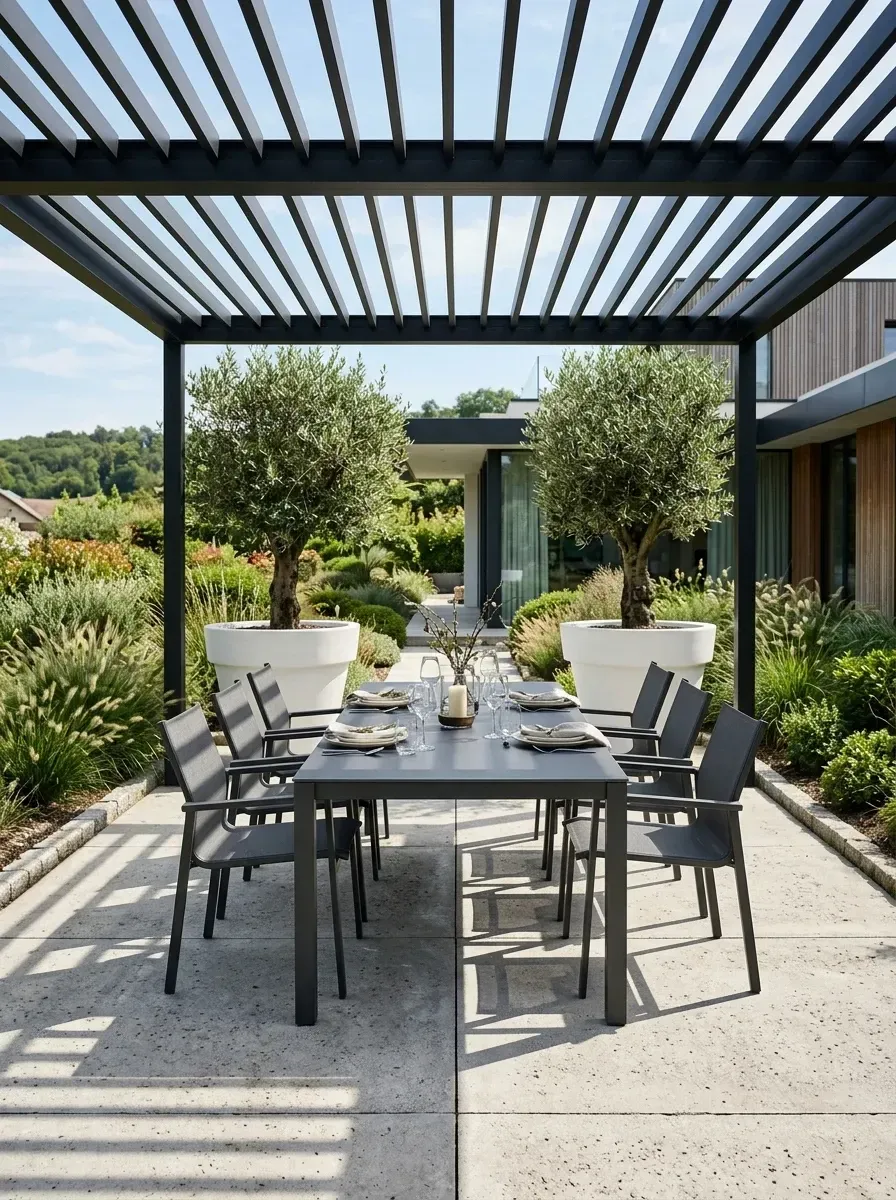
A concept for a Daniel Island new-build with the brief “Mykonos hotel, Lowcountry climate.” The pergola is a StruXure Pergola X in matte black: louvered aluminum that opens for sun, closes against summer thunderstorms and carries hurricane wind ratings. It is an investment piece, and the cedar frame in design 1 cannot offer the same control. The dining table is specified as an RH Outdoor Concrete Trestle, 96 inches, with eight Janus et Cie Knit Outdoor chairs in carbon for a household that entertains; the rendering approximates them with a dark slab table and grey mesh chairs. The patio is Belgard Mega-Lafitt concrete pavers set in a soldier-course border, drawn here as large pale slabs. The olive trees in the white Campania International Tuscan planters are six-foot mature specimens from a specialist grower, and they are the only living thing the space needs.
Why the Louvered Dining Terrace Works
The terrace is built around a StruXure Pergola X louvered aluminum roof in matte black, which is hurricane-rated and can close against an afternoon storm. Under it, the RH Outdoor Concrete Trestle 96" dining table is long enough for a real dinner party, surrounded by 8 Janus et Cie Knit Outdoor chairs in carbon, a dark tone that hides pollen and wear.
The floor is Belgard Mega-Lafitt concrete pavers with a soldier-course border, which gives the patio a finished edge for far less than natural stone. Campania International Tuscan planters holding mature olive trees supply the only planting the space needs and soften the hard lines of the aluminum and concrete.
A fixed roof would make sense in a drier place, but Daniel Island sees afternoon thunderstorms for about five months of the year, and louvers let the same terrace run open at noon and closed at four. The palette needs equal discipline: black frame, concrete grey, white planters and nothing else, which is what keeps the look from sliding toward a spec-house patio.
The olives only work at size. Planted as 4-foot starters they would sit low inside those wide white pots, while mature trees put a canopy at eye level, as the rendering shows, and give the frame its vertical anchor. If the concrete table is used, order it honed; a glossy sealed top looks cheap up close.
Charleston Median (2026) $24,500 $16,200 to $34,000Budgeted as drawn, the terrace comes to $16,200 to $34,000. The installed StruXure Pergola X louvered aluminum roof accounts for $8,000 to $15,000 and the installed Belgard Mega-Lafitt paver patio, about 250 sq ft, for $3,000 to $6,000, roughly 62% of the top figure between them. The roof's $7,000 spread is the one to pin down first with a written quote.
Furniture and planting fill the rest: $1,500 to $4,000 for the RH Outdoor Concrete Trestle 96" dining table, $2,000 to $4,800 for the Janus et Cie Knit Outdoor dining chairs (x8), $600 to $1,400 for the large Campania International Tuscan planters (x2), and $1,000 to $2,500 for mature 6 ft olive trees (x2). Table styling, meaning vases, candles and linens from Bloomist and Hawkins NY, adds $100 to $300.
A StruXure louvered pergola is usually the single most expensive line in a Lowcountry outdoor build, and the most often justified. It converts a six-month patio into a twelve-month one, and its hurricane rating is a real number for insurance purposes.
Matte Charcoal Black (#36454F) is assigned to both the pergola and the chairs, so frame and seating read as one piece of architecture rather than furniture parked under a roof. Concrete Grey (#BEBEBE) covers the table and the patio, tying the two horizontal planes together.
The planters are Pure White (#FFFFFF), the sharpest contrast on the terrace, which turns each olive into a piece of sculpture. Warm Cypress Wood (#A0785A) belongs to the house siding at the right of the image, and that strip of timber keeps the monochrome from feeling cold.
4. Cozy Fire-Pit Conversation Lounge in Mount Pleasant
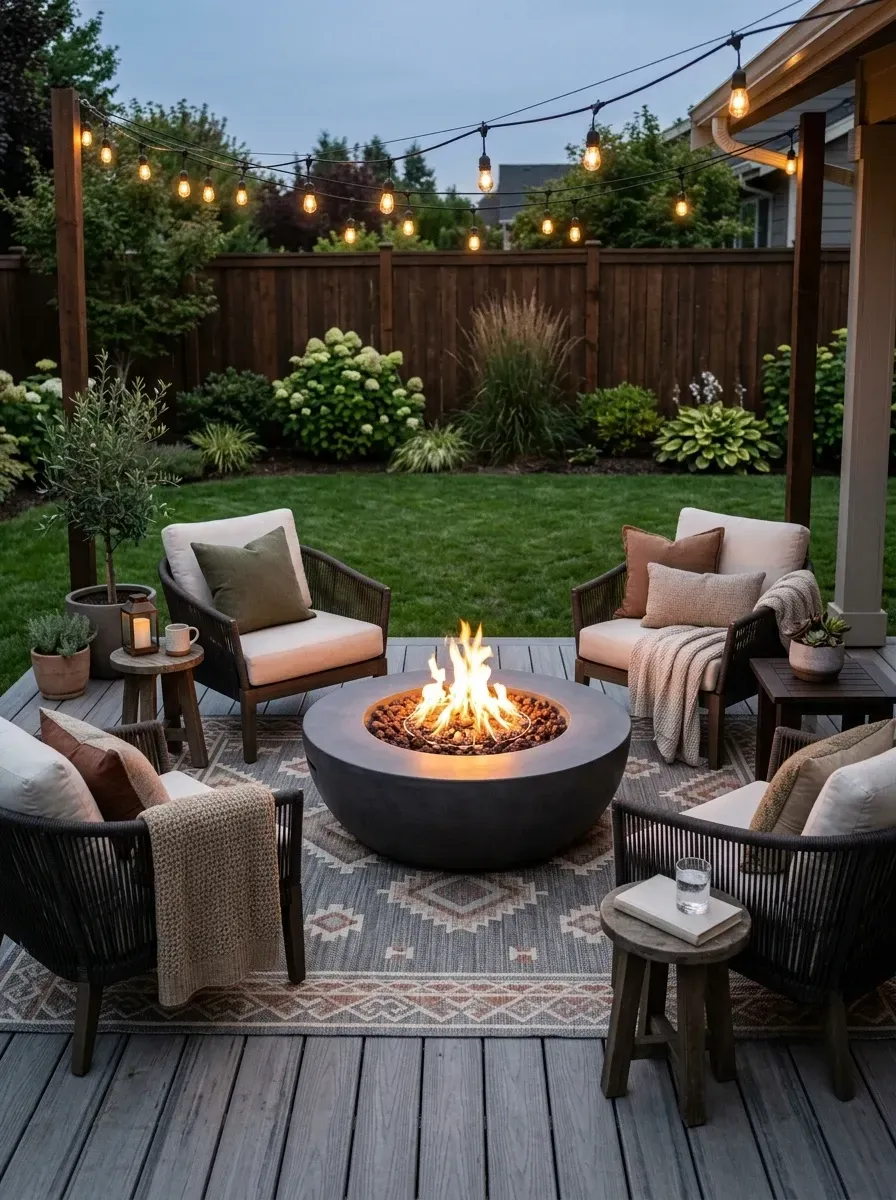
A backyard in I'On, the kind of suburban Mount Pleasant lot that suits a fire-pit cluster. The pit is a Solus Decor Hemi 36" gas fire pit in lava-rock finish, run on a buried propane line by a licensed gas installer. The seating is four Lloyd Flanders Mackinac club chairs, the version with aluminum frames and vinyl weave rather than natural wicker, which crumbles in salt air. Cushions are Sunbrella Cast Ash. The rug is specified as the RuggSmart Outdoor Vintage Persian 8×10 in faded rust, washable and fade-resistant; the rendering shows a flatweave in grey and rust with a geometric border rather than a Persian medallion. String lights overhead are Brightech Ambience Pro on cedar posts. Decking is Trex Transcend Tiki Torch composite, which holds up to summer humidity better than ipe at half the price.
Why the Fire Pit Circle Works
The center of the circle is a Solus Decor Hemi 36" gas fire pit, professionally plumbed to propane so it can be lit in seconds rather than treated as a weekend project. Around it, Lloyd Flanders Mackinac all-weather wicker club chairs, 4 of them, hold the conversation in a tight ring, and Sunbrella Cast Ash cushion fabric is used throughout so every seat weathers the same way.
A RuggSmart Outdoor Vintage Persian rug, 8×10 in faded rust, warms the floor and brings in the only pattern. Brightech Ambience Pro string lights strung on cedar posts give soft overhead light after dark, and the Trex Transcend Tiki Torch composite decking underneath keeps maintenance to a hose and a brush.
Shape decides how this space gets used. A round pit ringed by four chairs, as here, keeps everyone facing each other, whereas a square pit pushed against a sectional tends to turn the seating toward a screen. Gas is the sensible fuel in the Lowcountry, because burn bans during summer drought can sideline a wood pit for months.
The chairs in the rendering are a dark synthetic weave, the right call near salt water, where resin wicker from makers such as Lloyd Flanders, Brown Jordan or Harmonia Living can outlast natural wicker by a factor of five. Overhead, the strings hang at 9–10 feet and are carried mainly on posts rather than the house, which gives the deck a ceiling of light without crowding the eaves.
Charleston Median (2026) $10,100 $6,250 to $14,000This lounge is estimated at $6,250 to $14,000 in total. The Trex Transcend composite deck, about 200 sq ft installed, runs $2,500 to $5,000, and the Lloyd Flanders Mackinac club chairs with Sunbrella cushions (x4) run $2,000 to $4,500; those two lines make up about 68% of the upper estimate. Of the two, the chairs have the wider range, so settle the seating quote before ordering accessories.
Around them, $1,000 to $2,500 covers the Solus Decor Hemi 36" gas fire pit with its propane plumbing, $200 to $500 the RuggSmart Outdoor Vintage Persian rug in 8×10, $150 to $400 a pair of West Elm acacia outdoor side tables (x2), and $200 to $600 the Brightech Ambience Pro string lights with installed cedar posts. Sunbrella pillows and Pendleton Eco-Wise wool throws for cooler evenings come to another $200 to $500.
A buried propane line for a fire pit runs $400–$900 in Charleston depending on distance from the tank. Worth the cost over a portable propane tank that you have to wrestle every time you light it.
The deck and fire pit share Weathered Grey Concrete (#808080), a neutral floor that lets the rug and the woven chairs carry the texture. Dark Walnut (#5C4033) is assigned to the furniture and the fence; in the rendering it shows on the stained privacy fence and the chair frames, and it deepens as the light drops.
Against those darks, the Sunbrella Cast Ash cushions in Cream (#F5F5DC) keep the seats light without turning dingy, and Faded Rust Terracotta (#CC6633), taken from the rug and repeated on a few pillows, picks up the color of the flames.
5. Rustic Mediterranean Courtyard South of Broad
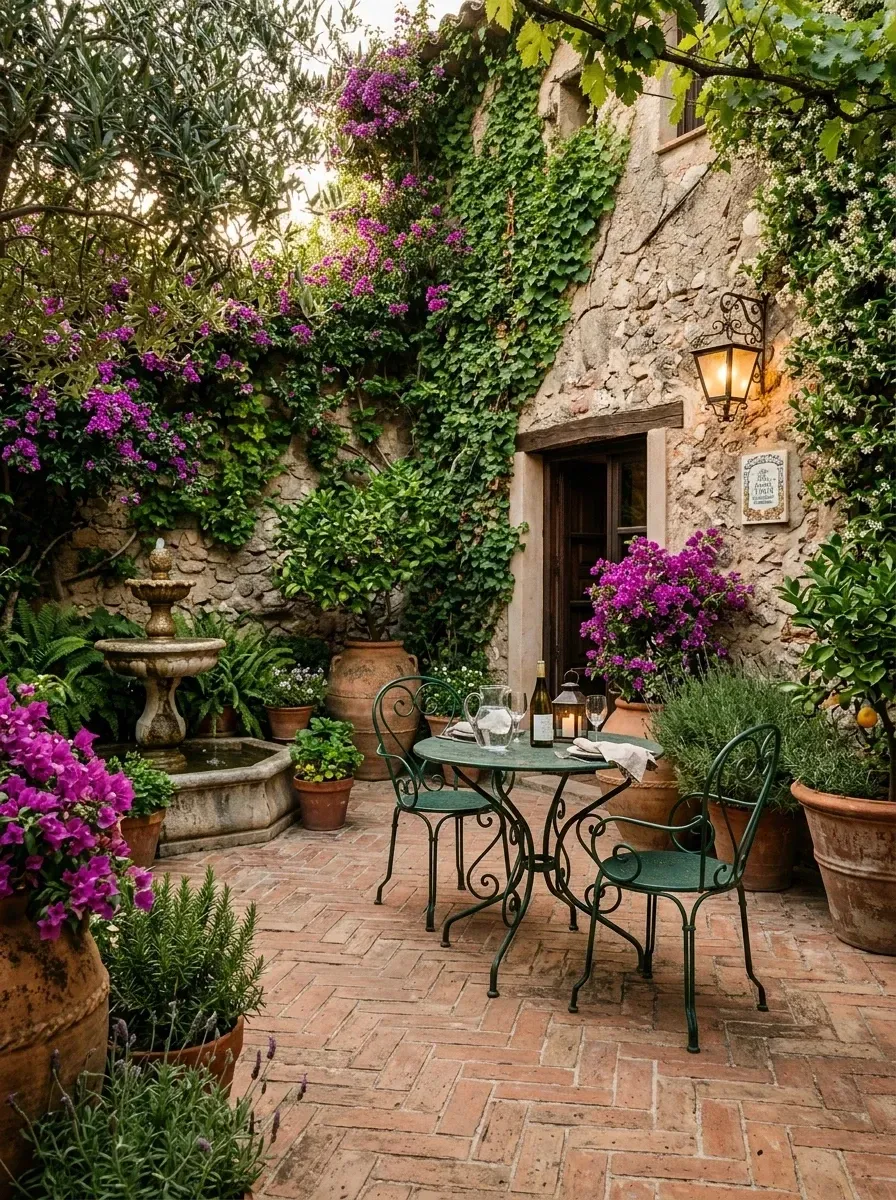
An interior courtyard south of Broad, the kind of hidden Charleston room seen only by invitation. The plan finishes the walls in Romabio limewash over old brick, in a soft warm white that ages well; the rendering shows rough rubble stone instead, which hints at the chalky texture limewash leaves. The floor is reclaimed Charleston brick laid in a true herringbone, about $14 per square foot installed and impossible to imitate with new pavers. The bistro set is a Fermob Luxembourg in fern green, from the Parisian park-chair line. The fountain is a cast-stone two-tier from Campania International, plumbed simply to a recirculating pump. Confederate jasmine climbs the south wall; it is the right Lowcountry climber, fragrant in May and tough through August. A wall lantern from Bevolo Gas & Electric in New Orleans completes the courtyard.
Why the Brick Courtyard Works
In the written plan the walls are brick washed with Romabio limewash in warm white, which lets the masonry texture show through and ages gracefully; the stone walls in the image give a similar rough, sun-warmed surface. The floor is reclaimed Charleston brick laid in true herringbone, a pattern that suits the scale of a small courtyard. A Fermob Luxembourg bistro set in fern green supplies the seating and the one painted color.
Sound and scent come next. A Campania International two-tier cast-stone recirculating fountain masks street noise, and Confederate jasmine trained on the south wall is fragrant in May and hardy through August. A Bevolo Gas & Electric New Orleans wall lantern finishes the courtyard with warm, flickering light at night.
Limewash is a better wall finish for a courtyard like this than stucco: it patinas as it weathers, and when it does crack it reads as age rather than failure. The same thinking governs the floor. Reclaimed Charleston brick, with the chipped edges and uneven color visible in the herringbone here, looks as if it has always been there, which new pavers rarely manage at any price.
The rendering is full of magenta bougainvillea, and that is the one element to change for Charleston: it rarely comes through a Charleston winter, while Confederate jasmine, already flowering white on the right-hand wall, is a dependable fragrant climber there. The lantern is small but carries the evening, a hand-finished gas or electric fixture throwing the flickering light the image shows beside the door.
Charleston Median (2026) $6,150 $3,500 to $8,850The 2026 estimate for the courtyard runs $3,500 to $8,850. Most of it goes into the ground and the water: about 120 sq ft of reclaimed Charleston brick in herringbone at $1,500 to $3,500, and the Campania International two-tier cast-stone fountain at $800 to $2,000, together roughly 62% of the high end. Brick is the line to price first, since reclaimed supply and the labor of cutting a true herringbone both vary from job to job.
The smaller lines are where the courtyard gets its lived-in look: $250 to $600 for the 3-piece Fermob Luxembourg bistro set in fern green, $500 to $1,500 for a collection of 15+ Bergs Potter and vintage terracotta pots like the crowd lining the walls in the rendering, $300 to $800 for Confederate jasmine, herbs and Boston ferns, and $100 to $300 for the Bevolo Gas & Electric wall lantern. Romabio limewash and linen outdoor cushions round it out at $50 to $150.
Reclaimed Charleston brick from salvage dealers runs about $4–$6 per brick in 2026, plus installation. New "antique-look" brick from a big-box yard costs roughly half as much, and in person it looks it.
Aged Romabio Plaster (#C0B190) is the wall color, a warm, chalky beige close to the sunlit stone in the image, and it only improves as the weather works on it. The floor's Reclaimed Brick Terracotta (#E2725B) is the strongest warm tone in the courtyard and the reason the greens look so saturated.
Fern Green (#4F7942) on the Fermob set sits between the brick and the ivy, close enough to the foliage to look planted rather than placed. Aged Iron Black (#333333) is kept for the lantern bracket and any ironwork, a thin dark line that gives the soft surfaces an edge.
6. Minimalist Zen Garden Retreat in East Cooper
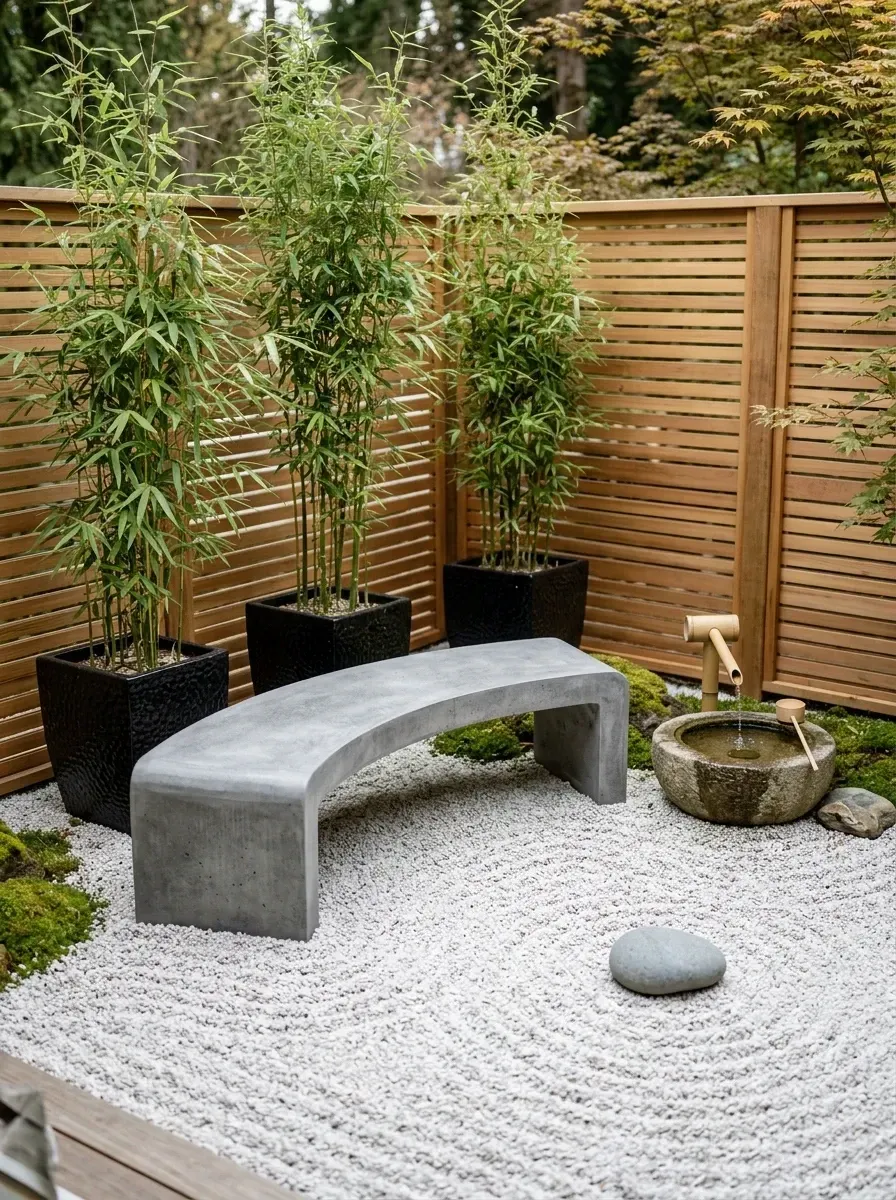
A side yard typical of a Mount Pleasant home, reimagined from a useless patch of pine straw as a 16×20 meditation garden. The screen is ipe-wood slats, custom-built by a local woodshop with a 3/4-inch reveal between boards. Ipe is the right specification here: cypress fades grey too fast, cedar twists in the humidity. The bench is a Solus Decor Pi Bench in lava finish concrete. Plants are Bambusa multiplex 'Alphonse Karr', the clumping bamboo, not the running kind, because running bamboo is a Lowcountry nightmare. They sit in Campania International Cyprus matte-black planters, 30-inch. The tsukubai water basin is a custom granite piece. The ground cover is Mexican beach pebble white, raked with a wooden zen rake from a local garden shop.
Why the Meditation Garden Works
Privacy comes first in this garden: a custom ipe-wood slatted privacy screen from a local woodshop encloses the space while letting air move through. Seating is the Solus Decor Pi Bench in lava-finish concrete, heavy enough to stay put in a storm. The planting is Bambusa multiplex 'Alphonse Karr' clumping bamboo (NOT running), set in Campania International Cyprus 30" matte-black planters, 3 in all, so it stays contained.
The quiet elements finish the design. A custom granite tsukubai with a bamboo spout runs on a recirculating pump, giving the garden the sound of water without a pond to maintain, and a ground cover of raked Mexican white beach pebble reflects light and keeps the floor calm and uncluttered.
Running bamboo has no place in a Lowcountry side yard; it travels under fence lines into the neighbor's lot, and getting it out becomes both a digging job and a legal one. Clumping types such as Bambusa multiplex or Fargesia stay where they are planted, and the square black planters in the rendering add a second line of containment. For the screen, ipe slats outlast cedar about three times over in salt air and silver evenly.
The ground is the main surface here, so its material matters. White Mexican beach pebble is heavier than standard gravel, stays put in summer downpours and holds a raked line; the concentric ripples around the bench and the single river stone in the image are the whole composition. Plan on re-raking weekly, as routine as watering.
Charleston Median (2026) $5,500 $3,250 to $7,750As drawn, this garden comes to $3,250 to $7,750. The installed custom ipe slatted screen, about 16 ft long, accounts for $1,500 to $3,500 and the Solus Decor Pi concrete bench for $600 to $1,500, about 65% of the high figure together. The screen is custom joinery with the widest spread, so it is the price to settle first.
Planting and water cost far less: $300 to $750 for Campania International Cyprus 30" matte-black planters (x3), $300 to $600 for Bambusa multiplex 'Alphonse Karr' clumps (x3), $250 to $600 for the custom granite tsukubai with its bamboo spout and pump, and $200 to $500 for about 200 sq ft of Mexican white beach pebble over landscape fabric. Moss patches and river-stone accents like those at the edges of the gravel add $100 to $300.
An ipe slatted screen runs about $90–$140 per linear foot installed in Charleston. Cedar at half the cost will warp within four summers, while ipe outlasts the rest of your hardscape.
Light Pebble White (#E8E8E8) is assigned to the gravel and the bench, so most of the garden is one quiet pale surface, although the cast bench in the image reads a shade darker. Aged Ipe Wood (#C4A484) is the warm wall around it; the screen in the rendering is still honey-colored and will silver gradually in Lowcountry humidity.
Matte Black Concrete (#000000) on the planters gives the bamboo a heavy base and the strongest contrast in the space. Natural Stone Grey (#888C8D) belongs to the granite basin and the river stones, linking the water feature to the gravel around it.
7. Sophisticated Rooftop Lounge with a City Skyline View
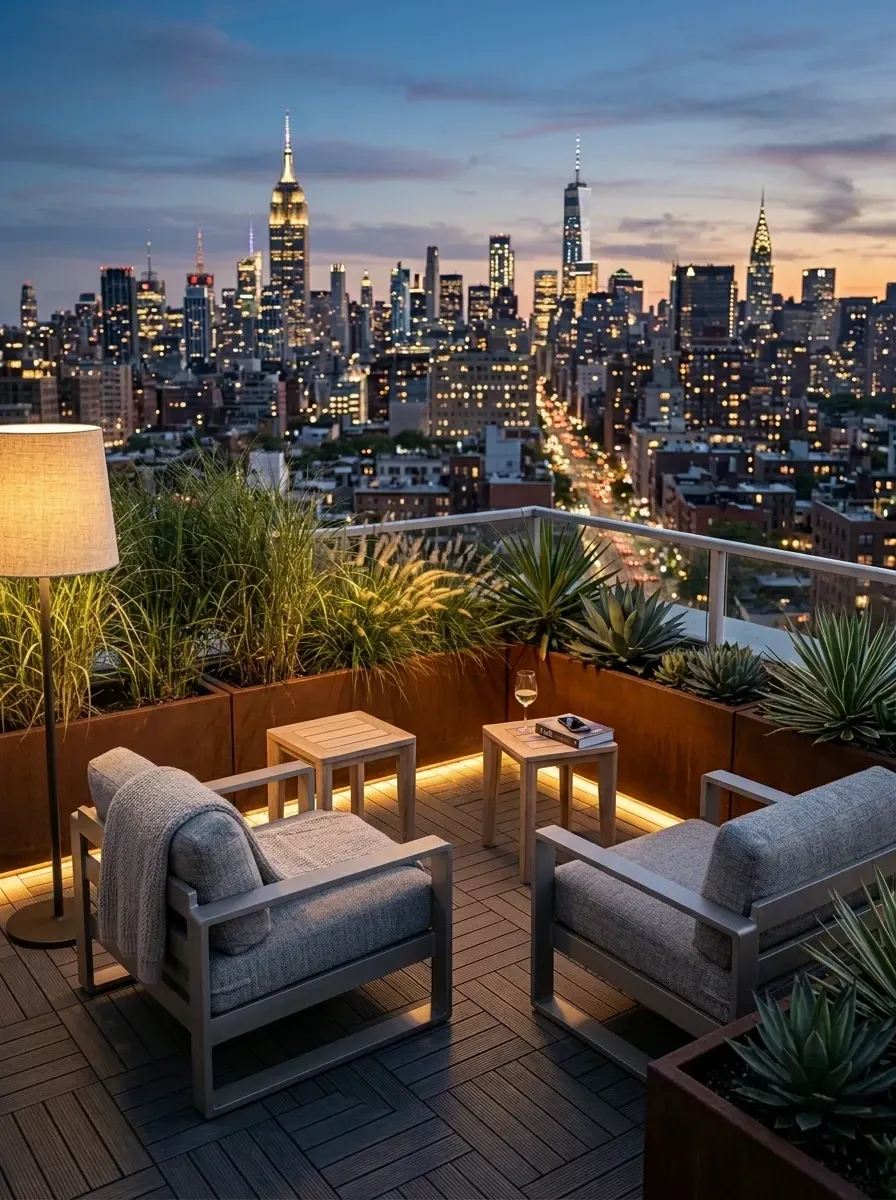
The roof terrace of a converted warehouse condo on East Bay Street, overlooking the Cooper River and the Ravenel Bridge; the rendering stands in a dense high-rise skyline for that view, but the furnishing logic is the same. The brief: make it usable in November and August both. Custom Corten steel planters are fabricated with integrated WAC Lighting Endurance warm-LED strips at 2700K. Decking is Trex Transcend Spiced Rum over a structural pedestal system, the right move on any roof, because the deck lifts for membrane access without being torn apart. The glass railing is specified frameless, although the image shows a slim metal cap rail. Armchairs are Brown Jordan Vibe in carbon, with Sunbrella Cast Slate cushions. Plants are 'Whale's Tongue' agave, fountain grass and three sabal palmetto minor, all proven survivors in Charleston roof wind.
Why the Rooftop Terrace Works
On a roof, the planters do double duty. Custom Corten steel planters with integrated WAC 2700K LED strips hold the soil and wash the deck in warm light at night, the glow running along their base in the rendering. The floor is the Trex Transcend Spiced Rum pedestal decking system, which sits above the roof membrane instead of trapping water against it, and the glass railing keeps the view open.
Brown Jordan Vibe armchairs in carbon with Sunbrella Cast Slate cushions handle the wind and sun exposure that comes with height. The planting is limited to plants that tolerate wind: 'Whale's Tongue' agave, fountain grass and sabal palmetto minor.
The pedestal deck is a requirement here, not a refinement. Composite laid directly on a roof holds water against the membrane and can ruin it within five years, while the square deck tiles in the image sit on adjustable feet with drainage beneath. Leave the Corten raw: it reaches a deep rust patina within about nine months, and a sealer only interrupts that.
Wind sets the furniture rules. Low, heavy armchairs like the pair in the rendering stay put in a Charleston gust, whereas tall, light pieces get blown across the roof. The same view-first logic argues for a frameless railing over the capped version drawn here, since any horizontal bar at seated eye level cuts across the skyline the terrace exists for.
Charleston Median (2026) $15,500 $9,850 to $21,700Fitting out this roof is estimated at $9,850 to $21,700. The custom Corten steel planters with integrated WAC LEDs, priced as a linear run, take $3,000 to $7,000, and the installed frameless glass railing takes $3,000 to $6,000; the two together are about 60% of the top estimate. Fix the planter lengths and finish before ordering anything else, because that custom fabrication carries the widest range.
The seating group is $1,200 to $3,000 for Brown Jordan Vibe armchairs (x2) with Sunbrella cushions, plus $200 to $500 for West Elm acacia outdoor side tables (x2), the low wood cubes between the chairs. The Trex Transcend pedestal decking, about 250 sq ft, is $2,000 to $4,000, and the Cedar & Moss outdoor floor lamp in the corner is $150 to $400. 'Whale's Tongue' agave, fountain grass and sabal palmettos for the planters add $300 to $800.
A frameless glass railing system runs about $200–$320 per linear foot installed in Charleston in 2026. Insurance often requires hurricane-rated tempered glass at the higher end of that range, so confirm with your HOA before specifying.
Patinated Corten Rust (#A5694F) is the warmest color on the roof, and against the evening skyline the planters read as one long band of oxidized metal. The deck and tables are listed as Weathered Composite Grey (#999999), the shade composite fades to under coastal UV, though in the rendering the new tiles and tables are still a warm brown.
Cool Slate Grey (#808080) on the Sunbrella Cast Slate cushions matches the aluminum chair frames and keeps the seating quiet. The last color is light itself: Warm LED Glow (#FFFACD) from the 2700K strips under the planters, which flatters skin and makes the terrace look finished after dark.
8. Boho Hanging-Chair Nook for a Sullivan's Island Garden or Porch
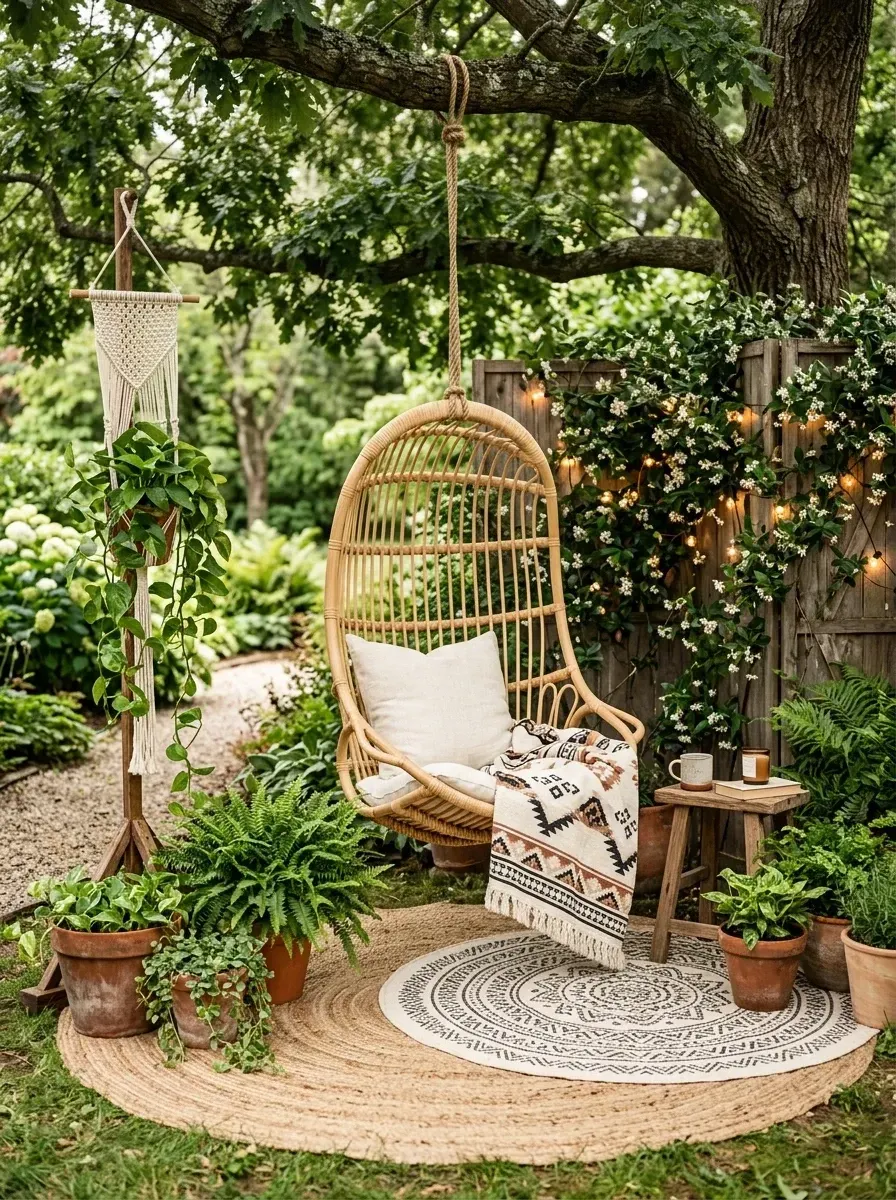
A side-porch concept for a Sullivan's Island cottage, with the brief “the porch from a Nancy Meyers movie but smaller and more honest.” The rendering moves the idea outdoors, hanging the chair by rope from a big tree limb in a garden corner, but the specification is written for a porch. The chair is the Serena & Lily Hanging Rattan Chair, hung from a structurally rated National Hardware ceiling hook driven into a 2×8 joist; confirm the joist first, because these chairs put about 250 lb of dynamic load on it. The rug is the Annie Selke Indoor/Outdoor Round Jute, 6 ft, layered here with a smaller patterned round. The plant stand is reclaimed cypress from a salvage yard, about $80. Macrame hangers come from a small maker, and the plants are Boston ferns and golden pothos, two dependable choices for Lowcountry summer humidity. String lights are Brightech Ambience Pro warm-LED, around 12 ft of usable run. The fence behind is old heart-pine, left raw and silvering.
Why the Boho Hanging-Chair Nook Works
The centerpiece is a Serena & Lily Hanging Rattan Chair. On a porch it hangs from a 2×8 joist rather than a decorative hook, because a seated adult puts real load on the ceiling; under a tree, as drawn, it needs a sound, live limb and a rope rated for the same load. Beneath it, an Annie Selke Indoor/Outdoor Jute Round Rug, 6 ft across, defines the nook. A reclaimed cypress plant stand adds height and an aged wood tone.
The greenery hangs in Modern Macrame hangers holding Boston ferns and golden pothos, both humidity-proof choices that thrive on a shaded Southern porch. Brightech Ambience Pro warm-LED string lights complete the corner with soft evening light.
A hook driven only into porch-ceiling drywall or beadboard will fail under a swinging chair, so the structure overhead matters more than anything else in this corner. Natural rattan also needs cover: in full sun the weave dries and cracks within two summers, one reason the plan puts this chair on a covered porch rather than in the open garden of the rendering.
The plants and textures carry the look. Boston ferns and pothos tolerate a Charleston August in shade, which most container plants do not, and the rendering clusters both in terracotta at the chair's feet. Color comes last: jute, rattan, weathered wood, macrame and the fringed throw supply the layering, and without that texture a boho corner starts to look like a costume.
Charleston Median (2026) $1,650 $960 to $2,430In 2026 dollars the whole listed scope comes to $960 to $2,430. The Serena & Lily Hanging Rattan Chair with its hardware is $300 to $800, and the plant collection of Boston ferns, pothos and vintage terracotta pots (x10+) is $300 to $700, about 62% of the upper total between them. The chair has the broadest range, so confirm its specification and mounting hardware first.
The rest is small-ticket: $50 to $150 for the Annie Selke Indoor/Outdoor Jute Round Rug, 6 ft; $80 to $200 for a reclaimed cypress side table from a salvage dealer, which the little stool beside the chair stands in for; $100 to $250 for the reclaimed cypress plant stand with macrame hangers; $100 to $250 for a Sunbrella throw and linen pillows; and $30 to $80 for the Brightech Ambience Pro warm-LED string lights.
Of the nine designs, this one is the easiest to achieve: keep to the low end of each range, buy the side table secondhand, and a complete corner comes in under $1,200. The hanging chair is the only piece without a cheaper substitute that still looks right.
Natural Rattan Jute (#D4C4A8) covers the two largest pieces, the chair and the round rug, so the nook reads as one woven shape on the grass. Aged Cypress Brown (#8B5A2B) on the fence and stand frames it from behind and keeps the pale fibers from floating.
The textiles add the pattern: Cream & Rust (#CD853F) for the pillows and the fringed throw, whose geometric band is the busiest thing in the picture. Vintage Terracotta Clay (#E2725B) repeats in every pot, and in coastal air the clay picks up a white salt bloom that only improves it.
9. Resort-Style Poolside Chaises at a Kiawah Beach House
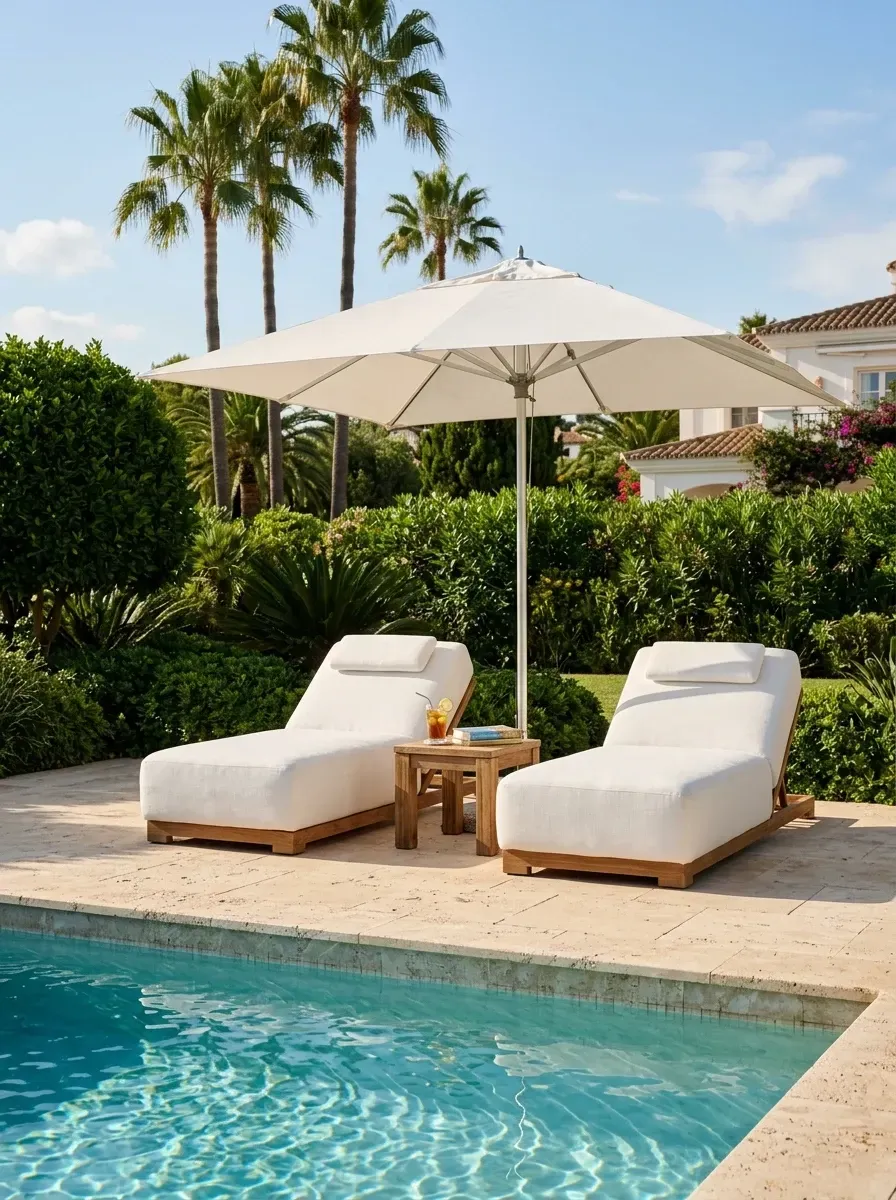
A poolside concept for the kind of Kiawah Island property owners use roughly twelve weeks a year, which means every line item has to survive nine months of unattended salt air. The chaises are Kingsley-Bate Amalfi in untreated teak, left to silver naturally rather than fight the sun. Cushions are Sunbrella Cast Pumice, custom-cut to the deep-seat profile shown. The umbrella is the Tuuci Ocean Master Max Classic 11-foot, a commercial-grade resort umbrella of the kind worth specifying anywhere within 200 feet of salt water. The deck is honed travertine pavers from Belgard, sealed with a penetrating sealer rather than a topical one. The side table is specified as a Brown Jordan Cucumber in stainless, though the rendering shows a small teak table between the chaises. Background plants are meant to be mature sabal palmetto, the South Carolina state tree and the palm best suited to Kiawah hurricanes; the tall palms in the image are a generic stand-in.
Why the Poolside Setup Works
Seating comes from Kingsley-Bate Amalfi teak chaise lounges, left to silver-age rather than stained, which is the finish that holds up best around chlorine and sun. Sunbrella Cast Pumice custom-cut deep-seat cushions make them comfortable for a full afternoon. Shade is a Tuuci Ocean Master Max Classic 11 ft commercial umbrella, drawn as a center-pole model between the chaises and built for coastal wind in a way residential umbrellas are not.
The deck is honed travertine pavers from Belgard, penetrating-sealed so it stays cool and keeps its grip when wet. The plan replaces the teak table drawn between the chaises with a Brown Jordan Cucumber in stainless steel, and mature sabal palmetto plantings form the backdrop that makes the setting read as Lowcountry.
Wind is what separates a resort umbrella from a decorative one. Retail umbrellas at half the price of a Tuuci are generally built for a sheltered patio, not for open Kiawah gusts. The paving follows the same safety logic: honed travertine, like the matte, sandy coping in the rendering, grips wet feet far better than a polished finish around a pool.
Leave the teak to weather. A silver-grey frame needs no annual oiling, which suits a house that sits empty most of the year, and it looks more settled than freshly oiled gold. The palms deserve the same caution: date and queen palms are prone to snapping in hurricane winds, while sabals tend to bend and recover, so sabal palmetto is the planting to specify for a Kiawah garden.
Charleston Median (2026) $15,000 $8,600 to $21,300The poolside scope is estimated at $8,600 to $21,300, and almost all of it sits in two lines: the installed Belgard honed travertine paver deck, about 350 sq ft, at $5,000 to $12,000, and the Kingsley-Bate Amalfi teak chaises (x2) with Sunbrella cushions at $2,500 to $6,000. Those account for about 85% of the high figure. The travertine has the largest swing, so measure the deck and get the paving quote in writing before anything else.
What remains is shade and a place to set a glass: $800 to $2,500 for the Tuuci Ocean Master Max Classic 11 ft umbrella and base, and $300 to $800 for the Brown Jordan Cucumber stainless side table.
A Tuuci umbrella runs three to five times the cost of a big-box equivalent. It is also built for commercial resort use rather than seasonal replacement, and that math wins on a beach house used twelve weeks a year.
Crisp Resort White (#FFFFFF) is used on both the cushions and the umbrella canopy, the two largest soft surfaces, and in the rendering it throws the midday light back off the water. Natural Teak Wood (#BD8E63) is the color of the chaise frames on day one; within two beach summers it weathers to silver-grey.
Honed Travertine Beige (#E3D2B4) underfoot stays cool and keeps its texture when wet. The pool supplies the only saturated color, an Aqua Blue (#00FFFF) that the white and beige around it are chosen to frame.
Practical Tips for Lowcountry Outdoor Rooms
Fabric and hardware fail first in salt air, so specify them carefully. Choose Sunbrella, not just anything labeled “outdoor-rated.” Polyester “outdoor” fabric fades, mildews and smells within two Charleston summers, while Sunbrella's solution-dyed acrylic is rated to hold its color and resist mildew far longer, which is why it is the fabric this guide specifies throughout. Hardware follows the same logic: buy what survives salt air or replace it twice. That means Stainless 316 (marine grade), powder-coated aluminum or HDPE only, because mild steel hardware rusts within nine months no matter how it is painted.
Plant for the climate you actually have, not the photo you saw. Confederate jasmine, sweet olive, gardenia, sabal palmetto, sago palm, oakleaf hydrangea, lantana and knock-out roses make up the bulletproof Lowcountry shortlist. The same respect for place applies to the whole design: haint blue ceilings, oyster-shell paths, reclaimed brick, ipe over cedar, and sabal palmettos over date palms are the durable regional choices, not the precious ones.
Lighting and fuel decide how often the space gets used. Layer outdoor lighting with path lights, uplights on trees, ambient overhead string or pendant light, and one warm task light per seating zone, since single-source overhead lighting outside reads industrial and unfinished. Fuel follows the same rule. The $400–$900 buried line priced under design 4 can also serve a grill and patio heaters, and an appliance that lights at a switch gets used far more often than one that needs a tank wrestled into place first.
Cost-Saving Strategies That Don't Read Cheap Outside
The biggest saving is labor on structures. Build your own cedar pergola: a weekend with two people, a circular saw and Atlantic white cedar from a lumberyard saves 50–60% versus contractor labor, and the result looks better than the big-box kit you may have considered. Choose materials by where they sit, too. Trex Transcend at $9–$12/sq ft installed reads as well as ipe at $25+/sq ft on a fire-pit deck, where nobody needs the visible grain, so use composite over hardwood for utility decks. Paint is another easy win. One gallon of SW Watery is about $90 in 2026, while the painter is $1,500, so DIY the haint-blue ceiling; the only skills required are a roller and a steady ladder.
Furnishings and pots reward patience and secondhand buying. Aged Italian terracotta runs $12–$40 per pot from salvage dealers versus $80–$200 new at retail, and the patina cannot be bought new. Skip the matched dining set as well: pair one nicer dining table with secondhand chairs from estate sales, because the collected look reads more luxurious than a matched eight-piece set at any price.
Plants are the cheapest place to wait. A 1-gallon confederate jasmine for $14 in March will cover a wall by August, while the 3-gallon at $48 saves you only about six weeks, so plant smaller perennials and let time do the work. Patience is the least expensive landscape-design tool there is.
Regional Fit Across Southern Markets
We treat Charleston, SC (baseline 1.00x) as the salt-air corrosion benchmark: specify Sunbrella, marine stainless, Polywood and powder-coated aluminum, and treat hurricane wind ratings on pergolas and railings as real budget lines rather than options. Savannah, GA (0.96x) has identical climate considerations, but antique-brick salvage in the Savannah area tends to cost less, and vintage pots and ironwork are similarly cheaper. Naples / Ft. Myers, FL (1.05x) combines higher UV with a stronger hurricane code, so wind-rated umbrellas and pergolas such as Tuuci and StruXure are practical requirements there, not luxuries; pricing on mature palms is similar to Charleston.
Inland markets drop the salt premium. Nashville, TN (0.94x) has no salt air, so teak, wrought iron and standard wicker all last longer; material costs are slightly lower, though trade labor on custom hardscape is comparable to Charleston. Atlanta, GA (1.00x) can use mostly the same plant palette (with some heat exceptions) and carries no salt-air premium, and the ADAC trade showrooms make Brown Jordan, Janus et Cie and Sunbrella easy to source. In Charlotte, NC (0.97x), prices run slightly under Charleston, and the same Lowcountry plant logic applies because the humidity is comparable.
The Washington, DC metro (1.12x) carries the highest premium on this list. Labor on custom hardscape and pergolas runs 12% above Charleston, and while materials translate one-to-one, you should plan for budget headroom.
Frequently Asked Questions
What outdoor furniture brands actually survive Lowcountry salt air?
In rough order of confidence: Polywood (HDPE), Brown Jordan (powder-coated aluminum), Lloyd Flanders (synthetic vinyl wicker over aluminum), Kingsley-Bate (untreated teak left to silver), Janus et Cie (commercial-grade outdoor), and Fermob (powder-coated steel, surprisingly resilient if dry-stored each winter). Real wicker, mild steel, and cheap “outdoor-rated” cushions all fail within three Charleston summers.
Pergola, pavilion, or louvered roof: which is the right call?
A simple cedar pergola is right for a romantic, plant-heavy garden where you do not need rain protection (design 1). A louvered aluminum pergola like StruXure is right for a serious outdoor dining or living room you want to use in afternoon thunderstorms (design 3). A solid-roof pavilion is the rare correct answer. It is a building, with a building's permitting cost, and usually a shaded patio is what people actually want. If your climate gets afternoon storms more than once a week in summer, the louvered system pays for itself in extra usable months.
What plants actually survive a Charleston summer on a porch or patio?
Bulletproof in containers: confederate jasmine (vine), sweet olive, gardenia, Boston fern, golden pothos, and 'Wintergreen' Japanese boxwood. In the ground: sabal palmetto, sago palm, oakleaf hydrangea, knock-out rose, lantana, plumbago, crape myrtle, camellia, and confederate jasmine on a wall. Avoid in unshaded summer pots: hostas (cook), real ivy (mites), most herbs after July, and any plant labeled "for cool-summer climates."
What is the realistic minimum to make a backyard look intentional?
For a 12×12 patio in Mount Pleasant in 2026, the floor is roughly $2,500: a single Polywood loveseat-and-chair set, a 6×9 outdoor rug, two large terracotta pots with mature plants, and string lights. Below that, paint, plants, and lighting will do more than another piece of furniture would. Design 8 in this article (the boho hanging-chair nook) is the most achievable starter project. If you are starting from a more dramatic before-and-after baseline, our 11-direction backyard makeover guide walks through that range in more depth.
Are concrete or composite better than wood decks in the Lowcountry?
For shaded or seasonal-use areas, real ipe outlasts the rest of your house and ages well, so it is worth the cost. For sun-exposed daily-use decks (especially fire-pit zones and pool aprons), Trex Transcend or AZEK Vintage outperforms hardwood on heat retention, splinters, and fade. Polished concrete works for ground-level patios with proper drainage but reads cold in shaded outdoor rooms.
How much should you really budget for outdoor lighting?
A defensible Lowcountry budget for a 1,000 sq ft outdoor area is $2,000–$4,500 for a layered scheme: path lights, uplights on two or three trees, integrated planter LEDs, one or two task lamps, and 50–80 ft of string lights. Hire a low-voltage installer rather than DIY anything that involves transformer sizing, because rewiring a failed install costs more than doing it right. For evening drama, integrated 2700K warm LEDs in custom planters (design 7) are the highest visual return per dollar.
Where in Charleston do you actually source these outdoor pieces?
Charleston has each of the supplier types this article relies on. Polywood and Sunbrella pieces are stocked by outdoor-furniture dealers and large online retailers; pavers and stone come from hardscape supply yards and hearth-and-patio dealers; mature plants and palms from the specimen-size nurseries along the Highway 17 corridor; fountains, urns and salvaged pieces from architectural salvage dealers. For lanterns and lighting, Bevolo Gas & Electric (New Orleans, ships nationally) and Visual Comfort dealers cover the designs shown. The 10 outdoor garden spaces piece goes further into plant-heavy gardens, and the 11-direction backyard transformation is the closest sister read for full outdoor-room rebuilds.
Sources & References
- Polywood: polywood.com. Vineyard bench and Jefferson rocker line specifications, HDPE warranty data.
- Kingsley-Bate: kingsleybate.com. Amalfi teak chaise specifications and silvering guidance.
- Brown Jordan: brownjordan.com. Vibe armchair and Cucumber side-table specifications, Charleston dealer network.
- Janus et Cie: janusetcie.com. Knit Outdoor dining-chair specifications, ADAC trade showroom availability.
- Lloyd Flanders: lloydflanders.com. Mackinac all-weather wicker line, salt-air durability ratings.
- Fermob: fermob.com. Luxembourg bistro line, fern green color reference and powder-coat warranty.
- Sunbrella: sunbrella.com. Solution-dyed acrylic fade specifications, Cast Slate and Cast Pumice color references.
- StruXure: struxure.com. Pergola X louvered aluminum specifications, hurricane wind ratings.
- Solus Decor: solusdecor.com. Hemi 36" gas fire pit and Pi concrete bench specifications.
- Tuuci: tuuci.com. Ocean Master Max Classic 11 ft cantilever umbrella commercial specifications.
- Trex & AZEK: trex.com, azekexteriors.com. Transcend Tiki Torch and Spiced Rum composite decking specs, pedestal-system options.
- Belgard & Campania International: belgard.com, campaniainternational.com. Mega-Lafitt and travertine paver lines; Tuscan and Cyprus planter references.
- Visual Comfort & Bevolo Gas & Electric: visualcomfort.com, bevolo.com. Bryant outdoor sconce and copper gas-lantern specifications.
- Brightech & WAC Lighting: brightech.com, waclighting.com. Ambience Pro string lights and Endurance LED-strip specifications.
- Romabio: romabio.com. Limewash technical specifications for masonry application.
- Sherwin-Williams & Benjamin Moore: sherwin-williams.com, benjaminmoore.com. Color references for Watery 6478, Hale Navy HC-154, Boothbay Gray HC-165.
- Local lumber yards, woodshops & architectural salvage dealers: local Charleston shops; prices referenced are typical 2025–2026 estimates.
- The Layered Homes editorial notes: outdoor-room design concepts developed for homes typical of Charleston, Mount Pleasant, Sullivan's Island, Daniel Island, Folly Beach, and Kiawah Island.
Designing Outdoor Rooms for Lowcountry Weather
Outdoor rooms in the Lowcountry are not interior rooms with the walls removed. The constraints are different: salt, humidity, sun, hurricane wind, and twelve-month use that no Northern climate has to plan for. The nine rooms above all hold up because every line item was chosen against those constraints, not against an inspiration photo. That is the difference between a backyard that looks great in May and one that looks great in October as well.
For a before-and-after view of the same Lowcountry thinking, the 11-direction outdoor transformations piece takes one neglected backyard through eleven complete rebuilds and is the nearest companion to this article. Design 1's plant-heavy approach is developed further in the 10 outdoor garden spaces guide. The roof terrace in design 7 gets a fuller treatment in the 12-rooftop transformation piece, and the poolside in design 9 has a Mediterranean cousin in the Mediterranean poolside transformation.
Spec for the salt, plant for the humidity, and let the room finish itself across two summers. That is the whole Lowcountry outdoor framework.
Styling & Living Desk
The Layered Homes editorial teamThe Styling & Living Desk produces the room-by-room guides, outdoor and garden pieces, celebration ideas and design solutions, each with an itemised cost estimate, and the Home Files essays.
More from the Styling & Living Desk →
Reader notes