


These sunroom ideas restyle one 1990s sunroom through color, finish, lighting, furniture and storage. The fixed room shell remains in place, so each image is a design study rather than a claim that construction took place.
The 1990s Sunroom Starting Point
The starting photo shows a 1990s sunroom wrapped in white framed windows on three sides, each hung with tired yellow vertical blinds, under a vaulted ceiling with two skylights whose trim is peeling and a brass ceiling fan with dark blades. Two rattan loveseats with pink floral cushions face a glass topped rattan coffee table on a faded rug, a folding table piled with magazines runs along the right windows, and a potted ficus fills the far corner. The beige tile is sound but dull, and the knee walls below the glass are scuffed and stained. Those proportions and openings are what every direction has to work with.
None of the ten concepts moves a window, a skylight or the vaulted ceiling, and the fan stays on its existing mount even where a new one replaces it. All of them are concept renderings of finish and furniture changes, not finished rooms. The stained knee walls and worn skylight trim in the photo hint at moisture or age, and anything of that kind, along with electrical or code questions, needs its own inspection before paint goes on.
1. Bohemian Plant Room
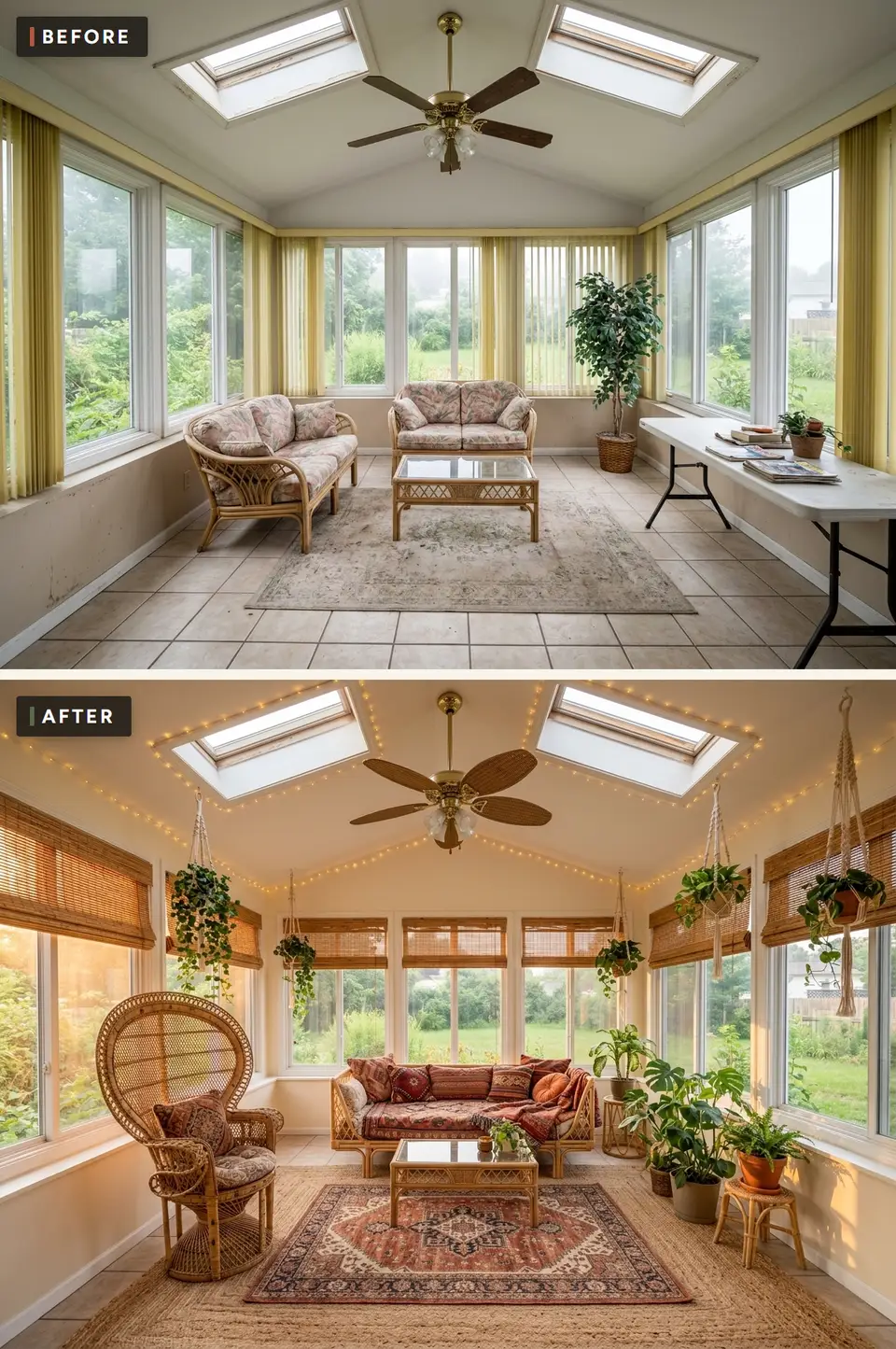
The bohemian version swaps the vertical blinds for woven bamboo shades and runs a strand of small lights around the skylight wells and along the ridge. A rattan sofa piled with kilim cushions sits under the far windows, a peacock chair takes the left corner, and the glass topped rattan table from the original room stays at the center on a red medallion rug laid over a larger jute one. Macrame hangers carry trailing plants in front of the side windows, while a monstera, a fern in a clay pot and smaller plants on rattan stools crowd the right corner. Even the fan gets woven blades.
Plants are either hung high or grouped on the floor in one corner, so the lower panes stay open and the view of the yard survives. The layered rugs do the anchoring: the patterned one marks the seating zone, and the jute spreads warmth across most of the old tile. Treat the string lights as decoration; they glow nicely in a rendering but do little for reading after dark.
Leaf green (#526B4E) comes almost entirely from the plants, which is why so many of them are needed, and Linen (#E6DDCF) is the warm cream of the walls and ceiling. Terracotta (#A95F45) runs through the medallion rug, the kilim cushions and the clay pot by the fern, while Dark bronze (#3A3831) belongs in small doses, a lamp base or a picture frame, to give all that honey toned rattan an edge.
Sunrooms run hotter and brighter than any other room in the house, and conditions change from one window to the next. Match each plant to the heat and sun at the exact window where it will live; a fern that does well on a shaded north side can scorch a few feet away behind west glass. The hanging pots also add a watering job overhead, so choose hangers with sealed saucers or plan to lift them down each time.
Expect about $1300–$4700. Most of the spread sits in the seating: a secondhand peacock chair and an inexpensive rattan sofa keep it near the low figure, while new hand woven pieces and two good rugs push it toward the top. Bamboo shades for this many windows are the next largest line, and the plants can be added slowly.
2. Breakfast Sunroom
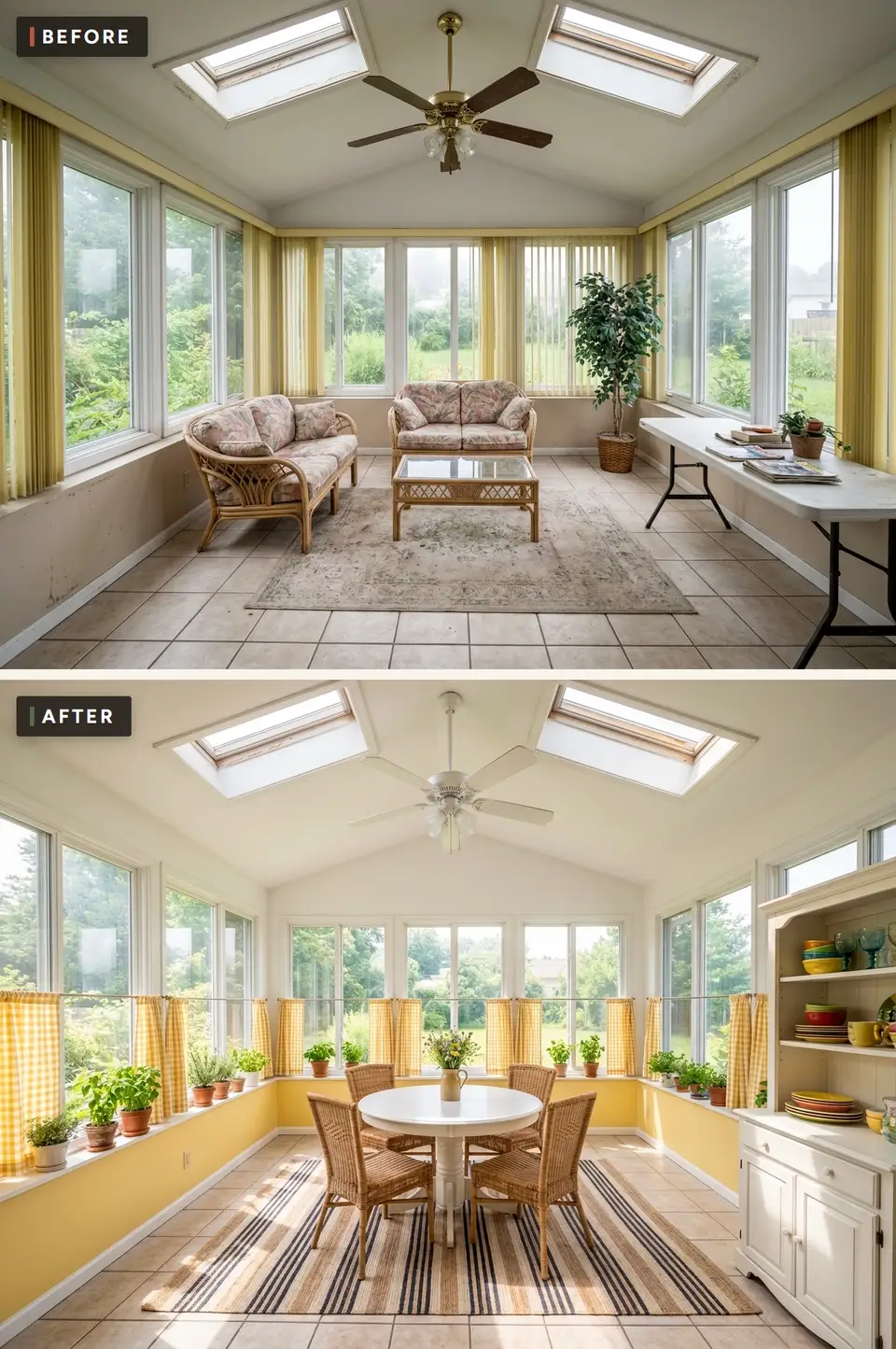
The breakfast version paints the knee walls a soft butter yellow, hangs yellow gingham cafe curtains across the lower half of every window, and swaps the brass fan for a white one. A white pedestal table with four woven wicker chairs sits at the center on a striped flatweave rug in tan and charcoal, and a tall white hutch stacked with colorful dishes stands against the right wall. Pots of herbs line the sills.
A round table suits this room because chairs can pull out in any direction without hitting the knee walls, and it leaves a clear lane down the right side past the hutch. Centered under the fan, it gives the room an obvious middle, and the half height curtains cut low morning glare at the table while the upper glass still shows the yard.
Warm plaster (#E7DED0) fits the ceiling and the trim, and Light oak (#C49D72) is carried by the wicker chairs and the tan bands of the rug rather than by any wood. Charcoal (#343735) appears as the dark stripes in that rug, and Moss (#61705A) comes from the herb pots along the sills; the butter yellow walls and curtains are a bright extra the listed palette does not name.
Chairs placed against the glass sit in direct morning sun for hours, so any seat pad on the wicker should be UV resistant or it will fade unevenly within a summer. Leave enough floor around the table for all four chairs to pull back, and keep the hutch doors free to swing fully open. Open shelves of dishes gather dust quickly in a room with operable windows, so the closed lower cupboards shown in the rendering are the better home for anything used less than weekly.
We estimate $1500–$5200 for this one. A wicker dining set and a flatweave rug are modest purchases; the hutch is the swing item, anywhere from a painted secondhand piece to a new unit, and the yellow paint, curtains and herbs are small lines.
3. Coastal Garden Room
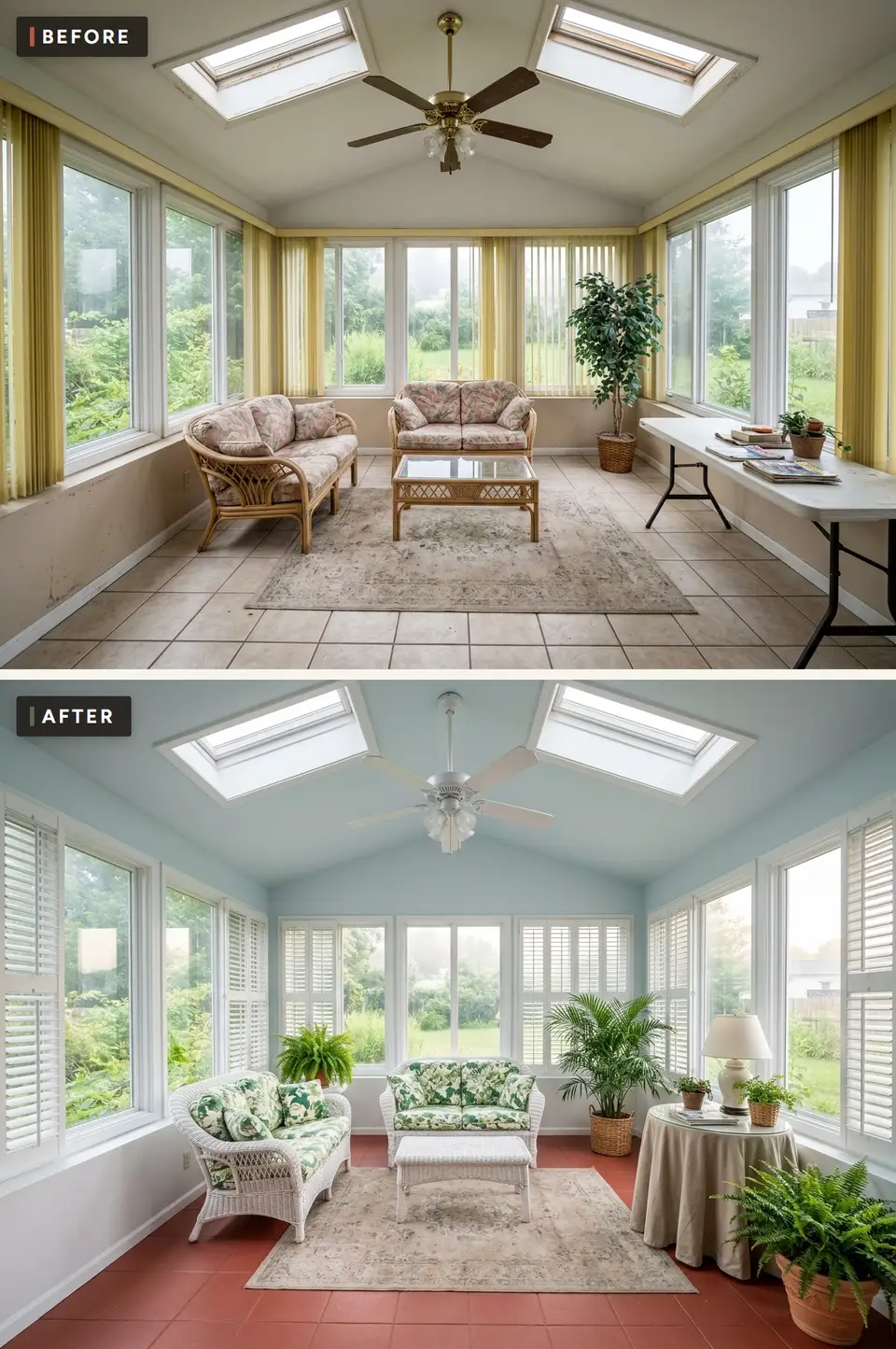
Coastal garden paints the walls and the vaulted ceiling a pale aqua blue and replaces the vertical blinds with white plantation shutters on every window. White wicker loveseats with green banana leaf cushions face a matching wicker table on a faded vintage style rug, a skirted round table with a lamp stands in the right corner, and ferns and a palm in a basket bring the garden indoors. The biggest change is underfoot, where the beige tile becomes a deep terracotta red.
White wicker reads light against the blue, so the window grid remains the strongest pattern in the room. Turning both loveseats toward the far wall makes the view the focus, and the skirt on the round table hides a watering can or a stack of magazines below it. Shutters also control light panel by panel, which suits glass on three sides.
Mist blue (#C8D8DA) is the wall and ceiling color, and Warm white (#EFECE3) covers the wicker, the shutters and the trim. Pale oak (#C7A77D) shows only in the plant basket, so a wood tray or side table could carry it further, and Soft navy (#354B5E) is absent from the rendering; a pair of pillows or a trimmed lamp shade would add it. The red floor sits outside the listed palette and supplies most of the warmth.
A sunroom without full heating and cooling can swing from cold mornings to hot afternoons, and indoor foam and fabric do not handle that well. Where the swings are large, outdoor grade inserts and covers are the safer choice for these loveseats, since they resist mildew and dry quickly after condensation. White wicker also needs a gentle wash each spring, because pollen settles into the weave.
The estimated allowance is $1400–$5000. The cost summary below prices this direction for seating, a rug, paint and plants, so the plantation shutters and the new red tile floor, both prominent in the rendering, would sit on top of that range. Painting a vaulted ceiling is also a ladder job that adds labor.
4. Modern Family Room
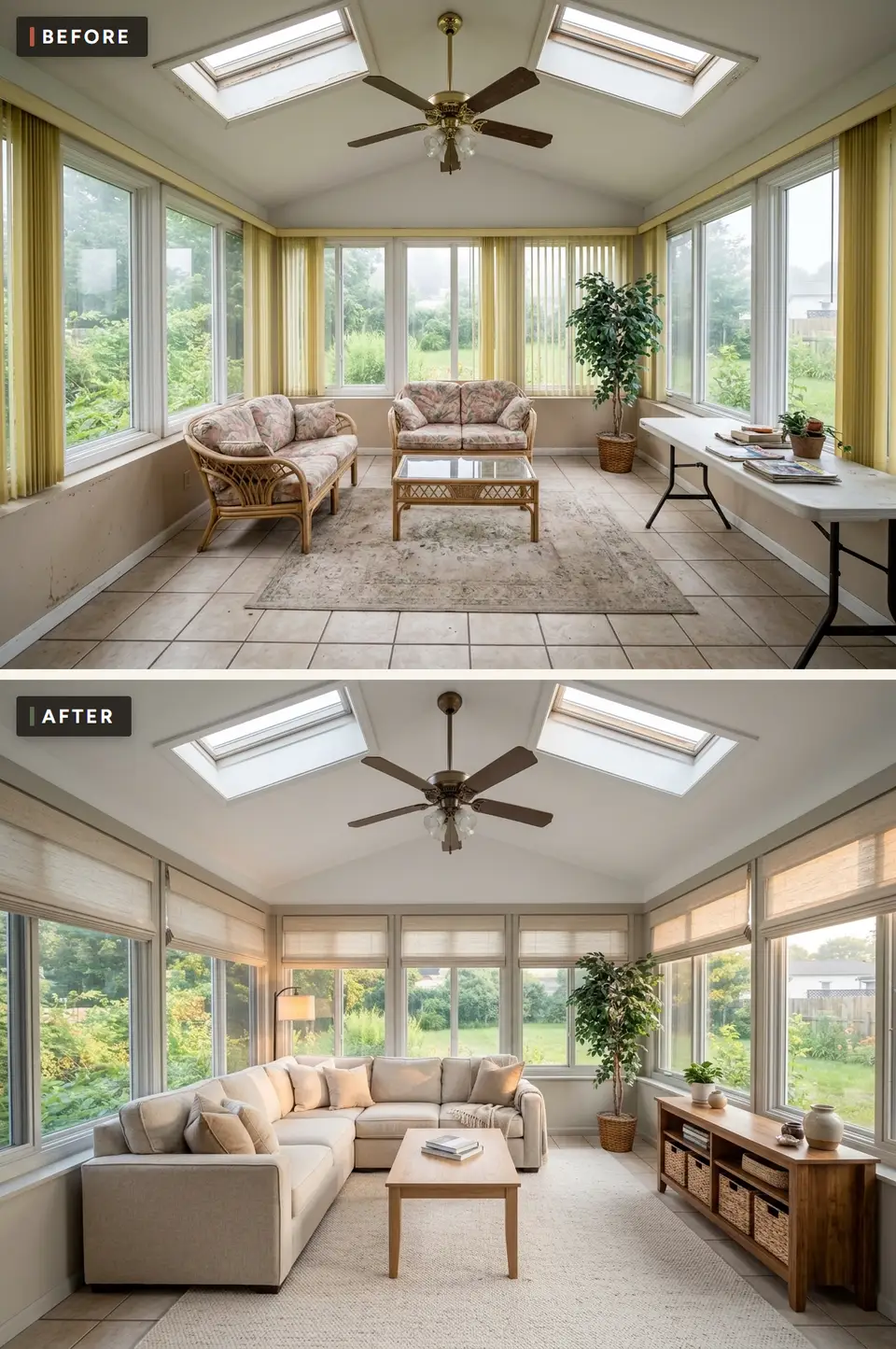
The family room version keeps the shell neutral: warm greige walls, pale woven roman shades and a bronze fan with dark wood blades. A cream L shaped sectional fills the left corner, a light oak coffee table sits on a textured cream rug, and a wood console with wicker baskets runs along the right windows where the folding table used to stand. A floor lamp behind the sofa and a ficus in the far corner finish it.
Of the ten, this plan suits a whole household watching, talking and sprawling at once. The sectional is pushed into one corner rather than floating, so the floor between the entry and the console stays open, and the baskets give toys, blankets and remotes somewhere to land. Its backs rest against the knee walls, which keeps the cushions below the window line.
Warm plaster (#E7DED0) describes the walls, the sectional and the rug almost equally, which is why the room feels so calm, and Light oak (#C49D72) is the coffee table and the console. Moss (#61705A) and Charcoal (#343735) barely appear beyond the ficus and the fan, so they are the colors to bring in through throws, pillows or a lamp if the cream starts to feel flat.
A family sectional is the largest fabric surface in the room, and in a sunroom it is also the one most exposed to fading. Check the upholstery's fade rating for the sunniest position and lower the roman shades during the brightest hours, which they do well because each one covers a full pane. Cream forgives sun better than it forgives children and pets, so performance fabric or removable washable covers earn their extra cost on a sofa this size.
At an estimated $2200–$6800, this carries the highest allowance of the ten. A full sectional is the single largest purchase in the article, and shades for every window plus the console and a large rug make up most of the rest.
5. Moody Conservatory
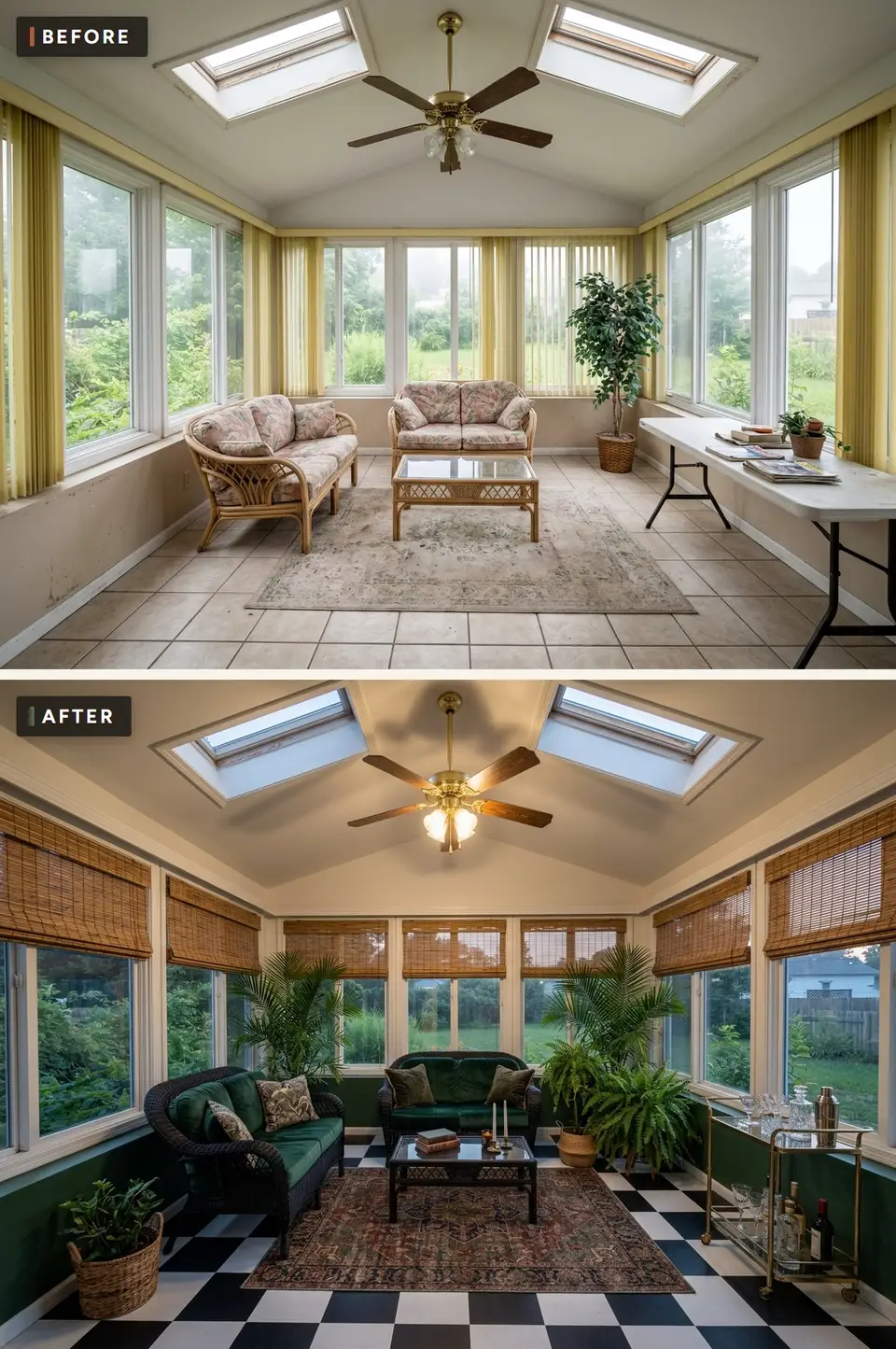
The moody conservatory paints the knee walls a deep bottle green, lays a black and white checkerboard floor over the old tile, and hangs bamboo shades at every window. Black wicker loveseats with green velvet cushions face a dark coffee table holding candlesticks and books, a red Persian rug grounds the seating, and a brass bar cart stands along the right windows. Tall potted palms and ferns frame the far corners, and the brass fan stays, now with its globes lit.
The dark color stops at the sill line, so the glass above still floods the room with daylight and the green never closes in. All the heavy color sits low, in the floor, the walls and the furniture, while the ceiling stays a warm cream. After sunset that balance flips, and the room will need lamps beyond the fan light to keep it from feeling like a cave.
Deep charcoal (#252725) is the black wicker and the dark squares of the floor, and Aged brass (#A98252) shines in the fan housing, the bar cart and the candlesticks. Walnut (#6B4F3A) shows in the fan blades and the bamboo shades. Ink blue (#263747) is the one listed color the rendering does not use, since the walls came out bottle green, so it fits best as a velvet pillow or a glass decanter rather than as wall paint.
A dark floor in a glass room can get very hot in afternoon sun, and many adhesives and resilient products fail when the surface runs warmer than their rating. Test the floor temperature on a sunny day before choosing any glued or peel and stick checkerboard. Glassware on the bar cart also needs a stable spot outside the walking line, and the cart's wheels should lock on the smooth floor.
We put this direction at about $1800–$6100. A checkerboard floor laid over tile is the cost that moves most, followed by the two loveseats, the bar cart and the shades; the green paint itself is inexpensive.
6. Coastal Blue
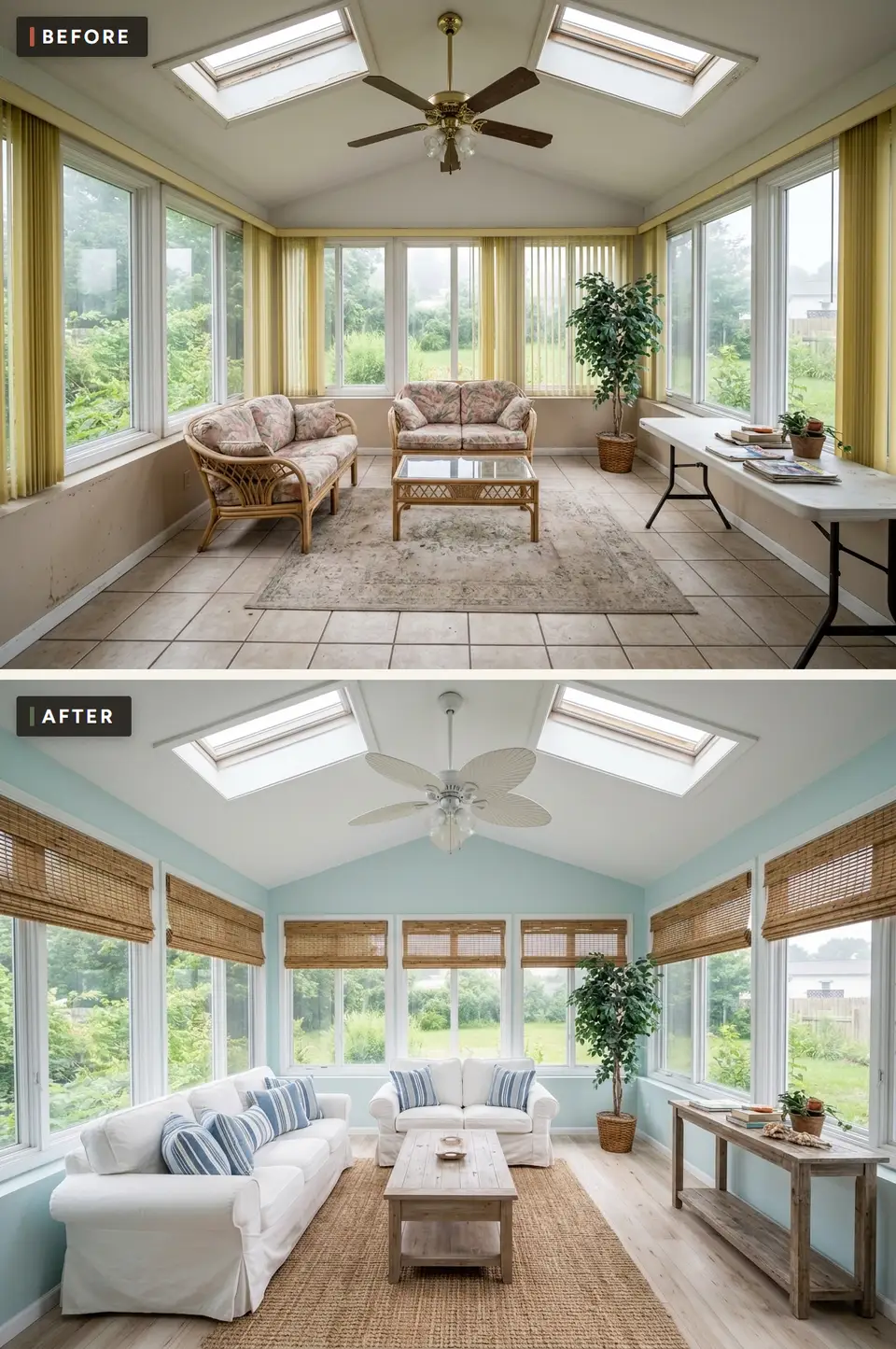
Coastal blue paints the walls a pale aqua, leaves the vaulted ceiling white, and pairs bamboo roman shades with a white palm leaf fan. A white slipcovered sofa and matching loveseat with blue striped pillows face a weathered wood coffee table on a large jute rug, and a rustic console along the right windows holds books and a potted plant. The tile gives way to pale wood look planks.
No anchors, shells or driftwood signs are needed; the room reads coastal through color and texture alone. The sofa and loveseat form an L, leaving the right half of the floor open beside the console, and the jute rug is big enough for the front legs of both pieces, which keeps the group from looking scattered.
Mist blue (#C8D8DA) is the wall color, a shade greener than its name in this light, and Warm white (#EFECE3) covers the slipcovers, ceiling and trim. Pale oak (#C7A77D) runs through the new floor, the coffee table and the console, and Soft navy (#354B5E) appears only in the pillow stripes, which is exactly enough.
Sunrooms with operable windows let in pollen and fine dust, which settles visibly on white upholstery. Removable, washable covers like the ones on this sofa solve most of that, and they cost far less than replacing a fabric that has gone gray. A spare set of pillow covers helps too, since the striped pillows get handled most and fade first near the glass.
We estimate $1500–$5300. Slipcovered seating and a large jute rug form the core, and the bamboo shades multiply across every window. The summary below prices this direction for paint, seating, a rug and shades, so replacing the tile with planks as the rendering shows would add to that figure.
7. Coastal Blue Variation
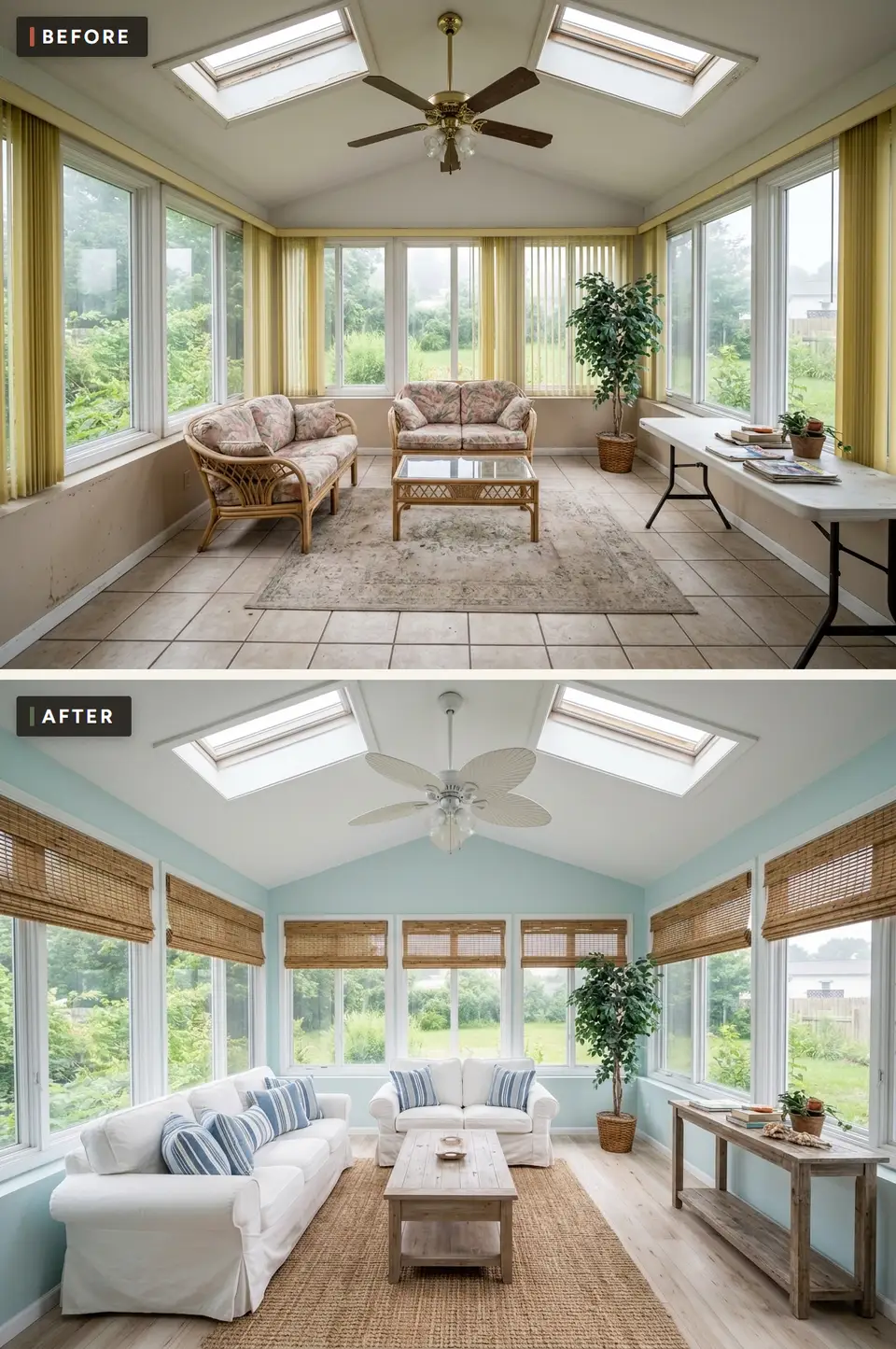
The variation starts from the same pale aqua walls, bamboo shades, jute rug and weathered wood pieces as coastal blue, and its rendering is in fact identical to the previous one, sofa and loveseat included. The written plan differs in one way: it replaces the upholstered pair with two slipcovered armchairs around a narrow table to make a smaller conversation group.
Two chairs and a narrow table take far less floor than a sofa and loveseat, which matters if this sunroom also serves as the route to the yard. Angled toward each other near the far windows, the chairs leave the middle of the room free for a second use, a small desk or a potting bench, and one person can rearrange the plan in minutes.
The four colors carry over from coastal blue but with less fabric to hold them: Warm white (#EFECE3) for the chair covers and trim, Mist blue (#C8D8DA) on the walls, Pale oak (#C7A77D) in the floor and the narrow table, and Soft navy (#354B5E) in one striped pillow per chair. With fewer upholstered pieces, the woven shades become a larger part of what the eye takes in.
With chairs instead of a sofa, it is tempting to drift the seating right up to the glass. Keep a direct route from the house entry across the room, wide enough to carry a tray, and set the chairs on either side of it rather than across it. Chairs also leave more of the knee walls exposed, so the scuffs visible in the starting photo need patching before the blue goes on.
Budget roughly $1200–$4300 for this version. Two armchairs usually cost less than a sofa and loveseat, which is why it lands below the coastal blue range, while the shades and rug cost about the same in both.
8. Plant Lover Room
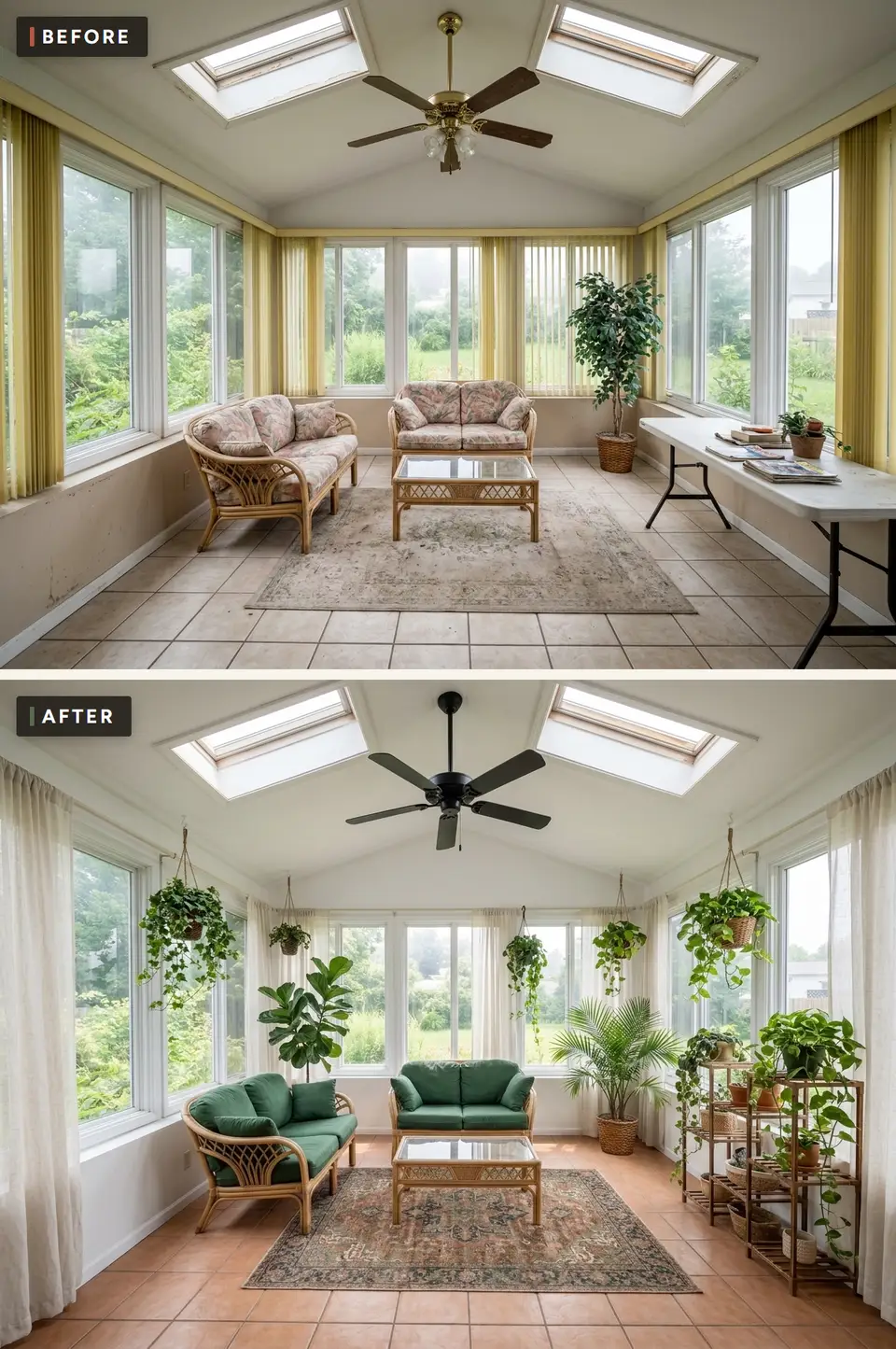
The plant lover version keeps the original rattan loveseats and glass topped table but recovers the cushions in deep green, and the beige tile becomes warm terracotta. Sheer linen curtains hang at the corners in place of blinds, a matte black fan replaces the brass one, and plants are everywhere: pothos and ivy hanging in front of the windows, a fiddle leaf fig and a palm in the corners, and a tiered bamboo stand loaded with pots along the right wall. A faded Persian rug sits under the seating.
Reusing the rattan frames and the table frees money for plants and the stand. The tiered stand is the working center of the room: it gathers most of the pots by the brightest glass, so watering happens along one short route instead of across the whole floor, and the tile below shrugs off spills.
Leaf green (#526B4E) is the cushions and nearly every plant, and Linen (#E6DDCF) is the sheer curtains and the soft white walls. Terracotta (#A95F45) covers the new floor and repeats in the clay pots and the rug, while Dark bronze (#3A3831) is the matte fan, the one dark note in a very warm room.
A room full of plants is also a room full of water. Moisture trapped under a planter can stain grout within weeks even on tile, so every pot on the stand needs its own saucer, and the bamboo shelves should be sealed or lined. Sheer linen brushed by wet leaves will spot and mildew, so tie the curtains back clear of the hanging pots.
We put the allowance at roughly $1100–$4100, the lowest of the ten, because the seating frames and table stay. New cushion covers, the plant stand, planters and a rug make up the core; the terracotta floor is not part of that list, so retiling would come on top.
9. Minimal Sunroom
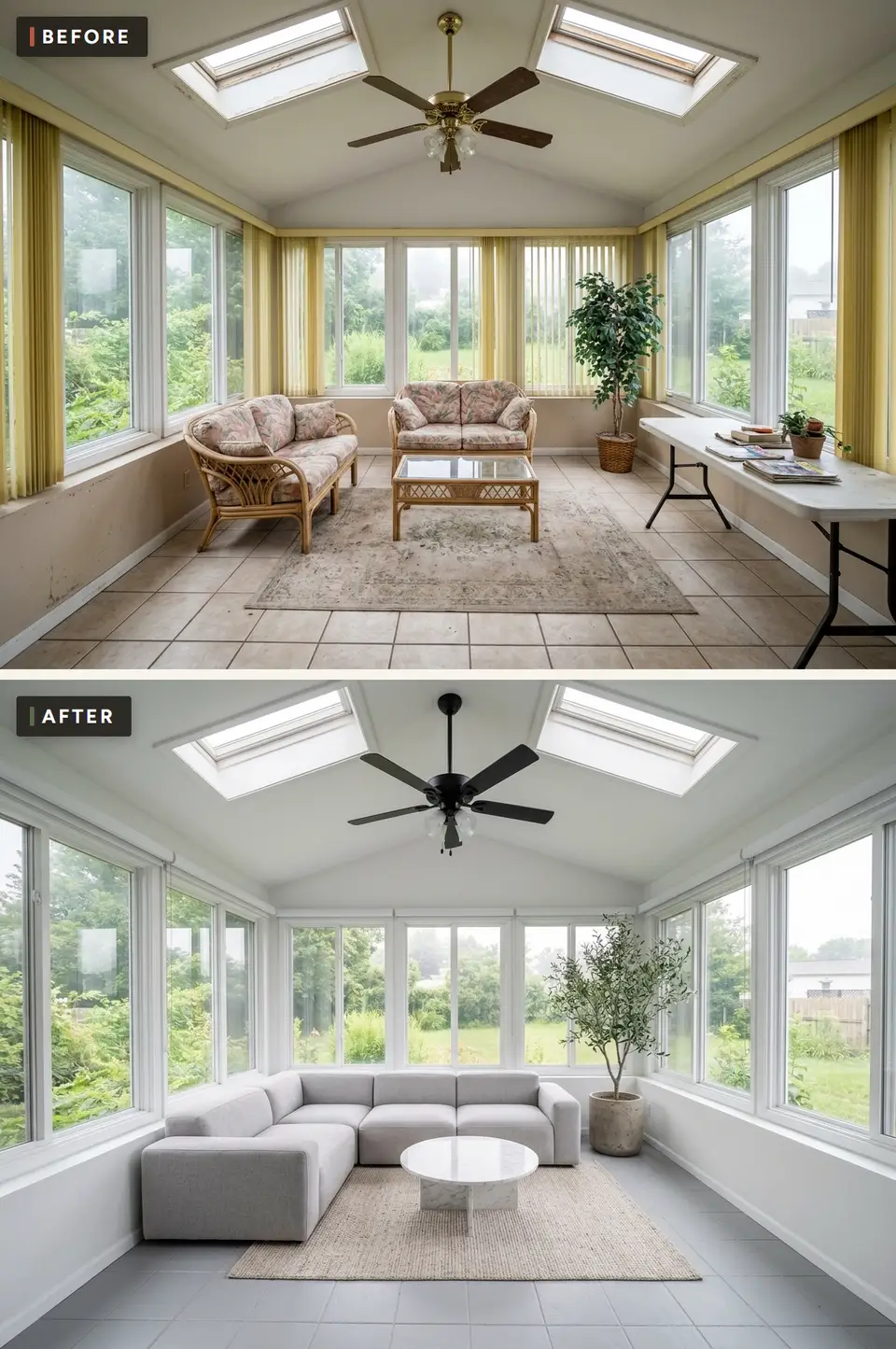
The minimal version strips the room back to white walls and trim, a light grey painted tile floor and slim roller shades rolled up at the head of the windows. A light grey modular sectional wraps the far left corner, a round white marble table sits on a plain jute rug, and a single olive tree in a concrete planter stands in the right corner. The fan becomes matte black.
With so little furniture, the windows become the decoration, and fewer pieces also make the glass easier to clean. The sectional's backs run along the knee walls below the sills, so it never blocks a pane, and the round table is easy to walk around in a room where every route ends at glass.
Warm white (#EFECE3) is nearly the whole room, the walls, the trim and the marble table, with the sectional a shade cooler. Pale oak (#C7A77D) comes only from the jute rug, and Mist blue (#C8D8DA) sits close to the cool grey cast of the painted tile. Soft navy (#354B5E) does not appear; in a room this restrained it could be one throw or a single ceramic piece, no more.
Minimal rooms show dirt quickly, and pale grey painted tile is no exception, so confirm that any floor coating is rated for foot traffic and for the heat a sunroom floor reaches. A modular sectional can be split and slid aside for window cleaning, a real advantage in a room this glazed. The olive tree wants the brightest position available; the corner in the rendering works only if it gets several hours of direct sun.
Estimated at $1700–$5700, the minimal room is not the cheapest despite its few pieces. A good modular sectional and a marble table cost more than they look, and painting or coating tile adds preparation work.
10. Cozy Reading Room
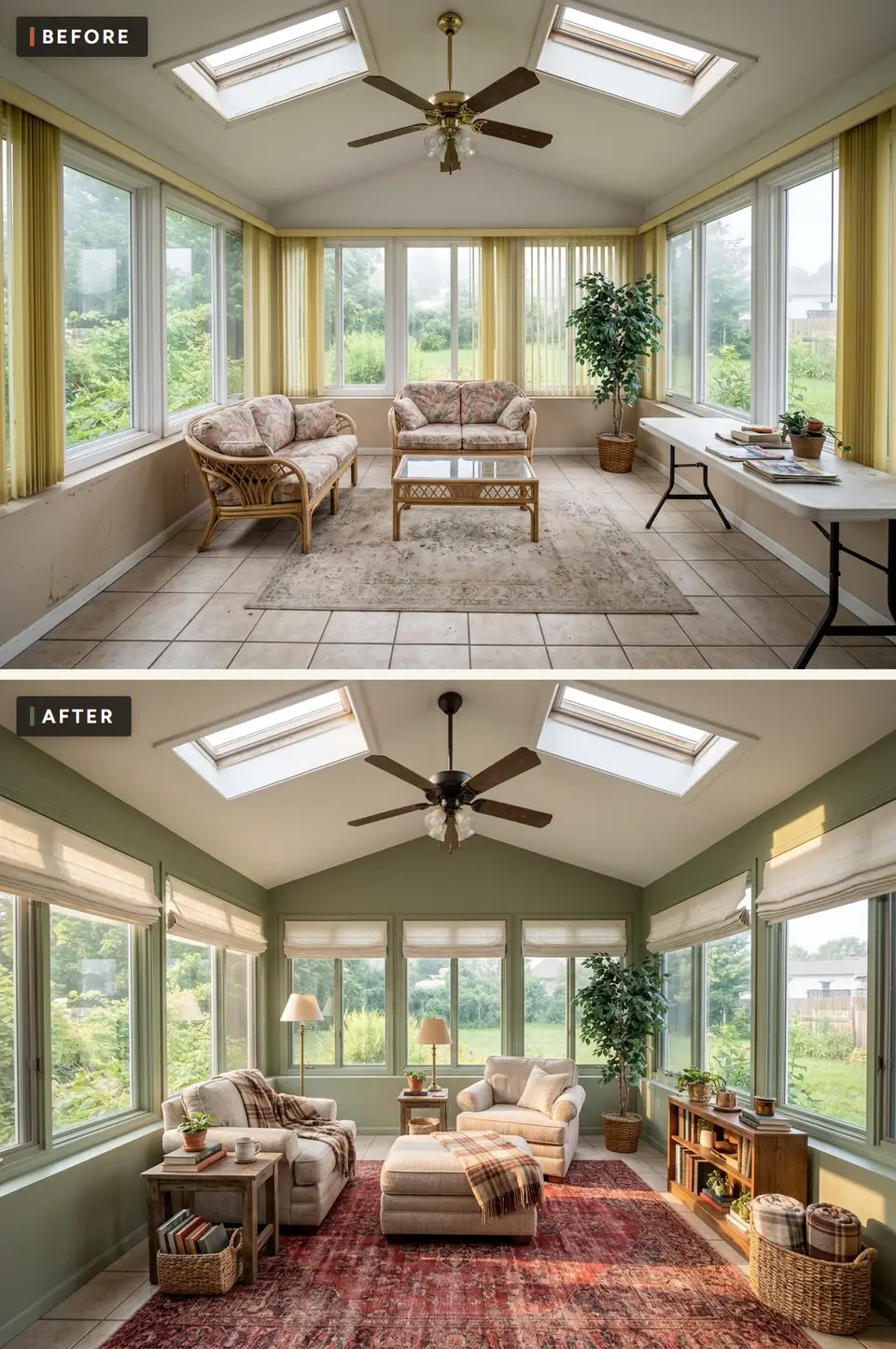
The reading room paints the walls and the window frames a soft sage green and swaps the blinds for white fabric roman shades. Two cream armchairs and an upholstered ottoman draped with plaid throws sit on a red Persian rug, a floor lamp and a small table lamp provide evening light, and a low wood bookcase runs under the right windows. Baskets hold blankets, a rustic side table stacks books by the left chair, and a bronze fan with wood blades replaces the brass one.
The chairs sit with their backs to the far windows, so daylight falls over the reader's shoulder onto the page rather than into the eyes. At dusk the two lamps take over, one standing behind the left chair and one on the small table between the pair, and the single ottoman serves both seats.
Moss (#61705A) sets the mood, rendered here as a lighter sage on the walls and frames, and Warm plaster (#E7DED0) is the ceiling, the chairs and the shades. Light oak (#C49D72) is the bookcase and the side tables, Charcoal (#343735) is the dark fan housing, and the red rug is a warm extra beyond the listed four.
Books and sunrooms are an uneasy pairing. Direct sun fades spines and humidity warps pages, and in the rendering the bookcase sits right under the windows, the brightest spot it could have. Move it to the wall that gets the least direct light, keep the room's humidity under control, and consider glass fronted storage for anything valuable.
We estimate $1500–$5100. Two comfortable reading chairs and the ottoman take the largest share, the rug and sage paint come next, and the lamps and bookcase are modest lines.
Preparation That Applies to Every Direction
Before choosing a direction, measure the room and photograph each wall. Note the height of the knee walls under the sills, since several of these plans push seating against them, the swing of the door from the house, and where outlets sit along that low wall. The stained patches on the left knee wall in the starting photo deserve a close look while you measure.
Find out what caused those stains before covering them. In a glass room the usual suspects are condensation running off the sills, a failed window seal or a skylight flashing problem, and the peeling trim around both skylights points the same way. Fix the source, then use a stain blocking primer before paint.
View paint samples on the knee walls at several times of day. Light pours in from three sides and two skylights, so a pale aqua or butter yellow can look much brighter at noon than the chip suggests, and a bottle green can turn nearly black once the sun drops.
Work in this order: repairs, paint and any floor change first, then window treatments, then the large seating, and finally rugs, lamps and plants. Hanging the shades before the furniture arrives makes it easier to judge glare at each seat.
Turn a Rendering Into a Written Scope
Write a short scope that turns the 1990s starting room into the chosen direction. List what stays, such as the windows, skylights and tile; what gets a new finish, such as the knee walls or the floor; and what is replaced, such as the blinds or the fan. Give each window treatment its own line with the count of windows, because that number multiplies quickly in a room like this.
Keep repair money apart from decorating money. Skylight trim, window seals and any wiring for new lamps or a fan belong to repair; paint, shades, rugs and furniture belong to finish. Hold a contingency for whatever turns up around the skylights, and leave it untouched until the room is working.
When someone else does the work, ask for written quotes that name preparation, the number of coats on the vaulted ceiling, how the floor will be protected and who supplies the shades, and compare them line by line rather than by total.
Plan lighting for after dark, because a room that glows by day turns into a box of black glass at night. A fan light alone flattens everything, so add a lamp at each main seat, and more than one in the darker schemes. Any new fixture or outlet needs an electrician's review rather than an assumption drawn from a rendering.
Live with the room for a couple of weeks before buying the last pieces. Notice which seat gets too hot in the afternoon, where plant water ends up and which window gets opened most, and solve those before adding anything decorative.
Material and Maintenance Notes for This Room
Record summer and winter temperature before selecting furniture. A three season room may expose glue, wood, plants and electronics to conditions very different from the main house.
Direct sun can fade fabric, art and book covers. Use suitable shades, fade resistant textiles and a layout that allows valuable pieces to move out of the strongest beam.
Keep access to window locks, screens and cleaning paths. A room wrapped in glass needs more service clearance than a conventional living room.
Large plant groups add watering work and raise the humidity of a closed room. Match each plant to its window exposure, and run the fan or crack a window on still, damp days so the cushions do not pick up mildew.
A sunroom rug should dry readily and remain stable across temperature changes. Lift it regularly to inspect the floor and remove trapped debris.
Final Check Before Ordering
Run through a last round of checks before you order. Every dimension should be measured twice, and doors, drawers and chairs need to move freely once the furniture is placed, which matters in a room where the house door and window cranks take up wall space. Surface preparation has to match the product instructions, and the lighting should be tested after sunset for whatever you will really do in the room at night.
Electrical, fire and guard issues deserve a professional review where needed. Count delivery, tax and return freight in the cost of every piece, and see paint and fabric samples in the sunroom itself, where strong light shifts colors more than in most rooms. Settle on a maintenance routine you will actually follow, keep a repair contingency unspent, and gather purchase records, finish codes and care sheets in one storage place.
Regional Fit Across the Southeast
In the humid Southeast, a sunroom that is not fully conditioned holds moisture, so washable paint, quick drying cushions and a dehumidifier on muggy days help every one of these schemes. Afternoon sun through west glass fades velvet and printed cotton fastest, so rotate the cushions on that side.
Near the coast, salt air dulls metal quickly. The brass fan and bar cart in the moody conservatory need a lacquered finish, and outdoor rated brackets for shutters and shades outlast thin plated parts.
What Each Direction Actually Costs
The ten sunroom directions span a wide range, with 2026 estimates running from $1100 to $6800. The Modern Family Room is the costliest at $2200–$6800, since a sectional, rug, console and shades all add up. The Moody Conservatory follows at $1800–$6100 for paint, a floor finish, seating and shades, and the Minimal Sunroom at $1700–$5700 for a sectional, table, rug and light.
In the middle, Coastal Blue runs $1500–$5300 for paint, seating, a rug and shades, the Breakfast Sunroom $1500–$5200 for a dining set, rug, shades and plants, and the Cozy Reading Room $1500–$5100 for chairs, lamps, a rug and storage. The Coastal Garden Room comes in at $1400–$5000 for seating, a rug, paint and plants.
The lighter budgets belong to the Bohemian Plant Room at $1300–$4700 for seating, a rug, planters and lights, the Coastal Blue Variation at $1200–$4300 for chairs, a table, shades and a rug, and the Plant Lover Room, the least costly at $1100–$4100 for chairs, shelving, planters and a rug.
These ranges are editorial planning estimates for visible finishes and furnishings, built from current retail categories. None of them includes structural work, hidden repair, permits or professional design fees, and a local estimate can land higher or lower depending on the condition of the windows, skylights and floor.
Questions Readers Ask
How much does it cost to furnish a sunroom?
A focused seating plan may cost $1,100 to $4,000. A sectional, shades, floor finish and larger furniture plan can reach $6,800.
What furniture works in a sunroom?
Choose materials that tolerate the room's actual temperature, humidity and sunlight. Outdoor grade pieces may be useful in three season rooms.
Do sunrooms need window shades?
Shades can reduce glare, heat and fading. Select them for the window type and do not block required operation.
What plants work in a sunroom?
The answer depends on direct sun duration, winter temperature and watering. Measure conditions at each window.
Can a sunroom become a dining room?
Yes if the table preserves door and chair clearances and the room stays comfortable during meal times.
How can fabric fading be reduced?
Use fade resistant textiles, shades and furniture rotation. Keep delicate objects out of direct sun.
Can books be stored in a sunroom?
Only when humidity and direct light are controlled. Strong sun can fade covers and heat can damage bindings.
Sources and Pricing Notes
All of the sunroom figures are stated in 2026 US dollars and cover only the pieces visible in each rendering; sales tax, delivery, permits and unusual site conditions are counted only where a section says so.
- U.S. Bureau of Labor Statistics: Consumer Price Index notes for household furnishings.
- The Home Depot: project calculators and current material categories.
- IKEA US: current furniture and storage categories.
Keep Planning
screened porch ideas, living room decor budgets, outdoor style guide.
Which Sunroom Direction Fits the Room
The right direction depends on how the sunroom will be used. A household that eats breakfast together gets the most from the breakfast room, a family with children from the modern family room, and anyone who mainly wants things growing from the plant lover version, which also costs least. Whichever wins, confirm the measurements and see the paint and fabric samples in this light before ordering the large pieces.
Transformations Desk
The Layered Homes editorial teamThe Transformations Desk produces the before-and-after design studies: one imagined starting space (a room, a facade, a backyard) shown in several design directions, each with a palette and a cost estimate.
More from the Transformations Desk →
Reader notes