


Quiet luxury, done properly, is less of an aesthetic and more of a discipline. It is the linen sofa that cost more than the Pottery Barn version because the cushions are down-wrap on hardwood frames; it is the Cole & Son wallpaper you only notice on the second visit; it is the un-lacquered brass that gets better with fingerprints. Below are ten room concepts (most drawn for Charleston single houses and Mount Pleasant new builds, two for a Daniel Island-style home, one for a Sullivan's cottage refresh), broken down by what they would cost in 2026, what brands each concept uses, and what we would change if the budget were tighter or looser. No aspirational fluff, just the spreadsheet next to the room.
Rooms in This Guide
- 1. The Quietly Layered Living Room
- 2. A Sage Bedroom Retreat in Mount Pleasant
- 3. Warm Minimalist Dining Nook
- 4. The Moody Walnut Study
- 5. An Edited, Working Entryway
- 6. The Cozy Reading Corner That Actually Gets Used
- 7. Fresh, Classic Bathroom Retreat
- 8. Honed Marble & Soft Grey Kitchen
- 9. A Hallway Treated as a Destination
- 10. Light-Filled Window Seat in a Bay
- Pro Tips for Styling Quiet Luxury
- Cost-Saving Strategies That Don't Read Cheap
- Regional Fit Across Southern Markets
- Frequently Asked Questions
- Sources & References
- Quiet Luxury Comes Down to Saying No
1. The Quietly Layered Living Room
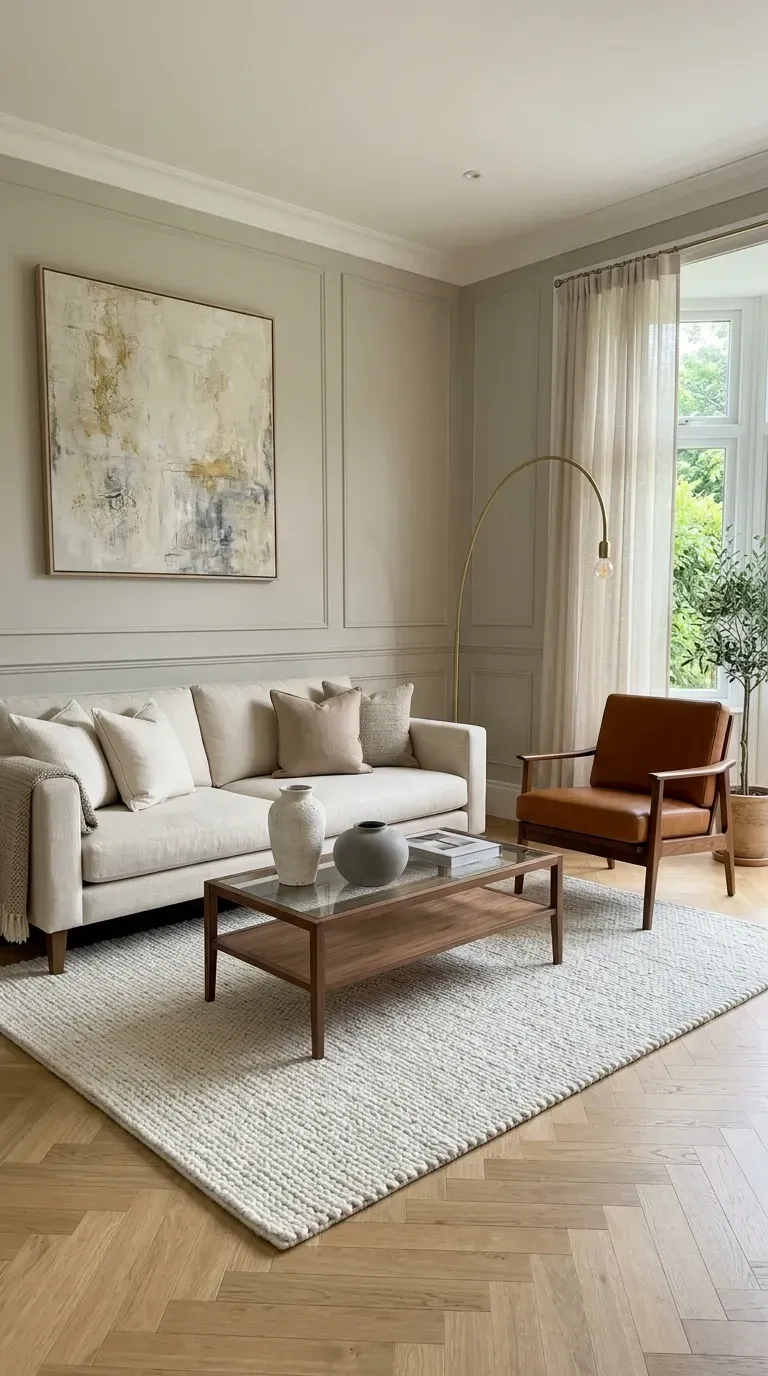
This living room concept is drawn as a reference for what quiet luxury looks like in a Charleston single house. The wall molding is meant to be real applied poplar rather than foam, painted Benjamin Moore Pale Oak on the field with crisp Simply White trim. The herringbone floor is imagined as the original boards of a 1920s structure, sanded and finished in a low-VOC Bona Traffic HD with a satin sheen. The sofa is a Sundays Solid Linen in Sand and the leather armchair a Restoration Hardware Maxwell in saddle. The spec calls for a Beni Ourain-style hand-knot from Annie Selke's Dash & Albert, 9×12, while the rendering draws a chunky cream wool rug in its place; both keep the floor soft without adding pattern. Above the sofa, a commissioned abstract by a local painter gives the room a focal piece that feels like Charleston rather than a Restoration Hardware showroom.
Key Pieces in the Charleston Living Room
The shell of the room does most of the work. Real applied wall molding in poplar, not foam, is painted Benjamin Moore Pale Oak with Simply White on the trim, and the original herringbone floors are refinished with Bona Traffic HD in satin rather than replaced. Those two decisions cost less than most of the furniture and give the room its age.
The seating is where the budget goes: a Sundays Solid Linen sofa in Sand with down-wrap cushions on a hardwood frame, paired with the RH Maxwell leather armchair in saddle. The gold and grey abstract over the sofa, commissioned from an artist working in the city, completes the list.
Here the sofa is the investment, so the rug and coffee table can stay simple, and the palette holds to four tones: Pale Oak on the walls, white on the trim, the honey oak of the floor and the cream of the linen. The cognac leather of the armchair is the only stronger note, and it works because nothing else competes with it.
The bay window corner holds an olive tree in a Bergs Potter Tuscan terracotta pot, a looser and more grown-up shape than the usual fiddle leaf fig. Money that might go on a fifth or sixth throw pillow is better spent on the painting above the sofa, which is what the eye lands on first.
Itemized, the living room comes to $9,850–$21,050 in 2026, with a Charleston median of about $15,400. Two lines make up about 50% of the high end: the Herringbone Floor Refinish (Bona Traffic HD) at $3,000–$6,000 and the Sundays Solid Linen Sofa, 89" at $2,000–$4,500. The floor refinish also has the widest spread, so it is the quote to get in writing first.
Behind those come the RH Maxwell Leather Armchair at $800–$1,800, the walnut and glass Lostine Bucks Wood & Glass Coffee Table at $600–$1,200, the Annie Selke Dash & Albert Hand-Knot Rug, 9×12 at $500–$1,000, and the brass arc lamp beside the curtains, a Cedar & Moss Atom Arched Floor Lamp, at $300–$700.
The finishing layer is smaller but adds up. The commissioned abstract, framed, is allowed $500–$1,500; a 6 ft olive tree in its Bergs Potter pot $150–$350; Astier de Villatte / Hawkins NY vases and vintage books $200–$400; and Loom & Last Belgian linen curtains on brass hardware $300–$600. The applied poplar molding, materials and installation together, takes $1,500–$3,000.
Refinishing the original floors is the highest-leverage line in this whole budget, at about $6/sq ft in Charleston for a full sand-and-finish in 2026. It cannot be replicated at any price by buying new flooring.
2. A Sage Bedroom Retreat in Mount Pleasant
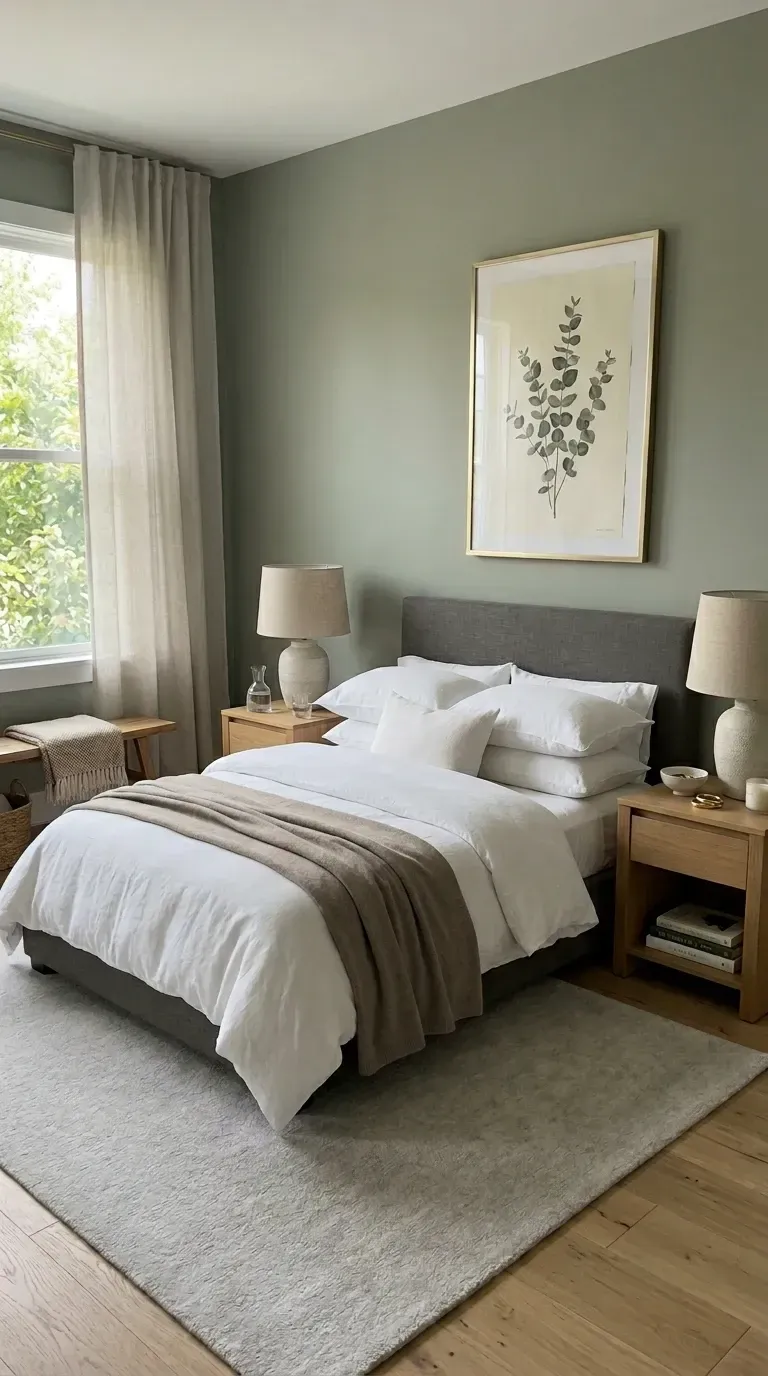
The brief for this concept is the calmest bedroom possible, and it starts with the wall in Farrow & Ball Mizzle 266, a soft grey-green that does most of the emotional work in the room. The bed is the Article Sven King; the spec calls for oatmeal bouclé, while the rendering shows it in a charcoal woven fabric that anchors the pale walls. It is dressed in Brooklinen Linen Core sheets and a Coyuchi Pebbled Linen duvet, drawn in white here rather than the chambray of the spec, with a taupe throw across the foot. The nightstands are Pottery Barn Modern Reeded in white oak, and the lamps are the Heath Ceramics Studio Table Lamp in oat. Everything else is edited out. Above the bed the rendering hangs a eucalyptus botanical in a thin gold frame; a vintage Charleston harbor map from an architectural salvage dealer, custom framed, would fill the same spot.
Key Pieces in the Sage Bedroom
Mizzle 266 goes on every wall, not just behind the bed, so the green wraps the room instead of framing one piece of furniture. Against it, the oak nightstands, the pale ceramic lamp bases and the white linen keep the rest of the palette to wood, clay and cloth, with the soft grey rug underfoot as the only other tone.
Linen is meant to look slept in. Leave the duvet unironed and let the throw fall loosely over the foot of the bed, as it does in the rendering; pressed, squared-off bedding is what makes a bedroom look staged.
A matching lamp on each nightstand gives both sides of the bed their own low light for the last half hour of the evening. One framed print above the headboard is enough art, since the upholstered headboard already acts as a frame for the wall.
Furnished as specified, the bedroom runs $4,300–$9,300 at 2026 prices, around a Charleston median of $6,800. The Saatva Classic Queen Mattress at $1,000–$2,500 and the Article Sven King Upholstered Bed Frame at $800–$1,600 account for about 44% of the high end between them.
Bedding comes next: $300–$700 for the Coyuchi Pebbled Linen Duvet + Brooklinen Sheet Set and $150–$300 for a Pendleton Eco-Wise Wool Throw. The pair of Pottery Barn Modern Reeded Nightstands (x2) is allowed $700–$1,400 and the Heath Ceramics Studio Table Lamps (x2) $300–$600.
The framed piece over the bed has $200–$500, enough for a vintage map or a botanical like the one drawn here. A Custom White Oak Bench under the window takes $250–$500, the Annie Selke Tencel Loop Rug, 8×10 $300–$600, and linen curtains on a brass rod $200–$400. Paint is the cheapest line in the room: $100–$200 for a gallon of Mizzle 266 plus primer.
Saatva Classic Queen Mattress has the broadest allowance, $1,000–$2,500; confirming its specification first will make the final total more reliable.
The mattress is the line item not to compromise on, though price alone does not settle it. A Saatva Classic at about $1,800 sits well below many $3,500 brand-name mattresses, so compare firmness, materials and trial terms before paying for a label.
3. Warm Minimalist Dining Nook
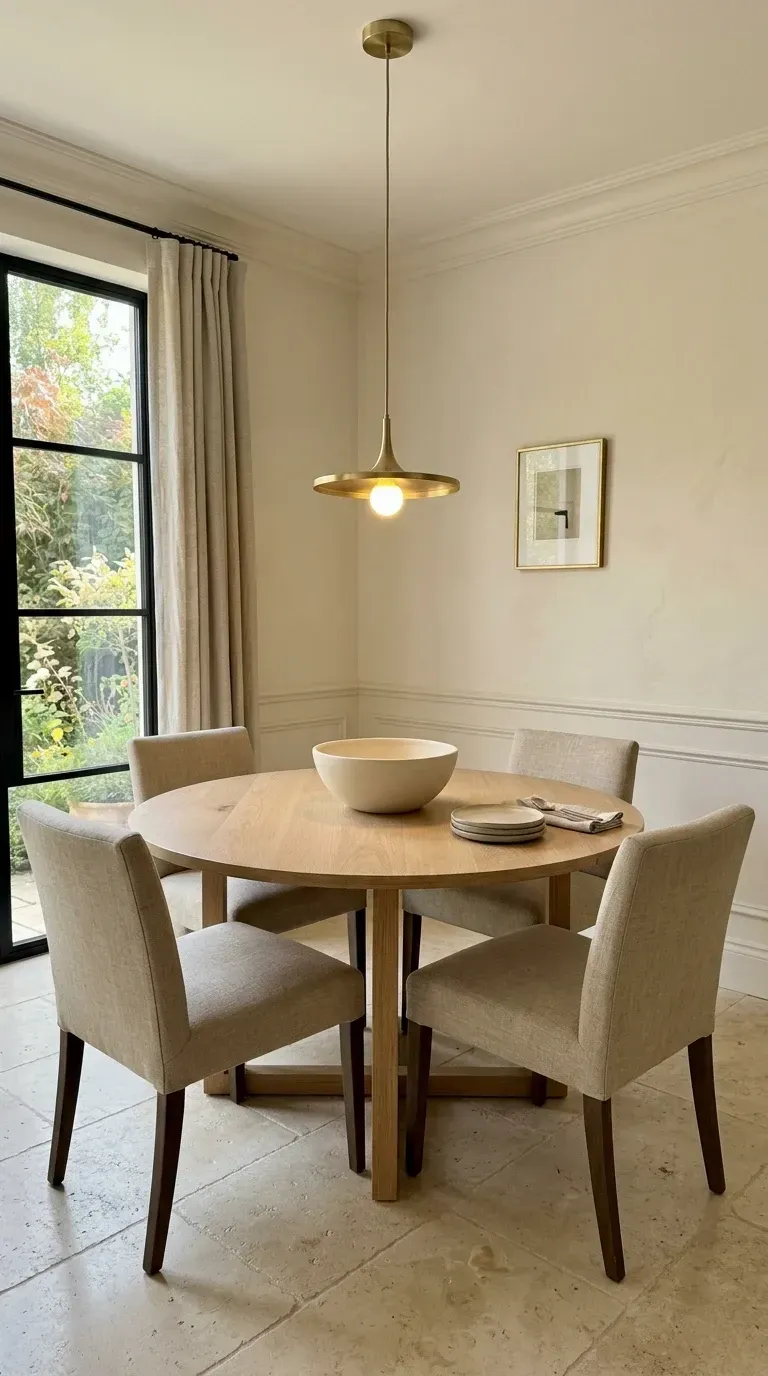
The case for a round dining table in a small house is geometric: it takes a corner that would otherwise hold a dead square footprint and turns it into a meal zone people can walk around. The concept specifies the Crate & Barrel Tate 48-inch Round Oak with four Carl Hansen Wishbone CH24 chairs in oak with paper cord seats, and the chairs cost more than the table, which is the right ratio for seats used three meals a day for twenty years. The rendering draws upholstered linen side chairs on dark legs instead, a softer option that sits just as comfortably against the cream walls. The pendant is the Schoolhouse Princeton in unlacquered brass, hung at 32 inches above the table, and the floor is laid in large pale flagstones.
Key Pieces in the Round-Table Dining Nook
The table is the Crate & Barrel Tate 48-inch round in oak, sized so a set of 4 Carl Hansen Wishbone CH24 chairs in oak with paper cord seats fit around it without crowding the nook. The chairs are the real investment here. Above, the Schoolhouse Princeton pendant in unlacquered brass hangs 32 inches over the tabletop.
The architecture stays quiet. The flagstone is cleaned and sealed with a matte penetrating sealer rather than a glossy topcoat that would read as fake, and a slim molding at chair-rail height is painted the same color as the walls, so it adds shadow and proportion without drawing a line around the room.
At 32 inches the brass shade sits inside the usual 30 to 36 inches above a tabletop, low enough to pool light on the oak rather than on the ceiling. The table carries a single object, a wide pale bowl in the rendering; a Bloomist Mango Wood bowl or one Hawkins NY Pillar Candle gives the same focus as a full tablescape with none of the clutter.
Four seats suit a 48-inch round, and squeezing in six for the occasional guest crowds the nook on every other day of the year. Leave the runner off too, because the grain of bare oak is part of the look.
The nook's listed scope totals $4,600–$9,600 in 2026 dollars, with $7,100 as the Charleston median. Seating and table do most of the spending: Carl Hansen Wishbone CH24 Chairs (x4) at $1,400–$3,000 and the Crate & Barrel Tate 48" Round Oak Table at $1,200–$2,500, about 57% of the high-end figure together. Price the chairs first, since their range is the wider one.
Lighting and dressing are modest by comparison. The Schoolhouse Princeton Brass Pendant is allowed $300–$700 and a Bloomist Mango Wood Centerpiece Bowl $100–$250. A small framed print by a local artist, like the one in a thin brass frame beside the table, gets another $100–$250, and Belgian linen curtains on a brass track $400–$800.
The shell work is the wall molding with Farrow & Ball Pointing paint at $800–$1,500 and the flagstone restoration with its penetrating sealer at $300–$600.
CH24s are sold widely now, but verify Carl Hansen authenticity, since there are convincing knock-offs at $200 that fall apart in three years. The real ones are stamped on the underside.
4. The Moody Walnut Study
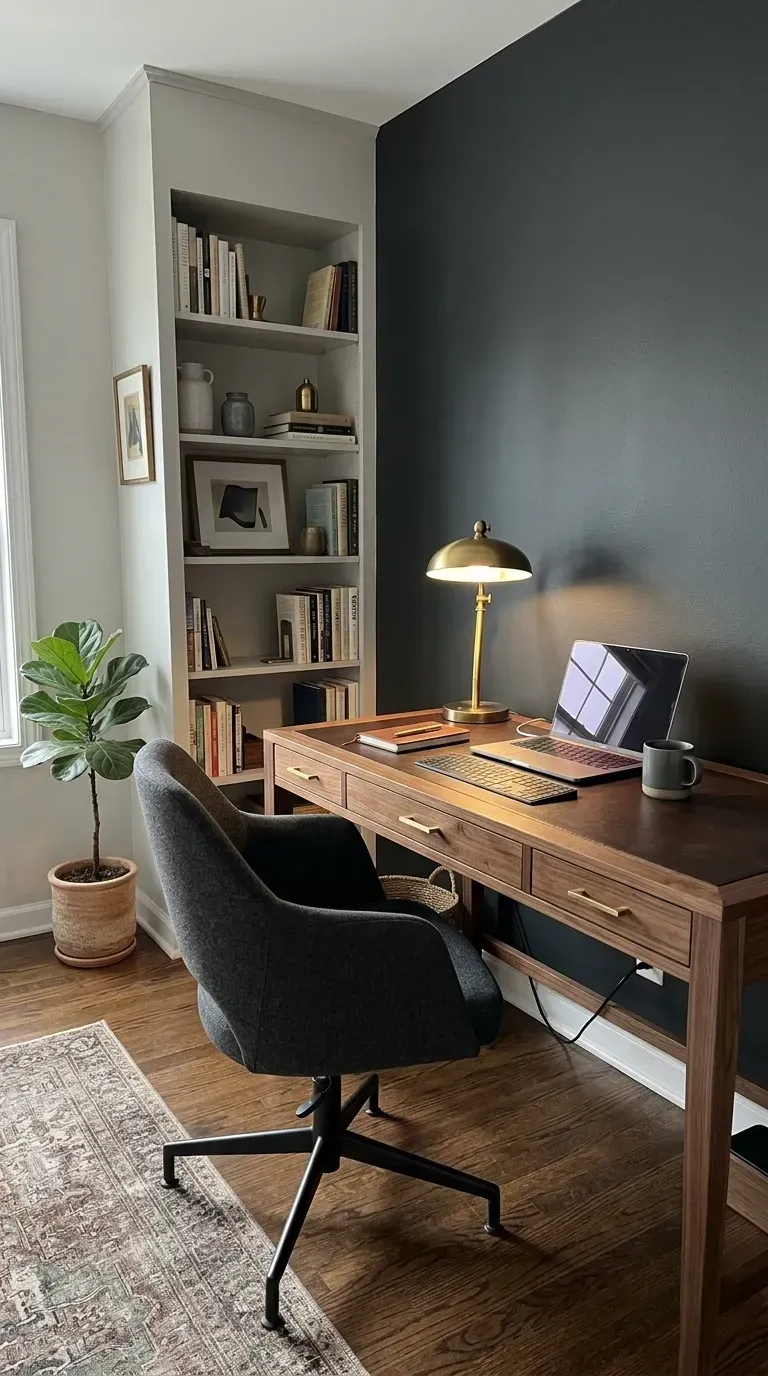
This study concept is for someone who wants a room that feels older than they are, in a good way. The wall behind the desk is painted Farrow & Ball Studio Green No. 93, a deep grey-green that reads almost charcoal under lamplight, while the window walls stay pale. The desk is a BDDW Walnut Library Desk, the headline expense at about $7,200 and built to outlast the house. The spec pairs it with a Herman Miller Eames Soft Pad Executive chair in walnut and tan leather; the rendering shows a charcoal upholstered swivel chair, a cheaper route to the same mood. The desk lamp is the original Bestlite BL1 in brass. The built-ins are specified as custom work from a local cabinet shop in white oak stained to match the desk, although the image paints them a soft white. A fiddle leaf fig in a terracotta pot (the spec names a Bergs Potter Helena) stands by the window, out of the strongest afternoon sun.
Key Pieces in the Studio Green Study
Studio Green No. 93 can run across all four walls and the ceiling for a fully enclosed study; the rendering keeps it to the single wall behind the desk, which shows how much atmosphere even one dark plane adds. Either way the BDDW Walnut Library Desk is the piece to spend on, and its brass pulls pick up the Bestlite BL1 on the desktop. Tall built-ins beside the window hold the books and a few framed pieces, so the dark wall itself can stay bare.
If the green does go onto the ceiling, use the same colour rather than a lighter tint, so the room reads as one deliberate enclosure. Buying one good desk instead of a desk plus a matching credenza frees up more than enough for that extra paint.
The shelves in the rendering mix upright and stacked books with a few ceramics and a framed print, the opposite of a rainbow-sorted wall, and the single fig by the window is all the greenery the room needs.
Itemized at 2026 prices, the study comes to $5,300–$11,100, with a Charleston median near $8,200. Two lines carry about 68% of the high end: Custom Built-ins, Stained Oak at $2,500–$5,000, which also has the widest spread and is the first quote to chase, and the BDDW or West Elm Anton Walnut Writing Desk at $1,200–$2,500.
The rest is furnishing. The Herman Miller Eames Soft Pad Executive Chair is allowed $400–$900, the Bestlite BL1 Brass Desk Lamp $200–$400, books and shelf objects $500–$1,200, and the fiddle leaf fig in its Bergs Potter Helena pot $150–$300.
A vintage Persian rug like the faded one under the chair is budgeted at $200–$500 from a salvage or estate source, and $150–$300 covers Studio Green No. 93 for the walls and ceiling plus the trim paint.
The BDDW desk at the high end is a 30-year piece. If the budget is tight, the West Elm Anton in walnut at $1,200 is the closest mass-market analog.
5. An Edited, Working Entryway
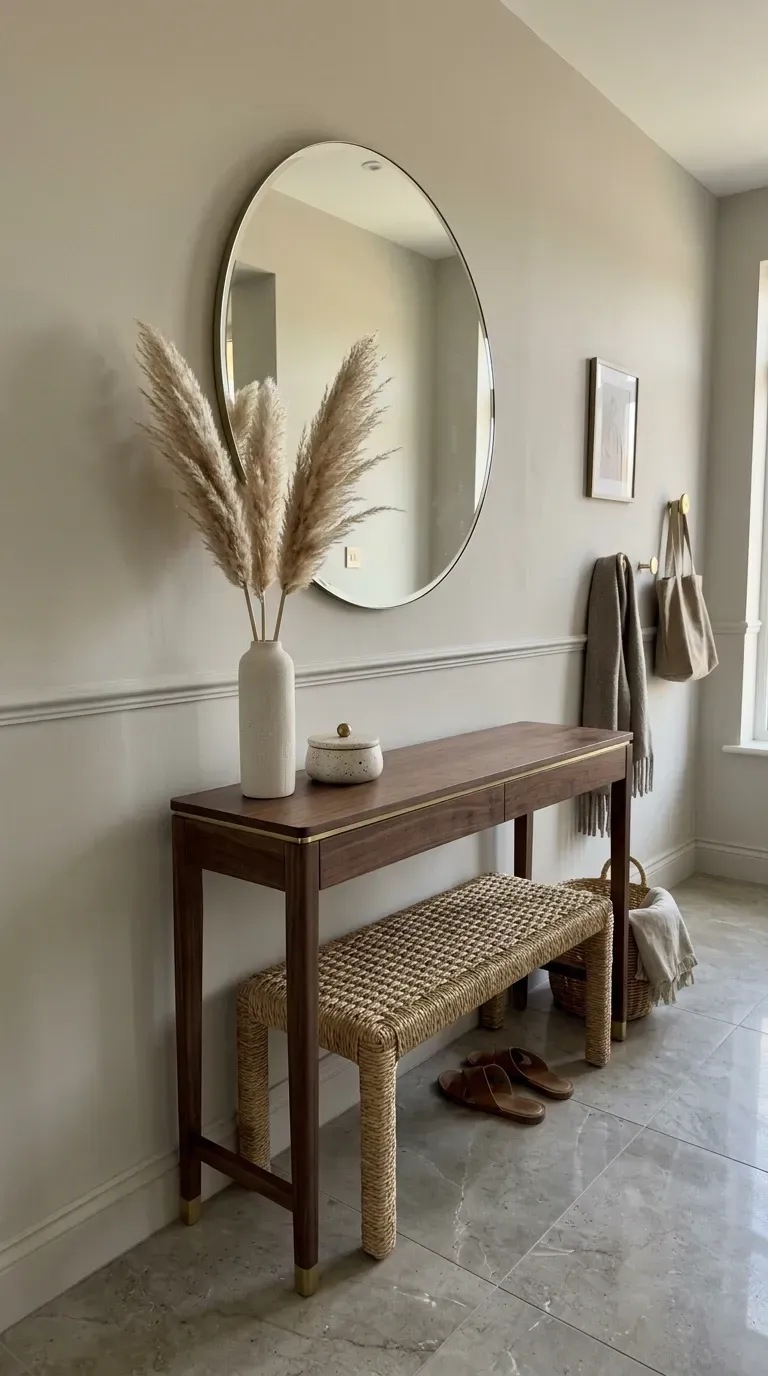
An entryway should look quietly composed and still absorb the actual chaos of arriving home: keys, mail, dog leashes, the shoes you only wear once a week. The console is a West Elm Anton 60" in walnut, slimmer in person than the photos suggest, and the rendering gives it a thin brass edge along the apron. Below it sits the Lostine Vidlak woven bench, drawn here fully wrapped in a natural rush weave. Above hangs a Made Goods Round Wesley Mirror in antique brass, 36 inches. Dried pampas grass stands in a speckled white ceramic vase, and Rejuvenation Ainsley hooks in unlacquered brass (the kind that develop a patina rather than chip) take keys, the dog's lead and a linen tote for market runs.
Key Pieces in the Entryway
A narrow hall needs a slim console, and the West Elm Anton in walnut, 60 inches long, keeps a shallow profile. The woven bench slides underneath it when not in use and pulls out as a seat for putting on shoes. The Made Goods Wesley Round Mirror, 36 inches in antique brass, softens the straight lines of the hall.
The smaller pieces do the daily work: Rejuvenation Ainsley wall hooks in unlacquered brass near the door, a lidded ceramic pot on the console for keys, and the pampas in its matte white vase for height.
Install the hooks before buying the console, and put them where coats and bags actually land, which in the rendering means the short stretch of wall nearest the door. In a hall this narrow, a rectangular mirror of the same width would box the wall in; the circle lets it breathe.
The rendering keeps one basket beside the bench with a throw tucked in; a second one for shoes would clear the slides off the marble floor. If the door needs a mat, a plain seagrass rug from Crate & Barrel ages better than one printed with a greeting.
The entry is the least expensive of the ten rooms at $1,890–$3,920, with a 2026 Charleston median of $2,900. The console has the widest range, so price it before anything else. The West Elm Anton 60" Walnut Console Table at $600–$1,200 and the Made Goods Wesley Round Mirror, 36" at $350–$700 take about 48% of the top figure.
The Lostine Vidlak Woven Bench is allowed $250–$500, a ceramic vase with pampas $100–$250, the Rejuvenation Ainsley Brass Wall Hooks (x2) $60–$120, and sisal baskets with a wool throw $150–$350. A small framed print by a Charleston artist adds $80–$200, and Farrow & Ball Skimming Stone paint with the chair rail molding $300–$600.
The single highest-leverage entryway upgrade for under $200 is replacing the builder-grade flush ceiling fixture with a Schoolhouse Isaac Pendant. It changes the room.
6. The Cozy Reading Corner That Actually Gets Used
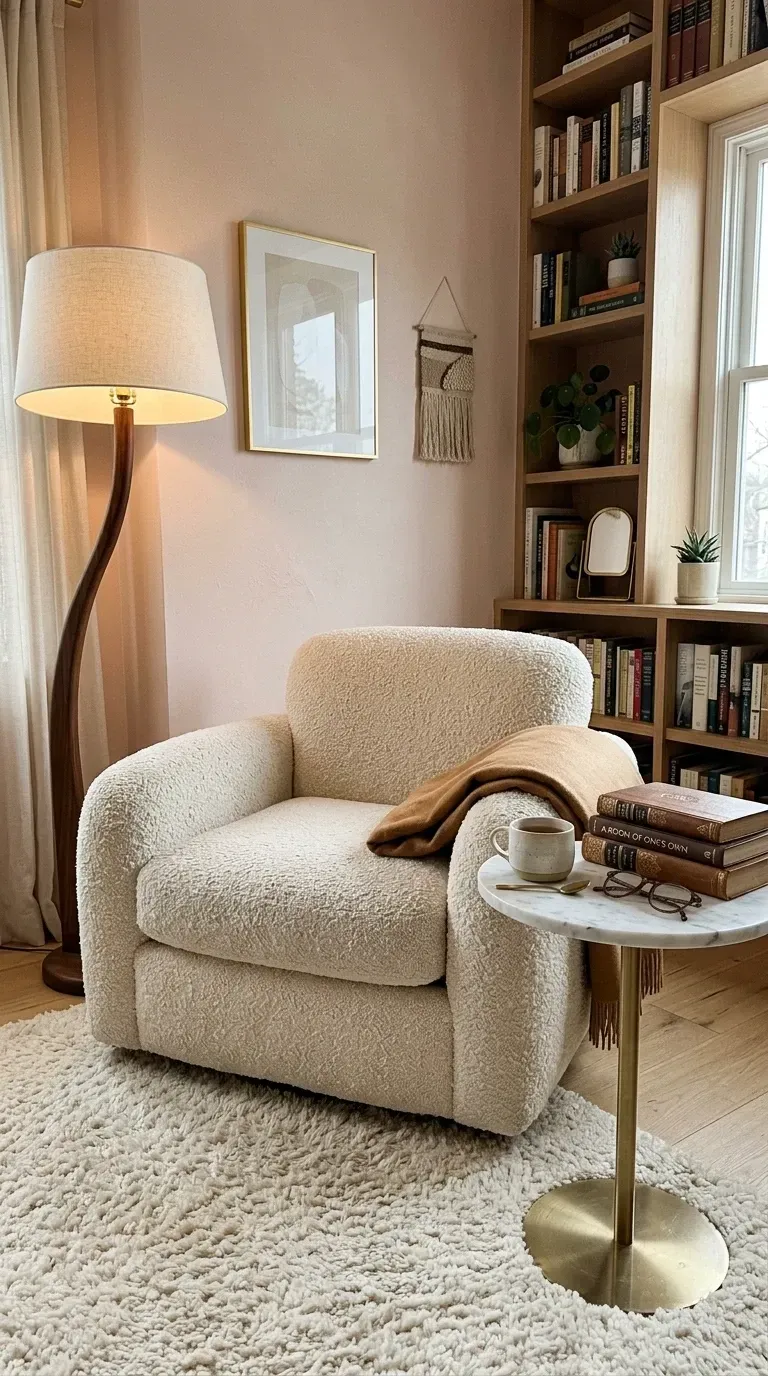
Reading nooks fail because they are styled but not engineered. The chair has to be the most comfortable one in the house, the lamp has to throw real working light, and the side table has to fit a hot drink and a hardcover at the same time. The concept uses the Article Lyssa Bouclé Lounge Chair in ivory (the wider, deeper version; measure your own seat depth before buying) and a Cedar & Moss Cluster floor lamp with a 60-watt-equivalent warm LED, which the rendering draws as a curved walnut stem under a linen drum shade. The spec's BluDot Yacht Side Table in white oak appears here as a slim marble-topped table on a brass pedestal. The walls are F&B Setting Plaster No. 231, a soft pink that reads as warm rather than sweet against the oak built-ins, which are specified as custom work from a local woodshop and made deep enough for art books.
Key Pieces in the Reading Nook
The chair decides whether the nook gets used. The Article Lyssa Bouclé Lounge Chair in ivory is the pick, but measure its seat depth against your own legs before ordering. The floor lamp takes a 2,700K warm LED, and the small round side table stands close enough to the arm for a cup, a stack of hardcovers and a pair of reading glasses.
Farrow & Ball Setting Plaster No. 231 on the walls reads as a warm pink, not a pastel, and the custom oak built-in bookshelves give it something solid to sit against.
Sit in the chair for a full hour before committing, because many bouclé pieces are firmer than their rounded shape suggests. At night the floor lamp should be the only light on in this corner, so keep any recessed ceiling fixture on its own switch.
The caramel throw over the arm, a Pendleton Eco-Wise wool throw in the spec, is what turns the chair from decoration into a seat used every day. One small side table is enough; a nest of three would crowd the rug.
This corner costs more than its size suggests: $5,800–$12,400 itemized for 2026, with a Charleston median of $8,900. Custom Built-in Bookshelves at $3,000–$6,000 and the Article Lyssa Bouclé Lounge Chair at $1,000–$2,200 make up about 66% of the high end, and the shelving is where a quote will move the total most.
The Cedar & Moss Cluster Floor Lamp is allowed $400–$900, the BluDot Yacht White Oak Side Table $250–$500, and an Annie Selke Andes Plush Wool Rug, 5×8, close to the shaggy cream one in the image, $300–$700. Filling the shelves with hardcovers and a few objects takes $600–$1,500, the line most easily stretched over several years.
A small framed work by a local artist adds $150–$350, and Setting Plaster No. 231 for the walls $100–$250.
The built-ins are the budget swing here. If you skip them and use a freestanding String Pocket System shelf at $400, the corner still works at about $3,000 total.
7. Fresh, Classic Bathroom Retreat
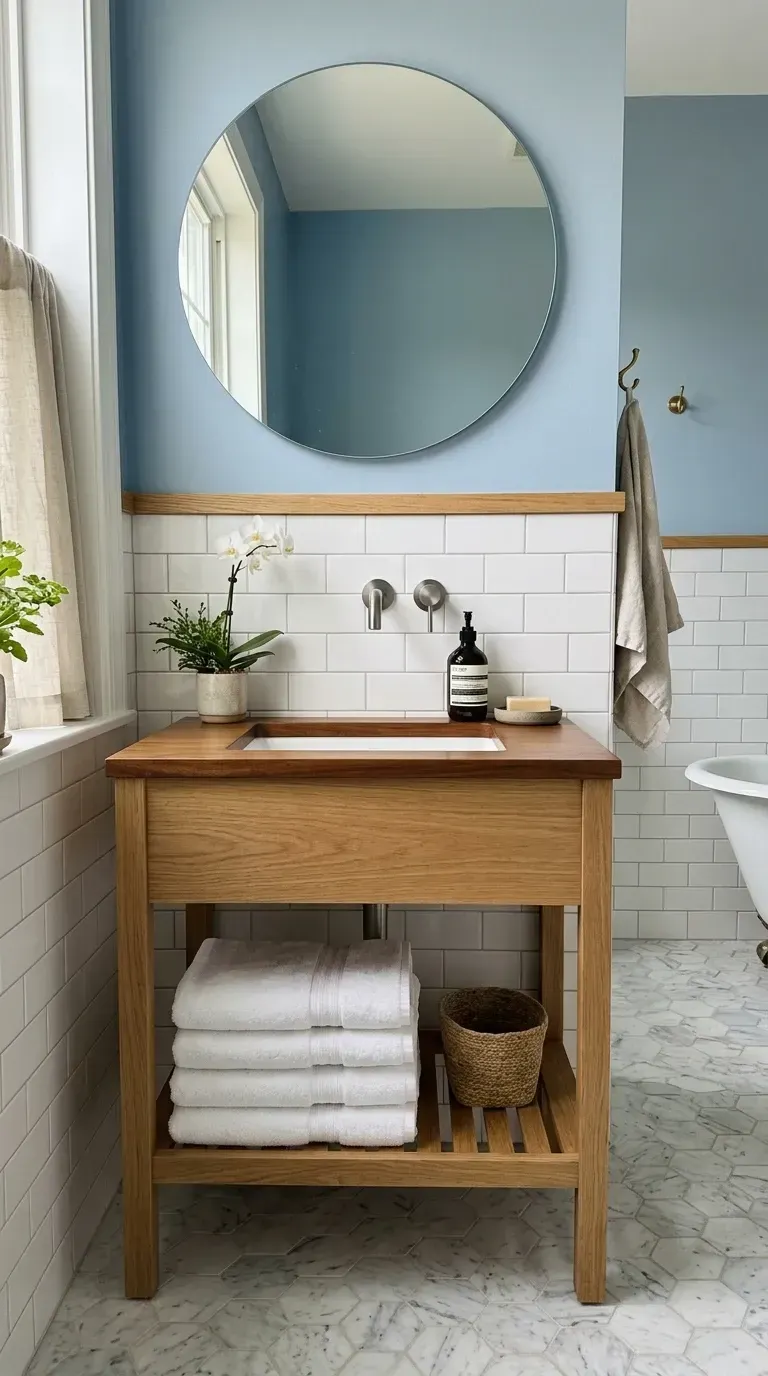
A small bathroom concept in the Sullivan's Island style where the brief is "spa, but not hotel." The white oak vanity is specified as custom work from a local cabinet shop, and the spec tops it with a Native Trails Tolosa hand-hammered copper vessel sink that patinas in salt air; the rendering instead sets a white basin into a warm wood top, the simpler and cheaper version. The wall-mounted spout is a Brizo Litze, specified in Luxe Gold but drawn here in brushed nickel. Walls below the oak chair rail are Fireclay Tile 3×6 subway in Whitewash, and above is Farrow & Ball Borrowed Light No. 235, a soft blue that reads coastal without saying it. The floor is Carrara honed marble hex, 2-inch, a smaller scale that reads more period-correct in a Charleston-area home than the 4-inch hex.
Key Pieces in the Bathroom
The vanity is an open-shelf piece in white oak, with folded white towels and a seagrass basket on the slatted lower shelf, so it reads as furniture rather than a cabinet. With a copper vessel and gold faucet it becomes the warm center of the room; drawn with nickel fittings as here, it is calmer, and the blue walls carry the color.
Below the chair rail, Fireclay Tile 3×6 subway in Whitewash runs up to an oak cap; dark grout would sharpen the grid, though the rendering keeps it white for a softer read. Above the rail, Farrow & Ball Borrowed Light No. 235 takes over, and the floor is honed Carrara marble in a 2-inch hex.
Keep the marble honed: a polished hex floor shows water spots within a week of use. The rendering also shows how to mix metals on purpose, with nickel at the faucet and brass on the towel hooks, two finishes repeated rather than four scattered.
A single framed piece on the wall opposite the mirror, a small print or a vintage botanical, is enough art for a room this size. Towels follow the same rule: the stack under the vanity is all white, and a linen hand towel on the hook is the only change of tone.
Fully specified, the bathroom comes to $5,900–$12,400 in 2026 dollars around a Charleston median of $9,150. The Carrara Honed Marble 2" Hex + Install at $2,000–$4,500 is both the largest line and the widest swing, so get it quoted in writing first; with the Custom Cabinet-Shop Vanity + Native Trails Vessel at $1,500–$3,000 it makes up about 60% of the high end.
Tile and fittings follow: $1,200–$2,500 for the Fireclay Tile Whitewash Subway + Install, $400–$800 for the Brizo Litze Wall-Mount Faucet, Luxe Gold, $250–$500 for a Rejuvenation Round Frameless Mirror, 28" like the one over the vanity, and $300–$600 for the white oak chair rail with Borrowed Light paint. Linen towels and soaps take the last $250–$500.
Salt air and daily use are hard on cheap fittings, so choose a faucet from an established line such as Brizo or Kohler Artifacts, with a ceramic cartridge and a long finish warranty; from those lines 15+ years of service is a reasonable expectation, while unbranded imports often need new cartridges within three.
8. Honed Marble & Soft Grey Kitchen
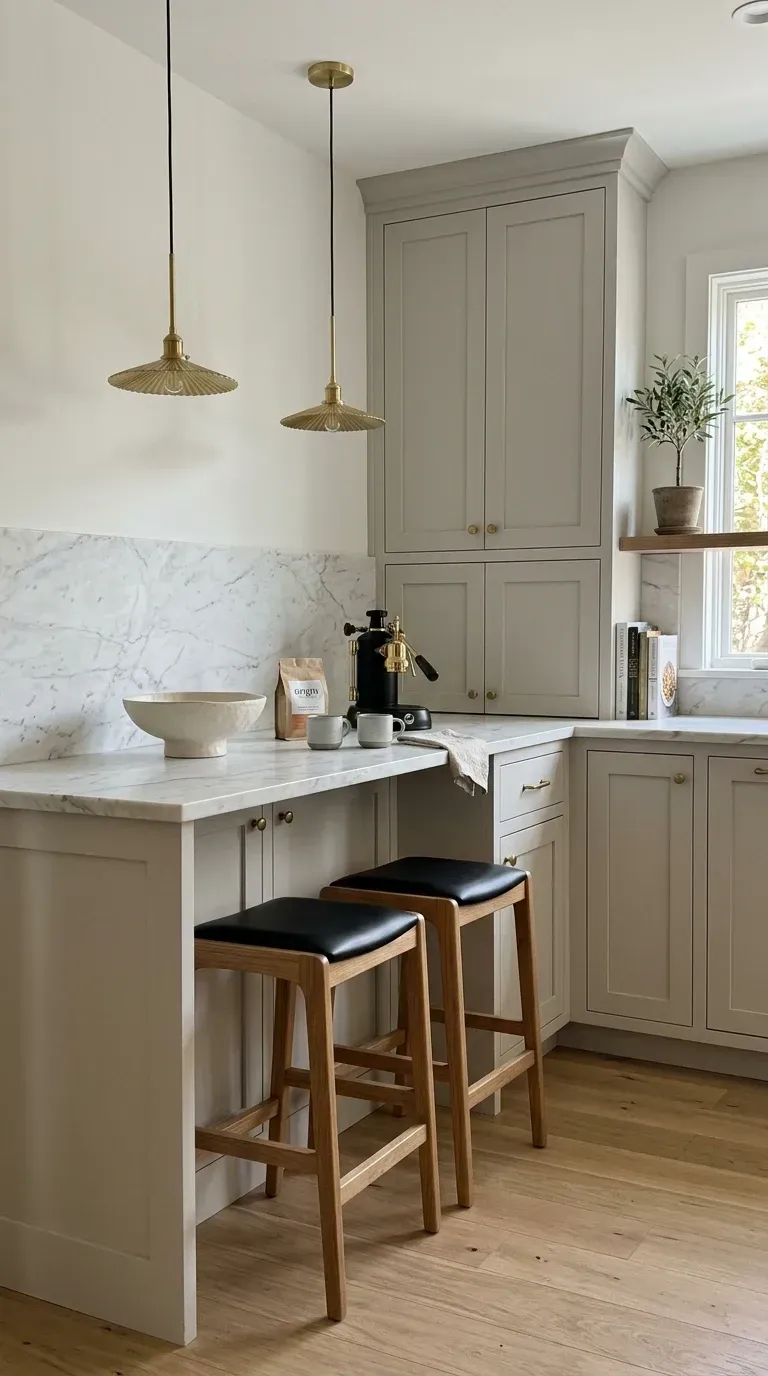
A West Ashley-style kitchen concept where the headline is the stone. The concept uses Calacatta Gold honed marble for the counter and the slab backsplash, the same piece bookmatched, fabricated by a local stone fabricator. Cabinets are inset shaker from a local cabinet shop in Benjamin Moore Edgecomb Gray HC-173, with Rejuvenation Mission cup pulls and knobs in unlacquered brass. The pendants over the coffee bar are specified as Visual Comfort Hicks Single Pendants in antique brass; the rendering draws them with fluted brass shades. Bar stools are the Sundays Counter Stool, shown in light oak with black leather seats rather than the oiled walnut and saddle of the spec. The espresso station is a Breville Oracle Touch with a Niche Zero grinder, tools rather than jewelry, and the image puts a black and brass lever machine in that spot.
Key Pieces in the Marble Kitchen
Stone carries this kitchen. The counter is honed Calacatta Gold marble, and the backsplash is a bookmatched slab of the same stone, so the veining runs up the wall without a break. The custom inset Shaker cabinetry is painted Benjamin Moore Edgecomb Gray HC-173 and fitted with Rejuvenation Mission cup pulls and knobs in unlacquered brass.
The two brass pendants hang over the coffee bar, where a pair of backless counter stools pull up to the marble overhang. The working end of that bar is the espresso machine and grinder, left out on the counter because they are used every morning.
Cutting the backsplash from the same slab as the counter adds well under $2,000 of fabrication, and it is the detail that makes this corner look most expensive, since the veining climbs the wall without a seam. Inset doors cost about 30% more than overlay, and their flush faces are what make these grey cabinets look as though they have been there for decades.
Stool height follows the counter: 24 inches of seat height for a 36-inch counter like this one, 30 inches for a 42-inch bar. And one good espresso machine does more for the room than a row of small appliances and canisters.
The kitchen corner is the most expensive room in the guide at $12,500–$25,900, with a 2026 Charleston median of $19,200. Cabinetry and stone take about 77% of the high end: the Custom Inset Shaker Section at $6,000–$12,000, also the widest range and the first quote to pin down, and the Calacatta Gold Honed Marble Counter + Slab Backsplash at $4,000–$8,000.
The Breville Oracle Touch + Niche Zero Grinder take $800–$2,000, the Sundays Counter Stools (x2) $600–$1,400, the Visual Comfort Hicks Single Pendants (x2) $400–$900 and the Rejuvenation Mission Brass Hardware Set $250–$600. Linens, plates and stoneware for the open shelf add $300–$700, and cabinet-grade Edgecomb Gray HC-173 paint $150–$300.
Calacatta Gold marble runs about $90 to $130 per sq ft installed in Charleston in 2026. Honed (matte) finish is what does the quiet work, while polished reads as glossy and dates faster.
9. A Hallway Treated as a Destination
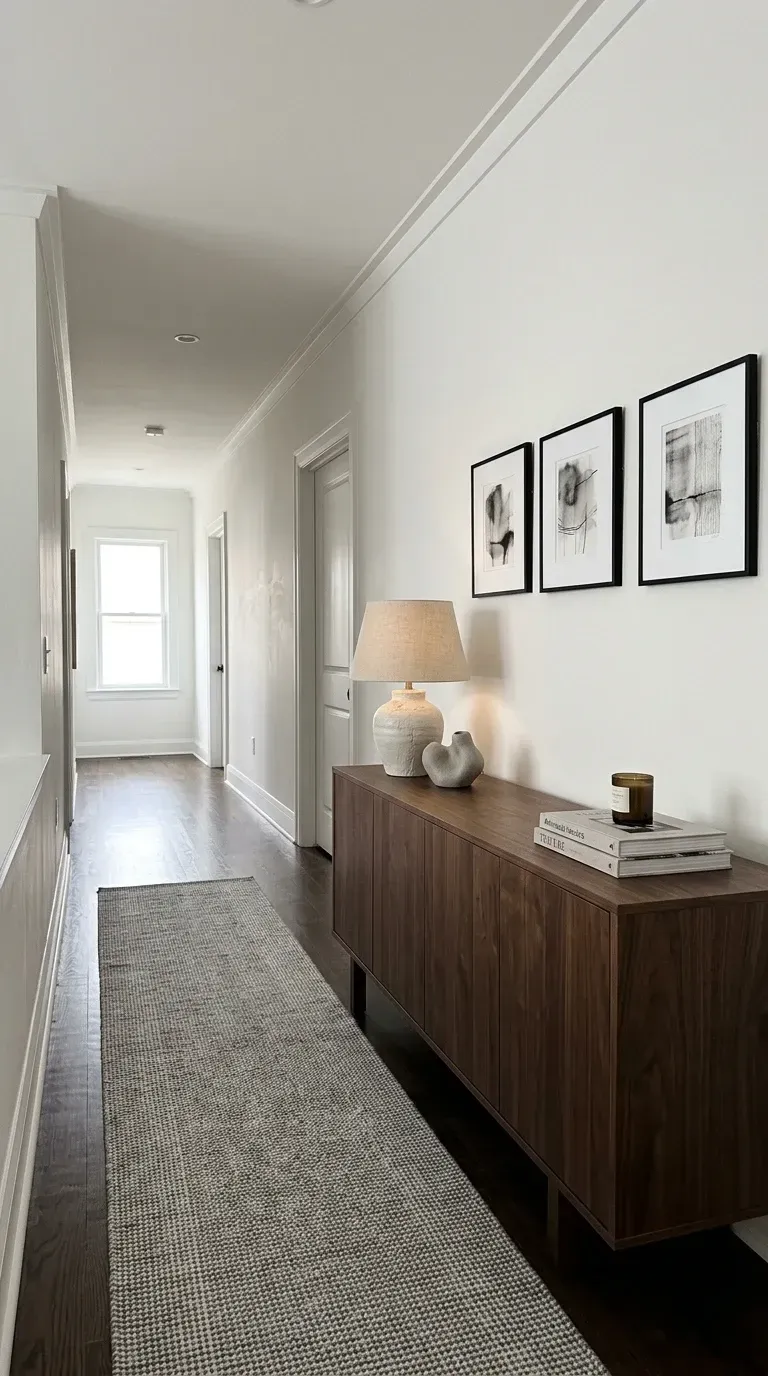
Charleston single houses have long, narrow center halls that most owners ignore for a decade, and this concept is drawn for a hall like that. The wall is anchored with a BDDW Walnut Credenza, low and long with flush slatted doors, and above it hangs a triptych of three abstracts, the kind a local painter could be commissioned for. The spec frames them in matching Larson-Juhl walnut floater frames; the rendering uses thin black frames with wide white mats, which suit the ink-wash prints. The runner is a Beni Rugs flatweave, 2.5×12, in a tonal weave that does not compete with the art. The spec's lamp is the Gubi Gräshoppa Table Lamp in black, a deliberately playful note against the credenza; the image shows a quieter ceramic lamp with a linen shade.
Key Pieces in the Center Hall
The BDDW Walnut Credenza is the anchor of the hall and the clear splurge. Above it the three prints hang as a matched set, close together and centered on the credenza rather than on the wall. Underfoot, the 2.5×12 flatweave runner leads the eye toward the window at the far end, while the lamp at one end of the credenza and a candle on a stack of books at the other keep the top from looking bare.
Three frames in a row read as a decision, where a scattered gallery wall in a hall this narrow would look like overflow from other rooms. Giving all three the same frame and mat is what turns them into one piece.
Leave at least 18 inches of bare floor at each end of the runner so the dark boards frame it. If the hall starts to feel stiff, one playful object on the credenza (the Gräshoppa lamp, a vintage clock, or a small sculptural ceramic like the one beside the lamp here) loosens it.
The hall comes to $2,250–$5,150 in 2026, with a Charleston median of $3,500. The BDDW or West Elm Anton Walnut Credenza at $1,000–$2,200 has the widest range and deserves the first quote, and with the framed abstract triptych (a set of 3) at $400–$1,000 it accounts for about 62% of the high end.
The Gubi Gräshoppa Table Lamp is allowed $200–$500, the Beni Rugs Flatweave Runner, 2.5×12 $250–$600, vases and vintage books $150–$350, and Farrow & Ball Cornforth White paint with repaired baseboards $250–$500.
If the BDDW credenza is out of scope, the West Elm Anton in walnut at $1,200 is the closest analog and looks expensive once you add a real lamp and real art on top of it.
10. Light-Filled Window Seat in a Bay
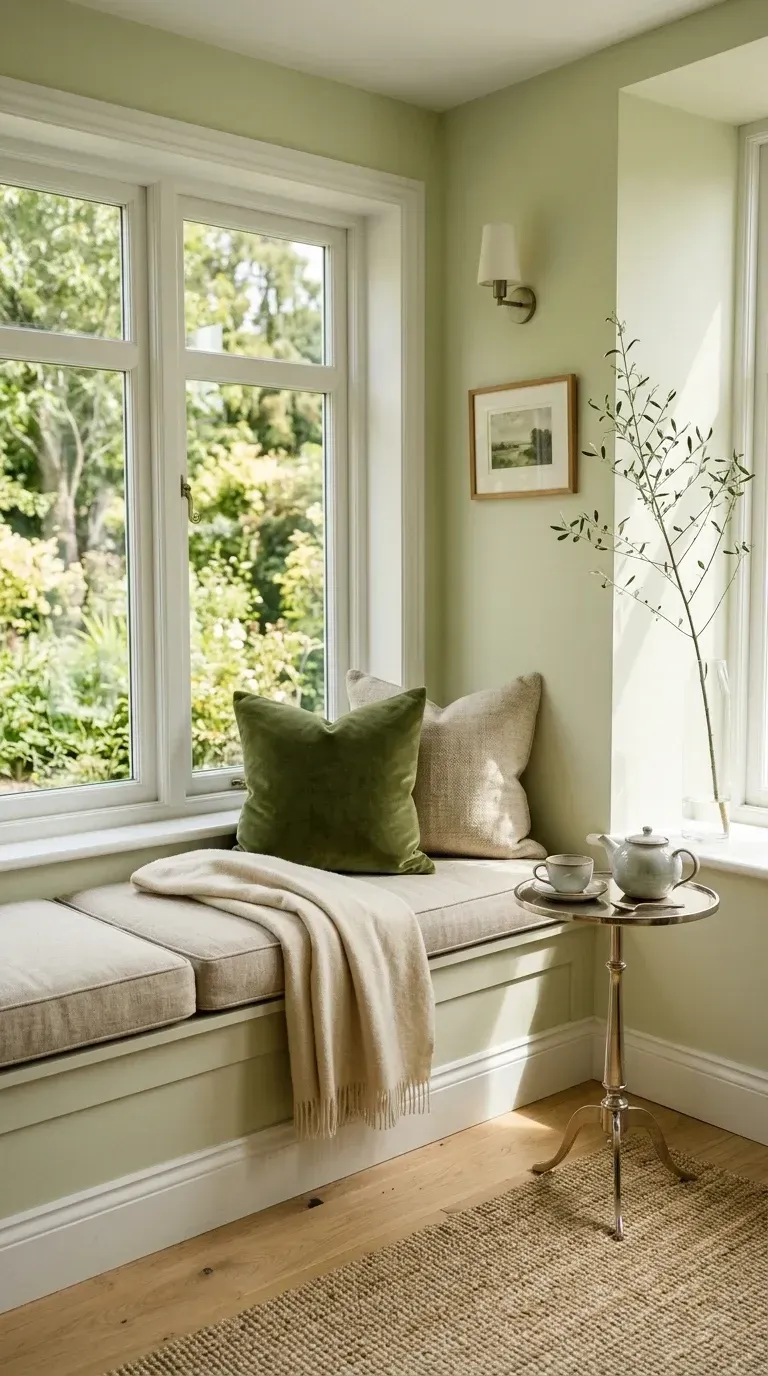
A bay window in a Mount Pleasant-style cottage, the kind that ends up as a dumping ground for laundry baskets for years. The concept builds in a flush cushioned bench with hidden storage below, fabricated by a local woodshop and painted in F&B Mizzle 266 so it recedes into the wall color. The cushion is custom from Sundays in their Shaker Linen, with a 6-inch-thick high-density foam core. Pillows pair Hawkins NY linen with a single velvet, moss green in the rendering. The sconce is the Visual Comfort Bryant Single in antique brass, hardwired and dimmable, drawn with a small white shade.
Key Pieces in the Bay Window Seat
The bench is a custom built-in from a local woodshop with hidden storage under the seat, painted in Farrow & Ball Mizzle 266 to match the wall so the joinery recedes. On top sits a Sundays Shaker Linen custom cushion over a 6-inch high-density foam core.
The linen pillow sits beside the green velvet one, and the Visual Comfort Bryant Single sconce in antique brass is hardwired and dimmable, so no cord runs down the window wall.
Use 6 inches of foam as the minimum for a seat meant for reading; thinner cushions flatten and become uncomfortable within about 20 minutes. The storage under the bench is what keeps this bay clear, because baskets lined up on the floor in front of it would read as clutter.
The sconce sits at roughly shoulder height for someone seated on the cushion, which is where a reading light belongs. The small pedestal table drawn beside the bench, a Lostine side table in the spec, holds the teapot and cup within reach.
The window seat totals $4,150–$8,550 in 2026, with a Charleston median of $6,300. Joinery and upholstery are about 76% of the high end, and the bench is the quote to get first: Custom Built-in Bench + Paint at $2,500–$5,000 and the Sundays Shaker Linen Cushion (custom, 6" HD foam) at $800–$1,500.
Pillows and a velvet throw are allowed $300–$700, the Lostine Bucks Small Side Table $150–$400, the Visual Comfort Bryant Single Sconce, Antique Brass $150–$350 and a small framed print $100–$250. A Crate & Barrel Sisal Jute Rug, 4×6, much like the jute one in front of the bench, adds $150–$350.
Hardwired sconces require an electrician (about $200–$400 in Charleston) but are worth it over plug-in versions. Cords break the meditative quality of the niche.
Pro Tips for Styling Quiet Luxury
Buy fewer, better pieces. One Sundays sofa beats three rotating West Elm sofas over a decade, and the cost-per-year math always favors quality. The same logic applies to finishes: specify unlacquered brass everywhere you can, because it develops a patina rather than chipping. Schoolhouse, Rejuvenation and Hardware Renaissance all carry honest unlacquered options. Materials follow the same rule. Use real wood, real linen and real stone, since synthetic substitutes read in person even when they photograph well, and fingertips can tell within a second.
Lighting should sit on three switches at minimum: overhead, a ring of lamps, and accent. Put the overhead on the least-used switch. Window treatments belong early in the budget too, because bare windows in beautiful rooms read as unfinished; a Loom & Last linen panel on a brass rod is the minimum.
Each main room can carry one commissioned artwork by a local painter, bought through a gallery or directly from the artist. Then edit, and edit again, because quiet luxury fails the moment the seventh decorative object lands on a coffee table. Finally, honor the architecture you have. A 1920s Charleston house does not want microcement floors, and a Daniel Island new build does not want fake transom moldings.
Cost-Saving Strategies That Don't Read Cheap
Vintage is the largest saving that never looks like one. Architectural salvage yards and estate sales around Charleston turn up solid-wood credenzas, vintage Persian rugs and salvaged trim mouldings, often at 30–60% less than new equivalents, and those pieces carry more character than anything off a showroom floor. The same thinking works at the table: skip the matched dining set and pair a Crate & Barrel table with secondhand vintage chairs, which makes the room look layered at once.
Surfaces offer the next round of savings. Refinishing floors instead of replacing them runs $4–$6 per square foot in Charleston for a sand-and-finish, against $14+ per sq ft for new engineered hardwood. In the kitchen, an IKEA Sektion box with Semihandmade or Reform fronts painted in Farrow & Ball Studio Green reads as custom at one-third the cost. For stone, a small bathroom counter or a single coffee bar can be cut from a stone yard's remnant pile for $300–$700 instead of $2,000+ for a fresh slab.
Framing and paint round it out. Use Michaels for staples, since a frame bought at 60% off is fine for the small piece in the hall, and save custom framing for the commissioned anchor work. Buy paint in eggshell rather than satin or pearl; eggshell looks more expensive on walls and is widely available in every brand.
Regional Fit Across Southern Markets
Charleston, SC sets the baseline at 1.00x. Custom cabinetry, marble fabrication and built-ins there benchmark the prices in this guide, and salt-air corrosion makes unlacquered brass a feature rather than a flaw. Savannah, GA comes in slightly under at 0.96x, with cheaper labor and similar material costs; its antique trade runs deep, so vintage credenzas and rugs cost 15–20% less.
Atlanta, GA at 1.02x is the closest analog to Charleston pricing, and the city's design trade showrooms make Visual Comfort, Brizo and Schumacher easy to source. Asheville, NC runs 1.04x; mountain trades are fully booked, so expect to wait 20+ weeks for built-ins, though reclaimed barn-wood vendors are a regional advantage. Nashville, TN is the most expensive at 1.06x. Higher demand for custom cabinetry has pushed lead times to 16+ weeks, so plan the schedule accordingly, while material costs stay about even with Charleston.
Frequently Asked Questions
What actually distinguishes "quiet luxury" from "minimalism" in a real home?
Minimalism is about reduction; quiet luxury is about quality. A minimalist room can feel cold, stark, even ascetic. A quiet luxury room is warm, layered, and tactile; it just happens to use fewer, better pieces. The test is whether you want to sit in the room for two hours. Minimalism often fails this test; quiet luxury passes it.
Can quiet luxury be done on a tight budget?
Yes, but with discipline. The strategy is one investment piece per room (the sofa, the dining table, the desk), then vintage and mid-tier for everything else. A $3,000 Sundays sofa with a $300 vintage credenza and a $200 secondhand armchair will read more luxurious than a fully-matched West Elm room at $5,000. The investment piece sets the standard the eye reads from.
What are the most overrated "quiet luxury" purchases?
In our view: bouclé everything (already dating in early 2026), travertine coffee tables that stain instantly, oversized pampas grass arrangements past their cultural moment, and luxury-label towels that cost several times more than well-made mid-range ones without lasting noticeably longer. Spend on stone, wood, and upholstery; save on textiles you replace every few years.
How do you avoid the "showroom" feel seen in some quiet luxury photos?
Mix one vintage piece per room (a salvaged mirror, a worn Persian rug, a chipped ceramic from a flea market) and the showroom flatness disappears. Showrooms are uniform in age; real homes are not. Even introducing a single object that is 40+ years old changes the room's feel.
Is custom cabinetry worth it over IKEA Sektion?
For inset, yes; for overlay, often not. An IKEA Sektion box with Semihandmade or Reform fronts in a custom paint color (F&B Studio Green works well) comes close to the look of full custom at about 35% of the cost. The exception is inset cabinetry: the precision required is genuinely beyond Sektion, and that's where the money should go.
Which paint colors suit quiet luxury rooms best?
Five Farrow & Ball shades carry the 2025–2026 concepts in this guide: Pointing for trim, Cornforth White for living rooms, Setting Plaster No. 231 for warmth, Studio Green No. 93 for moody studies, and Mizzle No. 266 for bedrooms. On the Benjamin Moore side, Pale Oak (HC-20) and Edgecomb Gray (HC-173) cover the same ground, with Salamander (#2050-10) for accents.
How long does a "quiet luxury" room actually take to come together?
Plan on 3–6 months for the major pieces and 12–18 months for the room to feel finished. Custom upholstery typically runs 8–10 weeks; custom cabinetry is 12–16; commissioned art varies. The rooms that fail are the ones rushed in 6 weeks; the rooms that work are layered over a year, with each piece chosen against the previous one.
Where around Charleston can these pieces be found?
For custom cabinetry, look for a local cabinet shop or woodshop with inset experience and ask to see finished inset work before signing. For vintage, the architectural salvage yards and estate sales around Charleston are the best hunting ground. For art, gallery walks and open studio events are the easiest way to meet local painters, and a specialty nursery will have healthier olive trees and fiddle leaf figs than a big-box garden center. The independent home shops in Mount Pleasant fill in the smaller objects, from vases to barware.
Sources & References
- Sundays Furniture: sundays-company.com. Source for the Solid Linen sofa and Shaker Linen cushion specifications used throughout.
- Article: article.com. Sven and Lyssa product line details, current 2026 pricing.
- Restoration Hardware: rh.com. Maxwell leather armchair specifications, Belgian Linen slipcover line.
- Carl Hansen & Søn: carlhansen.com. Wishbone CH24 chair authentication and dealer network.
- Visual Comfort & Co.: visualcomfort.com. Hicks Single Pendant and Bryant Single Sconce specifications.
- Schoolhouse Electric: schoolhouse.com. Princeton Pendant specifications, Isaac Pendant alternative.
- Cedar & Moss: cedarandmoss.com. Cluster floor lamp configuration and warm-LED specifications.
- BDDW: bddw.com. Walnut Library Desk and Walnut Credenza dimensions and 2026 pricing.
- Brizo: brizo.com. Litze wall-mount faucet line, Charleston dealer network.
- Native Trails: nativetrailshome.com. Tolosa hand-hammered copper vessel sink specifications.
- Fireclay Tile: fireclaytile.com. Whitewash 3×6 subway tile reference.
- Farrow & Ball: farrow-ball.com. Color references for Mizzle 266, Setting Plaster 231, Studio Green 93, Pointing, Cornforth White, Borrowed Light 235.
- Benjamin Moore: benjaminmoore.com. Color references for Pale Oak HC-20, Edgecomb Gray HC-173, Salamander 2050-10.
- Heath Ceramics: heathceramics.com. Studio table lamp specifications and finish options.
- Coyuchi & Brooklinen: coyuchi.com, brooklinen.com. Pebbled Linen and Linen Core sheet performance comparisons.
- Custom cabinetry & millwork: typical pricing from local Charleston-area cabinetry shops; figures referenced are estimated 2025–2026 price ranges.
- Charleston-area galleries: commission pricing referenced is an estimated range for 2025–2026.
- Charleston-area architectural salvage yards and estate sales: vintage and reclaimed pricing reference.
- Editorial team notes: design concepts drawn for home types found across Charleston, Mount Pleasant, Daniel Island, Sullivan's Island, and Folly Beach; prices are 2026 estimates.
Quiet Luxury Comes Down to Saying No
Quiet luxury, when you style for it, is mostly about saying no: to the trendy bouclé that will date in eighteen months, to the seventh decorative object on the coffee table, to the matched dining set that looks like a showroom rather than a home. It is one good sofa, one beautiful piece of stone, one commissioned piece of art, and the patience to live with the room a little longer before adding more. The rooms above are design concepts, drawn for Charleston-area homes, with price estimates that are honest as of spring 2026.
Several of these principles scale up to whole rooms elsewhere on the site. Our 12-theme living room revival applies the same layered-quality approach across twelve very different directions, and the one-room-ten-personalities walkthrough rebuilds a single shell around ten distinct palettes. For bathroom cost benchmarks that go deeper than design 7, see the twelve-bathroom makeover piece. The Nordic makeover is the closest relative of the reading corner in design 6, and the eleven spare-room makeovers are the place to start when the project is a guest room rather than a living space.
Buy fewer, buy better, and let the room finish itself slowly. That is quiet luxury in one sentence.
Styling & Living Desk
The Layered Homes editorial teamThe Styling & Living Desk produces the room-by-room guides, outdoor and garden pieces, celebration ideas and design solutions, each with an itemised cost estimate, and the Home Files essays.
More from the Styling & Living Desk →
Reader notes