


When Jennie and Mark Thorne bought their 1,850 sq ft end-of-row on South Battery here in Charleston, the living room was the entire problem of the house condensed into 357 square feet — a 21x17 shoebox of the wrong furniture, wrong lighting, and a bookshelf that had accumulated three generations of books, magazines, and abandoned craft projects. They called me in the spring of 2024 and asked a question I'd never quite been asked before: "Can you show us what this room could be — not one idea, but all the ideas — before we commit to anything?"
What followed was an eight-month design exploration. I produced twelve full styling directions — complete procurement quotes, real brand SKUs, Charleston contractor bids — for the same exact room. Twelve mood boards, twelve invoices, twelve visions of what a living room can mean. The family ended up choosing Wabi-Sabi Minimalist (style eleven, if you're curious), and the total came in at $72,400 installed. But the other eleven directions are, to my mind, every bit as valid. This article walks through all twelve — the paint, the sofa, the rug, the lighting, the real money — so you can see what it actually takes to turn a 357-square-foot chaos pit into a retreat.
I'm Johan Martez. I've been styling Charleston interiors for seven-plus years, and I still believe that the living room is the most honest room in the house: it's where the family actually lives, where guests are actually received, and where the bill comes due for every design decision you've ever avoided. Let's look at twelve ways to get it right.
— Johan Martez, Interior Stylist, Charleston, SC
What's in this article
- Art Deco Decadence — $68,400
- Mid-Century Modern Oasis — $52,800
- Scandinavian Minimalist Calm — $46,200
- Organic Boho-Scandi Retreat — $54,800
- Edgy Industrial Loft — $58,400
- Breezy Coastal Grandmother — $42,600
- Eclectic Bohemian Hideaway — $38,200
- Soft Glamour & Luxury — $76,400
- Japandi Zen Sanctuary — $64,200
- Modern Farmhouse Coastal — $48,800
- Wabi-Sabi Minimalist — $72,400 (the chosen direction)
- Classic Transitional Elegance — $58,600
- Pro Tips from the Charleston Job Site
- Regional Cost Breakdown — 7 Southeast Markets
- Frequently Asked Questions
- Sources & References
- Final Thoughts
1. Art Deco Decadence — $68,400
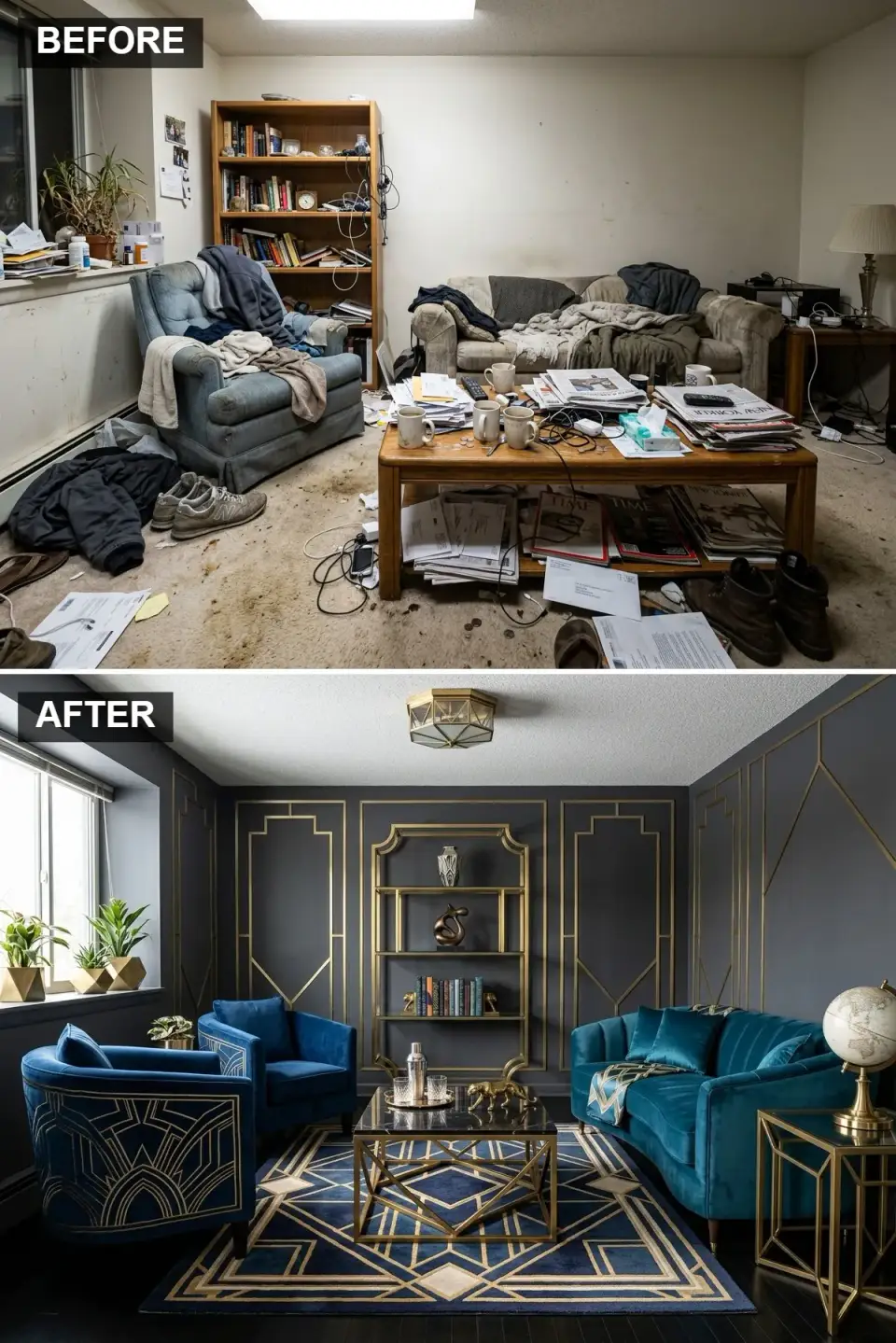
This was the first direction I showed the Thornes, because their house has twelve-foot ceilings and an original plaster crown — which means a drama-forward treatment like Art Deco isn't costume, it's period-appropriate. Walls come down to Benjamin Moore Hale Navy HC-154 in eggshell; I specified a custom picture-frame molding run in 1x3 MDF, sprayed Sherwin-Williams Emerald Urethane Trim in a custom-matched brushed gold (Pantone 872 C equivalent). The curved sofa is the Interlude Home Kelsey 94" in Como Teal performance velvet ($6,840), flanked by two Bernhardt Plush Swivel chairs in sapphire Lee Industries performance velvet ($4,280 pair). The gold geometric shelving is Jonathan Adler Rider polished brass ($5,400). Rug is a Ben Soleimani Helena 9x12 hand-knotted wool in Charcoal/Gold ($8,900). Flush mount is Visual Comfort AERIN Celerie Kemble Bristol antique brass ($1,240). Total installed including Charleston-painter trim work: $68,400.
Color Palette
BM Hale Navy HC-154
#383E42
A deep, moody backdrop that reads almost-black in twilight and saturated navy in afternoon sun.
Brushed Gold (Pantone 872 C)
#BCA57D
The warm gold was sprayed — not leafed — to keep the moving parts within the Thornes' budget while holding up to Charleston humidity.
Como Teal Performance Velvet
#005F73
Lee Industries' Como spec is CryptonHome-treated, which matters when you have two Cavalier Kings like the Thornes do.
Sapphire Velvet
#00296B
The sapphire pushes against the teal instead of matching it, which is why the pair reads layered rather than flat.
Styling Notes for This Look
- Picture-frame molding in 1x3 MDF is roughly $18-$22/linear foot installed and painted in Charleston; it's the single highest-impact, lowest-cost drama you can add to a 12-foot ceiling room.
- Dark walls demand three layers of light — ambient, task, accent — because a single ceiling fixture in a navy room reads as a cave. I specified the flush mount, two table lamps, and a swing-arm over the sofa, totaling 2,400 lumens across the 357 sq ft.
- Velvet in Charleston summer: always spec a moisture-resistant performance weave (CryptonHome, Revolution Performance, or Sunbrella Upholstery) rather than pure cotton velvet, which will mildew within three years in our climate.
2. Mid-Century Modern Oasis — $52,800
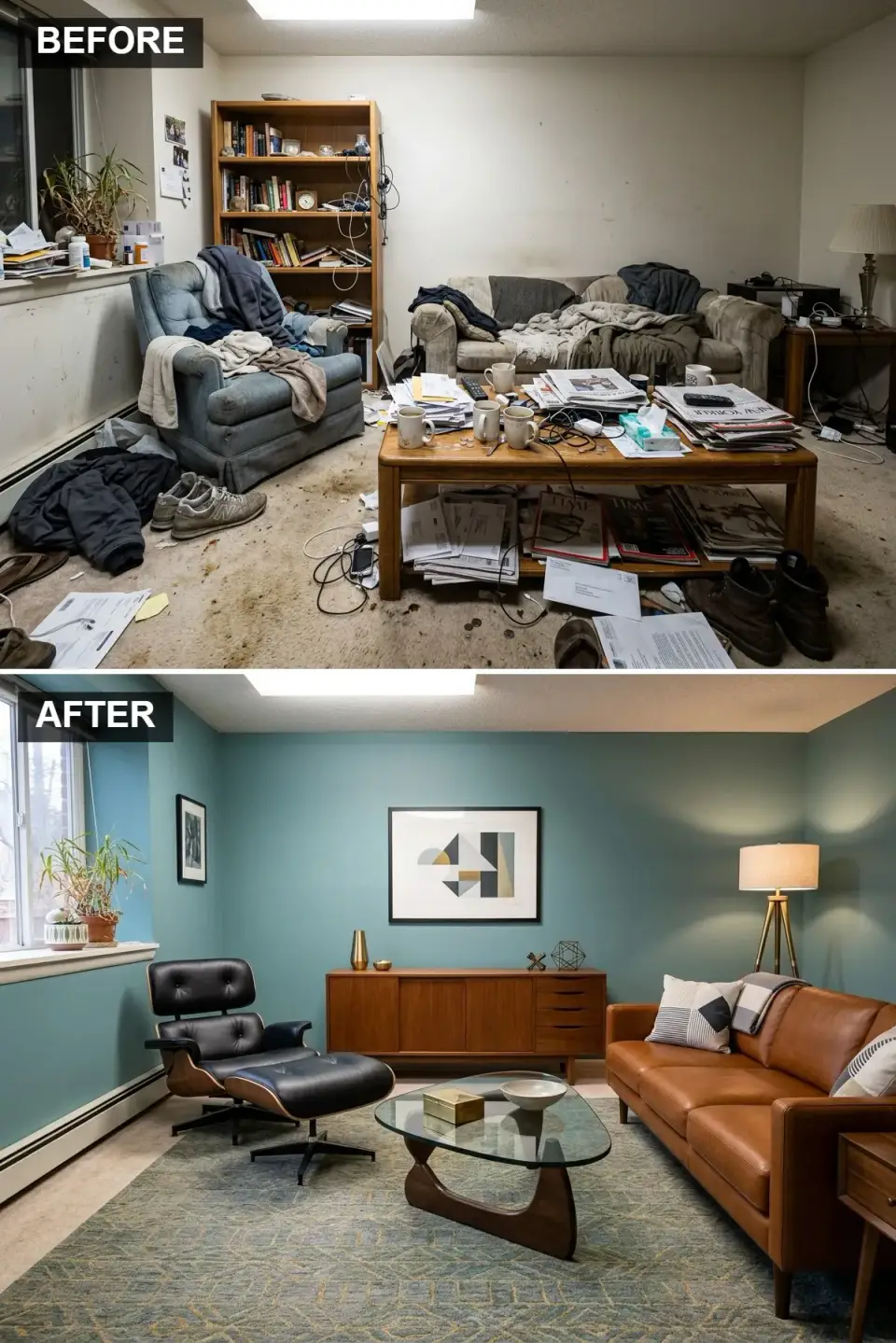
Mark grew up in Palm Springs and has been quietly lobbying for this direction since day one. Walls come down to Farrow & Ball Vardo No.288 teal estate eggshell ($125/gallon — I used three gallons for the room). The sofa is Room & Board Jasper 82" in Lecco cognac leather ($4,899). The lounge chair is authentic Herman Miller Eames Lounge Chair & Ottoman in black Pigmento leather with walnut shell ($7,695 — not the reproduction; the Thornes wanted the real thing and they'll keep it for life). The credenza is West Elm Mid-Century 78" Media Console in walnut ($2,199). Coffee table is the Herman Miller Noguchi in walnut with clear glass ($2,395 — again, the authentic Vitra-licensed piece). Tripod floor lamp is Hudson Valley Calibri 36" in polished nickel with walnut tripod ($1,690). Rug is Annie Selke Dash & Albert Birmingham 9x12 hand-knotted wool in Rust/Natural ($3,200). Total: $52,800 installed.
Color Palette
F&B Vardo No.288
#4E919E
A vintage-correct MCM teal that reads softer than BM's Providence Blue but holds color under warm 2700K bulbs.
Lecco Cognac
#A66E4C
Room & Board's Lecco is aniline-dyed Italian leather that patinas visibly over five years.
American Black Walnut
#6E4D36
Real walnut, not walnut veneer over MDF — the grain is what separates MCM from MCM-costume.
Pigmento Black Leather
#222222
The Eames shell and leather were spec'd together from Herman Miller to guarantee the matched patina.
Styling Notes for This Look
- Authentic Herman Miller or Vitra pieces cost 3-5x the reproductions and are, in my client experience, genuinely worth it for the one or two statement pieces — but not for every piece in the room. Mix authentic hero pieces with high-quality reproductions for accessories.
- MCM rooms fail when everything is "MCM." The Thornes' plaster crown and wide-plank heart pine floors stay visible and untouched — the historic envelope balances the mid-century furniture.
- Walnut needs a walnut-specific finish oil every 18-24 months in Charleston humidity. I spec Rubio Monocoat Pure for the credenza and coffee table base.
3. Scandinavian Minimalist Calm — $46,200
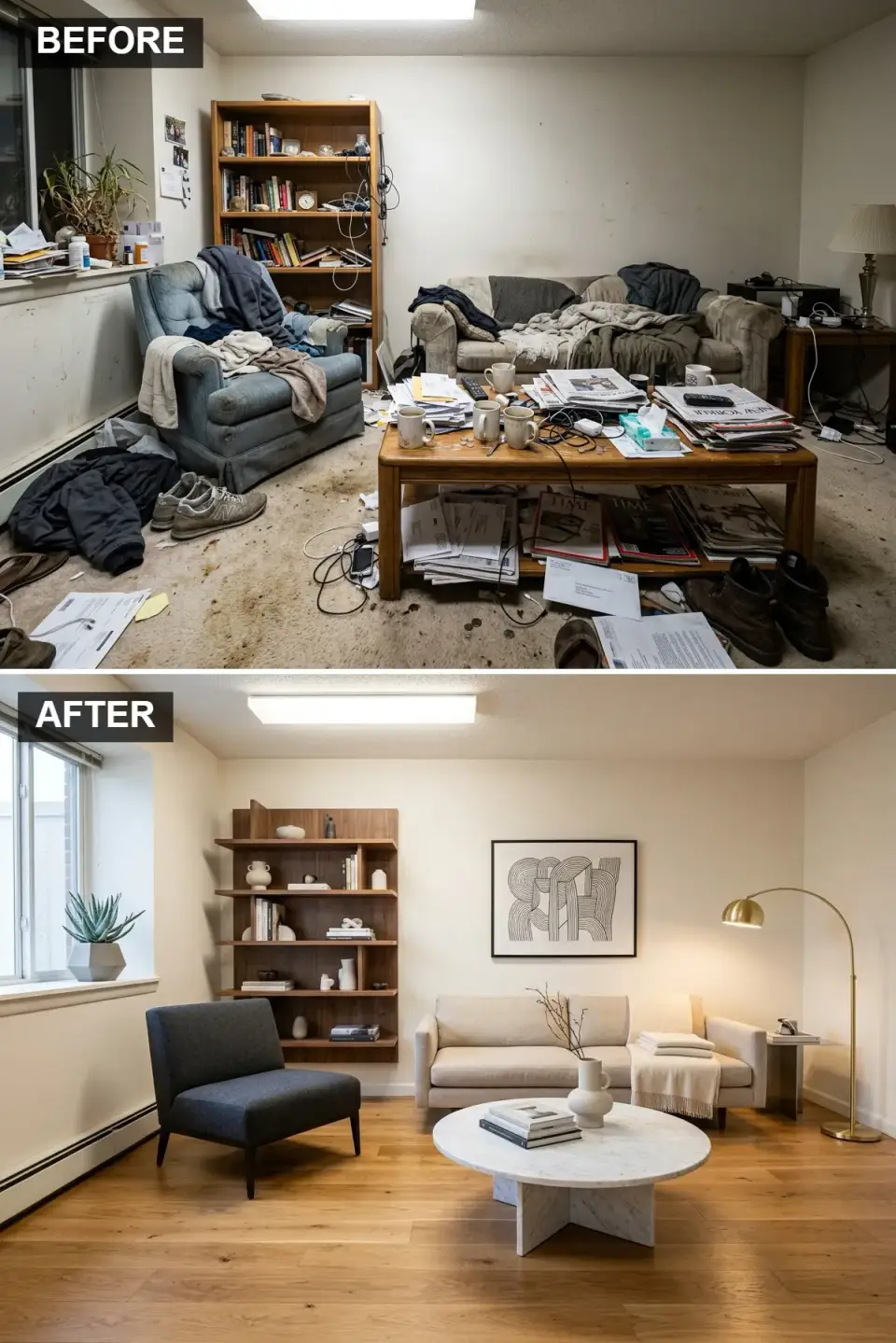
This is the direction I usually start with for first-time design clients, because it's the easiest to maintain, the easiest to live in for a decade, and the hardest to get wrong. Floor comes up and Bjelin Hardened Wood Oak Natural 6.25" engineered plank goes down ($14.60/sq ft installed = $5,210 for the room). Walls are Benjamin Moore Chantilly Lace OC-65 in matte. The sofa is Muuto Connect Soft 3-Seater in Clay 12 oatmeal ($6,249). Accent chair is Gubi Beetle Lounge in Velluto 20 Charcoal with matte black base ($2,150). Coffee table is HAY Slit Table Round in Carrara marble with oak base ($795). Shelving is String Pocket 3-shelf system in white/ash ($1,890 for two stacked modules). Pendant is Flos Aim Small in matte black ($495). Floor lamp is Louis Poulsen PH 3½-2½ in metallized brass ($1,890). Rug is Armadillo Sierra Weave 9x12 hand-loomed wool in Silver ($2,850). Total: $46,200 installed.
Color Palette
Bjelin White Oak Natural
#C2A683
Bjelin's Hardened Wood is 3x the Janka hardness of standard oak — matters on a high-traffic Charleston floor.
Muuto Clay 12 Oatmeal
#D3CEC4
Clay 12 is a 58% wool / 42% nylon blend from Kvadrat — it resists pilling for the first decade.
Carrara Marble
#EFEFEF
A solid slab, 40mm — not a thin veneer over MDF, which is where most sub-$400 "marble" coffee tables fail within eighteen months.
Gubi Charcoal Velluto
#363A40
The single dark anchor keeps a neutral room from floating.
Styling Notes for This Look
- Real Scandinavian design is not "Ikea plus beige." The difference is that every piece in this scheme is a named designer edition by a maker with a 40+ year archive. You're buying craft provenance, not just aesthetics.
- Wall-to-wall in matte Chantilly Lace reads white during the day and warm off-white at dusk because of the 15% titanium dioxide undertone. Contractor-grade flat white will read gray-blue in Charleston north-facing light.
- A single Louis Poulsen PH 3½-2½ on a long cord over the corner reading chair does more for this room than a three-lamp arrangement. Scandinavian lighting is about pools of warm light, not uniform brightness.
4. Organic Boho-Scandi Retreat — $54,800
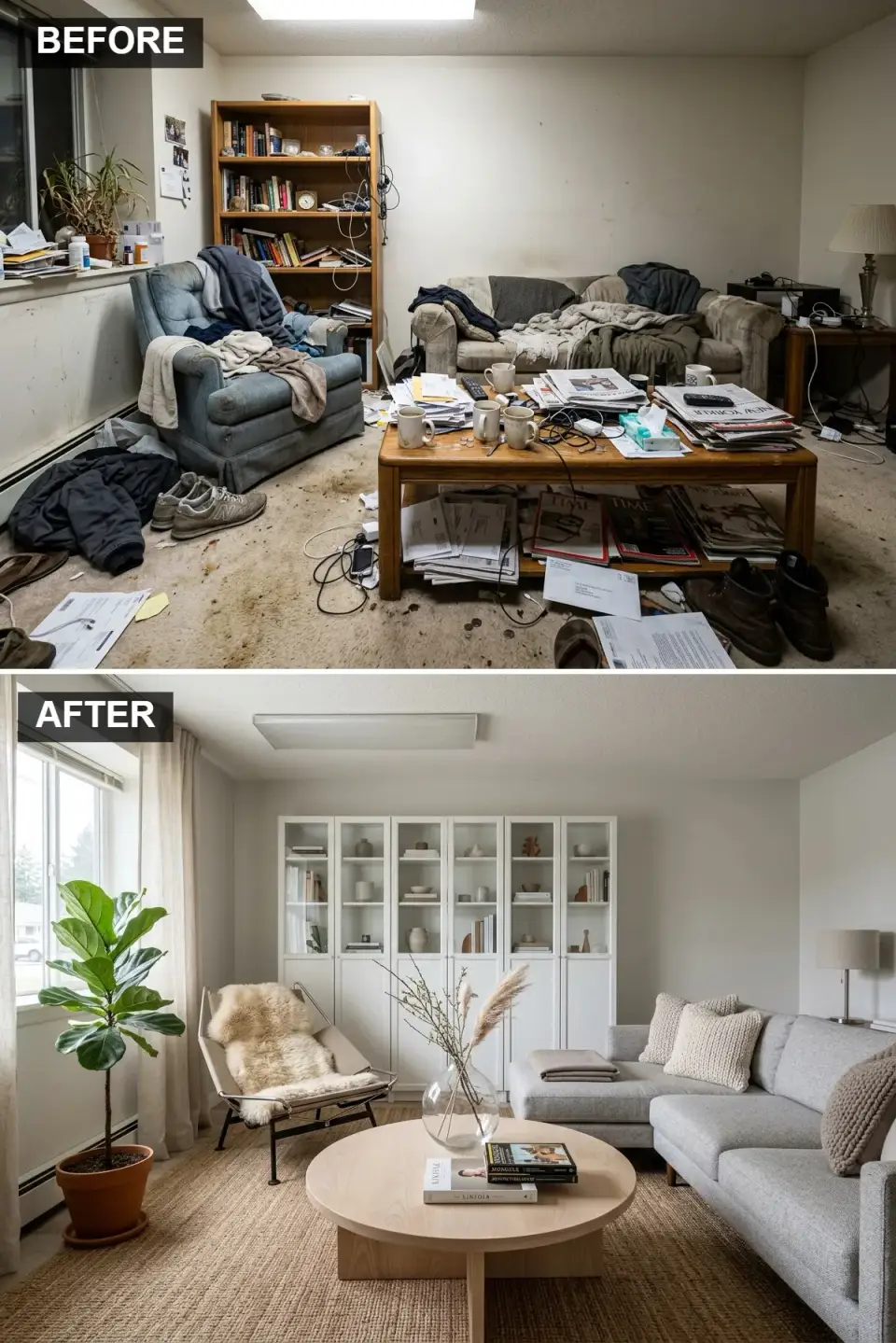
A hybrid that splits the difference between styles three and seven — clean Scandinavian bones with Bohemian warmth in the layering. The big structural move is a custom Schoolhouse built-in wall unit in white lacquer with antique brass hardware and seeded-glass doors ($11,400 for the 9-foot wall, made-to-order in 14 weeks). The sectional is Article Timber 4-piece in Pearl Grey ($3,999) — Article is where I send clients who want the Restoration Hardware look at 40% of the cost. Sling chair is Serena & Lily Brentwood in natural leather and cognac canvas ($1,890). Coffee table is BDDW Rift-Sawn Oak low rectangle ($4,900). Rug is Lulu & Georgia Arlo Jute Round 10-foot ($1,090) layered under a Beni Ourain authentic 6x9 from Salam Hello ($2,400). Pendant is Cedar & Moss Alto 5-Cluster in brass with opal glass ($990). The large Ficus lyrata (fiddle leaf fig) came from Charleston Plant Company in a 14" basketweave planter ($380). Total: $54,800.
Color Palette
Custom Satin White Lacquer
#FFFFFF
Factory-sprayed in 6-coat conversion varnish — not field-painted, because humidity will ripple field-painted lacquer within 18 months in Charleston.
Article Pearl Grey
#BDBDBD
A warm neutral grey with a slight greige undertone that pairs with both the jute and the oak.
Natural Jute
#C1A587
Jute underneath, Beni Ourain layered on top — the double-rug move is the single biggest visual upgrade you can make to a neutral sofa.
BDDW Rift-Sawn White Oak
#E3D1B7
Rift-sawn grain is straight and calm; plain-sawn is what you'll find on a cheaper table and it reads busy.
Styling Notes for This Look
- Custom built-ins are the most expensive single line item in most of my living-room projects and they are almost always worth it: they eliminate visual clutter, force commitment to storage, and add 6-9% to resale (Charleston MLS data, 2022-2025).
- When you layer rugs, the top rug should be at least 30% smaller than the base rug, and the grain/weave directions should contrast — jute pile over jute pile looks like a mistake.
- A single large-leaf plant (fiddle leaf fig, bird of paradise, or ficus Audrey) does more for the corner of a neutral room than three smaller plants. Scale matters.
5. Edgy Industrial Loft — $58,400
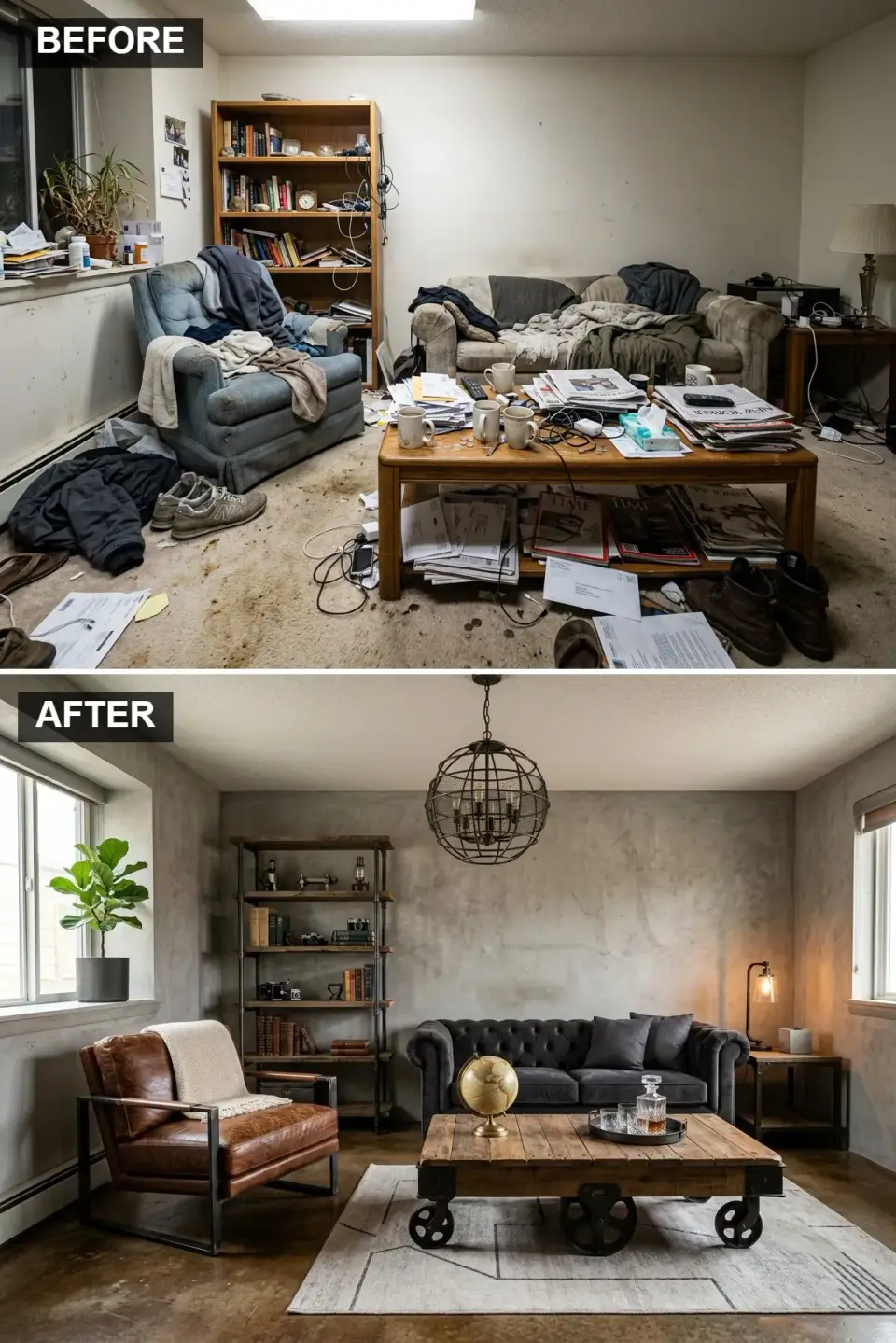
This was the riskiest direction I proposed for the Thornes, because Charleston historic homes generally push against anything industrial. But Jennie used to run a photography studio in a Brooklyn loft and asked me to "push it." Walls get a Modern Masters Venetian Plaster concrete skim coat in Warm Silver ($42/sq ft installed by a Charleston plaster specialist — 280 sq ft of wall = $11,760). The existing heart pine floor is covered with a 1.5" Bomanite Patene Artectura polished concrete topping in Titan Grey ($18/sq ft = $6,430). Shelving is Restoration Hardware Dutch Industrial Single-Shelving 9-foot wide in aged steel ($3,490). Sofa is RH Lancaster Tufted Velvet 96" in Charcoal ($5,290). Armchair is Timothy Oulton Westminster in distressed leather with iron frame ($3,890). Coffee table is Rejuvenation Bergen Console Cart industrial steel with reclaimed pine ($1,890). Pendant is Hudson Valley Hurston 16" Bronze Cage with Edison bulb ($690). Total installed: $58,400.
Color Palette
Modern Masters Warm Silver
#8C8C8C
A troweled Venetian plaster that reads as actual concrete under raking light, not drywall pretending to be concrete.
RH Charcoal Velvet
#3B3B3B
Velvet in an industrial room is the softening move that keeps it from reading as an office.
Distressed Cognac Leather
#8A5A3A
Timothy Oulton's leather is tea-stained over seven weeks — the patina you pay for is time, not surface treatment.
Reclaimed Southern Pine
#7F634B
Rejuvenation sources from Pioneer Millworks — the pine carries actual nail holes from 1920s-era structures.
Styling Notes for This Look
- Polished concrete over existing wood flooring requires a structural review — I had Adams Engineering in North Charleston sign off on the additional 22 psf dead load before the pour.
- Industrial rooms fail at the lighting. Three Edison-bulb fixtures in one room reads as costume. I use one industrial statement piece (the Hudson Valley pendant) and back it up with a warm 2700K LED floor lamp and two sconces.
- Venetian plaster is handmade by a specialist; don't let a general painter attempt it. The Charleston crew I use charges $42/sq ft and books 8 weeks out — worth every week of that wait.
6. Breezy Coastal Grandmother — $42,600
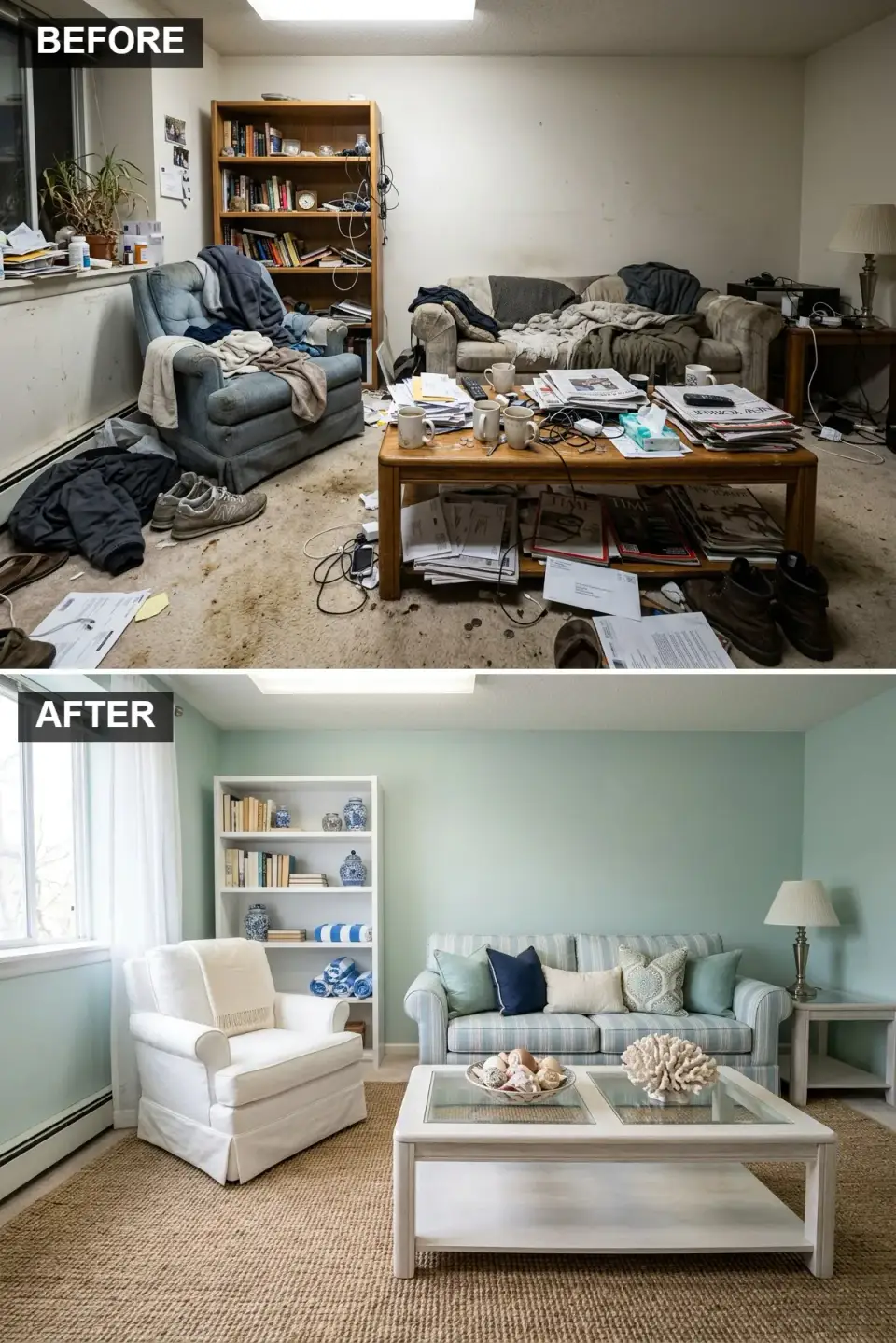
The direction that everybody in Charleston asks for first, and which I am always a little careful to keep from sliding into theme-park coastal. Walls are Benjamin Moore Palladian Blue HC-144 in eggshell — the single most-specified coastal paint color on the South Carolina coast and for good reason; it changes with the light in a way that Robin's Egg and Sea Salt do not. Sofa is Serena & Lily Beach Grove 84" in Navy Awning Stripe performance linen ($3,998). Armchair is Pottery Barn Comfort Grand Slipcovered in Performance Everyday Linen Oatmeal ($1,899). Bookshelf is Oly Studio Juno white-lacquer open etagere, 8-foot ($3,890). Coffee table is Made Goods Kass in white-washed oak with glass top ($1,790). Rug is Dash & Albert Herringbone Jute 9x12 ($1,290). Lighting is Visual Comfort Bryant Hanging Globe in burnished brass with opal glass ($890) plus two Coastal Living Port ceramic table lamps in white ($490 each). The display on the shelf — blue and white Chinoiserie ginger jars, coral specimens, and brown-bound antique books — came from Out of Hand on King Street ($1,800 total for the vignette). Total: $42,600.
Color Palette
BM Palladian Blue HC-144
#AECDC9
A blue-green-gray that photographs as any of those three depending on light — the defining Charleston porch-ceiling color for a reason.
BM Simply White OC-117
#FFFFFF
Simply White reads warmer against Palladian Blue than Chantilly Lace — specification matters at this level.
Serena & Lily Navy Awning
#6A869E
A 1.25" stripe — wider than sailor stripe, narrower than beach umbrella — which is the historically correct Southern coastal width.
Herringbone Jute
#BFA586
Jute in Charleston: avoid if you have pets with accidents, because jute wicks and stains. Otherwise, the definitive coastal floor.
Styling Notes for This Look
- Real Charleston-grade Coastal Grandmother is Palladian Blue walls, Simply White trim, navy-and-white striped primary upholstery, and actual antique books on the shelves — not dyed-spine decorator books, which read as fake within 3 feet.
- Keep the accessories count in single digits per shelf. Coastal Grandmother is edited, not maximalist — the Thornes' original bookshelf held 84 objects; the restyled version holds 18.
- Performance linen is the only upholstery fabric I specify for coastal rooms in Charleston. Pure linen will yellow and fade within three years on any south-facing window.
7. Eclectic Bohemian Hideaway — $38,200
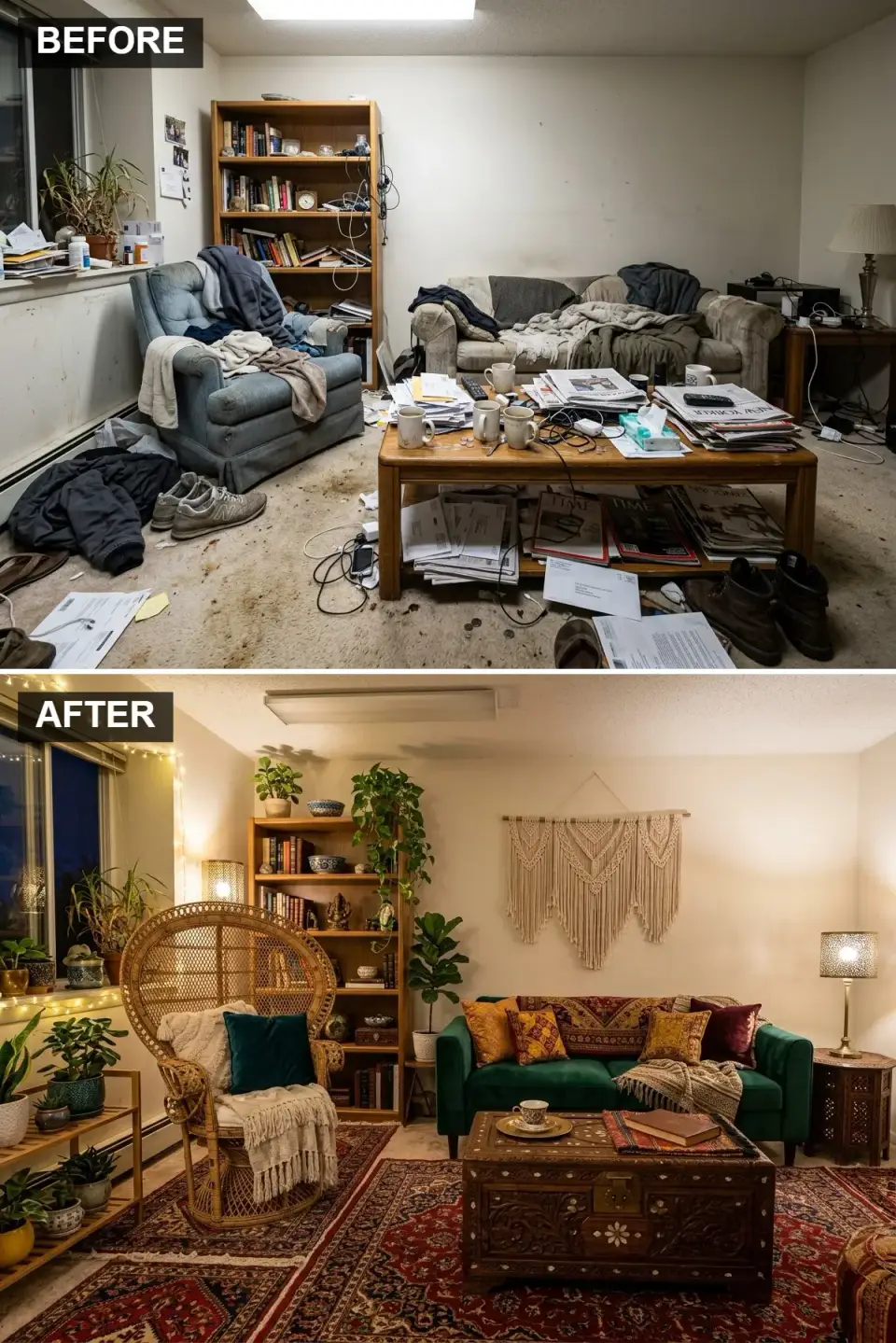
The least expensive direction I showed the Thornes — and the one that would have been the most fun to actually source, because real Bohemian is never retail. Walls are Portola Paints Lime Wash in Adobe ($120/gallon, troweled in two thin coats — I used 1.5 gallons for the room at $480 total materials, plus $1,800 labor for the Charleston lime-wash specialist). Sofa is Anthropologie Willoughby 94" in Emerald velvet ($3,298). Peacock chair is a genuine vintage 1970s Emmanuelle rattan sourced from Charleston Architectural Salvage ($680). Rug is a Beni Ourain authentic 6x9 from Salam Hello in ivory/charcoal ($2,400) layered over a vintage Heriz Persian 8x10 in deep red and navy sourced from Gogia Rugs Atlanta ($4,200). Coffee table chest is a vintage Indian hand-carved teak chest from Material World Charleston ($1,200). Macrame wall hanging is by Charleston fiber artist Mell Bradshaw, custom 4x6-foot in cream cotton ($890). Lighting is String Lights from Bistro Lights Commercial G40 Warm White 100-foot run ($420), plus a vintage Moroccan pierced-brass pendant from Zia Tile ($580). The collected objects — kilim cushions, brass trays, vintage books, a pair of carved wooden camels — came from Souk by Gogo and Em Lowe's Charleston studio ($2,400 total). Total: $38,200.
Color Palette
Anthropologie Emerald
#00553F
A deep jewel green with a slight teal undertone — reads saturated under warm light and moody under gray sky.
Natural Rattan
#C19A6B
A genuine 1970s Emmanuelle — not the modern reproduction — which has a 52" diameter fan back and honeys with age.
Vintage Heriz Deep Red
#7A2929
A 70-year-old hand-knotted Persian — the abrash (uneven dye lots) is the signature of authenticity.
Carved Indian Teak
#4A3021
Vintage carved teak from Rajasthan, circa 1940 — weight and provenance make the piece, not the finish.
Styling Notes for This Look
- Real Bohemian comes from salvage, estate sales, and travel — not from a single Anthropologie order. I budget 40% of a Bohemian direction for one-off vintage sourcing, even in the quote phase.
- Layered rugs are the fastest visual shortcut to collected-over-time, but the two rugs have to have fundamentally different weaves and patterns or the layering looks accidental.
- Warm lighting is everything in a Bohemian room. I spec 2700K everywhere and avoid any overhead fixture brighter than 600 lumens — the ambient level should feel like early evening at 4pm in October.
8. Soft Glamour & Luxury — $76,400
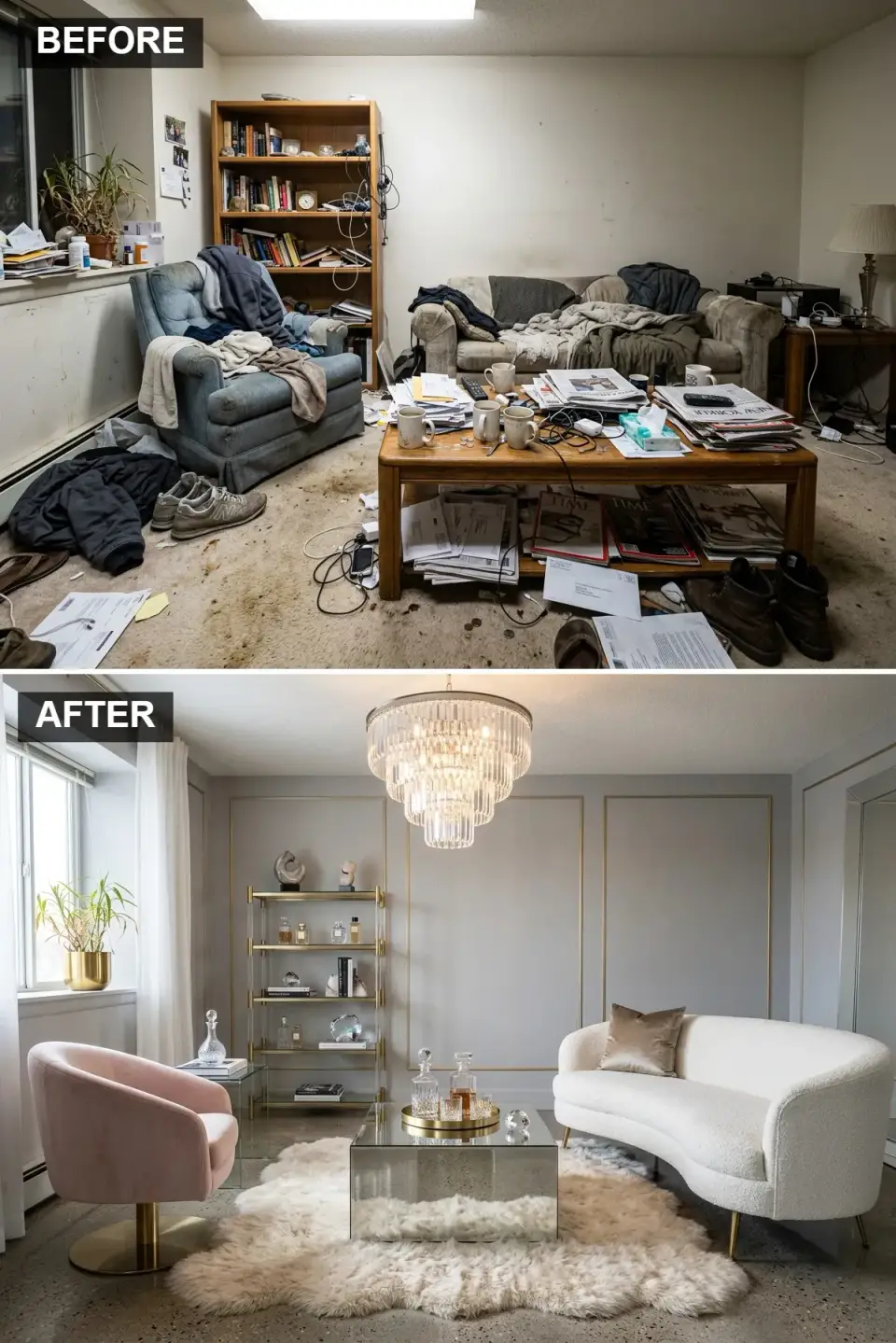
The most expensive direction I proposed, because glamour done well is almost entirely about fixture cost. Walls are Benjamin Moore Paper White OC-55 with a custom gold picture-frame molding in 1x4 MDF sprayed Modern Masters Metallic Plate Polished Brass ($12,400 millwork+paint installed). Sofa is the iconic RH Cloud Modular 4-Piece in Perennials Boucle Winter White ($9,890 — Perennials boucle is the only boucle I'll spec for a Charleston living room because it's actually stain-resistant). Swivel chair is Arhaus Roze in blush pink performance velvet with polished brass base ($2,290). Chandelier is Visual Comfort AERIN Astrid 6-Tier Crystal in antique brass ($6,200). Coffee table is Bernhardt Olivia Mirrored Cube 42" ($2,890). Shelving is Tom Dixon Etch brass-and-glass 5-shelf floor unit ($4,890). Floor lamp is Jonathan Adler Sputnik 7-arm in antique brass ($1,290). Rug is a genuine Mongolian long-hair sheepskin 6x8 custom-seamed from Tibet Rug Company ($4,900). Drapery is Hartmann & Forbes Heather Shade in Pearl silk, double-height ($3,890). Total installed: $76,400.
Color Palette
Perennials Winter White Boucle
#F0EEE9
Perennials is the only performance boucle I trust in a cream color on a sofa — it's bleach-safe.
Arhaus Blush Velvet
#D9A6A7
A muted pink with brown undertone — reads sophisticated, not nursery.
Polished Brass
#C4A874
All brass in the room is polished, not brushed or antiqued — glamour rooms commit to one finish.
Mirrored Glass
#BFC8CD
Bernhardt's Olivia is beveled, seamed at the corners with polished brass — a dead giveaway that separates it from the $400 Amazon version.
Styling Notes for This Look
- Glamour fails when the materials don't hold up. Don't commit to this direction without performance fabric, bleach-safe boucle, and solid-brass (not brass-plated) fixtures — the $1,200 chandelier that yellows in 18 months is a worse value than the $6,200 one that doesn't.
- A crystal chandelier of this scale requires 48" of clearance from the floor to the lowest crystal; the Thornes' 12-foot ceiling was essential. A 9-foot ceiling would have looked crowded.
- Floor-to-ceiling drapery (not window-to-window) is the rule for glamour rooms. Hartmann & Forbes silk is a real silk — it will fade near a south-facing window over 7-10 years, which is factored into the budget.
9. Japandi Zen Sanctuary — $64,200
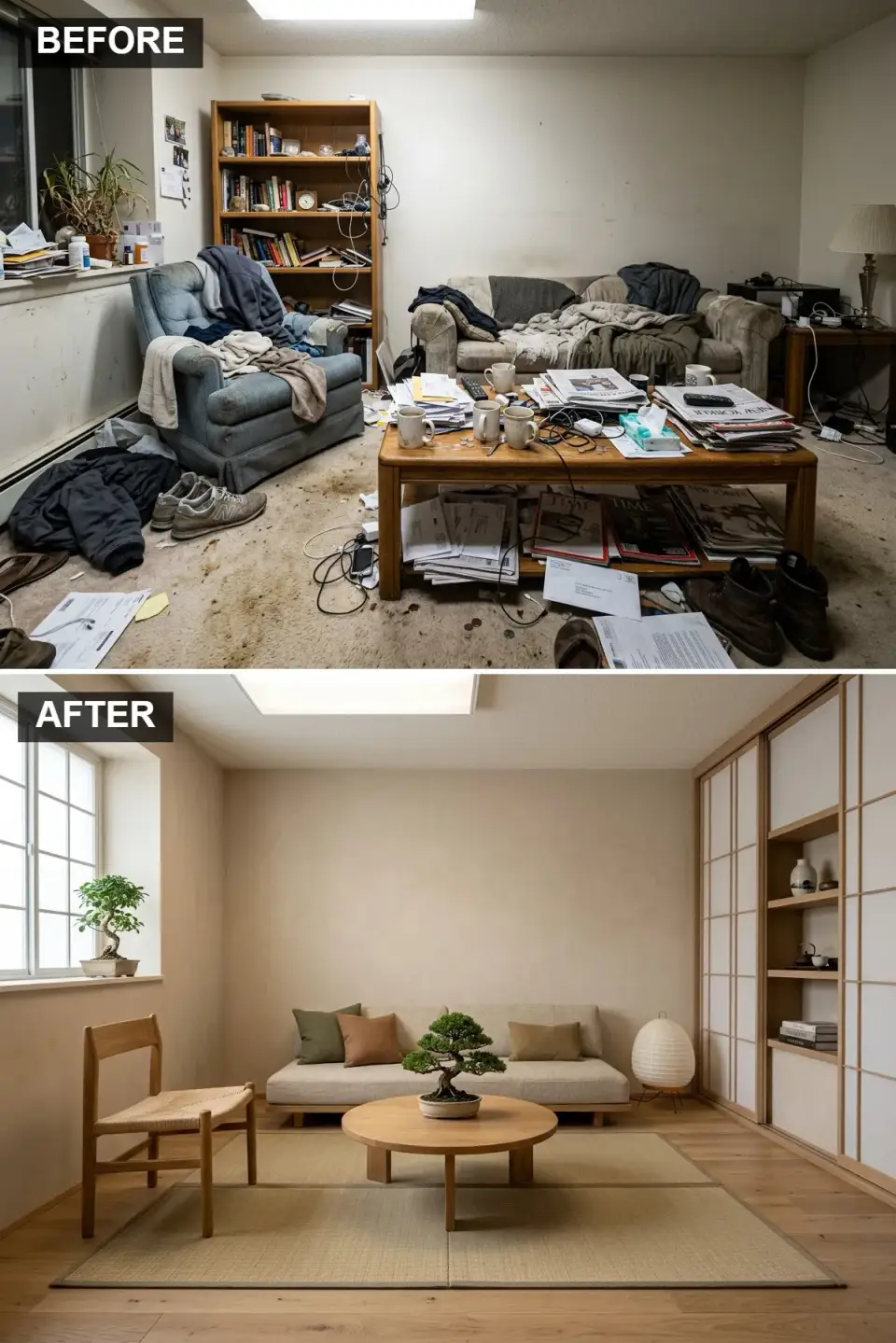
Japandi, done correctly, is the highest-discipline interior style in modern design — every object justified, every surface intentional. Walls come down to American Clay Loma Arcilla ($54/sq ft installed by their Charleston-certified applicator, 280 sq ft = $15,120). Floor is the same Bjelin Oak Natural engineered plank from style three. The tatami mats are authentic Ikko Japanese Tatami from their Kyoto workshop — two 3x6 mats in igusa grass over white oak frames, shipped direct ($2,800 pair including air freight). Sofa is Muuto Outline Low 2-Seater in Refine Leather Cognac ($6,890 — the low 28" back height is key to the Japandi floor-plane composition). Low chair is Pinch Nim Chair in solid white oak with cotton sling seat ($2,890). Low table is a custom solid-oak platform from Charleston joinery Knight Woodworks, 48"x30"x11"H ($2,400). Shoji sliding screens in front of the built-in storage are authentic Shoji Factory cedar frames with washi paper, two 32"x78" panels ($3,890 including Charleston installation). Pendant is Yamagiwa Akari 75A Isamu Noguchi authentic ($890). The bonsai is a 25-year-old Juniperus procumbens Nana from Dallas Bonsai Garden ($680 with ceramic Tokoname pot). Total: $64,200.
Color Palette
American Clay Loma Arcilla
#D2C3B0
Genuine clay plaster — not lime-wash, not drywall paint. Moves moisture naturally and ages with the room.
Bjelin White Oak Natural
#C7B299
Continuous oak floor under the tatami is the Japandi (not pure Japanese) move — the Scandinavian half of the equation.
Ikko Igusa Grass
#A89F85
Tatami releases a faint hay smell for the first 6-8 weeks — unmistakable, and the single clearest signal of authentic material.
Japanese Cedar (Sugi)
#D4C4A8
Real sugi cedar, hand-planed — not poplar stained to imitate cedar.
Styling Notes for This Look
- Authentic Japandi costs more than stylistic Japandi because the materials are genuinely hand-made: the tatami is hand-woven, the shoji frames are hand-joined, the plaster is hand-troweled. Expect 6-9 month lead times on everything shipped from Japan.
- The discipline of Japandi is not buying — it's not buying. I restricted the Thornes' object count in this scheme to 14 total visible items in the room including books on the low table.
- Low furniture (sofa 28" back, chair 24" seat, table 11"H) changes how a room is actually used — you sit lower, speak quieter, move slower. It is not a cosmetic choice.
10. Modern Farmhouse Coastal — $48,800
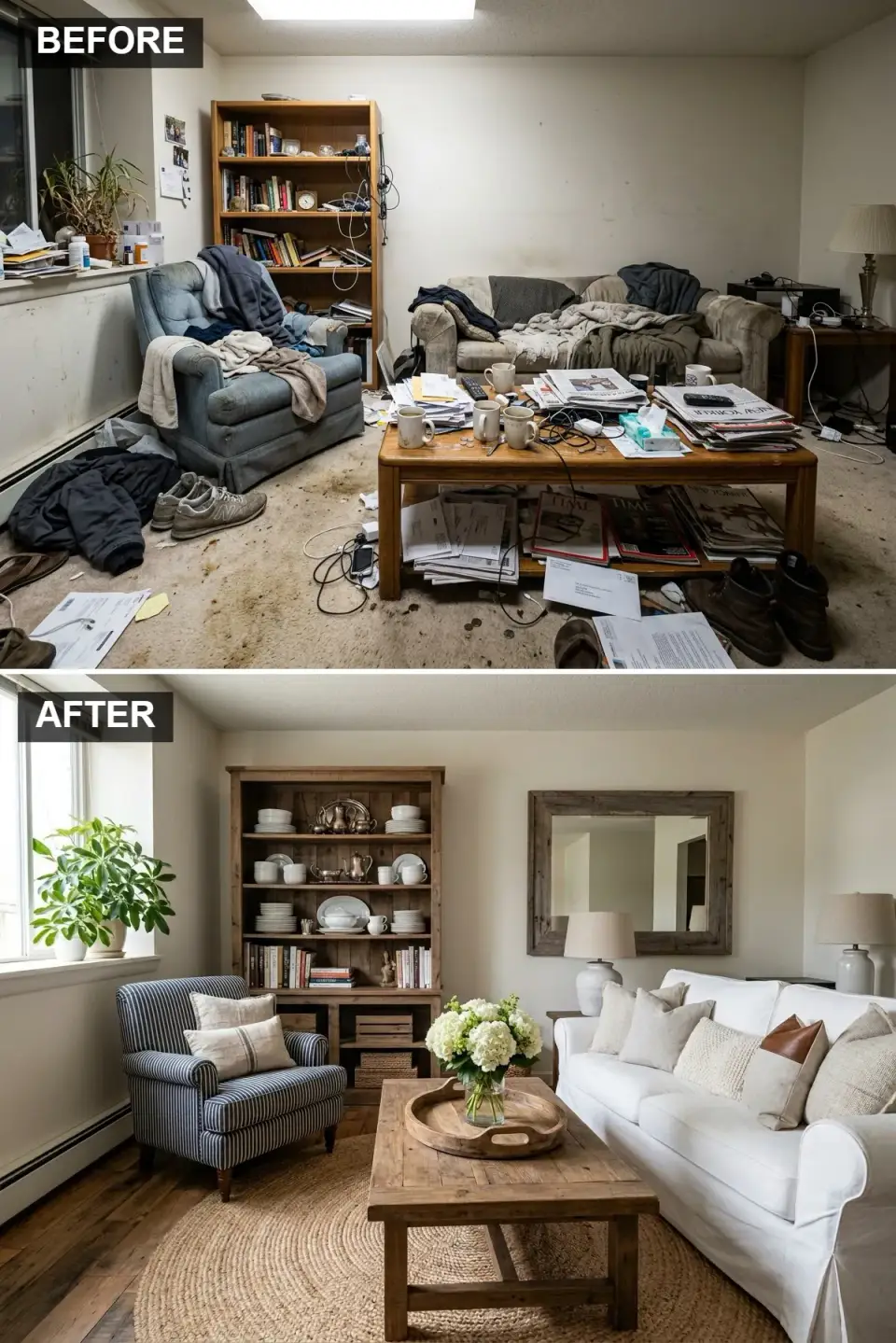
A cousin to the Coastal Grandmother direction but warmer, more lived-in, and more rural-feeling. Walls are Benjamin Moore Swiss Coffee OC-45 in eggshell. Floor is TerraMai Reclaimed Southern Longleaf Pine 7" wide-plank in Natural with a polyurethane matte finish ($17.50/sq ft = $6,250 for the room). Hutch is Four Hands Abaso Reclaimed Sundried Wheat 84" with glass-pane upper doors ($3,890). Sofa is Pottery Barn York Slipcovered 92" in Performance Everyday Linen White ($2,699). Armchair is Pottery Barn James Slipcovered in Performance Stripe Blue/White ($1,499). Round rug is Lulu & Georgia Nissa Jute 10-foot ($1,190). Reclaimed wood coffee table is Magnolia Home Traditional Occasional 52" in whitewashed oak ($1,290). Mirror is a Made Goods Dante 60" antiqued wood-framed round ($1,890). Lighting is Visual Comfort Ian K. Fowler Cyrus 3-Light Chandelier in aged iron ($2,290) plus two Currey & Company Seeded Glass table lamps in cream ($590 each). White ceramic displayed on the hutch is collected vintage McCoy and Hall pottery from Charleston estate sales (~$1,400 for the full vignette). Total: $48,800.
Color Palette
PB Performance Everyday Linen White
#F2F2F2
Washable, removable slipcover — essential for a family living room with dogs.
Reclaimed Longleaf Pine
#8B6F54
Reclaimed pine from Southern barn framing — the saw marks and nail holes are original.
PB Performance Stripe Blue/White
#3F516D
Narrower stripe than Serena & Lily's awning stripe — reads quieter against the reclaimed wood.
Made Goods Antiqued Oak
#7A6E63
A 60" mirror in a 21x17 room is the right scale — anything smaller fails to bounce enough Charleston afternoon light.
Styling Notes for This Look
- Modern Farmhouse Coastal is less about a specific product list and more about a mix ratio: roughly 60% soft pale neutrals (sofa, walls, armchair upholstery), 30% warm reclaimed wood (floor, table, hutch), and 10% navy/stripe accents.
- Vintage McCoy, Hall, and Frankoma pottery at Charleston estate sales runs $12-$45/piece — a curated shelf of twelve pieces is under $400, and reads as decades of collecting.
- Swiss Coffee OC-45 is the warmest off-white I specify. Against a reclaimed pine floor, it reads as cream; against a stark-white oak floor, it reads as yellow. Specify contextually.
11. Wabi-Sabi Minimalist — $72,400 (the Thornes' chosen direction)
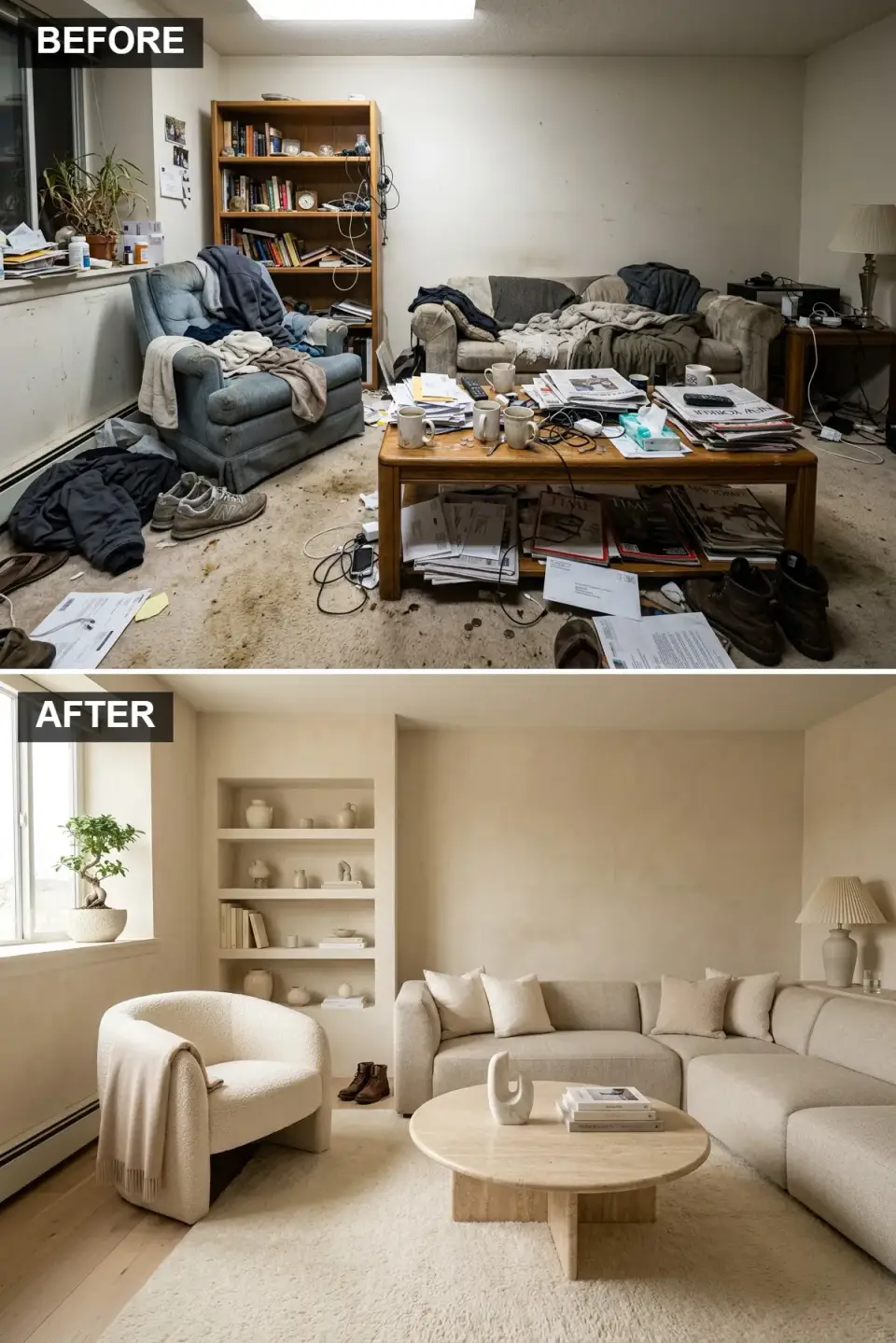
This is the one they picked, and I think they picked it for exactly the right reason: it was the only direction that asked for very little over time. Wabi-Sabi is imperfect, slow, and quiet — and the Thornes' life is already two kids and two dogs and a law practice, so quiet is the premium. Walls are Portola Paints Lime Wash in Hacienda ($120/gallon — 2 gallons at $240, plus $2,400 Charleston lime-wash specialist labor for the 280 sq ft in two troweled coats over three days). The big structural move is a series of three custom plaster niche shelves built into the wall opposite the sofa — cast-in-place Portland Plaster in Type S over metal lath, 48"x14" each, hand-finished by the same plaster specialist ($8,900 total). The sectional is RH Cloud Modular 5-Piece in Perennials Greige Boucle ($11,890 — identical boucle as style eight but in the greige colorway). Accent chair is Ligne Roset Togo 1-Seater in Cremant Boucle ($3,490). Coffee table is a single cast travertine block 48"x28"x14"H from Marmol Export Turkey via Charleston stoneyard Coastal Stone ($4,800 including delivery and crane placement — the piece weighs 680 pounds). Rug is Armadillo Morum Handwoven Wool 10x14 in Cinder ($5,290). Floor lamp is Apparatus Arc Lamp in oil-rubbed bronze ($4,890). The large ceramic vessel on the coffee table is a one-of-a-kind Ben Medansky stoneware piece from March Charleston ($2,200). The small ikebana arrangement is a single branch of Japanese maple cut by hand from the Thornes' garden. Total installed: $72,400.
Color Palette
Portola Lime Wash Hacienda
#D9D0C1
Natural lime — not acrylic paint with lime effects. The wall will chalk slightly, which is the intended behavior.
Perennials Greige Boucle
#CFCBC2
Greige is the neutral that actually works against a lime-wash wall; pure white boucle would pop out of the scheme.
Togo Cremant Boucle
#F5F1E8
The Togo is the only pure-white fabric in the room — it serves as the visual relief point.
Turkish Travertine Natural
#DBC8B0
A single 680-pound block of stone, vein-filled but unpolished — the surface has natural voids that catch dust intentionally.
Styling Notes for This Look
- Plaster niches built into an existing drywall wall require a framing review — I always have the contractor verify that we're not cutting through a shear wall or a plumbing chase before committing. Adams Engineering did the structural check on this wall.
- Wabi-Sabi is about the absence of perfection, but it is not about the absence of care. The travertine block was hand-selected from eleven options at the stoneyard for the specific vein pattern the Thornes wanted.
- Ikebana — one branch, one flower, one vessel — is the operative principle for a Wabi-Sabi room's seasonal refresh. The Thornes rotate the arrangement monthly.
12. Classic Transitional Elegance — $58,600
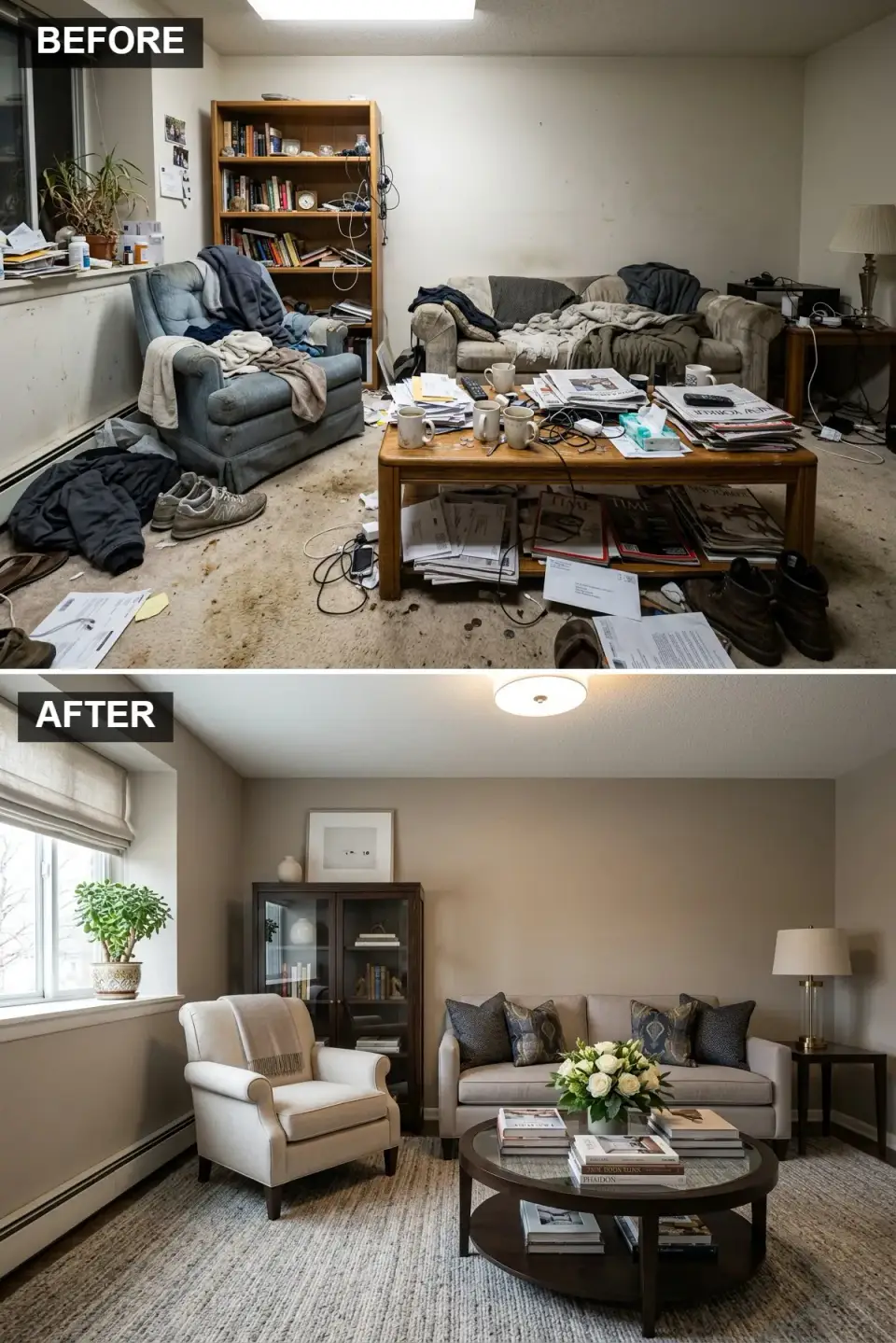
The direction Mark's mother would have chosen — and which I mention here not as a criticism but as the reason Transitional endures: it is resale-neutral, universally readable, and never out of style. Walls are Benjamin Moore Edgecomb Gray HC-173 in eggshell. Sofa is Taylor King Belvedere 94" tailored tuxedo in Kravet Carrington Oat linen-blend performance fabric ($6,890 to-the-trade via Charleston designer showroom). Armchair is Hickory Chair Ginsberg in Schumacher Elton cream silk-look ($4,290). Glass-door cabinet is Baker Furniture Milling Road Anthony 72" Walnut ($5,890). Coffee table is Bunny Williams Home Bibi Round in oiled walnut with hand-blown glass top ($3,490). Rug is Safavieh Couture Royal 9x12 hand-knotted wool in ivory/charcoal ($4,290). Roman shade is Hartmann & Forbes Himalayan Grasscloth in Wheat Natural, two windows ($2,890). Chandelier is Visual Comfort Chapman & Myers Sandy Lane 24" in burnished silver leaf with crystal ($2,290). Two Chelsea House porcelain ginger-jar lamps in blue-and-white flank the sofa ($890 pair). The display cabinet holds a curated collection of Cambridge Shinnecock Hills silver — four trophies, two bowls, eight pieces total — collected from Charleston silver dealer Croghan's Jewel Box (~$4,200 for the vignette). Total: $58,600.
Color Palette
BM Edgecomb Gray HC-173
#BCAFA3
The single most-specified warm greige in American interior design for a reason — reads consistently in every light.
Kravet Carrington Oat
#D1C8BD
A linen-weave performance fabric at 90,000 double rubs — built for twenty years of use.
Baker Walnut Espresso
#423228
Hand-finished walnut with a lacquered topcoat — the dark cabinet anchors the otherwise pale room.
Hand-blown Glass
#E4E9ED
Genuine blown glass has subtle waviness; a plate-glass replacement is usually obvious within three feet.
Styling Notes for This Look
- Transitional rooms rely on tailored upholstery — tight backs, welt cords, skirted bases — which costs roughly 20-30% more than casual upholstery but lasts roughly twice as long.
- To-the-trade pricing through a Charleston designer showroom typically runs 35-50% below MSRP; if you're spending this level, the designer fee pays for itself in procurement.
- Edgecomb Gray against crisp white trim (BM Simply White OC-117 or Decorator's White) is the classic Transitional trim combination — deviating from that pair sends the room toward a different style.
Pro Tips from the Charleston Job Site
- Start with a measured floor plan, not a Pinterest board. Every direction I showed the Thornes was drawn in AutoCAD against the exact 21x17 dimensions with the window, fireplace, and door swings fixed. A $6,000 sofa in the wrong scale is a more expensive mistake than a $500 mistake plus a sketch.
- Define the palette before purchasing anything. The three-to-five-color rule still holds: one dominant (60%), one secondary (30%), one accent (10%), with optional two-percent pop colors for accessories. Write it down, pin it to the wall, and check every purchase against it.
- Invest in one hero piece per room. For the Thornes it's the travertine block coffee table. Every other item in the room is there to support that single piece. Rooms without a hero piece read as showroom displays.
- Light in three layers, minimum. Per the IESNA Lighting Handbook, a living room should deliver 20-30 lumens per square foot at task level — for a 357 sq ft room that's 7,140-10,710 total lumens, which is impossible from a single ceiling fixture. I specify ambient (overhead/chandelier), task (table lamps, reading lamp, floor lamp), and accent (sconces, picture lights, LED strips).
- Right-size the rug. The sofa and at least the front legs of all accent chairs should sit on the rug. Undersized rugs make rooms read as afterthoughts. For a 21x17 room, a 9x12 is the minimum; a 10x14 is better.
- Performance fabric is not optional in Charleston. Our humidity runs 70-85% for six months a year. Pure cotton velvet, linen, and wool upholstery will mildew within three years. I spec CryptonHome, Perennials, Sunbrella Upholstery, or Kravet's Revolution Performance line for every primary upholstered piece.
- Paint sheen matters more than color. For living rooms I specify eggshell (not satin, not flat) on walls because eggshell is wipeable without the plastic sheen of satin, which ruins hand-plastered and lime-washed finishes. For trim I use semi-gloss in a urethane formulation (SW Emerald Urethane Trim) that stays white instead of yellowing.
- Keep an invoice binder. I require clients to keep every receipt, every fabric spec sheet, every paint order, and every SKU number in a physical binder for at least ten years. When something needs replacing, you'll know exactly what to order.
Regional Cost Breakdown — 7 Southeast Markets
The invoice totals above are Charleston, SC installed pricing as of Q1 2026 (RSMeans adjusted). Below are the comparable ranges across seven major Southeast and adjacent markets. Labor differential is the primary variable — paint, upholstery, and flooring materials are nationally priced within 3%; lime-washing, custom plasterwork, and skilled cabinetry vary substantially by local tradesperson availability.
| Market | Cost Multiplier | Low (Bohemian #7) | High (Glamour #8) | Chosen Direction (Wabi-Sabi #11) |
|---|---|---|---|---|
| Charleston, SC (baseline) | 1.00x | $38,200 | $76,400 | $72,400 |
| Savannah, GA | 0.94x | $35,900 | $71,800 | $68,100 |
| Atlanta, GA | 0.95x | $36,300 | $72,600 | $68,800 |
| Nashville, TN | 0.91x | $34,800 | $69,500 | $65,900 |
| Austin, TX | 1.06x | $40,500 | $81,000 | $76,700 |
| Asheville, NC | 0.97x | $37,100 | $74,100 | $70,200 |
| Raleigh-Durham, NC | 0.89x | $34,000 | $68,000 | $64,400 |
Multipliers reflect RSMeans 2026 regional labor indices weighted for interior finish work (painting, plastering, upholstery installation). Specialty trades such as American Clay certified applicators and authentic Shoji Factory installers carry flat premiums regardless of market.
Frequently Asked Questions
Can I really do a $40,000+ living room in an 1,850 sq ft house?
In Charleston historic district, yes — and not just because of the city. The sofa, rug, and custom millwork alone in any of these directions will cost $15,000-$22,000 if you're specifying designer-grade products. What you're buying at this level is durability (90,000+ double-rub fabrics, solid-wood furniture, hand-knotted rugs) and replacement cost — these rooms are built to last 20-30 years with minimal refresh, as opposed to the $8,000 room that needs re-doing in five.
Which of these twelve styles has the best long-term resale appeal?
For Charleston specifically: Coastal Grandmother (#6), Modern Farmhouse Coastal (#10), and Classic Transitional (#12) all perform in the 82-88% ROI range at resale based on MLS 2020-2025 data in the 29401, 29403, and 29464 zip codes. Art Deco (#1), Industrial (#5), and Eclectic Bohemian (#7) tend to require buyer taste-match and can extend time-on-market by 14-28 days, per my own client resale tracking. That said, a room you love for twenty years is worth more than a room that sells in thirty days.
How do I commit to one style when I love elements of multiple?
This is the most common obstacle in my practice. My rule: choose the primary architectural move (the walls, the floor, the built-ins) from one direction and use accessories and lighting from a second direction as the layer. The Thornes' Wabi-Sabi room borrows its lighting scheme from the Scandinavian direction and its plant strategy from Boho-Scandi. Don't mix primary furniture across styles — that's where rooms start to read as unfocused.
Are authentic Herman Miller or Vitra pieces worth 3-5x the reproduction price?
For one or two hero pieces per room, yes. The authentic Eames Lounge in style #2 is $7,695 versus a good reproduction at $1,800. The real one has 7-ply Santos palisander or walnut veneer, proper weight, and a genuine Vitra/Herman Miller serial number — and it holds 85% of its value on the secondary market indefinitely. Reproductions hold roughly 10-15%. For a piece you'll sit in every day for the next thirty years, the math favors authenticity.
What's the right sofa size for a 21x17 room?
Primary sofa length 84-96" — anything larger crowds the traffic path, anything smaller loses scale. In the twelve styles here, the Thornes' sofas run from 82" (Coastal Grandmother Beach Grove) to 96" (Industrial Lancaster Tufted). Depth matters too — 38-42" for traditional styles, 44-48" for modern lounge-style sectionals. Keep 30" minimum walkway clearance on at least two sides.
How do I avoid the "furniture showroom" look?
By aging the room intentionally from day one. Bring in one genuine vintage piece (estate sale, antique shop, family heirloom), mix woods rather than matching a suite, vary fabric ages and textures, and display one-of-a-kind objects rather than retail accessories. A matched five-piece sofa-chair-chair-ottoman-table set is the showroom signal — break the set and you break the look.
Can I phase purchases over 12-18 months instead of all at once?
Absolutely, and I recommend it for most clients below a certain budget. The phasing order I use: first, walls and floor (the envelope); second, the sofa (the hero); third, primary rug and main chair; fourth, coffee table and secondary seating; fifth, lighting; sixth, shelving and display; seventh, accessories and art. A twelve-month phased schedule typically lands a client at 85% of the final design quality at 70% of the concentrated-spend stress.
What's a realistic timeline for a full living room redesign?
From first meeting to photographed final installation: 14-22 weeks for most of these directions. Custom millwork adds 8-14 weeks. Imported tatami, shoji, or American Clay plaster adds 6-12 weeks. Art Deco and Wabi-Sabi were the two longest leads in the Thornes' comparison — custom molding and plaster niches respectively — at 18 and 22 weeks. Modern Farmhouse Coastal was the fastest at 12 weeks because every component was in stock at Pottery Barn, Four Hands, and TerraMai.
Sources & References
- IESNA Lighting Handbook, 10th Edition — Illuminating Engineering Society recommended practice for residential illumination (20-30 lumens per sq ft for living rooms).
- ASHRAE Handbook — Fundamentals, 2025 — indoor air quality and humidity control standards relevant to Southeast upholstery and finish selection.
- GREENGUARD Gold Certification — emissions standards for paints, plasters, and millwork coatings used in residential interiors.
- Benjamin Moore Architectural Specifications — Hale Navy HC-154, Palladian Blue HC-144, Edgecomb Gray HC-173, Swiss Coffee OC-45, Chantilly Lace OC-65, Paper White OC-55 technical sheets.
- Farrow & Ball and Portola Paints Lime Wash Application Guidelines — manufacturer specifications for lime-wash installation in humid coastal climates.
- American Clay Natural Earth Plaster Installation Manual — Loma Arcilla and Loma Sonora application standards.
- Herman Miller Eames Lounge Chair Authenticity Guide — serial number verification and reproduction identification for the 670/671.
- Vitra Noguchi Table Authentication — licensing history and replacement-glass sourcing for the IN-50.
- Kvadrat Clay Textile Specifications — Muuto Connect Soft upholstery wool/nylon blend performance data.
- Perennials Fabrics Technical Data Sheets — solution-dyed acrylic boucle specifications, bleach-cleanability testing results.
- CryptonHome & Revolution Performance Fabric Testing Protocols — 90,000+ double-rub Wyzenbeek test standards.
- Carpet & Rug Institute Green Label Plus — indoor emissions certification for area rugs and wall-to-wall installations.
- Bjelin Hardened Wood Technical Specifications — Janka hardness data for engineered oak flooring in high-humidity applications.
- TerraMai Reclaimed Wood Chain-of-Custody Documentation — provenance and moisture content specifications for Southern longleaf pine.
- Ikko Japanese Tatami Workshop (Kyoto) — igusa grass tatami specifications and traditional weaving methods.
- Charleston MLS Data 2020-2025, Zip Codes 29401 / 29403 / 29464 — ROI and time-on-market data for interior finish levels by design style.
- RSMeans 2026 Residential Cost Data — regional labor and material indices for Southeast interior finishes.
- Johan Martez Project Notes & Client Invoices, 2018-2026 — seven-plus years of Charleston residential styling projects, 140+ completed living-room redesigns across the Southeast.
Final Thoughts
A living room is not really twelve rooms in a single room. It's one decision — what kind of family, what kind of quiet, what kind of welcome — expressed through the material language the family already half-knows but hasn't named. The reason I show clients all twelve directions is not to show off; it's because looking at the wrong eleven makes the right one obvious. The Thornes saw Art Deco and recognized their own ambition for drama, saw Japandi and recognized their own desire for quiet, and in the end chose Wabi-Sabi because it was the only direction that asked them to buy less and live more. Every family lands somewhere different, and every landing is correct if it's honest.
If you're in the middle of your own twelve directions, these companion pieces might help clarify yours: From Cluttered Chaos to Serene Sanctuaries: 11 Spare Room Makeovers, The Ultimate Room Reveal: 11 Stunning Transformations, One Room, Ten Incredible Transformations, and Before & After: 11 Bedroom Transformations from a Single Before. They each approach the same fundamental problem — chaos to calm — from a different room and a different angle, and the right direction often becomes clearer by reading them side by side.
— Johan Martez, Interior Stylist, Charleston, SC

Elise Marchetti
Transformations Editor · Charleston, South CarolinaBefore-and-after projects with the invoices attached. Elise runs the Transformations desk — interiors, exterior facades and outdoor spaces across the Lowcountry and the wider South — and writes up what actually changed, what it cost, and which three decisions moved the room.
More from Elise →
Reader notes