


Quiet luxury is the phrase most of my Mount Pleasant and Daniel Island clients use now when they describe what they actually want in a kitchen. Not a logo, not a trend wall, not a kitchen built to photograph well for three months and feel dated in two years. They want a room that holds up over time, reads confident without being loud, and uses materials that age into themselves rather than out of fashion. After seven years of specifying Charleston-area kitchens for everyone from young downsizers in Summerville to a retired oncologist who'd lived in Paris for twelve years and wanted that emotional register translated to the Lowcountry, I've built a working sense of what the "quiet luxury" label actually costs, where people overspend, and where the money genuinely matters. This guide walks through eight directions I'd propose in a real client meeting, each with honest 2026 cost ranges grounded in invoices I've reviewed or paid, plus the specification detail that separates a kitchen that reads luxury from one that reads aspirational.
Table of Contents
- Curated Open Shelving with Warm Illumination
- Statement Marble Island as a Focal Point
- Muted Color and Artisanal Details
- Tactile Materials and Mixed Metals in the Wet Zone
- A Cozy, Texture-Rich Breakfast Nook
- The Hidden Luxury of a Butler's Pantry
- A Dedicated, High-End Coffee Station
- Seamless Indoor-Outdoor Dining
- Pro Tips I Give Every Client
- Where to Cut Without the Kitchen Knowing
- Frequently Asked Questions
- Sources & References
- Final Thoughts
1. Curated Open Shelving with Warm Illumination
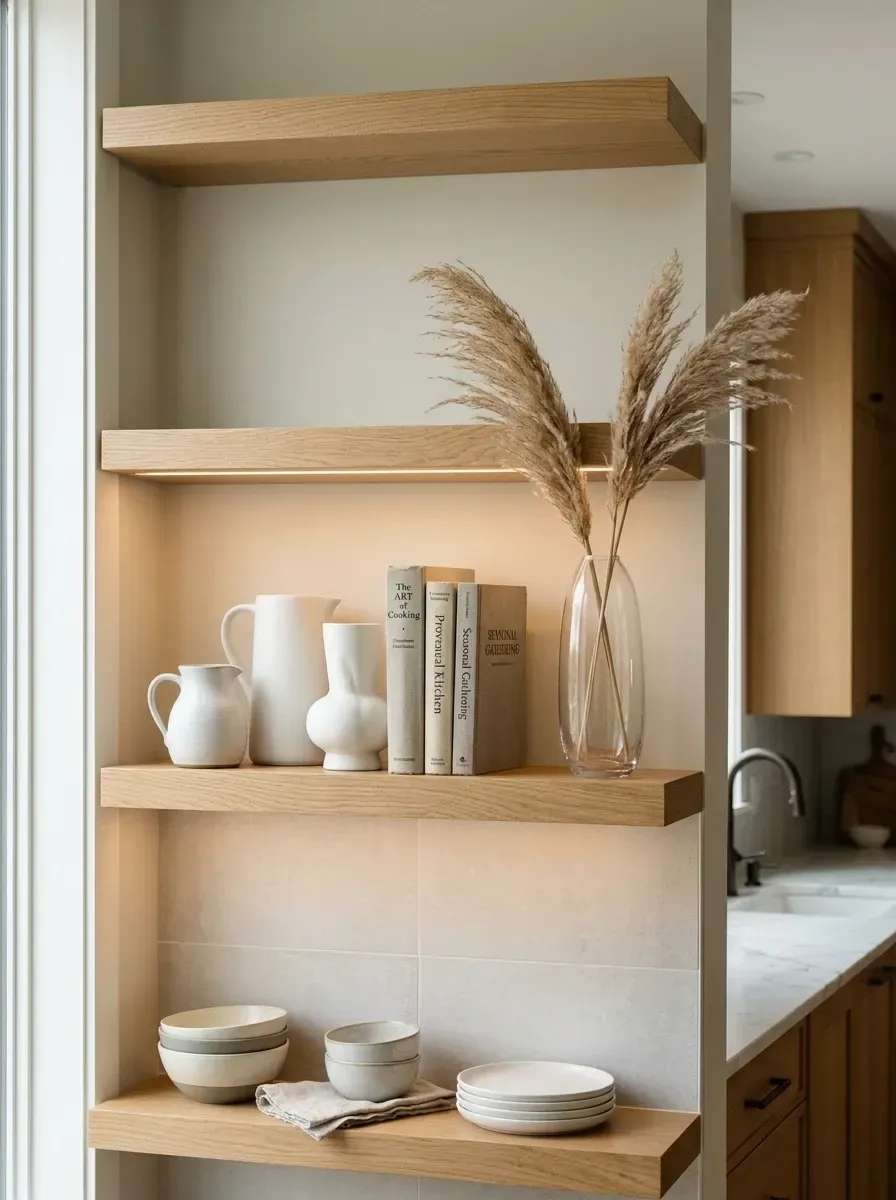
The move that makes this vignette work is the restraint. Open shelving reads as a design statement only when the objects on it are chosen with discipline — three or four artisanal ceramics, a stack of two cookbooks, a wooden bread board, negative space between groupings. Anything more and it reads cluttered within a week. The floating shelves themselves are two-inch-thick rift-sawn white oak bolted into blocking behind the drywall (never into plain studs — a loaded 48-inch shelf pulls roughly 70–100 pounds at the wall). The integrated LED strip routed into a channel along the underside is what turns shelves from functional into evening-ambient — spec a warm 2700K strip, not the cooler 3000K that still shows up in builder-grade kits. For a Charleston client last spring, I specified Cedar & Moss ceramics and pottery from a Savannah studio on the shelves and told her to rotate them seasonally; she's been happy with the look for a full year because it has breathing room to change.
- Rift-sawn white oak floating shelves, 2-inch thick, 48 inches wide
- Warm 2700K LED strip routed into the underside channel (Diode LED Fluid View or similar)
- Curated ceramic collection, rotated seasonally to avoid staleness
- Handmade zellige or cement tile backsplash with visible texture
| Line Item | Price Range (Charleston 2026) |
|---|---|
| Custom rift-sawn white oak floating shelves (x3, 48") | $1,400 – $2,800 |
| In-wall blocking & installation labor | $400 – $800 |
| LED strip with dimmer, 2700K (Diode LED / WAC Lighting) | $220 – $450 |
| Artisanal ceramic vases & vessels (4–6 pieces) | $280 – $750 |
| Zellige or cement tile backsplash, installed (30 sq ft) | $1,050 – $2,400 |
| Total estimated cost | $3,350 – $7,200 |
Color Palette
& Tiles Warm Off-White
#F2F0EB
Benjamin Moore White Dove OC-17 or Farrow & Ball Pointing No. 2003 — both read warm without pink undertones.
Light Oak
#D4C4A8
Rubio Monocoat Natural 5% or Bona NaturalSeal — both finish close to raw without yellowing over time.
#E8E4D9
Tonal variation within the same family prevents the shelves from reading like a gift shop.
#C8B79B
Soft linen and dried stems carry the palette without introducing a new tonal family.
Styling Notes for This Look
Route the LED strip into a channel rather than surface-mounting — the diffuser makes the difference between a high-end built-in read and a DIY adhesive-tape look. Style objects in odd-numbered groupings and leave at least 30% of each shelf empty. Mix matte ceramic, smooth glass, and a single woven or dried element for textural depth. Resist the urge to fill the shelves — restraint is the whole point of the look.
2. Statement Marble Island as a Focal Point
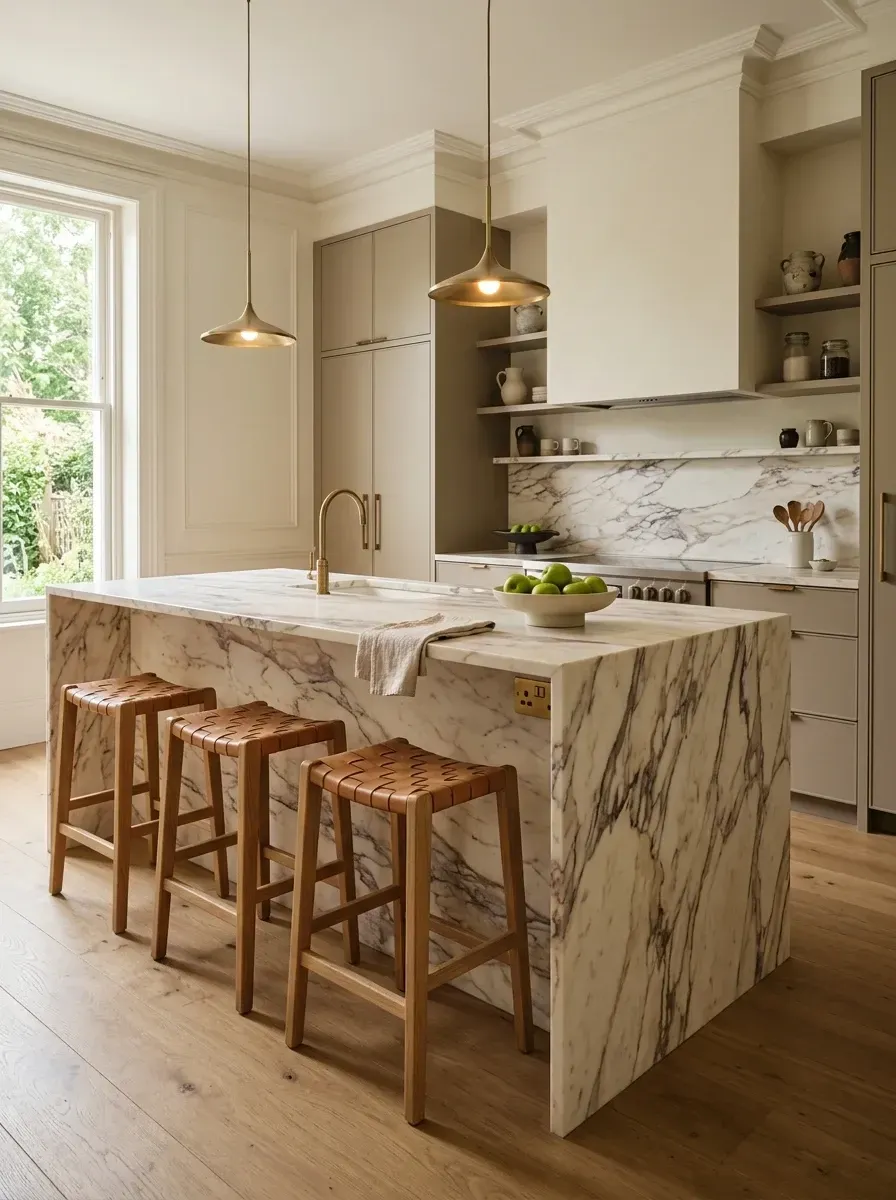
A waterfall marble island is the single biggest budget decision most clients make, and I spend serious time making sure they understand what they're signing up for. Calacatta Gold (with bold grey and warm gold veining) and Statuario (whiter field, sharper grey veining) both read luxury at resale, but both are calcium carbonate and will etch within weeks if you put lemon juice, tomato sauce, or a red-wine glass directly on them. That's not a defect — that's what marble does. I walk every client through this before they sign, and about half switch to a quartzite alternative (Taj Mahal, Mont Blanc, or Macaubas Gold) which gives the marble aesthetic with dramatically better daily durability. If the client still wants real marble, we seal with Miracle Sealant 511 Impregnator on install day and again every 12 months, and I explain that the patina is part of the material's honesty. The rest of this scene — woven leather stools (I specify Soho Home or Serena & Lily for durability), aged brass pendants (Allied Maker or Schoolhouse), taupe cabinet color — all exist to let the stone speak without competing.
- Waterfall marble or quartzite island, 3-cm slab, mitered-edge waterfall ends
- Professional sealing (Miracle 511) at install and annually — or quartzite alternative
- Woven leather bar stools with open-back profile to minimize visual weight
- Aged or unlacquered brass pendants for living-finish patina over time
- Taupe cabinetry (Farrow & Ball Drop Cloth or BM Revere Pewter) to let the stone lead
| Line Item | Price Range (Charleston 2026) |
|---|---|
| Calacatta or Statuario marble waterfall island (material + fabrication + install) | $9,500 – $24,000 |
| Quartzite alternative (Taj Mahal / Mont Blanc) — durability upgrade | $7,500 – $18,000 |
| Woven leather bar stools (Soho Home / Serena & Lily) x3 | $1,350 – $3,300 |
| Aged brass pendants (Allied Maker / Schoolhouse) x2 | $800 – $2,200 |
| Unlacquered brass gooseneck faucet (Waterstone Gantry / Rohl) | $650 – $1,600 |
| Professional sealing at install (511 Impregnator) | $180 – $320 |
| Total estimated cost | $12,480 – $31,420 |
Color Palette
& Splash Calacatta Marble
#EAE7E0
Bold grey and warm gold veining; specify a slab from the top of the block for the strongest pattern.
#AFA79C
Farrow & Ball Drop Cloth 283 or Benjamin Moore Revere Pewter HC-172.
& Stools Medium Oak
#B89B7B
Warm wood balances the cool stone — specify rift-and-quartered for dimensional stability in Charleston humidity.
Aged Brass
#C5A66F
Unlacquered brass patinas over 12–18 months into a darker, richer tone — lacquered brass stays uniform.
Styling Notes for This Look
If the marble is the star, everything else has to step back. Keep cabinets a single color, avoid hardware that competes (simple brass knobs, not jewelry), and limit accessories on the island to a single cutting board and a bowl of fruit. For mixed-metal work, let the faucet and hardware share a family (both unlacquered brass) and use stainless on appliances only — three metal families on one island reads busy, not collected.
3. Muted Color and Artisanal Details
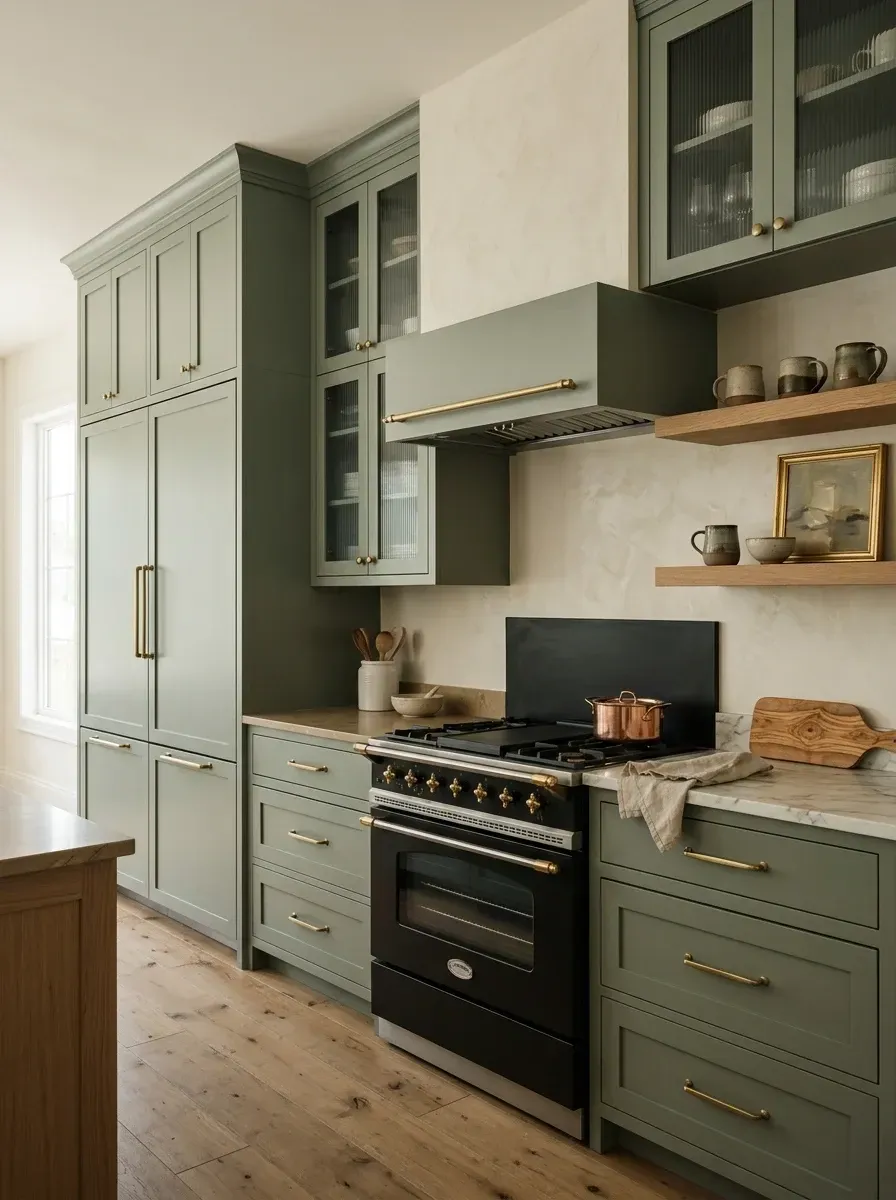
Sage green has been the dominant kitchen cabinet color among my clients for three years running, and there's a reason — the right green reads organic and calming rather than trend-loud, and it photographs as well as it lives. The exact color matters enormously. Farrow & Ball Card Room Green No. 79 and Benjamin Moore Saybrook Sage HC-114 are my two defaults; Sherwin-Williams Evergreen Fog SW 9130 is a third option that reads more blue-grey in southern light. The plaster hood is the detail that separates this look from a standard shaker kitchen — a real lime or Roman clay application (Portola Paints Roman Clay or American Clay) costs $14–$22 per square foot installed and has a hand-troweled depth that painted drywall cannot fake. The range is where I tell clients to spend: a 36-inch dual-fuel Ilve Majestic II or Hallman 48-inch in matte black with brass knobs delivers the focal point that anchors the whole scene. Brass hardware on the cabinets should match the range knobs — I specify Rejuvenation's Peyton pull in unlacquered brass for most installs.
- Sage green shaker cabinets (F&B Card Room Green / BM Saybrook Sage / SW Evergreen Fog)
- Real lime or Roman clay plaster range hood (Portola or American Clay)
- Premium 36"+ dual-fuel range (Ilve, Hallman, BlueStar) in matte black with brass trim
- Glass-front upper cabinets with leaded or reeded glass for display storage
- Unlacquered brass cabinet hardware (Rejuvenation, Rocky Mountain, Armac Martin)
| Line Item | Price Range (Charleston 2026) |
|---|---|
| Semi-custom sage green cabinetry, 15 linear ft (Plain English spec-level) | $9,200 – $21,500 |
| Custom Roman clay / lime plaster range hood, installed | $2,400 – $5,500 |
| Premium range (Ilve Majestic II 36" or Hallman 48") | $4,200 – $8,800 |
| Unlacquered brass cabinet hardware (20 pulls + knobs, Rejuvenation/Armac) | $480 – $1,350 |
| Leaded or reeded glass cabinet inserts | $620 – $1,800 |
| Total estimated cost | $16,900 – $38,950 |
Color Palette
Muted Sage Green
#8F9E8B
F&B Card Room Green No. 79 or BM Saybrook Sage HC-114 — pull two large drawdowns before committing.
#E3DED1
Portola Roman Clay or American Clay — real lime plaster, not painted drywall imitation.
#2B2B2B
Matte black range finish weathers splatter and fingerprints better than gloss.
Unlacquered Brass
#D4B675
A living finish that develops patina — if a client wants the shine preserved, specify lacquered brass instead.
Styling Notes for This Look
Plaster hoods cure for 10–14 days after application — plan your finish trades accordingly so the plaster installer isn't working around painters. Match the metal accents on your range (brass knobs, brass bezel trim) to your cabinet hardware exactly. Use glass-front cabinets only for dishware you actually want to display — if you have mismatched takeout containers and cereal boxes behind glass, the entire look falls apart.
4. Tactile Materials and Mixed Metals in the Wet Zone
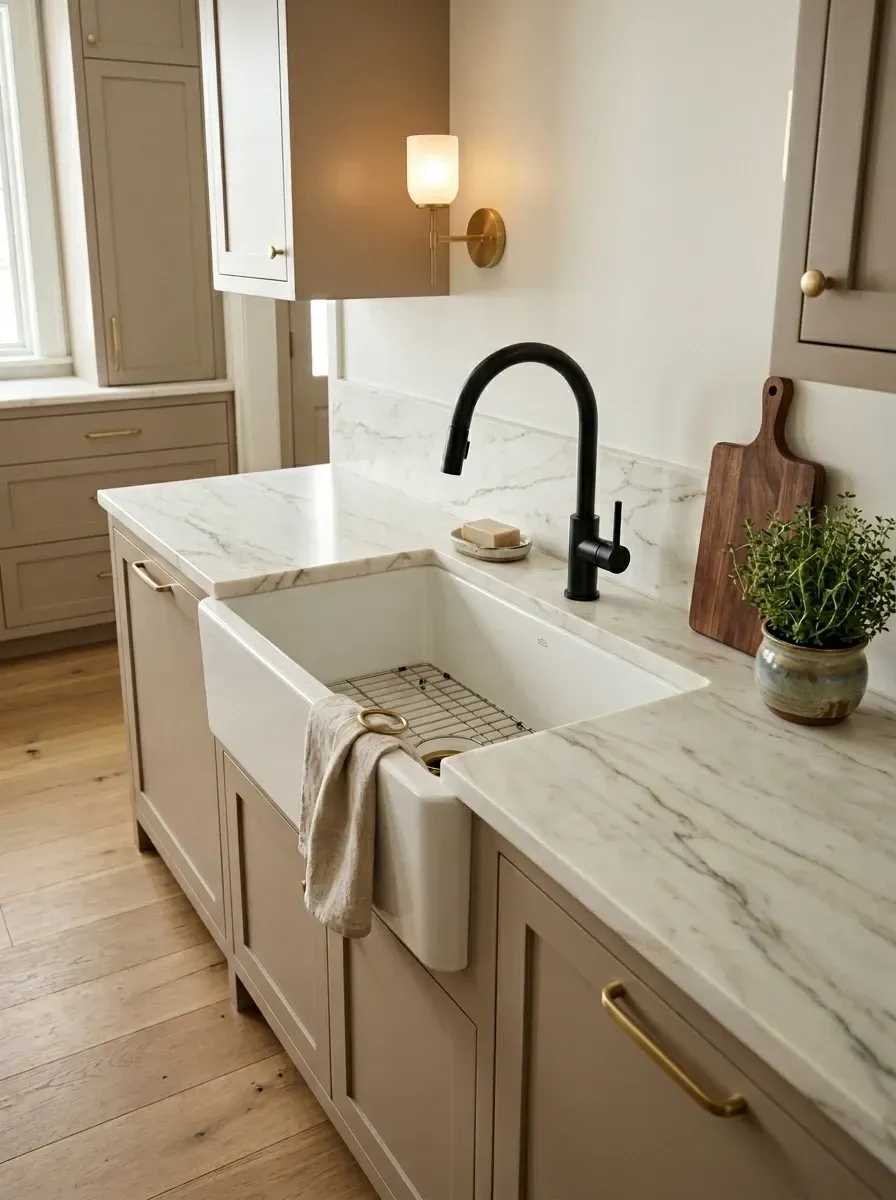
The sink zone is where a kitchen either feels considered or cheap, and it's also where most clients underspend relative to how much daily use the area gets. A proper fireclay apron-front sink (Shaws of Darwen if the budget exists, Kohler Whitehaven as the realistic alternative) is a 20–30 year install — it will outlast three faucets and two remodels. The integrated stone backsplash — where the countertop material runs up the wall 16–20 inches rather than stopping at the deck — is one of the highest-impact moves in a quiet-luxury kitchen. It removes the grout line transition that makes most sink zones read dated after five years, and it's roughly $800–$1,800 more than a tile backsplash for the area shown. For mixed metals, the rule I give every client: one dominant finish, one accent. Here the dominant read is unlacquered brass (the sconce, the cabinet pulls), and the matte black faucet is the deliberate accent. Three metal families in a wet zone reads busy; two reads tailored.
- Fireclay farmhouse sink with apron front (Shaws of Darwen / Kohler Whitehaven)
- Matte black gooseneck faucet (Kohler Purist, Waterstone Gantry in matte black)
- Integrated stone backsplash — countertop material runs 16–20 inches up the wall
- Unlacquered brass wall sconce (Cedar & Moss, Allied Maker)
- One dominant metal finish plus one deliberate accent, never three families
| Line Item | Price Range (Charleston 2026) |
|---|---|
| Fireclay farmhouse sink (Shaws / Kohler Whitehaven) | $750 – $2,400 |
| Matte black gooseneck faucet with pull-down sprayer | $420 – $950 |
| Unlacquered brass wall sconce, hardwired | $220 – $550 |
| Integrated marble or quartzite backsplash (10 sq ft) | $950 – $2,400 |
| Brass cabinet pulls (x2) for sink-base cabinet | $50 – $140 |
| Plumbing rough-in modifications (if relocating sink) | $650 – $1,800 |
| Total estimated cost | $3,040 – $8,240 |
Color Palette
Zone Cabinets Mushroom Taupe
#B5AFAA
Farrow & Ball Elephant's Breath 229 or BM Bleeker Beige HC-80 — warm neutrals that work with both cool and warm tones.
& Splash Honed Marble
#F0EBE5
Honed finish hides etching better than polished — the real-world choice for a working kitchen.
Matte Black
#1A1A1A
Specify a brand with PVD coating rather than paint — paint chips within 18 months of use.
& Pulls Satin Brass
#C9A96E
Satin brass (lacquered) holds a uniform finish; unlacquered brass patinas. Pick one and stick with it throughout the kitchen.
Styling Notes for This Look
Integrated stone backsplashes require a bookmatched or continuous pattern specification at the slab yard — go select your slab in person rather than trusting a sample. Add a sconce above the sink on a dedicated dimmer switch; the difference between overhead-only lighting and a sconce on a dimmer in a wet zone is the difference between utilitarian and inviting. Seal the backsplash with 511 Impregnator on install day — the wall sees constant water splatter and will etch faster than the counter itself.
5. A Cozy, Texture-Rich Breakfast Nook
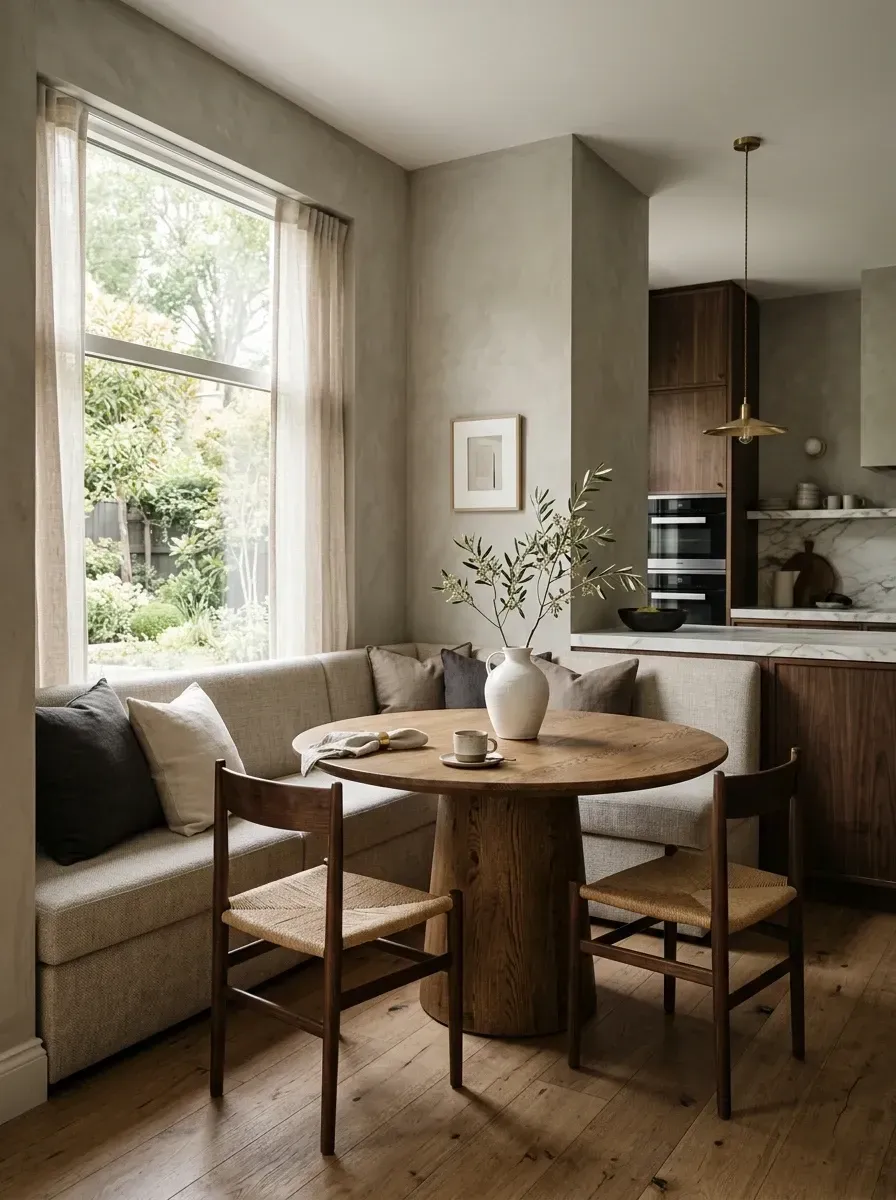
Breakfast nooks live or die on three specifications: seat height, fabric choice, and table geometry. The magic banquette seat height is 18 to 19 inches (not 17, not 20) — anything taller pushes you into lounge proportions and makes the table read too low; anything shorter feels like a child's seat. I build every banquette with a 3-inch medium-firm foam base plus a 1-inch Dacron wrap, which gives the seat resistance without feeling boardy. Performance fabric is non-negotiable in an eating area — Crypton Home, Sunbrella Renaissance, or Kravet Anywhere will survive coffee spills, toddler pasta, and a decade of daily use; decorator-grade linen will not. The round pedestal table (solid white oak, 48-inch diameter for a four-top, 54-inch for a six-top) has no legs to bang shins on and allows flexible seating. Woven rush or cane chairs on the open side introduce the textural counterpoint that keeps the nook from reading uniform. Lime wash on the walls (Portola Lime Wash or BM Century Natura) is what pushes the whole thing from "built-in bench" to "retreat."
- Custom upholstered banquette, 18–19 inch seat height, performance fabric
- 3-inch medium-firm foam base + 1-inch Dacron wrap for resilient sit
- Solid white oak round pedestal table (48" diameter for four seats, 54" for six)
- Rush-seat or cane side chairs for textural counterpoint
- Lime wash or Roman clay wall treatment (Portola / American Clay / BM Century Natura)
- Under-bench hidden storage for table linens, cookbooks, kids' items
| Line Item | Price Range (Charleston 2026) |
|---|---|
| Custom banquette, Crypton/Sunbrella upholstery, hidden storage | $3,200 – $6,800 |
| Solid white oak round pedestal table, 48–54" | $1,200 – $3,400 |
| Rush-seat or cane side chairs (x2) | $680 – $1,800 |
| Linear or plaster pendant on dimmer | $340 – $850 |
| Lime wash wall finish (120 sq ft, installed) | $620 – $1,650 |
| Linen Roman shade or panel curtain | $280 – $720 |
| Total estimated cost | $6,320 – $15,220 |
Color Palette
& Walls Warm Greige
#BDBAAE
SW Accessible Beige SW 7036 or BM Edgecomb Gray HC-173 — unifying neutral that cocoons rather than brightens.
Aged Oak
#9C7E60
A mid-tone oak reads substantial without going too dark for the space.
Textiles Charcoal & Natural Linen
#4A4A4A
Two contrasting pillow fabrics add depth without breaking the neutral palette.
Aged Brass
#B3945F
A single warm metal note completes the palette without demanding attention.
Styling Notes for This Look
Banquette storage is a quiet-luxury move that matters more than it looks — design the under-bench space with flip-up lids or deep drawers on full-extension slides, not just fixed cushion lifts. Specify the table lighting on a dimmer; mealtimes and workspace-hours need different light levels. Layer pillows at 20-inch scale for a cushioned back feel without turning the nook into a pillow parade.
6. The Hidden Luxury of a Butler's Pantry
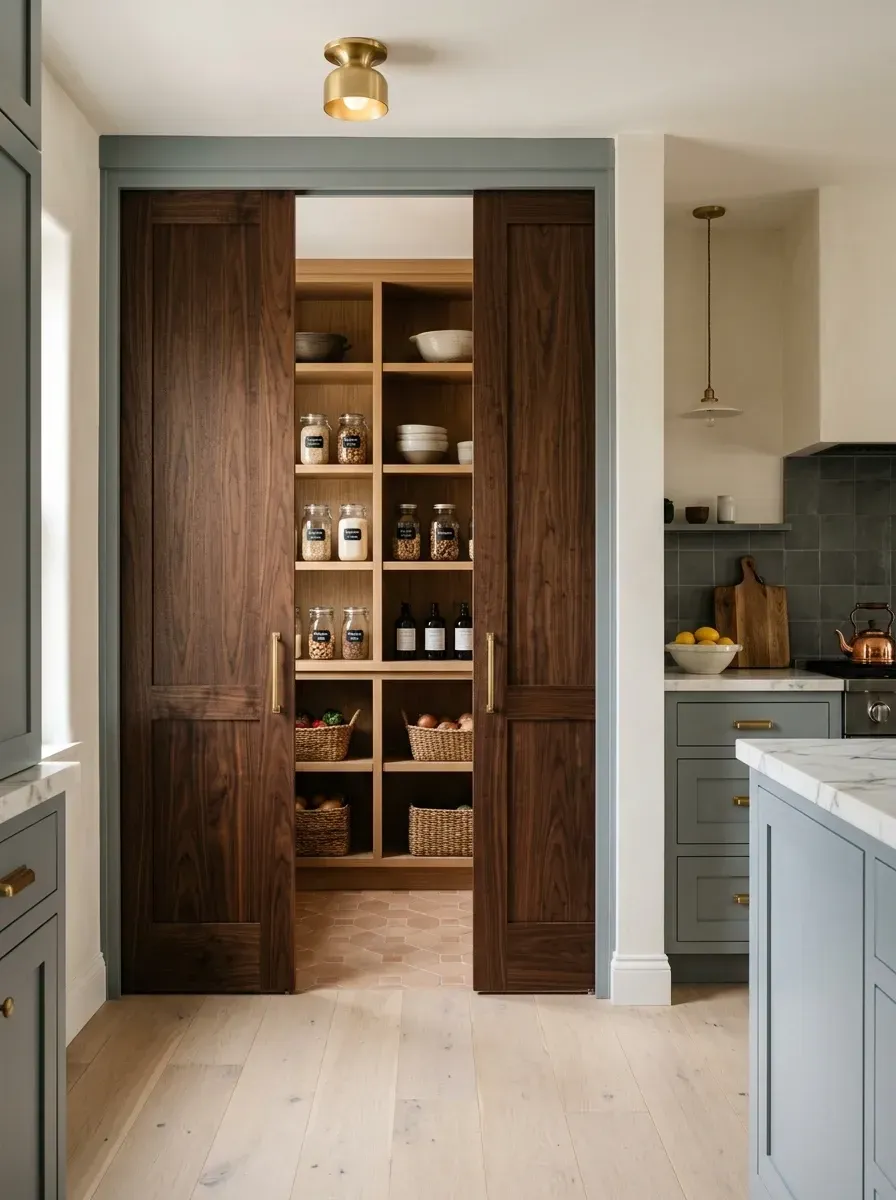
A true walk-in butler's pantry is one of the single highest-ROI luxury moves in a Charleston-area remodel — and also one of the most under-budgeted by homeowners who assume it's "just a closet." It is not. A properly built 35–55 square-foot walk-in pantry with walnut pocket doors, custom shelving, dedicated lighting, a counter work surface, and terracotta or tile flooring runs $18,000–$45,000 installed in the 2026 Charleston market. The pocket doors alone, in solid walnut with soft-close hardware and concealed track (look at Cavity Sliders or Johnson Hardware 2000 series), are $4,500–$9,500 the pair. For a Mount Pleasant client last fall I specified a 42-square-foot pantry with Shaws of Darwen terracotta tile, Plain English-inspired walnut shelving, a soapstone counter for small-appliance use, and a flush-mount brass ceiling light; her invoice landed at $32,400. She reports it's the room she's gotten the most compliments on, which tracks with what I've seen across four other pantry builds.
- Solid walnut pocket doors with concealed soft-close hardware (Cavity Sliders / Johnson 2000)
- Custom walnut or white oak built-in shelving, adjustable pin system
- Terracotta or hand-glazed Shaws tile flooring (not porcelain printed to look terracotta)
- Soapstone or butcher-block counter surface for small appliances
- Dedicated brass or bronze flush-mount ceiling light on its own switch
- Labeled glass jar storage (Weck, Le Parfait) + wicker baskets for less visual items
| Line Item | Price Range (Charleston 2026) |
|---|---|
| Solid walnut pocket doors (pair) with concealed soft-close track | $4,500 – $9,500 |
| Custom walnut built-in shelving, ~40 linear ft | $4,800 – $11,000 |
| Terracotta or Shaws tile flooring, installed (~30 sq ft) | $950 – $2,400 |
| Soapstone or maple butcher-block counter surface | $800 – $2,200 |
| Flush-mount brass ceiling light + dedicated circuit | $280 – $720 |
| Glass jar + basket storage collection (Weck / Le Parfait) | $420 – $1,100 |
| Electrical outlet + small-appliance wiring | $450 – $1,200 |
| Total estimated cost | $12,200 – $28,120 (budget tier) | $18,000 – $45,000 (premium tier installed) |
Color Palette
#5C4033
Solid black walnut, rift-and-quartered, finished with Osmo PolyX-Oil for a protective natural look.
Shelving Natural Oak
#C2A878
A lighter wood prevents the interior from going cave-like against the dark walnut doors.
Terracotta Tile
#BC7A5B
Handmade terracotta (Moroccan or Italian) with visible firing variation — not printed porcelain.
#708090
F&B Plummett 272 or BM Chelsea Gray HC-168 — the moody main-kitchen color that contrasts the pantry reveal.
Styling Notes for This Look
Pocket doors are the right hardware call because they don't swing into walkways — critical for a room that sees daily traffic. Decant dry goods into matching glass jars only for items you actually use weekly; decanting flour or sugar for display is a pretense that falls apart the first time you need to refill mid-recipe. Treat the pantry as a real room with proper lighting, flooring, and finishes — the moment someone opens those doors is a reveal moment that pays back for years.
7. A Dedicated, High-End Coffee Station
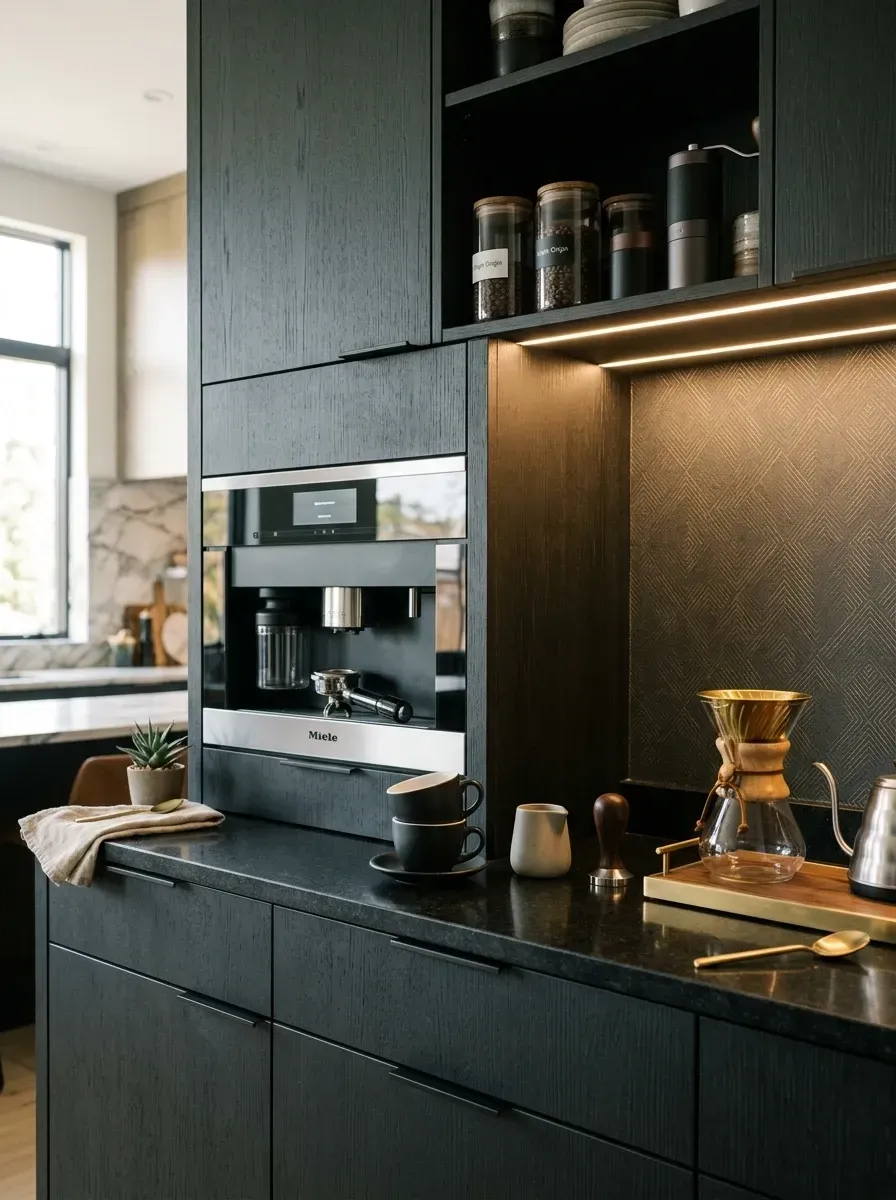
A dedicated coffee zone is the quiet-luxury move for clients who actually use it — if you drink two cups a day and care about the ritual, the station pays back in a way a second ice-maker never will. The hardware choice that matters most: a built-in plumbed Miele CVA 6805 or CVA 7845 unit ($3,800–$5,800) vs. a high-end countertop machine like the Breville Oracle Touch or Rocket Appartamento ($1,500–$3,200). Built-in is elegant and space-efficient but commits you to one brand for a decade; countertop is more flexible and lets you upgrade at the 5-year mark. Either way, the installation requirements are real: a dedicated 20-amp electrical circuit (NEC 2023 Article 210 for appliance branch circuits), a 1/4-inch water supply line plumbed to the location with shutoff valve, and ideally a drip tray drain. For the Charleston client I did this for two years ago, we ran the water line from the main sink through the lower cabinet chase and tapped into the existing supply; invoiced plumbing was $850. The dark cabinetry (F&B Railings No. 31 or BM Soot 2129-20) creates a "zone" inside the kitchen without walling it off — what makes the station feel like a room within a room.
- Built-in Miele CVA 6805/7845 plumbed unit OR premium countertop machine
- Dedicated 20-amp circuit (NEC 2023 Article 210 requirement)
- 1/4-inch water line with shutoff valve plumbed to station
- Dark cabinet zone (F&B Railings / BM Soot / SW Tricorn Black)
- Soapstone counter — forgiving of heat and espresso splatter
- Integrated 2700K under-cabinet LED for morning ambient light
| Line Item | Price Range (Charleston 2026) |
|---|---|
| Miele CVA 6805/7845 built-in plumbed espresso machine | $3,800 – $5,800 |
| Premium countertop alternative (Breville Oracle Touch / Rocket) | $1,500 – $3,200 |
| Custom dark-stained cabinet section, zone panel | $1,800 – $3,800 |
| Soapstone counter section | $480 – $1,100 |
| Under-cabinet LED 2700K, dimmable | $150 – $380 |
| Dedicated 20-amp circuit + water line rough-in | $620 – $1,450 |
| Coffee accessories (pour-over, kettle, Acaia scale, wood tamper) | $280 – $680 |
| Total estimated cost | $5,430 – $11,410 (built-in premium tier) |
Color Palette
& Counter Charcoal Black
#2C2C2C
F&B Railings No. 31 or BM Soot 2129-20 — rich black with blue undertone that reads confident rather than flat.
Patterned Dark Grey
#4A4A4A
Honed Pietra Cardosa or zellige in deep charcoal — tonal pattern within the dark palette.
#FDFBD3
2700K under-cabinet LED — 3000K or cooler reads clinical and kills the ritual atmosphere.
#A67B5B
A wood tamper, a brass scoop, a wooden spoon jar — small natural-material touches that warm the dark zone.
Styling Notes for This Look
If you're installing a built-in plumbed machine, rough in the water line during framing — retrofit plumbing through finished cabinetry is awkward and expensive. The dedicated 20-amp circuit is a code requirement, not a suggestion — a coffee machine sharing a circuit with the toaster will trip every morning. Use under-cabinet lighting at 2700K; cooler light makes the zone read like a convenience store instead of a morning retreat.
8. Seamless Indoor-Outdoor Dining
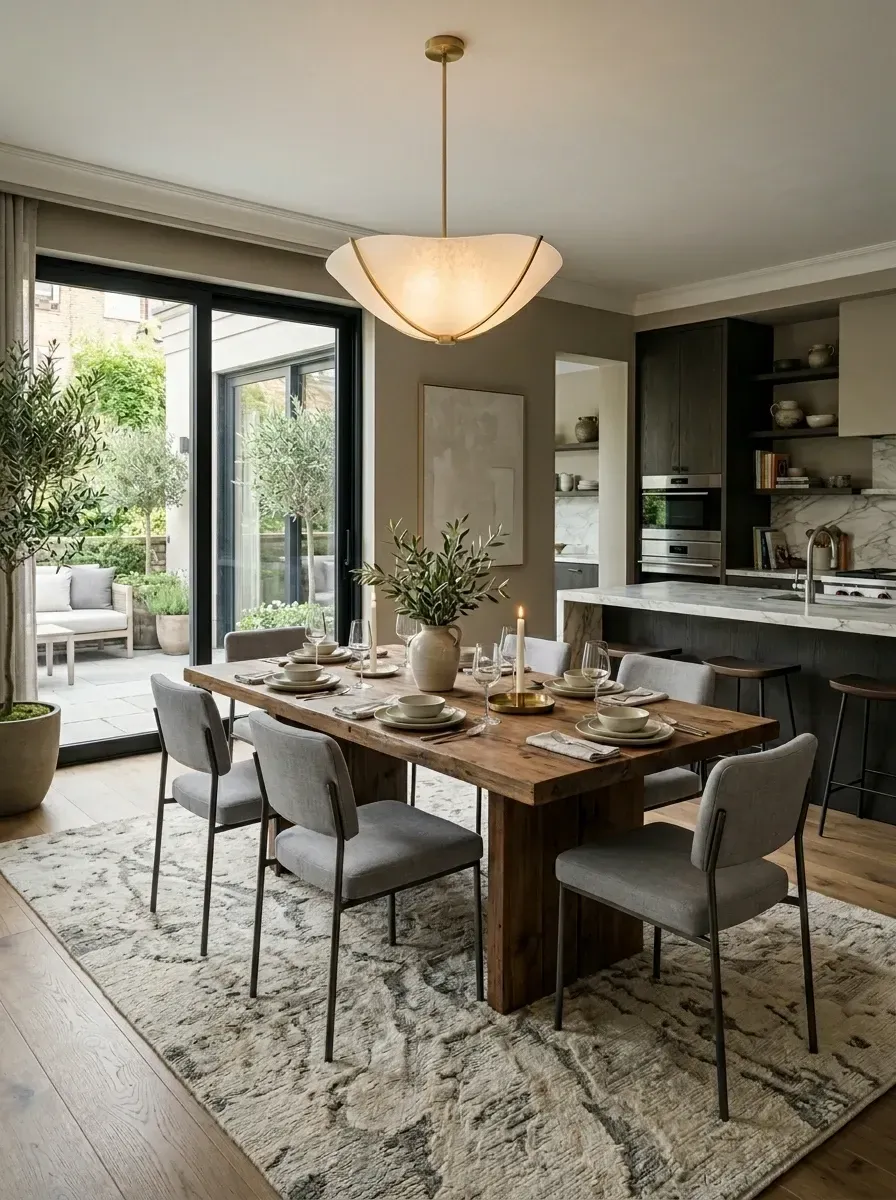
Indoor-outdoor dining is the specific Lowcountry luxury move — Charleston summers reward it, and the mild shoulder seasons run long enough that a well-designed sliding door system gets used eight or nine months of the year. The door package is the real spend: a 12-foot Andersen E-Series or Marvin Ultimate multi-slide in aluminum-clad wood runs $14,000–$28,000 installed for a proper hurricane-rated assembly (required in coastal Charleston County per IRC Section R301.2 and Charleston County wind zone). LaCantina and Western Window Systems are the other premium options; I specify LaCantina most often for the thinner sightlines. For the table, reclaimed wood reads authentic only if it actually is reclaimed — spec species-named pieces from Elmwood Reclaimed or Longleaf Lumber rather than generic "reclaimed wood" that often means new wood distressed in Vietnam. Olive trees (Olea europaea) do not overwinter reliably outside in Charleston's USDA zone 8b/9a — they handle the summer heat well but need to come inside below 20°F, so specify large fiberglass or terracotta planters with casters, not permanent ground plantings. A Pawleys Island client learned this the hard way her first winter; we replaced her frozen trees with 'Arbequina' olives in 24-inch rolling planters the following spring.
- Hurricane-rated multi-slide door system (Marvin Ultimate / LaCantina / Western Window Systems)
- Reclaimed solid wood dining table — specify species and source, not generic "reclaimed"
- Six upholstered dining chairs with performance fabric (Crypton / Sunbrella)
- Olive trees in 24-inch fiberglass rolling planters — mobile for winter protection
- Large patterned or textured rug (8x10 minimum for 72-inch table)
- Linen fabric pendant on dimmer (Cedar & Moss, The Urban Electric Co.)
| Line Item | Price Range (Charleston 2026) |
|---|---|
| Hurricane-rated 12-ft multi-slide glass door system, installed | $14,000 – $28,000 |
| Solid reclaimed wood dining table (Elmwood / Longleaf, 72–84") | $2,400 – $6,200 |
| Upholstered dining chairs, performance fabric (x6) | $2,100 – $4,800 |
| Large linen fabric pendant on dimmer | $620 – $1,400 |
| Performance-grade wool or poly-blend area rug (8x10) | $550 – $1,400 |
| Two olive trees + 24" fiberglass rolling planters | $540 – $1,200 |
| Total estimated cost | $20,210 – $43,000 (includes door system) | $6,210 – $15,000 (excludes doors) |
Color Palette
& Rug Soft Greige
#CFCBC2
BM Classic Gray OC-23 or SW Agreeable Gray SW 7029 — the most-requested in-between neutral of the last five years for good reason.
Reclaimed Pine / Oak
#A68A6D
Reclaimed heart pine (Longleaf Lumber) or white oak — species-named sourcing is the quiet-luxury signal.
Light Grey Upholstery
#B0B0B0
Performance linen-look in greige; specify Crypton Home or Sunbrella Renaissance for durability.
#556B2F
The only saturated note in the palette — it reads as intentional precisely because nothing else competes.
Styling Notes for This Look
Size the rug big enough that all chairs remain on it when pulled out — 8x10 minimum for a 72-inch table, 9x12 for 84 inches. Put the pendant on a dimmer, always — the same light level that works for breakfast feels wrong at dinner. Olive trees need a winter plan in Charleston and north; budget a mudroom or heated porch spot for the 8–10 coldest weeks of the year or plan to replace trees every 3 years.
Pro Tips I Give Every Client
- Spend on touch-points first. Cabinet hardware, faucet, and light switches are touched daily — this is where quality is felt. I'd rather see a $120 Rejuvenation pull on an IKEA box than a $12 Amazon pull on custom cabinets.
- Natural materials age into themselves. Real wood, real stone, unlacquered brass — these patina beautifully. Laminate, printed-porcelain stone, and lacquered metals degrade without grace. A quiet-luxury kitchen looks better at year 10 than year 1.
- Panel your appliances. Custom panels on the fridge and dishwasher cost $800–$2,400 more than stainless-steel fronts and transform a kitchen from "nice appliances" to "architectural furniture." Panel-ready Sub-Zero or Miele dishwashers are the standard spec.
- Specify the paint sheen. Cabinet sheen should be satin or low-sheen (Benjamin Moore Advance in Satin, or Farrow & Ball Estate Eggshell). Full gloss ages worse and shows every fingerprint.
- Honed over polished stone in a working kitchen. Honed marble and honed quartzite hide etching and fingerprints in a way that polished simply cannot — the working-kitchen choice, every time.
- Measure lighting in layers. Overhead + task + ambient is the minimum. Dimmers on every circuit. Warm 2700K across the whole kitchen — mixing color temperatures within a single room reads amateur immediately.
- Build in the sound dampening. A proper Bosch 800-series or Miele G7000 dishwasher runs at 38–42 dB. A builder-grade $600 dishwasher runs at 52 dB. In an open-plan kitchen, that's the difference between a background whisper and a conversation-killer.
Where to Cut Without the Kitchen Knowing
- IKEA Sektion + Semihandmade. IKEA cabinet boxes with Semihandmade or Reform doors deliver 80% of a Plain English look at roughly 35–45% of the cost. The boxes are structurally solid; the paint-grade MDF doors accept custom finishes beautifully.
- Splurge on one stone; stretch on the rest. A dramatic Calacatta island surrounded by honed soapstone perimeter counters costs half of all-Calacatta and reads more collected than uniform luxury.
- Pre-made floating shelves + custom brackets. A stock rift-sawn white oak shelf from House of Antique Hardware paired with heavy iron brackets hand-welded locally runs $180–$320 vs. $900+ for fully custom.
- Salvaged reclaimed wood. Architectural Salvage Warehouse in Charleston and a handful of Savannah yards sell true reclaimed heart pine at $8–$14/board foot — half the price of boutique reclaimed-wood brands.
- Unlacquered brass patina naturally. Let the brass patina rather than paying for pre-aged finishes. Rejuvenation and Rocky Mountain Hardware both sell true unlacquered brass; the weathered look is free, you just wait 12–18 months.
- Paint over wallpaper on the hood. A Roman clay plaster hood costs $2,400–$5,500. A well-executed limewash hood using BM Century Natura or Portola Roman Clay by a decorative painter runs $600–$1,400 and reads 85% the same.
Frequently Asked Questions
Is quiet luxury the same as minimalism?
No. Minimalism is about reduction — fewer things, fewer materials, cleaner lines. Quiet luxury is about considered abundance — real stone, real wood, a curated selection of good objects, layered textures. A minimalist kitchen might have a single concrete island and nothing on the counters; a quiet-luxury kitchen has a marble island, a bowl of lemons, an olive wood cutting board, and a stack of cookbooks. The visual densities are different, the spirit is different.
Can I do quiet luxury on a tight budget?
Partially. The painted-cabinet + honed quartzite + brass hardware + open shelving look can be achieved for $28,000–$45,000 with IKEA Sektion cabinet boxes, Semihandmade doors, a single quartzite slab, unlacquered brass hardware, and a limewash hood by a local decorative painter. What you cannot fake on a tight budget: real stone in large quantities, custom walnut millwork, or a plumbed built-in espresso machine. Pick two or three quiet-luxury moves and execute them well rather than spreading a budget across eight half-finished moves.
Will marble actually hold up in a working kitchen?
With honest expectations, yes. Honed Calacatta will etch from lemon juice, wine, and tomato — and the etching becomes part of the material's patina rather than a defect. Seal at install with Miracle 511 Impregnator and again annually. If you cannot live with etching, specify a quartzite alternative (Taj Mahal, Mont Blanc, Macaubas Gold) — same aesthetic, dramatically better daily durability.
How long does a full kitchen remodel take in the Charleston area?
Design + permitting + ordering: 10–16 weeks (cabinet lead times are the long pole at 8–12 weeks for semi-custom, longer for full custom). Demo + construction: 8–14 weeks once materials are on site. Plan for 6–9 months from signed contract to functional kitchen. Full-custom builds with imported stone and European appliances can push to 12 months — this is normal, not slow.
Panel-ready vs. stainless steel appliances — which is the quiet-luxury choice?
Panel-ready. A panel-ready Sub-Zero or Miele refrigerator with custom door fronts that match the cabinetry reads as architectural furniture rather than appliance. Costs about $800–$2,400 more than stainless equivalent. The exception: a premium range (Ilve, Hallman, La Cornue) is meant to be seen — panel that, and you've hidden the kitchen's visual focal point.
Will unlacquered brass tarnish unevenly?
Yes — that's the whole point. Unlacquered brass develops a non-uniform patina that reads as living and collected. Darker where hands touch it, lighter where they don't. Clients who want a uniform finish should specify satin or lacquered brass instead, which holds a single tone but reads flatter aesthetically.
How much should I budget for cabinet hardware?
For a 40-pull kitchen: $800–$2,800 for solid-brass pulls from Rejuvenation, Rocky Mountain, or Armac Martin. This is not a place to cut — hardware is touched thousands of times a year and is the most direct tactile experience of the kitchen. A $14 pull feels like a $14 pull every time you grip it.
Does a quiet-luxury kitchen add to resale value?
In markets like Mount Pleasant, Sullivan's Island, Kiawah, and Daniel Island, yes — substantially. Remodeling Magazine's 2024 Cost vs. Value Report shows upscale kitchen remodels recovering 48–56% of cost at resale nationally; in coastal Charleston submarkets with buyer demand for high-end finishes, I've seen recovery north of 65% on properly-specified remodels. In suburban submarkets where buyers default to builder-grade expectations, the premium is less reliable. Match your finish tier to your neighborhood.
Sources & References
- Remodeling Magazine, 2024 Cost vs. Value Report — South Atlantic regional data for major and upscale kitchen remodels.
- National Association of Home Builders (NAHB), 2024 Cost of Remodeling report — line-item cost benchmarks by region.
- Marble Institute of America (Natural Stone Institute), Dimension Stone Design Manual — sealing and maintenance standards for calcium-carbonate and siliceous stones.
- Miele Professional Installation Specification: CVA 6805 / CVA 7845 Built-in Coffee Machine — plumbing and electrical requirements.
- International Residential Code (IRC) 2021 — M1503 Range Hood Exhaust Ventilation; R301.2 wind-zone glazing requirements for coastal Charleston County.
- National Electrical Code (NEC) 2023 — Article 210 Branch Circuits (dedicated 20-amp requirement for built-in appliances).
- ASTM C1526 — Standard Specification for Serpentine Dimension Stone (soapstone).
- Portola Paints & Glazes, Roman Clay Application Guide — surface prep, cure time, and drywall compatibility specs.
- Crypton Home Fabric, Performance Testing Data — abrasion, stain release, and UV stability for upholstered banquette use.
- Bosch & Miele product specification sheets — dishwasher dB ratings (Bosch 800 Series, Miele G7000 series).
- Marvin Windows & Doors, Ultimate Multi-Slide Door Performance Data — hurricane-rated installation requirements for IRC Section R301.2 coastal wind zones.
- Author's own 2024–2026 Charleston-area consulting notes and invoiced line items from Mount Pleasant, Summerville, Daniel Island, Kiawah, and Pawleys Island kitchen projects.
Final Thoughts
Quiet luxury in a kitchen is a specification discipline more than a stylistic one. The clients who land the look cleanly are the ones who make a dozen small right choices — 2700K lighting across the board, unlacquered brass throughout, honed stone, solid wood shelves, panel-ready appliances, performance fabric on the banquette, a single metal family with one deliberate accent — rather than chasing a single dramatic moment. The clients who don't land it are the ones who pick the marble island but surround it with builder-grade everything else; the kitchen ends up reading aspirational rather than achieved.
My Mount Pleasant client from last fall — the retired oncologist who'd lived in Paris — said it best when I showed her the finished pantry reveal: "I wanted a kitchen that would be boring to explain and wonderful to stand in." That's the working definition I've used for quiet luxury ever since. If the kitchen reads obvious in photographs, it's probably trying too hard. If it reads calm in person, you've built the thing.
For readers thinking about a full-home design approach, my related pieces on living room transformations into calm retreats, Scandi-sanctuary interiors, bathroom quiet-luxury makeovers, and spare-room sanctuary transformations cover the adjacent spaces where the same material discipline pays the same returns.
— Johan Martez, Charleston, SC

Rowan Whitaker
Styling & Living Editor · Charleston, South CarolinaRoom-by-room decor cost guides, outdoor and garden styling, celebrations, design solutions and the Home Files essays. Rowan writes the pages where the house gets lived in — with paint lines, fabric sources and paid-invoice figures for every room.
More from Rowan →
Reader notes