


Front porch ideas are easiest to judge when the house stays the same, so every direction below starts from one plain 1980s two-story colonial: beige vinyl siding, white louvered shutters, a shed-roof porch on four white posts, a bare concrete floor and two overgrown shrubs. Ten makeovers follow, from a Southern haint blue porch with a swing to a charcoal minimalist front and a fall harvest porch. None of them touches the structure. Each one is paint, a door, lights, furniture and planting (the kind of refresh that takes a weekend to a month), with the paint colors by name, practical notes on furniture and planting, and what it costs in 2026.
Table of Contents
- The 1980s Colonial Porch Before Any Changes
- Southern Haint Blue: A Porch Swing, Wicker and White Hydrangeas
- Classic Farmhouse White: Black Shutters, Rockers and a Honey Floor
- Charleston Classic: Butter Yellow, Charleston Green and Window Boxes
- Modern Farmhouse Black and White: Black Sashes and a White Oak Door
- Coastal Cottage: Navy Shutters, an Aqua Door and Blue Hydrangeas
- English Cottage Garden: Climbing Roses and a Sage Door
- Craftsman Earth Tones: Sage Siding, Brick-Red Shutters and Copper
- Moody Dark Green: Hunter Green Siding and Glowing Brass
- Modern Minimalist Charcoal: No Shutters, Olive Trees and Walnut
- Fall Harvest Porch: A Pumpkin Door, Mums and Plaid
- Pro Tips for Front Porch Ideas That Last
- Regional Fit Across the Southeast
- What Each Direction Actually Costs
- Frequently Asked Questions
- Sources and References
- What the Ten Porches Show
The 1980s Colonial Porch Before Any Changes
The house is one that sits on thousands of suburban lots across the country: a two-story center-hall colonial built in the 1980s, clad in beige vinyl lap siding under a brown asphalt-shingle roof, with a brick chimney on the right-hand end. Five double-hung windows line the upper floor and four line the ground floor, every one of them flanked by a pair of white louvered vinyl shutters. Across the middle of the ground floor runs a shallow covered porch with a low shed roof on four plain square white posts, a white vinyl railing between the posts, a bare grey concrete floor and two concrete steps down to a straight concrete walk.
In the before rendering it all reads as one flat, washed-out beige. A dark brown six-panel door hides behind an equally dark storm door, one small coach light hangs to its right, a faded mat is the only thing on the porch, and two overgrown foundation shrubs are swallowing the corners on both sides. Nothing is broken; the house was simply finished in builder neutrals forty years ago and never revisited.
Here is the rule that makes this study useful: in every one of the ten directions below, the house and the porch stay exactly as they are. Same roof, same chimney, same porch roof, same four posts in the same places, same steps, same door opening, same nine windows, same camera position. What changes is paint, shutters, the door, the lights, the furniture, the planters and the planting, and in a few of the renderings, whether the railing panels stay or come out. That makes these front porch ideas a refresh, not a remodel. There is no framing, no new roof and no permit-level carpentry in any of them, which is why each one can realistically be done in a long weekend to a month and on a budget most owners can plan for.
Quick answer: the front porch ideas that change a plain colonial the most are, in order, a new body color for the siding, a front door in a color that contrasts with it, a pair of proper lights either side of the door, and two or three pieces of furniture sized to the porch. Shutters, rugs, planters and planting finish it.
Southern Haint Blue: A Porch Swing, Wicker and White Hydrangeas
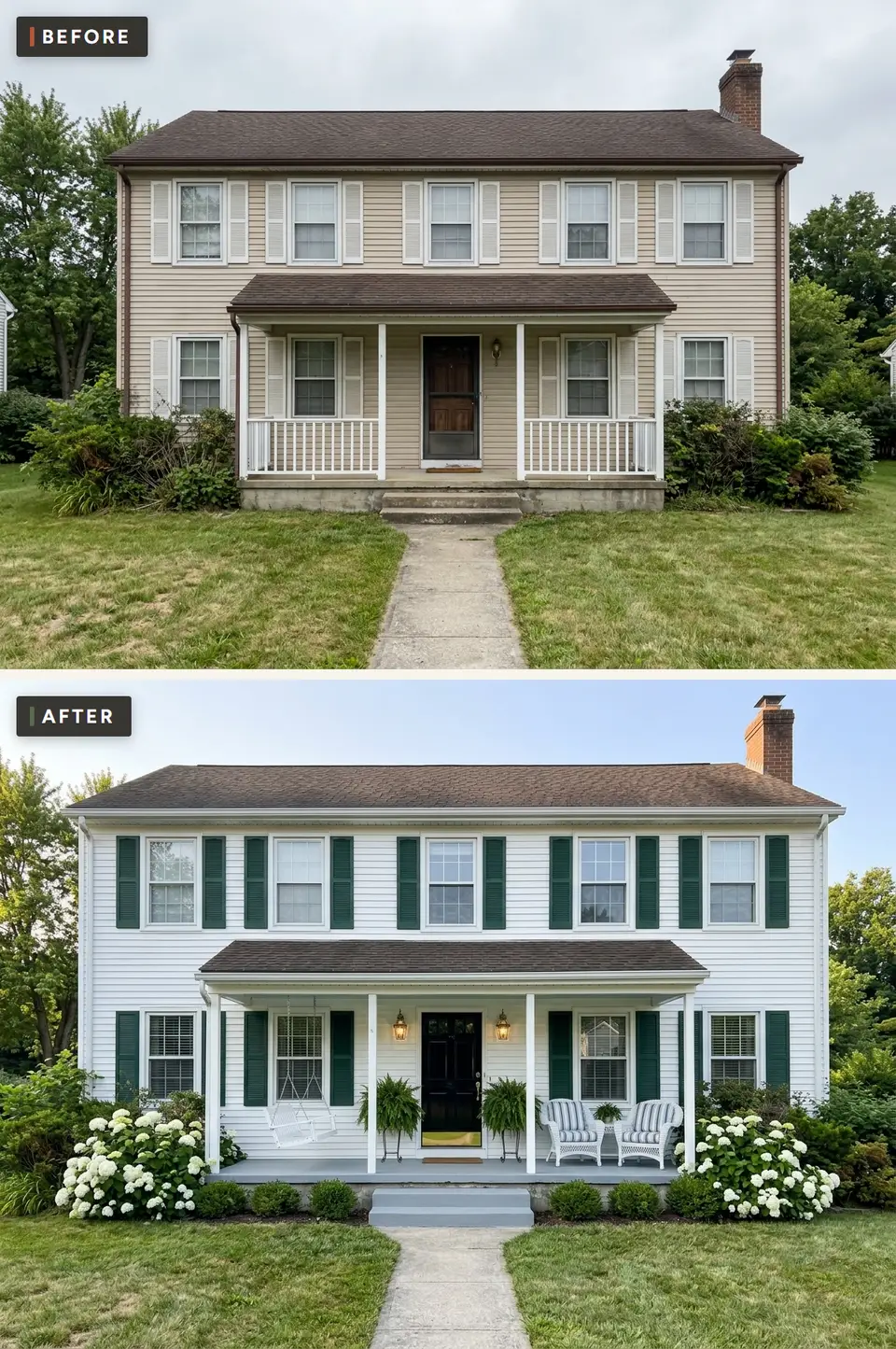
If we could choose only one of these front porch ideas for a colonial on a Southern street, it would be this one. The beige siding becomes a clean white, the white louvered shutters are painted a deep forest green, and the brown door becomes glossy black. Those three changes alone give it the look of an older street in Charleston or Savannah. The grey concrete porch floor and the two steps are painted a soft dove grey, so the floor reads as a finished surface rather than a slab.
The furniture is where the porch comes alive. A white porch swing hangs at the left end, a pair of white wicker armchairs with blue-and-white striped cushions sit at the right end, and two large Boston ferns on slim stands flank the door under a pair of brass lanterns. The railing panels are gone in this take, which opens the porch to the yard and lets the swing and chairs read from the street. Big white mophead hydrangeas fill the foundation beds at both corners, with low clipped shrubs along the front of the porch. The ceiling is the part named in the title: a pale haint blue, a color you notice less from the lawn than when you are sitting under it, which is exactly how it should behave.
For all the talk of haint blue, the palette here is mostly white and green. SW Pure White SW 7005 (#EDECE6) covers the siding and trim, and BM Essex Green 2140-10 (#2F3F35) goes on the shutters, a green that looks almost black at dusk but still shows its colour in full sun. SW Upward SW 6239 (#BFC9D0) is the porch ceiling shade, and its grey undertone keeps it from tipping into nursery blue. High-gloss SW Tricorn Black SW 6258 (#2F2F30) on the door gives the sharpest contrast on the elevation, with the brass lanterns and kick plate catching the light against it.
The swing is the measurement to settle before ordering anything: it needs roughly 3 feet of clear space in front and about 14 inches behind, with rated hardware fixed into a joist or header rather than the soffit board. The chairs should be all-weather resin wicker, not natural rattan, and the ferns work better raised on stands where their fronds stay out of the walking path. For the beds, white 'Annabelle' hydrangeas support the restrained palette and bloom on new wood, so a late-winter cutback does not sacrifice the next season.
Classic Farmhouse White: Black Shutters, Rockers and a Honey Floor
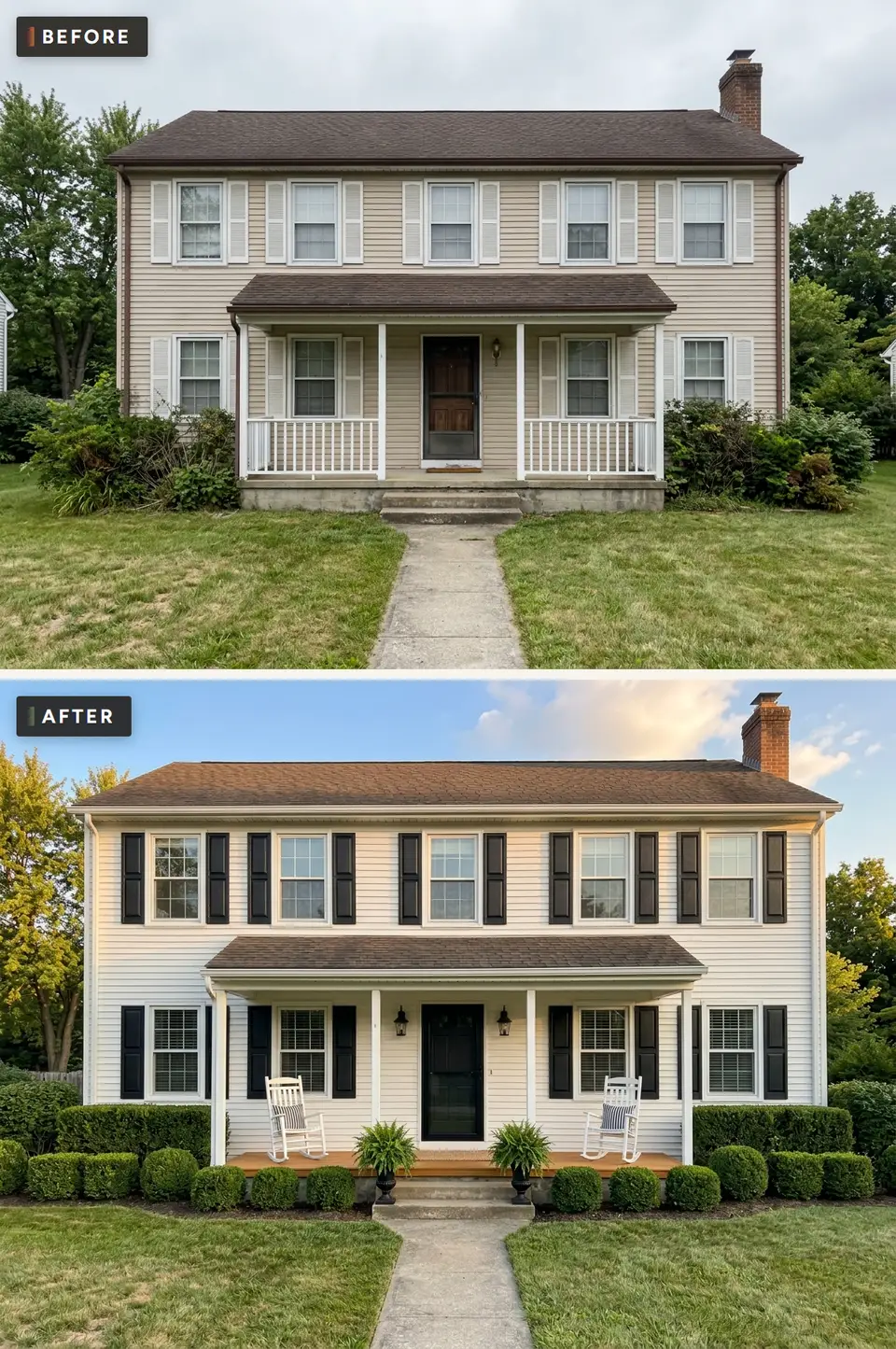
Of the ten, this is the look most buyers will recognise at once, and it is the one we would point an owner toward if a sale is a year or two away. The siding is painted a soft warm white, the shutters and the front door go black, and a black full-glass storm door takes the place of the old dark one. A pair of black lantern sconces now sits either side of the door instead of the single small coach light, which fixes the lopsided look of the original entry at almost no cost.
The porch floor is where this direction gets its warmth: the concrete is stained a honey brown, so the white rockers and white posts sit on something that looks like wood from the street. Two white rocking chairs with striped pillows sit at either end, a jute mat lies at the door, and two Boston ferns in black urns stand on the steps. The overgrown foundation shrubs are gone, replaced by a continuous run of clipped boxwood that frames the porch and steps along both sides. As in the haint blue version, the railing panels have been taken out in this take, which makes the rockers read as part of the front of the house.
This version gets its warmth from the floor rather than from extra decoration. SW Alabaster SW 7008 (#EDEAE0) gives the siding a soft white that does not turn icy beside the black, while SW Tricorn Black SW 6258 (#2F2F30) can be satin on the shutters and high-gloss on the door. Underfoot, a honey-toned concrete stain around #B5763D makes the slab read like aged timber from the street. The clipped boxwood green (#3F5A33), black urns and fresh ferns then provide enough color without weakening the simple white-and-black structure.
Before committing to two rockers, mark their movement on the floor; each needs about 30 inches of usable depth to rock without striking the wall. The lanterns should be close to one-third of the door height so they do not look undersized, and the concrete has to be cleaned, etched and stripped of any old sealer before stain will take evenly. In areas where boxwood blight is established, dwarf yaupon holly gives a similarly clipped outline with fewer regional worries.
Charleston Classic: Butter Yellow, Charleston Green and Window Boxes
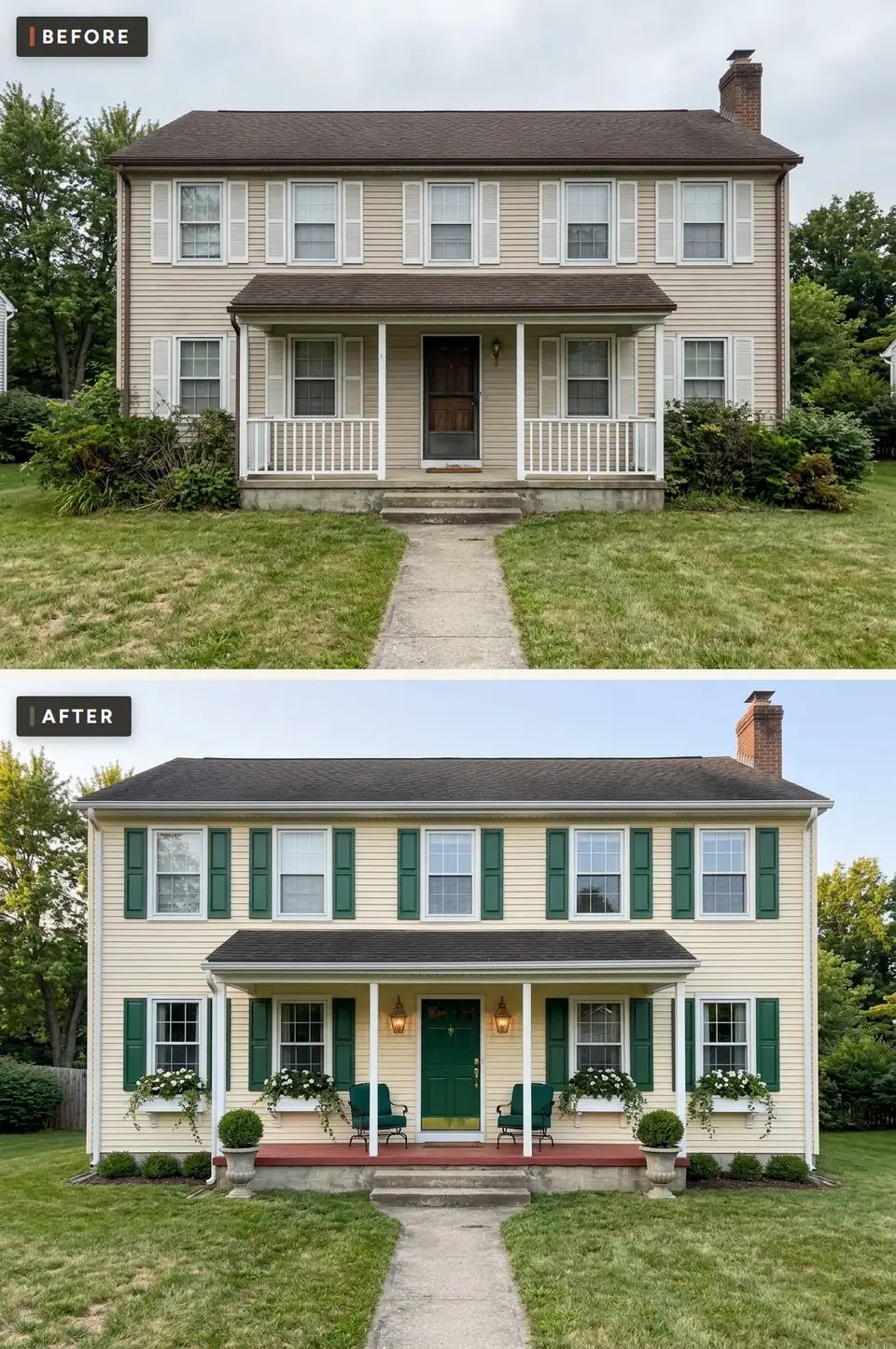
Charleston green is the near-black green that covers shutters and doors all over the historic peninsula, and paired with a soft butter yellow it gives this colonial more personality than any other direction in the study. The siding goes a pale, warm yellow, the trim and posts stay white, and every one of the eighteen shutters and the front door take the same deep green. The door gets polished brass hardware, and a pair of gas-style copper lanterns replace the single coach light.
The porch floor is painted a brick red, and two green iron chairs with matching cushions sit either side of the door. Window boxes under all four ground-floor windows, planted with white flowers and trailing ivy, carry the porch out across the full width of the house, and two round clipped boxwood topiaries in cast-stone urns flank the steps. The railing panels are absent in this take, so the chairs, urns and window boxes do all the framing. Low clipped shrubs replace the overgrown foundation planting on both sides.
The near-black green is what makes this read as Charleston rather than generic traditional. BM Hawthorne Yellow HC-4 (#F3DFA8) is sunny without becoming lemon-yellow, while SW Rookwood Shutter Green SW 2809 (#303B39) gives both shutters and door one continuous, historic-looking dark note. SW Fired Brick SW 6335 (#6A2E2A) belongs in porch-and-floor enamel below; it grounds the pale siding and is forgiving of red-clay dust. Natural copper (#B87333) on the lanterns starts bright, settles to brown and will eventually pick up a green patina that belongs with the shutters.
The window boxes need to be treated as architecture, not accessories: each should roughly match the full width of its window trim, measure at least 8 inches deep and sit on brackets that leave air behind the box so damp soil never rests against the siding. Electric gas-style lanterns give the right silhouette without the cost of running a gas line. A second green anywhere on the entry would be a mistake; one consistent green across shutters and door looks deliberate, while two close greens usually look like a paint-matching error.
Modern Farmhouse Black and White: Black Sashes and a White Oak Door
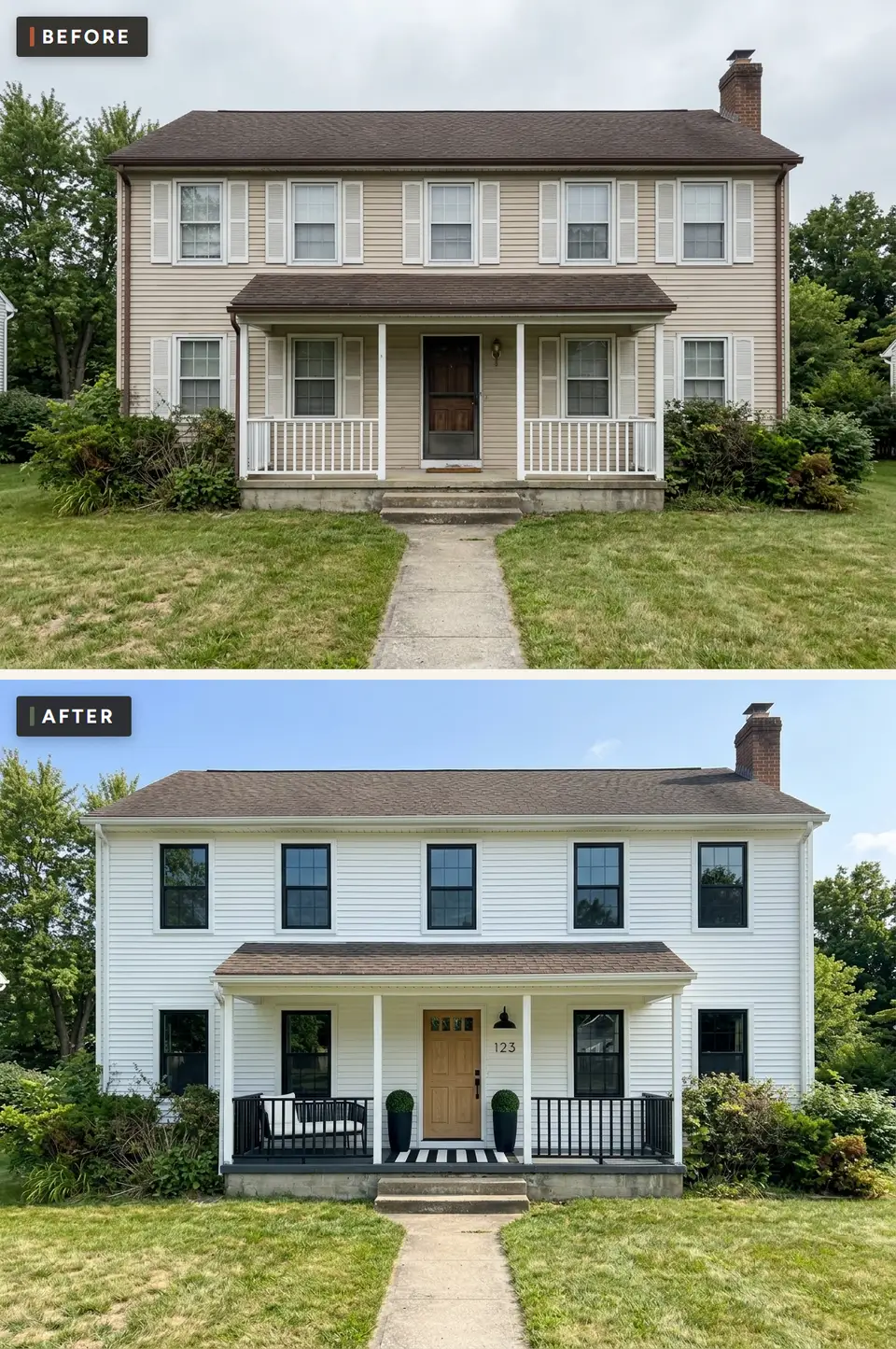
The modern farmhouse version takes the opposite route to the classic one: instead of adding dark shutters, it removes them altogether and paints the window sashes black instead. On a colonial with nine evenly spaced windows that changes the character of the house more than any color could. The siding is a bright white, the posts stay white, and the railing is painted matte black, so the porch reads as a crisp black-and-white frame around the door.
The front door becomes natural white oak with modern black hardware, a black gooseneck barn light hangs above it with black house numbers beside it, and a black-and-white striped outdoor rug runs in front of the door. Two tall black planters with clipped boxwood balls stand either side of the door, and a slatted black metal bench with a white cushion sits behind the left-hand railing. The foundation shrubs in this take are still the overgrown originals, which shows how much clipped planting adds in the other directions. Budget for it.
The discipline here is a four-material limit: bright white, black, natural wood and planting. SW Extra White SW 7006 (#EEEFEA) keeps the siding clean, SW Tricorn Black SW 6258 (#2F2F30) defines the sashes and railing, and the front door supplies warmth through natural white oak around #C8A97E. SW Iron Ore SW 7069 (#434341) on the porch floor is softer than true black, so it hides tracked-in dirt without turning the whole base into a hard stripe.
Black window sashes are the detail to price and test first. Vinyl frames need careful cleaning, scuffing and a bonding primer, and paint can affect the window warranty, so the manufacturer should approve the system in writing. Once the shutters come off, every fastener hole and old outline must be repaired before the siding is painted. The centered gooseneck light also needs about 12 inches of clear wall above the door trim. After those technical moves, restraint matters more than shopping: a colored cushion or extra patterned pot would interrupt the black-white-wood rhythm immediately.
Coastal Cottage: Navy Shutters, an Aqua Door and Blue Hydrangeas
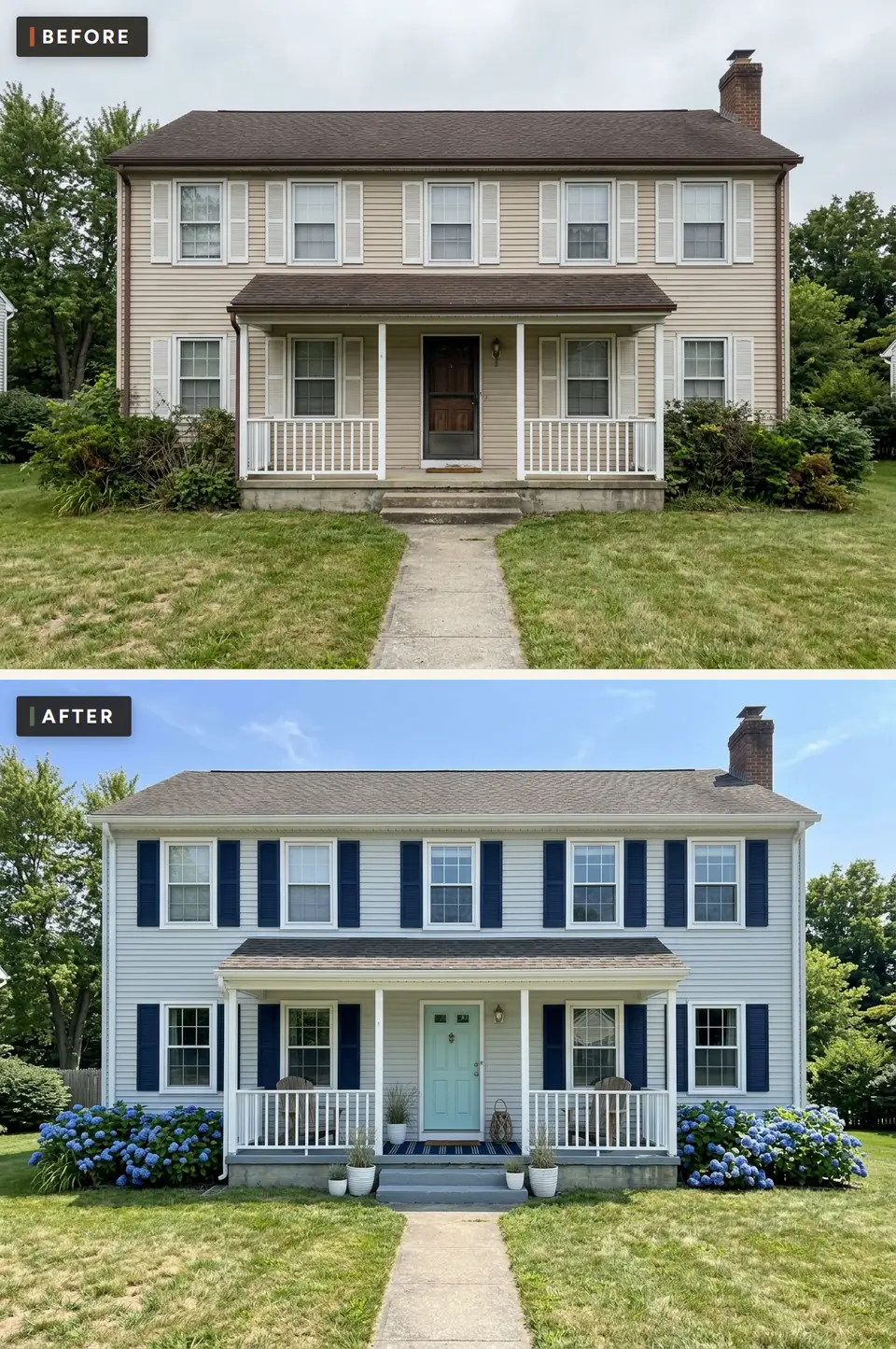
Of all ten, the coastal cottage version changes the least and still ranks among the most convincing. The siding goes a pale grey with a hint of blue, the trim, posts and railing stay white, and the shutters are painted a deep navy. Only the door carries real colour, a soft aqua that would look out of place against the old beige and sits naturally between grey and navy. The single coach light from the before image stays where it was.
On the porch, a pair of wooden Adirondack chairs sit behind the railing at either end, a navy striped rug runs in front of the door, and a rope-wrapped lantern stands beside it. White ceramic planters with ornamental grasses are grouped on the steps and on the porch, and the porch floor and steps are painted grey. The most striking change is the planting: big blue hydrangeas now fill both corners where the overgrown shrubs used to be, and they carry the navy and aqua right out to the lawn.
This palette works because the blue notes are separated by value. BM Stonington Gray HC-170 (#C5C9C8) gives the siding a pale, cool base; SW Naval SW 6244 (#2F3D4C) makes the shutters visibly navy rather than black; and SW Tame Teal SW 6757 (#8FC9B9) lets the door be the one brighter note. Blue hydrangeas around #5B7FD1 carry that color into the beds, although the actual bloom will follow the soil: acidic conditions tend toward blue, while alkaline soil pushes the same plant toward pink.
Sample the grey on a large board and check it at noon because a color this pale can look almost white on a sunny elevation. The Adirondack chairs are around 35 inches deep, so a pair at the porch ends is already the practical limit. In the planters, grasses should finish below roughly 3 feet so they do not block the view from the chairs. A soil test is more useful than buying a blue-flowering label blindly, and it tells you whether the hydrangea color shown here is realistic for the actual bed.
English Cottage Garden: Climbing Roses and a Sage Door
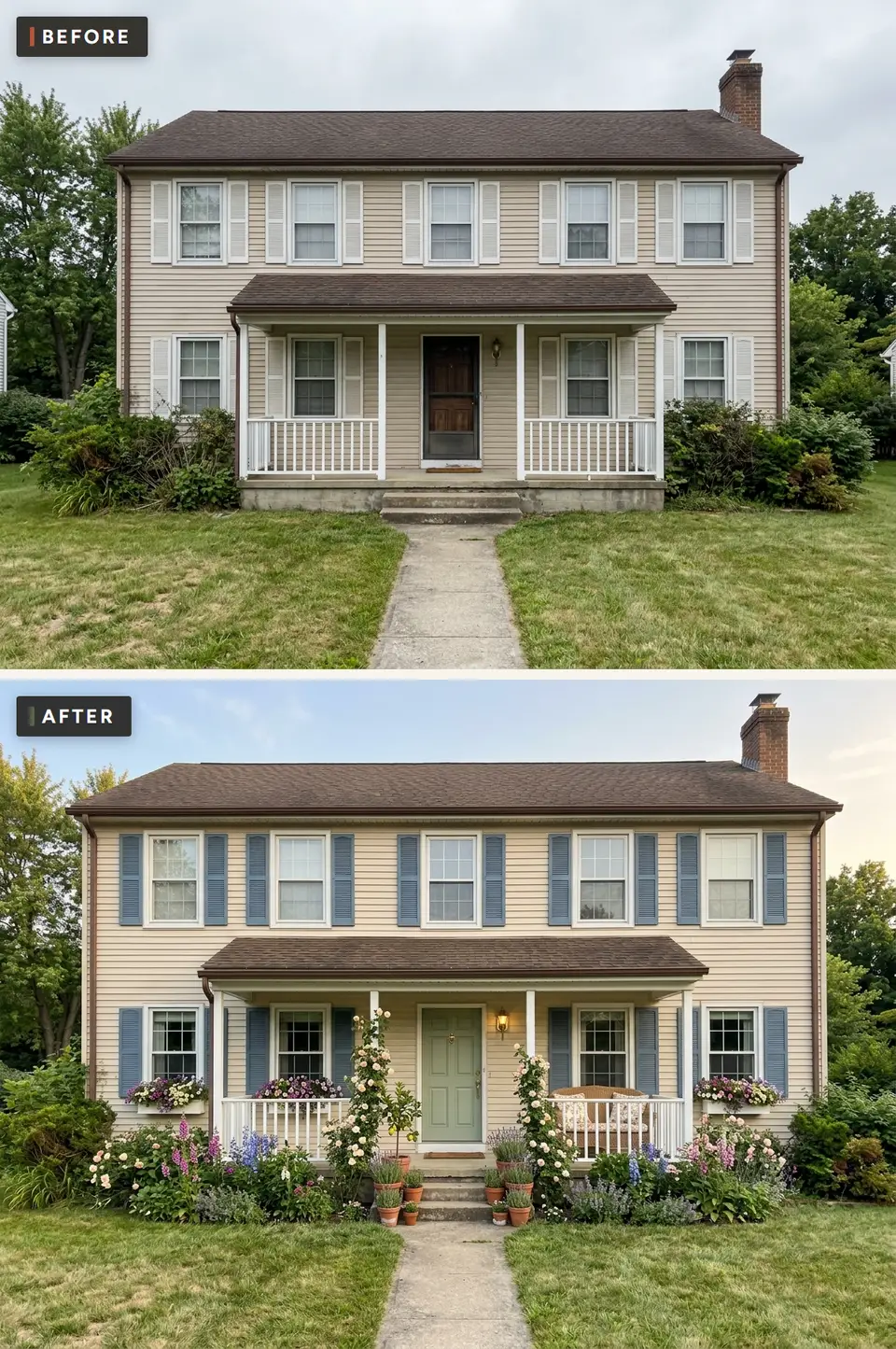
Of all the front porch decorating ideas in this study, this is the one that depends most on plants and least on paint. The siding is a warm cream, close enough to the original beige that the paint job could be skipped in a tight year, the shutters go a soft slate blue, and the front door becomes a pale sage green with a brass knocker. Window boxes of mixed flowers sit under the ground-floor windows.
The planting does everything else. Climbing roses are trained up the two posts either side of the steps, pots of lavender and herbs in terra-cotta line both sides of the steps with a small potted tree near the door, and full cottage beds of foxgloves, delphiniums, roses and lavender replace the overgrown shrubs across the whole front of the porch. A wicker settee with floral cushions sits behind the right-hand railing. It is the most romantic direction here and the most work: porch roses need training, deadheading and disease control every year.
The paint is deliberately secondary to the garden. SW Navajo White SW 6126 (#E9DCC6) warms the siding, BM Van Courtland Blue HC-145 (#5B7290) makes the shutters feel softly weathered, and SW Clary Sage SW 6178 (#ACAD97) connects the door to the planting without matching it exactly. Terra-cotta around #C66B3D appears only in the pots, where its dry, earthy orange bridges the cream wall and the pink, lavender and blue flowers.
This is the least convincing option if nobody wants to garden. Climbing roses need a disease-resistant variety for humid summers and a slim trellis or wires held a few inches off the post so air can circulate behind them. The planting reads best with tall foxgloves and delphiniums against the porch, medium roses and lavender through the middle, then lower plants softening the lawn edge. The terra-cotta grouping will need daily water in high summer, and the settee should stay under the roof with solution-dyed cushions; ordinary floral fabric fades long before the planting matures.
Craftsman Earth Tones: Sage Siding, Brick-Red Shutters and Copper
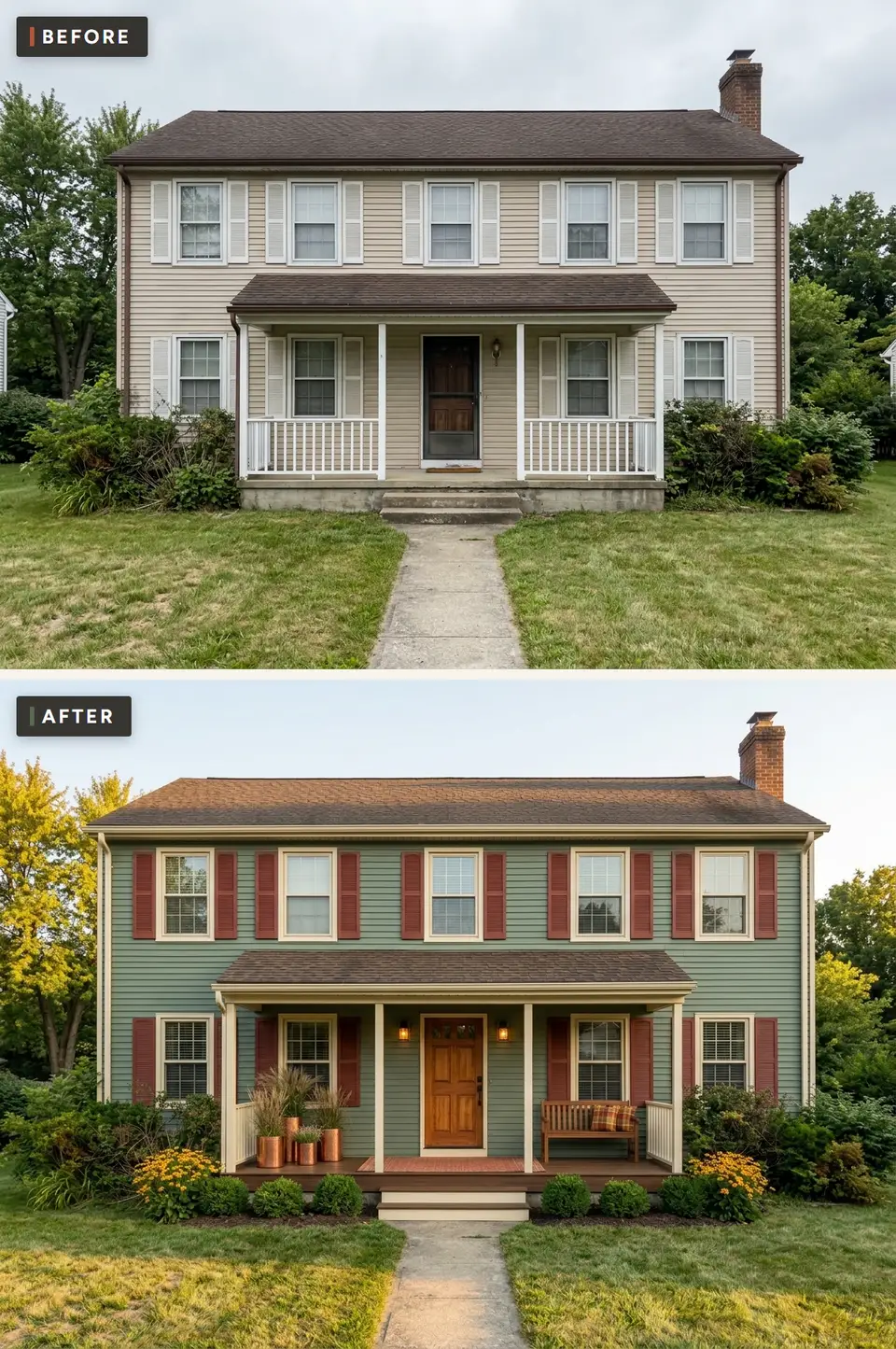
A colonial is not a Craftsman house, but a Craftsman palette suits it surprisingly well. The siding goes a muted sage green, the trim and posts are painted cream, and the shutters take a deep brick red: three colors pulled straight from the Arts and Crafts tradition. A warm fir stain replaces the brown paint on the door, and amber-glass lanterns on both sides glow orange at dusk. In this take the front railing panels are removed, leaving only short cream rail sections at the ends of the porch.
The porch floor and steps are stained a dark walnut brown, a rust-colored rug sits at the door, and a wooden bench with plaid cushions stands at the right end. On the left, a group of copper planters with tall ornamental grasses gives the porch height without blocking the window. Below the porch, low mounded shrubs and drifts of black-eyed Susans replace the overgrown planting, and their gold flowers pick up the copper and amber.
The Craftsman reference comes through color and material, not through pretending the colonial has different architecture. SW Retreat SW 6207 (#7A8572) gives the siding a tree-friendly grey-green, SW Roycroft Vellum SW 2833 (#E8D9BD) softens the trim and posts, and SW Roycroft Copper Red SW 2839 (#7B3728) makes the shutters earthy rather than barn-red. A clear-finished fir door around #B5703B supplies the same amber note as the lantern glass and copper planters.
Those warm materials need upkeep. Copper planters should have drainage holes and liners so wet soil does not stain them unpredictably, while a real stained door facing south or west may need a fresh UV-protective topcoat every year or two; wood-grain fiberglass is the lower-maintenance substitute. Black-eyed Susans are a useful regional choice because they handle heat and dry spells once established. Repeating their rust and gold once in the rug or plaid cushion is enough to make the porch and beds read as one composition instead of a collection of autumn colors.
Moody Dark Green: Hunter Green Siding and Glowing Brass
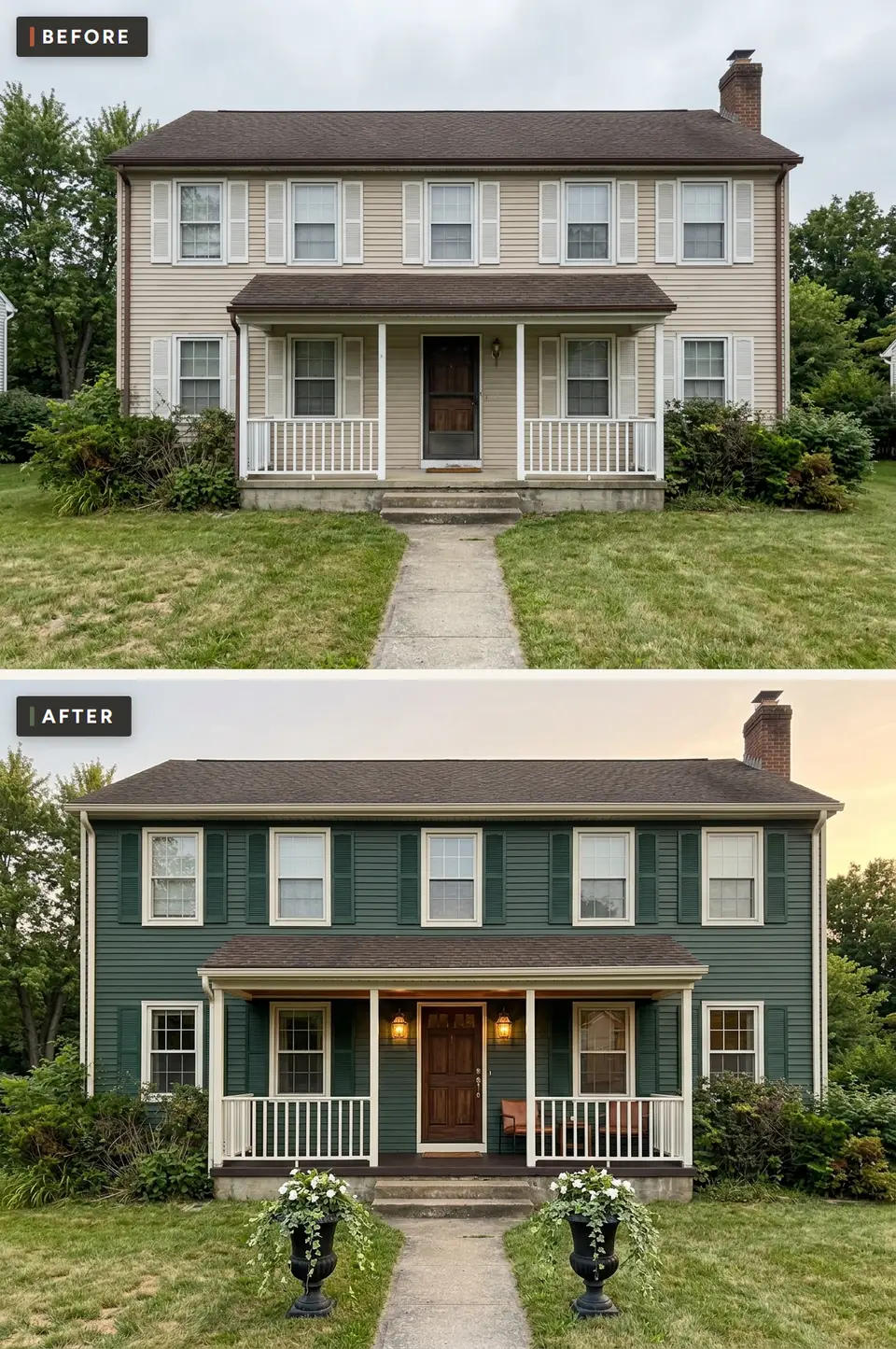
Painting the whole house a deep hunter green is the boldest move in the study, and it works because everything else stays restrained. The siding and the shutters are the same green, so the shutters become a subtle texture rather than a contrast, while the window trim, posts and railing are painted a warm off-white that outlines the architecture. Dark-stained wood with brass hardware replaces the old painted door, and the two brass lanterns flanking it throw a warm glow across the porch at dusk.
The porch floor is stained a deep espresso, and a pair of leather-and-iron chairs with a small side table sit behind the right-hand railing. The only planting change in this take is a pair of large black urns with white flowers and trailing ivy set at the foot of the walk; the foundation shrubs are still the overgrown originals. A trim would still help.
The expensive-looking move is using one green across both siding and shutters rather than outlining every window in contrast. BM Hunter Green 2041-10 (#3E5948) creates that continuous field, SW Creamy SW 7012 (#EFE8DB) traces the trim, posts and railing without the glare of pure white, and a dark walnut door around #4A3226 keeps the entry warm. Aged brass around #B08D57 is most effective after sunset, when it catches the 2700K lantern light and stops the deep green from going flat.
The siding is also the technical risk. On vinyl, this scheme only works with a color and formula the paint manufacturer specifically approves as vinyl-safe; a dark standard exterior paint can absorb enough heat to warp the boards. The planting should stay edited to white flowers and trailing ivy in black urns, which gives the strongest useful contrast against the wall. Warm bulbs are essential here, and matching shutters to siding is intentional: introducing another dark trim color would break the calm massing that makes this scheme work.
Modern Minimalist Charcoal: No Shutters, Olive Trees and Walnut
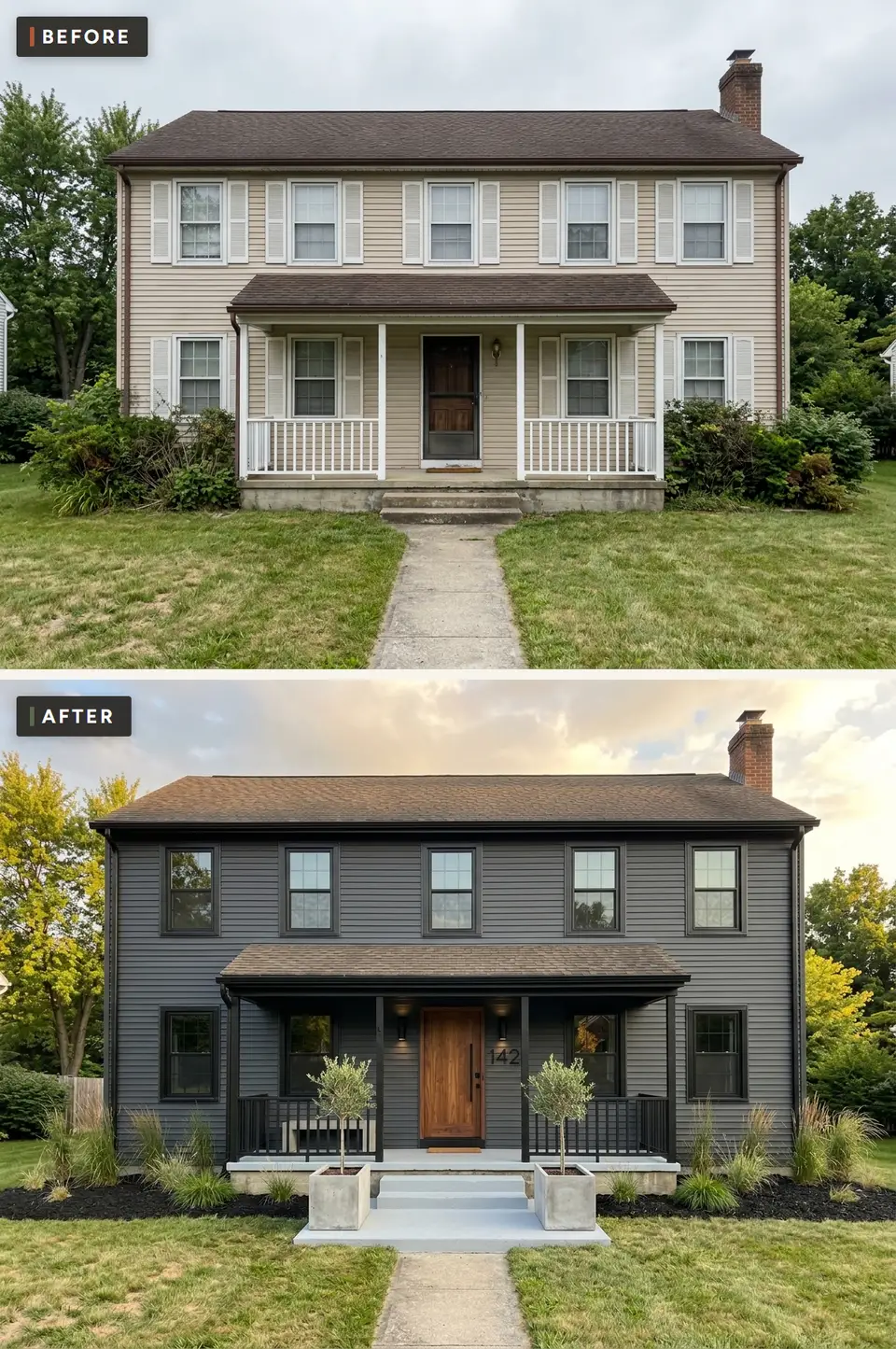
The minimalist direction strips the colonial back to its bones. The shutters are removed, the siding is painted a deep charcoal, and the trim, window frames, posts and railing all go matte black, so the house becomes a single dark mass with nine crisp window openings. Against all that dark, a warm walnut front door with a long vertical pull is the focal point, lit by slim black cylinder wall lights either side and marked by large black house numbers.
On the porch, a low concrete bench sits behind the left-hand railing, and two large square concrete planters with small olive trees stand at the foot of the steps. The steps and the landing at their foot are finished in a pale concrete grey that matches the planters; in the rendering the landing reads wider than the original, which would be a small concrete job rather than paint. The foundation beds are simplified to black mulch and clumps of ornamental grass, and the overgrown shrubs are gone completely.
The front door has to carry almost all the warmth in this scheme. SW Iron Ore SW 7069 (#434341) makes a softer charcoal body than a flat black, while SW Tricorn Black SW 6258 (#2F2F30) keeps the trim, posts and railing low-sheen and precise. Natural walnut around #7B4A2A becomes the focal material, and raw concrete around #A9A9A3 on the planters and steps gives the dark facade a pale, mineral base rather than another painted surface.
Simplification comes before shopping: remove the shutters, repair every old fixing hole and inspect the wall in raking light, because charcoal exposes flaws that beige hides. The concrete planters need to be placed before filling; at this scale they can weigh several hundred pounds. Olive trees are credible outdoors only in the warmest parts of the Southeast, roughly zone 8b and warmer, so clipped holly or another compact evergreen is the safer inland substitute. One bench and two planters are enough. The success of this image depends on the empty space between them.
Fall Harvest Porch: A Pumpkin Door, Mums and Plaid
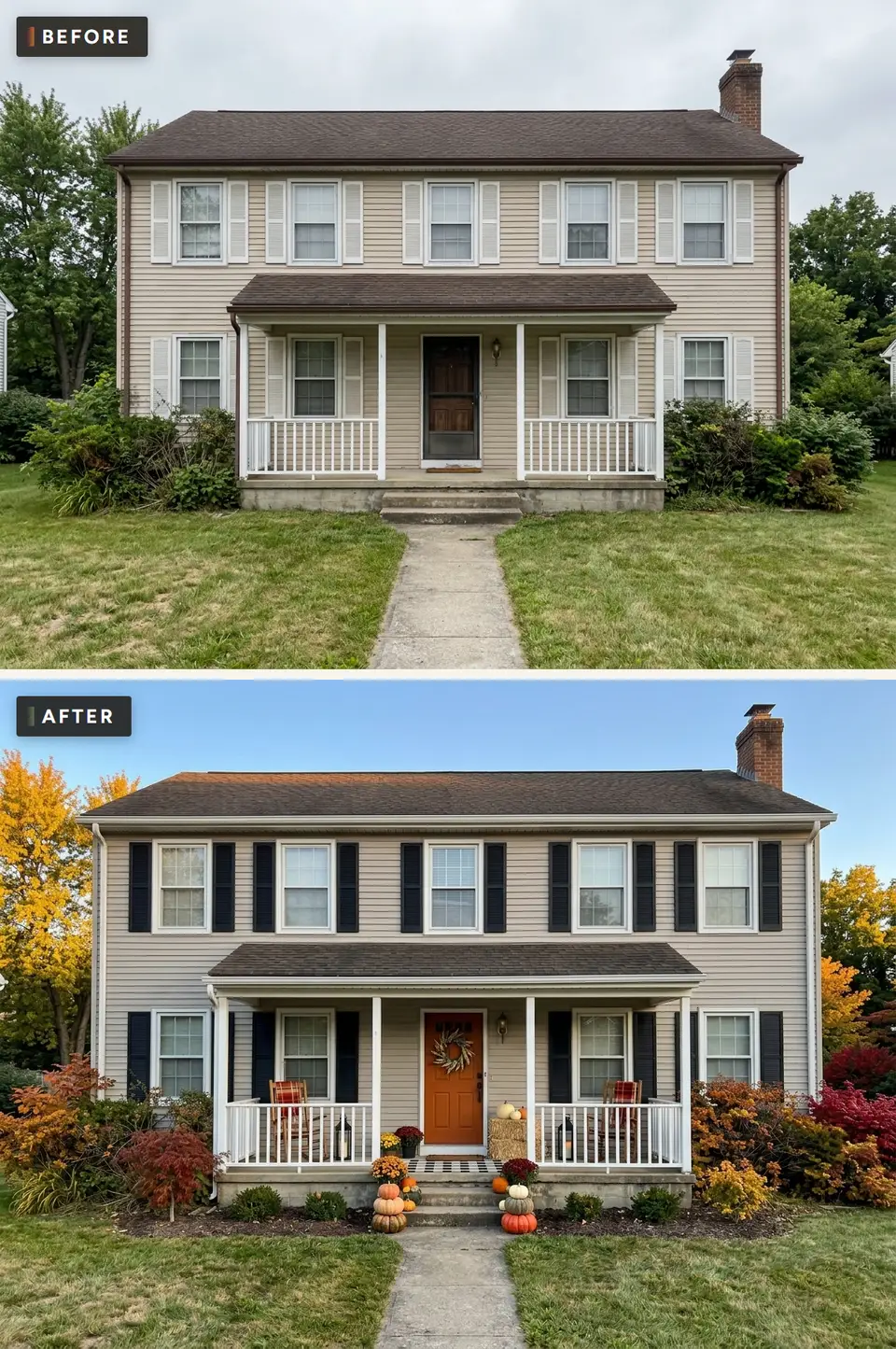
The fall version shows how far seasonal front porch decor can go on a house that only needed a neutral repaint. The siding becomes a soft greige, the trim, posts and railing stay white, and the shutters are painted black, which is a base that works in every season. All of the seasonal colour is concentrated on the door, painted a deep pumpkin orange and hung with a dried eucalyptus-and-wheat wreath, while the original single coach light stays beside it.
The fall front porch decor itself is simple and repeatable. Stacks of heirloom pumpkins sit on both sides of the steps with pots of mums in gold, rust and burgundy, a hay bale with cream pumpkins stands beside the door, black lanterns with candles sit on the floor, a buffalo-check rug lies at the door, and two wooden rocking chairs with red plaid throws sit behind the railing at each end. The foundation beds are replanted with shrubs in autumn reds and oranges, with small clipped evergreens along the front. In December the same porch takes greenery and a wreath with no repainting.
The smartest part of the fall porch is that most of its color is temporary. SW Agreeable Gray SW 7029 (#D1CBC1) gives the siding a warm neutral base, and SW Tricorn Black SW 6258 (#2F2F30) makes the shutters useful in every season. SW Robust Orange SW 6627 (#C25A3C) turns the door into the autumn statement; if that feels too permanent, it is the one surface that can be repainted without disturbing the rest of the elevation. Mum gold around #D9A12B repeats the door near the ground and keeps the display connected from porch to steps.
Build the arrangement in odd-numbered groups and preserve the full stair tread rather than letting pumpkins creep into the walking path. Mums last longer when bought with mostly closed buds, while faux pumpkins work best at the top of stacks and real ones can stay on the cooler ground. In a warm, humid October, inspect the real fruit often because soft spots develop quickly. Battery LED candles belong in the lanterns; an open flame beside dry hay, wheat and a wreath is not worth the atmosphere. The same neutral base can take simple greenery in December without another exterior repaint.
Pro Tips for Front Porch Ideas That Last
Paint is where most porch makeovers succeed or fail, so start there. Paint vinyl siding only with vinyl-safe colors. Vinyl expands with heat, and a color darker than the original can push the siding past the temperature it was designed for, which causes warping. Sherwin-Williams publishes a VinylSafe palette and other makers publish similar lists, which matters most for the charcoal and hunter green directions. Remember too that prep is the job: wash the siding, rinse it, let it dry and spot-prime chalky areas, because most paint failures on old vinyl trace back to dirt and chalking. Underfoot, use the right floor product. A concrete porch floor needs a porch-and-floor enamel or a concrete stain made for exterior slabs, and the surface must be cleaned and often etched first; regular house paint will peel within a season.
Layout and safety come next. Check the railing height rule before removing railings. Several of these renderings take the railing panels out, and under the International Residential Code a guard is required where a porch floor is more than 30 inches above the grade below. This porch sits two steps up, so measure yours and check HOA rules. Size the furniture to the porch as well: a shallow porch like this one is about 6 to 7 feet deep, so leave a clear path at least 36 inches wide from the steps to the door and fit the furniture around it.
The last moves are small and effective. Light the door, not the yard. A pair of sconces at the door replaces the single off-center coach light in six of the ten directions; choose fixtures rated for wet or damp locations and warm-white bulbs. Clear the foundation first, since removing the overgrown shrubs costs little and makes every direction look better, and keep new shrubs at least 3 feet off the siding. Finally, there are no lead paint concerns on this vintage. Houses built after 1978 fall outside the EPA's lead renovation rule, so sanding old trim on a 1980s colonial does not need lead-safe certification. Pre-1978 houses do.
Small Front Porch Decorating Ideas
The porch in these renderings is small: it covers only the middle of the front and is not deep. That makes small front porch decorating ideas cheaper and faster to pull off. Pick one seating idea (a pair of chairs, a bench or a swing) and stop there. Use a pair of matching planters to frame the door rather than many small pots. Put the rug under the door, not under the chairs. And make the door the brightest or darkest thing on the front, because on a small porch it is what visitors actually look at.
Choosing Front Porch Furniture
Front porch furniture lives outdoors even under a roof, so materials matter more than style. Powder-coated aluminum, resin wicker, teak and marine-grade polymer all handle Southern humidity well. Cushions should be solution-dyed acrylic so they do not fade, and they should come inside or into a storage bench during storms.
Regional Fit Across the Southeast
The Southeast runs from USDA zone 6 in the North Carolina mountains to zones 8b and 9 on the coasts, which changes both the plants and the finishes.
Coastal Carolinas, Georgia and Florida (zones 8b to 10). The haint blue, Charleston classic and coastal cottage directions are at home here. Choose marine-grade fixtures and solution-dyed fabrics against salt air and sun. Blue hydrangeas thrive in the acidic soil but need afternoon shade. Olive trees from the minimalist direction can live outdoors in the warmest coastal pockets.
Piedmont and mid-South (zones 7 and 8a). Atlanta, Charlotte, Raleigh, Greenville and Nashville suit every direction on this list. Hot, humid summers call for mildew-resistant paint and airflow behind roses and shrubs. In inland zones, replace olive trees with a clipped holly or another evergreen.
Mountains and upper South (zones 6 and 7a). In western North Carolina, east Tennessee and north Georgia, the moody green and Craftsman directions sit naturally among the trees. Freeze-thaw winters call for exterior-rated floor coatings with a non-slip additive on the steps. Boxwood, yaupon holly and black-eyed Susans handle these winters; cottage roses need a hardy variety.
What Each Direction Actually Costs
These are estimated 2026 ranges for the full refresh shown in each rendering on a two-story colonial of about 2,000 square feet in Southeast markets. They include professional exterior painting of the siding and trim, painting or replacing shutters, the porch floor finish, the front door (painted or replaced), the lights, the furniture, rugs and planters, and new planting at the foundation. Siding replacement, roof work and structural repair are excluded; big metros sit at the top of each range.
The ten directions sit within a fairly tight band, because the siding repaint is the shared base cost in almost all of them. Fall Harvest Porch is the least expensive at $6,500 to $12,000, driven by the siding repaint, with seasonal decor adding $250 to $700. Classic Farmhouse White runs $8,000 to $15,000 for the repaint, a black storm door and boxwood planting, and Coastal Cottage costs $8,500 to $16,000 for the repaint, hydrangeas and Adirondack chairs. English Cottage Garden sits just above at $8,500 to $16,500, its money going into full cottage beds, roses and window boxes.
The middle group adds color work and fittings. Southern Haint Blue runs $9,000 to $17,000 for the siding repaint, swing hardware and hydrangeas, and Craftsman Earth Tones costs $9,000 to $17,500 for a three-color paint job, a stained door and copper planters. Charleston Classic and Moody Dark Green both land at $9,500 to $18,000: the first for window boxes, copper lanterns and a three-color paint job, the second for dark vinyl-safe paint, a stained door and brass lanterns.
The two most expensive directions spend on doors and detail. Modern Farmhouse Black and White runs $10,500 to $19,500, largely for painting nine window sashes and a white oak door. Modern Minimalist Charcoal tops the list at $12,000 to $24,000, with a walnut door, olive trees, concrete planters and a new landing.
How the numbers break down, as estimates: a professional repaint of the siding and trim on a two-story house of this size runs about $5,000 to $10,000, and that is most of every range above. Painting the existing nine pairs of vinyl shutters costs roughly $400 to $1,000; new vinyl or composite shutters run $1,000 to $3,000. Painting the front door is a $150 to $600 job, while a new wood or wood-grain fiberglass door like the white oak, fir or walnut doors in the renderings typically costs $2,500 to $6,000 installed. A pair of good exterior lanterns runs $250 to $1,200 plus an electrician if new wiring is needed. Furniture ranges from $400 for two chairs to $2,500 for a swing and an armchair pair, and foundation planting from $500 for a band of shrubs to $3,000 for full cottage beds. On a tight budget, keep the siding color, paint only the door and shutters, and spend on lights and planting: about $1,500 to $5,000 for any direction.
Frequently Asked Questions
What are the best front porch ideas on a budget?
Paint the front door a strong color, paint the shutters to contrast with the siding, replace the single porch light with a matching pair of sconces, add two chairs or one bench, a rug and a pair of planters, and clear out overgrown shrubs. On a typical colonial that costs about $1,500 to $5,000 and changes the front without repainting the whole house.
How do you decorate a small front porch?
Choose one seating idea (two chairs, a bench or a swing) and keep a clear path at least 36 inches wide from the steps to the door. Frame the door with a matching pair of planters or lights, put the rug at the door, and keep everything else off the floor. On a small porch, the door color is the focal point.
What are the best porch paint colors for a colonial house?
Classic pairings are white siding with black or deep green shutters, soft yellow with Charleston green, pale grey with navy, and cream with slate blue. For the porch floor, a grey, a brick red or a warm stain hides dirt best. On vinyl siding, choose the body color from a vinyl-safe palette to avoid warping.
Why are porch ceilings painted haint blue?
The tradition comes from the Gullah Geechee communities of the Lowcountry, where blue paint around doors and windows was believed to keep away "haints," or restless spirits. Over time it spread across Southern porches. Many owners also say the pale blue extends daylight and discourages wasps from nesting, though that part is folklore rather than proven.
Can you paint vinyl siding a dark color?
Yes, but only with paint formulated for vinyl and in colors the paint maker approves for it. Dark colors absorb more heat, and vinyl siding can warp or buckle if it gets hotter than it was designed for. Sherwin-Williams' VinylSafe palette and similar lists from other makers include some deeper colors that are safe.
What is the best front porch furniture for humid climates?
Powder-coated aluminum, resin wicker, teak and marine-grade polymer hold up best in Southern humidity. Choose cushions in solution-dyed acrylic fabric so they resist fading and mildew, and bring them in or store them in a deck box during storms. Avoid natural rattan and painted softwood outdoors.
How do you make fall front porch decor last?
Use faux pumpkins at the top of the stacks and real ones on the ground, buy mums with closed buds, keep everything out of direct rain under the porch roof, and use LED candles in lanterns. In warm, humid Octobers real pumpkins can soften within a couple of weeks, so swap them out as needed.
Sources and References
- Zonda / Remodeling, Cost vs. Value Report: national and regional costs and resale recovery for entry door replacement, siding and other exterior projects.
- National Association of Realtors, Remodeling Impact Report: realtor and homeowner survey data on curb appeal projects such as a new front door and exterior painting.
- Sherwin-Williams VinylSafe Paint Colors: the manufacturer's list of colors approved for painting vinyl siding, and its color pages for the shades named above.
- Benjamin Moore Historical Colors collection: color pages for Hawthorne Yellow, Stonington Gray, Van Courtland Blue and the other Benjamin Moore shades named above.
- Vinyl Siding Institute: guidance on cleaning, maintaining and painting vinyl siding.
- International Residential Code (IRC) 2021, Section R312.1: guard requirements for porches and decks more than 30 inches above grade.
- U.S. EPA Lead Renovation, Repair and Painting (RRP) Rule: applies to homes built before 1978.
- USDA Plant Hardiness Zone Map (2023): zone ranges used for the plant recommendations above.
- Clemson Cooperative Extension, Home & Garden Information Center: fact sheets on hydrangea color and soil pH, boxwood blight, roses and foundation planting.
- Gullah Geechee Cultural Heritage Corridor Commission: background on Gullah Geechee traditions, including the origin of haint blue.
What the Ten Porches Show
Ten directions from one tired 1980s colonial, and not one of them needed a new porch. Every change in these renderings is paint, a door, a pair of lights, a few pieces of furniture and planting: the kind of work that fits into a long weekend for the decor and a few weeks for a professional paint crew. That is the real lesson of these front porch ideas. The structure you have is usually good enough; color and details decide how the house feels.
For the ground in front of a porch like this one, the walk, the beds and the trees, our ten front yard landscaping makeovers of one 1970s ranch picks up where this study stops, and thirteen curb appeal ideas for one beige house takes the same before-and-after method to the whole front of the house. For the siding decision itself, thirteen ways to transform a suburban facade compares siding materials and colors on a similar two-story house.
Start with the door and the lights. If you still love the porch a month later, paint the siding.

Transformations Desk
The Layered Homes editorial teamThe Transformations Desk produces the before-and-after design studies: one imagined starting space (a room, a facade, a backyard) shown in several design directions, each with a palette and a cost estimate.
More from the Transformations Desk →
Reader notes