


Front yard landscaping ideas are easiest to judge when the house stays the same, so every direction below starts from one neglected 1970s brick ranch — the same roof, windows, door, driveway and camera angle from the street. Two overgrown shrubs hide its windows, the lawn is half bare and the walk has cracked into slabs. Ten makeovers follow, from a Southern traditional front with herringbone brick and boxwood to a drought-tolerant xeriscape and a formal French parterre, each with the palette, the plants that actually survive a Southeast summer, and what it costs to install in 2026.
Table of Contents
- The 1970s Ranch Front Yard We Started With
- Front Yard Landscaping Ideas at a Glance
- Southern Traditional: Herringbone Brick, Boxwood and Crepe Myrtles
- Modern Farmhouse: Bluestone, Hydrangeas and a Black Board Fence
- Modern Minimalist: Columnar Trees, Boxwood Spheres and Black Trim
- English Cottage Garden: A Picket Fence, a Rose Arbor and a Brick Path
- Woodland Native Garden: River Birch, Dogwood and a Flagstone Path
- Drought-Tolerant Xeriscape: Gravel, Agave and Corten Steel
- Mid-Century Modern: Breeze Block, an Orange Door and Offset Pavers
- Japanese-Inspired Garden: Raked Gravel, a Black Pine and a Red Maple
- Mediterranean Courtyard Front: Stucco, Terracotta and an Iron Gate
- Formal French Parterre: Boxwood Knots, a Fountain and Standard Trees
- Pro Tips for Front Yard Landscaping That Lasts
- Regional Fit Across the Southeast
- What Each Direction Actually Costs
- Frequently Asked Questions
- Sources and References
- Final Thoughts
The 1970s Ranch Front Yard We Started With
The house is the most common house in the American South: a single-story 1970s brick ranch with a low asphalt-shingle roof, a sided front gable, a plain front door set a single step above the lawn and a one-car garage on the right with a straight concrete driveway. Every one of the ten directions below keeps that house exactly where it is — the same roofline, the same windows, the same door, the same driveway and the same camera position from the street. What changes is the yard, the walk, the planting and, in most of them, the colour of the brick.
The before is familiar to anyone who has bought a ranch from its original owners. Two overgrown shrubs have swallowed the front windows, a foundation hedge is half dead, the lawn is more bare soil than grass, the straight concrete walk has heaved into slabs, and a rusted mailbox leans on a split wooden post at the curb. There is no path lighting and nothing that tells a visitor where to look. None of it is expensive to fix. It is simply fifty years of planting that nobody ever pruned, on a house that was never given a front garden in the first place.
Quick answer: the front yard landscaping ideas that do the most for a 1970s ranch are the ones that fix three things before anything else — a wider, straighter or deliberately curved walk to the door, foundation planting kept low and away from the windows, and one or two trees that give a long, low house some vertical relief. Paint on the brick and a new front door multiply the effect, but the yard is what turns a plain ranch into a house with curb appeal.
- Remove before you add. Taking out overgrown foundation shrubs is the single cheapest and most visible improvement on almost every ranch.
- Size the walk properly. Four feet wide is the working minimum for a front walk; five feet lets two people walk side by side.
- Plant for mature size. Foundation shrubs go at least 3 feet off the brick, and trees at least 15 to 20 feet from the house for medium species.
- Call 811 first. Every direction below involves digging near buried utility lines, and the locate service is free.
Front Yard Landscaping Ideas at a Glance
Here is how the ten directions compare on the questions homeowners actually ask first: how much work the yard will be once it is planted, how much lawn is left to mow, and roughly what it costs to install in the 2026 Southeast market. The detailed breakdown sits in the cost section further down.
| Direction | Best For | Maintenance | Lawn Left | Installed Range |
|---|---|---|---|---|
| Southern Traditional | Classic neighborhoods, resale | Medium (hedge shearing) | Most | $11,000 - $22,000 |
| Modern Farmhouse | Painted brick, black windows | Low to medium | Most | $9,500 - $19,000 |
| Modern Minimalist | Clean-lined, low-fuss owners | Low | Most | $8,500 - $17,000 |
| English Cottage Garden | Keen gardeners | High | Small | $9,000 - $19,000 |
| Woodland Native Garden | Shady lots, wildlife | Low once established | None | $7,500 - $16,000 |
| Drought-Tolerant Xeriscape | Sunny, well-drained lots | Low | None | $11,000 - $23,000 |
| Mid-Century Modern | Owners who want colour | Low | Most | $10,500 - $21,000 |
| Japanese-Inspired Garden | Small, calm, detailed yards | Medium (pruning, raking) | None | $13,000 - $28,000 |
| Mediterranean Courtyard | Hot, sunny coastal lots | Low to medium | None | $16,000 - $34,000* |
| Formal French Parterre | Symmetrical fronts, formal taste | High (clipping) | Strips only | $15,000 - $30,000 |
*Before any roof work. The Mediterranean photo also shows the main roof re-covered in clay tile, which is a separate project priced on its own.
Southern Traditional: Herringbone Brick, Boxwood and Crepe Myrtles
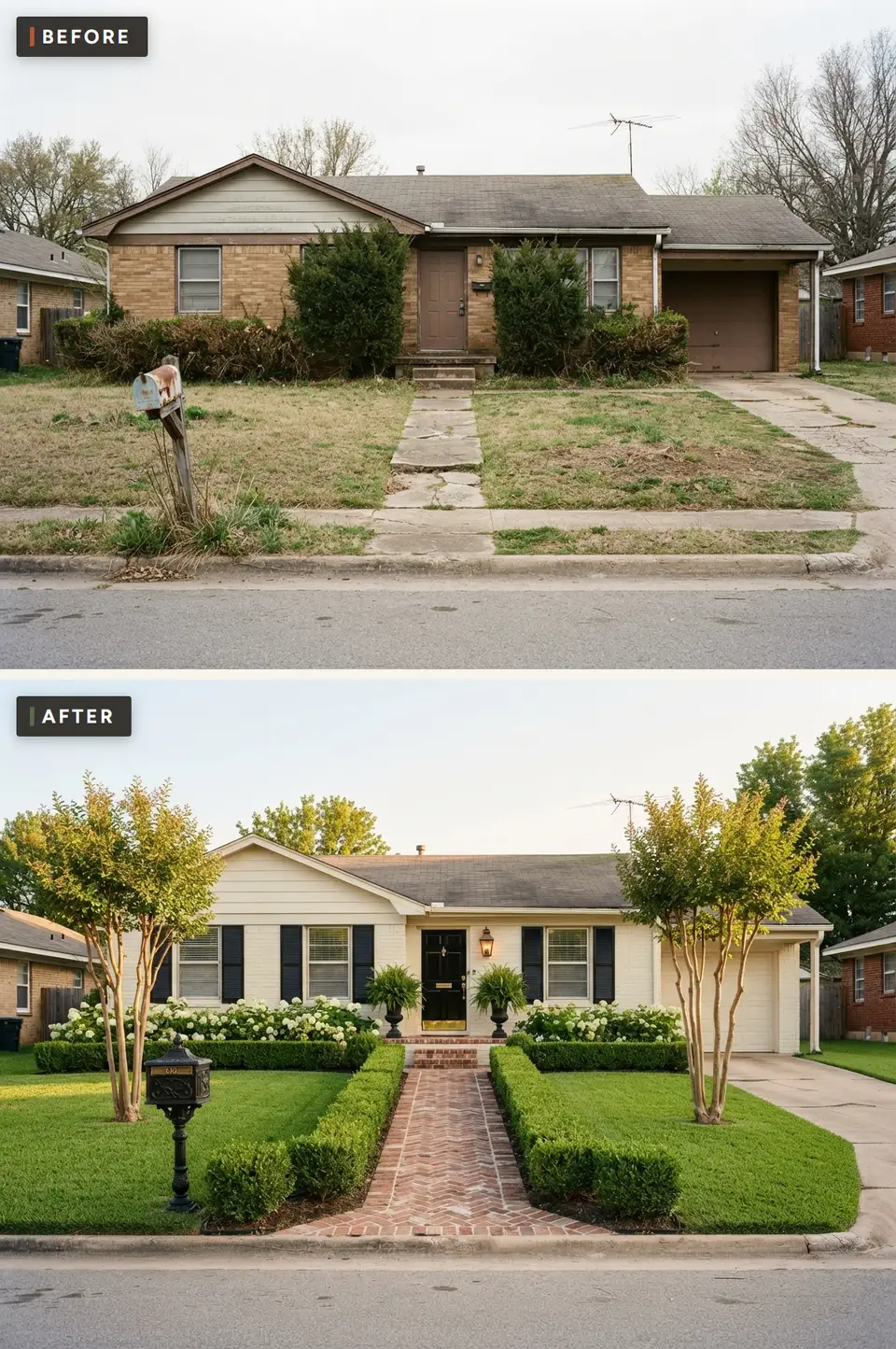
If I had to pick one direction for a ranch in a Charleston, Savannah or Raleigh neighborhood, it would be this one. The cracked concrete walk becomes a herringbone brick walk laid on a compacted base, lined on both sides with a clipped boxwood hedge that turns the path into a small green corridor to the door. Behind the hedge, a band of white hydrangeas runs the length of the foundation, low enough to sit under the windowsills. Two crepe myrtles — limbed up to show their bark rather than chopped at the top — flank the lawn and give the long, low house the vertical lines it never had.
The house does its share. The tan brick and the sided gable are painted one warm off-white, the windows get black shutters sized to actually close over them, and the brown door becomes glossy black with brass hardware. Ferns in black urns sit either side of the step, a lantern hangs by the door and a black cast-iron mailbox replaces the rusted one at the curb. It is the most familiar of the ten directions and, in most Southern markets, the one buyers read instantly as well kept.
Color Palette
#EDEAE0
Warm off-white in a breathable masonry paint so the brick can still dry out
SW Tricorn Black
#2F2F30
High-gloss on the door, satin on the shutters, both in exterior enamel
#A0573F
Pavers rated for ground contact, herringbone on a sand-set base
#3F5A33
Clipped hedges against the white mopheads of 'Annabelle' hydrangea
Styling Notes for This Look
- Shutters should be half the width of the window they flank. Undersized shutters are the one detail that makes a traditional front look like a builder upgrade.
- Boxwood blight is now established across much of the Southeast. Dwarf yaupon holly (Ilex vomitoria 'Nana'), a native hardy in USDA zones 7 to 10, clips into the same low hedge without the risk.
- Plant crepe myrtles at least 8 to 10 feet from the foundation and choose a variety whose mature height fits; never top them to control size.
- Use real brick pavers, not wall brick. Wall brick is not rated for foot traffic and freeze cycles and will spall within a few winters.
Modern Farmhouse: Bluestone, Hydrangeas and a Black Board Fence
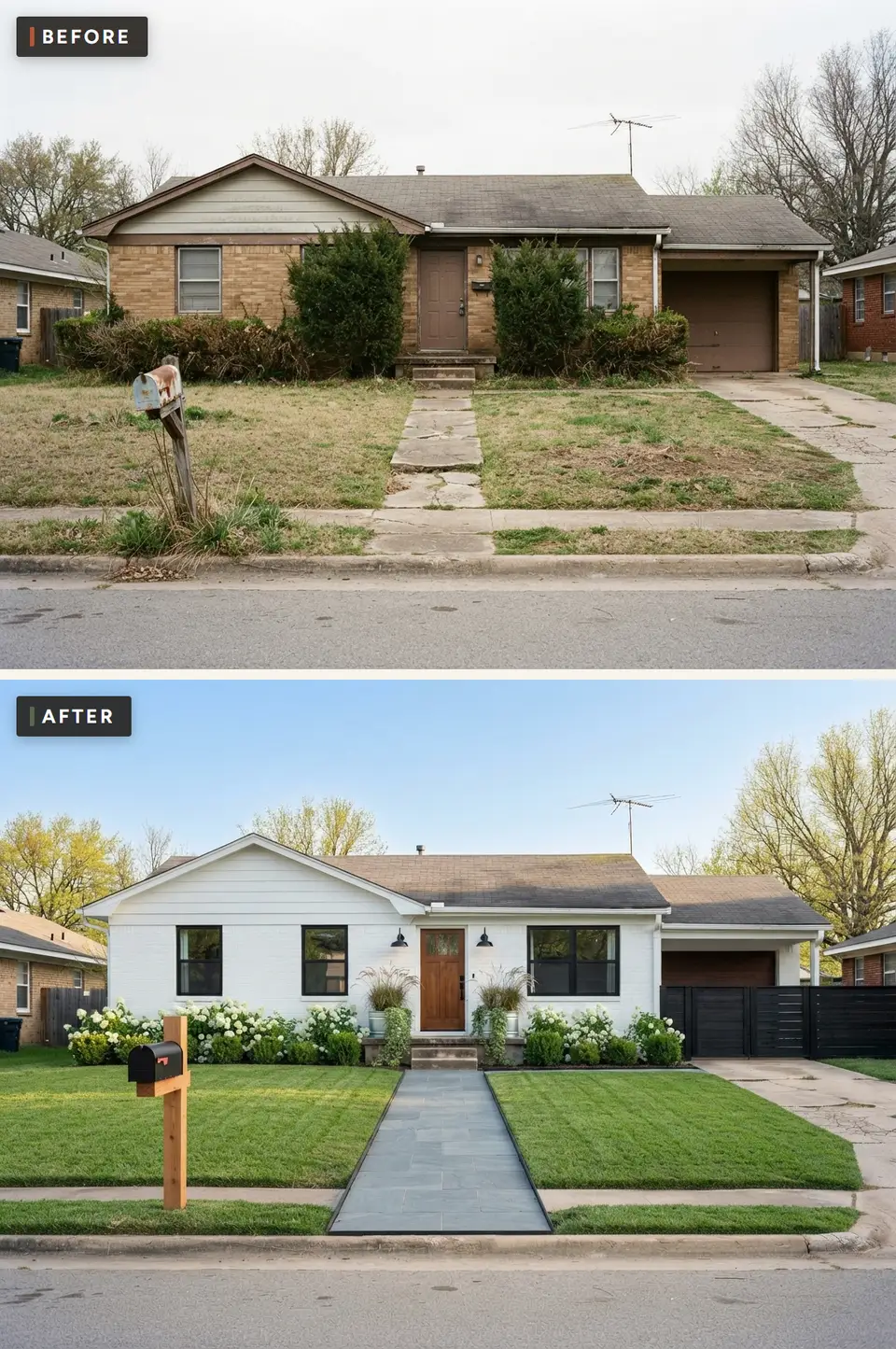
The modern farmhouse direction keeps almost all of the lawn and spends the budget on three hard surfaces. The walk is a straight run of bluestone slabs edged in steel, a little wider than the old concrete, running from the sidewalk to a new single step. A black horizontal-board fence closes off the side yard beside the driveway, which does two jobs at once: it hides the bins and the side gate, and it gives the long, flat front a dark vertical frame on the right-hand side. The brick is painted a clean white, the window frames go black and the door is stained oak, the one warm note on the whole front.
Planting is deliberately simple: a continuous band of white hydrangeas and boxwood along the foundation, two galvanized planters of ornamental grass at the stoop, black gooseneck lights either side of the door and a black mailbox on a cedar post. This is the direction I would choose for a buyer who wants the house to look current without committing to a garden they will have to learn. The whole front can be maintained by a lawn service in the same visit as the mowing.
Color Palette
SW Pure White
#EDECE6
Clean white in a mineral silicate or masonry acrylic, flat sheen
, Fence and Lights SW Iron Ore
#434341
Soft black that reads black from the street without looking harsh
White Oak, Warm Stain
#9C6B3F
Exterior-grade oak or fiberglass with a stained oak skin
#6E7A83
Thermal finish for grip when wet, steel edging to hold the line
Styling Notes for This Look
- Choose panicle hydrangeas (Hydrangea paniculata, zones 3 to 8) for full sun and smooth hydrangeas such as 'Annabelle' (zones 3 to 9) for the shaded side of the house.
- Keep the fence to the side yard. A black fence across the whole front of a ranch closes it off from the street and undoes the curb appeal it was meant to add.
- Gooseneck lights look right at roughly one-third the height of the door, mounted centred on the trim either side.
- Galvanized planters heat up in full sun; line them or use them only on the shaded stoop.
Modern Minimalist: Columnar Trees, Boxwood Spheres and Black Trim
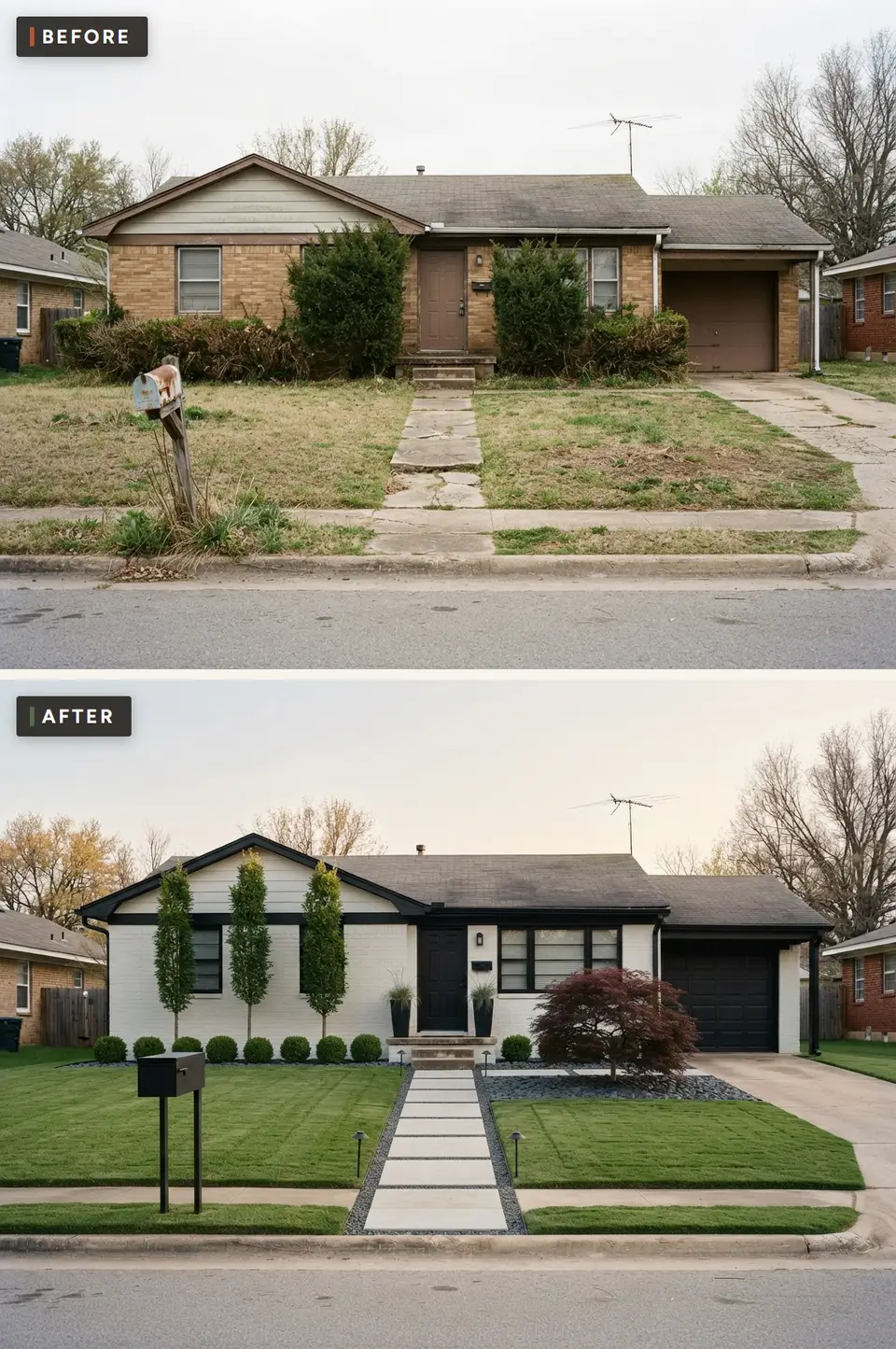
Minimalism on a ranch is about lines, and this direction uses only three of them. Three columnar trees stand in a row across the left half of the front, a string of clipped boxwood spheres runs along the entire foundation at the same height, and a walk of large rectangular concrete pavers with narrow gravel joints runs straight to the door. One Japanese maple in a bed of dark stone on the right breaks the symmetry just enough to stop it feeling like an office park. The lawn is kept, edged sharply against the beds, so the yard reads as green planes and dark outlines.
The house is painted white with the fascia, the door and the garage door all in black, which reads very modern from the street for the cost of paint. Low black path lights, a black mailbox on a steel post and black planters at the door complete it. The reason this direction works on a 1970s ranch is proportion: the house is long and low, and the three upright trees supply the verticals that the architecture never had. Planting is minimal, maintenance is a twice-yearly shear and a lawn service.
Color Palette
BM Chantilly Lace
#F4F4F0
Crisp, neutral white that stays white next to black trim
, Door and Garage BM Black Beauty
#2A2A2C
Deep black in satin exterior enamel, the same on every element
#B9B6AE
24 by 36 inch slabs with 2-inch pea gravel joints
Charcoal River Rock
#4A4A48
Dark stone that makes the green of the boxwood and maple read brighter
Styling Notes for This Look
- Columnar hornbeam (Carpinus betulus 'Fastigiata', zones 4 to 8) suits the upper South; in the coastal plain the native American hornbeam or a columnar yaupon holly copes better with heat.
- Space the upright trees evenly, at least 6 to 8 feet off the brick so their canopies do not rub the gutter as they widen.
- Spheres must be sheared to the same size or the effect collapses; buy them all from one nursery lot.
- Keep dark river rock out of full afternoon sun beside the walk — it stores heat and can scorch the plants around it.
English Cottage Garden: A Picket Fence, a Rose Arbor and a Brick Path
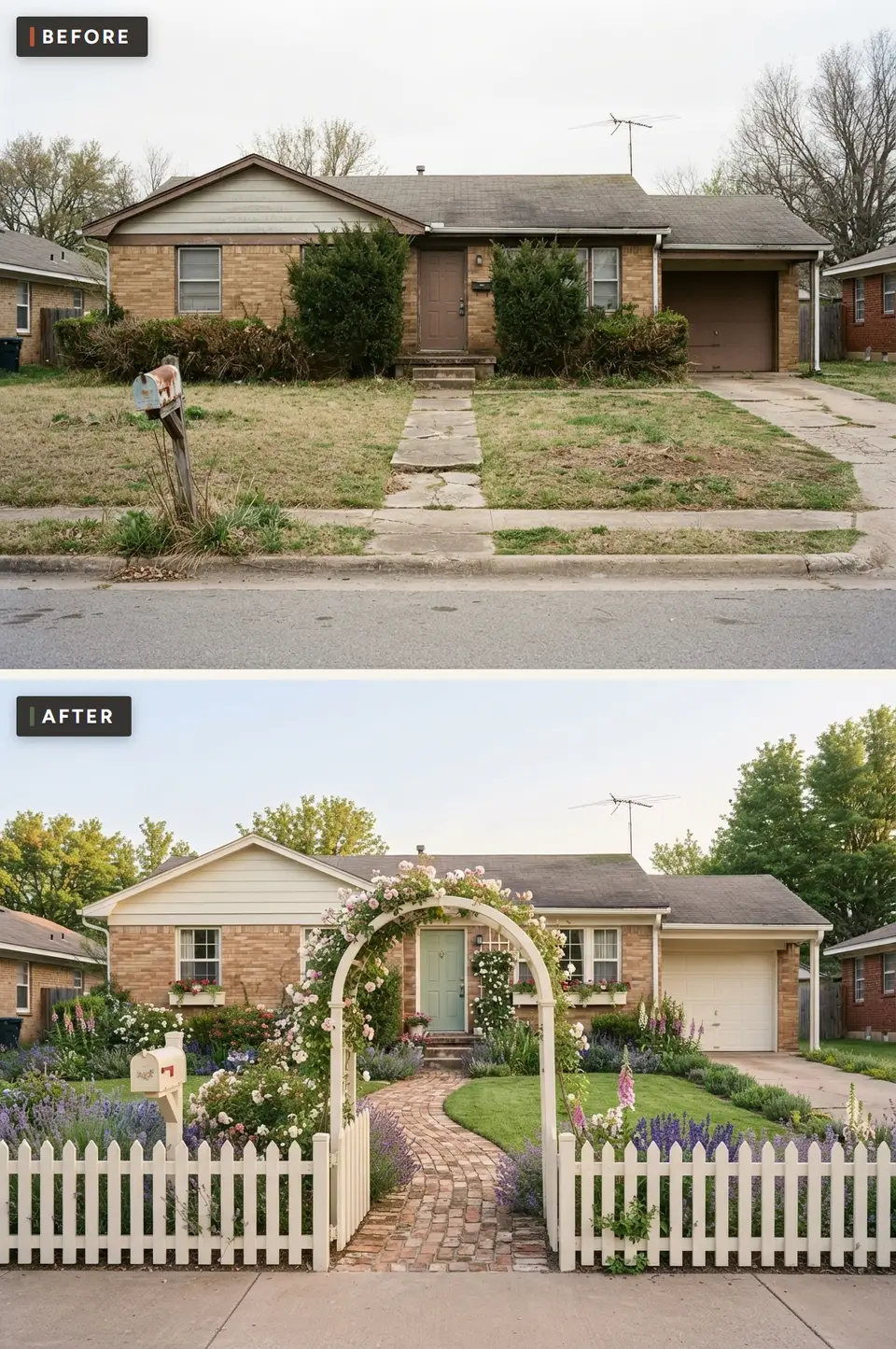
This is the romantic answer, and it is the only direction that deliberately hides the house. A white picket fence runs along the sidewalk, broken in the middle by an arched arbor smothered in climbing roses, and a curving brick path winds from the gate to a sage-green front door. Either side of the path, overflowing borders of lavender, salvia, catmint, foxglove and roses take the place of most of the lawn, with a small oval of grass left in the middle. Window boxes of trailing flowers sit under the front windows and a cream mailbox stands by the gate.
The brick is left natural, with the gable and trim painted cream, which suits the style: cottage gardens are about age, not freshness. The honest warning is maintenance. A border like this needs deadheading, dividing and replanting every year, and it looks its best from April to June and its least convincing in late August in the Southeast. For a keen gardener it is the most rewarding front yard on this list; for anyone else, it becomes a weeding job.
Color Palette
#EFE9DB
Soft cream that flatters the tan brick instead of fighting it
Farrow and Ball Lichen
#9EA391
Muted sage green in exterior eggshell
#F2F0EA
Cedar or PVC pickets in satin white, posts set in gravel
#9C8FC2
Purple spires of salvia and lavender against pale pink roses
Styling Notes for This Look
- English lavender sulks in Southern humidity. 'Phenomenal' lavandin (zones 5 to 9) and Salvia 'May Night' give the same purple haze and survive July.
- Treat foxglove as a cool-season biennial in the Southeast: plant in fall, enjoy spring flowers, replace the next year.
- Charleston gave the world the Noisette rose. A repeat-blooming Noisette or an old tea rose on the arbor handles the heat better than most English roses.
- Keep the fence at 36 to 42 inches. Any taller and a front garden becomes a barrier rather than a welcome.
Woodland Native Garden: River Birch, Dogwood and a Flagstone Path
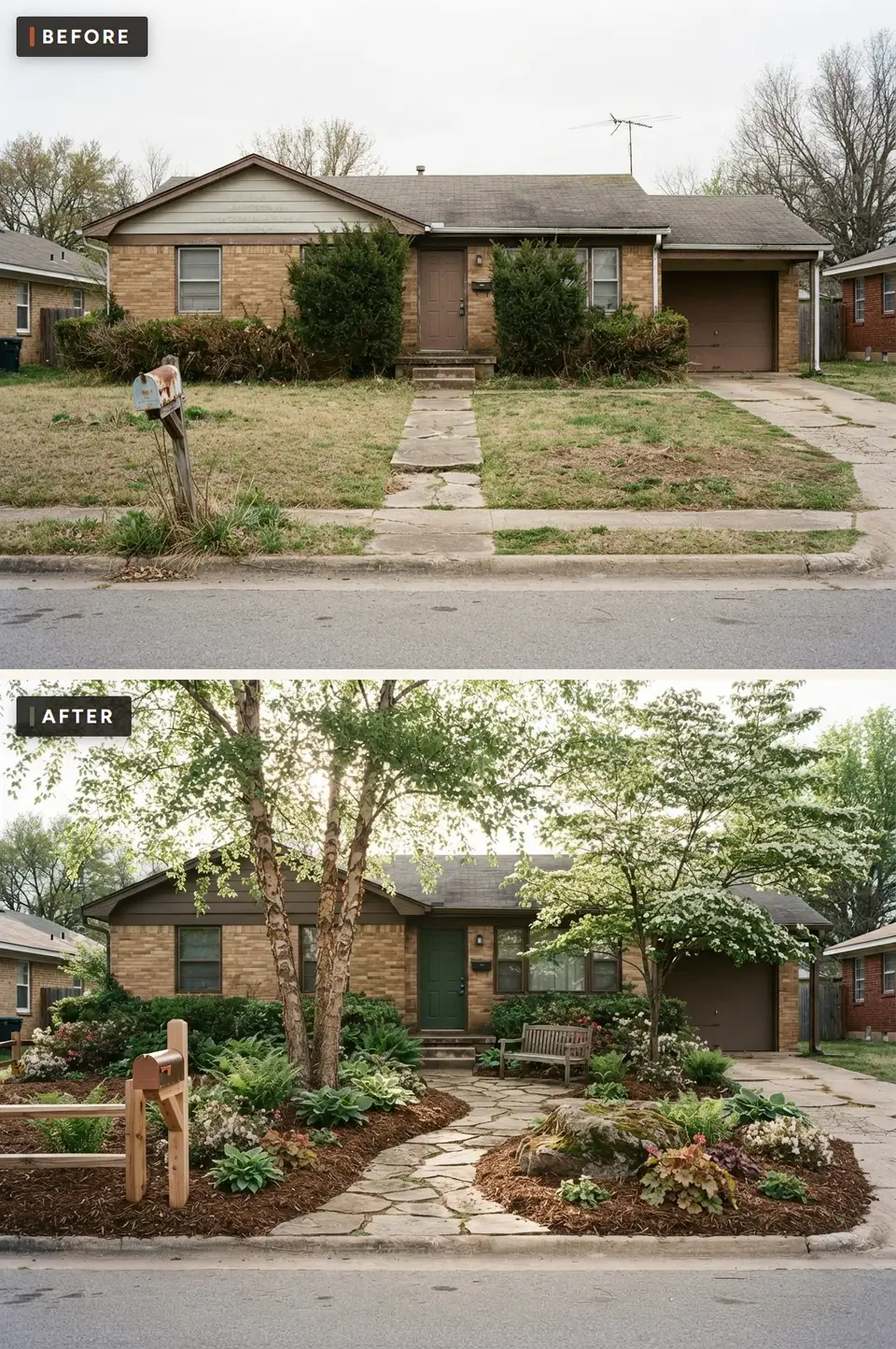
The woodland direction removes the lawn entirely and replaces it with a young forest edge. Two multi-stem river birches and a flowering dogwood form a light canopy, and beneath them a shredded-bark ground layer is planted with ferns, hostas, coral bells and native azaleas. A curving flagstone path leads to the door, a moss-covered boulder anchors the right-hand bed, a cedar bench sits by the entry and a short run of split-rail fence at the corner holds a natural cedar mailbox post. The brick stays natural, the trim is painted dark bronze and the door is forest green.
It is the most ecological of the ten and, once established, one of the cheapest to keep: no mowing, no weekly edging and only an annual top-up of mulch. The trees will shade the front rooms in summer and let the winter sun through after leaf fall, which on a west- or south-facing ranch is a real comfort benefit. The trade-off is patience. It takes three growing seasons for a woodland garden to fill in, and the first year it can look sparse between the plants.
Color Palette
SW Black Bean
#403330
Dark bronze-brown that lets the brick and the planting lead
BM Salamander
#353D35
Deep forest green, almost black in shade
Tennessee Flagstone
#8C8274
Irregular slabs set in stone dust with moss in the joints
Layer Shredded Hardwood Mulch
#5A4030
Laid 2 to 3 inches deep, kept away from stems and trunks
Styling Notes for This Look
- River birch (Betula nigra, zones 4 to 9) and flowering dogwood (Cornus florida, zones 5 to 9) are both native to the Southeast and tolerate its clay soils.
- Native azaleas such as the Florida flame azalea (Rhododendron austrinum) and piedmont azalea (R. canescens) bloom before the canopy leafs out.
- Christmas fern (Polystichum acrostichoides) is evergreen and native in zones 3 to 9; mix it with hostas so the bed is not bare in winter.
- Plant birches 15 feet or more from the foundation and from the driveway; their roots are thirsty and their canopy spreads 40 feet.
Drought-Tolerant Xeriscape: Gravel, Agave and Corten Steel
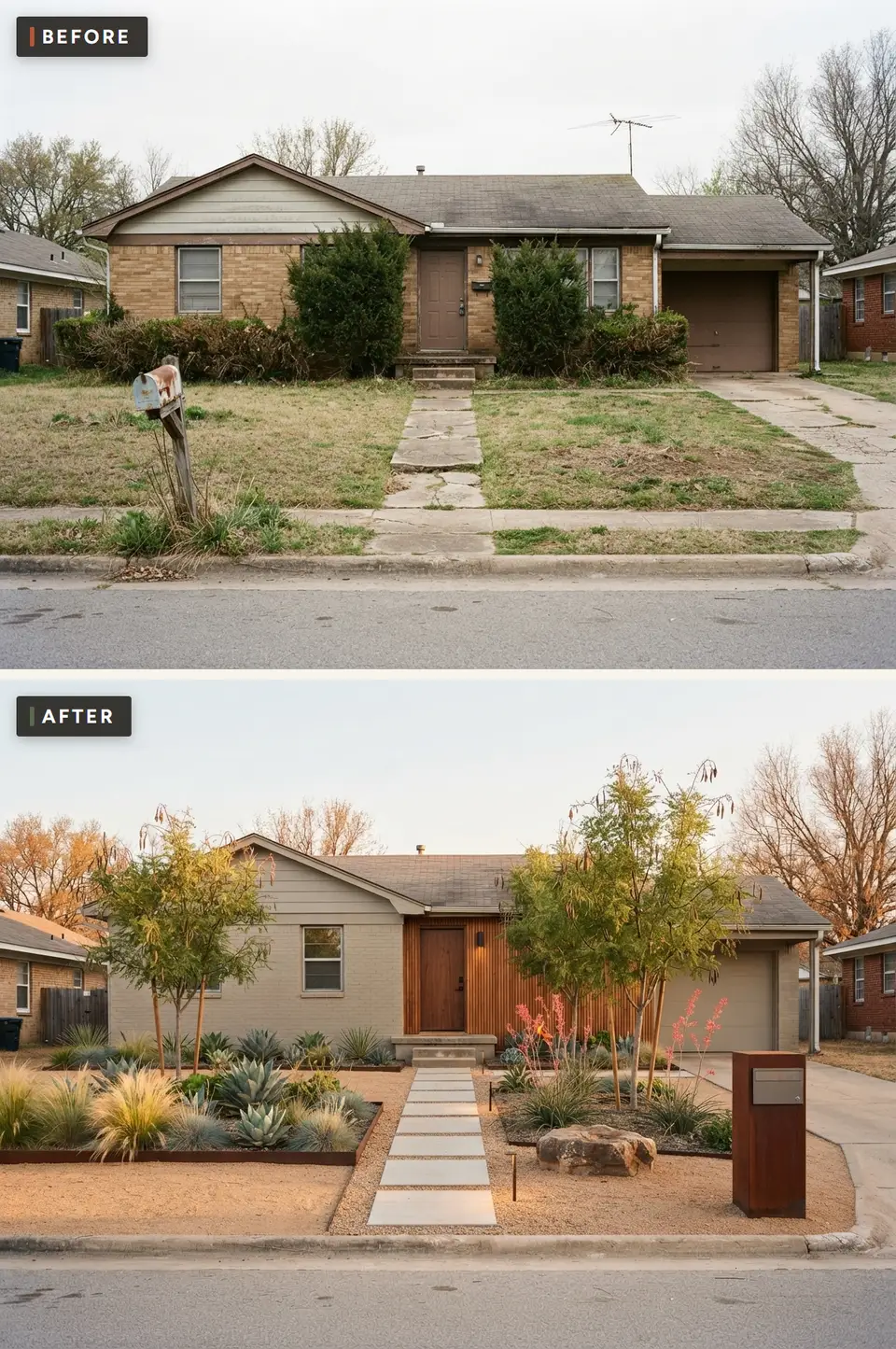
The xeriscape direction trades turf for decomposed granite and a planting of ornamental grasses, agave, yucca and red yucca. Large square concrete steppers set in the gravel form the walk, a low Corten steel edge separates the beds from the sidewalk, a single large boulder sits in the left-hand bed and three multi-trunk desert willows give height and a light, moving shade. A monolithic Corten mailbox stands at the drive. The brick is painted a warm greige, a vertical wood-slat panel frames a new walnut door and warm LED path lights run up the walk.
In the arid West this would be the default. In the Southeast it needs honest adjustment: our problem is rarely drought for months on end but heavy rain on heavy clay. The design works where the lot is sunny and drains well, and it asks for a proper gravel base, amended planting pockets and plants chosen for wet winters. Done that way, it cuts irrigation to almost nothing after establishment and it is among the lowest-maintenance front yards on the list.
Color Palette
SW Agreeable Gray
#D1CBC1
Warm greige in a breathable masonry coating
#6B4A32
Oiled hardwood door with a cedar slat surround
Plane Decomposed Granite
#C9A77C
Stabilized DG, 3 inches over compacted base and filter fabric
Corten Steel
#8A4B2A
Weathering steel that rusts to a stable brown within months
Styling Notes for This Look
- Pick plants that tolerate wet winters: red yucca (Hesperaloe parviflora, zones 5 to 10), Adam's needle (Yucca filamentosa, a native, zones 4 to 10) and Agave parryi (hardy to about zone 7).
- Desert willow (Chilopsis linearis) needs sharp drainage and suits zones 7b to 9; on heavy clay use chaste tree (Vitex agnus-castus, zones 6 to 9) for the same airy shape and summer flowers.
- Corten stains concrete as it weathers. Set it back a few inches from the sidewalk or on a gravel strip.
- Check your HOA covenants before removing turf; some Southeast subdivisions still require a percentage of lawn.
Mid-Century Modern: Breeze Block, an Orange Door and Offset Pavers
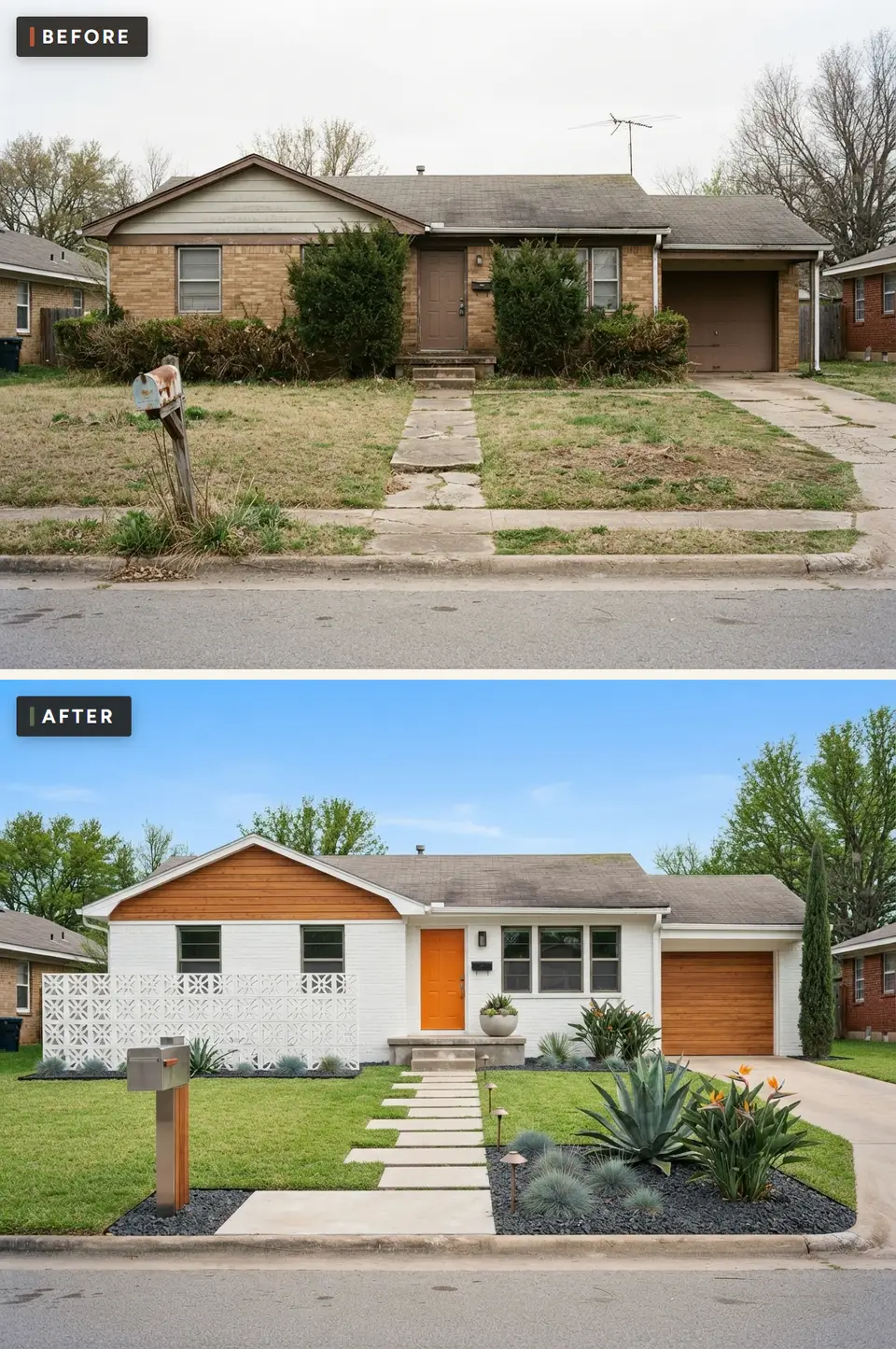
A 1970s ranch is only a decade or two away from the mid-century houses this style came from, which is why this direction feels so natural on it. The walk is a series of offset concrete rectangles crossing the lawn in a zigzag, a white breeze-block screen wall stands in front of the left-hand window, and the sided gable is re-clad in warm cedar boards. The door is painted bright orange and the garage door is replaced with a warm wood panel door, so the house has two warm blocks of colour against white painted brick.
The planting sits in crisp beds of black lava rock: blue fescue, agave and bird of paradise, with a tall slender cypress at the right corner and a round concrete planter by the door. A stainless-and-wood modern mailbox and low mushroom path lights finish it. The lawn stays, which keeps maintenance close to what the owners had before. It is a graphic, cheerful front yard, and on the right street it is the one that makes people slow down.
Color Palette
BM Simply White
#F4F2EA
Bright, warm white that suits the orange and cedar
SW Obstinate Orange
#D7552A
Saturated orange in exterior gloss, the single strong colour
#B4703E
Clear cedar with a UV-protective penetrating oil
Black Lava Rock
#2E2B29
Crushed volcanic rock, 2 inches over landscape fabric
Styling Notes for This Look
- Bird of paradise (Strelitzia reginae) is hardy only in zones 10 to 12. In most of the Southeast use it as a summer container plant or swap in a hardy canna.
- Blue fescue struggles in humid heat. Blue muhly or 'Blue Dune' lyme grass holds the colour better in zones 7 to 9.
- Italian cypress (zones 7 to 10) gives the vertical accent; on coastal lots, a columnar juniper handles salt better.
- Breeze block walls over about 4 feet need a footing and reinforcement; check local code before building one.
Japanese-Inspired Garden: Raked Gravel, a Black Pine and a Red Maple
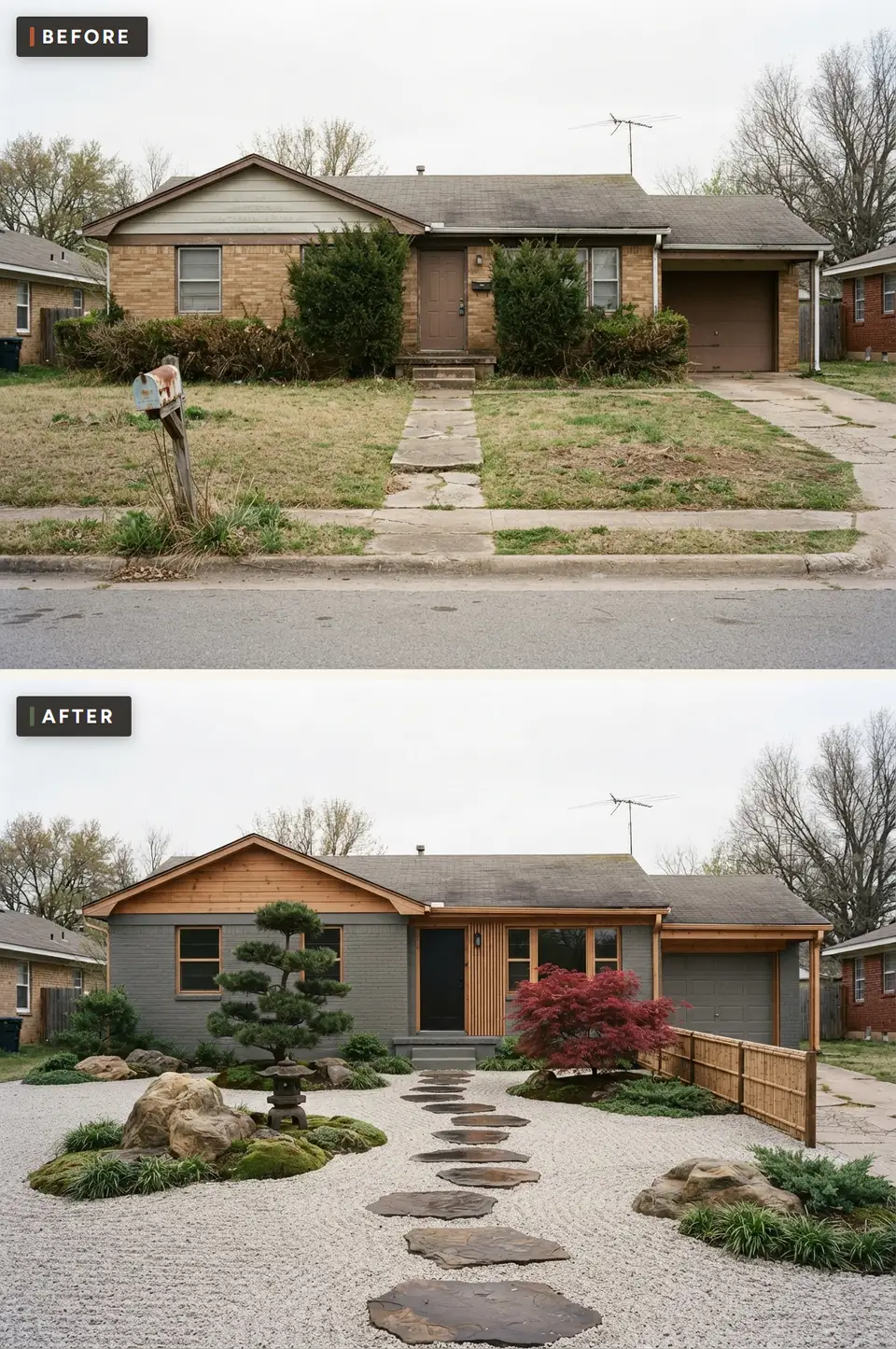
The Japanese-inspired direction replaces the lawn with raked pale gravel and treats the front yard as one composed view. A meandering path of large stone slabs crosses the gravel to the door, moss mounds and weathered boulders form islands, a cloud-pruned black pine anchors the left side and a red Japanese maple glows on the right. A stone lantern sits among the boulders, and a low bamboo fence along the driveway edge closes the composition. The brick is painted soft charcoal, the gable and trim are clad in natural cedar, a wood-slat screen stands beside the entry and the door is black.
This is the most crafted of the ten directions and the one that most depends on the installer. The boulders need to be set a third of their depth into the ground so they look like they grew there, the pine needs annual candle pruning, and the gravel needs raking to stay crisp. Done well, it turns an ordinary ranch into the calmest house on the street, and it is a strong choice for a small front yard where every square foot is on view.
Color Palette
BM Kendall Charcoal
#686865
Soft charcoal in masonry paint, never pure black on brick
#A96F45
Cedar boards with a clear penetrating stain
Plane Pale Granite Gravel
#D8D4CA
Angular 3/8-inch gravel, 2 to 3 inches deep so it rakes cleanly
Japanese Maple Red
#8E2A25
One red tree against a field of green, grey and cedar
Styling Notes for This Look
- Japanese black pine (Pinus thunbergii, zones 6 to 8) tolerates salt spray, which makes it a good coastal choice; it needs yearly pruning to keep the cloud shape.
- Japanese maples (Acer palmatum, zones 5 to 8) need afternoon shade in the Southeast or their leaves scorch by August.
- Dwarf mondo grass (Ophiopogon japonicus 'Nana', zones 6 to 10) stands in for moss where the bed gets too much sun for moss to survive.
- Bury the gravel edge: a hidden steel or stone edge stops the gravel migrating into the driveway.
Mediterranean Courtyard Front: Stucco, Terracotta and an Iron Gate
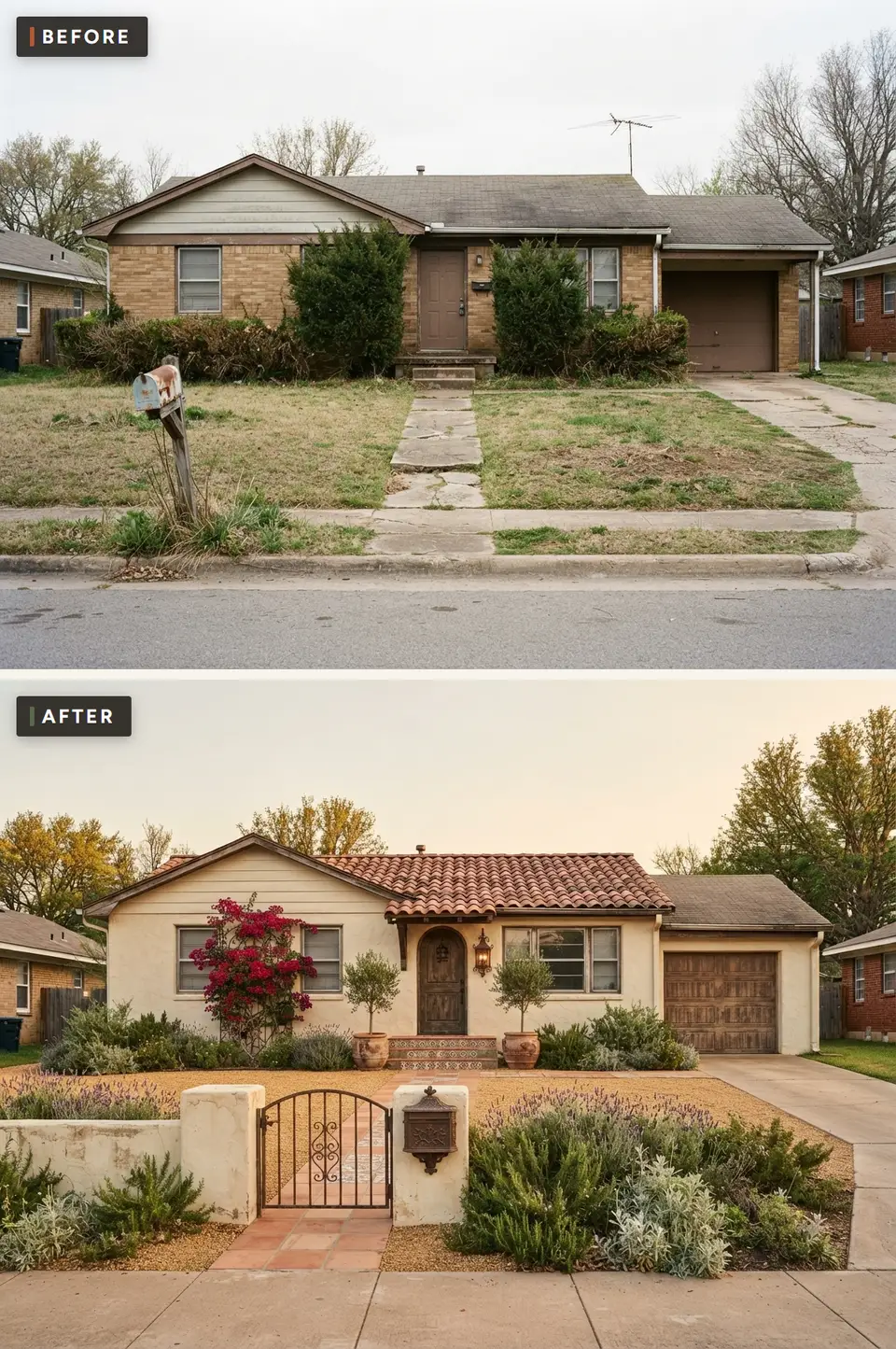
The Mediterranean direction turns the front yard into a walled forecourt. A low cream stucco wall runs along the sidewalk with a wrought-iron gate at its centre, and a terracotta-paver walk leads through a gravel court to painted tile risers at the step. Beds of lavender, rosemary and silver santolina fill the ground, two olive trees stand in large terracotta pots at the door and a magenta bougainvillea climbs the facade. The brick is stuccoed in warm cream, the door becomes an arched wood door and an iron lantern hangs beside it.
It is the most transformative direction and the most invasive. In the photo the main roof has also been re-covered in clay barrel tile, which is not a landscaping project at all — clay tile is heavy, and adding it to a house framed for shingles needs an engineer's look at the rafters first. Without the roof, the stucco, wall and planting alone still give a strong Mediterranean read. It suits hot, sunny coastal lots best, where the silver-leaved plants thrive and the gravel stays dry.
Color Palette
Warm Cream Stucco
#E9DCC0
Three-coat or acrylic finish over lath, hand-troweled texture
#B8663F
Saltillo-style pavers sealed for outdoor use, clay pots
#3B2A20
Arched hardwood door, black-brown iron gate and lantern
#A7AE9C
Lavender, rosemary and santolina in silver and grey-green
Styling Notes for This Look
- Olive trees (Olea europaea) are reliable in zones 8b to 10; in colder areas keep them in pots that can move into a garage for hard freezes.
- Bougainvillea is hardy only in zones 9b to 11. North of that, grow it in a large pot and overwinter it indoors, or use crossvine, a native, on the wall.
- Stucco over old brick needs metal lath and a weep screen at the base so moisture can escape; never trap it against the brick.
- Rosemary (zones 7 to 10) and santolina (zones 6 to 9) need fast drainage — plant them slightly high on amended soil.
Formal French Parterre: Boxwood Knots, a Fountain and Standard Trees
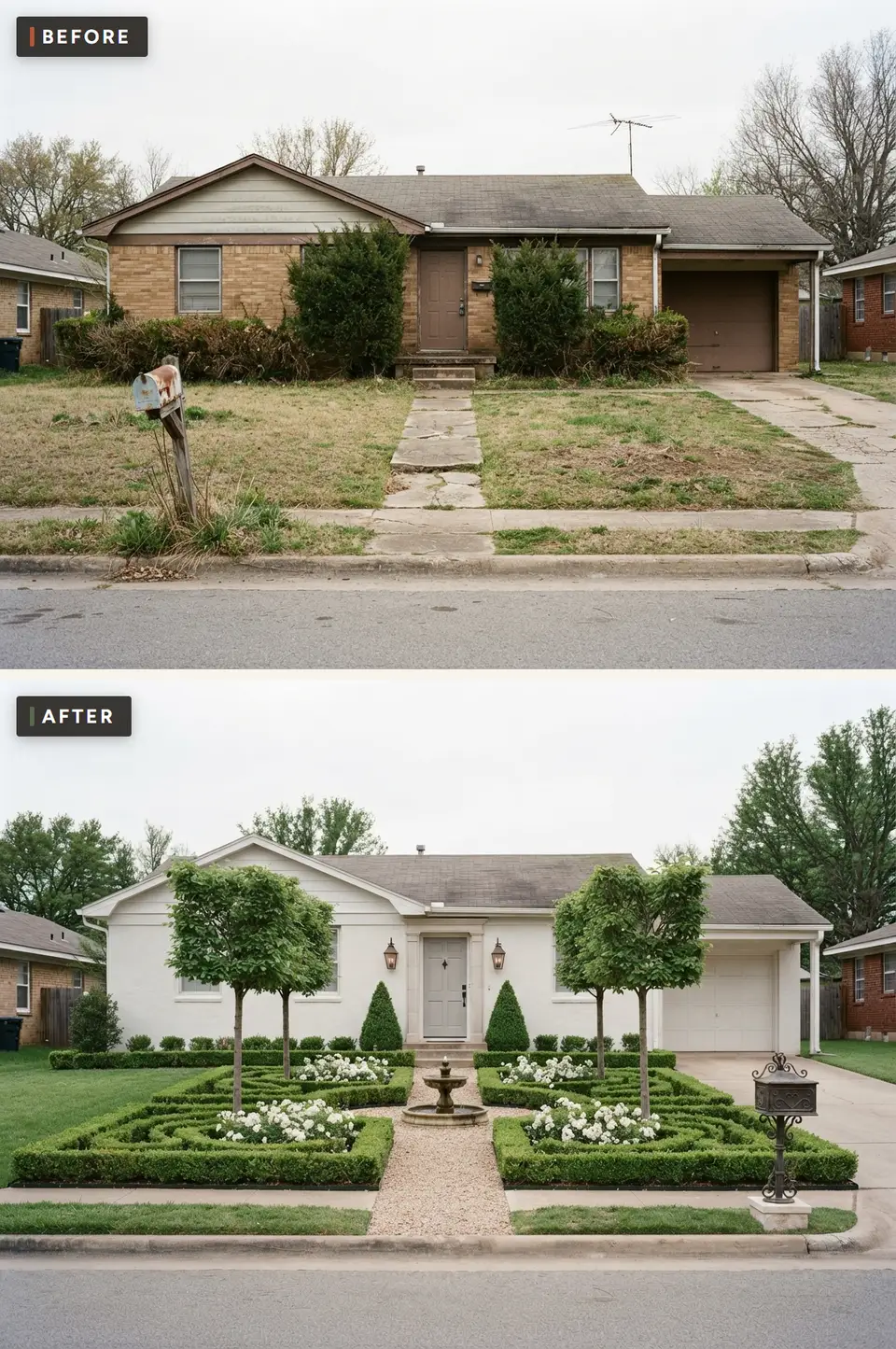
The parterre is the most formal answer to a ranch and, surprisingly, one of the most successful, because a long, low, symmetrical house is exactly the backdrop a parterre needs. The lawn is replaced by two mirrored beds of low clipped boxwood worked into a knot pattern and filled with white roses, divided by a central pea-gravel walk with a small tiered stone fountain in the middle. Two standard trees on clear stems frame the beds, and cone-shaped evergreens stand either side of a pale grey front door with a classical surround.
The brick is limewashed soft white, iron lanterns flank the door and an ornate iron mailbox sits on a stone plinth at the drive. This is a high-maintenance garden in the literal sense: every hedge in it is clipped two or three times a year, and the pattern only reads if the lines stay sharp. It rewards owners who enjoy that kind of work, and it gives an ordinary ranch the kind of presence that is usually reserved for much larger houses.
Color Palette
Limewash Soft White
#EFEBE2
Mineral limewash that lets some brick texture show through
Farrow and Ball Pigeon
#A2A59B
Pale grey-green in exterior eggshell, classical surround in white
#CFC3AA
Rounded 3/8-inch gravel over a stabilizing grid
#3D5A34
Dark clipped green holding white 'Iceberg' or similar roses
Styling Notes for This Look
- For the knot hedges, choose a blight-resistant boxwood such as the NewGen series or use dwarf yaupon holly; losing one section ruins the pattern.
- Yews dislike Southeastern heat and wet clay. Podocarpus macrophyllus (zones 7 to 10) shears into the same cone shape and survives it.
- Keep the fountain small and recirculating, with a GFCI-protected outlet installed by an electrician.
- Pea gravel rolls underfoot; set it in a honeycomb stabilizing grid so the walk feels firm.
Pro Tips for Front Yard Landscaping That Lasts
Whatever style you choose, these are the working rules that decide whether a new front yard still looks good in five years:
- Call 811 before you dig. The call or online request is free, and utilities will mark buried lines within a few business days (three full working days in South Carolina). Gas, power and fiber lines commonly run under exactly the strip between the house and the street.
- Slope soil away from the house. The International Residential Code asks for the grade to fall at least 6 inches within the first 10 feet from the foundation. New beds built up against the brick often reverse that slope and send water under the slab.
- Keep mulch 2 to 3 inches deep and off the brick. Pull it a few inches back from trunks and stems — mounded "volcano" mulch rots bark — and keep mulch and soil well below the weep holes and any siding.
- Plant for the size on the label, not the size in the pot. Foundation shrubs go at least 3 feet off the house and should mature below the windowsills; this is what went wrong with the two shrubs in the before photo.
- Light the walk, not the sky. Warm 2,700 to 3,000 K fixtures, spaced roughly 6 to 8 feet apart and staggered, read as welcoming; fixtures pointed up into the trees add glare for the neighbors.
- Set the mailbox where the carrier needs it. USPS guidance puts the bottom of a curbside box 41 to 45 inches above the road and 6 to 8 inches back from the curb.
- Make the house number readable. The IRC requires address numbers at least 4 inches high, contrasting with their background and visible from the street — a small detail that also helps emergency services.
- Group plants by water need. EPA WaterSense notes that outdoor use accounts for roughly 30 percent of household water, and much of it is lost to overwatering; drip irrigation in beds and separate zones for lawn save the most.
Regional Fit Across the Southeast
Most of the Southeast falls between USDA hardiness zones 7a in the mountains and 9b on the Gulf and Atlantic coasts, and front yard landscaping ideas need adjusting across that range. On the coast — Charleston, Savannah, Wilmington — the challenges are salt spray, sandy soil and summer humidity. The Southern traditional, Mediterranean and Japanese directions travel best there, with Japanese black pine, yaupon holly, muhly grass, palmetto and podocarpus all tolerating salt. Warm-season turf such as St. Augustine or zoysia replaces the cool-season grasses that look so fine in magazine photos but fade in a Lowcountry July.
In the Piedmont — Greenville, Charlotte, Atlanta, Raleigh — heavy red clay is the constant. Amend planting holes broadly rather than deeply, set shrubs slightly high so their root flare sits above grade, and favour the modern farmhouse, woodland native and English cottage directions, whose plants handle clay. Bermuda and zoysia lawns are the norm, with centipede grass a lower-input option. In the mountains of western North Carolina and east Tennessee, zones 6b to 7a allow true hornbeams and yews but rule out olives, agave parryi in wet sites and bougainvillea. Florida, at the other end, is the one place in the region where the xeriscape, mid-century and Mediterranean plant lists work exactly as drawn. For your specific county, your state extension service — Clemson HGIC, UGA Extension, NC State Extension or UF/IFAS — publishes free plant lists and soil tests that are more useful than any national guide.
What Each Direction Actually Costs
These are my working 2026 ranges for professional installation on this typical ranch lot, a front yard about 60 feet wide and 30 feet deep with the driveway excluded, in Southeast markets. They include design, removal of old shrubs and turf, soil preparation, hardscape, plants, mulch or gravel, basic lighting and a new mailbox. Charleston, Atlanta and Nashville sit at the top of each range; Greenville, Augusta and Columbia sit at the bottom. Painting or limewashing the brick is priced separately below because many owners do it at a different time.
| Direction | Budget Range | Main Cost Driver |
|---|---|---|
| Woodland Native Garden | $7,500 - $16,000 | Multi-stem trees, flagstone path, mass planting |
| Modern Minimalist | $8,500 - $17,000 | Large concrete pavers, columnar trees, matched spheres |
| English Cottage Garden | $9,000 - $19,000 | Picket fence and arbor, brick path, perennial borders |
| Modern Farmhouse | $9,500 - $19,000 | Bluestone walk, board fence, hydrangea band |
| Mid-Century Modern | $10,500 - $21,000 | Breeze block wall and footing, cedar gable cladding |
| Drought-Tolerant Xeriscape | $11,000 - $23,000 | Turf removal, stabilized DG, boulders, Corten edging |
| Southern Traditional | $11,000 - $22,000 | Herringbone brick walk, boxwood hedging, shutters |
| Japanese-Inspired Garden | $13,000 - $28,000 | Specimen pine and maple, boulder setting, stone slabs |
| Formal French Parterre | $15,000 - $30,000 | Hundreds of hedge plants, fountain and electrical |
| Mediterranean Courtyard | $16,000 - $34,000 | Stucco over brick, stucco wall and gate (roof extra) |
Separate line items: painting a ranch of this size in a breathable masonry paint runs about $4,000 to $8,000, and limewash about $3,500 to $7,000. Specimen trees are the fastest way to overshoot a budget — a 12-foot sculpted black pine can cost more than the rest of the Japanese planting combined. For cheap, simple front yard landscaping ideas, the most effective under-$3,000 version of any direction on this list is the same: remove the overgrown shrubs, reset or replace the walk, plant one tree and a low foundation band, mulch everything and replace the mailbox and house numbers.
Frequently Asked Questions
What is the cheapest way to landscape a front yard?
Remove overgrown shrubs, edge and mulch the existing beds 2 to 3 inches deep, plant a low band of foundation shrubs and one small tree, and replace the mailbox and house numbers. On a typical ranch that costs well under $3,000 in materials and a few weekends of work, and it delivers most of the curb appeal of a full redesign.
How do you landscape the front of a ranch house?
Keep planting low under the long run of windows, add vertical interest with one to three trees or upright shrubs set well away from the foundation, and give the entry a clear, generous walk at least 4 feet wide. Ranch houses are long and low, so the landscape's job is to add height at the ends and draw attention to the door in the middle.
What are low-maintenance plants for a front yard in the Southeast?
Dwarf yaupon holly, 'Annabelle' and panicle hydrangeas, muhly grass, Christmas fern, native azaleas, red yucca and dwarf mondo grass all handle Southeast heat with little care once established. Choose plants rated for your USDA zone, group them by water need and mulch the beds to cut weeding.
How far from the house should foundation plants be?
Plant shrubs at least 3 feet from the foundation, measured from the wall to the centre of the plant, and further for anything that grows wider than 4 feet. Medium trees belong at least 15 to 20 feet away. This keeps air moving along the wall, keeps roots away from the slab and stops plants covering the windows as they mature.
How much does front yard landscaping cost in 2026?
For a typical ranch front yard of about 60 by 30 feet in the Southeast, professional installation runs roughly $7,500 to $34,000 depending on the style, with most directions between $9,000 and $23,000. Hardscape — walks, walls and fences — and specimen trees are the biggest variables; plants and mulch are usually the smallest part of the bill.
Can I replace my front lawn with plants or gravel?
Usually yes, but check HOA covenants and any city rules first, since some subdivisions require a share of turf. Gravel and native planting cut mowing and watering, but in the Southeast they need good drainage, a proper base under the gravel and plants that tolerate wet winters as well as dry summers.
Should I paint my brick ranch before landscaping?
Paint first if you plan to paint at all. Painters need access to the walls, and new foundation plants and mulch get trampled during the work. Use a breathable masonry paint or limewash so moisture can leave the brick, and choose the planting palette after you have seen the new colour on the house.
Sources and References
- USDA Plant Hardiness Zone Map (2023) — zone ranges used for every plant recommendation above.
- Clemson Cooperative Extension, Home & Garden Information Center — fact sheets on foundation planting, mulching depth, crepe myrtle pruning and boxwood blight in South Carolina.
- University of Georgia Extension — landscape plant selection, soil testing and water-wise landscaping for Georgia's Piedmont and Coastal Plain.
- NC State Extension Gardener Plant Toolbox — native plant characteristics, mature sizes and site requirements for the Southeast.
- U.S. EPA WaterSense — Outdoor Water Use — household outdoor water use figures and guidance on efficient irrigation and plant grouping.
- 811 / Common Ground Alliance — the national call-before-you-dig service and state notice requirements for marking buried utilities.
- International Residential Code (IRC) 2021, Sections R401.3 and R319 — lot grading away from foundations and address identification requirements.
- United States Postal Service — Curbside Mailbox Guidelines — height and setback recommendations for roadside mailboxes.
Final Thoughts
Ten directions from the same tired 1970s ranch, and not one of them needed a new roofline, a bigger porch or a different window. What they needed was a walk that leads somewhere, foundation planting that stays below the sills, a tree or two to lift a long, low house, and a door worth walking toward. Those four moves are the backbone of every good front yard, and the style is what you hang on them.
If you want to go further on the house itself, our eleven ranch facade makeovers work through paint, siding and porch changes on a similar house, and eleven painted brick house ideas goes deep on the colour decision that sits behind most of the directions above. For a broader view of the whole front elevation, thirteen curb appeal ideas for one beige house shows how far the same method can go.
Start with the direction that suits how much time you want to spend outside on a Saturday in July. The rest is planting.

Elise Marchetti
Transformations Editor · Charleston, South CarolinaBefore-and-after projects with the invoices attached. Elise runs the Transformations desk — interiors, exterior facades and outdoor spaces across the Lowcountry and the wider South — and writes up what actually changed, what it cost, and which three decisions moved the room.
More from Elise →
Reader notes