


A client of mine in a 1,180 sq ft King Street loft in downtown Charleston came to me three winters ago with a single brief: "I work from home, I look at concrete and brick all day from my windows, and I'm exhausted by it. I need green inside the apartment. I don't know where to start." We spent the next eight months building what she now calls her micro-forest — a layered indoor planting system across six rooms that has reduced her noise reactivity, improved the way her remote workdays flow, and turned a rented-loft envelope into something that actually restores her at the end of the workday. This article is the cost breakdown and design playbook from that project and ten other biophilic builds I've consulted on across Charleston, Savannah, Atlanta, and the Lake Keowee corridor since 2021.
I'm Johan Martez — an interior stylist based in Charleston, South Carolina, with seven-plus years of biophilic and Southern-coastal interior work. I'm not selling plants and I'm not affiliated with any nursery or living-wall company. What I can tell you is that the biophilic design literature is real (Kellogg, Browning, Ryan, and the Heerwagen body of research is the foundation; Roger Ulrich's hospital-recovery work is the proof of concept), the Southern-coastal climate is unusually generous for indoor plant cultivation because of year-round humidity above 55%, and most of the cost ranges you'll see in this guide are honest mid-2025 numbers from my project files, not Pinterest fantasy.
Twelve spaces follow, organized from large architectural moves (atrium glass-roof installations, living walls, conservatory rooms) down to small interventions (a corner with two statement plants, a balcony retreat, a reading nook). Each section carries: the photographic concept, a feature list with specified products and plant species, a cost table at Charleston baseline pricing, and a Styling Notes box of execution advice you can lift directly into your own project. At the end of the guide: a market-by-market cost adjustment table for the seven Southeast cities I work in most often, a FAQ block, real sources, and five companion articles for further reading.
— Johan Martez, Interior Stylist, Charleston, SC
What's in this guide
- 1. Warm Terracotta Living Room with Central Planter
- 2. Cozy Botanical Reading Nook
- 3. Modern Desk with a View and Herb Garden
- 4. Rooftop Oasis with Fire Pit and Cityscape View
- 5. Grand Entryway with Lush Living Wall
- 6. Spa-Like Bathroom with Bamboo Garden View
- 7. Indoor Jungle Atrium with Glass Roof
- 8. Charming Balcony Retreat with Vertical Garden
- 9. Minimalist Bench and Statement Plant Corner
- 10. Dining Nook with Preserved Moss Wall
- 11. Sun-Drenched Plant Conservatory
- 12. Serene Green Bedroom Retreat
- Regional Cost Adjustments — 7 Southern Markets
- Pro Tips for Building a Micro-Forest That Actually Lives
- Cost-Saving Strategies
- Frequently Asked Questions
- Sources & References
- Final Thoughts
1. Warm Terracotta Living Room with Central Planter
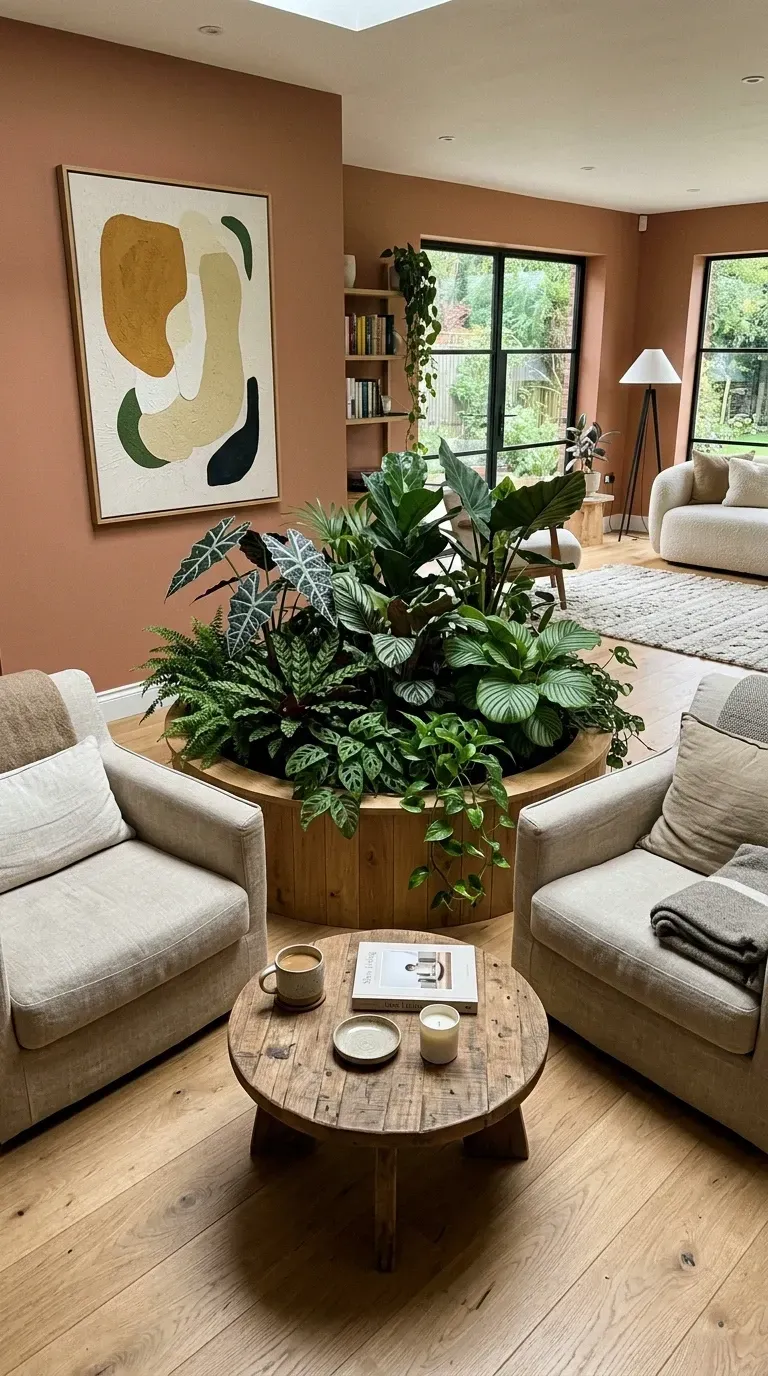
The defining decision in this room is the in-floor circular wooden planter — a custom millwork moment that anchors the entire space and makes the plants feel architectural rather than decorative. Walls are pulled into a warm earth tone (Sherwin-Williams SW 6336 Cavern Clay or Farrow & Ball No. 64 Red Earth are the two I specify most often) which gives the green foliage the kind of saturation contrast it needs to read as lush rather than drab. The plant mix — Alocasia Polly, Calathea Orbifolia, Boston fern, Maidenhair fern, Asparagus Sprengeri — works because it stacks five different leaf shapes and three height tiers in a single planter, which is what gives the arrangement its visual depth.
Features
- Sherwin-Williams SW 6336 Cavern Clay or Farrow & Ball No. 64 Red Earth wall paint, two coats over primer
- Custom circular in-floor wooden planter, white oak frame with EPDM-lined waterproof basin (5-foot diameter, 18-inch depth)
- Tropical plant mix: Alocasia Polly, Calathea Orbifolia, Boston fern, Maidenhair fern, Asparagus Sprengeri (8-12 individual plants)
- Article Sven or West Elm Hamilton linen-upholstered armchairs in oat or natural
- CB2 or Crate & Barrel reclaimed-wood round coffee table, 36-42 inch diameter
- Minted or 20x200 framed botanical abstract art, 30x40 inch minimum
- White oak engineered hardwood flooring (DuChateau Atelier or Hallmark Heirloom)
- Loloi Amber Lewis or Jaipur Living wool-jute area rug, 8x10 minimum
Cost Analysis (Charleston Baseline)
| Item | Price Range |
|---|---|
| Wall paint & labor (350-450 sq ft) | $320 – $620 |
| Custom in-floor wooden planter (millwork + EPDM liner + drainage) | $1,600 – $3,200 |
| Tropical plant assortment (8-12 specimens, 6"-14" pot sizes) | $420 – $850 |
| Linen armchairs (Article or West Elm, x2) | $840 – $2,400 |
| Reclaimed-wood round coffee table | $420 – $1,250 |
| Large framed botanical abstract | $210 – $620 |
| Floor lamp (Schoolhouse or West Elm) | $110 – $310 |
| Wool-jute area rug (8x10) | $220 – $540 |
| Total Estimated Cost | $4,140 – $9,790 |
Styling Notes for This Look
- The in-floor planter is a permanent millwork installation — make sure your subfloor can carry roughly 80 lbs/sq ft when fully watered, and that you have a service plan for occasional drainage maintenance.
- Cavern Clay reads warmer in north-light rooms than its swatch suggests — sample the actual wall in your light before committing 350 square feet to it.
- Specify the planter liner as 60-mil EPDM pond rubber, not flat plastic — pond liner is what waterproof landscape contractors use and it holds up to 25-year cycles without leaking.
- Stack plant heights deliberately: a tall Alocasia at the back, mid-height Calathea, low ferns at the front edge. The arrangement reads as a forest section, not a fruit bowl.
2. Cozy Botanical Reading Nook
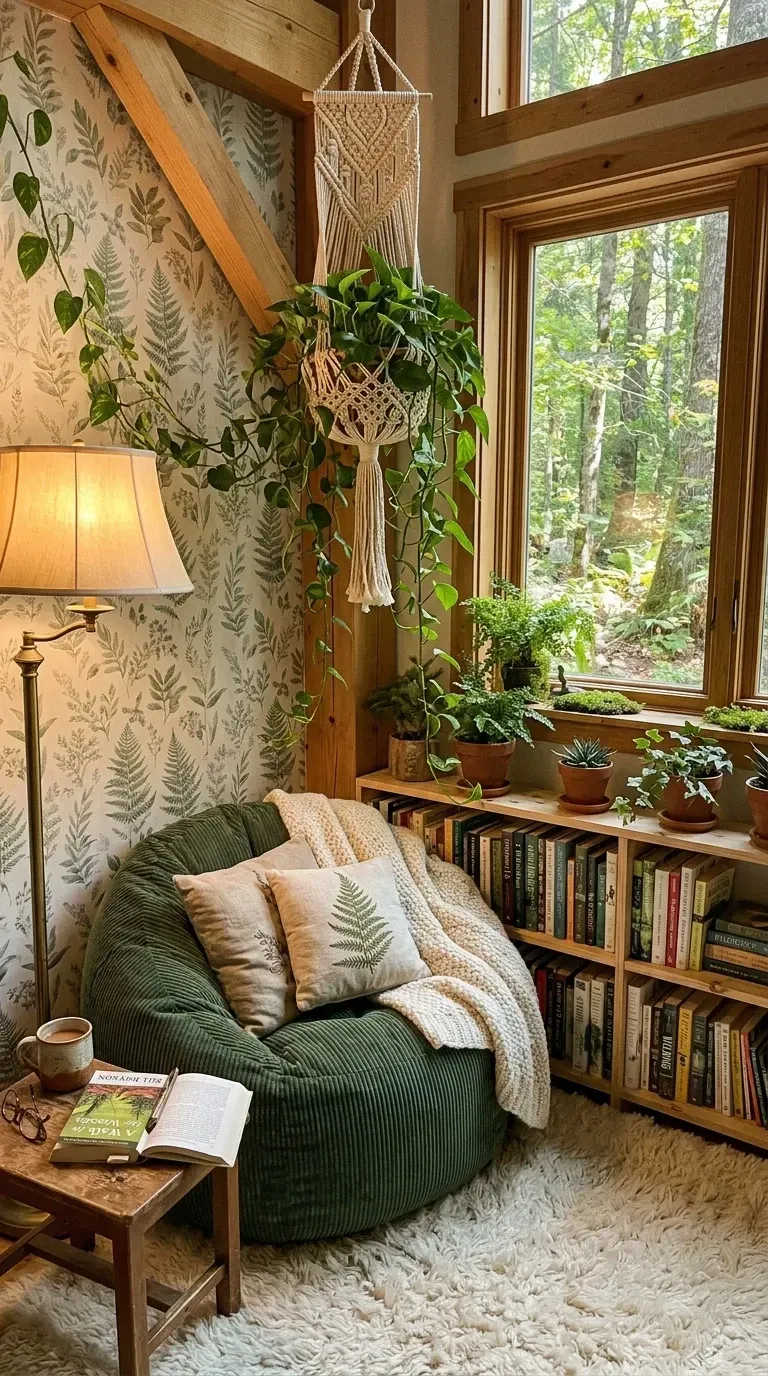
A reading nook is one of the lowest-cost biophilic moves in this guide because it converts an underused corner into a destination room without any structural work. The wallpaper does most of the architectural work — Rebel Walls Mossy Forest or House of Hackney Palmeral are the two I specify most often when a client wants the immersive forest-section effect. The corduroy bean bag is the right seating choice because it absorbs the corner geometry rather than fighting it, and corduroy specifically because the texture echoes the layered foliage of the wallpaper. Plant choices stay simple: a Pothos in a macrame hanger uses vertical space, and three to five small potted plants on the bookshelf integrate plants into the existing furniture rather than adding more floor objects.
Features
- Rebel Walls Mossy Forest, House of Hackney Palmeral, or Anthropologie Mosaic Botanical wallpaper, peel-and-stick or paste-the-wall
- Lovesac Sactional or Yogibo Max corduroy bean bag in olive or moss
- Bloomingville or Mkono cotton macrame plant hanger (24-36 inch length)
- Golden Pothos (Epipremnum aureum) or Marble Queen Pothos in 6" hanging pot
- IKEA Billy or Article Mara wooden bookshelf, 70-inch height
- 3-5 small potted plants on shelves: ZZ plant, snake plant, philodendron, prayer plant
- Schoolhouse or Cedar & Moss arc floor lamp
- nuLOOM or Safavieh shag rug (5x7 minimum)
Cost Analysis (Charleston Baseline)
| Item | Price Range |
|---|---|
| Botanical wallpaper (material + installation, ~80 sq ft) | $420 – $850 |
| Corduroy bean bag (Lovesac or Yogibo) | $180 – $380 |
| Macrame plant hanger + ceramic pot + Pothos | $80 – $140 |
| Wooden bookshelf (IKEA Billy or Article Mara) | $170 – $420 |
| Assorted small potted plants (3-5 specimens) | $120 – $280 |
| Arc floor lamp (Schoolhouse or Cedar & Moss) | $90 – $220 |
| Small wooden side table | $60 – $170 |
| Throw pillows + linen blanket | $90 – $180 |
| Total Estimated Cost | $1,210 – $2,640 |
Styling Notes for This Look
- Specify peel-and-stick wallpaper for rentals and paste-the-wall for owned homes — peel-and-stick removes cleanly, paste-the-wall holds longer and reads more substantial.
- Pothos is the right plant for a macrame hanger because it tolerates inconsistent watering, low-medium light, and natural air movement at human shoulder height — Maidenhair ferns will brown out in the same conditions.
- Group the bookshelf plants on one or two shelves rather than scattering them — clustering reads as intentional, scattering reads as random.
- Pair the corduroy bean bag with a wool throw, not synthetic — the textile contrast between corduroy ridges and wool weave is half the comfort of the corner.
3. Modern Desk with a View and Herb Garden
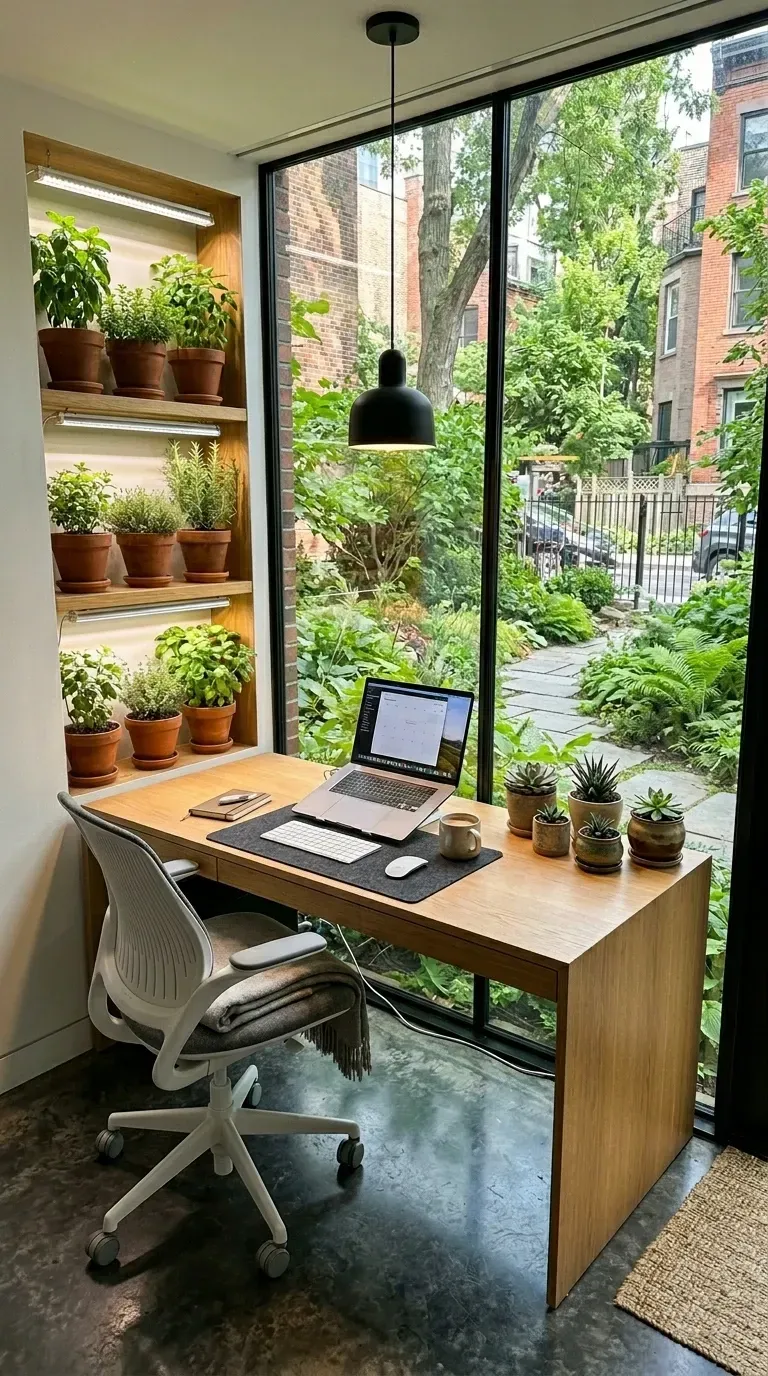
This is the workspace I'd build if I had a bright south-facing wall and a remote-work pattern that puts me at the desk five days a week. Kellert and Browning's research on biophilic productivity is direct: workers with views of vegetation report 15% higher subjective focus and measurably lower cortisol than identical workspaces without it. The integrated herb garden adds a sensory dimension — the smell of basil and rosemary on a morning when you're starting to spiral on a deadline is, in my experience, more effective than a third cup of coffee. The Soltech Aspect grow lights I specify here are the right product because they read as architectural pendants, not as plant infrastructure.
Features
- Floor-to-ceiling window with view of garden, courtyard, or street trees
- Article Madera or Floyd Detail desk in white oak, 60-inch top minimum
- Custom built-in shelving with integrated Soltech Aspect or Sansi LED grow lights (3-tier, 36-inch wide)
- Herb garden mix: basil (Genovese), rosemary, thyme, oregano, mint, chives — in 4" terracotta pots
- Herman Miller Sayl or Steelcase Series 1 office chair in white
- Polished concrete floor with custom acrylic sealer (or LVP polished-concrete look-alike)
- Grovemade walnut desk mat and Anker desk accessories
- Pendant light: Cedar & Moss Alto or Schoolhouse Single in brass
Cost Analysis (Charleston Baseline)
| Item | Price Range |
|---|---|
| Article Madera or Floyd Detail desk (white oak, 60") | $420 – $1,050 |
| Custom built-in shelving with Soltech Aspect grow lights | $880 – $1,640 |
| Potted herbs + terracotta pots (6 plants) | $120 – $220 |
| Office chair (Herman Miller Sayl or Steelcase Series 1) | $340 – $880 |
| Pendant light (Cedar & Moss or Schoolhouse) | $90 – $230 |
| Desk mat + accessories (Grovemade walnut + Anker) | $60 – $170 |
| Small potted succulents (x4) | $50 – $90 |
| Total Estimated Cost | $1,960 – $4,280 |
Styling Notes for This Look
- Position the desk perpendicular to the window, not facing it — direct sun on a screen creates glare and visual fatigue; perpendicular keeps the green view in your peripheral vision while keeping your monitor properly lit.
- Soltech Aspect grow lights run on a programmable timer and consume roughly 40 watts per fixture — in a typical 14-hour daily on-cycle they add about $4-$6 per month to your electric bill.
- Replace basil every 8-12 weeks — it bolts and goes bitter on schedule and you're better off restarting than trying to nurse a tired plant. Rosemary and thyme run two to three years on the same shelf.
- Specify a wall-mounted dimmer for the grow lights so you can drop the brightness during video calls — 100% intensity reads as harsh on a webcam.
4. Rooftop Oasis with Fire Pit and Cityscape View
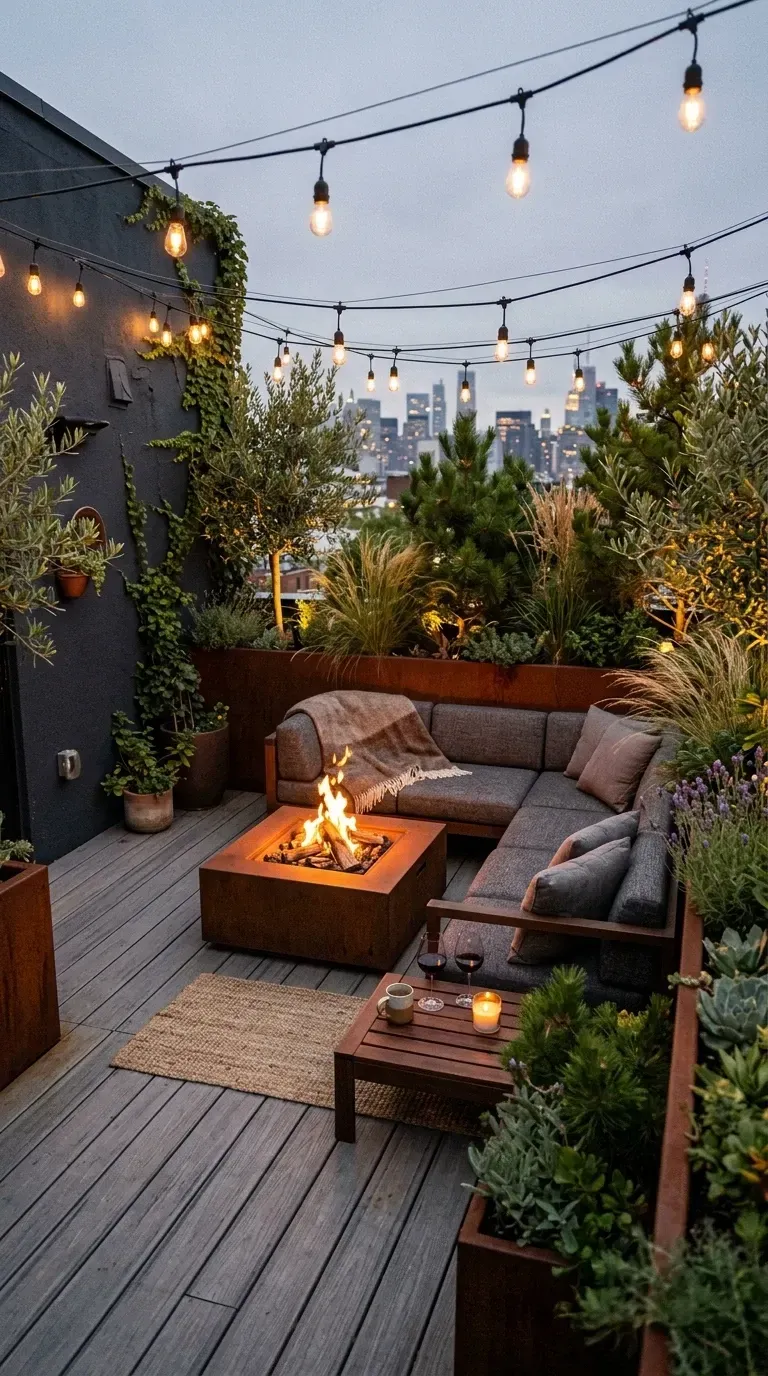
This is the highest-impact urban biophilic move available, and the most logistically demanding. The dark walls (Sherwin-Williams SW 7069 Iron Ore is the typical specification) are the secret weapon — they make the foliage glow against the contrast and dissolve the boundary between the deck and the night sky. The Corten steel fire pit is right because it patinas correctly to the rusted-iron tone in roughly 8-14 weeks of weather exposure and it never needs paint maintenance. Olive trees and ornamental grasses (Karl Foerster, Mexican feather grass, blue oat grass) are the right plants because they tolerate wind, full sun, and the moisture stress of container planting on a hot rooftop better than most ornamental flowering specimens.
Features
- Sherwin-Williams SW 7069 Iron Ore or Benjamin Moore Wrought Iron exterior wall paint
- Corten weathering-steel fire pit (Solo Stove Bonfire or Restoration Hardware Cor-Ten)
- Polywood Lakeside or Article Aleca outdoor sectional in charcoal or fog
- Reclaimed teak outdoor coffee table
- Brightech Ambience Pro or Excello Global commercial-grade LED string lights
- Large fiberglass planters: 3-4 olive trees (Olea europaea Arbequina) plus ornamental grasses (Karl Foerster, Mexican feather grass)
- Trex Transcend or Kebony composite/modified-wood decking
- Ruggable Outdoor or Loloi In/Out outdoor rug (8x10)
Cost Analysis (Charleston Baseline)
| Item | Price Range |
|---|---|
| Outdoor sectional sofa (Polywood Lakeside or Article Aleca) | $1,640 – $4,200 |
| Corten steel fire pit (Solo Stove or Restoration Hardware) | $540 – $1,580 |
| Reclaimed teak outdoor coffee table | $220 – $640 |
| Commercial-grade LED string lights (Brightech) | $110 – $320 |
| Large fiberglass planters + olive trees + ornamental grasses | $1,140 – $2,680 |
| Composite/modified-wood decking + wall painting (250-350 sq ft) | $2,200 – $5,400 |
| Outdoor rug (Ruggable or Loloi In/Out) | $170 – $420 |
| Total Estimated Cost | $6,020 – $15,240 |
Styling Notes for This Look
- Verify your roof's structural live-load rating before specifying large planters and a fire pit — most residential roofs carry 30-40 lbs/sq ft, but planters with wet soil run 60-80 lbs/sq ft and need to be positioned over load-bearing walls or beams.
- Specify fiberglass or rotomolded plastic planters, not real stone or concrete — fiberglass at 1/8 the weight gives you the same visual presence with a fraction of the structural load.
- Olive trees in containers in the Southeast need winter protection only at sustained temperatures below 22°F — Charleston, Savannah, and Atlanta typically need cold protection only 3-6 nights per winter.
- Use a propane or natural-gas Corten fire pit if your municipality restricts wood-burning on rooftops (most do) — the visual is identical and you avoid permitting friction.
5. Grand Entryway with Lush Living Wall
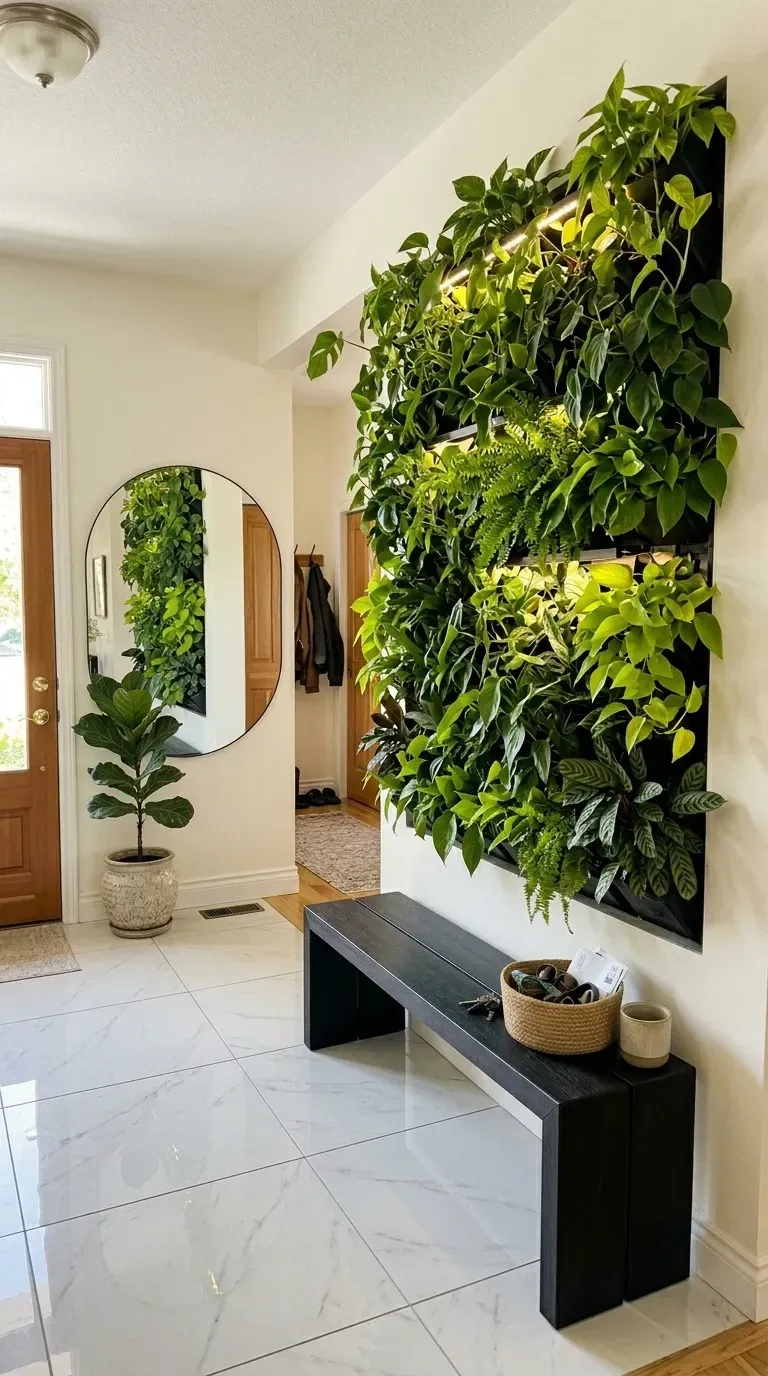
A living wall in an entryway is the most photographed biophilic move in this guide and the most operationally complex. The wall systems I specify (GSky Versa Wall, Florafelt Pro System, or Plants On Walls Florafelt panels) all carry integrated drip irrigation and a recirculating water reservoir, which is what makes them survivable for a homeowner who is not running a commercial greenhouse. The plant mix is intentionally weighted toward Pothos, Philodendron, Boston ferns, and Maidenhair ferns because they tolerate the lower-light conditions typical of an interior entryway and they grow at compatible rates so the wall fills in evenly rather than developing dominant species and bare patches.
Features
- Living wall system: GSky Versa Wall, Florafelt Pro System, or Plants On Walls Florafelt panels with integrated irrigation and reservoir
- Soltech Aspect or commercial GE LED strip grow lights (full-spectrum, dimmable)
- Plant mix: Golden Pothos, Heartleaf Philodendron, Boston fern, Maidenhair fern, Spider plant, Peperomia
- Article Sven or West Elm Mid-Century black entryway bench
- West Elm or CB2 round mirror, 32-42 inch diameter
- Tall potted Fiddle Leaf Fig (Ficus lyrata) in 14"-16" planter
- Carrara or Statuario marble tile flooring (or Daltile RevoTile marble-look porcelain)
- Solid wood front door (Simpson or Sun Mountain in walnut or stained oak)
Cost Analysis (Charleston Baseline)
| Item | Price Range |
|---|---|
| Living wall system + plants + irrigation (40-60 sq ft) | $2,200 – $4,800 |
| Integrated LED strip grow lights + dimmer | $340 – $720 |
| Minimalist black entryway bench | $320 – $740 |
| Large round mirror (West Elm or CB2) | $220 – $540 |
| Large potted Fiddle Leaf Fig + ceramic planter | $210 – $480 |
| Ceramic floor planter | $60 – $170 |
| Decorative basket + accessories | $50 – $110 |
| Total Estimated Cost | $3,400 – $7,560 |
Styling Notes for This Look
- Living walls require a hardline plumbing connection and a drain — budget the plumbing rough-in ($800-$1,400) separately if you don't already have a water source within 6 feet of the wall location.
- Plant replacement is real — expect to lose and replace 8-15% of the wall's plants in the first 18 months as the system stabilizes. Budget $200-$400 annually for replacement specimens.
- Light is the binding constraint — LED grow lights are mandatory for an interior wall, and the wall's location should ideally also receive 2-4 hours of indirect natural light daily.
- Specify the marble floor with a sealed honed finish, not polished — water from plant maintenance will spot polished marble within months and is invisible on honed.
6. Spa-Like Bathroom with Bamboo Garden View
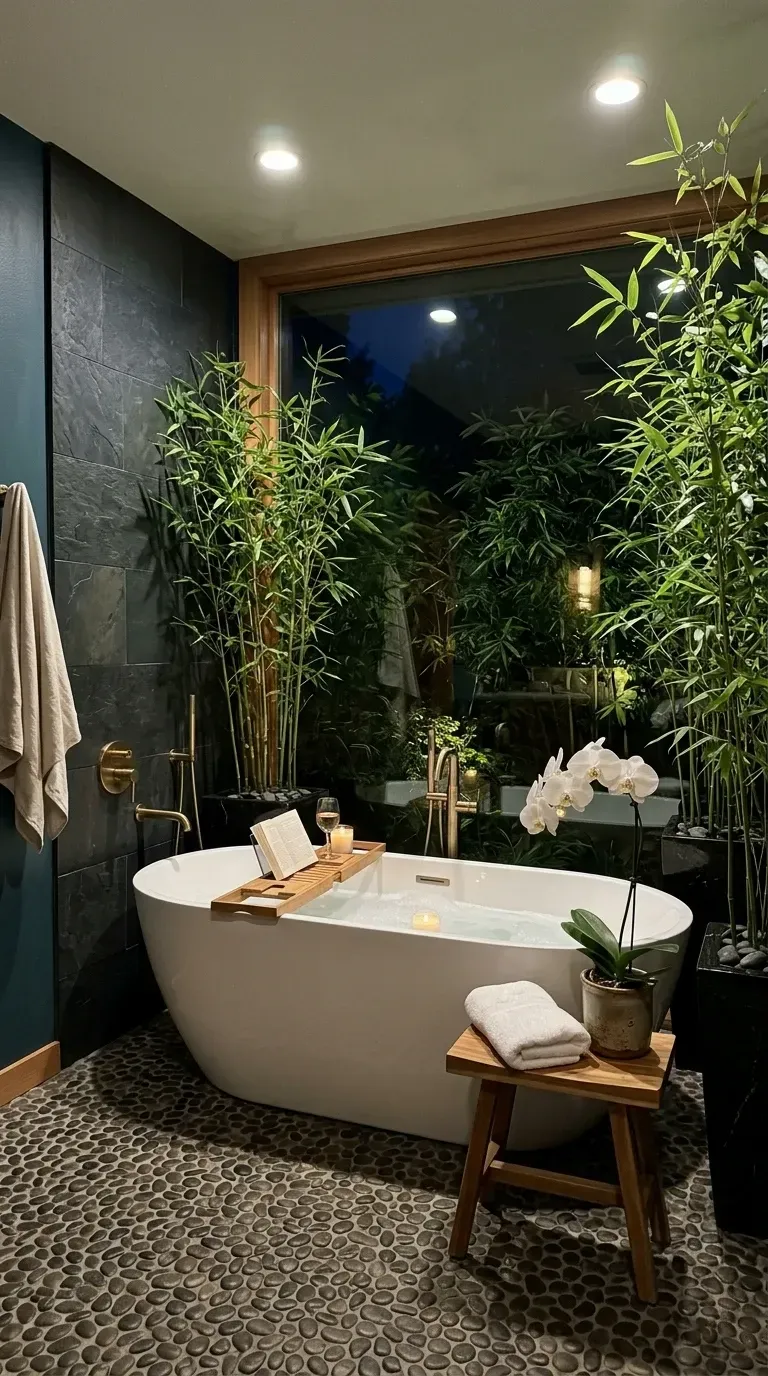
A bathroom is the right room to push biophilic design hardest because humidity is your friend instead of your enemy — bamboo, ferns, calatheas, and pothos all thrive in the 60-80% relative humidity typical of a regularly-used bathroom. The freestanding tub against a window facing an exterior bamboo planting is the architectural move that makes the room. The interior bamboo plants (Bambusa multiplex 'Alphonse Karr' is the species I specify for indoor cultivation in pots — clumping not running, height to about 8-10 feet) reinforce the visual continuity between inside and out. Slate wall tile is correct because it reads as natural stone without the maintenance demands of true slate, and the river pebble floor inset adds a tactile dimension you actually feel under bare feet.
Features
- Freestanding soaking tub: Kohler Iron Works Historic, Signature Hardware Erie, or Wyndham Soho in 60-67" length
- Floor-mounted tub filler: Brizo Litze, Kohler Purist, or Delta Trinsic in brushed gold or champagne bronze
- Large picture window (4'x6' minimum) with low-iron tempered glass facing exterior planted area
- Indoor bamboo: Bambusa multiplex 'Alphonse Karr' clumping bamboo in 14"-16" pots (x3)
- Daltile Continental Slate or Anatolia Mayfair slate-look porcelain wall tile
- Mexican beach pebble floor inset (3/8"-5/8" black or grey, set in mortar bed)
- Hinoki wood bath tray and Toulouse-style wooden stool
- Brizo Litze or Watermark sconces in brushed gold
Cost Analysis (Charleston Baseline)
| Item | Price Range |
|---|---|
| Freestanding soaking tub (Kohler Iron Works Historic or Signature Hardware Erie) | $1,140 – $3,200 |
| Floor-mounted tub filler (Brizo Litze or Kohler Purist) | $340 – $880 |
| Large picture window installation (4'x6') | $1,640 – $3,800 |
| Indoor potted clumping bamboo (x3, 14"-16" pots) | $170 – $480 |
| Slate-look wall tile + river pebble floor (material + labor) | $2,200 – $5,400 |
| Hinoki bath tray + wooden stool | $160 – $380 |
| Exterior bamboo planting + pathway lighting | $420 – $980 |
| Total Estimated Cost | $6,070 – $15,120 |
Styling Notes for This Look
- Specify clumping bamboo (Bambusa species) for indoor pots, never running bamboo (Phyllostachys) — running bamboo will breach a pot and a finished floor faster than you'd believe possible.
- The exterior bamboo grove behind the window matters as much as the tub — without it, you're looking at a fence or a neighbor's wall, and the room loses 70% of its design impact.
- Specify low-iron glass for the picture window — standard glass carries a green tint that makes the bamboo outside read murky, and low-iron is colorless.
- The river pebble floor inset needs to be sealed annually with a penetrating natural-stone sealer (Aqua Mix or Miracle Sealants) — unsealed pebbles trap soap residue and discolor within 8-12 months.
7. Indoor Jungle Atrium with Glass Roof
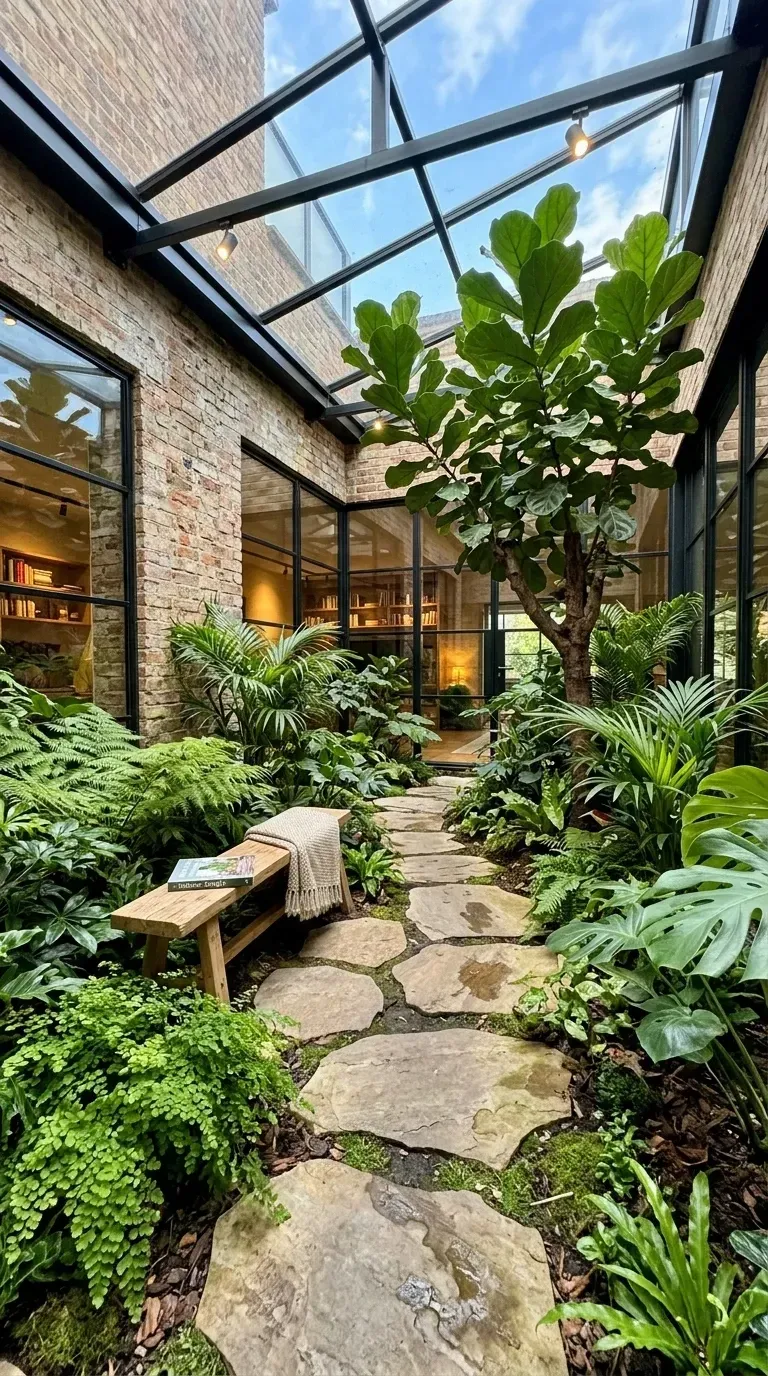
An indoor atrium with a glass roof is the highest-investment space in this guide and the only one that approaches the architectural ambition of botanical conservatory work. It is also the space with the longest design timeline — typical concept-to-occupancy is 9-14 months once you account for structural review, glazing fabrication, and the planting establishment period. The glass roof system I specify most often is a Solar Innovations or Velux Modular Skylight assembly with thermally-broken aluminum framing and dual-pane low-iron tempered glazing — that's the package that handles humidity buildup, condensation management, and seasonal thermal load without the failure modes that take down cheaper conservatory-style installations.
Features
- Glass atrium roof: Solar Innovations Stratus or Velux Modular Skylight system with thermally-broken aluminum framing and low-iron dual-pane tempered glazing
- Exposed brick or reclaimed-brick veneer walls (Glen-Gery or Endicott)
- Pennsylvania bluestone or Tennessee fieldstone flagstone pathway, dry-laid on compacted base
- Specimen tree options: Ficus benjamina, Areca palm (Dypsis lutescens), or Bird of Paradise (Strelitzia nicolai) at 8-12 feet height
- Tree ferns (Cyathea cooperi or Dicksonia antarctica), Boston ferns, Calatheas, Philodendrons
- Reclaimed-wood bench (Article or custom millwork) at 5-foot length
- WAC Lighting or Tech Lighting track-mounted plant grow spotlights with full-spectrum LED bulbs
- Drip irrigation system with timer (Hunter or Rain Bird) and central water management
Cost Analysis (Charleston Baseline)
| Item | Price Range |
|---|---|
| Atrium glass roof system (Solar Innovations or Velux), engineering, install | $16,400 – $42,800 |
| Flagstone pathway installation (60-80 sq ft) | $1,140 – $3,200 |
| Specimen tree + tropical underplanting | $2,200 – $5,400 |
| Reclaimed-wood bench (custom or Article) | $220 – $540 |
| Track-mounted plant grow spotlights | $340 – $880 |
| Drip irrigation + timer + water management | $640 – $1,400 |
| Exposed brick veneer or finish work (existing brick assumed) | $0 – $4,200 |
| Total Estimated Cost | $20,940 – $58,420 |
Styling Notes for This Look
- Engage a structural engineer before pricing the glass roof — atrium installations typically require steel beam reinforcement at the perimeter, which is where the cost differential between a $20K and $58K project lives.
- Specify thermally-broken aluminum framing, not standard aluminum — non-thermally-broken framing condenses water continuously in any climate with humidity above 50%, which damages adjacent finishes.
- Plan for 14-18% annual plant turnover for the first three years as the atrium ecosystem stabilizes — even with grow lights, indoor light is roughly 1/3 the intensity plants need to grow at outdoor rates.
- The drip irrigation system needs a manual override and a leak detector — a run-away irrigation cycle can flood a hardwood floor adjacent to the atrium overnight.
8. Charming Balcony Retreat with Vertical Garden
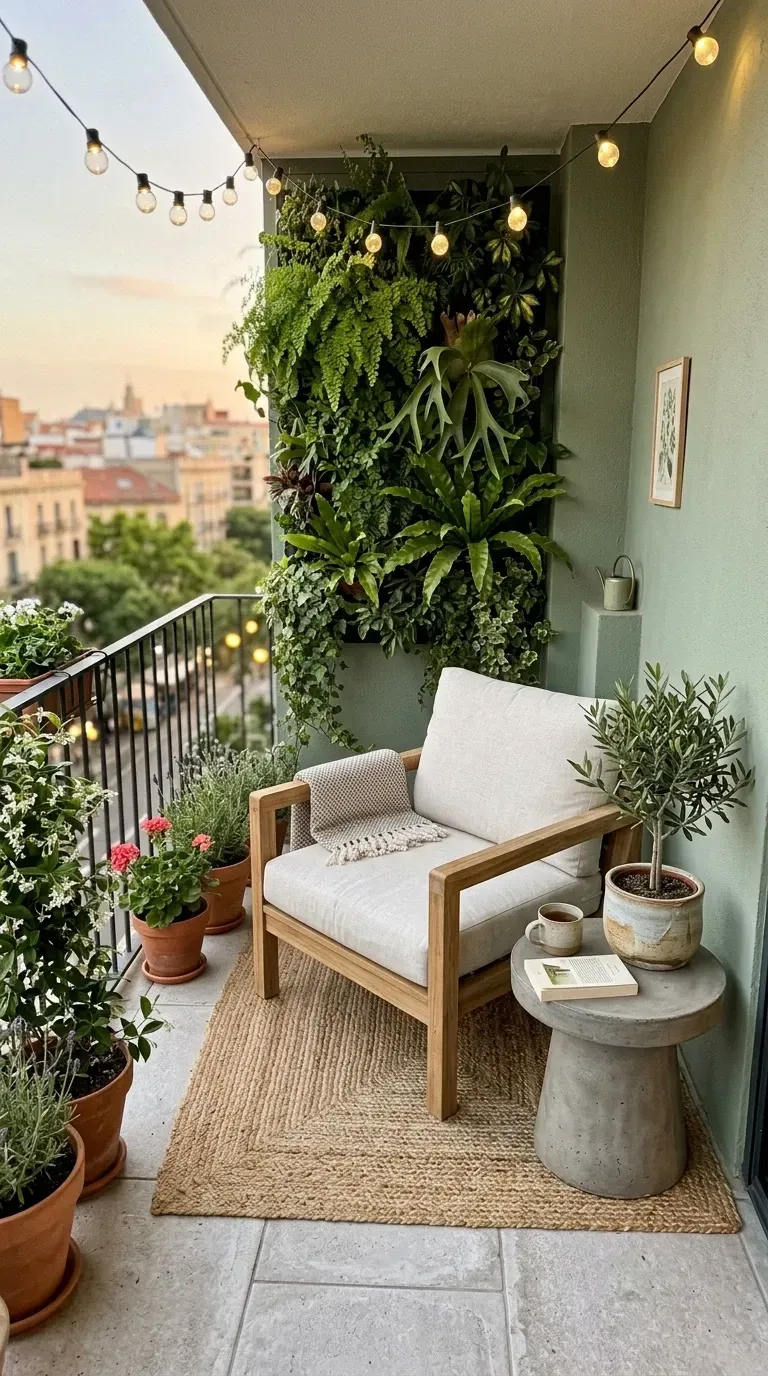
A small balcony is one of the highest-leverage biophilic projects available to renters and condo owners because it transforms the apartment-to-city interface without requiring landlord approval for permanent changes. The vertical garden is the architectural move — a Florafelt Compact 12 or a Wallygro modular wall system mounts to the existing balcony wall with no permanent fasteners and converts roughly 30 square feet of dead vertical space into a planted surface. Teak outdoor furniture is correct because teak develops a silver patina rather than rotting in the Southeast climate and survives untreated for 15-25 years. The string lights aren't decoration — they're the lighting infrastructure that makes the balcony usable from 7 PM to 11 PM during summer evenings.
Features
- Vertical garden: Florafelt Compact 12, Wallygro modular wall system, or DIY pallet planter
- Plant mix: Boston fern, Staghorn fern, Pothos, Spider plant, Heuchera (in semi-shade balconies); Lantana, Verbena, Calibrachoa (in full-sun balconies)
- Outdoor Interiors solid teak armchair with Sunbrella cushion in oat or natural
- West Elm or CB2 fiber-reinforced concrete side table
- Potted olive tree (Olea europaea Arbequina) + flowering pots: bougainvillea, citrus, or jasmine
- Safavieh or nuLOOM jute outdoor rug (3x5 or 4x6 minimum)
- Brightech Ambience Pro or Nostalgic Bulbs LED string lights (24-foot run minimum)
- Sherwin-Williams SW 6448 Etruscan or Behr Greenwich Village exterior wall paint
Cost Analysis (Charleston Baseline)
| Item | Price Range |
|---|---|
| Vertical garden system (Florafelt Compact 12 or Wallygro) + plants | $340 – $760 |
| Teak outdoor armchair + Sunbrella cushion | $420 – $940 |
| Concrete side table (West Elm or CB2) | $110 – $280 |
| Potted olive tree + flowering pots | $170 – $440 |
| Jute outdoor rug (Safavieh or nuLOOM) | $60 – $170 |
| String lights (Brightech Ambience Pro) | $40 – $90 |
| Wall paint (renter-friendly removable, or owner option) | $0 – $180 |
| Total Estimated Cost | $1,140 – $2,860 |
Styling Notes for This Look
- Diagnose your balcony's light exposure first — a north-facing balcony in Charleston gets roughly 2-3 hours of usable indirect light, a south-facing one gets 6-8 hours of direct, and the plant lists are completely different.
- For renters: Wallygro and Florafelt Compact systems mount with adhesive backing or removable French cleats — verify lease language before installing any permanent fastener system.
- Olive trees in 14"-16" containers need to come inside or against an exterior wall when overnight temps drop below 22°F — Charleston needs this maybe 4-7 nights per winter, Atlanta closer to 12-16.
- String lights should be commercial-grade with weatherproof gasketed sockets — consumer holiday lights fail in 6-9 months of constant outdoor use.
9. Minimalist Bench and Statement Plant Corner
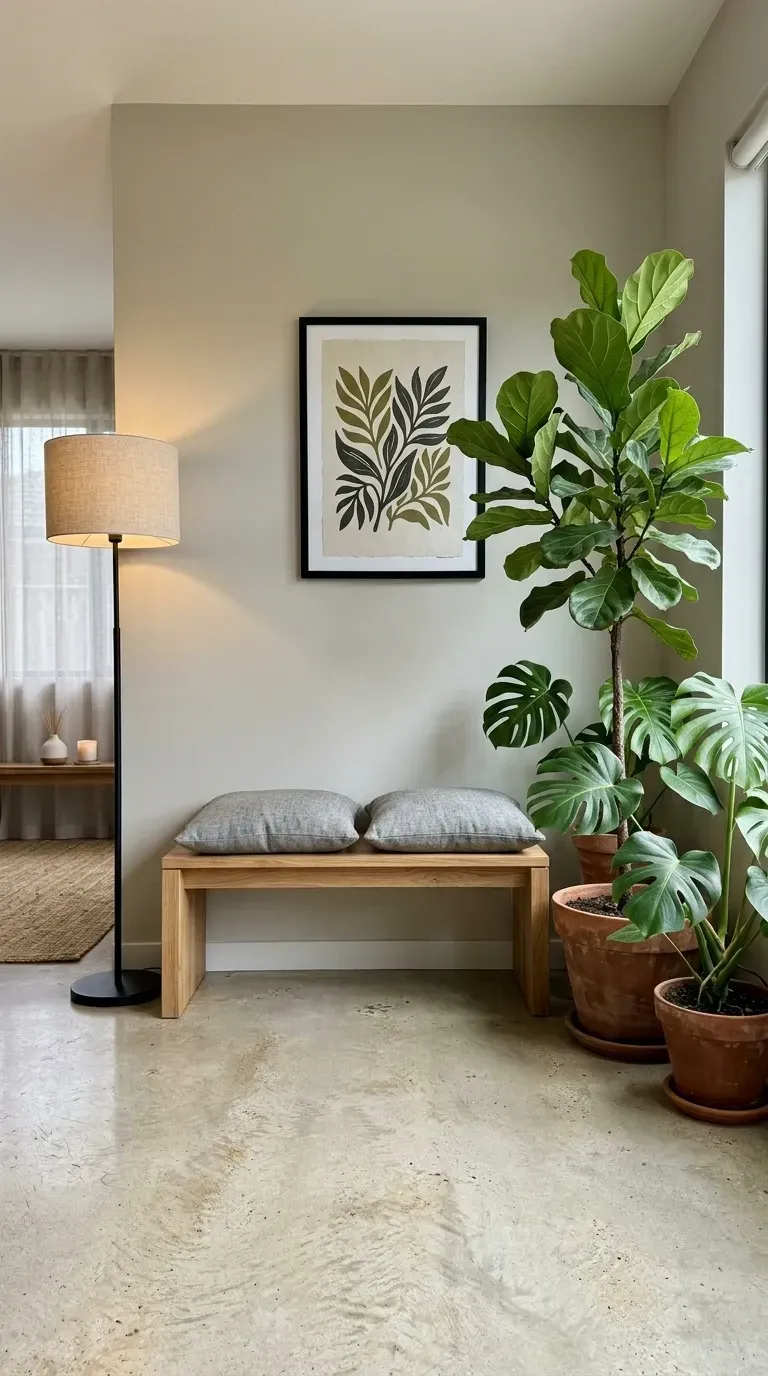
This is the lowest-friction biophilic intervention in this guide and the one I recommend most often to new clients who want to test the biophilic approach before committing to anything larger. Two architectural plants — a Fiddle Leaf Fig and a Monstera Deliciosa — plus a simple bench, a botanical print, and a floor lamp. Total cost lands under $2,200 in most cases. The reason it works disproportionately well is that two large plants in a corner read as a deliberate design choice; one large plant in the same corner reads as decoration, and three or more reads as a plant collection. Two is the right number for the minimalist vignette aesthetic.
Features
- Article Madera or Floyd Detail wooden bench in white oak (60-72 inches)
- Parachute or West Elm linen pillows in grey or oat (x2)
- Large potted Fiddle Leaf Fig (Ficus lyrata) in 14-16 inch ceramic pot, 5-7 foot specimen height
- Large potted Monstera Deliciosa in 12-14 inch pot, 4-6 foot specimen height
- Minted, 20x200, or Society6 framed botanical art print (24x36 minimum)
- Cedar & Moss or Schoolhouse arc floor lamp in matte black
- Jaipur Living or Loloi flatweave jute runner
- Polished concrete floor or LVP in concrete-look (Mohawk RevWood or Shaw Floorté Concrete)
Cost Analysis (Charleston Baseline)
| Item | Price Range |
|---|---|
| Wooden bench (Article Madera or Floyd Detail) | $320 – $840 |
| Linen pillows (Parachute or West Elm, x2) | $70 – $170 |
| Large Fiddle Leaf Fig + ceramic pot | $170 – $380 |
| Large Monstera Deliciosa + ceramic pot | $110 – $280 |
| Framed botanical art print (24x36) | $90 – $220 |
| Black arc floor lamp (Cedar & Moss or Schoolhouse) | $110 – $280 |
| Jute flatweave runner | $60 – $170 |
| Total Estimated Cost | $930 – $2,340 |
Styling Notes for This Look
- Fiddle Leaf Figs in this size require 6-8 hours of bright indirect light — east or west exposure works, full north fails. If your corner is north-facing, substitute a Bird of Paradise or a Rubber Plant (Ficus elastica), both of which tolerate medium-low light.
- Repot the Fiddle Leaf into a slightly larger ceramic pot one inch wider than the nursery pot — leaving it in the plastic nursery pot inside a basket is the most common reason these plants drop leaves in the first 90 days.
- The Monstera should sit slightly forward of the Fiddle Leaf in the corner — staggering depth creates the visual layering that converts the corner from "two plants" to "a planted vignette."
- Replace ceramic pot saucers with cork saucers (sold by IKEA or Sansui) — cork prevents the dark watermark rings that ceramic saucers leave on hardwood and concrete floors.
10. Dining Nook with Preserved Moss Wall
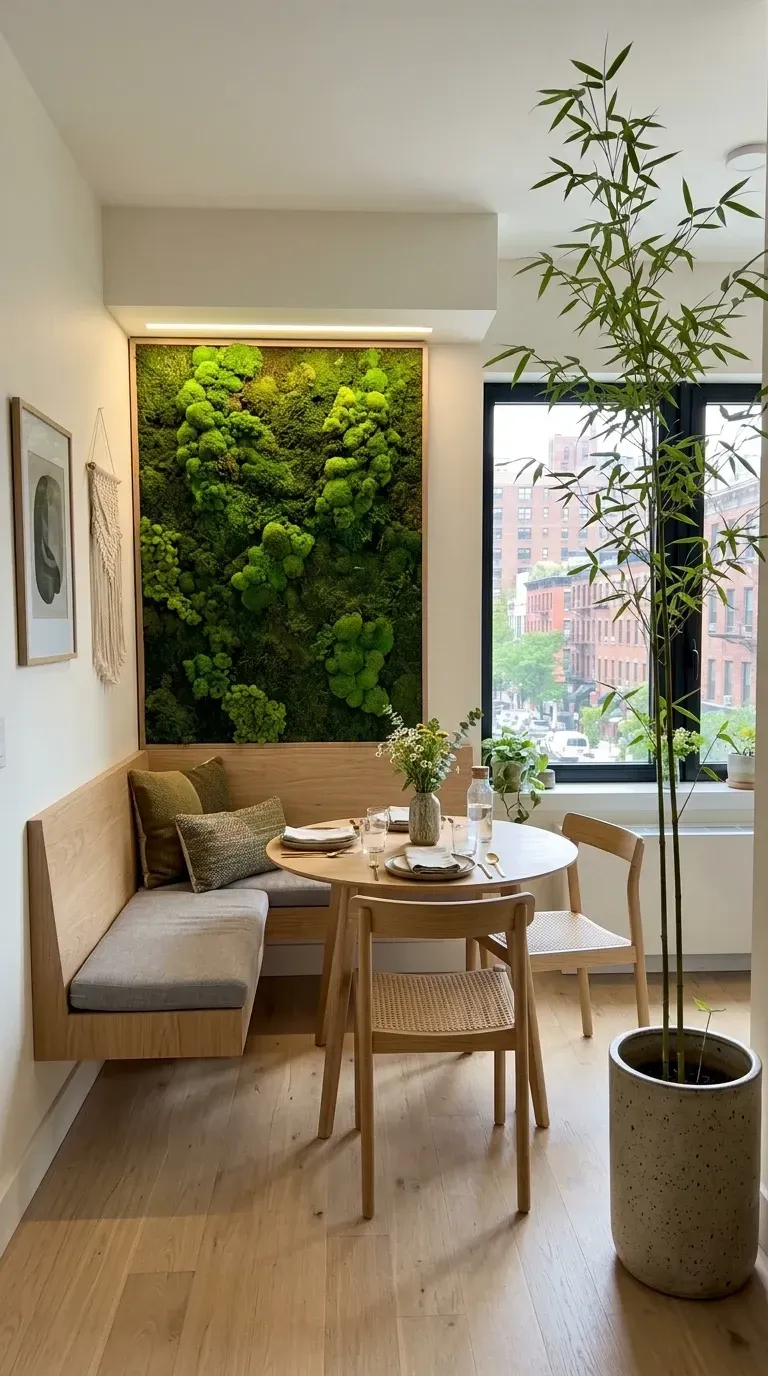
A preserved moss wall is the right move for a low-light dining area, a windowless interior, or any space where a homeowner wants the visual impact of a living wall without the operational burden of irrigation, lighting, and plant replacement. Preserved reindeer moss and sheet moss are real botanical material that has been treated with food-grade glycerin and dyed to a stable color — they require zero water, zero light, and zero maintenance for roughly 8-12 years before color begins to fade. Brands worth specifying are Botanical Innovations, Plant the Future, or Moss & Stone Gardens for premium installations; for budget builds, Etsy moss-art panels work but check the supplier's preservation method before committing.
Features
- Custom built-in wooden banquette in white oak with linen-upholstered cushion (24-30 inches deep, 60-72 inches wide)
- Large framed preserved moss wall (Botanical Innovations, Plant the Future, or custom local installer) — typically 4'x4' to 6'x6' panel
- Round wooden dining table (Article Madera, West Elm Mid-Century, or CB2 Lincoln) at 42-48 inch diameter
- Cane-back wooden dining chairs (Article Tasi or West Elm Mid-Century) x2
- Tall potted bamboo: Bambusa multiplex 'Alphonse Karr' or Lucky Bamboo (Dracaena sanderiana) for low-light tolerance
- Cedar & Moss or Schoolhouse pendant light over table
- White oak engineered hardwood flooring
Cost Analysis (Charleston Baseline)
| Item | Price Range |
|---|---|
| Custom wooden banquette + linen cushions | $1,640 – $3,800 |
| Large framed preserved moss wall (4'x4' to 6'x6') | $880 – $2,200 |
| Round wooden dining table (42-48 inch) | $420 – $1,250 |
| Cane-back wooden dining chairs (x2) | $320 – $840 |
| Tall potted bamboo + ceramic pot | $170 – $380 |
| Pendant light over table | $140 – $380 |
| Total Estimated Cost | $3,570 – $8,850 |
Styling Notes for This Look
- Preserved moss is not living and does not photosynthesize — confirm with your installer that the moss is preservation-grade glycerin-treated material, not freshly-harvested live moss that will brown out within weeks.
- Avoid moss walls in bathrooms, kitchens, or other high-humidity rooms — preserved moss reabsorbs moisture above 65% relative humidity and loses its stable color.
- Specify the framing depth at 2.5-3 inches minimum — a flat-mounted moss panel reads as wall art; a recessed-frame moss installation reads as architectural.
- Pair the preserved moss wall with one live plant in the room (the bamboo by the window in this design) — the contrast between living and preserved keeps the room feeling alive rather than artificial.
11. Sun-Drenched Plant Conservatory
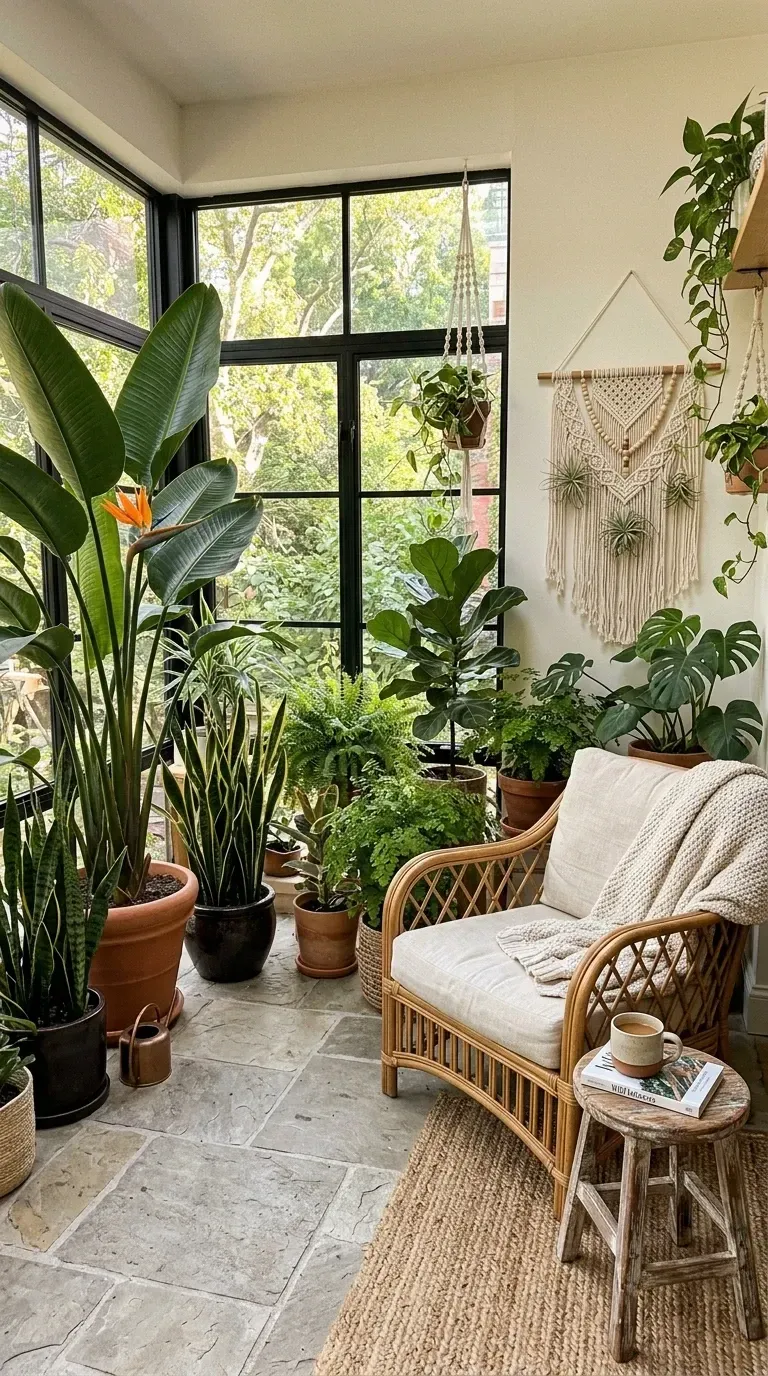
A dedicated plant conservatory or sunroom is the use I most often suggest for the bright south or southwest-facing room that's been functioning as a poorly-utilized formal living room or sitting area. The wrap-around windows give you the 6-8 hours of direct sun that the larger architectural plants — Bird of Paradise (Strelitzia nicolai), Banana plants (Musa basjoo), Areca palms (Dypsis lutescens), Snake plants (Sansevieria trifasciata) — actually need to thrive rather than barely survive. Rattan furniture is correct because the texture and warm tone reinforce the bohemian-conservatory aesthetic without competing visually with the plants. Terracotta pots are not just style — terracotta breathes, drains better than glazed ceramic, and is what most of these tropical plants actually want at the root zone.
Features
- Large wrap-around windows (existing) with low-iron tempered glazing if planning a renovation
- Anthropologie or Serena & Lily rattan armchair with linen throw
- Sun Bleached Wood or vintage rustic wooden stool
- Mkono or Bloomingville macrame wall hangings + plant hangers
- Large Bird of Paradise (Strelitzia nicolai) in 16-18 inch terracotta pot, 5-7 foot specimen
- Plant mix: Snake plant (Sansevieria), Boston fern, Maidenhair fern, Areca palm, Monstera Deliciosa, Pothos
- Daltile slate-look porcelain or natural travertine floor tile
- Safavieh or Loloi jute area rug or runner
Cost Analysis (Charleston Baseline)
| Item | Price Range |
|---|---|
| Rattan armchair + linen throw (Anthropologie or Serena & Lily) | $340 – $760 |
| Rustic wooden stool | $90 – $220 |
| Macrame wall hangings + plant hangers | $110 – $280 |
| Large Bird of Paradise + terracotta pot | $220 – $540 |
| Assorted medium/small plants + terracotta pots (8-12 specimens) | $340 – $760 |
| Jute runner rug (Safavieh or Loloi) | $60 – $170 |
| Optional Soltech grow lights for winter supplementation | $0 – $440 |
| Total Estimated Cost | $1,160 – $3,170 |
Styling Notes for This Look
- Even a sun-drenched conservatory benefits from supplemental Soltech Aspect grow lights during the November-February window when daylength drops below 10 hours — plant growth otherwise stalls and many tropicals defoliate partially.
- Bird of Paradise needs to be repotted into a one-size-larger pot every 18-24 months — root-bound Strelitzia stop flowering and develop yellow leaves at the base.
- Specify a high-quality cactus-and-succulent potting mix (Espoma Organic Cactus Mix or Black Gold Cactus Mix) for terracotta-potted tropicals — standard potting soil retains too much water in unglazed terracotta and rots root systems.
- Rotate plants 90 degrees every 4-6 weeks — single-direction sun pulls plants into asymmetric growth patterns that are hard to correct after a year.
12. Serene Green Bedroom Retreat
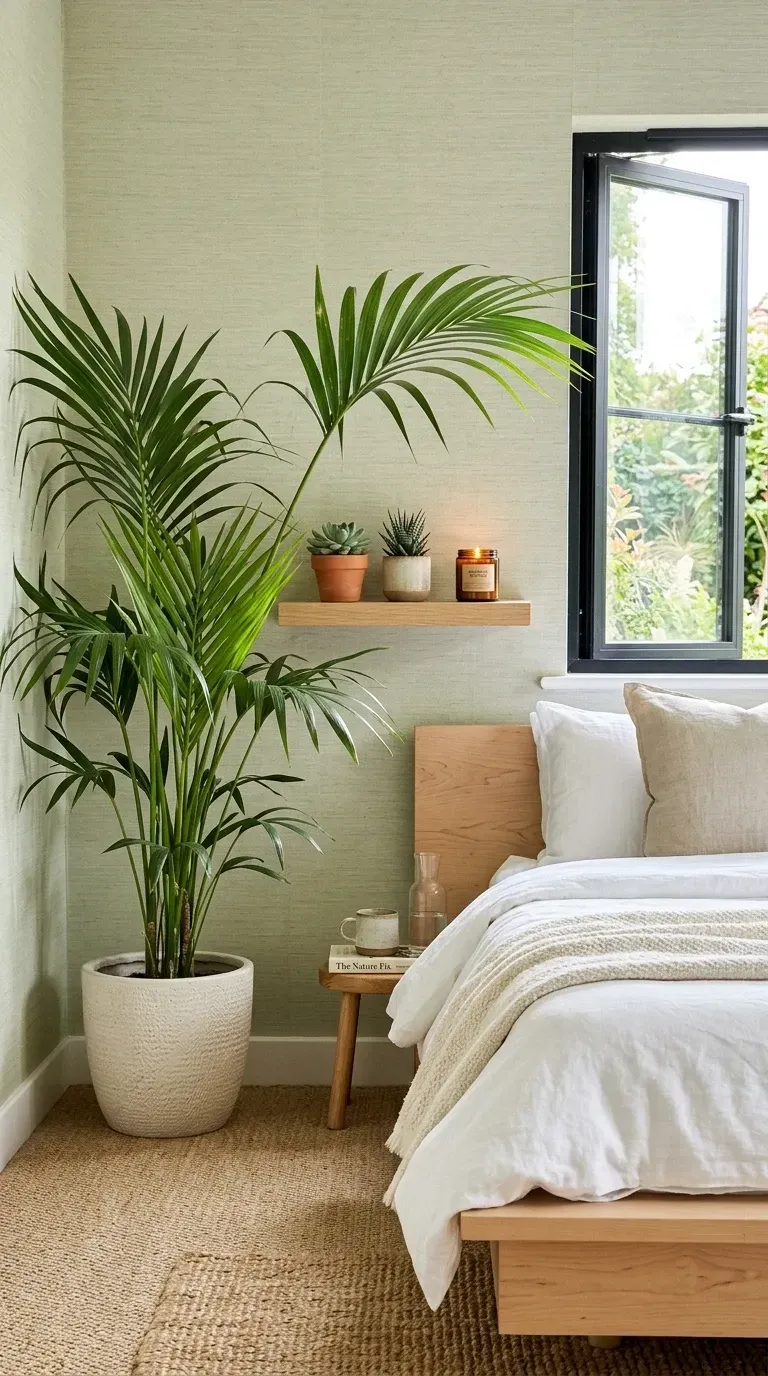
A bedroom is the room where the biophilic case crosses from aesthetic preference into measurable quality-of-life impact. Sleep researchers (Damiani, Reinhart, and a handful of others) have documented improved sleep latency and reduced nighttime cortisol in subjects with bedroom plants and natural-textured environments compared to identical rooms with no organic elements. The textured green wallpaper (Farrow & Ball No. 268 Mizzle, Sherwin-Williams Acacia Haze SW 9132, or Nina Campbell Casadeco Botanical) sets the calming color baseline. The Kentia palm (Howea forsteriana) is the right plant species because it tolerates the lower light typical of bedroom corners, grows slowly enough that you don't need to repot for 4-6 years, and doesn't release pollen or shed leaves that disturb sleep.
Features
- Textured green wallpaper: Farrow & Ball No. 268 Mizzle (paint) or Nina Campbell Casadeco Botanical wallpaper
- Article Sven or West Elm Mid-Century light oak bed frame (Queen 60x80)
- Brooklinen, Parachute, or Coyuchi white linen bedding set (sheets, duvet cover, shams)
- Large Kentia palm (Howea forsteriana) in 14-16 inch textured white ceramic pot, 5-7 foot specimen
- West Elm or CB2 floating wooden shelf, 36 inches
- Small potted succulents (Echeveria, Haworthia) in 4-inch terracotta pots (x3)
- Wooden bedside stool/table (Article Madera or vintage)
- Loloi or Safavieh jute area rug (8x10 minimum)
Cost Analysis (Charleston Baseline)
| Item | Price Range |
|---|---|
| Textured wallpaper or paint (material + installation, 250-300 sq ft) | $320 – $720 |
| Light oak bed frame, Queen (Article Sven or West Elm Mid-Century) | $540 – $1,540 |
| Linen bedding set (Brooklinen, Parachute, or Coyuchi) | $220 – $540 |
| Large Kentia palm + textured ceramic pot | $220 – $480 |
| Floating wooden shelf (West Elm or CB2) | $60 – $170 |
| Small succulents + terracotta pots | $50 – $110 |
| Wooden bedside stool/table | $90 – $220 |
| Jute area rug (8x10) | $170 – $440 |
| Total Estimated Cost | $1,670 – $4,220 |
Styling Notes for This Look
- Limit bedroom plants to 3-5 specimens — more than that introduces excessive nighttime humidity and CO2 buildup in a closed sleeping space, which can disturb sleep rather than improve it.
- Skip flowering plants in bedrooms — pollen, fragrance compounds, and leaf-shed all create allergy and sleep-disturbance risk that non-flowering green plants don't carry.
- Specify true linen bedding (100% flax linen, not cotton-linen blend) — flax linen is the textile that thermoregulates best in Southeast humidity and pairs with the biophilic sensory profile of the room.
- Position the Kentia palm at least 18 inches from the bed — proximity to a sleeper can trigger psychological "crowding" responses that defeat the calming intent.
Regional Cost Adjustments — 7 Southern Markets
Cost ranges throughout this guide reflect Charleston, SC baseline pricing for materials, plants, and labor as of mid-2025. Apply the multiplier below to estimate cost in your local market. Plant prices generally vary less than labor and millwork — expect plant cost variation of plus-or-minus 8-15% across the table; furniture and built-in cost varies more, in the plus-or-minus 12-30% range. Living wall systems and atrium glass-roof installations carry the largest regional variation because they depend on specialty contractor availability.
| Market | Cost Multiplier | Notes |
|---|---|---|
| Charleston, SC (baseline) | 1.00x | Strong nursery network, competitive labor |
| Savannah, GA | 0.94x | Lower labor, similar plant access |
| Atlanta, GA | 1.04x | Higher labor, excellent specialty contractor access |
| Nashville, TN | 1.06x | Higher labor and millwork, narrower plant selection |
| Austin, TX | 1.12x | Premium labor and design fees, seasonal heat affects plant survival |
| Greenville, SC | 0.91x | Lower labor, strong access via Atlanta wholesale routes |
| Raleigh-Durham, NC | 0.97x | Excellent nursery and specialty contractor networks via NC State Extension |
Pro Tips for Building a Micro-Forest That Actually Lives
- Diagnose your light honestly before buying any plant. Use a Photone or Lumetric smartphone light meter app to measure foot-candles at the actual planting location — bright indirect light is 200-500 fc, medium is 100-200, low is 25-100. Most plant losses in the first 90 days come from buying a plant for a spot that doesn't have the light it needs.
- Build vertical, not horizontal, in small spaces. A 600 sq ft urban apartment doesn't have the floor area for ten large plants — but it has the wall area for living-wall systems, hanging planters, and floor-to-ceiling shelf systems that can carry 30-50 plants without consuming usable floor.
- Mix leaf textures deliberately. The visual depth of a planted vignette comes from contrast — pair glossy (Monstera, Philodendron) with fuzzy (African Violet, Dusty Miller), broad-leaf (Bird of Paradise, Banana) with strappy (Spider plant, Snake plant). A collection of all-similar foliage reads as one large plant and loses visual interest.
- Buy from local nurseries, not big-box. Local independent nurseries (Hyams Garden & Accent in Charleston, Pike Nurseries in Atlanta, Bates Nursery in Nashville, The Great Outdoors in Austin) carry plants that have been climate-acclimated to your region and stocked at correct light and humidity, which dramatically improves first-90-day survival versus big-box plants that have been shipped through multiple distribution centers.
- Specify ceramic over plastic for visible pots. A nursery plastic pot inside a decorative basket is the giveaway tell of an inexperienced plant collection — repotting into a properly-sized ceramic pot is a $20-$60 upgrade per plant that meaningfully improves the visual quality of the entire room.
- Plan for plant mortality. Even with optimal conditions, expect to lose 8-15% of your plants in the first 18 months. Build the budget assuming this as normal operating cost rather than as a project failure.
- Buy young, not mature. A 4-foot Fiddle Leaf Fig at the nursery costs $180-$280; a 7-foot specimen costs $420-$680, and the 4-foot plant will reach 7 feet in 18-24 months under correct conditions. Buying young is roughly 60% cheaper and gives you the satisfaction of watching the plant become the room.
- Establish a watering rhythm before adding more plants. Most beginners overwater in the first 60 days, killing more plants than underwatering does. Build the habit on five plants before scaling to twenty-five.
- Consider air quality realistic, not romantic. The famous NASA Clean Air Study from 1989 has been substantially recontextualized by more recent peer-reviewed research — indoor plants make a meaningful psychological difference but a marginal air-quality difference at typical residential plant-density. Build the project for the wellness experience, not for the air filtration claims.
Cost-Saving Strategies
- Propagate aggressively. Pothos, Philodendron, Tradescantia, succulents, and most Begonias propagate from stem cuttings in water within 2-4 weeks. A single $24 Pothos can become 6-8 plants in a year. Local plant-swap groups on Facebook or Nextdoor frequently trade propagated cuttings at no cost.
- Shop estate sales and Facebook Marketplace for furniture. Article, West Elm, CB2, and Crate & Barrel inventory turns over rapidly in secondary markets — expect to find lightly-used furniture at 40-65% off retail with a few weekends of patient searching.
- Start with one or two architectural plants and scale gradually. A single statement Fiddle Leaf or Bird of Paradise plus three small plants reads as a beginning collection; expanding over 18-24 months as you build watering and maintenance habits is dramatically more successful than buying twenty plants in one Saturday.
- Use IKEA Hyllis or RÅSHULT shelves as plant stands. Industrial-style metal shelving from IKEA runs $25-$70 per unit and reads as intentional plant infrastructure rather than as decoration when stocked with five to eight plants per shelf.
- Repurpose vintage and thrift pots. Estate sale ceramics, vintage McCoy planters, mid-century brass pots — all available at $10-$40 each at typical estate sales and dramatically more characterful than new big-box ceramic.
- Skip the living wall, build a shelf wall. A floor-to-ceiling Article Mara or IKEA Bergshult shelf system stocked with 25-40 small plants in matching white ceramic pots delivers 70% of the visual impact of a $4,500 living wall system at roughly $800-$1,400 in total cost.
- Specify peel-and-stick wallpaper for biophilic backgrounds. Tempaper, Walls Need Love, and Chasing Paper offer botanical and forest-pattern peel-and-stick wallpapers at $120-$280 per accent wall versus $400-$900 for traditional paste-the-wall installation.
- Use exterior-grade Cobra outdoor LED string lights for year-round porch lighting. Commercial-grade weatherproof string lights at $40-$90 per 24-foot run last 4-7 years versus 8-14 months for indoor-rated holiday lights and dramatically reduce replacement cost over time.
Frequently Asked Questions
What's the realistic monthly maintenance time commitment for a 20-plant micro-forest?
Roughly 30-45 minutes per week once the collection is established — call it 2-3 hours per month. This includes watering on a 5-10 day rotation, pruning damaged leaves, monthly fertilization with a diluted balanced liquid fertilizer (Espoma Organic Indoor or General Hydroponics Maxi-Bloom), and occasional repotting (annually for fast-growers, every 2-4 years for slow-growers). A living wall system adds another 1-2 hours per month for the first six months as you learn the irrigation behavior, then drops to 30-45 minutes per month at steady state.
Which plants are most beginner-friendly for a first micro-forest project?
Start with the resilient four: Pothos (Epipremnum aureum), Snake plant (Sansevieria trifasciata), ZZ plant (Zamioculcas zamiifolia), and Philodendron (Heartleaf or Birkin). All four tolerate inconsistent watering, low to medium light, and the kind of mistakes new plant owners make. Add a Spider plant (Chlorophytum comosum) for trailing texture and a Boston fern (Nephrolepis exaltata) if your humidity stays above 50%. Skip Fiddle Leaf Figs, Calatheas, and Maidenhair ferns until you've kept the resilient four alive for at least six months.
Are living walls worth the cost versus a shelf system with potted plants?
For most homeowners, no — a well-designed shelf wall with 25-40 potted plants delivers 65-75% of the visual impact at 20-30% of the cost. Living walls are worth the investment when (1) the architectural moment matters (lobby, entry, prominent feature wall), (2) you have access to a maintenance contract or genuine personal time commitment for the irrigation system, and (3) the wall location has good natural light or you're committing to integrated grow lighting. A botanical client of mine in Atlanta installed a 60 sq ft GSky Versa Wall in 2023 — total project cost was $7,800 with maintenance running $140/month, and she values it as a defining feature of the home. Most clients don't need that.
Can renters install a meaningful biophilic environment without permanent modifications?
Absolutely. The reading nook, minimalist plant corner, balcony retreat, conservatory, and bedroom retreat sections of this guide all work in rental units with no landlord modifications required. Skip the in-floor planter, living wall, atrium roof, slate-and-pebble bathroom, and built-in banquette in rental contexts unless you have written approval and a budget you're willing to write off at lease end. Peel-and-stick wallpaper, freestanding furniture, potted plants, vertical garden systems with adhesive backing, and string lights all work as removable installations.
How does Southern climate (Charleston, Savannah, Atlanta) affect indoor plant choices versus colder regions?
The Southeast's year-round humidity above 55% is unusually generous for tropical houseplants — Calatheas, Maidenhair ferns, Alocasias, and Bird of Paradise specimens that struggle in low-humidity Northeast or Midwest homes thrive in Charleston with relatively little intervention. The trade-off: long Southern summer daylengths and intense direct sun can scorch shade-tolerant tropicals, so position bright-light plants away from west-facing windows during June-August. Cold protection is essentially a non-issue for indoor plants except during the 3-7 nights per winter when interior temperatures drop near a poorly-insulated window.
What's the simplest entry-level micro-forest setup under $500?
Three plants: a 4-foot Fiddle Leaf Fig in a $35 ceramic pot, a Monstera Deliciosa in a $25 pot, and a Pothos in a $15 ceramic hanging pot — total plants and pots roughly $250-$340. Add a $60-$120 Article or West Elm small plant stand for the Monstera, an IKEA Bergshult or Article Mara shelf for the Pothos, and a $40-$80 jute rug under the arrangement. Total project cost lands at $400-$540 and creates a meaningful biophilic vignette in any 100-200 sq ft corner.
Do I need grow lights, or is natural light enough?
Depends entirely on your home's exposure. South-facing rooms with 6+ hours of unobstructed sun: natural light is enough for most species. East and west-facing rooms with 3-5 hours of direct or strong indirect light: natural is sufficient for medium-light tolerant species (Pothos, Philodendron, ZZ, Snake plant) and supplementation with Soltech Aspect or Sansi grow lights is recommended for tropicals. North-facing rooms, interior rooms, and any space that drops below 100 foot-candles for most of the day: grow lights are mandatory for any plant beyond the most resilient species.
How do I keep a Fiddle Leaf Fig from dropping leaves?
Three causes account for roughly 90% of leaf drop: inconsistent watering (water once weekly when the top 2 inches of soil are dry, never on a fixed calendar), insufficient light (Fiddle Leafs need 6+ hours of bright indirect light, full stop), and frequent relocation (these plants take 3-5 weeks to acclimate to a new location and will drop leaves with each move). Settle on a permanent location, water consistently, ensure correct light exposure, and resist the urge to relocate. Allow 60-90 days for the plant to stabilize before deciding it's failing.
Sources & References
- Browning, W. D., Ryan, C. O., & Clancy, J. O. (2014). 14 Patterns of Biophilic Design — Terrapin Bright Green; foundational framework for biophilic design integration in residential and commercial environments.
- Kellert, S. R., Heerwagen, J. H., & Mador, M. L. (Eds.) (2008). Biophilic Design: The Theory, Science and Practice of Bringing Buildings to Life — Wiley; comprehensive academic treatment of biophilic design principles.
- Ulrich, R. S. (1984). View through a window may influence recovery from surgery. Science, 224(4647), 420-421 — landmark study documenting health outcomes from natural views.
- NASA Clean Air Study (1989), Wolverton, B. C. — original indoor plant air quality research, with subsequent peer-reviewed reassessment in Cummings & Waring (2020) Journal of Exposure Science.
- Damiani, K., Reinhart, C., et al. (2020). The effects of indoor plants on subjective sleep quality. Building and Environment, 175 — quantitative research on bedroom plant impacts on sleep latency.
- American Society of Landscape Architects (ASLA) Sustainable Landscape Initiative — best practices for sustainable interior planting design.
- GSky Plant Systems Versa Wall Technical Documentation — engineering specifications and installation requirements for modular living wall systems.
- Florafelt Pro System Installation Manual — plant selection, irrigation, and lighting guidance for vertical garden installations.
- Solar Innovations Stratus Atrium Glass Roof Engineering Submittal — structural and thermal performance data for residential glass roof installations.
- Velux Modular Skylight Technical Data Sheet — performance and installation requirements for skylight and atrium applications.
- Soltech Solutions Aspect Grow Light Specification Sheet — full-spectrum LED performance and energy consumption data.
- Sansi Premium LED Grow Light Engineering Documentation — alternative grow light specification and PAR output measurements.
- Hyams Garden & Accent Center, Charleston SC — independent nursery and plant pricing reference for Lowcountry market.
- Pike Nurseries (Atlanta GA), Bates Nursery (Nashville TN), The Great Outdoors (Austin TX) — regional independent nursery network pricing references.
- Botanical Innovations Preserved Moss Wall Installation Guide — preservation methods, longevity, and humidity tolerance for preserved moss applications.
- Brizo Litze, Kohler Iron Works, Signature Hardware Erie Product Documentation — freestanding tub and tub filler specifications.
- Marvin Elevate and Andersen E-Series Window Engineering Submittals — performance ratings for picture windows in spa-bathroom and conservatory applications.
- Daltile Continental Slate and RevoTile Specification Sheets — slate-look porcelain tile performance for bathroom and entryway applications.
- Espoma Organic Indoor Plant Food and Black Gold Cactus Mix Technical Data — fertilizer and potting media specifications for indoor plant cultivation.
- NC State Cooperative Extension Houseplant and Indoor Plant Care Guides — peer-reviewed cultivation guidance for Southeast indoor plant cultivation.
- USDA Plant Hardiness Zone Map (2023 update) — hardiness reference for indoor/outdoor plant selection and balcony container plant winter survival.
- Kebony Decking and Trex Transcend Composite Decking Specifications — outdoor decking material warranty and performance for rooftop installations.
- Johan Martez Project Notes & Consulting Files, 2018-2026 — biophilic design consulting on 11 Charleston, Savannah, Atlanta, and Lake Keowee residential projects, 2021-2025.
Final Thoughts
A micro-forest is not a project that ends. The plants grow into the room over months and years, the seasons cycle through different light conditions, and the homeowner's relationship with the space deepens in a way no static design intervention provides. What I've tried to do in this guide is give you twelve concrete starting points — from the under-$500 entry-level corner to the $58,000 atrium — alongside the cost honesty, plant species specifications, brand SKUs, and styling notes that will help you build something that actually lives, not something that photographs well for a season and then dies. The Charleston King Street client whose project I described in the introduction is now four years into her micro-forest and recently added a small atrium expansion off her kitchen. The work compounds.
If you're moving toward a larger biophilic transformation that crosses from interior into outdoor space — backyard, rooftop, garden — these companion articles will help anchor your planning: From Concrete Coffin to Canopy of Comfort: Our Urban Garden's Grand Awakening for a single-property urban garden transformation, From Forgotten Concrete to Urban Paradise: 10 Incredible Rooftop Transformations for rooftop biophilic conversions, From Concrete Crypt to Lush Living Room: Our Rooftop's Radiant Rebirth for a deep-dive single-rooftop project, The Ultimate Backyard Makeover Guide: 12 Ways to Transform a Neglected Space for outdoor garden direction options, and From Mud Pit to Paradise: 13 Jaw-Dropping Backyard Transformations for residential backyard biophilic case studies.
— Johan Martez, Interior Stylist, Charleston, SC

Rowan Whitaker
Styling & Living Editor · Charleston, South CarolinaRoom-by-room decor cost guides, outdoor and garden styling, celebrations, design solutions and the Home Files essays. Rowan writes the pages where the house gets lived in — with paint lines, fabric sources and paid-invoice figures for every room.
More from Rowan →
Reader notes