


Two questions come up about dining rooms more than any others: which style will still feel right in ten years, and what does each one actually cost to pull off. This guide works through dining rooms in nine distinct directions for the Southeast, from a Scandi-minimalist room fit for a James Island cottage to a full Art Deco jewel box fit for downtown Charleston, and the honest answer is that every style works if the numbers match the room. Below are the nine designs, each with a line-by-line cost breakdown, a specific color palette, and the practical decisions that separate a decorated room from a dining room that actually gets used.
The 9 Dining Room Styles in This Guide
- Scandi-Minimalist Retreat
- Breezy Coastal Retreat
- Art Deco Jewel Box
- Modern Farmhouse Charm
- Classical Opulence
- Bohemian Terracotta Dream
- Transitional Elegance
- Industrial Loft Living
- Modern Luxe Penthouse
- Regional Fit Across the Southeast
- Practical Tips for Any Dining Room
- Dining Room Design FAQ
- Related Guides for Each Dining Style
1. Scandi-Minimalist Retreat
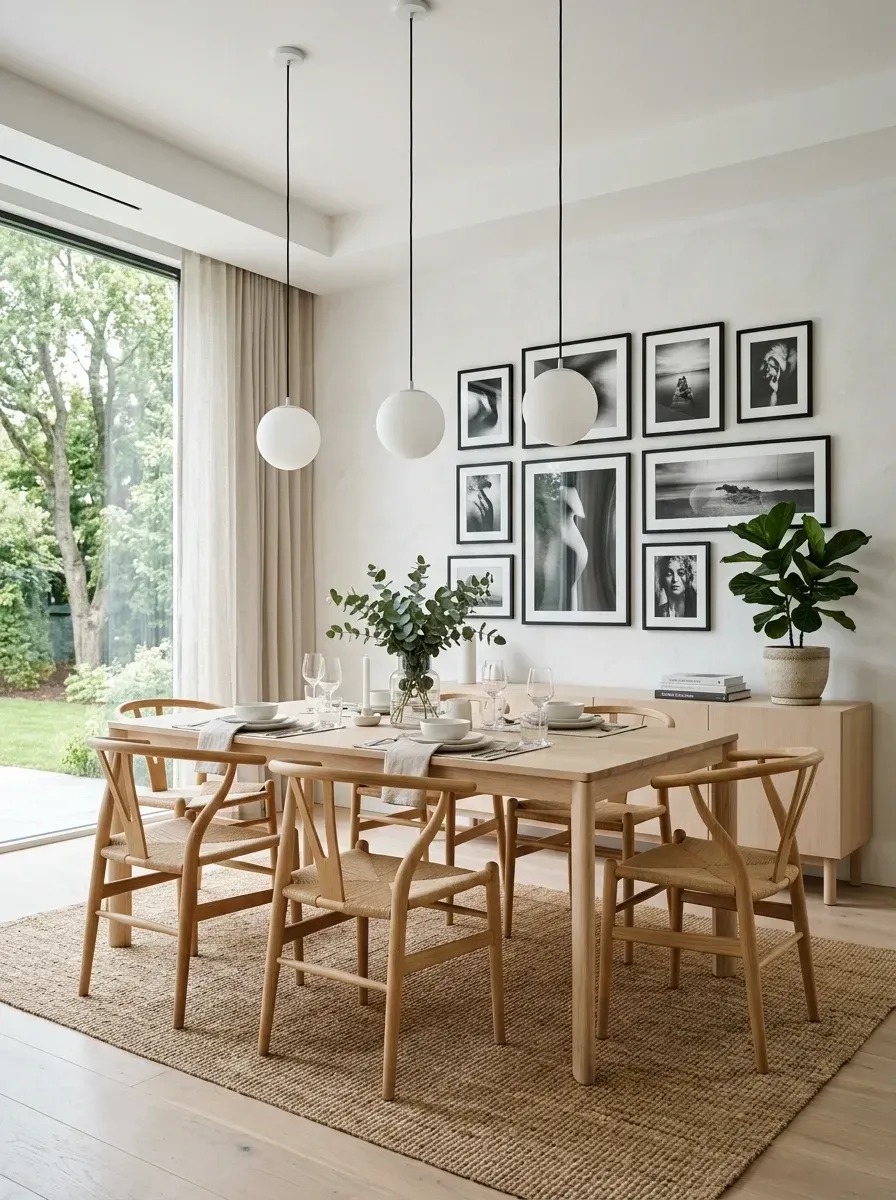
The first direction we would suggest to anyone who says "light and uncomplicated" is Scandinavian minimalism. The bones here (a light oak table, a set of wishbone-style chairs, a jute rug large enough to hold every chair leg when pulled out, and three globe pendants on a single run) do most of the work. A single large fiddle-leaf fig keeps the room from reading austere. Everything else is restraint. This combination ages slowly; two years in, you might change the art on the gallery wall once and nothing else.
Priced as a full room, the Scandi scheme runs $3,800–$10,600 in 2026 dollars, and almost half of the top figure sits in the two pieces everyone touches: the Light oak dining table at $800–$2,500 and the Wishbone-style chairs (x6) at $900–$2,400. At the high end those two lines come to about 46% of the spend, which is the right place for it in a room this spare, since there is nothing else for the eye to land on. Pin down the table's length and finish before anything else, because its range is the broadest on the list.
Behind them sit four mid-sized purchases. The flat-weave Large jute area rug is priced at $300–$800, the three opal globes on their long drops (Globe pendant lights (x3)) at $300–$900, the low Light oak sideboard under the photographs at $800–$2,000, and the black-framed Gallery wall frames and prints (set of 10) at $300–$800.
The small lines are where this look is easiest to trim. The fig in its stone-coloured pot (Large fiddle-leaf fig and pot) is $100–$300, the floor-length Linen curtains and hardware are $200–$600, and Wall paint (materials + labor) for the soft white walls adds $100–$300.
Colour is close to absent here, and that is deliberate. The walls are Off-White (#F2F2F0), a clean neutral that makes the most of Lowcountry daylight through the big window, while the table, chairs and sideboard share a single Light Oak (#D4C4A8), so the wood reads as one warm block against the pale plaster.
Texture does the job a stronger palette would do elsewhere. Natural Jute (#C9B292) appears twice, in the rug and in the woven paper-cord seats, which ties floor and furniture together. The only saturated note is Deep Green (#3A5F3B) from the fig beside the sideboard and the eucalyptus on the table, one living element that keeps the room from feeling clinical.
Two practical calls protect the look. Curtains should stay as unlined linen hung from a ceiling track, as they are here; a blackout lining or a second layer of drapery would add bulk and take the airiness out of the window wall. The rug has to be generous as well, and the one in the rendering gets it right by running well past the chairs on every side.
Stick with one wood. Light oak beside a walnut sideboard looks unfinished in a scheme this quiet rather than collected. The gallery wall follows the same logic: it holds only black-and-white photography in thin black frames, and slipping botanical drawings in among them would break the calm.
2. Breezy Coastal Retreat
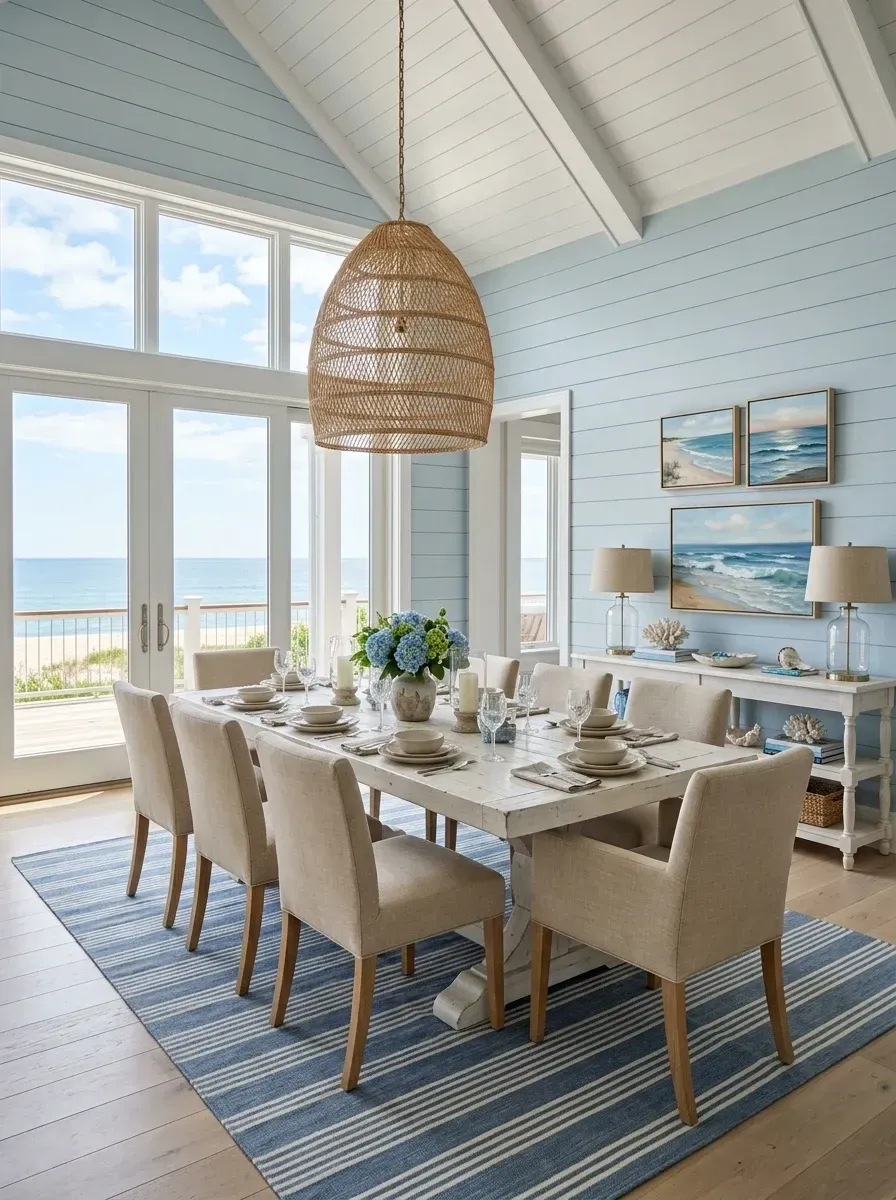
Painted shiplap, a white farmhouse table and a striped rug suit beach rentals on Kiawah, Isle of Palms and 30A for practical reasons more than photographic ones. A beach-house dining room deals with sand, damp swimsuits, sunscreen on chair arms and a rotating cast of house guests. Soft sky-blue shiplap hides scuffs better than flat paint on drywall, the distressed white top forgives the ring from a wet margarita glass, and an indoor-outdoor polypropylene rug can be hosed off on the deck. In pictures the room looks tranquil; in use, its real virtue is resilience.
Budget the coastal room at $5,850–$15,000 for 2026. Get firm prices first on the Upholstered dining chairs (x8) at $1,600–$4,000 and the Shiplap installation + paint at $1,500–$4,000; between them they account for about 53% of the upper figure. The shiplap carries the widest spread of any line, and its final price depends on how many walls and how much of the vaulted ceiling get boarded, so settle that quote before locking the smaller purchases.
The rest of the room comes in smaller pieces. The rattan dome over the table, listed as the Large woven basket pendant, runs $300–$800. The trestle-based Distressed white dining table is $1,000–$2,500, the Blue-and-white striped rug $400–$1,000, and the open-shelf White console table under the seascapes $500–$1,200.
Accessories finish the list: Ocean art prints and frames (set of 4) at $200–$600, a pair of glass-based Table lamps (x2) at $200–$500, and Coastal decor (coral, vases, hydrangeas) at $150–$400. Those last pieces are worth buying slowly, once the big surfaces are done.
Blue and white do almost all the work. The shiplap walls are Light Sky Blue (#AECAD6), a shade in the family of SW Atmospheric or BM Palladian Blue, and Crisp White (#FFFFFF) covers the trim, the vaulted ceiling boards, the table and the console, which keeps the room bright even with the sun behind the glass doors.
The deeper blue, Navy Blue (#000080), is meant to anchor the pale walls so they do not drift. In the rendering it appears only in the rug stripes, which read closer to denim, so a truly navy rug or a few navy cushions would tighten the scheme. Natural Rattan/Sand (#D8C8B0) comes in through the woven pendant, the basket on the console shelf and the oatmeal fabric of the chairs.
Proportion matters more than any single purchase in this style. Board three walls rather than all four; here the fourth side is almost entirely glass, which settles the question on its own. Full coverage feels heavy, while a single boarded wall looks like a change of mind. Hold the palette to soft blue, white and sand, and resist a second accent such as coral or yellow.
Near the coast, materials fail in predictable ways. Within 10 miles of salt water, lighting and curtain hardware should be marine grade, because standard finishes can oxidize within 18 months. The chairs in the rendering wear a linen-look upholstery; for a rental or a busy family table, ask for the same look in a performance fabric such as Crypton or Revolution rather than real linen.
3. Art Deco Jewel Box
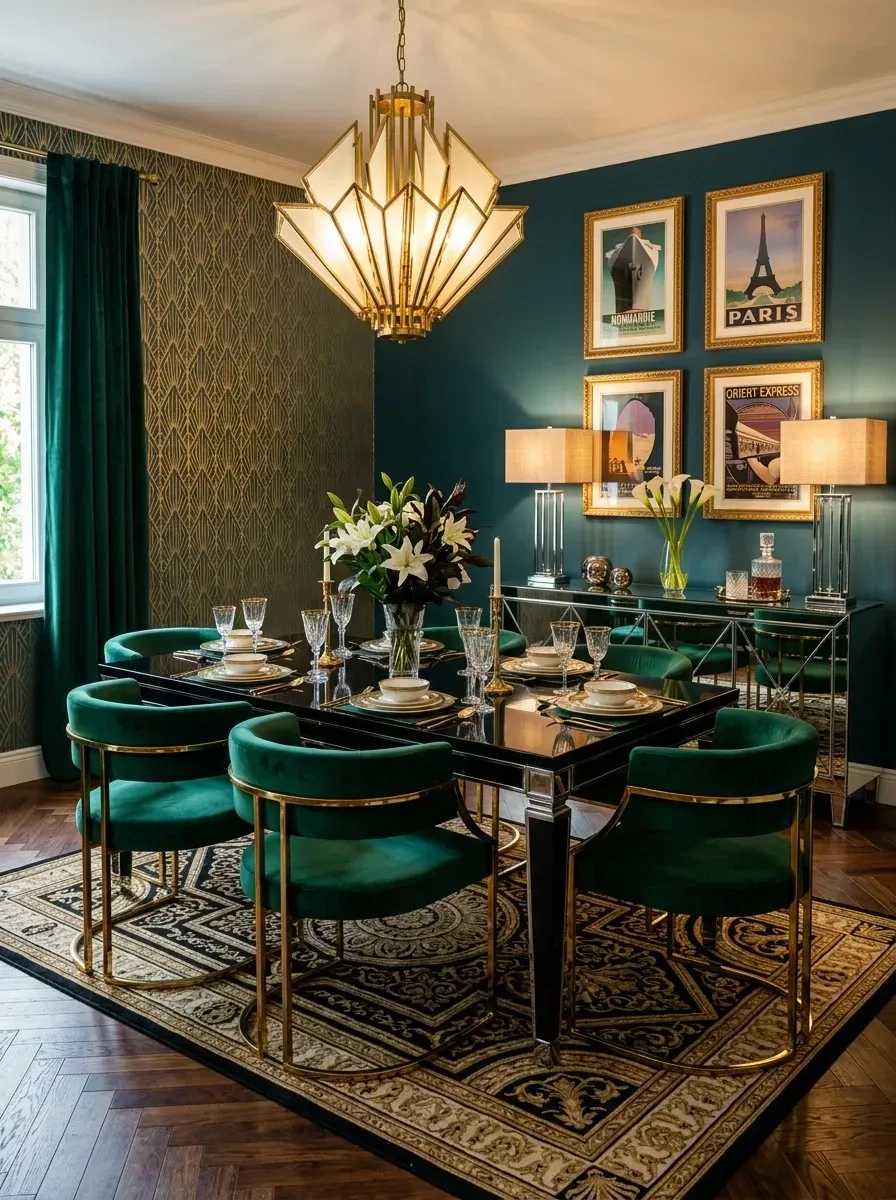
Art Deco is the style people underestimate until they see it finished. It reads glamorous in photos; it feels intimate in person, which is precisely why it works for dining rooms, where you want the room to close in slightly around the conversation. The combination here (deep teal walls, a gold geometric wallpaper feature, a black and gold dining table, emerald velvet chairs with brass frames, and a mirrored buffet) needs restraint to land. Specify this style almost only in rooms with 9-foot ceilings or higher; below that, the saturation reads heavy.
At $7,100–$18,600 in 2026 dollars, the Deco room costs more than its size suggests, mainly because of the Emerald velvet chairs with gold frames (x6) at $1,800–$4,200 and the Black and gold dining table at $1,500–$4,000. Those two account for about 44% of the high-end figure. The table is where prices vary most, so decide its top and its base finish before ordering anything else.
The fan-shaped Geometric gold chandelier is allowed $800–$2,500, and the Mirrored buffet/sideboard that doubles the lamplight along the teal wall $800–$2,000. Only one wall gets the gold pattern, so Art Deco wallpaper (feature wall) stays at $300–$800, while the travel posters in gilt frames (Vintage-style framed posters (x4)) cost $400–$1,000.
Soft goods and labour close the estimate: a black-and-cream Patterned area rug at $500–$1,500, Modern table lamps (x2) for the buffet at $400–$1,000, floor-length emerald Velvet curtains at $300–$800, and Paint + installation labor at $300–$800.
Deep colour carries this room. Deep Emerald/Teal (#005F52) runs across the painted walls and returns in the velvet chairs and curtains, so the saturation wraps around the table instead of sitting on one wall. Antique Gold (#BFA760) is the metal of the room: chair frames, the fan chandelier, the poster frames and the fine lines of the feature wallpaper.
Black (#000000) on the glossy table keeps the jewel tones grounded, and Cream/Beige (#F5F5DC) on the ceiling, the lampshades and the field of the rug gives the eye somewhere to rest, which stops the drama from becoming oppressive.
Commit to full saturation. Emerald, sapphire and garnet are the vocabulary of Deco; greyed or dusty versions of the same colours make a dark room, not a Deco one. Pattern needs a limit as well. The geometric paper is confined to the window wall, and that is plenty; papering all four walls would wear thin within six months.
Choose one metal family and hold it. The chairs, chandelier and frames are all warm gold, and the lamp columns and buffet read as glass and mirror rather than as a competing metal; rose gold or chrome would split the effect. Mirror works best in one large dose, which is why a single mirrored buffet does more here than a scatter of small mirrors could.
4. Modern Farmhouse Charm
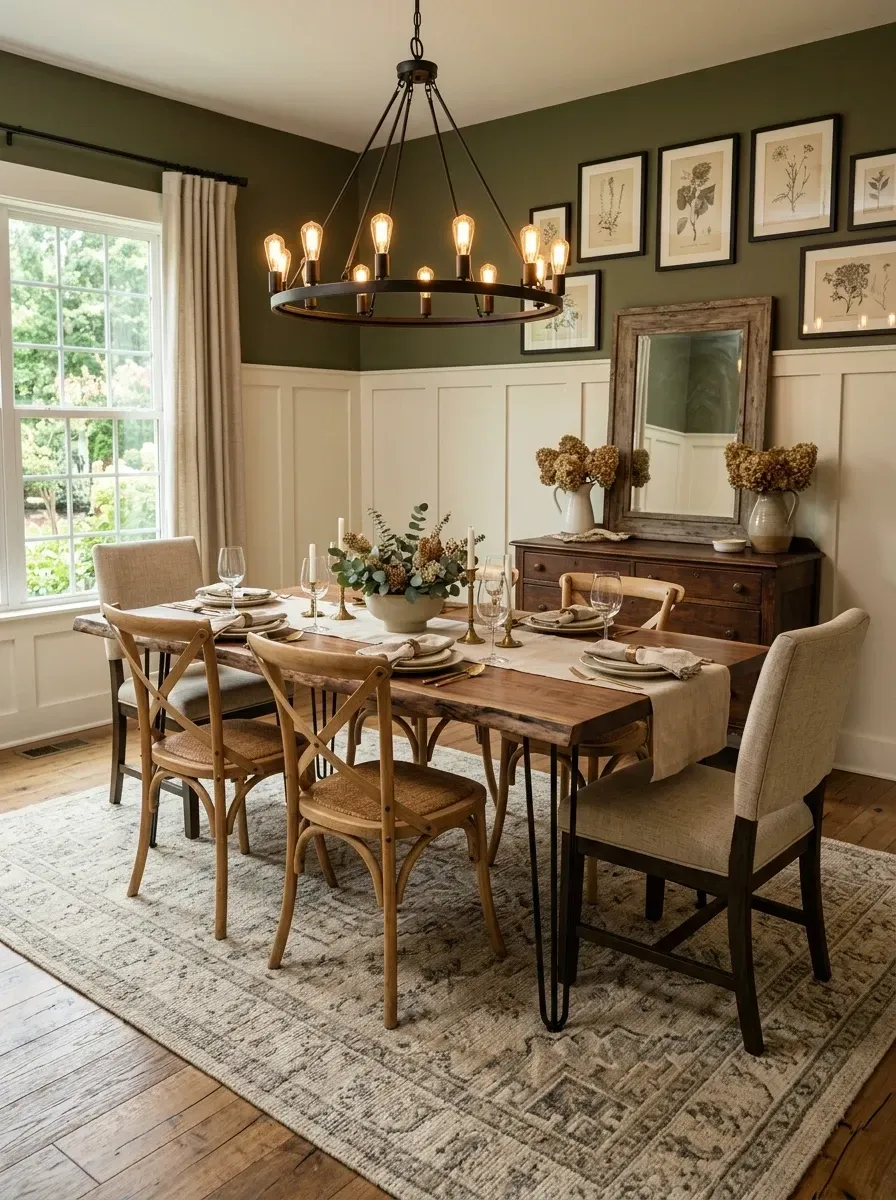
Modern farmhouse is the workhorse of the group and suits the newer houses around Summerville, Daniel Island and outer Mount Pleasant. It looks approachable in pictures and stays that way in daily use. A live-edge slab on black hairpin legs, four cross-back side chairs with two upholstered host chairs, cream wainscoting under a deep green upper wall and a wagon-wheel chandelier with Edison bulbs add up to what we think of as a 90% solution, one that fits most houses and households with little adjustment. Mixed seating, rather than a matched set, is what separates a lived-in farmhouse room from a catalogue page.
The farmhouse room totals $6,300–$15,700 in 2026 dollars. The slab is the big number: the Live-edge dining table is carried at $1,500–$4,000, the widest range in the section, so its species, length and finish should be fixed first. Wainscoting install + paint follows at $1,500–$3,500, and the two lines together make up about 48% of the top of the budget.
The seating splits into Cross-back wooden chairs (x4) at $400–$1,000 and Upholstered host chairs (x2) at $500–$1,000, which shows how cheaply the mixed look comes together. The iron Wagon-wheel chandelier with Edison bulbs is $400–$1,000, and the dark Antique/rustic wooden buffet under the mirror is $800–$2,000, a piece where an older find suits the style better than anything new.
Decor completes it: the weathered Large rustic wood-framed mirror at $400–$1,000, a faded Vintage-style patterned rug at $400–$1,200, the framed pressed-plant studies of the Botanical print gallery wall at $200–$500, and Linen curtains + iron hardware at $200–$500.
The wall is split in two. Forest Green (#3A4B3C) on the upper walls, in the range of BM Tate Olive or SW Rosemary, gives the room its depth, and Creamy White (#FDFBF7) on the board-and-batten wainscoting and trim is warm enough to sit beside it without the chill of a builder white.
Medium Rustic Wood (#8B5A2B) covers the slab, the buffet, the mirror frame and the floorboards, and Matte Black (#1C1C1C) on the chandelier, the curtain rod and the hairpin legs supplies the modern edge that keeps the room from sliding into full country.
Set the wainscoting at 34–42 inches and cap it with a proper chair rail. Any lower and it looks like a wall someone stopped painting halfway. In this room the cream panels rise to roughly the window sill, a height that holds its own against the dark green above.
Spend on the slab. Every other piece in the room is arranged around the live-edge table, so it is the wrong place to economize. Repeat the matte black at least three times so it reads as intentional; the chandelier, the curtain rod and the hairpin legs already do that here, and black pulls on the buffet would make a fourth.
5. Classical Opulence
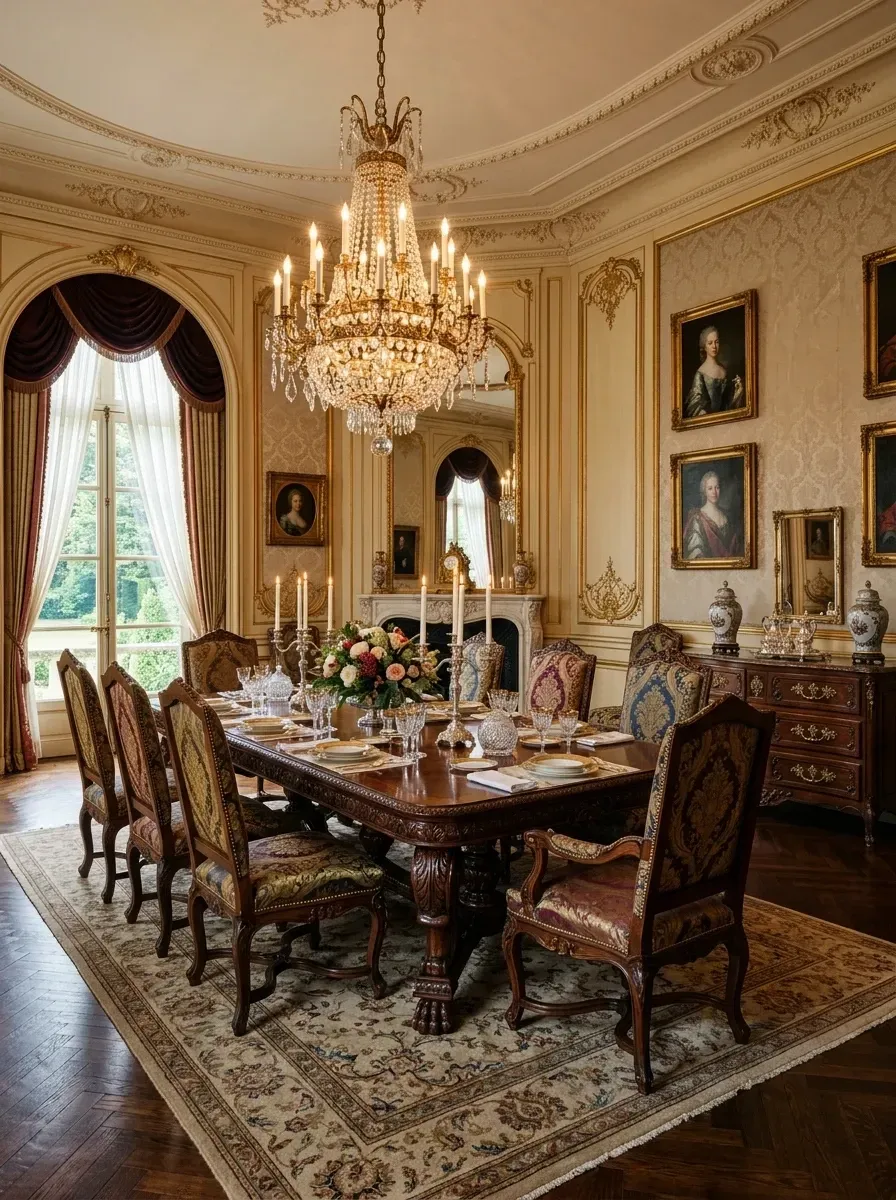
Formal, symmetrical, and unapologetically traditional, this is the style for historic downtown Charleston homes where any other direction would fight the architecture. A massive crystal chandelier, a carved dark mahogany table, eight upholstered chairs in a brocade fabric, ornate wall molding, and a Persian-style rug that anchors the whole composition. The cost runs higher than any other style in this guide because the traditional category rewards substance: real wood, real crystal, real silk, real wool. Synthetic versions read wrong within twelve months.
Classical Opulence is the most expensive scheme in the guide, carried at $21,000–$67,000 for 2026. Seating leads: the Upholstered carved dining chairs (x8) at $4,000–$12,000, a range wide enough that the carving, frame wood and brocade grade should be settled before anything else. The Carved dark wood dining table follows at $3,000–$10,000. Even together they are only about 33% of the upper figure, because the spending is spread across many substantial pieces.
Light, storage, art and fabric each claim a serious share. The Large ornate crystal chandelier is budgeted at $2,000–$8,000, the Antique/reproduction sideboard at $2,000–$6,000, Gold-framed oil portraits (x3) at $1,000–$5,000, and the swagged Custom heavy drapery + valance at $2,000–$5,000.
In this style the architecture costs as much as the furniture. The Persian-style area rug runs $2,000–$8,000, Decorative molding install + paint for the gilded panels and ceiling work $3,000–$8,000, and the Fireplace mantel + mirror at the far end $2,000–$5,000.
Warm neutrals hold the background. Warm Beige/Cream (#E8DCCA) covers the damask wall panels and the ceiling, leaving the furniture to carry the room, and Dark Mahogany (#4A2511) on the carved table, the chair frames and the commode gives it weight.
Gilded Gold (#D4AF37) traces the mouldings, the portrait frames and the chandelier. Deep Burgundy (#800020) is the textile colour, strongest in the swagged valances and repeated in the chair brocades, which also mix in gold and a dusty blue.
Symmetry is the rule this style cannot break: portraits, sconces, lamps and lidded jars all come in pairs, and an off-balance arrangement undoes the look faster than any wrong colour. The chandelier deserves real crystal rather than acrylic or composite, since imitation drops look flat in daylight while cut crystal throws light all day.
Two placement details finish it. Drapery should break about one inch onto the floor, neither trailing across it nor hovering above it. The rug is centred on the table rather than on the room, since the table is the focal point and the rug marks out its ground.
6. Bohemian Terracotta Dream
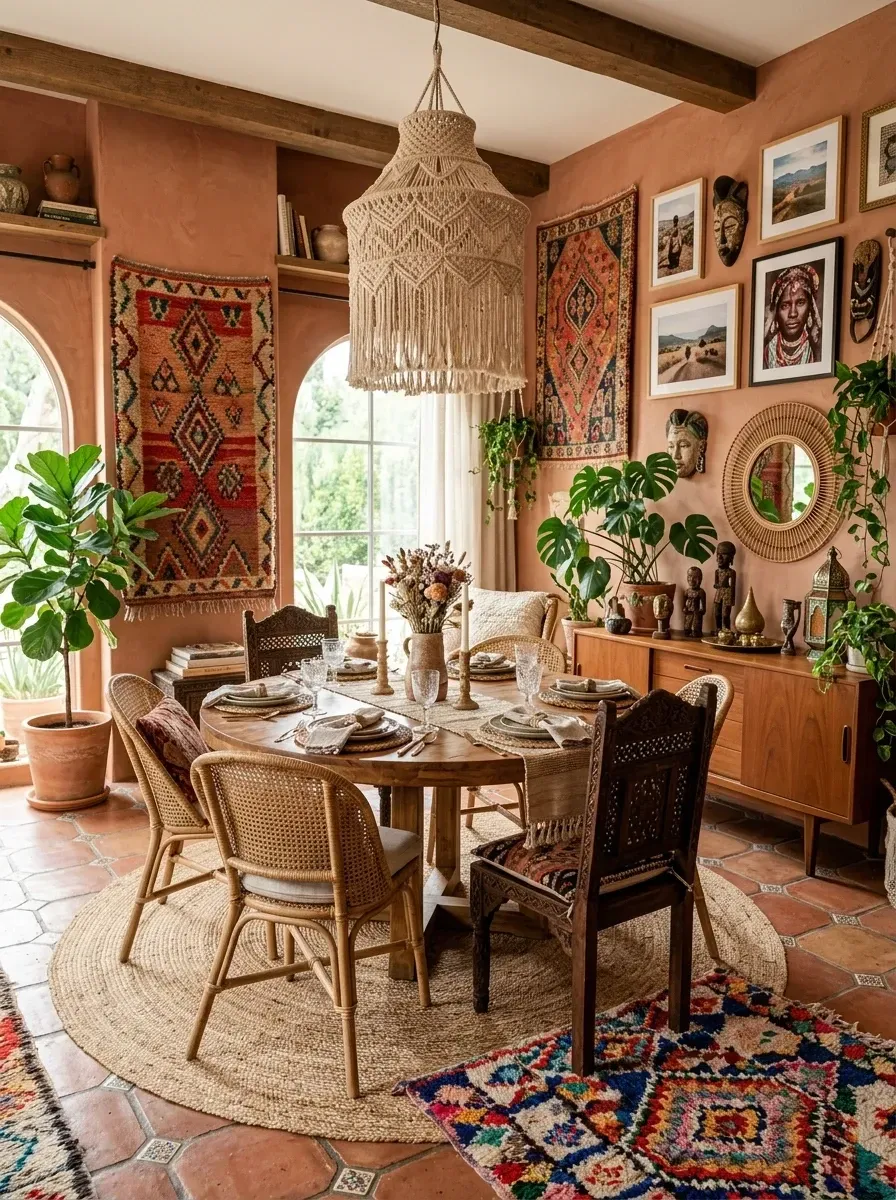
Boho reads warm in any region but performs specifically well in the lower Southeast: the warm color temperature in Savannah, Naples, or the Gulf Coast sun brings out terracotta's depth in ways that temperate light in Richmond or Nashville can't quite replicate. A round reclaimed-wood table, a mix of cane and carved-wood chairs (no matched set), a macrame chandelier, two or three layered patterned rugs (Moroccan or vintage Turkish), and an abundance of live plants: monstera, fiddle-leaf fig, pothos. The rule is controlled maximalism: every element must earn its place, even when the overall composition reads eclectic.
The boho room comes to $6,900–$18,000 in 2026 dollars, and its largest line is a surface rather than furniture: Terracotta floor tile (materials + labor) at $2,000–$5,000, the range to pin down first because tile grade and subfloor condition swing it widely. The Layered vintage/Moroccan rugs (x3) follow at $800–$2,500; together the two make up about 42% of the top figure.
The table and chairs are deliberately mismatched. A Round reclaimed-wood table is allowed $800–$2,000, the Cane/rattan dining chairs (x4) $600–$1,400, and the two dark Carved-wood accent chairs (x2) $500–$1,200. The fringed Large macrame pendant over the table is a modest $200–$600.
Around the walls, the teak-toned Mid-century modern sideboard is $800–$2,000, Textured wall paint/plaster for the chalky clay-coloured finish $500–$1,500, the monstera, fig and trailing pothos in Large plants + pots $400–$1,000, and Wall hangings, mirrors, decor $300–$800.
Earth tones run from floor to ceiling. Terracotta/Rust (#9E4F34) is both the plastered walls and the clay floor tile, the base the whole look depends on, and Warm Reclaimed Wood (#A67B5B) in the round table, the beams and the sideboard adds rustic grain against it.
Lush Green (#4F7942) arrives with the plants, which matter as much as any painted surface in this scheme, and Natural Beige (#E3DCCB) in the cane chairs, the round jute rug and the macrame softens the terracotta so it does not overwhelm the room.
Limit the floor to three rugs. In the rendering a round jute base sits under the table, a bright Moroccan pile rug overlaps it at the front, and a third edges in from the side; a fourth would look cluttered rather than collected. Plants need light that suits their species: fiddle-leaf figs want 6+ hours of indirect daylight or they shed leaves, so a dimmer room is better served by sansevieria and pothos.
Round geometry suits this style, and the circular table keeps a busy room easy to move through. The walls mix woven rugs, carved masks and framed photographs, which holds together only because all three share the same earthy palette; if the room starts to feel crowded, edit back to two of those three kinds of wall piece rather than adding another.
7. Transitional Elegance
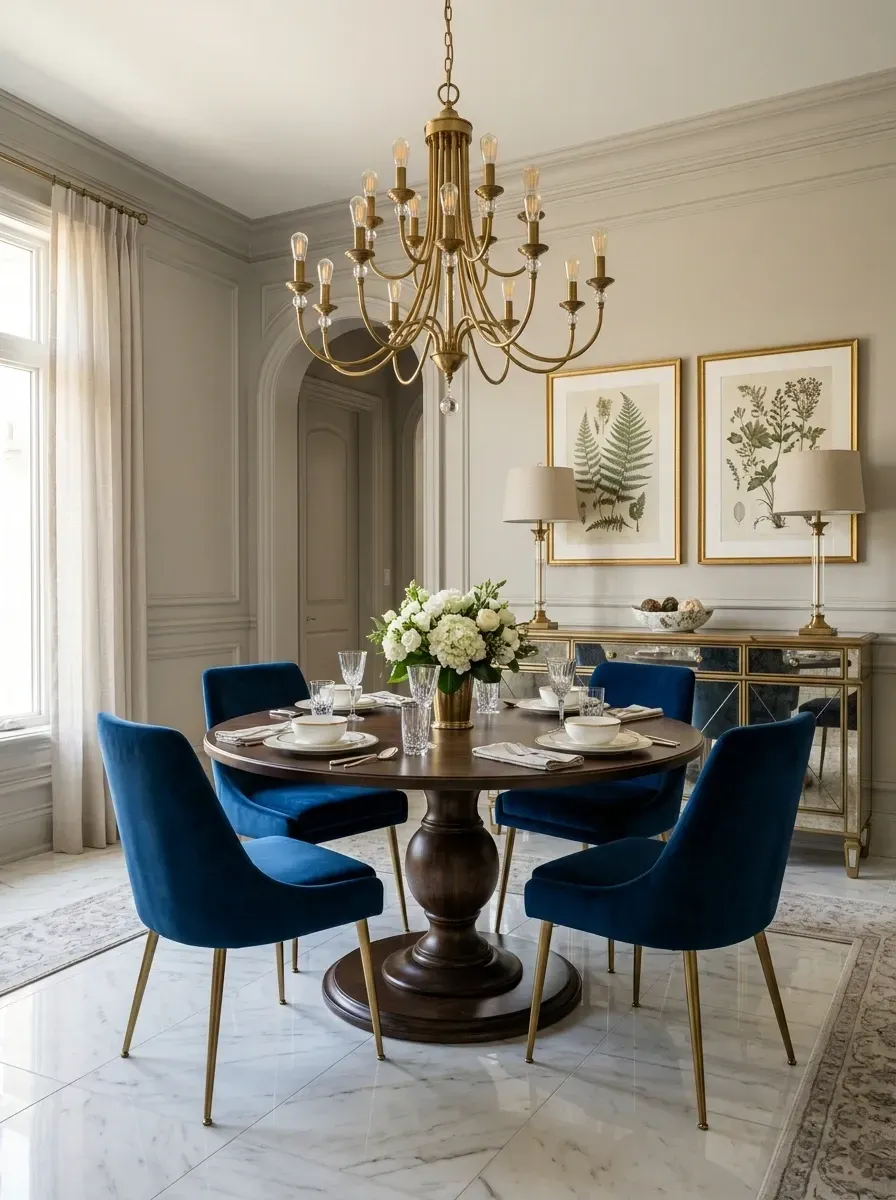
Transitional is the style we would recommend to anyone who can't decide between traditional and contemporary, which describes most new builds in Charlotte, Raleigh, and Nashville. A round dark-wood pedestal table, six navy velvet chairs with brass legs, a brass candelabra chandelier, and a mirrored buffet. The round table is the quiet star: it improves conversation flow and seats one more person than a rectangular equivalent. This style photographs cleanly and ages slowly; ten years on, very little of it reads dated.
Transitional Elegance is priced at $8,800–$23,200 for 2026, and the floor is the surprise. Marble tile flooring (materials + labor) at $3,000–$8,000 is the biggest and least predictable line, so get a written quote on it early. The Navy velvet chairs with brass legs (x6) follow at $1,500–$3,600, and between them the two take about 50% of the high-end budget.
By comparison the Round dark-wood pedestal table is a reasonable $1,200–$3,000. The many-armed Brass candelabra chandelier is set at $600–$1,800, the gold-trimmed Mirrored credenza at $1,000–$2,500, and the two fern studies listed as Botanical prints in gold frames (x2) at $300–$800.
Modern table lamps (x2) on the credenza add $300–$800, an Area rug to soften the marble $400–$1,200, and Wall paint + molding for the paneled greige walls $500–$1,500.
Two colours lead. Royal Navy Blue (#000080) on the velvet chairs gives the room depth while staying quiet enough to age well, and Light Greige (#EDECE8) on the paneled walls, carried down into the pale marble floor, is the neutral that sits between traditional and contemporary.
Polished Brass (#E5B80B) shows up on the chandelier, the tapered chair legs, the lamp stems and the frame mouldings, warm and a little glamorous without the gold-everywhere feel of Deco. The pedestal table in Dark Espresso Wood (#3B2F2F) is the classical anchor the newer pieces play against.
The style works by pairing classical shapes, like the pedestal base and the candelabra arms, with contemporary materials such as velvet, brass and mirror. Sizing the round table is the main practical decision: under 60 inches suits four, 60–72 inches suits six, and beyond 72 inches people sit too far apart to talk easily, which is when a rectangle becomes the better shape.
Hold to one metal. Brass reads warm and polished nickel reads cool, and mixing them in a transitional room leaves it feeling unresolved. Marble underfoot makes everything around it look more expensive; porcelain that imitates marble costs a fraction as much, but check the veining on a full-size sample before ordering, because a repeating pattern gives it away.
8. Industrial Loft Living
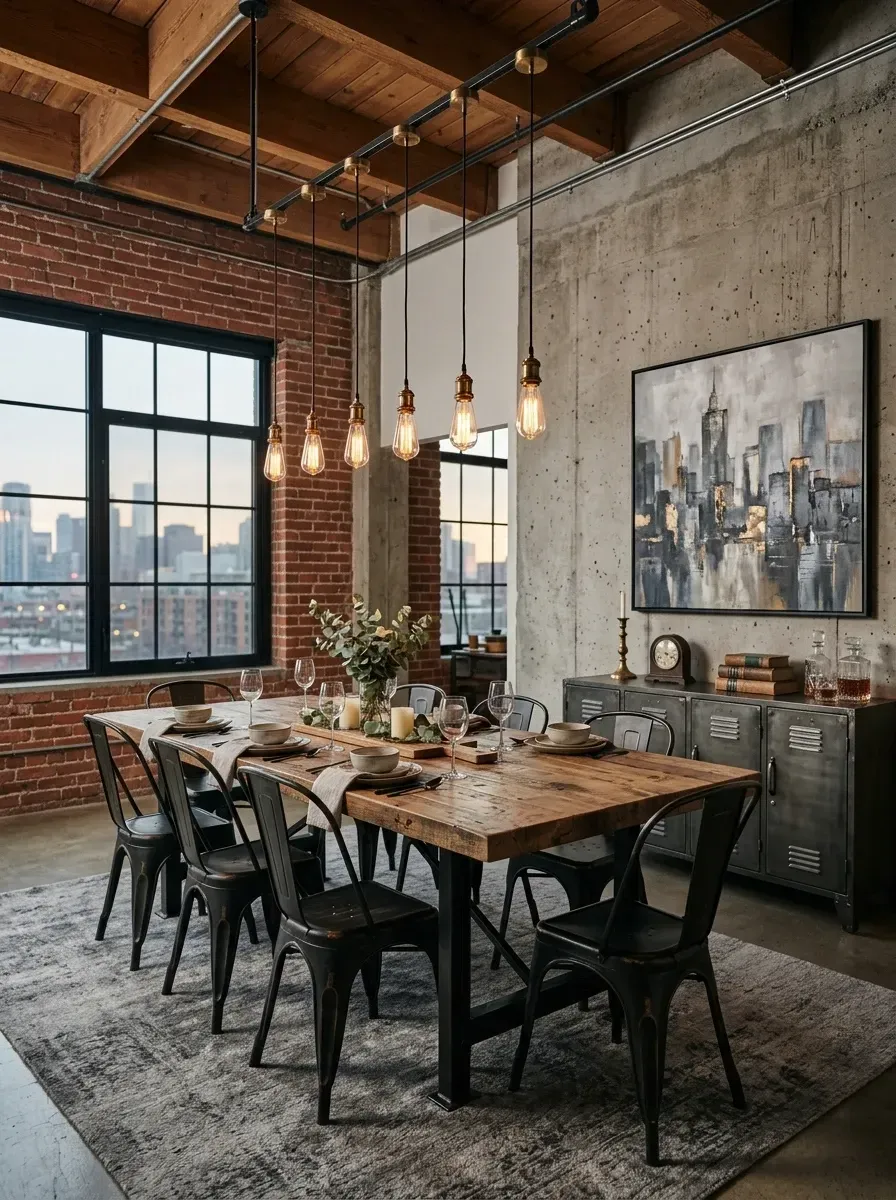
Industrial works best where it's honest: converted warehouses in Atlanta's Westside, renovated row houses in Richmond, infill lofts in downtown Nashville. Exposed brick on one wall, raw concrete on another, a reclaimed-wood table paired with eight metal Tolix-style chairs, a linear multi-bulb Edison pendant suspended from visible conduit, and a metal industrial sideboard. The most common mistake is faking industrial in a suburban tract home, where the faux-brick veneer reads cartoonish when the rest of the architecture doesn't support it. If the bones aren't industrial, specify transitional instead.
The loft scheme totals $5,340–$14,400 in 2026 dollars. Where the brick has to be added, the Faux-brick install (if not original) line at $1,500–$4,000 is both the largest and the least certain cost, so it gets the first supplier check; the Reclaimed-wood industrial table follows at $1,000–$3,000. Those two make up about 49% of the top figure.
The black Metal Tolix-style chairs (x8) are among the better values in the guide at $640–$1,600 for the set. The rail-mounted Linear multi-light Edison pendant is $400–$1,000, the locker-style Industrial metal sideboard $600–$1,500, and the Large abstract cityscape art above it $300–$800.
Two finishing lines remain: a Distressed area rug in washed grey at $400–$1,000, and a Concrete wall finish at $500–$1,500 for rooms with no poured wall to expose.
The materials supply the colour. Brick Red + Concrete Grey (#964B00) are the two walls, one of old brick and one of bare concrete, and Rustic Reclaimed Wood (#8B5A2B) on the table top and the exposed ceiling planks and beams brings warmth against that cold shell.
Matte Black (#2C2C2C) belongs to the chairs, the table base, the pendant rail and the steel window frames, the modern edge of the scheme. The rug in Distressed Grey (#808080) and the grey locker cabinet sit between concrete and metal and tie the two together.
Expose what the building already has, such as brick, concrete, beams and pipes, and do not manufacture what it lacks. Comfort is the other thing to plan for: steel Tolix-style chairs are fine for 40 minutes and hard going over two hours, so a household that hosts long dinners should add upholstered seat pads.
Standard Edison bulbs run hot and use more power than LED replicas; dimmable LED filament bulbs at 2400K give the same amber glow without the heat. Height matters too. This style wants 9+ feet of ceiling, which the beamed loft in the rendering clearly has, and under an 8-foot ceiling the exposed services and dark metal make the room feel cramped.
9. Modern Luxe Penthouse
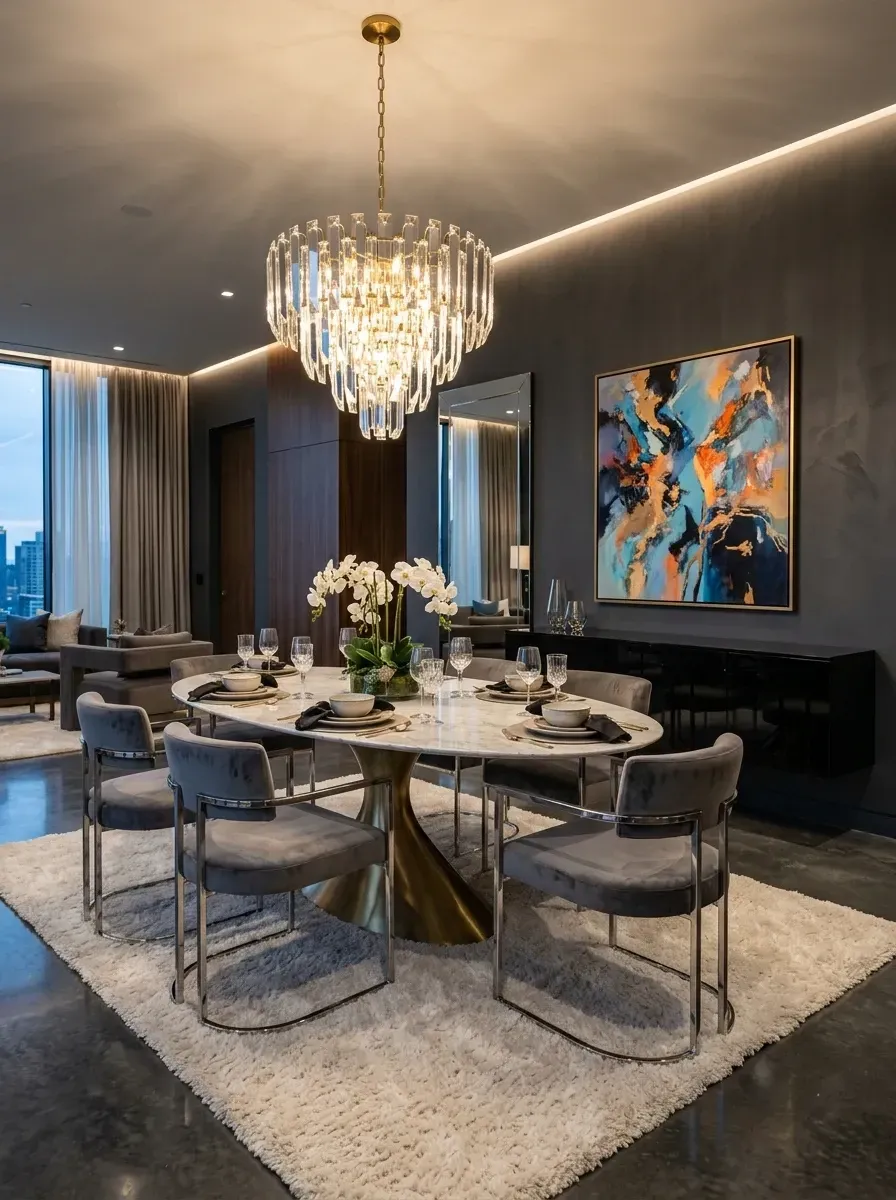
The most expensive direction in this guide, and the one people overspecify most often. Oval marble table on a sculptural metal base, eight grey velvet chairs with polished chrome frames, a tiered crystal chandelier, dark paneled walls with integrated LED lighting, a plush white shag rug on polished concrete. This is a direction for a penthouse or a high-floor condo. It works spectacularly when the architecture supports it: tall ceilings, big glass, a real view. It falls flat in a standard eight-foot-ceiling suburban dining room regardless of how much money you throw at it.
The penthouse scheme is priced at $13,800–$35,700 for 2026. Its two largest lines are the Wall paneling + integrated LED at $3,000–$8,000, the broadest range here and the one to specify first because the electrical work drives it, and the Grey velvet + chrome chairs (x8) at $3,200–$7,200. Together they account for about 43% of the upper figure.
The Oval marble dining table with metal base is budgeted at $2,500–$6,000, the Tiered crystal chandelier at $1,500–$4,000, the gloss-black Floating black sideboard at $1,000–$3,000, and the blue-and-orange Large abstract canvas art at $800–$2,500.
Underfoot, the Plush shag area rug adds $800–$2,000 and the Polished concrete floor finish $1,000–$3,000.
The scheme runs from dark to light. Charcoal Grey (#36454F) wraps the walls and is echoed in the velvet chairs, and against it the marble top and the shag rug in White/Light Grey (#F0F0F0) supply the contrast the dark shell needs.
Polished Chrome (#C0C0C0) is assigned to the metals and is right on the chair frames; in the rendering, though, the sculptural table base and the chandelier canopy are brass, so either those move to chrome or the chairs move to brass to keep a single metal. The only strong colour is the canvas, Vibrant Blue/Orange (#007FFF), one loud piece that keeps the room from going flat.
Marble on a dining table needs upkeep. It is porous, so seal it at installation and again every 12–18 months, because red wine left on an unsealed top can stain permanently within hours. Wall paneling has to follow the ceiling height, since tall panels in a low room look top-heavy.
Integrated LED strips come in cooler (3000K) and warmer (2700K) temperatures, and the warmer one is the right choice over a dining table, since cool light makes food look flat. Keep to one pop of colour rather than three; the whole idea is a restrained room with a single loud moment.
Regional Fit Across the Southeast
Not every style travels well across regions. These are the combinations to steer toward based on where you live: the daylight temperature, typical ceiling heights, and dominant architectural vocabulary all influence which style actually lands.
Where Each Style Performs Best
In Charleston and the historic Lowcountry, three styles fit: Classical Opulence, Modern Farmhouse and Breezy Coastal. Historic architecture rewards traditional restraint, and the formal molding and high ceilings in those houses support the Classical direction. A few miles away in Mount Pleasant and Daniel Island, the newer builds have 9-foot ceilings and open floor plans, so Modern Farmhouse and Transitional Elegance suit them better, and transitional ages more gracefully than most styles.
Along coastal GA, 30A and Naples, Breezy Coastal and Bohemian Terracotta are the strong choices: warm light makes terracotta sing, and salt air rewards crisp coastal palettes. Industrial Loft belongs in places with the architecture to back it up, such as Atlanta's Westside, the Nashville Gulch and Richmond, where real warehouse conversions and loft buildings support the style honestly. In Charlotte, Raleigh and Greenville, new-construction neighborhoods still include formal dining rooms, and Transitional Elegance or Modern Farmhouse reads current there without committing to a trend.
Asheville and the Western NC mountains pair well with Modern Farmhouse and Bohemian Terracotta, because regional materials and a craftsman vocabulary line up with both. The two most dramatic styles, Modern Luxe and Art Deco, fit downtown Charleston penthouses and Sarasota condos, rooms driven by architecture where ceiling height and views justify the investment. For any space in any region, Scandi-Minimalist is the safe answer. It is the only style that works in practically every ceiling height, daylight condition and architectural style, and it is the safest choice for anyone who cannot commit to one direction yet.
Practical Tips for Any Dining Room
Size the rug correctly, because it is the single most common mistake. The rug must be large enough that every chair leg stays on it when a chair is pulled out, which means at least 24 inches of rug beyond the table on each side. An 8 × 10 rug fits a 60-inch table, and a 9 × 12 fits a 72-inch table. The chandelier has a rule of its own: the bottom of the fixture should sit 30–34 inches above the tabletop under an 8-foot ceiling, plus 3 inches for every additional foot of ceiling height. Hung too high it looks like an afterthought, and too low it clips your sightlines.
Lighting works best in layers. A chandelier alone is the lazy answer, so add two sconces on the buffet wall or table lamps on the sideboard, with everything on dimmers. Three dimmable layers of light change how useful a dining room is across a typical day. Seating should be mixed on purpose, too. A matched set of six identical chairs photographs well and lives stale, while four side chairs plus two upholstered host chairs at the ends reads more collected, costs less and makes the ends of the table more comfortable.
Upholstery in a dining room should be performance fabric. Crypton or Revolution performance fabrics clean up after red wine, oil and food spills, and regular linen or cotton does not. The premium is roughly 15–20% over standard fabric, which is money well spent in a room where food is the whole point. For the statement piece, shop secondhand: estate sales in the historic districts of Charleston, Savannah and Raleigh often turn up solid mahogany tables and carved sideboards well below retail prices. Refinishing adds $300–$800, and the savings run to thousands.
Know where DIY pays. Wainscoting is a weekend project with standard tools. Marble, hardwood or tile flooring almost always goes wrong as a DIY job, because the subfloor prep is what separates a 20-year install from a 3-year one.
Dining Room Design: Frequently Asked Questions
How much does a full dining room makeover cost in 2026?
Between $3,800 (a fully DIY Scandi-minimalist setup with secondhand furniture) and $67,000 (full Classical Opulence with custom millwork, real crystal, and antique pieces). Most Southeast homeowners can expect to land in the $8,000–$18,000 range for a complete dining room with new furniture, lighting, paint, wall treatment, and a properly sized rug.
Which dining room style is the most timeless?
Transitional Elegance, by a meaningful margin. It reads current today, reads current in 2016, and will read current in 2036. Classical Opulence is equally timeless but requires real architecture (high ceilings, formal trim) to support it. Modern Farmhouse is approaching its saturation point in many markets; if longevity matters more than trend-currency, Transitional wins.
What size dining table does a family of six need?
A rectangular table at 72 inches × 38 inches seats six comfortably with room for serving dishes. For a round table, 60 inches seats six tightly, 72 inches seats six comfortably. Always leave 36 inches of clearance between the table edge and any wall or furniture behind the chairs; with less than that, and pulling out a chair runs you into the wall.
What's the correct hanging height for a dining room chandelier?
For an 8-foot ceiling, the bottom of the fixture should sit 30–34 inches above the table surface. For every additional foot of ceiling height, add roughly 3 inches to that clearance. Center the fixture over the table, not over the room, because the table is the focal point, not the geometric center of the floor.
Are open-plan dining rooms still in style in 2026?
Yes, but the hard open plan (dining flowing into kitchen with no separation) is softening into what's being called broken-plan layouts: open sight lines but partial visual separation through cased openings, half walls, or large area rugs that define zones. They suit households that want the dining area to feel like its own room without closing it off.
How many chairs should a dining room have?
Six to eight is the standard range for a primary dining room. If your family is four, six chairs (four everyday + two spare for guests) works most dinners and scales for holidays. Planning to entertain regularly pushes you toward eight. Anything larger than eight needs a banquet-sized room with matching proportions.
Can styles be mixed, for example a farmhouse table with modern chairs?
Yes, deliberately. Transitional Elegance is essentially this principle codified: classical silhouettes with contemporary materials and finishes. The key is that the mixing should feel intentional: one traditional anchor piece paired with contemporary accents, rather than a disorganized mashup of unrelated styles. Pick two styles at most and blend them consistently across the room.
Related Guides for Each Dining Style
The dining room is one of the few rooms in the house where style really does shape how you use the space. A formal Classical Opulence dining room invites long Sunday dinners with extended family; a Scandi-minimalist setup encourages weeknight meals and homework sessions; a Breezy Coastal room assumes guests, sand, and a casual turnover. Pick the style that matches how your family actually lives, not the one that photographs best on Pinterest.
For more on these directions in other rooms, the 12-direction living room revival guide applies many of the same styling principles to the living room, which often adjoins the dining room. Readers drawn to the farmhouse scheme above can see it carried through a whole house in the builder-grade to modern farmhouse transformation. The Scandi approach is covered in more depth in the Nordic Scandi makeover walkthrough, and the 11-direction room reveal guide is a broader companion on room-by-room costs and choices.
Start with your honest budget, pick the style that matches your architecture and household, and then commit to the details. The details are what separate a room people compliment from a room people actually want to linger in.
Sources & References
- Remodeling 2024 Cost vs. Value Report: South Atlantic regional data for millwork, wainscoting, and trim installations
- ASID 2024 Interior Design Trends Outlook: style popularity and regional preference data
- Sherwin-Williams and Benjamin Moore 2024–2026 color library: paint specification references for documented palettes
- NKBA (National Kitchen & Bath Association): lighting height and fixture placement guidelines for dining applications
- The Layered Homes editorial notes: 2026 dining room concepts for Charleston, Mount Pleasant, Summerville, Kiawah, Savannah, Atlanta, Nashville, and Naples
Styling & Living Desk
The Layered Homes editorial teamThe Styling & Living Desk produces the room-by-room guides, outdoor and garden pieces, celebration ideas and design solutions, each with an itemised cost estimate, and the Home Files essays.
More from the Styling & Living Desk →
Reader notes