


Take a Sullivan's Island homeowner: early-retirement empty-nester, a 1996 raised coastal house rented out for eighteen years, now moving back in for good. The references are three Nancy Meyers movie stills and a 1980s Hamptons living room, and the brief fits in one line: the house should feel inherited, not bought from a coastal catalog. That's the whole Coastal Grandmother problem in a sentence. This guide walks through ten room concepts for a 2,340 sq ft cottage like that, and every direction is priced twice: once at the Serena & Lily price point, and once at the mix of antique, slipcovered, and regional-vendor sources that actually produce the inherited-not-purchased feeling. This is the honest breakdown of both paths, room by room, with the specific fabrics, finishes, and jute rug weights that make the difference between "grandmother from the Hamptons" and "beach house rental."
This guide from The Layered Homes editorial team looks at Coastal Grandmother, coastal-traditional, and Lowcountry-vernacular interiors of the kind found across Sullivan's Island, Isle of Palms, Kiawah, Daniel Island, Mount Pleasant, Beaufort, and the Savannah-area barrier islands. The honest truth about this aesthetic is that it looks deceptively casual and is actually one of the most disciplined styles to specify: the wicker has to be the right wicker (real hand-caned, not bent-reed-glued), the jute has to be the right weight (8/9 ply, not the loose 5-ply that unravels in twelve months), the slipcovers have to be the right linen (Belgian linen, not polyester-blend imitation), and the art has to feel collected over forty years, not ordered from a single vendor in a single shipment. Every direction below names the specific SKUs, the finish details, and the one tradeoff that, if you skip it, collapses the room from Coastal Grandmother into generic-coastal within the first photograph.
The style is rooted in a real place and a real generation. Nancy Meyers codified the visual vocabulary in films like Something's Gotta Give (2003) and It's Complicated (2009), but the actual source is the Long Island, Rhode Island, and Carolina Lowcountry cottages where generations of families layered linen, wicker, blue-and-white porcelain, and salt-faded wood over decades of summers. Getting it right in a Southern coastal context means honoring the Lowcountry's specific plant palette (hydrangea, gardenia, magnolia, rather than Long Island's hortensia and rose), the specific humidity (every slipcover and throw has to handle 95% July humidity without molding), and the specific light (Charleston's southern-exposure light is warmer and harsher than Hamptons north-light). What follows is ten rooms done honestly at Lowcountry prices.
What's inside this Coastal Grandmother guide
- 1. The Sun-Drenched Seaside Conservatory
- 2. Cozy Coastal Reading Nook
- 3. Collected Coastal Gallery Wall & Floating Shelf
- 4. The Breezy Ocean-View Home Office
- 5. Relaxed Coastal Farmhouse Living Room
- 6. Elegant Seaside Dining Room
- 7. Serene & Sandy Bedroom Retreat
- 8. Welcoming Coastal Entryway
- 9. Charming Cottage Breakfast Nook
- 10. Luxurious Classic Coastal Bathroom
- What Separates Coastal Grandmother From Coastal Cliché
- Cost-Saving Strategies That Don't Dilute the Style
- Regional Installed Cost: 7 Southeast Markets
- Frequently Asked Questions
- Sources & References
- Edit, Then Let the Rooms Accumulate
1. The Sun-Drenched Seaside Conservatory
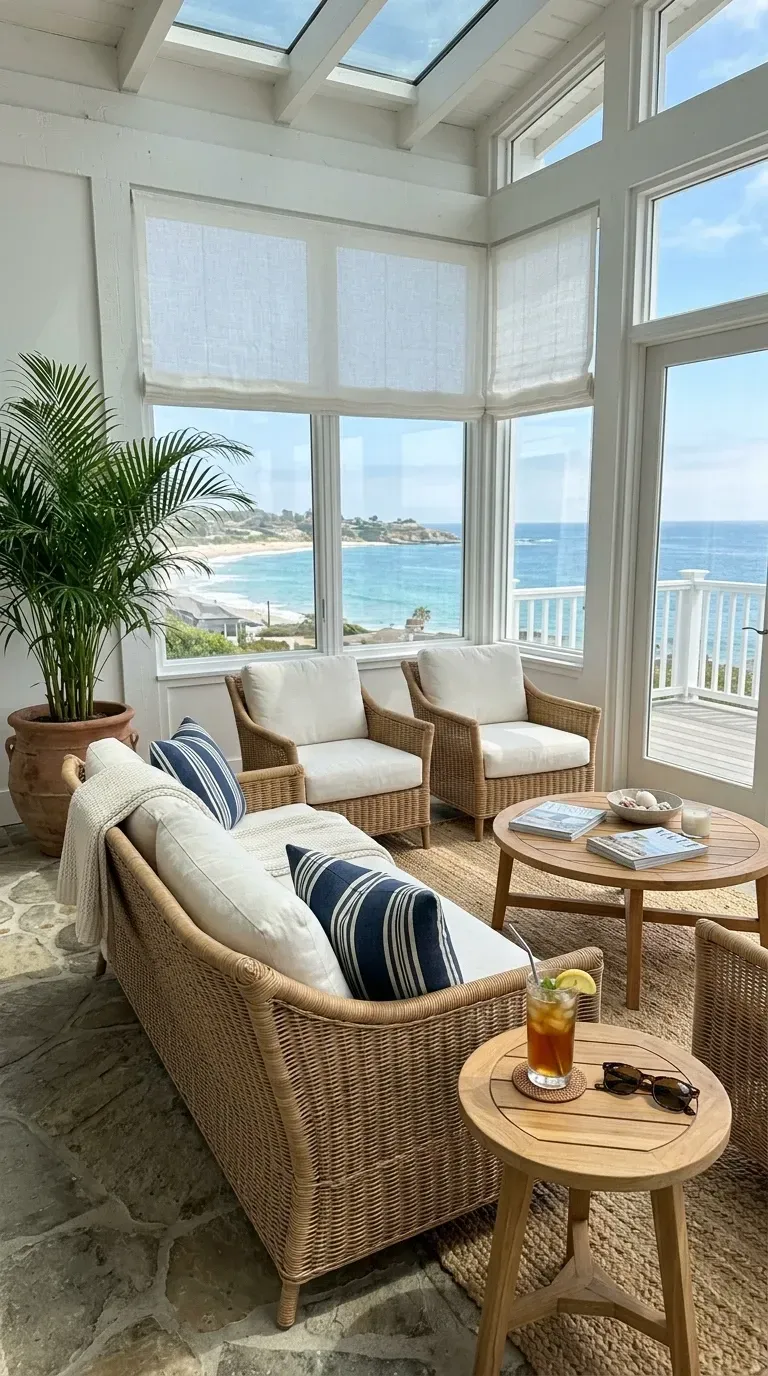
We drew this direction for houses with a true enclosed porch or three-season sunroom, the room a Lowcountry cottage lives in every morning from October through May. The rendering shows a woven wicker sofa and two matching armchairs; for the real room, specify hand-caned pieces such as the Palecek Serena collection, Sika Design Charlottenborg or, if the budget stretches, the Serena & Lily Balboa, and skip big-box bent-reed imitations, which tend to come apart after a couple of humid summers. Cushions take Belgian-linen slipcovers over Sunbrella fills, or Tempotest Home marine-grade performance linen where humidity is a bigger problem than salt. The round coffee table and the small side table read as natural teak in the image; a whitewashed solid oak round (West Elm Anton, Lulu & Georgia Mario, or a vintage drum table from a regional antique dealer) gives the same shape in a paler finish. The jute rug is the decision point. An 8/9-ply weight from Annie Selke Dash & Albert or Serena & Lily's Naples jute holds together where 5-ply big-box versions can unravel within twelve months of salt air. Walls in Benjamin Moore Simply White OC-117 or Farrow & Ball Skimming Stone No. 241 stay warm under hard southern sun without turning clinical. The one statement plant is a kentia palm (Howea forsteriana) in a large terracotta pot from a local garden center, exactly what stands in the corner of the image, rather than a fiddle leaf fig left in its plastic grower pot.
Key Elements of the Wicker Sunroom
The seating sets the tone: a wicker sofa and two armchairs with deep cream cushions, ideally hand-caned pieces from Palecek or Sika Design in Belgian linen slipcovers. A round wood coffee table sits at the center, and its round shape keeps traffic moving around the wicker.
Underfoot, flagstone or tumbled limestone flooring handles sun and sandy feet, and an Annie Selke Dash & Albert 8/9-ply jute rug, at minimum 8x10, softens the seating group. A single large kentia palm in terracotta does more than a cluster of small plants, and the classic blue-and-white striped accent pillows should stay at no more than three so the room keeps its calm.
Our estimate for the conservatory runs $8,690–$14,950, and two lines carry about 78% of the high end: the Wicker sofa + 2 armchairs with cushions at $3,800–$6,200 (Palecek Serena or Sika Design Charlottenborg) and Flagstone flooring (200 sq ft, installed) at $3,200–$5,400 (Tennessee crab orchard or Pennsylvania bluestone). The wicker set has the wider spread, so it deserves the first supplier check, while the stone figure already includes installation.
Everything else is smaller and easier to phase. The Whitewashed oak coffee table is budgeted at $450–$950 (West Elm Anton or a regional antique) and the Round teak side table, the one holding the iced tea in the rendering, at $280–$520 (Pottery Barn Chesapeake or Teak Warehouse). The Jute rug 8x10 takes $420–$780 (Annie Selke Dash & Albert Drake Natural), and the Accent pillows (5 total), a Belgian linen and blue/white stripe mix, need $180–$380. Two finishing pieces close the list: a Cashmere or merino throw at $120–$240 (Brahms Mount or Pendleton classic wool) and the Kentia palm + terracotta planter at $240–$480 from a local garden center.
Two specifications decide how this room ages. Real hand-caned wicker costs roughly 2.5-3x the bent-reed imitation, and in coastal humidity it typically lasts far longer, which is why Palecek, Sika Design or Serena & Lily earn their price over Target or Home Depot look-alikes. The cushion fabric is the second: ivory or bone Belgian linen keeps the warm, lived-in look, while bright white tips the room toward a beach rental. The image already follows that rule, pairing cream cushions with navy-striped pillows rather than stark white.
For the floor and the corner, think in years rather than first impressions. Under the wicker, an 8-ply jute rug is the minimum and 9-ply is better in a conservatory that sees daily traffic from the deck, because ply count decides whether the rug still looks right in year five. The kentia palm works because it stands alone; a mature citrus or ficus would do the same job, but a cluster of small pots on the flagstone would read as a garden center display.
2. Cozy Coastal Reading Nook
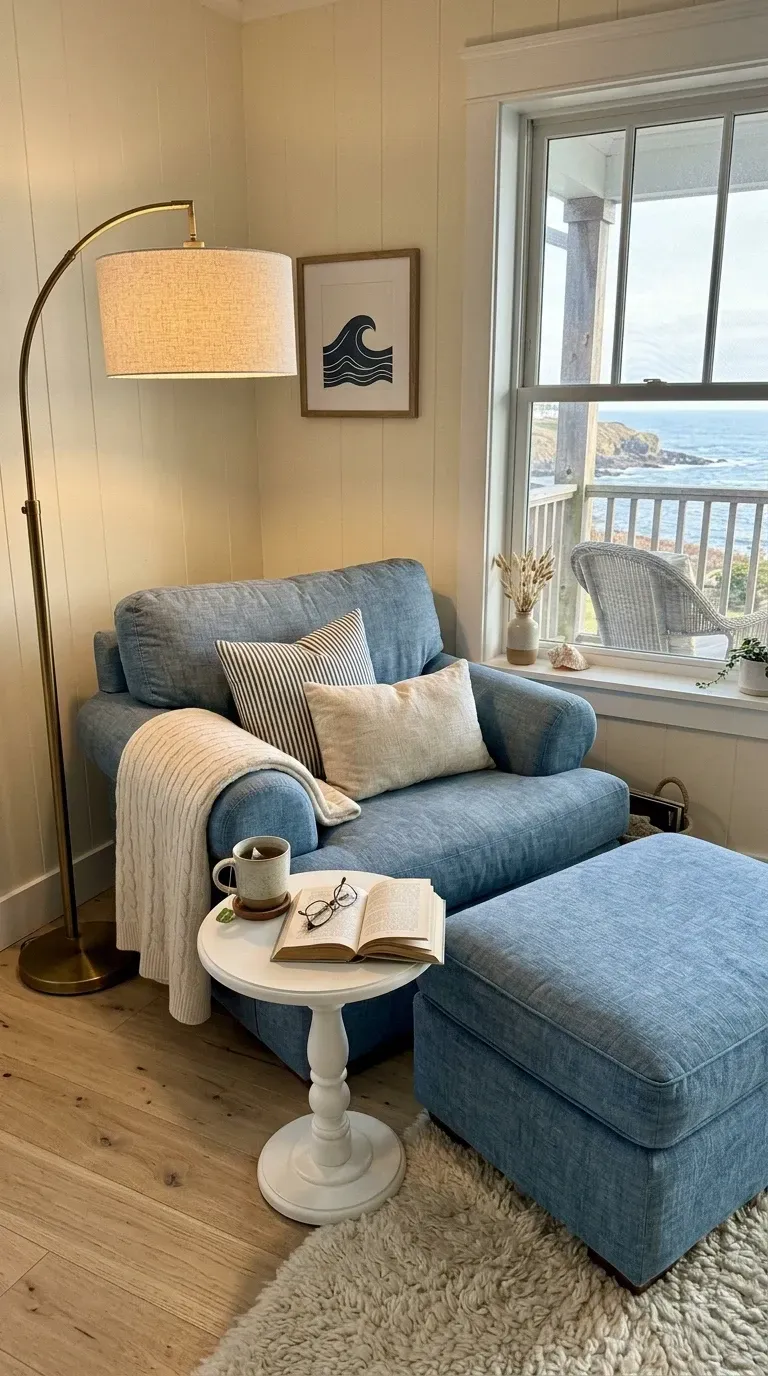
A dedicated reading nook is the quiet specification move that lifts an ordinary room into Coastal Grandmother territory, because it signals that the homeowner actually reads books, slowly, in natural light, with time to linger. The armchair is slipcovered in performance linen or a pre-washed cotton-linen blend, not bare upholstery: specify Pottery Barn PB Comfort Roll Arm in Sunbleached Linen, Article Ceni in Seashell White, or the Serena & Lily Sundown Slipcovered Armchair for the premium tier. The color is the decision: a Belgian-linen slipcover in washed denim blue (F&B Light Blue No. 22, BM Blue Dash 2061-40) reads Coastal Grandmother; bright navy reads nautical and bright white reads spa. The floor lamp is brass-finished arc style (Visual Comfort Belle Meade brass arc, Hudson Valley Pickwick, or the West Elm Staggered Globe for the budget tier), shaded in natural linen, never the cold brushed-nickel finishes. The pedestal side table is a whitewashed or painted solid wood piece (Pottery Barn Parker Round Pedestal, Anthropologie Maura, or a family piece repainted in Benjamin Moore White Dove OC-17). Layer a chunky merino or alpaca throw across one arm of the chair: Brahms Mount fisherman's throw, or the Pendleton Yakima Camp Herringbone for the less expensive anchor. Sheer linen drapery panels in Belgian linen (from Pottery Barn, Restoration Hardware, or Loom Decor) filter the afternoon light without blocking the ocean view.
Key Elements of the Reading Nook
The nook is built around one slipcovered armchair with a matching ottoman, from Pottery Barn or Article, covered in Belgian linen or a denim-blue performance linen that stands up to daily use. A brass arc floor lamp with a linen shade reaches over the chair for reading light, and a whitewashed pedestal side table holds a cup and a book without crowding the corner.
The softer layers do the rest. A cable-knit throw over the arm, a white shag rug under the ottoman and a simple framed print on the wall (a graphic wave in the rendering, where a vintage or estate-sale botanical would suit just as well) give the corner the slightly inherited feeling this style depends on. Sheer linen panels can be added at the window if the afternoon sun is strong; the image leaves the glass bare to the sea view.
We put the reading nook at $2,650–$5,810 for 2026, and about 70% of the high end sits in two lines: the Slipcovered armchair + ottoman at $1,350–$2,800 (Pottery Barn PB Comfort or Article Ceni) and Light oak wood flooring (50 sq ft nook) at $650–$1,280 (White oak 4" plank, wire-brushed). If the nook goes into a room that already has a sound wood floor, that second line drops out, and the chair and ottoman become the one price worth shopping hard.
The rest is lighting and soft goods. A Brass arc floor lamp with linen shade costs $180–$480 (Visual Comfort, Hudson Valley, or West Elm), the Whitewashed pedestal side table $120–$290 (Pottery Barn Parker or Anthropologie), and the Chunky merino or alpaca throw $95–$220 (Brahms Mount fisherman, Pendleton Yakima). Linen accent pillows (x2) in Belgian linen and classic ticking stripe come to $75–$180, the Shaggy area rug (5x7) under the ottoman to $120–$380 (Loloi Olivia wool shag or Ruggable), and the Vintage botanical framed print to $60–$180 from an estate sale, Chairish, or 1stDibs; the wave print drawn in that spot fits the same allowance.
In a corner this small the lamp does the work a ceiling fixture cannot. The arc carries the linen shade over the chair's left arm, so the light lands on the page instead of bouncing off the window glass, and its brass finish keeps the corner warm where brushed nickel would date it to the mid-2000s. Keep the ottoman pulled tight to the chair, as drawn, so the pair reads as one long place to stretch out rather than two separate pieces.
The throw belongs over the arm, the way it hangs in the image, rather than folded along the back; that slightly used look keeps the corner from feeling staged. For the wall, a vintage framed print from an estate sale or Chairish at $60-180 usually carries more character than new coastal art at $300-600, because age is the one finish nobody can buy new.
3. Collected Coastal Gallery Wall & Floating Shelf
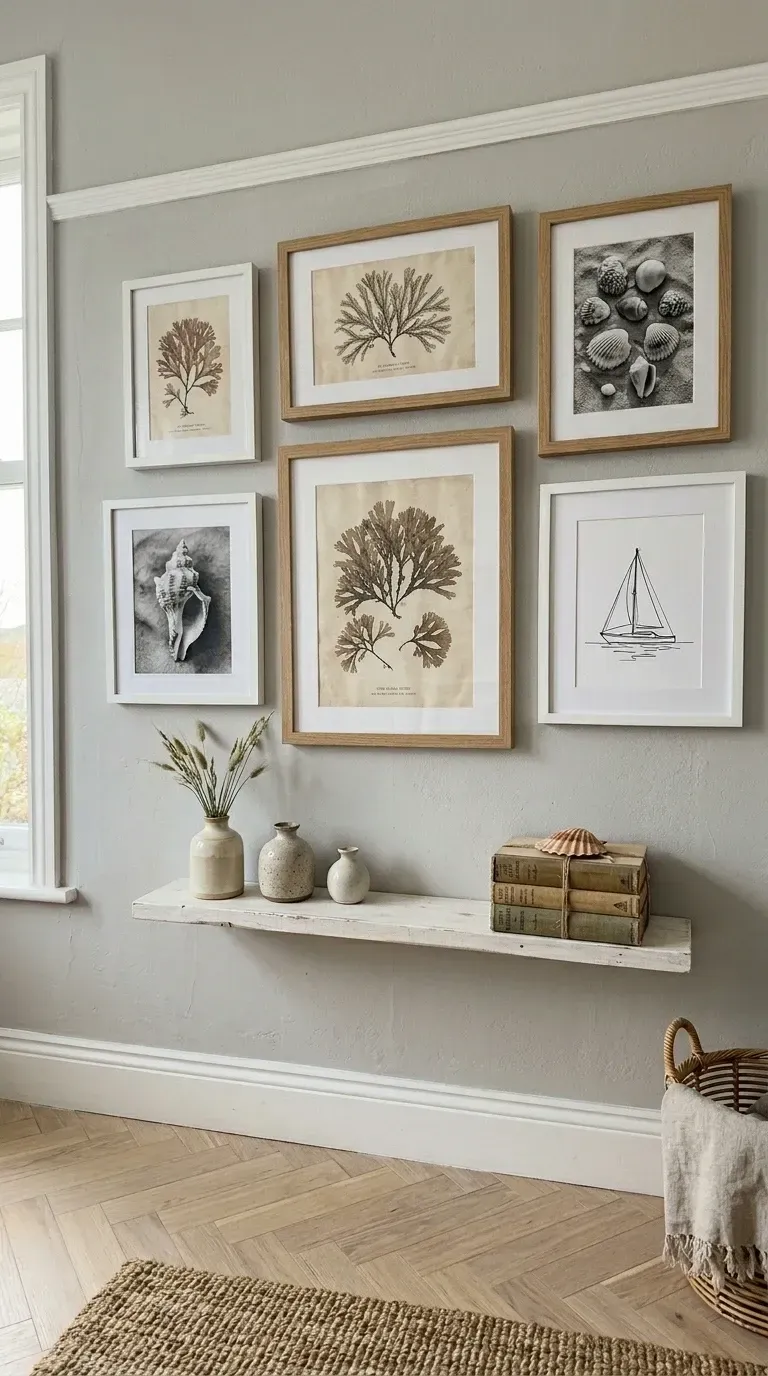
A gallery wall is the most skill-dependent small project in this style. Done well it looks gathered over decades; done poorly it looks like a catalog set shipped in one box. The rendering shows a disciplined version: six frames in a loose three-by-two grid, natural oak alternating with white, so the frames come in exactly two finishes rather than a random mix, and Framebridge or Williams Sonoma supply both profiles. The prints split between vintage botanical reproductions, here pressed-seaweed studies, from antique dealers and Chairish, and contemporary coastal photography and line drawings from Minted or Juniper Print Shop, like the shell photograph and the sailboat sketch. Keep the overall footprint near 40x30 inches above a typical shelf; much larger and the wall tips toward maximalism, much smaller and it reads sparse. The floating shelf is solid oak in a whitewash or painted Benjamin Moore Cloud White OC-130 (Pottery Barn Holman or Rejuvenation Classic at the premium tier, or a built-in from a local millworker, often the best value). Style it with three to five objects: handmade East Fork Pottery or Bauer stoneware vases, a few stems of dried beach grass (Sea Oats, Salvia or Baptisia from a regional native-plant nursery), a single seashell picked up on a beach rather than bought, and a short stack of worn vintage hardbacks from an estate sale or used bookshop. The wall is Farrow & Ball Pavilion Gray No. 242 or Benjamin Moore Revere Pewter HC-172, soft warm grays that let the art lead.
Key Elements of the Gallery Wall
Consistency in the frames holds the wall together. Here that means two finishes, natural oak and white, used in a regular rhythm around a mix of vintage botanical and contemporary coastal prints in a balanced 3x2 grid; a 4x3 or 3x3 layout works the same way on a larger wall. The grid keeps a varied collection looking ordered.
Below the art, a solid whitewash oak floating shelf from Rejuvenation or Pottery Barn carries a few objects: East Fork Pottery or Bauer stoneware vases holding dried beach grass such as Sea Oats or Baptisia, a short stack of selected vintage hardback books and a single seashell. Restraint on the shelf lets the frames above stay the focus.
The gallery wall is the least expensive project in this guide, at $920–$2,495 for 2026. About 60% of the high end goes to the Framed prints (x6) at $360–$1,080 (Framebridge Mercer Natural Oak, mixed sources) and the Solid oak floating shelf (48") at $180–$420 (Rejuvenation Classic or Pottery Barn Holman). The prints carry the widest spread of any line, so settle that quote before buying the smaller pieces.
The styling pieces are modest. Handmade stoneware vases (x3) run $180–$420 (East Fork, Bauer, or Mudshire Pottery), and Vintage hardback books (stack of 6-8) about $40–$120 from estate sales or used bookshops. The Dried beach grass arrangement is $35–$95 (a native-plant nursery or Afloral.com), the Woven storage basket at the edge of the image $45–$180 (Serena & Lily Fanback or Target Threshold), and the Jute runner rug (2.5x8) along the herringbone floor $80–$180 (Annie Selke or Dash & Albert).
Frame discipline is what separates this wall from clutter. Two finishes in a set rhythm, as drawn, or one finish throughout both work; three or four unrelated finishes do not. Sourcing can be looser: pull about 50% of the prints from estate sales and the rest from Minted or Juniper Print Shop, and let the consistent frames make them feel related.
On the shelf, odd numbers and uneven heights look natural. The rendering groups three vases of three heights at one end and balances them with the book stack at the other. A single shell set on top of the books does more than a bowl of specimen shells, which starts to look like a gift shop counter.
4. The Breezy Ocean-View Home Office
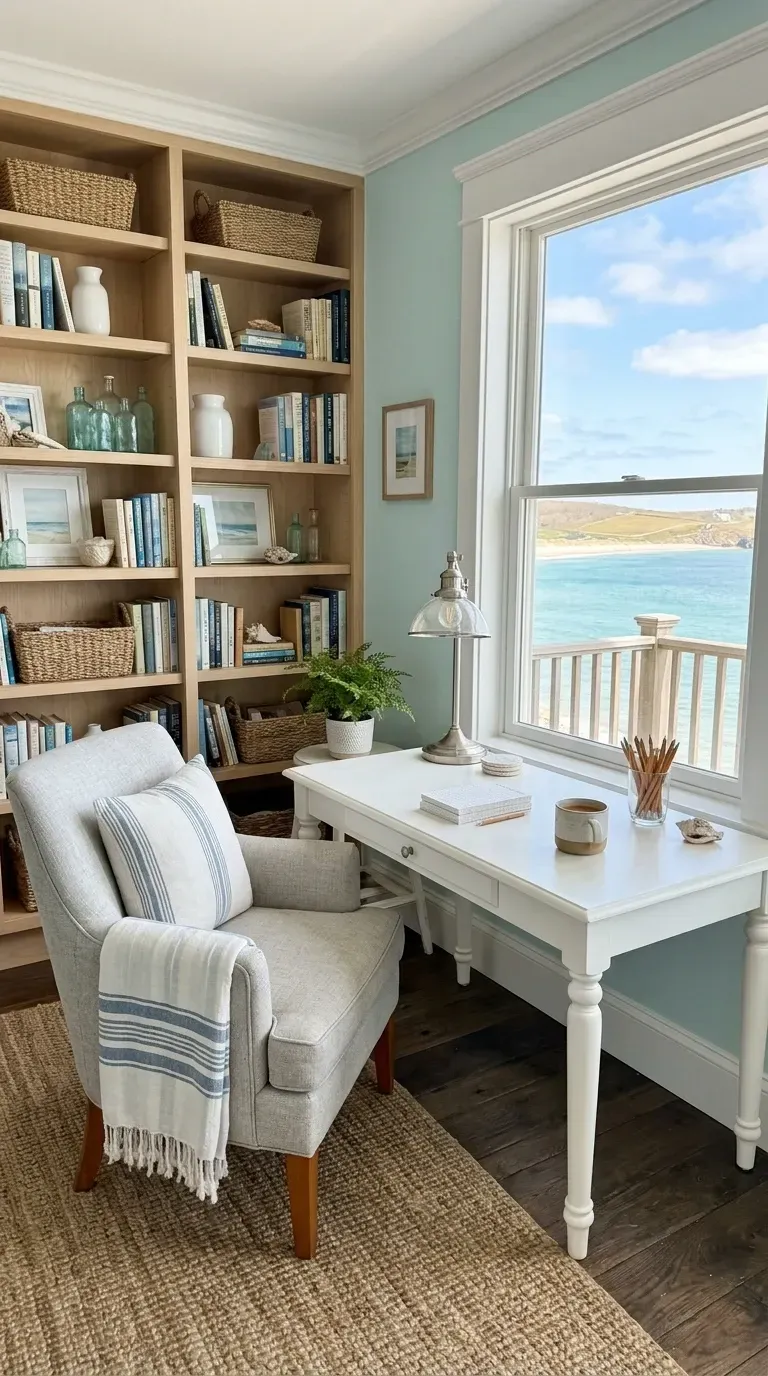
A home office in 2026 has to handle video calls, paperwork and a laptop and still look inherited rather than bought, a harder brief than it sounds. The walls are Benjamin Moore Palladian Blue HC-144 or Farrow & Ball Skylight No. 205, pale blues with a slight green lean that stay soft from morning into late afternoon; the rendering shows that watery aqua clearly. The built-ins are the structural move and the largest line item: floor-to-ceiling rift and quartersawn white oak from a local millwork shop, painted Benjamin Moore White Dove OC-17 at the value tier or left in natural wire-brushed oak at the premium tier, as in the image. The writing desk is either a vintage secretary (Chairish, 1stDibs or a regional estate sale; English reproductions made between 1960 and 1990 are good value now) or a painted white desk; the one drawn here has turned legs and a single drawer, and Pottery Barn Bedford or Ballard Designs Rhys fill the same role. The chair is the decision: a light gray upholstered or slipcovered armchair in performance linen (Pottery Barn PB Comfort, Article Ceni or McGee & Co Swivel) suits the style far better than a leather executive chair. Accessories stay edited: a task lamp (polished nickel with a glass shade in the image, with Visual Comfort Tavern or Hudson Valley Waterbury in brass as the warmer option), woven seagrass baskets on the shelves, a pencil cup, a framed coastal print and stacks of hardbacks for weight without clutter.
Key Elements of the Home Office
Storage and orientation come first in this office. Floor-to-ceiling built-in bookshelves in white oak or paint line the wall, and the desk is positioned to face an ocean or garden view rather than a blank wall. A vintage secretary or a Parsons-style painted white writing desk keeps the room domestic, and the chair is a slipcovered upholstered armchair, not a leather office chair.
The finishes stay soft: walls in Benjamin Moore Palladian Blue or F&B Skylight, an 8x10 jute area rug under the chair and desk, a single task lamp, and woven seagrass baskets for the small things that would otherwise pile up on the desktop.
We estimate the office at $6,475–$15,110 for 2026, and the built-ins explain most of that range. Custom built-in bookshelves (10 LF installed) run $4,200–$9,600 (white oak or painted Cloud White, local millwork), and the Slipcovered upholstered armchair adds $680–$1,650 (Pottery Barn PB Comfort or McGee & Co Swivel); together they make up about 74% of the high end. Because the shelving alone can swing by $5,400, get the millwork quote before choosing anything else.
The remaining lines are easier to phase in. The Writing desk (vintage or Parsons) is budgeted at $420–$1,280 (Chairish vintage or Pottery Barn Bedford), the Brass task lamp at $140–$360 (Visual Comfort Tavern or Hudson Valley), and the Jute area rug 8x10 at $380–$740 (Annie Selke Dash & Albert Drake). Decor accessories (baskets, glass floats, art), which fill the open shelves in the rendering, take $280–$720 from Serena & Lily, Pottery Barn and estate sales. A Striped throw + decorative pillow in Pendleton wool and Belgian linen adds $95–$240, and Wall paint (Palladian Blue, 2 coats + primer) comes to $280–$520 for 1 gallon, supplies and labor.
Put the desk where the light and the view are, as the rendering does by pushing it right up to the window frame. A desk facing a blank wall feels like a retrofit cubicle; if the best view sits behind the chair, turn the furniture rather than the person. Built-ins matter more in this room than anywhere else in the house, because freestanding flat-pack bookcases fight the gathered-over-time look while fitted shelving looks original to the room.
Using an armchair as the desk chair is a fair trade only for part-time use. Expect to give up roughly 20% of a task chair's ergonomics for 100% of the look, which works for a few hours of letters and email and fails for eight-hour workdays. On the shelves, group books in bands of color and height rather than alphabetically, the way the blues and creams are arranged here; stylists disagree on this rule, but it photographs consistently well.
5. Relaxed Coastal Farmhouse Living Room
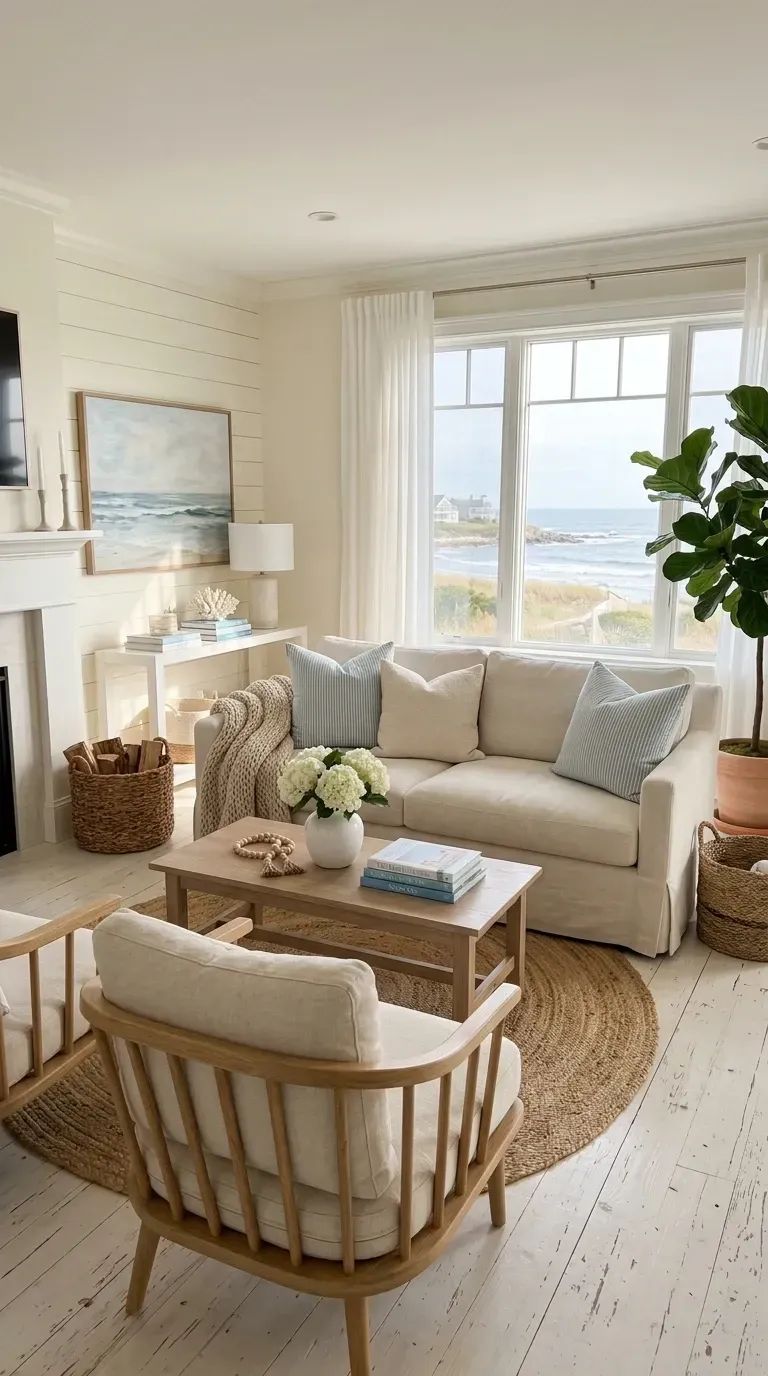
Most people picture this version of the style first: slipcovered, hydrangea-anchored, white, blue and beige, with a Lowcountry farmhouse edge. Shiplap is the structural move, on one accent wall only (planking all four walls looks like a 2016 makeover show), installed in primed nickel-gap boards such as Metrie or Fypon Nickel Gap and painted Benjamin Moore Simply White OC-117. In the rendering it runs along the fireplace wall and carries the painting. The slipcovered sofa is the defining piece: the Pottery Barn PB Comfort Roll Arm Slipcovered in Washed Grainsack Flax, the Williams-Sonoma Chelsea Slipcovered, or at the premium tier the Verellen Sutherland or Lee Industries Slipcovered 3-seater in Belgian linen. The armchairs are wood-frame with loose cushions, like the spindle-back pair drawn here; Serena & Lily Morgan and Ballard Designs Bordeaux Slipcovered both fit. The coffee table is a substantial wooden piece, either a plain rectangular oak table like the one in the image or an oak drum such as Lulu & Georgia Mario or Pottery Barn Tobias, or reclaimed barn wood from an architectural salvage yard. The round jute rug is 9-foot diameter minimum (Annie Selke, Serena & Lily Naples). A white console against the shiplap holds a ceramic lamp (Pottery Barn Kingston, or Visual Comfort Belle Meade for a pair), a mature fiddle leaf fig in terracotta fills the window corner, and a large framed coastal horizon painting, commissioned from a regional artist or found secondhand, hangs on the planking beside the white-painted fireplace.
Key Elements of the Shiplap Living Room
A single shiplap accent wall in Benjamin Moore Simply White gives the room its coastal backbone without turning every wall into planking. The seating is a skirted slipcovered sofa in Belgian linen or washed grainsack, joined by wood-frame armchairs with cushions, and a solid oak coffee table anchors the group.
A large round jute rug, 9 feet in diameter, pulls the furniture together. Against the shiplap, a white console holds a ceramic lamp, a piece of coral and a stack of books, and the framed coastal horizon painting hangs on the planking beside the fireplace. A mature fiddle leaf fig in terracotta gives the window corner height, and seagrass baskets hold firewood and a spare throw.
The living room comes to $5,550–$12,300 in our 2026 estimate, and seating takes about 49% of the high end: the Slipcovered roll-arm sofa (3-seater) at $1,650–$3,400 (Pottery Barn PB Comfort or Williams-Sonoma Chelsea) and the Wood-frame armchairs with slipcovers (x2) at $1,200–$2,600 (Serena & Lily Morgan or Ballard Bordeaux). The sofa has the largest single range, so settle its fabric and size before ordering the smaller pieces.
The rest splits between tables, light and the wall itself. The Oak drum coffee table line is $380–$920 (Lulu & Georgia Mario or Pottery Barn Tobias), the Round jute rug (9-foot) $380–$780 (Annie Selke Dash & Albert or Serena & Lily), and the Console table (behind sofa) $340–$780 (Pottery Barn Layton or Ballard Westport), though the rendering stands the console against the shiplap instead. Large framed coastal art runs $280–$880 from a regional artist commission or Etsy, Matching brass table lamps (x2) $240–$540 (Pottery Barn Kingston or Visual Comfort), and the Fiddle leaf fig + terracotta planter $180–$380 (Costa Farms plus a regional nursery). Accent pillows + throw in Belgian linen and ticking stripe add $220–$540, and the Shiplap accent wall (installed, one wall), Metrie Nickel Gap primed and painted, adds $680–$1,480.
Keep the shiplap to one wall. Planking on all four walls is the clearest sign of a by-the-numbers 2016 farmhouse renovation, while a single wall, as drawn here around the fireplace and console, reads as architecture. Slipcover fabric shows from across the room too: Belgian linen or washed grainsack flax falls in soft folds like the skirted sofa in the image, where polyester linen-look covers tend to sit stiff and shiny.
Size the rug so it reaches at least under the front legs of the armchairs; anything smaller leaves the seating floating on the painted boards. Round and 9-foot minimum suits a square seating group like this one. For the painting, a regional artist's coastal piece at $300-700 has far more presence than a mass-produced canvas at the same price.
6. Elegant Seaside Dining Room
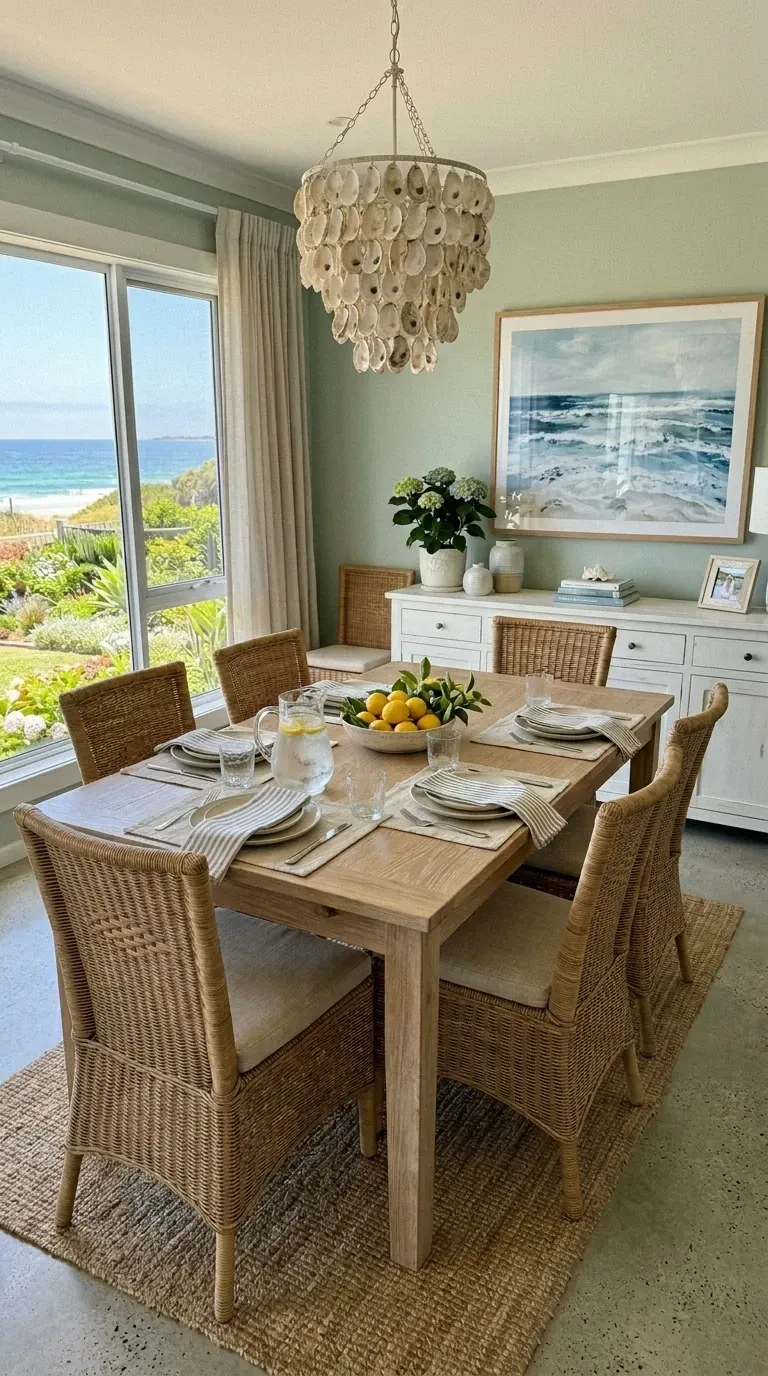
A dining room that seats six-plus is the single most important Coastal Grandmother space because it signals the family-gathering function at the heart of this aesthetic, the room where the actual grandmother actually fed everyone at holiday dinners. The table is a light oak farmhouse or trestle table (Pottery Barn Benchwright Extending, Arhaus Kinsman, Williams-Sonoma Aaron Probyn, the Magnolia Home Park Hill collection, or a custom piece from a regional millwork shop). The chairs are the signature: high-back woven wicker or rattan in Serena & Lily Riviera (the industry standard) or Loggia; alternates include the Article Lobby, the Sika Design Monet, or at the premium tier the Palecek Laurel. Cushions are ivory Belgian linen, tied to the chair back, never secured with Velcro or foam inserts. The chandelier is the focal point: specify a Regina Andrew capiz shell chandelier, a Currey & Company Ramsgate, or the Visual Comfort Orson, always in warm natural shell, never in overly polished lacquer that reads Vegas hotel. The sideboard is a white-painted traditional piece (Pottery Barn Larkspur, Williams-Sonoma Chantal, or a repainted antique from a Charleston estate sale). A large jute rug grounds the table (12-foot minimum for six-chair seating), and fresh-cut hydrangeas in a handmade ceramic or vintage silver footed bowl are the single most effective daily-styling move; the rendering sets them on the sideboard and keeps the table to a bowl of lemons.
Key Elements of the Wicker Dining Room
The table and chairs carry this room. A light oak farmhouse or trestle dining table, 8 feet long, sits under high-back woven wicker dining chairs such as the Serena & Lily Riviera, softened with ivory Belgian linen tied cushions. Above it, a capiz shell or oyster chandelier from Regina Andrew or Currey & Co adds the coastal note through light rather than decoration.
Along the wall, a white-painted sideboard buffet, either the Pottery Barn Larkspur or an antique, gives storage and a serving surface, and in the rendering it carries the hydrangeas in a white pot below a large seascape. A large jute rug of 12 feet minimum keeps every chair on the rug when pulled out, and the table itself holds only a bowl of lemons, a water pitcher and simple place settings.
Our 2026 figure for the dining room is $5,300–$12,760. The Woven wicker dining chairs (x6) are the biggest and most variable line at $1,680–$3,480 (Serena & Lily Riviera or Sika Design Monet), followed by the Light oak dining table (8-foot extending) at $1,200–$2,800 (Pottery Barn Benchwright or Arhaus Kinsman); the two lines account for about 49% of the high end. Price the chairs first, since six of them multiply any difference in quality.
Light and storage come next. The Capiz or oyster shell chandelier, the oyster-shell drum hanging over the table here, is budgeted at $620–$2,200 (Regina Andrew or Currey & Co Ramsgate), and the White-painted sideboard buffet at $680–$1,680 (Pottery Barn Larkspur or antique). A Large jute rug (12-foot) needs $420–$840 (Annie Selke Dash & Albert) and the Framed coastal art (large) above the sideboard $240–$720 (Charleston artist or Minted). Soft goods finish it: Chair cushions (x6, Belgian linen) at $240–$480, custom or matched from Pottery Barn, and Centerpiece bowl + linens + place settings at $220–$560 (East Fork, Williams-Sonoma Hotel Collection).
The chairs are the most photographed element in this room, so if one line gets the money, it is the Serena & Lily Riviera or a comparable hand-woven chair; a well-made one can reasonably be expected to outlast a cheap copy by 10-15 years. Fasten the seat cushions with fabric ties rather than Velcro straps, which make even good chairs look like rental patio furniture.
Hang the shell chandelier low, 30-34 inches above the tabletop, so it reads as part of the table setting rather than an afterthought near the ceiling. On the table, keep the styling to something you will actually refresh: the rendering uses lemons, and a weekly bunch of grocery-store hydrangeas at $8-14 does the same job better than a permanent faux arrangement.
7. Serene & Sandy Bedroom Retreat
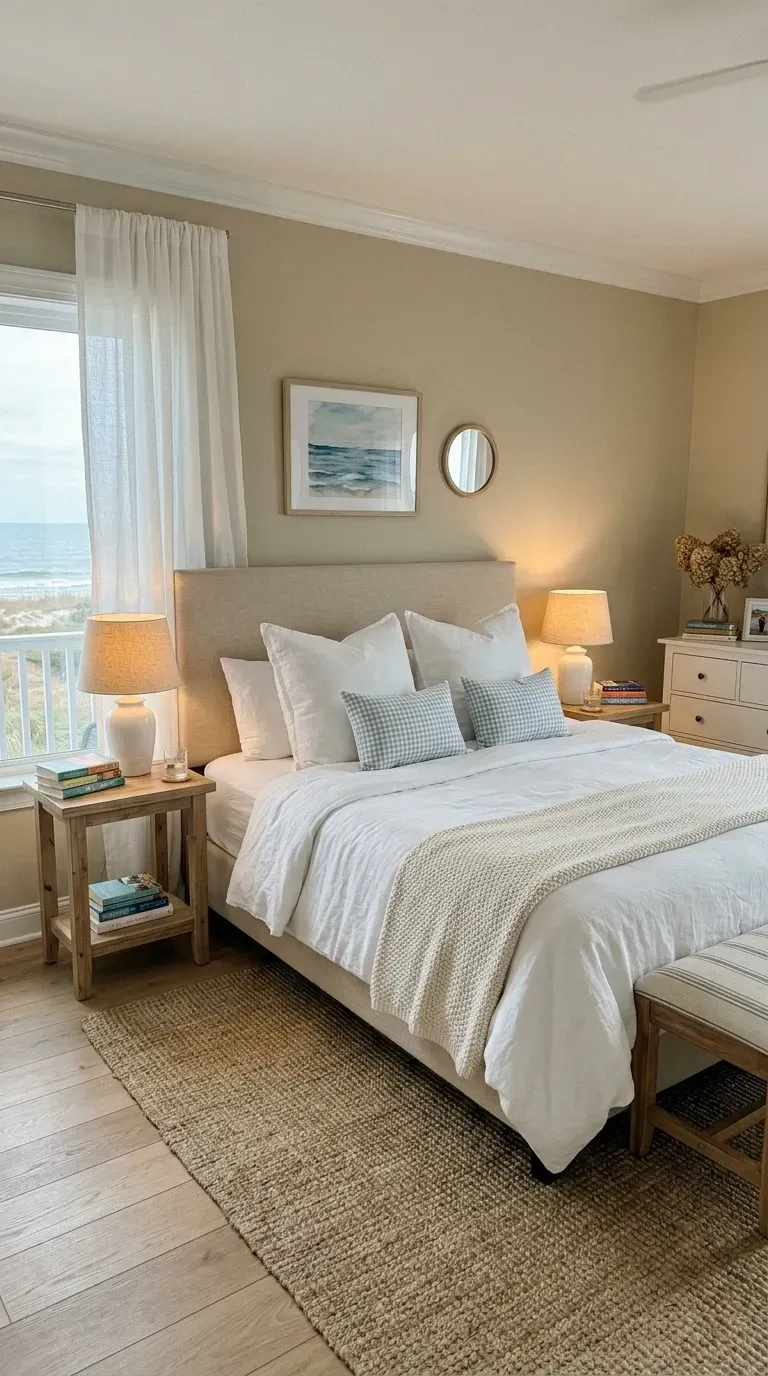
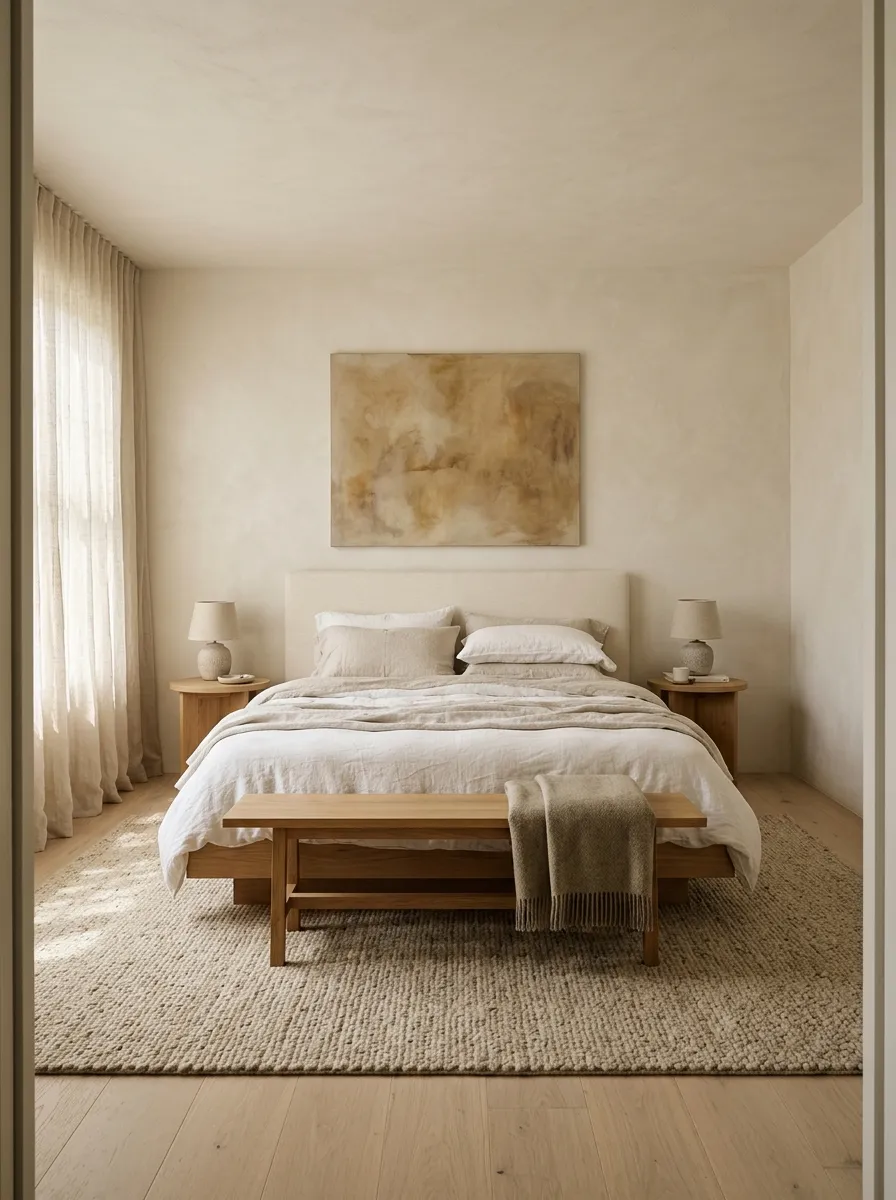
The bedroom is where Coastal Grandmother works its quietest magic: a room built for real sleep, real rest, and the kind of serenity that can't be faked. The bed frame is the foundation: specify Pottery Barn Linen Upholstered Platform Bed in Washed Linen Flax, Restoration Hardware Calais Upholstered in Belgian Flax Linen, West Elm Andes Upholstered in Oat, or the Serena & Lily Surfrider at the premium tier. Color matters: specify Belgian-linen beige or oat, never the cool-grey variants that pull the room into Scandi territory. Bedding is layered Belgian linen (specify Cultiver Belgian Linen in Vintage White, Pottery Barn Linen in Classic Ivory, or Parachute Venice Linen Duvet at the slightly-softer alternative). The decision is six-pillow layered stack: two euro shams in ivory linen, two standard shams in ivory linen, two decorative pillows in blue gingham check (F. Schumacher Gingham or Pottery Barn Emily gingham) or classic blue ticking stripe. A chunky merino or alpaca throw folds diagonal across the bottom corner. Nightstands are matching rustic reclaimed wood (Pottery Barn Holly, Serena & Lily Sandhill, or the West Elm Reclaimed). Ceramic table lamps in ivory or cream with linen shades (Pottery Barn Kingston, Williams-Sonoma Regal). End-of-bed bench is linen-upholstered (Pottery Barn Belle or Ballard Designs Melrose). Walls are Benjamin Moore Ballet White OC-9 or Farrow & Ball Wevet No. 273.
Key Elements of the Linen Bedroom
The bed is an upholstered linen platform frame in Belgian flax or oat, made up with layered Belgian linen bedding and a 6-pillow stack, with blue gingham check or ticking stripe decorative pillows in front. A chunky merino or alpaca throw at the foot adds weight and warmth on cooler nights.
Matching rustic reclaimed wood nightstands flank the bed, each holding a ceramic ivory table lamp with a linen shade, and an upholstered bench in a soft ticking stripe sits at the end of the bed. Walls in Benjamin Moore Ballet White or F&B Wevet keep the whole room in the warm white range.
Furnishing the bedroom as drawn comes to $4,680–$10,140. Nearly half of the high end, about 47%, goes to two pieces: the Upholstered queen bed frame at $1,100–$2,400 (Pottery Barn Linen or West Elm Andes) and the Premium queen mattress at $1,200–$2,400 (Saatva Classic or Pottery Barn Organic). The frame has the broader range, so confirm it and its fabric before buying the smaller pieces.
Bedding and the pieces around the bed make up the rest. The Belgian linen bedding set (duvet, sheets, pillowcases) is $380–$780 (Cultiver or Parachute Venice Linen), the Decorative pillows (6-pillow layered stack) in ivory linen with gingham check $220–$480, and the Chunky merino or alpaca throw laid across the foot of the bed $120–$320 (Brahms Mount or Saranoni). Rustic reclaimed wood nightstands (x2) run $480–$1,280 (Pottery Barn Holly or Serena & Lily Sandhill) and Ceramic table lamps (x2, linen shades) $240–$540 (Pottery Barn Kingston or Williams-Sonoma). Underfoot and at the window, the Jute area rug (8x10) takes $380–$740 (Annie Selke Dash & Albert) and Sheer linen curtains + hardware $180–$420 (Pottery Barn Belgian Flax Linen panels), while the Linen-upholstered end-of-bed bench adds $380–$780 (Pottery Barn Belle or Ballard Melrose).
The pillow stack in the image is the model: two plain white pillows against the headboard, two larger white shams in front of them, and two blue gingham pillows last. Fewer looks sparse and more starts to look like a hotel bed. Let the linen duvet stay relaxed, as drawn; wrinkle-free polyester blends lose the soft drape that makes this bed work.
Matching nightstands suit a primary bedroom, where symmetry around the bed calms the room; mixed pieces look collected in a family room but restless here. At the window, sheer linen panels on a simple rod, like the ones filtering the ocean light in the rendering, separate this style from coastal modern, which leans on roller shades and solar blinds.
8. Welcoming Coastal Entryway
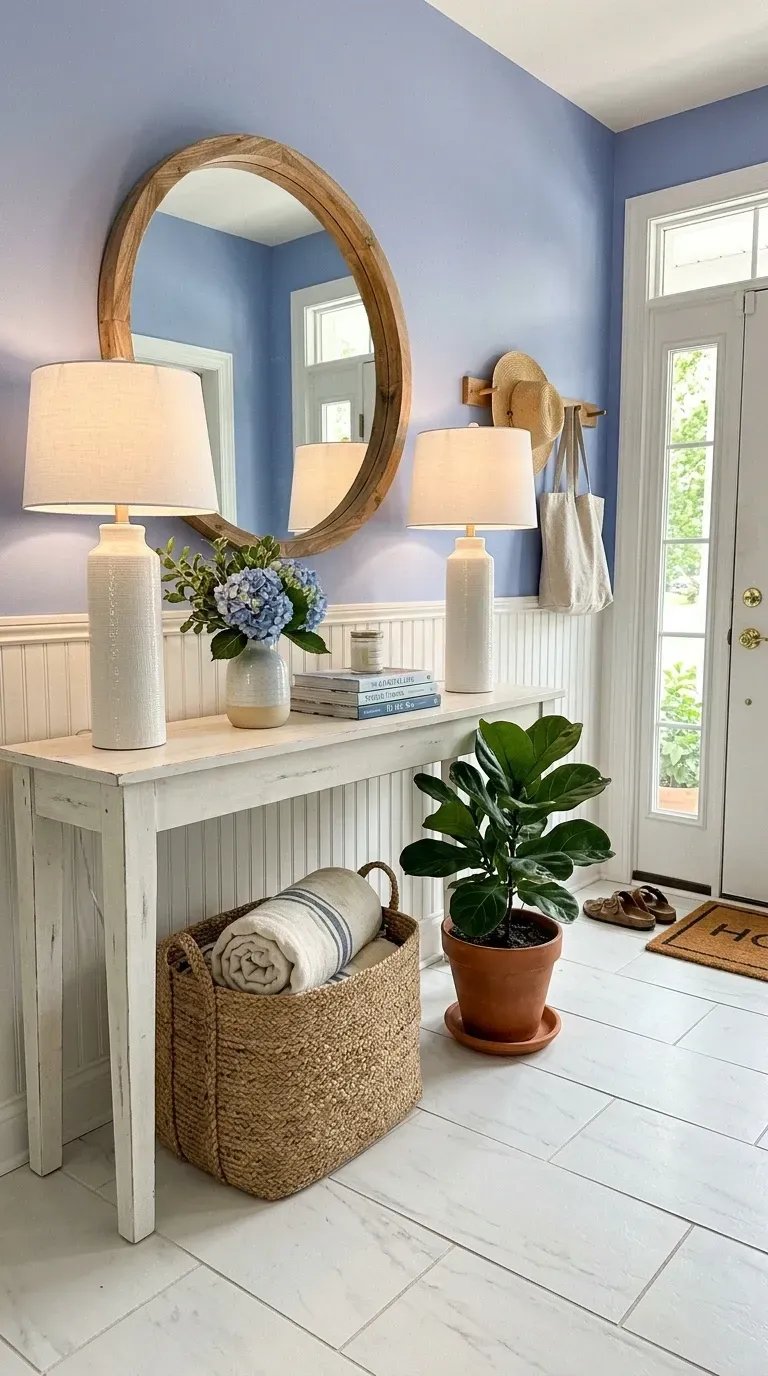
The entryway is where a visitor reads the whole house, so it rewards discipline: a console, a mirror, flowers and very little else. Specify white beadboard wainscoting (Metrie Shaker Beadboard or Fypon Routed Beadboard panels, primed and painted Benjamin Moore White Dove OC-17) on the lower 42 inches. Above it, Benjamin Moore Palladian Blue HC-144 or Farrow & Ball Skylight No. 205 gives a pale, slightly green blue; the rendering pushes the upper wall to a stronger periwinkle, which also works if the hall gets plenty of daylight. The console table is white-painted solid wood (West Elm Foundry, CB2 Amesbury, Pottery Barn Taft Marble Top, or a repainted antique from a regional estate sale), lightly distressed at the edges in the image. Style it with restraint: two matching tall ivory or cream ceramic table lamps (Pottery Barn Kingston, Williams-Sonoma Regal, or Bunny Williams Jamie Young Willa), a stack of three to four vintage hardbacks, and fresh hydrangeas in a handmade ceramic vase (East Fork Pottery or a Mudshire Studio vase). The mirror is round and natural wood-framed (Pottery Barn Kingman, McGee & Co Oka, or the Serena & Lily Round Burl); 32-38 inches in diameter suits a 60-inch console. A large woven seagrass basket under the console holds rolled beach towels, and hooks at 66 inches from the floor take hats and totes. The rendering uses a simple wooden peg rail by the door, with polished brass hooks (Rejuvenation Classic, Emtek) as the dressier alternative.
Key Elements of the Entryway
The architecture of the entry is simple: white beadboard wainscoting 42 inches high with a soft blue on the upper wall, Benjamin Moore Palladian Blue in the specification and a deeper periwinkle in the rendering. That split gives a durable lower surface for bags and wet towels and color at eye level.
Against the wall, a white-painted solid wood console table holds two matching tall ivory ceramic lamps, with a round natural wood-framed mirror of 32 to 38 inches centered above. A sun hat and a canvas tote hang from a wooden peg rail beside the door, a woven seagrass basket keeps rolled towels under the console, a fiddle leaf fig in terracotta stands next to it, and blue hydrangeas in handmade ceramic greet anyone coming in.
The entry is one of the cheaper projects here, estimated at $1,820–$4,400 for 2026. The two quotes to get first are the Beadboard wainscoting (installed, 12 LF) at $480–$1,180 (Metrie Shaker Beadboard, primed + painted), which also has the widest range, and the White-painted console table at $380–$920 (West Elm Foundry or Pottery Barn Taft); between them they hold about 48% of the high end.
The Round wood-framed mirror (32-38") is budgeted at $220–$580 (Pottery Barn Kingman or McGee & Co Oka) and the Matching ivory ceramic table lamps (x2) at $220–$540 (Pottery Barn Kingston or Bunny Williams). Smaller pieces fill in around them: a Large seagrass storage basket for $80–$180 (Serena & Lily Fanback or Target Threshold), the Fiddle leaf fig + terracotta planter beside the console for $120–$320 (Costa Farms plus a local garden center), Polished brass wall hooks (set of 4) for $80–$180 (Rejuvenation Classic or Emtek, or a wooden peg rail like the one drawn), Vintage books + hydrangea centerpiece for $60–$140 from an estate sale and a grocery florist, and Wall paint (Palladian Blue, upper) for $180–$360, covering 1 gallon, primer, supplies and labor.
Use two identical lamps, the same model rather than a complementary pair, as the rendering does with its tall textured ceramic bases. Size the mirror at roughly 55-65% of the console's width; smaller looks lost on the wall and larger crowds the lamps. Measure the console before ordering either.
Fresh hydrangeas need replacing weekly; if that will not happen, choose good faux stems from Afloral or Pottery Barn and commit to them rather than mixing real and fake. For the wainscoting, 42 inches is the usual height in this style and the one drawn here; 36 inches can look timid against a tall wall, and 48 inches starts to feel formal.
9. Charming Cottage Breakfast Nook
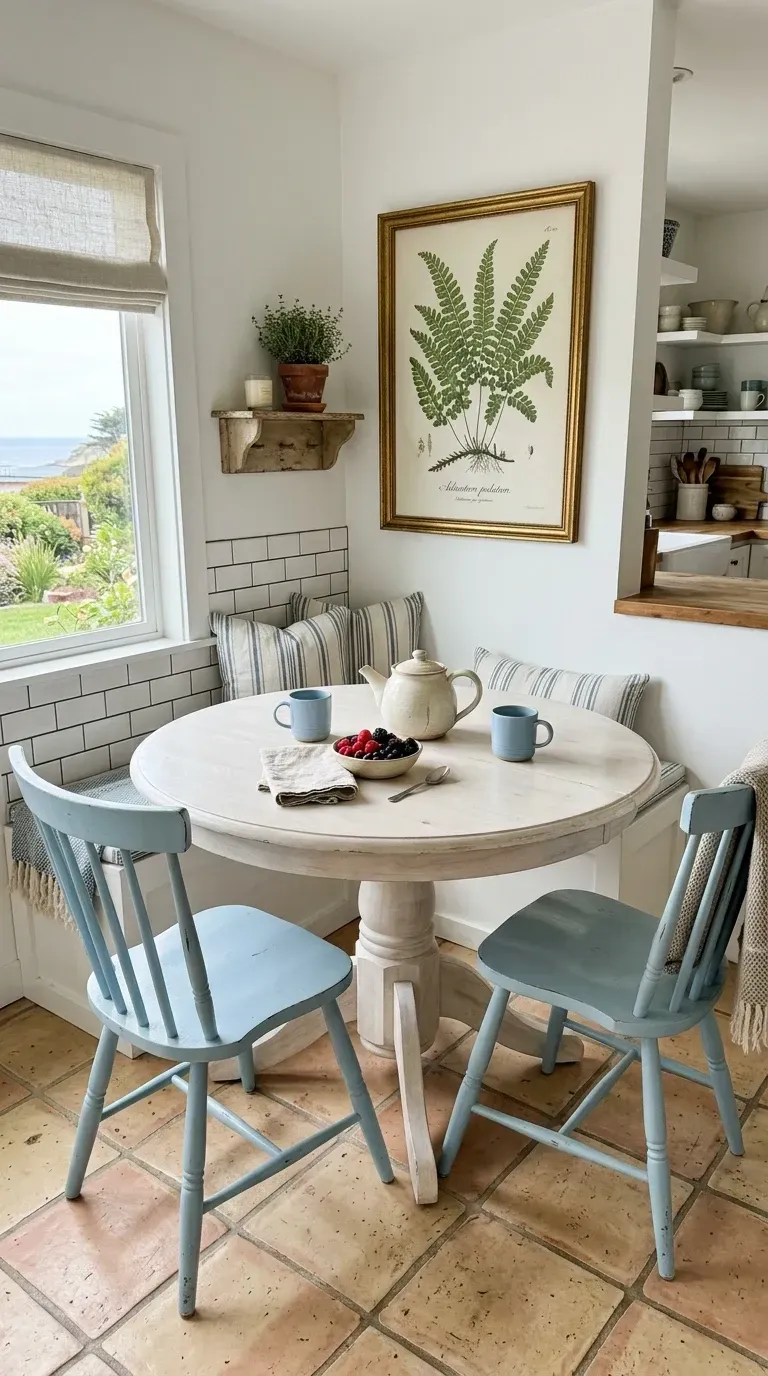
The breakfast nook is the quietly-designed room in a Coastal Grandmother house, the room where the real life of morning coffee, grandkid cereal bowls, and Sunday crossword-puzzles plays out. Specify custom built-in corner bench seating (a local millworker or using IKEA PLATSA or NORRASJON bases with custom face frame and Semihandmade Shaker fronts at the value tier). The bench cushions are ivory Belgian linen or a soft ticking-stripe performance fabric (Perennials Revival Stripe or Sunbrella Cast Shale) in 4-5 inch thickness with welted edges, never loose cushions or bean-bag inserts. The table is a round whitewashed or painted solid oak pedestal (Pottery Barn Willow Round Pedestal, Williams-Sonoma Coley, or a painted antique) in 42-48 inch diameter. The chairs are two painted Windsor spindle chairs (Pottery Barn Emerson, Ballard Designs Winslow, or vintage Windsors), shown in a soft powder blue in the rendering; for a deeper navy, Benjamin Moore Polo Blue 2062-10 or Farrow & Ball Stiffkey Blue No. 281 works. The backsplash is the decision point: specify handmade Fireclay Tile 3x6 subway in White Wash or Cle Tile 3x6 Zellige in Chalk White (not the mass-produced flat-glaze subway from big-box, since the slight hand-glaze irregularity is what separates cottage from tract home). The floor is terracotta Saltillo tile (The Tile Shop, Bedrosians, or Stone Tile Depot) in 8x8 or 12x12 squares, sealed with a penetrating sealer annually to handle Charleston humidity. Pendant lighting, which sits above the frame of the image, is a single Schoolhouse Electric pendant or Rejuvenation Cleary in antique brass with a milk glass shade.
Key Elements of the Breakfast Nook
Custom built-in corner bench seating is the backbone of the nook, topped with ticking-stripe cushions and pillows. A round whitewashed solid oak pedestal table, 42 to 48 inches across, fits the corner without legs in the way of knees, and two painted Windsor spindle chairs in pale powder blue close the circle on the open side.
The surfaces bring the handmade quality: white subway tile wraps the wall behind the bench (Fireclay Tile or Cle Tile zellige in the specification), and terracotta Saltillo tile covers the floor. A small rustic corbel shelf holds a potted herb and a candle, a gold-framed fern print fills the wall beside the window, and the specified Schoolhouse Electric antique brass pendant would hang over the table, just out of the frame.
The breakfast nook comes in at $3,740–$8,620, and about 50% of the high end is in the fixed work: the Custom built-in corner bench (installed) at $1,200–$2,800 (local millwork or Semihandmade over IKEA) and Terracotta Saltillo tile flooring (60 sf) at $680–$1,480 (8x8 or 12x12, installed + sealed). The bench has the widest range of any line, so fix its length and finish before ordering cushions to fit it.
Furniture and finishes share the rest. Bench cushions + pillows (Belgian linen) run $280–$680 (welted 4-5" custom, ivory or ticking), the Round whitewashed oak pedestal table (48") $480–$1,180 (Pottery Barn Willow or Williams-Sonoma Coley), and the Painted Windsor spindle chairs (x2) $280–$580 (Pottery Barn Emerson or vintage painted). The Schoolhouse Electric or Rejuvenation pendant in antique brass with a milk glass shade is $320–$680, the Gold-framed botanical art + rustic shelf $120–$340 (vintage art and a handmade shelf), and the Fireclay Tile or Cle Tile backsplash (20 sf) in 3x6 handmade subway, installed, $380–$880.
Handmade tile is worth its 40-60% premium over big-box subway here, because the slight irregularity in the glaze is what keeps the nook looking like a cottage rather than a tract kitchen. The chairs are the opposite case: vintage Windsors at $40-80 from an estate sale, repainted in the pale blue of the rendering or a deeper Stiffkey Blue, look much the same in a room as $300-400 reproductions.
Unglazed Saltillo needs resealing once a year in Charleston humidity; set aside $180-280 annually for it, or expect the grout to start mildewing. Hang the single pendant about 30 inches above the round top. One fixture is enough for a table this size, and a second would crowd the corner.
10. Luxurious Classic Coastal Bathroom
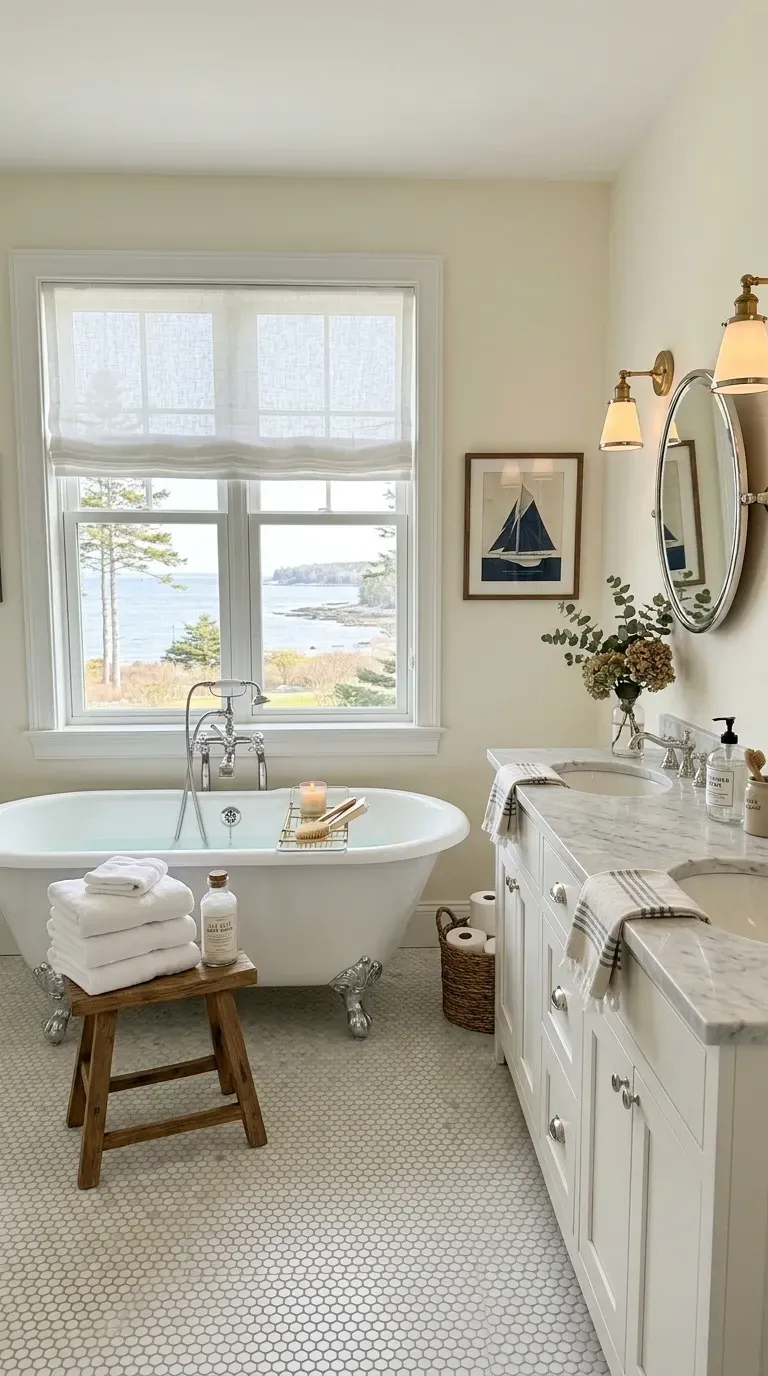
A Coastal Grandmother bathroom shows money through restraint: a freestanding tub, honed marble, warm metal and very little else. The tub is the centerpiece, set under the window in the rendering: specify the Signature Hardware Kingston 68-inch acrylic clawfoot, the Kohler Iron Works Historic in cast iron for the premium tier, or a restored antique clawfoot from an architectural salvage yard. The vanity is a long double piece (Restoration Hardware Hutton 72-inch double, Pottery Barn Sausalito Double, or a custom built-in), painted white with simple knobs as drawn. The countertop is honed rather than polished Carrara marble, or Cambria Torquay quartz for easier upkeep; the honed finish keeps the room traditional, while polish pushes it contemporary. The sinks are undermount ovals in white porcelain (Kohler Ladena or Signature Hardware Bristol). For metal, the rendering pairs polished brass Visual Comfort Belle Meade sconces with polished nickel faucets, tub filler, mirror frame and knobs; Watermark brass faucets and Emtek brass pulls are the all-brass alternative. The mirrors are oval (Pottery Barn Kensington or McGee & Co Oval). The floor in the image is a small white hex mosaic, and handmade Fireclay Tile penny round in White Wash or Cle Tile penny round in Chalk gives a similar early-1900s look. A custom natural linen Roman shade (Smith & Noble or The Shade Store) keeps privacy without blocking light, and a framed vintage sailboat print from an estate sale or Etsy completes the room.
Key Elements of the Clawfoot Bath
The freestanding white enameled clawfoot bathtub is the centerpiece, and the rest of the room supports it. A long double vanity with a honed Carrara marble countertop gives two people room to work, lit by polished brass Visual Comfort Belle Meade sconces above oval vanity mirrors from the Pottery Barn Kensington line.
A small white hex mosaic covers the floor in the rendering, with handmade Fireclay penny round as the specified alternative, and a custom linen Roman shade from Smith & Noble softens the window. A framed vintage sailboat print, a wooden stool stacked with white Turkish cotton towels from Brooklinen or Coyuchi, and a seagrass basket beside the tub complete the room.
The bathroom has the highest ceiling in the guide, $6,420–$15,800 by our estimate. About 63% of the high end sits in two lines: the Double vanity with honed marble top at $2,200–$5,200 (Restoration Hardware Hutton or custom) and the Freestanding clawfoot bathtub + faucet at $1,800–$4,800 (Signature Hardware Kingston or Kohler Iron Works). Both swing by $3,000, and the tub's range mostly reflects acrylic versus cast iron, so get a written quote on it early.
Fixtures and finishes make up the remainder. Brass vanity faucets (x2) are budgeted at $480–$1,180 (Watermark, Kohler Purist, or Visual Comfort), Brass wall sconces (x2) at $280–$720 (Visual Comfort Belle Meade or Hudson Valley), and Oval vanity mirrors (x2) at $220–$540 (Pottery Barn Kensington or McGee & Co). The Fireclay Tile penny round flooring (80 sf), installed in White Wash or Chalk, takes $980–$2,200; the hex mosaic shown in the rendering would need its own quote. A Custom linen Roman shade adds $280–$680 (Smith & Noble or The Shade Store) and Vintage framed coastal art + accessories, Turkish towels included, $180–$480 from estate sales and Chairish.
Honed marble is the clearest marker of this style in a bathroom: polished stone reads contemporary or grand Italianate, while honed reads like an old shingled house by the water. In salt air, metal quality matters more than color. Solid brass bodies, finished in brass or in nickel as in the rendering, hold up well from makers such as Waterworks, Rohl, Visual Comfort or Emtek, while thin plated fixtures from big-box shelves can start pitting within about 24 months near the coast.
On the floor, small white hex like the rendering's or penny round both suggest an early-1900s bath, while large-format porcelain pulls the room toward newer styles. For the wall, a real vintage sailboat print from an estate sale at $30-80 usually has more depth than a big-box reproduction at $120-240; the aged paper and old frame are what carry it.
What Separates Coastal Grandmother From Coastal Cliché
Slipcovers are the aesthetic, not a feature. The most decisive move in this style is specifying slipcovered rather than upholstered seating throughout. Slipcovers in Belgian linen or washed grainsack flax signal the relaxed, washable, inherited-from-grandmother feeling, while bare upholstery reads as hotel-lobby formal, so budget for two covers per piece. The same thinking applies to the linen itself: it will wrinkle, and that is the point. Do not iron the bedding or the slipcovers. The rumpled texture is load-bearing; ironed linen looks sterile, pressed linen looks like a showroom, and wrinkled linen looks like a home where people actually live.
Flowers, metal and white paint each have a right answer. Hydrangeas beat every other flower for weekly rotation, with blue tones for the dining room centerpiece and white for the entryway console; grocery florists and Charleston farmers' markets carry them from April through September. Solid brass, not plated, is the right metal. Brushed nickel reads 2008 to 2016 suburban and matte black reads 2020 modern farmhouse, while brass belongs to every coastal decade from 1900 forward, and solid brass lasts in salt air in either an aged or polished finish. Keep the walls in ivory and warm white, never bright white: Benjamin Moore Simply White, Cloud White or White Dove, or Farrow & Ball Pointing, Wevet or Skimming Stone. Bright whites such as Decorator's White and Super White are too cool for Charleston's warm southern light and read as sterile by 3pm.
The rugs and chairs are where cheap shortcuts fail. Jute rugs must be 8-ply minimum. Cheap jute looks identical on day one and falls apart by month twelve, which makes it the biggest budget trap in this style, so specify Annie Selke Dash & Albert, Serena & Lily Naples or Ruggable Premium, all weighted at 8 to 9 ply. Wicker dining chairs are an investment rather than a splurge: a well-made hand-woven chair such as the Serena & Lily Riviera can reasonably be expected to hold up 15 to 20 years in Lowcountry humidity, where cheap versions often fail within five. Budget for the real thing, not the lookalike.
Collected pieces and layering finish the look. A mix of 40% antique and estate sourcing with 60% new retail produces the collected-over-decades feeling that ordering from a single vendor cannot. Plan a quarterly estate-sale Saturday route through Charleston's Avondale, Mount Pleasant and Summerville markets. And commit to jute over carpet as well as over hardwood: a jute rug layered over existing wall-to-wall carpet is an underdiscussed move that makes a room read as Coastal Grandmother without replacing the flooring, and it works especially well in bedrooms with older beige broadloom.
Cost-Saving Strategies That Don't Dilute the Style
Secondhand sourcing gives the deepest savings. Estate sales and Chairish often come in 50 to 70% under retail on consoles, mirrors and side tables that look the same as new once styled. A Saturday morning route through Charleston, Mount Pleasant, James Island and the occasional Summerville estate sale is a practical way to look for those pieces. Chairs follow the same logic, as the breakfast nook section shows: thrifted Windsors from estate sales and Facebook Marketplace at $30 to $80 each, repainted in Farrow & Ball Stiffkey Blue, Benjamin Moore Polo Blue or a paler blue, stand in for $280 to $420 retail reproductions.
Built-ins and furniture can come from smarter channels. IKEA Sektion boxes with Semihandmade fronts get close to the custom-millwork look, roughly 80% of it in our judgment, at 40 to 50% of the cost; order Semihandmade Shaker white fronts and hire a local carpenter for assembly, and the photographed difference from pure custom is small. Outlet and end-of-season clearance at the larger home retailers often takes 30 to 50% off the slipcovered sofas and wicker chairs that define the aesthetic, especially at the transitions in January and July.
Window, wall and flower costs drop with simple swaps. Custom Roman shades in natural linen from mid-price online retailers such as Smith & Noble or Blinds.com can cost 40 to 60% less than premium custom-shade studios for similar results; specify the 1/2-inch spacing and natural linen fabric. Online framing services can cut 50 to 70% off a frame-shop bill for a matching gallery wall, with ready-made oak profiles at roughly $45 to $110 per frame against $180 to $340 for custom framing. DIY shiplap from pre-primed pine boards at a home center, about $16 to $24 per 8-foot board, costs roughly 40% of a premium nickel-gap product at $45 to $72 per board installed, and once painted Benjamin Moore Simply White the visual difference is minor. Flowers follow the same pattern: hydrangeas cut from your own garden (Limelight and Annabelle both grow well in Charleston's Zone 8b) or bought at a grocery store for $8 to $14 a bunch beat any $60 to $120 permanent faux arrangement.
Regional Installed Cost: 7 Southeast Markets
What a full Coastal Grandmother home refresh actually costs (across 10 rooms)
These numbers reflect installed cost for a mid-range version of the ten directions above, applied across a complete 2,200-2,500 sq ft coastal home. Each row assumes slipcovered and upholstered furniture replacement or reupholstery, textiles (bedding, pillows, throws, rugs), one built-in millwork feature per room, lighting upgrade, fresh paint, art and accessories, and one signature-room renovation (typically the bathroom or breakfast nook with tile work). They do not include full kitchen or bath gut renovations beyond the Coastal Bathroom specification, structural changes, or flooring replacement beyond the specified rooms.
Our estimates group the ten rooms into three tiers: a budget direction (the reading nook, gallery wall and entryway), a mid-range tier (living room, dining room, bedroom, breakfast nook and office) and a premium tier (the conservatory, the bathroom and a full refresh). The Charleston metro, meaning the peninsula and Mount Pleasant, is the 1.00x baseline at $920–$5,810 for the budget rooms, $3,740–$15,110 for the mid-range rooms and $6,420–$15,800 for the premium tier.
The barrier islands are the most expensive market. Sullivan's Island, Isle of Palms and Kiawah run 1.08x, which puts the budget rooms at $993–$6,274, the mid-range rooms at $4,039–$16,318 and the premium tier at $6,933–$17,064. The inland suburbs of the other two big metros sit between the baseline and the islands: the Nashville suburbs (Franklin and Belle Meade) at 1.07x, or $984–$6,216, $4,001–$16,168 and $6,869–$16,906, and the Atlanta suburbs (Brookhaven and Decatur) at 1.04x, or $957–$6,042, $3,889–$15,714 and $6,677–$16,432.
The other coastal markets come in slightly below Charleston. Beaufort and the Lowcountry SC are the least expensive at 0.94x, with $865–$5,461 for the budget rooms, $3,515–$14,203 for the mid-range rooms and $6,034–$14,852 for the premium tier. Savannah, GA (historic districts and Tybee) is 0.95x, at $874–$5,519, $3,553–$14,354 and $6,099–$15,010. Wilmington, NC (Figure Eight and Wrightsville) is 0.97x, at $892–$5,636, $3,627–$14,656 and $6,227–$15,326. Across all seven markets the spread is modest, so the choice of rooms and tier moves the budget far more than the zip code does.
What's not in those numbers: structural modifications (wall removal, window additions, doorway widening), full kitchen cabinetry replacement outside the breakfast nook spec, HVAC upgrades, electrical work beyond basic new lighting circuits (licensed electrician at $85-140/hour in the Southeast), flooring replacement beyond the specified rooms, designer fees if you hire an interior stylist for the full 10-room spec and install ($4,000-12,000 typical fee in Charleston), and premium antique sourcing beyond the estate-sale tier. Numbers assume a 1996-2015 construction starting condition. Historic Charleston peninsula homes and pre-1950s coastal cottages may require meaningful additional millwork and plaster repair work that justifies adding 15-25% to the budget.
Frequently Asked Questions
What's the single most important element to get right in Coastal Grandmother?
The slipcovers. Every other element is second-order. If your sofa and armchairs are slipcovered in Belgian linen or washed grainsack flax, the room reads Coastal Grandmother even if every other accessory is off. If your seating is bare upholstered (even in beautiful linen upholstery), the room tips toward formal-traditional or coastal-modern and never arrives at Coastal Grandmother. The slipcover is the whole discipline.
Can Coastal Grandmother work away from the ocean?
Yes, the look works just as well in landlocked Nashville, Atlanta, and even Austin homes. The style is less about proximity to saltwater and more about a mood of relaxed refinement, natural textures, and quality-over-quantity discipline. Lean harder into the botanical prints, garden-cut hydrangeas, and warm-light color palette, and the coastal-reference stays as a whisper rather than shouting. The only element that feels forced in a non-coastal setting is the capiz shell chandelier and overt nautical motifs; skip those, keep everything else, and the aesthetic translates cleanly.
What's the difference between Coastal Grandmother and Hamptons style?
Hamptons style leans formal and traditional: navy-and-white striped everything, English garden formality, more brass hardware, crisper tailoring on upholstery, and a visible nod to yacht-club membership. Coastal Grandmother keeps much of the same palette but softens every edge: slipcovers instead of tailored upholstery, washed linen instead of crisp cotton, estate-sale antiques instead of Ralph Lauren-tier new pieces, and a more forgiving relationship with visible wear. Think of Hamptons as the cousin who summered at the club and Coastal Grandmother as the aunt who inherited the cottage and never redecorated: same bones, different soul.
How should Charleston humidity be handled with all this natural linen and wicker?
Two specifications matter most. For linen slipcovers and bedding, specify pre-washed Belgian linen from Cultiver, Parachute, or Pottery Barn's Linen line rather than unwashed, because the pre-wash has already done its shrinkage and the fabric handles humidity cycles without pulling. For wicker, specify real hand-caned (Palecek, Sika Design, Serena & Lily) over bent-reed-glued; real wicker swells and releases moisture across seasons, glued wicker delaminates. Also run a whole-house dehumidifier during July-September: $600-1,200 installed inline with the HVAC, and steady humidity control helps every natural material in the house last longer.
What paint colors work best for Coastal Grandmother in Lowcountry light?
For main walls, Benjamin Moore Simply White OC-117, White Dove OC-17, or Cloud White OC-130, all warm whites that hold up in Charleston's harsh southern exposure without going sterile. For accent walls or specific rooms, Benjamin Moore Palladian Blue HC-144 (for offices and entryways), Farrow & Ball Skylight No. 205 (for bedrooms), Benjamin Moore Ballet White OC-9 (for primary bedrooms wanting softness), or Farrow & Ball Skimming Stone No. 241 (for living rooms wanting warmth). Avoid Sherwin-Williams Sea Salt SW 6204 (reads too mint-green in southern exposure) and Benjamin Moore Decorator's White OC-149 (too cool and sterile for this style).
Where can real vintage pieces for this aesthetic be found in Charleston?
Start with the estate sales held most weekends across the peninsula, Mount Pleasant, James Island and Summerville, which are announced in advance on the usual estate-sale listing sites. Architectural salvage yards in North Charleston are the place to look for old doors, mantels and clawfoot tubs, and used bookshops supply the vintage hardbacks for shelves and consoles. For larger furniture, the antique districts of Beaufort and Savannah each make an easy day trip. Chairish and 1stDibs ship nationally, and a monthly check of their Charleston-area sellers is worthwhile. Plan a quarterly Saturday route and go early, since the best pieces tend to sell in the first hour.
What's the minimum budget for a single Coastal Grandmother room refresh?
A meaningful single-room Coastal Grandmother refresh starts around $1,800-2,800 for the Reading Nook or Gallery Wall direction, assuming you're working with existing furniture and adding slipcovers, textiles, art, and paint rather than full furniture replacement. The Entryway direction sits similarly at $1,800-4,400 depending on built-in beadboard work. Larger-room refreshes (Living Room, Dining, Bedroom) start at $4,500-5,500 and can reach $10,000-15,000 at the premium Serena & Lily + Pottery Barn specification tier. The honest advice: budget for one room fully, not five rooms partially, because the aesthetic collapses in a half-committed room and compounds in a fully-committed one.
Can Coastal Grandmother mix with other aesthetics like Japandi or Modern Farmhouse?
Coastal Grandmother blends beautifully with Modern Farmhouse (they share the shiplap, slipcovered sofa, and white-painted vocabulary) and with Scandi-traditional (they share the warm-white walls, natural wood, and restrained palette). The blend fails with Japandi (too spare, too Asian-referenced), pure Mediterranean (too terracotta-heavy and warm-toned), and Mid-Century Modern (too architectural and structural). If you're blending, use Coastal Grandmother as the dominant language for public rooms (living, dining, entry) and let the complementary aesthetic take a bedroom or office; mixing within a single room rarely reads as cohesive.
Sources & References
- Pottery Barn Product Catalog: PB Comfort Roll Arm Slipcovered Sofa, Bedford Secretary Desk, Larkspur Sideboard, Kingston Ceramic Lamp, and Linen Upholstered Bed Frame specifications.
- Serena & Lily Balboa and Riviera Collections: hand-caned wicker chair durability and construction specifications, 2024-2025 product line.
- Palecek Furniture Trade Program: hand-caned wicker construction standards and 10-15 year service life in coastal humidity documentation.
- Sika Design Charlottenborg Collection: Danish-designed wicker furniture construction specs, published by Sika Design of Denmark.
- Annie Selke Dash & Albert Drake Natural Jute Rug: 8/9-ply jute weight specification, product line notes on longevity.
- Benjamin Moore Color Portfolio 2024-2025: Simply White OC-117, Cloud White OC-130, White Dove OC-17, Palladian Blue HC-144, Ballet White OC-9 color specifications and coastal-application notes.
- Farrow & Ball Paint Catalog: Skimming Stone No. 241, Pavilion Gray No. 242, Skylight No. 205, Wevet No. 273, Stiffkey Blue No. 281 specifications.
- Cultiver Belgian Linen Bedding: Vintage White and stonewashed Belgian-flax product documentation and care requirements.
- Parachute Venice Linen: Belgian linen duvet and sheet construction specifications, 2024 product line.
- Fireclay Tile White Wash Collection: handmade ceramic 3x6 subway and penny round specifications, 2024-2025 trade documentation.
- Cle Tile Zellige Chalk Collection: Moroccan handmade zellige specifications, product documentation.
- Restoration Hardware Hutton Vanity Collection: 72-inch double vanity specifications and honed marble availability.
- Kohler Iron Works Historic Bathtub: cast iron clawfoot tub specifications, product documentation.
- Visual Comfort Belle Meade Sconce: brass sconce specifications and coastal-application notes.
- Rejuvenation Classic Floating Shelf and Cleary Pendant: solid oak shelf and antique brass pendant specifications.
- USDA Plant Hardiness Zone Map 2023: Charleston metro Zone 8b classification and coastal planting-zone boundaries.
- AHS Heat Zone Map: Charleston metro AHS Heat Zone 8 specification for plant-selection filtering.
- Something's Gotta Give (2003) Production Design: set-design research for Coastal Grandmother aesthetic origins, Nancy Meyers directorial style.
Edit, Then Let the Rooms Accumulate
The Coastal Grandmother aesthetic at its best isn't about recreating a movie set or ordering a themed shopping list from a single retailer; it's about building a home that photographs as though it had been quietly layered over forty summers by someone with excellent taste and no particular hurry. Every direction in this guide is a design concept drawn for Charleston-area homes, priced at estimated regional installer costs, with the specific SKUs that survive Lowcountry humidity and the specific fabrics that hold up to actual family use. The discipline here is not in adding but in the editing. One statement plant rather than five. One real seashell rather than an arranged bowl. One shiplap accent wall rather than four. One hydrangea variety each week rather than a mixed bouquet.
If you're applying this to a full home, pick one room, commit fully, and live with it for three weeks before moving to the next. The aesthetic compounds: a fully-executed Reading Nook teaches you what the Living Room wants to be; the Living Room teaches the Entryway; the Entryway teaches the bedroom. The way to fail at this style is to rush all ten rooms at once; the way to nail it is to start with the smallest room and let the style reveal itself over six to eight months.
For more compilation-style direction guides on other rooms and styles, the Nordic Scandi living room transformation guide walks through a parallel set of decisions in a different aesthetic vocabulary, and our ultimate room-reveal compilation shows eleven direction-by-direction refreshes for a single flexible room. If you're working on a primary-bedroom Coastal Grandmother refresh specifically, the 11 bedroom transformations compilation covers adjacent direction choices in depth. For outdoor Coastal Grandmother spaces that continue the aesthetic into the garden, see the ultimate backyard makeover guide and the neglected yard transformation series for direction options that complement the interior work priced in this guide.
The best Coastal Grandmother homes share one quality: the people who live in them can't point to a single expensive purchase that made the house feel the way it does. It's always the accumulation of restrained decisions (the slipcover, the honed marble, the penny round tile, the one hydrangea), and those accumulations are what make a home feel inherited rather than purchased. Build toward that feeling, not toward a checklist.
Styling & Living Desk
The Layered Homes editorial teamThe Styling & Living Desk produces the room-by-room guides, outdoor and garden pieces, celebration ideas and design solutions, each with an itemised cost estimate, and the Home Files essays.
More from the Styling & Living Desk →
Reader notes