


A Daniel Island client renovating her 1996 kitchen called me last March asking a question I hear constantly: "What does a real pantry glow-up actually cost, not the Instagram version?" She'd fallen down a Pinterest rabbit hole of matching glass jars, chalkboard labels, and distressed hutches, and she wanted a straight answer about which look would survive three kids, two school lunch rotations, and a weekly Costco run without collapsing back into chaos by October. So I built her ten different pantry directions, each priced honestly against real Southeast installer costs, each with a plant list — I mean a product list — that would actually arrive at her house when she clicked buy, not the aspirational version that exists only in staged photography.
I'm Johan Martez — an interior stylist based in Charleston, South Carolina, with seven-plus years organizing, specifying, and rebuilding pantries across Mount Pleasant, Daniel Island, Isle of Palms, Beaufort, and Savannah. The honest truth about pantry design is that the Instagram-ready version almost never survives real family life unless the organizational system is built for how the occupants actually shop, cook, and unload groceries. What follows are ten distinct pantry micro-organization directions I've specified on real projects, each with the container SKUs I actually order from The Container Store, OXO, Williams-Sonoma, IKEA, and the handful of smaller manufacturers (Weck, Kilner, Zevro) whose products hold up to daily use. Each direction lists the installed cost for a standard 4x6-foot walk-in pantry footprint, the decanting strategy that makes the look stick, and the one small decision within each style that, if you skip it, collapses the entire system within a season.
The micro-organization trend is not really about tidiness — it's about treating the pantry as a designed room rather than a utility closet. When the system is built correctly, the pantry becomes the first space you show friends on a tour, not the door you keep closed. When it's built on copied-from-Pinterest shortcuts without the structural decisions behind them, it photographs beautifully for a week and reverts to a snack avalanche by the end of the first month. This piece is about the decisions that separate those two outcomes.
— Johan Martez, Interior Stylist, Charleston, SC
What's in this pantry guide
- 1. Moody & Luxurious Decanting
- 2. The Ultimate Snack Drawer
- 3. Corner Pantry Solutions
- 4. Vintage Baking Nook
- 5. Bright Breakfast Station
- 6. The Decanting Masterclass
- 7. Rustic Farmhouse Hutch
- 8. Vertical Jar Display
- 9. Industrial Modern Shelving
- 10. The Butler's Pantry Baking Center
- Pro Tips: What Actually Keeps the Organization Intact
- Cost-Saving Strategies That Don't Compromise the Look
- Regional Installed Cost — 7 Southeast Markets
- Frequently Asked Questions
- Sources & References
- Final Thoughts
1. Moody & Luxurious Decanting
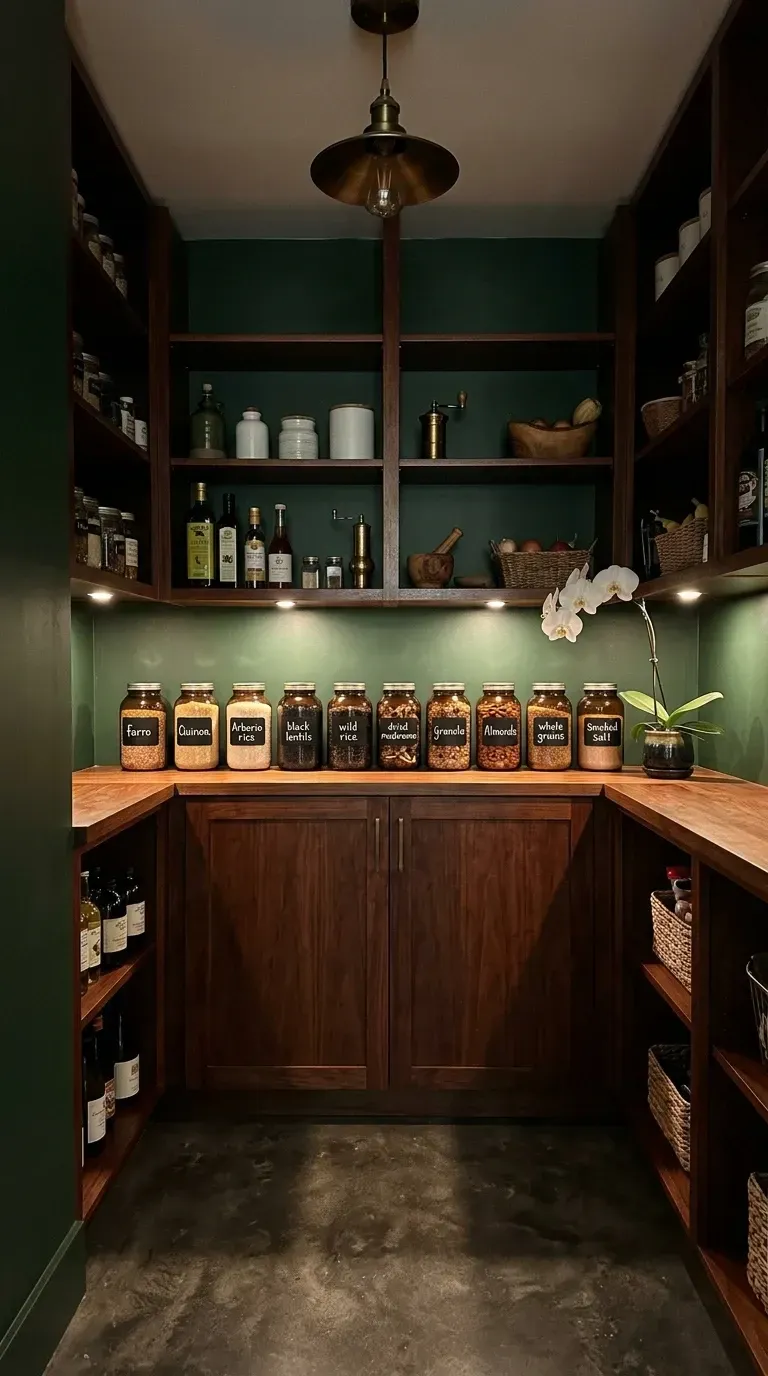
This direction commits fully to the sophisticated-apothecary aesthetic: dark walls, rich wood, and the kind of disciplined decanting that turns a pantry into a gallery. The walls are Farrow & Ball Studio Green No. 93 or Sherwin-Williams SW 6473 Jasper — both are deep enough to read as confident but not so black they kill the warm light bouncing off the jars. The cabinetry is walnut (custom or Semihandmade walnut fronts over IKEA Sektion boxes at the value tier), with the shelves sized at 11 inches deep for single-row jars and 14 inches deep where you need two rows. Decanting is the whole game: specify a cohesive set of Weck 1/2-liter and 1-liter tulip jars for grains and pastas, Williams-Sonoma Hotel Collection canisters or OXO POP 2.0 in the larger sizes for flour and sugar, and Bormioli Rocco Quattro Stagioni jars for spices. Labels are chalkboard vinyl cut on a Cricut with the handwritten calligraphy look, or the premium alternative is Calligraphy By Lea custom vinyl sets from Etsy. Lighting is Kichler 6TD LED 2700K warm under-shelf strips on a dimmer, never the cold 4000K "daylight" strips that fight the warm wood. The curated decor — a brass mortar and pestle (Vermeer Vintage or any Charleston antique mall find), a single white Phalaenopsis orchid in a terra cotta pot — is the restraint that keeps the space reading as designed, not cluttered.
Features
- Walnut built-in shelving, 11-14 inch depth
- Farrow & Ball Studio Green or SW Jasper walls
- Warm 2700K LED under-shelf lighting
- Cohesive jar set (Weck, Williams-Sonoma, Bormioli)
- Chalkboard vinyl or custom calligraphy labels
- Disciplined curated decor (single orchid, brass accents)
| Line Item | Specification | Cost Range |
|---|---|---|
| Walnut cabinetry & shelving | Custom or Semihandmade walnut over IKEA Sektion | $3,200 – $6,400 |
| Paint (Farrow & Ball or SW) | 1 gallon + primer + supplies | $85 – $180 |
| LED under-shelf lighting | Kichler 6TD 2700K warm, dimmable, 4 sections | $180 – $340 |
| Glass jars (28 total assorted) | Weck, Williams-Sonoma, Bormioli Rocco | $260 – $460 |
| Chalkboard or calligraphy labels | Cricut cut or Etsy custom set | $35 – $95 |
| Curated decor | Brass mortar & pestle, orchid, baskets | $150 – $285 |
| Total installed cost (Charleston baseline) | $3,910 – $7,760 | |
Styling Notes for This Look
- Dark pantry walls are only successful if the lighting is layered — overhead, under-shelf, and ideally a small accent light on the curated decor. Skip any one layer and the space reads like a cave.
- One jar brand is the honest answer; mixing Weck tulips with OXO POP on the same shelf dilutes the discipline that makes this style work.
- Chalkboard labels wear at the edges faster than printed vinyl — refresh the labels annually with a chalk marker, not liquid chalk paint, to keep the crisp handwritten look.
- Restrict decor to three items maximum per shelf surface. Orchids, brass tools, and stacked linen napkins are the acceptable vocabulary; anything else is clutter pretending to be design.
2. The Ultimate Snack Drawer
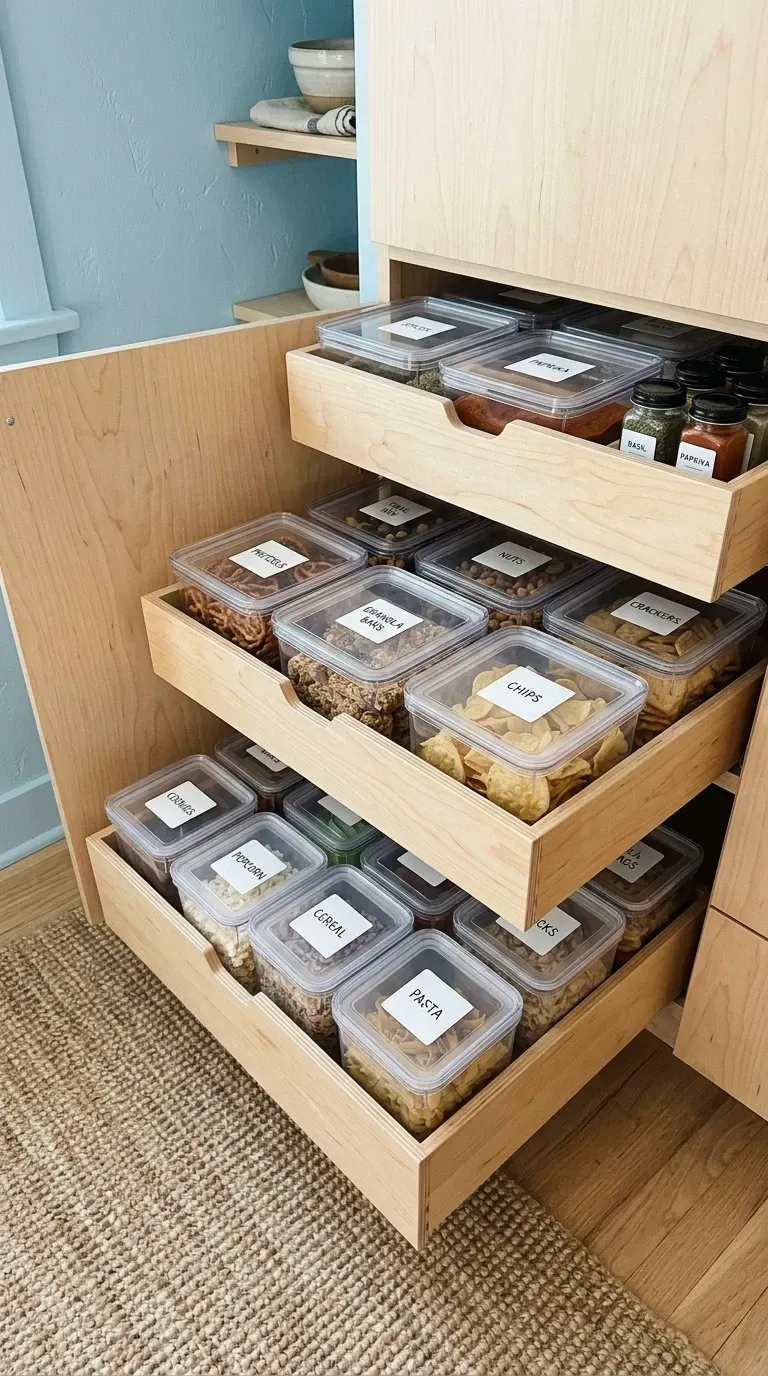
For families with kids old enough to pack their own lunches, the snack drawer is the single highest-return micro-organization move in any kitchen — and the one most often done wrong with mismatched plastic bins shoved into the space. The deep drawer is part of the base cabinetry (custom at the premium tier, or specify Blum Legrabox or Blum Tandembox inserts in your existing cabinetry at the retrofit tier). The bins are the discipline: OXO Good Grips POP 2.0 in the rectangular sizes (medium and large squares), iDesign Linus stacking bins for irregularly shaped bags, and the YouCopia StoraLid or similar silicone stretch lids for partial-bag storage. The top drawer is the spice zone — specify the YouCopia SpiceStack 30 (tiered insert holding 30 spice jars in a shallow drawer) or the Richards Homewares Kensington drawer organizer as the less expensive alternative, filled with matching AllSpice Berry jars or the Williams-Sonoma French Kitchen Glass spice jar set. Labels go on the lid tops, not the bin fronts — in a deep drawer you read from above. The difference between a snack drawer that works and one that doesn't is a label you can read when standing over the drawer without tilting your head.
Features
- Deep natural maple or oak cabinetry drawer
- OXO Good Grips POP 2.0 clear lidded bins
- iDesign Linus bins for irregular bags
- YouCopia SpiceStack 30 or Richards Homewares drawer spice organizer
- Top-of-lid vinyl labels for overhead visibility
| Line Item | Specification | Cost Range |
|---|---|---|
| Drawer cabinetry / retrofit | Custom drawer unit OR Blum Legrabox retrofit | $850 – $1,600 |
| OXO Good Grips POP 2.0 bins (x12) | Mixed medium and large rectangular | $180 – $310 |
| iDesign Linus bins (x6) | Irregular-bag storage inserts | $60 – $120 |
| Spice drawer insert + jars | YouCopia SpiceStack 30 + AllSpice Berry jars x30 | $95 – $170 |
| Custom top-of-lid labels | Printed vinyl from Paper Source or Etsy | $18 – $40 |
| Total installed cost (Charleston baseline) | $1,203 – $2,240 | |
Styling Notes for This Look
- Measure the drawer's internal clear dimensions to the 1/8 inch before ordering bins. A 1/2-inch overrun on any bin means the drawer won't close — and "close enough" is not close enough in a pull-out drawer system.
- Labels on lid tops, always. Side labels are invisible from the grocery-unloading standing position; the point of a pull-out drawer is overhead scanning.
- Dedicate the bottom drawers to kid-accessible snacks, not the high drawers. Children under 12 cannot reach the top drawer reliably and will end up stacking chairs against your cabinetry to reach their target anyway.
- Restock the drawer on Sunday night every week from the Costco or grocery run, not during weeknight meal prep. A drawer-restock ritual is the difference between a system that stays organized and one that collapses by Thursday.
3. Corner Pantry Solutions
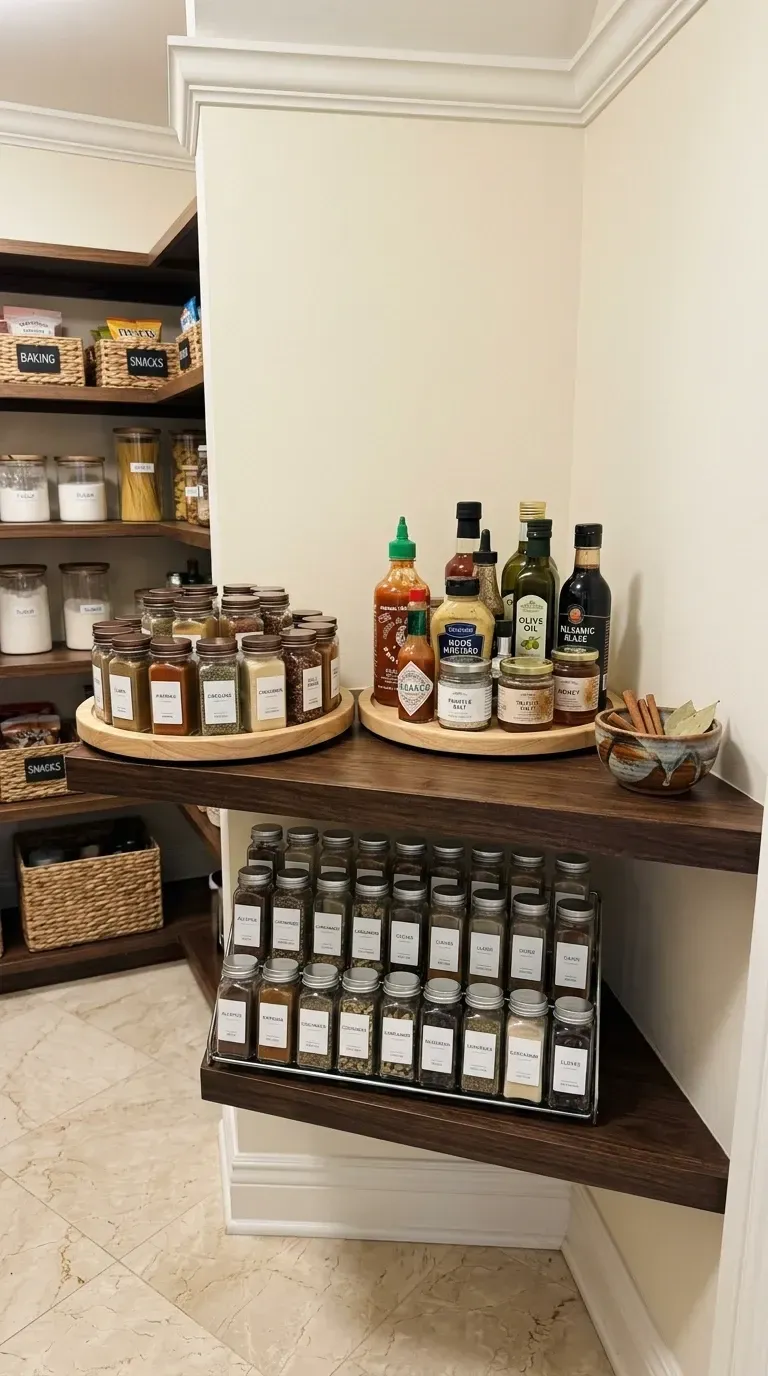
Corner pantries are the single most frustrating pantry configuration for anyone trying to maintain visibility on inventory — the back corner is where jars of curry paste go to die unseen for eighteen months. The solutions are predictable and effective: Rev-A-Shelf blind-corner pull-outs or Hafele corner optimizers retrofitted into existing cabinets, OXO Good Grips or Copco solid-wood lazy Susans (specify the 12-inch or 15-inch sizes with the non-skid surface, not the cheap wobble-prone plastic versions), and a dedicated tiered spice rack for the back wall where the shelves would otherwise become a graveyard. For the spice jars themselves, specify the Bellemain 24-jar set or the Williams-Sonoma Hotel Collection glass spice jars (both include printed labels for the most common 20-30 spices, which solves the naming-convention problem that otherwise derails any jar-matching system). Lower-shelf baskets should be uniform — Y-Weave seagrass from The Container Store, or the Pottery Barn Wynne woven baskets for the premium tier — sized in a rhythm across the shelf (two medium + one wide, not a random collection of salvaged baskets).
Features
- Rev-A-Shelf or Hafele blind-corner pull-outs (for blind-corner configurations)
- Copco or OXO solid-wood lazy Susans (12-15 inch)
- Bellemain or Williams-Sonoma tiered spice rack + matching jars
- Y-Weave seagrass baskets (uniform sizing rhythm)
| Line Item | Specification | Cost Range |
|---|---|---|
| Corner cabinetry upgrade or retrofit | Rev-A-Shelf pull-out OR custom corner shelving | $650 – $1,800 |
| Lazy Susans (x2) | Copco or OXO solid wood 12-15" | $70 – $130 |
| Spice rack + 24 uniform jars | Bellemain tiered + labeled jar set | $90 – $180 |
| Y-Weave or Pottery Barn baskets (x4) | Uniform sizing on lower shelves | $95 – $220 |
| Misc. decor | Decorative bowl, herb plant | $20 – $45 |
| Total installed cost (Charleston baseline) | $925 – $2,375 | |
Styling Notes for This Look
- Solid-wood lazy Susans last — the plastic ones wobble off-center within six months and end up in the donate pile. Pay the $60 premium for wood.
- Tiered spice racks work because every jar is visible from the front at the reaching angle; flat single-shelf rows always bury the back row.
- Pre-labeled spice jar sets solve the "what's cumin again?" problem that stalls every jar-matching project; write-your-own labels sound aspirational and rarely happen.
- Baskets in corners should be deeper than wide — the geometry of a corner shelf rewards depth over width.
4. Vintage Baking Nook
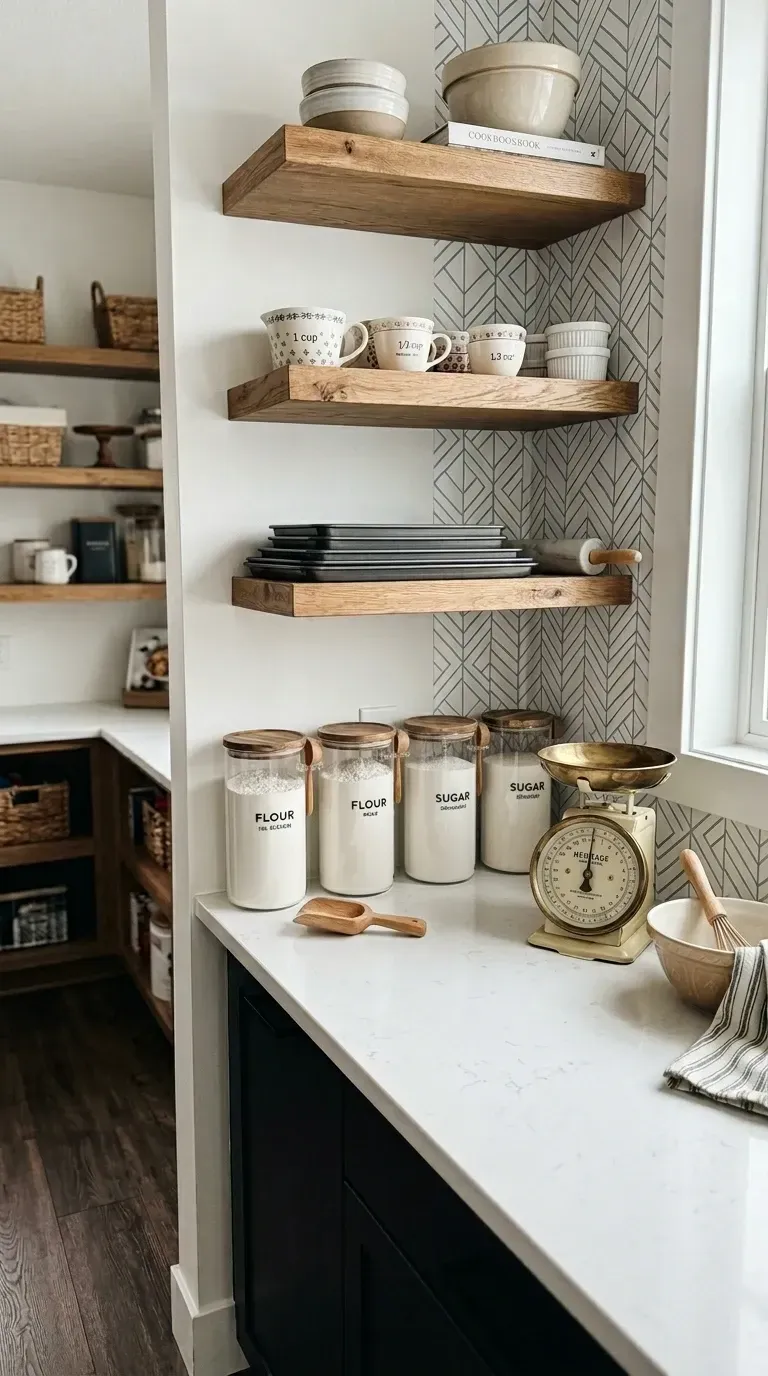
The baking nook is the most personality-driven direction on this list — it works best when the homeowner actually bakes, and it reads as staged theater when they don't. The open shelves are white oak floating shelves (Federal Brace floating bracket system or Park Hill Floating Shelf kits) sized 30-48 inches long depending on your wall space. The wallpaper backsplash is the single most recognizable feature: Rebel Walls Harlequin, Magnolia Home Threaded Herringbone, or the Spoonflower peel-and-stick herringbone patterns — all three work behind floating shelves where a traditional tile backsplash would read as heavy. The counter is Cambria Torquay or Caesarstone Creme Brule quartz (both warm-cream tones that complement white oak and the vintage accessories), sized as a 24-36 inch wide prep zone. The canisters are the workhorses: Anchor Hocking Heritage Hill glass canisters with the wooden sealed lids, Mason Cash English Collection ceramic jars, or the Williams-Sonoma Hotel Collection for the premium tier. The vintage scale is the focal point — sources: Etsy vintage (Hanson, Taylor, American Family scales from the 1940s-1960s are still plentiful at $80-250), Park Hill Collection reproduction, or Pottery Barn's vintage-style brass scale.
Features
- White oak floating shelves (3-tier)
- Rebel Walls / Magnolia / Spoonflower herringbone wallpaper backsplash
- Cambria Torquay or Caesarstone Creme Brule quartz counter
- Anchor Hocking or Mason Cash glass canisters
- Vintage kitchen scale (Etsy or Park Hill)
- Ceramic mixing bowls and turned wooden rolling pins
| Line Item | Specification | Cost Range |
|---|---|---|
| White oak floating shelves (x3) | Federal Brace or Park Hill system | $180 – $340 |
| Wallpaper backsplash + install | Rebel Walls / Magnolia / Spoonflower | $120 – $280 |
| Quartz counter section (24-36") | Cambria Torquay or Caesarstone Creme Brule | $350 – $700 |
| Glass canisters (x4) | Anchor Hocking Heritage Hill or Mason Cash | $95 – $160 |
| Vintage scale + baking decor | Etsy vintage or Park Hill reproduction | $140 – $280 |
| Total installed cost (Charleston baseline) | $885 – $1,760 | |
Styling Notes for This Look
- Open shelving looks beautiful and collects a grease film faster than closed cabinetry — plan for a weekly wipe-down on any shelf within 6 feet of a cooktop.
- Wallpaper behind shelves works only with a peel-and-stick or properly sealed installation; traditional paste-applied wallpaper in a kitchen backsplash zone peels at the edges within 18 months.
- Vintage scales are decorative 95% of the time and functional 5% — buy the scale you like looking at, not the one you plan to weigh flour on.
- Sealed-lid canisters are worth the 30% premium over regular screw-top jars; humidity in Charleston summer will cake open-lid flour within a month.
5. Bright Breakfast Station
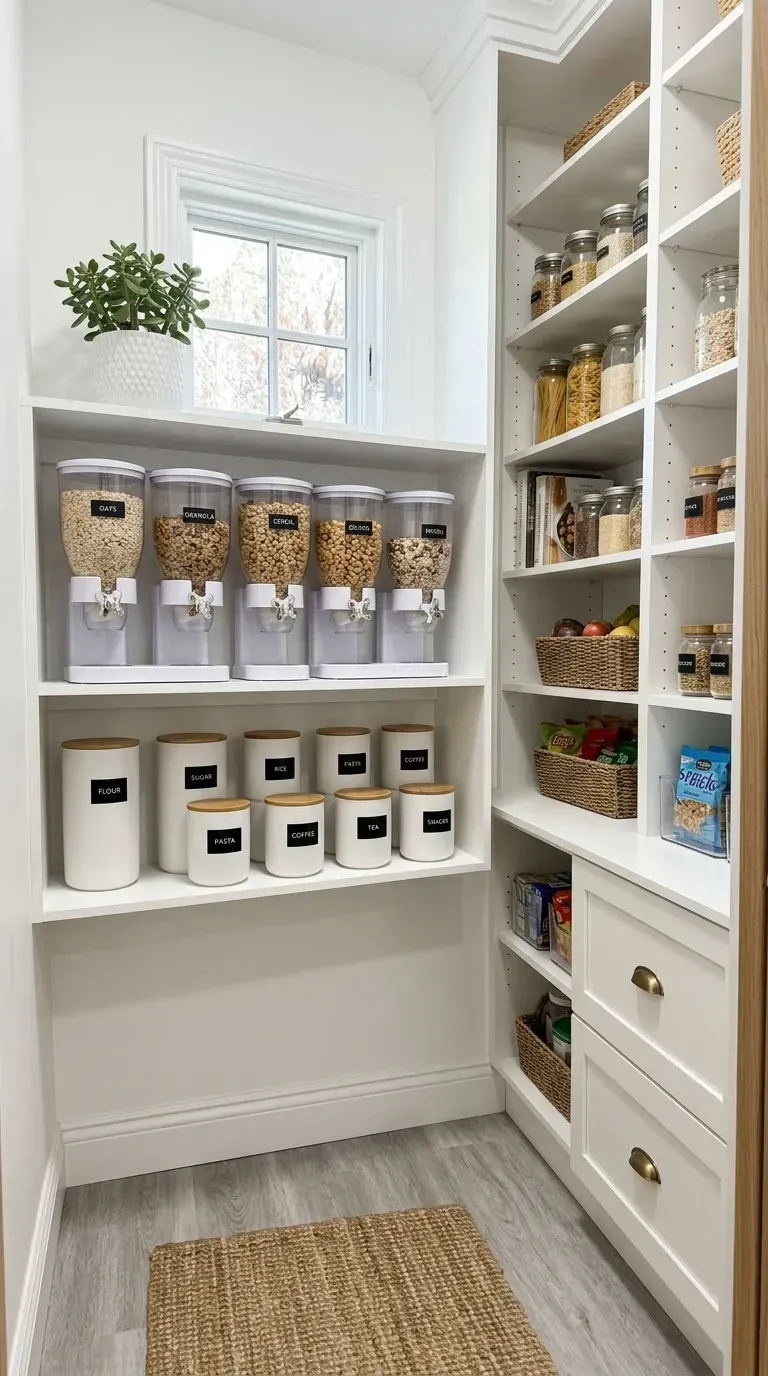
The breakfast station is the most functional direction on this list for families that share a kitchen during the 6am-8am rush. The centerpiece is the wall-mounted cereal dispenser array: Zevro Indispensable Dry Food Dispenser in the dual or triple configurations is the honest best-in-class choice (BPA-free, 17-cup capacity per chamber, the portion-control dial actually works). For visibility and safety, specify the glass viewing window versions, not the fully opaque body. Below the dispensers, uniform stoneware canisters hold coffee, flour, sugar, and the one or two additional staples that rotate through breakfast — the Mrs. Meyer's Clean Day stoneware canisters, the Anchor Hocking Stoneware Jar Set, or the Williams-Sonoma Hotel Collection canisters all work. Baskets on the side shelves are for produce that benefits from air circulation (bananas, onions, potatoes, garlic — avoid refrigerating any of these unless you like mealy fruit) in Y-Weave seagrass or the Pottery Barn Round Rattan series. Labels are matte vinyl in a single font — Bebas Neue in condensed or the Pantone 448 C olive-black are the typical designer specifications for this look.
Features
- Crisp white painted built-in shelving
- Zevro Indispensable wall-mounted cereal dispensers (2-3 chambers)
- Uniform stoneware canisters (Anchor Hocking or Williams-Sonoma)
- Y-Weave or Pottery Barn rattan baskets for produce
- Bright natural light exposure (east or south-facing if possible)
| Line Item | Specification | Cost Range |
|---|---|---|
| Custom white built-in shelving | Painted MDF or maple, 4x6 footprint | $2,100 – $4,200 |
| Zevro wall-mounted cereal dispensers | Dual or triple chamber, 17-cup each | $140 – $260 |
| Stoneware canisters (x9) | Anchor Hocking or Williams-Sonoma Hotel | $190 – $335 |
| Y-Weave or rattan produce baskets | Uniform sizing, 4-6 pieces | $110 – $220 |
| Faux plant / fresh herb pot | Nearly Natural or live basil | $25 – $50 |
| Total installed cost (Charleston baseline) | $2,565 – $5,065 | |
Styling Notes for This Look
- Cereal dispensers work in families that go through boxes weekly; a single adult who eats granola twice a month is better served by a single canister than a wall-mounted array.
- Opaque stoneware canisters hide the visual clutter of varied flour, sugar, and coffee textures; specify opaque over clear for the cleanest look.
- Produce baskets need airflow — don't use lidded or tight-woven baskets for bananas, onions, or potatoes unless you enjoy fruit flies.
- A single font on every label across the room is the secret to the cohesive Pinterest-adjacent look; mixing fonts even slightly ruins the discipline.
6. The Decanting Masterclass
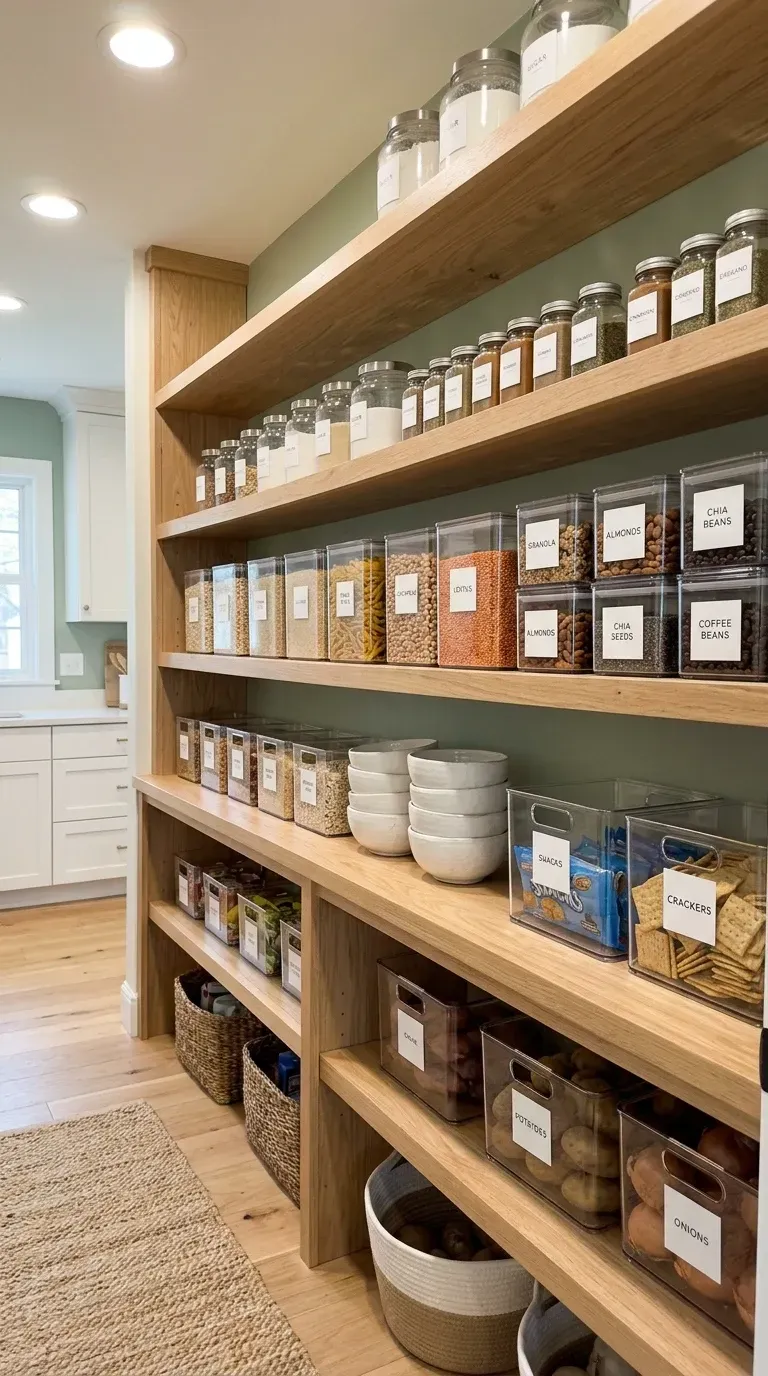
If you commit fully to the decanting system, this is where you end up: every single dry good transferred into matching containers, inventory legible at a glance, and the entire pantry operating as a designed visual system rather than a storage jumble. This is the highest-discipline direction and also the one that most rewards the investment once it's in place. The container system has to be OXO Good Grips POP 2.0, iDesign Linus, or the Williams-Sonoma Hotel Collection acrylic — mixing brands breaks the visual system. Count the decanted items honestly before buying: a typical family pantry holds 40-60 distinct dry goods, which means ordering a starter set and adding 8-12 individual pieces for the outliers. Baskets hold the non-decantable bulky items — flour bags over 10 lbs, potato sacks, root vegetables — and should be rope-weave or tight seagrass from Hearth & Hand at Target or the Pottery Barn Wynne series. Labels are Paper Source printed vinyl or a Cricut-cut custom set in a single font at two sizes (larger for the container front, smaller for the lid). Lighting is recessed 2700K LEDs on a dimmer (Halo Elite H273 or Lithonia WF6), positioned 18-24 inches from the shelf face so the light hits the contents, not just the shelf edge.
Features
- Long horizontal white oak open shelves
- Full OXO / iDesign / Williams-Sonoma container system (40-60 pieces)
- Minimalist uniform vinyl labels, single font
- Rope-weave and seagrass baskets for bulk items
- Recessed 2700K LED ceiling lighting
| Line Item | Specification | Cost Range |
|---|---|---|
| Custom white oak shelving & cabinetry | 4x8 footprint, painted or stained | $3,100 – $5,700 |
| Container system (40-60 pieces) | OXO POP 2.0 or Williams-Sonoma Hotel | $420 – $780 |
| Rope & seagrass baskets (x4) | Hearth & Hand or Pottery Barn Wynne | $135 – $260 |
| Custom vinyl labels | Paper Source or Cricut cut | $40 – $85 |
| Recessed LED lighting (installation extra) | Halo Elite H273 or Lithonia WF6, 4 fixtures | $180 – $320 |
| Total installed cost (Charleston baseline) | $3,875 – $7,145 | |
Styling Notes for This Look
- Invest in one cohesive container brand — mixing OXO with Williams-Sonoma on the same shelf breaks the visual system even though both are quality products individually.
- Decant everything packaged, period. The moment you leave a Cheez-It box on the shelf, the entire pantry reverts to looking like a disorganized pantry with some jars.
- Inventory monitoring is easier when you can see the contents; pay the premium for clear containers over opaque, even though opaque photographs cleaner.
- Baskets handle the irregular shapes that jars cannot — big flour bags, sweet potatoes, pumpkin — without breaking the decanting discipline elsewhere on the shelves.
7. Rustic Farmhouse Hutch
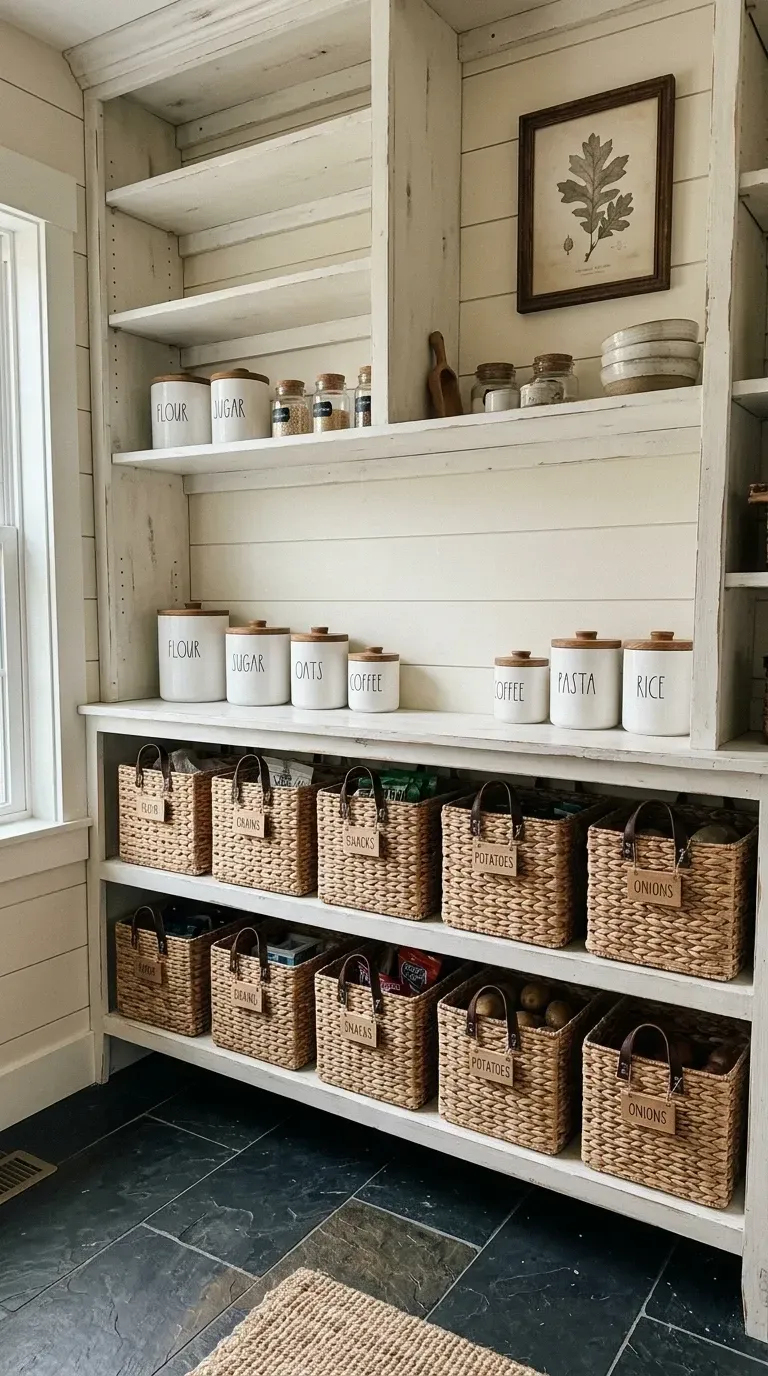
For homeowners who rent, don't want to invest in built-ins, or want a pantry that moves with them, a freestanding hutch is the honest best answer — and the charm of a distressed antique piece outperforms any custom builder-grade solution for quarter of the cost. Sources for the hutch itself: Chairish and 1stDibs at the premium tier, Magnolia Home by Joanna Gaines at Pottery Barn and Park Hill Collection at the mid-tier, or Facebook Marketplace and regional estate sales for the genuinely vintage piece at the bargain tier. Look for hutches with at least 18-inch interior depth — the shallow 12-inch display hutches cannot hold real pantry staples. The beadboard back is original on a true antique or specified as an accessory on reproductions; if your hutch lacks it, retrofit with PlankCladd 3.5-inch beadboard panel (the peel-and-stick version from Home Depot works in a pinch). The uniform baskets are the discipline point — Hearth & Hand at Target makes a stitched seagrass line with leather luggage-tag labels built in, or specify the Pottery Barn Wynne with Etsy custom leather tags sewn on. Canisters should be ceramic in warm cream or sage (Williams-Sonoma Vintage Stoneware, Pottery Barn Cambria, or the Magnolia Home jar collection) — glass jars fight the rustic aesthetic.
Features
- Distressed antique white freestanding hutch
- Beadboard backing (original or retrofit)
- Uniform seagrass baskets with leather luggage tag labels
- Warm cream or sage ceramic canisters
- Framed botanical prints, stoneware mixing bowls, rustic decor
| Line Item | Specification | Cost Range |
|---|---|---|
| Freestanding hutch | Magnolia/Park Hill new or vintage antique | $1,400 – $3,200 |
| Beadboard retrofit (if needed) | PlankCladd or similar peel-and-stick | $80 – $220 |
| Seagrass baskets with leather tags (x8) | Hearth & Hand or Pottery Barn + Etsy tags | $260 – $440 |
| Ceramic canisters (x8) | Williams-Sonoma Vintage or Pottery Barn Cambria | $170 – $310 |
| Rustic decor (prints, bowls, jars) | Framed botanicals, stoneware | $95 – $180 |
| Total installed cost (Charleston baseline) | $2,005 – $4,350 | |
Styling Notes for This Look
- A true antique hutch has character a new reproduction cannot fake — spend the afternoon at an estate sale before committing to a new build.
- Every basket identical is the rule that makes this style sing; "close enough" matching baskets break the order that the rustic aesthetic depends on.
- Leather luggage-tag labels outperform paper or vinyl in a farmhouse setting — they age into the look rather than against it.
- Ceramic canisters win over glass in this direction because the opacity reinforces the country-kitchen feel; clear glass looks too modern against distressed white wood.
8. Vertical Jar Display
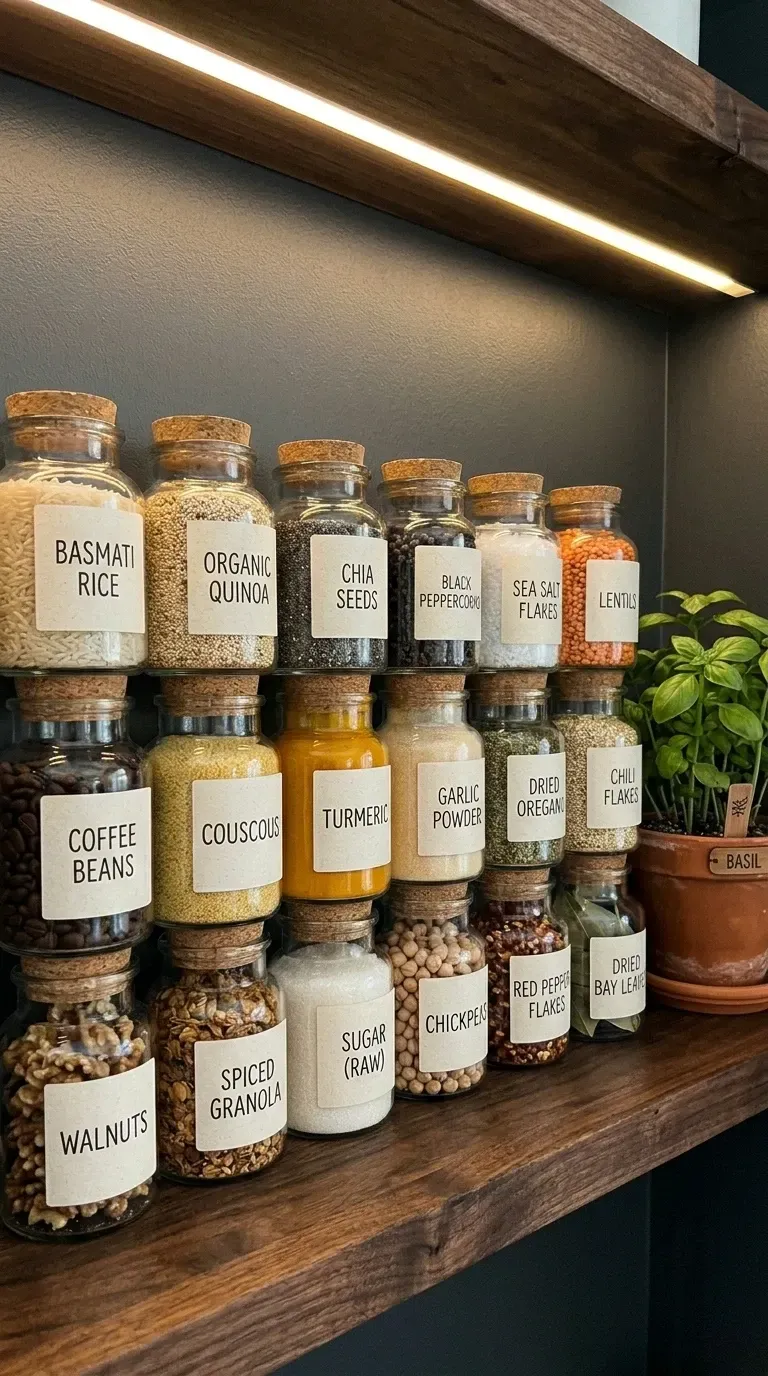
For homeowners with limited shelf depth but tall vertical wall space, stacking cork-lidded jars is the smartest use of the geometry. The jar specification matters: Kilner Cliptop jars with the orange-gasket clip closure, Le Parfait French terrines with cork lids, or Weck tulip jars all work — but the flat tops that allow stable stacking are the non-negotiable feature. Specify 500ml and 750ml sizes predominantly; the 1-liter and larger sizes are too heavy to stack safely when full. The shelf itself is a single floating dark-stained white oak shelf (Federal Brace floating bracket, 1.5-inch thick minimum, sized 36-48 inches long) mounted against a contrasting wall color — SW 6258 Tricorn Black or Benjamin Moore HC-166 Kendall Charcoal both create the gallery backdrop. LED strip lighting is critical here — the Philips Hue Lightstrip Plus Outdoor (or the Govee LED strip for the budget tier) mounted to the underside of the shelf, set to warm 2700K. The basil plant is an essential styling element: it breaks up the grid rhythm of the jars and adds organic texture. Specify Genovese basil in a small terra cotta pot, replaced every 3-4 months as needed.
Features
- Single dark-stained white oak floating shelf
- Philips Hue or Govee LED strip lighting (2700K)
- Kilner Cliptop or Le Parfait cork-lidded jars (stackable)
- Large clear printed vinyl labels
- Dark gallery-style wall paint (SW Tricorn Black or BM Kendall Charcoal)
- Live basil plant for organic texture break
| Line Item | Specification | Cost Range |
|---|---|---|
| Floating dark wood shelf + paint | White oak + stain + Federal Brace bracket | $110 – $210 |
| LED strip lighting | Philips Hue Lightstrip or Govee | $55 – $120 |
| Cork-lidded jars (x24) | Kilner Cliptop or Le Parfait 500ml-750ml | $280 – $520 |
| Printed vinyl labels | Large-format for shelf-scale legibility | $30 – $60 |
| Basil plant + terra cotta pot | Genovese basil, 4-inch pot | $15 – $30 |
| Total installed cost (Charleston baseline) | $490 – $940 | |
Styling Notes for This Look
- Stacked jars must have flat lids — Weck tulip jars stack safely, Mason jar screw tops do not.
- LED strip lighting under every shelf is the single styling move that elevates this look from "nice shelf" to "magazine shoot."
- Label fonts need to be readable from five feet away — small cursive labels disappear against dark backgrounds.
- One live plant is the rule; two plants read as collection, three read as clutter. Restraint is the aesthetic discipline.
9. Industrial Modern Shelving
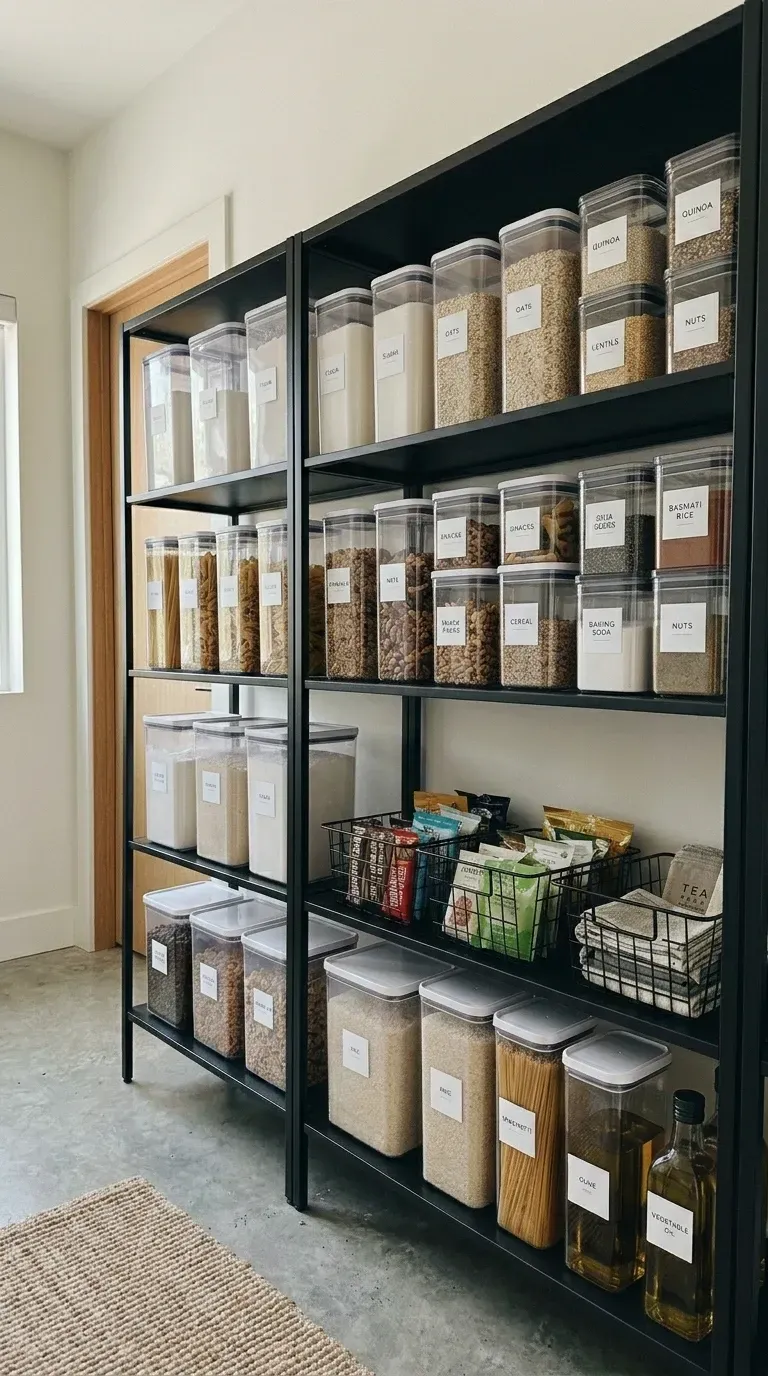
For homeowners who want the pantry to read as a commercial-grade organizational system rather than a traditional residential pantry, industrial metal shelving is the honest answer — and the price-performance ratio beats custom cabinetry by a significant margin. Specify NSF-rated commercial shelving: Metro Super Erecta in the chrome or black epoxy finish, or the Trinity EcoStorage TBFPBA NSF Black units for the residential-accessible version. Size matters: 48x18 inch shelves in 72-inch tall units accommodate the typical 4x6 pantry footprint with two units side by side. The container system is the discipline — full OXO POP 2.0 or iDesign Linus in matching sizes across all shelves. Wire baskets (the Mesh Black Wire series from The Container Store or the Amazon Basics stackable black wire bins) handle the smaller bag storage that would otherwise clutter the containerized shelves. The concrete floor reinforces the industrial language; if you have tile or wood floors, accept that the look will soften slightly but still work.
Features
- Metro Super Erecta or Trinity EcoStorage metal shelving (x2 units)
- Complete OXO POP 2.0 or iDesign Linus container set
- Black wire mesh storage baskets
- Minimalist printed vinyl labels
- Industrial-coded flooring (concrete or dark tile)
| Line Item | Specification | Cost Range |
|---|---|---|
| Metal shelving units (x2) | Metro Super Erecta or Trinity EcoStorage 48x18x72" | $340 – $680 |
| Clear plastic container set (x32) | OXO POP 2.0 or iDesign Linus assorted sizes | $460 – $820 |
| Black wire baskets (x6) | Container Store or Amazon Basics stackable | $75 – $150 |
| Printed vinyl labels | Paper Source or Etsy custom set | $25 – $50 |
| Total installed cost (Charleston baseline) | $900 – $1,700 | |
Styling Notes for This Look
- NSF-rated commercial shelving outperforms consumer-grade wire shelving in load capacity by 2-3x, which matters if you plan to store cast-iron cookware or canning supplies on the same shelves.
- Every container identical in brand and style — mixing OXO with Rubbermaid breaks the industrial-precision aesthetic immediately.
- Black matte powder-coat finishes hide fingerprints better than chrome; pay the $50 premium for the matte version if kids will be touching the shelves.
- Wire shelves require a plastic shelf liner (Grid-Set or the Metro clear polypropylene liners) if you store items that would fall through the wire grid.
10. The Butler's Pantry Baking Center
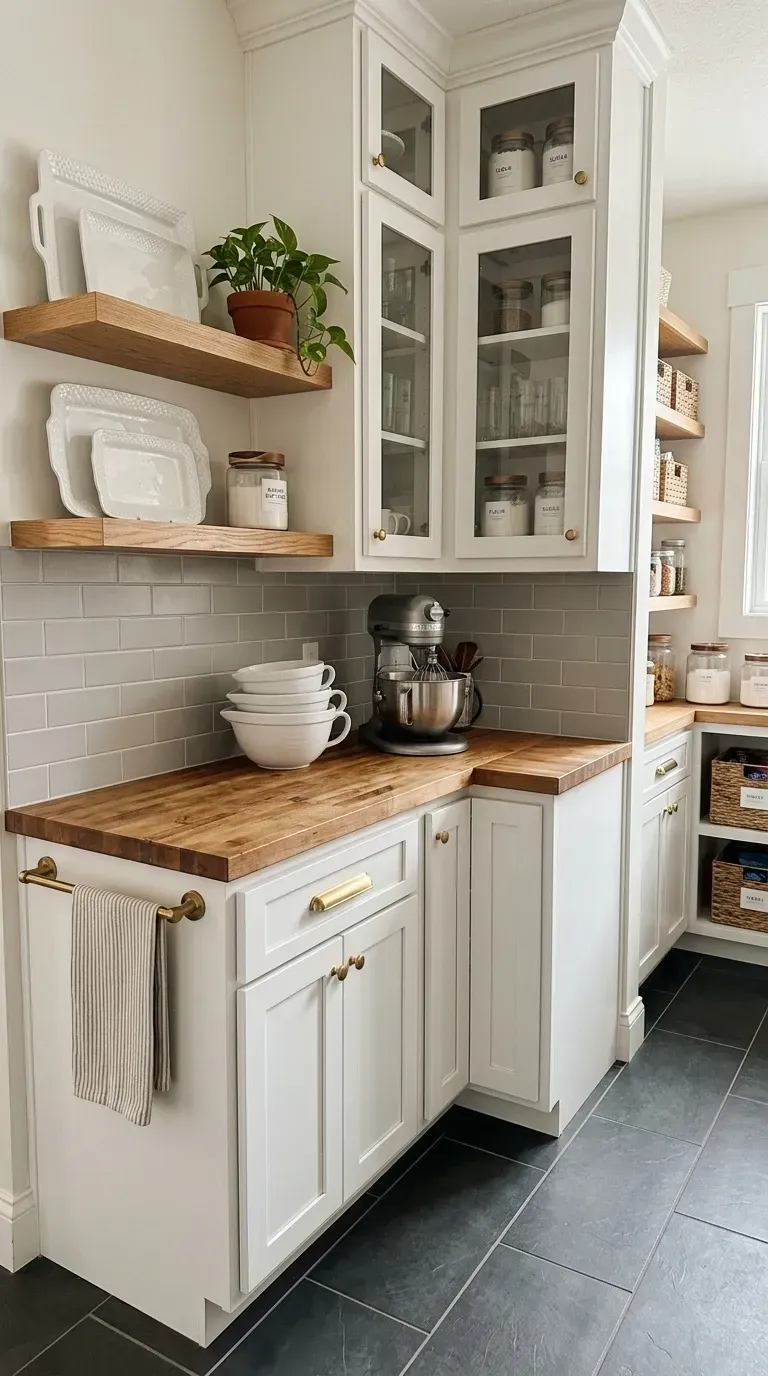
The butler's pantry is the most architecturally committed direction on this list — a dedicated zone between the kitchen and dining room that functions as a secondary prep area, storage pantry, and beverage station all in one. The cabinetry must be shaker-profile painted MDF or wood with glass-front uppers (specify 12-over-12 true divided lite or simple full-light glass doors, depending on your formality preference) and solid lower doors with soft-close hinges. Hardware is brass cup pulls and knobs (Rejuvenation Ballard, Schoolhouse Electric's hardware collection, or Top Knobs Asbury Collection for the premium tier; Amerock Kane or Liberty Matte Brass for the value tier). The butcher block is John Boos maple edge grain or Hardwood Lumber Company reclaimed oak — both proper food-prep surfaces that hold up to 20 years of cookie-dough rolling if oiled quarterly. The subway tile is Daltile Rittenhouse in glossy white with a dark gray grout that will hold its color; avoid white grout, which will gray unevenly from steam and use. Open shelves above the counter display the daily-use items and serveware. The KitchenAid Artisan Stand Mixer (specify matte black, hammered copper, or the limited-edition colors that read as sculpture rather than appliance) is positioned as the room's focal point.
Features
- White shaker cabinetry with glass-front uppers and solid lowers
- John Boos or Hardwood Lumber butcher block countertop
- Daltile Rittenhouse subway tile with dark grout
- Open white oak shelves above counter
- KitchenAid Artisan Stand Mixer as focal-point appliance
- Brass cup pulls and knobs (Rejuvenation, Schoolhouse, or Top Knobs)
| Line Item | Specification | Cost Range |
|---|---|---|
| Custom shaker cabinetry + open shelves | Painted MDF or wood with glass uppers | $2,800 – $5,200 |
| John Boos butcher block + subway tile backsplash | Edge-grain maple 1.5" + Daltile Rittenhouse | $750 – $1,500 |
| KitchenAid Artisan Stand Mixer | Matte black or hammered copper | $320 – $530 |
| Brass cup pulls & knobs | Rejuvenation or Schoolhouse; value: Amerock Kane | $120 – $240 |
| Storage jars, serveware, styling | Decanting jars, coupes, cake stands | $220 – $430 |
| Total installed cost (Charleston baseline) | $4,210 – $7,900 | |
Styling Notes for This Look
- Glass-front uppers only work if the contents are curated — a butler's pantry with glass doors showing boxed cereal and random mugs fails immediately.
- Butcher block needs to be oiled with food-grade mineral oil or Boos Block Board Cream every quarter; skip the oiling and the surface cracks within 3-5 years.
- Dark grout with white subway tile is the honest choice for a pantry near the kitchen — white grout will gray from cooking steam and is impossible to return to original color.
- A stand mixer as focal point works only if it's actually used; an unused mixer reads as prop, not daily tool.
Pro Tips: What Actually Keeps the Organization Intact
- Decant everything you actually want to keep visible, nothing you don't. The pantry's appearance is driven by what the eye sees; decanting is the single most impactful move because it replaces the visual clutter of varied retail packaging with a uniform container language. But decanting works only if the system is maintained — every Costco run gets decanted into the containers immediately, not stacked on the counter "to do later."
- Use every inch vertically. Back-of-door organizers (Elfa utility rails from The Container Store or the OXO Over-the-Door system), shelf risers (YouCopia Shelf Stacker or Copco 2-tier riser), and stacking bins double your usable storage on any pantry shelf. A 4x6 walk-in with no vertical optimization holds 40% of its potential capacity.
- Label everything — twice if necessary. The front label identifies the contents; the top-of-lid label identifies the contents when the container is viewed from above in a drawer or high shelf. Good labeling is worth the hour it takes.
- Zone your items by actual use frequency. The daily-use items (coffee, cereal, bread, snacks) go at eye level and at the arm-reach depth. Weekly-use items go to the high and low shelves. Monthly-use items go to the back of deep cabinets. A pantry organized by food category alone, without a use-frequency overlay, becomes chaotic within weeks.
- Match container brands within each zone at minimum, across the pantry at best. OXO POP, iDesign Linus, and Williams-Sonoma Hotel are all quality systems — but they visually fight each other when placed on the same shelf. Pick one and commit.
- Light the pantry like a room, not a closet. Overhead fixture on a dimmer, under-shelf LEDs for the contents, and an accent light on any display-piece zone. A single bare-bulb ceiling fixture is what makes pantries read as utility closets.
- Plan for Charleston humidity. In a coastal pantry, silica gel packs (replace every 4-6 months), an airtight-lidded container specification (not just clear plastic — properly gasketed), and occasional use of a small dehumidifier during July and August are what keep flour, sugar, and cracker crumbs from going stale or clumping.
- Commit to a Sunday-night reset. A 15-minute ritual every Sunday — refilling containers from the week's grocery run, wiping shelves, reshuffling anything out of place — is the difference between a system that holds for years and one that collapses by month three. Calendar the ritual if you have to.
- Photograph the finished pantry before you start using it. The photographic reference becomes the target when the system inevitably drifts. I tell every client to keep the "Day One" photo on their phone; looking at it in month two is usually enough to trigger the 15-minute reset.
Cost-Saving Strategies That Don't Compromise the Look
- IKEA Sektion boxes with Semihandmade fronts deliver 80% of the custom-cabinetry aesthetic at 40-55% of the cost. Specify the Sektion boxes to fit your pantry footprint, order Semihandmade's Shaker or slab door fronts in your chosen finish, and have a local carpenter install the assembly. The result photographs identically to custom in 95% of pantry installations.
- Target's Hearth & Hand line and Walmart's Better Homes & Gardens collection produce excellent basket, canister, and storage SKUs at 30-50% the cost of the Pottery Barn or Williams-Sonoma equivalents. For baskets particularly, the quality difference at the retail tier is now nearly invisible.
- Cricut-cut custom vinyl labels cost $30-60 in materials compared to $120-300 for a full commissioned Etsy label set, and allow you to replace or update labels as needed without reordering. The Cricut Maker 3 pays for itself by the third project.
- Facebook Marketplace and regional estate sales are where the actual antique hutches live — $400-900 for pieces that sell retail at Chairish for $2,500-4,000. Plan a Saturday morning route through Charleston, Mount Pleasant, and Summerville estate sales once a quarter.
- Amazon Basics, Mainstays, and OXO's lower-tier product lines handle the basics — wire baskets, silicone stretch lids, shelf liners — at dollar-store pricing with quality that matches the premium brands for these specific categories. Save the investment for the visible containers that define the look.
- Repurposed mason jars from your recycling bin, with black vinyl labels cut from a single Cricut session, produce a decanting system equivalent to Kilner Cliptop for 10% of the cost. The only compromise: mason jar screw lids don't stack, so this strategy works for single-row shelves, not vertical jar displays.
- Pre-printed spice jar sets from Bellemain or Chef's Star solve the custom-label problem for spices specifically (30-60 jars with printed labels for standard spices for $70-120) and match the uniform look of custom-labeled jars without the custom-labeling labor.
- Peel-and-stick beadboard and wallpaper deliver the rustic-backing and wallpaper-backsplash aesthetics at 25-40% of traditional-application pricing, with a DIY-achievable installation that doesn't require a wallpaper specialist.
Regional Installed Cost — 7 Southeast Markets
What a full pantry glow-up actually costs (4x6-foot walk-in footprint, mid-range specification)
These regional numbers assume a mid-range version of any of the ten directions above — a pantry that reads as polished and intentional but not magazine-feature-priced. The numbers include removal of existing shelving, new shelving or hutch, full decanting container system, labels, lighting upgrade, and decor. They do not include kitchen-wide cabinetry replacement, full remodels, structural work, or premium appliances beyond a single stand mixer where the style calls for it.
| Market | Cost Multiplier | Budget Direction (Vertical Jar, Industrial) | Mid-Range (Snack Drawer, Corner, Baking Nook, Breakfast, Hutch) | Premium (Moody Decanting, Masterclass, Butler's Pantry) |
|---|---|---|---|---|
| Charleston metro (peninsula & Mt. Pleasant) | 1.00x (baseline) | $490 – $1,700 | $885 – $5,065 | $3,875 – $7,900 |
| Daniel Island & Isle of Palms | 1.05x | $515 – $1,785 | $929 – $5,318 | $4,069 – $8,295 |
| Beaufort & Lowcountry SC | 0.95x | $466 – $1,615 | $841 – $4,812 | $3,681 – $7,505 |
| Savannah, GA | 0.94x | $461 – $1,598 | $832 – $4,761 | $3,643 – $7,426 |
| Wilmington, NC | 0.96x | $470 – $1,632 | $850 – $4,862 | $3,720 – $7,584 |
| Atlanta suburbs (Decatur, Dunwoody) | 1.04x | $510 – $1,768 | $920 – $5,268 | $4,030 – $8,216 |
| Greenville, SC (upstate) | 0.88x | $431 – $1,496 | $779 – $4,457 | $3,410 – $6,952 |
What's not in those numbers: full kitchen cabinetry replacement (if your pantry is inside a broader kitchen remodel, budget separately), electrical work for new lighting circuits (licensed electrician at $85-140/hour in the Southeast), structural modifications to the pantry room itself (wall removal, window addition, widening the doorway), premium built-in appliances like refrigerator drawers or wine fridges, and designer fees if you hire an interior stylist for the full spec and install. Numbers assume typical Lowcountry humidity and a builder-grade starting condition — pantries in homes older than 1950 or newer than 2020 may require more or less structural work than baseline.
Frequently Asked Questions
Which of these ten directions works best for a small pantry under 20 square feet?
The Vertical Jar Display (#8) is purpose-built for tiny pantries — a single wall shelf with stacked jars takes essentially zero floor space. The Ultimate Snack Drawer (#2) works if you have any drawer space in adjacent cabinets. The Industrial Modern Shelving (#9) fits a 48x18 shelf unit into a corner or against a narrow wall. Avoid the Butler's Pantry, Farmhouse Hutch, and Baking Nook directions at this scale — each needs a dedicated counter or freestanding furniture piece that a small pantry cannot accommodate.
How much of this can I DIY versus hiring out?
The Vertical Jar Display, Industrial Shelving, Snack Drawer, and Farmhouse Hutch directions are all genuinely DIY-able for any homeowner with basic tools and a Saturday afternoon — no structural work, no electrical work beyond plug-in LED strips. The Moody Decanting, Baking Nook, Decanting Masterclass, and Breakfast Station directions benefit from a carpenter or cabinet installer for the shelving work but can be DIY-completed with IKEA Sektion plus Semihandmade fronts if you're handy. The Butler's Pantry and Corner Pantry Solutions directions typically require contractor work for the cabinetry and potentially an electrician for lighting circuits — budget for professional install on those two.
Will these systems survive real family life, or are they just for photos?
The systems that survive family life are the ones with fewer, better-chosen containers and a weekly reset ritual. The Ultimate Snack Drawer and the Corner Pantry Solutions directions are the two most family-resilient on this list because both were designed for frequent access and easy restocking. The Decanting Masterclass direction can survive family life but requires discipline — every grocery trip gets decanted immediately, not "later." The pure aesthetic directions (Moody Decanting, Butler's Pantry, Vertical Jar Display) work best in households where the pantry isn't the primary snack/lunch-pack zone; pair them with a separate snack drawer if you have kids.
How do I handle Charleston humidity in a pantry?
Airtight-gasketed containers (OXO POP 2.0, Weck with clamps, Kilner Cliptop) are non-negotiable for flour, sugar, salt, cereal, and anything that absorbs moisture. Silica gel packets rotated every 4-6 months inside each container extend freshness. For the pantry as a whole, a small battery or plug-in humidity monitor (AcuRite 01080 or ThermoPro TP50) helps you track when conditions get above 65% relative humidity — and a small plug-in dehumidifier (Pro Breeze Electric Mini) rotated during July and August prevents the caking problem that affects open-lid storage in Lowcountry summer. Avoid storing anything in paper bags in a humid Charleston pantry; everything gets transferred to a sealed container or absorbs moisture within weeks.
How do I choose between glass and plastic containers?
Glass wins on aesthetic, contents visibility, and longevity — it doesn't scratch, stain, or absorb odors over time. Plastic wins on weight (meaningful if you have high shelves or small kids helping to put groceries away), impact resistance (plastic doesn't shatter when dropped), and cost. The honest hybrid most pros recommend: glass for the display-visible zones (eye-level shelves, open shelving, dark-walled pantries where contents become decor), plastic for the high and low shelves where weight and impact resistance matter more. Both OXO POP 2.0 (plastic) and Kilner Cliptop (glass) offer equivalent airtight seals, so neither choice compromises food freshness.
What's the realistic time commitment to set up one of these pantries?
A weekend direction like Vertical Jar Display or Industrial Modern Shelving can be DIY-installed and filled in 4-8 hours across one weekend day, with another 2-3 hours the following week for label refinement and adjustments. Mid-range directions like Snack Drawer, Corner Solutions, Baking Nook, or Breakfast Station take 2-3 weekends including ordering, shelving install, decanting, and labeling. The full custom directions (Moody Decanting, Decanting Masterclass, Butler's Pantry) are 4-8 week projects including cabinetry lead times, contractor scheduling, and the intensive initial decanting-and-labeling phase. Budget 15-25 hours of actual decanting and labeling labor regardless of which direction you choose — the hands-on time is the constant.
Do I need to replace everything I currently own, or can I phase the upgrade?
Phasing works beautifully if you commit to a single container brand and size system from day one and add pieces over time. Start with the 12-18 most-frequently-used dry goods (flour, sugar, rice, pasta, oats, common cereals, and the top snacks) and decant those into the chosen container system. Everything else stays in original packaging temporarily. Over 3-6 months, add 4-6 containers per month until the system is complete. The only phasing mistake to avoid: don't mix two different container brands thinking "the next purchase will match" — once you have a disparate mix, the motivation to consolidate usually evaporates. Commit to the brand first, then phase the quantity.
Which direction adds the most home value at resale?
The 2024 NAR Remodeling Impact Report and Remodeling Magazine Cost vs. Value data both show custom pantry upgrades recovering 60-90% of invested cost at resale in most Southeast markets. The directions that recover most are typically the built-in ones that a buyer sees as permanent value — the Butler's Pantry, the Moody Decanting built-ins, and the Baking Nook all photograph well for listings and register as "custom kitchen" features during showings. The freestanding-hutch and shelving-unit directions (Farmhouse Hutch, Industrial Modern, Vertical Jar) deliver aesthetic value but move with the seller at closing and don't add to the home's appraised value. For resale-focused improvements, invest in built-ins; for personal enjoyment and portability, invest in freestanding systems.
Sources & References
- OXO Good Grips POP 2.0 product specifications and warranty documentation — airtight-gasket container technical data, size guides, and manufacturer care instructions referenced throughout the container recommendations.
- The Container Store — product catalogs and sizing guides — Y-Weave, iDesign Linus, and stacking container specifications used in the snack drawer, corner, and decanting masterclass directions.
- Williams-Sonoma Hotel Collection and French Kitchen Glass product specifications — canister and spice jar documentation for the moody decanting and breakfast station directions.
- Weck, Kilner Cliptop, and Le Parfait preserving jar technical literature — airtight clip and gasket jar specifications, size ranges, and stacking tolerances for the moody decanting and vertical jar display directions.
- Zevro Indispensable Dry Food Dispenser product documentation — wall-mounted cereal dispenser specifications, capacity, and portion control mechanisms.
- Rev-A-Shelf and Hafele corner optimizer product literature — blind-corner pull-out and lazy Susan product specifications for corner pantry solutions.
- Copco and OXO Good Grips lazy Susan product specifications — solid wood turntable product information referenced in the corner pantry direction.
- Bellemain and Williams-Sonoma spice jar set documentation — pre-labeled spice jar systems for 24-30 standard spice collections.
- Magnolia Home by Joanna Gaines and Park Hill Collection product catalogs — freestanding hutch and farmhouse furniture specifications used in the rustic farmhouse hutch direction.
- Anchor Hocking Heritage Hill and Mason Cash ceramic canister specifications — product literature for the vintage baking nook direction.
- Spoonflower, Rebel Walls, and Magnolia Home wallpaper product specifications — peel-and-stick wallpaper technical data for the baking nook backsplash.
- Cambria Torquay and Caesarstone Creme Brule quartz product documentation — engineered stone countertop specifications for the baking nook and butler's pantry counter zones.
- John Boos butcher block technical literature — edge-grain maple butcher block specifications, care instructions, and warranty terms.
- Daltile Rittenhouse Square subway tile product specifications — ceramic subway tile technical data for the butler's pantry backsplash.
- Metro Super Erecta and Trinity EcoStorage commercial shelving product literature — NSF-rated shelving unit specifications, load capacity, and finish options for the industrial modern direction.
- Kichler, Hudson Valley, and Lithonia LED lighting product specifications — under-shelf and recessed LED lighting technical data, color temperature, and dimming compatibility.
- Philips Hue Lightstrip Plus and Govee LED strip product documentation — consumer-grade LED strip lighting specifications for shelf integration.
- Federal Brace and Park Hill floating shelf bracket systems — floating shelf hardware specifications and weight ratings for wall-mounted open shelving.
- IKEA Sektion and Semihandmade cabinet front product documentation — modular cabinet system specifications for value-engineered custom-look pantry builds.
- Farrow & Ball and Sherwin-Williams paint color and product specifications — Studio Green, Jasper, Tricorn Black, and Kendall Charcoal paint documentation referenced for wall color recommendations.
- 2024 NAR Remodeling Impact Report — National Association of Realtors survey data on pantry and kitchen organizational upgrades and their impact on resale value and home sale timelines.
- Remodeling Magazine 2024 Cost vs. Value Report — Southeast Region — annual industry analysis of home improvement ROI, including kitchen and pantry upgrade recovery rates.
- Author's project notes — Johan Martez pantry design consulting files from 2021 through 2026, covering projects in Mount Pleasant, Daniel Island, Isle of Palms, Charleston peninsula, Beaufort, Savannah, and Wilmington; includes installed cost reconciliation data used to build the regional cost table.
Final Thoughts
My Daniel Island client chose a hybrid of directions five and six — the bright breakfast station for the cereal-and-coffee zone her kids actually used, with the decanting masterclass applied to the baking and dry-goods half of the pantry. She spent $4,850 all in, which was within 6% of the mid-range estimate I gave her at the first visit. Two years later, the system still holds — she sends me a photo every January when she restocks after the holidays, showing the same uniform OXO containers, the same chalk-labeled canisters, the same Sunday-night reset ritual she committed to on day one. That is what pantry design can become when you treat it as a designed room rather than a storage closet, and when the discipline of the system matches the discipline of the aesthetic. A show-stopping pantry is not a Pinterest board moment — it is a set of small repeatable decisions that quietly hold over months and years.
If you want to see how these ten pantry directions translate into whole-room organizational transformations I have documented, four of my prior pieces work as direct companions: my ultimate room reveal with 11 stunning transformations from a cluttered mess covers the broader "before-to-after" organization playbook applied across multiple room types, my one room, 10 transformations from cluttered chaos piece documents the same single-space-multiple-directions approach used for garden and pantry design, my 11 spare room makeovers from cluttered chaos to serene sanctuaries shows how the decanting-and-containerize discipline translates to non-kitchen spaces, and my 11 cluttered-basement-to-stylish-sanctuary transformations walks through the storage and zoning decisions that parallel every pantry reorganization. For the pure aesthetic direction, my Nordic glow-up Scandi sanctuary piece documents the color and material decisions that translate to the moody decanting and vertical jar pantry directions most directly.

Rowan Whitaker
Styling & Living Editor · Charleston, South CarolinaRoom-by-room decor cost guides, outdoor and garden styling, celebrations, design solutions and the Home Files essays. Rowan writes the pages where the house gets lived in — with paint lines, fabric sources and paid-invoice figures for every room.
More from Rowan →
Reader notes