


I was helping a recently widowed client in South of Broad empty her husband's study when she asked me to stop mid-sentence and pick up a small brass compass from the top shelf. "He carried this in Korea," she said. "His father carried it in Italy before that. I never once asked him why he kept it on this shelf rather than somewhere he could actually see it." She held it for a long time. We did not move it. That afternoon, standing in a room that was about to be reorganized around her, I understood something I had been circling for years — that a home is not decorated so much as it is layered, and the layers function less like magazine pages and more like the strata of an archaeological dig. If you know how to read them, they will tell you who lived here, what they loved, and what they are still quietly carrying. This essay is about reading them. Not about style, not about rules — about the slow, careful work of letting a home explain its occupants to themselves.
Table of Contents
- The Stratigraphy of Style: Understanding Decor Layers
- The Narrative of Objects: Every Item Tells a Story
- The Comfort of Nostalgia: Anchoring the Present in the Past
- The Evolution of Taste: Tracking Personal Growth Through Design
- The Curation Process: The Conscious Act of Choosing
- The Influence of the Outside World: Travel, Culture, and Inspiration
- The Future of Adornment: Digital Layers and Virtual Spaces
- Practical Archeology: How to Read Your Own Home
- The Emotional Weight of Stuff: Clutter and Curation
- Return to the Self: What the Layers Finally Say
- Reflections on Common Questions
- Sources & References
The Stratigraphy of Style: Understanding Decor Layers
Geologists speak of stratigraphy as the study of rock layers, each deposited by a specific event in a specific century, each legible if you know how to read the record. A living room is not so different. The base strata — the floorboards laid during a 1923 renovation, the plaster walls patched after the 1989 hurricane, the white-oak dining table you bought the week you got the job offer in Charleston — record foundational decisions made at foundational moments. On top of these sit the mid-layers: the wedding-gift lamp, the bookcase dragged through four moves, the rug that cost too much during a confident year. Above those, the most recent deposits — a ceramic mug your niece made in her pottery phase, a print you bought last spring because it reminded you of a person you used to be. Harold Proshansky's work at CUNY on place identity (1978, 1983) argued that physical environments are absorbed into self-concept over time, not as backdrop but as constitutive material. A home accumulates self the way sediment accumulates silt. Reading the layers in order is how you see what was made of what.
The Narrative of Objects: Every Item Tells a Story
Russell Belk's 1988 paper Possessions and the Extended Self remains, nearly forty years later, the clearest articulation of a claim most of us already intuit: our possessions are not ornaments to the self but part of it. A chipped ceramic mug is not a utensil that happens to have lasted; it is a tether, one end anchored to a person you were at a specific table on a specific morning. Belk called this the extended self, and what makes his argument hold is that the extension runs both directions — the object extends us, but we also keep extending the object, re-reading it through each new season of our life. The seashell from your honeymoon means one thing at year one and another thing at year twenty. Csikszentmihalyi and Rochberg-Halton, in their 1981 Chicago study The Meaning of Things, asked over three hundred people which household objects mattered most to them and why. The answers almost never cited aesthetic quality. They cited memory, relationship, continuity, and in a smaller percentage, a wordless recognition that the object embodied something the speaker had once been or still was. When you curate, you are not arranging. You are writing, in three dimensions, the autobiography Belk said you were already writing whether you noticed it or not.
The Comfort of Nostalgia: Anchoring the Present in the Past
The Greek roots of nostalgia — nostos, the return home, and algos, pain — describe the feeling exactly. Nostalgia is not a sentimental indulgence; it's a cognitive mechanism that anchors the present self to a continuous past self when the world moves faster than you'd like. Sociologist Fred Davis, in Yearning for Yesterday (1979), observed that nostalgia intensifies in periods of rapid change — divorce, relocation, bereavement, retirement, cultural upheaval. Homes respond. The grandmother's teacup migrates from the back of a cabinet to the front counter. The father's wristwatch finds a bedside tray. Clare Cooper Marcus, in House as a Mirror of Self (1995), documented dozens of homes in which inherited objects functioned as continuity devices during periods when other forms of continuity had thinned out. The risk Cooper Marcus also named: a home that is only nostalgic, entirely frozen in a previous decade, can become a mausoleum rather than a dwelling. The craft is in the dialogue — past and present allowed to speak to each other without one silencing the other. The homes I've walked in Charleston that feel most profoundly lived-in are almost never period rooms; they are present-day rooms that hold a century of small anchors.
The Evolution of Taste: Tracking Personal Growth Through Design
Taste evolves because we do. Pierre Bourdieu's Distinction (1979) mapped how aesthetic preference tracks social position, education, and class mobility over a lifetime. But read at a more intimate scale, the same idea applies to the individual biography: the maximalist college apartment, the careful minimalism of an early career, the return to layered texture after the first child, the quiet pared-back restraint of a late career. The arc is not arbitrary. It charts a person learning what to include and what to let go of. Winifred Gallagher, in House Thinking (2006), described this as the internal work of making a house fit a self that has moved without alerting the furniture. When a client tells me they no longer like their own living room, I try not to interpret that as a decor problem. Almost always it is news. Something has shifted in who they are and the room has not been invited into the conversation. The evolution is a gift, not a failure — a sign that the self is still in motion, and an invitation to let the rooms catch up.
The Curation Process: The Conscious Act of Choosing
To curate, in its older museological sense, is to care for. A curator is not a stylist. A curator is a caretaker of a collection who decides what is significant, what is ancillary, and what does not belong. Home curation carries the same weight. Every object admitted is a statement; every object released is also a statement. The French philosopher Gaston Bachelard, in The Poetics of Space (1958), wrote that a well-curated home is a series of "felicitous spaces" — not spaces that are pretty but spaces that are generative, the kind that help a person be more fully themselves inside them. The work of curation is moving toward felicity and away from clutter without confusing the two. Marie Kondo's spark joy criterion, for all the pop-culture attention it drew, is at its heart a restatement of the same curatorial question that museum conservators have asked since Sir John Soane's house in London in 1837: does this object earn its place in the collection? I have watched clients spend weeks with a single inherited sideboard, trying to decide whether it stays. These are not decor decisions. They are decisions about what the next chapter of a life will hold.
The Influence of the Outside World: Travel, Culture, and Inspiration
The things we bring home from elsewhere — a Moroccan rug from a week in Fez, a ceramic bowl from a studio visit in Mashiko, a Shona sculpture from a market stall in Harare — carry their provenance with them. Anthropologist Daniel Miller's The Comfort of Things (2008) followed thirty households on a single London street and found that global objects were almost never imported for aesthetic alone; they carried a story of encounter the owner wanted to keep alive. The ethical difficulty is that encounter is not the same as ownership, and display is not automatic appreciation. Sarah Pink's Home Truths (2004) argues that cross-cultural home objects deserve the same accountability a museum curator would apply: who made it, under what conditions, what does its display mean here that it did not mean there? The honest layering of a home includes this question, rather than skipping past it for a good photograph. At its best, a home with global layers is not a trophy room but a map of attentions paid — of the places the occupant has actually noticed and been changed by.
The Future of Adornment: Digital Layers and Virtual Spaces
The concept of home is expanding into environments Proshansky never had to theorize — the Zoom background, the Instagram grid, the Horizon Worlds apartment, the game-engine dwelling a teenager spends afternoons decorating. Sherry Turkle's Evocative Objects (2007) already saw this arriving; her later work on alone together argued that digital adornment functions emotionally much the way physical adornment does, but with different stakes around durability, audience, and consent. A physical room is legible only to visitors. A digital room is legible to strangers. That changes what goes into it. Augmented-reality art that shifts with mood, virtual furniture rendered through smart glasses, AI-generated prints produced on demand — these are adornment technologies with real aesthetic force and real ethical friction. The question worth holding is not whether to let the digital in but how. The homes I've seen that integrate digital layers well treat them as extensions of the same curatorial discipline — choosing, attending, pruning — rather than as an infinite canvas that demands constant filling. The same archaeology applies. Someday, someone will excavate your Pinterest board.
Practical Archeology: How to Read Your Own Home
If you want to try this as a practice rather than a theory, walk your own home as if you were arriving for the first time. Begin in one room — the one you use most, not the one you keep for guests. Move slowly. Note what your eye lands on first and whether that object was chosen or merely accumulated. Pick up something small and hold it for a full minute. Ask what decade it dates from in your life and whether the person who acquired it is the person holding it now. Look for patterns — colors that recur, materials you return to, themes that keep appearing without your permission. Notice the zones that feel charged and the zones that feel thin. The goal is not judgment; it is description. Archaeologists do not arrive at a dig site already knowing what they will find. They photograph, sketch, record. The same discipline applied to your own rooms will tell you — usually gently, sometimes not — what you actually value, what you are holding on to past its meaningful life, and what the next layer wants to be. This is not a one-time audit. It is a practice. The rooms will keep speaking for as long as you keep listening.
The Emotional Weight of Stuff: Clutter and Curation
There is a distinction, more felt than articulated, between a richly layered home and a cluttered one. Psychologists Darby Saxbe and Rena Repetti, at UCLA's Center on Everyday Lives of Families, studied the stress hormone cortisol in thirty-two families and found that women who described their homes as cluttered showed flatter diurnal cortisol slopes — a pattern associated with chronic stress — than women who described the same amount of stuff as meaningful (Saxbe & Repetti, 2010). The volume of possessions mattered less than the owner's relationship to them. This is the distinction a curated home makes legible. Clutter is a cacophony; curation is a sentence. Clutter holds on; curation releases as much as it keeps. Letting go of objects is sometimes experienced as loss, but Csikszentmihalyi and Rochberg-Halton noted that families who periodically released possessions reported higher, not lower, attachment to the objects that remained. The mechanism is simple: attention concentrates. What you have fewer of, you see more of. This is also why the widow's brass compass stayed on the shelf that afternoon. It did not need to be relocated to be seen. It had been seen — finally — exactly where it was.
Return to the Self: What the Layers Finally Say
Erving Goffman, writing in 1959 about the presentation of self in everyday life, made a distinction between the front stage rooms of a home — the rooms performed for guests — and the back stage rooms where the performance is suspended. What I keep finding, twenty years into this work, is that the most revealing archaeology happens in the back-stage rooms: the laundry shelf, the bedside drawer, the kitchen windowsill. Those are the strata the owner did not arrange for an audience. They are where the layered self is most legibly itself. A home that reads as coherent and deeply occupied is almost never a home that was styled as a whole. It is a home whose front-stage and back-stage speak the same language quietly. The archaeology of adornment is, in the end, not about objects. It is about the person the objects have been keeping company with. The layers are a long letter written from the self to the self, delivered one Tuesday morning at a time, waiting to be read.
Reflections on Common Questions
Is every object in a home "saying something," or am I overthinking this?
Not every object carries equal weight, and it would be exhausting if they did. Csikszentmihalyi and Rochberg-Halton's Chicago study found that, on average, adults identified about a dozen truly meaningful objects in their homes — the rest functioned as context. Think of it less as "every object is a message" and more as "the signal objects organize the meaning, and the rest support them." The work is learning to notice which is which, not to canonize every teacup.
Does this mean I should keep everything with sentimental value?
No — and this is where I see people get stuck. Sentimental value and active meaning are not the same thing. An object can have mattered deeply in a previous chapter of a life without claiming the same importance now. Photographing and releasing has been, for many of my clients, the gentler resolution. The memory is not in the object; the object was the doorway to the memory. You can walk through the doorway, close it, and still carry what you saw.
How long should it take to "audit" my own home this way?
It is a practice, not a project. Clare Cooper Marcus suggested one room at a time, over weeks rather than hours. The impulse to do it in a weekend tends to produce either decorative anxiety or purging that gets regretted. Go slowly. Let the room stay half-understood for a while. The slower the read, the more honest the findings.
What if my partner and I read the same objects differently?
You will, and that is useful information. Daniel Miller's work on London households found that couples rarely agreed on which objects mattered most, but agreement was less important than articulating the disagreement. The conversation itself — you kept this? I thought we were done with this — is how two people calibrate a shared home. Treat the difference as a starting point, not a problem.
Is this really "archaeology" or just a metaphor?
Loosely archaeology. The philosopher Edward Casey, in Getting Back into Place (1993), made the serious argument that the physical reading of a lived environment is a form of site analysis with genuine cognitive rigor. It is not indistinguishable from a dig in Pompeii, but it is not merely metaphor either. The slowness, the attention, the effort to see what is actually there rather than what you expect to see — those are the shared disciplines.
Can a home be over-curated?
Yes. The risk of curation — I have seen it in my own work — is that it tips from caretaking into control. A home so carefully curated that nothing is allowed to surprise it, that every inheritance is refused and every spontaneous acquisition quarantined, reads airless. The layered home is alive partly because it allows new sediment to arrive without the curator's full approval. Sometimes the meaningful object is the one you did not choose.
What do I do with objects I feel ambivalent about?
Move them, first. Often ambivalence is positional — the object is in the wrong place, not the wrong house. If after a month in a new location the ambivalence persists, consider what it would mean to release it. Kondo's formulation is useful here, but so is the older curatorial question: if this object were not already in the collection, would I acquire it today? If the honest answer is no, you already know.
How does this apply to people who have moved often?
Frequent movers often feel that they cannot accumulate layers and therefore cannot have an "archaeology." My experience disagrees. The strata in a frequent mover's home tend to be portable — objects that survive multiple moves are already self-curating by attrition. What moved with you six times is almost certainly signal. Geographer Tim Cresswell's work on mobility and place (2004) argues that the mobile life develops a particularly intense relationship to the few objects that accompany it. The archaeology is shallower but more concentrated.
Sources & References
- Proshansky, H. M., Fabian, A. K., & Kaminoff, R. (1983). Place-identity: Physical world socialization of the self. Journal of Environmental Psychology, 3(1), 57–83.
- Belk, R. W. (1988). Possessions and the Extended Self. Journal of Consumer Research, 15(2), 139–168.
- Csikszentmihalyi, M., & Rochberg-Halton, E. (1981). The Meaning of Things: Domestic Symbols and the Self. Cambridge University Press.
- Cooper Marcus, C. (1995). House as a Mirror of Self: Exploring the Deeper Meaning of Home. Conari Press.
- Bachelard, G. (1958 / 1994 trans.). The Poetics of Space. Beacon Press.
- Goffman, E. (1959). The Presentation of Self in Everyday Life. Anchor Books.
- Bourdieu, P. (1979 / 1984 trans.). Distinction: A Social Critique of the Judgement of Taste. Harvard University Press.
- Davis, F. (1979). Yearning for Yesterday: A Sociology of Nostalgia. Free Press.
- Miller, D. (2008). The Comfort of Things. Polity Press.
- Miller, D. (2010). Stuff. Polity Press.
- Pink, S. (2004). Home Truths: Gender, Domestic Objects and Everyday Life. Berg Publishers.
- Turkle, S. (Ed.) (2007). Evocative Objects: Things We Think With. MIT Press.
- Turkle, S. (2011). Alone Together: Why We Expect More from Technology and Less from Each Other. Basic Books.
- Casey, E. S. (1993). Getting Back into Place: Toward a Renewed Understanding of the Place-World. Indiana University Press.
- Cresswell, T. (2004). Place: A Short Introduction. Blackwell Publishing.
- Gallagher, W. (2006). House Thinking: A Room-by-Room Look at How We Live. HarperCollins.
- Saxbe, D. E., & Repetti, R. (2010). No Place Like Home: Home Tours Correlate With Daily Patterns of Mood and Cortisol. Personality and Social Psychology Bulletin, 36(1), 71–81.
- Dissanayake, E. (1995). Homo Aestheticus: Where Art Comes From and Why. University of Washington Press.
- Johan Martez. Consulting notes and client conversations, Charleston and Mount Pleasant residential archaeology sessions, 2019–2026.
Final Thoughts
A home is not a museum, but it is in some literal sense an archive — a record maintained by a person who did not always realize they were keeping it. The practice described here does not demand renovation, purge, or new purchases. It asks for slower attention. The layers were put down over years. The reading of them will take years. What I have watched happen, again and again, is that the slow reading produces a quieter home rather than a more decorated one — a home that has shed what no longer speaks and has let what does speak say it a little louder. If the meditation on layers resonates, I've written adjacent pieces on one room seen ten different ways, the work of moving a room from clutter to coherence, twelve living-room re-readings from chaos to calm, and the spare-room as a site of second-chapter reinvention — each takes a practical room and lets it carry the same questions this essay has been asking.
— Johan Martez, Interior Stylist, Charleston, SC

Rowan Whitaker
Styling & Living Editor · Charleston, South CarolinaRoom-by-room decor cost guides, outdoor and garden styling, celebrations, design solutions and the Home Files essays. Rowan writes the pages where the house gets lived in — with paint lines, fabric sources and paid-invoice figures for every room.
More from Rowan →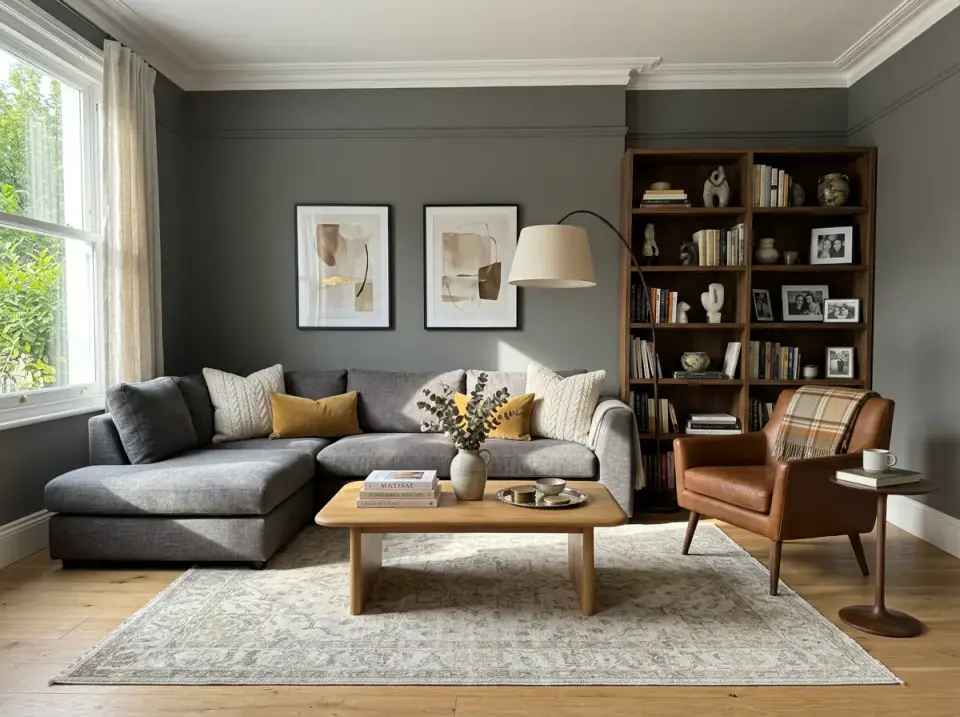
Reader notes