


In seven years of walking into other people's houses as a residential stylist, I've stopped needing the introductions. By the time a client finishes showing me the entry hall, I already know most of what I need to know about them — not because I'm clairvoyant, but because a house is an artifact of the person who lives in it, and artifacts can be read. The paint colour they chose in 2019 when they were newly divorced. The bookshelf that got reorganised when the kids left for college. The chair nobody sits in but nobody will throw out. None of these are interior-design questions. They're identity questions that wear interior-design clothes. This essay, for The Home Files, is about how to read a room — and more usefully, how to read your own. It draws on the environmental psychology literature that's been asking these questions for fifty years, from Clare Cooper Marcus on the home as a self-portrait to Russell Belk on possessions as the extended self, and on what I've watched play out in Charleston living rooms between 2018 and now.
Contents
- Colour: The First Sentence of the Room
- Possessions: The Extended Self on the Bookshelf
- Texture: The Room as Contact Comfort
- Lighting: Warm Light, Cool Light, and the Body's Clock
- The Reading Corner: Cooper Marcus and the Need for a Sanctuary
- Biophilia: The View Out the Window Is Doing Work
- Time: Nostalgia and the Possible Self
- Place Identity: Why the Room Becomes Part of You
- A Few Questions This Essay Tends to Raise
- Sources & Further Reading
- Closing Note
Colour: The First Sentence of the Room
Colour is the first thing a room tells you, because it's the first thing you register before your slower cognitive systems get involved. Environmental psychologists have been measuring this for decades — Küller and colleagues' work on chromatic environments, the Mehrabian-Russell PAD model (Pleasure, Arousal, Dominance) that's still the standard framework for how spaces make us feel — and the consistent finding is that colour operates on mood before we have language for why.
What's more interesting to me, as someone in client homes, is what people choose. The sage greens and mushroom taupes that have dominated my client boards in the last three years aren't arriving because Pinterest said so. They're arriving because a specific kind of twenty-first-century exhaustion is asking for restoration, and those colours read as rested. I had a Charleston client in 2023 repaint a white kitchen in Farrow & Ball Pigeon after her mother passed away. She didn't put it that way. She said she wanted "something calmer." The research on what sage greys do to heart rate variability would have agreed with her. The person who instead picks a deep lacquered red for a dining room is, usually, somebody who feels their life could use more event, not more rest. Neither choice is better. They're different sentences.
Possessions: The Extended Self on the Bookshelf
In 1988, the consumer-behaviour researcher Russell Belk published a paper called "Possessions and the Extended Self" that has quietly shaped how the field thinks about stuff. His argument was that the objects we keep don't sit outside the self — they're continuous with it. Lose a wedding ring and you're not just out a ring; a piece of the self you'd constructed around it comes loose. Add a chair that belonged to a parent and a version of them continues to sit in the room.
What this means, practically, is that a bookshelf is never just storage, and the thing you can't bring yourself to get rid of is rarely really about the thing. A client in one of the room reveals I wrote up last year couldn't part with a battered wicker basket that read as dead weight in the living room. Eight sessions in, she admitted it had been her grandmother's sewing basket. We didn't throw it out. We moved it to the bedroom where she actually sits in the evenings, re-lined it in a fabric she liked, and it stopped being clutter and started being a memorial. The lesson isn't that you should keep everything; it's that the object people want to edit last is usually the one doing the most identity work, and knowing that changes the edit.
Texture: The Room as Contact Comfort
There's a line of research that goes back to Harry Harlow's 1950s work with rhesus monkeys — the ones who chose cloth mother-figures over wire ones, even when the wire mother held the food. Contact comfort, Harlow called it. The finding has been extended in a hundred directions since, but the thread that runs through it is that soft, yielding textures against skin are one of the oldest regulatory systems we have for distress. A wool throw, a linen slipcover, a deep-pile rug underfoot at 11 p.m. are not aesthetic decisions in the sense we usually mean. They're nervous-system decisions.
The reverse is worth noticing, too. A client who fills a home with polished concrete, bright steel, and taut leather is often — not always, but often — somebody who finds soft textures destabilising rather than soothing. I've worked with two clients in that mode; in both cases we got further by respecting the preference than by trying to soften it. The room has to feel like its owner. A home that's pillow-soft because a magazine said to will read, to the person living in it, as a costume.
Lighting: Warm Light, Cool Light, and the Body's Clock
The single intervention that most changes how a room feels, in my consulting experience, is also the one clients under-invest in most: lighting. The research on light and circadian regulation — Figueiro and the Lighting Research Center at Rensselaer, Rea on colour temperature, the broader literature on blue-enriched evening light and melatonin suppression — all points the same direction. Warm, low-angle light in the evening (2700K and below) signals wind-down. Cool, high-angle overhead light at the same hour reads to the body as midday, and the body responds accordingly.
A living room lit by a single 4000K ceiling fixture at 9 p.m. is, without exaggeration, telling your nervous system to stay on duty. A room with three or four warm pools of lamp light at sitting height is telling it the opposite. Which of those two rooms you grew up in, and which you've built for yourself, often tracks closely with how well you sleep. I've had clients change nothing in a room except the lighting plan and report within two weeks that they were using the room differently — reading, sitting, talking — because it had finally become evening-shaped.
The Reading Corner: Cooper Marcus and the Need for a Sanctuary
Clare Cooper Marcus's 1995 book House as a Mirror of Self is still the single most important thing I've read on this subject, and the idea at its centre is simple: a home that works is a home that holds a sanctuary space, however small. A corner chair with a lamp and a side table. A window seat. A writing desk pushed against a wall where nobody can come up behind you. The spaces where the self can decompress away from the household's social gravity.
Irwin Altman's privacy-regulation theory, from around the same period, fits alongside this. Altman's argument was that privacy isn't an absence of contact — it's the ability to dial contact up and down at will. A home without any controllable retreat is a home where the dial is stuck on "available." My Charleston walk-up in 2017, all 487 square feet of it, taught me this the hard way: without a door I could close, I couldn't actually rest, regardless of how "cosy" the room looked from the outside. The first renovation I did to it was a curtain rod separating the sleeping corner from the living corner. The room got smaller on paper and twice as large in use. I've covered how other people solved the same problem in a piece on spare-room sanctuary conversions — different spaces, same underlying move.
Biophilia: The View Out the Window Is Doing Work
In 1984, the environmental researcher Roger Ulrich published a now-famous study in Science: surgical patients whose hospital rooms looked out on trees recovered measurably faster, needed less pain medication, and had fewer post-operative complications than patients whose rooms faced a brick wall. The effect size wasn't small. The study sat in a longer tradition — Edward O. Wilson's Biophilia (1984), Kellert and Wilson's subsequent work on biophilic design — arguing that humans are not evolved to live in rooms with no sightline to living things.
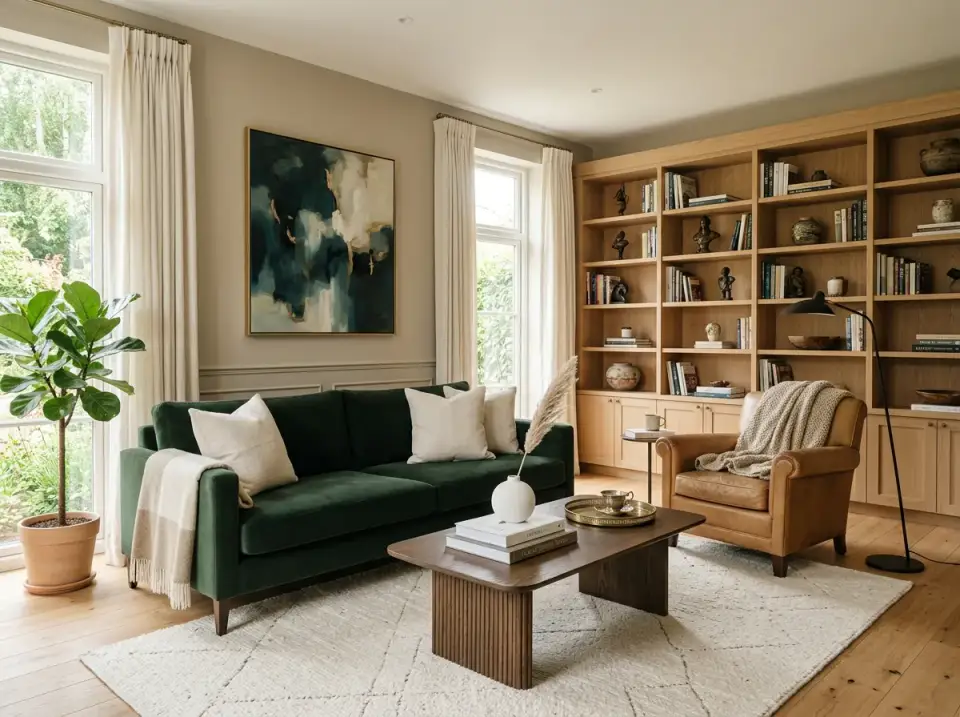
In practice, what this means for a home is that the view out the window, the presence or absence of plants, and the use of natural materials (wood grain, stone, linen, wool — things that were once alive) are not cosmetic. They're doing physiological work. A client of mine in Nashville turned a sunless home office into a usable room by adding two large pothos, a jute rug, and a tabletop fountain. Nothing about the room's dimensions changed. Her blood pressure at the end of the workday changed, by her report and by her doctor's. The workspace-to-urban-jungle transformations I've written up elsewhere are really this principle, applied to rooms that most people had given up on.
Time: Nostalgia and the Possible Self
Two research programmes in psychology, running in parallel, help explain why the same client can have a cherished grandmother's chair in the corner and a brand-new aspirational painting on the wall across from it. Constantine Sedikides's work on nostalgia, over the last two decades, has shown that nostalgia isn't a regressive state — it's an active resource the self uses to maintain continuity and meaning under stress. Hazel Markus and Paula Nurius's 1986 paper on "possible selves," meanwhile, argued that we carry around vivid mental representations of the people we might become, and that those future-selves shape present behaviour more than we give them credit for.
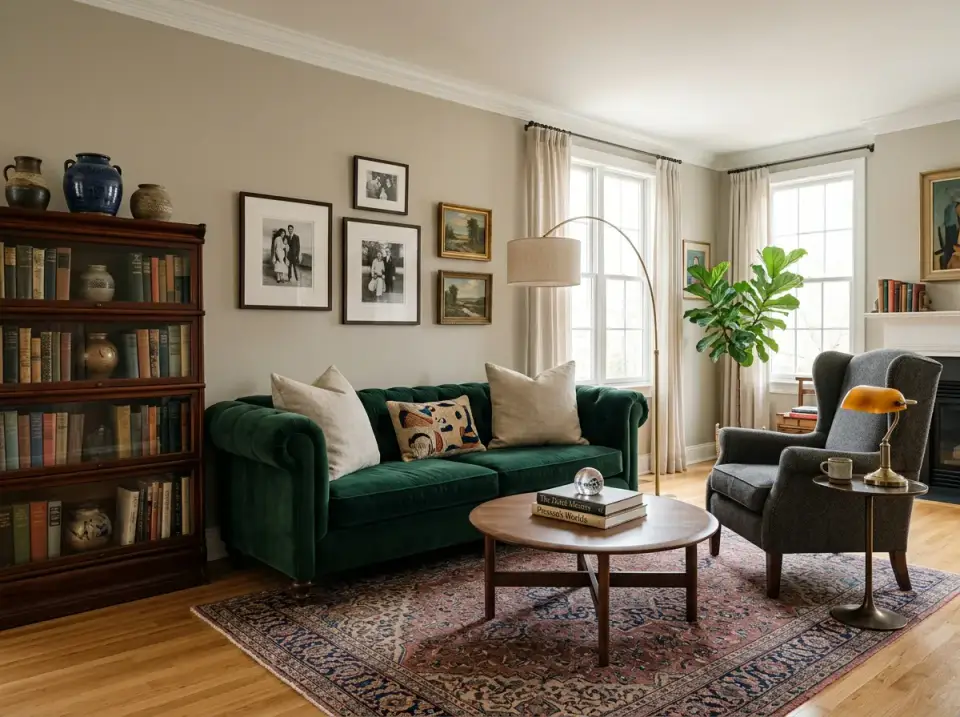
A home, read this way, is always negotiating between the continuous self (the objects that tell you who you've been) and the possible self (the objects that rehearse who you're becoming). A room with only the first reads as stuck. A room with only the second reads as hollow — an Instagram staging, not a place somebody actually lives. The rooms I find most moving in client work are the ones that hold both: a chair from a dead parent beside a painting bought on a solo trip last spring. The one-room transformations where I've seen clients happiest in the finished space are always the ones where we left something in that predated them.
Place Identity: Why the Room Becomes Part of You
Harold Proshansky, writing in 1983, gave the field a term it's still using: place identity. His argument was that alongside personal identity (who I am as a self) and social identity (who I am in groups), we carry a place identity — a sedimented sense of self built out of the physical environments we've lived in, loved in, and grieved in. The kitchen you learned to cook in. The bedroom you recovered in after a breakup. The porch where a parent sat and then didn't anymore.
Proshansky's work tells you something uncomfortable and clarifying: moving house is a bigger self-event than most of us admit, and "making a new house feel like home" is not an aesthetic project. It's an identity project. The practical implication, which I give every client who's just moved, is to unpack the objects that carry the strongest place-identity weight first — not the most functional ones. The coffee mug from the old kitchen, on the counter of the new one, on day one. A piece of art in its usual spot before the bed is assembled. This is not sentimentality; it's self-continuity. The research is on its side.
A Few Questions This Essay Tends to Raise
Does this mean everyone should do a full self-inventory before decorating?
No — and the clients who try usually stall out. The more useful approach is the opposite: decorate normally, then, every few months, look at a room you've lived in and ask which objects you'd grieve if they were gone. Those are the ones doing the identity work. The rest is scenery, and scenery can be updated without ceremony.
Is there a "right" balance between nostalgia and aspiration in a room?
There isn't a formula, but there's a question that tends to surface it: does the room make you feel more like yourself or less? If more, the balance is working regardless of how the room reads to a visitor. If less, something is crowded out — usually either the continuous-self objects (room feels rootless) or the possible-self ones (room feels embalmed). Add what's missing before subtracting what's there.
Does this apply to people who rent and can't paint or renovate?
More so, not less. The research on place attachment is essentially indifferent to who holds the deed. A rental where you've controlled lighting, texture, objects, and the view out the window — even if you haven't touched a wall — can carry as much identity weight as an owned house that was decorated by somebody else. My 487 sq ft Charleston walk-up was a rental. It was the most mine a room has ever felt.
How is this different from the decor-cost and before-and-after articles on this site?
The rest of the site is practical — paint names, paid invoices, what to buy. The Home Files are reflective, and they draw on the environmental-psychology and home-studies literature the practical articles don't need to cite. If you want the decisions, read a cost guide. If you want to understand why the decisions feel the way they do, this is the section.
Sources & Further Reading
- Belk, R. W. (1988). "Possessions and the Extended Self." Journal of Consumer Research, 15(2), 139–168.
- Cooper Marcus, C. (1995). House as a Mirror of Self: Exploring the Deeper Meaning of Home. Conari Press.
- Altman, I. (1975). The Environment and Social Behavior: Privacy, Personal Space, Territory, and Crowding. Brooks/Cole.
- Proshansky, H. M., Fabian, A. K., & Kaminoff, R. (1983). "Place-identity: Physical world socialization of the self." Journal of Environmental Psychology, 3(1), 57–83.
- Ulrich, R. S. (1984). "View through a window may influence recovery from surgery." Science, 224(4647), 420–421.
- Kellert, S. R., Heerwagen, J., & Mador, M. (2008). Biophilic Design: The Theory, Science, and Practice of Bringing Buildings to Life. Wiley.
- Wilson, E. O. (1984). Biophilia. Harvard University Press.
- Sedikides, C., Wildschut, T., & Baden, D. (2004). "Nostalgia: Conceptual issues and existential functions." In J. Greenberg, S. Koole, & T. Pyszczynski (Eds.), Handbook of Experimental Existential Psychology. Guilford.
- Markus, H., & Nurius, P. (1986). "Possible selves." American Psychologist, 41(9), 954–969.
- Mehrabian, A., & Russell, J. A. (1974). An Approach to Environmental Psychology. MIT Press.
- Küller, R., Ballal, S., Laike, T., Mikellides, B., & Tonello, G. (2006). "The impact of light and colour on psychological mood." Ergonomics, 49(14), 1496–1507.
- Figueiro, M. G., & Rea, M. S. — publications of the Lighting Research Center (Rensselaer / Mount Sinai) on circadian lighting.
- Harlow, H. F. (1958). "The nature of love." American Psychologist, 13, 673–685.
- Author's consultation notes, Charleston / Savannah / Nashville / Atlanta, 2018–2025.
Closing Note
A home doesn't need to be psychoanalysed to work. Most of the best rooms I've seen were assembled by people who weren't thinking about any of this consciously. The value of the research isn't in turning decorating into a therapy session; it's in giving us language for the things our rooms are already doing. You don't have to know why the chair in the corner matters to you. But if you've ever moved it and the room stopped feeling right, the literature would tell you the chair was doing load-bearing work, and you'd be right to put it back.
Look around your room. Notice what you'd grieve. Start there.
— Johan Martez, Charleston, SC

Rowan Whitaker
Styling & Living Editor · Charleston, South CarolinaRoom-by-room decor cost guides, outdoor and garden styling, celebrations, design solutions and the Home Files essays. Rowan writes the pages where the house gets lived in — with paint lines, fabric sources and paid-invoice figures for every room.
More from Rowan →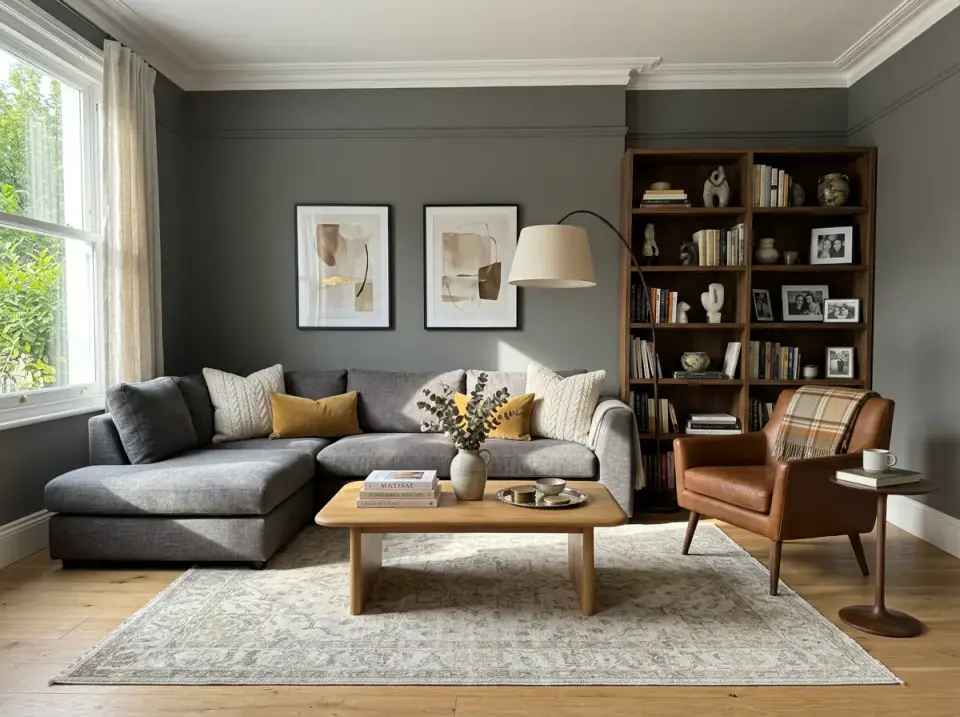
Reader notes