


The longer I have worked inside other people's houses in Charleston, the more I have come to believe that no room is ever neutral. Every object placed in a room has been placed by someone, and the someone has reasons — some conscious, most not. The worn leather chair set at an angle toward the window and not toward the television. The framed photograph of a grandmother kept on the bookshelf instead of in the hallway. The one wall painted deep green in a house otherwise full of whites. These decisions are small and they accumulate, and what they accumulate into is something like a self-portrait rendered in furniture and light. This essay is about that self-portrait — the invisible thread that runs from our interior lives into the rooms we build and inhabit, and what the environmental psychologists, the phenomenologists of space, and the students of domestic history have had to say about how that thread actually works.
— Johan Martez, Interior Stylist, Charleston, SC
What's Inside
- The Mirror Effect: What Your Space Tells About Your Mind
- Emotional Palettes: Decoding the Colors of Your Life
- The Library of You: Bookshelves as Autobiographical Statements
- The Sanctuary of Comfort: When Function Meets Feeling
- Anchors in Time: The Quiet Power of Personal Artifacts
- Curating Consciously: The Art of Slow Decorating
- From Shelter to Self-Expression: A Historical Perspective
- The Intuitive Home: What Comes After the Smart House
- Sources and References
- Final Thoughts
The Mirror Effect: What Your Space Tells About Your Mind
Harold Proshansky, writing with Abbe K. Fabian and Robert Kaminoff in the Journal of Environmental Psychology in 1983, gave us the phrase place identity: the idea that the self is not bounded by the skin but extends outward into the physical settings we inhabit, and that those settings in turn feed back into how we understand ourselves. Clare Cooper Marcus worked the same seam from the clinical side in House as a Mirror of Self (Conari Press, 1995), interviewing people about the rooms they loved and the rooms they could not live in, and finding that the language they used to describe a disappointing living room was almost indistinguishable from the language they used to describe an estranged part of themselves. This is not a poetic exaggeration — it is a consistent empirical finding across forty years of environmental psychology research.
What this means in ordinary practice is that a cluttered room is rarely just a cluttered room. It is often a cluttered life held by a person who has not yet had permission to address the clutter. And a minimalist, austere room is rarely just a minimalist room — it is sometimes a demand for control from a person whose interior life has felt uncontrollable. In my own work walking through Charleston living rooms for the first time with new clients, the most honest conversation is not about paint colors or furniture swatches. It is about what the current room is protecting the client from, or failing to protect them from, and what they hope the new room will allow them to become. The room is a question being asked about the self, and the redesign is a partial, provisional answer.
Emotional Palettes: Decoding the Colors of Your Life
The science on color and emotion is messier than the magazine articles suggest. Colin Ellard's Places of the Heart (Bellevue Literary Press, 2015) catalogs the fMRI and skin-conductance studies that show measurable physiological responses to ambient color — but Ellard is careful to note that the responses are modulated heavily by context, personal history, and culture. Red in a Chinese wedding parlor does not mean what red means in a hospital waiting room. What holds up across the research is narrower but still useful: we respond more strongly to the saturation and value of a color than to its hue per se, and we tend to read low-saturation, mid-value environments as calming and high-saturation, high-value environments as stimulating. That is why a deep slate-gray living room can feel like a cocoon rather than a gloom — the low saturation is doing the work of the quiet.
I have watched this play out in the homes I have styled in Charleston's Wagener Terrace, on the Isle of Palms, and in the West Ashley inland neighborhoods where the light behaves differently across the day. A client in a north-facing South of Broad drawing room asked me for Benjamin Moore Hale Navy HC-154 at the walls; the finished room read cocooning and restful. Another client in a full-south Daniel Island great room asked for the same color and we had to talk her out of it — the afternoon sun would have made those walls aggressive, not restful. The color was not the variable. The way the color was going to meet the room's particular light was the variable. Sarah Williams Goldhagen's Welcome to Your World (HarperCollins, 2017) frames this through the lens of embodied cognition: we experience a room through the whole body, not just the retina, and the room's color is one note in a chord that includes light, acoustics, temperature, and the tactility of every surface.
The Library of You: Bookshelves as Autobiographical Statements
Russell Belk, writing in the Journal of Consumer Research in 1988, argued that possessions are not decorative additions to the self but constituent parts of an extended self — we are literally more than our bodies, because our bodies have learned to incorporate books, tools, instruments, and artifacts as functional extensions of cognition and memory. Mihaly Csikszentmihalyi and Eugene Rochberg-Halton, in their earlier book The Meaning of Things: Domestic Symbols and the Self (Cambridge University Press, 1981), interviewed hundreds of families about the objects they valued in their homes, and what came back most often was not the expensive objects but the ones that held memory and relational meaning. Books cluster at the top of that list because they carry both intellectual autobiography and physical continuity — a book you read at nineteen still sits on your shelf at forty, and its presence is a small ongoing argument for continuity of self.
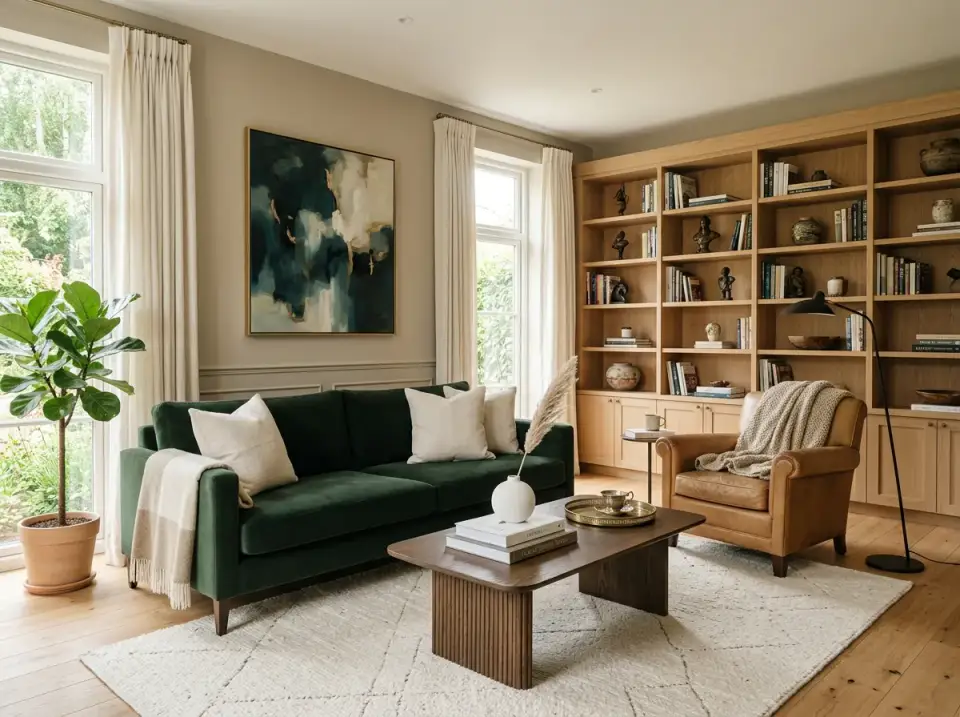
When I style a client's walnut or painted-poplar bookshelves — whether it is a pair of custom built-ins flanking a peninsula fireplace in a single-house renovation, or a freestanding USM Haller unit in a contemporary Isle of Palms pied-à-terre — the ordering conversation is revealing. Some clients want color-coordinated spines because the bookshelf is a visual instrument; others insist on topic ordering because they actually reach for the books; a small group wants the books stacked horizontally in leaning piles because the piles record the order in which they were last consulted. None of these is wrong. But each system is an honest statement about the relationship its owner has with the books — decorative, functional, or archaeological — and a good designer reads the preferred system and designs around it rather than imposing one.
The Sanctuary of Comfort: When Function Meets Feeling
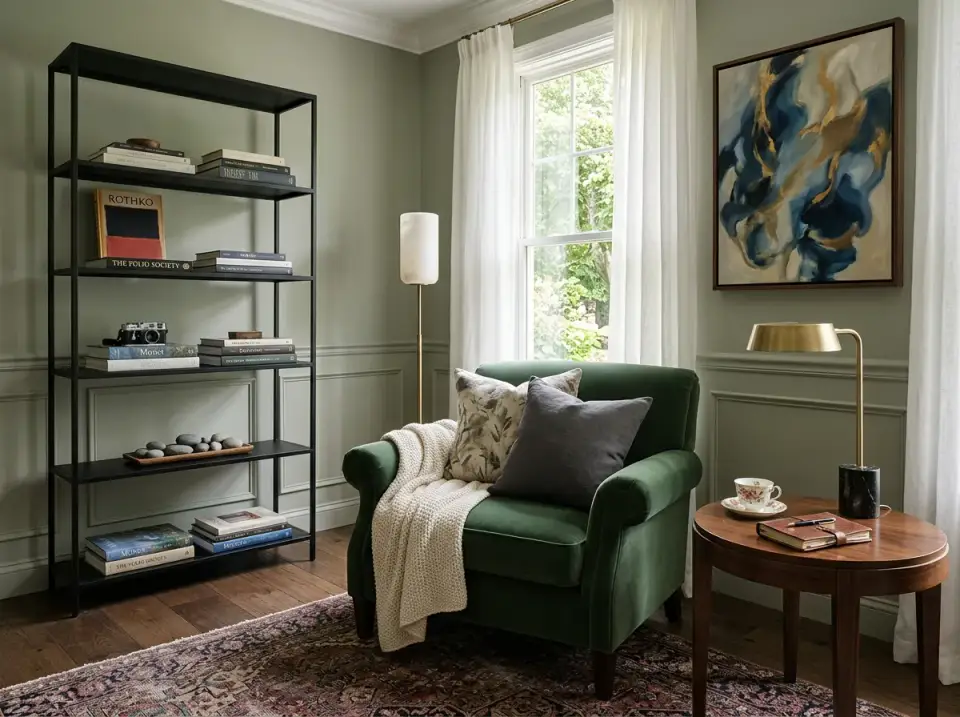
Gaston Bachelard's The Poetics of Space (Presses Universitaires de France, 1958, translated by Maria Jolas for Beacon Press in 1964) is still the clearest account of what a sanctuary actually is. Bachelard writes about corners, nooks, drawers, attics, cellars — the small compressed spaces inside the larger rooms where the psyche does its most important work. The plush sectional in a family room is not simply a piece of seating; it is a Bachelardian nest, a corner rendered soft. The leather reading chair angled toward the window is a different kind of nest — tighter, more solitary, structured for contemplation rather than for sinking.
Juhani Pallasmaa, in The Eyes of the Skin: Architecture and the Senses (Academy Editions, 1996), pushes the argument further: comfort is not a visual property but a multisensory one. The warmth of oiled oak under bare feet, the acoustic softening of a wool rug over heart-pine floors, the weight of a linen slipcover on a deep sofa — these are what the body registers as home, and they are what stiff ornamental furniture cannot provide regardless of how handsome it looks in a photograph. When I walk a first-time client through a room they have not yet lived in, I often ask them to sit in three different chairs for sixty seconds each, without talking. What their body tells them in those three minutes is more reliable than any mood board. A home that prioritizes photographs over bodies is a home where the bodies will eventually stop coming into the photographed rooms.
Anchors in Time: The Quiet Power of Personal Artifacts
The black-and-white photograph framed on a bookshelf. The hand-thrown Mel Chin ceramic bought at a Columbia gallery in 1997. The quilt folded across the back of a reading chair, made by a grandmother in Awendaw in the 1960s. These are what Belk would call constituents of the extended self, and what Csikszentmihalyi and Rochberg-Halton would call cultivating objects — objects that ask something of their owner and that give something back in exchange for the care of being displayed. Such objects rarely appear in Pinterest moodboards because they cannot be bought, only inherited or earned through a particular relationship. Their meaning is untransferable.
I have noticed that the houses I remember most vividly after leaving a job are the ones where the client insisted on placing a worn or idiosyncratic object in a visually prominent position against my gentle advice. The client was usually right. The object was the one that made the room real — that kept the room from reading as a catalogue spread. Yi-Fu Tuan's concept of topophilia, from his 1974 book of the same name (Columbia University Press), names this quality: the affective bond between persons and places, mediated almost always by objects that carry specific, unshared histories. A house without topophilic anchors may be handsome but it is rarely loved. A house with them, even a modest one, often is.
Curating Consciously: The Art of Slow Decorating
The best-loved homes I have walked through in the Charleston peninsula and the barrier islands — the ones that feel settled rather than staged — were almost never furnished in a single buying event. They were assembled over five, ten, twenty years, with long stretches of waiting between purchases. A client in a South of Broad single house told me, without embarrassment, that she had a particular reading corner empty of its intended armchair for eleven months while she saved for an original George Smith Scroll Arm in a velvet she had seen in an Architectural Digest photograph and never quite stopped thinking about. The chair she eventually bought is the best chair in the house, in part because she earned the right to it by waiting for it. Had I steered her to a substitute at the start of the project, the corner would have held a chair she liked rather than the chair she loved.
Slow decorating, as the practice has come to be called in design literature over the past two decades, is not a stylistic preference but an epistemological one. It asserts that the process of acquiring an object — the waiting, the comparing, the deliberating — is part of what gives the acquired object its meaning. Witold Rybczynski's Home: A Short History of an Idea (Viking, 1986) makes this case historically: the most beloved domestic interiors in the European tradition were almost always accreted rather than composed at a single moment. The accretion is what distinguishes a home from a hotel. It is also why I tend to leave one or two visible gaps in a first-pass styling — a shelf still holding room for a found object, a wall waiting for a piece of art that has not yet been painted or encountered. The gaps are invitations.
From Shelter to Self-Expression: A Historical Perspective
The idea that a home should express the self is not a universal human experience. Rybczynski traces its invention carefully in Home, arguing that the modern domestic interior — with its insistence on comfort, privacy, and personal expression — is largely a product of 17th-century Dutch burgher culture, elaborated by 18th-century English and French bourgeois households, and then mass-distributed through 19th- and 20th-century industrial middle-class housing. Before that, most European houses served primarily as shelter and workplace. Privacy, in the modern sense, was rare; the concept of a private bedroom for a single person is only about 300 years old in most Western traditions. Beatriz Colomina's Privacy and Publicity: Modern Architecture as Mass Media (MIT Press, 1994) extends the story, showing how the 20th-century house became a site where the self was deliberately staged for both lived experience and photographic reproduction — a dual life that continues today whenever we shape a corner for a guest and simultaneously for an Instagram frame.
The reason this history matters, for anyone walking their own rooms with fresh eyes, is that it defamiliarizes a set of assumptions we inherit unexamined. The idea that a living room should express who you are is a 200-year-old cultural inheritance, not a biological given. Which does not make the inheritance wrong — it makes it ours to accept, amend, or refuse with clearer sight. In my consulting work I meet clients who have absorbed the expectation but never examined it; helping them examine it is sometimes more useful than recommending a paint color.
The Intuitive Home: What Comes After the Smart House
The current generation of smart-home technology — Lutron RadioRA 3 lighting, Nest thermostats, voice-activated blind control, circadian-tuned LED systems — promises to make the house more responsive to the human body's rhythms. Some of this promise is real: tuning interior illumination to match the 2700K-to-5000K arc of sunlight across the day does, in fact, measurably support sleep onset and morning alertness, per the lighting research summarized in the Lighting Research Center publications at Rensselaer Polytechnic Institute. But the technological direction risks confusing responsiveness with intimacy. A house that adjusts your lights according to an algorithm is not the same as a house that knows you, and a house that pretends the first is the second can leave its inhabitants lonelier than they were in a drafty 1925 bungalow.
Pallasmaa's warning in The Eyes of the Skin — that architecture in the industrial and digital era risks becoming a primarily visual discipline, at the expense of the multisensory experience of the body in space — applies to smart-home design as well. The most persuasive future homes I have walked through, including several Charleston renovations I have consulted on in 2024 and 2025, use technology to recede rather than to foreground. The light fixtures dim themselves quietly at dusk without asking. The underfloor heating wakes up in the bath fifteen minutes before you do without a conversation. The smart behavior is noticed only in its absence. That, I think, is what the phrase intuitive home should come to mean: not a house full of gadgets, but a house whose gadgets have learned to be silent.
Sources and References
- Harold M. Proshansky, Abbe K. Fabian, and Robert Kaminoff (1983) — "Place-identity: Physical world socialization of the self," Journal of Environmental Psychology, 3(1), pp. 57-83. Foundational paper on the place-identity construct.
- Clare Cooper Marcus (1995) — House as a Mirror of Self: Exploring the Deeper Meaning of Home, Conari Press. Clinical interview studies of the relationship between domestic space and psychological self.
- Russell W. Belk (1988) — "Possessions and the Extended Self," Journal of Consumer Research, 15(2), pp. 139-168. The extended-self thesis.
- Mihaly Csikszentmihalyi and Eugene Rochberg-Halton (1981) — The Meaning of Things: Domestic Symbols and the Self, Cambridge University Press. Large-sample interview study of household objects and their meaning.
- Gaston Bachelard (1958, translated 1964) — The Poetics of Space, Beacon Press translation by Maria Jolas. Phenomenological treatment of domestic spatial experience.
- Juhani Pallasmaa (1996) — The Eyes of the Skin: Architecture and the Senses, Academy Editions. The multisensory experience of architecture.
- Colin Ellard (2015) — Places of the Heart: The Psychogeography of Everyday Life, Bellevue Literary Press. Neuroscience and environmental psychology of built space.
- Sarah Williams Goldhagen (2017) — Welcome to Your World: How the Built Environment Shapes Our Lives, HarperCollins. Embodied-cognition framework for architecture.
- Witold Rybczynski (1986) — Home: A Short History of an Idea, Viking. Historical emergence of domestic comfort and privacy in European and North American traditions.
- Beatriz Colomina (1994) — Privacy and Publicity: Modern Architecture as Mass Media, MIT Press. On the dual life of the 20th-century domestic interior as lived space and photographed image.
- Yi-Fu Tuan (1974) — Topophilia: A Study of Environmental Perception, Attitudes, and Values, Columbia University Press. The affective bond between persons and places.
- Edward T. Hall (1966) — The Hidden Dimension, Doubleday. Foundational proxemics text on human use of space.
- Erving Goffman (1959) — The Presentation of Self in Everyday Life, Doubleday Anchor. On the staging of identity in domestic and social settings.
- Lighting Research Center, Rensselaer Polytechnic Institute — Published research on circadian lighting, illuminance thresholds, and color temperature effects on alertness and sleep physiology.
- Johan Martez consulting notebook — Seven-plus years of Charleston-area styling and color consultation notes across the peninsula, the barrier islands (Sullivan's Island, Isle of Palms, Folly Beach), and inland neighborhoods (Wagener Terrace, Daniel Island, West Ashley).
Final Thoughts
The invisible thread that environmental psychologists and phenomenologists have been tracing for forty years is not a metaphor imposed on rooms from the outside; it is a real property of the relationship between persons and the spaces they build. Every object in the room has been placed by someone for a reason, and the accumulation of reasons is, slowly, a self-portrait. I have come to believe, after styling and consulting on homes in Charleston and across the Southeast for more than seven years, that the best service a designer can provide is not to impose a vision on a client but to help them notice the vision they have already been quietly building — to name the invisible thread so that the client can choose, for the first time deliberately, what pattern they want to weave next.
If you would like to continue thinking along these lines through the lens of specific rooms and transformations, you might enjoy my essays on the living room as emotional center of the home, the spare room becoming a sanctuary, the basement reimagined as retreat, and the long work of curating a room out of chaos. Each one is a particular variation on the same question — what do I want this space to say about the person I am becoming — and each returns, eventually, to the same quiet answer: the rooms we love are the ones we have had the patience to listen to.
— Johan Martez, Interior Stylist, Charleston, SC

Rowan Whitaker
Styling & Living Editor · Charleston, South CarolinaRoom-by-room decor cost guides, outdoor and garden styling, celebrations, design solutions and the Home Files essays. Rowan writes the pages where the house gets lived in — with paint lines, fabric sources and paid-invoice figures for every room.
More from Rowan →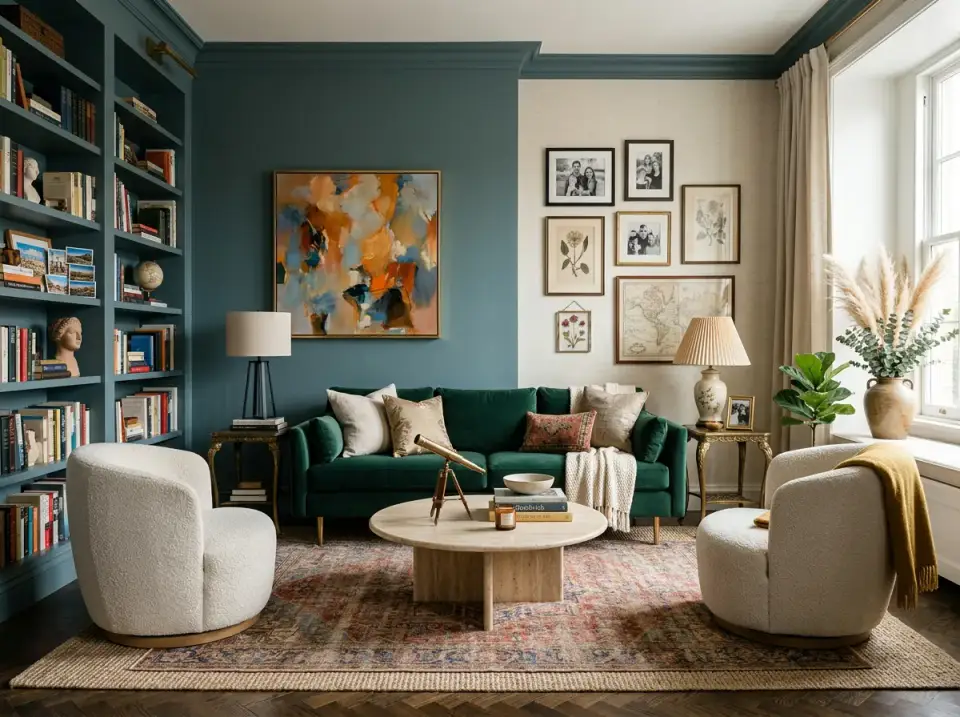
Reader notes