


These powder room ideas restyle one builder half bath through color, finish, lighting, furniture and storage. The fixed room shell remains in place, so each image is a design study rather than a claim that construction took place.
The Builder Half Bath Starting Point
The starting room is a narrow builder half bath: beige walls, a pedestal sink under a frameless mirror and a chrome four bulb bar, a white toilet with a fuzzy lid cover and matching rug, beige floor tile and a baseboard heater on the back wall. Nothing in it is broken, but nothing in it was chosen either, and the short distance between the door and the toilet sets the limits for every idea that follows.
All ten concepts leave the pedestal sink, toilet, door, heater, ceiling vent and floor plan where they are, and seven of them keep the beige floor tile too. The changes come down to wall finish, mirror, lighting, art and a few objects. The images are concept renderings rather than completed projects, and a soft patch of drywall, a rocking toilet or an old electrical box behind the light bar would need its own inspection and repair before any decorating money is spent.
1. Warm Terracotta
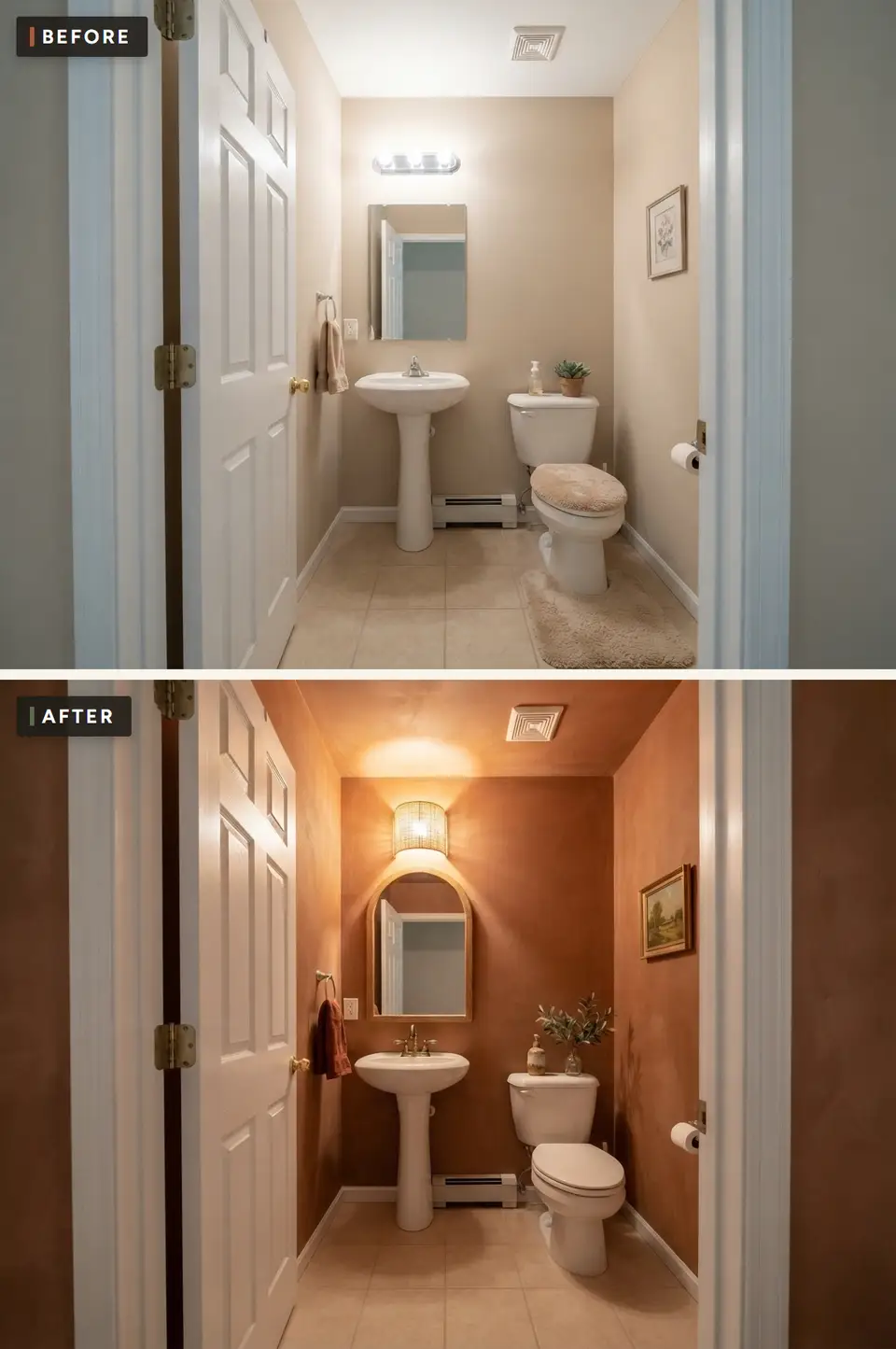
Here the walls and ceiling take a mottled clay finish in deep terracotta, and the frameless mirror gives way to an arched one in pale wood. A woven rattan sconce replaces the light bar, a brass faucet and a rust towel echo the walls, and a small landscape in a gilt frame hangs where the botanical print used to be.
Carrying the colour onto the ceiling is what makes the scheme work. Without a white lid overhead, the narrow room reads as one warm envelope rather than a corridor, and the white sink and toilet stand out against it as clean sculptural shapes.
The named palette is quieter than the walls suggest. Warm plaster (#E7DED0) is the beige of the floor tile, Light oak (#C49D72) is the arched mirror frame, and Moss (#61705A) arrives with the olive branches on the tank. Charcoal (#343735) is best kept to one or two small dark notes, a soap pump or a thin frame, so the clay stays in charge.
In a powder room the only counters are the sink rim and the toilet tank, and both are in full view from the door, so keep them nearly bare. A soap bottle and one sprig of greenery are enough against the terracotta. Light oak works best in two places, the mirror frame and perhaps a narrow wall shelf, rather than spreading across every surface.
Keep the principal walking line and every opening clear, which in a room this small means the door swing and the space in front of the toilet. Review the room in daylight and after sunset before buying the final accessories; terracotta looks orange under cool bulbs and much warmer under warm ones.
We put this direction at $420–$1500, which buys the wall finish, the arched mirror, the woven sconce and a small rug.
2. Black and White Classic
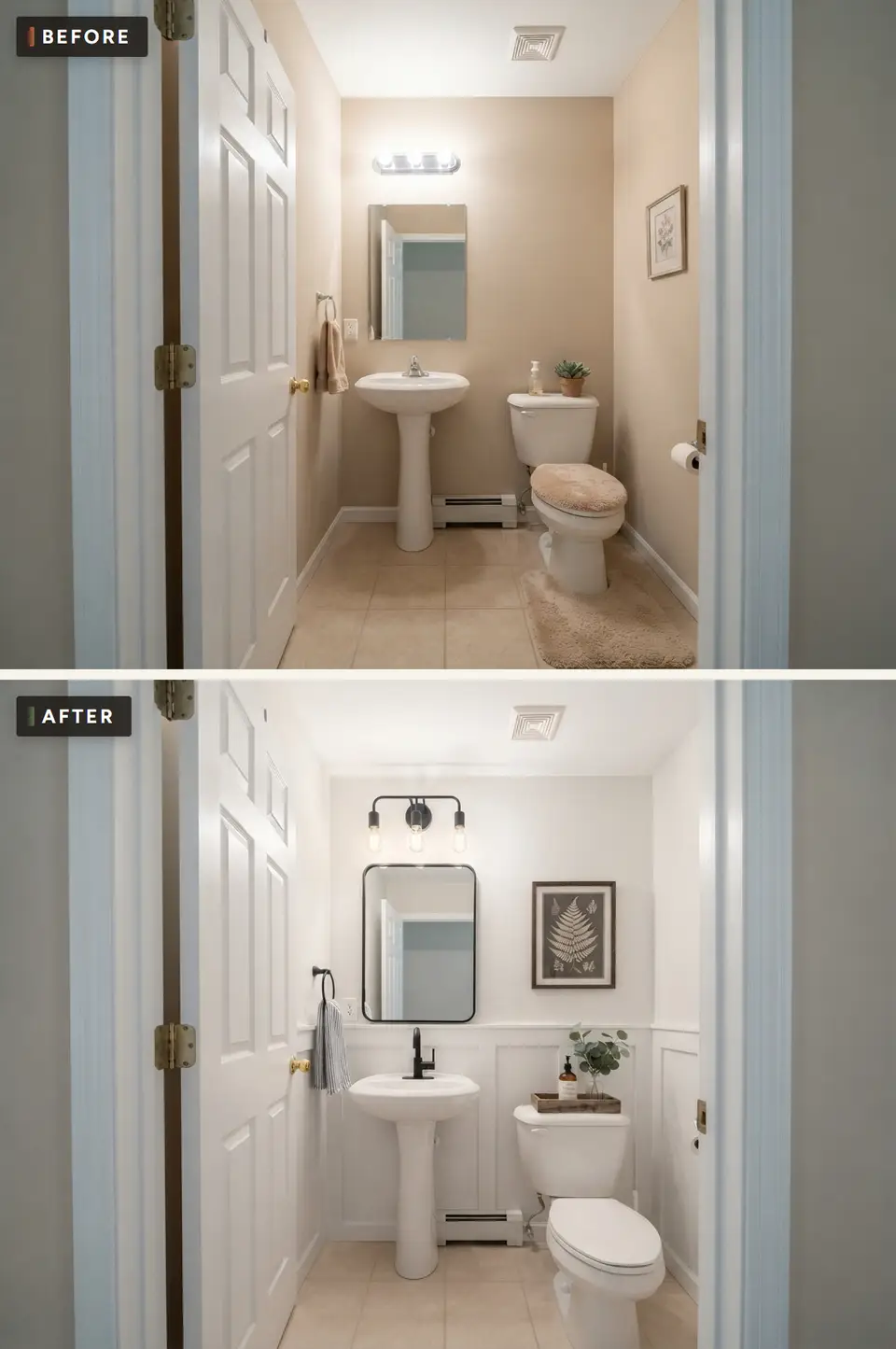
The beige walls turn bright white, with board and batten panelling added across the lower half of the room. Black does the drawing: a three bulb bar light, a rounded black mirror frame, a matte black faucet and towel ring, and a fern print in a dark wood frame beside the mirror.
With only two values in play, the room is easy to keep looking tidy, since there are no competing colours for stray clutter to clash with. The panelling also gives the white walls some relief and a harder wearing lower half near the sink, which flat paint alone cannot.
Deep charcoal (#252725) is the black of the metalwork, and Ink blue (#263747) turns up only in the stripe of the hand towel. Walnut (#6B4F3A) is the print frame and the small tray on the tank, while Aged brass (#A98252) is the existing door knob and hinges, a good reason to leave them as they are.
Black and white rooms stay crisp when you repeat black in only three useful points, such as the mirror frame, the faucet and a light fixture. More than that and the room starts to feel heavy. Ink blue should sit in two locations, a towel and a small print for instance, not on every surface.
Panelling adds depth to each wall, so confirm the door still opens fully past it before anything is glued in place. Exposed bulbs like these can make white walls look harsh after dark, which is why a warm colour temperature matters more here than in the other schemes.
At $380–$1400 this is the cheapest of the ten, covering paint, the mirror, the light and black hardware; if the panelling is added as trim work, expect the upper end of that range.
3. Blue Chinoiserie Paper
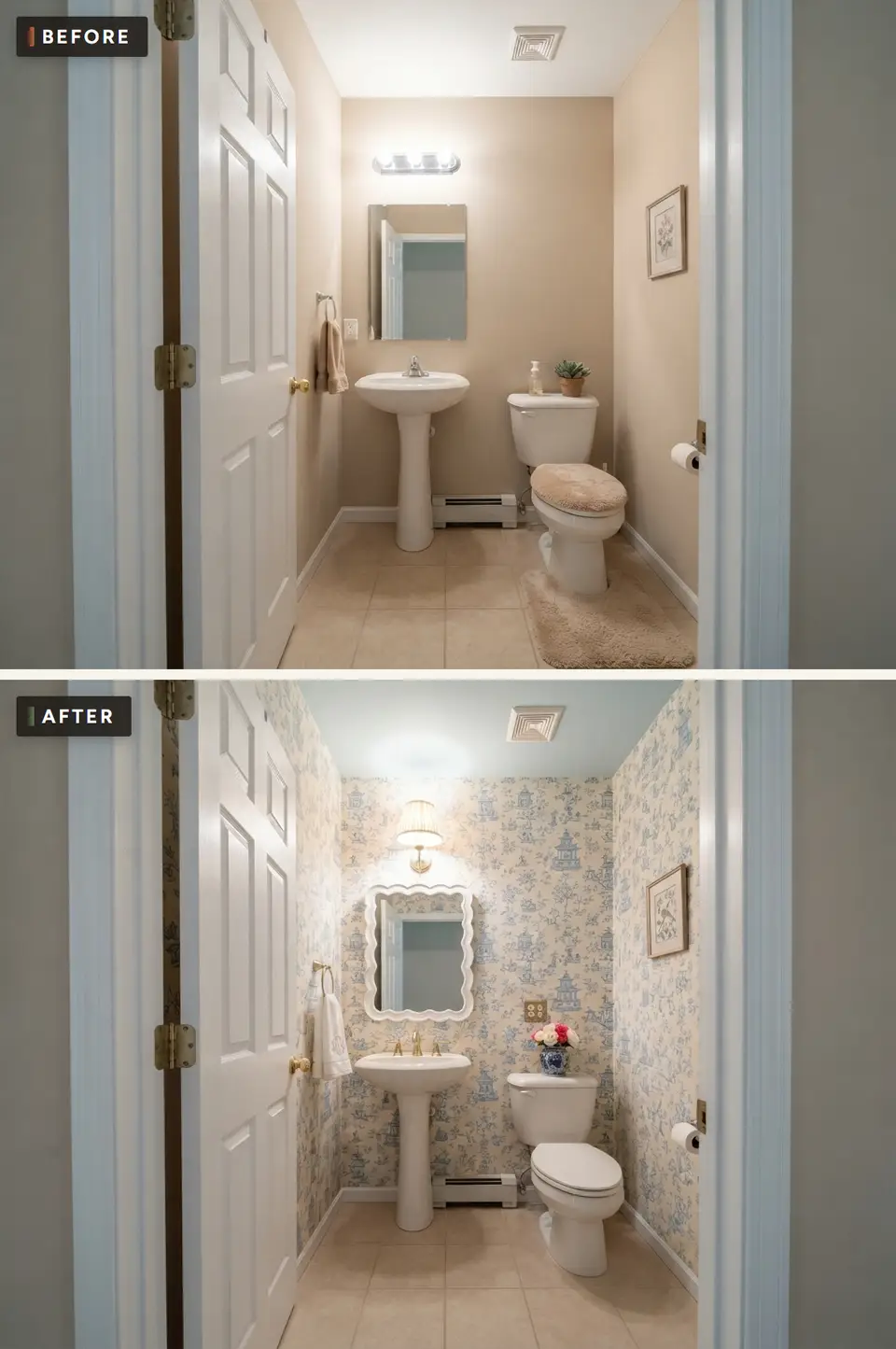
A blue and cream wallpaper with pagodas and flowering branches covers every wall, and the ceiling is painted a pale sky blue. The frameless mirror becomes a scalloped white one, a single brass sconce with a pleated shade sits above it, and a blue and white jar of roses stands on the tank.
The motif is small, and that matters in a room this narrow. A large repeat would be chopped at every corner and around the mirror, while this one reads as an even texture from the doorway. The brass faucet and sconce add just enough warmth to keep all that blue from feeling chilly.
Cream (#F1E5D2) is the ground of the paper. Dusty rose (#B98278) and Clay (#A75C45) come from the roses in the jar and Sage (#8C9A79) from their leaves, so the warm notes live in flowers that can change with the season.
Wallpaper near a basin takes water, so order extra paper for repair near splash zones and store it flat. Matching a pattern later from a new run is often impossible. Dusty rose is best left to the flowers and perhaps one towel, where it supports the blue rather than competing with it.
Leave the gap between the toilet and the door free of baskets or stands, because paper scuffs quickly at that pinch point. Judge the blue under the pleated shade at night before buying towels to match; the sconce softens it considerably.
Allow $650–$2100, with the wallpaper and its hanging taking the biggest share, followed by the mirror and the light.
4. Art Deco Dark
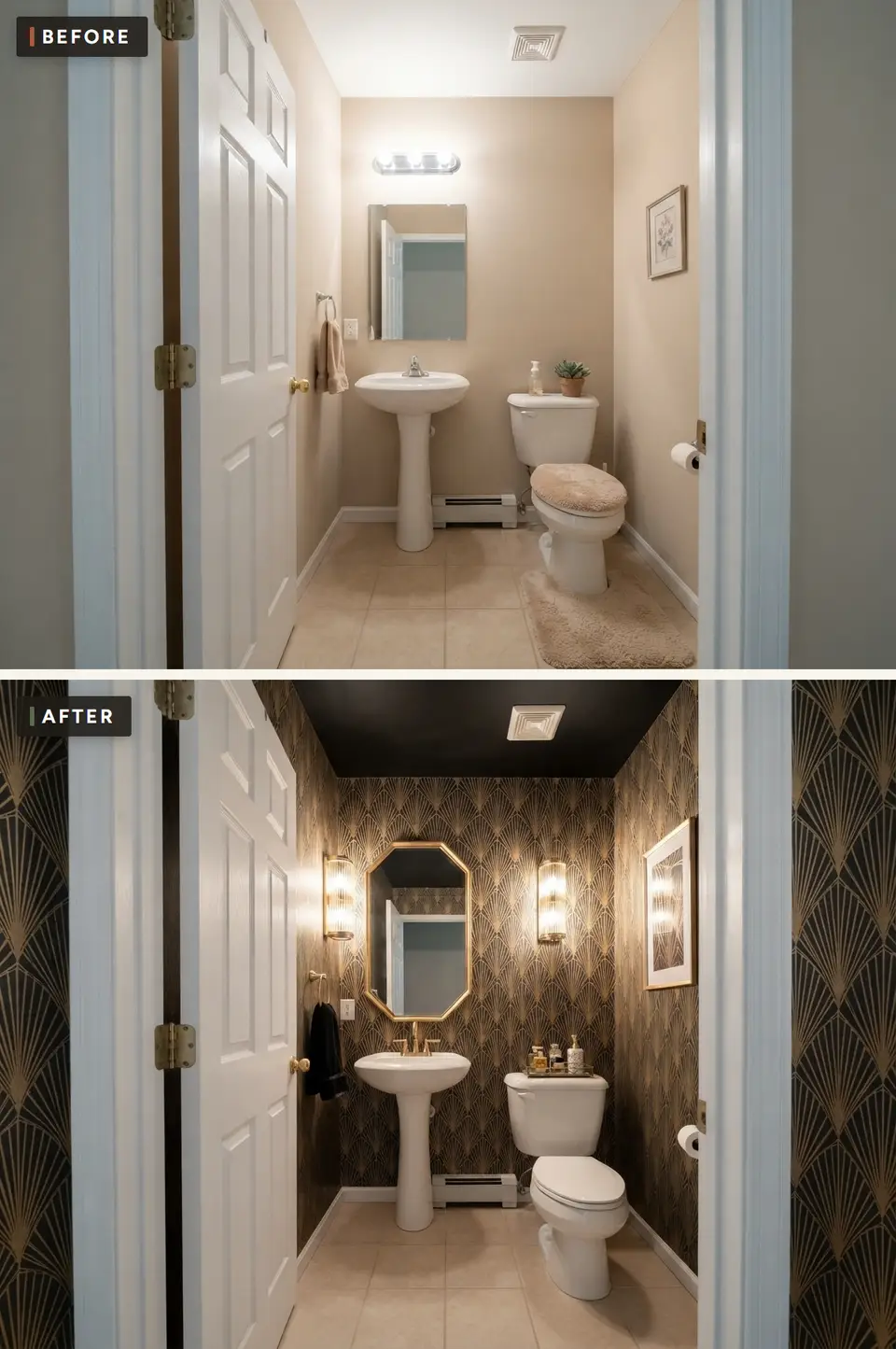
Black wallpaper with a gold fan pattern covers the walls, and the ceiling goes fully black. An octagonal brass mirror sits between two ribbed glass sconces, the faucet changes to brass, and a mirrored tray of bottles on the tank adds a little sparkle.
Short visits make this level of contrast easy to live with. The fan lines pull the eye upward, and the brass mirror flanked by lit glass becomes the obvious centre the moment the door opens.
Deep charcoal (#252725) covers the paper ground and the ceiling, and Aged brass (#A98252) runs through the fan lines, mirror and faucet. Walnut (#6B4F3A) suits a frame or tray if the room wants a warmer middle tone, and Ink blue (#263747), absent from the rendering, is an option for towels if pure black feels too stark.
Art deco sconces belong close to the basin, so use damp rated lighting where required by code. A fixture that is fine in a hallway may not be rated for a bathroom. With the walls already this busy, keep any added colour to the towels and a single framed print.
Keep the principal walking line and every opening clear, and check the room in daylight and after sunset before buying the final accessories. Dark rooms depend on their lighting at night, and metallic paper can glare under the wrong bulb.
At $850–$2600, Art Deco Dark is the costliest of the ten, mostly because it pairs patterned paper with two new wired sconces.
5. Warm Plaster Neutral
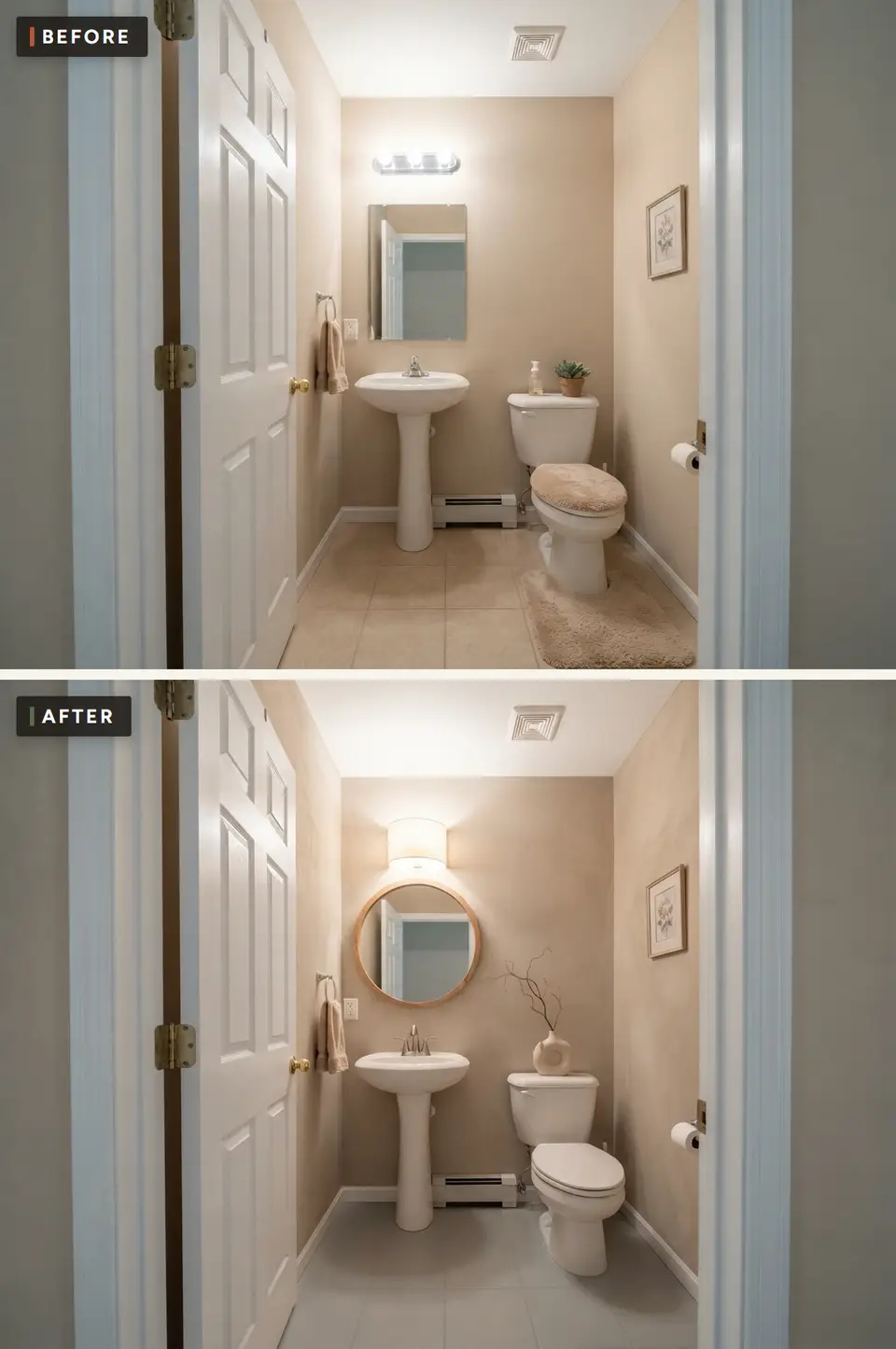
The beige paint gives way to a soft plaster look finish in nearly the same colour, and a round mirror in light wood replaces the frameless one. A white drum sconce takes the place of the bulb bar, a cream ring vase holds a single twisted branch, and the floor tile changes to a pale grey.
Because the colour barely moves from the original, the change is carried by texture and shape: the gentle clouding of the plaster, the circle of the mirror and the soft drum of light. Pick a limewash look finish that is rated for bathroom humidity, since some mineral paints are not meant for damp rooms.
Warm plaster (#E7DED0) is the walls themselves and Light oak (#C49D72) the mirror frame. Moss (#61705A) and Charcoal (#343735) are not in the rendering yet; a moss towel and the thin dark line of a picture frame would be the natural places to add them.
Plaster finishes mark easily from splashes, so use a washable product near the basin, or seal that zone with a clear coat. Light oak needs only one more appearance beyond the mirror, such as a small tray on the tank, rather than turning up on every surface.
With so little contrast, this room relies on side light to show the plaster's movement; under a single ceiling bulb it can look like flat beige paint again. Check it at night under the drum sconce before deciding the extra cost of the finish was worth it.
The estimated finish and decor allowance is $450–$1600. That range covers the visible scope described here and leaves out structural work, hidden repair, permits and professional design fees.
6. Dramatic Charcoal
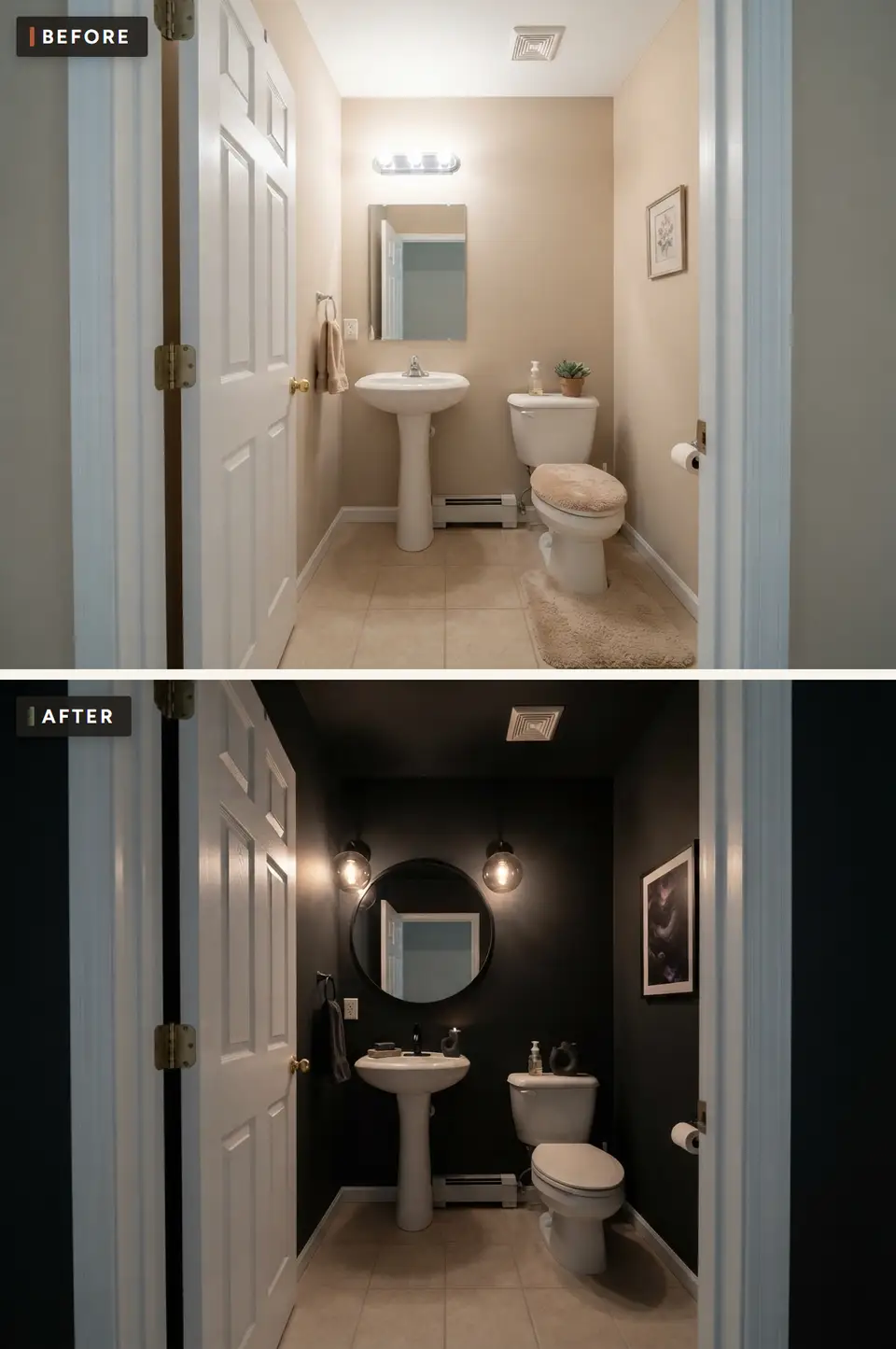
Walls and ceiling go a charcoal that reads almost black, with a round black mirror between two clear glass globe sconces. The faucet turns matte black, a dark abstract print hangs on the side wall, and a pair of small sculptural pieces sit on the sink and the tank.
Against this field the white pedestal sink and toilet look almost graphic, and the white door and casing frame the view like a picture mat. Running the colour across the ceiling is what makes the room feel deliberate rather than simply dim.
Charcoal (#343735) is the whole shell, and Warm plaster (#E7DED0) is the beige floor tile left in place, which keeps the room from turning cold. Light oak (#C49D72) and Moss (#61705A) are held in reserve: a wooden soap tray or a deep green towel would add warmth without breaking the dark mood.
Charcoal walls absorb light, so the room needs real mirror light for grooming; the two globes on either side of the mirror light the face evenly. Keep any wood to one or two small pieces, a tray or a frame, which is enough to stop the dark room from feeling closed in.
The near black ceiling hides the vent and corners, which is part of the effect, but it also means the globes are the only light after dark. Stand at the sink at night before choosing bulbs, and pick a warm colour temperature that keeps skin tones natural.
Plan on $500–$1800 for paint, the mirror, two sconces and art, with the electrical work for the second sconce as the main variable.
7. Pale Coastal Blue
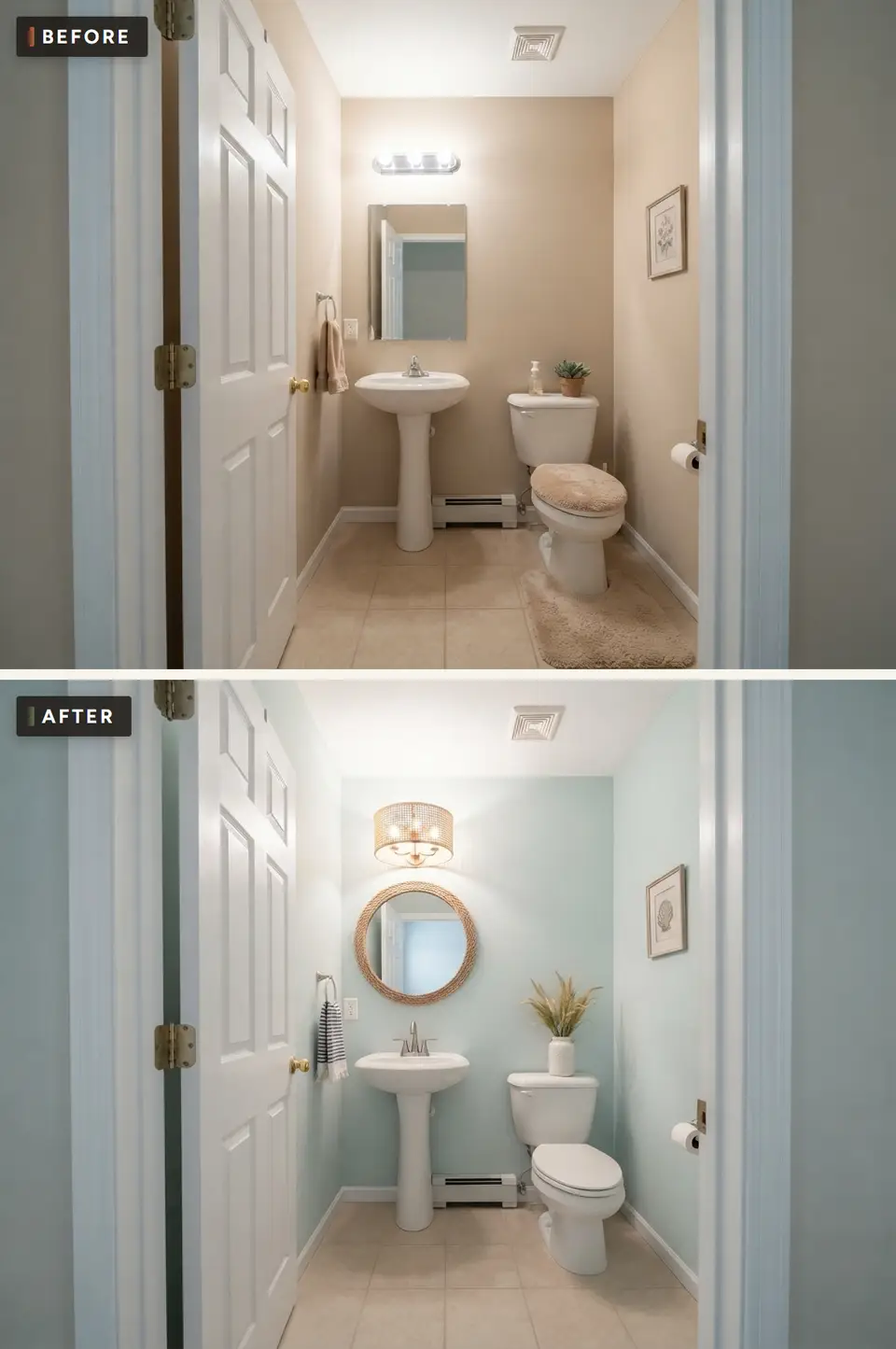
Pale aqua blue paint replaces the beige, the white trim stays crisp, and a woven rattan drum sconce hangs above a round mirror wrapped in natural rope. A framed shell print, a navy striped towel and a vase of dried grass finish the scheme.
Next to the original beige floor tile the blue reads fresh rather than icy, because the tile supplies the warmth. The rattan shade and the rope frame share a sandy tone, so two colours do nearly all the work.
Mist blue (#C8D8DA) is the wall colour and Warm white (#EFECE3) the trim, door and porcelain. Pale oak (#C7A77D) lives in the rattan shade, rope mirror and dried grass, and Soft navy (#354B5E) is the stripe on the towel.
Keep the coastal references to the two already in the rendering, the rope mirror and the single shell print. The pale blue walls do the rest, and adding anchors, oars or signs would turn the room into a theme. Mist blue can repeat once more in a towel, but no further.
A powder room without a window depends on its bulbs, and pale blue drifts toward grey under cool light. Test the paint sample under the rattan sconce at night as well as by day before buying towels to go with it.
This direction comes in at $420–$1550, covering paint, the rope mirror, the sconce and its woven shade.
8. Gloss Black Wainscot
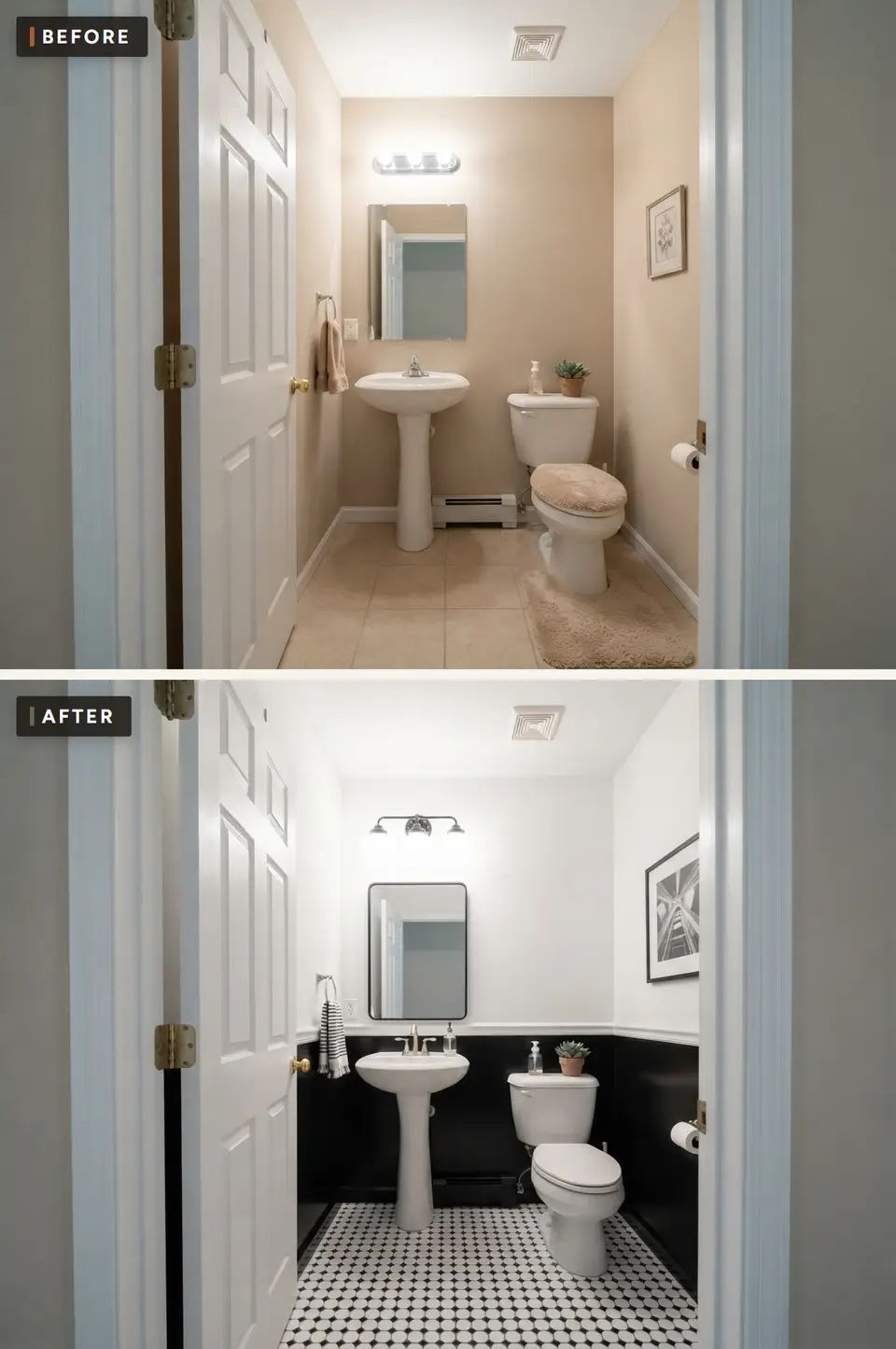
The lower part of the walls turns gloss black below a white chair rail, with clean white paint above, and the floor changes to a white mosaic dotted with small black squares. A black framed mirror, a three light bar and a black and white architectural print keep to the same two colours.
The dark base anchors the narrow room and the white top keeps the ceiling feeling high. Where the break falls is the decision that matters most, and here the chair rail sits just above the basin, so the line reads as planned rather than arbitrary.
Deep charcoal (#252725) is the lower field and the floor accents, and Ink blue (#263747) is the alternative if pure black feels too hard. Walnut (#6B4F3A) and Aged brass (#A98252) supply the warmth: the brass is already there in the door knob and hinges, and a walnut frame or tray would add the one wood tone the room lacks.
Where the black field meets the white paint, a chair rail like the one in the rendering gives the line a finished edge. Set its height from something real in the room, here the basin, because a line floating at a random height looks like a mistake. Ink blue, if used at all, belongs in a towel or one small print.
Keep the principal walking line and every opening clear, and review the room in daylight and after sunset before buying the final accessories, because a glossy black finish reflects bulbs strongly.
The estimated finish and decor allowance runs $700–$2300. That covers the visible scope described here, not structural work, hidden repair, permits or professional design fees.
9. Grandmillennial Floral
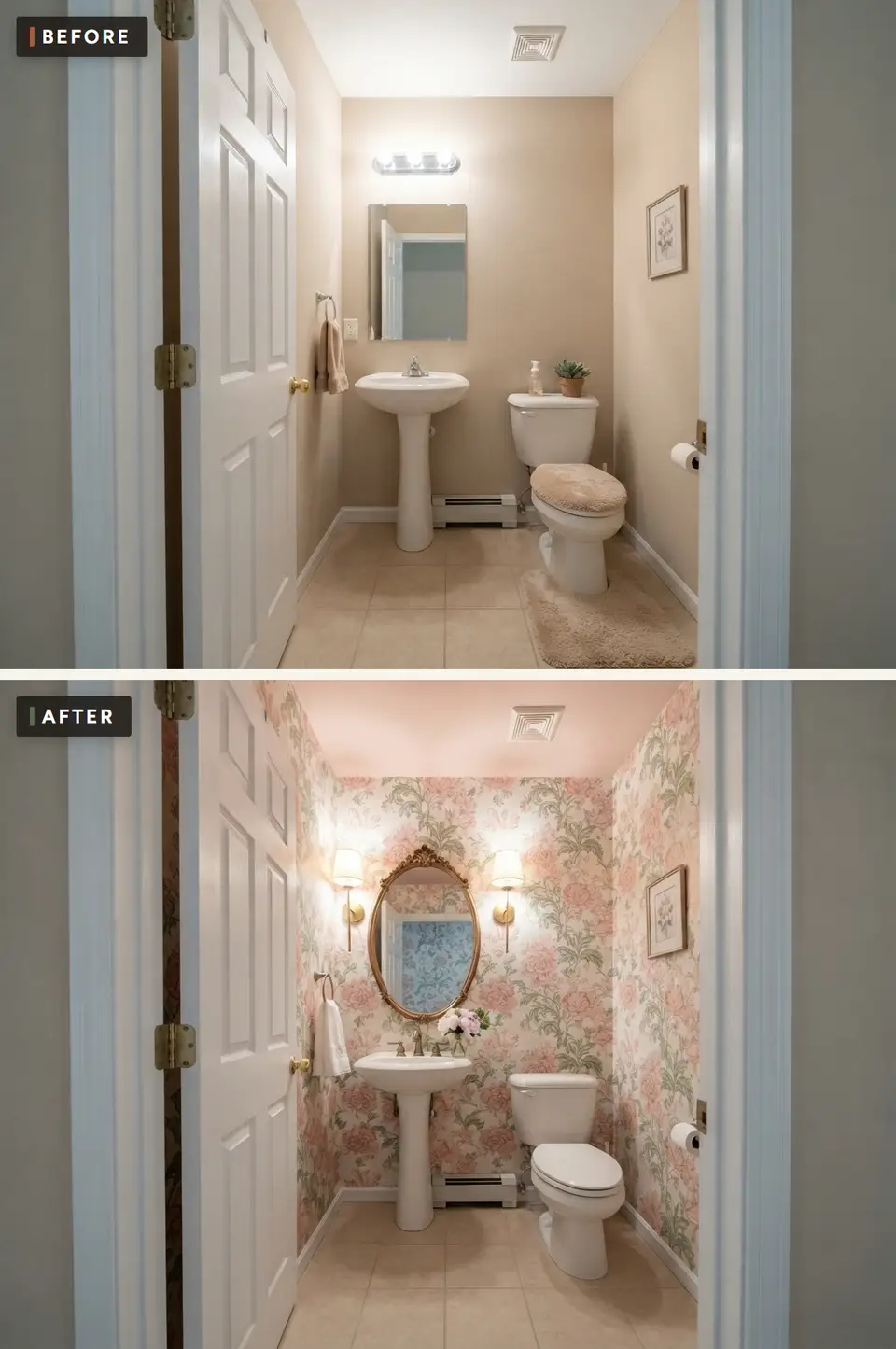
Large pink peonies and sage leaves cover the walls, the ceiling takes a soft blush, and an ornate gilt oval mirror hangs between two brass sconces with white shades. A brass faucet and a small glass of peonies on the basin complete the picture.
The white sink, toilet and door give the eye somewhere to rest against such a busy pattern. With a repeat this large, the way the flowers turn the corners matters, since a sliced bloom in an inside corner is hard to miss in a room this small.
Cream (#F1E5D2) is the ground of the paper, Dusty rose (#B98278) the peonies and ceiling, and Sage (#8C9A79) the leaves. Clay (#A75C45) is the deepest note, found in the shaded petals, and it makes a good towel colour if the white one feels too plain.
A large floral in a small room shows every awkward cut, so plan pattern placement before cutting the first drop. Center a main motif on the mirror wall and work out from there. Beyond the paper, the fresh flowers on the basin are all the extra pink the room needs.
Floral paper shifts noticeably between daylight and the yellow cast of shaded sconces, and a blush ceiling can drift toward peach at night. Keep the floor around the toilet clear so the pattern runs down to the baseboard without interruption.
Expect $750–$2400, the second highest of the set, for the paper, the gilt mirror, two sconces and accessories.
10. Emerald Jewel Box
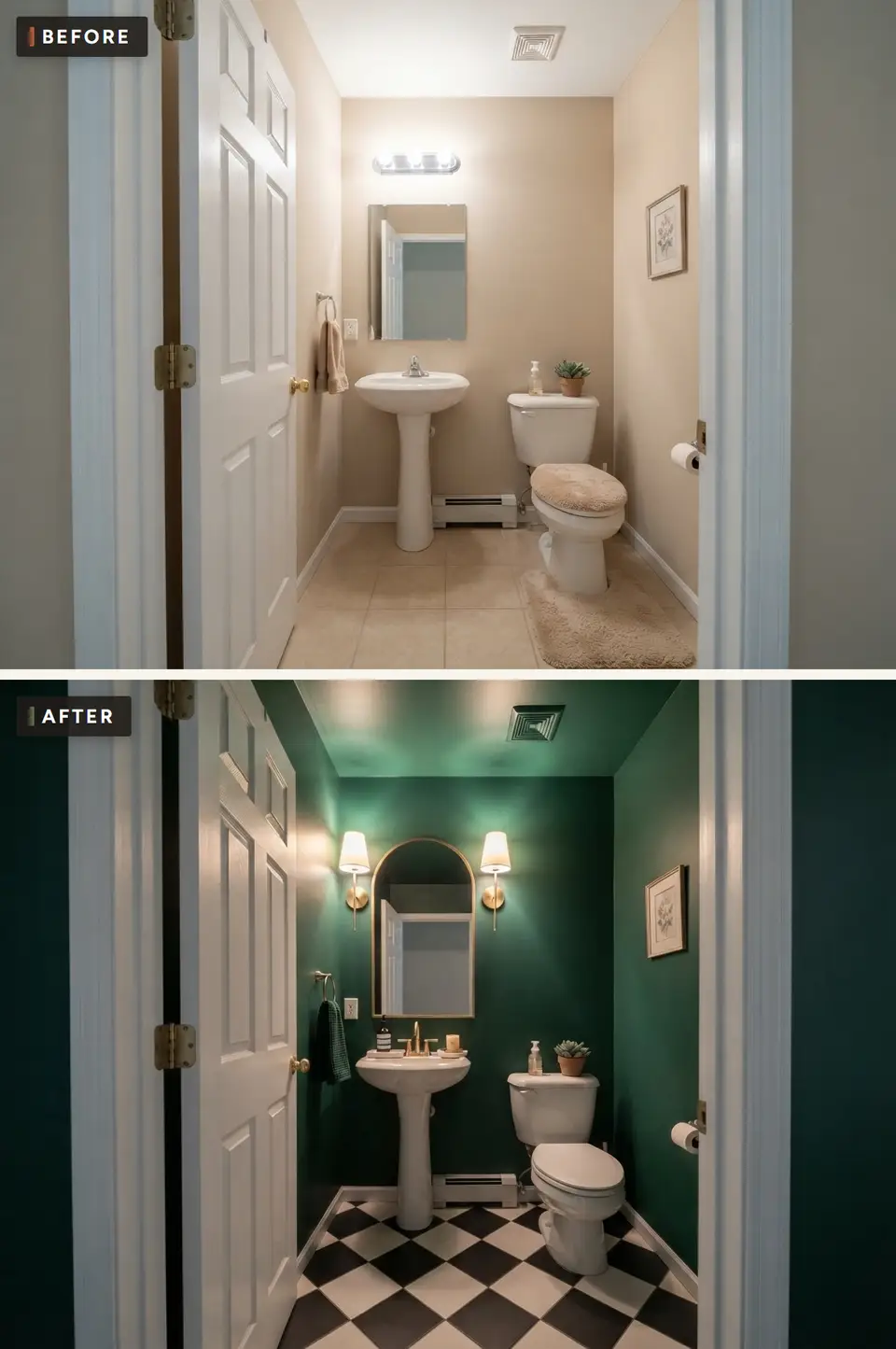
A deep emerald covers the walls and ceiling, and a slim arched brass mirror sits between two brass sconces with white shades. The floor changes to a black and cream checkerboard, the faucet turns brass, and the botanical print from the original room stays on the side wall.
In a room this small, one saturated colour on every surface works better than green used as an accent, because there is no leftover beige to make the room look half finished. The warm glow of the shades keeps the green rich instead of murky.
Moss (#61705A) is the green hand towel, Charcoal (#343735) the dark squares of the floor and Warm plaster (#E7DED0) the light ones. Light oak (#C49D72) does not appear in the rendering; a small wooden tray on the basin would be the place for it.
Emerald depends on its surroundings, so sample the paint next to the checkerboard floor in evening light, when most guests will see it. A green that glows by day can look muddy at night beside large black squares. The brass of the mirror, sconces and faucet is the only metal the room needs.
With walls and ceiling in the same deep colour, the two sconces carry the room after dark, so test bulbs and paint together rather than one after the other. Leave the space between the toilet and the door empty; the checkerboard reads best uninterrupted.
We estimate $520–$1900 for paint, two sconces, the arched mirror and art.
Preparation That Applies to Every Direction
Before choosing among these ten, measure the back wall between the door casing and the side wall, and note the outlet beside the sink, the ceiling vent and the baseboard heater behind the toilet. Several directions add a second sconce or panelling, and those fixed points decide whether either one fits.
Take down the old light bar and mirror first and look at the wall behind them. Builder mirrors are often glued on, and the patch they leave needs repair and primer before paint or paper goes up. Staining near the toilet or under the sink should be traced to its cause before it is covered.
Judge paint and paper samples on the actual wall, next to the white porcelain and the floor tile, under the bulbs that will stay. Respect the cure time on the label before towels start rubbing against fresh paint.
Turn a Rendering Into a Written Scope
For a room this size, the written scope fits on half a page. Note what stays (sink, toilet, door, heater and, in most directions, the floor), what gets a new finish (walls, ceiling, trim) and what is replaced (mirror, light, faucet, towel ring), with the size of every new piece.
Keep repair apart from decoration on that page. Patching behind the old mirror, recaulking the toilet base and moving a junction box to centre a sconce are preparation costs; paper, paint and accessories are the finish budget, and one should not quietly borrow from the other.
When a paperhanger or electrician is involved, ask for a written quote that names wall preparation, the number of coats or the hanging method, protection for the porcelain and floor, and cleanup. Compare those lines between quotes rather than only the totals.
Hold back a contingency for hidden damage behind the old fixtures and for a wallpaper that turns out to be discontinued, and release it for towels and art only once the walls are done.
Work from the top down: repairs and primer, then the ceiling, then paint or paper on the walls, then the mirror, sconces and faucet, with towels and art going in last so nothing new gets splashed.
In the papered directions, approve the first full drop beside the mirror before the rest goes up. Seam position, pattern match and the trim line at the ceiling are easiest to correct at that point.
When the old light bar comes off, photograph the box and the wire positions before anything is covered. That picture saves guesswork later if a sconce moves or a section of paper needs patching.
Material and Maintenance Notes for This Room
Powder rooms have less steam than full baths, yet splash and frequent cleaning still affect wall finishes. Use a washable coating or suitable wallcovering and seal vulnerable edges according to the product guidance.
A mirror should serve the user at the basin. Check its center height, reflection and nearby door before choosing a decorative shape. Side or over mirror light should illuminate the face without a bare source at eye level.
Wallpaper layout begins at the focal wall and works around corners. Draw the seam plan, account for pattern repeat and order extra from the same production lot for mistakes and future repair.
Dark paint can work in a small room when the mirror light is adequate. Test the proposed color with the actual floor and porcelain because warm white and cool white fixtures can change the undertone.
Keep the floor clear around the toilet and basin for cleaning. A tiny rug or basket should not block the door, baseboard heat or access to plumbing shutoffs.
Final Check Before Ordering
A powder room is small enough that one wrong dimension shows at once, so check every dimension twice before ordering a mirror, vanity or light. Door, drawer and chair movement must remain clear; even a small stool can block the door. Surface preparation has to match the product instructions, which matters around the basin where paint and paper see water, and lighting should serve the real task after sunset, such as washing hands and checking a face in the mirror.
Electrical, fire and guard issues need professional review where needed, especially for fixtures near water. Include delivery, tax and return freight in the budget, and view samples in the room under its own lights. Make sure the maintenance routine is realistic for a room guests use.
Keep a repair contingency unspent until the work is done, and give purchase records, finish codes and care sheets one storage place.
Regional Fit Across the Southeast
In the humid Southeast, a windowless powder room relies entirely on its exhaust fan, so confirm the existing vent runs and is ducted outdoors before hanging paper or applying a plaster finish. Scrubbable papers and washable paint cope with summer humidity far better than grasscloth or an unsealed mineral finish.
Near the coast, salt air is hard on thinly plated faucets and towel rings. The brass in several of these concepts lasts longer as solid or lacquered brass, and matte black hardware should carry a powder coat rather than a sprayed finish.
These notes are planning considerations only. Moving a light box, adding a second sconce or touching the heater is work for a qualified local electrician or plumber under local code.
What Each Direction Actually Costs
In 2026 estimates, the ten powder room directions run from about $380 to $2600, with wallpaper and sconces pushing the higher figures. Art Deco Dark is the most expensive at $850–$2600 for wallpaper, sconces, a mirror and paint. Grandmillennial Floral follows at $750–$2400 for wallpaper, a mirror, sconces and accessories, and Gloss Black Wainscot costs $700–$2300 for a surface finish, paint, a mirror and a light.
Blue Chinoiserie Paper sits in the middle at $650–$2100 for wallpaper, a mirror, a light and accessories. Emerald Jewel Box runs $520–$1900 for paint, lighting, a mirror and art, and Dramatic Charcoal comes to $500–$1800 for paint, a mirror, sconces and art. Warm Plaster Neutral is estimated at $450–$1600 for a paint finish, mirror, light and textile.
The paint led directions are the most affordable. Pale Coastal Blue costs $420–$1550 for paint, a mirror, a light and a shade, and Warm Terracotta runs $420–$1500 for paint, a mirror, a light and a small rug. Black and White Classic is the least expensive at $380–$1400, covering paint, a mirror, a light and hardware.
These figures are our planning estimates, built from the visible materials and current retail categories with limited labour where noted. They leave out structural work, hidden repair, permits and design fees, and a local quote can land higher or lower depending on what turns up behind the old mirror.
Questions Readers Ask
How much does a powder room refresh cost?
A paint, mirror and light update may cost $400 to $1,500. Wallpaper and electrical work can push the range above $2,500.
Can wallpaper be used in a powder room?
Yes, because a half bath has less steam than a full bath. Prepare the wall and use an adhesive and paper suitable for the room.
What color works in a small powder room?
Pale and deep colors can both work. The light, floor and fixed white fixtures decide the undertone.
Does a powder room need special paint?
Use a washable interior product suitable for bathrooms and follow ventilation and cure guidance.
How large should the mirror be?
Relate it to the basin and available wall, and keep lights positioned for the face rather than only the room.
Can the existing pedestal sink stay?
Yes. New wall color, mirror, light and hardware can change the room without moving plumbing.
What should be stored in a powder room?
Keep hand soap, spare tissue and a small cleaning supply. Move bulk storage elsewhere.
Sources and Pricing Notes
Each powder room allowance above is a 2026 planning figure in US dollars, based on current retail prices for the vanity, mirror, lighting and finishes shown in that after rendering. Add tax, delivery and permits on top of the powder room numbers, plus a margin for whatever turns up behind the wall tile.
- U.S. Bureau of Labor Statistics: Consumer Price Index notes for household furnishings.
- The Home Depot: project calculators and current material categories.
- IKEA US: current furniture and storage categories.
Keep Planning
paint color guide, small bathroom design study, entryway decor budgets.
Which Powder Room Idea Fits the Room
Choose by how the room is used and cleaned. Paint led schemes such as Warm Terracotta or Pale Coastal Blue shrug off scuffs, while the papered rooms ask for more care near the sink. Measure the mirror wall and live with a sample for a few days before ordering paper or light fixtures.
Transformations Desk
The Layered Homes editorial teamThe Transformations Desk produces the before-and-after design studies: one imagined starting space (a room, a facade, a backyard) shown in several design directions, each with a palette and a cost estimate.
More from the Transformations Desk →
Reader notes