


"Quiet luxury" describes rooms with no logos and no trend walls, rooms that read confident without being loud, made from materials that age into themselves rather than out of fashion. Charleston-area interiors (and homes from Savannah up to Asheville and west to Nashville) give a working sense of what quiet luxury actually costs, where the money genuinely earns its keep, and where homeowners routinely overspend. This guide walks through twelve vignettes of the kind a designer would propose in a real design meeting, each with a specific material spec, a 2026 cost range based on typical local estimates, and the styling notes that separate a room that reads luxury from one that reads aspirational.
Table of Contents
- Serene Bedroom Vignette with Grasscloth & Oak
- Minimalist Hallway Gallery with Concrete Floors
- Spa-Like Bathroom Retreat in Honed Stone
- Moody & Textured Reading Corner in Green Velvet
- Elegant Dining Room Buffet with Symmetrical Brass Lamps
- Light-Filled Living Room with Bouclé & Travertine
- Wood-Paneled Bedroom Retreat with Floating Walnut Nightstands
- Warm & Inviting Dining Space with Linen-Upholstered Chairs
- Sophisticated Home Office with Built-In Library Shelving
- Minimalist Entryway Console with Pampas & Brass Mirror
- Cozy Window Seat Corner with Cashmere & Travertine
- Modern Fireplace Lounge with Stone Surround
- Pro Tips for Every Quiet-Luxury Room
- Where to Cut Without the Room Knowing
- Regional Fit Across Five Southeast Markets
- Frequently Asked Questions
- Sources & References
- Quiet Luxury Is a Specification Discipline
1. Serene Bedroom Vignette with Grasscloth & Oak
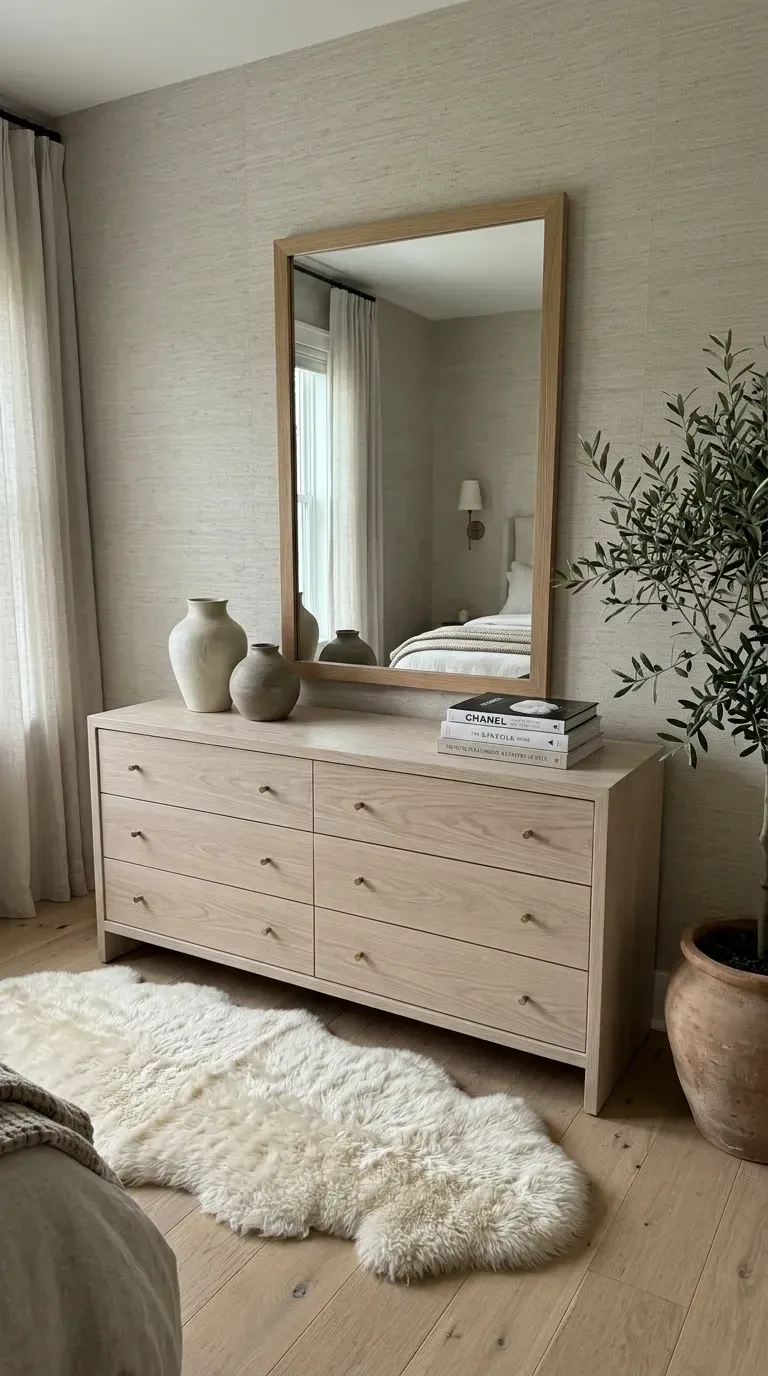
This corner works because nothing in it is competing. A rift-sawn white oak dresser finished in Rubio Monocoat Natural 5% (not a stained "light oak" from a big-box store; the raw-finish oak is the quiet-luxury signal) carries the composition. The large wood-framed leaner mirror behind it does two jobs: it nearly doubles perceived light in the room, and its frame shares a tonal family with the dresser rather than matching it exactly. Grasscloth wallpaper (specifically Phillip Jeffries Vinyl Arrowroot II or Schumacher Natural Grass on Paper) adds the tactile depth that flat paint cannot fake. A genuine New Zealand sheepskin from Auskin or UGG over wide-plank white oak flooring, a chosen stack of three art books, and two Heath Ceramics Coupe vases finish the vignette. A 6-foot faux olive from Afloral in a terracotta pot from Mud Australia can join the corner, and accessories like that can rotate without changing the core pieces. That's how you know the bones are right.
Storage is a rift-sawn white oak dresser, drawn with eight drawers in two columns although a 6-drawer case suits the same wall, finished in Rubio Monocoat Natural 5%, which keeps the grain matte and close to raw. Above it leans a wood-framed mirror of 30 by 70 inches whose frame is a tonal match to the dresser rather than an exact one, so the two pieces relate without looking like a set. The feature wall behind is grasscloth, Phillip Jeffries Vinyl Arrowroot II or a Schumacher paper.
Softer layers finish the vignette: a genuine long-wool sheepskin from Auskin or UGG at 2x3 ft minimum, Heath Ceramics Coupe vases, and a 6-ft Afloral faux olive in a terracotta pot. Underfoot runs wide-plank engineered white oak in a 7-inch plank at minimum.
Priced as a 2026 estimate, this bedroom corner comes to $4,040–$8,690, and most of that sits in two places. The solid white oak dresser (RH, Crate & Barrel or a cabinet shop near you) carries $1,400–$2,800, and the grasscloth feature wall of roughly 60 sq ft, paper plus professional hanging, adds $950–$2,100; between them they account for about 56% of the top figure. The rendering shows an eight-drawer case rather than the 6-drawer piece first listed, so settle the drawer count you actually want before ordering anything else, because the dresser is where quotes spread furthest.
The smaller pieces are easier to pin down. The wood-framed mirror resting on the dresser (West Elm Industrial or Pottery Barn Chelsea) is allowed $450–$950, the long-wool sheepskin from Auskin or UGG $180–$440, and the 2 stoneware vases with a stack of 3 art books $240–$520. The 6-ft Afloral faux olive in its Mud Australia terracotta pot takes $280–$620, and the visible run of engineered white oak flooring, supplied and laid, $540–$1,260.
Spec the sheepskin by fiber length; short-wool reads thin and synthetic at the price point. Hang the mirror so the top edge reaches 6–10 inches above the tallest person in the household; ceiling-hung placement reads awkward in a residential scale. Rotate the vignette's accessories seasonally (dried pampas in winter, olive or eucalyptus in summer) and leave the dresser and mirror untouched. The core pieces should never move.
2. Minimalist Hallway Gallery with Concrete Floors
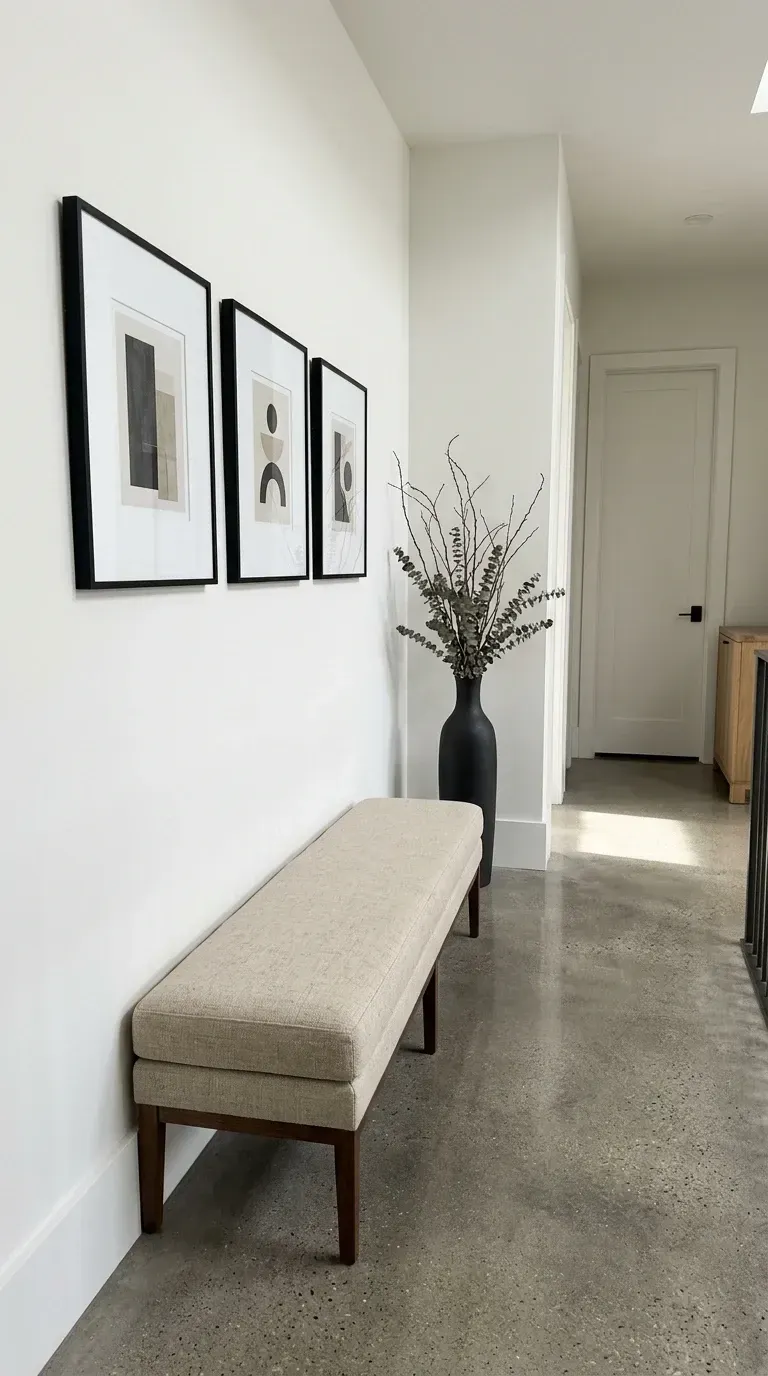
Hallways are the room most people forget, and the room where restraint pays the biggest dividend. An upholstered bench in a tight natural-linen weave (Lulu and Georgia's Quincy bench or the RH Modena) reads luxurious against a simple Benjamin Moore White Dove wall because nothing on the wall is arguing with it. A tight trio of black-framed abstract prints (we would source these from Minted on a budget or Artfully Walls for higher tiers), hung 5–6 inches apart and vertically centered 58 inches off the floor, delivers the gallery read without the chaos of a salon wall. The tall black ceramic vessel (ideally a Pol 48 from Atelier Vime or a Taos floor vase from Pottery Barn) gets dried eucalyptus branches that last twelve months. The polished concrete floor is the material move that ties it to architecture: if the slab is already concrete, a diamond-polish refinish is $7–$14/sq ft; new pour + polish is closer to $18–$32/sq ft.
An upholstered bench in natural linen or textured wool, the Lulu and Georgia Quincy or the RH Modena, gives the hallway a place to pause. Above it hangs a trio of black-framed abstract prints from Minted or Artfully Walls, centered 58 inches above the finished floor, against walls painted Benjamin Moore White Dove OC-17.
The floor is polished concrete, either diamond-polished or the existing slab refinished. At the end of the hall, a tall black ceramic floor vase, 28–36 inches high, holds dried eucalyptus or seeded pampas branches, which last 12–18 months before they need replacing.
The hallway is the least expensive room in this guide, at $2,195–$6,130 in 2026 terms, and the floor decides where in that range it lands. Refinishing an existing slab across the visible run is estimated at $900–$2,400, the widest spread here because crack repair and polish grade vary so much from one slab to the next, so get that quote first. The linen bench from Lulu and Georgia, RH or Serena & Lily follows at $480–$1,400, and floor and bench together make up about 62% of the upper estimate.
Everything on the wall is modest by comparison. The 3 framed abstracts run $340–$1,050 depending on whether they come from Minted or Artfully Walls, the tall black floor vase (28" to 36") $180–$520, and a bundle of dried eucalyptus with a plan to replace it $55–$140. Priming the walls and rolling two coats of BM White Dove OC-17 is put at $240–$620.
Measure the bench depth before ordering: a 16" bench leaves no practical sitting room once draped with throws and hats; 18–20" is the comfortable minimum in a working hallway. When hanging the print trio, use a consistent 5–6" gap and a single horizontal centerline; skipping that discipline turns a gallery into a yard sale. If the existing concrete slab has visible cracks, route and fill with matching polymer filler before polishing rather than attempting to hide damage under area rugs.
3. Spa-Like Bathroom Retreat in Honed Stone
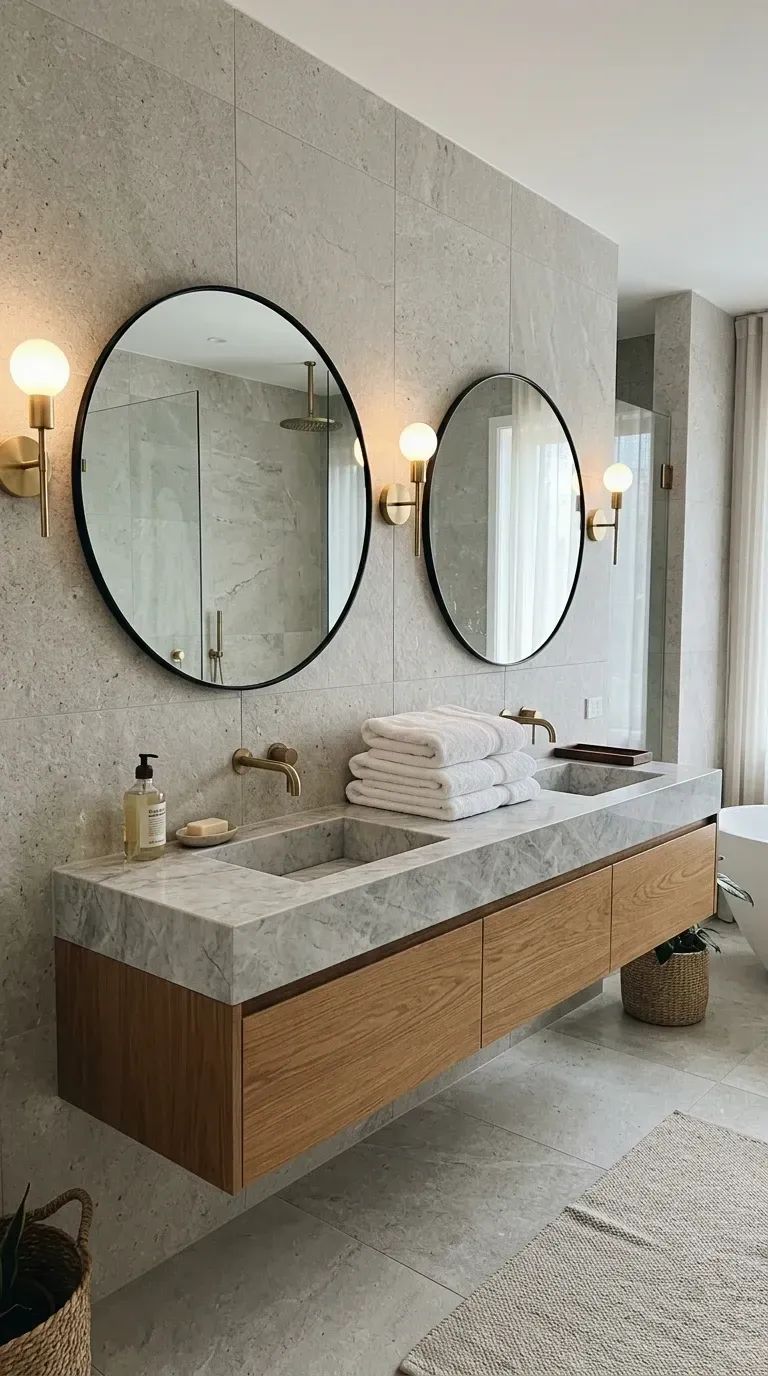
This is the bathroom direction best suited to coastal homes, and it's also where budget discipline matters most. The spa read comes from three moves executed together: honed (not polished) large-format stone tile, a floating wood vanity with a thick marble or quartzite top, and warm brass fixtures. Specifying honed is not a style preference: polished stone in a wet zone shows every water spot within a week, and the maintenance burden turns a spa bath into a chore. For the vanity top, we would push toward honed Calacatta Gold or, for a more durable coastal spec, honed Taj Mahal quartzite from Walker Zanger or ABC Stone. The walnut or rift-sawn oak vanity base is custom-built by a cabinetmaker, not ordered from stock catalogs, because the proportions on pre-built vanities almost never land right on a floating install. Round mirrors with thin black frames keep the sightline crisp (Rejuvenation's Madison in aged brass is the warmer option), lit by Visual Comfort Bryant sconces in hand-rubbed antique brass. Faucets: Waterstone Gantry wall-mount or Brizo Litze in luxe gold.
The room is clad in honed large-format stone tile, Walker Zanger Grafitte or ABC Stone Silver Travertine, which keeps grout lines few and the surfaces calm. A custom floating vanity in walnut or rift-sawn oak from a local cabinet shop carries a honed slab top of Calacatta Gold or Taj Mahal quartzite at 3 cm thickness.
The vanity is laid out in pairs. There are 2 round mirrors, framed in black metal in the rendering, three brass sconces in hand-rubbed antique brass (one at each end and one between the mirrors), and 2 brass wall-mount faucets from Waterstone (the Gantry) or Brizo (the Litze), so each user has a full station.
Stone is the reason this bathroom costs what it does. The full itemized estimate for 2026 is $15,640–$35,760, and honed large-format tile on walls and floor, installed, accounts for $6,400–$14,500 of it, with the honed quartzite or marble top and its integrated sinks adding $3,400–$8,200. Those two lines are about 63% of the high figure. Tile quantity is the number to fix first: wrapping the shower and the whole vanity wall, as the rendering does, costs far more than stopping at wainscot height, and the slab top cannot be templated until the vanity is built.
The floating walnut or oak double vanity from a cabinetmaker is estimated at $3,200–$7,500. The round mirrors (x2) are allowed $780–$1,600; the rendering frames them in thin black metal rather than the aged brass of the Rejuvenation Madison, so choose the finish before ordering. Brass sconces of the Visual Comfort Bryant type are priced as a pair (x2) at $520–$1,200, although the image adds a third between the mirrors, and the 2 wall-mount brass faucets from Waterstone or Brizo come to $1,100–$2,200. Turkish cotton towels, the soap dish and the dispenser close the list at $240–$560.
Honed, always: the single most important spec in a quiet-luxury bath. Insist on large-format tile (minimum 24"x48") to reduce grout lines; smaller formats read busy regardless of how neutral the field color is. Drop the rough-in height for wall-mount faucets to 36" from finished floor rather than the typical 42"; it reads more hotel-spa and plays better with shorter users. Skip the vessel sink trend entirely; integrated or undermount is the specification that ages.
4. Moody & Textured Reading Corner in Green Velvet
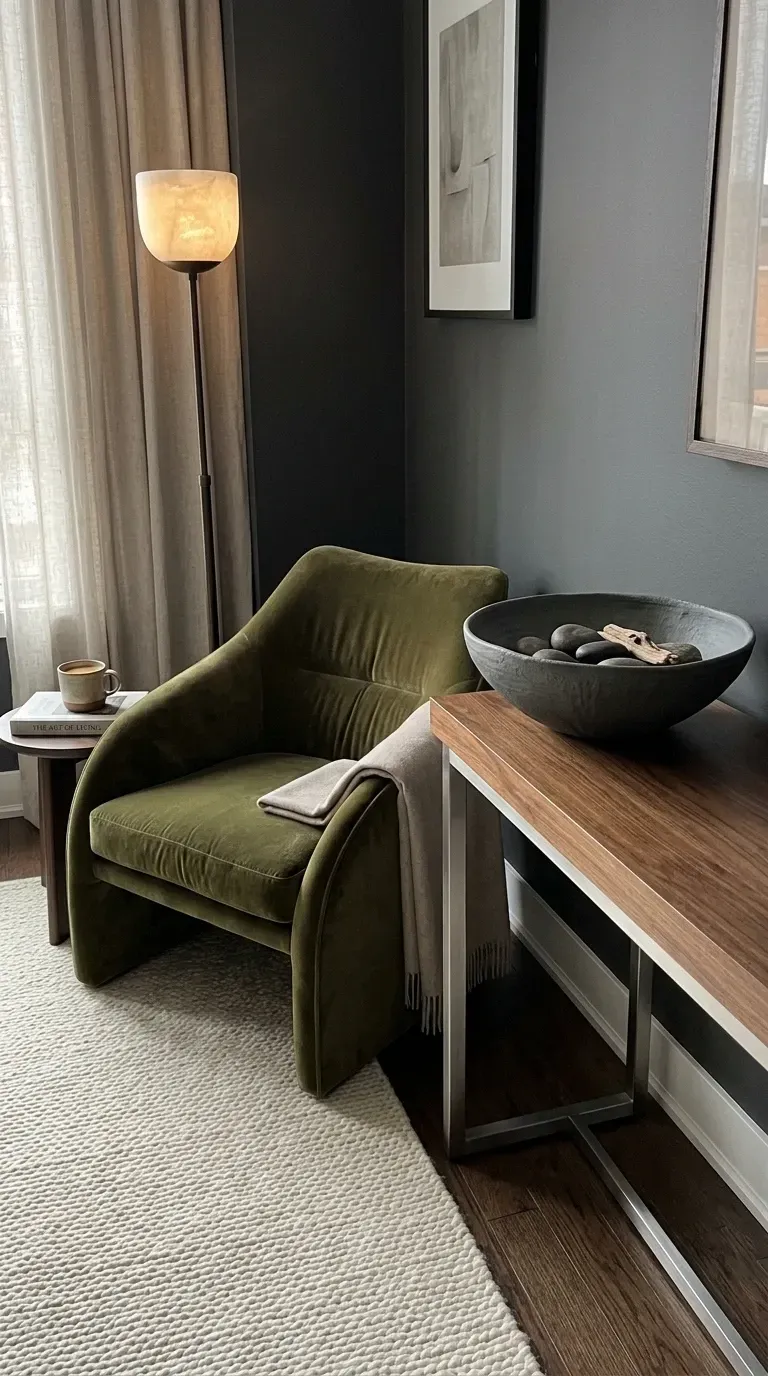
Not all quiet luxury is pale. A dark-walled reading corner suits the long, narrow rooms of a Charleston single house particularly well. The deep walls read as a jewel box rather than a sitting room, and they photograph beautifully in southern light. The wall color is everything. Farrow & Ball Railings No. 31 (a very dark blue-black) or Benjamin Moore Kendall Charcoal HC-166 are our two defaults; we would not spec a true black in a residential sitting space because the result reads flat rather than atmospheric. The green velvet armchair (ideally a George Smith Signature or the more accessible Article Sven in forest velvet) is the tactile anchor. Specify a dense cotton or performance velvet (Maharam Mohair Supreme or Brentano Silk Lux) rather than a viscose blend that flattens after six months of use. The wood-and-metal console is the textural bridge (Restoration Hardware's Dez console or a West Elm Industrial reproduction, depending on budget), holding a wide, dark stone bowl filled with river stones and a piece of driftwood. A Cedar & Moss Alto floor lamp with an alabaster globe provides the warmth that keeps a dark room from reading oppressive.
The walls go dark in Farrow & Ball Railings No. 31 or Benjamin Moore Kendall Charcoal HC-166, and a green velvet armchair in dense cotton or performance velvet from George Smith or Article sits against them. Floor-to-ceiling linen curtains, custom from The Shade Store or RH, soften the window wall, and a hand-knotted wool rug (Armadillo Malawi or Loloi Ingrid) warms the floor.
Beside the chair, a wood-and-metal console table (RH Dez or West Elm Industrial) holds a wide charcoal stone bowl filled with river stones. The Cedar & Moss Alto floor lamp with its alabaster globe is the light source.
This corner has the widest budget swing for its size, $3,370–$11,290 in 2026, and almost all of that swing sits in the chair. A green velvet armchair can be bought at the Article Sven level or commissioned from George Smith, which is why the line reads $900–$4,200; settle that choice first, since the console and lamp should be pitched to it. The wood-and-steel console follows at $620–$1,800, and chair plus console come to roughly 53% of the upper total.
Light and softness fill out the rest. The alabaster-shaded floor lamp from Cedar & Moss or a comparable maker is estimated at $480–$1,350, the hand-knotted wool rug (8x10) at $450–$1,400, and the small round side table by the window, a Menu Androgyne or Pottery Barn Drew, at $180–$480. The bowl of river stones on the console is allowed the same $180–$480; the rendering shows it in dark stone, and a travertine or alabaster version would cost about the same. Floor-to-ceiling linen curtains with rod and installation add $380–$1,100, while painting the walls in F&B Railings or BM Kendall Charcoal is the cheapest change in the room at $180–$480.
Test dark wall colors on all four walls, not a single chip; dark paint reads dramatically different on a north-facing Charleston wall at 4 pm than it does on a south-facing wall at noon. Warm every source of light in the room (2700K bulbs, alabaster or linen shades, no exposed filament) to keep the mood jewel-box rather than cave. One bright piece of art with a warm tone can anchor the whole corner; three compete and flatten the depth.
5. Elegant Dining Room Buffet with Symmetrical Brass Lamps
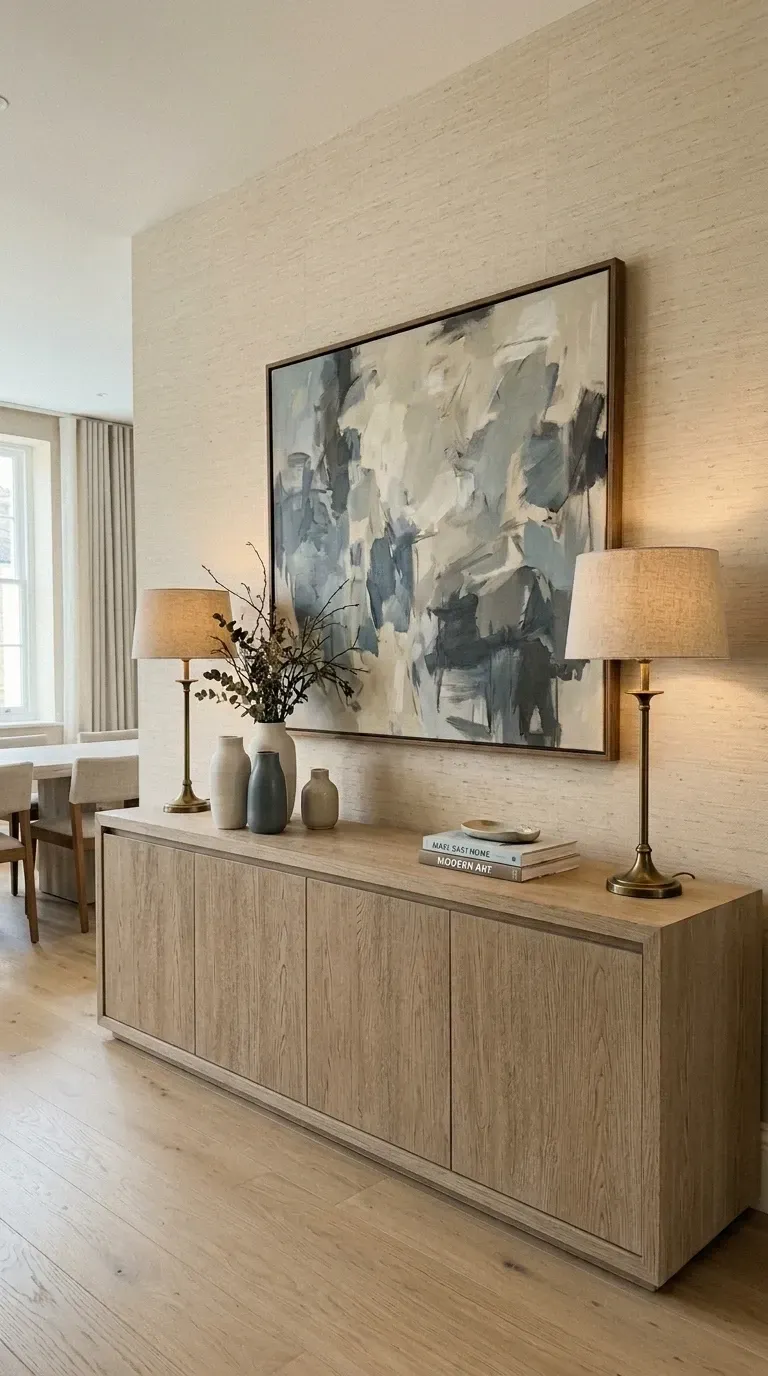
Symmetry is the single most underused tool in residential design. A pair of anything photographed straight-on reads automatically calm, and quiet luxury thrives on that calm. A 72-inch light wood sideboard (a cabinet-shop piece in rift-sawn white oak, or the Crate & Barrel Keane for a more accessible tier) anchors the long wall. Above it, a single large abstract in muted blues and greys (Artfully Walls commissions in the 40x60 range) defines the color story for the rest of the room. Two matched brass table lamps (Visual Comfort Hollis or Rejuvenation Dahlia) with natural linen drum shades flank the art. The styling math: keep the lamps exactly symmetrical; vary the ceramics in between them (three vessels in graduated heights, never four). One mix that works: three vases from Heath Ceramics, East Fork Pottery, and a single handbuilt piece from an independent potter; the mixed sourcing reads collected rather than catalog.
The sideboard is a 72-inch piece in light rift-sawn white oak, built by a local shop or bought as the Crate & Barrel Keane. A pair of matched brass table lamps, Visual Comfort Hollis or Rejuvenation Dahlia, stands at either end, framing a large abstract painting of 40x60 from Artfully Walls or Minted on a textured grasscloth feature wall by Phillip Jeffries or Schumacher.
Between the lamps sit three small vessels in white, slate blue and grey, one each from Heath, East Fork and a local handbuilt maker, in front of a taller white vase of dried stems that gives the group its height. The floor is wide-plank white oak with a 7-inch plank at minimum.
For 2026 the dining wall is estimated at $4,830–$12,500. The 72" light oak sideboard is the anchor and the least predictable cost, $1,800–$4,400 depending on whether it is the Crate & Barrel Keane or a cabinet-shop build, so ask for that written quote first. The 40x60 abstract in blues and greys comes next at $650–$2,400; between them, the case piece and the painting hold about 54% of the top number.
The grasscloth behind them, paper and professional hanging, is put at $900–$2,100, and the visible stretch of wide-plank white oak floor at $620–$1,500. The matched brass lamps with their linen shades need $420–$1,100 for the pair, the vase trio from Heath, East Fork and a handbuilt maker $320–$720, and the art books and small dish stacked at the right-hand end $120–$280.
Exact symmetry is the point: the lamps should be the same height, shade, and bulb temperature, with the plugs routed into the sideboard rather than draped down the back. Hang art so the centerline lands 58–62 inches above finished floor, regardless of sideboard height. For the ceramic trio, graduate heights in odd increments (8", 12", 16" works; 10", 11", 12" reads like a set of measuring cups).
6. Light-Filled Living Room with Bouclé & Travertine
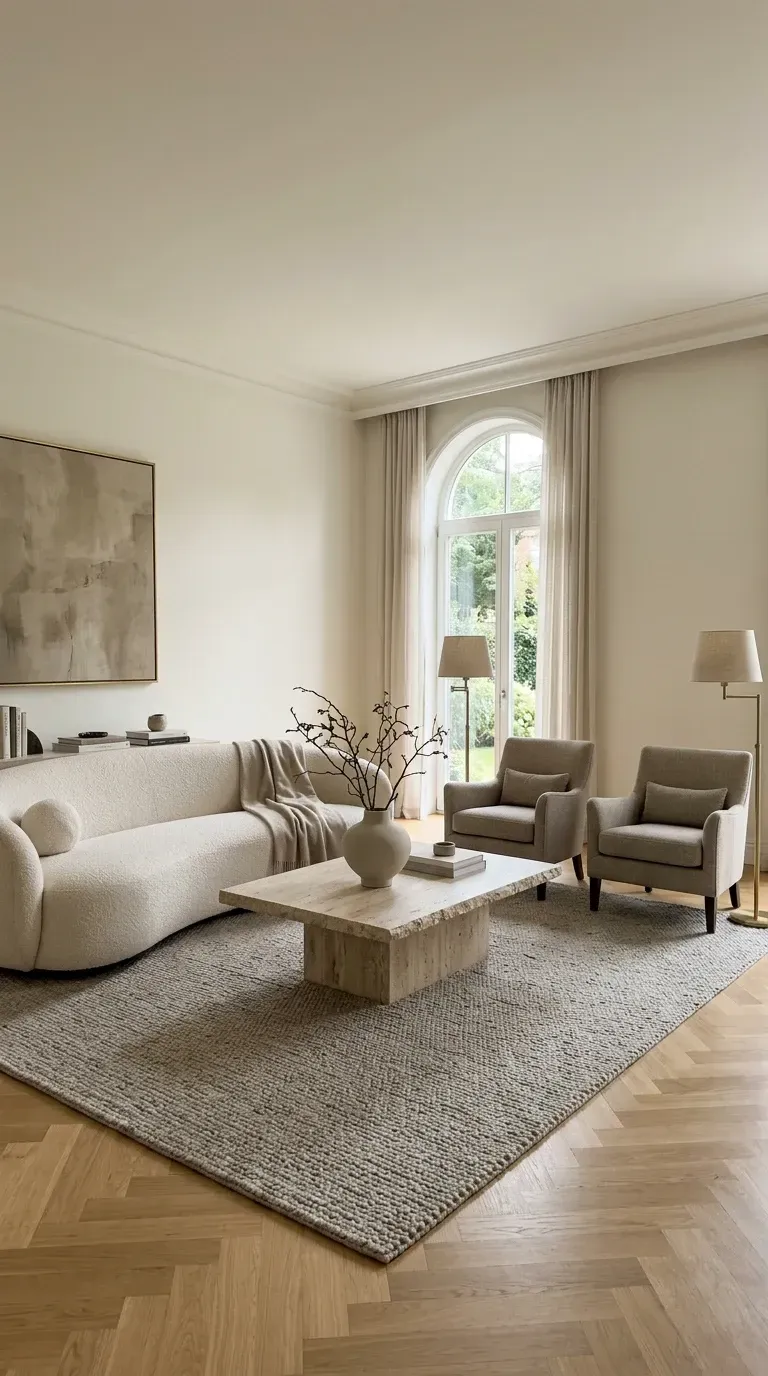
The curved bouclé sofa has moved from trend to baseline over the last three years, which is exactly why specification matters more now, not less. A genuine wool bouclé (Maharam Mantle or Pierre Frey La Rime) on a hardwood frame holds its shape for 10–15 years; the poly-bouclé knockoffs from online-only brands tend to pill within six months and look exhausted by year two. Two curved sofas offered in real wool bouclé are the Jayson Home Meret and the more accessible Interior Define Sloan Curved. The raw travertine coffee table is the other signature move. We would use Kalon's travertine block (oval or rectangle) or a Lulu and Georgia Reagan; the unpolished surface is deliberate, but the underside must be professionally sealed at install or white wine will permanently mark the stone within six months. The herringbone white oak floor is expensive ($24–$42/sq ft installed, vs $14–$22 for standard wide plank) but it's the detail that photographs at a different price tier than flat flooring ever will. For the tailored armchairs, we pair Lee Industries frames with a contrasting performance linen (Crypton Home in oat) to catch stains in a family room without looking like they're trying.
The sofa is a curved real-wool bouclé piece, the Jayson Home Meret or the Interior Define Sloan, facing a raw travertine coffee table from Kalon or the Lulu and Georgia Reagan, professionally sealed. A pair of tailored armchairs from Lee Industries in Crypton performance linen completes the seating, all on a large hand-loomed textured wool rug from Stark or the Loloi Ingrid in Oat.
The floor is herringbone white oak in 5-by-24-inch planks finished with Rubio Monocoat. An arched window with floor-to-ceiling linen drapes from The Shade Store is the focal point, flanked by a pair of floor lamps, the Cedar & Moss Alto or the Visual Comfort Clifton.
The living room is the second most expensive scope here, $12,440–$29,420 at 2026 prices, though no single piece dominates: the two biggest lines make up only about 40% of the high estimate. The curved real-wool bouclé sofa at the Jayson Home Meret level is put at $2,900–$6,400, and it deserves the first quote because fiber content moves the price more than size does. The herringbone white oak across the visible floor, material and installation, is close behind at $2,400–$5,400.
The raw travertine table is budgeted with its sealing included, $1,900–$4,400 with Miracle 511 on the invoice, and the two tailored armchairs in performance linen at $1,800–$4,200. Under them goes a hand-loomed wool rug, 9x12, at $1,200–$2,800, and the brass floor lamps with linen shades, one by the arched window and one beside the chairs, at $480–$1,200 for the two. The 40x60 abstract over the sofa needs $680–$2,400, the vase of bare branches and the small ceramics $180–$420, and the custom linen drapes with rod and installation $900–$2,200.
Ask for the fiber certification on any bouclé before purchase, since real wool has a burn test you can request, and reputable dealers will honor it. Specify the travertine sealer (Miracle 511 Impregnator) on the invoice, not as a verbal add-on; unsealed travertine will mark permanently. Herringbone looks wrong if the subfloor isn't level within 3/16" across 10 ft, so insist on the subfloor inspection before delivery.
7. Wood-Paneled Bedroom Retreat with Floating Walnut Nightstands
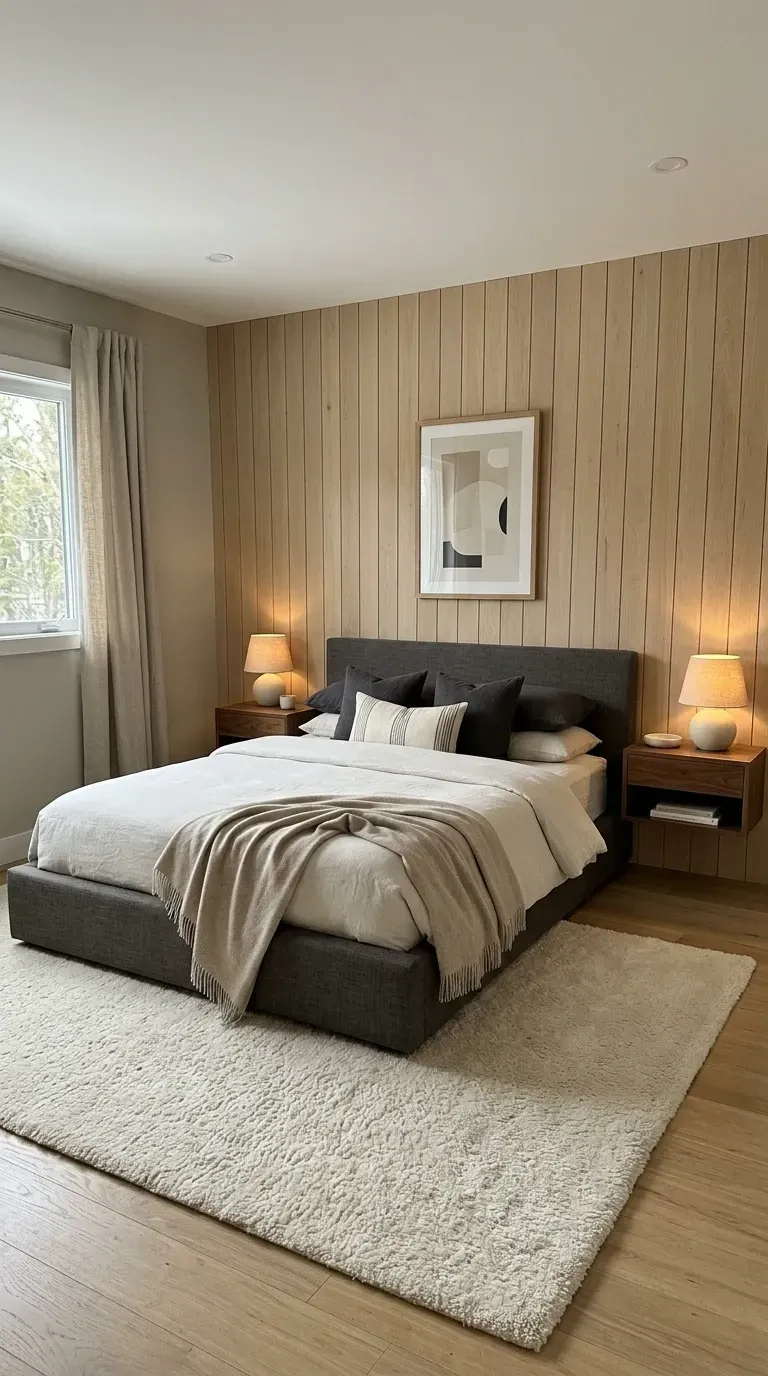
A vertical wood-plank feature wall is the architectural move that changes the entire weight of a bedroom. The spec calls for 1x6 rift-sawn white oak planks (Nakamoto Forestry's shou sugi ban line is beautiful for a darker read; rift-sawn oak from Carlisle Wide Plank for the light tone shown) installed over the existing drywall with a 1/4" reveal between planks for shadow line. The floating walnut nightstands (Rejuvenation's Ninth Street in American black walnut or a custom local shop build) cantilever from French cleats rather than pedestal off the floor, which both maximizes visible rug and simplifies under-bed cleaning. The grey upholstered bed frame should be a full bed, not a headboard-only unit; the spec calls for Crate & Barrel's Carnaby or RH's Italia for the tight-linen read, in a performance-blend greige like Crypton Home Oat or Romo Linara. Layered bedding: three-ply (sheet, quilt, coverlet) in white linen (Cultiver or Coyuchi), with a textured throw in oatmeal at the foot. Matched table lamps with round cream ceramic bases and linen shades sit on the nightstands, a softer choice than brass against the oak boards.
The feature wall is vertical 1x6 plank in rift-sawn white oak or shou sugi ban, set with a 1/4-inch reveal between boards so each plank casts a fine shadow line. Against it stands a grey upholstered bed frame in performance linen, the RH Italia or the Crate & Barrel Carnaby, flanked by floating walnut nightstands from Rejuvenation (Ninth Street) or a local custom shop.
Matched cream ceramic table lamps with linen shades sit on the nightstands, both on dimmers. The bed is dressed in three-ply linen bedding from Cultiver or Coyuchi in whites and oatmeal, and a large plush wool or wool-silk rug sits under it, 8x10 at minimum for a queen and 9x12 for a king.
Expect $7,040–$16,610 for this bedroom as drawn. The plank wall is the line most likely to move, $1,800–$4,200 for material and installation, because species, board count and whether the boards arrive prefinished all change the labor; a luxury mattress such as the Saatva Classic or Tempur-Pedic LuxeAdapt is the other heavy item at $1,600–$3,800. Wall and mattress together are roughly 48% of the upper total.
The charcoal upholstered frame, queen or king, from RH or Crate & Barrel is estimated at $1,200–$2,900, and the 2 floating walnut nightstands at $720–$1,650. The bedside lamps are budgeted at $320–$640 for 2 with dimmers; the rendering shows cream ceramic bases with linen shades rather than the brass Visual Comfort Clifton first named, and that pairing sits more quietly against the oak. Linen bedding for a king from Cultiver or Coyuchi runs $480–$1,200, the shaggy wool rug (9x12) $680–$1,600, and the framed abstract above the headboard $240–$620.
Pre-finish the plank wall material before install, because finishing in place means wet finish lands on drywall and adjacent trim no matter how carefully it's cut in. Set the nightstands' cleats at 24–26 inches above finished floor for a low-platform bed, 28 inches for a standard bed; nothing looks more amateur than a nightstand taller than the mattress. Specify bedding with pre-washed linen (it won't shrink after first wash and the hand starts soft rather than crisp).
8. Warm & Inviting Dining Space with Linen-Upholstered Chairs
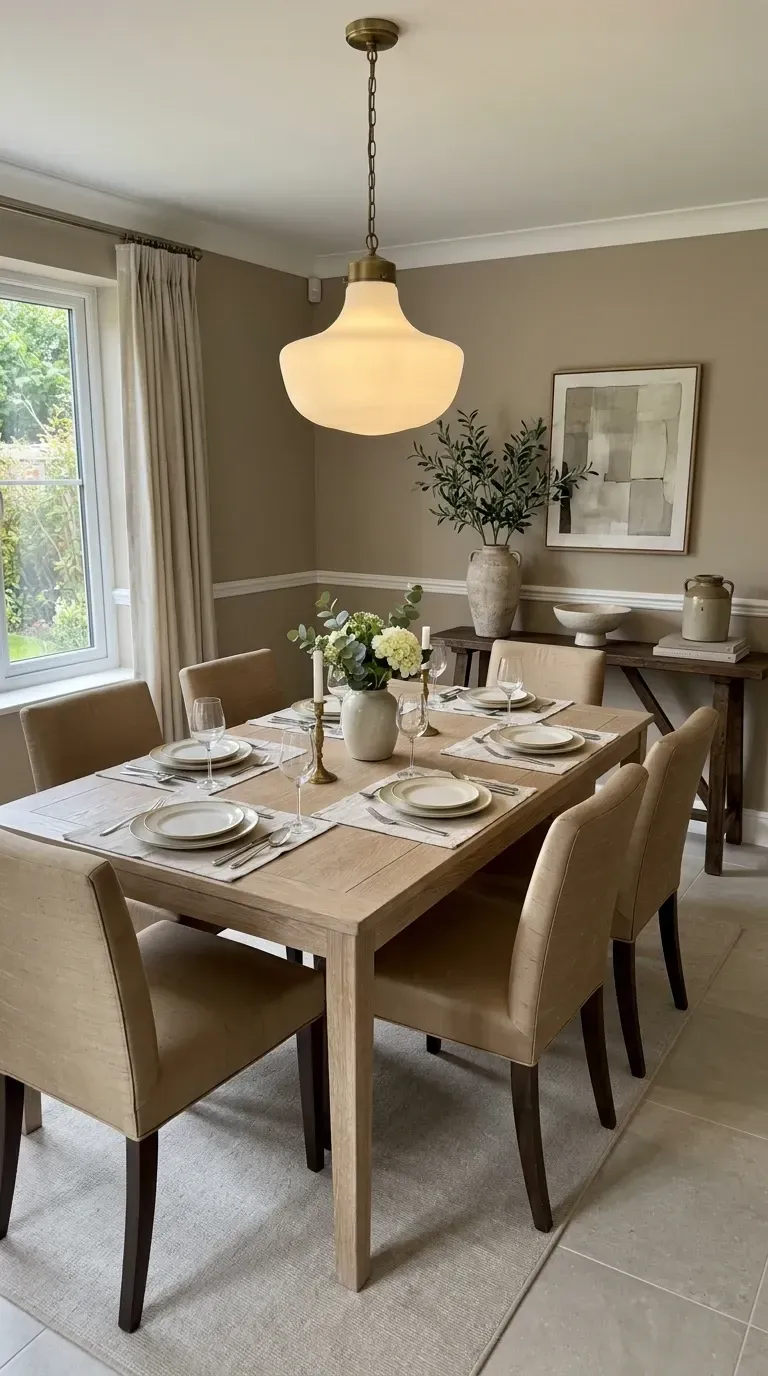
Dining rooms built for gathering, not formal occasion, are worth the most design conversation for Charleston households hosting large Low Country family dinners. A 96-inch reclaimed or white-oak table (a custom build in reclaimed heart pine or oak, or the Pottery Barn Benchwright as the accessible alternative) seats eight comfortably; the rendering shows a shorter four-leg pale oak version set for six. For the chairs, we would specify Bernhardt's Interiors line or Crate & Barrel's Miles chair upholstered in performance linen (Sunbrella Renaissance in Heather Beige or Crypton Home in Oatmeal), because spills happen at family tables, and performance-backed linen is the single most practical spec on the list. The brass-and-opal-glass pendant (Visual Comfort Hicks large or Schoolhouse Sylvan) should hang 34–36 inches above the table surface in a 9-foot-ceiling room, dropped a touch higher in older Charleston ceilings. The rustic console behind carries a 24-inch ceramic vessel with faux olive branches from Afloral, since real olives need a winter plan even in zone 8b. Mediterranean-inspired tableware (La Cafetière stoneware or Heath ceramics) finishes the scene.
A 96-inch dining table in reclaimed or white oak, custom built or the Pottery Barn Benchwright, anchors the room. Around it go eight upholstered chairs (six in the rendering) in performance linen, Bernhardt or the Miles from Crate & Barrel, and above it a brass and opal glass pendant (Visual Comfort Hicks or Schoolhouse Sylvan) hangs 34–36 inches over the tabletop. Under the set, a performance wool or poly-blend rug should be 9x12 at minimum for a 96-inch table.
Along the wall, a rustic wooden console in reclaimed heart pine or oak holds a 24-inch ceramic vessel with faux olive branches from Afloral, chosen for their realistic stems. The table is set with Heath or Mediterranean stoneware.
The dining room totals $7,840–$19,620, and seating is the biggest single decision. A set of 8 chairs in performance linen is estimated at $2,600–$6,400, a range that depends almost entirely on the frame maker and fabric grade, so price the chairs before the table. The 96" reclaimed wood table adds $1,800–$4,400, and with the chairs it makes up about 55% of the high estimate. A household seating six around a shorter table, as in the rendering, can expect the lower part of both lines.
The brass and opal glass pendant, with its dimmer, is allowed $480–$1,400, and the reclaimed wood console along the back wall $720–$1,800. The stoneware jar of faux olive stems from Afloral on that console takes $280–$560, a full set of Heath or Mediterranean tableware for 8 $580–$1,700, and the 9x12 performance wool or poly-blend rug $680–$1,700. Framed art and small styling pieces account for $220–$560, and linen curtains with installation for the garden window $480–$1,100.
Size the pendant to at least 50% of the table width; an undersized light is the most common mistake in otherwise-careful dining rooms. Put the pendant on a dimmer and specify warm 2700K; dining pendants run at 40–50% output at dinner, not full blast. Size the rug so every chair remains fully on it when pulled out: 9x12 minimum for a 96" table, 10x14 for a 108".
9. Sophisticated Home Office with Built-In Library Shelving
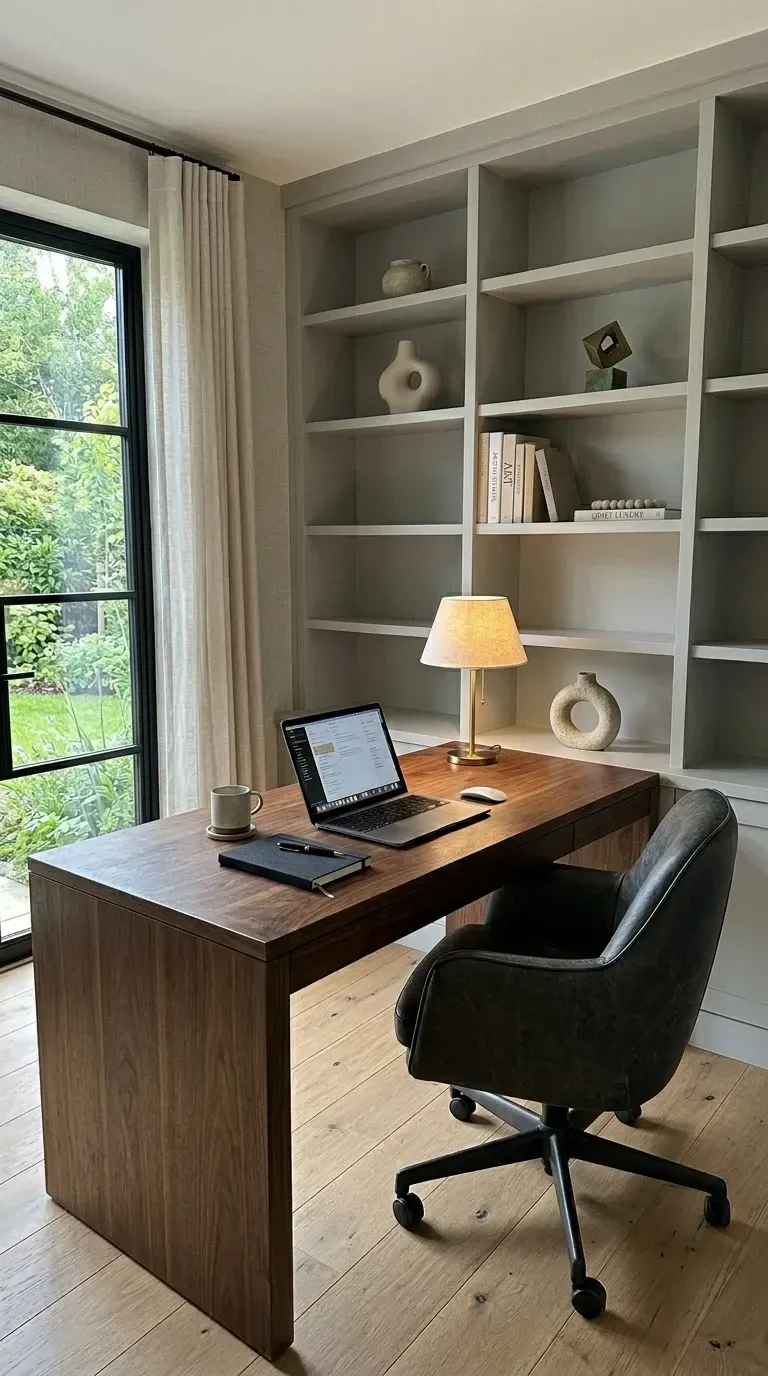
Since the pandemic the home office has become a permanent room for many households, and the full-wall built-in is the architectural move that distinguishes a home office from a repurposed guest room. Built-ins cost money ($3,000–$9,000 for a 12-foot run in Charleston, installed, painted in Farrow & Ball Pigeon No. 25 or Benjamin Moore Chelsea Gray HC-168), but they both solve the storage problem and create the backdrop that every Zoom-forward professional benefits from. The desk should be substantial: a solid walnut executive from the Restoration Hardware Martens line, or a local-shop build in American black walnut for a custom touch. Leather chair: Herman Miller Embody in leather for comfort, or the Stressless Consul for the warmer read. Steel-framed window (new-build) or steel-look interior window kit (renovation retrofit) is the architectural detail that turns a room into a study. Brass desk lamp from Visual Comfort's Parkington line provides warm task light.
A full wall of built-in shelving, painted Farrow & Ball Pigeon or Benjamin Moore Chelsea Gray, makes the room a library, and its styling follows a strict ratio of 75% books to 25% objects, never inverted. In front of it sits a solid walnut executive desk (the RH Martens or a custom local shop build) with an ergonomic leather office chair, the Herman Miller Embody or the Stressless Consul.
Light comes from a steel-framed window or a steel-look interior kit from Crittall or Arcadia, dressed with floor-to-ceiling Belgian linen curtains from The Shade Store. On the desk, the Visual Comfort Parkington brass lamp on a dimmer handles task light.
In 2026 dollars the study comes to $7,440–$19,320, and the built-in wall is most of the story. A 12-ft run of shelving with materials, labor and paint is estimated at $3,400–$8,600, the widest line in the room and the one to quote before anything else, since shelf depth and the number of uprights decide the price. The solid walnut desk, the RH Martens or a custom build like the waterfall-sided one in the rendering, adds $1,400–$3,800. Shelving and desk are about 64% of the upper figure.
The leather swivel chair is allowed $680–$1,900, and the brass desk lamp with its linen shade and dimmer $240–$560. Books and objects for the shelves take $540–$1,600; the rendering stocks them very lightly, with a few spines and ceramic rings, so this line can grow along with the library. Linen curtains for the steel-framed door, with rod and installation, are put at $640–$1,600, and the visible area of engineered wood flooring at $540–$1,260.
Style shelves with books as the base layer (horizontal stacks read more collected than vertical rows) and objects as the accent; 75/25 books to objects is our rule, never flipped. Keep book spines roughly grouped by tone, since mixing bright covers with muted spines scatters the eye. Spec dimmable overhead + dedicated task (desk lamp) + ambient (shelf sconces): three lighting layers minimum in any room where you work for hours.
10. Minimalist Entryway Console with Pampas & Brass Mirror
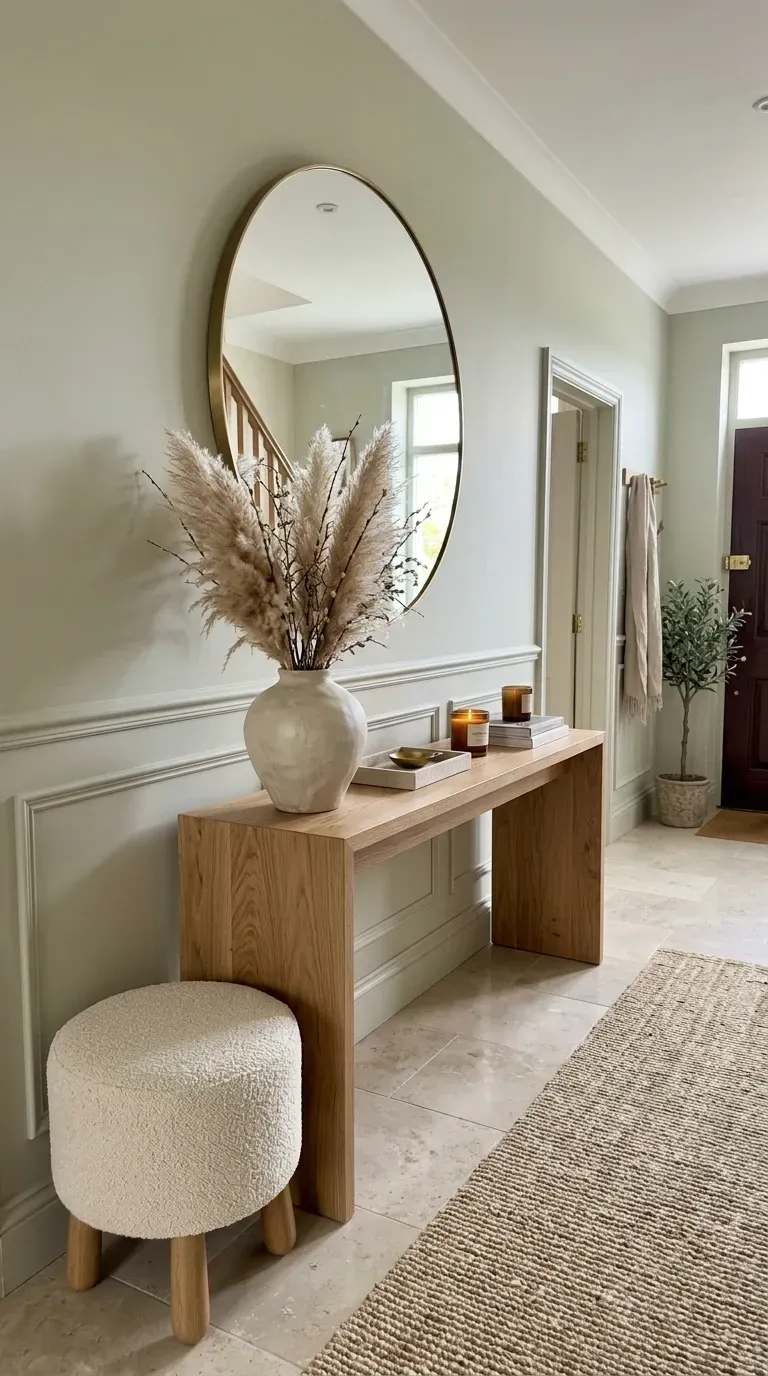
An entryway is the first tactile impression of a home. The waterfall-edge wooden console (a local Charleston build in rift-sawn white oak is our preference, or the Jayson Home Nestor for an accessible tier) creates the architectural front statement. Keep the top sparsely styled: a tall earthenware vessel from Pottery Barn's Lombok line or Mud Australia with dried pampas grass, a small brass tray, a pair of candles in amber glass (Trudon is one source), and a stack of two cloth-bound books. The large round brass mirror (Rejuvenation Madison 42" or RH Modern Solid Brass) is the move that makes the entryway breathe; it doubles light and adds implied depth. The bouclé stool (Serena & Lily Tuck or Lulu and Georgia Rhys) adds softness and practical function; it is the natural perch for pulling off wet boots after a Kiawah rainstorm. Jute runner (Fibreworks Almond), limestone or honed marble floor tile: these are the groundwork quiet-luxury details that set tone before anyone reaches the living room.
The console is a waterfall-edge piece in rift-sawn white oak, a local build or the Jayson Home Nestor, with a bouclé upholstered stool on oak legs beside it (Serena & Lily Tuck or Lulu and Georgia Rhys). Above hangs a large round brass mirror of 36–42 inches, the Rejuvenation Madison or an RH Modern piece, against classic wainscot paneling, drawn here in a pale sage-grey; Benjamin Moore White Dove is the warmer white option.
On top, a tall earthenware vessel with dried pampas (Pottery Barn Lombok or Mud Australia) gives height, and a brass tray sits beside two candles in amber glass jars. A Fibreworks Almond jute runner lies over a limestone or honed marble floor.
The entry is estimated at $4,080–$10,040 for 2026, and its largest cost is in the wall rather than the furniture. Applied wainscot paneling with professional installation and paint (BM White Dove in the original spec) is put at $1,200–$2,800, and it varies most with the length of wall and the number of panels, so measure and quote it before choosing anything else. The waterfall-edge oak console, custom or the Jayson Home Nestor, adds $900–$2,200; paneling and console are about 50% of the higher figure.
The round brass mirror, a Rejuvenation Madison at 42", is budgeted at $480–$1,200, and the bouclé stool on wooden legs at $240–$580. The earthenware vessel and its pampas bundle take $160–$380, while the brass tray and the candles, Trudon or a comparable maker, take $120–$320. The jute runner from Fibreworks costs $180–$460, and the honed stone tile across the visible floor $800–$2,100.
Entryway styling lives and dies on restraint: one tall vertical element, one stack of something horizontal, one reflective surface, nothing more. Swap the pampas for dried eucalyptus every six months to keep the vignette from becoming wallpaper. Wainscot height matters: 42" reads residential-traditional in a standard 9-foot ceiling; 54" reads hotel-lobby luxurious but requires tall ceilings to avoid compressing the room.
11. Cozy Window Corner with Cashmere & Travertine
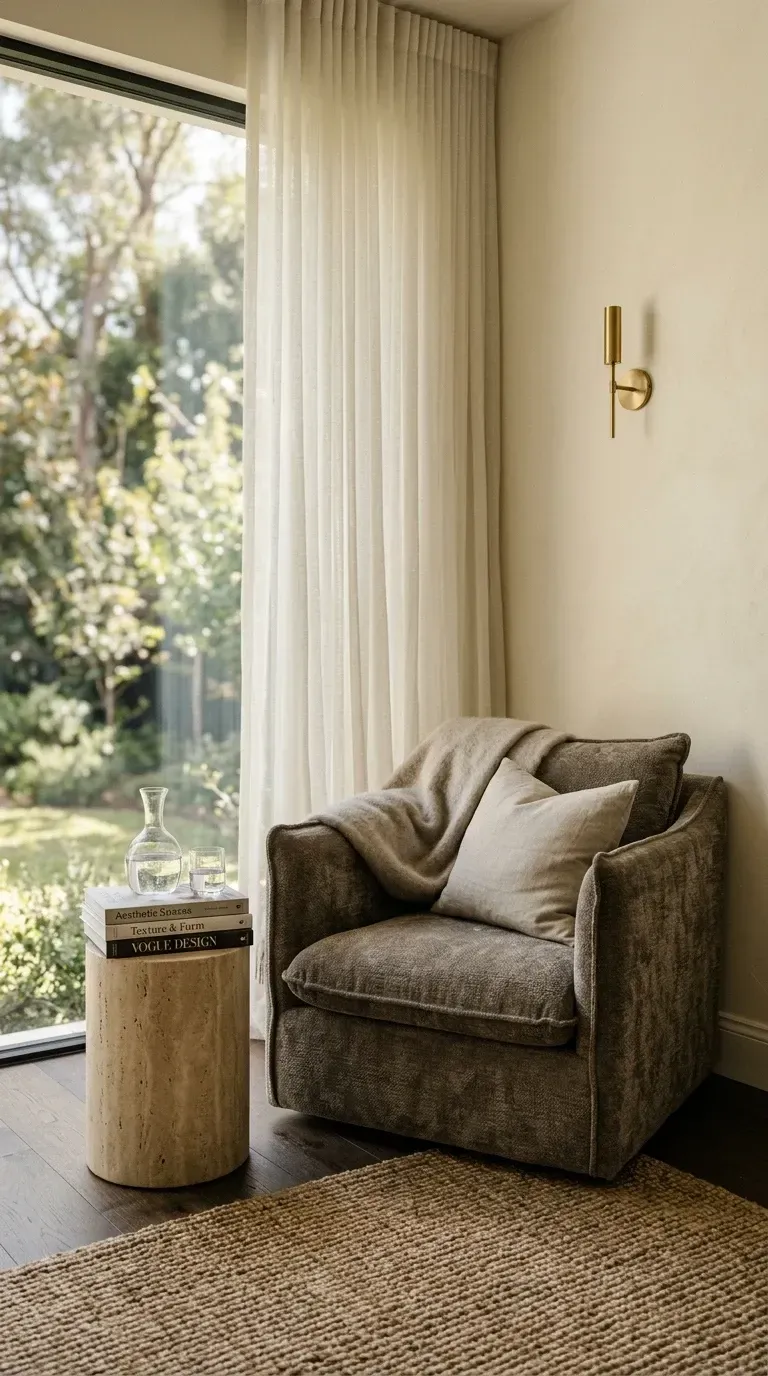
This direction suits the corner with no clear job, the leftover space beside a big window. A single armchair in a rich taupe velvet (Article Abisko in Mist Gray or a custom Lee Industries in Pierre Frey Mohair) creates a destination rather than a fill piece. The cashmere throw is not optional: the spec calls for White + Warren or Hastens for real cashmere that holds up over a decade; cheap cashmere blends pill within a season and communicate the opposite of quiet luxury. The cylindrical travertine side table (Kalon Block table or Lulu and Georgia Vail) carries styling duty: a small stack of monographs, a clear glass carafe and tumbler (Hawkins New York or a Japanese Kinto set), dried stems in a small bud vase. Above the chair, a minimalist brass wall sconce (Cedar & Moss Mast or Allied Maker Dome) provides a dedicated reading source on a dimmer, because overhead light alone kills a reading corner. Sheer floor-to-ceiling linen curtains (The Shade Store Belgian linen) filter the daylight without shutting the window off.
The seat is a taupe velvet armchair, the Article Abisko or a custom Lee Industries piece, with a real cashmere throw from White + Warren or Hastens. Next to it stands a cylindrical travertine side table (Kalon Block or Lulu and Georgia Vail) holding a clear glass carafe set from Hawkins NY or Kinto Japan beside a stack of monographs.
A minimalist brass wall sconce on a dimmer, the Cedar & Moss Mast or Allied Maker Dome, lights the page in the evening, while sheer Belgian linen curtains run floor to ceiling. A textured jute rug from Fibreworks or Jaipur Living sits underneath.
This window corner is estimated at $3,340–$8,290. The taupe armchair is where the range opens up, $900–$2,400 from an Article Abisko to a custom Lee Industries frame, so decide on it first; the cylindrical travertine side table from Kalon or Lulu and Georgia follows at $580–$1,300. Chair and table make up roughly 45% of the upper estimate.
The brass sconce with a dimmer is allowed $240–$640, and a real cashmere throw $340–$860. The glass carafe set and the monographs stacked on the table come to $160–$380; the rendering shows a clear carafe and tumbler rather than amber glass. Sheer Belgian linen curtains with rod and installation add $480–$1,100, a textured jute rug $220–$560, and the visible engineered wood floor $420–$1,050.
Place the chair at a slight angle to the window (20–30 degrees) rather than square-facing it; the angle reads intentional rather than staged. Hardwire the wall sconce if at all possible; plug-in sconces with visible cords never read luxury regardless of finish. Layer the throw over one arm rather than folding neatly at the back. A throw that looks used reads inviting; a throw folded hotel-tight reads like a showroom.
12. Modern Fireplace Lounge with Stone Surround
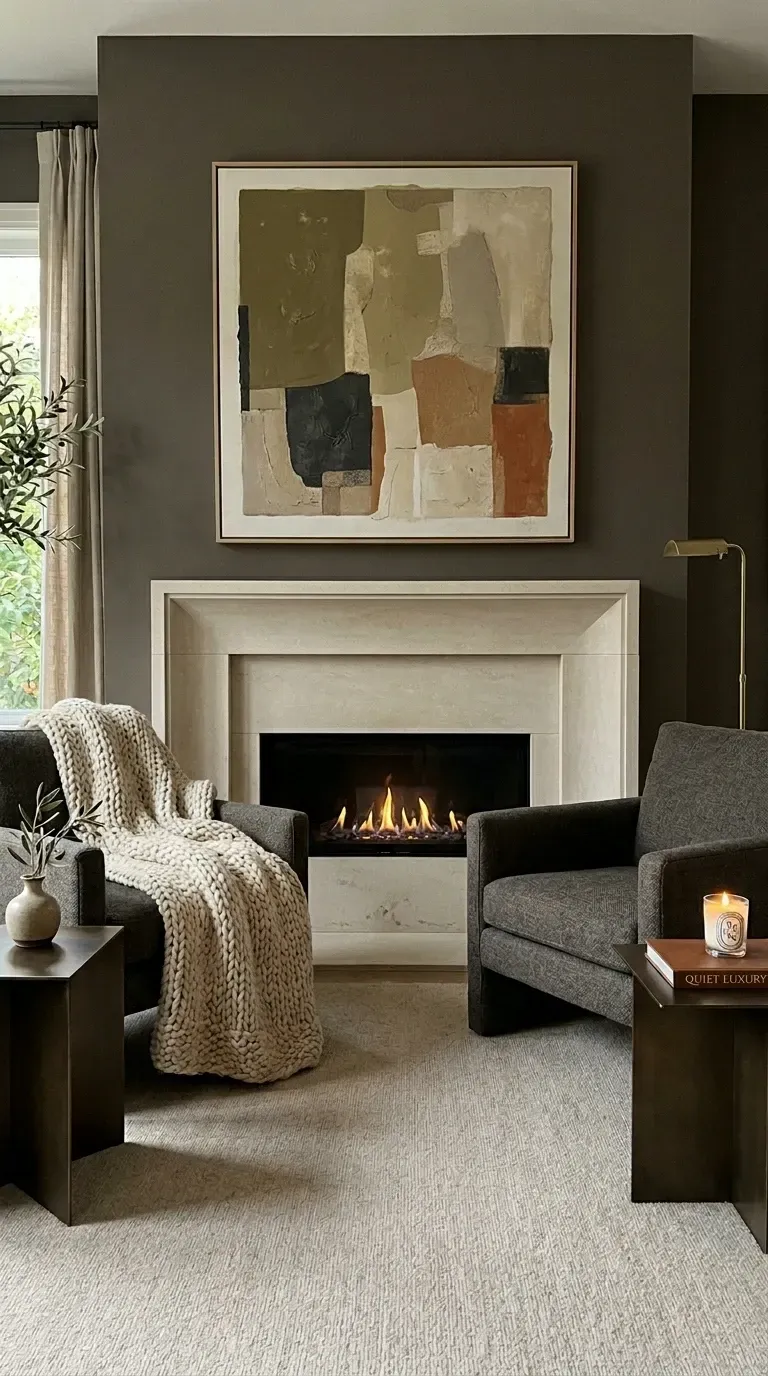
A well-specified fireplace is still the single most emotionally loaded feature in a living room: install one, spec it right, and it tends to get used more than almost any other investment. The honed stone surround is the material that makes the vignette; we default to honed French limestone (Exquisite Surfaces or Paris Ceramics) where the budget allows, or honed Danby marble from Vermont Quarries as a domestic alternative at 55–65% of the cost. The gas insert should be a Valor G3 or Heat & Glo Mezzo; we would steer away from wood-burning inserts in Charleston because of coastal humidity maintenance and chimney code complexity. The symmetrical dark-upholstered armchairs (Crate & Barrel Grayson or Lee Industries custom in Kravet Charcoal performance velvet) frame the hearth. A chunky merino or alpaca throw from Hygge & West or Amagansett softens one chair; matching side tables (RH's Nichols or West Elm Industrial) in dark patinated metal hold a single candle and a small vessel. The light-colored hand-knotted wool rug is the contrast that keeps the scene from feeling crushed by dark walls and furniture.
The surround is honed French limestone or honed Danby marble, built around a direct-vent gas insert, the Valor G3 or the Heat & Glo Mezzo. The wall carries a large abstract painting in earthy tones, commissioned through Artfully Walls.
Seating is symmetrical: a pair of dark upholstered armchairs in performance velvet from Crate & Barrel (the Grayson) or Lee Industries, each with a matching dark metal side table from RH (Nichols) or West Elm Industrial. A chunky merino or alpaca throw from Hygge & West or Amagansett adds weight and texture, and a large, light-colored hand-knotted wool rug from Armadillo (Malawi) or Stark sits between the chairs.
The fireplace wall is estimated at $10,780–$25,100 in 2026, and the hearth itself is about 52% of the upper figure. The direct-vent gas insert, a Valor G3 or Heat & Glo Mezzo with installation, is put at $3,400–$6,800 and should be specified first, since the venting route and gas run decide both the price and the opening the stone has to frame. The custom honed French limestone or Danby marble surround follows at $2,800–$6,200.
The two charcoal armchairs in performance velvet are allowed $1,800–$4,400 as a pair, and the matching dark patinated metal side tables $440–$1,100. A 40x60 abstract above the mantel, from Artfully Walls or commissioned, takes $680–$2,400, and the chunky knit merino or alpaca throw $240–$560. The pale hand-knotted wool rug (9x12) is put at $900–$2,400, the brass floor lamp and the few accessories at $340–$780, and the dark wall paint, F&B Pigeon or BM Cheating Heart with labor, at $180–$460.
Center the armchairs on the fireplace hearth, not on the room. If a doorway or circulation path forces asymmetry, orient both chairs toward the fire rather than facing one another across the hearth. Honed over polished for the stone surround; polished reads too bright and shows every fingerprint from heat operation. Set the gas insert flame on a dimmer valve rather than full-on/full-off; ambient low-flame is the spec that makes an insert earn its keep year-round.
Pro Tips for Every Quiet-Luxury Room
Spend on what you touch daily. Cabinet hardware, door pulls, faucets, light switches, throws and bed linens are handled thousands of times a year, and a $120 Rejuvenation pull reads right while a $12 Amazon pull feels cheap every time you grip it. Fiber content follows the same logic and matters more than silhouette: choose real wool bouclé, real cashmere and real linen. Poly-bouclé pills in six months, viscose velvet crushes, and fake linen never drapes right, so ask for content labels before you buy. On working stone, specify honed rather than polished. Honed Calacatta, soapstone, limestone and travertine look right in working kitchens and bathrooms and hide etching and fingerprints in a way polished never will.
Finishes and light need restraint. Three metal families is busy, two is tailored and one is unified, so pick a dominant finish (usually unlacquered brass or matte black) and one deliberate accent; three or more finishes in one vignette read as indecision however expensive each piece is. Keep the whole room at warm 2700K. Mixing 2700K and 3000K in the same space is the fastest way to make a careful room look amateur, so put dimmers on every circuit and stay warm across the board. Window treatments matter just as much, because bare windows or stock curtains undercut every other good decision. Custom floor-to-ceiling linen drapes from The Shade Store or RH change the read of a room more than any single piece of furniture.
Styling comes down to simple arithmetic. Group in odd numbers at graduated heights: three vases beat four, three books in a stack beat two, and varied heights beat uniform ones. Color works on a similar rule. Quiet luxury does not mean colorless, it means disciplined color, so give each room one saturated element (a green velvet chair, an olive tree, a deep-blue painting) and keep everything else tonal. Two or more saturated accents fight each other.
Where to Cut Without the Room Knowing
Framing and built-ins offer the clearest savings. Framebridge or Simply Framed with a 4-inch linen mat comes as close to a $600 custom frame as most eyes can tell, so keep the custom framing budget for one or two anchor pieces. For built-ins in an office or living area, IKEA Sektion boxes with Semihandmade or Reform paint-grade MDF fronts come surprisingly close to a Plain English look at 35–45% of the cost. Paint can be handled the same way: a painter can custom-mix stock Benjamin Moore to Farrow & Ball codes, matching F&B colors in BM Aura or Regal Select for half the cost per gallon. The difference in depth of pigment is real but subtle, and the cost difference is substantial.
Textiles and plants are next. Cultiver and Coyuchi linen bedding is the reference standard at $400–$1,000/set, while Target's Casaluna pre-washed linen at $180–$260/set performs remarkably well for three seasons before it needs replacing. A high-quality Afloral faux olive tree ($240–$400) passes for real from 6 feet away and never needs winter protection. Keep sheepskin and linen real (and a real olive if you can care for one), and use faux for branches and botanical stems.
Metal and stone round out the list. Pay for unlacquered brass and wait 12–18 months for the patina to develop on its own; pre-aged brass costs 25–40% more and looks uniform rather than earned. On floors, honed French limestone gives much of the feel of honed Calacatta at 55–70% of the cost, and it holds up better in coastal humidity.
Regional Fit Across Five Southeast Markets
Costs and material choices in this guide reflect Charleston 2026 pricing. The broader Southeast follows a consistent pattern, with small but meaningful adjustments per market:
Charleston and Savannah are the base pricing for this article. Coastal humidity pushes the specification toward quartzite over marble, performance velvets over pure wool velvet, and Nakamoto-style charred wood or rift-sawn oak over softer species that cup in damp air. The region also has a solid base of independent potters and furniture makers. Atlanta sits closest in cost, with labor and material comparable to Charleston, while broader retail access through ADAC and Atlanta Design Center brings faster lead times on Visual Comfort, Kravet and Pierre Frey, and trade programs are easier to reach for direct client pricing.
Nashville and Asheville both come in cheaper. Nashville runs roughly 5–8% lower on furnishings and 10–12% lower on labor for built-ins and custom cabinetry, and its drier winter climate opens the full range of marble and limestone for floors. Its maker scene for reclaimed wood is strong enough to be worth a look even for a Charleston room. Asheville prices furnishings 8–12% lower, and its craftsmen-and-trades culture means custom cabinet and millwork pricing tends to run 15–25% below Charleston for comparable quality; mountain-climate species such as cherry and walnut dominate there over the coastal-friendly oak. Austin and Dallas run the other way, 10–15% above Charleston on custom pieces because of higher labor rates. Material access is exceptional, with Austin's design showrooms and the Dallas Design District holding deeper inventory than most Charleston showrooms, and the dry climate favors real marble and limestone even in working bathrooms.
Frequently Asked Questions
What's the difference between quiet luxury and minimalism?
Both look calm, but they get there differently. Minimalism works by subtraction, keeping objects and materials to a bare few with clean lines. Quiet luxury keeps more, as long as every piece is real and pleasant to touch: stone, solid wood, wool, linen. In this guide the hallway, with its concrete floor and three prints, sits closest to minimalism, while the living room layers a bouclé sofa, a travertine table, a wool rug, a throw and a ceramic vase without looking crowded. The difference is the density of material, not the amount of decoration.
Can quiet luxury work on a tight budget?
Partially, and with discipline. The painted-wall + mid-range wool bouclé + brass hardware + honed quartzite look can be achieved across a main living room, primary bedroom, and entryway for $18,000–$32,000 if you execute two or three moves perfectly rather than spreading the budget thin across eight compromised ones. What you cannot fake on a budget: real stone in large quantities, custom built-ins, custom window treatments, and solid-wood casework. Pick your investments and execute them fully.
Is bouclé still current in 2026 or is it over?
Bouclé has moved from trend to baseline; it's a material, not a style moment. What's changing is the shape. The curved bouclé sofa is now so common we would call it saturated for photography; the fresher choice now is a tailored bouclé armchair or a bouclé sectional with a more angular silhouette. The material itself isn't going anywhere; the curves are softening back toward more architectural forms.
How can you tell real wool bouclé from synthetic?
Ask for the fiber certification before purchase; reputable retailers (RH, Jayson Home, Interior Define) will provide content labels. A burn test is the definitive method: real wool self-extinguishes and smells of burning hair; polyester melts into a bead and smells chemical. By touch, real wool bouclé has slight lanolin softness; synthetic bouclé feels scratchy and almost plastic when you rub a loop between fingers. Price is the rough proxy: anything under $1,500 for a curved "bouclé" sofa is almost certainly synthetic.
Should bathrooms get honed or polished stone?
Honed, almost always, in working wet zones. Polished stone looks dramatic in showrooms and shows every water spot, every fingerprint, every edge etching within a week of real use. Honed hides daily life and develops a subtle patina over years. The exception is a very low-use powder room where the dramatic read of polished Calacatta works and daily-use concerns are minimal.
What's the most common quiet-luxury mistake?
Buying one dramatic investment piece (a marble island, a bouclé sofa, a brass chandelier) and surrounding it with builder-grade everything else. The room reads aspirational rather than achieved because the eye catches every cheap neighbor of the expensive anchor. Better to spec one room fully at $18,000 than to spec three rooms at $6,000 each with one good piece in each. Fully executed beats broadly spread every time.
Will unlacquered brass tarnish unevenly?
Yes, and that's the point. Unlacquered brass develops a non-uniform living patina: darker where fingers touch it, lighter where they don't. Homeowners who want uniform color should specify satin or lacquered brass. Unlacquered is the choice that ages into itself; lacquered freezes the finish in time. Both are valid; they're just different design languages.
Does a quiet-luxury renovation add to resale value in Charleston?
In Mount Pleasant, Sullivan's Island, Kiawah, Daniel Island and parts of downtown Charleston it can help, because buyers in those submarkets expect real stone, good millwork and careful lighting, and a house without them competes poorly. No finish level guarantees a return, though: Remodeling Magazine's annual Cost vs. Value Report has consistently shown upscale remodels recovering only part of what they cost. In outer-ring suburbs where buyers expect builder-grade finishes, the premium is even less reliable, so match the finish tier to the neighborhood's buyer base and spend first on rooms you will enjoy regardless of resale.
Sources & References
- Remodeling Magazine, 2024 Cost vs. Value Report: South Atlantic regional data for major room renovation recoveries.
- National Association of Home Builders (NAHB), 2024 Cost of Remodeling report: line-item cost benchmarks by region and project type.
- Natural Stone Institute (formerly Marble Institute of America), Dimension Stone Design Manual: sealing, maintenance, and wear characteristics of calcium-carbonate and siliceous stones.
- American Society of Interior Designers (ASID), 2024 Outlook & State of Interior Design Report: residential material trends and client spending patterns.
- International Residential Code (IRC) 2021: R703 Exterior Wall Coverings; R301.2 wind-zone glazing requirements for coastal Charleston County.
- Portola Paints & Glazes, Roman Clay Application Guide: surface prep, cure time, and drywall compatibility specs.
- Phillip Jeffries, Arrowroot II Installation Guidelines: grasscloth seam treatment and humidity tolerances.
- Visual Comfort & Co., Professional Specification Binder: circuit and dimmer compatibility for brass sconce and pendant lines.
- Farrow & Ball, Colour Consultation & Technical Guide: color behavior under natural light at varying latitudes.
- Crypton Home Fabric, Performance Testing Data: abrasion, stain release, and UV stability for residential upholstery applications.
- Cedar & Moss, Product Specification Sheets: fixture compliance with NEC 2023 Article 410 for hardwired sconces and pendants.
- The Shade Store, Custom Drapery Specification Guide: Belgian linen weight, lining options, and installation hardware requirements.
- Marvin Windows & Doors, Ultimate Series Performance Data: hurricane-rated installation requirements for IRC Section R301.2 coastal wind zones.
- Carlisle Wide Plank Floors, Rift-Sawn White Oak Specification Guide: dimensional stability data for coastal Charleston humidity.
- Editorial team notes and estimated 2026 line-item costs for residential concepts typical of Mount Pleasant, Sullivan's Island, Kiawah, Daniel Island, Summerville, and Pawleys Island homes.
Quiet Luxury Is a Specification Discipline
Quiet luxury is a specification discipline more than a stylistic one. The homeowners who land the look cleanly are the ones who make a hundred small right choices (2700K lighting across every circuit, unlacquered brass throughout, honed stone instead of polished, real-fiber fabrics, symmetrical groupings, three-times-more-curtain-than-window fullness on drapery, odd-number styling groupings with graduated heights) rather than chasing a single dramatic moment. Those who don't land it are the ones who pick the marble coffee table and surround it with builder-grade everything else.
A useful test for any of these twelve rooms is whether it would be dull to describe and pleasant to sit in. The fireplace lounge, the window corner and the hallway bench all pass: none has a feature that demands attention in a photograph, and each rewards someone who stays for an hour. A room that looks obvious on screen is usually working too hard; one that feels calm in person has done its job.
For readers thinking about the adjacent spaces in a whole-home quiet-luxury approach, our related pieces on 12 living room transformations into calm retreats, the Nordic makeover into a calm Scandi room, 11 bedroom transformations, 12 bathroom quiet-luxury makeovers, and 11 workspace transformations cover the rooms where the same material discipline pays the same returns.
Styling & Living Desk
The Layered Homes editorial teamThe Styling & Living Desk produces the room-by-room guides, outdoor and garden pieces, celebration ideas and design solutions, each with an itemised cost estimate, and the Home Files essays.
More from the Styling & Living Desk →
Reader notes