


An unfinished basement is just a blank, slightly damp canvas — and that's a gift. These 13 makeovers show how paint, lighting, furniture, and the right materials turn a cold cinder-block shell into a layered, livable retreat, whether your taste runs minimalist, maximalist, or somewhere in the comfortable middle.
I've styled enough below-grade rooms to know the basement is where most homes give up. People treat it as storage with a sofa pushed against one wall. But the same space that feels like a dungeon at noon can read as the coziest room in the house by dinner — it's all in how you handle the walls, the ceiling guts, and the lighting. Below are 13 basement transformation ideas I keep coming back to, each with the palette that makes it work and the moves I'd actually repeat in a client's home.
Glamorous Blush & Gold Lounge
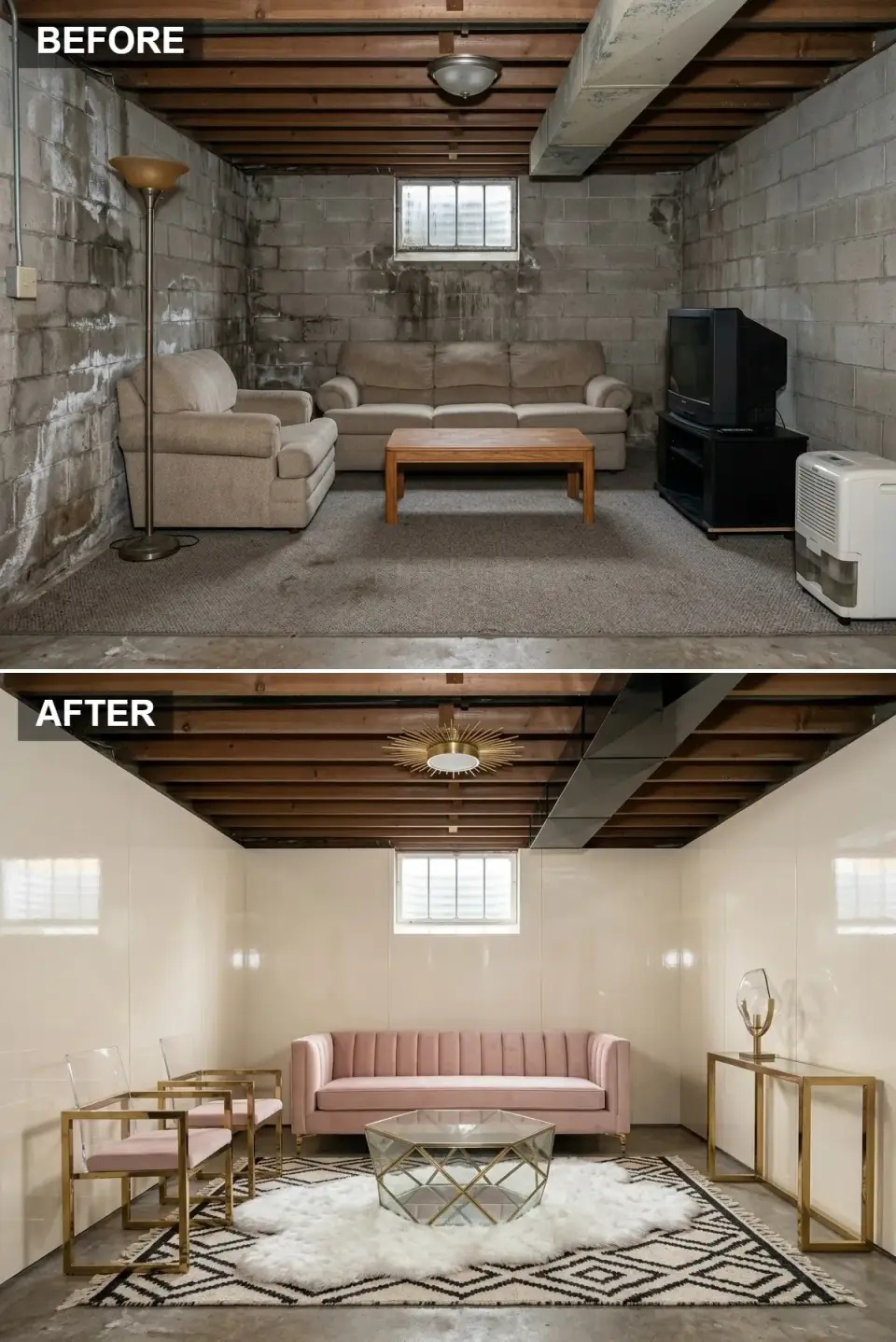
This is the one I'd point to for anyone who thinks a basement can't be glamorous. The cold cinder block disappears behind high-gloss cream panels that throw light around the room, and the joists and ductwork get painted black so they read as intentional contrast instead of leftover guts. A channel-tufted blush velvet sofa anchors the space, flanked by acrylic-and-brass chairs that keep sightlines open. A geometric glass-and-brass coffee table sits on a black-and-white tribal rug layered under white faux fur, and a sunburst flush mount swaps out the old dome light for genuine Hollywood Regency sparkle.
Color Palette
Dusty Rose
#D8A9A9
Upholstery of the channel-tufted sofa, introducing warmth and softness.
Warm Metallic Gold
#D4AF37
Finishes on the coffee table, chairs, console, and sunburst light fixture.
High-Gloss Cream
#F5F5DC
Reflective wall panels that conceal rough cinder block and amplify light.
Deep Black
#0A0A0A
Geometric rug detailing and painted ceiling ductwork for graphic contrast.
How to Get the Glam Look
- Install glossy wall panels to hide rough cinder block while bouncing light around the room.
- Layer a faux-fur rug over a geometric base rug for depth, luxury, and a little acoustic softness.
- Choose a sunburst flush-mount fixture to draw the eye up and glamorize the exposed joists.
- Bring in acrylic and brass accent chairs to keep the room feeling open yet opulent.
Mid-Century Modern Sage Retreat
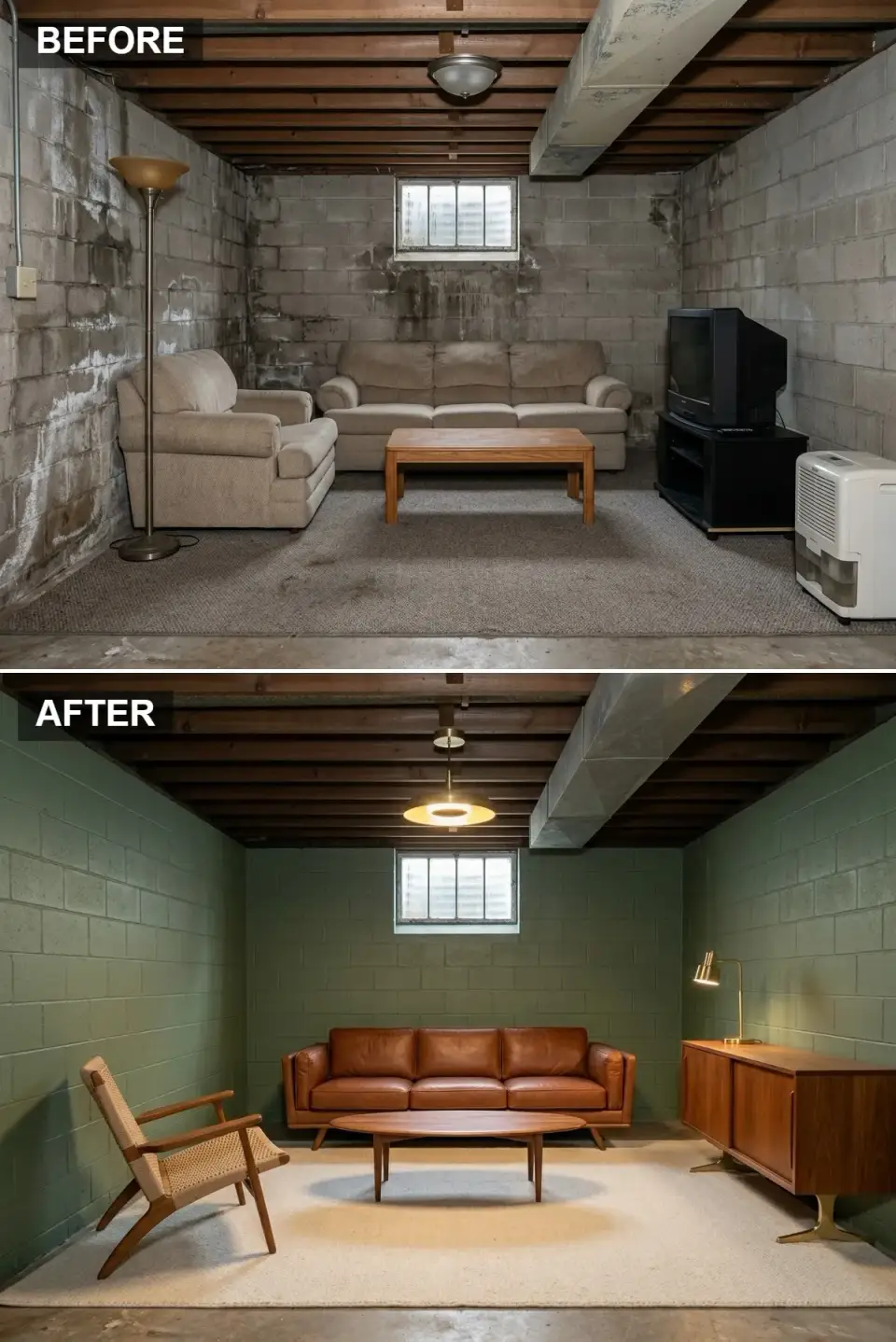
Instead of hiding the structure, this makeover leans into it — the cinder block goes a muted sage and the wood joists stay exposed in their raw state. A cognac leather sofa with clean mid-century lines replaces the sagging beige set, and a woven cane lounge chair plus a walnut credenza on brass legs settle the whole thing firmly in the 1960s. Swap the tired carpet for a thick off-white wool rug, hang a sculptural circular pendant with a warm brass interior, and the ductwork becomes just one more layer in the composition rather than an eyesore.
Color Palette
Muted Sage Green
#8A9A82
Matte paint on existing cinder block walls to soften the industrial shell.
Warm Saddle Brown
#A0552D
Rich leather upholstery of the mid-century sofa that ages beautifully.
Deep Wood Brown
#5C4033
Timber tone of the coffee table and low credenza for organic warmth.
Aged Yellow Metal
#C9A961
Hardware on the credenza and the interior of the pendant shade.
How to Get the Mid-Century Look
- Paint existing cinder block a matte sage to soften the room without burying its texture.
- Anchor the space with a cognac leather sofa that adds warmth and earns a patina over time.
- Pair mid-century wood case goods with brass hardware for authentic period character.
- Hang a sculptural pendant with a warm glow to make up for the lack of daylight.
Minimalist White & Travertine Sanctuary
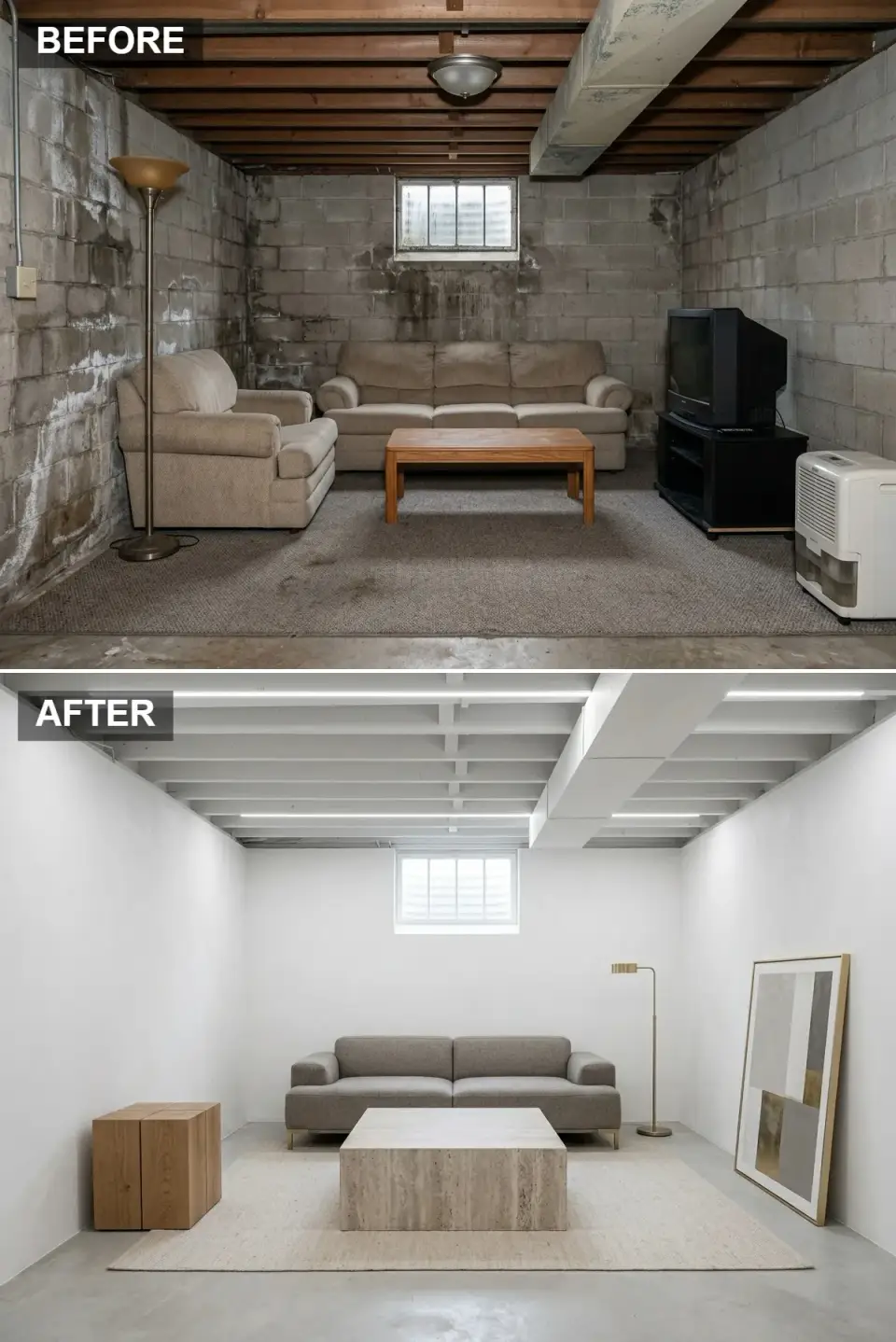
Here brightness is the entire strategy. Walls, joists, and ductwork all go a uniform gallery white, and linear LED strips tuck between the joists for even, shadowless light that makes a low ceiling feel deliberate. The bulky old seating gives way to a low-profile gray sofa and a monolithic travertine coffee table that reads like modern sculpture. Two oak block side tables and a large abstract canvas leaning against the wall finish the restrained, museum-quiet mood — this is a room that proves you don't need much, you need the right few things.
Color Palette
Crisp Off-White
#FAFAFA
Uniform paint on walls, exposed joists, and ductwork to maximize visual height.
Honed Beige
#D6C6B0
Monolithic coffee table material bringing earthy solidity to the minimalist scheme.
Light Wood
#E0D8C8
Side table blocks that add subtle warmth without visual noise.
Warm Gray
#B8B5B0
Sealed floor tone and sofa upholstery that ground the all-white envelope.
How to Get the Minimalist Look
- Paint walls, joists, and ductwork one uniform white to maximize brightness and blur the structure.
- Run linear LED strips between the joists for even, fixture-free ambient light.
- Use a monolithic travertine coffee table as a quiet sculptural focal point.
- Keep accessories sparse and let negative space set the calm, gallery-like tone.
Dark Academia Library Den
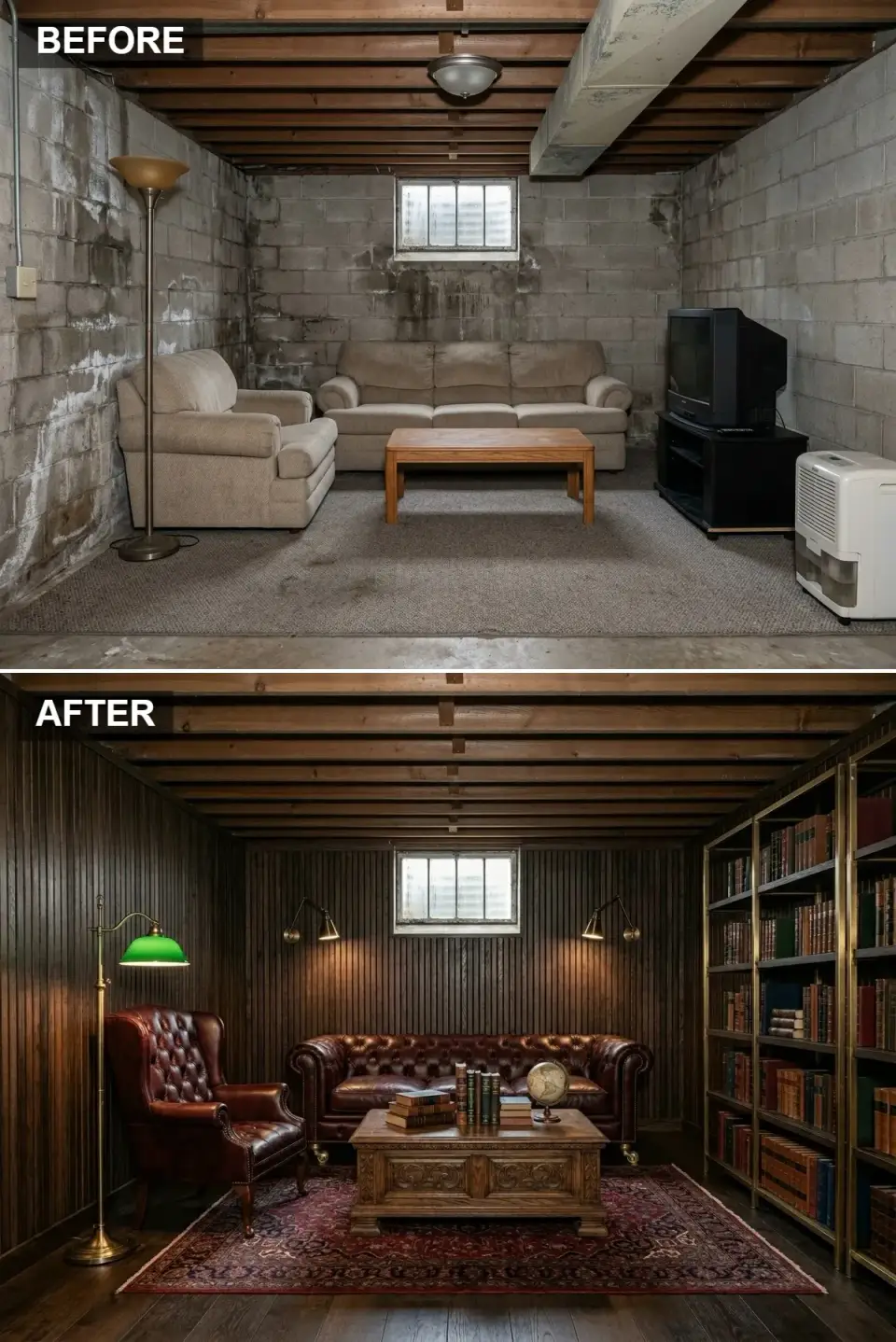
This basement gets wrapped — completely — in dark vertical mahogany paneling, with the joists stained to match so the whole room becomes a cocoon of wood. An oxblood Chesterfield and a tufted wingback bring classic comfort, and a carved oak coffee table stacked with leather-bound books and a globe sells the gentlemen's-club library fantasy. Brass swing-arm sconces flank the small window, a green banker's lamp adds its signature pop, and a deep red-and-gold Persian rug grounds the new dark hardwood. It's the rare basement that ends up reading older and richer than the house above it.
Color Palette
Deep Red-Brown
#3E2723
Vertical wall paneling, bookshelves, and stained ceiling joists for enveloping warmth.
Burgundy Brown
#4A0404
Tufted Chesterfield sofa and armchair upholstery for timeless sophistication.
Antique Yellow Metal
#B5A642
Sconce, floor lamp, and shelf framing finishes adding old-world polish.
Deep Red
#800020
Dominant tone of the vintage Persian rug anchoring the seating group.
How to Get the Dark Academia Look
- Install dark vertical wood paneling to create a cocooning, library-like envelope.
- Invest in a tufted Chesterfield sofa for timeless, scholarly weight.
- Flank the window with brass swing-arm sconces for task light and symmetry.
- Layer a vintage Persian rug to bring in color, pattern, and acoustic softness.
Organic Sage & Wood Oasis
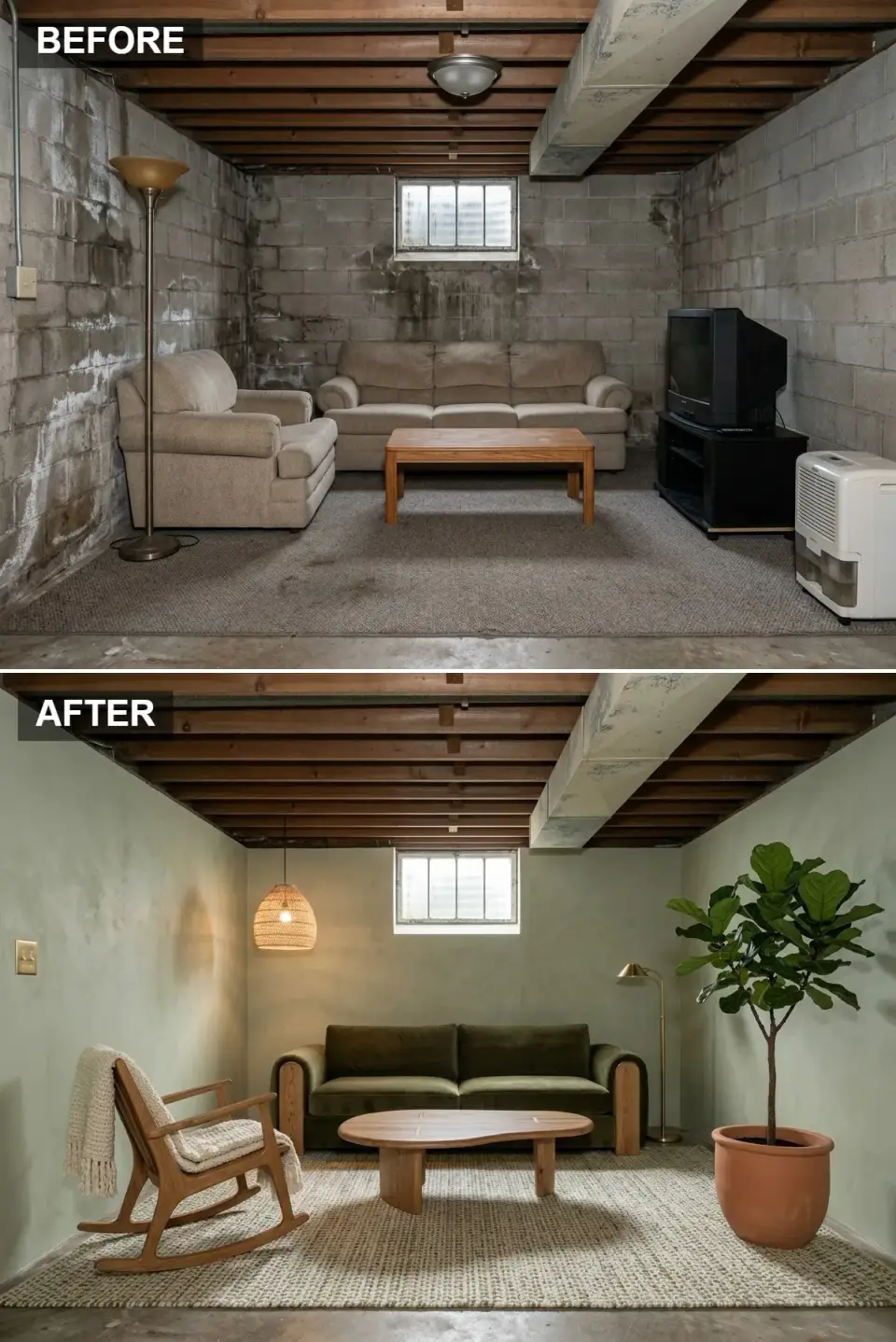
Limewash plaster in a soft sage gives these walls breathable texture and gentle variation — a world away from flat paint on block. The joists and weathered ductwork stay untouched, and that honesty is exactly what makes the organic furniture sing. A dark olive velvet sofa with sculptural wooden arms faces a live-edge coffee table and a teak rocker draped in a chunky knit. A woven rattan pendant scatters warm dappled light, and a fiddle-leaf fig in a terracotta pot drops real life into the corner and grounds the whole space in biophilic calm.
Color Palette
Gray-Green Plaster
#B2BEB5
Textured wall finish that softens the cinder block with organic variation.
Deep Moss Green
#556B2F
Sofa upholstery adding lush depth against the pale plaster walls.
Warm Golden Wood
#C19A6B
Rocking chair, coffee table, and sofa arm details introducing natural grain.
Burnt Orange
#E2725B
Large planter that ties the earthy palette together with sculptural presence.
How to Get the Organic Look
- Apply a limewash finish to the walls for subtle texture and a breathable, organic feel.
- Set a large potted tree like a fiddle-leaf fig to breathe life into a basement corner.
- Choose furniture with rounded profiles and visible wood grain to push the biophilic mood.
- Use a woven rattan pendant to cast warm, dappled light across the ceiling.
Warm Modernist Jewel Lounge
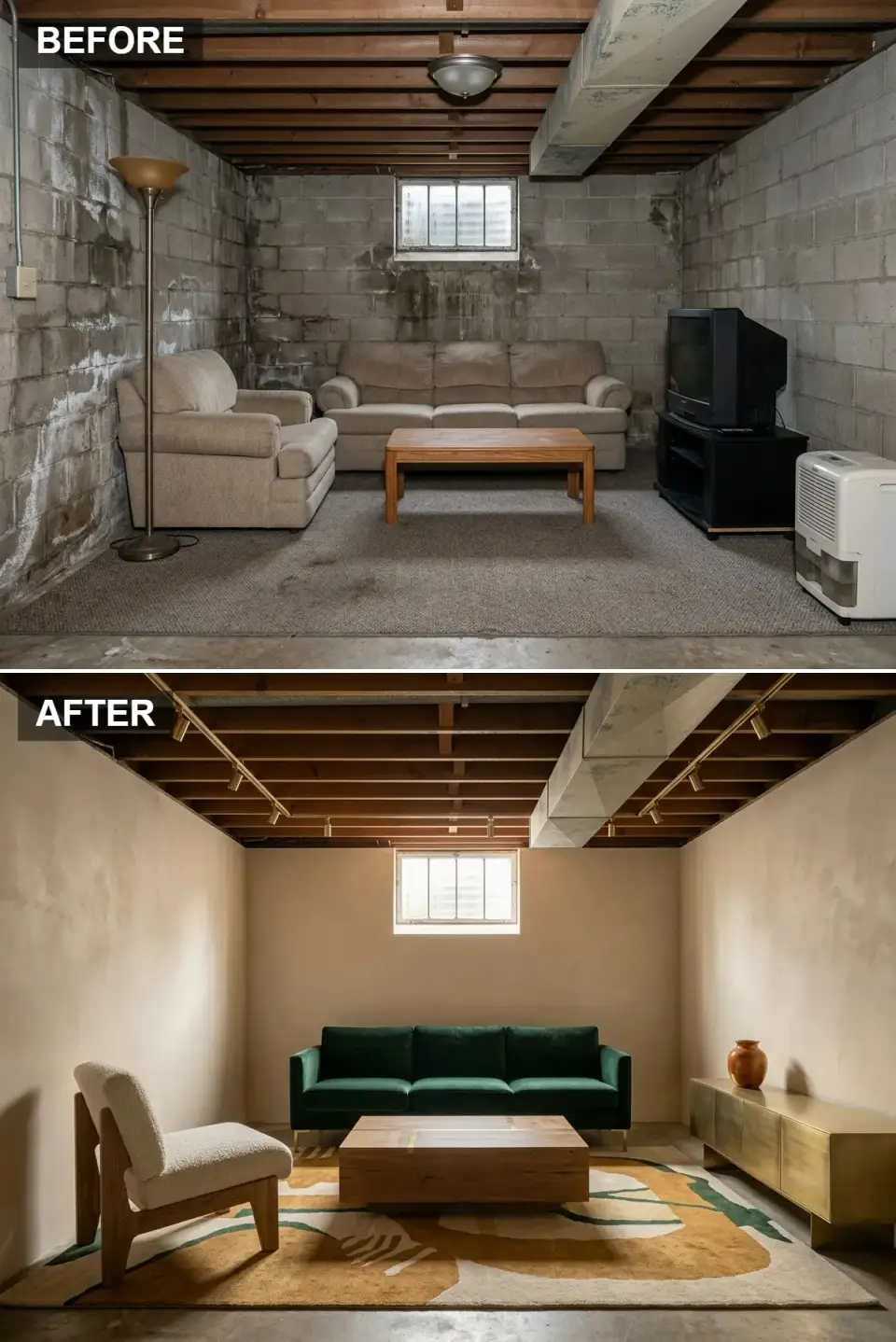
A warm plaster finish turns the cave into a sun-kissed hideaway, and track lighting mounted along the joists gives you flexible, gallery-style control over where the light lands. An emerald velvet sofa commands the room against the neutral backdrop, paired with a cream boucle chair and a low oak coffee table. A brass credenza catches the track light, and an oversized abstract rug in ochre, cream, and emerald pulls the seating zone together while injecting real artistic energy. This is jewel-tone done warm, not flashy.
Color Palette
Sand Beige
#DCC8B0
Limewashed wall finish that wraps the room in earthy warmth.
Rich Forest Green
#004F39
Deep sofa upholstery creating a luxurious focal point.
Warm Amber
#CC7722
Abstract area rug motifs that energize the neutral floor.
Aged Gold
#B5A642
Credenza body and track lighting hardware adding reflective warmth.
How to Get the Warm Modernist Look
- Mount track lighting along the exposed joists to send light exactly where you need it.
- Anchor the seating area with an oversized abstract rug that pulls together every accent color.
- Contrast a deep velvet sofa against warm plaster walls for rich tonal layering.
- Add a low brass credenza for storage that never interrupts the sightlines.
Japandi Minimalist Escape
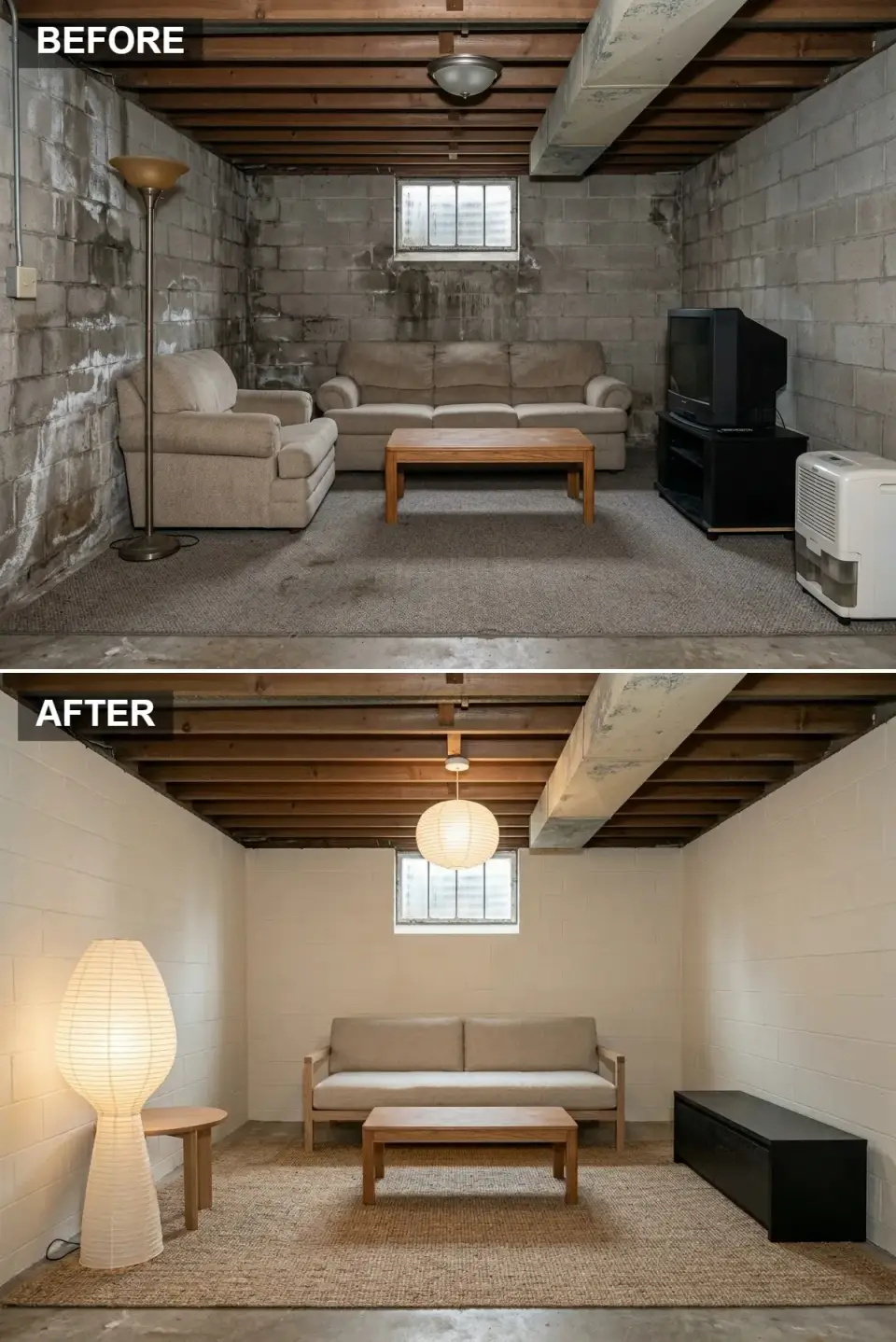
This redesign is an exercise in restraint. The block goes a warm alabaster — softer than stark white — paired with low oak furniture: a slender frame sofa with a linen cushion, a small round side table, a minimal coffee table. The real stars are the lanterns. A Noguchi-style paper floor lamp and a round paper pendant glow softly and do the work the missing windows can't. A jute rug and a low black storage bench complete a calm Japanese-Scandinavian meditation on empty space.
Color Palette
Soft Off-White
#FFFDD0
Painted cinder block walls that feel warmer than stark white.
Pale Golden Wood
#F3E5AB
Oak furniture frames offering quiet grain and understated craft.
Rice Paper Ivory
#FAF0E6
Pendant and floor lamp shades diffusing light into a soft glow.
Natural Fiber Beige
#C2B280
Area rug adding tactility and grounding without pattern competition.
How to Get the Japandi Look
- Embrace negative space and resist over-furnishing to hold the serene Japandi feel.
- Use sculptural washi paper floor and pendant lamps to diffuse light softly.
- Keep seating low-profile and leggy to preserve the open volume under the joists.
- Choose a natural-fiber rug for tactility without visual clutter.
Industrial Luxe Cocktail Lounge
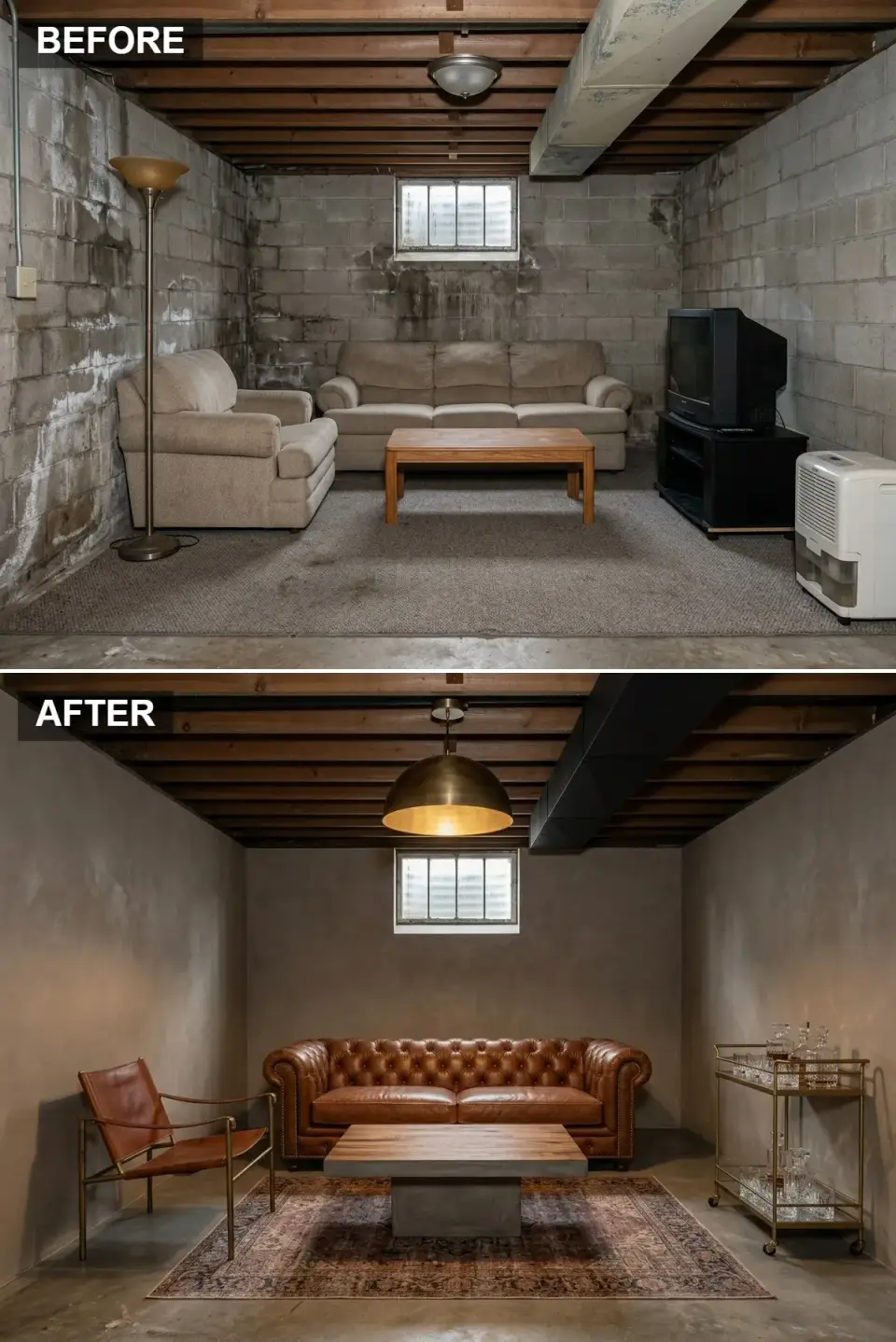
Dark Venetian plaster coats the walls in moody, tactile gray while the joists stay exposed and the ductwork goes matte black for an urban edge. A cognac Chesterfield brings timeless comfort, set against a modern leather-and-metal sling chair. The coffee table pairs a live-edge walnut slab with a raw concrete base, and a brass-and-glass bar cart stands ready for company. An oversized brass dome pendant pools warm metallic light over it all, and a faded vintage rug softens the polished concrete underfoot.
Color Palette
Deep Gray
#36454F
Venetian plaster wall finish adding depth, shadow, and tactile drama.
Rich Cognac
#8B4513
Chesterfield and sling chair upholstery bringing warmth to the dark shell.
Dark Yellow Metal
#C9A961
Pendant, bar cart framing, and accents introducing sophisticated shimmer.
Cool Mid-Gray
#959595
Coffee table base material reinforcing the industrial foundation.
How to Get the Industrial Luxe Look
- Apply dark Venetian plaster to the walls for depth, texture, and an industrial-luxe mood.
- Mix a classic Chesterfield with a raw concrete coffee table to balance refinement and edge.
- Add a rolling brass bar cart to carve out a real entertaining zone.
- Hang an oversized brass dome pendant to command attention and warm up the dark.
Soft Organic Modern Cloud Room
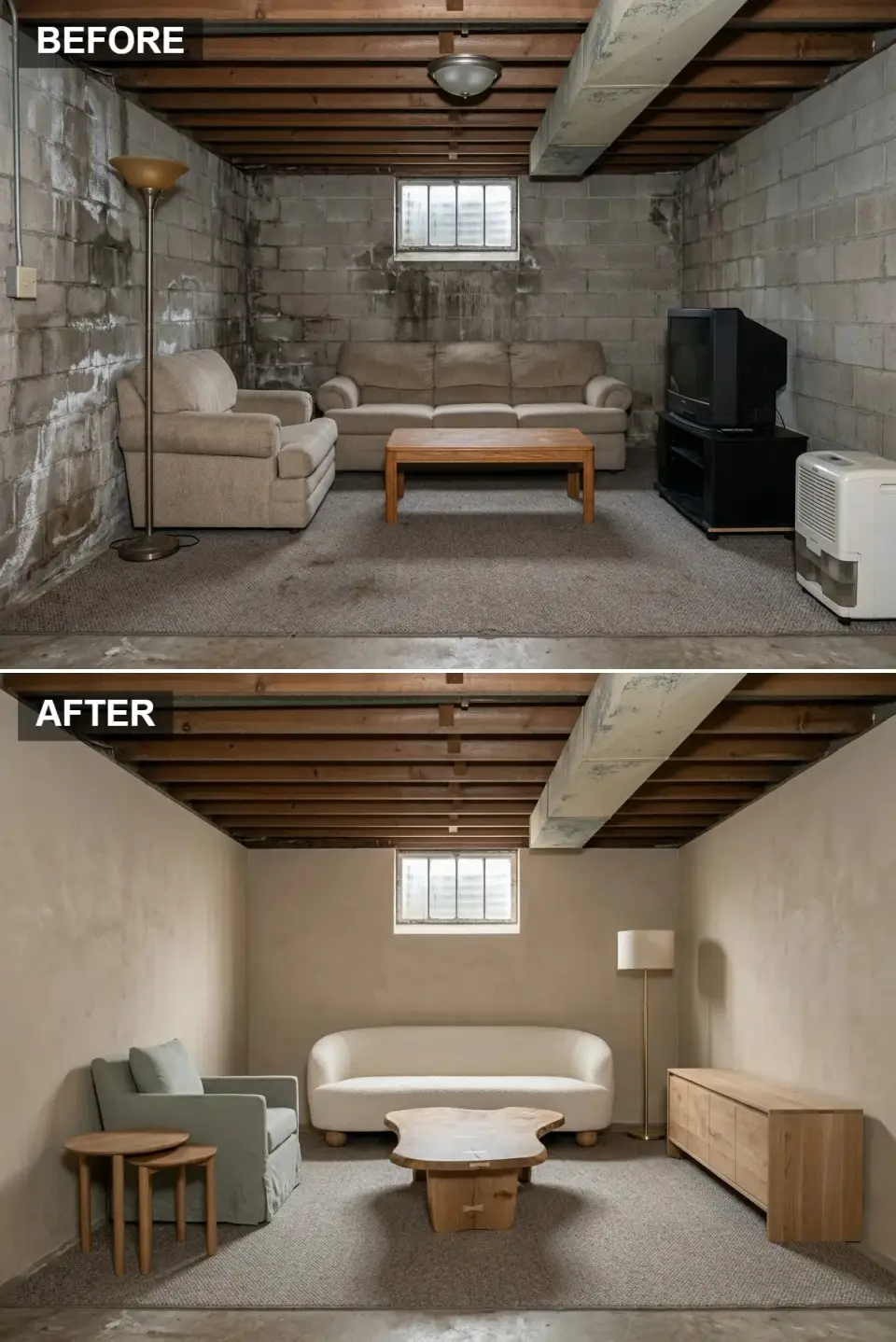
This one is all curves and comfort. Soft taupe plaster on the walls, a cloud-like cream boucle sofa with rounded, sculptural edges, and a pale eucalyptus linen armchair for a whisper of color. A live-edge oak coffee table brings in natural imperfection, two nesting oak side tables add flexibility, and a long oak credenza handles storage without drawing attention. The light stays gentle — a single floor lamp with a white linen drum shade — and a textured gray rug finishes a palette that genuinely feels like a hug in basement form.
Color Palette
Warm Taupe
#E6DCC4
Plaster wall finish creating a calming, earthy envelope.
Ivory White
#F5F5F5
Boucle sofa upholstery offering plush texture and curved softness.
Soft Blue-Green
#A8C3BC
Linen armchair upholstery adding a subtle wash of cool color.
Natural Blond Wood
#C19A6B
Coffee table and side tables showcasing organic grain and freeform edges.
How to Get the Soft Organic Look
- Bring in curved silhouettes, like a cloud sofa, to soften the basement's boxy geometry.
- Layer tonal neutrals — cream, oat, and pale sage — for a calm, cohesive palette.
- Use a live-edge wood coffee table to add natural, one-of-a-kind character.
- Keep the rug plush and high-pile for literal softness underfoot.
Art Deco Glamour Underground
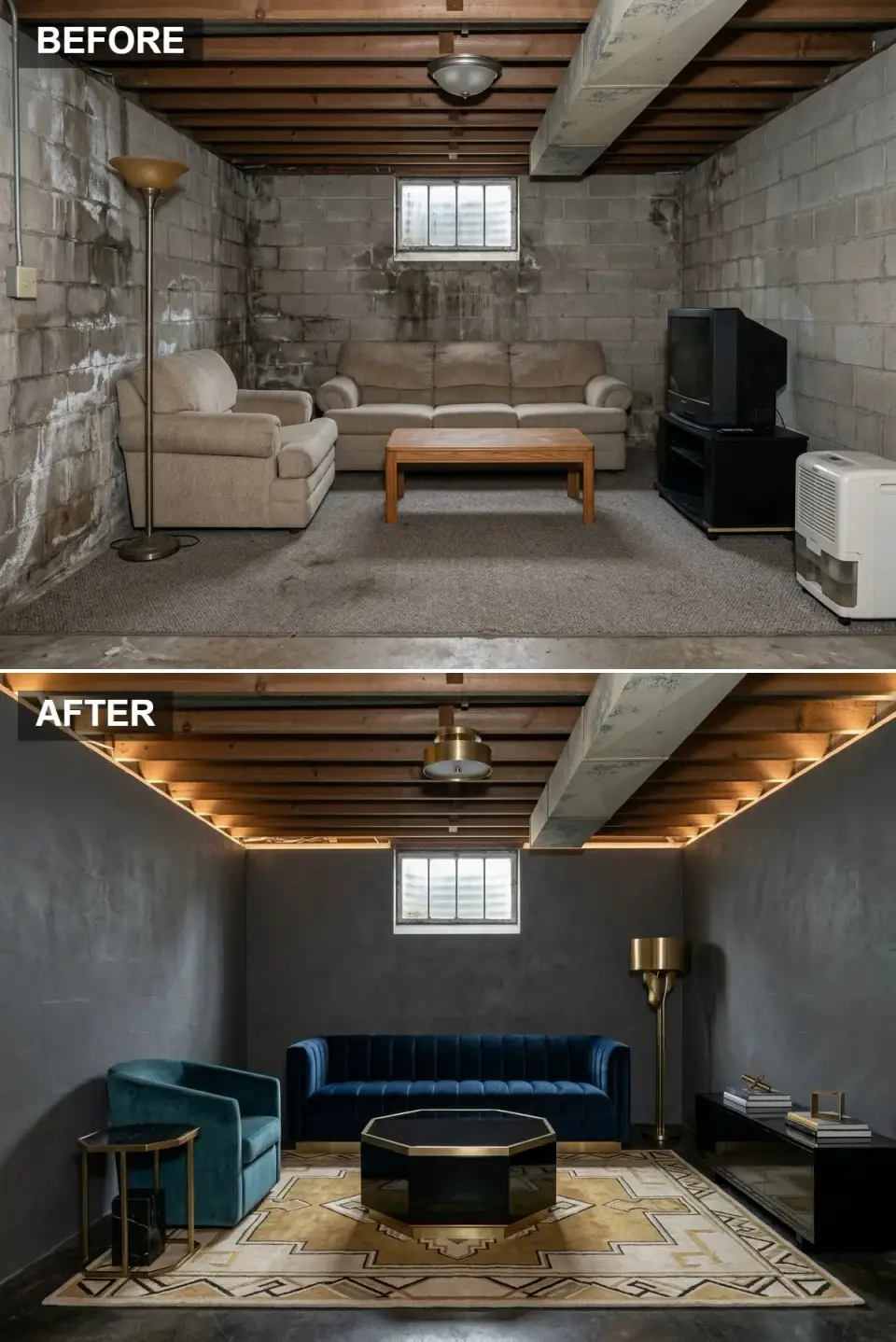
Dramatic and a little decadent, this basement is wrapped in charcoal plaster and lit by warm LED strips tucked into the joists, so the perimeter glows like a hidden speakeasy. A navy velvet channel-tufted sofa and a teal barrel chair deliver the jewel tones, while a black lacquer octagonal coffee table with brass trim brings the Deco geometry. A brass floor lamp and a black lacquer console with stacked books reinforce the high-gloss glamour, and a geometric gold-and-cream rug anchors it all in unmistakable 1920s opulence.
Color Palette
Deep Blue
#191970
Velvet sofa upholstery creating a rich, saturated anchor.
Dark Cyan
#006D5B
Barrel chair upholstery adding complementary jewel-tone contrast.
Bright Metallic Gold
#D4AF37
Geometric rug motifs, lighting trim, and hardware reflecting Deco luxury.
High-Gloss Black
#000000
Coffee table and console finishes adding mirror-like drama.
How to Get the Art Deco Look
- Install perimeter LED strips inside the exposed joists for dramatic, indirect ceiling glow.
- Combine jewel-toned velvets with high-gloss black furniture for Art Deco drama.
- Use a geometric area rug to reinforce the structured, glamorous aesthetic.
- Pick a low, octagonal coffee table to echo Deco geometry and keep the room open.
Scandinavian Bright & Airy Den
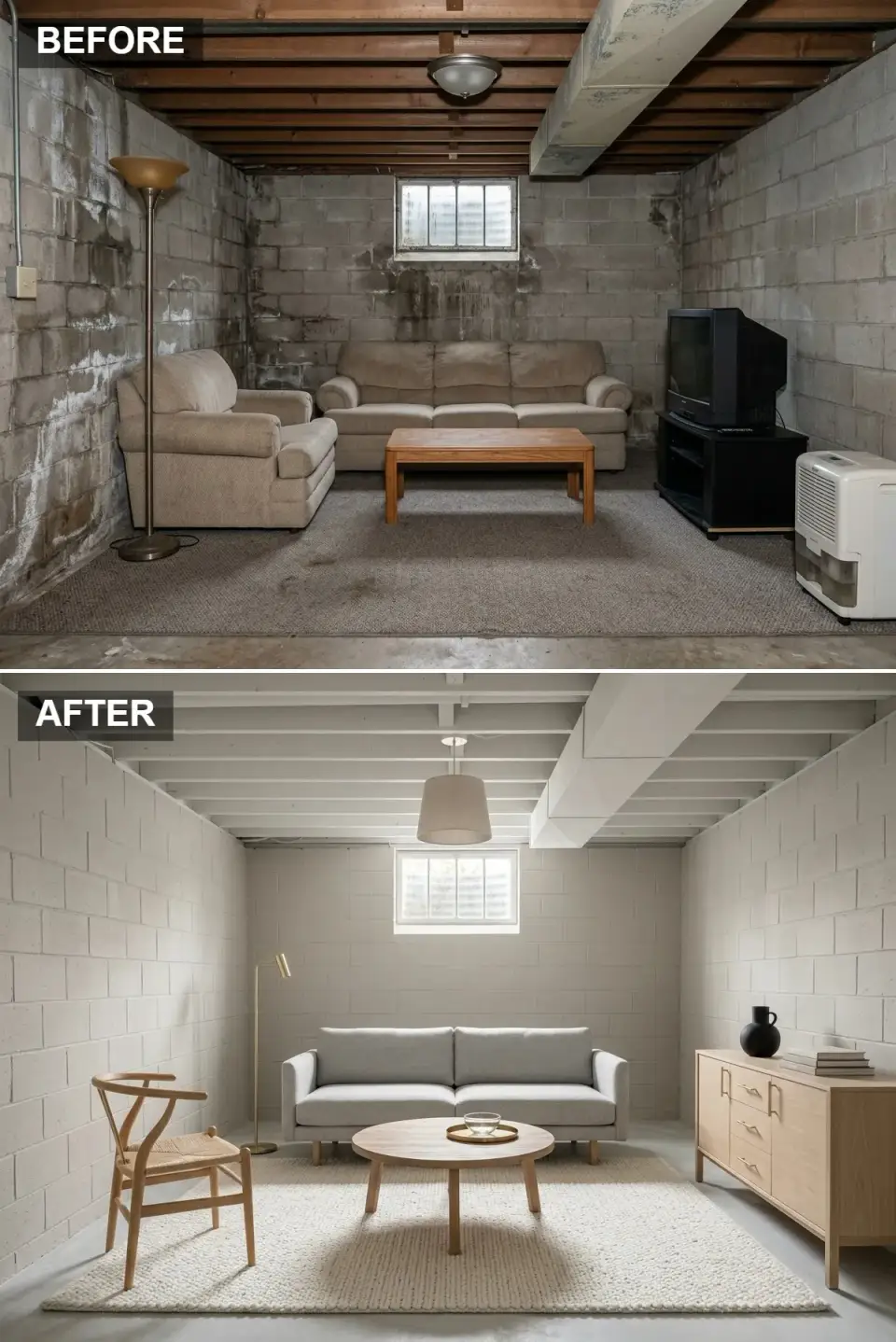
To squeeze every bit of light out of a dim basement, this makeover paints the block walls, the joists, and the beams a uniform Nordic white, quietly erasing the visual boundaries. Classic Scandinavian pieces keep it light and functional — a pale gray sofa, a Wishbone chair with a woven cord seat, a pale oak credenza. A round oak coffee table sits on a thick off-white textured rug, and a brass floor lamp plus a fabric drum pendant add just enough warmth so the all-white scheme never tips into sterile.
Color Palette
Crisp White
#F0F0F0
Uniform paint on block walls and ceiling joists expanding perceived volume.
Blond Wood
#E0D8C8
Oak furniture frames delivering quintessential Scandinavian warmth.
Light Gray
#B0B5B9
Upholstery of the low sofa adding gentle contrast to the white shell.
Warm Gold
#B5A642
Floor lamp finish introducing a pinpoint of metallic warmth.
How to Get the Scandinavian Look
- Paint the cinder block and ceiling joists the same crisp white to blur boundaries and open the room.
- Invest in iconic Scandinavian pieces, like a Wishbone chair, for timeless functional beauty.
- Add brass through the lighting so an all-white scheme never feels sterile.
- Use a textural off-white rug to unify the pale tones and add coziness.
Cozy Contemporary Charcoal Cocoon
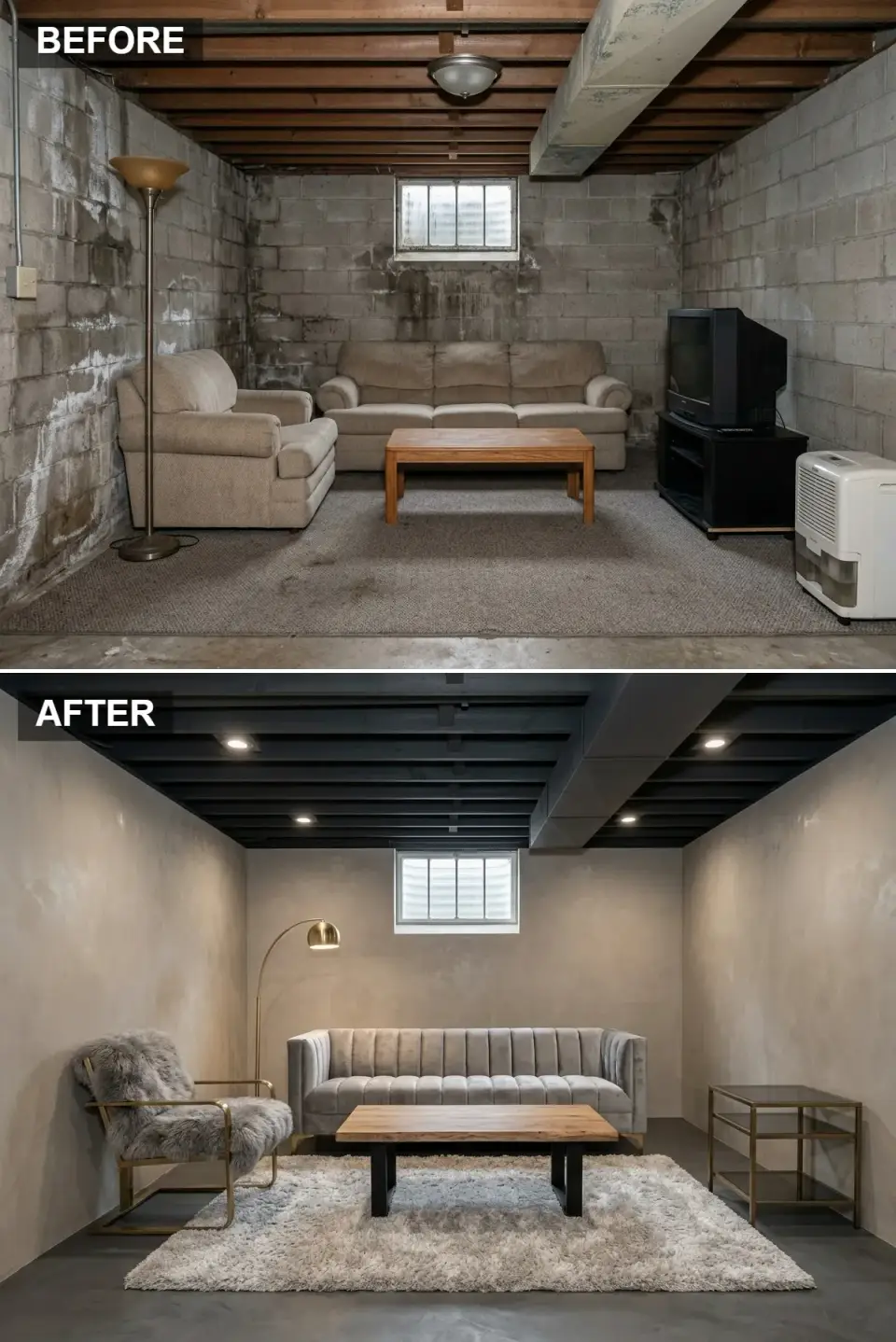
Here the joists and ductwork go matte black for an intimate, cocooning effect — the basement reads as a private hideaway rather than an afterthought. Warm gray plaster covers the walls, and recessed cans give clean, modern light without fighting the low ceiling. A channel-tufted silver velvet sofa sits opposite a brass-framed chair draped in thick gray faux fur, a reclaimed-wood coffee table with black legs bridges the two, and a plush white shag rug layers softness over the dark sealed floor.
Color Palette
Warm Gray
#708090
Wall finish providing a soft, stone-like backdrop.
Dark Charcoal
#2A3439
Painted ceiling joists and ductwork creating an enveloping cocoon.
Light Gray
#C0C0C0
Sofa upholstery reflecting the recessed lighting with subtle sheen.
Pale Gold
#F7E7CE
Arc floor lamp and chair frame adding delicate metallic warmth.
How to Get the Charcoal Cocoon Look
- Paint the joists and ductwork matte black to create an intimate, cocooning envelope.
- Use recessed can lights for clean, modern light that doesn't fight a low ceiling.
- Mix textures — channel-tufted velvet, faux fur, shag — for tactile luxury.
- Keep all furniture low-slung to hold onto generous headroom beneath the structure.
Mediterranean Terracotta Hideaway
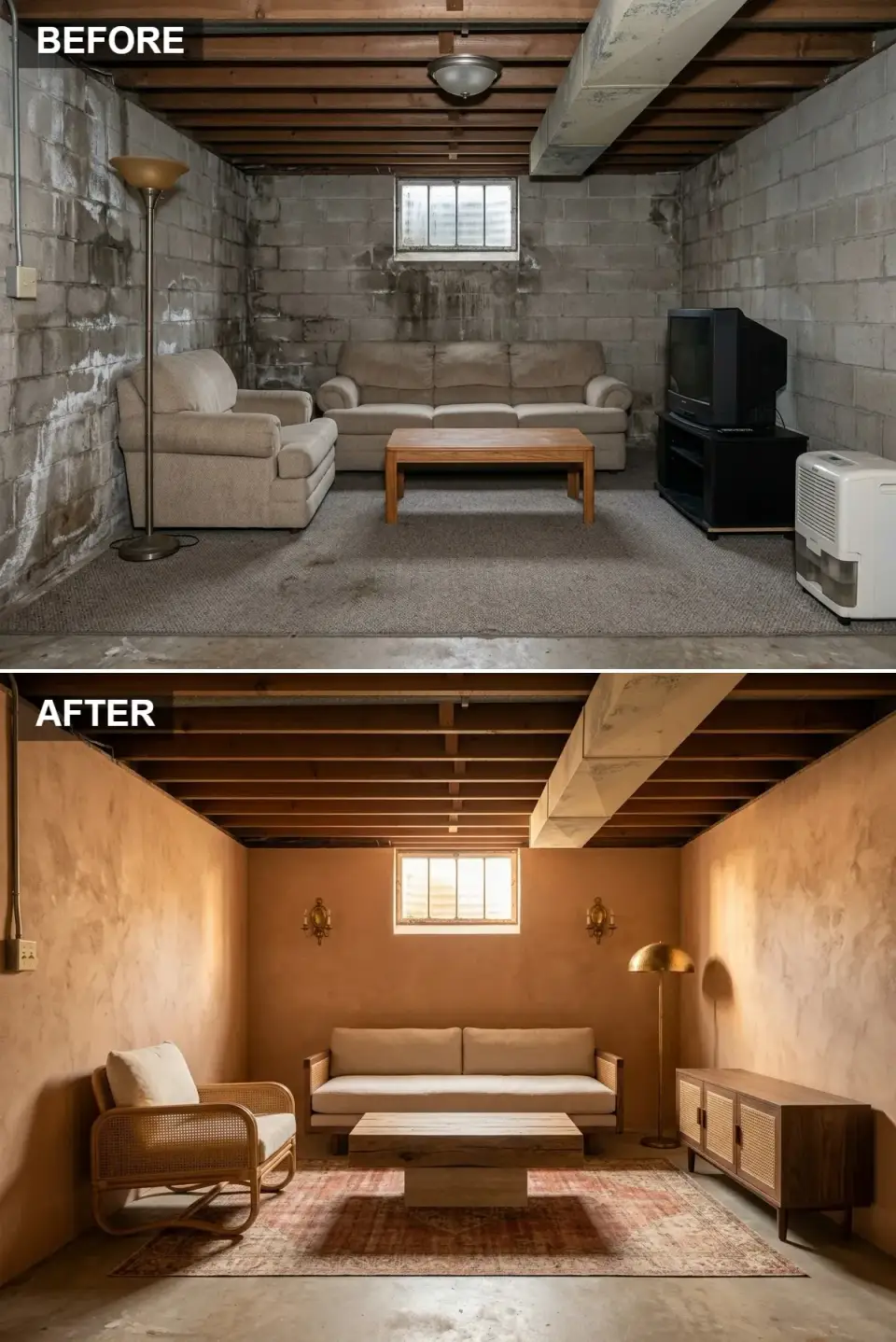
Warmth comes off every surface here. The walls get hand-troweled terracotta plaster that reads like a Mediterranean sunset, the joists stay natural, and vintage brass sconces flank the small window like antiqued jewelry. A cane-and-wood sofa with raw linen cushions faces a matching cane lounge chair, and a reclaimed wood block coffee table centers a faded vintage rug in clay tones. A brass dome floor lamp and a cane-front sideboard seal the sunbaked, old-world resort feel — proof a basement can read as a getaway.
Color Palette
Burnt Sienna
#E2725B
Hand-troweled wall finish infusing the room with sunbaked warmth.
Woven Tan
#D2B48C
Cane webbing and furniture frames adding lightweight, breezy texture.
Unbleached Cream
#FAF0E6
Sofa and chair cushions providing soft, casual comfort.
Dark Bronze
#B87333
Vintage wall sconces and floor lamp patina complementing the plaster.
How to Get the Mediterranean Look
- Coat the walls in warm terracotta plaster to call up Mediterranean sunset tones.
- Work in cane and rattan furniture for lightweight texture and vintage resort style.
- Flank the window with aged brass sconces for symmetry and old-world charm.
- Layer a faded vintage rug to ground the room with subtle pattern and warmth.
Pro Tips for Your Basement Transformation
- Test for moisture and seal the concrete before you install any finished flooring or rugs — this is the step people skip and regret.
- If you're leaving the ceiling joists exposed, paint them and the ductwork one color so they read as a design choice, not a shortcut.
- Layer three sources of light — ambient, task, and accent — to make up for the daylight a basement doesn't have.
- Choose low-profile, visually light furniture to protect your headroom and keep the space feeling open.
- Use large area rugs to define seating zones and insulate against a cold slab underfoot.
Frequently Asked Questions
How do I deal with basement moisture before finishing the space?
Start there before you buy a single piece of furniture. Identify and fix any water intrusion, run a dehumidifier through a full season to gauge humidity, and test the slab's relative humidity before laying finished flooring. Limewash and plaster wall finishes are popular in these makeovers partly because they breathe better than vinyl wallpaper over block.
Can these looks work in a basement with low ceilings?
Yes, and most of them are designed for it. Painting the joists and ductwork the same color as the ceiling, keeping furniture low-slung, and using fixture-free lighting like LED strips or recessed cans all make a low ceiling read as intentional rather than cramped.
Should I cover the ceiling joists or leave them exposed?
It depends on the mood you want. Exposing and painting the joists — black for a cocoon, white to disappear them — saves the height a dropped ceiling steals and gives the room an honest, loft-like character. Cover them only if you need to hide a lot of mechanicals or want a more formal finish.
How do I light a basement with little or no natural light?
Layer it. Combine an ambient source (recessed cans or LED strips), task lighting where you read or pour a drink, and accent pieces like a sculptural pendant or paper lantern. Warm-toned bulbs around 2700K keep the space from feeling clinical, which matters even more when there's no window to soften things.
What flooring works best over a concrete slab?
Once the slab passes a moisture test, luxury vinyl plank, sealed concrete, and engineered wood over a proper vapor barrier all hold up well below grade. Whatever you choose, a large area rug does double duty — it warms the floor underfoot and defines the seating zone.
Final Thoughts
What all 13 of these rooms have in common is that nobody tried to pretend the basement was something it isn't. They worked with the low ceiling, the exposed structure, and the missing daylight instead of fighting them — and that's the whole secret. Whether you land on dark academia drama, an all-white Scandinavian den, or a terracotta hideaway, start with moisture and lighting, then layer in the textures that make the room feel collected rather than decorated.
If you're carving out other hard-working corners of the house, my roundups of workspace transformations and garage-to-studio makeovers use a lot of the same below-grade tricks. For more on building a layered, livable palette upstairs, I'd read my take on the quiet-luxury kitchen, and if you're hunting for a specific style direction, the 11 bedroom transformations and dining room styles guides are good places to keep going.
Sources & References
- U.S. EPA — Moisture Control Guidance — federal guidance on identifying and managing basement moisture before finishing below-grade space.
- Building Science Corporation — research-based methods for insulating and air-sealing below-grade walls.
- ASTM F2170 — standard test method for relative humidity in concrete slabs prior to installing finished flooring.
- American Lighting Association — principles of layered ambient, task, and accent lighting for low-daylight rooms.
- Benjamin Moore & Farrow & Ball — limewash and high-gloss interior finishes referenced for the wall treatments above.

Elise Marchetti
Transformations Editor · Charleston, South CarolinaBefore-and-after projects with the invoices attached. Elise runs the Transformations desk — interiors, exterior facades and outdoor spaces across the Lowcountry and the wider South — and writes up what actually changed, what it cost, and which three decisions moved the room.
More from Elise →
Reader notes