


Most of my Charleston clients with growing families end up with the same problem — the beige spare bedroom that was a fine guest room when they bought the house becomes a low-functioning kids' room the moment a second child arrives. I get asked about this conversion more than almost any other room project. Below are thirteen restylings of one such room — a tired beige guest box that I helped one family rework — laid out as a menu of design directions rather than a single answer. Some lean traditional and timeless; others commit to a theme; a few are deliberately quiet. Pick the one that matches your child's age, your house's broader style, and how long you want the room to read as "kid" before it shifts to "tween."
1. The Gilded Canopy: Art Deco Blush & Teal Glamour
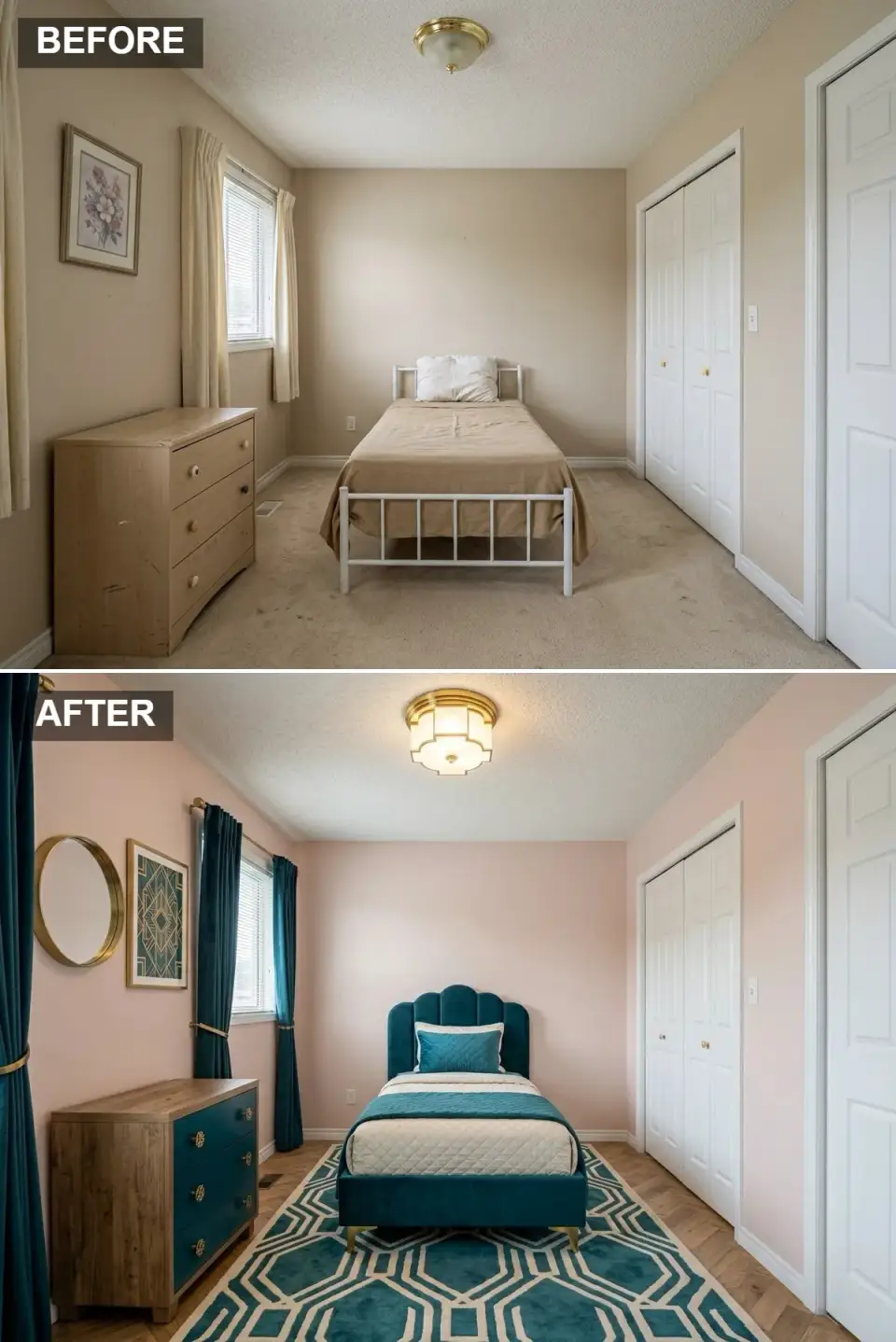
The original beige box becomes a glamorous Art Deco bedroom. The dated brass dome ceiling light is replaced with a scalloped semi-flush mount in warm brass, the worn carpet is pulled and replaced with herringbone hardwood, and the walls take on a soft blush plaster tone. The vintage white metal bed gives way to a deep teal velvet platform bed with a scalloped headboard and brass legs. The mismatched oak dresser becomes a two-tone oak-and-teal piece with starburst brass knobs. Heavy teal velvet curtains, a round brass mirror, geometric gold-framed art, and a bold teal-and-cream geometric rug carry the Deco palette through every layer.
Color Palette
#FADCD9
Soft pink wall color that replaced the original beige and creates a warm, youthful backdrop.
#1B4F4F
Velvet upholstery, curtains, and rug color that grounds the room in rich jewel-tone sophistication.
#D4AF37
Metallic finish on the light fixture, mirror, art frame, and hardware that adds Art Deco glamour.
#C19A6B
Natural hardwood flooring and dresser body tone that introduces organic warmth underfoot.
Styling notes for similar spaces
- Swap a basic metal bed for an upholstered scalloped headboard — it sets the formality of the whole room and reads as designed in a way a metal frame never will.
- Layer velvet curtains in a deep jewel tone against blush walls. The contrast is what makes this direction land; matchy-tonal curtains here would dilute the entire scheme.
- Replace wall-to-wall carpet with herringbone hardwood. The pattern reinforces the Deco geometry without needing a single themed accessory.
- Mix three brass moments (mirror + knobs + flush mount) and stop. More than three is jewelry; three is intentional.
2. Cloud Nine: A Sky-Blue Sleep Sanctuary
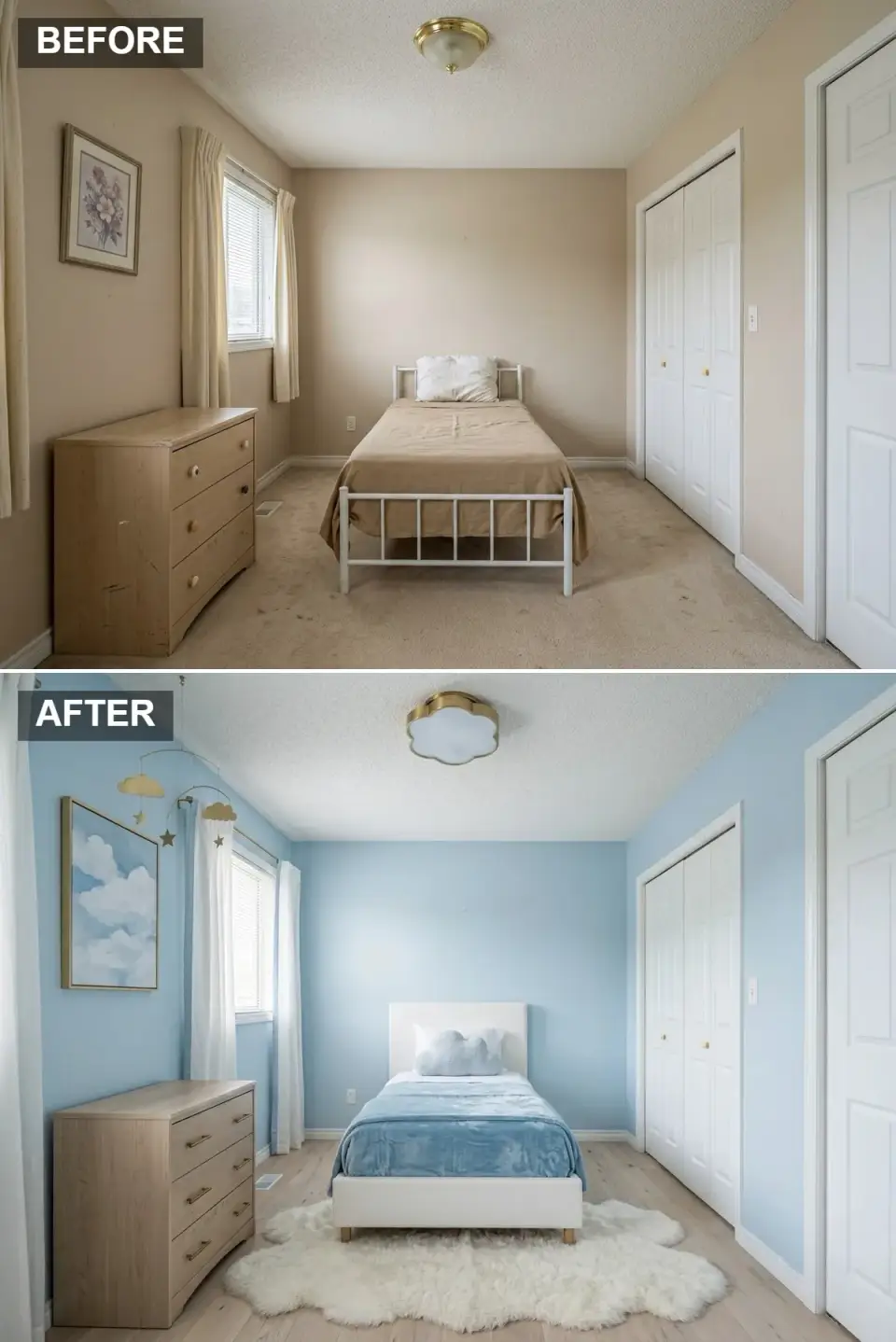
Where the before image was a dull beige cocoon, this version drifts upward. The walls are painted a soft sky blue and the carpet is replaced with pale oak hardwood. A clean white upholstered platform bed dressed in light blue linens — and a single cloud-shaped accent pillow — replaces the white metal frame. The dresser becomes a sleek pale-oak four-drawer with brass pulls. Sheer white curtains take over from the heavy beige drapes. A cloud-shaped brass ceiling fixture and a celestial mobile reinforce the airy theme overhead, and a plush white faux-fur rug softens the floor for tiny bare feet.
Color Palette
#B3D9E8
Wall color evoking open skies, replacing the beige box with an airy, uplifting envelope.
#F7F7F7
Bedding, sheer curtains, and cloud pillow shade that keeps the palette soft and heavenly.
#E6DCC4
Light wood flooring and dresser tone that provides a Scandinavian-inspired neutral base.
#D4AF37
Ceiling fixture, mobile accents, and frame finish that adds subtle, warm-metallic punctuation.
Styling notes for similar spaces
- Soft sky blue is the rare wall color that reads as both nursery and child-aged — it grows with a 0–6-year-old without needing a repaint.
- One cloud-themed accessory (a pillow, the ceiling fixture, OR the mobile) is enough; all three at once tips the room into theme-park.
- Faux-fur rugs collect everything in a kid's room. Specify a washable polyester version, not real sheepskin, if you want it to survive year one.
- Pale oak floors and pale oak furniture together can read flat. Break up the tone with at least one warmer textile (linen drape, throw blanket).
3. Enchanted Forest Lodge: Brass & Emerald Velvet
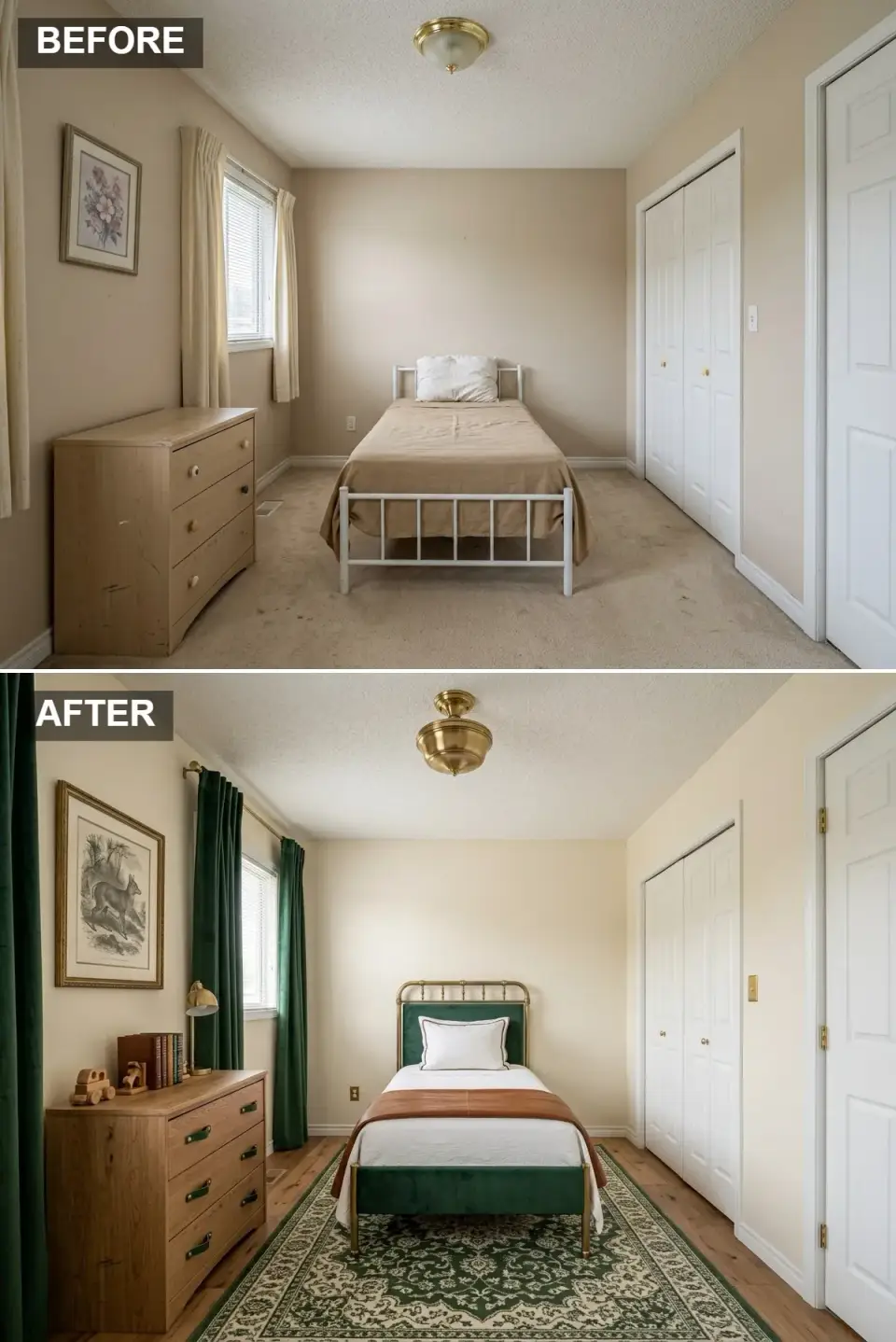
The original beige anonymity becomes a small-scale lodge for a child who will outgrow themed rooms but never outgrow this one. Walls shift to warm cream and the carpet comes out to expose honey-oak hardwood. The white metal bed is replaced by a vintage brass spindle bed with emerald velvet panels at the head and foot. The dresser becomes a solid oak chest with dark green leather pulls. Heavy emerald velvet curtains, an ornate green-and-cream traditional rug, a vintage deer etching, a brass desk lamp, and wooden toys on the dresser create a curated, old-world explorer vibe — the kind of room a six-year-old loves and a fourteen-year-old still tolerates.
Color Palette
#F5F5DC
Clean, warm white wall color that brightens the room while preserving its vintage character.
#355E3B
Velvet bed upholstery, curtains, and rug base that channel an enchanted-forest atmosphere.
#C19A6B
Hardwood flooring and dresser wood tone that complements the brass and green palette.
#C9AE5D
Bed frame, ceiling fixture, and lamp finish that lends a timeworn, collected feel.
Styling notes for similar spaces
- This is the longest-lasting direction on the list — the palette and silhouette read as appropriate from age 4 to age 14 with only bedding swaps along the way.
- A brass spindle bed sourced from a vintage shop or estate sale is far more characterful than a new reproduction; budget for a few weeks of looking.
- Avoid actual deer trophies or animal-skin accents — a vintage etching or framed print holds the explorer vibe without the sensitivity issues.
- Wooden toys displayed on the dresser do double duty as decor and as the child's actual play objects. Rotate seasonally.
4. Peach Blossom Hideaway: Soft Clay & Curved Silhouettes
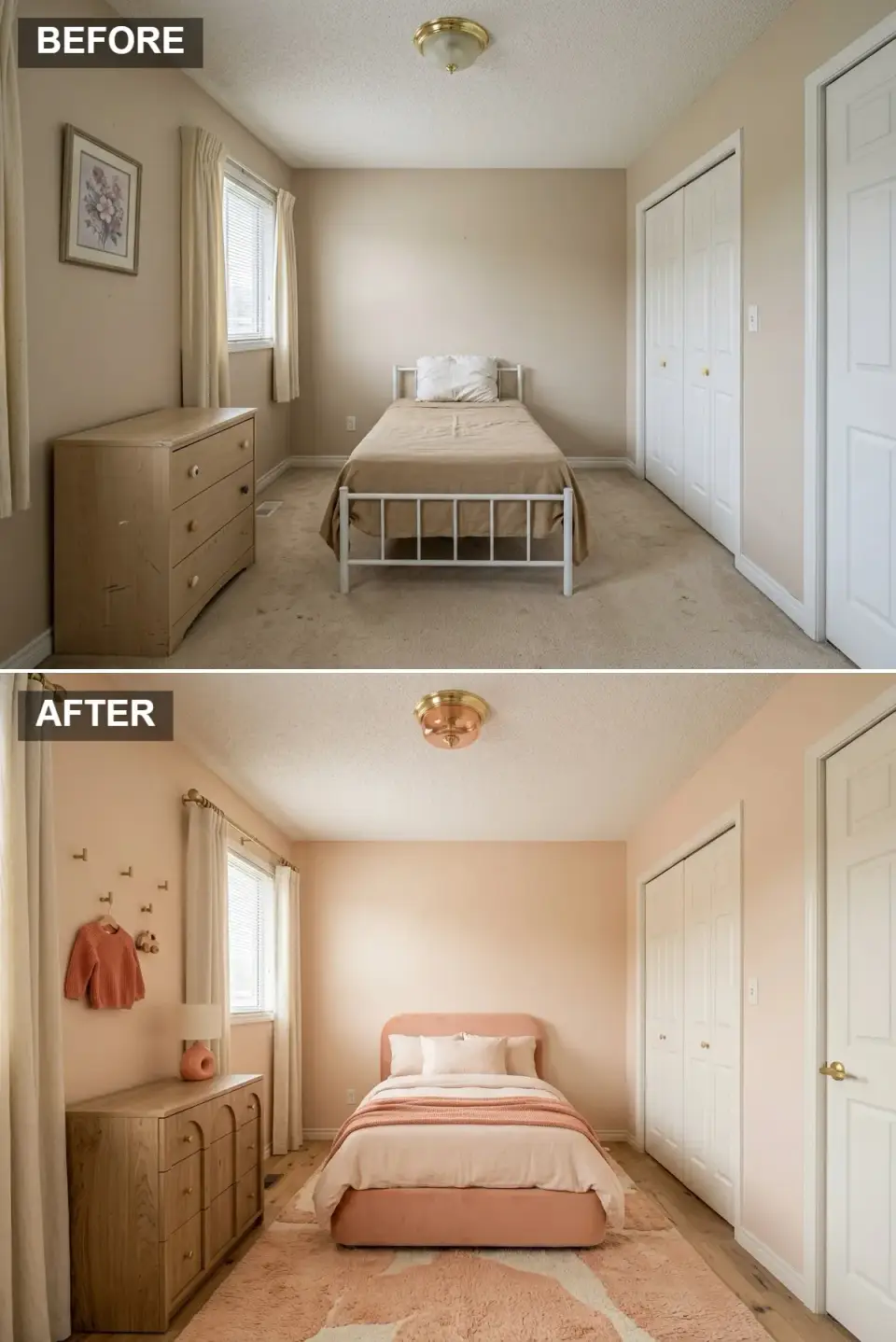
This direction leans warm and tonal — a sunset palette that flatters the room's natural light and ages well past the toddler years. Walls glow in a warm peach plaster, and the carpet is replaced by pale hardwood. The white metal bed is removed in favor of a peach upholstered platform bed dressed in white and peach layered linens. A new oak dresser with arched drawer fronts and brass knobs adds personality without going themed. Cream linen curtains filter the daylight. A sculptural peach ceramic lamp and an abstract peach-and-cream area rug complete the tonal scheme.
Color Palette
#FAD1B0
Warm peach wall color and upholstered bed tone that creates a sunset-inspired cocoon.
#F3E5D0
Curtains and bedding shade that softens the light and enhances the tonal layering.
#D2B48C
Dresser and flooring wood tone that anchors the pastel scheme with natural grain.
#D4AF37
Curtain rod, knobs, and light fixture finish that adds understated polish.
Styling notes for similar spaces
- Peach reads as soft and warm without veering into pink-coded gendering. It's the right color for a child whose room shouldn't feel boy-or-girl coded.
- Arched drawer fronts (or any curved-line furniture detail) reads modern and youthful — the geometry alone does the work that themed accessories would.
- Brass wall hooks at child height are a useful styling detail. Tomorrow's outfit, today's costume, and the favorite tote bag all need a home.
- Tonal layering — peach wall, peach bed, peach lamp — only works with one breaking element. The cream curtains here are doing that job; don't skip them.
5. The Modern Treetop: Monochrome Chic With Brass Accents
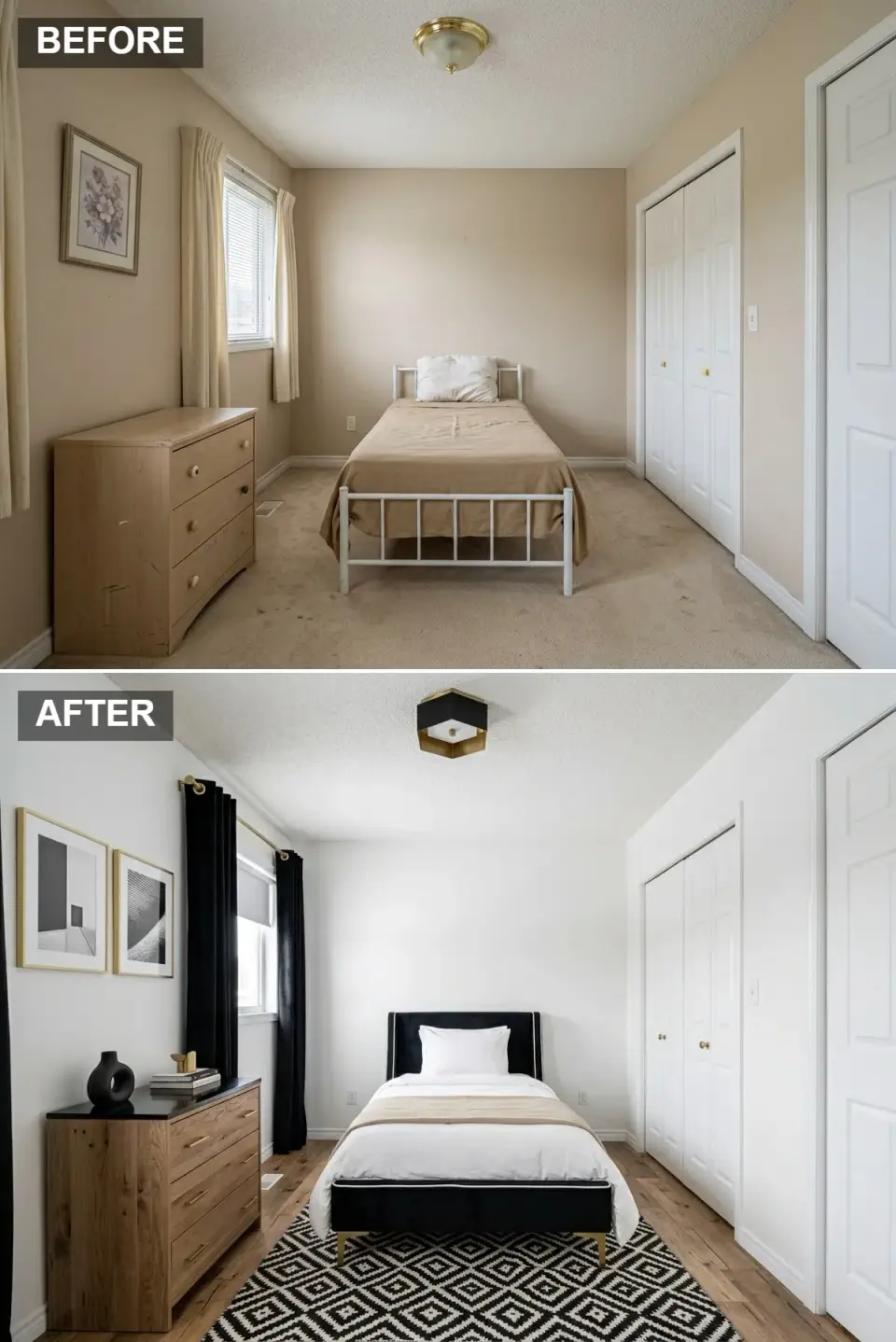
The before room's beige neutrality is replaced by a gallery-style monochrome scheme — appropriate for a tween or older child whose tastes have moved past primary colors. Walls go crisp white and the carpet is swapped for natural oak hardwood. A black velvet platform bed with brass legs and crisp white bedding becomes the focal point. The dresser is replaced by an oak piece topped with black stone and accented with brass pulls. Black velvet curtains hang from a brass rod. Two black-and-white architectural prints in thin brass frames, a sculptural black ceramic vase, and a graphic black-and-white diamond rug carry the contrast.
Color Palette
#FFFFFF
Wall and bedding color that establishes a gallery-like, high-contrast canvas.
#1A1A1A
Velvet bed upholstery and curtain color that delivers dramatic, modern sophistication.
#C19A6B
Hardwood floor and dresser body tone that warms the otherwise monochrome scheme.
#D4AF37
Hardware, picture frames, and light fixture accents that punctuate the black-and-white story.
Styling notes for similar spaces
- This direction works best for ages 9 and up. For younger children, the lack of color reads cold; for tweens, it reads like respect for their grown-up taste.
- Specify a black-out velvet curtain; it doubles as actual blackout for the room and looks expensive in a way standard polyester blackouts don't.
- The natural oak in the floor and dresser is what prevents the room from feeling clinical — don't substitute white-painted oak or you'll lose that warmth.
- Architectural photography (buildings, cities, facades) reads more "designed" than abstract prints in a kid's space at this age.
6. Mossy Loft Retreat: Sage Serenity & Clean Lines
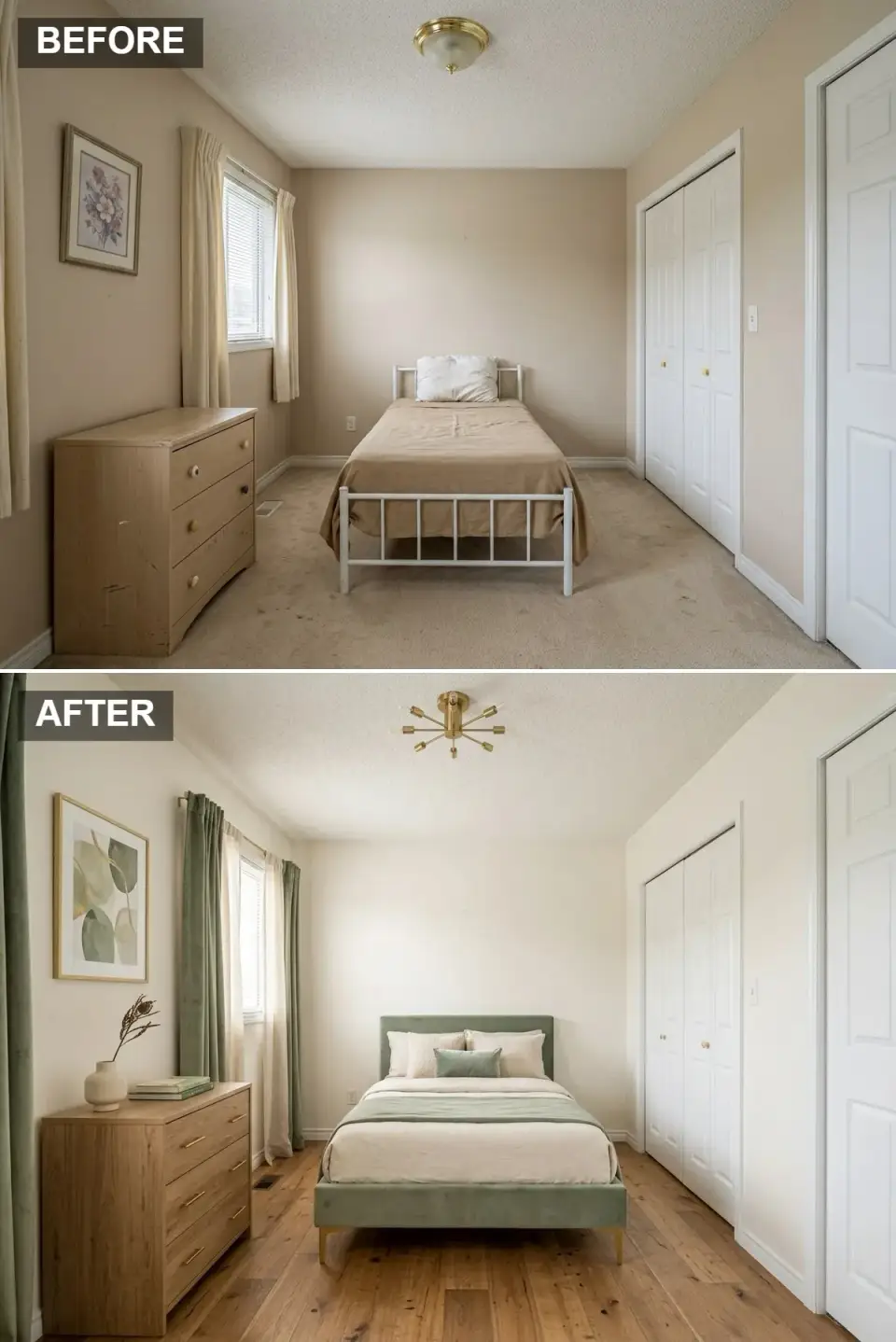
The most quiet direction on the list — the right call for a sensory-sensitive child or a parent who wants the kid's room to read more "slightly smaller bedroom" than "themed kid space." Walls are now warm alabaster white and the carpet is gone, revealing natural oak hardwood. A sage green velvet platform bed with brass legs takes center stage in white-and-sage linens. The dresser is a clean-lined oak chest with brass pulls. Sage velvet curtains layered over sheer white panels frame the window. A brass sputnik ceiling fixture adds a single mid-century moment, and a botanical print and dried-branch arrangement keep the styling unfussy.
Color Palette
#FAF9F6
Wall color that provides a quiet backdrop for the muted green furnishings.
#9CAF88
Velvet bed upholstery and curtain color that brings organic, calming energy to the room.
#C19A6B
Hardwood flooring and dresser wood tone that enhances the room's earthy, grounded feel.
#D4AF37
Sputnik fixture and drawer pull finish that introduces mid-century metallic sparkle.
Styling notes for similar spaces
- Sage is one of the most age-flexible colors in a kid's room — a 5-year-old reads it as garden-y, a 12-year-old reads it as quiet and mature.
- Skipping the area rug and exposing the hardwood is a deliberate choice — it lowers visual noise. Add a small bedside rug only if the floor is cold underfoot.
- Layered curtains (sheer behind velvet) give you blackout for naps without losing the daytime light.
- A botanical print and a vase of dried branches is enough wall and surface styling for this direction. Resist adding more.
7. Rose Petal Perch: Tufted Blush Glamour
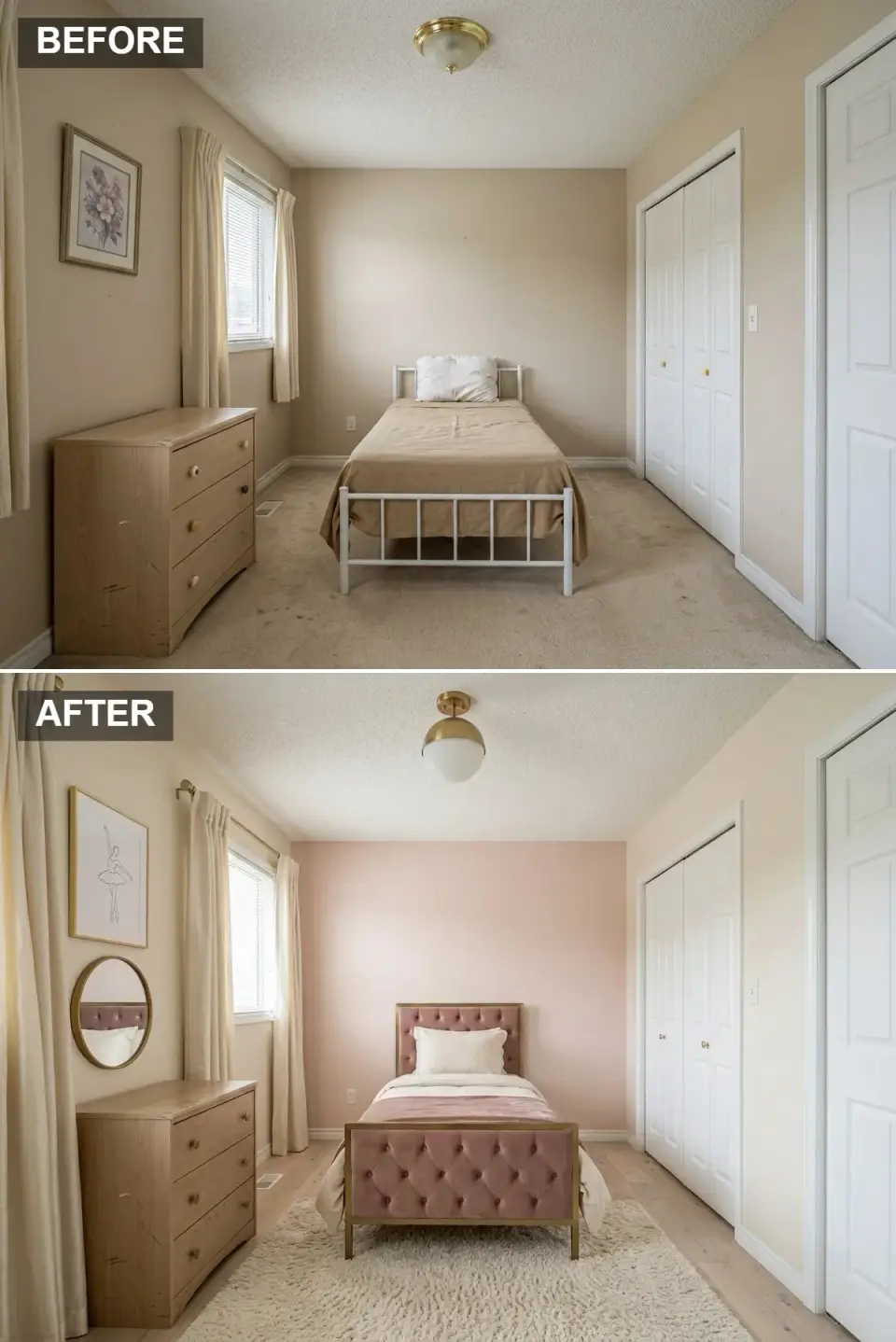
A ballet-school-meets-bedroom direction that lands as feminine without crossing into princess-themed. Walls are now soft dusty rose and the carpet is replaced by whitewashed oak flooring. The white metal bed gives way to a dusty rose tufted velvet bed in an antique brass frame. A light oak dresser with brass knobs handles storage. Cream linen curtains and a cream shag rug layer in softness. A round brass mirror, a delicate ballerina line drawing in a gold frame, and a brass globe ceiling fixture finish the room.
Color Palette
#F5D0C5
Wall color that wraps the room in a gentle, feminine glow.
#D4A5A5
Tufted velvet bed upholstery that serves as the room's plush focal point.
#F5F5DC
Linen curtains and shag rug shade that layers in softness and tactile comfort.
#E6DCC4
Whitewashed hardwood and dresser tone that keeps the overall palette airy and light.
Styling notes for similar spaces
- Tufted velvet beds collect dust and snacks. Specify a removable, washable slipcover if you want this room to last past month two.
- Dusty rose ages gracefully — true bubblegum pink does not. Always pick the muted version of any saturated color in a kid's room.
- A line-drawing of any subject (ballerina, animal, building) ages much better than a literal photograph or illustration. Children grow out of subjects faster than they grow out of styles.
- Cream shag rugs in kid spaces require a lining to keep them in place and a quarterly deep clean to keep them looking cream rather than dingy.
8. Captain's Crow's Nest: Nautical Navy & Vintage Maps
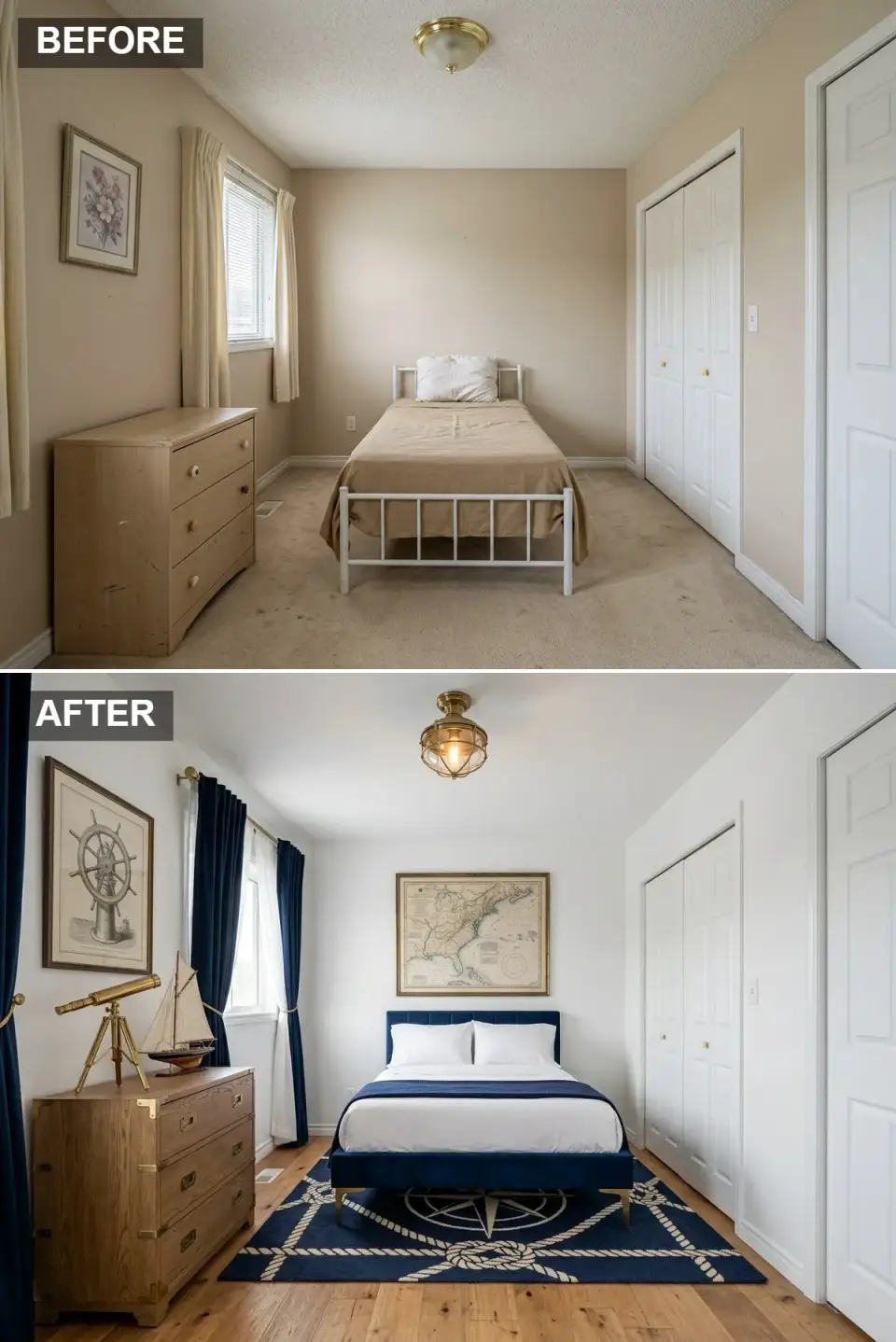
A natural fit for any of my Charleston, Savannah, or Outer Banks clients — the nautical theme reads as place-appropriate rather than cliché along the South Atlantic coast. Walls are now bright white and the carpet is replaced with warm oak hardwood. A navy velvet platform bed with brass legs anchors the room in crisp white hotel-style linens and a navy throw. The dresser is a campaign-style oak chest with brass corners and hardware. Navy velvet curtains, a brass caged lantern overhead, an oversized vintage map above the bed, a ship-wheel etching, a brass telescope, and a model sailboat on the dresser carry the explorer's vignette. A navy-and-white compass rug grounds the floor.
Color Palette
#FFFFFF
Wall color that acts as a crisp canvas for the bold navy and brass maritime narrative.
#1A2B4A
Velvet bed upholstery, curtains, and rug base that evokes deep ocean tones.
#C19A6B
Hardwood flooring and campaign dresser wood tone that adds warmth and character.
#B5A642
Lantern light, telescope, and frame finish that reinforces the vintage nautical theme.
Styling notes for similar spaces
- Limit the literal nautical objects to two or three (map + telescope + sailboat is plenty). More than that tips the room into theme-restaurant.
- An oversized vintage map above the bed reads as art, not theme — the same map at desk-poster scale would read as a kid's room cliché.
- A campaign-style chest is the perfect dresser for this direction — the brass corners and hardware reinforce the explorer narrative without being overt.
- Pick a true navy, not a "denim blue" — the saturation is what gives this direction its sophistication.
9. Explorer's Outpost: Olive Velvet & Warm Walnut
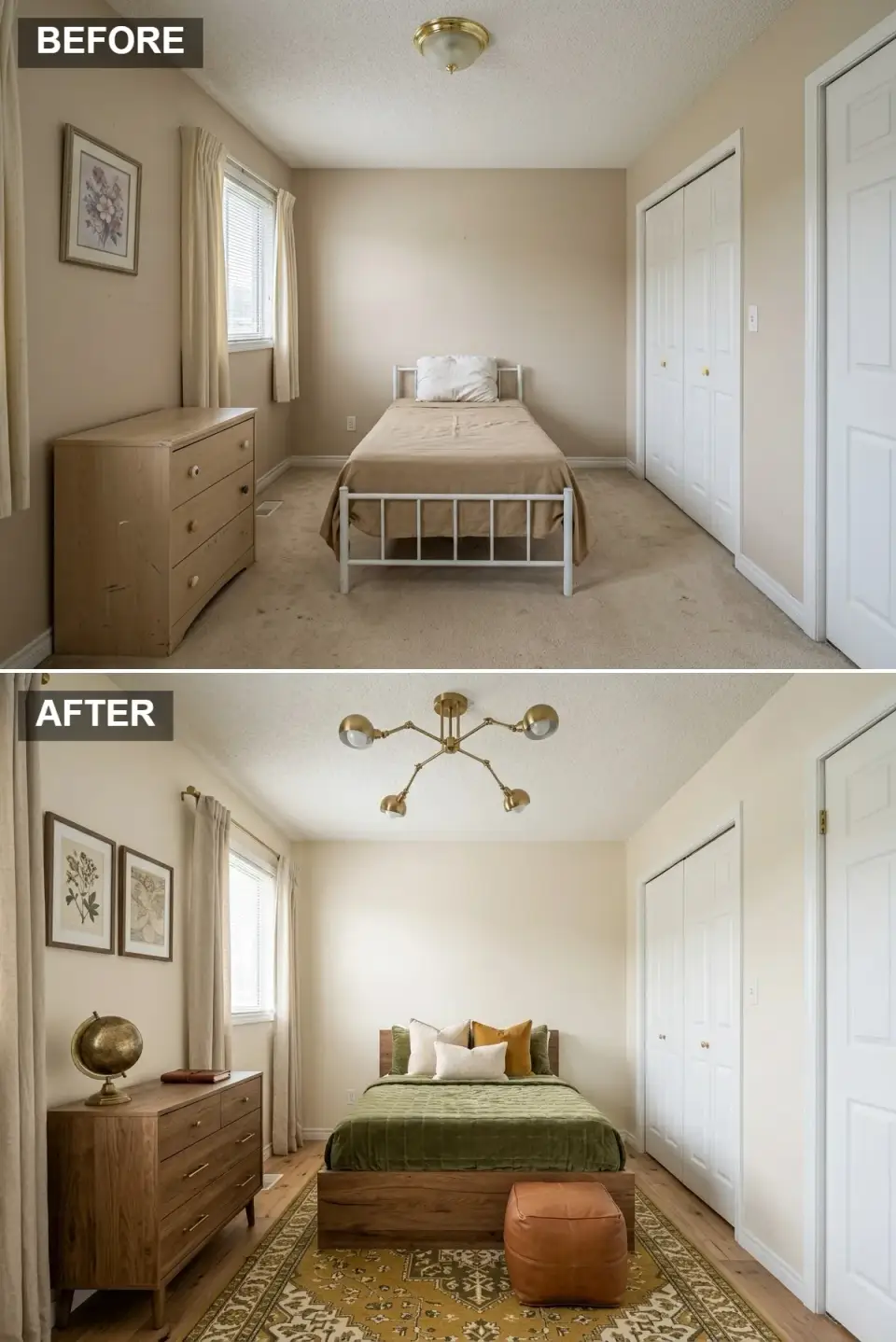
A mid-century-meets-explorer-camp direction that reads grown-up enough to last well into the teen years. Walls are now warm cream and the carpet is replaced by medium oak hardwood. A low walnut platform bed takes over from the white metal frame, dressed in an olive green velvet quilt with mustard, white, and olive pillows. A mid-century walnut dresser with brass pulls sits beneath two botanical prints and a vintage globe. A brass branch chandelier spreads warm light overhead. A mustard-toned Persian-style rug and a cognac leather pouf at the foot of the bed add rich, layered character.
Color Palette
#FAF9F6
Wall color that creates a neutral envelope for the rich, earthy furnishings.
#6B7C3F
Quilted bedding color that brings depth and a vintage camp-like feel.
#6F4E37
Solid platform bed and mid-century dresser wood tone that grounds the room in heritage style.
#D4AF37
Branch chandelier and hardware finish that adds sculptural metallic warmth overhead.
Styling notes for similar spaces
- A leather pouf at the foot of the bed is one of the most useful pieces in any kid's room — it works as a seat, a low table, and a foot rest for reading in bed.
- Vintage globes are inexpensive at estate sales and instantly inject the explorer mood without any other themed accessories needed.
- The mustard, olive, walnut, and brass color story is a four-shade palette — adding a fifth color here flattens the room. Resist the urge.
- Persian-style rugs in synthetic blends are durable, washable, and a fraction of the cost of real wool — appropriate for a kid's room where spills happen.
10. Desert Clay Haven: Terracotta Accent & Cane Textures
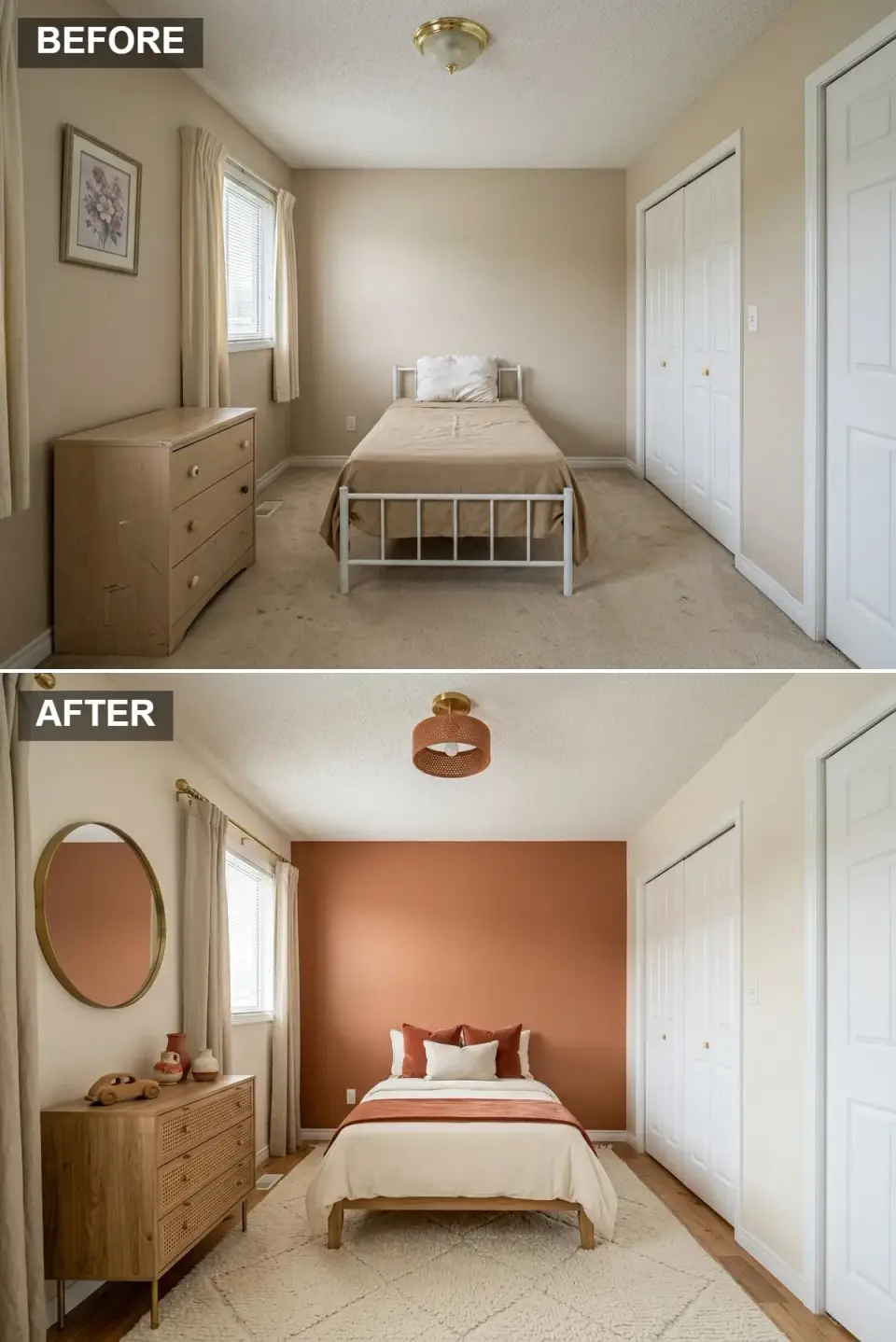
A boho desert direction that feels intentional rather than trendy because it commits to a single accent color across multiple surfaces. The back wall is painted a bold terracotta while the remaining walls and trim stay in natural linen white. Beige carpet is replaced with warm oak hardwood. A simple light wood platform bed with white and terracotta linens replaces the metal frame. A cane-front oak dresser with brass legs adds breathable texture and storage. A terracotta perforated drum ceiling light echoes the accent wall. Natural linen curtains, an oval brass mirror, ceramic vases, a wooden toy car, and a thick cream textured rug round out the earthy, handcrafted feel.
Color Palette
#E2725B
Bold accent wall and ceiling light shade that injects desert warmth and boho personality.
#F5F5DC
Side wall and curtain color that balances the terracotta with breathable neutrality.
#C19A6B
Hardwood flooring and dresser body tone that ties the organic material palette together.
#D2B48C
Dresser drawer fronts that introduce textural, hand-woven detail to the storage piece.
Styling notes for similar spaces
- An accent wall behind the bed only works if the bed is centered on it. If your bed has to sit against a side wall, paint a different surface or skip the accent.
- Cane-front furniture in a kid's room is gorgeous and slightly fragile — keep it where the child won't kick it. Cane drawer fronts on a chest at the wall are fine; cane on a footboard is not.
- Match the ceiling fixture's drum shade to the accent wall color. The repetition reads as intentional design rather than coincidence.
- One wooden toy on the dresser as styling is enough. The actual play toys live elsewhere; the styled toy is for the room photograph.
11. Lilac Fairy Hollow: Pastel Dreams & Gallery Walls
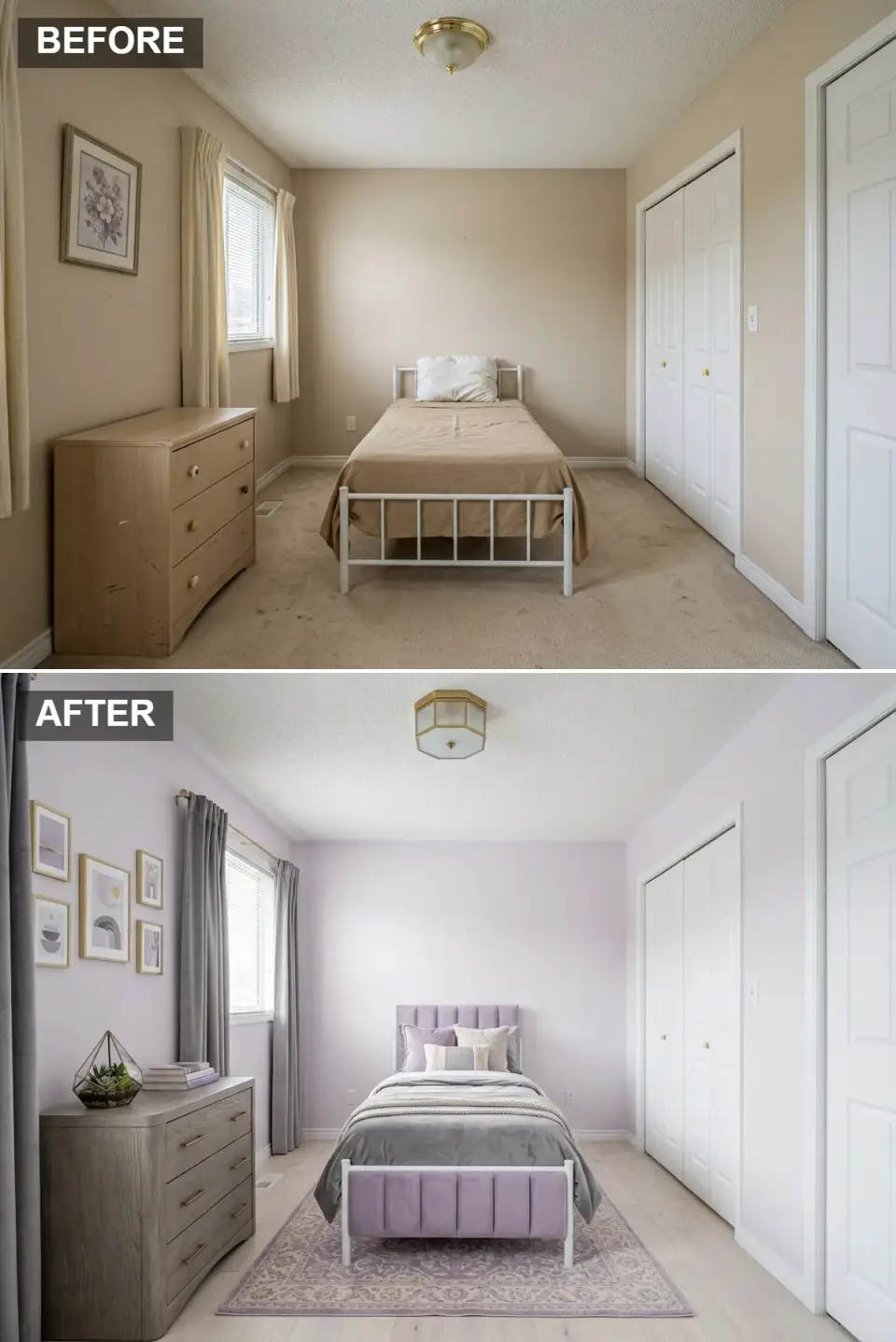
A lilac direction that sidesteps the saccharine pitfalls of pastel kids' rooms by grounding the pink-purple with grey. Walls are now soft lavender and the carpet is removed for whitewashed oak flooring. A lilac channel-tufted bed with white metal accents replaces the original frame, dressed in grey and lilac linens. A grey-washed oak dresser with brass pulls offers storage beneath a gallery wall of five abstract prints in brass frames. Grey velvet curtains add weight and contrast. A patterned lavender rug ties the floor to the walls. A geometric glass terrarium with a succulent adds living detail to the dresser top.
Color Palette
#D8BFD8
Wall and channel-tufted bed color that envelops the room in a dreamy, fairy-tale haze.
#9EA1A2
Curtain and dresser wash that adds sophisticated contrast to the pastel walls.
#E8E3D9
Light hardwood flooring that reflects natural light and keeps the room feeling open.
#D4AF37
Gallery frames, hardware, and light fixture metal that provides subtle golden highlights.
Styling notes for similar spaces
- Lilac is one of the harder colors to pull off in a kid's room — it tips into "tween" or "saccharine" easily. Grounding with grey curtains and a grey-washed dresser is what keeps it sophisticated.
- Five abstract prints in matching brass frames reads as a gallery wall; same five prints in mismatched frames reads as a child's project. Pick the look you want and commit.
- A geometric terrarium with a succulent is the only "alive" object I'd recommend in a kid's room — the succulent survives sporadic watering and the geometry reads as decor, not a craft.
- Channel-tufted upholstery collects dust and crumbs in the channels. Plan to vacuum the bed weekly.
12. Honeycomb Lookout: Geometric Wallpaper & Mustard Velvet
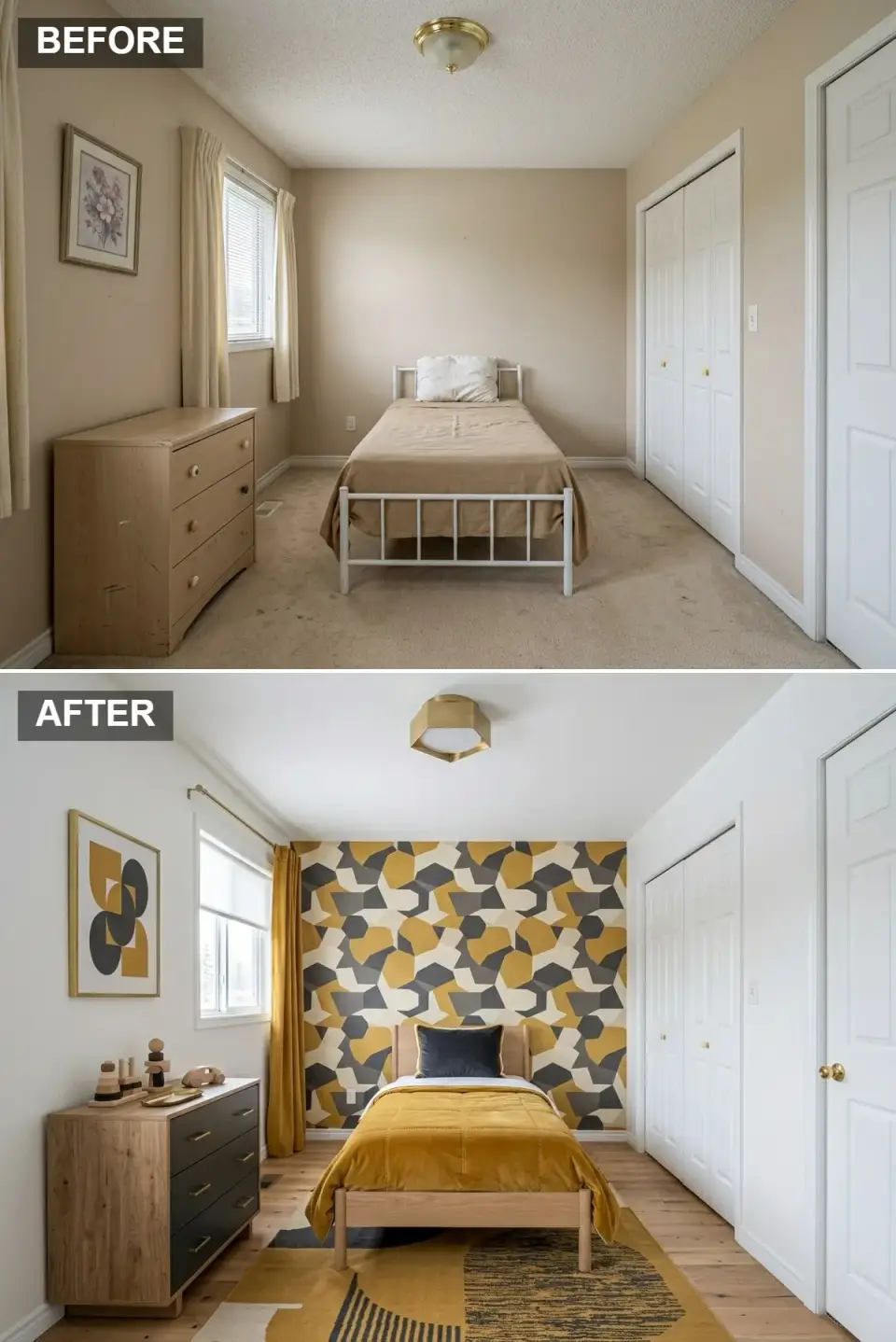
The boldest direction on the list — a bet on a single design move (the wallpaper) carrying the entire room. The back wall sports statement geometric wallpaper in mustard yellow, charcoal grey, black, and cream shapes. Beige carpet is replaced by light oak hardwood. A blonde wood platform bed dressed in mustard velvet (with one navy pillow as the breaking note) replaces the metal frame. An oak dresser with matte black drawer fronts and brass handles handles storage. Mustard velvet curtains, a brass hexagonal flush mount, and a color-blocked geometric rug carry the wallpaper's palette through the rest of the room.
Color Palette
#DAA520
Velvet curtains, bedding, and wallpaper accent that energizes the room with sunny confidence.
#5A5A5A
Geometric wallpaper and dresser drawer fronts that anchor the bold palette with graphic depth.
#C19A6B
Hardwood floor, bed frame, and dresser body tone that balances the graphic prints.
#F5F5F0
Remaining wall color and wallpaper negative space that gives the eye somewhere to rest.
Styling notes for similar spaces
- Statement wallpaper is great until you need to redecorate. Use peel-and-stick (Tempaper, Chasing Paper) so a future repaint is a one-day removal job, not a strip-and-prime project.
- When a wall does that much work, the textiles need to pull from its palette without competing. Mustard curtains and bedding work because they reference, not match.
- One contrasting pillow (the navy here) is the breaking note that prevents the room from reading too matchy. Don't add a second one.
- This direction lands best with kids age 7 and up. Younger children are over-stimulated by this much pattern in their sleep room.
13. The Scandinavian Nest: Natural Wood & Barefoot Minimalism
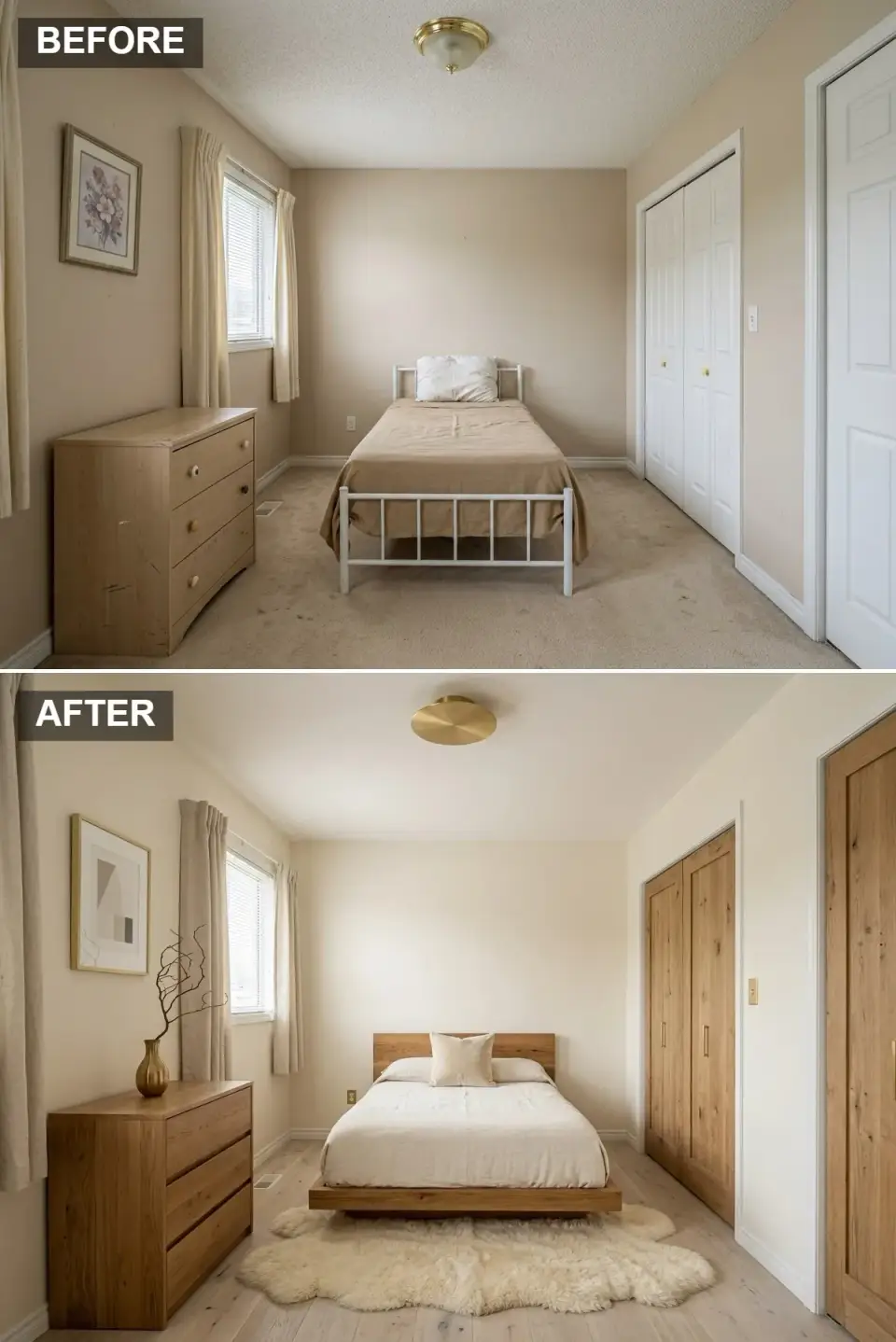
The most pared-back direction on the list — and arguably the one that ages best. The most dramatic architectural change is the replacement of the standard white bi-fold closet doors and white entry door with natural wood slab doors, which warms the room's envelope before any furniture moves in. Beige walls and carpet are swapped for warm white plaster and bleached oak plank flooring. The white metal bed gives way to a low solid wood platform bed dressed in natural linen. A matching solid wood dresser keeps storage minimal. A simple brass disc flush mount replaces the dome light, while a cream sheepskin rug underfoot and a brass vase with twisted branches provide the only styling moments.
Color Palette
#FAF9F6
Wall color that creates a quiet, meditative backdrop for the natural wood architecture.
#C19A6B
Solid bed, dresser, closet doors, and entry door wood tone that unifies the room in organic warmth.
#E6DCC4
Pale hardwood flooring that lightens the room and complements the warm wood furnishings.
#D4AF37
Minimal disc light, vase, and accent finish that adds quiet metallic punctuation.
Styling notes for similar spaces
- Replacing the standard white doors with natural wood slabs is the single highest-impact change here — and the most expensive line item. Plan for it from the start.
- Minimalism in a kid's room only works if you actually have closed storage for everything else. Plan a closet or built-in system as part of the room before committing to this direction.
- A low platform bed sits closer to the floor — easier for very young children to climb in and out of, and visually it makes a small room read taller.
- Specify a washable polyester sheepskin (not real wool) — it stays white instead of yellowing, and it goes through the washer.
Pro Tips That Show Up in Every Kids' Room Project
- Replace the carpet first. Wall-to-wall carpet is the single largest visual aging factor in a 1990s or 2000s guest room, and in a kid's room it traps allergens, juice spills, and mystery crumbs. Hardwood, engineered wood, or luxury vinyl plank with washable area rugs is almost always the right move.
- Upgrade the overhead light second. The dated brass dome or boob-light fixture is what reads "rental" more than anything else in the room. A flush or semi-flush in brass, black, or natural wood — whatever matches the direction — is the single highest-ROI fixture change in any kid's room.
- Pick a palette that ages with the child. The directions on this list that span the widest age range (Cloud Nine, Mossy Loft, Enchanted Forest, Scandinavian Nest) all use muted, multi-decade colors. Saturated theme colors (Mustard Honeycomb, Lilac Fairy) are gorgeous but require a refresh every 4–5 years.
- Mix closed storage with kid-height open storage. A dresser handles seasonal clothing; low hooks and labeled bins handle the daily play objects. Every room above benefits from a hidden mix of both.
- Specify low-VOC paint, formaldehyde-free furniture, and washable textiles. Kids spend disproportionately more time in their bedrooms than adults do — the indoor air quality and surface-cleanability of the room actually matter.
- Build in flexibility for the bed location. An accent wall behind the bed is gorgeous until the bed has to move when the child gets a sibling. Plan two viable bed positions before committing the accent wall to one of them.
Frequently Asked Questions
How do I design a kids' room that grows with my child? Anchor the room in a multi-decade-friendly palette (the Cloud Nine, Mossy Loft, Enchanted Forest, or Scandinavian Nest directions above are all good age-flexible starting points). Invest in furniture that doesn't read as "kid" — solid wood, neutral upholstery, real metal hardware. Then layer the age-specific decoration with bedding, art, and accessories that you can swap inexpensively every 2–3 years. The room evolves; the bones don't. What's the safest paint and finish for a kids' bedroom? Specify low-VOC or zero-VOC paint (Benjamin Moore Natura, Sherwin Williams Harmony, or any equivalent) — both for indoor air quality and to allow the child to sleep in the room within 24 hours of painting. For furniture, look for GREENGUARD Gold or CertiPUR-US certifications, which test for formaldehyde and other emissions. Avoid pressed-particle-board furniture for kids' rooms when possible; solid wood or sealed plywood is significantly lower-emission. Should I let my child pick their own room palette? Within bounds. Letting a 5-year-old pick wall paint usually ends in regret within a year. A workable compromise: present three palettes you'd be happy living with, and let the child choose between them. For older kids (10+), a fuller voice in the design is appropriate — but I'd still steer them toward the muted version of any color they pick. "Sage instead of grass green" or "dusty rose instead of bubblegum" gives them their color while keeping the room livable. How do I balance whimsy with longevity? Reserve the whimsy for the cheapest, most replaceable layers — pillows, bedding, art prints, removable wallpaper. Keep the expensive layers (bed frame, dresser, flooring, paint, fixtures) age-neutral. A kid will outgrow a unicorn-print duvet long before they outgrow a solid oak dresser. Build the bones to last and refresh the surface details on a 2–3 year cycle. Carpet vs. hardwood — which is better for a kid's bedroom? Hardwood (or engineered wood, or luxury vinyl plank) wins almost every time. It cleans easily, doesn't trap allergens, and lasts decades. Add a washable area rug under the bed for warmth and softness — that gets you the best of both. The exception: a true nursery for a not-yet-walking infant, where wall-to-wall carpet provides additional cushioning. Even then, plan to swap to hardwood by age 3. How long will a themed kids' room last before they outgrow it? Heavily themed rooms (literal nautical, princess, dinosaur, race car) typically last 3–5 years before the child outgrows them. Style-driven rooms with a theme suggestion (the Captain's Crow's Nest with its vintage map, the Explorer's Outpost with its globe) last considerably longer because the styling reads as adult-curated rather than kid-themed. The strongest age-flexibility comes from style-driven rooms where the "theme" is removable in an afternoon — swap the map for a piece of art, and the room repositions to "young adult" without a renovation.Sources & References
- U.S. EPA — Volatile Organic Compounds & Indoor Air Quality — guidance on VOC emissions from paints, finishes, and furniture that informed the low-VOC and certification recommendations in the FAQ.
- UL GREENGUARD Certification — third-party certification program for low-emission furniture and finishes appropriate for children's spaces.
- U.S. Consumer Product Safety Commission — Kids & Babies — safety guidance on furniture anchoring, crib and bed safety, and window covering hazards in children's rooms.
- Architectural Digest — Kids' Rooms — long-form features on residential children's bedroom design that informed several of the styling directions above.
- The Spruce — Kids' Rooms — consumer-facing reference on age-appropriate design, storage solutions, and material selection.
- American Society of Interior Designers (ASID) — professional guidance on residential interior design standards used by working stylists and designers.
Final Thoughts
The throughline across all thirteen makeovers is the same: the cluttered beige before isn't a problem of square footage or budget — it's a problem of intent. Pick one of the thirteen directions above as a starting point, commit to it across paint, flooring, lighting, bed, dresser, and one anchoring textile (rug or curtains), and the room reads as deliberately designed instead of accidentally accumulated. Even the highest-budget directions on this list (Captain's Crow's Nest, Scandinavian Nest, Honeycomb Lookout) are achievable in stages over two summers.
If you're sketching out your own kids' room project, a few related guides on the site are worth a look. My walkthrough of eleven bedroom transformations from a single before uses the same one-room, many-stylings format for a primary bedroom rather than a kid's room. Nine dining room designs in distinct styles works the same multi-direction structure for a public-facing room. And for the design psychology behind why a child's bedroom carries such outsized emotional weight, The Soul's Blueprint is the home-files essay I'd pair with this one.

Elise Marchetti
Transformations Editor · Charleston, South CarolinaBefore-and-after projects with the invoices attached. Elise runs the Transformations desk — interiors, exterior facades and outdoor spaces across the Lowcountry and the wider South — and writes up what actually changed, what it cost, and which three decisions moved the room.
More from Elise →
Reader notes