


After seven years of walking into strangers' houses to style them, I've come to believe that a home is a slower, more honest autobiography than anything people write about themselves. The furniture tells the truth even when the owner is still working out what the truth is. A Charleston client of mine once spent an hour showing me around her single-family on Broad Street — new kitchen, new paint, new everything — before catching herself in the hallway mirror and saying, quietly, "I don't know what I'm trying to say with any of this." She wasn't asking me for a design opinion. She was asking a psychological question. This piece is about that question. It's about why the choices we make inside our four walls rarely match the reasons we give for making them, and what contemporary environmental psychology can tell us about reading a home as a document of the self.
Contents
- Place Identity: Why Home Is a Mirror, Not a Stage
- The Emotional Weight of Color and Texture
- The Curated Self: Bookshelves as Autobiography
- Flow, Function, and the Quiet Choreography of Home
- Biophilia: The Pull Toward the Living World
- The Language of Empty Space
- Historical Echoes and the Comfort of Continuity
- The Slow Turn Toward Meaningful Living
- Questions Readers Often Ask
- Final Thoughts
Place Identity: Why Home Is a Mirror, Not a Stage
The environmental psychologist Harold Proshansky, writing in the late 1970s at the City University of New York, introduced the concept of place identity — the idea that a self is not formed only through relationships with other people, but also through a sustained relationship with physical places. The bedroom you grew up in, the college apartment where you figured out what music meant to you, the first house you bought with someone who stayed or didn't stay — these spaces become parts of the self you carry forward, and they shape which houses you are drawn to next. Proshansky argued that we tend to reproduce, unconsciously, the spatial textures we came up with, even when we consciously want something different.
I've watched this play out in client after client. A Mount Pleasant couple I worked with in 2022 wanted what they described as "a clean, modern Scandinavian interior," and what they kept buying were dark rugs, heavy drapes, and worn leather chairs. The husband had grown up in his grandfather's low-country fishing camp, and the rooms he was actually building — consciously or not — were versions of that camp. We eventually designed the house that way, on purpose. It's the home they actually wanted, even though it wasn't the home they asked for.
The American sociologist Erving Goffman is often read as saying that public life is a stage where we perform selves. But the home, in his framing, is the back region — the place where the performance is suspended. That's why the decor choices in a home carry psychological weight that office or public-space choices do not. No one is watching, or at least we tell ourselves no one is. What we build for ourselves in private is closer to what we actually want than what we build to be seen.
The Emotional Weight of Color and Texture
Color psychology is a field that overclaims. The confident assertions you'll find in Pinterest captions about what each color "means" rarely survive contact with the peer-reviewed literature. What the research does support, consistently, is that saturation, value, and contrast affect arousal and emotional regulation in measurable ways — and that those effects are strongly moderated by individual history, culture, and the specific lighting under which the color is perceived. A forest-green velvet sofa registers differently in an east-facing Charleston sitting room at 7 a.m. than it does in a north-facing Asheville study at 3 p.m. The color isn't speaking; the color is being heard through the room.
What I've noticed over hundreds of consultations is that people gravitate toward the color palettes they associate with psychological safety, almost regardless of current fashion. Clients who describe themselves as anxious tend to want deep, grounding tones — forest greens, warm browns, oxblood. Clients in transitional life stages (new city, new marriage, recent grief) often over-specify whites and light neutrals, asking for what one client called "a room that lets me think." The white is functioning, in those cases, as cognitive space — visual room to breathe. Neither choice is right or wrong; both are legible.
Texture is the less-discussed cousin of color and probably the more telling one. Russell Belk's 1988 work on the extended self — the idea that our possessions are experienced as literal parts of ourselves — argues that tactile qualities matter disproportionately because touch is the sense we use to verify ownership. The bouclé throw, the linen cushion, the wool rug, the marble tabletop: each is a point where your skin meets your home, and the repertoire of textures you gather over years is closer to a psychological signature than the paint color you happened to choose last spring.
The Curated Self: Bookshelves as Autobiography
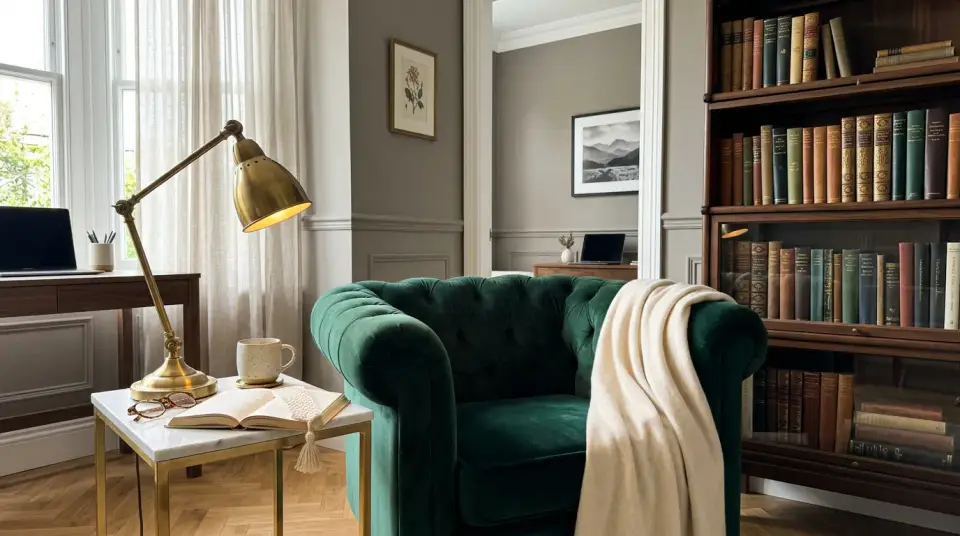
There's a specific kind of information you get from a bookshelf that you cannot get anywhere else in a home. The clothes reveal how someone wants to be seen; the kitchen reveals how they live; the bedroom reveals how they rest; the bookshelf reveals what they've thought about for long enough to purchase a physical copy and keep it after reading. Belk and later the anthropologist Daniel Miller have both written about the ways that household objects become storage for autobiographical memory — the same way photographs do, but in a different key.
I've been in Charleston homes where the bookshelves were color-coordinated by spine and where the owners had clearly not opened most of the books in years. That isn't a judgment; it's an observation. The room is doing a different kind of work — it's performing a curated surface rather than storing a lived-through history. I've also been in homes where every shelf was overflowing, books stacked horizontally on top of vertical rows, slipped behind other books, annotated, dog-eared, and the owner could find any volume within thirty seconds. Those rooms contain different souls, and both are legitimate. The first is a room oriented outward; the second, inward.
The more interesting question isn't which kind of bookshelf you have, but what you've let onto it. The anthropologist Pierre Bourdieu's concept of cultural capital is relevant here — our displayed objects signal belonging to particular cultural formations, whether or not we mean them to. The stack of design monographs, the row of classics from college, the unread biographies of founders, the dog-eared novels from a reading slump five years ago — these aren't just books. They're coordinates. Reading your own shelves carefully is one of the more uncomfortable acts of self-examination available, and it costs nothing.
Flow, Function, and the Quiet Choreography of Home
Furniture arrangement is a form of behavioral engineering, and most people set up their rooms once and then live inside the constraints of that arrangement for years without reconsidering. The research that design psychologist Toby Israel has done on the formative power of domestic space emphasizes something I see constantly in my own work: the sofa doesn't face the way it faces because of a decision; it faces that way because of the shape of the room, the position of the TV outlet, or because that's where the movers put it. Behavior follows that one casual placement for a decade.
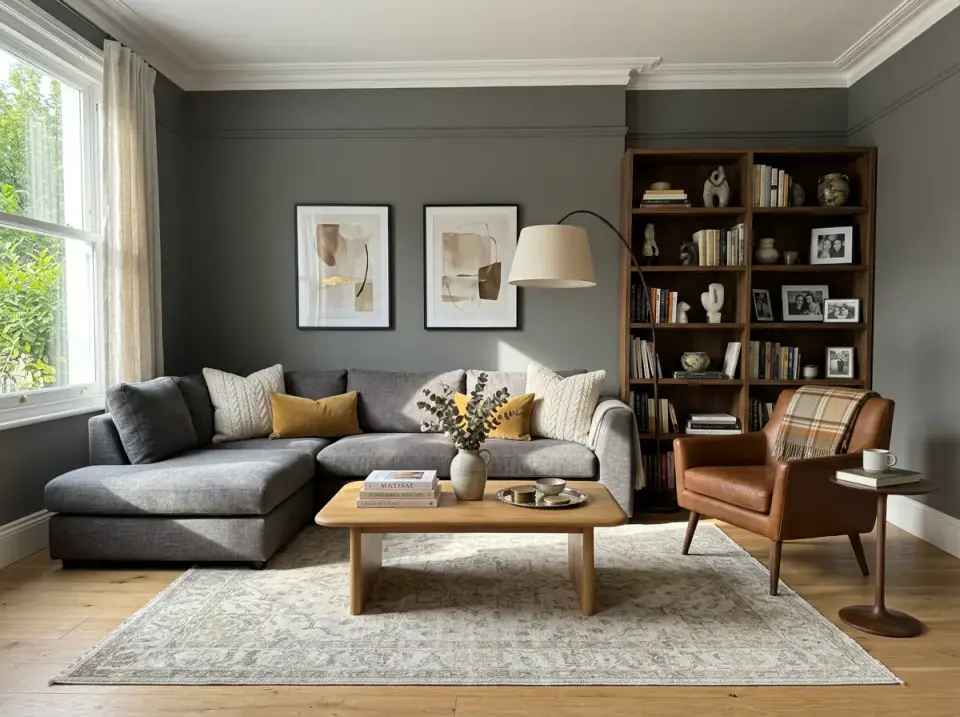
A living room in which the primary seating faces a television produces one kind of evening life: passive, parallel, comfortably non-verbal. A living room in which a sofa and two chairs form a loose triangle, with the TV mounted on a side wall or hidden, produces a different kind of life — more conversation, more read-aloud, more of the slow talking that relationships depend on. Neither arrangement is morally superior. What matters is whether the room you live in is producing the life you want to be living.
A related observation: the architect Clare Cooper Marcus, in her field-defining book House as a Mirror of Self, argues that homes don't simply express who we are — they actively help us become who we are in the process of using them. Furniture layout is a slow teacher. If you set up a reading nook by a south-facing window, you begin to read more. If you center every room around a television, your evenings narrow toward that television. The flow of a home makes the person who lives in it, over time, and the direction of causation runs both ways.
Biophilia: The Pull Toward the Living World
The biologist E. O. Wilson introduced the term biophilia in 1984 to describe what he argued was an innate human tendency to seek connection with other living systems. The architect Stephen Kellert took the idea further and translated it into design principles — natural light, natural materials, visible plants, views onto water, the tactile presence of wood and stone. The peer-reviewed literature has since accumulated strong evidence that biophilic interior conditions correlate with reduced cortisol, improved sustained attention, and faster recovery from cognitive fatigue (a 2019 Terrapin Bright Green review of fifty-plus studies is the usual citation). None of this is news to anyone who has sat by a window with a plant for an afternoon.
In the Southeast, where I do most of my work, biophilic design is almost redundant — the outside is insistently present in a way it isn't in other climates. The problem my clients more often bring me is the opposite: rooms that turn their backs on the landscape. A Summerville house I styled last year had ten-foot ceilings and a row of oaks outside the back wall, and the owners had placed every piece of seating so that it faced into the room rather than out. We rotated one sofa ninety degrees. That small move changed the house. The room stopped feeling like a decorated box and started feeling like a porch with walls.
The specific biophilic moves that work most consistently in my Southeast projects, regardless of architectural style: one large indoor tree or tall plant (fiddle-leaf fig, olive tree, or rubber tree), natural sightlines to at least one window from every seat, wood rather than painted finishes on at least one major surface, and a lack of translucent window treatments that would block the daylight. These aren't design rules. They're closer to instructions for how to arrange a room so that the nervous system notices the world outside and relaxes accordingly.
The Language of Empty Space
What is left out of a room is as expressive as what is put in, and most of the time we underread it. Negative space in interior design has a history that reaches far outside the Western minimalist vocabulary — it draws from Japanese aesthetic traditions (the concept of ma, the meaningful interval), from Shaker practice, from Scandinavian domestic philosophy. In a contemporary Charleston or Nashville home, a client's relationship to empty space tends to reveal something about their relationship to attention itself.
A deliberately uncluttered home often signals a conscious effort to reduce cognitive load — the resident is trying to protect the mind from the constant low-grade negotiation that a crowded visual field demands. The psychologist Sabine Kastner at Princeton has shown that the visual cortex is continuously processing every object in a field of view, whether or not we're attending to it. A room with fewer things in it is, quite literally, a room that demands less of the brain. That isn't aesthetic purity; it's a physiological preference with aesthetic consequences.
The opposite condition — maximalism, layered pattern, rich color, collected objects — can be equally intentional and equally psychologically coherent. Some people find empty rooms unsettling in a way that's older and more visceral than style. For them, the maximalist interior is a form of sensory security. The distinction I'd draw is between curated abundance (chosen, edited, loved) and accumulated clutter (deferred decisions, emotional avoidance, inherited objects that have never been evaluated). The first is a statement. The second is a symptom. Reading your own rooms honestly means being willing to ask which you're looking at.
Historical Echoes and the Comfort of Continuity
Most of my clients, regardless of age or income, end up wanting at least one old thing in the house. Not "vintage" in the Instagram sense, but genuinely old — a piece of furniture from a grandparent, a rug with a wrong edge, a chair that was reupholstered three times before they got it. The pull is consistent enough that I've stopped thinking of it as personal taste. Something about contact with the past, made physical in a domestic object, seems to regulate a particular kind of anxiety.
The sociologist Fred Davis, in Yearning for Yesterday, argued that nostalgia is not simply a retreat from the present but a psychological tool for building a stable sense of self across time. Old objects in a contemporary home perform that work at the level of the room. They slow the tempo. They suggest that not everything in the house will need to be replaced in five years, which by extension suggests that not everything about the resident will need to be replaced in five years, either.
The aesthetic that gets called "layered" or "collected" in magazines is almost always this principle in operation: a modern sofa paired with a nineteenth-century side table, a vintage Turkish rug under a contemporary dining table, a reproduction lamp next to an actual antique clock. The mix reads warm because it compresses time. A room containing only objects manufactured in the last three years reads cold in a specific way, regardless of how expensive those objects are. The room is missing a history, and we feel the absence without being able to name it.
The Slow Turn Toward Meaningful Living
What I'm watching happen across the Southeast, and I don't think only here — a shift in how my clients talk about the goal of the house. Ten years ago, the operating question was some version of what will this room look like when it's done? Increasingly the question is how do I want to feel in this room five years from now, and what would have to be true for that feeling to persist? That second question is harder to answer, and it's a better question. It forces the design work into a longer time horizon than a single photograph.
The environmental psychologist Sally Augustin has written that the strongest predictor of long-term satisfaction with a home isn't the quality of the furnishings or the size of the rooms — it's the degree of fit between the home and the resident's specific psychological needs. That's an unsexy finding. It doesn't sell magazine covers. But it matches what I've observed: the clients who are still happy with their homes three years after the project finishes are rarely the ones who spent the most. They're the ones who were the most honest about who they actually were when they were making choices.
The slow-living movement, the resurgence of interest in craft furniture, the pushback against fast-interiors retailers — these are all, I think, expressions of the same instinct. Not a style trend. A correction. People are tired of furnishing rooms that don't feel like them and then feeling vaguely alienated in their own houses. The corrective is uncomfortable and slow: fewer purchases, more consideration, more willingness to live with empty space while you work out what belongs in it. The home that emerges from that process doesn't photograph as well as the home that emerges from a weekend shopping trip. It's also almost always the home people want to come back to.
Questions Readers Often Ask
Can a person's home really reveal their personality?
The research supports a meaningful — though not absolute — correlation. Sam Gosling's work at the University of Texas, particularly his 2002 study on personal environments, found that outside observers could accurately infer several Big Five personality traits (particularly openness and conscientiousness) from brief looks at a person's bedroom or office. Not every aspect of personality is legible in a room, but more is legible than people assume, and the signals observers pick up on are often unconscious ones the resident didn't intend to send.
Is there an objectively correct interior style?
No. What the environmental-psychology literature does support is that certain structural features — adequate natural light, some connection to nature, reasonable acoustic privacy, a mix of social and retreat spaces — reliably correlate with well-being across cultures. Surface style (minimalist, maximalist, traditional, modern) is mostly a matter of individual fit. A style that supports one resident's psychology may actively work against another's.
How do I tell whether my home reflects who I am now or who I used to be?
A useful exercise: go through one room and ask, for each major object, whether you would acquire it today. Not whether you still like it — whether, standing in a store, you would buy it now. The objects that fail that test are residues of a previous version of you. Keeping one or two is fine and even grounding. Keeping most of them is a quiet signal that the house is lagging behind the resident.
Does the amount I spend on a home affect how much it reflects me?
Surprisingly little, in my experience. Some of the most psychologically coherent homes I've been in are built on a modest budget, furnished over years from secondhand stores and family hand-me-downs, with a few careful new purchases. Some of the least coherent homes I've been in are multimillion-dollar projects styled by people other than the resident. Money buys options; it doesn't do the work of self-knowledge.
What's the difference between minimalism as self-expression and minimalism as avoidance?
Minimalism as self-expression is a room where the things present are precisely chosen and loved — the resident can tell you why each item is there. Minimalism as avoidance is a room where the emptiness is the result of not having decided yet, or of being unable to commit, or of actively suppressing parts of the self. The rooms look similar in photographs. They feel quite different to stand in. The test is whether the empty space is holding something, or whether it's a hole.
Is biophilic design just a trend, or is there actual evidence behind it?
There's actual evidence. The Terrapin Bright Green 2014 and 2019 biophilic design reviews summarize dozens of peer-reviewed studies linking plant presence, natural light, and natural materials to measurable reductions in stress markers and improvements in attention. The trend packaging obscures a legitimate body of research. The evidence is strongest for sustained daylight exposure, visible greenery, and natural materials — not for specific product categories being marketed as "biophilic."
Final Thoughts
The home is slower than conversation and more honest than social media, which is why reading your own rooms carefully is one of the cheaper and more effective forms of self-study available. You don't need a renovation or a designer or a new set of furniture to do the work. You need an hour and a willingness to look.
If this essay resonated, some adjacent reading on this site extends the argument in practical directions. The clutter-and-clarity question at the center of the empty-space section gets an applied treatment in the ultimate room reveal — eleven transformations from clutter to calm, which follows one room through directions that correspond roughly to the personality profiles discussed above. The Scandi-minimalist thread runs through the Nordic glow-up Scandi sanctuary walkthrough, which is less about style for its own sake and more about what it feels like to live with the minimal palette over time. For readers drawn to the biophilia section, the urban garden transformation piece is the practical companion — how biophilic principles translate into lived choices in a constrained outdoor space. And the flow-and-furniture-arrangement discussion in this essay is extended directly by the twelve-direction living room revival guide, which treats the living room as the single most important psychological room in the Southern home and walks through what changes when you change the furniture.
Walk through your home. Listen to what the walls are actually saying, not what you're asking them to say. The blueprint is already there.
Sources & References
- Proshansky, H. M., Fabian, A. K., & Kaminoff, R. (1983). Place-identity: Physical world socialization of the self. Journal of Environmental Psychology.
- Cooper Marcus, C. (1995). House as a Mirror of Self: Exploring the Deeper Meaning of Home. Conari Press.
- Belk, R. W. (1988). Possessions and the Extended Self. Journal of Consumer Research, 15(2).
- Goffman, E. (1959). The Presentation of Self in Everyday Life. Doubleday Anchor.
- Wilson, E. O. (1984). Biophilia. Harvard University Press.
- Kellert, S. R., Heerwagen, J., & Mador, M. (2008). Biophilic Design: The Theory, Science, and Practice of Bringing Buildings to Life. Wiley.
- Terrapin Bright Green (2014; revised 2019). 14 Patterns of Biophilic Design. Meta-review of empirical biophilia studies.
- Gosling, S. D., Ko, S. J., Mannarelli, T., & Morris, M. E. (2002). A room with a cue: Personality judgments based on offices and bedrooms. Journal of Personality and Social Psychology, 82(3).
- Davis, F. (1979). Yearning for Yesterday: A Sociology of Nostalgia. Free Press.
- Augustin, S. (2009). Place Advantage: Applied Psychology for Interior Architecture. Wiley.
- Miller, D. (2010). Stuff. Polity Press.
- Bourdieu, P. (1984). Distinction: A Social Critique of the Judgement of Taste. Harvard University Press.
- Israel, T. (2003). Some Place Like Home: Using Design Psychology to Create Ideal Places. Wiley-Academy.
- Author's consulting notes — Charleston, Mount Pleasant, Summerville, Asheville, Nashville residential projects, 2019–2026.

Rowan Whitaker
Styling & Living Editor · Charleston, South CarolinaRoom-by-room decor cost guides, outdoor and garden styling, celebrations, design solutions and the Home Files essays. Rowan writes the pages where the house gets lived in — with paint lines, fabric sources and paid-invoice figures for every room.
More from Rowan →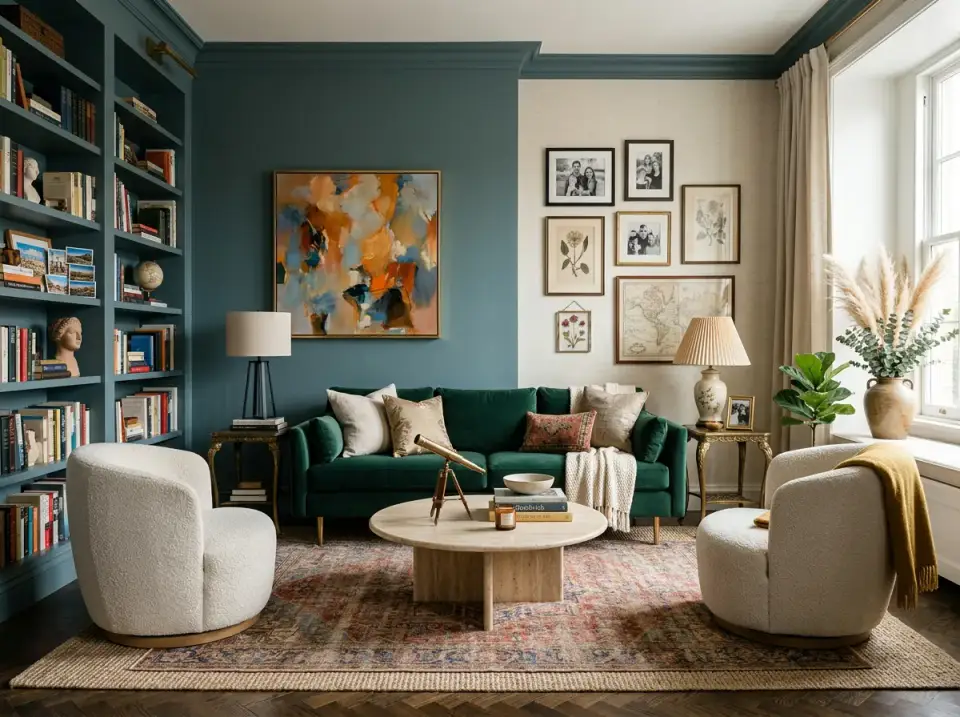
Reader notes