


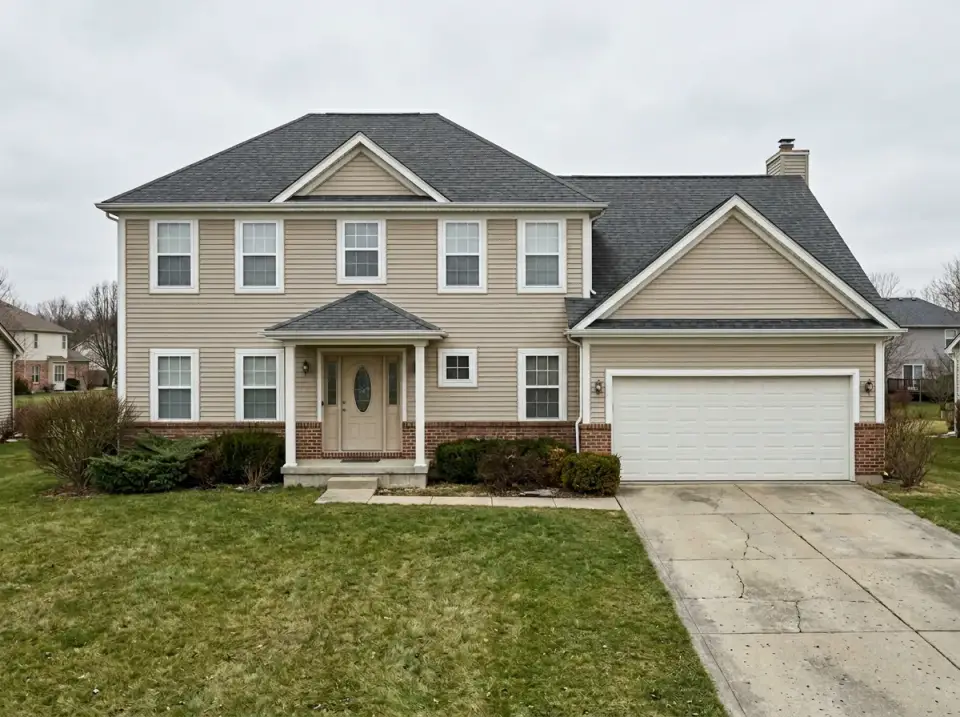
The two-story brown brick box is the most common starting point I see when clients call me about an exterior renovation — Charleston suburbs, Atlanta inner ring, the Nashville outskirts. The good news: that brick is structurally sound, the proportions usually work, and you have more directions to take it than the original builder ever imagined. Below are eleven exterior makeover ideas I keep coming back to for this exact starting point — each one tied to a real material palette, a regional fit, and the kind of curb-appeal payoff that holds up at resale, not just in the listing photos.
Sleek Modern Stucco Makeover
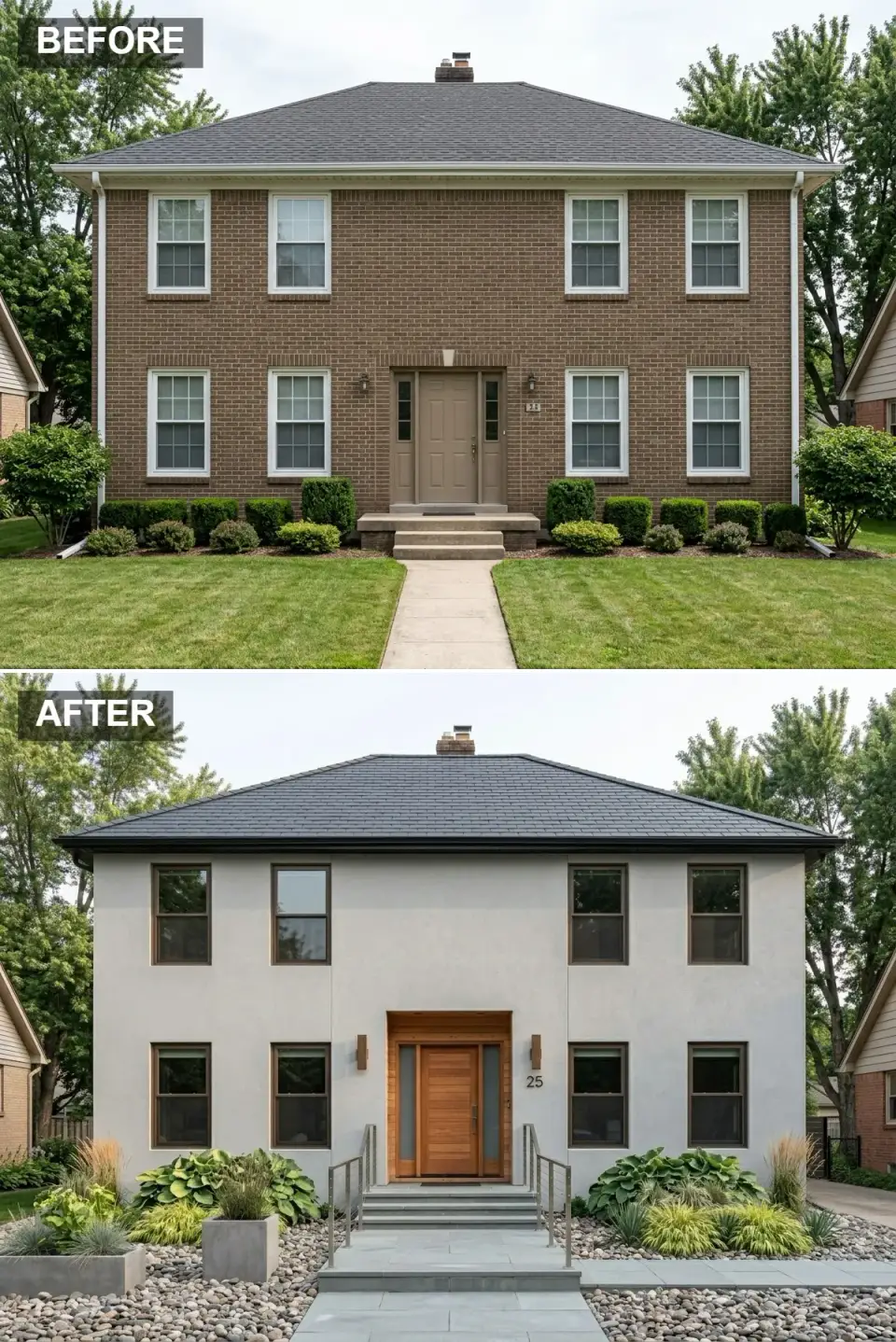
This is the version I sketch first when a client tells me the brick has to go entirely. Stucco over the existing brick — applied as a three-coat system over a properly furred substrate — gives you a smooth, light grey facade that reads contemporary the second the cure is done. I usually specify Sherwin-Williams Repose Gray or Benjamin Moore Coventry Gray for the integral color or topcoat. The original builder windows get replaced with large dark-bronze casement units (Marvin Essential or Andersen 100 Series both deliver the look at a sane price), and the standard slab door is swapped for a warm wood front door with a glass sidelight. New bluestone pavers and a slim metal handrail finish the entry sequence.
Color Palette
WallsLight Grey Stucco
#D0D0D0
A clean, neutral facade that holds up under harsh Southern light.
Door & TrimWarm Wood
#A67B5B
Warm wood door — the single warm note that makes the grey palette work.
Window FramesDark Bronze
#4A4A4A
A modern frame finish that draws clean lines across the facade.
HardscapingBluestone Pavers
#8C9BA5
Durable Pennsylvania bluestone — wears in beautifully over a decade.
Johan's Styling Notes
- Stucco over brick requires a proper rainscreen detail — never apply directly to old brick without consulting an envelope contractor, especially in humid Southern climates where trapped moisture turns into mold within a few years.
- Specify the casement windows in dark bronze rather than pure black; bronze reads more refined and ages without showing scratches the way a powder-coat black can.
- The wood door is the room's only warmth — keep it sealed annually with Sikkens or Penofin marine-grade finish, especially on south-facing entries.
- One slim handrail is plenty; the trend toward heavy black hairpin railings reads dated quickly.
Charming Craftsman-Style Update
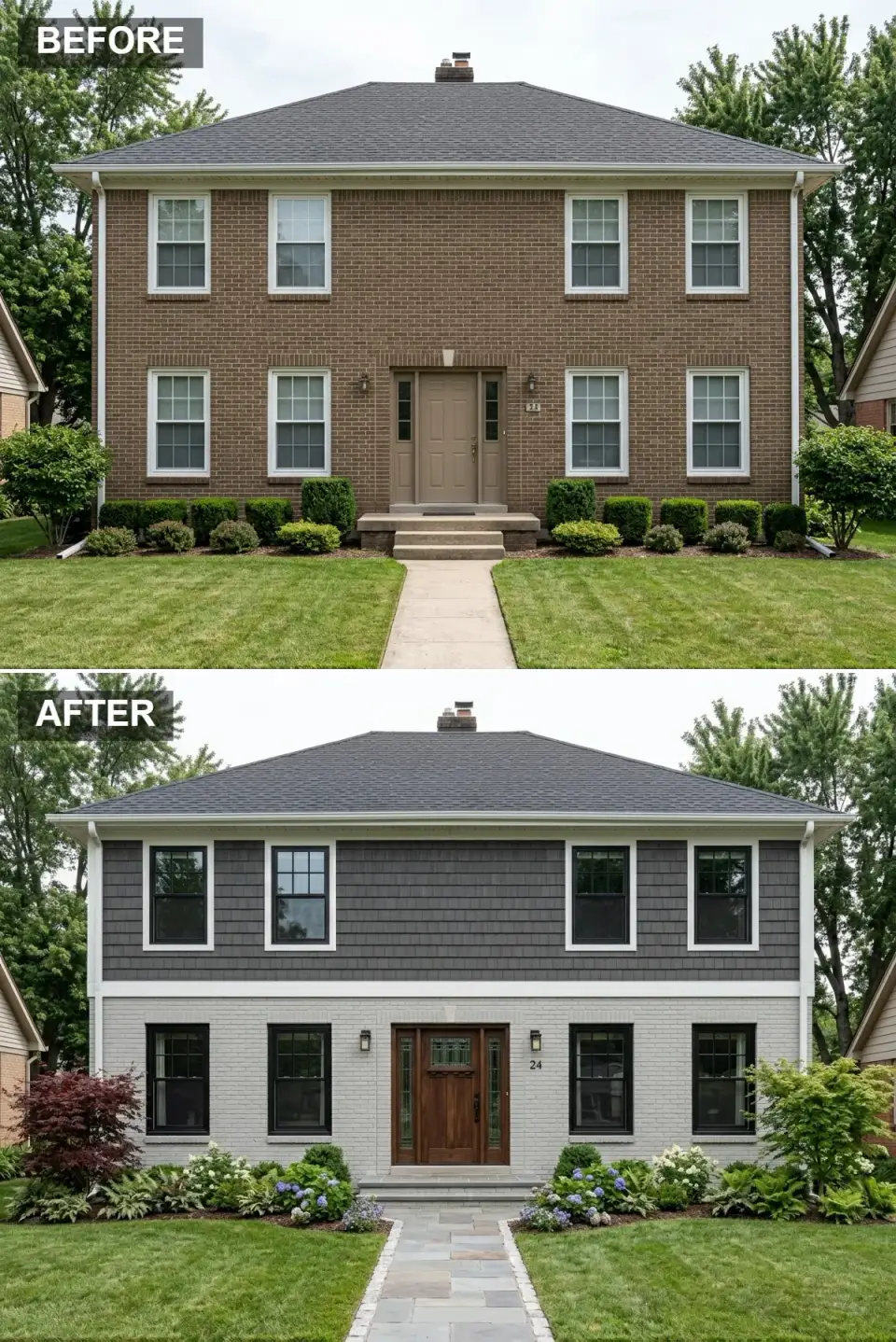
Painting the lower brick a soft grey and adding shake siding above is the renovation I propose to clients who want to keep the visual weight of the brick base but lose the dated brown. Sherwin-Williams Repose Gray on the brick (after a proper masonry primer like Sherwin-Williams Loxon), with James Hardie shake panels in Iron Gray on the upper level, gives the house a Craftsman two-tone language without committing to full demo. The original windows go to matte black, the original slab door becomes a real Craftsman wood door with stained glass detail (Krosswood or Simpson make these in solid wood at custom-ish prices), and a flagstone path through hydrangeas finishes the arrival.
Color Palette
Upper SidingCharcoal Shakes
#555555
Pre-finished cement-board shakes — adds dimension above the brick base.
Lower BrickLight Grey
#B0B0B0
Painted brick in a soft, neutral grey — keeps the masonry texture visible.
DoorDark Walnut
#664229
A traditional stained-glass Craftsman door — the entry's focal moment.
Window FramesMatte Black
#222222
Sharp graphic contrast against both the grey brick and the charcoal shakes.
Johan's Styling Notes
- Painting brick is permanent — once it's coated, you can't go back to natural without sandblasting that damages the brick face. Be sure before you commit.
- The shake siding has to be installed over a proper rainscreen with Z-flashing at the brick-to-siding transition; Southern humidity is unforgiving of this detail.
- Stained-glass Craftsman doors photograph beautifully but cost double a flat panel door — budget accordingly, and consider a side-light glass detail as a less expensive alternative that still reads Craftsman.
- Hydrangeas need afternoon shade in the Carolinas; if your front bed gets western sun, swap to oakleaf hydrangea or Annabelle for the same lush look without scorching.
Luxurious Contemporary Facade
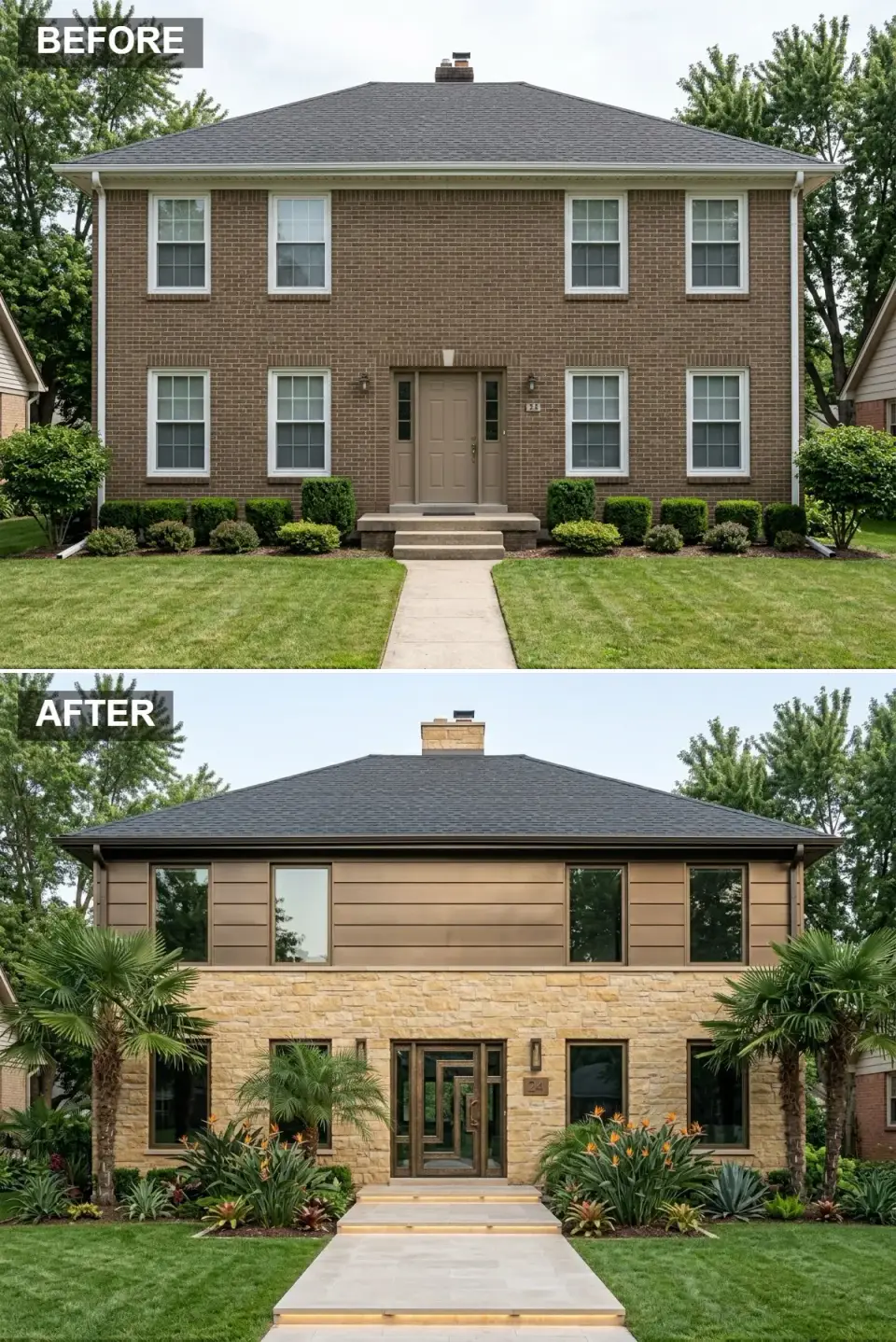
This is the splurge direction — the version I propose to clients in Naples or in the new Charlotte SouthPark builds when budget is the smaller constraint. Horizontal aged-bronze metal panels (Petersen PAC-CLAD or Berridge make these with proper standing-seam profiles) clad the upper level; warm stacked stone runs the lower wall plane and the entry surround. The custom bronze door is the moment — anything from Krosswood's pivot-door line through to genuine custom blacksmith work depending on budget. Integrated step lighting and palm-tree landscaping shift the read from "renovated suburban" to "purpose-built contemporary."
Color Palette
Upper PanelsAged Bronze Metal
#8C7853
Standing-seam metal in a bronze patina — catches afternoon light.
Lower WallsWarm Stacked Stone
#E0CFAA
Real stacked stone veneer, not faux panel — the texture is the splurge worth taking.
Door & TrimDark Bronze
#5F4B32
A custom bronze door — the room's deliberate point of expense.
HardscapingLimestone Pavers
#EBEBEB
Light limestone walkway — bounces evening light back at the metal panels.
Johan's Styling Notes
- Real stacked stone veneer (Eldorado Stone, Cultured Stone) costs three times the panelized "stone-look" alternatives. The texture difference reads from the curb — panel substitutes don't.
- Metal panels need expansion joints at every story break; specify a structural engineer review for any building over 25 feet of panel length.
- Palm trees only if you're zone 8b or warmer — Charleston, Savannah, Naples, Houston, parts of Atlanta. Otherwise, sub in tree-form crape myrtles or Magnolia 'Little Gem' for the same vertical statement.
- Step lighting is most effective at 2700K and aimed downward — uplit step lighting flares into the eye and reads as parking-lot rather than residential.
Coastal-Inspired Siding Renovation
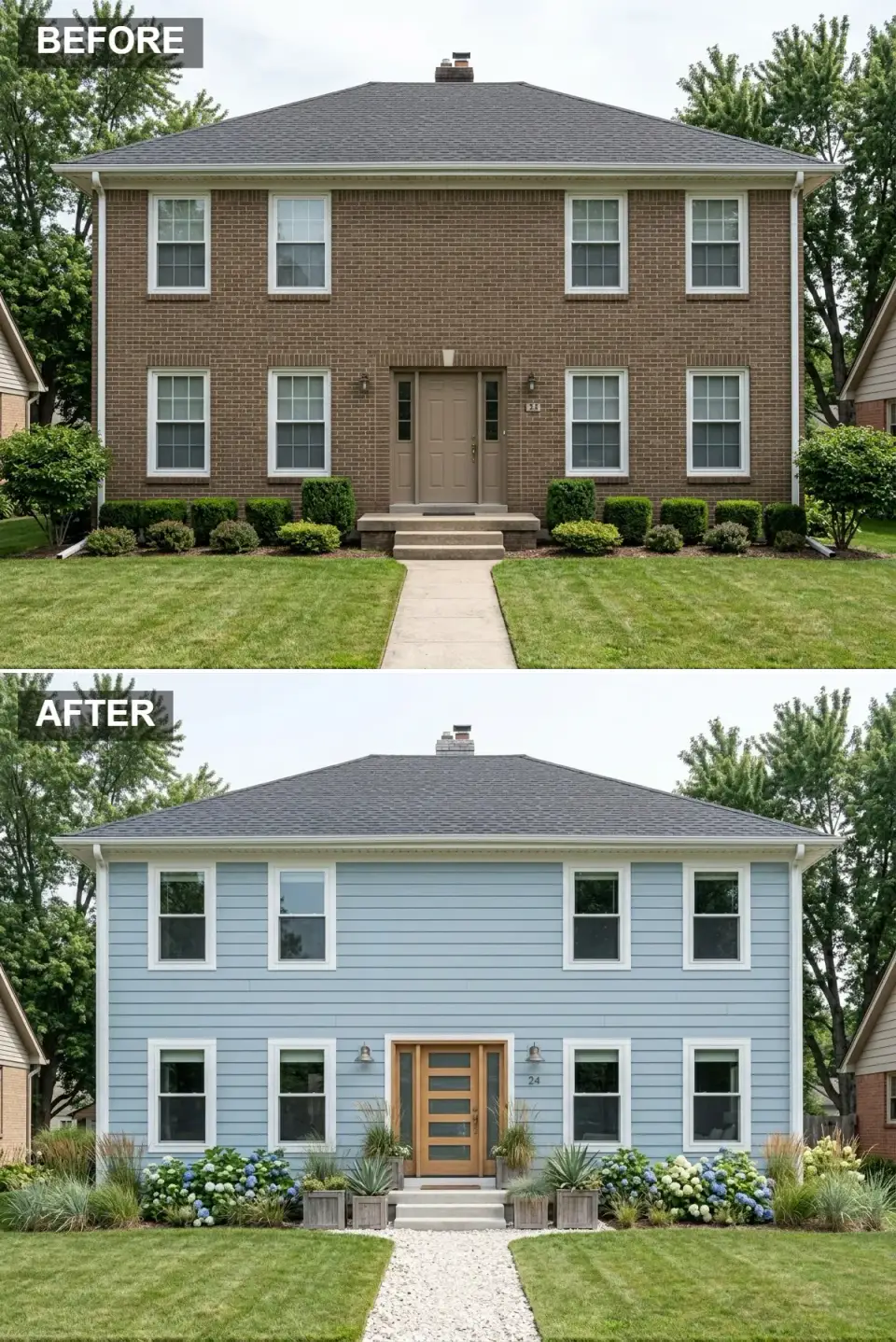
For the lakeside and tidal-creek clients I work with — Mount Pleasant, Daniel Island, Bluffton, Naples Park — this is the direction that almost always wins the family vote. Horizontal lap siding in soft coastal blue (Benjamin Moore Beach Glass or Sherwin-Williams Sea Salt both have the right under-grey to keep the blue from going cartoon), crisp white trim, and a wood door with frosted glass panels. A simple pea-gravel path with steel edging and beach-grass landscaping seal the read. The original windows can stay if their frames are sound — just paint the cladding white to match the new trim language.
Color Palette
SidingSoft Coastal Blue
#A8C0D8
A blue with enough grey to read sophisticated rather than novelty.
TrimCrisp White
#FFFFFF
Bright white trim — the punctuation that makes the blue read intentional.
DoorLight Oak
#CFAF8C
A natural-tone door with frosted glass — adds warmth and lets light through.
PathWhite Pea Gravel
#F0F0F0
A casual, beach-house walkway — needs annual top-up but worth it.
Johan's Styling Notes
- Coastal blue siding fades fast in direct sun — specify a fade-resistant finish from Hardie's ColorPlus line or a high-quality acrylic paint, and budget for a full repaint at year ten rather than year fifteen.
- Pea gravel walkways need steel edging and a compacted base, otherwise the gravel migrates into the lawn and into the house on every shoe.
- Beach grass (Panicum virgatum or Sporobolus heterolepis) reads coastal but stays low-maintenance through Carolina summers; pampas grass is increasingly considered invasive — skip it.
- The wood door wants a UV-stable marine finish (Sikkens Cetol or Epifanes) for any south or west exposure; clear-coat alone yellows within two seasons.
Industrial Chic Concrete and Metal
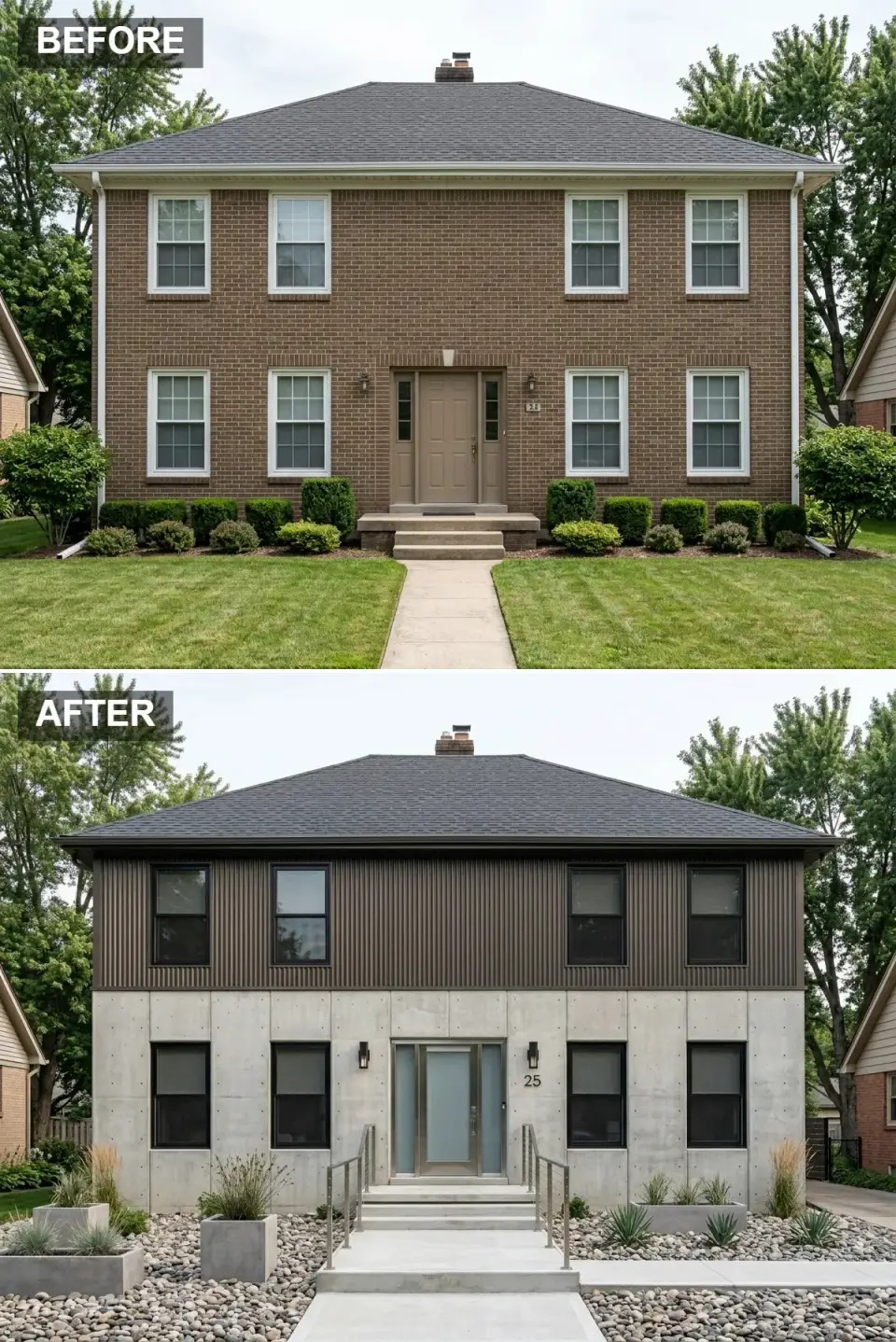
The industrial direction is a polarizing one — clients either fall for it on the first sketch or rule it out before I finish the pitch. The upper level gets clad in dark corrugated metal (Bridger Steel or McElroy Metal both supply this in 24-gauge that holds up); the lower level becomes raw concrete panels — either real board-formed concrete if budget allows, or smooth-finish cementboard panels in Concrete Grey by James Hardie as the more accessible option. Black-framed casement windows, a glass-and-steel door (Western Window Systems or Andersen's Architectural line), and a poured-concrete walkway with a slim steel handrail finish the look.
Color Palette
Upper SidingDark Corrugated Metal
#4F4F4F
A rugged, industrial texture that does the work of paint, pattern, and material in one move.
Lower WallsRaw Concrete
#BDBDBD
Minimalist, durable, and increasingly accessible through panelized cementboard.
Door & WindowsMatte Black Steel
#1A1A1A
Black frames cut clean lines against both the metal and the concrete planes.
RailingStainless Steel
#C0C0C0
A clean metallic accent that fits the structural language of the rest of the facade.
Johan's Styling Notes
- Real board-formed concrete is a meaningful budget commitment and requires a contractor with the specific formwork skill — vet portfolios carefully, this isn't a generalist trade.
- Corrugated metal needs proper trim closures at every panel termination; cheap installs leave gapped corners that become wasp nests within a season.
- Drought-tolerant landscape (agave, yucca, ornamental grasses, gravel mulch) is the only plant language that reads correct here — the moment you add a hydrangea, the aesthetic falls apart.
- Industrial reads especially well in Atlanta Westside warehouse-conversion neighborhoods, on Charleston Upper King infill lots, and in the new Nashville East nest of contemporary new-builds; it reads wrong in established traditional neighborhoods.
Modern Farmhouse with Stone and Batten
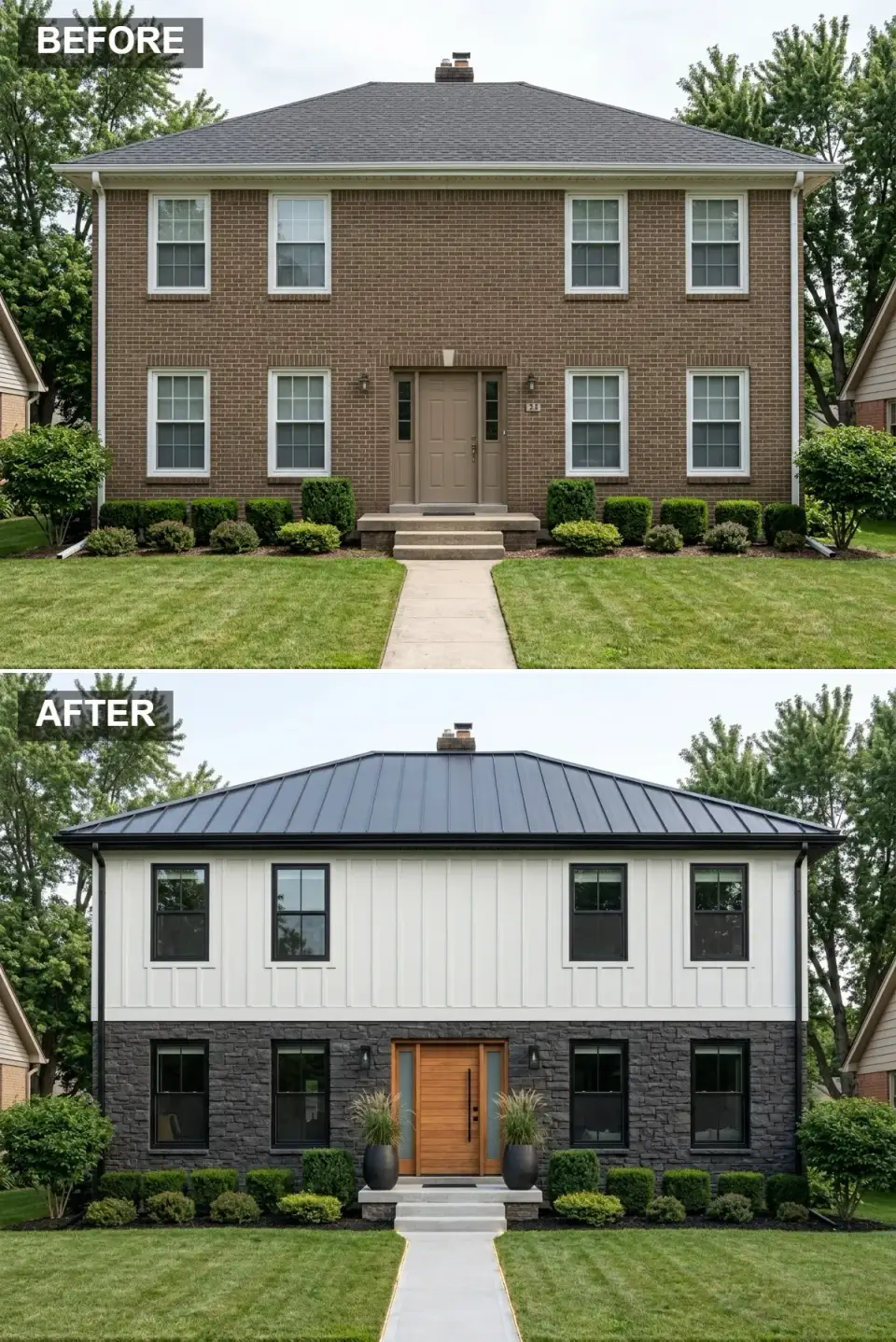
This is the version I install most often — modern farmhouse remains the dominant brief in Charleston suburbs and the Nashville outer ring, and for good reason. White board-and-batten Hardie panels (Sherwin-Williams Pure White or Benjamin Moore Chantilly Lace) on the upper level, charcoal stacked stone on the lower level (Eldorado Stone's Cliffstone in Sequoia reads particularly well), a standing-seam metal roof in dark grey, black-framed windows, and a stained wood plank door. Two oversized concrete planters flank the entry. The combination is photogenic, holds resale value, and ages well in humid climates.
Color Palette
Upper SidingWhite Board-and-Batten
#FAFAFA
Crisp, classic farmhouse cladding — the most photographed exterior in the South right now.
Lower StoneCharcoal Stacked Stone
#363636
Adds visual weight and modern contrast to the white above.
DoorMedium Wood Plank
#B37E4E
A warm-stained plank door — the entry's focal point against the high-contrast palette.
RoofDark Standing-Seam Metal
#2C2C2C
Durable, fire-resistant, and the defining roofline of the modern farmhouse vocabulary.
Johan's Styling Notes
- White board-and-batten needs to be Hardie or LP SmartSide — vinyl board-and-batten reads obviously plastic from the curb and never recovers.
- Standing-seam metal roofs are a 30-year investment; specify a 24-gauge Galvalume substrate with a Kynar paint finish, and budget for proper underlayment, not just felt.
- Two large planters flanking the door is the right move — one alone reads off-balance, three or more reads cluttered. Specify cast-stone or fiber-stone planters that won't crack in a freeze.
- Stacked stone needs proper weep flashing at the top of the wall plane; Southern rainwater finds every detail you don't address.
Classic Cream and Wood Renovation
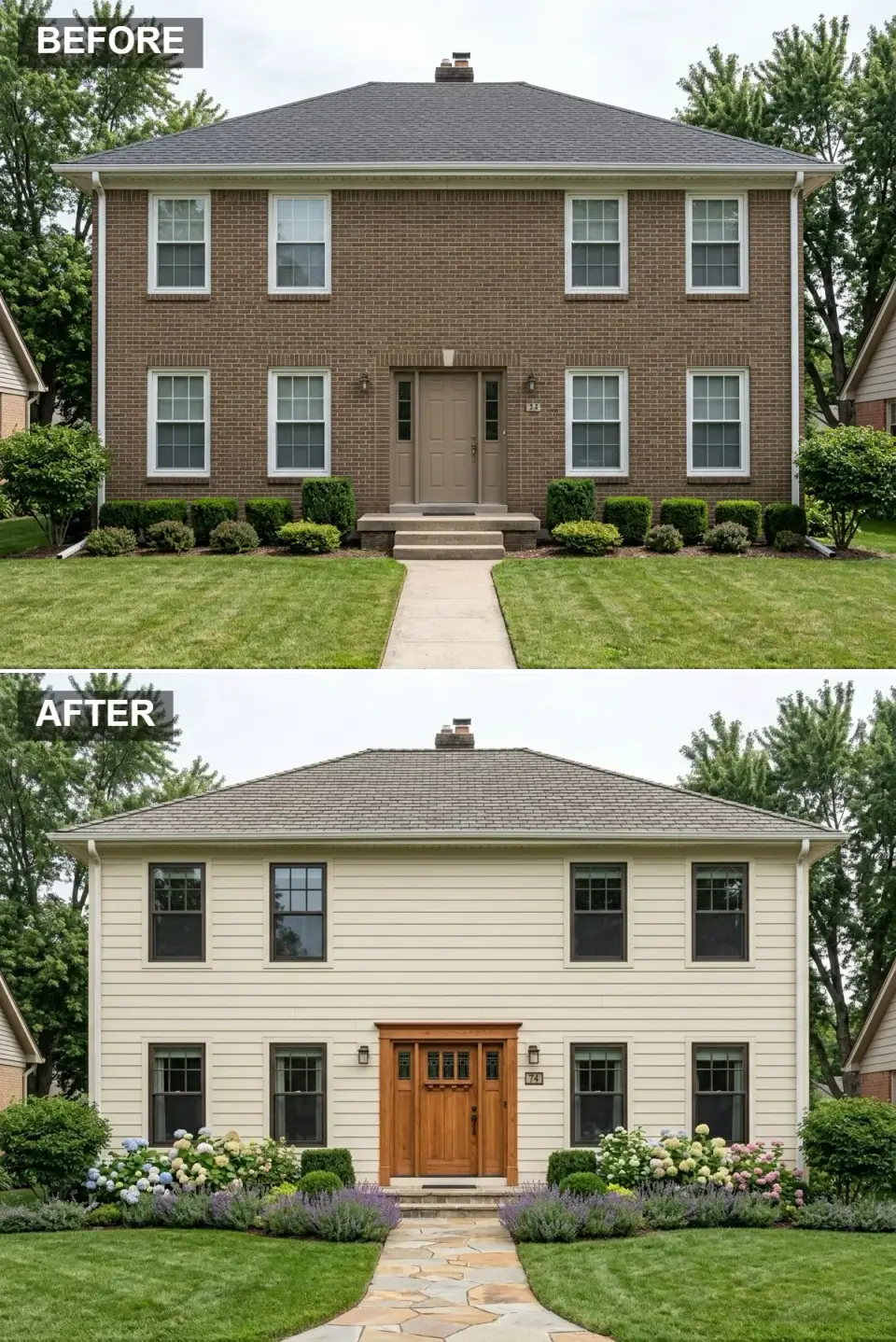
For clients who want timeless rather than trendy, this is the direction that ages out the slowest. Cream-colored horizontal lap siding (Benjamin Moore Manchester Tan or Sherwin-Williams Natural Linen, both in a satin finish) covers the brick entirely; a Craftsman wood door with a wide stained surround becomes the entry. A flagstone path winds through a garden of lavender and hydrangea, with low boxwood spheres anchoring the bed corners. This is the version I install for owners planning to stay in the home long-term — it photographs beautifully without ever feeling of a specific moment.
Color Palette
SidingWarm Cream
#F2E8D5
A soft, timeless neutral that flatters every season's light.
Door & TrimMedium Oak
#A07648
Natural wood door and surround — defines the entry without shouting.
Window FramesDark Bronze
#423E37
A subtle dark frame that grounds the cream siding without going stark.
PathFlagstone
#C8BFAE
Natural flagstone — wears in over decades rather than out.
Johan's Styling Notes
- Cream-toned siding shows dirt streaks more than white; specify a finish coat with mildew inhibitors built in, especially in coastal humidity.
- Lavender struggles in Carolina humidity — for clients in Charleston or Savannah, swap to Russian sage (Perovskia) for a similar look that actually thrives in our wet summers.
- Boxwood blight is a real ongoing issue in the Southeast — choose blight-resistant cultivars like 'NewGen Independence' or sub in inkberry holly for the same evergreen mass.
- Flagstone laid on a sand base shifts with freeze-thaw cycles; for high-traffic walkways, set it on a mortar bed with proper drainage instead.
Striking Minimalist Stone and Siding
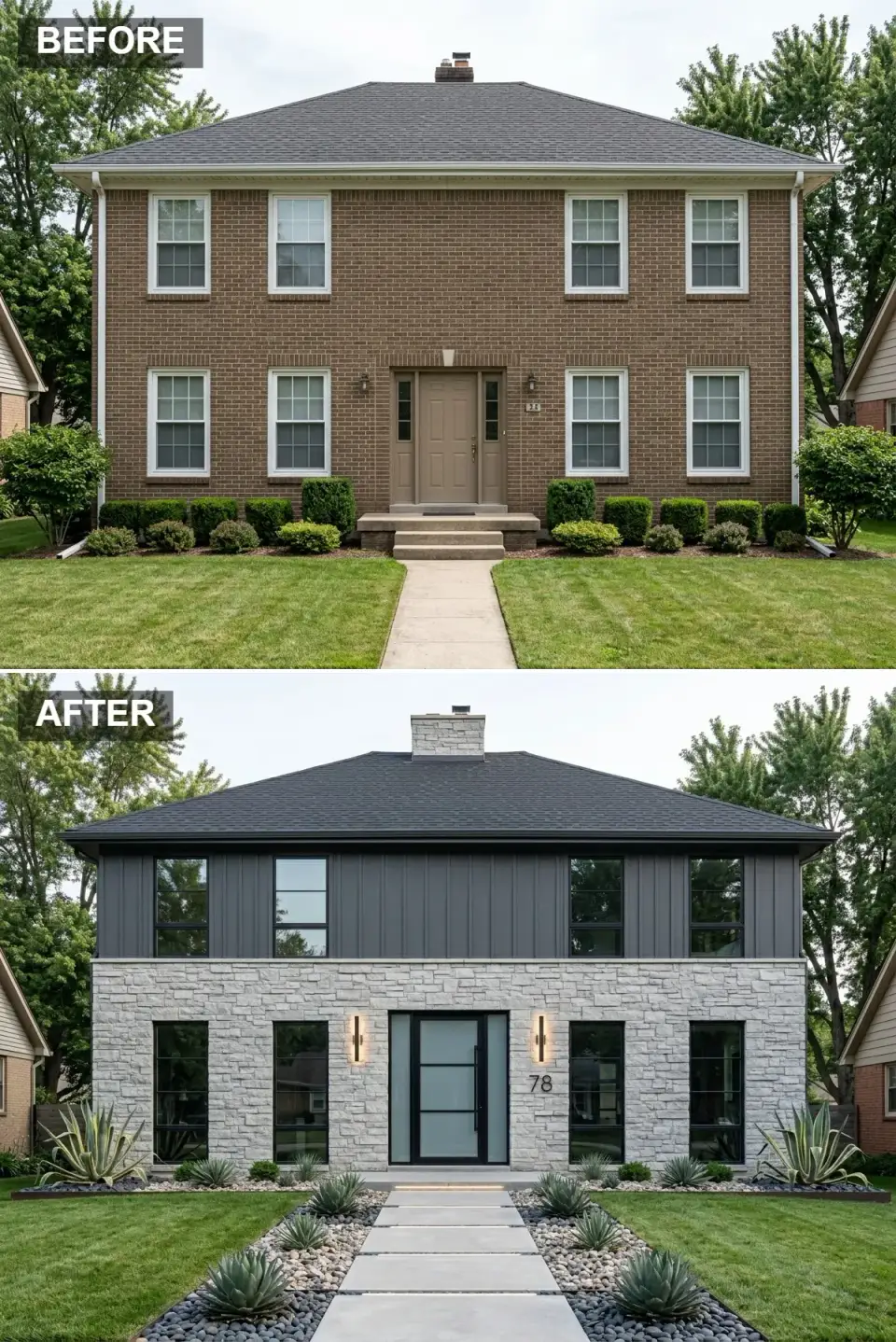
A high-contrast minimalist makeover that lets the architecture do the speaking. Dark charcoal vertical siding (Hardie's Iron Gray or Tricorn Black for the bolder version) on the second floor; light grey stacked stone on the first. Black-framed casement windows oversized at the great room and primary suite; a sleek glass front door with a long stainless pull. The walkway is large-format concrete pavers, the landscaping leans architectural — agave, yucca, and a single specimen tree (often a multi-trunk crape myrtle here in the South).
Color Palette
Upper SidingDark Charcoal Vertical
#333333
A strong, modern color that visually recedes against the daytime sky.
Lower StoneLight Grey Stacked Stone
#D1D1D1
Provides texture and brightness against the dark cladding above.
Door & WindowsMatte Black
#000000
Maximum contrast — the graphic line that defines the modern facade.
PathConcrete Pavers
#E0E0E0
Large-format clean-lined pavers — the only walkway material that reads minimalist.
Johan's Styling Notes
- Vertical siding needs to terminate properly at top and bottom edges — exposed end-grains read sloppy and admit water; insist on factory-made closure trims.
- Dark exteriors absorb significantly more heat — in the South this matters; specify radiant barrier sheathing and upgrade attic ventilation accordingly.
- Agave and yucca thrive in Charleston and warmer; they survive Nashville winters in protected microclimates only — for clients farther north, sub in upright junipers or boxwood pyramids for similar architectural punch.
- The single specimen tree is the architectural move — a row of identical shrubs reads as builder-grade here.
Bold Painted Brick Transformation
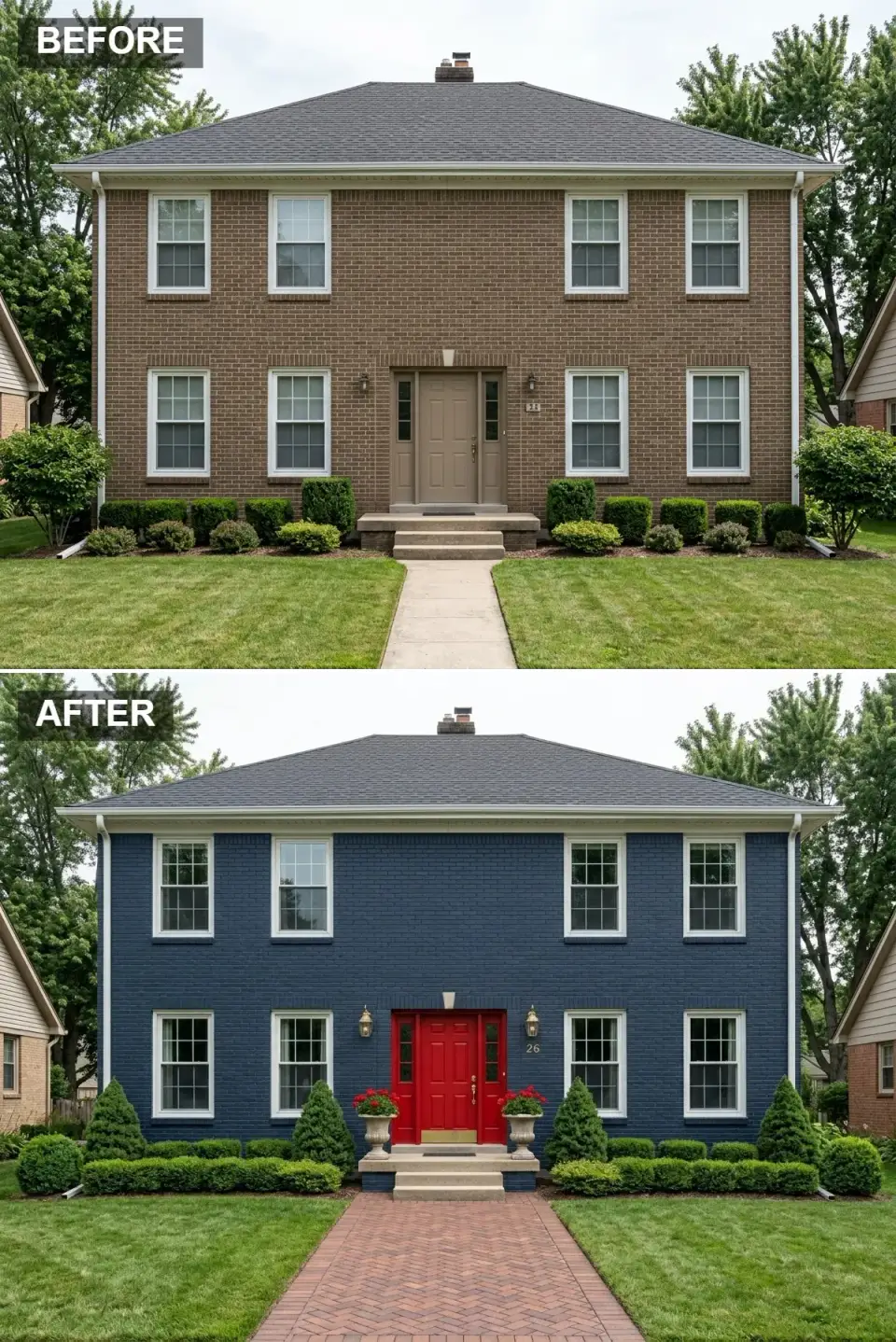
When a client tells me the budget is tight but they want a real transformation, this is the direction I push them toward. Painting brick is the most cost-effective makeover on this list, and the deepest payoff if the color is right. Benjamin Moore Hale Navy or Sherwin-Williams Naval are my two go-tos for this navy direction — both photograph beautifully and hold their saturation at year five better than cheaper paints. Crisp white trim (Sherwin-Williams Pure White), a vibrant red door (Benjamin Moore Heritage Red is my preferred shade), and the original brick paver path retained. Manicured boxwood hedges and clean planters complete the stately, traditional look.
Color Palette
Brick WallsDeep Navy Blue
#1B2F4E
A bold and sophisticated paint color — the most transformative single decision on this list.
Trim & WindowsCrisp White
#FFFFFF
Highlights every architectural moulding against the dark brick.
Front DoorHeritage Red
#C21807
A classic accent color — bold without being trendy.
PathRed Brick Pavers
#A65E4E
Original brick walkway retained — ties the new palette to the bones of the property.
Johan's Styling Notes
- Brick must be properly cleaned, primed (Sherwin-Williams Loxon XP or Benjamin Moore Insl-X), and then top-coated with a true masonry paint like Romabio Limewash or Sherwin-Williams Loxon — standard exterior paint will peel within three years on brick.
- Painting brick is permanent. Once committed, future buyers can't easily reverse it. Confirm with your real estate agent that painted brick is desirable in your specific neighborhood before you commit.
- Red doors traditionally signal "welcome" in Southern colonial homes; Charleston historic-district owners should confirm allowable door colors with their architectural review board first.
- Boxwood hedges are the stately move but require annual shearing — for clients who don't want the maintenance, swap to dwarf yaupon holly for the same formal look without the trim schedule.
Crisp White Modern Farmhouse
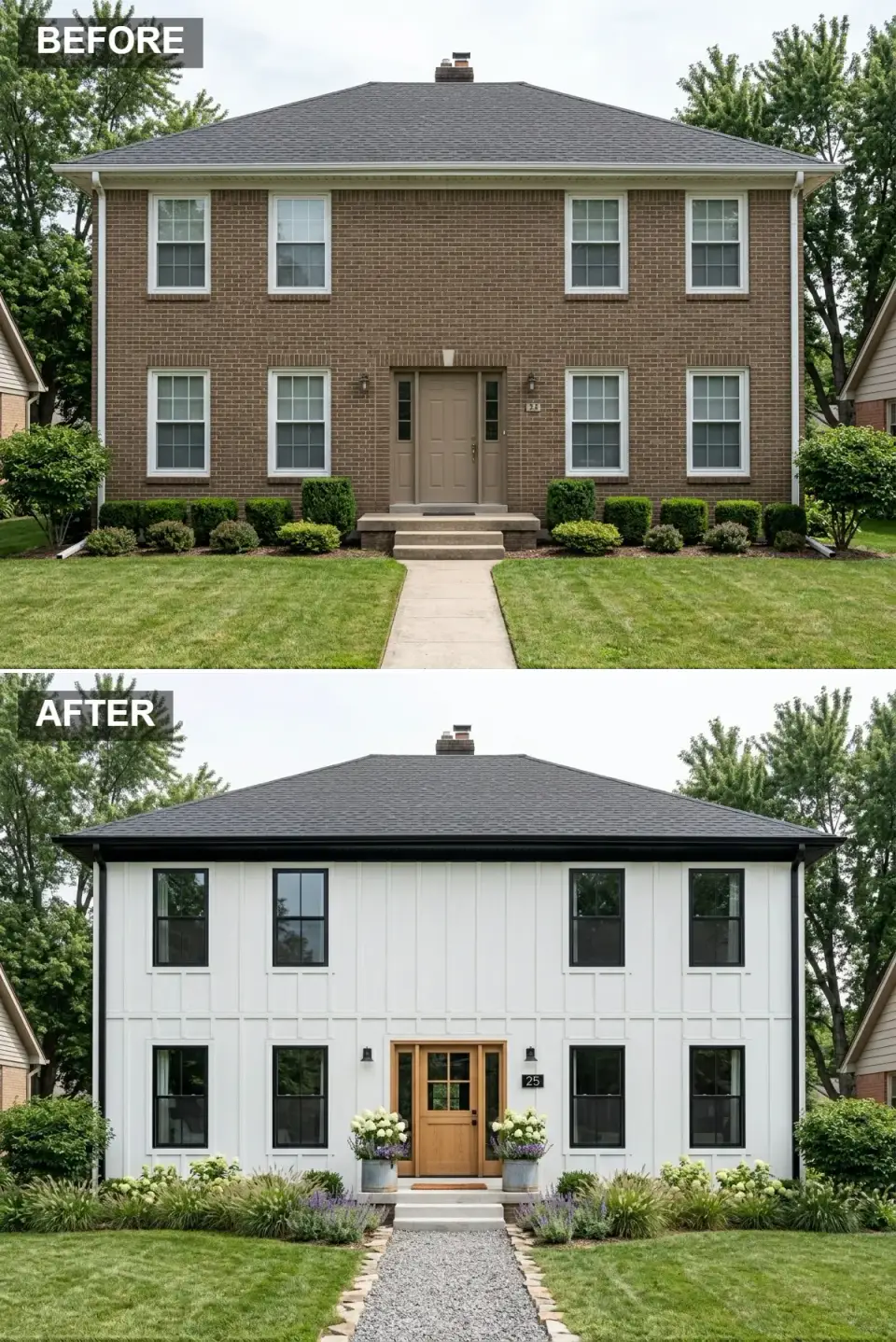
The full-commitment version of the modern farmhouse direction — one continuous skin of white board-and-batten across the entire facade. This reads cleaner and more contemporary than the two-tone stone-and-batten version above, and it is the direction that has dominated Pinterest and the Charleston suburb new-build market for the past five years. Same cladding specifications as before — Hardie or LP SmartSide board-and-batten in a true white, black-framed casement windows, light wood entry door, gravel walkway, generous hydrangea plantings.
Color Palette
SidingPure White
#FFFFFF
Clean, bright, and reflective — unifies the facade into one calm plane.
Window FramesMatte Black
#1F1F1F
A graphic, modern contrast — the defining frame of the modern farmhouse style.
DoorLight Oak
#C8A882
Adds a natural, warm focal point against the white facade.
Roof & GuttersBlack
#2A2A2A
Frames the entire silhouette and reinforces the modern farmhouse vocabulary.
Johan's Styling Notes
- Pure white siding shows green algae bloom in Carolina humidity within two years if not specified with mildew-resistant finish; budget for soft-wash cleaning every 18 months to keep the brilliance.
- Black gutters and downspouts are non-negotiable in this aesthetic — white gutters disappear into the siding and read as missed detail.
- Hydrangea 'Limelight' or 'Annabelle' both perform reliably in Carolina conditions and bloom large enough to read from the curb; mophead types like 'Endless Summer' tend to disappoint by August.
- This direction has been so saturated in Southern suburbs over the past five years that resale advantage is shrinking — beautiful, yes, but no longer differentiating.
Mediterranean-Style Stucco & Tile
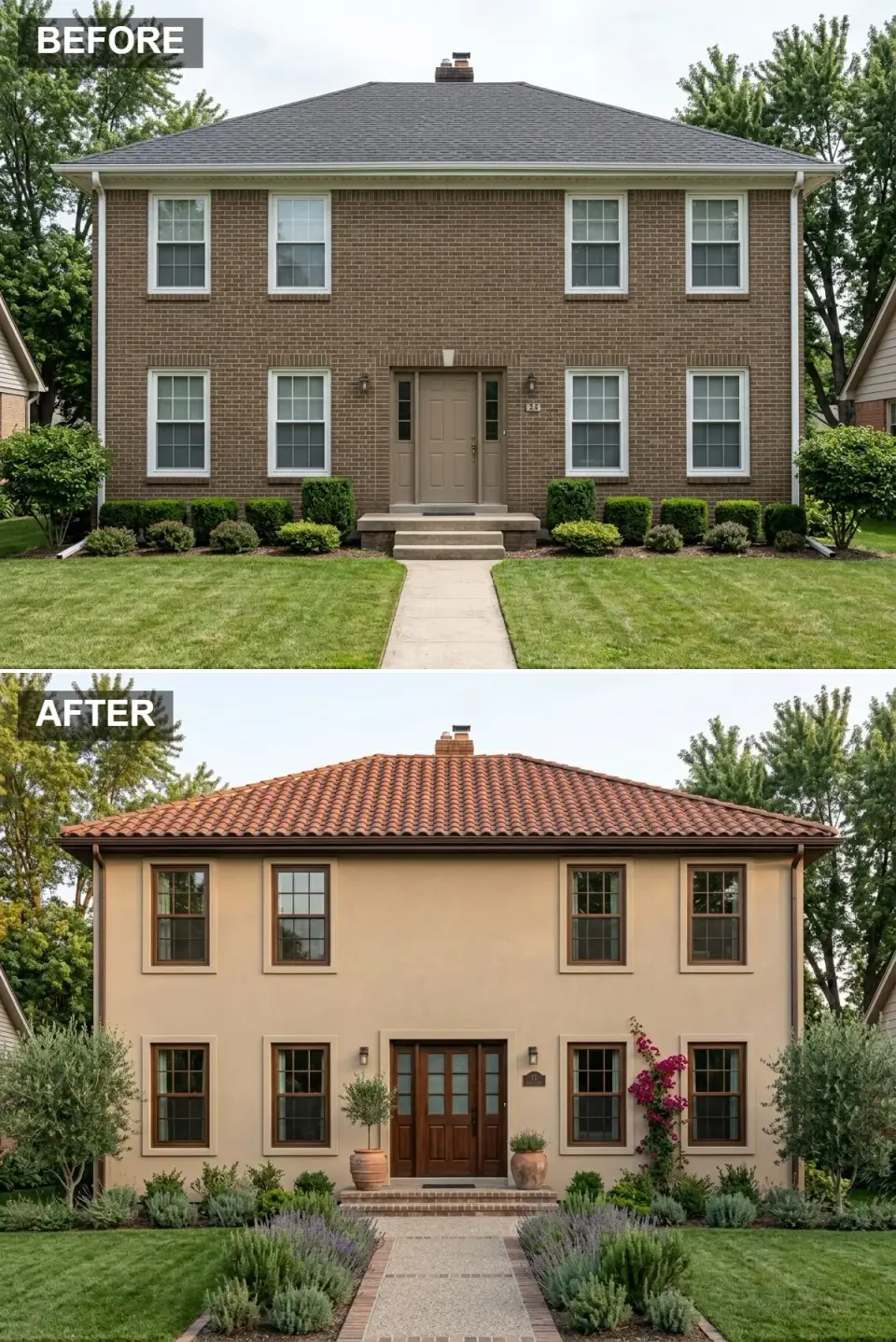
The biggest architectural pivot on this list — the brick gets covered with warm beige stucco, the existing asphalt roof gets replaced with terracotta clay tile, and the entire architectural language shifts to Mediterranean. This is the direction I propose for clients in Naples, Sarasota, parts of Houston, and the Mediterranean revival pockets of Charleston's Daniel Island. Dark walnut wood windows and a matching plank door with iron hardware reinforce the read. Terrazzo or exposed-aggregate walkway, terracotta pots, olive trees, and lavender plantings complete the transformation.
Color Palette
WallsWarm Beige Stucco
#D9C4A9
An earthy tone typical of Mediterranean architecture — flatters the terracotta roof.
RoofTerra Cotta Clay Tile
#A85A3F
The signature element — adds color, texture, and unmistakable Mediterranean identity.
Door & WindowsDark Walnut Wood
#5C4033
Rich wood tones that contrast warmly with the stucco and terracotta.
PathExposed Aggregate
#B8B0A4
A textured, earthy walkway material that fits the architectural language.
Johan's Styling Notes
- Real terracotta clay tile is heavy — your existing roof structure may need engineering reinforcement before you can install it; budget for a structural review before specifying.
- Stucco over brick in humid Southern climates requires a proper rainscreen and weep system — synthetic stucco (EIFS) without a drainage cavity has a long, ugly history in Southeast humidity.
- Olive trees survive zone 8b and warmer; for Atlanta, Charlotte, and Nashville clients, sub in willow oak or sweetbay magnolia for a similar architectural form.
- Iron door hardware (Emtek's Bronze line, Sun Valley Bronze for the splurge) is the detail that sells the Mediterranean read — generic brushed-nickel pulls undo the entire scheme.
Johan's Pro Tips for Any Brick Exterior Makeover
- Mix materials with intention, not by reflex. Two cladding materials reads designed; three reads busy; four reads reno-flip. The two-material rule (siding above, stone or painted brick below) is the most reliable pattern on this list.
- Painting brick is permanent — be certain before you commit. Once brick is painted, sandblasting to remove the coating damages the brick face and is rarely worth the cost. Test the color on a small section, live with it for two weeks, then proceed.
- The front door earns the largest single visual return. Of every exterior change you can make, swapping the door delivers the most curb-appeal payoff per dollar spent. A real wood door with proper hardware shifts the read of the entire facade.
- Window frames are the line that defines the style. Black-framed windows turned the modern farmhouse into a category — they're the single decision that signals which decade your renovation is from. Choose deliberately.
- Landscape carries half the curb appeal. The most beautifully renovated facade reads incomplete without considered planting beds, a real walkway, and proper bed edging. Budget at least 15% of the project total for landscape, not as an afterthought.
Where These Looks Land in the South
- Charleston, SC: The Modern Farmhouse with Stone, Cream and Wood, and Painted Brick Navy directions all read as natural fits in West Ashley, Mount Pleasant, and James Island. Mediterranean works on Daniel Island specifically.
- Savannah, GA: Painted Brick Navy and Cream and Wood land beautifully in the historic squares; Industrial Chic reads wrong in this market.
- Naples, FL: Mediterranean and Luxurious Contemporary are dominant in the new-build communities; Coastal Siding lives in the older neighborhoods near Naples Park.
- Nashville, TN: Crisp White Modern Farmhouse and Modern Farmhouse with Stone are the suburban defaults; Industrial Chic fits East Nashville and the Wedgewood-Houston conversions.
- Atlanta, GA: Industrial in the Westside warehouse pockets; Luxurious Contemporary in Buckhead; Painted Brick Navy in the established Decatur and Druid Hills neighborhoods.
- Charlotte, NC: Modern Farmhouse with Stone and Minimalist Stone and Siding both perform in SouthPark and Ballantyne new-builds; Painted Brick Navy reads beautifully in the Myers Park traditional homes.
Frequently Asked Questions
How much does a brown brick exterior makeover cost in 2026?
A paint-only refresh (clean, prime, paint the brick, swap the door, redo the landscaping) runs $8,000 to $18,000 for a typical two-story home in 2026 pricing. Adding board-and-batten siding to the upper level pushes the project to $25,000 to $50,000. The full-commit Mediterranean or Luxurious Contemporary directions, with new roof tile, custom doors, and stucco work, run $80,000 and up depending on home size and regional labor rates.
Can I paint over brick myself, or do I need a professional?
Technically yes, but the prep work — proper cleaning, repointing any failed mortar, applying a true masonry primer like Loxon XP, and using the right top-coat — is where DIY brick paint jobs fail. The cost difference between a quality DIY job and a quality professional job is smaller than people expect, and the durability difference is significant. For an investment as permanent as painted brick, hire a contractor with verifiable masonry experience.
Will painting my brick affect resale value?
It depends entirely on your local market. In Charleston historic-adjacent neighborhoods, the Atlanta Decatur ring, and the Nashville Belmont area, painted brick is a desired feature that adds value. In some suburban developments where natural brick is the dominant aesthetic, it can be a neutral-to-slight-negative. Check three recent comparable sales of painted-brick homes within a half-mile of your address before committing.
What is the most cost-effective transformation on this list?
The Bold Painted Brick Transformation. A complete navy paint job, white trim repaint, new front door, and refreshed landscaping delivers more visual change per dollar than any other option here. The Coastal Siding direction is the second most cost-effective, especially if your existing windows are sound enough to keep with a paint refresh.
Can I do this renovation in phases?
Yes — and I often recommend phasing for clients with budget constraints. Start with the door swap and landscape refresh in year one (the highest curb-appeal payoff per dollar). Add windows and exterior lighting in year two. Tackle the cladding (paint or new siding) in year three. The phased approach lets you live with each decision before committing to the next, and prevents the all-at-once budget panic that derails good projects.
How do I choose between painting the brick or covering it with siding?
If the brick is structurally sound and the proportions of your facade work, paint is the lower-cost, lower-risk option. Cover the brick only when you want a different texture entirely (smooth stucco, cement-board siding, board-and-batten) or when the brick is in such poor condition that repair would cost more than encapsulating. The decision often comes down to the architectural identity you want — painted brick keeps a traditional language; covered brick lets you fully reset the style.
Sources & References
- Sherwin-Williams Color Visualizer — paint color references for Repose Gray, Naval, Pure White, and Natural Linen used throughout this guide. sherwin-williams.com
- Benjamin Moore Color Tools — Hale Navy, Manchester Tan, Beach Glass, Coventry Gray, and Heritage Red references. benjaminmoore.com
- James Hardie Building Products — Cladding Specifications — Hardie Plank, Hardie Panel, and Hardie Shake durability and warranty data referenced in the siding recommendations. jameshardie.com
- National Association of Home Builders — Cost vs. Value Report (2024) — return-on-investment data for siding, window, and door upgrades referenced in the cost discussion. nahb.org
- Sherwin-Williams Loxon XP — Masonry Primer Specifications — technical reference for the painted-brick preparation process. sherwin-williams.com/loxon
Final Thoughts
Eleven directions on the same brown brick starting point isn't the same as eleven equally good answers. The right direction is the one that matches your neighborhood, your climate, your budget, and the years you plan to stay. Modern farmhouse is dominant for a reason but also saturated. Painted brick navy delivers the highest payoff per dollar but is permanent. Mediterranean is beautiful in the right region and reads costume in the wrong one. The renovation that holds up for fifteen years is the one that's deliberately matched to its context — not the one with the most Instagram saves the week the photos go up.
If you found a direction here that pulled you in, you might also enjoy my deep dive on the single-property red brick to Scandi modern transformation, my full breakdown of eleven facade renovations on a run-down Tudor, my walkthrough of thirteen styles applied to one cookie-cutter home, or my review of twelve makeover directions for a tired stucco home.
Pick the direction. Live with it on paper for two weeks. Then call the contractor.

Elise Marchetti
Transformations Editor · Charleston, South CarolinaBefore-and-after projects with the invoices attached. Elise runs the Transformations desk — interiors, exterior facades and outdoor spaces across the Lowcountry and the wider South — and writes up what actually changed, what it cost, and which three decisions moved the room.
More from Elise →
Reader notes