


A dedicated fire pit lounge is one of the most rewarding ways to pull a home's living space out into the open air. With the right plan, a tired concrete slab and a rusty steel bowl can turn into the spot everyone gathers by October. The eleven transformations below show how hardscaping, thoughtful furniture, and layered lighting work together to build real outdoor rooms. From a raked-gravel courtyard to a moody modern patio, each one is a working blueprint for warmth, conversation, and year-round curb appeal around the flame.
Suburban Charm: Herringbone Brick & String Lights
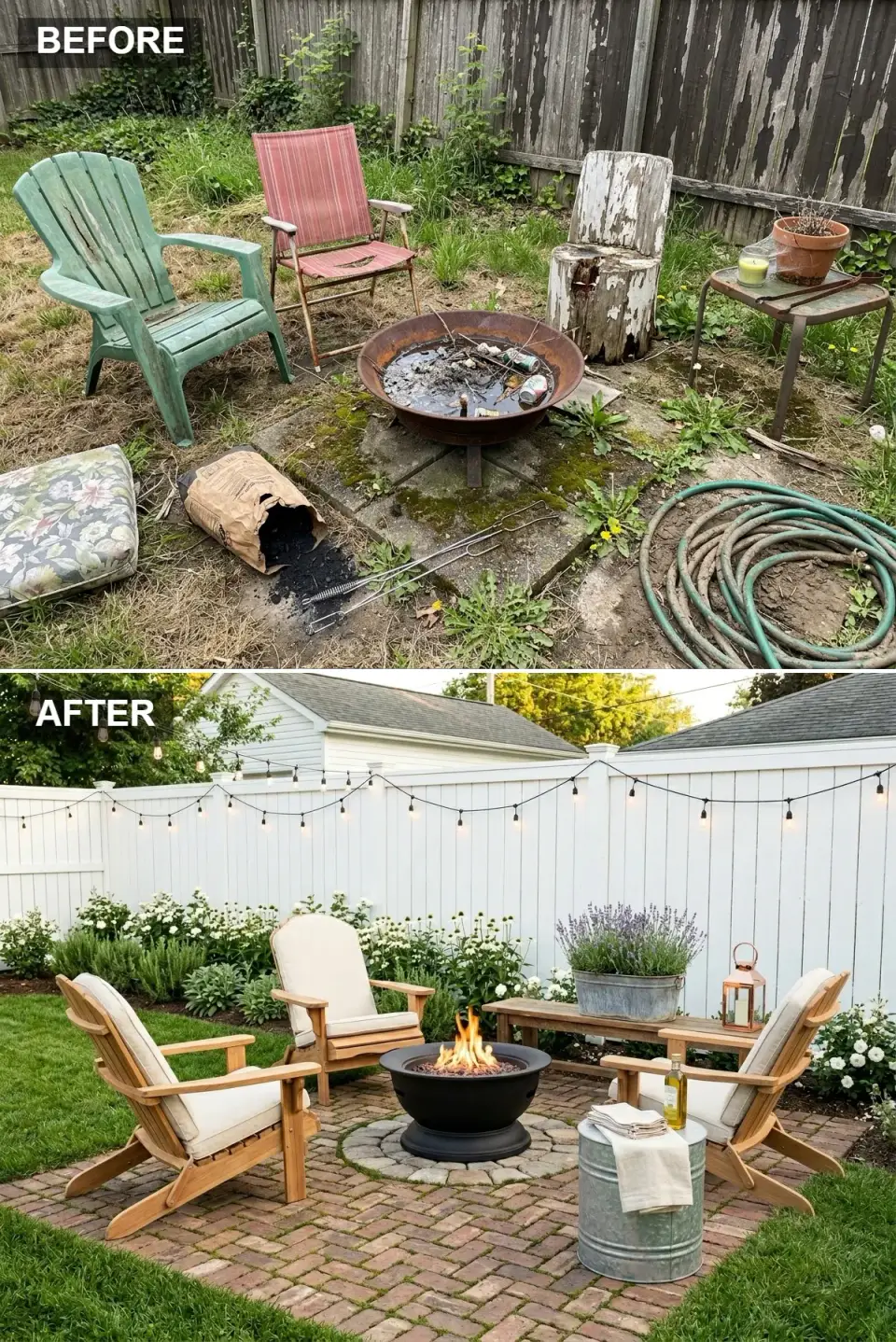
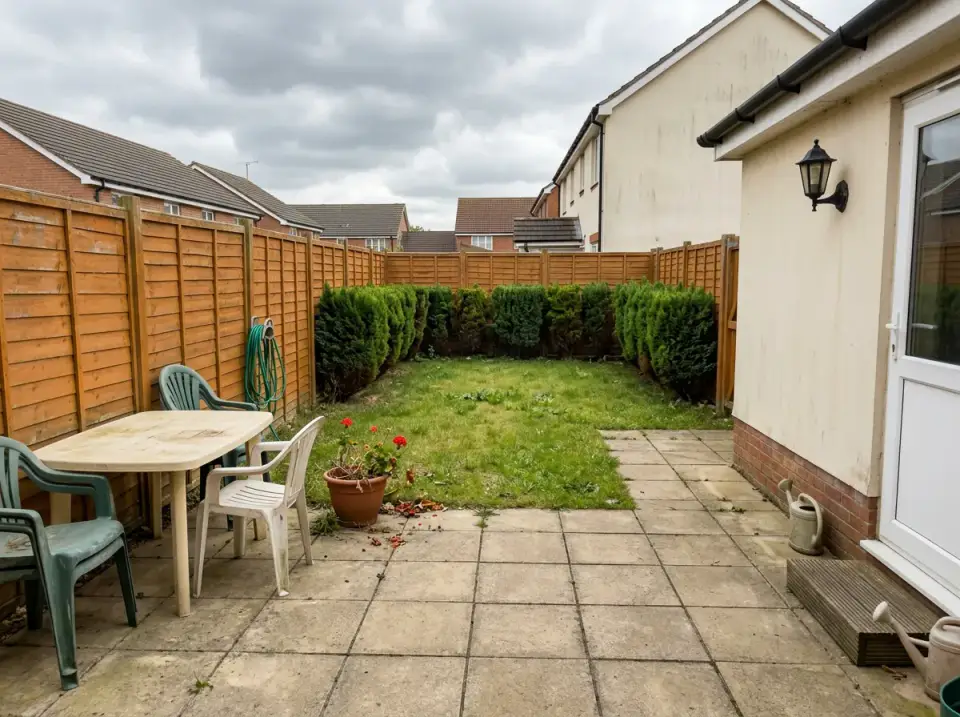
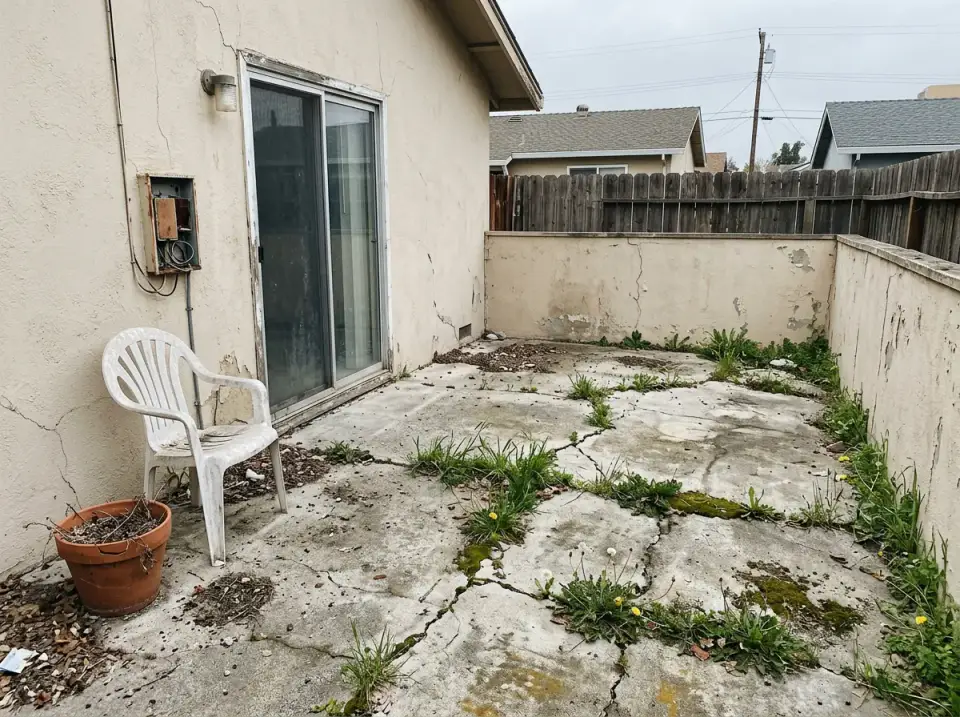
The cracked slab and that sad rusty bowl are gone, and in their place sits a warm herringbone brick patio anchored by a low black gas fire pit. A crisp white privacy fence and café string lights close the space in, and three natural cedar Adirondack chairs with ivory cushions make you want to stay past dark. A galvanized tub spills over with lavender, and a matching barrel side table holds linen napkins and a lantern. It reads polished but relaxed, the kind of country-leaning patio that suits homes all over the Carolinas.
Most of the light in this picture comes off the fence. Its boards are painted Ivory (#FDFDFD), close to pure white, so at dusk they hold the glow of the string lights and give the lavender something clean to stand against. The three Adirondack chairs are left as bare Warm Cedar (#D4A373), and that honey color is what keeps the white enclosure from feeling clinical.
Underfoot, the brick reads as Terracotta (#B45F4D), a softened clay red rather than a bright one, and the herringbone stops at a small ring of stone under the fire pit. The beds along the fence bring in Soft Sage (#A8B5A0) through gray-green foliage, white flowers and the lavender in the galvanized tub, all muted enough that the brick stays the warmest surface in the yard.
Tips for a Herringbone Brick Fire Pit Patio
The ground plane does the most work here. A herringbone brick field with a small circular stone inset anchors the fire pit and marks out the gathering zone, so the seating area reads as its own room. Choose a gas fire pit with a broad rim, which lets everyone enjoy the flame while keeping the surround free of soot.
Light and metal finish the scheme. Commercial-grade café string lights hung in overlapping V shapes spread warm light evenly across the whole patio, and repeating galvanized metal on the planters and side tables runs one consistent rustic thread through the space.
Linear Luxe: A Contemporary Cedar Retreat
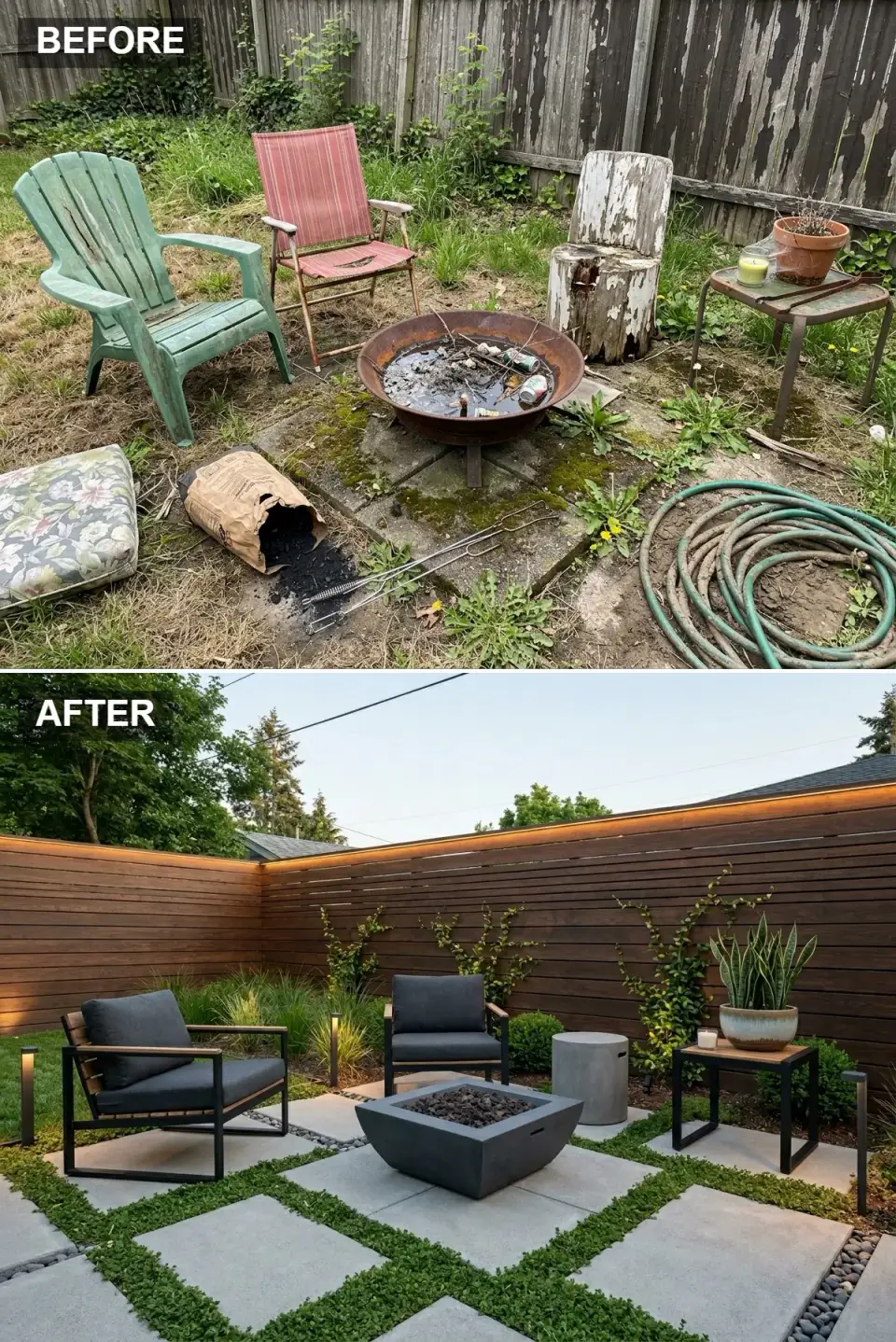
This one trades clutter for calm. A grid of large concrete pavers is interplanted with low ground cover, and a horizontal cedar fence glows with hidden LED cove lighting that washes up the wood grain. Two architectural armchairs in matte black and charcoal face a square concrete fire bowl. A snake plant in an artisan ceramic pot and a slim concrete drum table keep the mood quiet and disciplined. For anyone who wants something that feels edited rather than busy, this is the direction to choose.
The fence carries Rich Cedar (#8B5A2B), a deeper brown than the raw wood in the first patio, and the LED strip under its top rail turns the upper boards amber after sunset. Against that wood, Deep Charcoal (#36454F) on the squared chair frames and the darker face of the fire bowl is close enough to black to read as outline rather than color.
Everything on the ground is Cool Concrete (#B2B2B2): the big square pavers, turned on the diagonal with creeping ground cover between them, and the slim drum table beside the chairs. The cushions sit only a shade lighter than the frames in Graphite (#4A4A4A), so each chair reads as one dark block with very little contrast inside it, which suits how quiet this design wants to be.
Tips for a Minimal Cedar-and-Concrete Lounge
On a horizontal wood fence, a recessed LED strip along the top rail creates ambient uplighting that doubles as architecture. Underfoot, alternate large concrete pavers with mondo grass or clover to soften the grid and bring living texture between the hard surfaces.
A square concrete fire bowl echoes the paver geometry and keeps the contemporary language consistent. Keep the decor spare: one sculptural plant and a single candle are plenty on a patio like this, and anything more starts to crowd the clean lines.
Stone Hearth: Rustic Elegance at Dusk
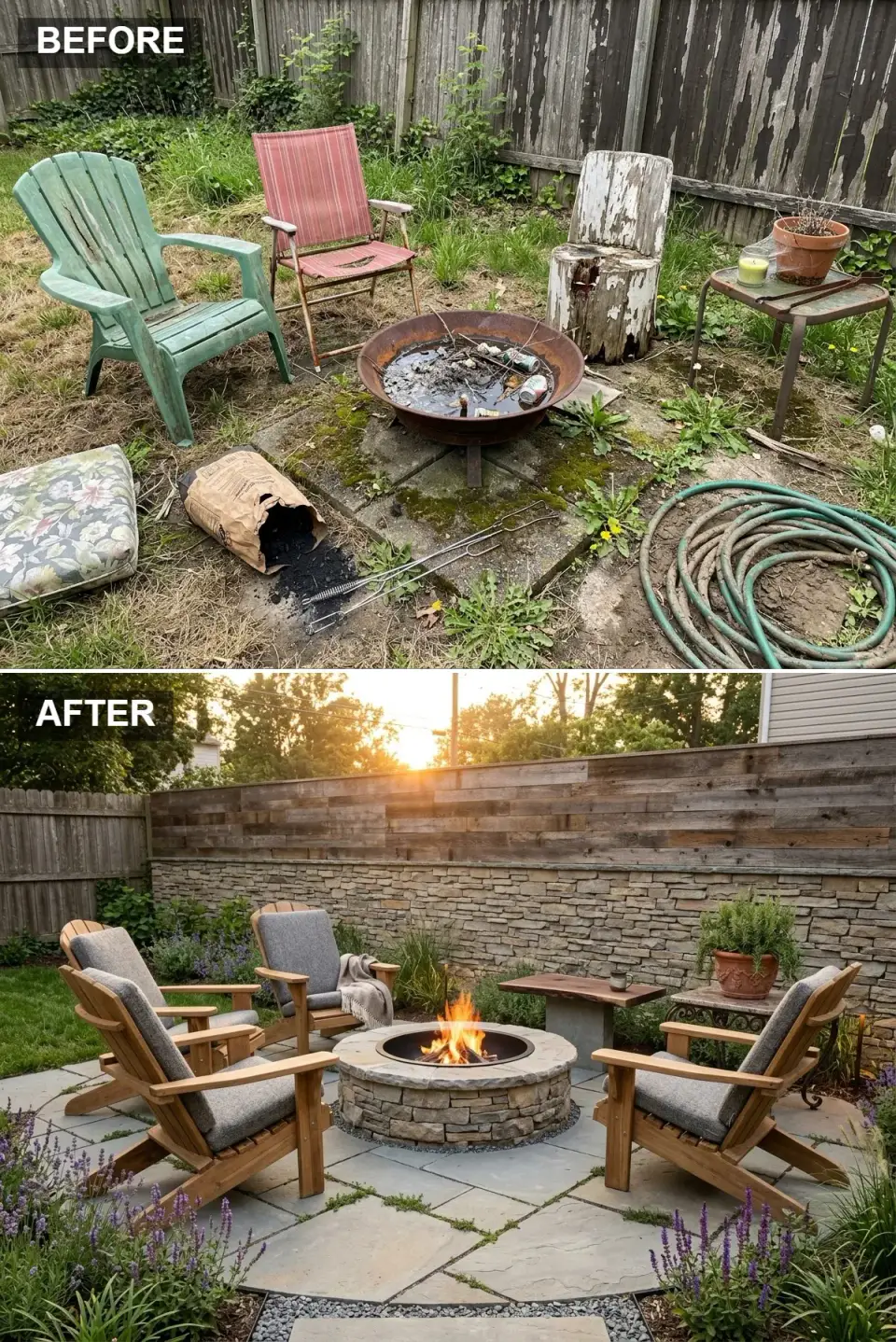
A stacked stone retaining wall and a matching circular fire pit give this yard a permanent, lodge-like focal point. Four substantial cedar Adirondack chairs wear heathered gray cushions on a bluestone patio with thyme growing in the joints. A live-edge walnut side table perches on a stone pedestal, and terracotta pots of rosemary and billowing lavender add scent and color. It's the kind of layered, collected look that suits an older Savannah garden as easily as a new build.
The terrace is cut Blue-Gray Stone (#8A9BA8), laid as large irregular flags with low green growth in the joints, and it is the coolest color in the scene. Warmth comes from the four Adirondack chairs in Natural Cedar (#C19A6B). The boards above the stone wall are weathered to a gray brown in the rendering, so the chairs are the only place that cedar tone shows at full strength.
The retaining wall and the round fire pit share one stacked stone, Ashlar Stone (#9E9E88), a khaki gray with enough brown in it to sit between the bluestone and the wood. The chair cushions pick up a cooler note in Heather (#9AA2A8), and their textured weave keeps them from looking flat against so much masonry.
Ideas to Borrow From This Courtyard
The fire pit itself is stacked stone with a stainless steel insert, which pairs the rustic look with safe, contained wood burning. Beside it, a live-edge side table set on a stone base combines organic shapes with the solidity of the masonry, and a lower stone retaining wall can serve as extra bench seating when a crowd arrives.
Planting softens all that stone. Leave gaps between the bluestone pavers and fill them with creeping thyme or moss, which softens the terrace and releases fragrance underfoot. Around the edge, layer scented plants such as lavender and rosemary so the courtyard engages the senses in the evening.
Midnight Grid: Dark Drama & Clean Lines
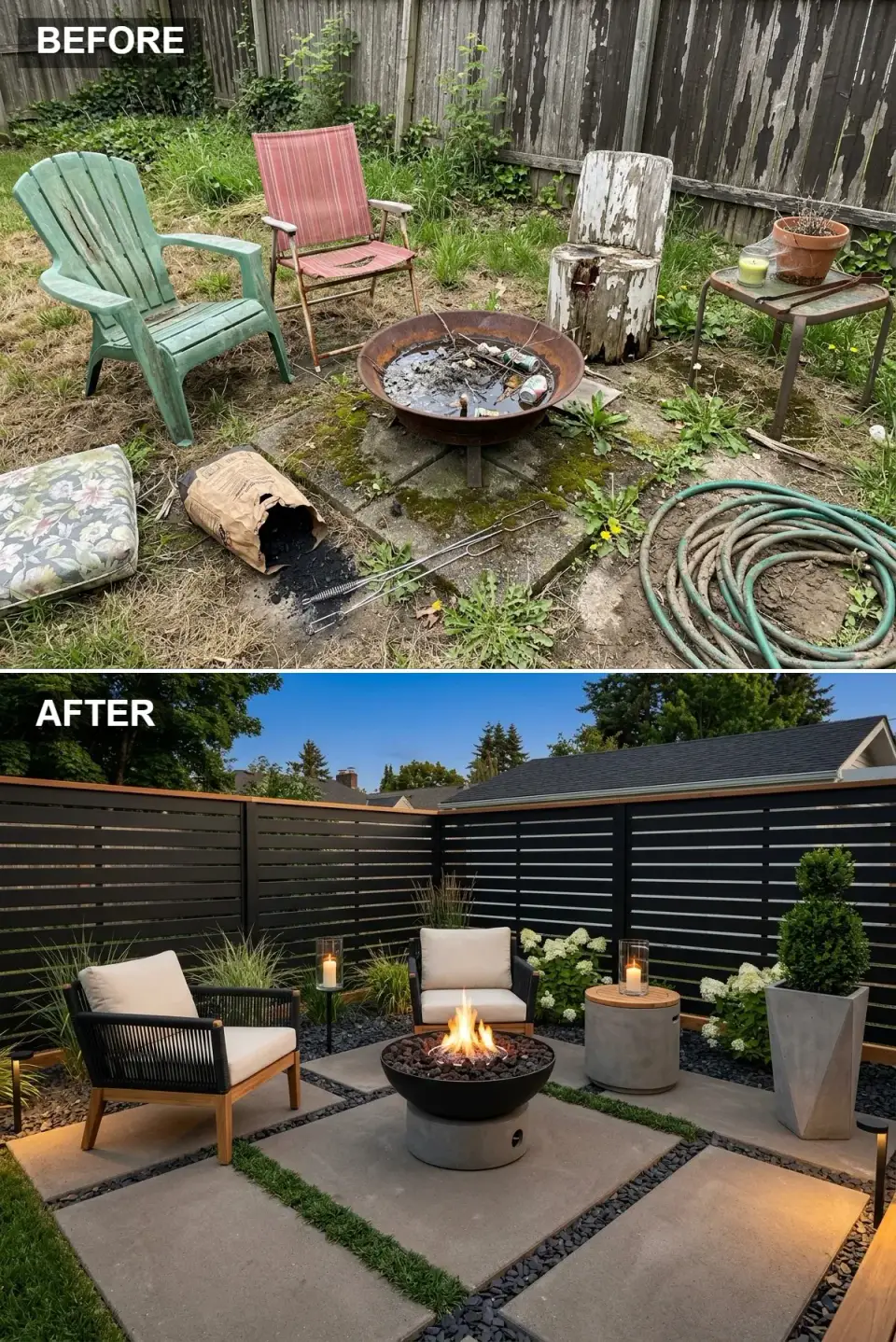
This patio leans into a darker palette, and it works. A black horizontal slat fence hides the perimeter and pulls the eye inward, while massive square concrete pavers float among ribbons of black river rock and mondo grass. Two woven rope armchairs with teak legs and ivory cushions bring coastal texture, and a black concrete fire bowl on a pedestal burns at the center. Concrete side tables and glass hurricanes add sculptural punctuation without fighting the geometry. Dark fences are one of the best small-yard tricks, because they make everything green look richer.
The slat fence and the fire bowl are both Midnight Black (#1A1A1A), which pushes the boundary back at dusk and makes the white hydrangeas planted along it look brighter. The light note is Ivory (#F2F0E6), and in the rendering it belongs to the cushions; the woven rope on the front chair is actually dark, so the ivory reads as soft pads set into a black frame.
The square pavers are Pavement Gray (#9E9E9E), matched by the tall faceted planter holding a clipped topiary. Between them run strips of polished river rock in Dark Slate (#4A5459) next to bands of mondo grass, a ground plane that turns almost black at night and lets the low path lights pick out its texture.
Tips for a Dark Slat-Fence Patio
Stain the fencing a deep charcoal or black. A dark boundary makes greenery and firelight stand out and adds depth to a small yard. On the ground, oversized pavers set against dark gravel and grass joints create a bold, modern checkerboard.
The furniture and light bring the warmth back. Rope-accented chairs add a tactile softness that balances the coolness of concrete and metal, and a pedestal fire bowl lifts the flame closer to eye level when you are seated. Clear-glass hurricane candles placed at varying heights around the seating layer flickering light without blocking the view.
Nordic Glow: Minimalist Concrete & LED Edges
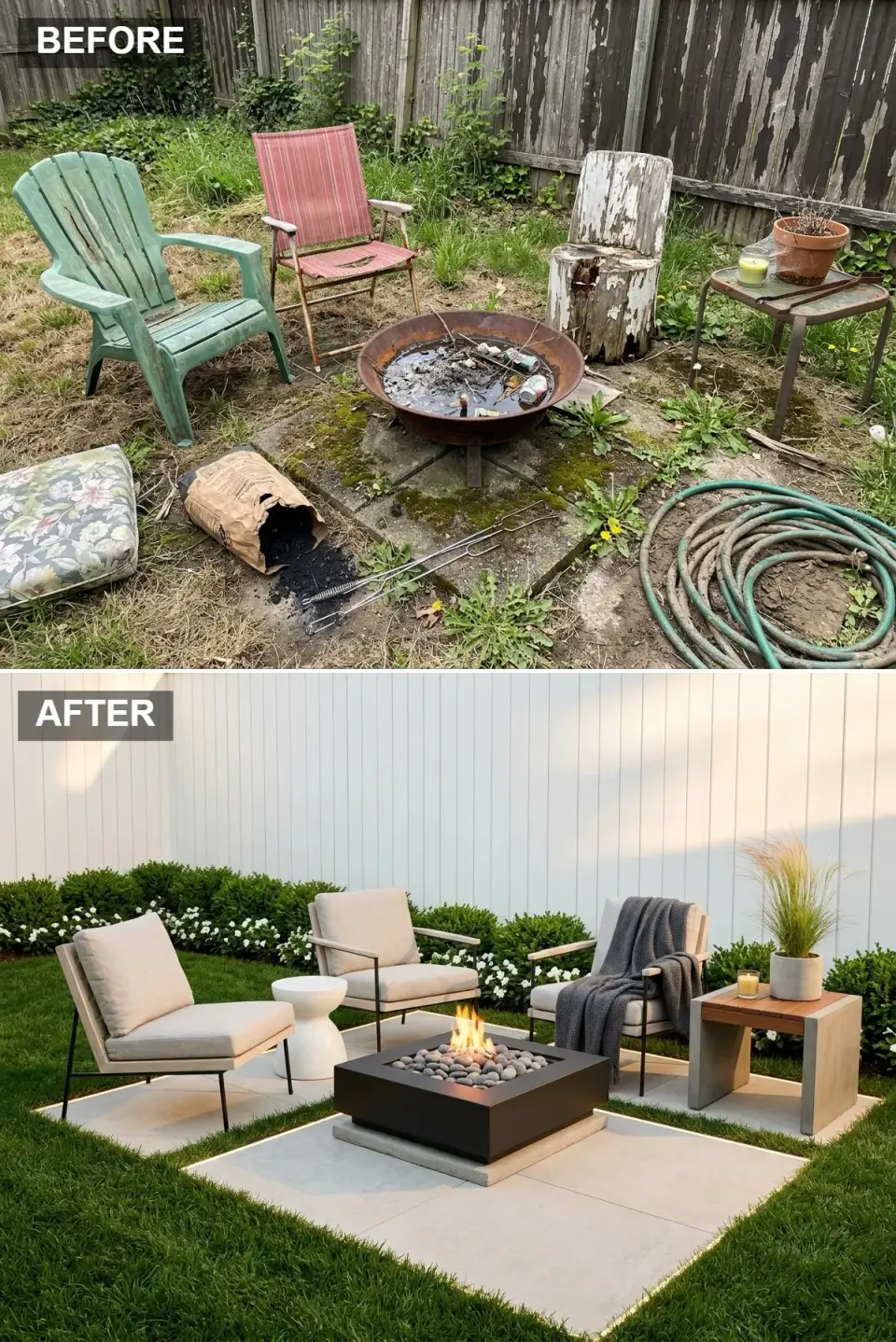
Scandinavian restraint meets outdoor living here. A white vertical fence bounces golden-hour light onto pale concrete slabs edged with hidden LED strips. Three low-slung lounge chairs with oatmeal cushions sit beside a rectangular black gas fire pit filled with smooth gray river stones. A sculptural white ceramic side table and a concrete-and-teak end table finish the look, while clipped boxwoods draw a lush green line around the edge. It feels bright and unfussy, a good fit for a smaller courtyard that needs to feel larger.
Two pale tones do most of the work. The vertical fence and the round ceramic side table are Alabaster (#F8F8FF), a white with a faint blue cast that keeps the courtyard bright even in the evening shot. The three lounge chairs wear Warm Oat (#E6DCC8) cushions, close in value to the pale slabs, so the seating barely interrupts the floor.
Contrast arrives in one hit: the long gas fire pit and the thin chair legs in Matte Black (#232323). The only other strong color is Deep Green (#2D5016) in the clipped hedge behind the chairs, a low living wall at the foot of the fence that stops the white boards from running straight into the lawn.
Tips for a Bright Scandinavian Courtyard
Recessed LED strip lighting along the edges of the concrete pavers gives a floating effect and safe footing after dark. Keep the lounge furniture low-slung so sightlines stay open and the horizontal planes of the courtyard dominate. A linear gas fire pit filled with uniform light-gray river stones holds the calm, monochromatic palette.
Two small decisions keep it from feeling rigid. A single sculptural side table in a contrasting organic shape breaks up the geometry, and perimeter planting limited to one species, such as boxwood, gives a clean architectural hedge.
Zen Courtyard: Gravel, Moss, and Floating Stone
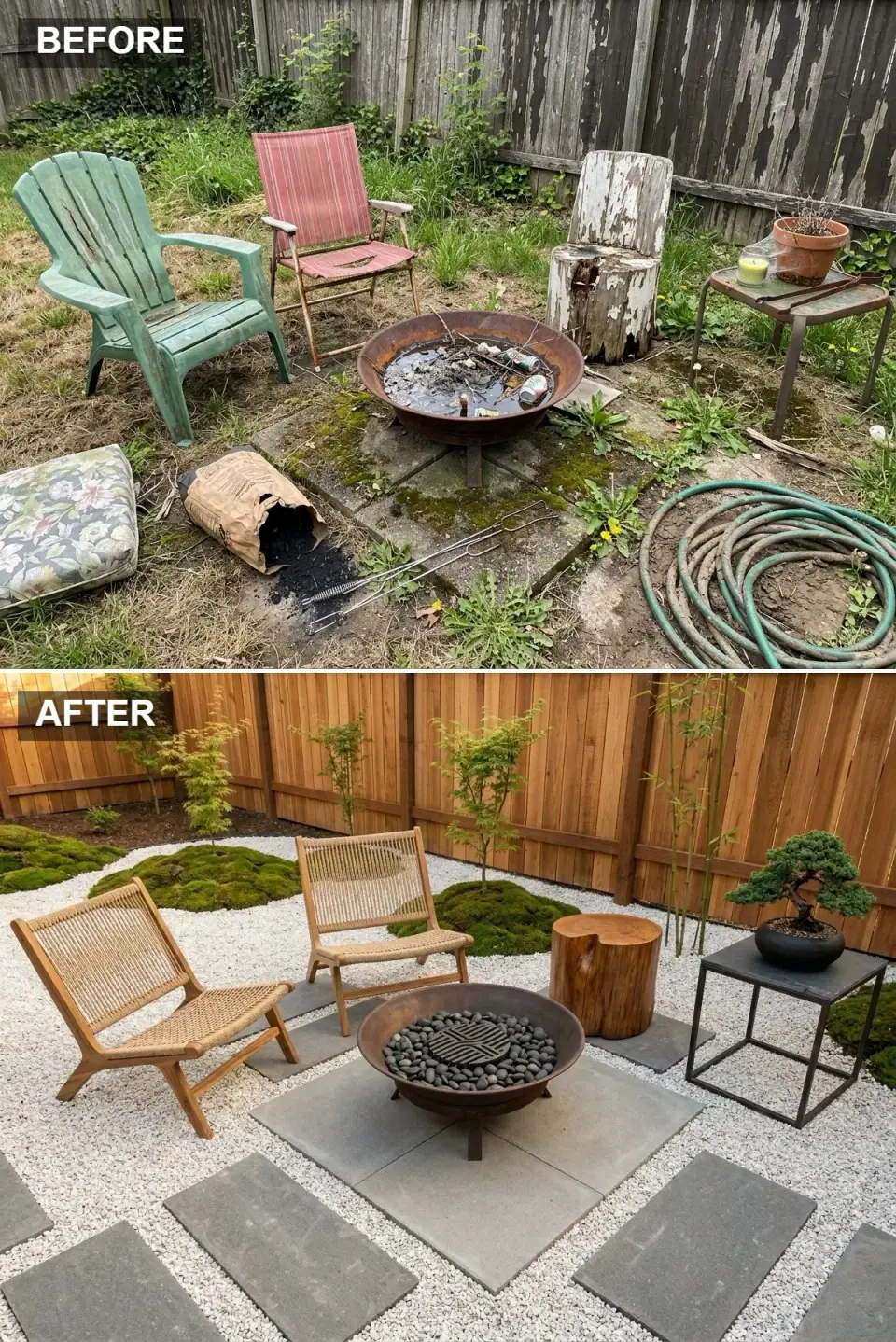
This transformation borrows from a Japanese courtyard, with a ground plane of white pea gravel punctuated by large bluestone landing pads. A cedar privacy fence encloses sculpted moss mounds, young Japanese maples, and bamboo. Two low woven-rope chairs with teak frames face a patinated copper fire bowl filled with dark lava stones. A tree-stump side table and a black metal accent table holding a bonsai keep the whole thing meditative and nature-first. It's a wonderful answer for a shady side yard that never quite worked as lawn.
The ground is crushed gravel in Pearl White (#E8E8E8), bright enough to stand in for raked sand. Set into it are rectangular pads of Blue Slate (#7A8B99) plus one large square slab under the fire bowl, and because the gravel runs right up to their edges they look laid on the surface rather than sunk into it.
Wood is kept to one family. The rope chairs have frames in Teak (#C8A67E), close to the color of the stump table and only slightly paler than the cedar fence. The green is Forest Moss (#4A5D23) on the rounded moss mounds, and the young maples and bamboo against the fence carry that olive tone up to eye level.
Ideas to Borrow From This Patio
Replacing turf with white gravel and large stone pavers cuts maintenance and gives the patio the calm of a Japanese garden. Moss mounds and small trees such as Japanese maple add a living landscape that thrives in partial shade.
Choose low-profile rope chairs that sit close to the ground for a grounded, restful posture. The fire bowl should be weathered copper or bronze, which brings warmth and an organic patina that ages well outdoors. When the fire is out, a single bonsai or sculptural plant on a simple metal table becomes the focal point.
Coastal Prep: Navy Stripes & Hydrangea Hues
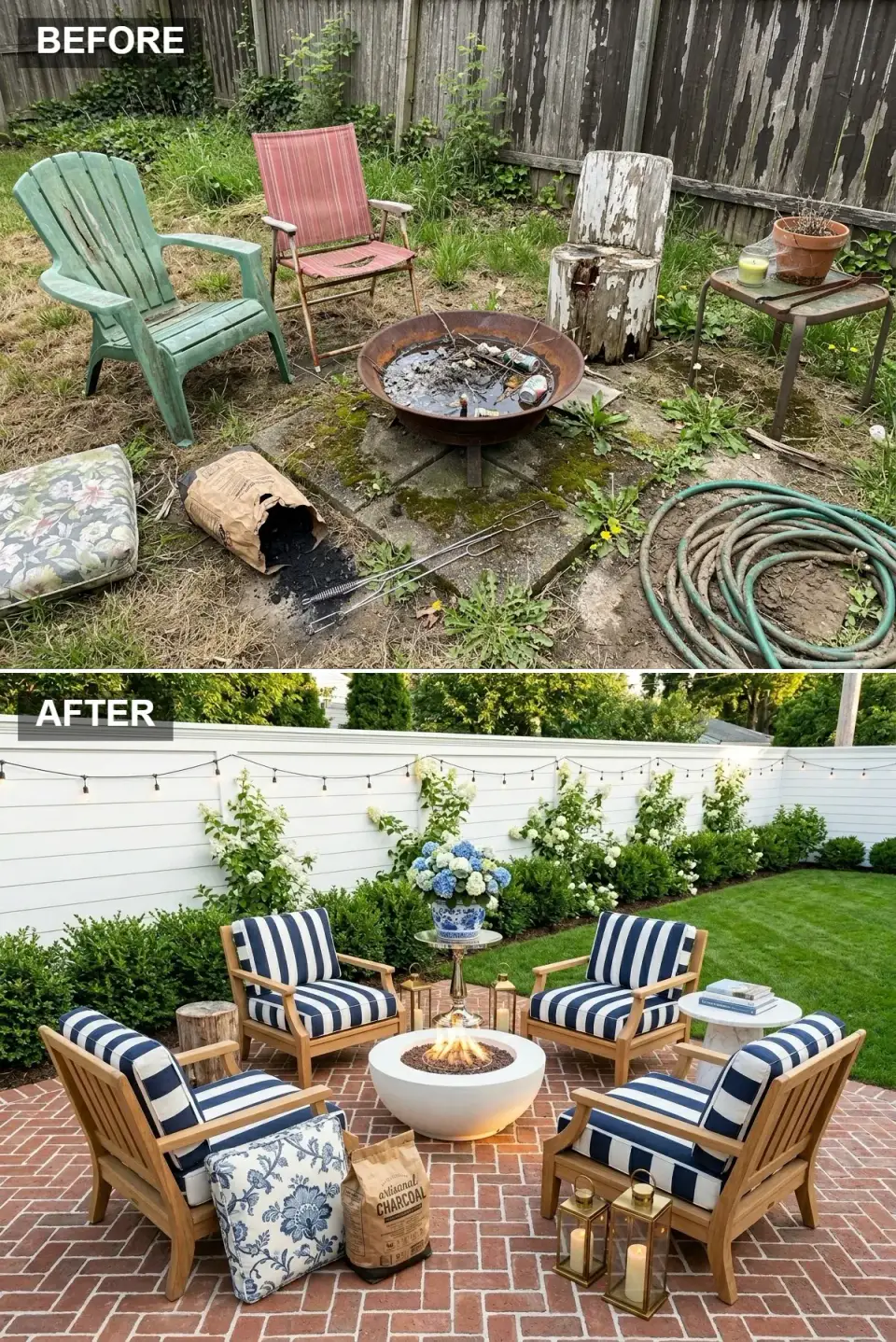
Nautical style takes the lead here, with four teak armchairs in navy-and-white striped cushions on a herringbone brick patio. A white concrete fire bowl glows at the center, flanked by brass lanterns and a blue-and-white chinoiserie pedestal full of hydrangeas. String lights zigzag over a white fence, and boxwoods and climbing white roses give a tailored backdrop. Crisp, cheerful, and endlessly summery, this palette suits the coast from Charleston down to Naples.
The stripes set the tone. Deep Navy (#1B3A5F) runs in wide bands across every seat and back cushion on the four armchairs, and the frames underneath are Warm Teak (#A67B5B), a mid honey brown that will turn silver if it is left unoiled.
This brick is redder than the first patio's, Canyon Brick (#C15B46), laid in herringbone across the whole terrace. That red would fight the navy if nothing bridged them, and the hydrangeas in the blue-and-white chinoiserie pot do the job in Cornflower (#6B8EC4), a blue repeated on the floral pillow leaning against the front chair.
Tips for a Coastal Navy Fire Pit Patio
A white concrete fire bowl anchors the space and keeps the center bright and friendly to a coastal color scheme. Under it, a herringbone brick pattern adds heritage character that suits both colonial and coastal architecture. Along a white fence, climbing hydrangeas or white roses grow into a lush green wall with seasonal blossoms.
The accessories carry the rest of the story. Mix brass lanterns with striped upholstery and chinoiserie ceramics to layer nautical and traditional motifs, then add outdoor pillows in complementary florals to soften the stripes and give the seating depth.
Desert Modern: Cacti and Warm Adobe Tones
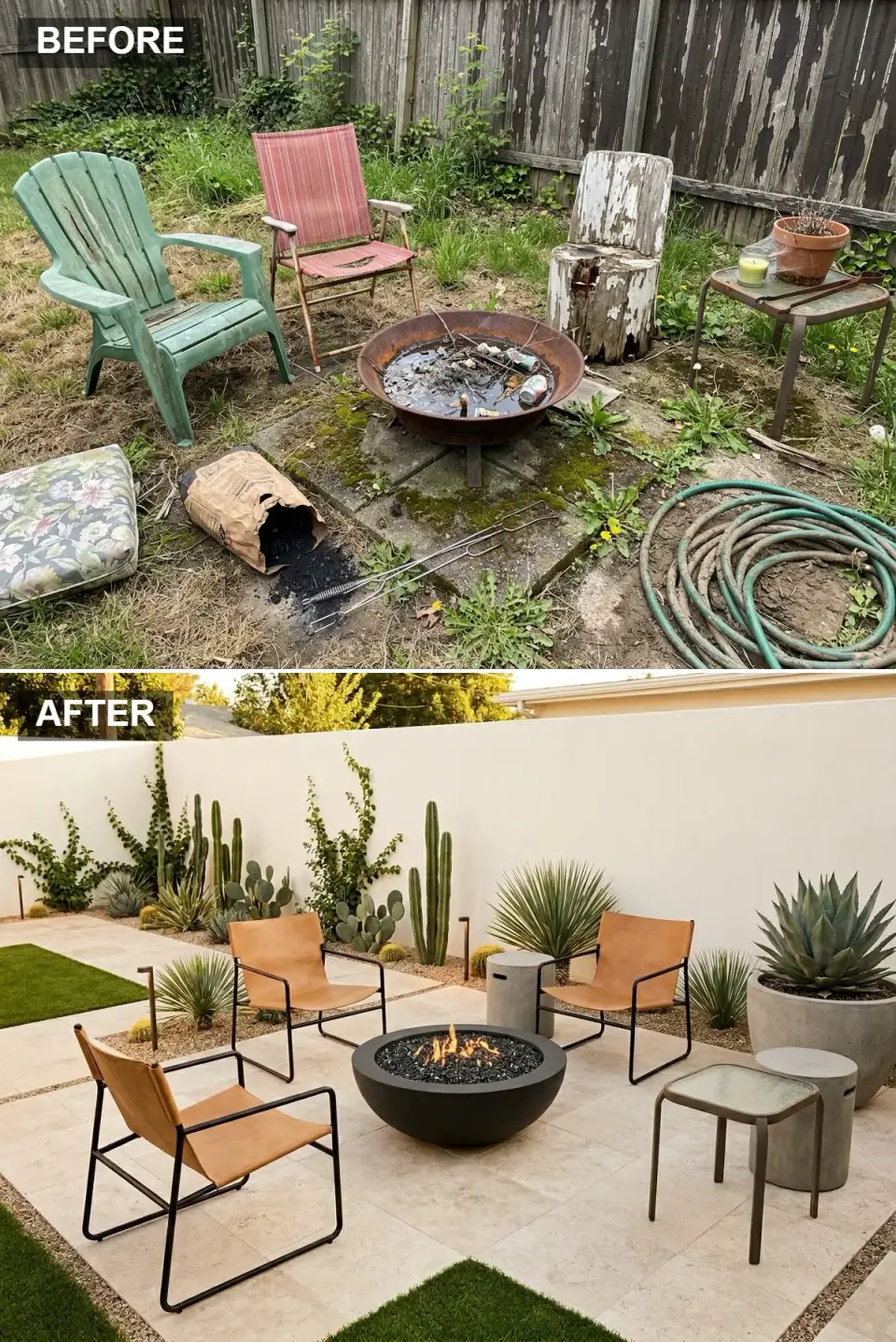
Sun-baked sophistication takes over on a travertine tile patio set against a stark white plaster wall. Three sling chairs in caramel leather and black iron surround a hemispherical black concrete fire pit filled with reflective glass. Columnar cacti, agave, and trailing succulents line the perimeter in gravel beds, and a large concrete planter with a statement agave underscores the sparse, sculptural beauty. Even in the humid South, this xeriscape thinking works for the hottest, driest corner of a property where lawn always struggles.
The travertine covers the floor in Warm Cream (#D6CDBF), only a shade off the plaster wall, so the courtyard reads as one pale box. Inside it, the three sling chairs in Tan (#C8956D) leather are the warmest objects, close in color to the dry gravel in the planting beds.
Black is reserved for structure: the bent iron chair frames and the half sphere of the fire pit, both in Forged Iron (#2C2C2C). The plants supply Sage (#8F9779), the dusty blue-green of agave and columnar cactus, which looks spare and intentional against the white wall rather than lush.
Tips for a Desert Travertine Patio
Plant drought-tolerant specimens such as agave, cacti and yucca in gravel beds for an authentic, low-water palette. Warm travertine pavers paired with black metal furniture create a high-contrast look that reads organic and modern at the same time. Keep the walls white or off-white so they reflect strong sun and let the sculptural plants stand out as living art.
For the anchors, use a hemisphere or bowl fire pit in dark concrete as the sculptural center of an open patio. A single oversized concrete planter with a spiky agave balances the horizontal lines of the patio and the fence.
Mossy Modern: Dark Fence & Organic Stone
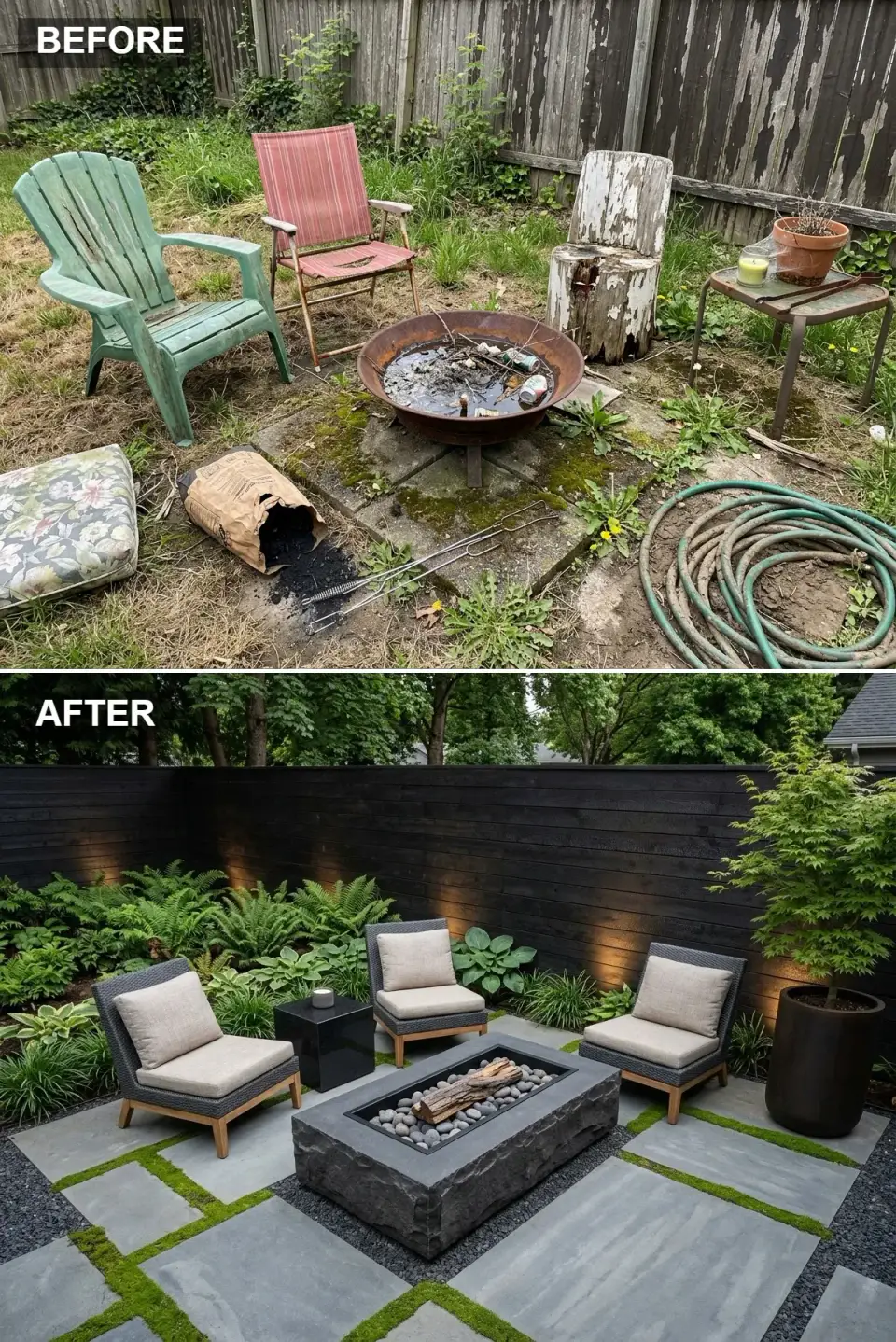
A black-stained wood fence turns into a canvas for uplighting, throwing light across ferns, hostas, and a Japanese maple. The patio is laid with large bluestone slabs separated by velvety moss ribbons and dark gravel. Three woven wicker armchairs with oatmeal cushions and teak legs circle a hefty rectangular stone fire pit filled with river rocks and birch logs. A glossy black cube side table catches the flames for a subtle layer of glamour. This woodland scheme suits the old oaks around Charlotte or Atlanta.
The horizontal fence is stained Charcoal (#36454F), and with uplights at its base the ferns and hostas in front of it look almost backlit. The paving slabs are Slate Blue (#8899A6) bluestone, separated by strips of moss and edged with dark gravel, so the floor stays a few steps lighter than the fence.
The three armchairs are woven in a dark gray wicker, not a pale one, and the light tone comes from their cushions in Natural Oat (#D5CFC0). Around them, Hunter Green (#355E3B) fills the beds through ferns, hostas and the potted Japanese maple, the deepest green of any design in this set.
Tips for a Woodland Bluestone Patio
Stain the fencing dark charcoal or black and set uplights at its base, so the green foliage glows after dark. Against that fence, layer varied shade plants such as ferns and hostas to build a dense, textured living wall. Fill the joints between the bluestone pavers with moss rather than polymeric sand for an aged, woodland feel.
A monolithic stone fire pit with a rough finish works as a natural sculptural element in the garden. To keep the organic palette from becoming predictable, add a single high-gloss accent table as an unexpected contemporary note.
Industrial Ember: Steel, Edison Bulbs & Corrugated Iron
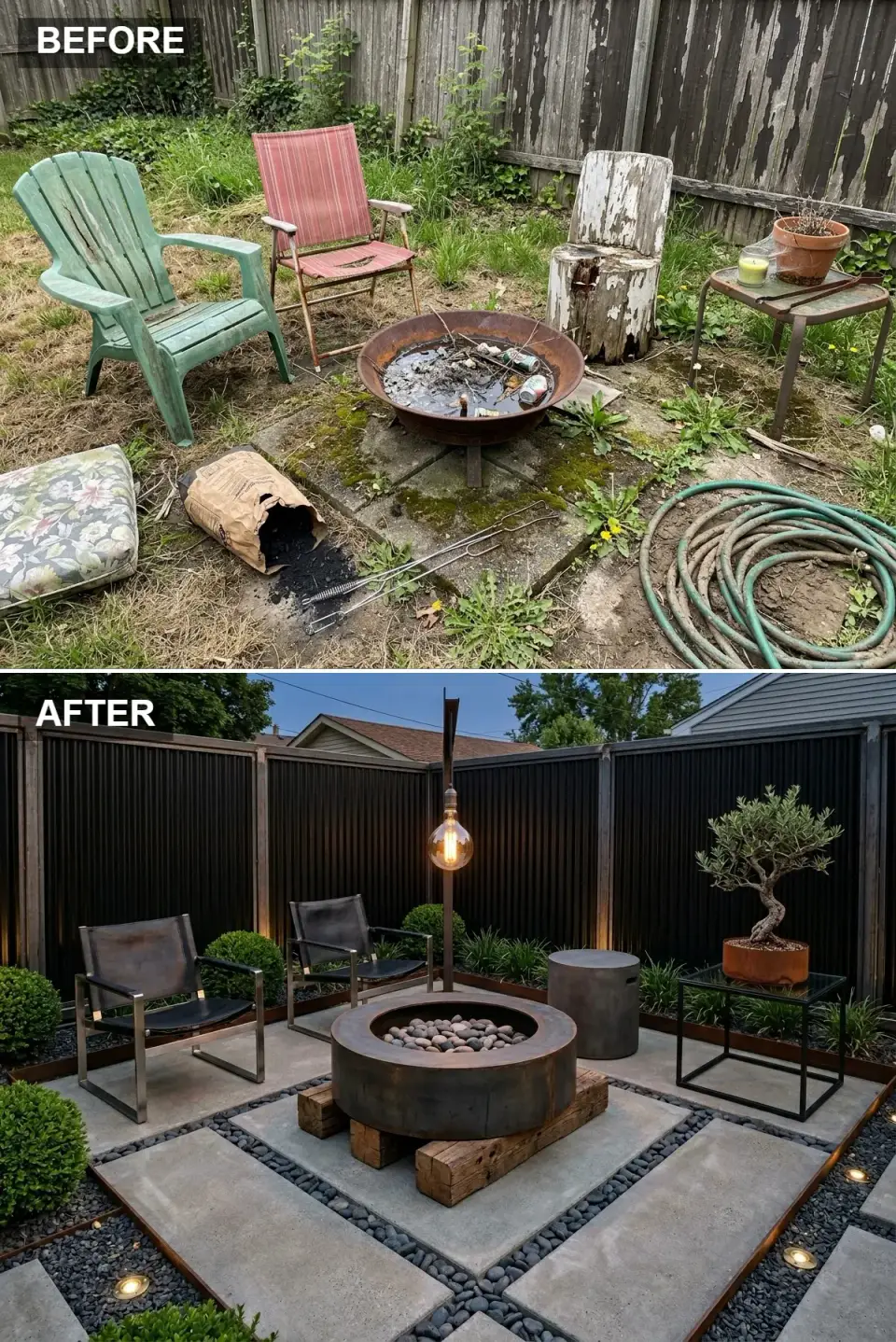
Raw materials set the tone in this courtyard, where a black corrugated metal fence with wood trim encloses concrete pavers bordered by copper-edged river rock. Two sling chairs in distressed leather with polished stainless frames sit beneath a dramatic Edison bulb pendant hung over the fire feature. The fire pit itself is a hefty steel drum resting on reclaimed timber beams. In-ground lights, boxwood spheres, and a windswept olive tree in a copper planter round out the workshop-meets-backyard mood, a strong fit for a loft-style townhome patio.
The corrugated fence and the round steel drum share Gunmetal Gray (#4A4A4A), which reads nearly black under the evening sky. Burnished Copper (#B87333) is the counterweight, showing up on the metal edging along the gravel, the planter holding the olive tree and the first patina forming on the drum.
On the ground, the poured pavers are Raw Concrete (#A9A9A9) with bands of black river rock between them. The one soft material is timber in Barn Wood (#8B6F47): the reclaimed beams cradling the drum and the wood trim on the fence posts, both left rough.
Tips for an Industrial Steel-and-Copper Courtyard
Corrugated metal panels make the fence, adding vertical texture and a modern-edged sound barrier. Over the fire pit, a single Edison bulb pendant hung from a steel rod gives a dramatic, workshop-inspired focal point. The steel fire drum rests on reclaimed beams, which lift it slightly and bring raw, salvaged character into the scheme.
Edging and planting keep it orderly. Copper or steel edging between the pavers and gravel defines crisp lines and stops the gravel from migrating. Live plants such as boxwood spheres and an olive tree ground the industrial look and soften all that hard metal.
Root & Flame: Organic Sculptural Luxury
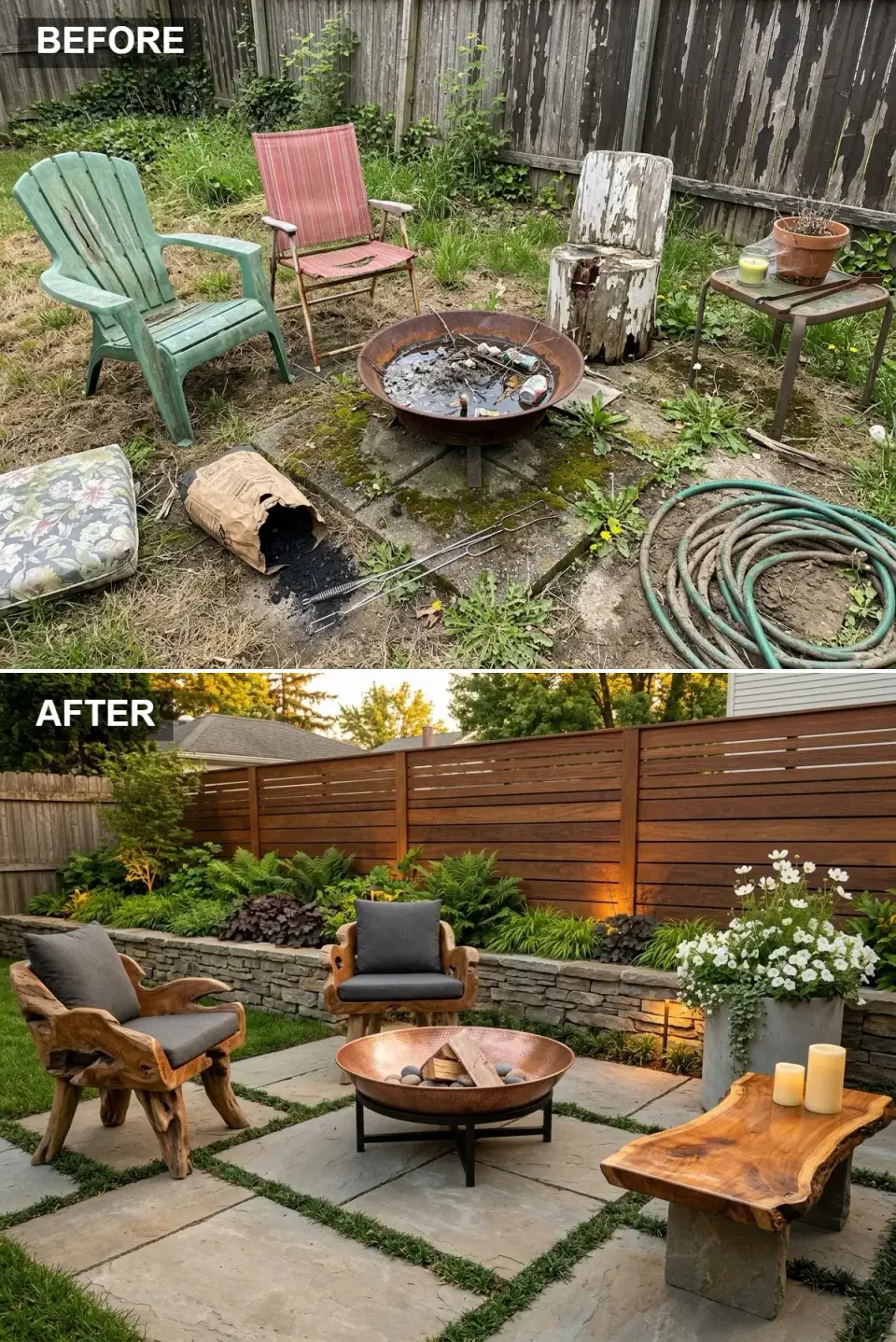
This lounge celebrates raw wood, pairing two hand-carved root chairs with charcoal cushions against a stacked stone retaining wall and a horizontal cedar fence. A burnished copper fire bowl on a wrought-iron stand burns at the center of a bluestone patio laced with grass joints. A live-edge walnut bench on stone plinths adds auxiliary seating, and white cosmos in a concrete planter plus glowing pillar candles bring the romance. Uplighting on the fence and stone wall carries the space from sunset into starlight. Of all eleven, this is the one that feels most like a collected, one-of-a-kind room.
The furniture brings the strongest color. The root chairs and the live-edge bench are Rich Walnut (#8B5E3C), oiled so the grain shows, and they stand on bluestone pavers in Cool Gray (#8A9EA8) with grass growing in the joints, a cool floor that makes the wood look warmer than it is.
The fire bowl is Aged Copper (#B8623B) on a black iron stand, and once lit it throws a pink-orange light back onto the bench. The chair cushions in Dark Charcoal (#36454F) keep the sculpted wood from looking busy and, being dark, show fading less than a pale fabric would.
Tips for a Raw-Wood and Stone Lounge
The furniture is the reason to look at this lounge. One-of-a-kind sculptural wood pieces, such as root chairs or a live-edge bench, make the patio feel like an outdoor gallery, and they are worth the investment. A copper fire bowl adds to that character, developing a living patina that shifts in color over the years.
The hardscape supports the pieces without competing with them. A low stacked stone retaining wall along the fence line adds a change in elevation, extra seating and a backdrop for layered planting. Grass or moss inlaid between bluestone pavers softens the geometry and blends the hardscape into the lawn. After dark, uplights on the fence combined with wall-washers on the stone build depth and bring out texture.
Pro Tips & Advice
Safety comes first: plan at least 18 to 24 inches of non-combustible hardscape around any fire feature, which meets safety codes and keeps the surrounding grass from scorching. Then give the lounge a clear boundary with a durable outdoor rug or a distinct paving pattern, so it reads as its own room separate from the rest of the yard.
Lighting decides how long the space is used. Layer three kinds (overhead ambient light, table-level lanterns and low uplighting) and the lounge stays useful well past sunset. Fabrics need the same practical thinking: choose ones labeled for outdoor use and bring the cushions in during heavy rain to protect their shape and color, which makes a real difference in humid Southern summers. To pull the whole design together, repeat one material, natural stone or finished wood, in at least two elements such as the fence, the furniture or the fire pit surround.
Frequently Asked Questions
How much clearance does a backyard fire pit need?
Plan for 18 to 24 inches of non-combustible hardscape (brick, stone, or concrete) around the rim of any fire feature, and keep the pit at least 10 feet from the house, fence, and low branches. Always check your local code, since setback rules vary by municipality and some HOAs limit wood-burning pits entirely.
Gas or wood-burning: which fire pit is better?
Gas wins on convenience and cleanliness: no smoke, no ash, and an instant on-off that suits a polished, low-maintenance patio. Wood-burning gives you the crackle, scent, and higher heat that many people associate with a real fire. For most layered, everyday lounges, a gas pit gets used far more often simply because it takes no effort.
What flooring works best under a fire pit lounge?
Herringbone brick, bluestone, travertine, and large-format concrete pavers all hold up beautifully and are non-combustible. Gravel is a budget-friendly alternative that drains well. Whatever you choose, give the surface a slight slope away from the house so water never pools around the seating.
How can a small backyard feel bigger around a fire pit?
Stain the fence a deep charcoal or black so the boundary recedes and the greenery reads richer, keep furniture low-slung to protect sight lines, and stick to one flooring material to avoid visual chopping. A single pedestal fire bowl at the center draws the eye inward and makes even a compact courtyard feel intentional.
Can a fire pit lounge be used year-round in the South?
Yes, and that's one reason they suit our region so well. In Charleston or Nashville, a well-lit fire pit stretches the usable season from early spring into late fall and beyond. Add weather-resistant cushions, a couple of throws in a deck box, and layered lighting, and the space earns its keep on every cool evening.
Choosing the Right Fire Pit Lounge
These eleven lounges show that almost any open-air footprint can become a room you genuinely use. Coastal prep, desert minimalism, or moody modern, the recipe holds: define the ground plane with purposeful hardscaping, arrange the furniture for real conversation, add lighting that flatters after sunset, and anchor everything with a fire feature that draws people in. Start with the architecture of the space (fence, terrace, and walls), then layer in textiles, greenery, and flame. For more outdoor ideas, these backyard transformations walk through a full yard reset, mud pit to paradise covers a start-to-finish overhaul, and there are more ideas in these neglected-yard makeovers. Build it thoughtfully, and you'll have a destination you reach for across every season.
Sources & References
- National Fire Protection Association (NFPA): outdoor fire feature clearance and safe-use guidance for residential settings.
- Hardscape North America / ICPI: installation standards for brick, bluestone, and concrete paver patios.
- The American Society of Landscape Architects (ASLA): best practices for xeriscaping, drainage, and outdoor-room planning.
- University of Georgia Cooperative Extension: regional planting guidance for Southern gardens, including shade and drought-tolerant selections.

Transformations Desk
The Layered Homes editorial teamThe Transformations Desk produces the before-and-after design studies: one imagined starting space (a room, a facade, a backyard) shown in several design directions, each with a palette and a cost estimate.
More from the Transformations Desk →
Reader notes