


These staircase ideas use paint, stain, runners, lighting and wall treatment to restyle one builder foyer. The stair direction, step count, upper rail, window and openings remain the same in every design study.
The Builder Foyer Starting Point
The starting point is a builder-grade straight flight: a honey oak handrail and newel, white spindles along the upper landing, worn beige carpet on every tread, scuffed beige walls and one tall window high in the stairwell. A plastic shoe rack sits on cracked vinyl tile at the foot. Everything works, but the rail, the carpet and the wall color share no material plan.
A real staircase is a safety assembly. Guard height, baluster spacing, handrail continuity, tread dimensions and structural attachment sit outside the decorative scope and should not be altered casually. Each concept below therefore keeps the stair direction, tread count, landing, upper guard, window and foyer openings as they are; the images are concept renderings of finish and furnishing ideas, not photographs of finished projects.
1. Traditional Runner
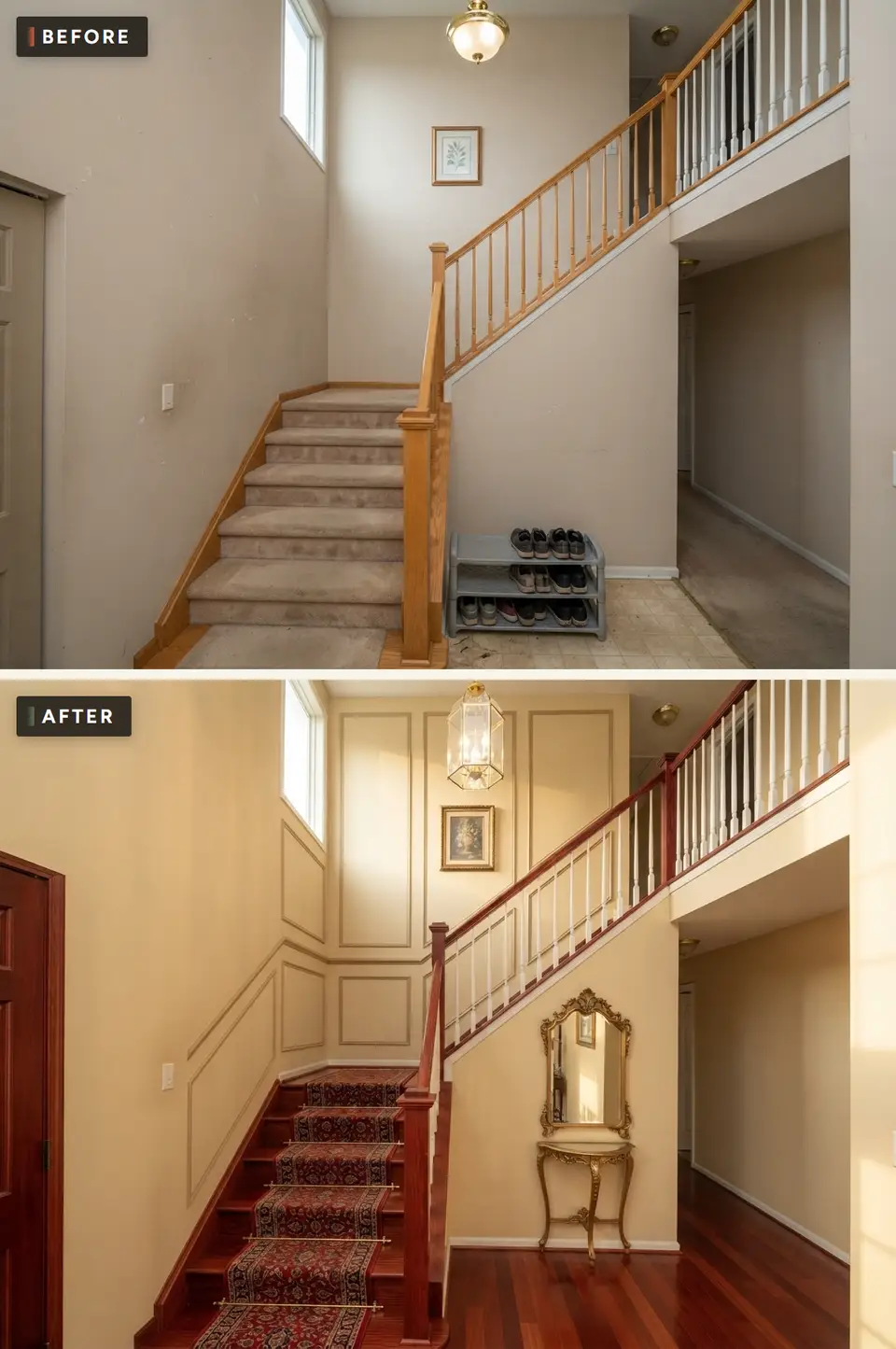
In this concept the beige walls turn a warm cream, applied picture-frame moulding divides the tall wall into panels, and the oak gives way to cherry-toned treads, rail and floor. A red Persian-style runner held by brass rods climbs the middle of the flight, a beveled glass lantern replaces the flush ceiling light, and a gilt mirror over a matching console fills the corner where the shoe rack stood. The runner is the point of the scheme, since it puts a centered line down the longest view in the foyer, and it only earns that role if every edge is fitted tight.
Soft white (#F0EEE8) belongs on the moulding and the spindles, Warm wood (#8A6446) on the treads, rail and new floor, and Iron (#343633) in the small dark notes such as rod ends and the frame of the print. Historic blue (#506477) is the reserve color; the dark border of the runner hints at it, and it should stay that quiet.
A runner changes the grip of every tread, so this is work for a stair installer rather than a weekend project. The brass rods in the rendering are decorative; the runner itself has to be fastened so it cannot creep at any nosing, and that is hard to judge without experience.
Cream walls and red wood both swing warmer under incandescent light, and the lantern is the only fixture on the stair. Lay the runner sample on a tread at night as well as at noon, because a red that looks rich beside the window can go brown under one bulb.
We put the finish and decor allowance for this direction at $1600–$5200, the second highest of the ten, because the runner, the moulding and the lantern each carry installation labor on top of the material.
2. Scandinavian White
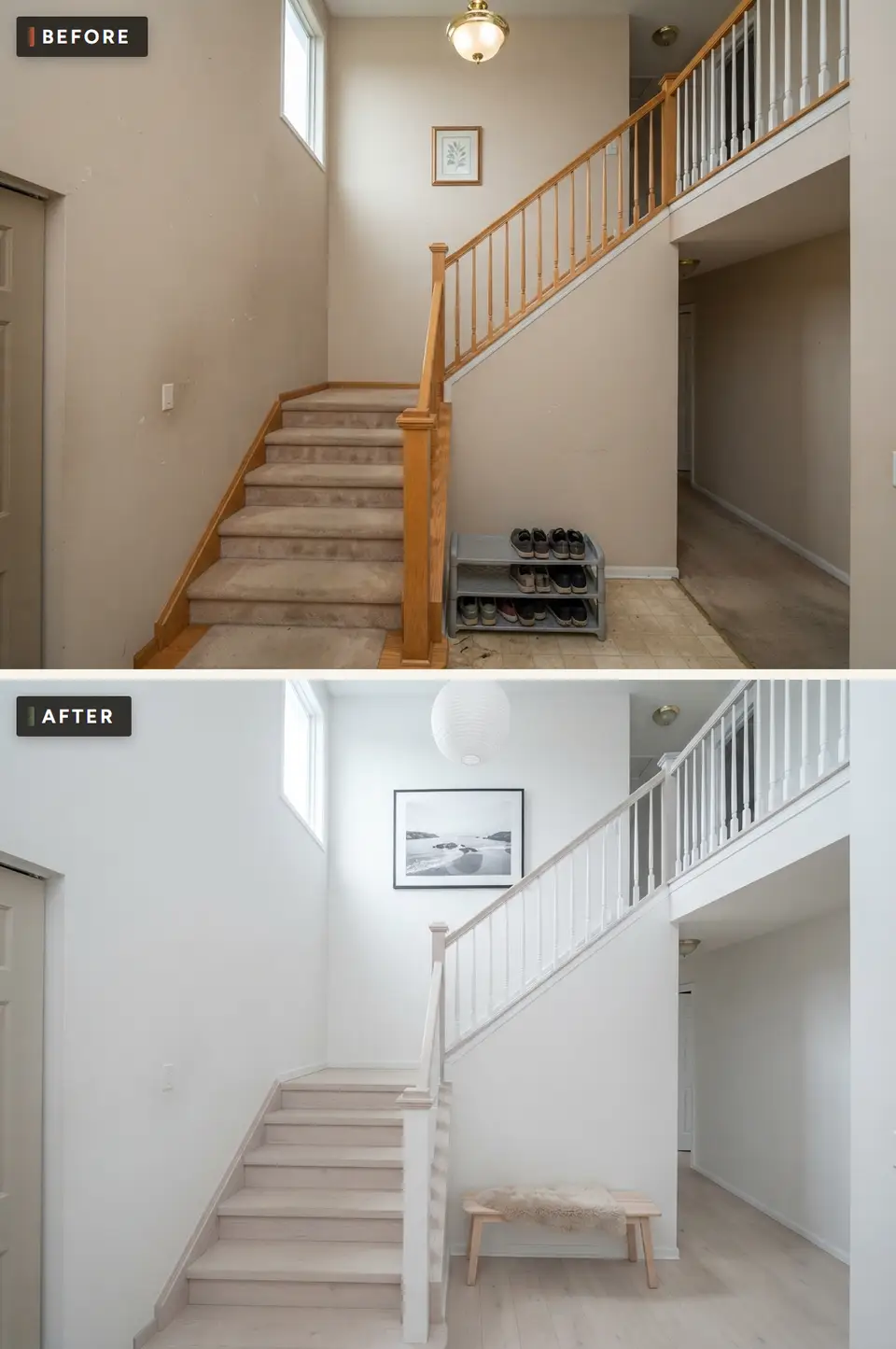
Here everything warm is taken out. Walls, spindles and newel go white, the treads and floor are refinished in a pale whitewashed oak, a paper globe pendant hangs under the window, and a single black and white coastal print and a slatted bench with a sheepskin are the only objects. Lowering the contrast between rail, wall and tread makes the stair volume read wider than it is, and the high window does more work because every surface returns its light.
The palette is close to monochrome: Warm white (#EFECE3) on walls and spindles, Pale oak (#C7A77D) for treads, floor and bench, Mist blue (#C8D8DA) as an optional cool tint for a cushion or print mat, and Soft navy (#354B5E) held to a thin line such as a frame or a lamp base. Keep those last two small or the hall stops reading as white.
White stair walls take constant contact at hand and shoulder height, where people steady themselves and carry laundry past, so specify a scrubbable finish there rather than a flat ceiling paint. Pale treads show grit just as quickly, which makes a good mat at the front door part of this scheme, not an extra.
All-white walls show every bulb color. Check the globe pendant at night with the bulb you plan to buy, since a cool one turns this hall gray and a very warm one turns it yellow.
Plan on roughly $1100–$3600 for finish and decor. The tread finish is the line most likely to push it toward the top, because pulling up carpet can expose treads that need more than a sanding.
3. Black Rail With Clay Runner
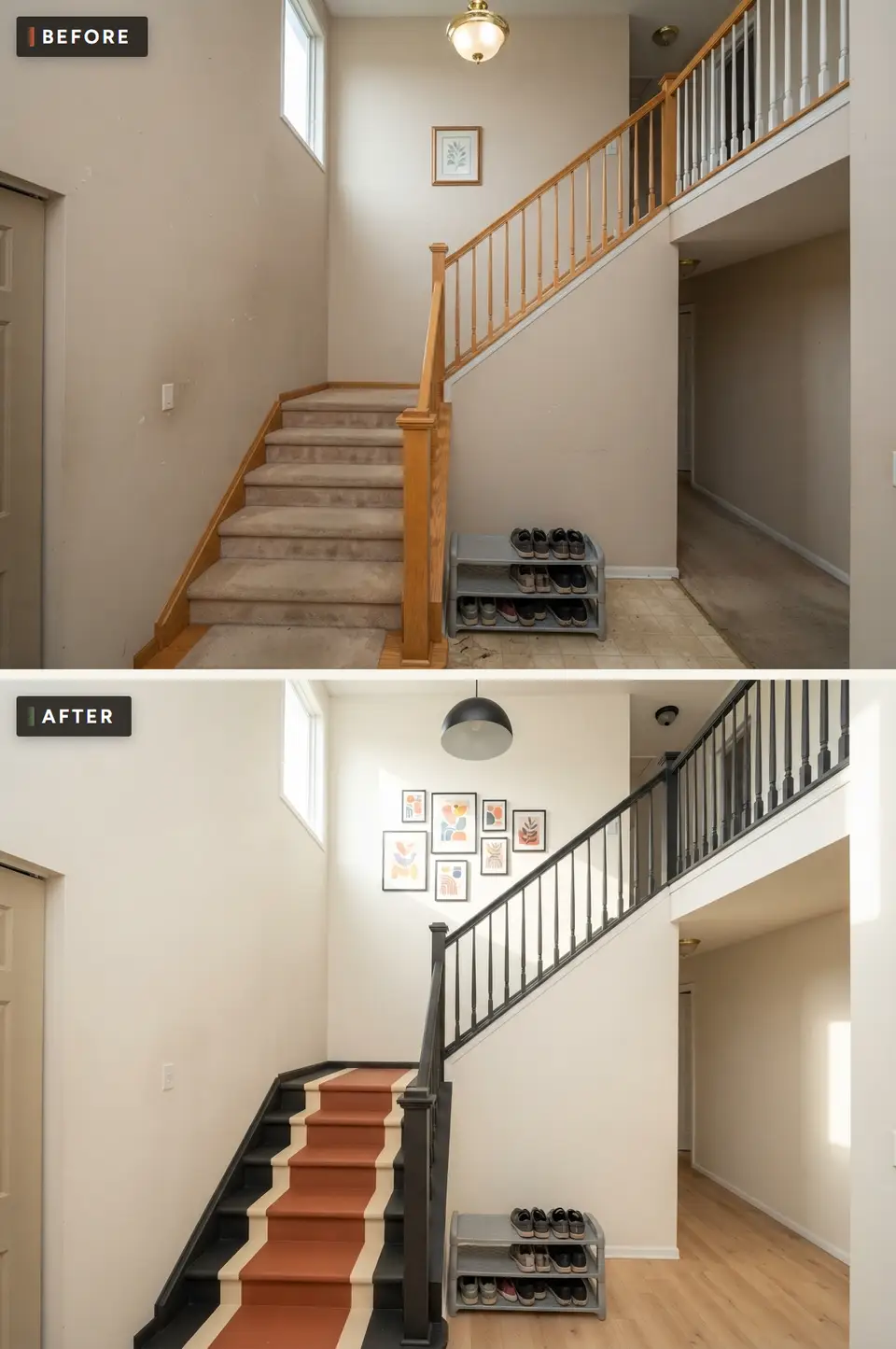
This concept paints the whole stair structure near black: newel, rail, every spindle, the stringer and the tread ends. Down the middle runs a terracotta band edged in cream, a black dome pendant hangs from the high ceiling, and a cluster of small abstract prints in clay, blush and blue sits on the wall above the landing. The walls stay a soft off-white, so the dark outline of the stair reads clearly from the front door.
Deep charcoal (#252725) is the stair paint and the pendant shade. Ink blue (#263747), Walnut (#6B4F3A) and Aged brass (#A98252) are supporting tones for the prints, a frame or a hook rail, while the terracotta down the treads does the warm work by itself.
Art beside a black rail has to keep its frames outside the handrail clearance, so a hand sliding along the rail never knocks a corner. The small-frame cluster in the rendering sits above the rail line, which keeps it clear of hands and is easier to hang level than a diagonal stair gallery.
Black paint and terracotta both shift under warm bulbs, the first toward brown and the second toward orange. Hold a painted sample board on the bottom tread after dark before committing to the full flight.
Budget about $1500–$4800 here. Painting a rail and every spindle is slow hand work with a lot of surface to prepare, and the runner, the pendant and the prints make up the rest.
4. Greige Traditional
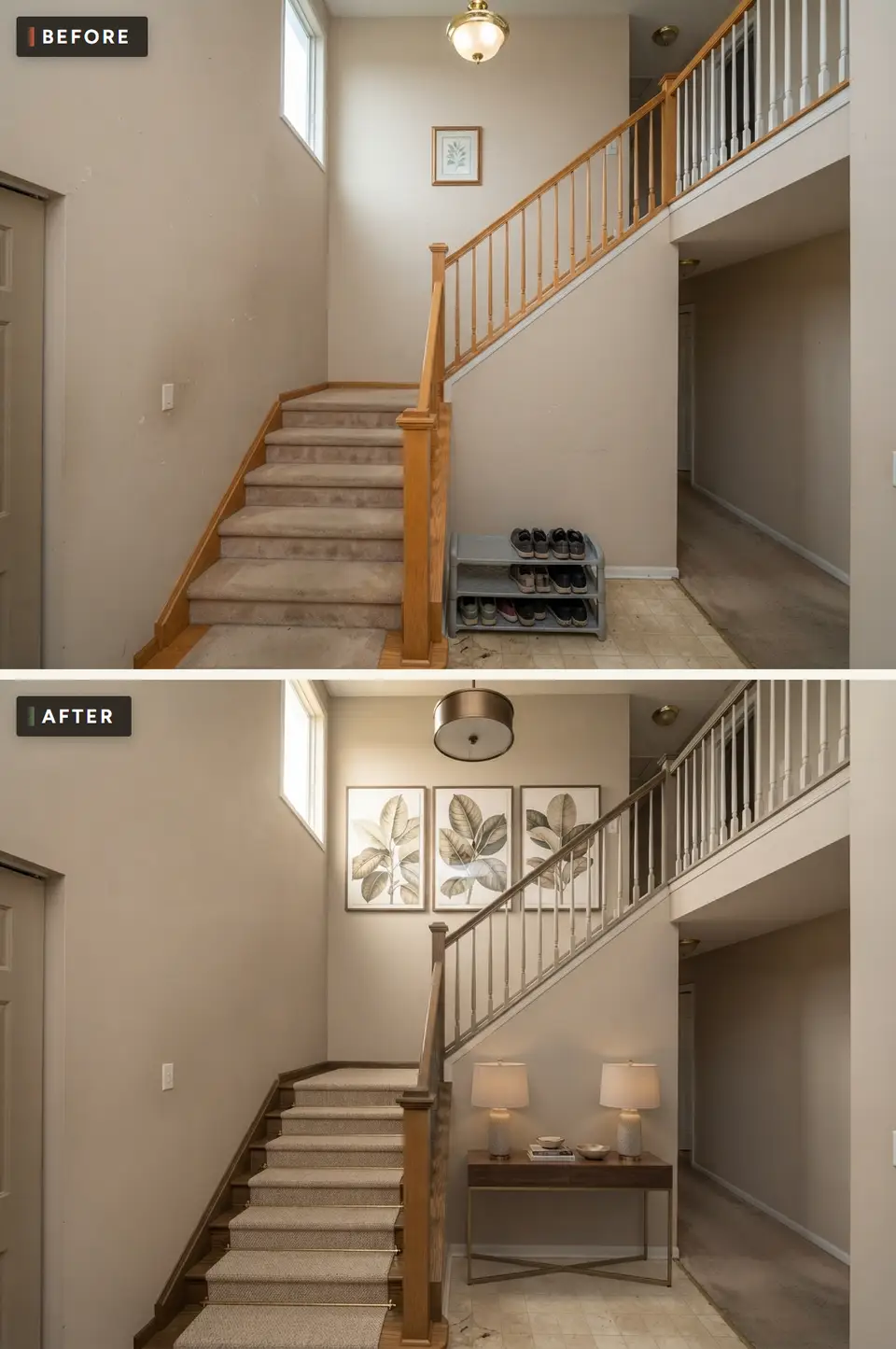
The greige version is the gentlest change. The walls keep a warm stone color, the treads take a darker walnut stain, the spindles are painted a soft taupe, and a textured neutral runner with brass rods covers the flight. A drum pendant with a bronze band replaces the old fixture, three large leaf prints line up above the landing, and a slim walnut console with two ceramic lamps takes the spot where the shoes used to sit. Similar values across wall, runner and spindles let the eye travel up the tall wall without a break, and the weave of the runner carries the interest that color carries elsewhere.
The palette repeats the first direction's, so the difference is all in proportion. Soft white (#F0EEE8) only shows in the print mats and lamp shades, Warm wood (#8A6446) moves to the treads and console top, Iron (#343633) is limited to picture frames and hardware, and Historic blue (#506477) stays out of the rendering altogether, available for one later accessory.
Greige depends on what sits next to it, so sample it beside the existing floor and the new tread stain before painting. A greige that looks neutral on a chip can turn pink or green against oak, and this scheme has no strong color to distract from the shift.
Greige moves warmer or cooler with the light more than any other color in this set. The two table lamps help, because they give a steady warm source at eye level in the evening, so check the walls by lamplight as well as by the window.
Expect roughly $1300–$4200 for the finish and decor allowance, split across paint, the runner, the pair of lamps and the console table.
5. Charcoal Stair, Pale Blue Hall
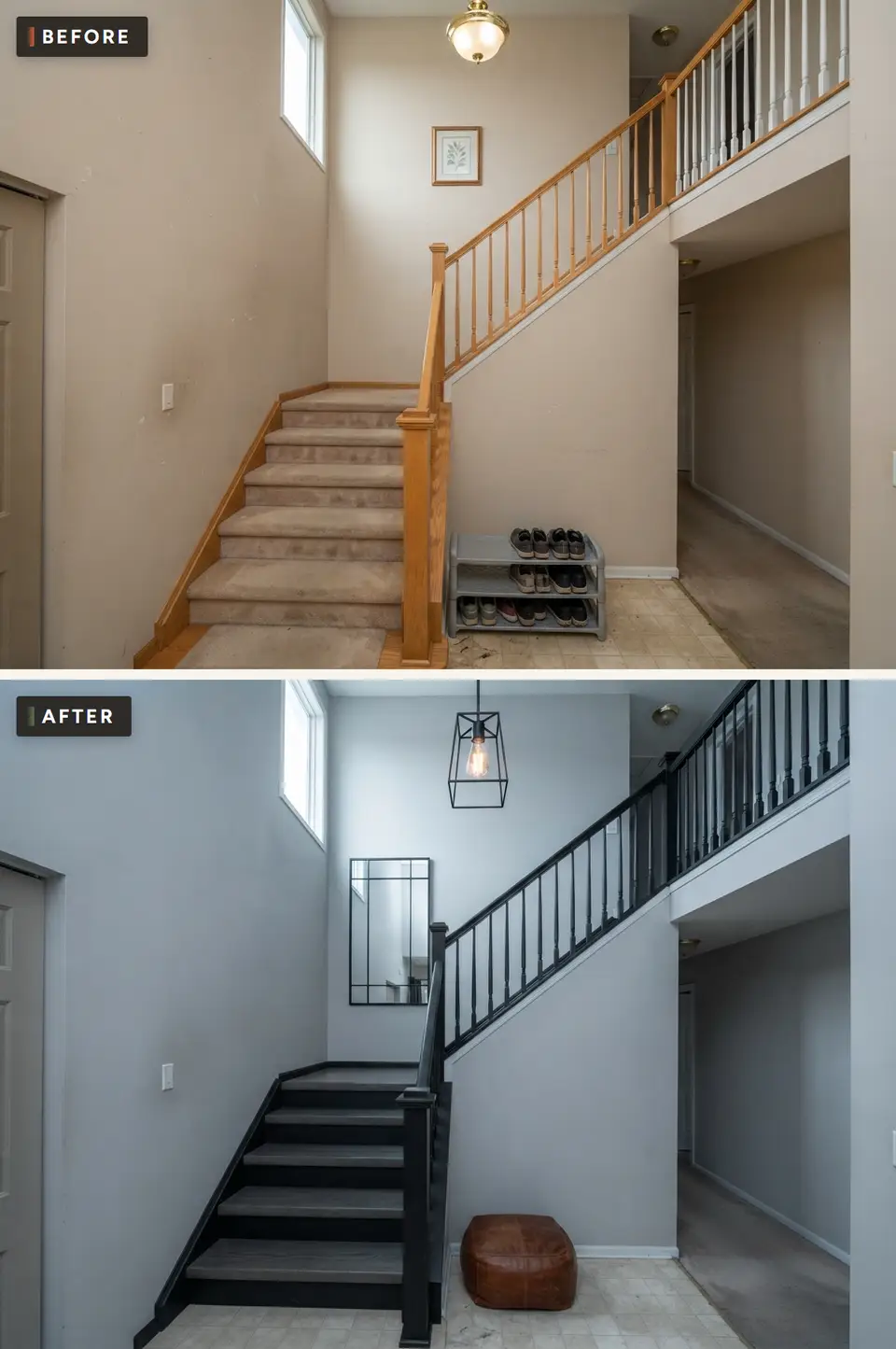
The rendering for this direction keeps the walls a pale blue-gray and puts the dark color on the stair itself: newel, rail, spindles, stringer and risers are painted charcoal black, and the treads are a gray-washed wood. A black cage pendant with an exposed bulb, a black grid mirror on the back wall and a cognac leather pouf at the foot complete it. The high window and the light walls keep that dark structure from closing in the stairwell. Painting the walls navy as well is a valid variation, but what the image shows is a dark stair inside a light hall.
Deep charcoal (#252725) is the stair paint and the pendant cage, Ink blue (#263747) is the shade to use if the walls are taken darker, Walnut (#6B4F3A) shows up in the leather pouf, and Aged brass (#A98252) would be the warm note to add through a bulb holder or switch plate.
Charcoal risers under gray treads give some contrast, but a dark finish can make treads hard to tell apart in low light, so plan high-visibility tread edges if the contrast drops. A lighter nosing strip or a contrasting runner edge makes each step easy to read.
At night the single pendant throws hard shadows from its cage frame, and a black stair can disappear into them. Walk the flight after sunset before buying accessories, and add a low light near the bottom tread if the edges are hard to pick out.
Its estimated allowance of $900–$3000 makes this the least expensive of the ten directions, since paint does most of the work and the furnishing comes down to a pendant, a mirror and one pouf.
6. Cottage Wallpaper Wall
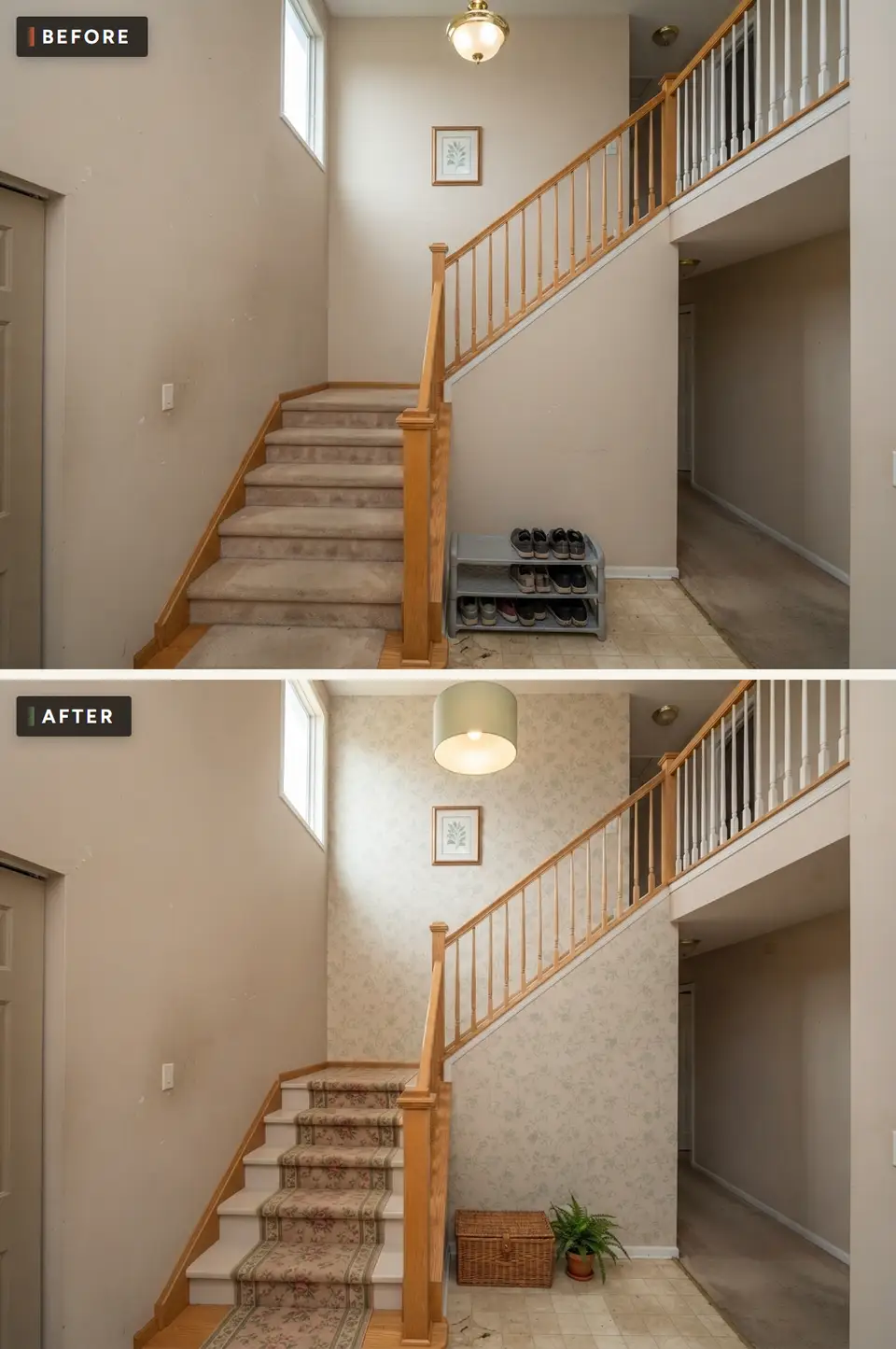
Here a small-scale floral paper in cream and sage covers the back wall of the stairwell and the wall under the stair, while the side wall stays painted. The oak rail and newel are kept, the treads are painted white, and a bordered floral runner in dusty rose and sage climbs the flight. A sage drum shade replaces the old fixture, the original botanical print stays in place, and a wicker hamper and a potted fern sit at the foot. Pattern gives the tall stair wall scale without needing a large art collection.
Cream (#F1E5D2) is the ground of the paper and Sage (#8C9A79) its leaf color, which the pendant shade picks up; Dusty rose (#B98278) lives in the flowers of the runner, and Clay (#A75C45) is the fern pot, a small warm accent that keeps the scheme from going pastel.
Wallpaper on a stair wall takes scuffs from bags and shoulders, so order extra rolls from the same lot for future repair. A later batch can differ slightly in color, and on a wall this tall a mismatched patch would show from the front door.
A printed paper changes as daylight moves across it, and the sage shade casts a faintly green light at night. Tape a large sample to the wall and look at it in both conditions before ordering the full run.
We estimate $1400–$4400 for finish and decor. Paper and professional hanging on the tall wall take the largest share, followed by the runner, the pendant and the basket.
7. Coastal Pale Blue
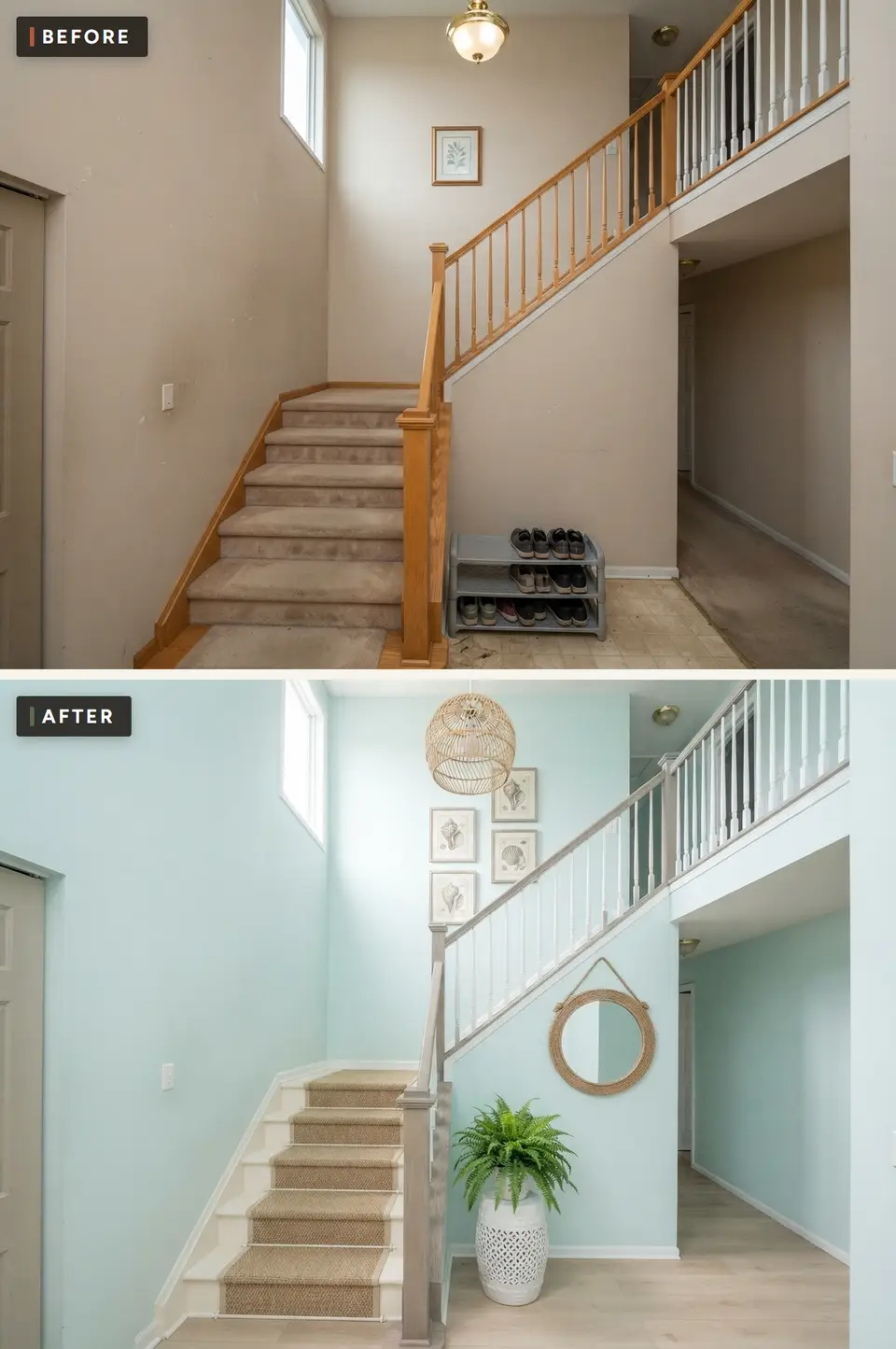
Pale aqua walls, a whitewashed gray rail over white spindles and a sisal runner on white-painted treads give the foyer a light coastal feel. A woven rattan pendant hangs in the stairwell, four framed shell prints step down the back wall, a rope-hung round mirror sits under the stair, and a fern in a pierced white ceramic stool stands at the bottom. The cool walls balance the warmth of the pale oak floor and the natural fibers.
Mist blue (#C8D8DA) is the wall color, Warm white (#EFECE3) the spindles, risers and print mats, and Pale oak (#C7A77D) the floor and the sisal. Soft navy (#354B5E) is not in the image; it is the darker blue to bring in only if the hall needs an anchor, as a frame or a pillow on a nearby bench.
Coastal stairs carry sand up from the door, so choose a runner fiber that releases tracked grit when vacuumed rather than holding it in the pile. Sisal is hard-wearing but marks easily with water, which matters on a stair that wet feet climb.
Pale blue can look gray under cool light and greenish under very warm bulbs. The rattan pendant also throws a woven pattern across the walls at night, so judge the paint with the pendant on as well as in daylight.
At $1100–$3500, the coastal scheme is one of the cheaper options: paint, a runner, the pendant and a plant, with no carpentry at all.
8. Navy Gallery Stair
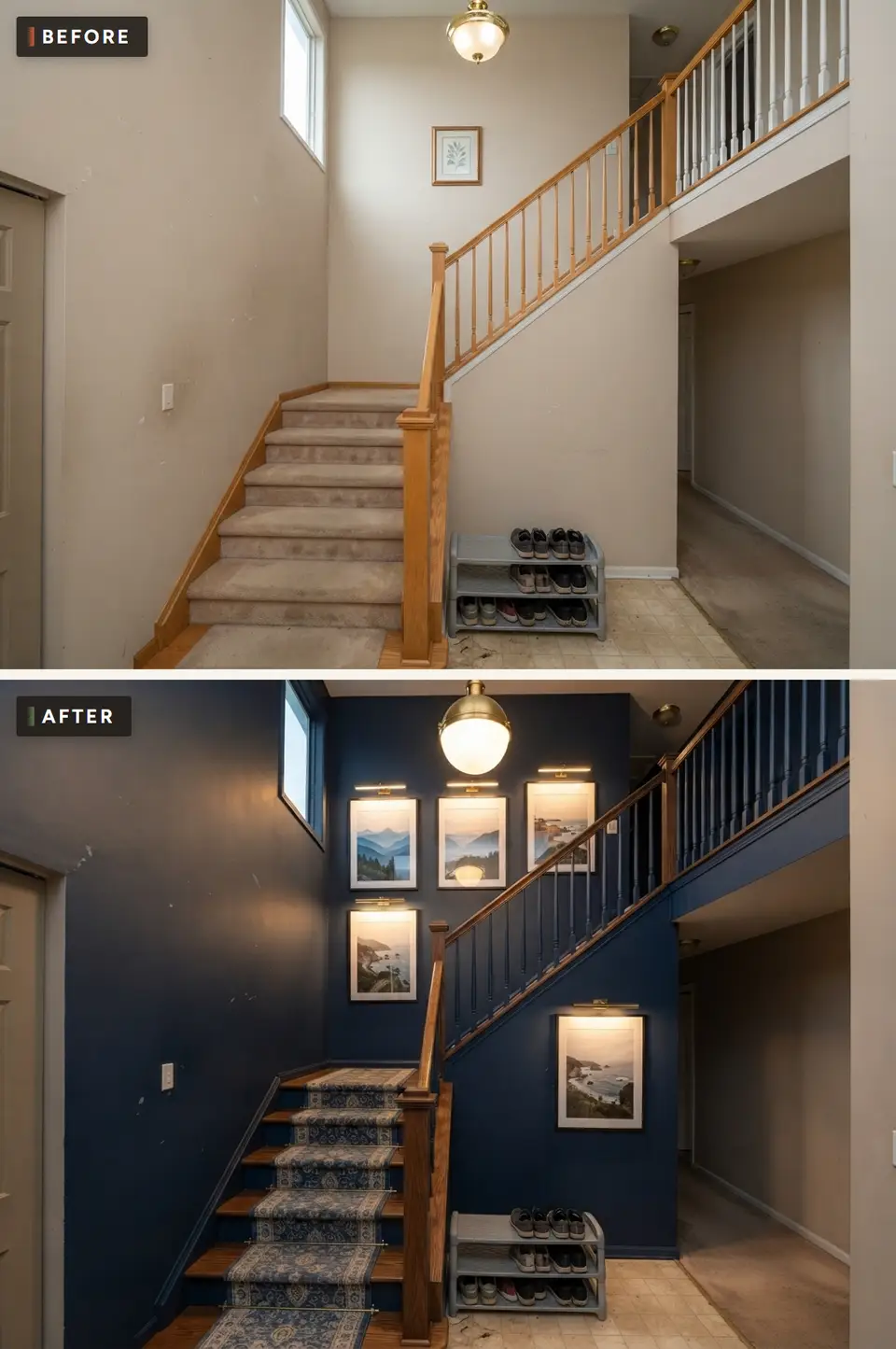
Navy covers the whole hall in this direction. Deep blue goes on every wall and on the spindles, the oak rail and treads stay warm, and a blue patterned runner with brass rods runs up the middle. A brass globe pendant lights the landing, and five landscape prints in white mats each get their own brass picture light, so the stairwell reads as a small lit gallery after dark. The frames step with the stair in a measured grid while the rail stays visually continuous in front of them.
Ink blue (#263747) is the wall and spindle paint, Walnut (#6B4F3A) the rail and treads, Aged brass (#A98252) the pendant, rods and picture lights, and Deep charcoal (#252725) the thin frame edges. With this many brass points, keep every metal finish matched.
A gallery wall on a stair is hard to adjust once the holes are in, so lay the arrangement on the floor and mark every anchor before drilling. Picture lights add a second set of fixings and a cable or battery route for each frame, which needs planning before the first nail goes in.
Picture lights change how the walls read: navy looks nearly black between the pools of light at night and clearly blue at noon. Review the stair at both times, and keep every frame well back from the rail.
The allowance for this gallery version is $1500–$4900, driven by the frames and picture lights as much as by the paint and runner.
9. Warm Wood and Paneling
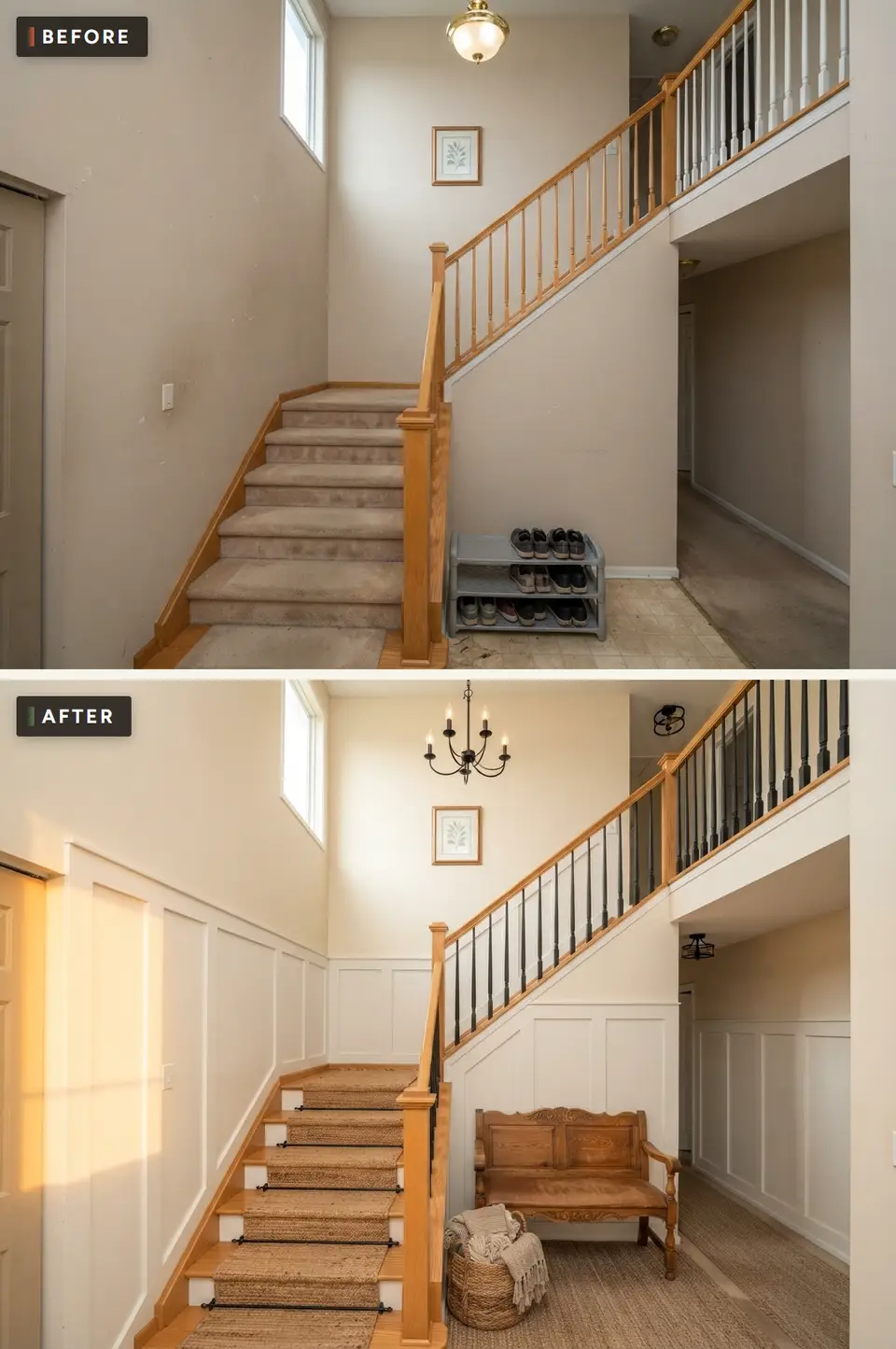
White board-and-batten paneling covers the lower part of the walls up the stair, under it and along the hall, with cream paint above. The oak rail and newel are kept, the spindles turn black, the treads stay natural wood over white risers, and a jute runner is held by black rods. A black candle-style chandelier hangs in the stairwell, a carved wooden bench and a basket of throws sit at the foot, and the old botanical print stays. The panel cap follows the architecture and protects the busiest band of wall.
Warm plaster (#E7DED0) is the upper wall, Light oak (#C49D72) the rail, treads and bench, and Charcoal (#343735) the spindles, chandelier and runner rods. Moss (#61705A) does not appear yet; it is the color for one textile or a painted door if the hall feels too pale.
New paneling looks added on unless the trim lines up with the existing door casing and baseboard. Matching heights and profiles makes it look original to the house, and on the stair the cap has to rake at a steady line parallel to the handrail.
Wood tones deepen noticeably under warm evening light, and a candle chandelier is warmer still. Check the oak and the jute side by side at night, because together they can read orange.
At $1800–$5600, paneling is the costliest direction in this set, since trim carpentry and the paint on it add labor that the other schemes avoid.
10. Graphic Black Runner
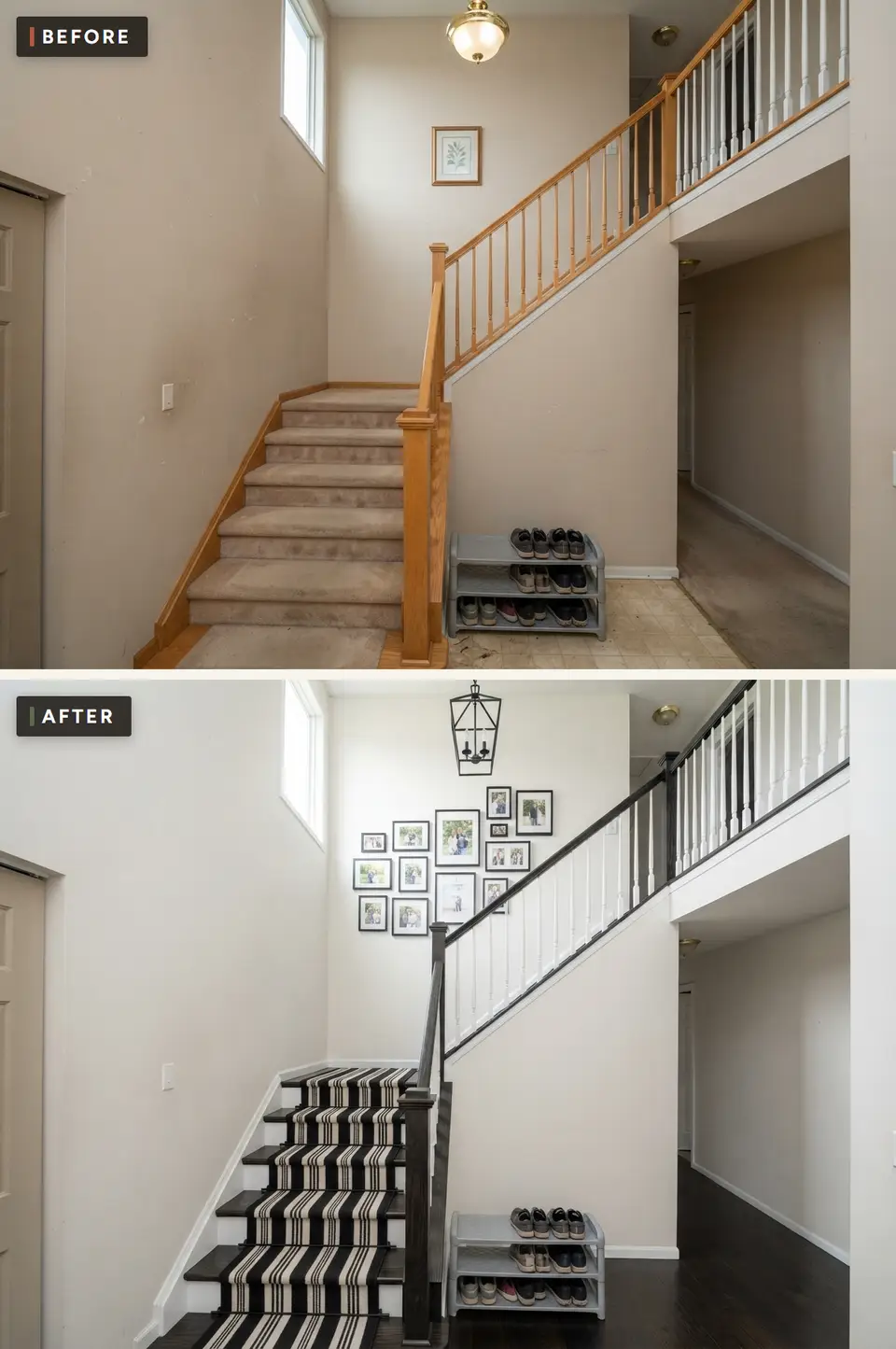
A black and cream striped runner over dark-stained treads, white risers and white spindles under an espresso rail gives the stair a crisp graphic line. The floor at the foot turns dark wood, a black lantern pendant hangs in the stairwell, and a cluster of black-framed personal photographs fills the back wall. The stripe stresses the direction of travel and hides moderate traffic better than a solid pale runner would.
Deep charcoal (#252725) is the stripe, the rail and the lantern; Walnut (#6B4F3A) sits under it in the treads and floor. Ink blue (#263747) and Aged brass (#A98252) are optional accents the rendering leaves out, useful in a single photo mat or a hardware finish if the black and white starts to feel severe.
A graphic runner shows every misalignment, so avoid a pattern repeat that appears to drift from side to side as it climbs. Center the stripes on the first tread and check them again at the top before the last fastener goes in.
Strong black and white contrast can feel harsh under bright, cool bulbs. A warm bulb in the lantern softens the stripes at night without dulling them.
Allow about $1500–$4700, mostly for the runner and its installation, then rail paint, the pendant and the frames.
Preparation That Applies to Every Direction
Before settling on any of the ten directions, photograph the foyer and measure it: the width of each tread and the reveal wanted on either side of a runner, the height of the stairwell wall, switch and vent positions, and the state of the rail finish. That record shows the repairs a rendering hides, such as the scuffed walls and worn carpet in the starting photo.
Carpet removal comes first in almost every direction here, and the treads underneath decide what happens next. Builder stairs are often left rough where carpet was always meant to cover them, so inspect the exposed wood and repair or replace treads before planning a stain, paint or runner. Walls need cleaning, patching and primer before paint or paper, and any staining from moisture needs its cause found first.
Look at samples on the stair itself: paint at the top and the bottom of the wall, a runner swatch laid on a tread, stain on the underside of a tread. Allow each product its stated cure time before the stair goes back into normal use, which for painted treads means routing traffic around them for a few days.
Then work in order: repairs, then fixed finishes such as paint, paper, paneling and tread work, then lighting, then the runner, and only at the end furniture, art and small objects. Buying the bench or the frames first tends to mean buying them twice.
Turn a Rendering Into a Written Scope
Once a direction is chosen, write a one-page scope for the foyer. List what stays (in most of these concepts the rail, newel and window), what gets a new finish and what is replaced, with a quantity, dimension and finish on every line, so a paint idea does not quietly grow into new treads nobody priced.
Keep repair and decoration in separate columns. Tread repair, wall patching and any electrical work for a new pendant or picture lights are preparation; paint, paper, runner, art and furniture are finish. Finish money should never be used to cover an unresolved defect.
Where a painter or runner installer is involved, ask for a written scope that names preparation, product, number of coats or fastening method, protection for the floor below, cleanup and schedule, and compare quotes line by line rather than by total.
Hold back a contingency for whatever the carpet is hiding, and leave it untouched until the stair is finished rather than spending it on a bench or frames at the start.
Treat the first finished tread as the standard for the rest. Check the runner reveal, fastener visibility and the paint line on the riser before the installer carries on up the flight, and put any agreed correction in writing while access is easy.
Material and Maintenance Notes for This Room
A staircase is a circulation and fall protection system before it is a decorating surface. Do not reduce handrail grip, guard height, tread visibility or landing clearance for a cleaner image.
Paint at a handrail needs a durable preparation system because skin oils and repeated contact test adhesion quickly. Clean, dull and prime the existing finish with products that are compatible as a complete system.
A stair runner needs exact measurement at every tread and riser. Pattern repeat, turn direction and edge reveal should be planned before cutting. Secure installation is more important than preserving a particular stripe position.
Wall frames should follow a measured reference line but remain outside the hand path. Use suitable anchors for the wall type and avoid placing fragile glazing where it can be struck from the stairs.
Light the first tread, last tread and any direction change. A decorative pendant can support the room, but it does not replace useful illumination on the walking surface.
Final Check Before Ordering
A stair leaves less room for error than most spaces, so check every dimension twice before ordering a runner, trim or furniture for the landing. Door, drawer and chair movement must remain clear at the top and bottom of the flight. Surface preparation has to match the product instructions, especially on treads and rails that take daily wear, and lighting should serve the real task after sunset, which on a stair means seeing each step.
Electrical, fire and guard issues need professional review where needed; balusters and handrails are safety items as well as finishes. Include delivery, tax and return freight in the budget, and view samples in the room under the stair light. Make sure the maintenance routine is realistic, since a pale runner on a busy stair needs regular cleaning.
Keep a repair contingency unspent until the work is finished, and store purchase records, finish codes and care sheets in one place.
Regional Fit Across the Southeast
Humid summers across the Southeast favor scrubbable wall paint on a stair that sits by the front door, and they are hard on natural-fiber runners: the sisal and jute in two of these concepts can stain or slacken if indoor humidity stays high, so keep it controlled. Strong afternoon sun through the stairwell window can also fade a red or blue runner unevenly from tread to tread.
Near the coast, salt air shortens the life of thin plated metal, which on a stair means runner rods, picture lights and pendant hardware. Solid brass, stainless or powder-coated rods hold up better than plated ones.
Treat these regional points as planning considerations only. Guard and handrail rules, electrical work and moisture repair belong with qualified local professionals working to the local code.
What Each Direction Actually Costs
In 2026 estimates, the staircase directions run from about $900 to $5600, and the high end comes from trim, runners and lighting rather than paint alone. Warm Wood and Paneling is the most expensive at $1800–$5600, covering wall trim, paint, a wood finish and a bench. Traditional Runner follows at $1600–$5200 for a runner, wall trim, lighting and a small table.
Three directions sit close together. Navy Gallery Stair costs $1500–$4900 for paint, picture lights, frames and a runner; Black Rail With Clay Runner runs $1500–$4800 for rail paint, a runner, a light and art; and Graphic Black Runner comes to $1500–$4700 for a runner, rail paint, a pendant and frames. Cottage Wallpaper Wall is estimated at $1400–$4400 for wallpaper, a runner, a light and a basket, and Greige Traditional at $1300–$4200 for paint, a runner, lamps and a table.
At the lower end, Scandinavian White costs $1100–$3600 for paint, a tread finish, a light and a bench, and Coastal Pale Blue runs $1100–$3500 for paint, a runner, a pendant and a plant. Charcoal Stair, Pale Blue Hall is the least expensive at $900–$3000, covering paint, lighting, art and small furniture.
All of these figures are editorial planning estimates built from the materials visible in each rendering, current retail categories and limited labor allowances where noted. None of them covers structural work, hidden repair, permits or professional design fees, and a local quote may land higher or lower depending on what lies under the carpet, the wall height and access.
Questions Readers Ask
How much does a staircase makeover cost?
Decorative paint, light and art may start near $900. A fitted runner, wall trim and professional finish work can bring the range above $5,000.
Can stair rails be painted?
Yes when the surface is cleaned, sanded and primed for the existing finish. High touch durability matters.
Are stair runners safer?
A well installed runner can add traction, but loose edges are a hazard. Use an installer familiar with stair work.
How wide should a stair runner be?
The runner should leave a deliberate, even reveal on both sides. Exact width depends on the stair and local installation method.
Can wallpaper be used on a stair wall?
Yes. Choose a durable paper and plan safe access for installation on tall walls.
Where should stair lighting go?
Light the treads, landings and direction changes without glare. Electrical work should meet local code.
Can balusters be removed for a new look?
Guard and baluster changes affect safety and code. Consult a qualified professional rather than treating them as simple decor.
Sources and Pricing Notes
The staircase costs above are 2026 planning allowances in US dollars, priced from current retail paint, runner, hardware and lighting categories for the scope each of the ten renderings shows. None of the staircase figures includes tax, delivery, permits or the cost of fixing loose treads found once the old finish comes off.
- International Code Council: model code references for stairs, guards and handrails.
- U.S. Bureau of Labor Statistics: Consumer Price Index notes for household furnishings.
- The Home Depot: project calculators and current material categories.
- IKEA US: current furniture and storage categories.
Keep Planning
entryway decor budgets, paint color guide, mudroom design study.
Choose the Long Line First
Runner, rail and wall treatment create the three longest lines in this foyer. Decide how those lines relate before choosing frames or a table, and keep every decorative change subordinate to stair safety.
Transformations Desk
The Layered Homes editorial teamThe Transformations Desk produces the before-and-after design studies: one imagined starting space (a room, a facade, a backyard) shown in several design directions, each with a palette and a cost estimate.
More from the Transformations Desk →
Reader notes