


Teen bedrooms are one of the trickiest briefs in residential design. The room has to look like it belongs to a near-adult without aging out of usable in two years; it has to survive homework, hobbies, and the occasional sleepover; and it has to read as authentically the kid's, not as a parent's idea of what a teen room should be. Below are eleven concept directions for thirteen-to-eighteen-year-olds. They start from the same plain builder-grade bedroom (pale lavender grey walls, beige carpet, an oak veneer dresser and desk, a plain twin bed) and walk it forward into eleven different rooms. For each one we have included the palette, the brand-level product references to source from, the practical advice a parent or DIY teen needs, and the failure mode first-time stylists most often fall into.
What This Guide Covers
- Bohemian Rhapsody Retreat
- Sleek Modern Industrial
- Soft & Feminine Glam
- Vintage Academic Hideaway
- Organic Modern Retreat
- Scandi-Minimalist Calm
- Mid-Century Modern Revival
- Edgy Industrial Loft
- Breezy Coastal Escape
- Tranquil Japandi Zen
- Opulent Emerald Glamour
- Planning Notes for Any Direction
- Frequently Asked Questions
- Sources & References
- Choosing a Direction That Grows with the Teen
Bohemian Rhapsody Retreat
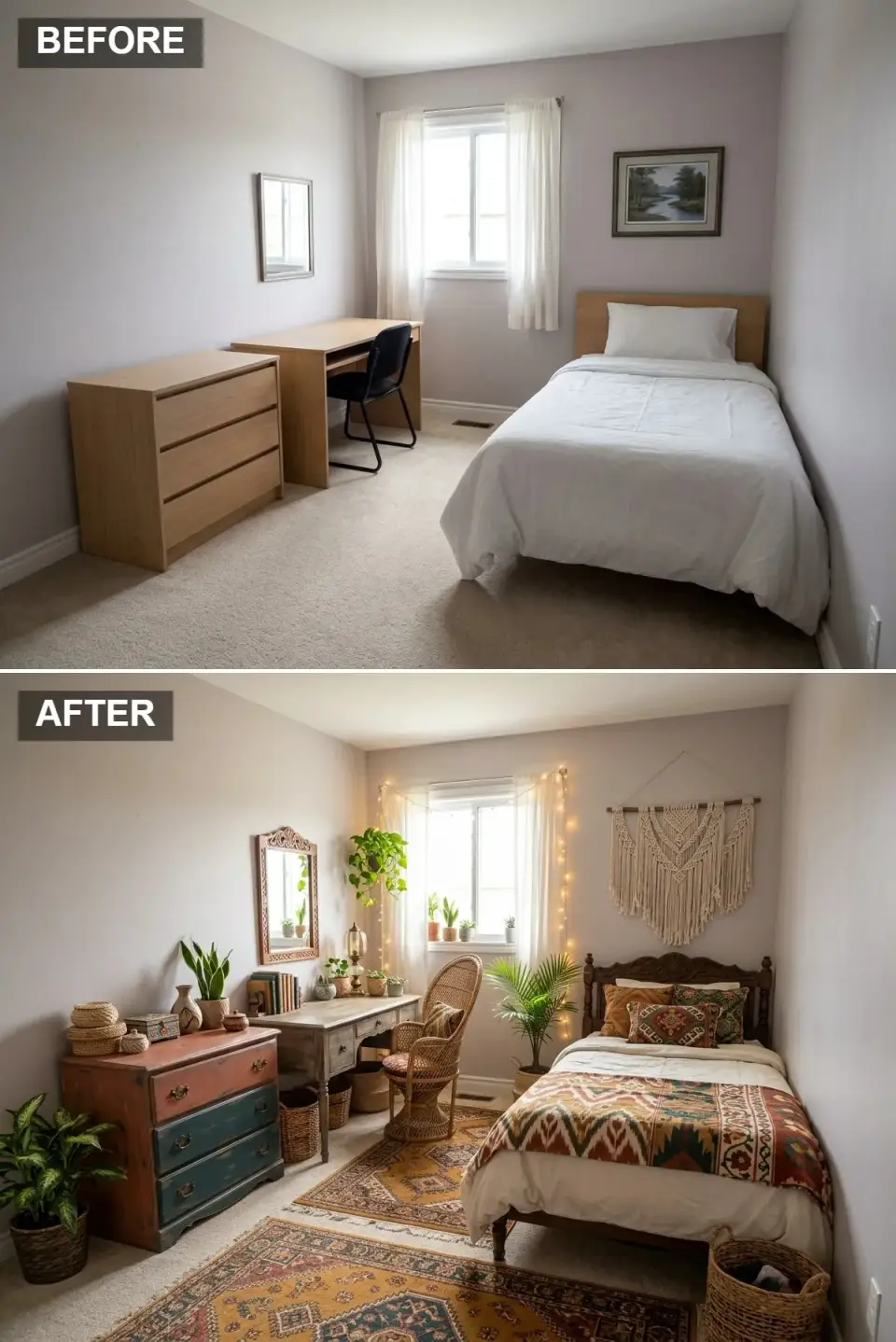
Boho is a popular direction with fifteen-and-sixteen-year-olds, usually after a long session on Pinterest, and it only works if both the layering and the light temperature are fully committed to. In this rendering the builder dresser gives way to a chest painted in chipped terracotta and teal, the plain bed becomes a carved dark-wood frame, and two patterned rugs, a mustard medallion by the desk and a larger red-and-teal one at the foot of the bed, overlap on the carpet. A cream macrame hanging fills the wall above the headboard while a pothos trails from the window frame, and together they soften the hard corners of a builder bedroom and take some of the echo out of bare drywall. The most common failure is 4000K LED string lights. Boho needs a 2700K warm bulb in every fixture, and anything cooler flattens the whole scheme.
The colours in the rendering are easy to trace. Distressed teal (#4A707A) shows up on the lower drawers of the painted chest, and medium walnut (#7B5D46) runs through the carved bed and the mirror frame, so the teal reads as a cool break in a room that is otherwise warm wood. Mustard yellow (#CFA657) is carried by the rug under the desk and the bed cushions, and the walls stay a soft taupe cream (#D9D0C5) rather than bright white, which would make all those textiles look like costume pieces.
The double rug is the detail that separates a considered boho room from a themed one. A 6x9 base with a 4x6 laid over it at an angle is the usual proportion; the rendering does it with two patterned rugs, but a flat jute base under a single wool kilim gives the same depth with less visual noise if the bedding is already busy. Fit the string lights and the bedside lamp with matching 2700K bulbs so that no single fixture throws a blue cast across the macrame.
Plants and one older piece do the rest. Three live trailing plants, for instance a pothos, a heartleaf philodendron and a string of pearls, are the minimum for this look, since plastic foliage gives itself away in daylight. Real wear also beats factory distressing: one secondhand chest or chair from an estate sale or a vintage listing will carry more character than a full set of new furniture finished to look old.
Sleek Modern Industrial
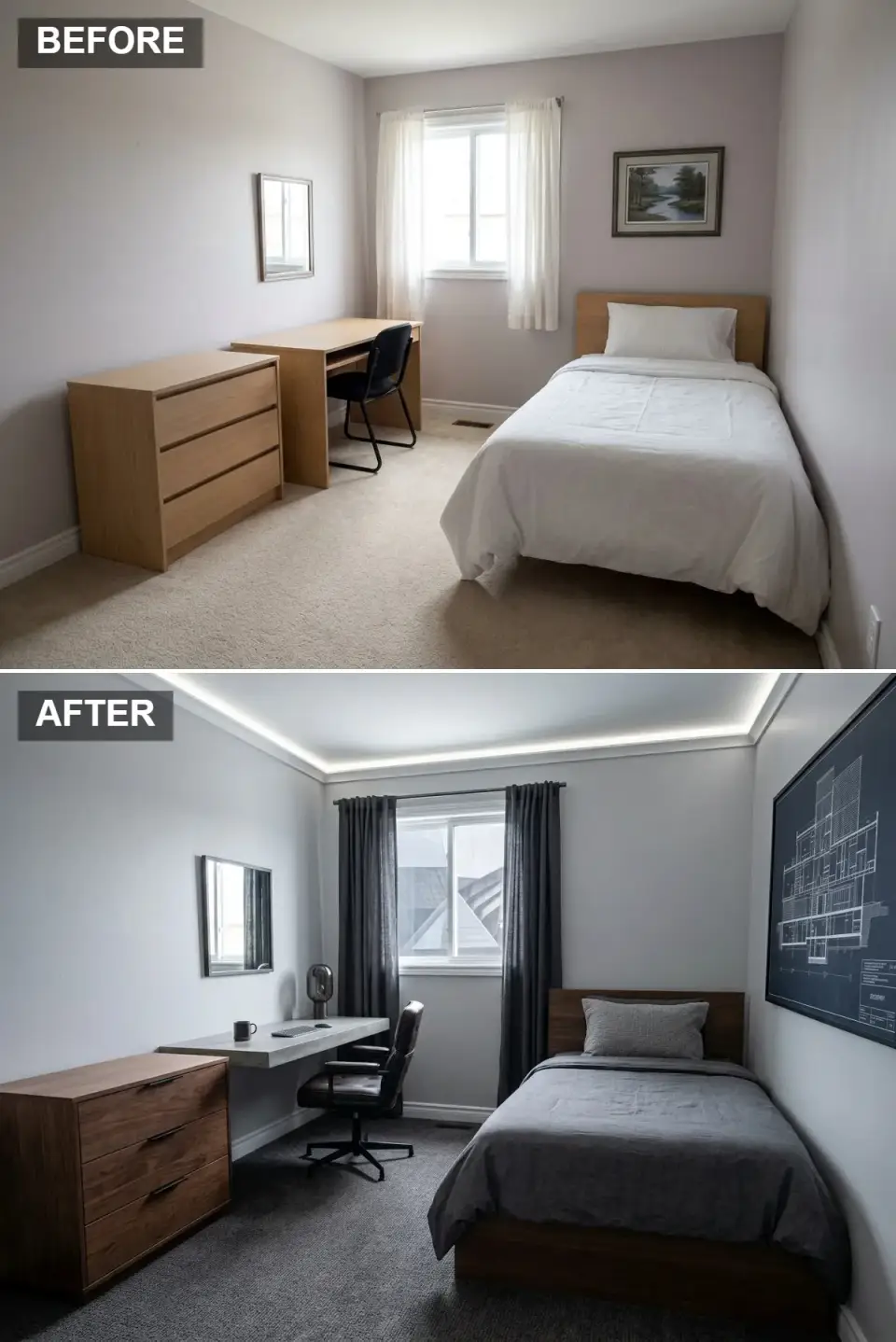
This direction suits sixteen-and-seventeen-year-old boys with a serious gaming or design hobby. The architectural cove lighting up at the ceiling is the move that lifts the whole room: it can be a single Philips Hue strip-light reveal recessed behind a custom 1x4 fascia, at around $380 installed. The floating desk reads as concrete; a real concrete slab (not laminate) wants French-cleat steel brackets rated around 600 lb per linear foot. That is overkill for a laptop, but it's the spec that prevents the desk from sagging under monitor arms in year four. The dark walnut case goods (Crate & Barrel Steppe or West Elm Modern have the right silhouette) hold their value into the kid's twenties, so this is a room that ages with the teen rather than against them.
The grey is split between two surfaces: concrete grey (#959595) on the floating desk, with the walls held a half-shade lighter so the slab still reads as a solid object against them. Dark walnut (#4F3829) on the dresser and the bed frame is the only warm material in the room, and solid walnut matters here because its grain shows under the cove light where a printed veneer would look flat.
Charcoal (#363636) goes on the curtains, the bedding and, in the rendering, the carpet as well, which soaks up screen glow at night and keeps the room dark enough to sleep in. The one cool light source is the ceiling cove, set to a cool white (#F0F8FF) from a 4000K strip that gives the ceiling its crisp architectural edge while the desk lamp stays warm.
Discipline with colour is what holds industrial modern together. Greys, black and a single wood are enough; a fourth colour, even a small red throw, starts pulling the room back toward a generic teen bedroom. For the cove itself, a dimmable LED strip with colour control, such as a Philips Hue Lightstrip Plus or an equivalent diode strip, matters more than raw wattage, because the strip will spend most evenings at a fraction of full output.
The blueprint on the side wall earns its place because it is an actual architectural drawing print rather than generic wall art; a framed drawing of a building or machine the teen genuinely cares about has the same effect. Fix the concrete desk into studs with steel brackets rated for the load. Toggle bolts in drywall tend to pull out once a monitor arm starts levering on the slab.
Soft & Feminine Glam
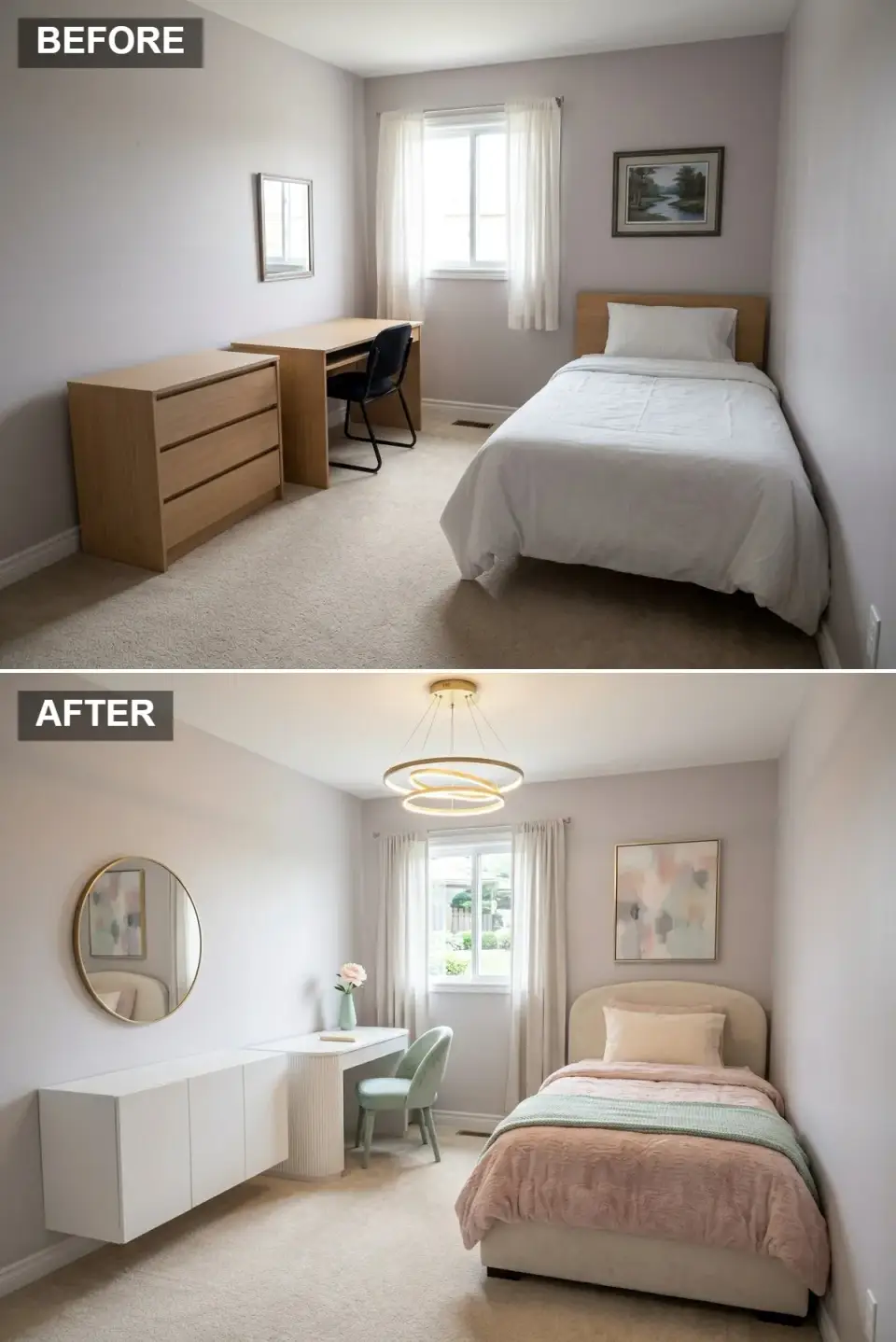
This direction is a natural fit for a fourteen-or-fifteen-year-old daughter's room. The curve language is non-negotiable: the arched upholstered headboard, the fluted desk pedestal, the round mirror and the looping ring pendant overhead. Every silhouette in the room rounds rather than squares, and that carries the softness more than the pink does. Blush and sage read as deliberate rather than juvenile because the two sit roughly opposite on the colour wheel; one alone tips young, but balanced together they look modern. The brushed gold (CB2 Channing or Anthropologie's Gleaming Primrose Mirror) is the punctuation that lifts the scheme out of pastel-nursery territory and into something the kid won't outgrow at seventeen.
Blush pink (#E8CCD7) sits on the comforter and in the abstract print above the bed, and soft sage green (#A8C3B4) answers it on the desk chair and the knitted throw folded across the foot. Without the sage, the pink would cover too much of the room and everything would melt into one sugary tone.
Matte white (#FFFFFF) is reserved for the floating credenza and the fluted desk, and the matte part matters: a gloss lacquer shows every fingerprint within a week on furniture a teenager leans on daily. Brushed gold (#CBA168) appears only on the mirror frame and the ring pendant. Keep it brushed rather than polished, since polished gold looks like a costume prop under the ceiling light.
Squared furniture is the quickest way to undo this palette, so each replacement piece should have a radius somewhere: an arched headboard, a rounded desk end, a round side table. Upholster the headboard in a performance velvet from the Crypton or Sunbrella Renaissance ranges. A teen bed gets sat against, leaned on and eaten on, and decorative velvets tend to pill within six months of that kind of use.
Put the pendant on a dimmer. Brushed gold looks warm at around 30% output and turns harsh at 100%, which matters in a room used for homework in the afternoon and for winding down at night. Resist the urge to answer blush with a second pink, too; a pink-on-pink room reads several years younger, while the sage keeps it closer to a young adult's room.
Vintage Academic Hideaway
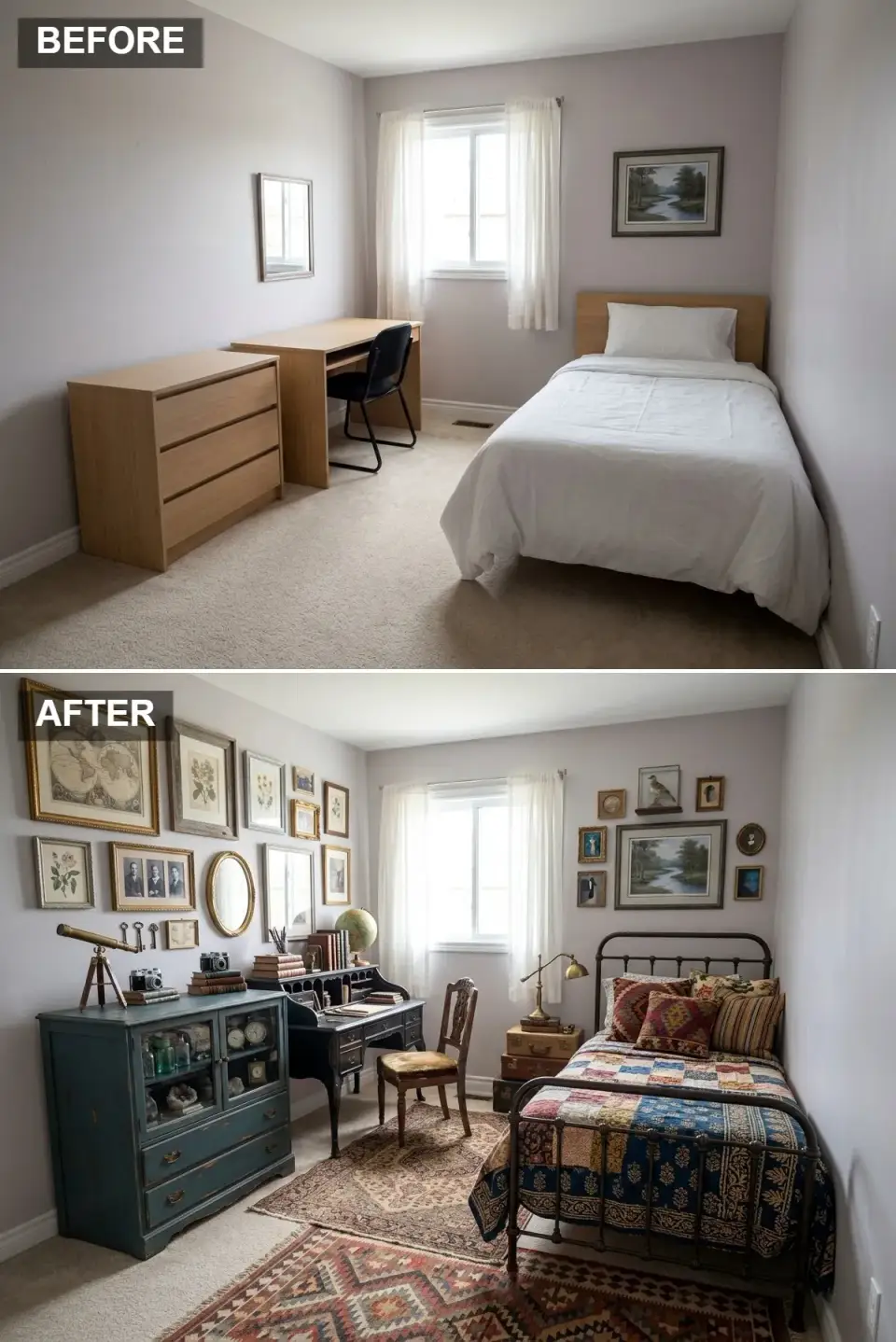
Dark Academia has had a long run online, and it suits a sixteen-year-old reader or writer who specifically does not want a bedroom that looks like an Instagram set. The antique secretary desk is the load-bearing piece and probably the most important purchase in the room: a genuine one, typically $850 to $2,400 on the antiques market, carries the whole aesthetic, while a reproduction gives the game away. The gallery wall is the second tell, with twelve to twenty-five framed pieces in mismatched antique gold and walnut frames hung salon-style. The distressed deep teal display cabinet isn't a centerpiece but a counterweight: it gives the room a focal piece that has nothing to do with sleeping, which is what makes the space feel like a study rather than a teenager's bedroom. Underfoot, the rendering layers a worn Persian-style rug with a red geometric kilim, and a real vintage rug from a secondhand dealer will look truer than a new printed one.
Distressed deep teal (#2F5B66) belongs to the glass-fronted cabinet alone, which is why it reads as the room's anchor rather than as a wall colour. Aged metal and dark wood (#3E2F25) cover the iron bed frame and the black secretary desk, two pieces whose patina a new purchase cannot fake.
The warmth comes from textiles. Rich reds and blues (#8A3324) in the patchwork quilt, the kilim cushions and the two rugs pull the corners of the room together, while antique gold and wood frames (#8B7355) on the gallery walls are mismatched on purpose, so the salon hang looks gathered over years rather than bought as a set.
On the gallery wall, align the bottom edges loosely and let the tops vary, with two-to-four-inch gaps between frames. A tight grid looks like an office corridor; the staggered hang shown above the cabinet looks like a scholar's study. Slipping in a small oval mirror, a row of old keys or a mounted bird, as the rendering does, breaks up the run of rectangles.
Fill the cabinet with real books, not decor-store fake spines. Old hardcovers from a thrift-store bin cost $1 to $3 each and look far more convincing than a $40 set of faux volumes. Keep every bulb at 2700K as well; under cool LED light the dark woods and deep teal turn institutional instead of scholarly.
Organic Modern Retreat
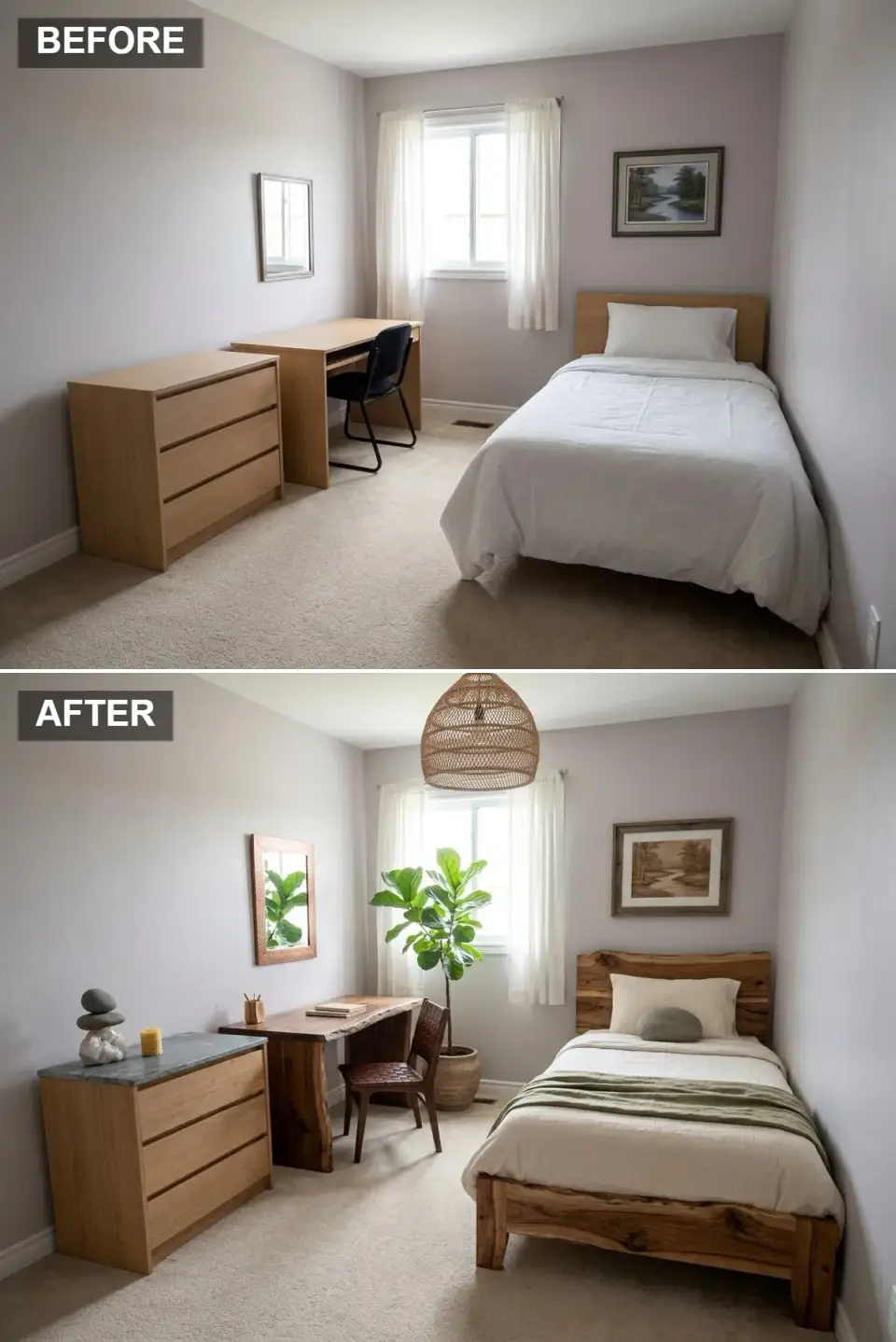
Organic Modern suits the teen who reads as an old soul: the kid into pottery, hiking or Hayao Miyazaki films. The live-edge bed is the load-bearing piece (custom builds run $1,800 to $3,400, and West Elm Anton is the closest mass-market substitute), and the stone-topped dresser is the second anchor. What makes the scheme work is restraint. This is a room with maybe twelve objects in total, and each one has a job: the woven pendant throws a soft pattern of shadow, the woven leather chair pulls up to the live-edge desk, and the fiddle-leaf fig fills the corner by the window. Don't add things. The room gets its calm from what isn't there.
Natural live-edge wood (#A67B5B) is shared by the bed and the desk, so the two most organic shapes in the room match in tone even though no two edges match in outline. Grey stone (#808080) on the dresser top adds a cool, heavy surface beside all that warm grain, and the stacked pebbles on top of it repeat the colour.
Creamy off-white (#F2F0E6) covers the bedding, and the palette intends it for the walls too, a warmer choice than the cool grey left in the rendering and far kinder to the wood than stark white. Muted olive green (#7C8466) is the only saturated note, on the throw across the foot of the bed and in the fig leaves, so colour enters the room through living things.
Finish the live-edge pieces with a hardwax oil such as Rubio Monocoat or Osmo Polyx-Oil rather than polyurethane, which seals the grain under a plastic film and loses the hand-worked feel. Accumulation is the main risk with this style: every birthday gift and souvenir that lands on the dresser chips away at the quiet, so agree on a home for the overflow before the room is finished.
The fiddle-leaf fig wants about five hours of bright indirect light a day. In a room without a south-facing window, a Strelitzia nicolai or a Rhapis excelsa palm is more forgiving. Hang the woven pendant 30 to 36 inches above bedside table height: high enough to keep sightlines open, low enough that the weave throws a pattern on the wall.
Scandi-Minimalist Calm
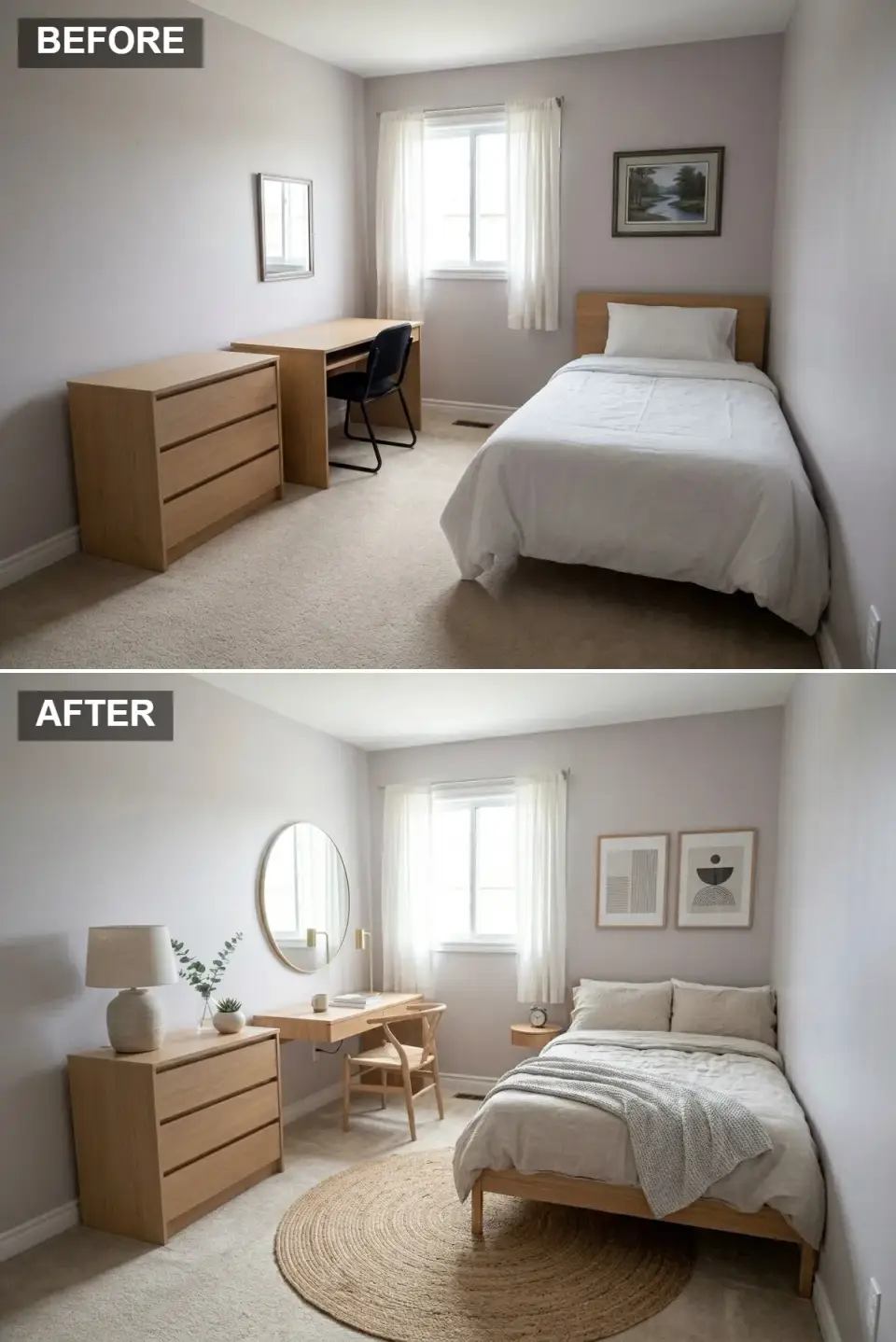
Scandi suits the teen with sensory sensitivity, the over-stimulated kid, or the high-anxiety high-achiever. The room shown here functions as a recovery space as much as a bedroom: light oak case goods (IKEA Sundvik or Hay Pastille collection works at the price point), linen bedding (Coyuchi Crinkle organic or Magic Linen if budget runs higher), and a single round jute rug as the floor anchor. The discipline is what carries it. Minimalism collapses if you put too much in, and most first-time stylists tip Scandi over by adding an “interesting” piece they couldn't resist. Every object that earns a spot here has to fight for it. The visual lightness is itself the point, because it lets the kid's nervous system settle before sleep.
Light oak (#CDBA96) runs through the bed, the dresser, the wall-mounted desk and the wishbone chair, and solid birch or oak at the IKEA Sundvik level is a reasonable price benchmark. Natural linen beige (#D3C7B6) on the duvet and pillows gives the bed texture without adding colour; washed Belgian linen tends to wear well for five to seven years.
Natural jute (#C0A983) arrives as a single round rug angled off the bed, the only floor texture in the room. Pale cool grey (#E0E0E0) is the wall colour on the palette, with BM Classic Gray OC-23 as the paint reference, and it keeps the narrow room reading open.
Hold the furniture to four main pieces: bed, dresser, desk and one chair. The rendering bends that slightly with a small round shelf fixed to the wall beside the bed, which works because it floats and takes no floor space; a fifth freestanding piece would start turning the room into an ordinary bedroom that happens to be beige. For the bedding, choose real linen rather than linen-look polyester, which neither drapes nor softens with washing.
BM Classic Gray OC-23 and BM White Dove OC-17 both sit on the warm side of white, which is where this scheme belongs; a cool blue-grey would make the oak look orange and the room clinical. Skip the pop of colour, too. In a room this restrained, one bright cushion becomes the only thing anyone sees.
Mid-Century Modern Revival
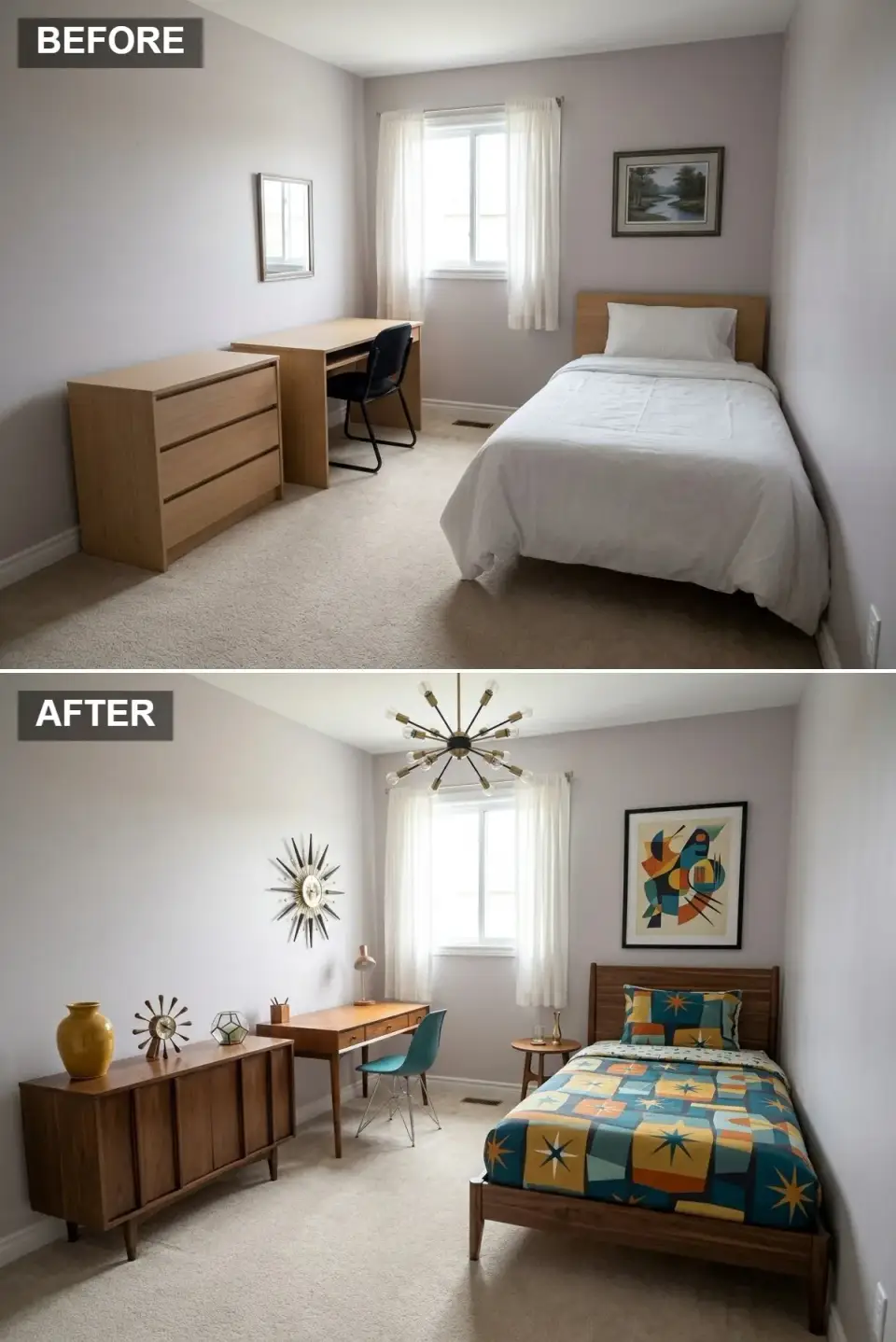
MCM is the direction to steer toward when the teen has architecture, design or industrial-design ambitions, and it is the most forgiving direction here because genuine mid-century pieces have a deep secondary market. A walnut credenza found through an estate sale or a vintage dealer typically runs $400 to $900, and that single piece anchors the room. The geometric bedding (Anthropologie or Schoolhouse) and the Sputnik fixture (West Elm or Lights.com carry acceptable reproductions, though a vintage George Nelson is the better answer if budget permits) carry the rest. The failure mode is over-iconification: too many famous designs in one room reads as a furniture showroom rather than a bedroom.
Rich walnut (#664228) is the base of the room: the credenza, the desk and the slatted bed frame all share it, with tapered legs and an oiled rather than lacquered finish. Retro teal (#007F8B), saturated rather than muddied, appears on the molded desk chair and across the starburst bedding, the clearest period colour in the rendering.
Mustard yellow (#D8A900) is the warm counterpart, on the ceramic vase on the credenza and in the bedding squares, and it sits naturally against the walnut. Brass and black (#B5A642) belong to the Sputnik pendant and the sunburst clock, two sculptural metal pieces that keep the ceiling and the long wall from looking empty.
If only one piece in the room is genuinely from the period, make it the credenza; the walnut grain and tapered-leg proportions of original pieces are hard to match at reproduction prices. Cap the recognisable designs at three: the credenza, the Sputnik and one chair, whether an Eames-style molded shell like the teal one shown or a Wegner Wishbone. A fourth tips the room into showroom territory.
The bedding pattern should come from 1950s and 1960s graphics, starbursts and offset squares like those in the rendering, rather than a vague retro print; Schoolhouse and Dusen Dusen both draw on that period well. Keep the metals warm by pairing walnut with brass rather than chrome, which makes the wood look harsh under a bare bulb.
Edgy Industrial Loft
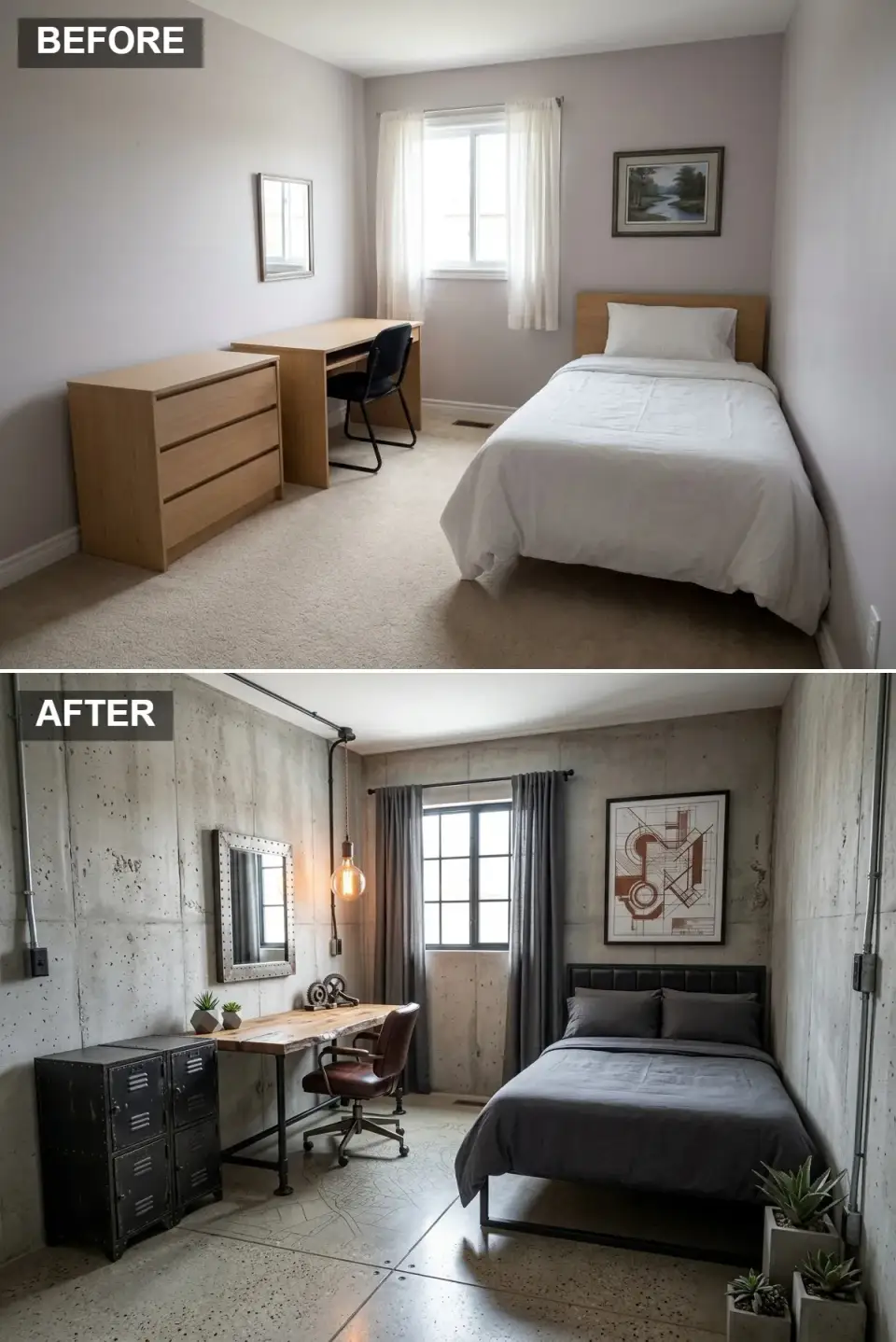
This is a polarizing direction, meant for teens who specifically want a “loft” rather than a bedroom. The faux concrete wall finish is the structural move and is achieved either with real Mortex polished plaster (around $14 to $22 per sq ft installed) or with Behr Texturized Concrete Effect paint at one-tenth the cost; the real plaster is meaningfully better, but the budget version is acceptable in a kid's bedroom that will repaint within five years. The locker-style cabinet (Wayfair or Restoration Hardware Teen) is the storage anchor. Expose the electrical conduit deliberately rather than fishing it through walls, since that's where the Industrial-Loft language earns its name. The room runs cooler in winter than warmer schemes; budget for an electric throw on the bed.
Concrete grey (#8C8C8C) wraps both the walls and the floor here, formed panels above and a polished speckled slab below, and it sets the raw tone for everything else. Matte black (#222222) belongs to the steel lockers, the bed frame and the conduit, and it should be powder-coated rather than glossy enamel so it doesn't pick up every reflection.
Aged wood and leather (#5C4033) on the desk top and the desk chair are the warm note that stops the room from feeling like a bunker. Dark slate grey (#4A4A4A) repeats on the bedding and the curtains, holding the moody envelope without adding a new colour.
If the conduit is going to be on show, run it properly: surface-mounted EMT in matte black, square to the ceiling line and terminated in proper boxes at each switch and outlet, the way it climbs the corners in the rendering. Any change to the wiring belongs with a licensed electrician, since the point is to display the conduit, not to improvise it.
The desk should be real steel pipe under a reclaimed-wood top, not a pipe-look reproduction; custom builds run $400 to $900. Balance all that cool material with at least one warm object, whether the leather chair, the wood desk or a wool throw. A room that is grey and black from floor to ceiling stops looking like a loft and starts looking like a basement.
Breezy Coastal Escape
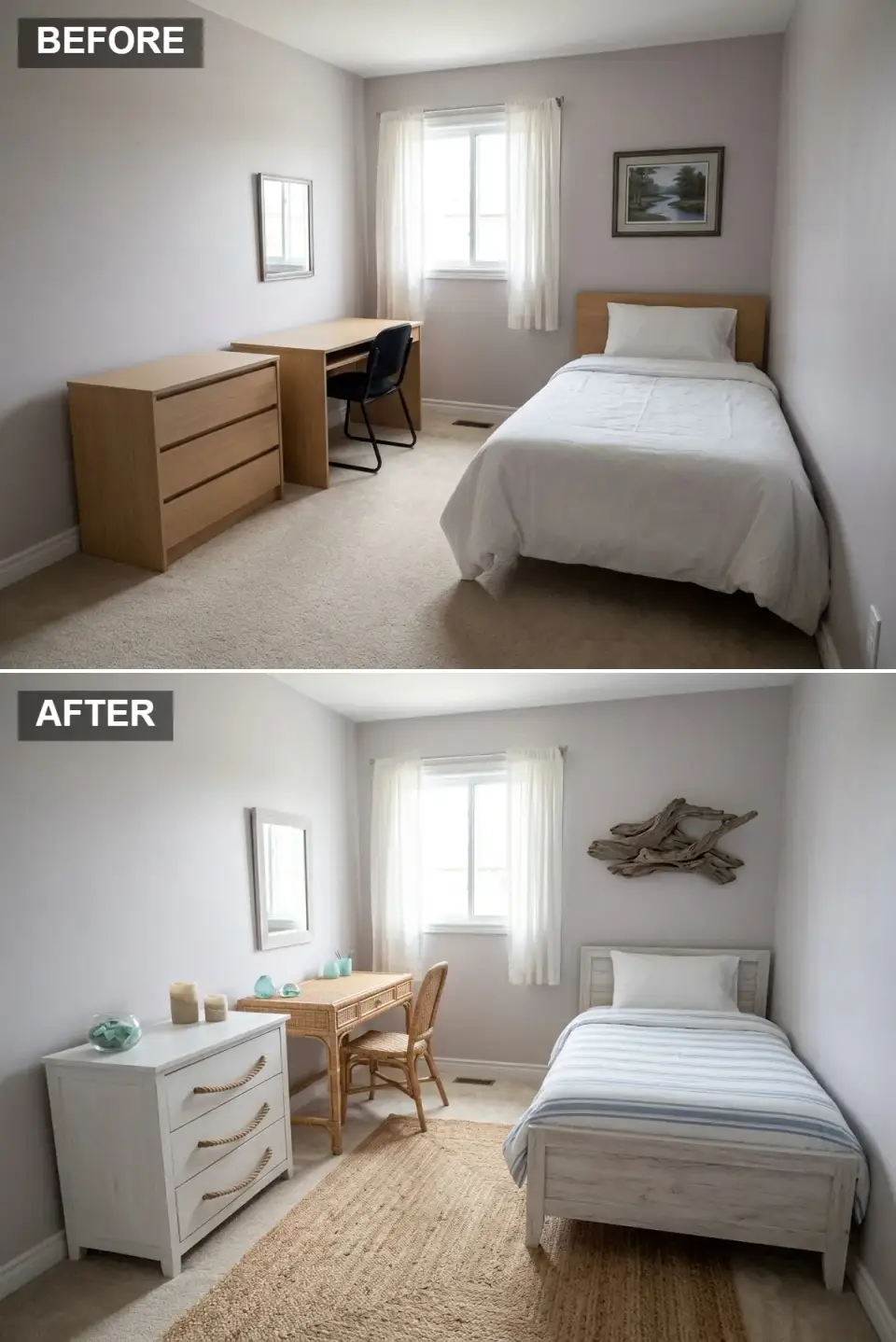
Coastal is the obvious answer for Isle of Palms, Naples FL, and Tybee Island families with teenagers, and it works because it's the only direction on this list that genuinely matches the climate the kid is living in nine months a year. The whitewashed wood (Serena & Lily Driftway or Pottery Barn Coastal Collection) is the foundation, the rattan desk and chair (CB2 Lyric or Anthropologie Cane Collection) carry the natural texture, and the blue-and-white striped bedding is the unambiguous coastal tell. The driftwood wall art needs to be real driftwood, not driftwood-look, because kids who actually live near beaches read fake immediately. This direction also ages well into late teens and early twenties because the language is timeless rather than trend-driven; a coastal bedroom from 2019 still looks current in 2026.
Whitewashed wood (#E3E0D7) covers the dresser with its rope pulls and the plank-style bed, a light weathered tone that keeps the furniture from looking showroom new. Ocean blue (#7FA9C3) appears only in the bed stripes, which is enough, and it pairs best with crisp white rather than cream.
Natural rattan and jute (#D4C3A3) carry the desk, the chair and the flat-woven rug, bringing in the colour of sand without any literal beach props. The walls take a pale sky blue grey (#D9E2E8), with BM Iceberg 2122-50 or BM Sea Mist 2150-60 as paint references.
Restraint is what keeps this room from turning into a gift shop. A bowl of sea glass, rope on the drawer fronts and the single driftwood piece over the bed are the only references to the shore. For the white, Decorator's White is a reliable crisp partner for the blue, while cream pulls the scheme toward country cottage.
Humidity is the practical issue near the coast. Whitewashed finishes hold up better under a marine spar varnish or a UV-stable hardwax oil than under a basic clear coat, and rattan legs should sit on glides rather than directly on a floor or rug that stays damp, where mold can start at the base within two seasons.
Tranquil Japandi Zen
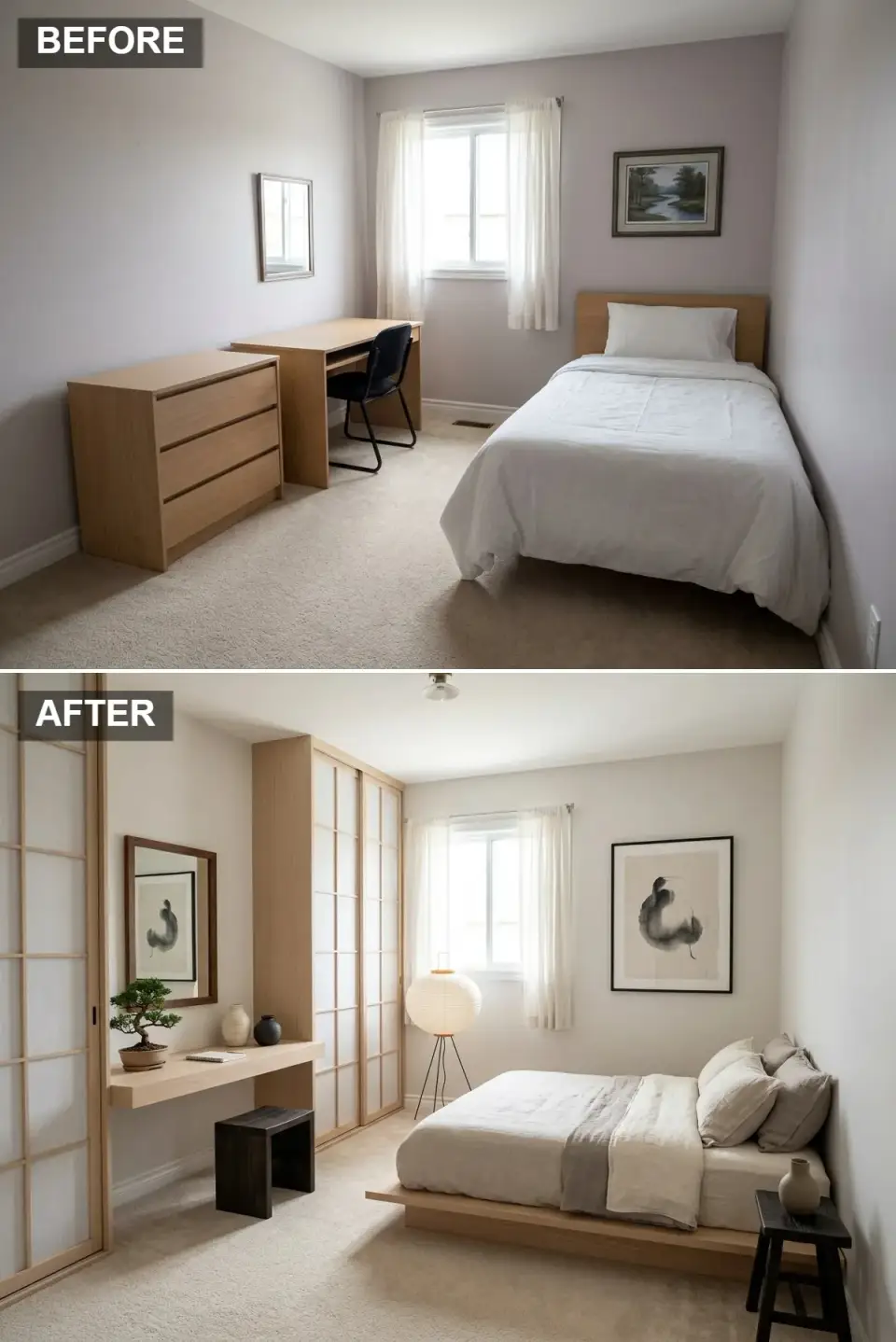
Japandi suits the meditation-practising teen, the kid in serious athletic training who needs disciplined recovery, or the one with anxiety who needs the bedroom to be a parasympathetic zone. The low platform bed (Etsy custom or West Elm Anton low) drops the visual weight of the room by a third, the shoji screen closet (custom millwork or IKEA Pax with rice-paper inserts as DIY substitute) introduces the Japanese architectural element, and the paper lantern floor lamp (Akari Noguchi authentic if budget allows; Hay Patio replica at the lower band) is the lighting punctuation that defines the whole scheme. Bonsai is the right plant: it's a five-year commitment, not a decor object, and the kid who chooses Japandi tends to know that. Ink wash art works because it's two colors with a lot of negative space. Resist symmetric balance. Japandi runs on asymmetric balance, and a centered art piece reads Western.
Light ash wood (#C2B29B) is used for the platform bed, the floating desk and the shoji frames, a pale wood that would turn heavy if swapped for dark walnut. Off-white rice paper (#F5F5F0) appears in the sliding closet panels, the lantern and the linen bedding, so daylight is filtered before it reaches the bed.
Charcoal black (#2E2E2E) is kept to the two small stools and the brushwork of the ink paintings, used as a line rather than a wash. The walls are a warm minimalist white (#EFEFE8), with BM White Dove OC-17 as the nearest paint match.
Bring the bed down to platform height, typically 8 to 12 inches off the floor; that lower line changes the room more than any accessory. Rice-paper shoji or fusuma panels need to be visible somewhere, and here they front the whole closet wall. Without them, the scheme is just minimalism with a lantern.
Limit the signature objects to three: one bonsai, one ink-wash painting, one paper lantern. Then arrange everything off-centre. The rendering hangs the ink painting toward the window side and lets the bed sit low in the corner, and that asymmetry is what keeps the room Japanese in spirit; a painting dead centre over the headboard would make it look Western at once.
Opulent Emerald Glamour
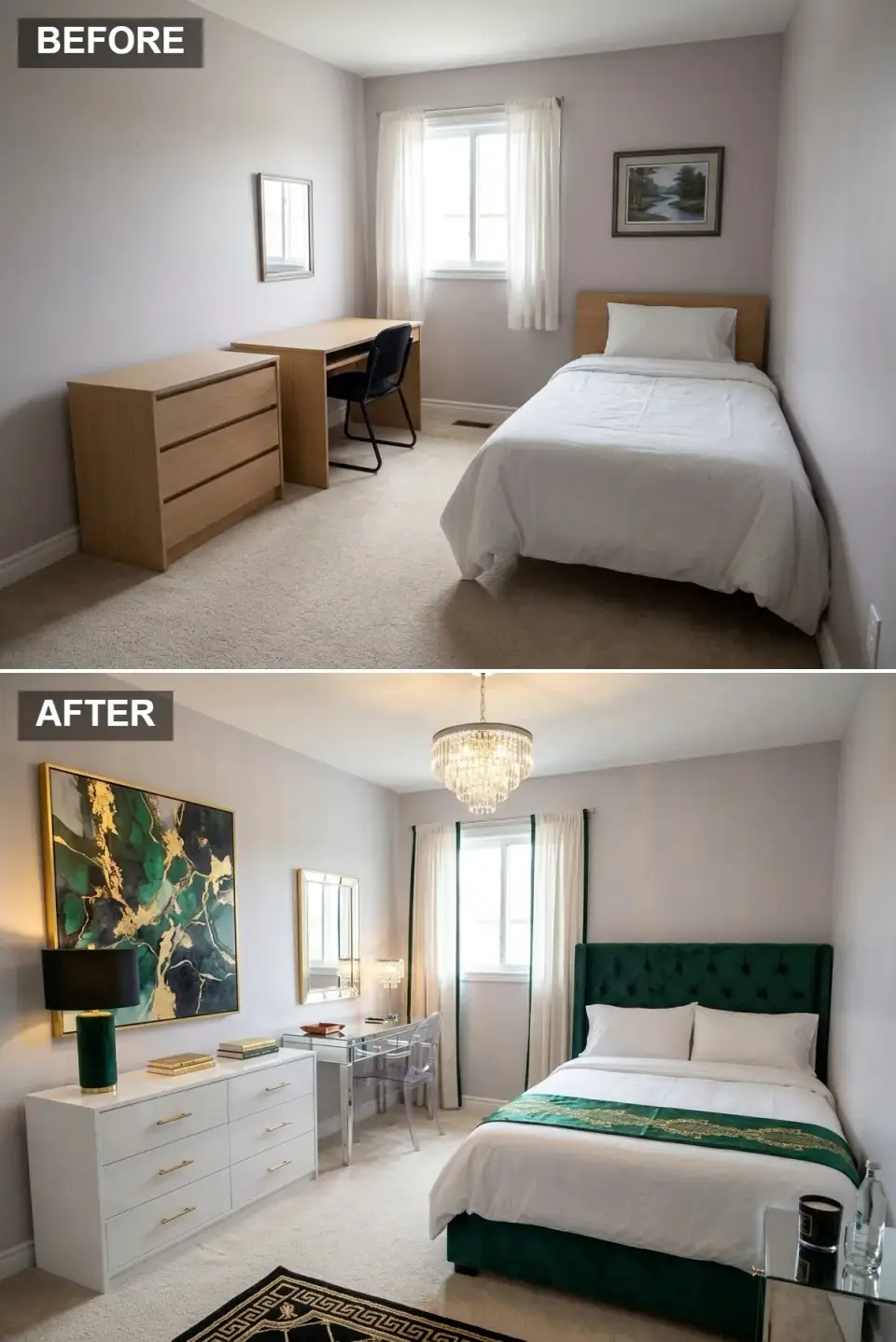
This is the highest-budget direction on the list and the one to approach with caution unless the teen is committed and the parents are ready for the spend. Done well, Opulent Emerald Glamour is gorgeous; done at half-budget, it collapses faster than any other direction here. The emerald velvet tufted bed needs to be real performance velvet (Crypton or Sunbrella Renaissance), because polyester velour pills in a teen bedroom within four months. The mirrored furniture needs to be antique mirror or gallery-grade beveled mirror, not the silvered-glass furniture mass retailers ship. The crystal chandelier needs a structural ceiling beam to hang from, not a standard ceiling box, because real crystal regularly exceeds box weight ratings. Budget runs $7,000 to $14,000 done properly. Done at $3,500, the room reads as a Halloween costume of itself.
Emerald green velvet (#005C3F) is on the tufted bed, the lamp base and the bed runner, a saturated jewel tone that only holds up in a true performance velvet. Metallic gold (#D4AF37) covers the drawer pulls, the mirror frame and the leafing in the abstract canvas; solid brass or a brass-look plated finish will last, where gold paint chips.
Crisp white (#FFFFFF) on the lacquered dresser and the bedding is what makes the green look deep, and Decorator's White CC-20 is the nearest paint match. Mirrored silver (#C0C0C0) is kept to the desk and the bedside table, with a clear acrylic chair at the desk so that reflective corner never gets heavy.
The smaller pieces in the rendering show where money can be saved. The white curtains with an emerald edge band, the black and gold Greek-key rug and the large abstract canvas are all inexpensive ways to repeat the palette, which leaves the budget for the bed, the mirrored desk and the chandelier, the three pieces that cannot be faked.
Planning Notes for Any Direction
Pick the style your teen will live with at twenty, not the one they want at fifteen. A common and expensive mistake in teen rooms is designing for the teen of today instead of the young adult of three years from now. The directions on this list that age best (MCM, Organic Modern, Japandi, Coastal and Scandi) read a fifteen-year-old as an adult in training rather than a kid with aspirations. Before settling on any of them, talk to the teen alone, without the parent in the room. The brief a teen gives one-on-one is often different from the one in the family meeting, and the one-on-one brief produces a room they actually use.
Lighting needs three levels, without exception: ambient (overhead), task (desk and bedside) and accent (string lights, sconces or cove lighting). A single overhead fixture, the usual builder setup, is the worst possible lighting scheme, and the room will fail at night until you fix it. Use 2700K bulbs in every fixture, too. Cool-toned 4000K and 5000K LEDs sold as "daylight" wreck every direction on this list, so replace the bulbs before you repaint.
Spend first on the bed, the rug and the lighting. Those three items carry most of the visual weight in any teen bedroom, so put the money there and thrift the dresser, the desk and the wall art. One real piece also beats a pile of reproductions: a vintage MCM credenza, a real antique secretary, an authentic Akari Noguchi lantern or a genuine handwoven Persian rug does more for the room than five, or even ten, mass-market copies of the same idea.
Acoustic treatment matters more in a teen bedroom than in a guest room, because teens spend ten hours a day in there between sleep, study and screen time. A wool rug, a fabric headboard, fabric curtains and at least one upholstered chair lower the room's reverberation time enough to make a difference to sleep quality.
Frequently Asked Questions
Which of these directions is the most forgiving on a tight budget?
Scandi-Minimalist Calm, with no real competition. The IKEA Sundvik or Hay Pastille collection delivers the right silhouette at the lowest price point, linen-look bedding works at the $80–$120 level if real linen is out of budget, and the discipline of the scheme means you're buying fewer things, not cheaper things. Done at $1,800 total, Scandi reads honest. Most other directions on this list collapse below $3,000.
Which direction ages worst?
Edgy Industrial Loft and Opulent Emerald Glamour, for opposite reasons. Industrial Loft accumulates dust on every exposed conduit, pipe, and rough finish, so by year three the room reads as un-cleaned rather than aesthetically raw. Emerald Glamour collapses if the velvet pills, the mirrored furniture clouds, or the crystal chandelier dulls, all of which happen on cheaper materials within eighteen months. Both are the highest-skill builds on this list.
How much should a real teen-bedroom transformation cost in the Southeast?
Rough 2025–2026 estimated ranges for the Charleston, Charlotte, Atlanta, and Nashville markets: $1,800–$3,200 for a paint-and-bedding-only refresh, $4,000–$8,000 for a stylist-led build with real furniture and proper lighting on most directions, and $9,000–$16,000 for the highest-skill directions (Emerald Glamour, Vintage Academic with authentic antiques, custom-millwork Japandi). Naples FL and DC metro markets run roughly 8–14% above Charleston baseline.
Can two of these directions be mixed?
Yes, as long as the two share a material or a mood. Japandi and Organic Modern both run on pale wood, plants and very few objects, so a teen torn between them can borrow freely. Scandi and Mid-Century Modern meet in their wood furniture, and a walnut credenza sits comfortably in an oak room. Coastal and Boho can share rattan and jute in a beach-town bedroom if the boho reds are toned down. The combinations to avoid are Industrial Loft with soft glam pieces, Opulent Emerald Glamour with rustic wood, and Vintage Academic with sleek modern furniture; each pair pulls in opposite directions and the room ends up looking unresolved.
Which direction is best for a small teen bedroom under 120 sq ft?
Japandi and Scandi-Minimalist Calm are the two that handle small footprints best because both reduce visual weight by design. Organic Modern works at small footprints if you commit to the under-twelve-objects discipline. The directions that struggle in small rooms are Edgy Industrial Loft (needs volume for the architectural language to read), Vintage Academic (needs wall length for the gallery wall), and Emerald Glamour (the chandelier and tufted bed need ceiling height and floor area).
What's the single most common mistake parents make styling teen bedrooms?
Bulb temperature mismatch, same as the adult-bedroom version of this question. A room painted in BM Hale Navy with 4000K daylight LEDs reads as morgue. The same room in 2700K warm bulbs reads as moody refuge. Every palette in this article is drawn against a warm-light envelope. Replace the builder-grade bulbs before you do anything else. The second-most-common mistake is buying everything new from one retailer: collected reads adult, matched reads juvenile.
How can parents help a teen pick the direction that fits them?
Ask them to walk through your house and name the three rooms they spend the most time in willingly. Notice the colors, textures, and lighting temperatures of those rooms. The direction on this list that maps closest to that triangulation is the one to build. Pinterest boards lie about preferences; daily-use behavior doesn't.
Should the teen actually be involved in the design or just present?
Involve the teen in three concrete decisions: paint color, bed frame, and rug. A real say in those choices gives the teen ownership of the room, and three decisions (not zero, not all) keeps the project manageable for everyone.
Sources & References
- Cooper Marcus, C. (1995). House as a Mirror of Self: Exploring the Deeper Meaning of Home. Conari Press. Referenced for adolescent identity and bedroom-as-self-concept material.
- American Society of Interior Designers (ASID), Outlook and State of Interior Design: 2024 and 2025 annual reports, sections on residential bedroom trends and youth-room client spending.
- U.S. Department of Energy, Building Technologies Office: Residential Lighting Guidance, on bulb color temperature and circadian considerations for bedrooms.
- Lighting Research Center, Rensselaer Polytechnic Institute / Mount Sinai: Figueiro M.G. and Rea M.S. publications on circadian-supportive home lighting.
- Illuminating Engineering Society (IES), Lighting Handbook, 10th Edition: reference standards for layered residential lighting.
- NKBA Bedroom Planning Guidelines: bedroom circulation and clearance standards referenced for the small-footprint FAQ analysis.
- Greenguard Gold and MADE SAFE certifications: chemical-emission standards cited for furniture and finishes appropriate to teen bedrooms.
- Manufacturer technical references: Crypton Performance Velvet, Sunbrella Renaissance, Coyuchi Crinkle organic linen, Mortex polished plaster, Phillips Hue Lightstrip Plus. Datasheets and care guides cited in the care advice.
Choosing a Direction That Grows with the Teen
Eleven directions, one bedroom, one teenager. The honest takeaway is the same advice we would give any fifteen-year-old redoing a bedroom: pick the direction your nervous system relaxes in at the end of a hard school day, not the one your Pinterest board has been promising you for a year. The room you'll actually use at sixteen, seventeen, and twenty-one is rarely the room that photographed best the day the project was finished. Build for the long version of the kid, not the trending version.
For more on the same idea, the adult-bedroom concept study runs a dated carpeted bedroom through a series of directions and pairs well with this one in a household redoing both a teen room and a primary bedroom. The Scandi and Japandi ideas continue in our Nordic bedroom walk-through, which spends more time on how a pale palette lives day to day. The spare-room makeover series picks up the idea of a room built for recovery, and the home-office transformation applies the one-room, many-directions format to a workspace.
Look at the room your teen actually has. Notice which of the eleven they'd come home to at the end of a hard day. Start there.
Transformations Desk
The Layered Homes editorial teamThe Transformations Desk produces the before-and-after design studies: one imagined starting space (a room, a facade, a backyard) shown in several design directions, each with a palette and a cost estimate.
More from the Transformations Desk →
Reader notes