


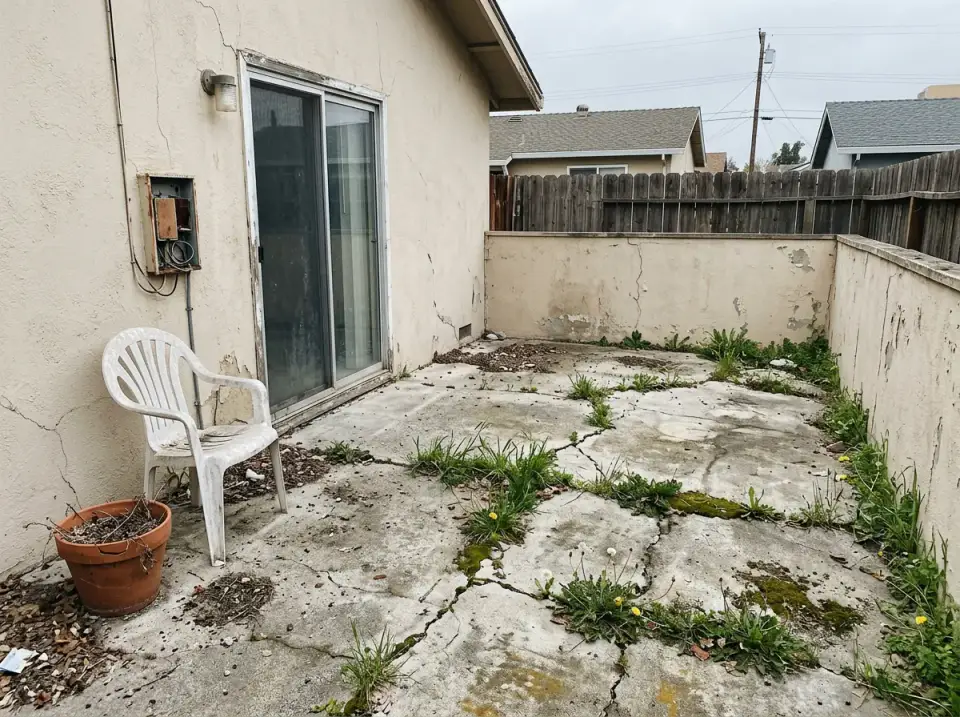
A 24-by-36-foot rectangle of compacted clay behind a Summerville rancher — split-rail fence falling inward, a concrete slab that had heaved in two places, and a drainage path that dumped straight into the property line at every summer storm. The owners wanted eleven directions rendered before they'd commit to one, and this is that study. Same ugly starting condition in every image; eleven finished directions with honest cost ranges, climate caveats, and which ones survive a Lowcountry summer without looking tired by year three. Use it as a planning document, not a brochure.
Contents
- 1. Romantic English Cottage Garden
- 2. Scandi-Inspired Minimalist Retreat
- 3. Ultra-Modern Luxury Lounge
- 4. The Productive Kitchen Garden
- 5. Contemporary Concrete & Fire Pit
- 6. Sun-Drenched Mediterranean Courtyard
- 7. Rustic Dining on Reclaimed Brick
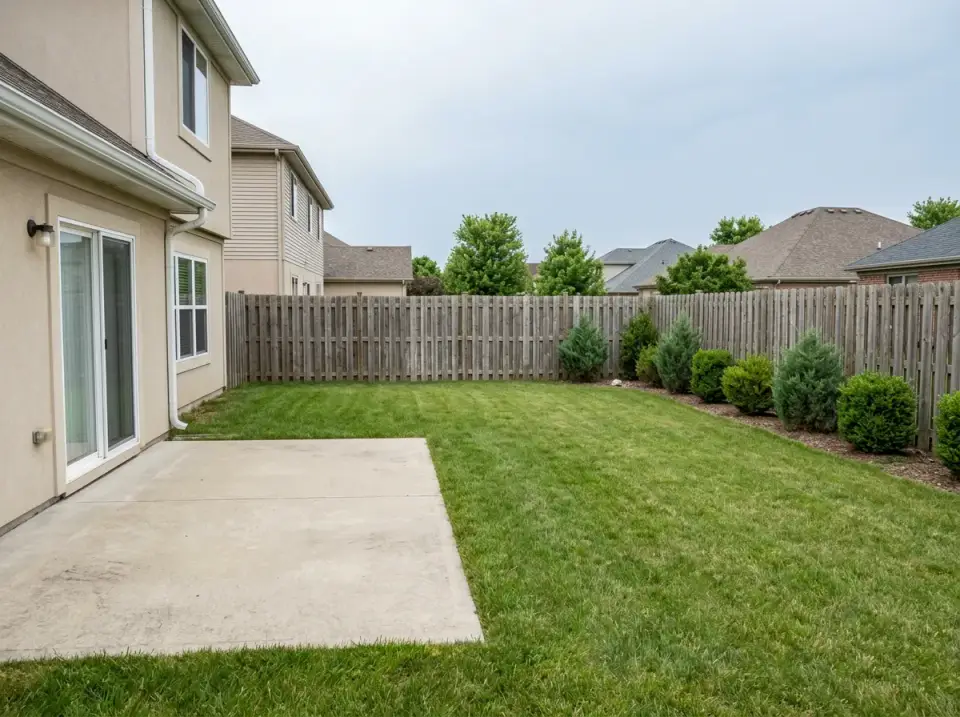
- 8. Zen-Inspired Minimalist Sanctuary
- 9. Classic Brick Patio & Vibrant Lawn
- 10. The Ultimate Outdoor Kitchen & Dining
- 11. Family-Friendly Fun Zone
- Pro Tips from the Field
- Frequently Asked Questions
- Sources & Further Reading
- Final Thoughts
1. Romantic English Cottage Garden
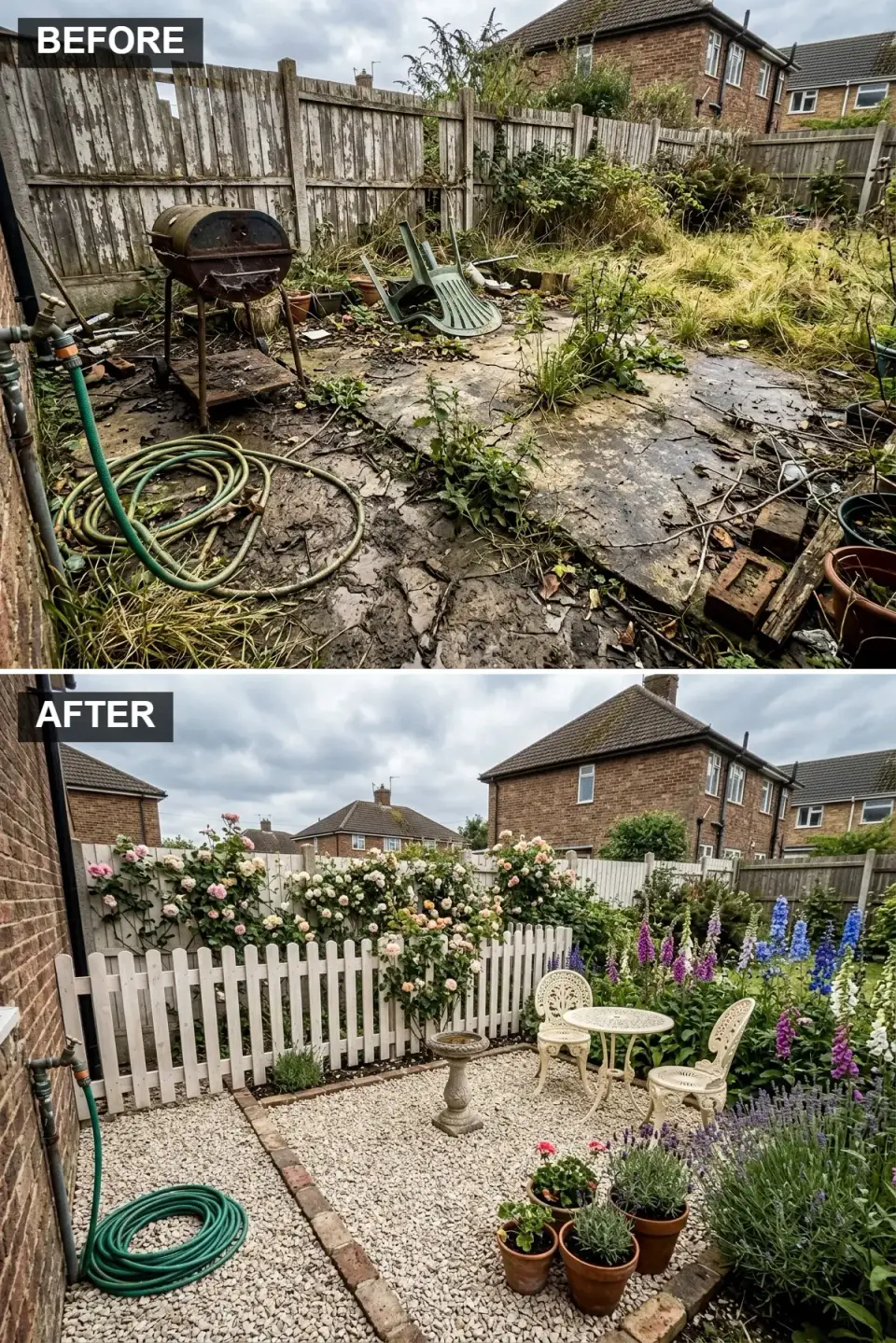
A white picket fence with climbing roses is one of the most requested directions I see from first-time Charleston-area homeowners — and it's achievable here, with caveats. Use a primed-and-painted cellular PVC picket, not solid wood, if the fence is getting less than half-day sun; Lowcountry humidity rots wood pickets at the ground contact line within seven to nine years no matter how well you seal them. For the roses, skip David Austin's English-bred cultivars (most struggle with our black spot pressure) and specify Southern-adapted climbers: 'New Dawn,' 'Zéphirine Drouhin,' or Kordes 'Summer Romance.' The gravel path wants a compacted crushed-granite base with polymeric-sand-free decomposed granite on top — bare pea gravel migrates into the lawn with every storm. A $450 cast-iron bistro set from a garden reseller beats a $180 powder-coated steel one over five years; the cast iron patinas, the powder coat chips and shows substrate rust.
Color Palette
& Furniture Base Benjamin Moore Chantilly Lace OC-65
#FFFFFF
A clean, slightly cool white that reads crisp against green planting without going blue.
Decomposed Granite
#E3DCCB
Compacted DG over crushed-granite base; permeable, low-cost, ages into a soft cream tone.
#9E9E9E
Real cast stone, not concrete lookalike. Develops lichen and moss within two Lowcountry seasons.
Classic Terracotta
#CC7A53
Italian Impruneta-style frostproof terracotta. Cheap imported terracotta cracks in our first hard freeze.
Styling Notes for This Look
- Specify cellular PVC pickets, not wood, unless the fence gets six-plus hours of direct sun — Lowcountry humidity rots wood at the ground line within a decade.
- Climbing roses: 'New Dawn,' 'Zéphirine Drouhin,' or Kordes 'Summer Romance.' Skip David Austin's English cultivars; they struggle with our black spot pressure.
- Cast-iron bistro furniture beats powder-coated steel on a 5-year horizon. Factor $80 of Rust-Oleum primer and repaint every third spring into the maintenance budget.
2. Scandi-Inspired Minimalist Retreat
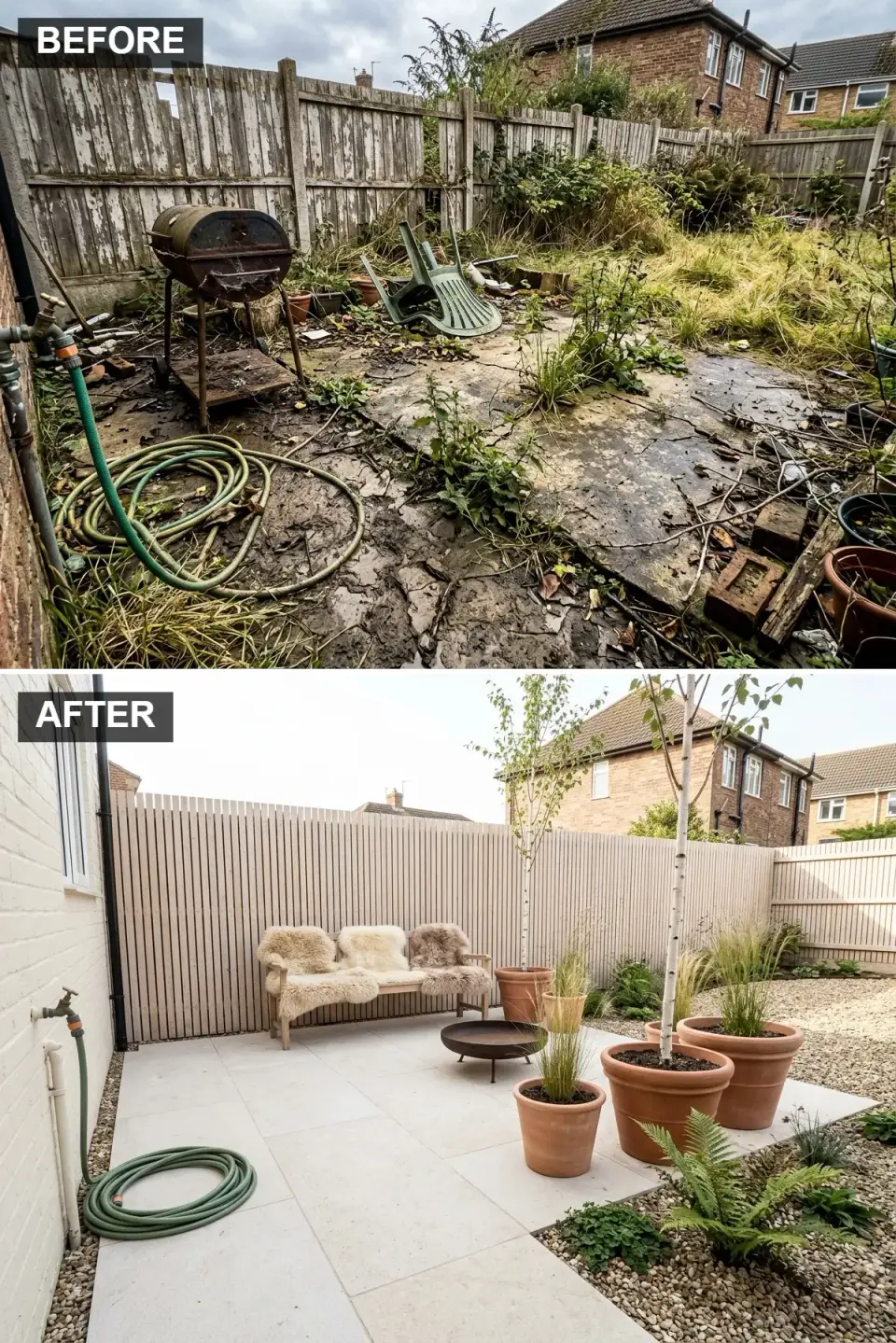
The vertical-slat pale timber fence is the signature move here, and the single detail most clients undershoot. Done right, it's ripped-to-width kiln-dried western red cedar (5/4-inch by 2-inch stock, dressed, clear-coated with a UV-inhibited marine-grade finish like Sikkens Cetol SRD), screwed to a concealed pressure-treated sleeper frame on galvanized standoffs with a half-inch ventilated gap at the bottom. Budget $85–$160 per linear foot installed. Large-format pale pavers want to be real stone or a through-body porcelain (so chipped edges don't read as a different color); 24x24 or larger, honed finish, on a screeded base, not laid on mortar. The birch trees are the climate caveat: classic Scandinavian white birches (Betula pendula) are not a Charleston tree — they sulk in our heat and die of bronze birch borer within 8-12 years. Substitute river birch (Betula nigra) for the same silhouette and real Lowcountry hardiness. Sheepskins are honest outdoor textiles for exactly one season; rotate through Sunbrella Renaissance fleece throws instead.
Color Palette
& Bench Western Red Cedar, Clear-Sealed
#D4C4A8
Kiln-dried cedar with Sikkens Cetol SRD. Refresh the finish every 18–24 months in full sun.
Silver Grey Porcelain or Stone
#C0C0C0
Through-body porcelain or honed bluestone, 24x24 minimum. Sealed concrete reads cheap in this composition.
Sunbrella Renaissance Fleece
#F5F5DC
Rotating outdoor textile, not real sheepskin. Cream reads Scandinavian; charcoal reads more current.
Matte Terracotta
#B37859
Low, wide Italian terracotta or matte-glazed ceramic. Avoid high-gloss — it fights the composition.
Styling Notes for This Look
- Swap classic white birch for river birch (Betula nigra). Same peeling-bark silhouette, Lowcountry-hardy, no bronze birch borer losses.
- Real sheepskins outdoors are a one-season romance. Sunbrella Renaissance fleece throws photograph identically and survive the UV cycle.
- A half-inch ventilated gap at the bottom of the slat fence keeps air moving and wood dry. Close that gap and rot starts there within five summers.
3. Ultra-Modern Luxury Lounge
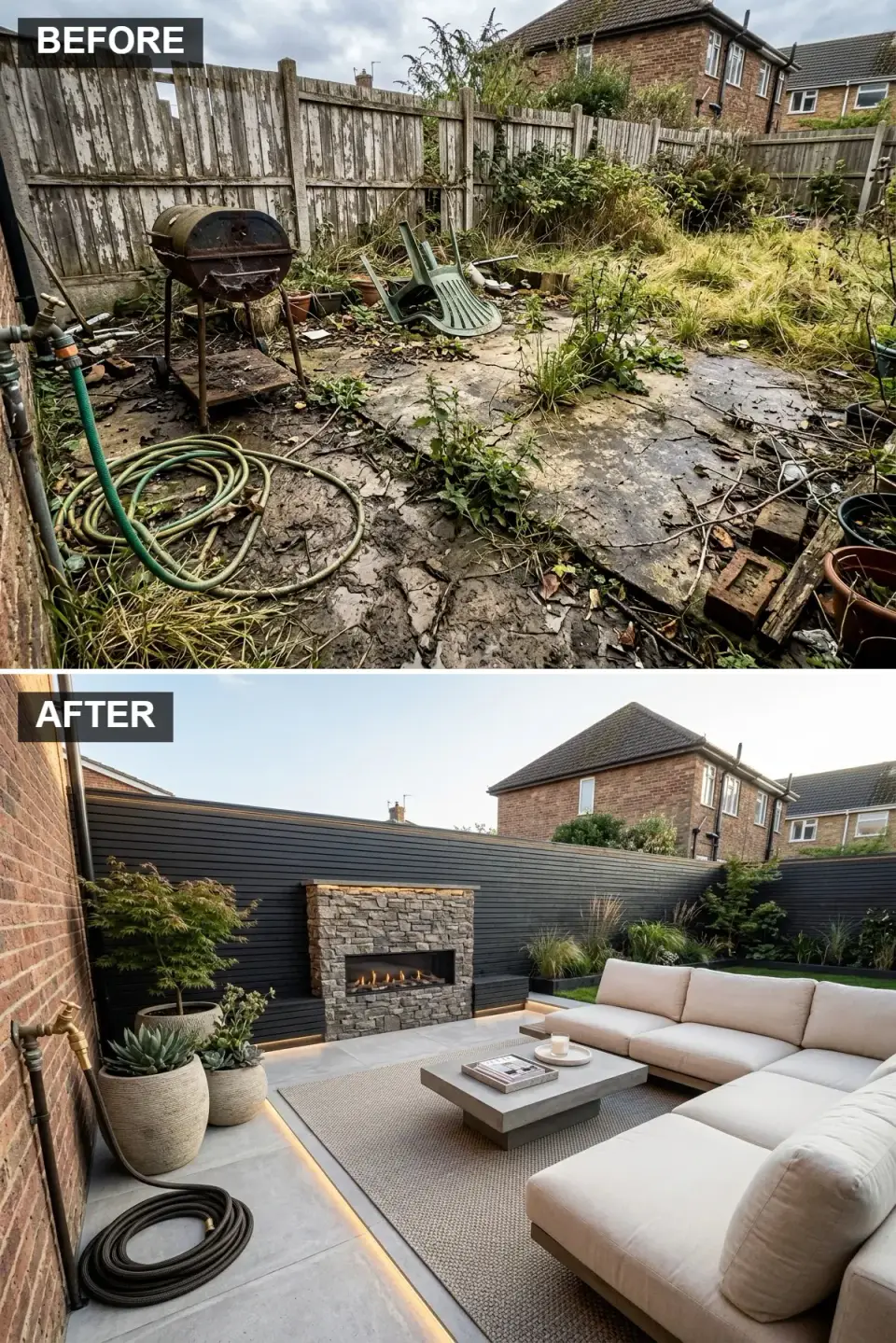
The outdoor linear gas fireplace is the single most-requested luxury feature in my Charleston and Mount Pleasant portfolio right now, and it's the line item where clients most commonly under-budget. A properly specified linear gas insert (Montigo, Napoleon, or DaVinci models rated for exterior installation), gas line run, non-combustible backing, and stacked-stone cladding comes to $14,000–$32,000 installed, not the $6,000 clients often carry in their heads. Add a real outdoor-rated TV — Séura Shade Series 2 or Sunbrite Veranda 3 — and another $3,500–$9,000 on top. The integrated LED strip lighting under coping and seating is the detail that makes or breaks the composition: specify warm-white (2700K) waterproof IP67 strips with a dedicated outdoor-rated transformer; cool-white (4000K+) strips read commercial. A 14-foot sectional sofa in performance-grade Sunbrella fabric runs $6,800–$14,000 before cushions. Total done-right scope lands $55,000–$110,000.
Color Palette
Charcoal Aluminum-Clad Slats
#2C2C2C
Powder-coated aluminum slats, not painted wood. Eliminates the 5-year repaint cycle.
Split-Face Grey Stacked Stone
#7F8285
Real stone veneer over a rated non-combustible backing. Budget $38–$65 per square foot installed.
& Floor Cool Concrete Grey
#999999
Matching concrete tones across sofa base, coffee table, and large-format pavers for a monolithic read.
2700K Warm LED Strip
#FFD580
Waterproof IP67 strip, warm white only. Cool-white strips read commercial and kill the luxury read.
Styling Notes for This Look
- Linear gas fireplace, permitted and installed correctly, is a $14,000–$32,000 line item — not the $6,000 most clients carry in their heads.
- Outdoor-rated TVs only (Séura, Sunbrite, Furrion). A regular TV in a "weatherproof" cabinet is a one-summer solution in our humidity.
- 2700K LED strips for the under-coping glow. Anything cooler reads parking-garage, not luxury lounge.
4. The Productive Kitchen Garden
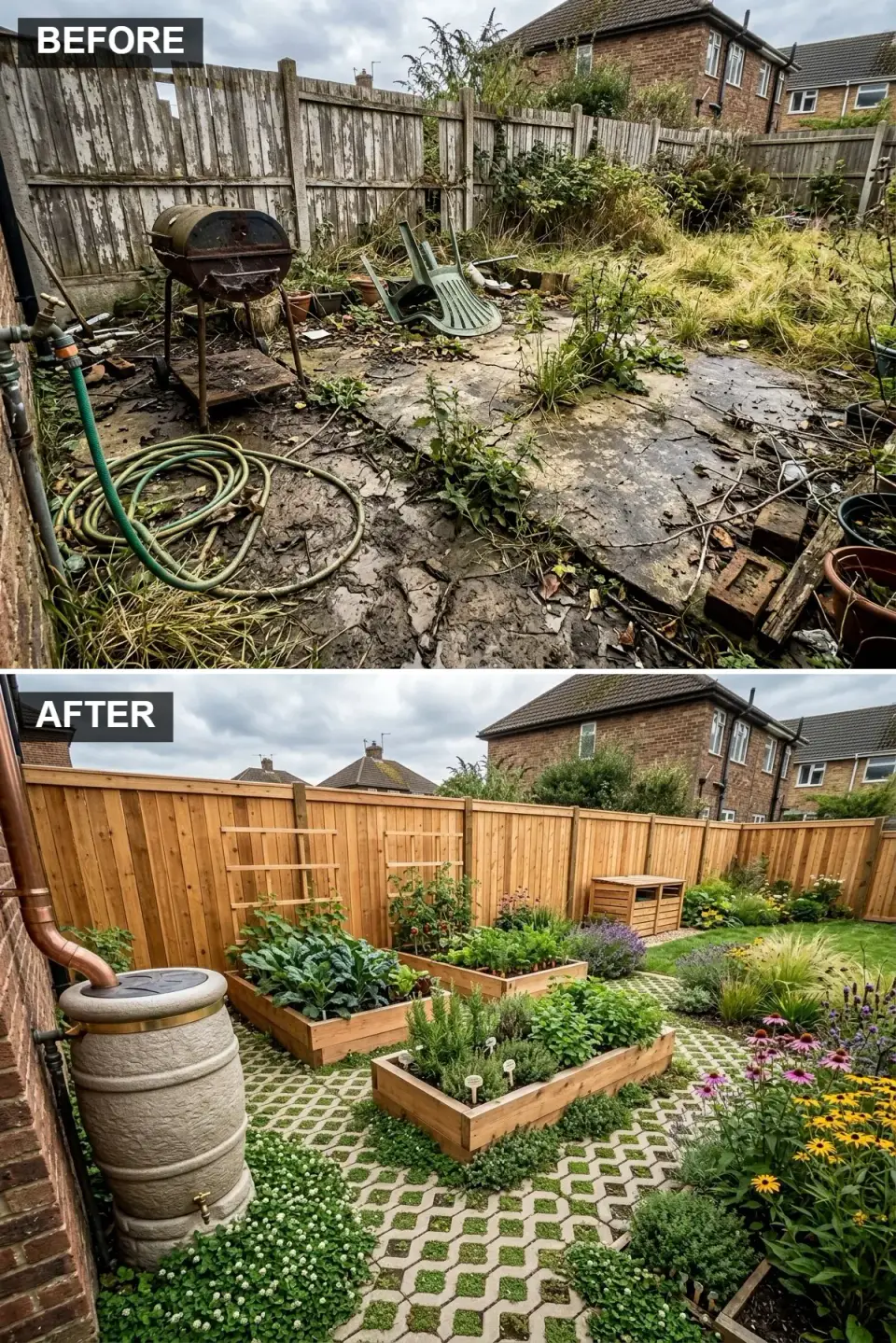
Of every direction in this study, the productive kitchen garden is the one I recommend most often to Lowcountry clients, and the one that holds up best across a decade. Raised beds are the critical choice: specify untreated white oak or cedar 2-inch stock for planting beds (pressure-treated CCA leaches into edible soil and is not appropriate for food crops), minimum 18-inch internal depth for tomatoes and root crops, and a galvanized hardware-cloth bottom to stop voles. Budget $380–$720 per bed built in place. The rain barrel is beautiful-looking and modestly useful — a 55-gallon barrel fills in one moderate Charleston summer storm and empties in about three days of garden watering; if irrigation is the real goal, a 500-gallon rain cistern plumbed to a drip system is the better investment at $2,800–$5,400. Permeable paving grids planted with Dichondra or creeping thyme work in dappled shade; in full Lowcountry sun they bake, and low-growing zoysia or buffalo grass survives better.
Color Palette
& Beds Natural Cedar, Unsealed
#A97C5B
Food-safe, left to silver naturally. Never pressure-treated on a vegetable bed — leaching into edible soil.
#BDB7AB
Decorative 55-gallon for look, or a real 500-gallon cistern plumbed to drip irrigation if yield is the goal.
Permeable Concrete Grid
#808080
Grasscrete-style grid planted with creeping thyme (shade) or zoysia (sun).
Aged Copper
#C87533
Real copper downspouts and gutter accents. Patinas to blue-green in roughly three Charleston winters.
Styling Notes for This Look
- Never build raised vegetable beds from pressure-treated wood. Specify food-safe cedar or white oak; plan to rebuild every 10–14 years.
- A 55-gallon rain barrel is a decorative object with a useful drain valve. If irrigation is the real goal, size to 500+ gallons and plumb it properly.
- Companion plant marigolds at tomato bed corners and basil between. Both deter common Lowcountry pests and are evidence-based (not just folklore).
5. Contemporary Concrete & Fire Pit
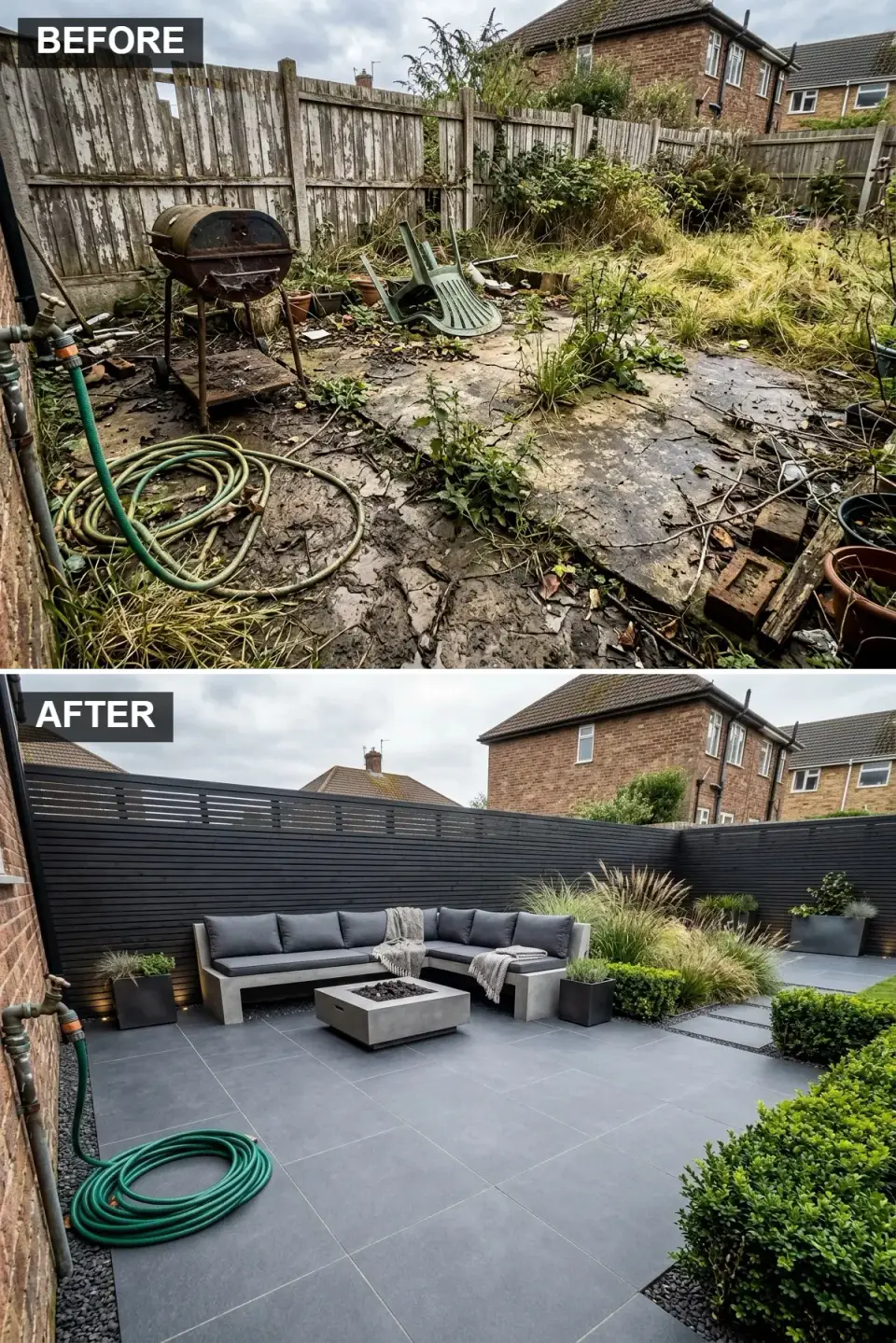
Built-in L-shaped concrete bench seating reads permanent and sculptural when done well, and reads like a misjudged renovation when done badly. The critical variable is layout: sit with the owner on folding chairs in the backyard for a full weekend, eating breakfast and hosting a dinner party, before you let a single form get poured. Concrete corner benches are a one-shot cast; they don't relocate. Build on a 6-inch compacted aggregate base with 4-inch reinforced slab, cast-in-place forms, and a food-safe penetrating sealer (Surecrete Evolution or similar). Budget $240–$420 per linear foot. Large-format 24x48 dark grey porcelain pavers over a drainage mat (not mortared) keeps the installation serviceable — a single cracked tile can be pulled and replaced in ten minutes, versus a day of jackhammering with mortar set. A square cast-concrete gas fire pit with a proper ring burner and lava rock runs $3,800–$8,500 professionally installed with permitting.
Color Palette
Matte Black Metal Slat
#1A1A1A
Powder-coated aluminum, not painted wood. Black paint in Charleston sun surface-temps to 150°F.
Dark Grey Through-Body Porcelain
#4A4A4A
24x48 large format on drainage pedestals. Chipped edges read as the same color, unlike glazed surfaces.
& Fire Pit Cast Concrete, Penetrating Seal
#787878
Surecrete Evolution or similar penetrating sealer. Surface-sealed concrete hazes and requires stripping.
Crypton Home Performance Charcoal
#363636
Solution-dyed acrylic or Crypton performance. Skip indoor fabric masquerading as outdoor.
Styling Notes for This Look
- Mock up the bench L-shape in plywood or cardboard for a full weekend before the pour. Cast concrete is a one-shot commitment.
- Specify powder-coated metal slat fencing, not painted wood. Black paint on wood in Charleston sun is a 5-year repaint cycle minimum.
- Through-body porcelain over pedestals stays serviceable. Mortared install is faster at build but much more expensive to repair later.
6. Sun-Drenched Mediterranean Courtyard
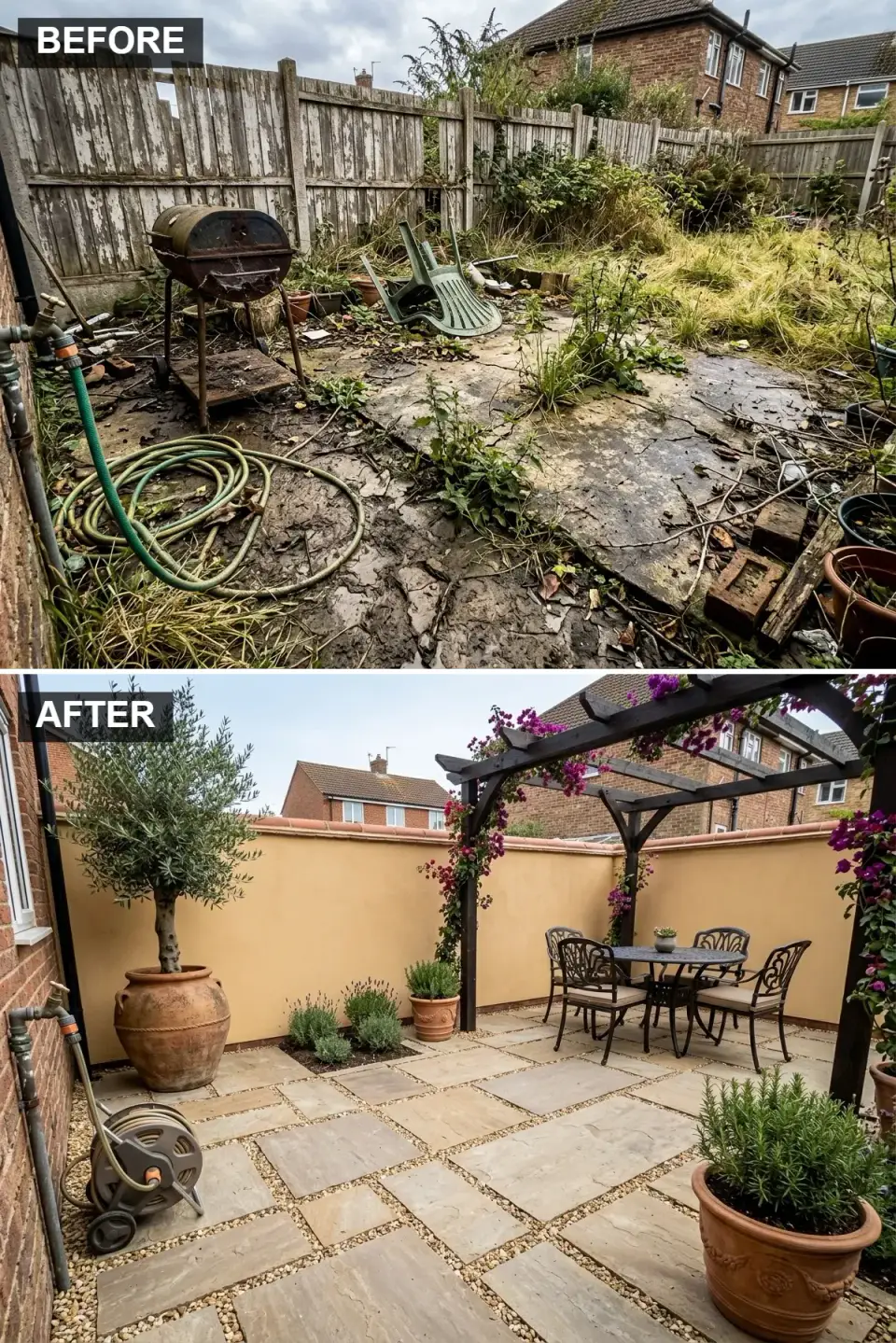
Mediterranean courtyards work in Charleston better than almost anywhere else in the country — our climate is zone 8b-9a, we get genuine summer heat, and the regional palette reads coherent rather than costume-y. The critical detail is the stucco itself: specify a real three-coat integral-color stucco per ASTM C926, not an EIFS (synthetic stucco) system. Lowcountry humidity and wind-driven rain find every weakness in EIFS; real stucco breathes and ages honestly over thirty years. Budget $14–$22 per square foot for real three-coat stucco versus $7–$12 for EIFS — pay the premium. Bougainvillea is hardy in a south-facing protected microclimate from Charleston south, with the caveat that it dies back in any winter hitting the low 20s and grows back from the root crown each spring. Olive trees in terracotta pots are correct for coastal Carolina (I have 'Arbequina' overwintering successfully on multiple client properties); specify real Italian Impruneta frostproof terracotta, not decorative domestic — cheap pots crack at the first hard freeze.
Color Palette
Real Integral-Color Stucco, Ochre
#D4A063
ASTM C926 three-coat system. Not EIFS — synthetic stucco fails in Lowcountry humidity within 15 years.
Dark-Stained Cedar
#3B2F2F
Western red cedar with Sikkens Cetol SRD in Ebony or similar. Refresh every 24–36 months.
Honed Sandstone
#CDBFA3
Real sandstone with natural cleft or honed finish. Porcelain lookalikes read flat at this scale.
Italian Impruneta Terracotta
#A0522D
Real Italian frostproof terracotta ($320–$900 per pot). Domestic knockoffs crack in the first hard winter.
Styling Notes for This Look
- Real three-coat stucco per ASTM C926, not EIFS. The $6–$10 per sq ft premium pays back in the first 15 years of Lowcountry weather.
- 'Arbequina' olive trees overwinter in coastal Carolina. Keep them in rolling planters so they can be moved against the house during the two or three hard-freeze nights per winter.
- Italian Impruneta frostproof terracotta is expensive and correct. Decorative domestic terracotta is cheap and fails at the first Charleston freeze event.
7. Rustic Dining on Reclaimed Brick
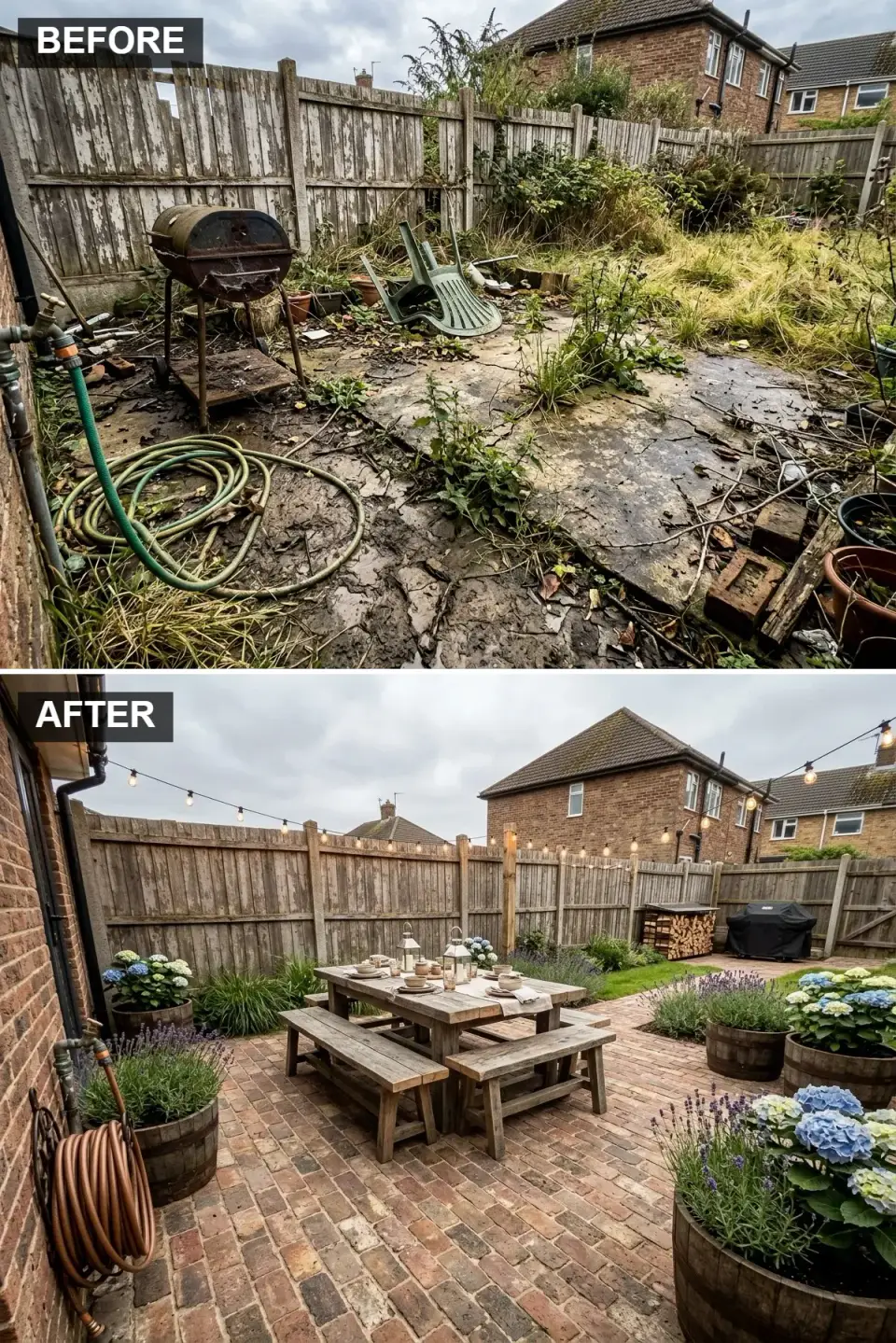
Reclaimed brick is a regional default in the Charleston, Savannah, and Beaufort historic districts for good reason — the brick was fired locally for two centuries, the color range is genuinely antique, and the permits approve for historic-district applications that new brick won't. Budget real reclaimed Charleston or Savannah brick at $3.80–$7.50 per brick sourced, plus install at $22–$38 per square foot for a herringbone pattern (herringbone costs more than running bond because of cut waste). A chunky solid-wood picnic table wants to be a proper 2-inch white oak or reclaimed pine top, not pine 4x4 construction-lumber-grade; budget $2,400–$6,500 for a table that outlasts a decade of Charleston summers. Bistro string lights are the detail that makes the space; specify commercial-grade LED bulbs (Enbrighten Classic or equivalent) with S14 or larger bulb size on weatherproof black cable. Cheap consumer-grade string lights are a one-season solution. Whiskey-barrel planters are charming and rot from the inside out; line them with pond liner and drill generous drainage before planting.
Color Palette
Real Reclaimed Charleston Brick
#8C533E
Multi-tonal antique brick, not dyed new brick. $3.80–$7.50 sourced; herringbone install at $22–$38 per sq ft.
& Benches Weathered White Oak
#7F6A55
2-inch solid white oak or reclaimed longleaf pine. Construction-grade pine is a 3-year solution.
Aged Oak Whiskey Barrel
#5C4033
Line with pond liner, drill 1-inch drainage holes. Bare whiskey barrels rot from the inside within 4 seasons.
Commercial-Grade LED on Black Cable
#000000
Enbrighten Classic or equivalent S14 LED bulbs. Consumer-grade fails in the first wet season.
Styling Notes for This Look
- Real reclaimed Charleston or Savannah brick over new brick. Historic districts often require it, and the tonal variation can't be faked.
- Commercial-grade string lights with real-weight cable and replaceable bulbs. Consumer-grade string lights are a single-season purchase.
- Whiskey-barrel planters need pond-liner lining and drilled drainage. Unlined, they rot from the inside out within four Lowcountry summers.
8. Zen-Inspired Minimalist Sanctuary
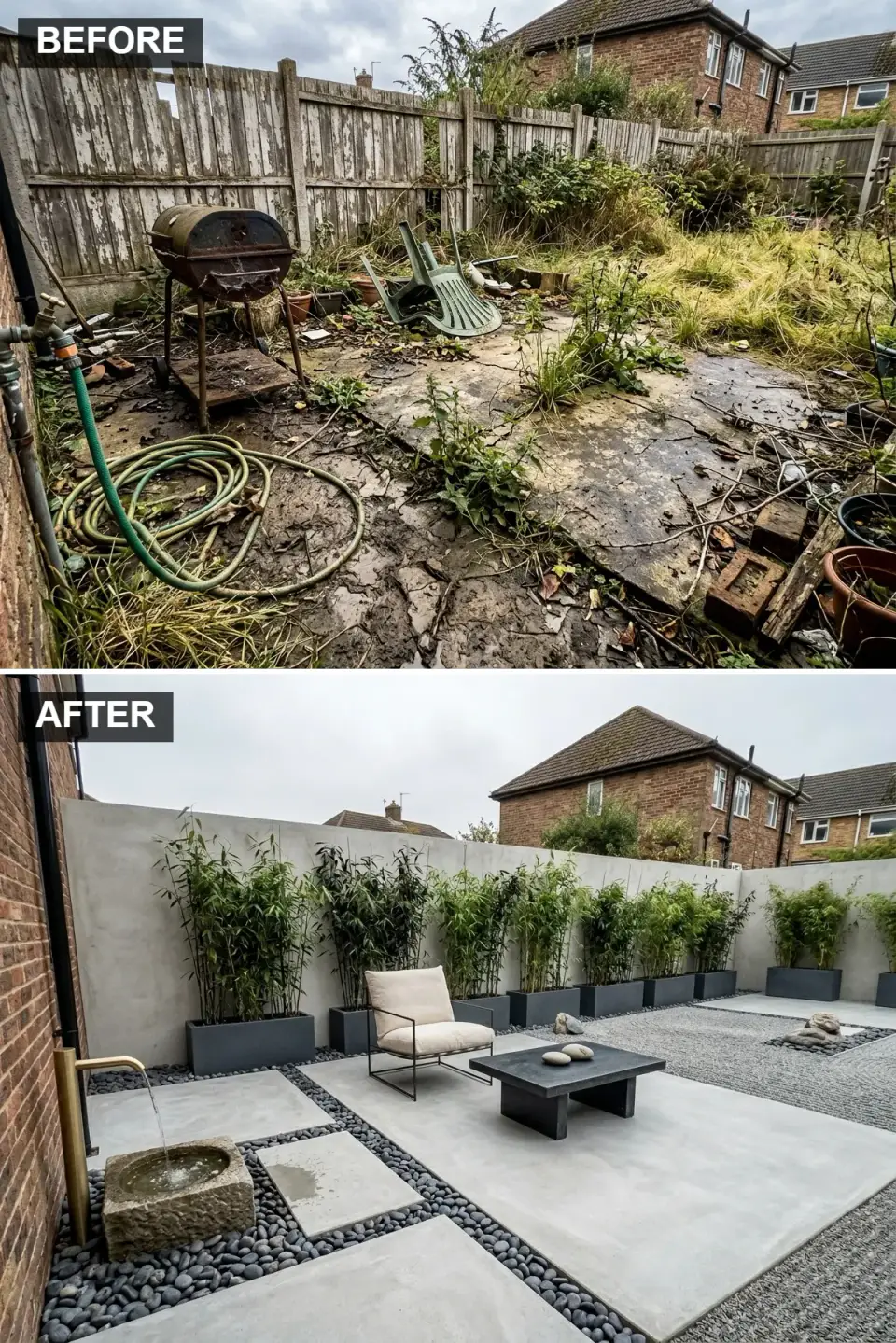
The zen minimalist direction looks deceptively simple and is one of the harder compositions to execute correctly — the fewer elements in a composition, the more every element has to be right. Smooth concrete perimeter walls want a proper steel-troweled finish, not a bag-mix rendered wall; the difference is labor cost (add $18–$28 per square foot for the true troweled finish) and it's the difference between serene and unfinished. The stone water basin is the focal point and the detail that tends to get value-engineered: a real carved granite basin from a stone yard runs $1,800–$4,800; a resin-cast lookalike is $380 and reads that way from six feet. The brushed-brass spout patinas well outdoors if it's real brass (unlacquered) rather than brass-coated steel. The climate caveat for the bamboo: specify clumping bamboo (Bambusa multiplex 'Alphonse Karr' or Fargesia robusta) — never running bamboo, which invades the neighbor's yard within three seasons and costs thousands to eradicate. Raked gravel is a genuine weekly maintenance commitment; if the client isn't going to rake it, substitute a low ornamental grass that reads similar.
Color Palette
& Pavers Steel-Troweled Concrete
#BDBDBD
Real steel-troweled finish on stucco-rendered walls. Bag-mix render reads unfinished at this level of minimalism.
#424242
Polished black Mexican beach pebble, 1.5–3 inch. Cheap gravel reads generic in this composition.
#B5A642
Real solid brass, no lacquer. Patinas honestly outdoors. Brass-plated steel fails at the first winter.
Matte Dark Grey Composite
#333333
Sleek matte composite (not gloss ceramic). Avoid anything ornamental that fights the minimalism.
Styling Notes for This Look
- Clumping bamboo only (Bambusa multiplex, Fargesia). Running bamboo invades the neighbor's yard within three years and costs $3,000–$8,000 to eradicate.
- Raked gravel is a weekly maintenance commitment. If the client won't do it, substitute low ornamental grasses (Mondo, Liriope) for the same read.
- Real carved granite basin over resin-cast lookalike. At this minimalism level, every element gets read close-up.
9. Classic Brick Patio & Vibrant Lawn
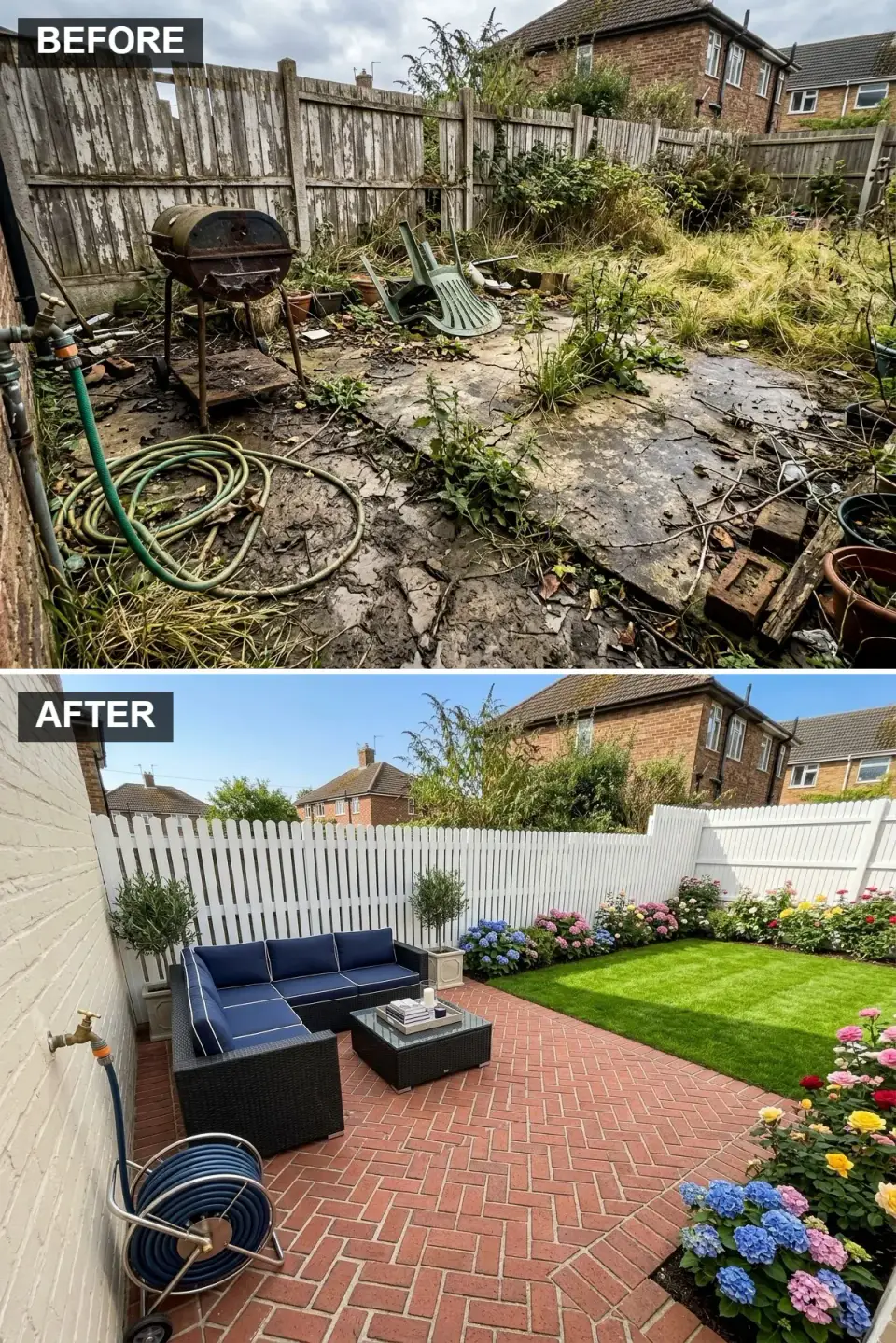
The classic brick patio with manicured lawn is the direction that sells homes in Mount Pleasant, West Ashley, Kiawah, and most of the Charleston metro secondary markets. Appraiser data is consistent here: a well-executed classic backyard pulls 72–82% ROI at resale in these submarkets. The three details that separate a well-executed version from a generic one: brick pattern (herringbone over running bond reads custom for $8–$14 per sq ft more), edge detail (a soldier course or bull-nose edge around the patio perimeter is a $12–$20 per linear foot upgrade that reads unmistakably intentional), and the lawn species (St. Augustine 'Palmetto' for shade tolerance, zoysia 'Zeon' for sun — both beat common bermuda for Charleston residential lots). Hydrangeas are the regional flowering shrub by default and they work; specify 'Endless Summer,' 'Penny Mac,' or 'Nikko Blue' for reliable Lowcountry performance. Deep-navy upholstery on rattan is the smart move because it hides pollen and oak-catkin debris between cleanings.
Color Palette
Benjamin Moore White Dove OC-17
#FFFFFF
Slightly warm white that reads right against Charleston sun. Chantilly Lace reads too cool here.
Traditional Red Brick, Herringbone
#9C3224
Herringbone pattern with a soldier-course edge. The edge detail is the difference between custom and generic.
HDPE Resin Wicker, Charcoal
#333333
HDPE resin "rattan" holds color and doesn't degrade. Real natural rattan outdoors is a 2-year commitment.
Sunbrella Canvas Navy
#000080
Deep navy hides oak-catkin debris and pollen between cleanings. Lighter colors show every Charleston spring.
Styling Notes for This Look
- St. Augustine 'Palmetto' for shade-dominant lawns, zoysia 'Zeon' for sun-dominant. Both outperform common bermuda in Charleston residential settings.
- A soldier-course edge on the brick patio is the $12–$20 per linear foot upgrade that reads custom, not subdivision.
- HDPE resin wicker, not natural rattan, for outdoor durability. Natural rattan outdoors in Charleston is a 2-year commitment at most.
10. The Ultimate Outdoor Kitchen & Dining
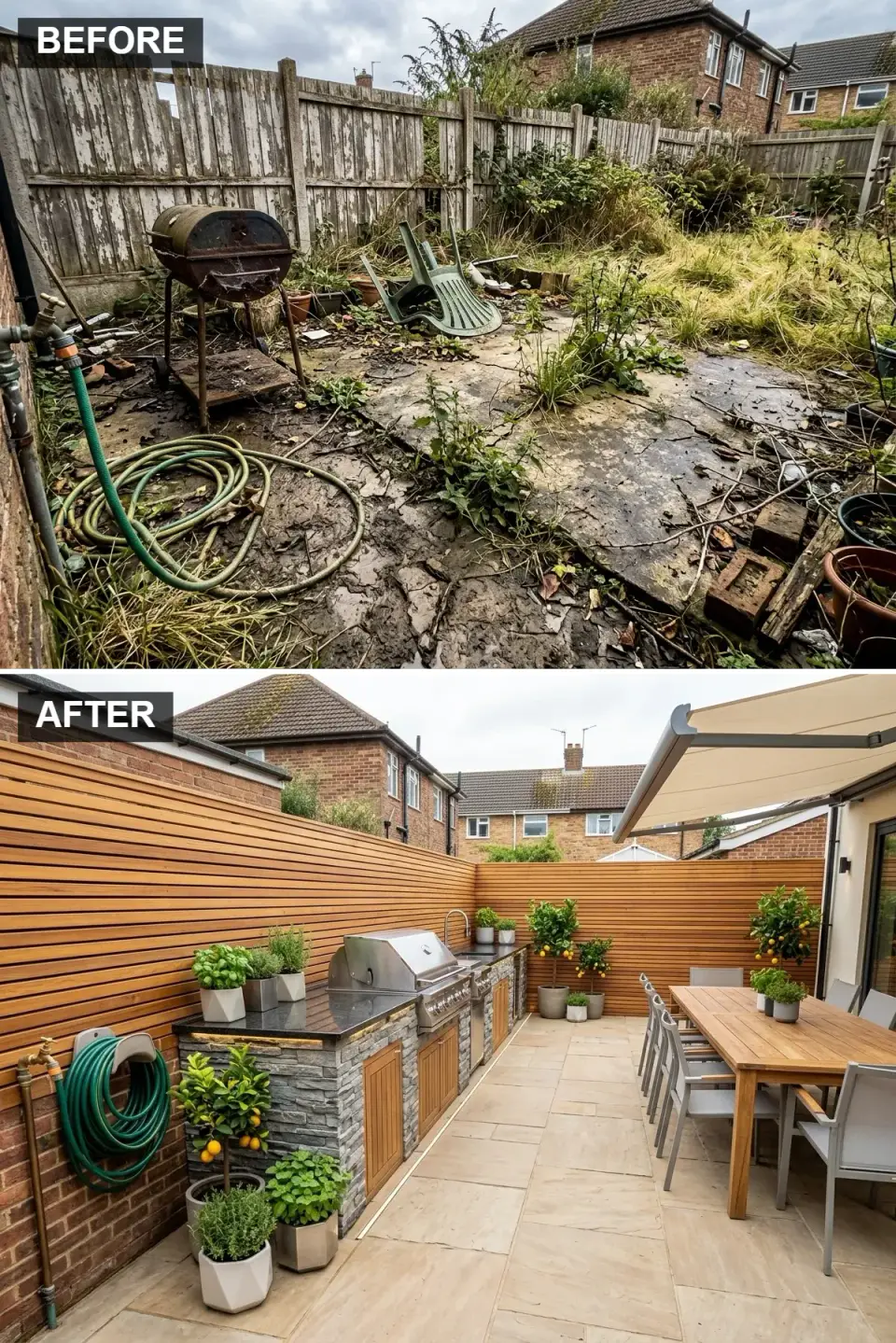
A fully built outdoor kitchen is the most expensive single direction on this list and also the one clients most often regret on budget but never regret on function — once it's there, it gets used. The realistic range for a done-right build in the Charleston area is $38,000–$115,000+, depending on appliance tier and stone finish. Core line items: 36-inch or 42-inch stainless grill ($2,400–$18,000 — the Hestan, Kalamazoo, and Lynx top-tier units are the ones my clients genuinely keep using after year three), outdoor-rated refrigerator ($1,800–$5,500), proper gas line run with shutoff and permit ($1,800–$4,500), full stone-veneer base with proper insulation jacket around the grill ($8,500–$22,000), polished granite counter ($65–$140 per sq ft installed), teak dining table that seats eight ($4,800–$12,000). The retractable awning is the detail that extends usable hours from 4 months to 9 — specify a motorized Sunbrella fabric awning from Sunsetter or ShadeTree at $3,800–$9,500 installed. Per the 2024 Cost vs. Value data, outdoor kitchens in the South Atlantic return roughly 64–71% of cost at resale.
Color Palette
& Table Weathered Teak
#B87333
Real teak from certified FSC source. Allow it to silver, or oil twice a year to hold the warm tone.
Base Grey Stone Veneer
#7A7A7A
Real stone veneer over a properly insulated grill jacket. Cheap thin-set lookalikes crack at the heat zone.
Polished Black Granite
#1C1C1C
Absolute Black or Black Galaxy granite. Outperforms quartz outdoors — quartz yellows in UV.
Sunbrella Canvas Beige
#EEDCBA
Motorized retractable Sunbrella. Expands usable hours from ~4 months to 9 in the Charleston climate.
Styling Notes for This Look
- Outdoor kitchens look best when spec'd once. Cheap grills, cheap fridges, and thin-set veneer all fail within 5 years. Budget for tier-two appliance brands (Lynx, Hestan, Kalamazoo) from day one.
- Polished granite outperforms outdoor quartz. UV exposure yellows most engineered quartz surfaces within 4–7 years.
- A motorized retractable Sunbrella awning is the single highest-ROI add for usable-hours. It extends the outdoor season by roughly five months in Charleston.
11. Family-Friendly Fun Zone
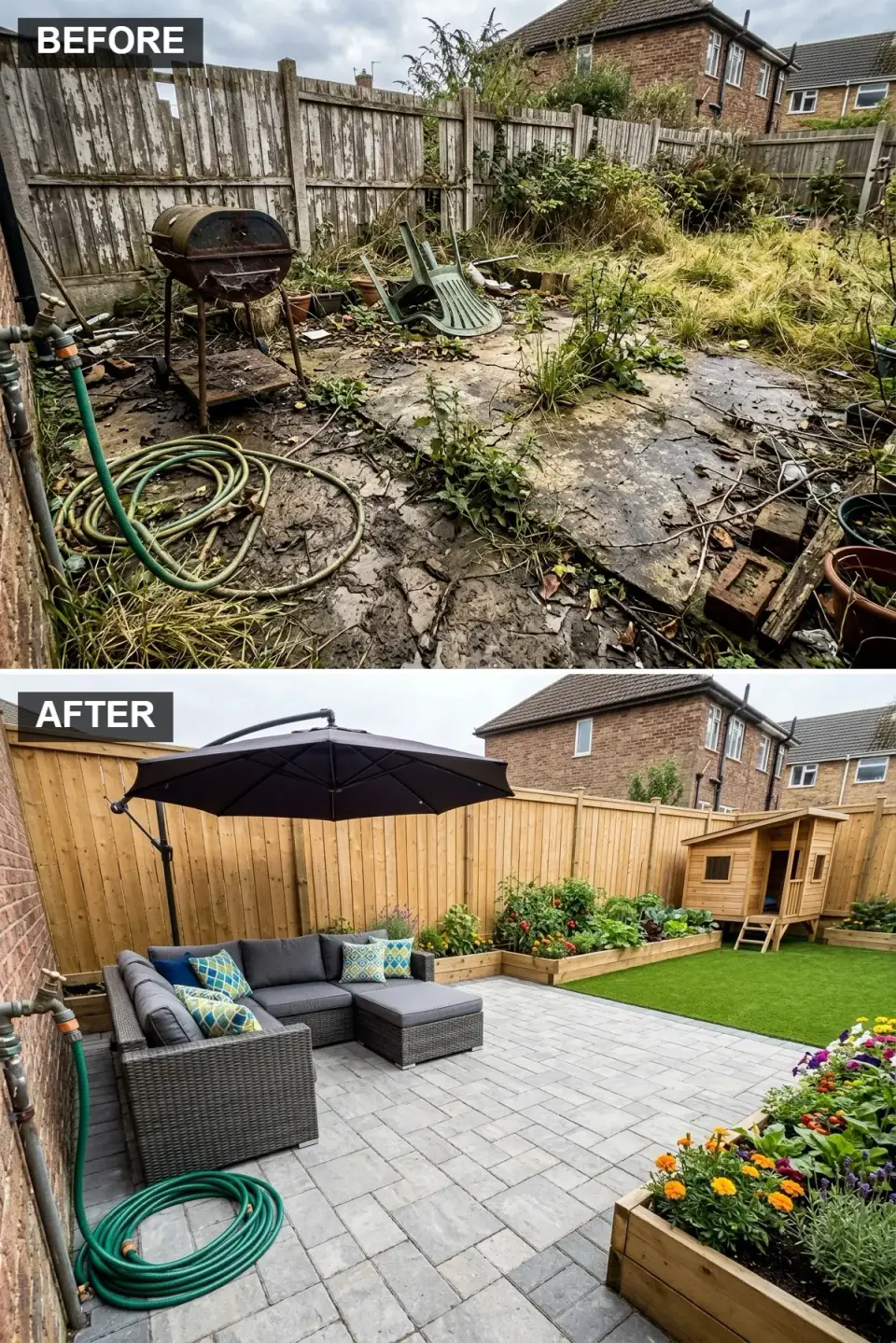
The family-zone direction is the one I've done most often for Charleston and Mount Pleasant families with school-age kids, and the one where the honest cost-benefit sits very differently than the other ten. Artificial turf is the contentious choice: high-quality polypropylene/polyethylene blend turf (SYNLawn Pet Platinum or ForeverLawn K9 Grass) costs $14–$22 per square foot installed and legitimately outlasts natural sod maintenance for families who want mud-free play year-round. The caveats: it runs 10–20°F hotter than natural grass under Charleston summer sun, it doesn't cool the microclimate the way a lawn does, and high-quality polypropylene has a real visual life of 10–14 years before infill compacts and the blades fade. A real wooden playhouse from Cedar Summit, KidKraft, or a local builder runs $2,400–$8,500 installed; skip inflatable or plastic. Raised sleeper beds pull double duty here — they teach kids where food comes from and they keep pets out. Cantilever parasols are the flexible-shade answer; specify a real teak or aluminum pole with a stainless base weighted to 180 pounds minimum to survive Category 1 wind.
Color Palette
#DEB887
Untreated cedar or heat-treated pine for the playhouse. Cedar for food-bed edges (avoid pressure-treated near edible soil).
Light Grey Concrete Pavers
#B0B0B0
Belgard or Techo-Bloc architectural pavers. Durable, cooler than dark tones, easy to replace a single damaged paver.
HDPE Resin Wicker, Grey
#666666
HDPE resin reads modern and handles kid traffic. Real rattan doesn't survive the duty cycle.
Charcoal Sunbrella Canopy
#222222
Cantilever pole with 180-lb stainless base. Category 1 wind moves anything lighter — ask anyone who's rebuilt a pergola after Hurricane Ian.
Styling Notes for This Look
- High-grade polypropylene turf (SYNLawn Pet Platinum, ForeverLawn K9 Grass) is legitimately long-lasting. Cheap turf looks generic at install and worse at year three.
- Artificial turf reads 10–20°F hotter than natural grass under Charleston summer sun. Plan shade accordingly if kids play on it barefoot.
- Weight cantilever parasol bases to 180 lb minimum. Category 1 winds move anything lighter — every Lowcountry hurricane proves this at scale.
Pro Tips from the Field
- Fix drainage before you design anything visible. The single biggest reason Lowcountry backyard renovations fail in their second year is unresolved water. Walk the yard in a moderate summer storm and see where water actually goes. A $2,800 French drain or dry well at the design stage beats a $14,000 retrofit that demolishes the new patio.
- Zone the yard like an interior floor plan. A 700 sq ft yard with one seating zone reads as a patio. The same 700 sq ft with three zones (lounge, dining, garden) reads as an outdoor house. Use flooring changes, level changes, and planted dividers to do the zoning work without building walls.
- Lighting is the highest-ROI line item in any backyard budget. Budget 12–15% of total project cost for warm-white (2700K) layered lighting: pathway lights, up-lights on signature plants, string lights overhead, task lighting at any cooking surface. Day-to-night photography tells the resale story, and this is the line item that sells the evening use.
- Specify climate-appropriate plants, not rendering-appropriate plants. Of the eleven directions above, three include plant lists that are borderline or fail in zone 8b (classic white birch, snake plant outdoors, Davidii bougainvillea in unprotected spots). Cross-check every plant against the USDA 2023 Hardiness Zone Map before ordering.
- Hurricane-anchor every freestanding element. Cantilever parasols, freestanding pergolas, planters over 18 inches, fire pits, outdoor kitchens. Category 1 winds move anything that isn't physically secured. Ground-anchor kits are $40–$180 per element — cheaper than one replacement.
- Plan irrigation before the first plant goes in. Drip irrigation installed at original build is $1,800–$5,000 for a typical Charleston residential lot. Retrofit after plantings are established runs 2.5x because of access constraints. The cheapest moment is before any plant touches the soil.
- Keep one element from the original yard if you can. A mature live oak, a well-sited hydrangea, a usable concrete pad. Preserving one existing element gives the renovation a relationship to the lot that a full teardown never has — and it typically saves $4,000–$12,000 off the total scope.
Frequently Asked Questions
How much does a complete backyard transformation actually cost in Charleston and the Lowcountry?
The range is wide by direction. Budget-conscious directions with existing bones (Direction 1 Cottage Garden, Direction 4 Kitchen Garden, Direction 7 Reclaimed Brick) land $9,000–$28,000. Mid-budget hardscape renovations with new paving, fencing, and planting (Directions 2, 6, 9) run $32,000–$75,000. Full-build directions with outdoor kitchens, custom concrete, or linear fireplaces (Directions 3, 5, 10) run $55,000–$180,000+ depending on appliance tier and stone finish. Always collect three written bids from licensed, insured landscape contractors before committing.
Which of these directions holds up best in the Charleston / coastal Carolina climate?
Direction 4 (Kitchen Garden), Direction 6 (Mediterranean Courtyard), Direction 7 (Reclaimed Brick), Direction 9 (Classic Brick Patio), and Direction 10 (Outdoor Kitchen) are the five I recommend most confidently for Lowcountry conditions. Directions 2 (Scandi) and 8 (Zen) work beautifully with appropriate plant substitutions (river birch for white birch, clumping bamboo for running). Direction 11 (Family Zone) is honest for its brief but carries real caveats around synthetic turf heat and maintenance life.
Can these transformations be staged across multiple seasons, or does it have to be one continuous build?
Most can be staged, with one order-of-operations caveat: drainage and any structural elements (concrete benches, pergola footings, outdoor kitchen gas lines, pool lines) must come first. Recommended staging order: drainage → hardscape → fencing → built-ins → planting → furniture → lighting. Clients who stage across two or three seasons typically save 15–25% versus all-at-once execution because they can self-project-manage labor between phases.
How long does a full backyard transformation take in the Charleston area?
Smaller directions (Cottage Garden, Kitchen Garden, Reclaimed Brick Dining) run 3–6 weeks of construction. Mid-scope hardscape projects (Scandi, Mediterranean, Classic Brick) run 7–14 weeks including Charleston-County permitting. Full-build projects with outdoor kitchens or linear fireplaces run 14–24 weeks. Always add 4–6 weeks to any contractor's first quote for local permitting, HOA approval windows, and weather-related delays (Charleston's summer afternoon storm pattern reliably extends exterior timelines).
Do I need a landscape architect, or is a good landscape contractor enough?
For paint-and-plant directions (1, 4, 7, 9), a licensed contractor plus a stylist consultation is typically enough. For directions with structural elements (3, 5, 8, 10) — built-in benches, outdoor kitchens, linear fireplaces, water features, significant drainage work — bring in a licensed landscape architect or, at minimum, a civil engineer for the drainage plan. Licensed landscape architect fees on residential work in Charleston run $4,500–$14,000 and are typically the best-spent dollars in the project.
How do I handle Lowcountry summer humidity and salt-air exposure in material selection?
Specify marine-grade 316 stainless for outdoor kitchen appliances within three miles of the coast, mildew-resistant stucco additives on any rendered wall, pressure-treated or heat-treated lumber for ground-contact framing (never untreated for structural below-grade), HDPE resin or powder-coated aluminum furniture (not painted steel or natural rattan), and breathable penetrating sealers on concrete. The regional material adjustment over inland-standard residential spec is roughly 12–20% premium and typically pays back within five to seven years through lower replacement rate.
How much does a backyard transformation add to home value in Charleston-area markets?
Per the 2024 Remodeling Magazine Cost vs. Value Report (South Atlantic region) and NAHB data, well-executed backyard projects in Charleston, Mount Pleasant, Kiawah, Daniel Island, and similar Lowcountry submarkets return roughly 64–78% of project cost at resale. Outdoor kitchens land in the 64–71% range; classic patio with lawn lands 72–82%; fire features return slightly less at 58–65%. The more important economic argument is usually daily-use value over the 8–15 years most clients stay in the home — that number typically exceeds the eventual resale premium.
Which direction should I choose if my yard has drainage problems?
Solve drainage first, regardless of direction. That said, Directions 4 (Kitchen Garden with raised beds), 8 (Zen with gravel rills, which can double as drainage courses), and 11 (Family Zone with permeable-grade pavers) accommodate imperfect drainage better than Directions 5 (Contemporary Concrete, which requires pristine subgrade) or 10 (Outdoor Kitchen, which has expensive equipment you don't want sitting in standing water). But the right answer is always to get the drainage right before any of these decisions.
Sources & Further Reading
- Remodeling Magazine, 2024 Cost vs. Value Report — South Atlantic regional figures for outdoor kitchen, deck, hardscape, and landscape ROI.
- USDA Plant Hardiness Zone Map (2023 update) — zone 8b / 9a boundary data governing Charleston-area plant selection.
- NAHB Economics, What Home Buyers Really Want, 2024 Edition — survey data on outdoor-living features and Southeast buyer priorities.
- Clemson Cooperative Extension, South Carolina Home Landscape Plant Guide — climate-appropriate shrub, tree, and perennial selections for coastal and inland Carolina.
- International Residential Code (IRC) 2021 — Sections R324 (coastal wind anchoring), R701 (exterior wood framing), and G2422 (outdoor gas appliances) for hurricane-zone and gas-feature compliance.
- ASTM C926 / C1063 — three-coat stucco and lath specifications for exterior stucco walls in humid climates.
- Western Red Cedar Lumber Association — species specifications for fencing, decking, and rainscreen cladding in Southeastern humidity.
- FSC certification data — teak sourcing standards for exterior furniture.
- Sunbrella and Crypton technical fabric data sheets — UV-stability and mildew-resistance specifications for outdoor upholstery.
- ASHRAE Handbook — HVAC Applications, residential outdoor systems chapter, for outdoor kitchen ventilation guidance.
- Author's consulting notes on Charleston, Mount Pleasant, Kiawah, Daniel Island, and Summerville backyard projects, 2019–2026.
Final Thoughts
Eleven directions for one neglected yard is intentionally more than any one homeowner will seriously consider — and that's the point of the exercise. The rendering study forces an honest conversation about what you're actually going to do outside: cook for guests? garden with kids? read quietly with a cup of coffee? host dinner in September? Once that question lands, most of the eleven directions fall away as obvious non-starters, and the real decision narrows to two or three. For the Summerville couple whose yard was the starting condition for this study, the final choice was a hybrid of Directions 7 and 9 — the reclaimed-brick herringbone patio paired with classic hydrangea borders and a white picket perimeter — with a proper French drain and rain cistern installed before the first brick was laid. They decided against the outdoor kitchen (cooking happens inside, that wasn't changing), against the Mediterranean courtyard (the house didn't support it architecturally), and against the zen sanctuary (nobody in the household was going to rake gravel weekly). The hybrid is what survived the decision process.
Three companion pieces are worth reading alongside this one. My thirteen-direction backyard study on a different starting condition runs the same rendering exercise on a Mount Pleasant ranch. The twelve-direction ultimate backyard makeover guide works through the planning sequence more rigorously and is the right read if you're still at the decision-framing stage. For a finished and lived-in version of a patio-focused direction, our Charleston patio transformation from backyard black hole to luminous living is the useful reference. And if the urban-small-lot variant is closer to your situation, the urban garden transformation piece walks through the same decision logic on a genuinely tight site.
— Johan Martez, Charleston, SC

Elise Marchetti
Transformations Editor · Charleston, South CarolinaBefore-and-after projects with the invoices attached. Elise runs the Transformations desk — interiors, exterior facades and outdoor spaces across the Lowcountry and the wider South — and writes up what actually changed, what it cost, and which three decisions moved the room.
More from Elise →
Reader notes