


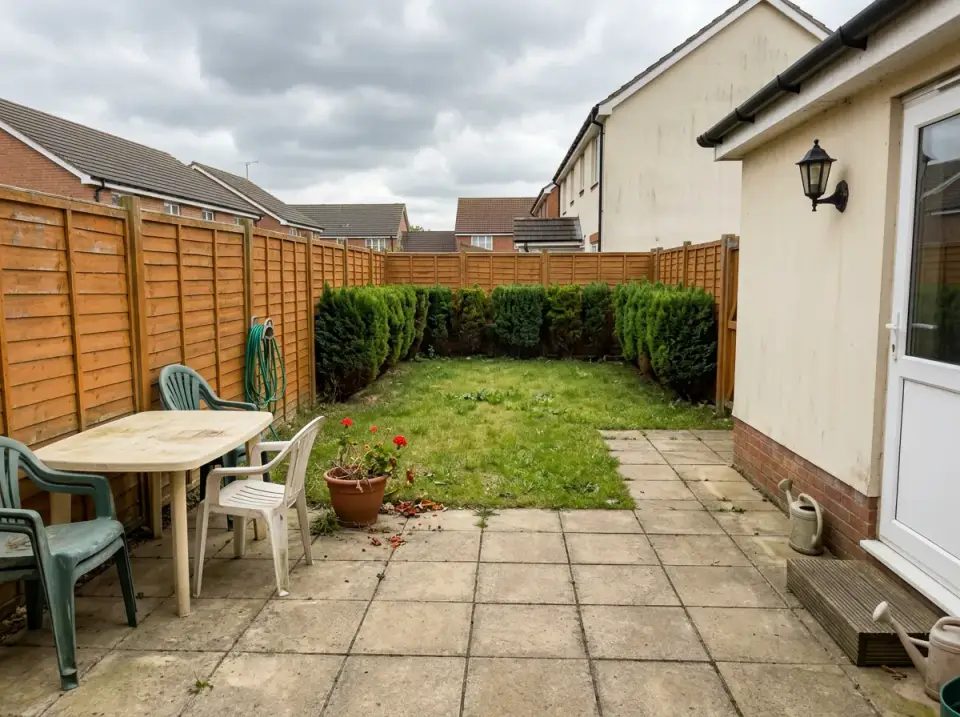
A client in West Ashley called me the week after Thanksgiving a few years ago with a classic Lowcountry backyard problem — 1,400 square feet of cracked concrete from a 1970s patio pour, a leaning cedar shed the previous owner had built directly on grade (it was rotting from the bottom up), a strip of what used to be lawn and was now a weed monoculture, and a privacy fence that had been patched with three different wood species. Over two months of Saturday-morning walk-throughs we went through twelve distinct design directions before she narrowed it to two and committed to one. This guide is all twelve — each one a direction I've actually built out or signed off on for a Lowcountry, Upstate South Carolina, or North Georgia client, with honest costs, real products, and the climate caveats that come with outdoor work in a zone that swings between 85% summer humidity and December freezes.
What's in This Guide
- The Modern Minimalist Retreat
- The Productive Gardener's Dream
- The Rustic Al Fresco Dining Destination
- The Ultimate Entertainment Hub
- The Boutique Spa Escape
- The Sunken Cinema Lounge
- The Contemporary Garden Studio
- The Split-Level Decking Delight
- The Architectural Courtyard
- The Mediterranean Escape
- The Serene Zen Sanctuary
- The Classic English Cottage Garden
- Regional Fit: How These Directions Land Across the Southeast
- Pro Tips for Any Backyard Transformation
- Frequently Asked Questions
- Sources and References
- Final Thoughts
1. The Modern Minimalist Retreat
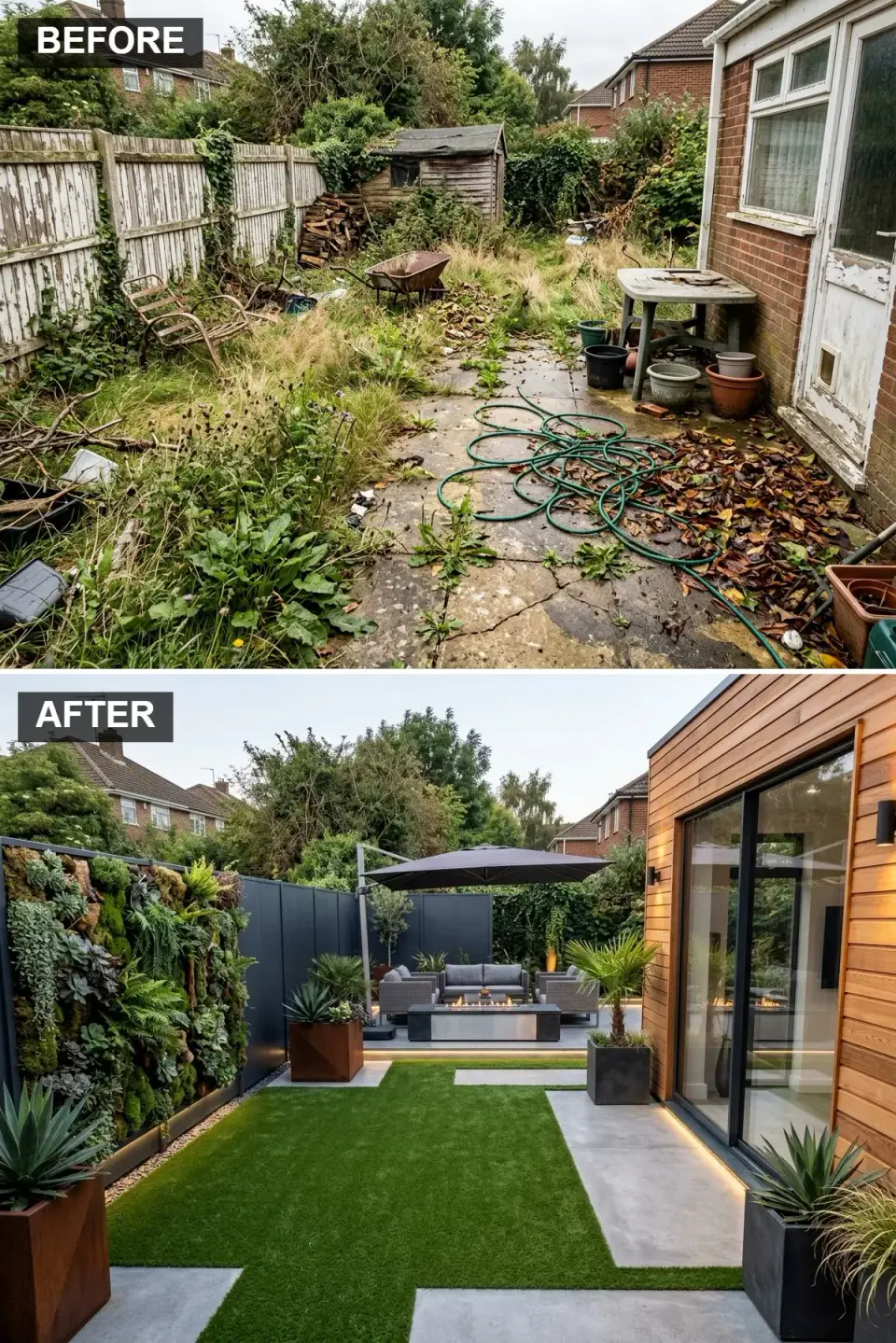
The minimalist direction is the one clients ask for most often on Instagram and execute worst in the Lowcountry if they don't plan for humidity. Large-format concrete pavers (Belgard Dimensions 24×36 or Borderline Contemporary, $16–$26 per sq ft installed) give the base the right scale — anything smaller reads busy. The feature wall combines charcoal horizontal fence panels (Trex Seclusions or Modinex in Charcoal) with warm cedar cladding (Western red cedar with a clear Cabot oil finish, reapplied every 18–24 months in our climate). The living wall is where most Lowcountry installs fail — pick a drip-irrigated modular system with a dedicated pump (Florafelt Pro or LivePicture Go, $58–$92 per sq ft installed) and plan for a full restart every 2–3 years rather than pretending it's permanent. Artificial turf gets a lot of hate and it's earned on cheap product; premium landscape-grade turf (SYNLawn Platinum or FieldTurf Landscape, $12–$18 per sq ft installed) actually holds up in full sun here.
Color Palette
Charcoal Grey
#363636
A strong, moody backdrop that makes greenery pop
Warm Cedar
#C18E60
Adds natural warmth and texture to the modern lines
Concrete Grey
#B0B0B0
A sleek, industrial base for the hardscaping
Corten Steel
#8B5A2B
Introduces a rustic, oxidized metal texture
Styling Notes for This Look
- Large-format pavers at 24×36 or larger make small yards read bigger — the grout-line ratio drops and the eye reads "continuous surface."
- Modular living walls need dedicated drip irrigation plus a time-of-day timer — manual watering fails by week three in July.
- Stick to three or four total materials. Minimalist fails when it becomes "three materials plus a fire pit plus a metal sculpture plus a planter wall."
- Corten steel planters run $680–$1,400 for a 3×3 foot cube from Planterworx or Veradek; cheaper rusted-steel imports warp in the first Lowcountry summer.
2. The Productive Gardener's Dream
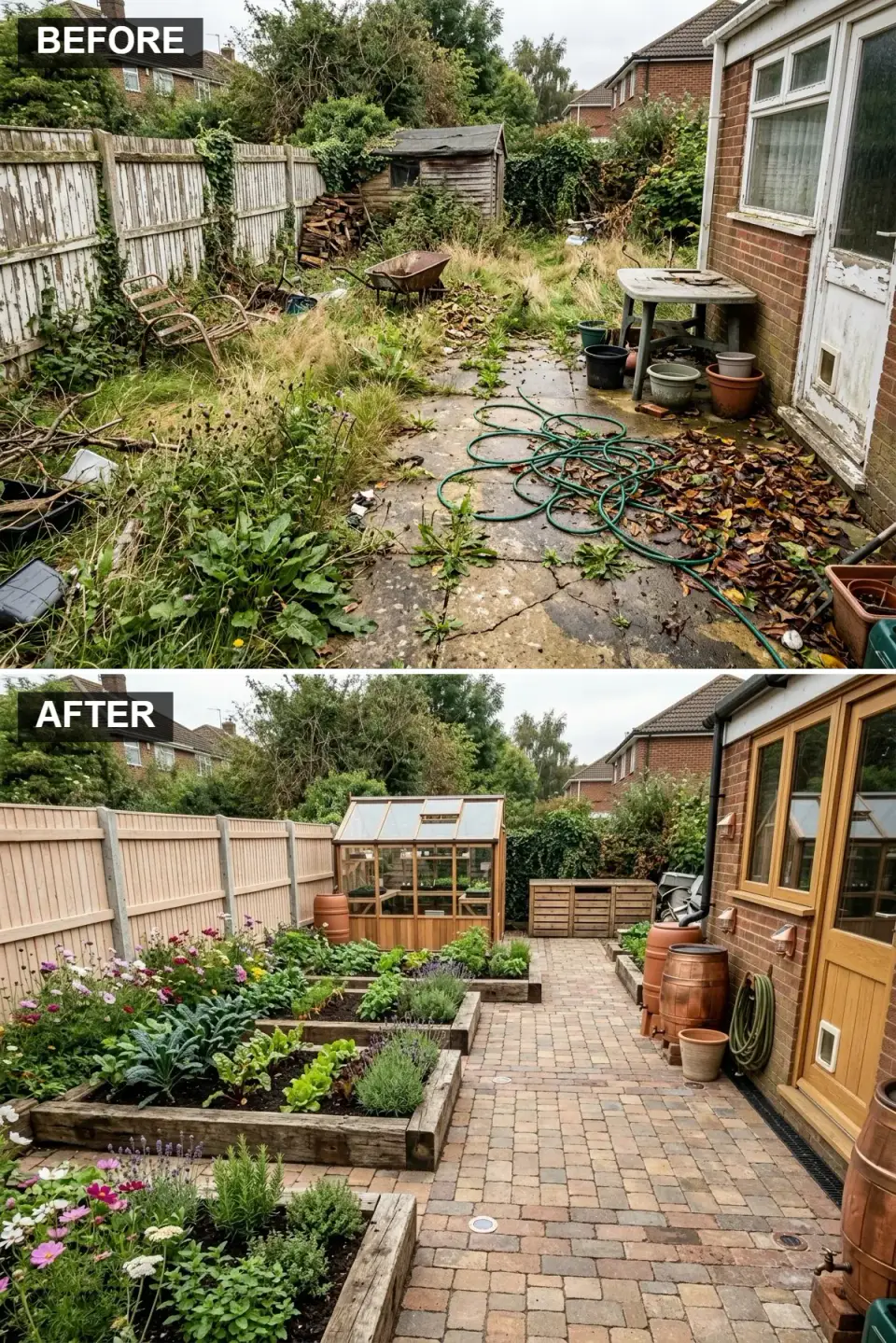
A real working kitchen garden is one of the highest-satisfaction directions I've executed in the last decade — but only if you plan for the Lowcountry's split growing seasons. Zone 8b/9a gets two peaks: a cool-season garden from October through April (greens, brassicas, peas) and a warm-season garden from late April through September (tomatoes, peppers, okra, eggplant). A cedar greenhouse (Greenhouse Megastore Palram Grand Gardener or a custom-framed Charleston build in rot-resistant western red cedar, $4,200–$9,800) lets you start seedlings in February rather than waiting on garden centers. Raised beds from real oak railway sleepers look correct but are increasingly hard to source creosote-free; modern equivalents are Douglas fir 4×6 or black locust (Charleston Hardwoods stocks both). Skip pressure-treated pine for anything food-contact — the newer ACQ treatment is safer than old CCA but still not ideal for vegetable roots.
Color Palette
Natural Cedar
#BC8F65
A warm, durable wood that ages beautifully
Weathered Railway Sleeper
#6D5A43
Dark, rustic timber providing robust structure
Multi-tone Brick
#A67B5B
Classic paving adding texture and warmth
Aged Copper Accents
#B87333
Metallic highlights on functional wooden barrels
Styling Notes for This Look
- Raised beds at 18–24 inches reduce back strain and let you control soil — Charleston native soil is often too clay-heavy for root vegetables without amendment.
- Black locust raised bed timber lasts 20–25 years untreated; Douglas fir lasts 8–12; pressure-treated southern yellow pine lasts 15–20 but leaches compounds best avoided for food plots.
- Permeable brick pathways work better than concrete here — Charleston's 52-inch annual rainfall demands drainage planning, and loose-laid brick on a gravel base handles it without cracking.
- A 55-gallon rain barrel captures roughly 500 gallons annually from a 200 sq ft roof section in our rainfall pattern. Budget $180–$420 for a quality barrel with overflow plumbing.
3. The Rustic Al Fresco Dining Destination
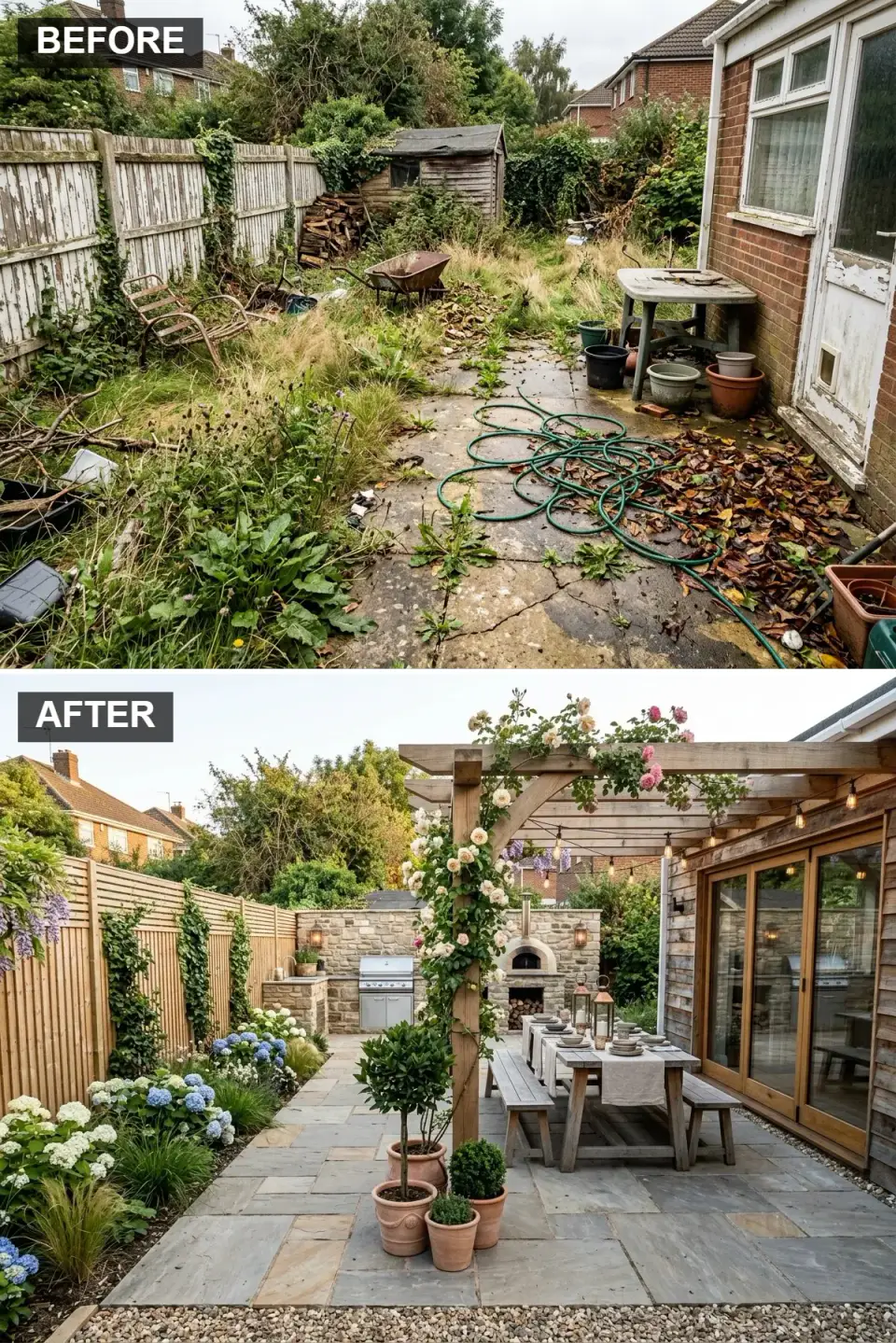
The dedicated outdoor-kitchen-plus-dining direction is the highest-resale-ROI hardscape I work on in the Southeast — Remodeling magazine's 2024 Cost vs. Value Report puts pergola-plus-outdoor-kitchen installations at 58–67% return in the South Atlantic region. A real wood-fired pizza oven (Forno Bravo Primavera 60 or an Alfa Pro Ciao M, $2,800–$5,400 for the oven plus $1,200–$3,800 for the stone base construction) beats the gas-only conversion every time for actual cooking temperature. Natural sandstone paving (Pennsylvania bluestone or Indiana sandstone, $18–$28 per sq ft installed) is the correct base material — travertine looks similar and cracks in our freeze-thaw cycles. The pergola needs real structural spans — a 12×16 foot cedar pergola with 6×6 posts runs $4,800–$9,400 built, and climbing roses or wisteria need at least two seasons to fill in.
Color Palette
Natural Sandstone
#C2B280
An earthy, textured base with varied warm tones
Weathered Oak
#8C7F70
Aged timber giving a sense of permanence and rustic charm
Reclaimed Timber
#7D5E46
Adds rustic texture to the house exterior
Cream Stacked Stone
#E5DCC3
A brighter stone veneer brightening the cooking area
Styling Notes for This Look
- Climbing roses need 8–12 months to fill a 10-foot pergola; wisteria needs 2–3 seasons but holds its structure better through Lowcountry storms.
- Real sandstone vs. porcelain plank: sandstone wins on look and texture; porcelain wins on stain resistance near the pizza oven zone.
- Outdoor kitchen countertops need to be sealed granite, honed soapstone, or Dekton. Concrete looks great and spalls under freeze-thaw within 3–5 years in the Upstate.
- Wood-fired oven needs dedicated cure cycles for the first 30 days — skip the shortcuts or the firebrick cracks.
4. The Ultimate Entertainment Hub
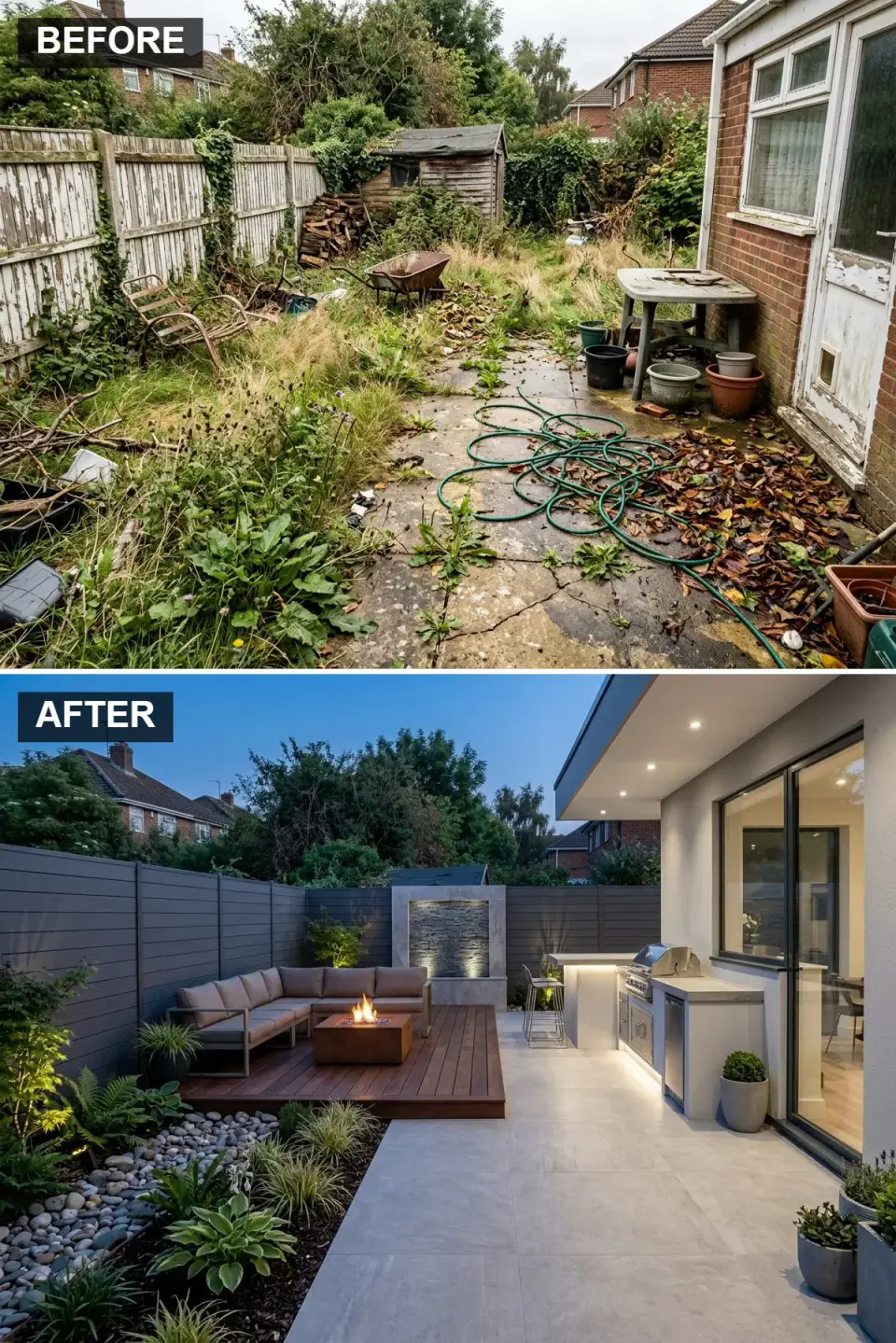
A split-level entertainment backyard is the direction where budget separates "Pinterest" from "actually works." Dark-teak composite decking (Trex Transcend Tiki Torch or TimberTech Advanced PVC Mahogany, $22–$38 per sq ft installed) gives the warm tone without teak's Lowcountry maintenance cycle. The lower porcelain tile patio uses large-format outdoor-rated porcelain (MSI Dimensions or Florim Stontech 4.0, $14–$24 per sq ft installed, 20mm thickness for pedestal-set application). LED strip lighting under every step nosing and counter overhang is the detail that sells the level change at night — plan on DC-wiring and a weather-rated driver (WAC Lighting InvisiLED or Kichler 12VDC, $140–$280 per 16-foot run plus transformer).
Color Palette
Dark Teak Composite
#5C4033
Rich, dark wood tones for the lounging zone
Pale Porcelain Tile
#DCDCDC
A bright, clean, modern surface for the bar area
Dark Slate Grey
#3F4246
A dramatic, receding background color
Concrete Grey
#9DA1A2
Sleek, durable surfaces for food preparation
Styling Notes for This Look
- Pedestal-set 20mm porcelain is the Lowcountry move for lower patios on sloped or poorly draining lots — it lets rainfall drain beneath rather than pond on surface.
- The water wall needs a submersible pump rated for continuous outdoor duty — Atlantic Water Gardens or Aquascape Ultra, $280–$580 depending on flow rate.
- LED strip lighting is DC-voltage so the driver (not the strip) is the failure point in humid conditions. Pick IP67-rated drivers and mount them in ventilated enclosures.
- Composite decking expands 0.005 inch per foot per 10°F temperature swing — gap accordingly or edges will mushroom against walls by August.
5. The Boutique Spa Escape
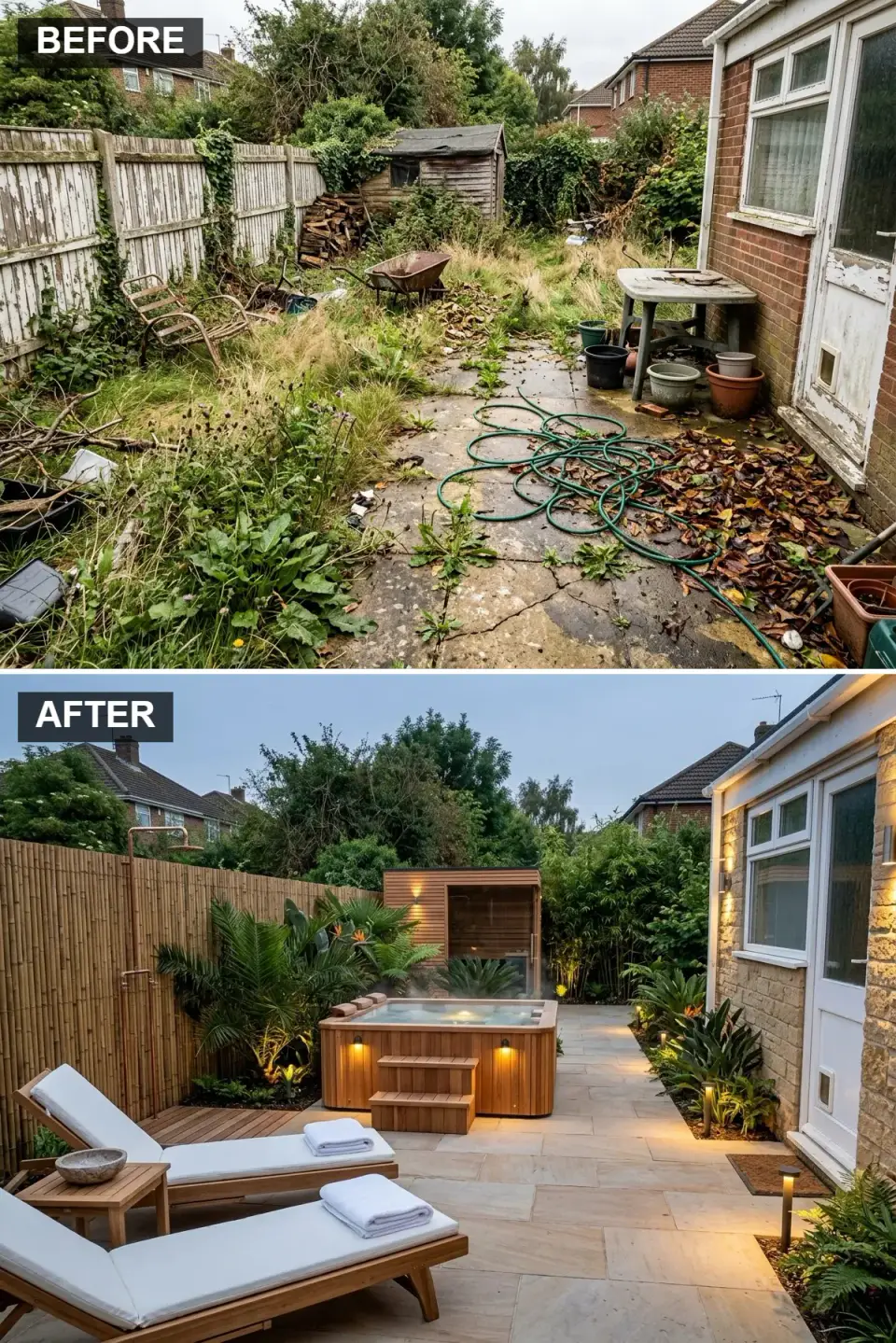
A private wellness retreat is the direction with the most hidden infrastructure cost. A cedar-clad hot tub is not a spa — a real saltwater or chlorine hot tub with a 50-amp 240V dedicated circuit, GFCI protection per NEC Article 680, a concrete pad rated for 75+ pounds per square foot (a typical 7-person tub fills to 4,200+ pounds), and plumbing to both supply and drain. Budget $9,800–$24,600 for the tub installed, not the $5,000 sticker price. An outdoor sauna (Finnleo, Almost Heaven, or a Dundalk Leisurecraft, $6,400–$14,200 installed) adds another dedicated 240V circuit. Bamboo fencing rolls up quickly — BambooImport or Cali Bamboo rolls at 6 feet tall run $12–$22 per linear foot — and give instant tropical privacy over an existing fence.
Color Palette
Natural Bamboo
#C8A97E
Provides instant height, privacy, and a tropical feel
Clear Cedar
#D19C6B
Premium, warm wood used for spa elements
Smooth Sandstone
#D8C6A8
Soft, warm paving that feels good underfoot
Polished Copper
#B87333
A luxurious metallic accent for the rinse-off area
Styling Notes for This Look
- Sandstone paving around wet areas must be textured, not polished — IRC R311 requires slip-resistant surfaces for walking surfaces adjacent to wet zones.
- Outdoor copper shower fixtures (Sonoma Forge or California Faucets) naturally develop verdigris patina. Seal with Everbrite or let them age — the mid-stage looks worst.
- Hot tub screens need a break between the tub and any cedar wall for heat and humidity dispersion — leave 18 inches minimum clearance.
- Tropical plants in the Lowcountry: hardy banana (Musa basjoo) is winter-hardy to 0°F root-hardy; Windmill palm (Trachycarpus fortunei) is the most freeze-tolerant true palm; elephant ear (Colocasia) returns perennially in our zone.
6. The Sunken Cinema Lounge
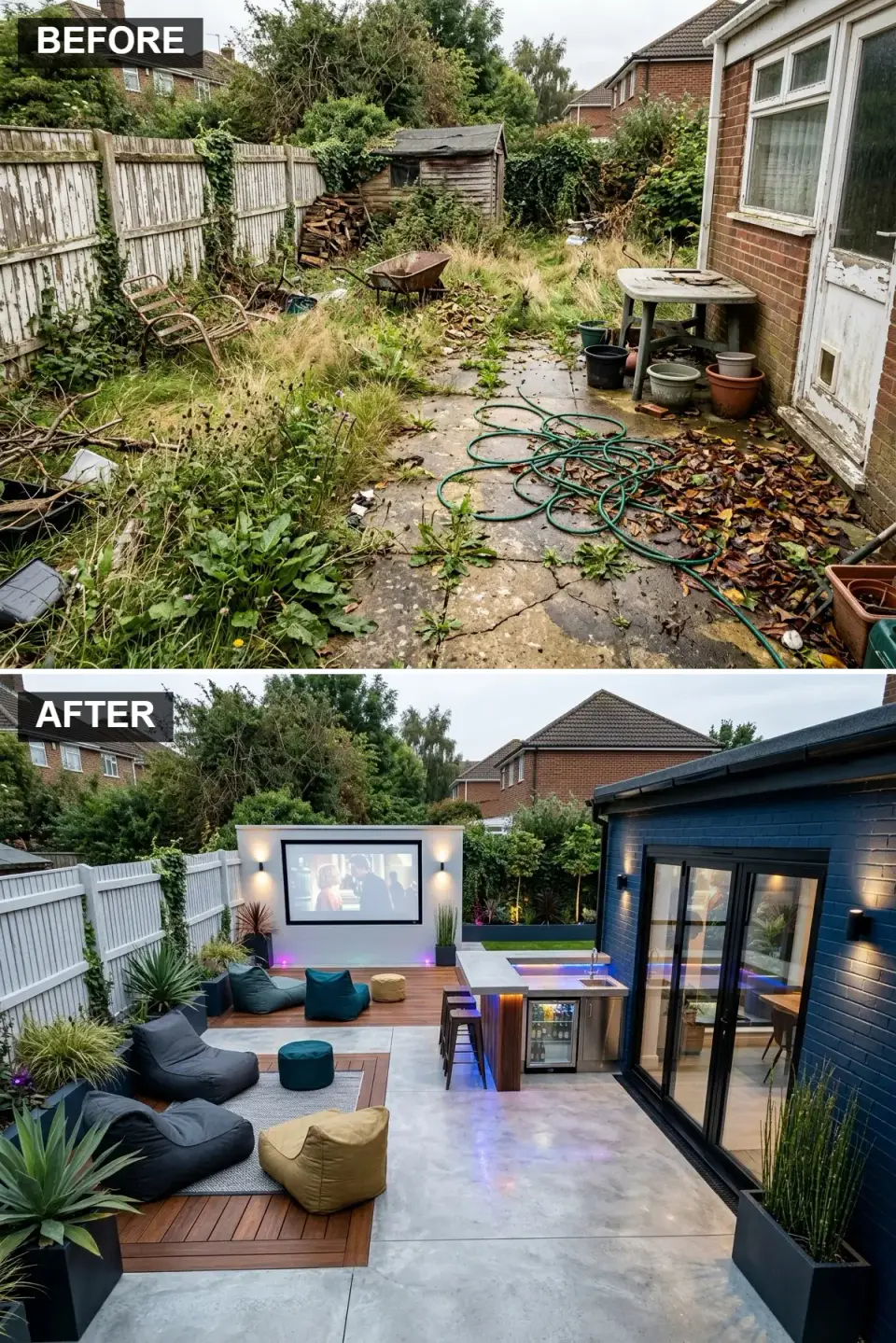
Outdoor cinema sounds like a gimmick and works when the projector is picked correctly. Indoor projectors fail outdoors at a few hundred ambient-lux; you need a minimum 3,500-lumen laser projector with ALR (ambient-light-rejecting) screen technology for an outdoor wall. Hisense PX2-Pro or Epson LS800 land in the $2,800–$4,200 range and genuinely work at dusk. The rendered white wall (Sherwin-Williams SnowBound SW 7004 with exterior-grade flat paint) needs to be smooth — orthogonal render finish is wrong; you want a steel-troweled flat finish so the projector doesn't catch texture shadows. Polished concrete is the right floor if you're doing new-pour construction; existing concrete slabs need to be ground with a concrete polisher and sealed with a lithium densifier ($4–$8 per sq ft for a DIY-adjacent finish, $14–$22 per sq ft for pro-grade).
Color Palette
Polished Concrete
#A9A9A9
An ultra-modern, durable, and reflective floor surface
Rich Ipe Wood
#6B4423
Dense, dark tropical hardwood adding warmth
White Render
#F5F5F5
A clean, smooth backdrop for the projector screen
Deep Navy Blue
#1B263B
A dramatic contrast color for the house exterior
Styling Notes for This Look
- Sunken seating typically drops 18–24 inches below grade and requires a retaining wall plus subsurface drainage — never skip the 4-inch perforated PVC and washed-gravel drainage layer or the sunken zone becomes a pond.
- Ipe wood (Brazilian ironwood) is the gold-standard tropical hardwood — 25–40 year service life untreated, Class A fire rating, and it actually tolerates Lowcountry humidity. Budget $16–$26 per sq ft installed.
- Outdoor audio: a pair of weatherproof rock or planter speakers (Sonos Outdoor, Klipsch AWR-650-SM) plus a covered amplifier beats bluetooth soundbars every time for a cinema zone.
- Projector needs a secure weatherproof enclosure (OC White ProjectorHaven or a custom soffit-mount) and should never live outdoors year-round.
7. The Contemporary Garden Studio
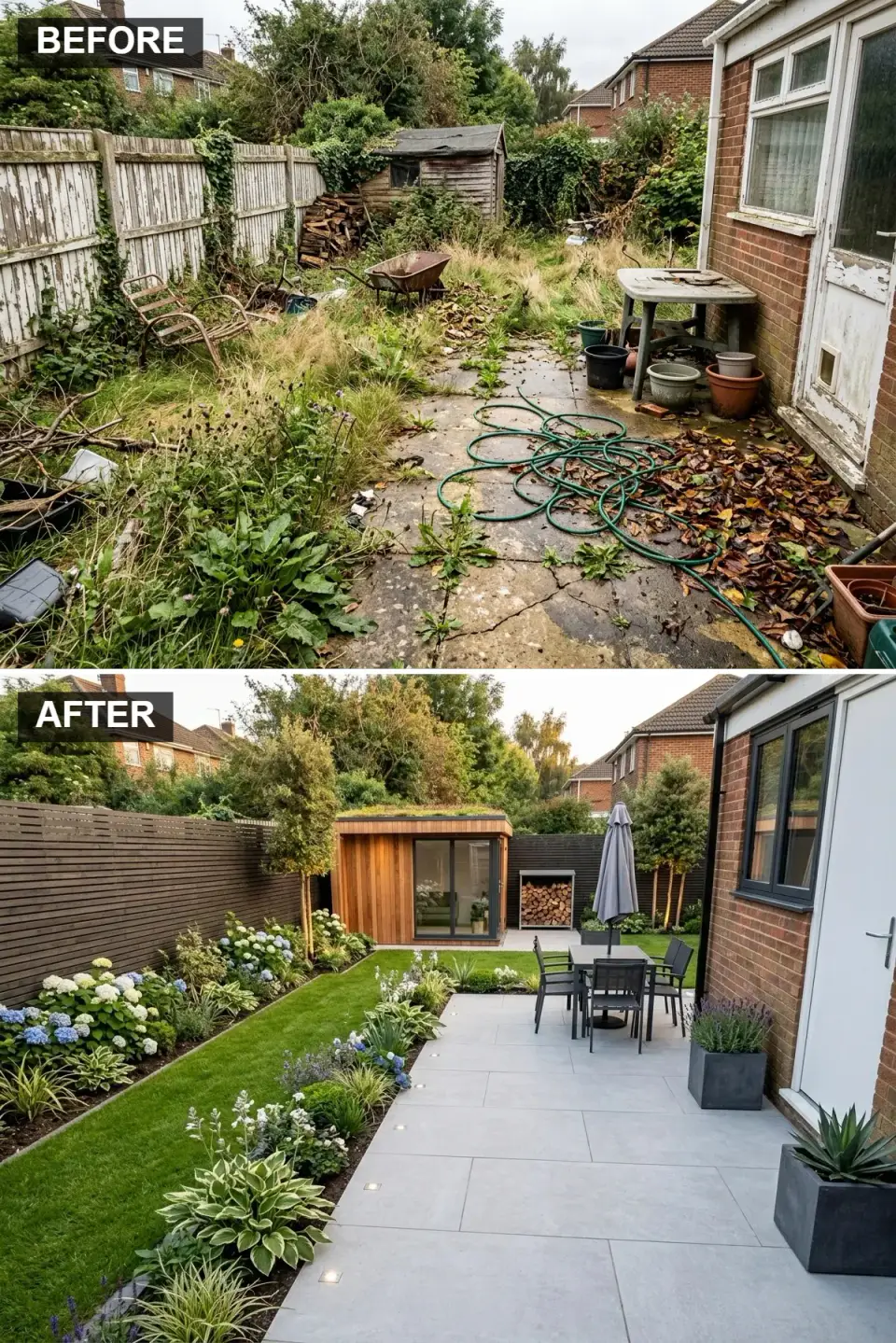
A backyard studio is one of the highest-utility directions on this list for anyone working remotely — and it's the direction with the strictest code path. A detached accessory structure under 200 square feet often qualifies for a simplified permit in Charleston County; anything 200 sq ft and up triggers a full residential-scale permit process including energy code compliance (IECC R402), electrical permitting (NEC Article 210), and in many jurisdictions a septic/sewer impact review. A cedar-clad studio with a sedum green roof runs $38,000–$72,000 turn-key in the Charleston market for a 120 sq ft unit (Studio Shed, Green Man, or a custom Charleston build). Large-format porcelain patio tiles (MSI Dimensions 24×48 or Atlas Concorde Boost, $14–$22 per sq ft) extend the studio feel into the outdoor patio. Horizontal slatted fencing is the contemporary default.
Color Palette
Vertical Cedar
#B6865A
Warm, natural wood cladding on the main structure
Light Grey Porcelain
#C0C0C0
Large format, clean tiles for a modern finish
Dark Slatted Timber
#4A4238
Contemporary horizontal fencing creating visual width
Matte Anthracite
#383E42
Dark grey metal accents for a modern touch
Styling Notes for This Look
- A sedum green roof requires a minimum 4-inch growing medium and a waterproof membrane (Carlisle or FiberTite EPDM). Installed cost is $22–$38 per sq ft. Drainage and structural load (15–35 psf saturated) must be engineered.
- Cedar needs oil reapplication every 18–24 months in Charleston. Budget 1 gallon per 150 sq ft per coat of Cabot Australian Timber Oil or similar.
- Horizontal slatted fencing needs rot-resistant bottom-plate material (cedar, locust, or aluminum) — pressure-treated southern yellow pine at grade rots within 8–12 years.
- If the studio is a permitted living space (not just a "shed"), budget $6,000–$14,000 for trenching, sub-panel, conduit, and mini-split HVAC.
8. The Split-Level Decking Delight
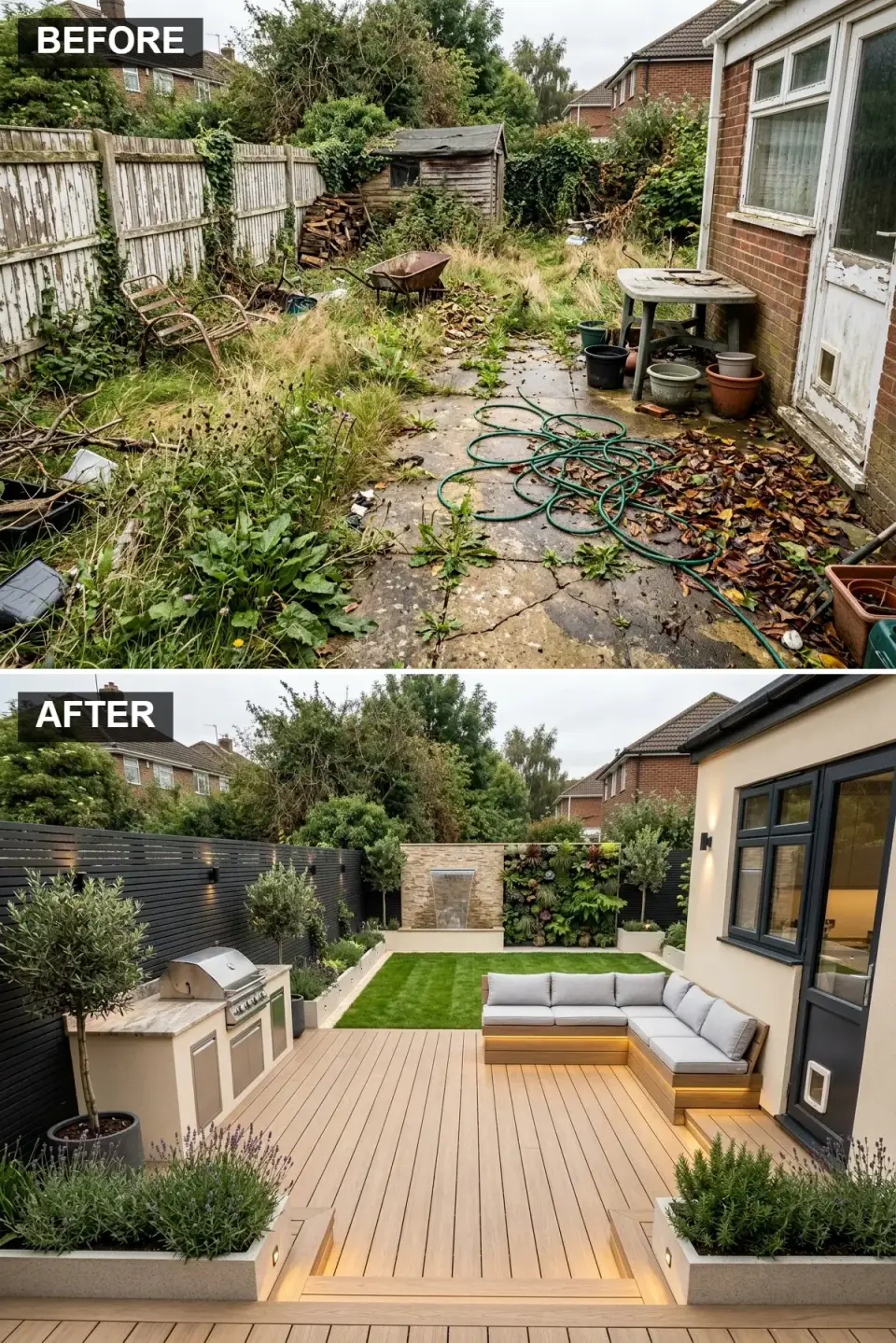
Split-level decking is the direction I recommend most often for small Lowcountry backyards under 800 square feet — the level change creates apparent space where there isn't any. Light-oak composite decking (Trex Transcend Spiced Rum or TimberTech Advanced PVC Weathered Teak, $22–$38 per sq ft installed) is the right tonal choice when the home exterior is neutral. Built-in bench seating with integrated storage is the space-efficient planning detail — lift-top benches with cedar interior and composite shell work for cushions, pool towels, or a weather-resistant generator cover. LED strip lighting under every bench nosing and every step edge sells the "floating" effect at night.
Color Palette
Light Oak Composite
#CDBA88
A bright, durable wood-alternative flooring
Cream Stucco
#EFEBD6
Smooth render for the built-in kitchen base
Beige Stacked Stone
#C9BFA3
Textured stone veneer creating a focal point
Matte Black
#212121
A modern, receding boundary color
Styling Notes for This Look
- Composite decking needs specific fastener systems — hidden fasteners (TrimClip, CAMO, or Trex Hideaway) are correct. Top-screwed composite reveals the screw head which never looks right.
- A 30-inch level change needs a code-compliant guardrail per IRC R312.1 when the drop exceeds 30 inches.
- Artificial grass over a paving substrate requires a 1/4-inch-per-foot slope and a permeable drainage layer — a DG (decomposed granite) base at 2 inches is the standard.
- Stacked stone veneer water walls need weep holes at the base and a waterproof membrane behind — skip this detail and you'll see efflorescence on the stone face within 18 months.
9. The Architectural Courtyard
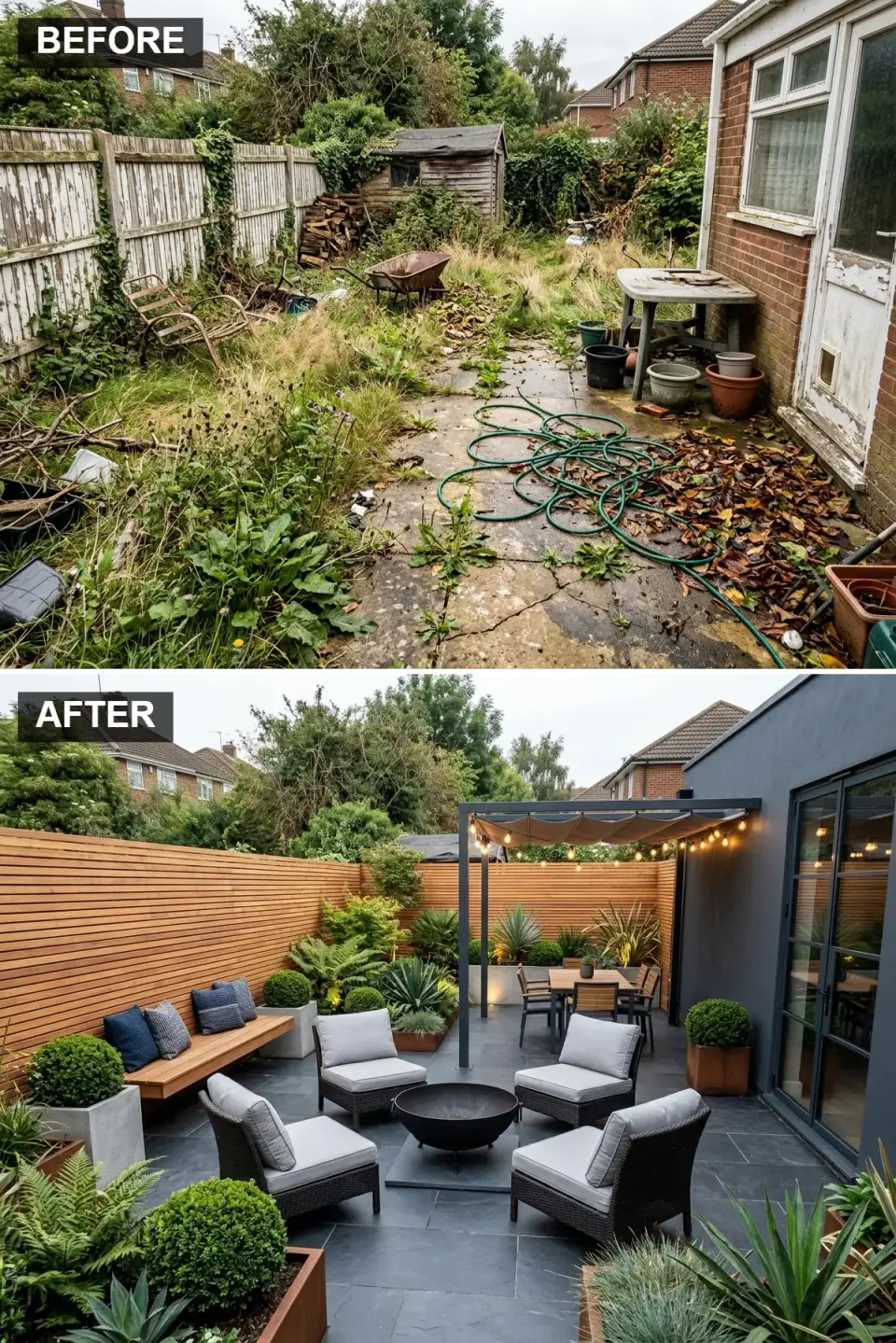
An architectural courtyard is a direction for a small urban or in-town lot — Charleston's peninsula neighborhoods, Asheville downtown, Atlanta in-town. The scale is deliberate; the planting is sculptural rather than abundant. Large-format dark slate pavers (Vermont Black or Welsh Penrhyn, $28–$46 per sq ft installed) set the moody base. The Corten steel fire bowl (Solus Décor, Paloform Robata, or AK47 Design Zero, $2,400–$6,800) becomes the literal center of the room. Shaped boxwood balls (Buxus sempervirens 'Green Velvet' is Charleston-hardiest) and architectural agaves give the structured-botanical dimension; avoid flowing perennials that would fight the geometry.
Color Palette
Dark Slate
#474A51
Large, dark natural stone pavers for drama
Warm Horizontal Timber
#B88A5D
Reddish-brown wood slats providing warmth
Corten Steel
#965F38
Weathered steel adding rustic orange tones
Dark Rattan and Grey
#555555
Modern woven furniture with neutral cushions
Styling Notes for This Look
- Real slate requires a sealed mortar-set installation — dry-laid slate on sand will heave over a Lowcountry winter. Budget 40% more labor than porcelain plank.
- Boxwood balls in the Lowcountry need annual shaping and sulfur-based fungicide protection against boxwood blight (Calonectria pseudonaviculata), which has hit the Southeast hard since 2018.
- Gas fire bowls beat wood-burning for urban courtyards — the fuel line is clean, the ignition is instant, and most municipal open-flame restrictions exempt propane-supplied appliances.
- Horizontal timber fencing made from rot-resistant species (cedar, cypress, or black locust) runs $35–$65 per linear foot; pressure-treated SYP equivalents start at $22 but rot at the bottom rail within 8 years.
10. The Mediterranean Escape
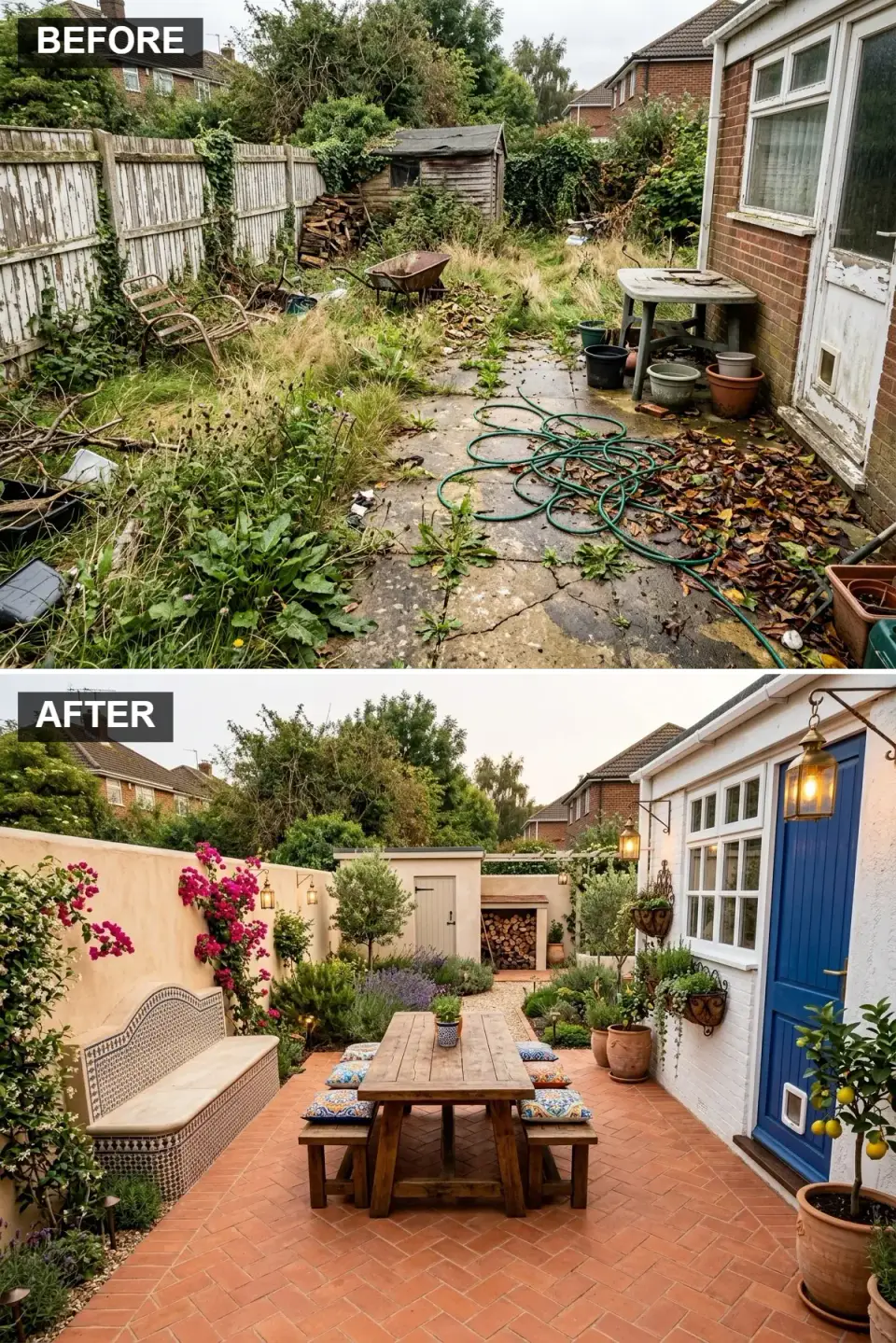
Mediterranean is one of the most difficult directions to execute honestly in the Lowcountry because the source climate is so specifically not ours — Marbella, Positano, and Marrakech all get 40+ inches less annual rainfall than Charleston. The direction works when the hardscape is sized for the space and the planting is adapted: true olive trees (Olea europaea) survive Zone 8b winters in Charleston but need protection below 20°F; bougainvillea returns perennially only in Zone 9a+; Italian cypress (Cupressus sempervirens) works. Terracotta tiles laid in herringbone require a proper exterior-grade tile (Saltillo tiles from Arto Brick or Meridian Mexican Tile, $12–$22 per sq ft installed) sealed annually against our humidity. Stucco walls need a cement-based system (LaHabra Fine Sand or BASF MasterPel) with proper flashing — skip these details and the wall crazes within 5 years.
Color Palette
Terracotta Tile
#CB6D51
Classic reddish-orange clay tiles
Warm Beige Stucco
#E3D0B4
Textured, warm-toned rendered walls
Cobalt Blue
#0047AB
Vibrant blue accents typical of Mediterranean design
Rustic Reclaimed Oak
#8B6B4B
Heavy, weathered wood furniture
Styling Notes for This Look
- Saltillo terracotta tile requires annual sealing with a breathable penetrating sealer (Miracle Sealants 511 Impregnator, $58 per gallon, covers 150–300 sq ft depending on tile porosity).
- Olive trees in the Lowcountry need trunk-wrap protection for nights under 20°F — 3–4 nights per decade threaten mature trees. Pick Arbequina or Mission varieties for maximum Zone 8 hardiness.
- Cobalt blue reads flat without a gloss or glaze — painted doors should be Benjamin Moore Twilight Blue 2067-10 or a custom-mixed cobalt in high-gloss enamel.
- Mosaic benches: commission from a local mosaic artist (Charleston has two or three) at $1,800–$4,800 for a 6-foot bench. Kit versions look uniformly machined and lose the hand-set aesthetic.
11. The Serene Zen Sanctuary
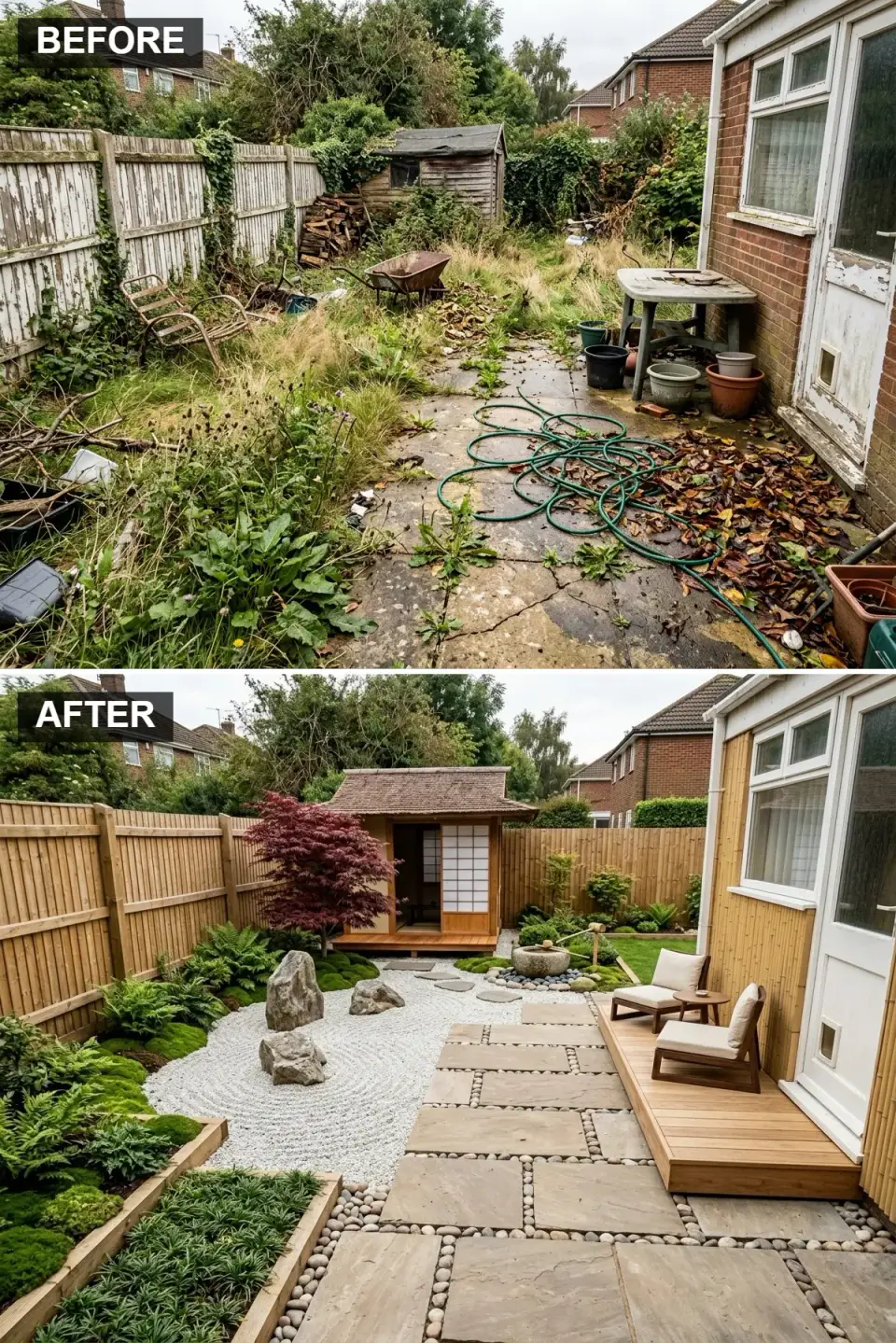
A true Japanese karesansui (dry landscape) garden is the direction that looks simplest and takes the most design discipline. The principle is restraint: one focal stone, a second support stone, a third accent stone — the "three-stone" composition (sanzon-ishigumi) is the foundational grammar. Raked gravel patterns around them represent water. In the Lowcountry the challenge is gravel color and drainage — white granite-chip gravel (Alpine White 3/8-inch, $58–$92 per ton delivered in Charleston) stays cleanest; crushed oyster shell weathers to grey within 18 months. A traditional tea house (chashitsu) built in cedar with tatami-style flooring runs $8,400–$22,600 in the Southeast depending on size and joinery complexity. Bamboo fencing rolls are the shortcut; a real woven bamboo tateyoshizu screen from a Japanese importer runs $180–$420 per linear foot.
Color Palette
Natural Pine
#D4B88C
Light-toned wood for structures and platforms
White Granite Gravel
#EAEAEA
Bright, clean gravel for raking patterns
Natural Grey Stone
#888C8D
Varied grey tones of boulders and flagstones
Bamboo Screening
#C0A67E
Natural vertical bamboo poles
Styling Notes for This Look
- Rake your gravel with a wooden Japanese rake (kumade) — metal rakes scar the gravel surface and leave inconsistent patterns.
- Plant palette for a Lowcountry zen garden: Japanese maple (Acer palmatum — Bloodgood or Waterfall varieties are most hurricane-tolerant), mondo grass (Ophiopogon japonicus) in place of fragile Japanese mosses, fatsia japonica, and a single black pine (Pinus thunbergii) if space allows.
- Place one or two large boulders as anchors — the single most common error I see is five small rocks instead of two large ones. Scale matters.
- Real Japanese moss lawns don't survive Lowcountry summers. Substitute mondo grass or blue star creeper (Isotoma fluviatilis) for the ground plane.
12. The Classic English Cottage Garden
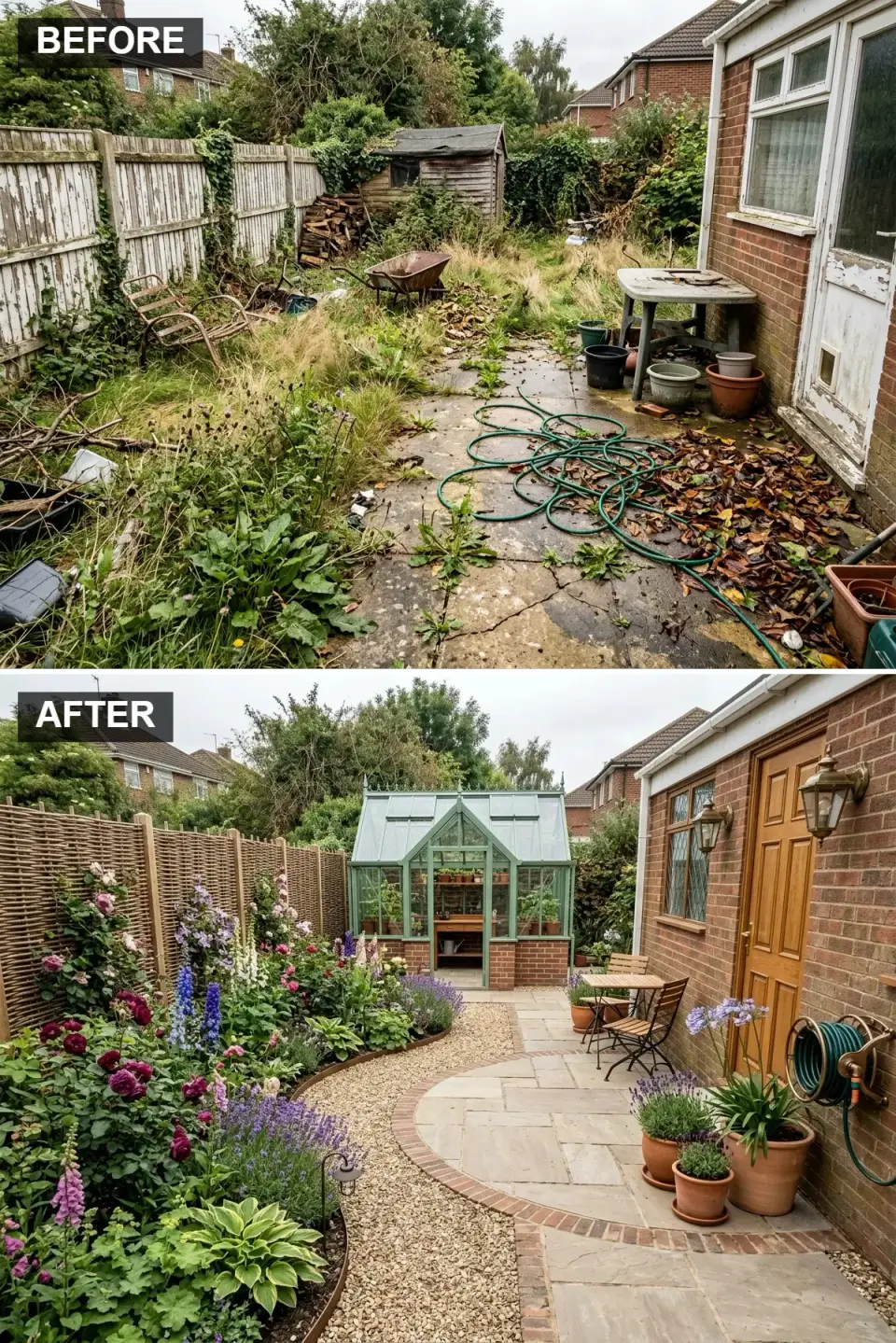
A cottage garden is the most romantic direction on this list and the most demanding to maintain — the "controlled chaos" aesthetic requires weekly deadheading, seasonal division, and honest pest management. In Charleston the palette substitutes are real: English foxgloves (Digitalis purpurea) die out after one season here; use foxglove penstemon (Penstemon digitalis) for a true perennial. English-style David Austin roses work well with twice-annual feeding and sulfur-based black-spot protection. Delphiniums rarely return in Zone 8b; substitute larkspur (Consolida ajacis) which self-seeds and looks close. A heritage-painted greenhouse (Hartley Botanic or Alitex in the premium tier, $18,000–$56,000; Palram Snap & Grow or Grandio Elite in the mid-tier, $3,800–$7,200) becomes the focal point. Reclaimed brick edging (salvaged Charleston brick from Material Things, $4–$8 per linear foot installed) ages into the garden rather than against it.
Color Palette
Heritage Sage Green
#7D927D
A classic, muted green paint for garden structures
Reclaimed Brick
#A66752
Weathered red and orange bricks
Pea Gravel
#C9C0A6
Small, loose beige stones for a crunchy texture
Woven Willow Hurdles
#8C7458
Rustic, natural woven fencing
Styling Notes for This Look
- A cottage garden needs a base structure of evergreen bones — boxwood cushions, lavender, or rosemary — to hold visual weight in winter when the perennials die back.
- Lowcountry-friendly perennial swaps: Shasta daisy (Leucanthemum × superbum) for ox-eye daisy; purple coneflower (Echinacea purpurea) for globe thistle; native bee balm (Monarda didyma) for lavender.
- Woven willow hurdle fencing needs replacement every 5–7 years in our climate — factor the replacement cycle into the budget.
- Pea gravel paths migrate without edging — salvaged brick at the borders keeps the path from creeping into the beds, and the brick weathers into the aesthetic rather than against it.
Regional Fit: How These Directions Land Across the Southeast
Charleston, SC
The governing constraints are humidity, flood-zone drainage, and hurricane wind load. Directions 3, 5, 8, and 12 land most naturally in the Lowcountry's humid-subtropical climate. Anything with exposed wood requires a planned re-oil or re-stain cycle. Permeable paving is strongly preferred in flood-zone lots to meet local stormwater requirements.
Savannah, GA
Similar climate profile to Charleston with slightly less extreme rainfall. Directions 3, 9, 10, and 12 work particularly well in the historic district's courtyard typology. The city's tree-protection ordinance restricts hardscape coverage; plan for minimum 25% permeable surface on most residential lots.
Atlanta, GA
Directions 1, 4, 6, and 7 fit the modern-build market; directions 3 and 12 fit in-town Virginia-Highland and Decatur historic neighborhoods. Clay soil requires aggressive drainage planning — budget 15–25% of hardscape cost for base preparation.
Nashville, TN
Moderate four-season climate supports the full range. Directions 2, 7, and 12 fit Williamson County's suburban-garden market; directions 1, 4, and 9 fit East Nashville and 12South contemporary builds. Tennessee's ground snow load is low (5–10 psf) so pergola spans can be lighter-built than mountain markets.
Asheville, NC
Mountain drainage and freeze-thaw cycles are the governing factors. Directions 2, 3, and 12 land most naturally in the mountain vernacular; direction 11 (zen) fits the tree-canopied Blue Ridge setting unusually well. Snow load requires ASCE 7-22 verification on any pergola or covered structure at elevation above 2,000 feet.
Austin, TX
Hot, dry summers favor directions 1, 9, and 10 — Mediterranean plants thrive and dark hardscape reads correctly for Hill Country modern. Water restrictions are strict; design for xeriscape with drip irrigation rather than broadcast watering.
Raleigh-Durham, NC
Directions 2, 3, 7, and 12 fit the Triangle's mix of traditional and new-build markets. North Carolina's stormwater rules vary by county — Wake and Durham both require permit-track stormwater management for hardscape over 2,500 sq ft.
Pro Tips for Any Backyard Transformation
- Start with a scale drawing, not Pinterest. Measure the yard, locate the utility easements (call 811 before you break ground), and sketch the zones on paper or in a free tool like SketchUp Free before buying a single paver. This step prevents the single most common and expensive mistake: hardscape sized wrong for the space.
- Permit anything structural before you dig. Charleston County requires permits for any structure over 120 sq ft, any fence over 6 feet tall, any retaining wall over 30 inches, and any hardscape in a wetland setback. Atlanta and Nashville have similar thresholds. A neighbor complaint will trigger code enforcement faster than any inspector walk-by — plan for permits from day one.
- Drainage is design. 52 inches of annual Lowcountry rainfall means every hardscape decision must account for where water goes. Plan 1/4-inch-per-foot minimum slopes away from the house; install 4-inch perforated PVC drain tile at the downhill edge of any paver installation; budget a French drain at any low spot that retains water after a 30-minute rainstorm.
- Invest the bones budget first. Spend 60–70% of the project budget on hardscape (paving, walls, fencing, structural planting) and 30–40% on soft elements (furniture, textiles, decorative planting). Hardscape is the permanent decision; soft elements are the flexible one.
- Layered lighting changes everything. Plan for at least three lighting layers: path lighting (LED bollards at 8-foot spacing, 2700K); ambient zone lighting (string lights or pendant fixtures over dining/lounging zones); accent lighting (uplights on feature plants and walls). A $1,400 lighting budget transforms a $30,000 backyard more than any $5,000 furniture set.
- Mind the HVAC load on house walls. Outdoor kitchens, fire features, and cinema walls near the house exterior heat-load the interior. Plan 24 inches minimum clearance from the house cladding to any heat source, and budget an additional insulation layer on the affected wall if the kitchen is a major cooking zone.
- Plan a maintenance calendar before you plant. A cottage garden, a zen garden, and a working vegetable garden each have 30–50 hours per year of mandatory maintenance. A modern minimalist garden has 8–12. Match the direction to the maintenance hours you'll realistically put in.
- Plan irrigation during the hardscape phase. Retrofitting drip lines or sprinkler heads after paving is installed means either tearing up pavers or running surface tubing. Trench during hardscape prep — the $1,800 incremental cost is a small fraction of the $8,000+ retrofit.
Frequently Asked Questions
Which direction has the best resale ROI in the Lowcountry? Direction 3 (Rustic Al Fresco with outdoor kitchen and pergola) returns 58–67% of cost in the South Atlantic per Remodeling magazine's 2024 Cost vs. Value Report, and the outdoor-living footprint is a measurable comp premium in post-2020 Charleston listings. Direction 4 (entertainment hub with bar and water feature) and direction 8 (split-level composite decking) also return well. Highly stylized directions like 10 (Mediterranean) or 11 (zen) are more polarizing and tend to be partially undone by the next owner. How much does a full backyard transformation cost in Charleston? Paint, furniture, and basic hardscape refresh: $8,000–$18,000. Mid-tier hardscape plus one focal structure (pergola, outdoor kitchen, or studio): $28,000–$68,000. Full multi-zone transformation including water feature, built-in seating, integrated lighting, and custom hardscape: $85,000–$240,000. Land-prep work (tree removal, grading, drainage, retaining walls) can add 15–40% on top depending on existing conditions. Do I need a permit for outdoor kitchens, hot tubs, or fire features? In Charleston County: hot tubs and outdoor kitchens with gas or 240V electrical require a permit. Fire features with gas require a permit plus an LP or natural gas line inspection. Wood-burning fire pits over 36 inches in diameter typically require a permit; smaller ones often fall under residential exemption. Confirm current local requirements — fire codes tightened in most Southeast counties after 2021. What's the minimum yard size for each direction? The smallest-footprint directions are 9 (architectural courtyard) and 11 (zen), workable in 200–350 sq ft. Directions 1, 5, and 10 work at 400–600 sq ft. Full entertainment builds (3, 4, 6, 8) benefit from 800+ sq ft. The productive garden (2) and cottage garden (12) scale up or down naturally — more square footage equals more growing area. How long does a full transformation realistically take? Soft-scape and furniture refresh only: 1–3 weekends. Mid-tier hardscape with one structure: 6–12 weeks including permits. Full multi-zone build: 16–28 weeks including permits, delivery lead times, and inspection queues. Summer hurricane prep season (July–October) delays Southeast outdoor work by 15–30%. Plan project start for October–February for the smoothest construction window. Can I DIY any of these directions? Directions 2 (garden), 11 (zen), and 12 (cottage) are the most DIY-friendly — plant-heavy, limited heavy hardscape. Directions 1, 9, and 10 require contractor-grade paver installation for a professional finish. Directions 3, 4, 5, 6, and 7 require licensed electrical, gas, and plumbing work for code-compliant results. A good rule: anything requiring 240V, gas line, or a permit is worth hiring out. Which direction works best for small urban lots under 400 sq ft? Direction 9 (architectural courtyard) is purpose-built for this footprint. Direction 11 (zen sanctuary) also works beautifully at small scale because the aesthetic favors restraint. Direction 10 (Mediterranean courtyard) fits well in Charleston peninsula, Savannah historic district, and Charleston-inspired in-town lots. Avoid large-scale directions like 3 (al fresco dining with pergola) and 4 (entertainment hub) below 600 sq ft — the scale is wrong. Can I mix elements from different directions? Yes, and most of my actual executed projects are hybrids. Common successful combinations: direction 1 (modern minimalist) plus direction 5 (spa) — clean hardscape with a cedar hot tub; direction 7 (garden studio) plus direction 2 (productive garden) — working studio beside raised beds; direction 9 (architectural courtyard) plus direction 11 (zen) — structured slate hardscape with restrained plantings. Avoid mixing highly stylized directions (10 Mediterranean plus 11 zen, for example) — the vocabularies fight.Sources and References
- Remodeling magazine, 2024 Cost vs. Value Report (South Atlantic region) — outdoor kitchen, deck addition, and landscape ROI figures.
- NAHB Construction Cost Survey, 2024 edition — regional labor and material cost benchmarks.
- International Residential Code (IRC), 2021 edition: R311 (slip-resistant walking surfaces), R312 (guardrail and handrail), R507 (decks), R703 (exterior wall coverings).
- International Energy Conservation Code (IECC), 2021 edition, Section R402 — detached accessory-structure envelope requirements.
- National Electrical Code (NEC) 2023, Article 210 (dedicated circuits), Article 680 (swimming pools, fountains, hot tubs), Article 300 (wiring methods).
- American Society of Civil Engineers, ASCE 7-22, Minimum Design Loads and Associated Criteria — wind and snow load figures by region.
- American Concrete Institute ACI 330R — Guide for Design and Construction of Concrete Parking Lots — used for paver-subbase drainage and load planning.
- Clemson Cooperative Extension, Home & Garden Information Center — Lowcountry plant hardiness and substitution references.
- Trex, TimberTech, and MoistureShield published technical data sheets — composite decking installation, fastener, and expansion specifications.
- Florafelt, LivePicture, and SYNLawn product technical guides — living wall and artificial turf installation references.
- Forno Bravo and Alfa Ovens published commercial installation guides — wood-fired pizza oven construction, cure cycles, and clearances.
- Sonos, Klipsch, and Kichler outdoor-rated product catalogs — exterior audio and low-voltage lighting specifications.
- Charleston County, Savannah-Chatham, Atlanta-Fulton County, and Nashville-Davidson building department published permit fee schedules and accessory structure guidelines.
- USDA Plant Hardiness Zone Map, 2023 update — regional zone data referenced throughout the plant palette discussions.
- Johan Martez consulting notes, 2018–2025 Lowcountry, Upstate, and North Georgia backyard projects — real-quote anchors on hardscape, lighting, and outdoor kitchen installations.
Final Thoughts
The West Ashley client I opened this piece with landed on a hybrid of direction 3 (al fresco dining with outdoor kitchen) and direction 8 (split-level composite decking). She got a cedar pergola with climbing Confederate jasmine instead of roses, Pennsylvania bluestone paving, an outdoor kitchen with a Big Green Egg instead of a pizza oven, and a lower composite deck zone with built-in bench seating around a gas fire bowl. Total cost: $82,400 over four months. Two years in, she tells me the backyard is the single most-used room of the house from late March through mid-November and that the living-square-footage math on the home quietly shifted by about 600 square feet.
That's what separates a backyard transformation that lasts from one that gets undone within three years — the direction has to match how the household actually uses outdoor space, not how the best reference photo happens to be lit. If you're looking for companion reading from the Lowcountry specifically, see our 11 neglected-yard transformations from a single before for single-room reference projects, our 13 backyard transformations from mud pit to paradise for expanded directional options, our 12 backyard transformations before-after review for peer project studies, and our backyard black hole to luminous patio transformation for a single-room build journal from start to certificate of occupancy.
— Johan Martez, Interior Stylist, Charleston, SC

Elise Marchetti
Transformations Editor · Charleston, South CarolinaBefore-and-after projects with the invoices attached. Elise runs the Transformations desk — interiors, exterior facades and outdoor spaces across the Lowcountry and the wider South — and writes up what actually changed, what it cost, and which three decisions moved the room.
More from Elise →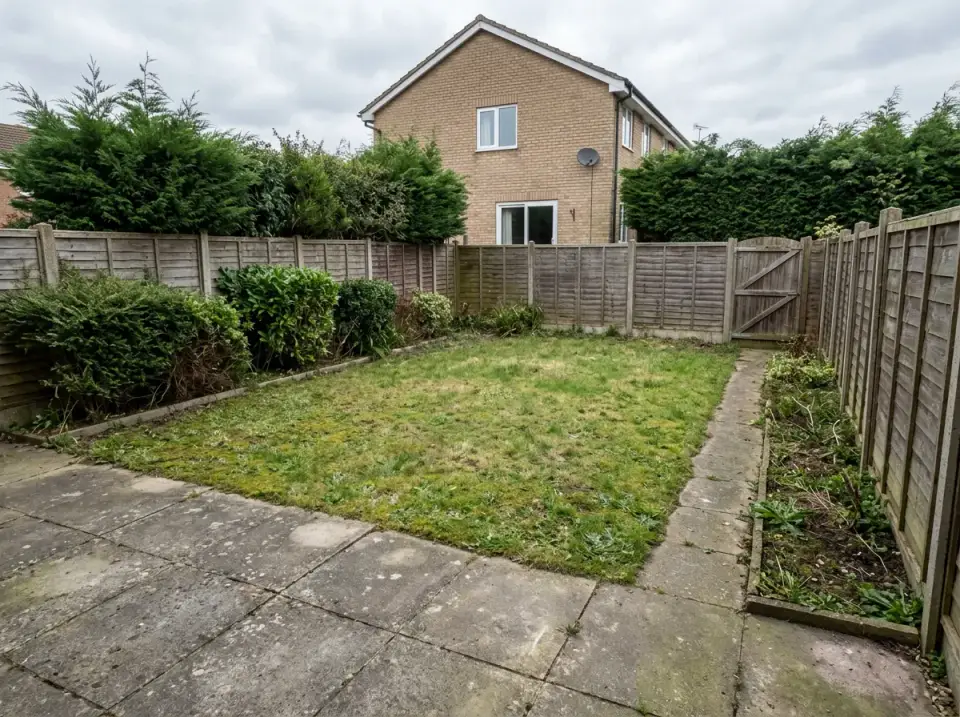
Reader notes