


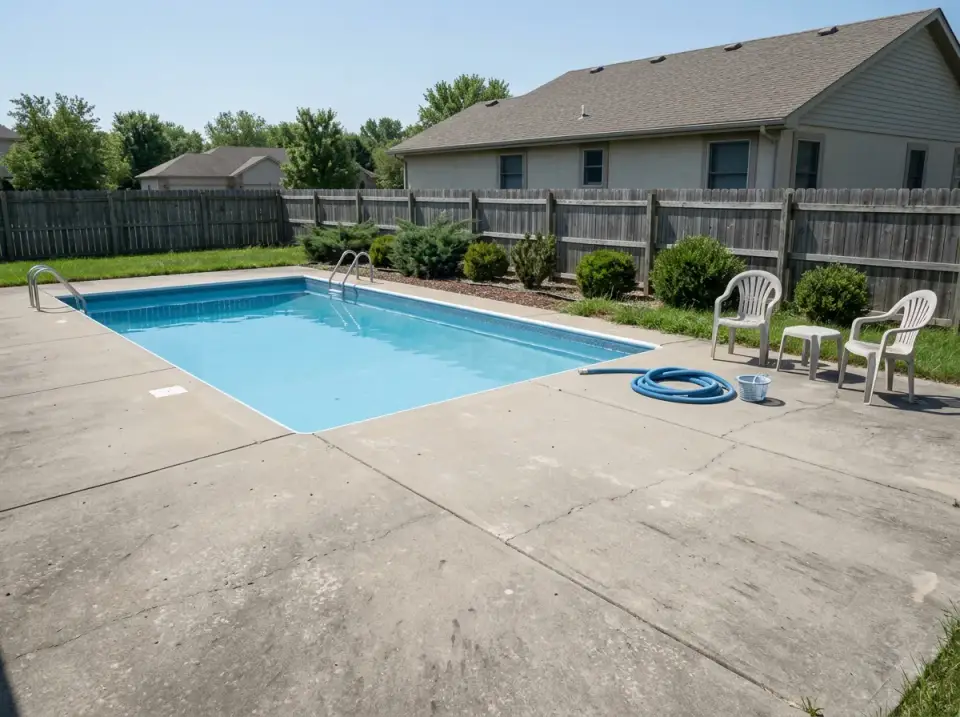
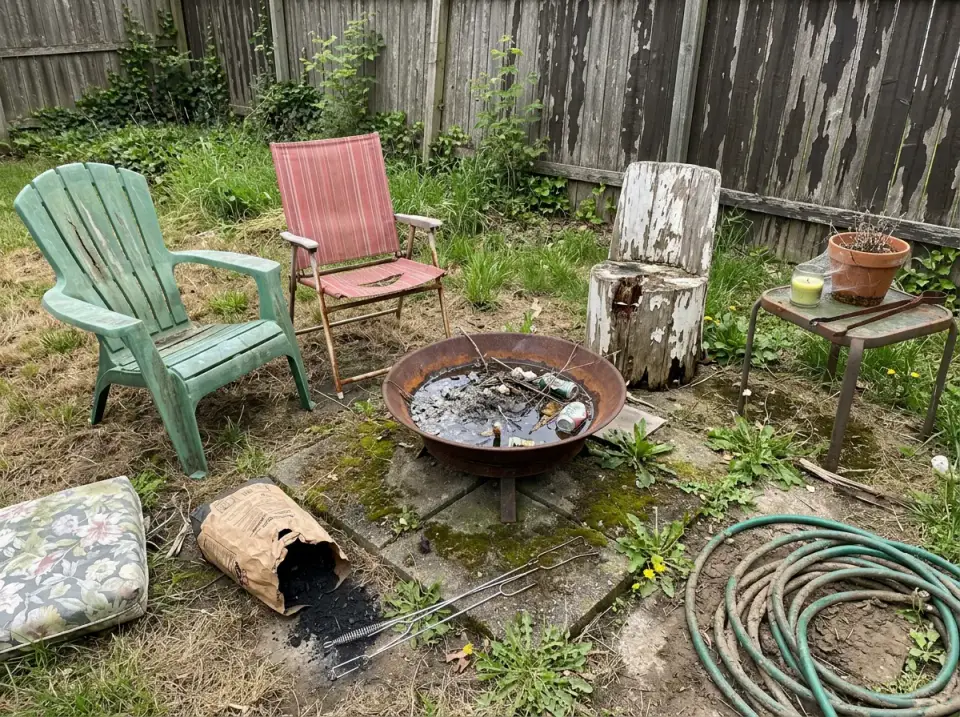
In Charleston, the same question comes up almost every spring: what do you do with the tired ornamental pond the previous owner left behind? The basins all look identical from yard to yard: a cracking plastic liner, a half-collapsed brick ring, and a stacked-stone fountain that quit pumping two summers back. The fix isn't ripping it out. It's rethinking the surround. Below, the same suburban pond is styled eleven different ways, holding the water shape constant and changing only the coping, the fence, the planting palette, the lighting, and the architecture behind it. One basin becomes a Lowcountry coastal courtyard, a Naples tropical hideaway, a Scandinavian minimalist pool, and a noir nightscape, which shows the pond is rarely the problem. The layers you build around it are.
Rustic Twilight Garden Room
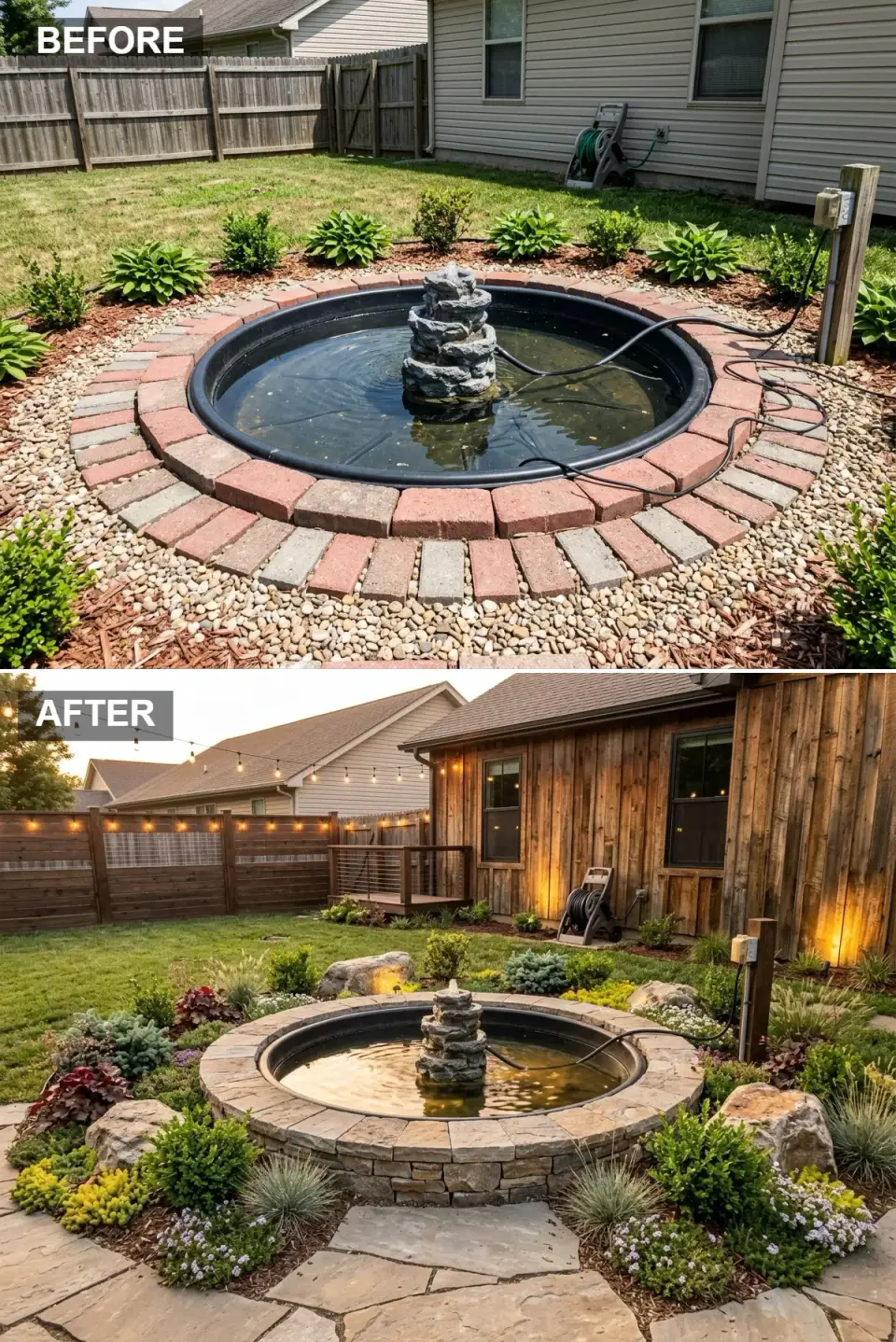
Of the eleven, this rustic version changes the most surfaces while leaving the basin exactly where it was. The brick ring is gone, and a stacked Tennessee fieldstone wall now wraps the old tub, with only its black lip still showing at the waterline, while oversized random-ashlar flagstone replaces the gravel apron. The vinyl siding behind it is reclad in vertical Western Red Cedar; a local mill is a better source than big-box pine, because the grain holds a warmer tone as it weathers. Along the boundary, a horizontal slat fence stained in Cabot Semi-Solid Espresso carries small lights on its top rail. After sundown the corner depends on its lighting: warm-white café bulbs on a catenary cable overhead, and 2700K spike uplights tucked behind the boulders and washing the cedar wall. The yard ends up reading as a layered Southern garden room, not a forgotten back patch.
Two browns and a gray do most of the work in this scheme. Burnished Cedar, a Dark Brown (#5D4037), covers both the vertical siding and the stained fence, so the house wall and the boundary read as one dark wooden enclosure. Flagstone Taupe, a Warm Gray (#BDB0A0), belongs to the big pavers and the stacked coping, keeping the hardscape a shade lighter than the timber around it. The glow is Antique Gold, an Amber (#C5A059) that is really the color of the string bulbs and of the 2700K spike lights on the wood, and Charcoal Roof (#424242) picks up the architectural shingles and the dark window frames.
The stacked wall earns its place for more than looks: dry-laid stone on a compacted base locks the pond perimeter against frost heave, which the loose brick never could. Put the 2700K uplights on a separate circuit from the café bulbs so the boulders can stay lit late without the whole yard glowing. The small cable-rail deck by the back door is worth copying as well, since it gives a flat facade a proper step down into the garden. For the evergreens and boulders that close the far corner, buy at least 7-gallon container sizes so the planting looks settled in its first season.
Zen Garden Retreat
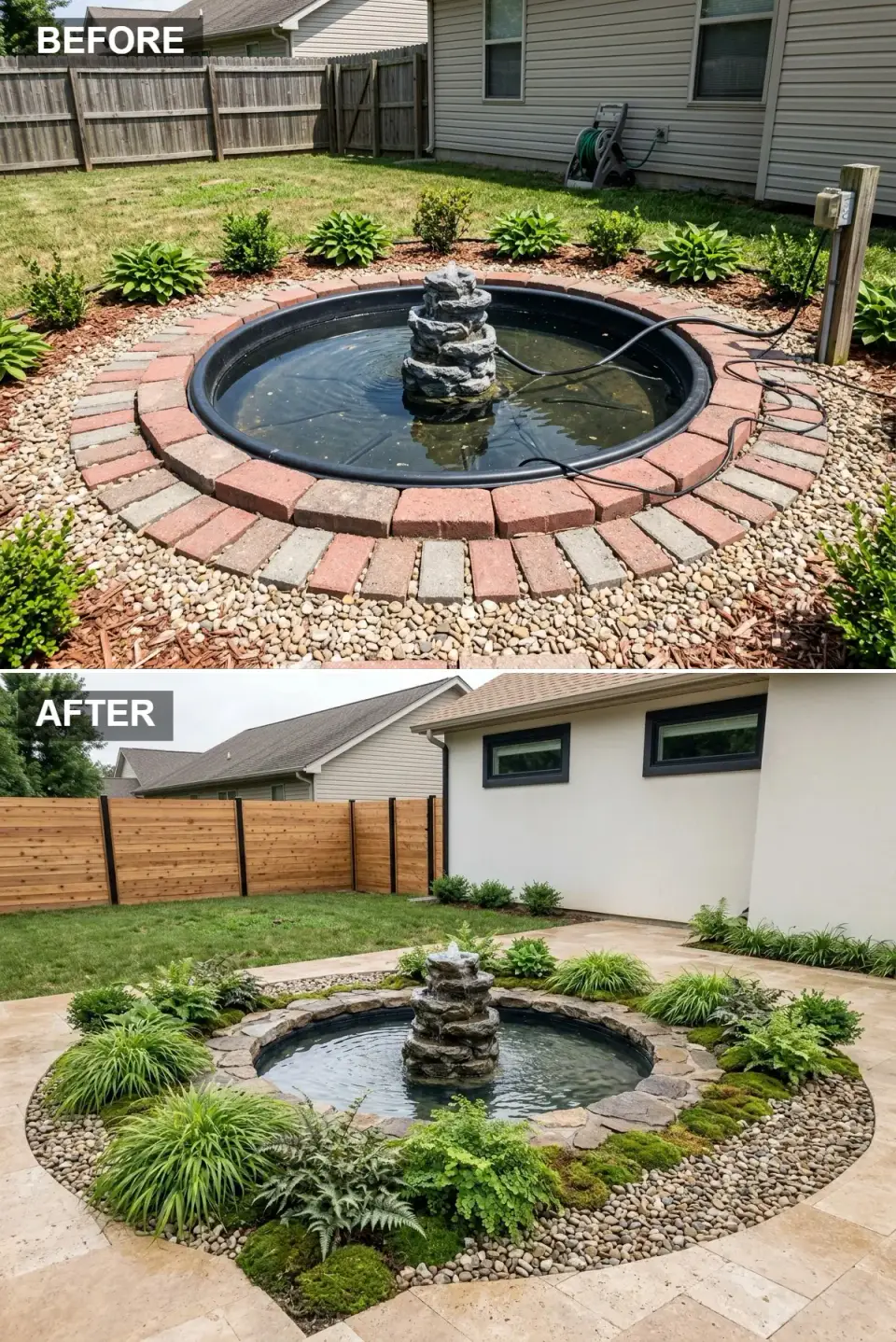
The circular brick border and black liner are reimagined with irregular natural flagstone laid loose, so the edge actually breathes into the planting beds. The patchy lawn gets replaced by Irish moss and Scotch moss between the stones, with shade-loving ferns and Japanese forest grass filling the back. The fence becomes horizontal cedar set on black powder-coated steel posts, a combination that suits a Mount Pleasant-style courtyard because the dark post line keeps the wood from looking suburban. The house gets smooth off-white stucco with matte-black window frames. The whole composition feels like a Charleston-meets-Kyoto courtyard.
Natural Cedar, a Light Brown (#D4A373), is the warmest thing in the frame, carried by the horizontal fence boards, and Cut Stone Beige (#E0D6C8) spreads a quieter version of that warmth across the large-format pavers that ring the planting bed. Stucco White, an Off-White (#F5F5F0), keeps the house wall plain enough to act as a screen for the ferns, while Iron Black (#212121) shows up only as thin lines: the window frames and the steel fence posts.
The flagstone edge is the change that makes this version work. Laid irregularly and lapping slightly over the water, it behaves like a stream bank instead of a ring, and the moss can creep right up to it. Irish moss and Scotch moss fill the joints and cover the bare soil around the basin, and both cope with Lowcountry humidity once established. Large-format cut stone on the surrounding patio keeps joint lines to a minimum, which suits the quiet read. In the image the original stacked fountain survives, and it is the one element still pulling against the calm; a single low basin or a bamboo spout would finish the idea more convincingly.
Coastal Formal Garden
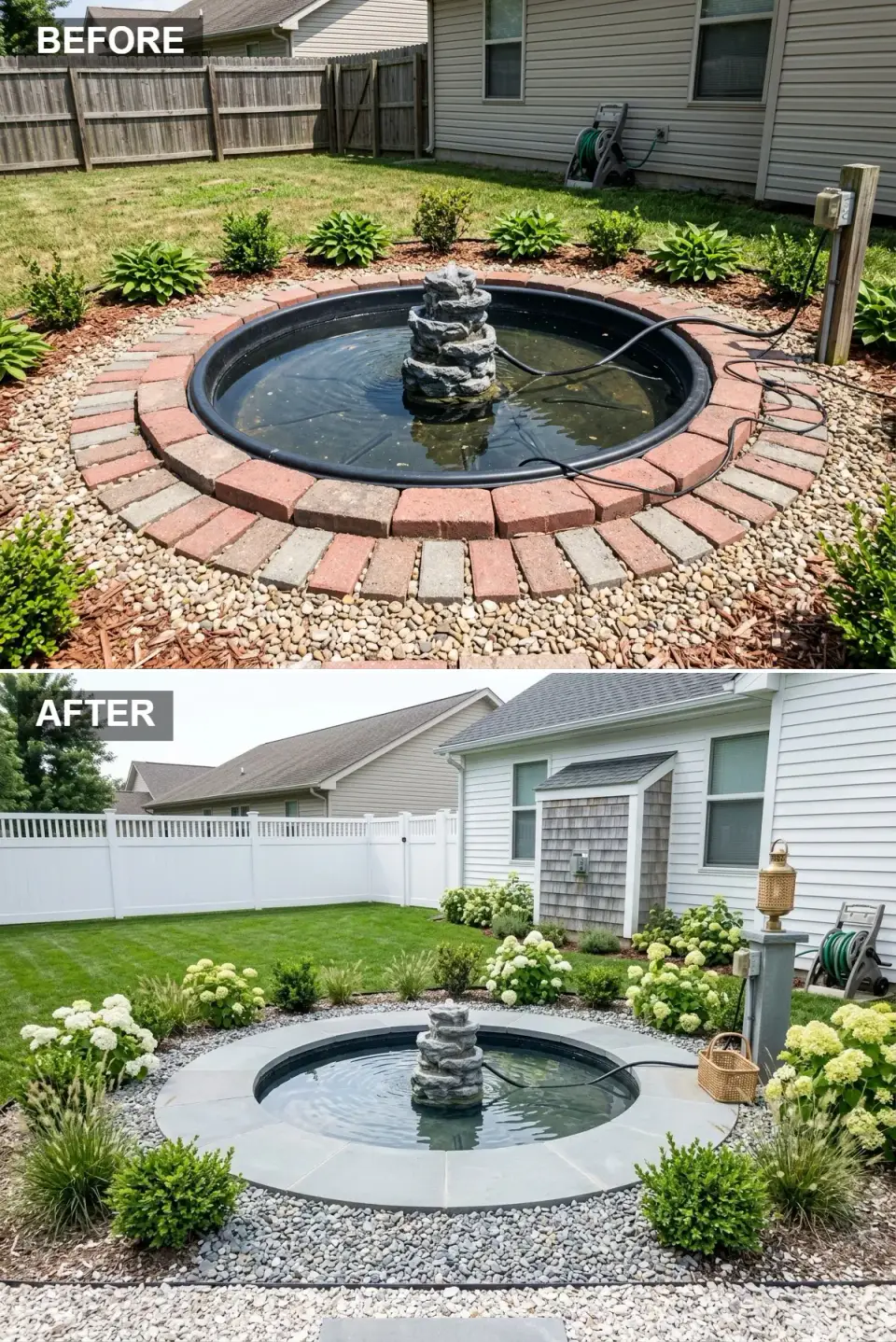
For a house downtown on South Battery, this is the most natural fit: Charleston formality with a Hamptons accent. The brick-and-gravel pad is traded for smooth cool-gray bluestone coping with a wide, thermal-finish top that doubles as informal seating. The old wooden fence comes out entirely in favor of crisp white vinyl board panels, a higher-grade Bufftech-style profile and not the cheapest big-box version. The house is repainted in Benjamin Moore Simply White, and the small utility bump-out gets a skin of cedar shakes. Annabelle hydrangea globes alternate with clipped English boxwood around the basin, and a Bevolo-style brass lantern on a gray pillar beside the pond adds a note of Lowcountry character.
Coastal White, a Pure White (#FAFAFA), is shared by the vinyl fence and the Simply White siding, so the backdrop reads as one bright plane. Against it, Bluestone Gray, a Cool Gray (#8E9EAB), holds the coping and the accent gravel in a cool band that frames the water. Warmth enters only in small doses: Cedar Shake, a Tan (#A1887F), on the weathered shingles of the bump-out, and Antique Brass, a Brass (#B5A642), on the lantern.
Order the bluestone as 2-inch-thick thermal-finish coping with a top broad enough to sit on; that width is what lets the rim in the image read as designed seating and not a plain edge. Annabelle hydrangea and English boxwood in an alternating rhythm give formal structure from the first season, and both handle partial shade in zone 8. A better vinyl profile from Bufftech or CertainTeed, with proper column caps and textured boards, comes much closer to painted wood than budget panels do. Underfoot, a mix of gray pea gravel, 1-inch stone and a few accent cobbles gives the smooth coping something to play against. One Bevolo-style or Charleston gas-effect lantern on a pillar is plenty; it marks the vertical line without turning a pond corner into an entry court.
Modern Farmhouse Pondscape
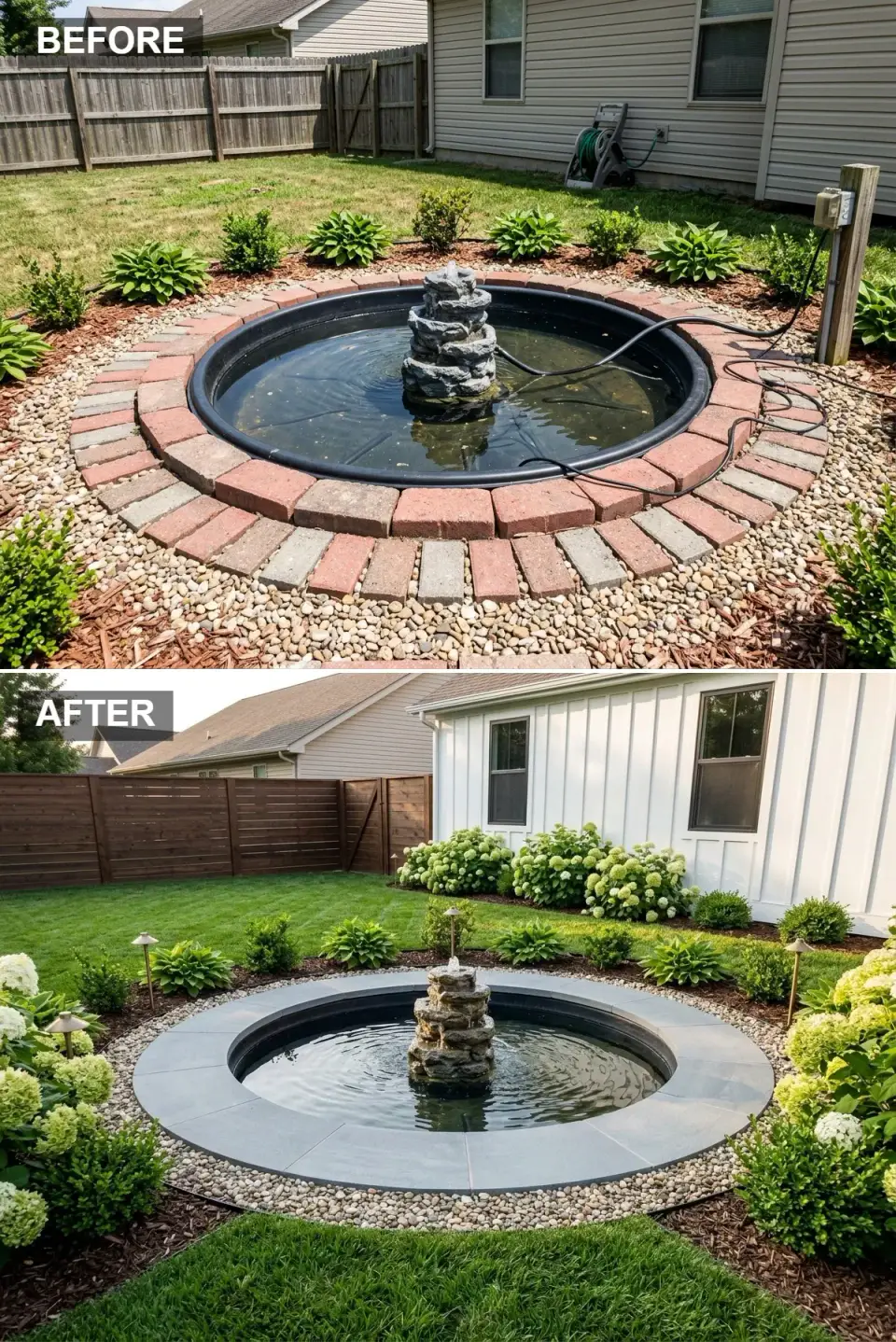
The dated brick ring and plastic tub get streamlined with wide, smooth gray concrete coping. A 12-inch top dimension is the sweet spot for visual presence on a small basin. The tired wooden fence shifts to rich espresso horizontal planks, which read as a quiet backdrop rather than a focal point. The house goes board-and-batten in James Hardie or LP Smartside, painted a soft farmhouse white. Annabelle hydrangea returns, but now it's rhythmically paired with classic hostas and structured bronze path lighting from Kichler or Hinkley. A clean compacted-aggregate gravel ring defines the pond perimeter. Every element feels intentionally chosen.
Farmhouse White, a Crisp White (#F0F0E8), covers the board-and-batten wall, and Espresso Brown, a Dark Brown (#3E2723), is kept for the horizontal fence, so the two big planes sit in clear contrast. Concrete Gray, a Medium Gray (#9E9E9E), belongs to the wide poured coping, while Bronze (#8D6E63), listed as Bronze Path Light, appears only on the small mushroom-cap lights spaced around the bed.
A smooth 12-inch coping top gives a small tub the presence of a custom basin, so pour that first and let the rest follow. The bronze path lights are best as low-voltage fixtures from a midline maker such as Kichler or Hinkley, wired to a properly sized 12V transformer so the run can grow later. Hosta and Annabelle hydrangea repeated at a steady interval keep the planting simple, and a compacted-aggregate gravel band three to four inches wide between bed and coping stops mulch from washing into the water. The white board-and-batten against the espresso fence is enough contrast to read modern farmhouse without leaning on the trend.
Minimalist Zen Retreat
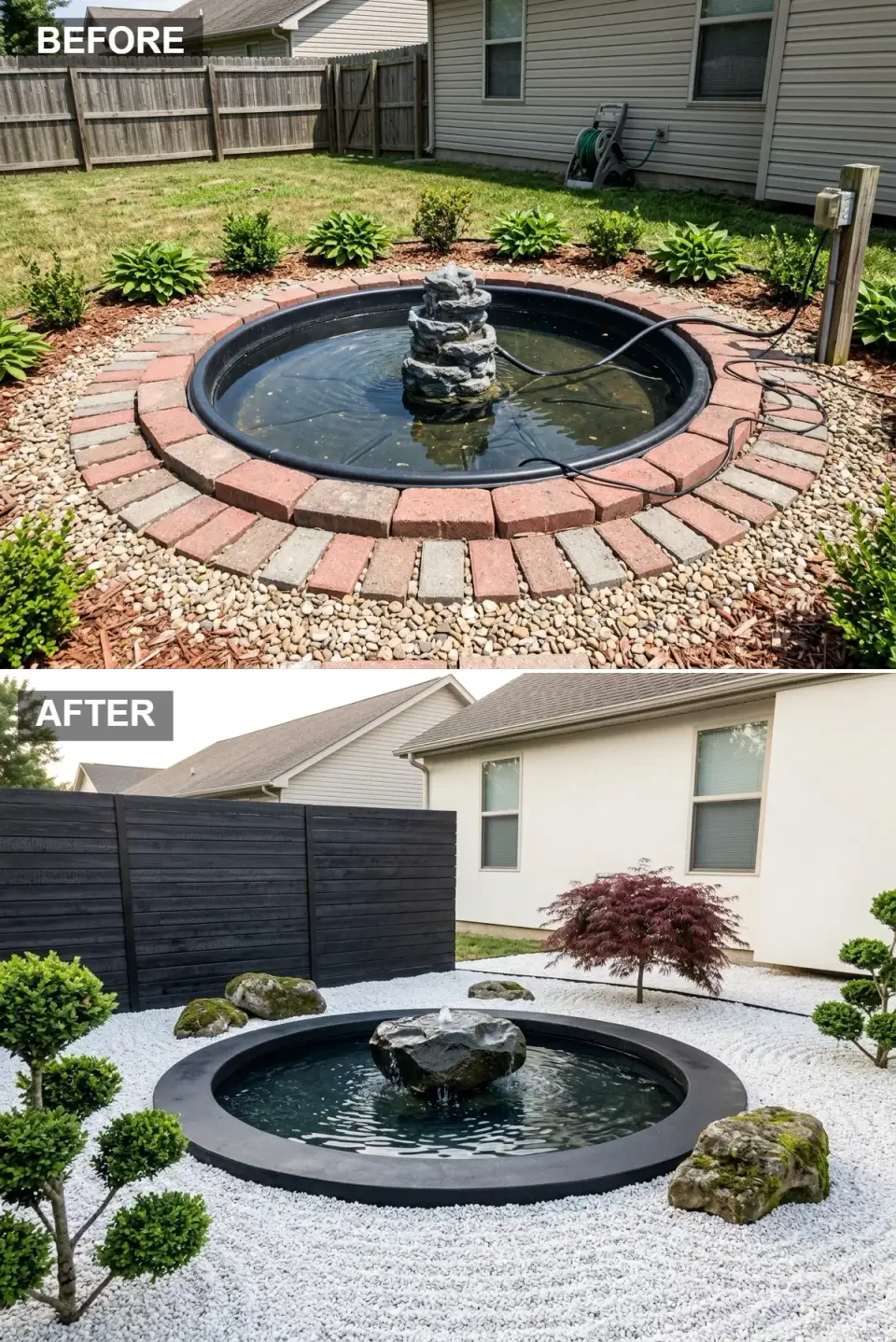
Restraint is the whole point of this version. Every kitschy element goes: the tiered stacked fountain, the red mulch, the patchy turf. The tub gets a thin black powder-coated steel rim, and a single dark boulder bubbler sits in the middle of the water where the stacked rocks used to be. The ground plane becomes white pea gravel raked into lines, with moss-covered accent boulders and cloud-pruned niwaki specimens at the edges. One Bloodgood Japanese maple supplies the only crimson in the frame, set against the black-stained fence and the cream stucco wall. The composition works like a small art installation in which every piece either earns its place or leaves.
Ink Black, a Jet Black (#1A1A1A), ties together the fence, the pond rim and the dark stone of the fountain, and Bleached White, a Pure White (#F5F5F5), answers it in the pea gravel that covers almost everything else. The house wall softens that contrast with Cream Stucco, a Cream (#F5F5DC), and Moss Stone, a Gray Green (#7D8471), lives only on the mossy boulders, the quiet midtones between the two extremes.
Swapping the tiered tower for one boulder or a basalt column is the decisive move, because a minimalist scheme can carry only one sculptural gesture. The white pea gravel needs raking every week; without that habit the look turns neglected within a month. Turf should go entirely around the feature, which cuts mowing and keeps the frame clean. Any single specimen maple can do the job the Bloodgood does here, Crimson Queen and Tamukeyama included. For the edge, a thin black steel rim or a honed concrete lip suits the scheme, whereas bullnose stone adds bulk it cannot absorb.
Desert Xeriscape Garden
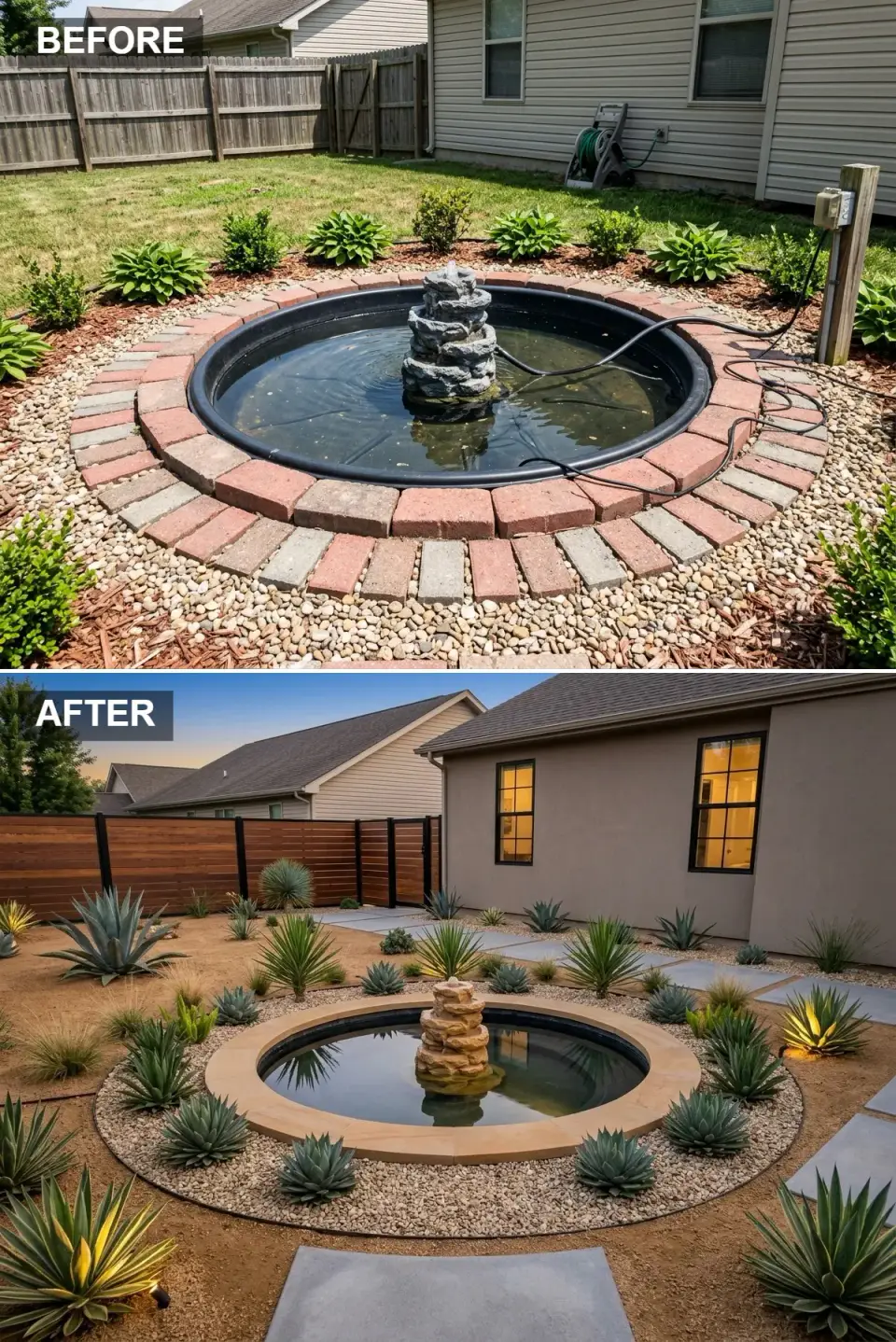
This isn't a Southern look, but it suits a Naples winter rental whose owner wants the resort feel of Scottsdale without the maintenance of turf. The Midwestern pond gets transplanted into a sun-baked xeriscape with warm sandstone coping and a tan stacked fountain. The thirsty lawn comes out entirely, replaced by decomposed granite with dramatic Agave parryi, blue-green Yucca rostrata, and golden barrel cactus. Large gray concrete pavers float through the scene as a stepping path. The house is rendered in warm taupe stucco, and golden 2700K uplighting at the base of the agaves casts long sculptural shadows. The look feels like a high-end Sonoran resort.
Sandstone Tan, a Tan (#D2B48C), sits in the pond coping and the stacked fountain, and Desert Taupe, a Taupe (#B8A088), stretches across both the stucco wall and the decomposed granite, so house and ground read almost as one surface. Cedar Amber, an Amber Brown (#A16E4B), gives the horizontal fence a warmer note behind the agaves, and Slate Paver, a Blue Gray (#78909C), cools the large stepping stones that float through the gravel.
Agave parryi, Yucca rostrata and golden barrel cactus make the right trio for full sun and low water, and they look better spaced out on open ground than massed together. Decomposed granite needs a compacted base and a stabilizer, or it ruts and tracks indoors; built properly, it drains and stays firm underfoot. Floating individual pavers in the gravel, instead of pouring a continuous path, leaves the planting in charge, and sandstone or another tan-toned material keeps the hardscape warm in late-afternoon light. Aim the 2700K uplights low and across the plants so their shadows land on the stucco and not in a neighbor's window.
Tropical Hideaway
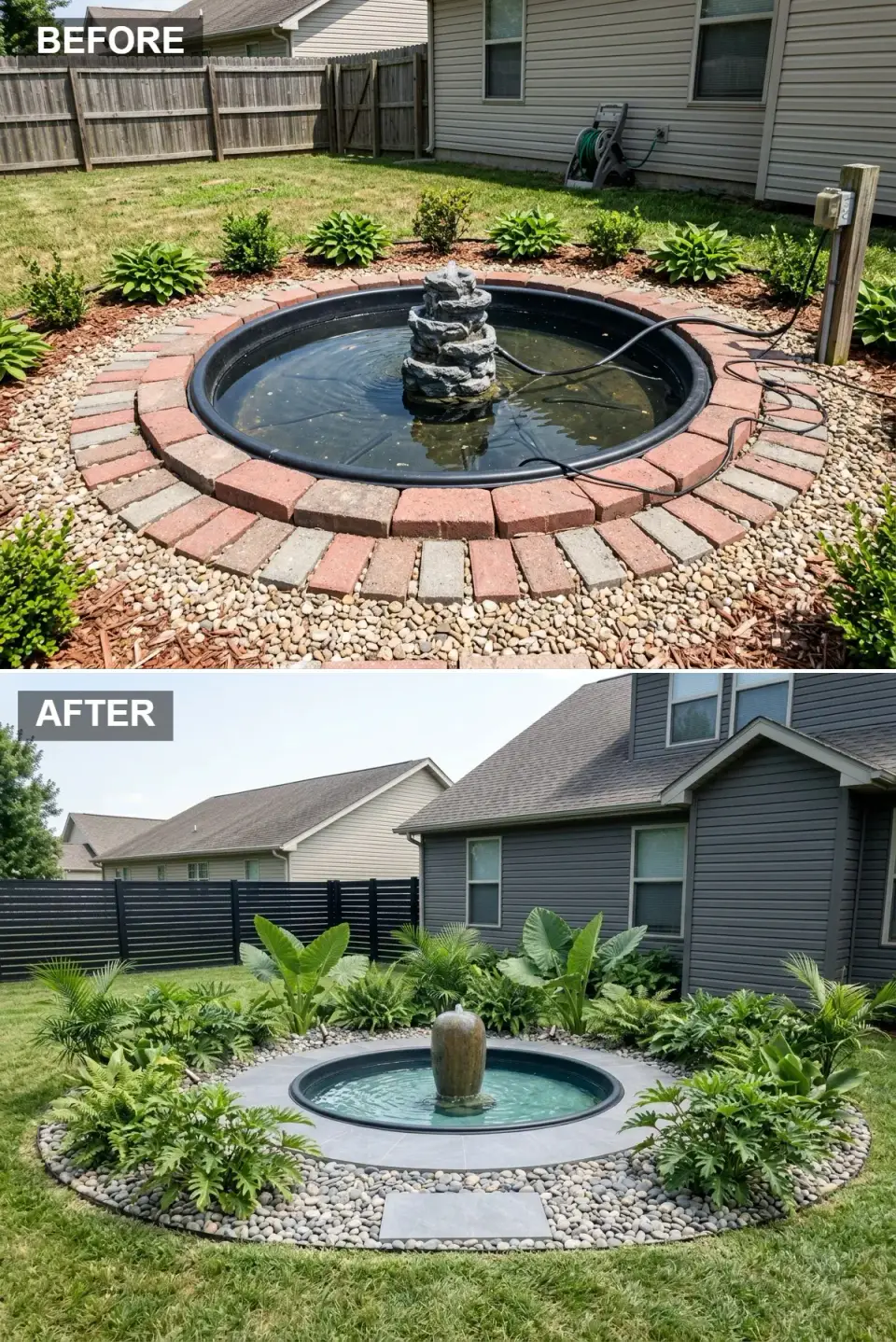
This version translates well to Naples and Ft. Myers yards. The modest fountain and brick ring get updated with smooth gray concrete coping and an elegant bronze urn bubbler; Aquascape's spillway urn is a common choice for this look. The sparse lawn explodes into a layered tropical understory: Colocasia elephant ear at the back, Sago palm for structure, queen palm for the canopy, and lady fern at the water's edge. The fence becomes a modern black slat panel, and the house is repainted a deep charcoal so it recedes behind the vibrant green. Mixed river rock and a single stone step complete a resort retreat that feels worlds away from the original suburban yard.
Charcoal Siding, a Charcoal (#37474F), lets the house fall back behind the leaves, and Concrete Sky, a Pale Gray (#B0BEC5), is the one light band in the scene, running around the coping and the single stone step. Bronze Urn, a Dark Bronze (#5D4037), colors the ceramic bubbler at the center, and Obsidian Fence, a Black (#212121), makes the slat fence nearly vanish against the foliage.
A tall urn or vase bubbler suits a basin up to about 8 feet long better than a stacked tower, because it puts one clean vertical among all that leaf. The planting needs layers to look tropical and not merely green: Colocasia elephant ear at the back, lady fern at the waterline, and one structural palm to break the canopy line. Dark paint such as Iron Mountain or Wrought Iron on the siding, together with the black fence, pushes the architecture back so the foliage carries the yard. The smooth gray coping is a deliberate contrast with the organic leaf shapes, and the band of mixed river rock between lawn and pond helps drainage while softening the transition to the liner.
Industrial Twilight Courtyard
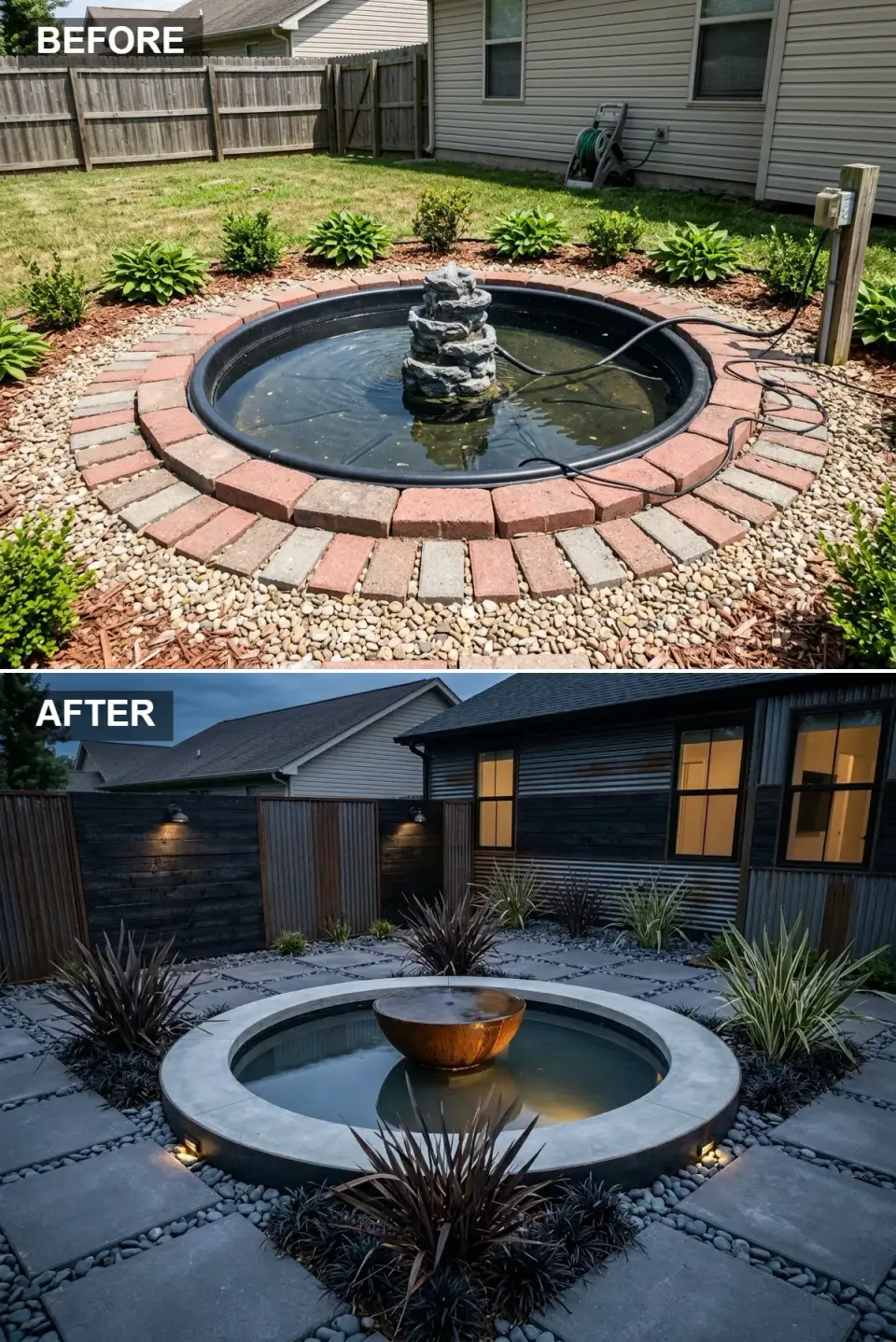
The basic plastic pond gets encased in thick raw concrete coping (specify a 4-inch-tall, 14-inch-deep board-formed pour) and paired with a statement copper bowl fountain that glows under integrated LED strip lighting. The yard becomes large square concrete slabs separated by dark river rock joints. The fence shifts into a textural composition of shou sugi ban charred cedar and Galvalume corrugated steel panels. The house echoes the same palette: dark vertical siding with metal accents. Spiky black phormium and dark-leafed New Zealand flax reinforce the moody, contemporary read. After dark, the LED strip turns the pond edge into a hovering line of light.
Raw Concrete, a Neutral Gray (#9E9E9E), runs through the board-formed coping and the square pavers, giving the whole floor one mineral tone. Burnished Copper, a Copper (#B87333), is the only warm color, concentrated in the bowl fountain that glows after dark. Charred Wood, a Dark Brown (#3E2723), covers the shou sugi ban fence panels and the lower siding, and Corrugated Steel, a Steel Gray (#78909C), alternates with it on both the fence and the house.
The board-formed coping, 4 inches tall and 14 inches deep, is what gives a modest tub real architectural weight, so it is the line item not to economize on. The copper bowl will patina with time, which only makes it read warmer at night against the gray paving. Alternating shou sugi ban cedar with Galvalume corrugated panels gives the fence texture and a mix of matte and ribbed surfaces. An LED strip at 2700K tucked under the coping overhang makes the basin appear to float after dark, and dark spiky foliage (black phormium, New Zealand flax, Black Mondo grass) keeps the planting inside the moody palette.
Southwestern Pop
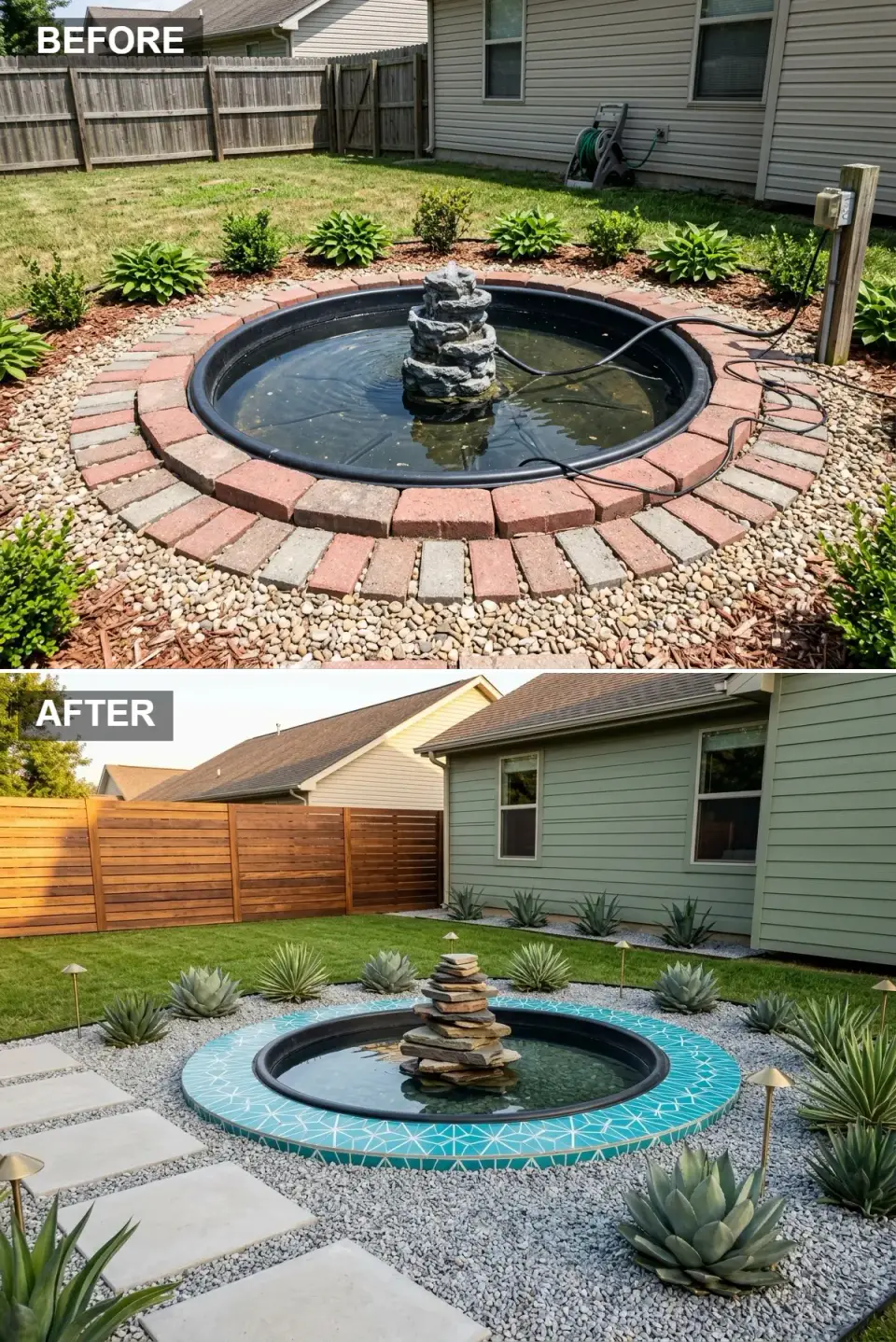
The forgettable brick trim gets traded for a vibrant turquoise mosaic tile ring: hand-mixed Talavera-style pieces, sourced from a specialty tile yard rather than big-box. The stacked fountain becomes a balanced stone cairn that feels artistic rather than kitschy. The lawn gives way to gray gravel and sculptural agave americana planted in a tight rhythm. Clean white concrete stepping stones lead to the feature, and a warm cedar fence contrasts beautifully with the sage green house; specify Sherwin Williams Evergreen Fog or Halcyon Green for that exact reading. Brass path lights dot the scene. The generic pond becomes outdoor art.
Turquoise (#40E0D0) is the loudest color in the article, set into the mosaic ring around the water as Turquoise Mosaic, and Sage Siding, a Sage Green (#8FBC8F) close to SW Halcyon Green, keeps the house quiet enough to let it lead. Cedar Warmth, a Warm Brown (#CD853F), is the horizontal fence, and Gravel Gray, a Pale Gray (#CFD8DC), covers both the gravel field and the concrete stepping stones.
Hand-mixed Talavera or Mexican Saltillo tile on the coping is what turns a basic basin into the centerpiece, and it only works because everything around it stays neutral: gray gravel underfoot and plain white pavers leading in. A balanced cairn of flat stones replaces the tiered tower and suits the regional vocabulary better. Keep the siding a muted sage (SW Halcyon Green or Evergreen Fog) so it supports the turquoise without competing, and repeat Agave americana at even spacing around the gravel to give the bed its Southwestern structure.
Scandinavian Minimalist Pool
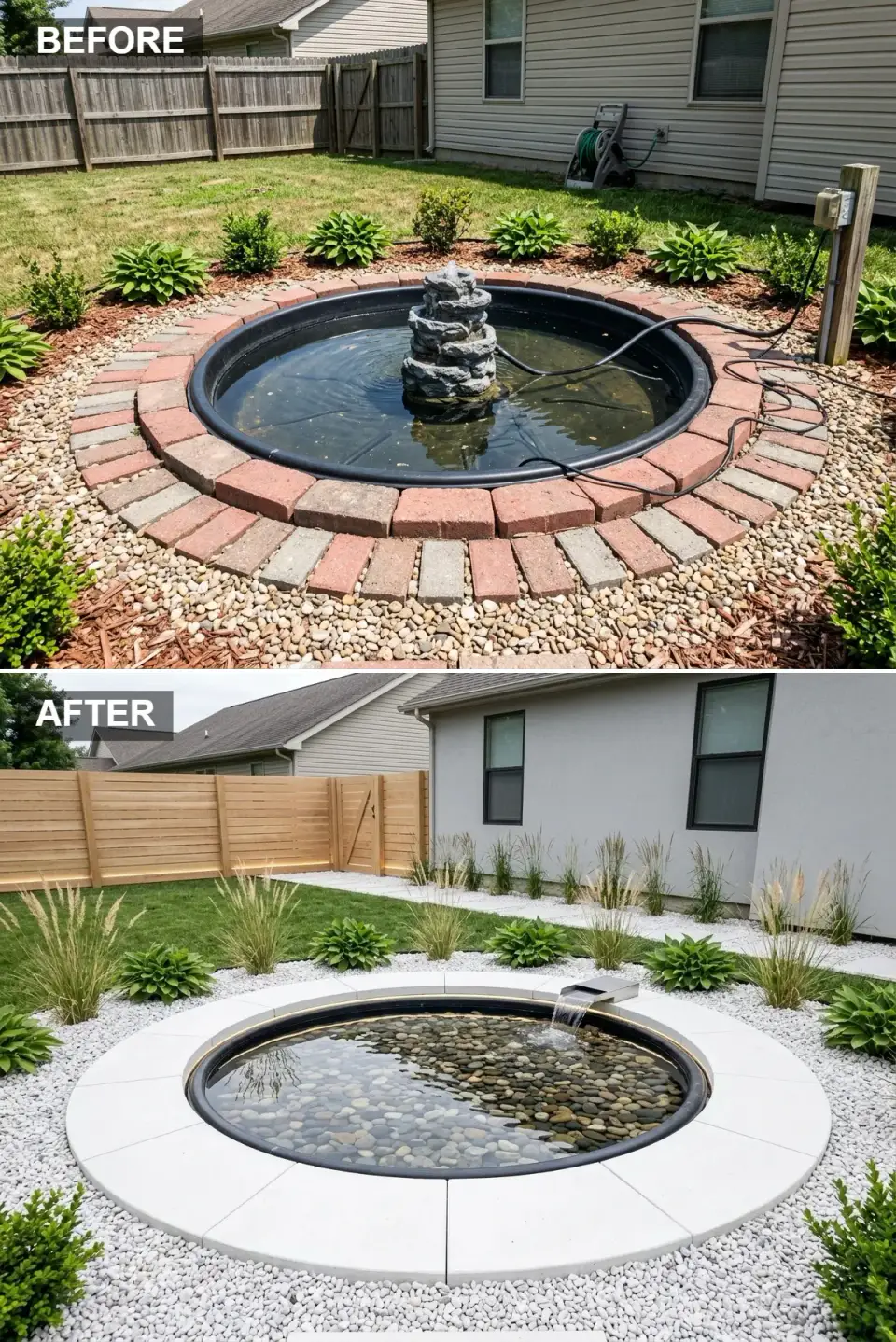
The Nordic version is the calmest of the set. Brick and gravel are stripped away for pure white poured concrete coping, and the water itself becomes part of the design, clear enough to show a smooth river-rock bottom. A brushed stainless steel scupper set into the coping replaces the fountain and lets a thin laminar sheet fall into the basin. Ornamental fescue and a few hostas stand in disciplined order in white gravel. The fence turns to pale birch-tone horizontal planks with a soft light along its base, and the house wall is a light dove gray. Nothing in the yard competes for attention, which is exactly the Scandinavian brief.
Pure White, listed as White (#FFFFFF), is both coping and ground, so the pond sits in a bright field, and Pale Birch, a Blonde Wood (#E8DCC4), gives the fence a light natural warmth. Soft Gray, a Light Gray (#B0BEC5), is the house wall and the concrete pavers beside it, and Stainless Steel, a Silver (#C0C0C0), appears in one place only: the brushed scupper.
The scupper gives a clean architectural water sound and a thin laminar fall that a central fountain cannot match. White concrete and white pea gravel bounce daylight back into the yard, and the fescue and hostas should stay in repetitive rows to hold the visual order. Along the fence base, a 3000K LED strip gives a floating effect after dark with no visible fixtures. Because the design depends on clear water, size the UV clarifier properly; once the river-rock floor clouds over, the idea is gone.
Noir Nightscape
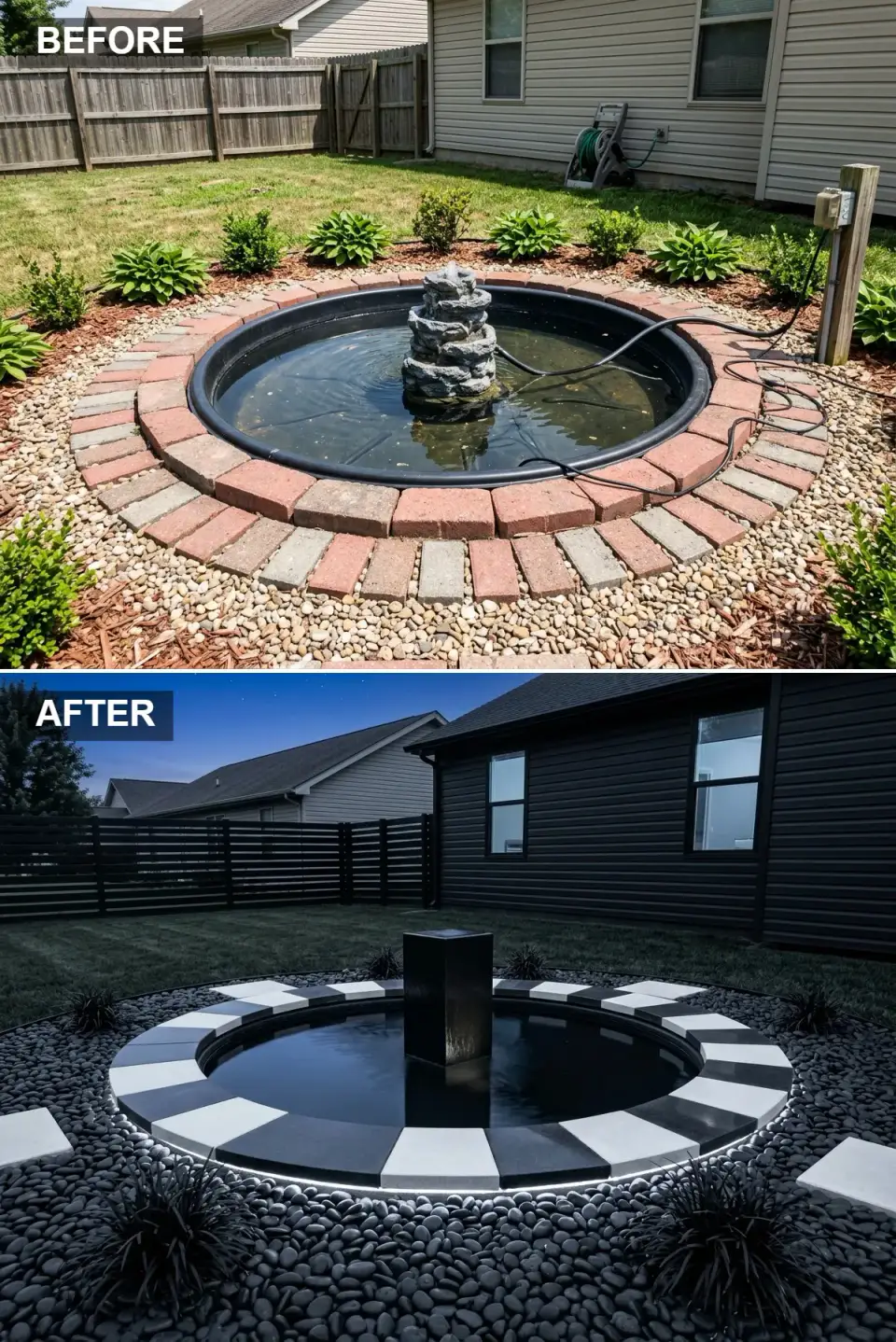
The noir version is the loudest of the eleven, and it earns the volume. Black-and-white checkerboard stone coping, lit from beneath by hidden LED strips, pushes the suburban pond to a graphic extreme. A monolithic black square fountain rises from the inky water and echoes the black horizontal fence and the darkened siding; Sherwin Williams Tricorn Black is the reference we would use. Around the basin, color drains away into black river rock and low tufts of Black Mondo grass, and Black Magic taro is the plant to add if more height is wanted. Against deep twilight, the yard reads like a stage set and not a residential garden.
Obsidian Black, a Black (#0A0A0A) firmly in SW Tricorn Black territory, covers the house, fence, fountain and river rock, and Chalk White, listed as White (#F8F8F8), appears only in the alternating coping segments and the two light step pads beside the ring. Midnight Blue, a Deep Blue (#1A237E), is borrowed from the twilight sky, and Slate Gray, a Gray (#424242), fills the darker coping squares, where honed stone reads a shade lighter than the black around it.
Honed black and white stone segments are what make the coping graphic, and the contrast holds by day and by night. A 2700K strip tucked under the pond edge gives the ring a lifted glow once the sun drops. One geometric fountain, a square steel basin or a basalt block, is the only sculpture this scheme needs. The planting should favor silhouette over hue (black gravel, Black Mondo grass, Black Magic taro), and the architecture wants a matte deep black such as Tricorn Black or Wrought Iron, which absorbs light and lets the lit hardscape stand out.
Pro Tips & Advice
Start with the pond edge. Swapping plastic or basic brick coping for natural stone, board-formed concrete or hand-mixed tile does more for the look of the whole yard than any other single change on this list, because the edge is the line your eye follows around the water. Once that is settled, treat the fence and the house siding as one backdrop rather than two separate surfaces. When their tones and materials are coordinated, the water feature reads as the focal point instead of competing with a busy wall behind it.
Lighting needs at least three layers to work: overhead ambient light from string lights or pendants, low-voltage path lights or uplights, and a concealed LED strip tucked under the coping. A pond only becomes a place people walk out to after dark when that layer is built properly. The fountain should also speak the same architectural language as the house. Stacked stone reads rustic, a basalt column reads zen, a stainless scupper reads Scandinavian, and an urn bubbler reads tropical or coastal; pair the wrong one with the wrong setting and the layered effect falls apart.
Two practical moves protect the investment. Replace the turf right around the pond with gravel, pavers or dense ground cover, since lawn beside water brings mud splatter, mower damage to the liner and a maintenance loop that never ends. Then buy the surrounding plants in 7-gallon or larger containers. Nursery starts in 1-gallon pots look thin for a full year and work against the designed feel from the first day.
Frequently Asked Questions
What budget does a full backyard pond transformation need?
The honest estimated range in the Lowcountry runs from about $1,800 for a homeowner-led coping and planting refresh up to $22,000 to $30,000 for a full hardscape, fence, and lighting integration done by a landscape contractor. The single highest-impact spend is the coping swap: a stacked-stone or board-formed concrete edge typically falls in the $1,200 to $3,500 range installed and changes the visual reading more than any other line item.
Does the pond have to be drained completely to upgrade the coping?
For most stone or concrete coping upgrades, yes, at least partially. Drop the water level to about six inches below the existing edge so the masonry crew can work dry. Fish and aquatic plants can hold in a 100-gallon stock tank with a battery aerator for 24 to 48 hours, which is the typical install window for a basin under 200 gallons.
Which fountain style works best for a small suburban pond?
Match the fountain to the architectural language of the house, not to the pond itself. Stacked stone reads rustic Southern, basalt column or simple bamboo spout reads zen, stainless scupper reads Scandinavian or modern, urn bubbler reads tropical or coastal. A craftsman bungalow paired with a stainless scupper feels wrong every time, because the architecture sets the language and the fountain finishes the sentence.
What plants thrive right at the pond edge in the South?
For Charleston's zone 8b range, lean on cardinal flower, Louisiana iris, dwarf horsetail (planted in submerged pots to control spread), creeping jenny, lady fern, and Japanese forest grass. For Naples and Ft. Myers in zone 10, shift to Colocasia elephant ear, lady palm at the back, and ruellia. The rule is the same in both: pick three textures (broad-leaf, fine grass, vertical blade) and repeat them around the perimeter.
How can a backyard pond be lit without looking gaudy?
Build three discrete layers. First, submerged LED for water animation. Second, low-voltage 2700K spike uplights aimed at architectural plants or boulders. Third, ambient overhead: string bulbs on a catenary cable, a pendant over a deck, or hidden coping strip lighting. Keep all visible fixtures matte black or bronze, never bright nickel, and avoid blue-tinted LEDs at all costs. The color temperature of bargain pond lights is what makes them read cheap.
Will replacing turf with gravel around the pond create drainage problems?
Only if you skip the base prep. Excavate four inches, lay woven landscape fabric (not the cheap non-woven version), add three inches of compacted ¾-inch crushed aggregate, then top with one inch of decorative gravel. A properly built gravel ring actually drains better than the compacted clay soil that sits beneath suburban lawn, which is usually why the pond surround was muddy in the first place.
Sources & References
- Aquascape Inc.: Industry-leading manufacturer of pond kits, urn fountains, and spillway bowls; technical guides on basin sizing, pump matching, and UV clarification.
- Fine Gardening Magazine: Editorial coverage on water-feature plant pairings, regional zone performance, and pond-edge design across U.S. climate ranges.
- The Spruce (Landscape and Outdoor): Practical homeowner guides on pond renovation budgeting, fountain selection, and turf-replacement methods.
- American Society of Landscape Architects (ASLA): Professional standards for residential water features, drainage best practices, and sustainable hardscape design.
- Pond Trade Magazine: Trade publication covering pond construction, equipment specifications, and contractor-grade installation methods.
- Garden Design Magazine: Editorial features on residential water-feature design across rustic, zen, modern, and coastal style families.
- University of Florida IFAS Extension: Plant performance data for southern climate zones, particularly Naples and Lowcountry tropical/coastal applications.
What the Eleven Versions Have in Common
From sludgy back-corner basin to designed water feature, these eleven versions show the pond itself is rarely the problem. The same suburban shape can live as a Charleston coastal courtyard, a Naples tropical hideaway, a Scandinavian minimalist pool, or a noir nightscape. What changes is the coping, the fence, the planting palette, the lighting, and the paint behind it all. Build those five layers with intention and the pond stops apologizing for the previous owner.
For a broader rework of the whole yard, our 12 backyard transformations walkthrough covers the larger hardscape and structure moves, and From Mud Pit to Paradise shows the same approach on bigger Southern lots. Bed structure and planting layers that suit these pond schemes are covered in Outdoor Garden Design. When the house itself needs the work, with fence, siding and color decided together, One Home, Eleven Personalities applies the same eleven-style method to the architecture.

Transformations Desk
The Layered Homes editorial teamThe Transformations Desk produces the before-and-after design studies: one imagined starting space (a room, a facade, a backyard) shown in several design directions, each with a palette and a cost estimate.
More from the Transformations Desk →
Reader notes