


Most game rooms have the same problem from day one: they were assembled rather than designed. Plastic storage bins, wire shelving, and a basic flush mount get dropped into a spare room around expensive gaming equipment, and the resulting space feels less like a retreat than a tech warehouse. The thirteen makeovers below trade that assembled energy for considered interior architecture across very different aesthetics, from cinematic moody dens to bleached-oak Japandi studios to Art Deco salons. Each room sketch includes a four-color palette and a short list of styling notes written the way they would go onto a mood board.
The Obsidian Lounge: Dark Luxury Gaming Den
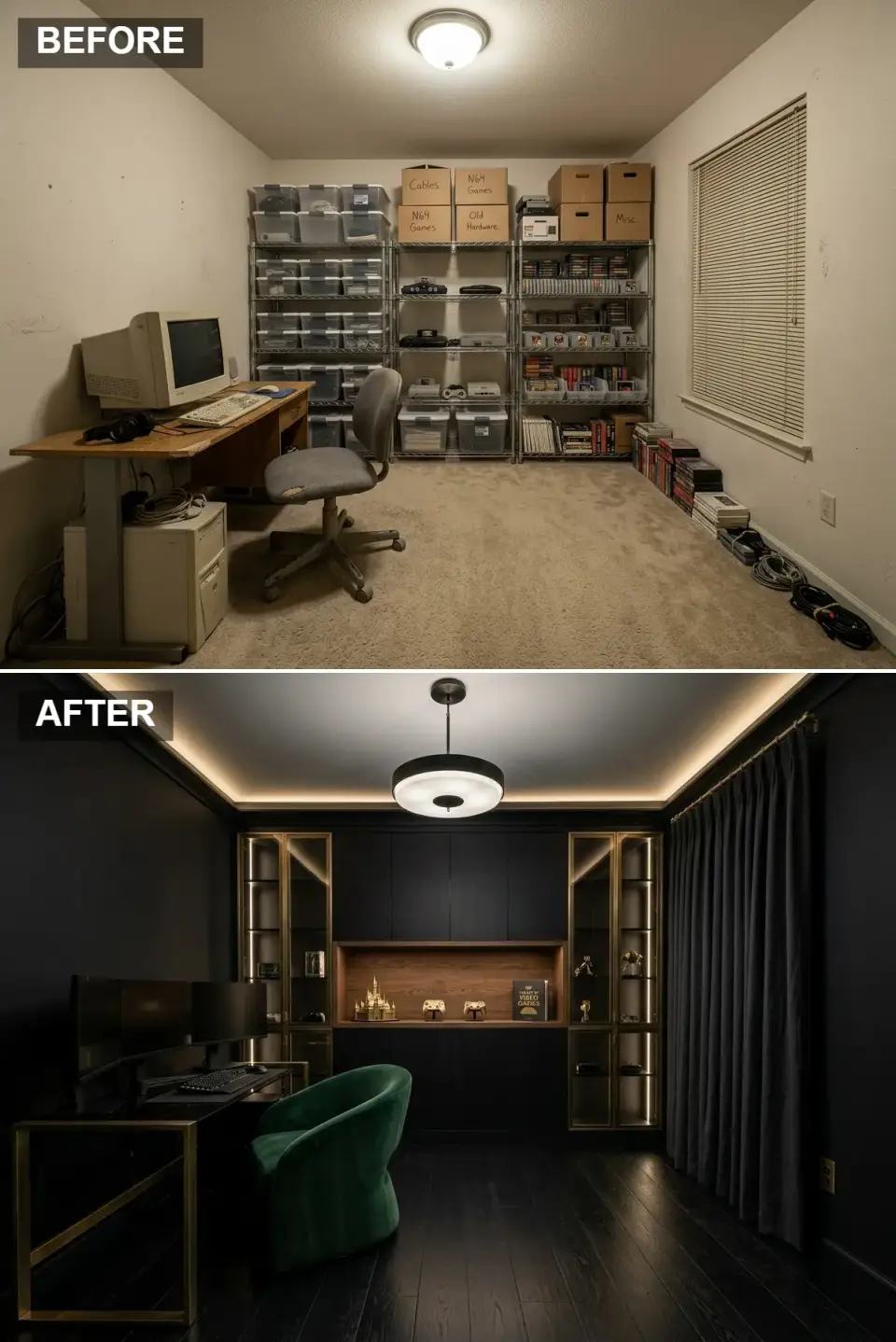
The Before image suffocates under beige carpet and chaotic wire shelving. In this configuration the popcorn ceiling and basic flush mount give way to a recessed LED perimeter and one sculptural black pendant, and the back wall is wrapped in matte black built-ins with brass trim and glass vitrines so the controllers and memorabilia read as a deliberate collection rather than a plastic bin graveyard. A walnut display niche adds warmth against the charcoal envelope, an emerald velvet chair brings the jewel-toned focal point, and heavy charcoal drapes replace the dusty blinds for both blackout coverage and acoustic value during long sessions.
Almost every surface in this den is painted Matte Black (#141414), the Midnight Charcoal that covers the walls, the ceiling and the cabinet doors so the edges of the room disappear once the cove light comes on. Against that, Burnished Brass in an Aged Gold tone (#B8943F) draws thin lines around the two glass vitrines and the open desk frame, which is why the cabinets read as display cases rather than more black boxes.
Only two other colours are allowed in. The tub chair is upholstered in Emerald Velvet, a Deep Green (#0B6623) that is the single saturated note in the rendering. Smoked Walnut (#3D2817), described as a Dark Wood, lines the central display niche; note that the floor in the image is stained nearly black rather than walnut, so if you want that warmth underfoot as well, plan it as a separate finish choice.
Design Notes
Lighting is the first fix in a dark game room. Cove or perimeter LED lighting washes the ceiling with a soft glow and ends the reliance on a single overhead fixture. Storage comes next: replace open wire shelving with matte built-ins behind integrated glass doors, a single move that turns a collection from clutter into an organized display. To keep the monochrome cabinetry from feeling relentless, add a contrasting wood tone in one display alcove, which also draws the eye toward the prized collectibles.
Textiles do two jobs here. Heavyweight floor-to-ceiling drapes in a matching charcoal tone black out screen glare and add acoustic dampening for immersive play. And one statement piece in a bold saturated fabric, such as the emerald velvet chair, anchors the dark room; that contrast is what keeps the space from going flat.
Scandi Serenity: A Breath of Fresh Birch
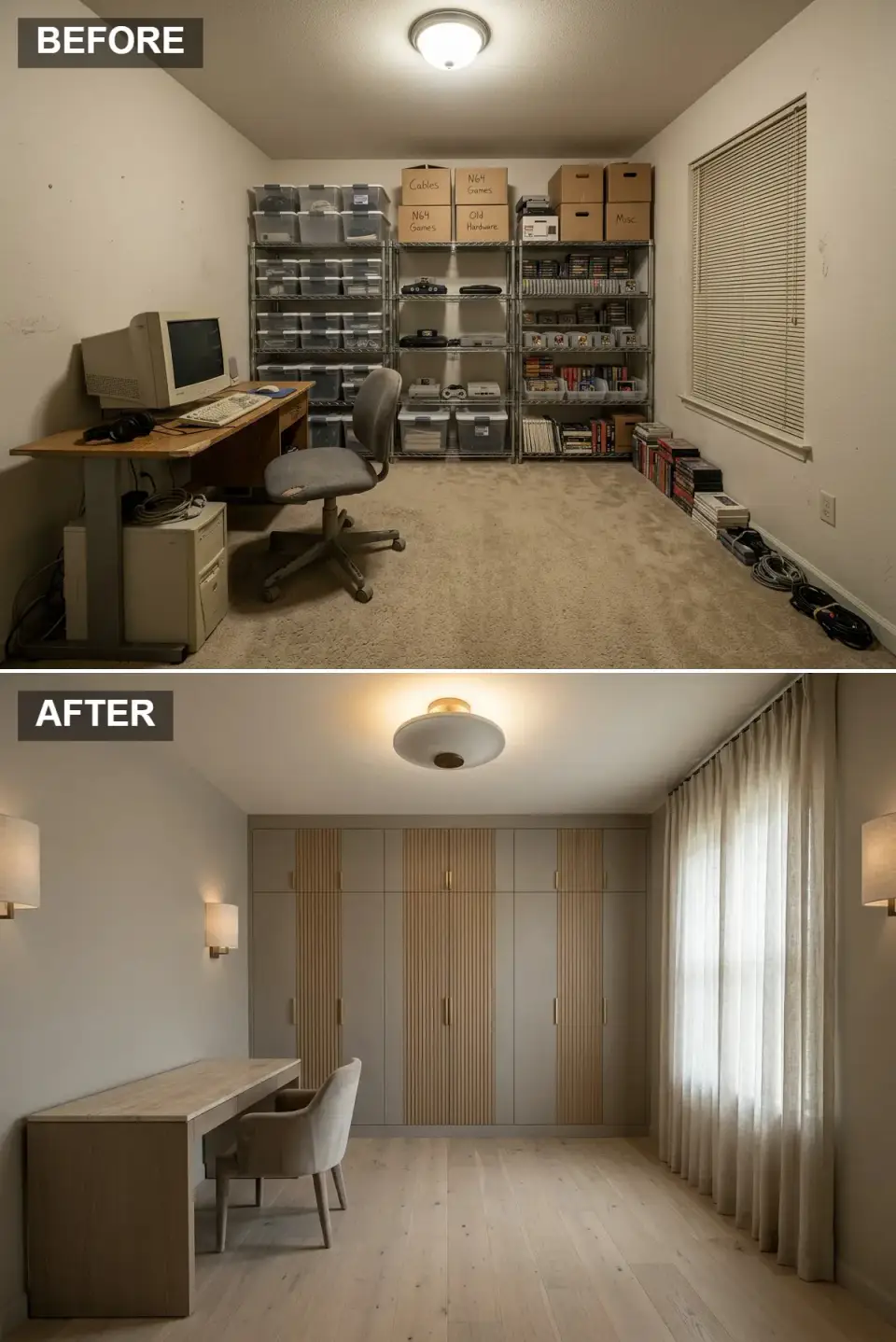
The chaotic Before, choked by labeled cardboard boxes and metal racks, gets fully erased here in favor of Japandi minimalism. Pale bleached oak flooring amplifies natural light, and the back wall becomes a continuous bank of cabinets in warm greige with fluted oak fronts and slender brass pulls, hiding all storage behind clean panels. A simple wooden desk, a tailored linen-hued chair, paired wall sconces, and a refined flush mount layer the light at three different heights. Sheer ivory curtains soften the window and turn the former dump into a meditative digital retreat.
The fluted wall carries most of this palette. Its flat doors and the walls around it share Greige (#D6CEC2), listed as Warm Linen, while the slatted panels between them are Fluted Oak in a Natural Wood tone (#C4A882), so the eye reads alternating stripes of paint and timber across the whole back wall. Underfoot, wide boards of Bleached Birch in Pale Oak (#E8DCC4) sit a shade lighter than the cabinets, and Soft Brass, a Champagne Gold (#C9B037), turns up only in the slim pulls, the sconce backplates and the rim of the ceiling light.
Design Notes
The floor makes the biggest difference in this direction. Swapping carpet for pale wide-plank hardwood can instantly double the perceived brightness of a north-facing game room. The cabinetry should stay quiet: specify handle-less or minimal-pull built-ins so controllers, cables and game boxes disappear behind a calm wall of paneling, and introduce fluted or reeded wood on the cabinet fronts for visual interest within the monochromatic scheme.
Light should be layered and soft. Wall sconces plus a central flush mount keep the mood gentle and free of shadow in a way one overhead source cannot. At the window, sheer floor-to-ceiling curtains diffuse harsh daylight and prevent screen glare without sacrificing the view.
Mid-Century Maverick: Walnut and Teal Cool
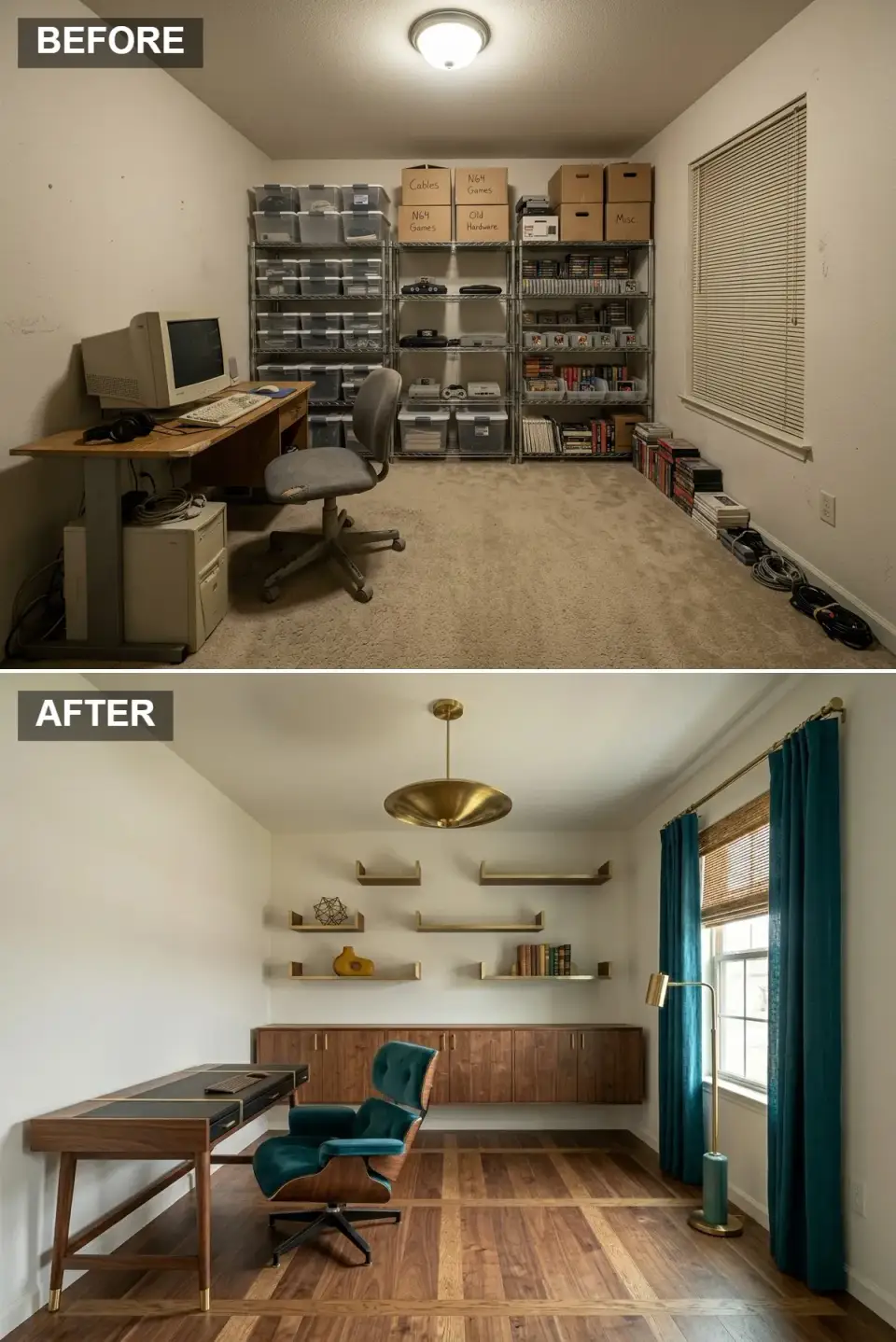
The Before's wire shelving and torn office chair give way here to a confident mid-century tableau. A walnut floating credenza with brass pulls now spans the back wall, capped by asymmetrical brass floating shelves displaying select tomes and sculptural objects. The beige carpet is replaced by graphic parquet flooring in varying walnut tones. A teal velvet Eames-style chair swivels before a brass-trimmed walnut desk, while a brass saucer pendant hovers overhead. Teal velvet drapes and a woven wood shade frame the window, channeling Don Draper into a space that finally respects its gaming heritage.
Walnut does the heavy lifting in this version: the floating credenza, the desk and the plank floor all sit in American Walnut, a Rich Brown (#6B4226), with lighter strips set into the floor to give it a banded, almost parquet rhythm. Teal Velvet in Deep Aqua (#0A6B6B) appears twice, on the lounge chair and on the long drapes, and that repetition is what makes the colour look planned. Aged Brass (#B5A642), a Warm Gold, runs through the floating shelves, the saucer pendant, the floor lamp and the desk's ferrules, while the walls stay Ivory Plaster in Soft White (#F2EFE9) so nothing competes with the wood.
Design Notes
The back wall is where this direction is won. Install a floating credenza beneath staggered wall-mounted shelves to reclaim floor space and create a lighter, more architectural composition. Then commit to a signature accent color such as teal and repeat it in at least two places, for example the chair and the drapes, which gives the room its mid-century confidence.
The ceiling fixture sets the era. Upgrading a basic fixture to an oversized brass saucer pendant establishes the period in a single swap and adds ambient uplight. Underfoot, parquet or geometric wood flooring brings pattern and lifts the room beyond standard planks. At the window, a woven wood shade paired with velvet drapes makes a layered treatment that controls light and adds texture.
Gatsby Gamer: Art Deco Opulence
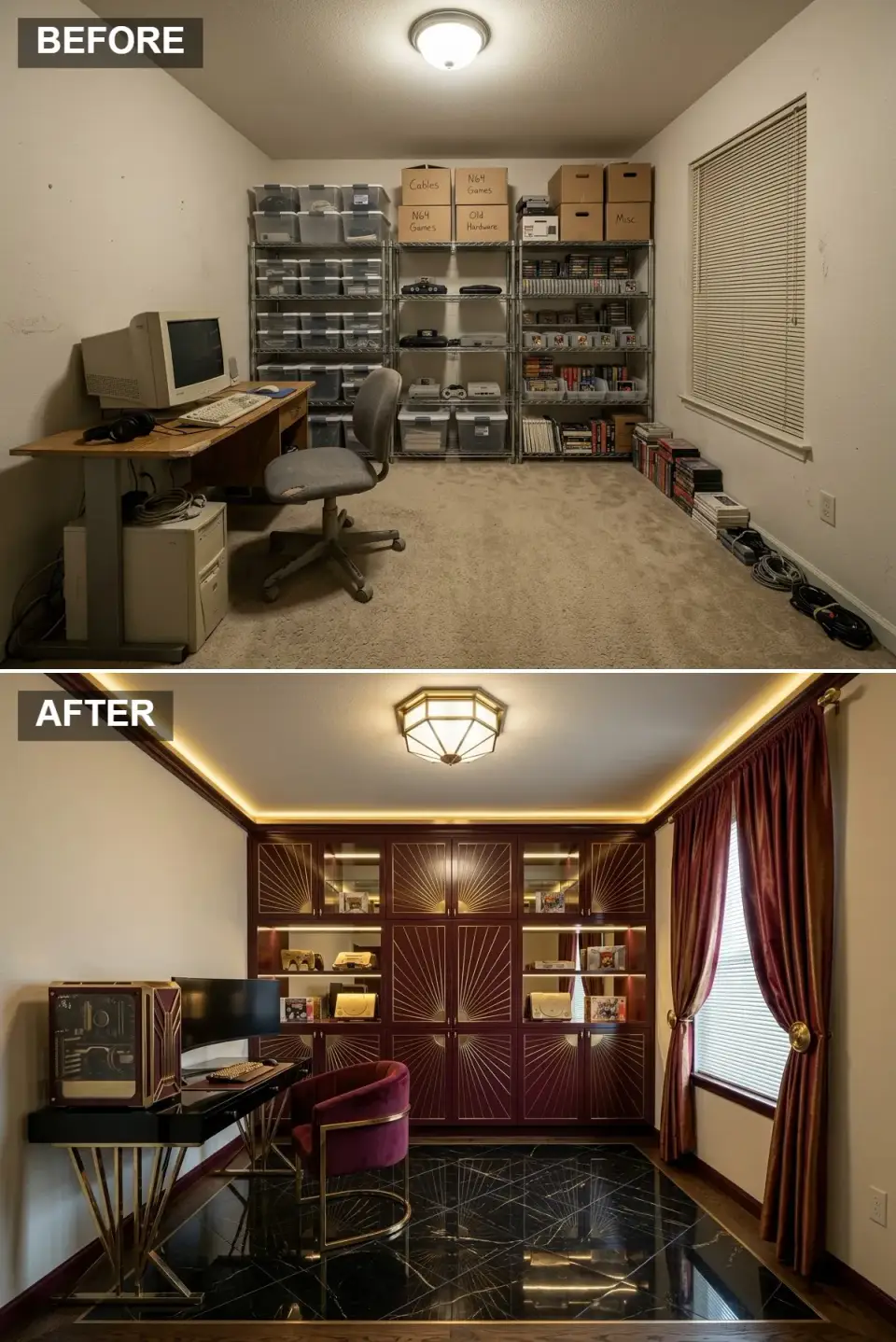
The Before room's utilitarian despair, industrial metal racks, stained carpet, and a bulky CRT, gets banished here in favor of roaring-twenties grandeur. The floor becomes a dazzling expanse of polished black marble with dramatic white veining bordered by dark wood. A custom burgundy built-in wall commands attention with gold sunburst inlays and glass cabinets lit from within. A matching burgundy velvet barrel chair with a gold frame pairs with a black lacquer desk on a gold geometric base. The ceiling features coved LED lighting and an octagonal faceted fixture, while heavy burgundy velvet curtains with gold tiebacks dress the window. Even the PC case wears gold sunburst armor.
Burgundy Lacquer, a Deep Merlot (#4A0404), is the colour that defines this room: it covers the full wall of built-ins and returns in the satin drapes, so cabinet and window read as one dark red mass. Each door carries a Gilded Sunburst inlay in Antique Gold (#C5A059), the same metal used for the chair frame and the splayed desk base.
The floor is a field of Nero Marquina tile, a Black Marble (#0D0D0D) with white veining and gold sunburst lines, bordered by a band of dark wood. Because the burgundy and black are so heavy, the walls are left in Ivory Stucco, a Cream White (#EDE8E0), which keeps the small room from closing in.
Design Notes
The floor is the investment in this direction. Polished black marble converts a humble spare room into a high-end entertaining space more decisively than any other single material. Symmetrical built-ins with repeating geometric motifs, sunbursts or chevrons, evoke Art Deco without relying on trendy decals, and echoing the cabinetry color in the upholstery and drapery (burgundy on burgundy) produces an enveloping, monochromatic richness.
Cove lighting along the ceiling perimeter casts a golden glow that highlights the crown molding and adds theatrical depth. Coordinate the technology with the decor as well: a custom PC case or peripherals that mirror the room's metallic motif keep the gear from looking like an afterthought.
Cloud White Curves: Soft Contemporary Retreat
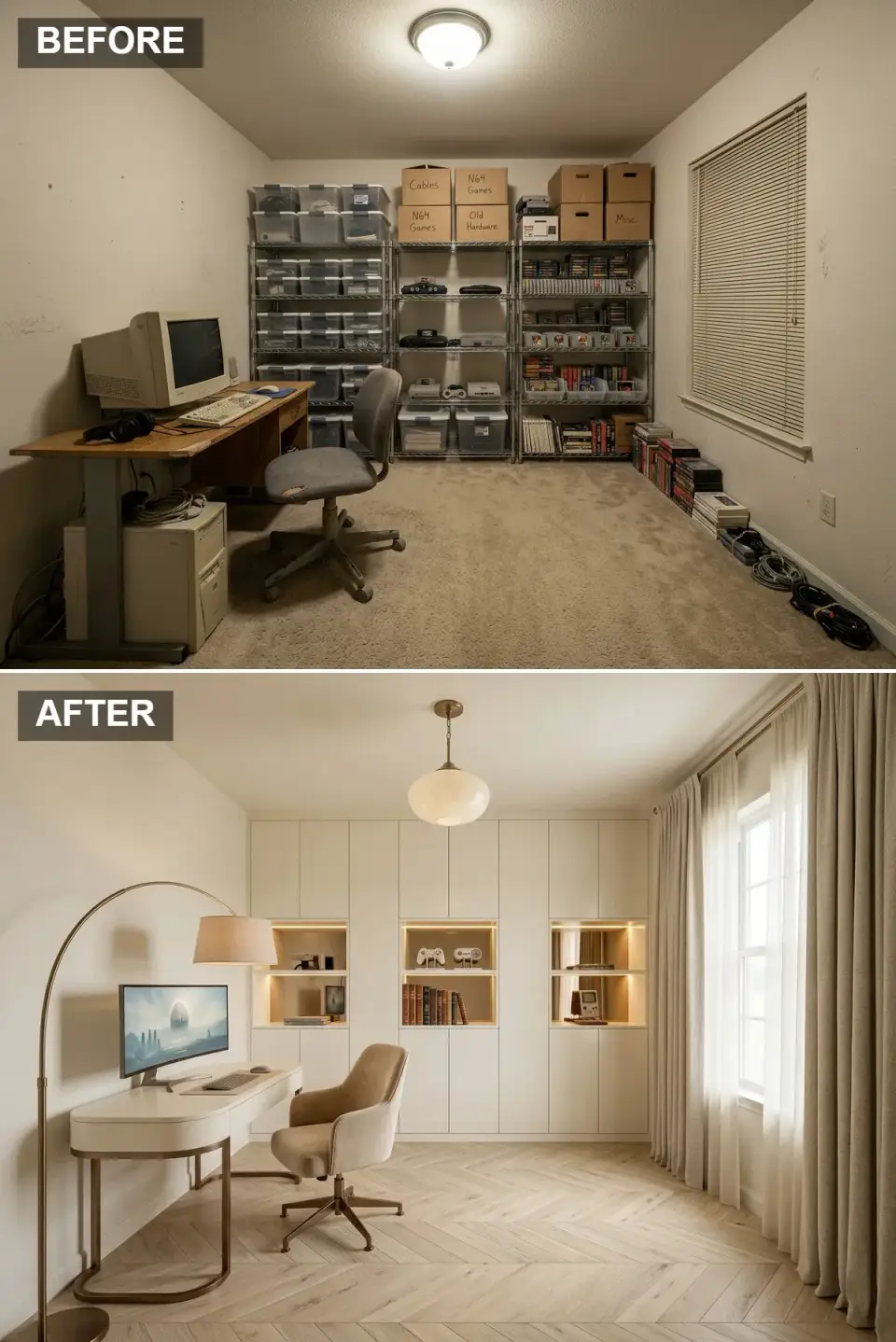
From the Before's jumble of plastic storage and dated PC towers, this configuration emerges as an ethereal cloud-like retreat. The entire room wraps in warm ivory, from the chevron oak floors to the continuous built-in wall. The back cabinet system features closed panels interspersed with softly lit open niches that showcase controllers and books like museum pieces. A curved white desk with a slender brass frame replaces the clunky wooden slab, paired with a plush taupe swivel chair. An arc floor lamp with a linen drum shade arcs over the setup, while a milky glass globe pendant floats overhead. Layered sheers and linen drapes filter sunlight into a gentle haze.
Nearly the whole room is one colour. Walls, the floor-to-ceiling cabinets and the curved desk are all Ivory Lacquer in Warm White (#F5F0E6), and the herringbone floor in Pale Oak Chevron (#E3D8C4), a Light Wood, is only a step deeper, so the boundaries between surfaces almost vanish. Two accents keep it from looking unfinished: Champagne Brass in Soft Gold (#C6B069) for the desk's looped frame, the arc lamp and the pendant fitting, and Warm Taupe, a Greige Velvet (#A89F91), on the swivel chair, the darkest object in the picture.
Design Notes
Curves soften the rigid geometry typical of most gaming setups, so select curved furniture such as a bow-front desk and a barrel chair. Wall color is just as important. Use a warm off-white rather than stark white on the walls and millwork; that single shift prevents the sterile laboratory feel so many minimalist rooms fall into.
Hidden LED strips inside the open cabinet niches turn controllers and books into illuminated objets d'art. At the windows, layer two types of treatment, sheer panels plus opaque drapes, to control glare during daytime sessions while keeping the look light and airy. A sculptural arc lamp frees up the desk surface and still provides direct task light for keyboard and mouse work.
The Executive Suite: Navy, Brass, and Marble
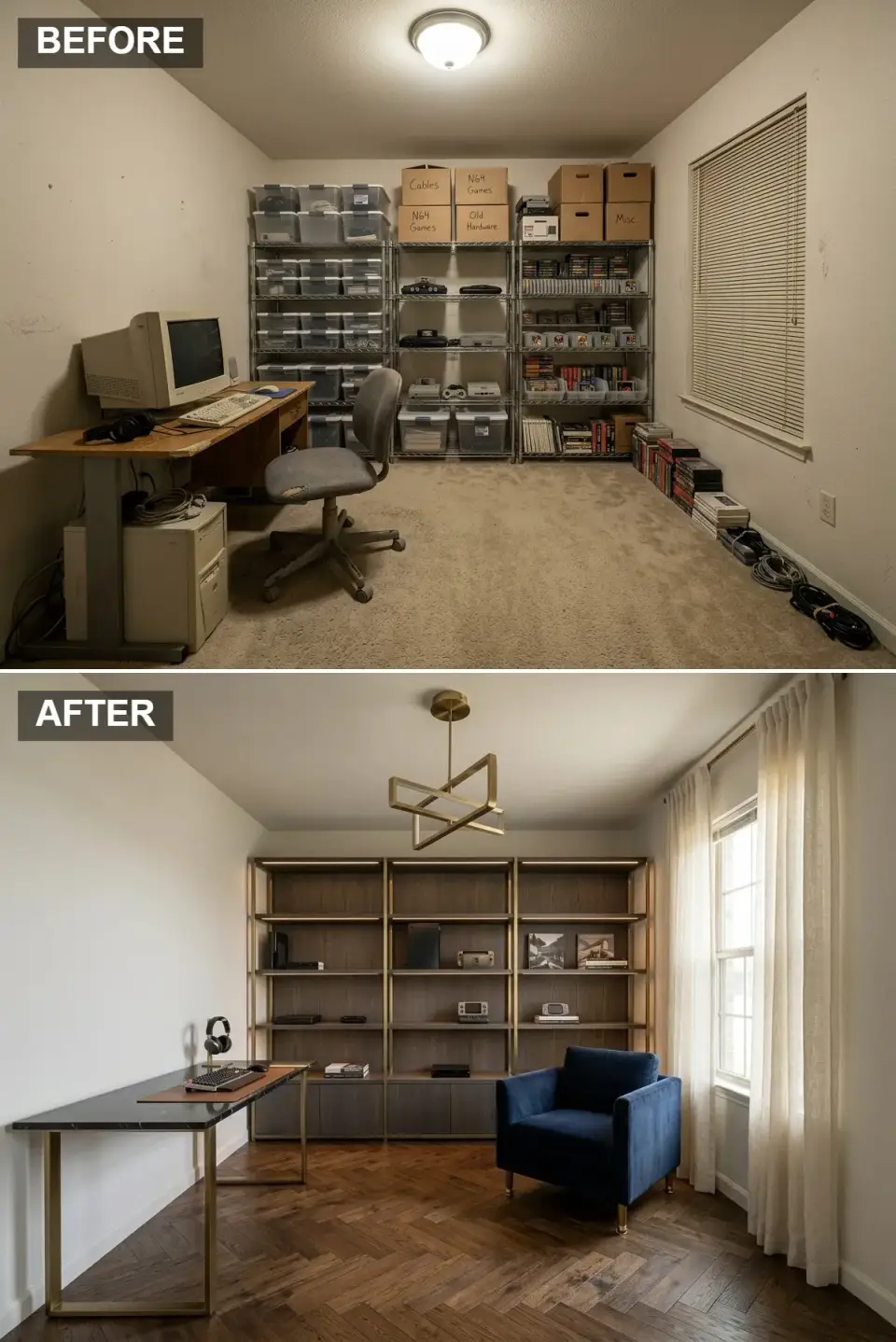
The cluttered Before room, with sagging shelves and a torn chair, becomes a CEO-level command center here. Carpet is replaced by rich herringbone walnut flooring that sets the tone immediately. The back wall holds a massive open shelving unit in dark wood and brass framing a tightly edited collection of consoles and memorabilia, with each shelf lit by hidden LED strips. A geometric brass chandelier hovers overhead like modern sculpture. The desk is a sleek slab of black marble on a brass base, while a navy velvet armchair adds clubby lounge warmth. Sheer linen curtains keep the room from feeling too heavy.
The shelving wall sets the base here, with dark wood boxes framed in Aged Brass, a Warm Gold (#B8A35F) that the geometric chandelier and the desk legs repeat. Below it, a herringbone floor in Herringbone Walnut (#5D3A1A), a Medium Brown, keeps the room warm despite the white walls.
The desk top is Calacatta Noir, a Black Marble (#1C1C1C), with a leather pad laid over it where the keyboard sits. The armchair by the window is in Navy Velvet, a Midnight Blue (#1A2650) dark enough to behave like a neutral beside the walnut while still giving the corner a soft, deep seat.
Design Notes
Presentation is the theme of this room. Replace utilitarian wire racks with open shelving that has a solid wood back and brass framing, which gives collectibles a gallery-quality setting, and light those shelves with shelf-specific LED strips rather than room floods. The focused pools of light pick out individual items the way a museum case would.
The desk deserves a stone or marble top for durability and a tactile, high-end feel during long sessions. Dark wood and metal can make an office read austere, so balance them with a single plush upholstered piece in a saturated color. Hang a sculptural chandelier in the center of the room to break up the rectilinear lines of the desks and shelving units.
The Scholar's Study: Cognac and Emerald Elegance
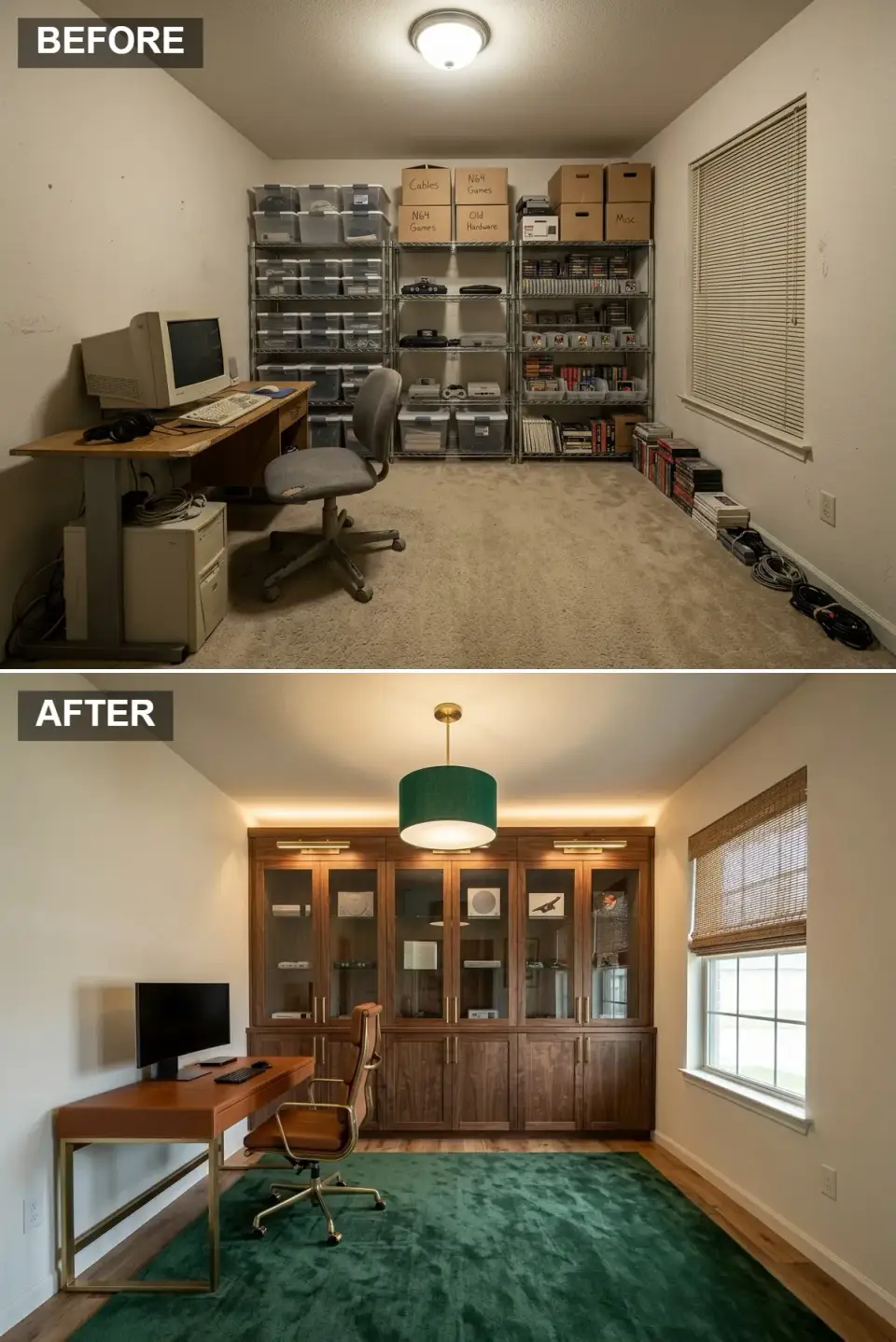
Gone are the Before's cardboard boxes and industrial shelving, replaced here by a stately walnut hutch lifted straight from an Ivy League library. Glass-front cabinets with brass pulls and integrated lighting protect and display vintage consoles, while the lower cabinets hide modern peripherals. A cognac leather-top campaign desk with a brass frame pairs with a matching leather chair on a lush emerald green rug. Above, a green linen drum pendant echoes the rug, and brass picture lights crown the hutch. A woven wood shade offers a natural counterpoint to the polished wood and brass, completing the gentleman's gaming lair.
Library Walnut, a Rich Wood (#5C3A21), covers the glass-front hutch and runs out across the wood floor, and the large rug in Emerald Wool (#0F5C3E), a Deep Green, fills most of that floor and picks up the colour of the drum pendant above it.
The desk and its rolling chair are both upholstered in Cognac Leather, a Warm Brown (#8B4513) a few shades lighter than the hutch, so the work zone stands out from the cabinetry behind it. The metal throughout is Antique Brass in an Aged Gold (#A67B3D): the long picture lights on the cornice, the bar pulls, the desk frame and the chair base.
Design Notes
The rug anchors this room. A large, high-pile area rug in a saturated color defines the gaming zone and absorbs echo for voice chat. The desk is the other working piece: a leather-top model is both historically refined and practical for daily mouse and keyboard use.
For the display, install picture lights or undershelf LEDs above the glass cabinets to remove reflections and spotlight the collection inside. Use a single cohesive wood species, walnut on walnut, so the built-in reads as furniture-quality, something inherited rather than installed. A woven wood shade paired with tailored walls introduces organic texture without compromising the traditional character.
Gallery Noir: Monochrome Drama
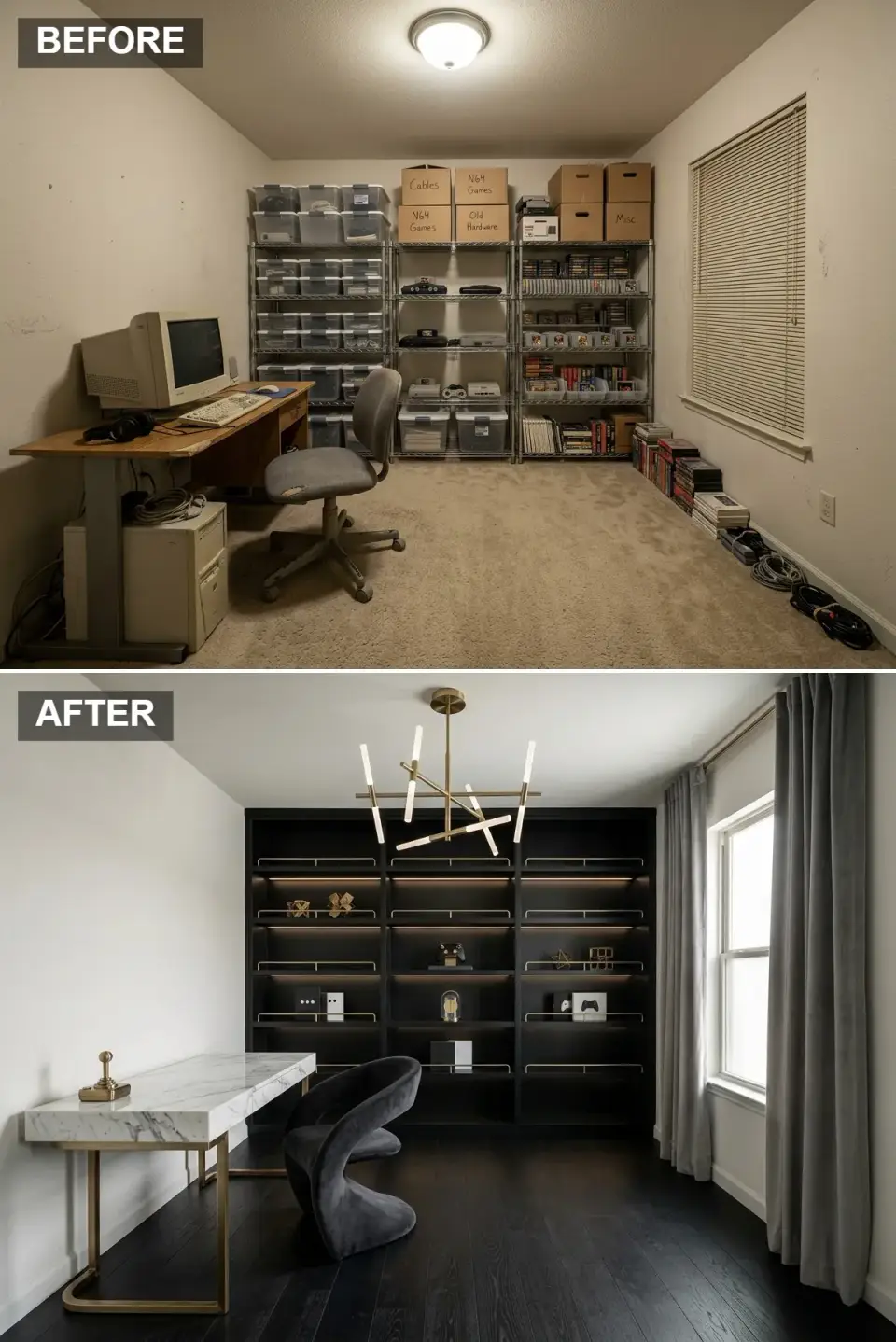
The Before's chaos of bins and cables gets distilled here into a razor-sharp, gallery-worthy statement. The walls stay stark white on one side to contrast with a full-height black built-in shelving wall acting as a dramatic backdrop for sculptural gaming collectibles. Each shelf is edged in brass and lit with precise LED strips, turning controllers and boxed sets into art installations. The floor turns dark espresso oak, reflecting a sputnik brass chandelier with frosted tubes. A Calacatta marble desk with a minimal brass frame floats against the white wall, paired with an avant-garde charcoal velvet chair. Gray linen drapes complete the high-fashion, low-color palette.
Two near blacks split the work in this room. The floor is Espresso Oak, a Near-Black Wood (#1F1A17), and the full-height shelving wall is Matte Black in Charcoal (#181818), so the dark back wall and the dark floor meet without a visible seam. Lifting it all is a desk of Calacatta White (#F0F0F0), a veined White Marble set on a thin frame of Brushed Brass in Pale Gold (#C9AE5D), the metal that also forms the shelf rails and the arms of the tube chandelier.
Design Notes
A monochrome room lives on its display wall. Paint or clad one entire wall in matte black and install open shelving to create a gallery moment for your favorite hardware and figurines, then limit the display to one or two items per shelf. Negative space is what sells the luxury.
Balance comes from contrast. Dark floors and a dark accent wall need a white stone desk surface, which keeps the room from going heavy and reflects task light back upward. A sculptural, non-traditional chair in charcoal velvet serves as functional art rather than standard office seating. Overhead, a sputnik or starburst chandelier with frosted bulbs distributes ambient light evenly without visible glare on the screen.
Earthbound Atelier: Raw Wood and Terracotta
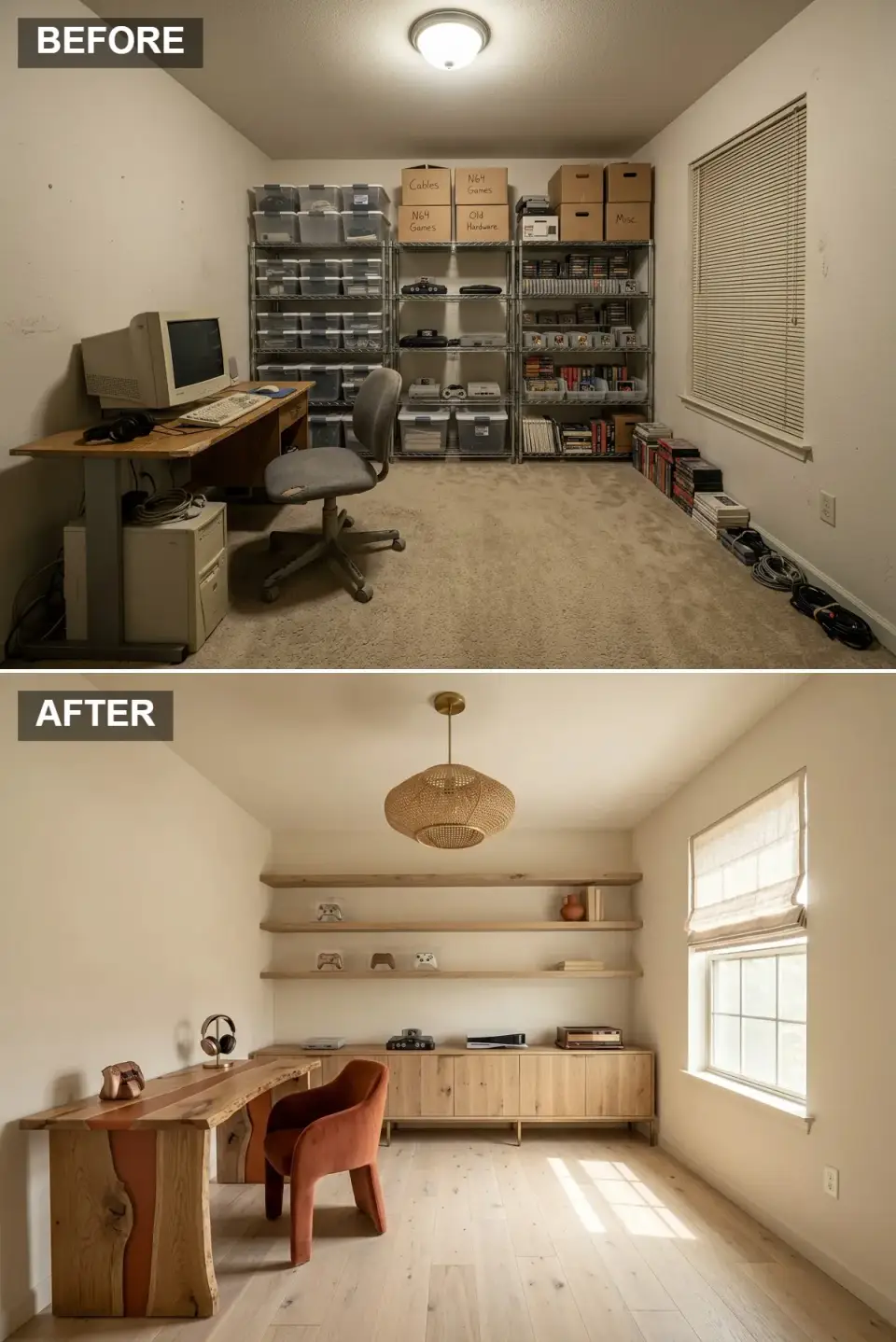
The Before room's sterile beige and plastic storage melt here into an organic, sun-drenched creative studio. Pale bleached oak floors and live-edge floating shelves replace the wire racks and carpet. A raw-edge slab desk with natural bark lines one wall, paired with a sculptural terracotta chair that feels hand-formed. Below the shelves, a low-profile light wood credenza holds concealed storage for modern consoles. A woven rattan pendant anchors the room overhead, while a simple linen Roman shade filters sunlight. Controllers rest casually on the shelves like found artifacts, celebrating gaming as craft in a space that breathes.
Bleached Oak in Pale Wood (#E6DCC8) covers the floor, the three long shelves and the credenza, and the walls and the Roman shade are Raw Linen, a Warm White (#EDE6D8) only slightly creamier. Colour comes from the furniture: the curved chair in Terracotta Clay (#C06C4F), a Burnt Orange, and the live-edge desk, whose Natural Bark edges show a Warm Brown (#8B5A2B) around a terracotta-coloured resin channel that ties the desk to the chair.
Design Notes
A live-edge or slab wood desk brings natural variation and an artisanal focal point into a tech-heavy room, and it sets the tone for everything around it. Paint the walls a warm raw-linen tone rather than stark white so they complement the wood and avoid a clinical feel. Floating shelves with hidden brackets let controllers and small consoles sit as sculptural objects rather than clutter.
One piece of organic, sculptural seating in an earthen tone softens the angularity of the monitors and desks. Above, a large woven pendant casts dappled light patterns and reinforces the room's handcrafted, natural material story.
Golden Hour Minimalism: Warmth Meets Whimsy
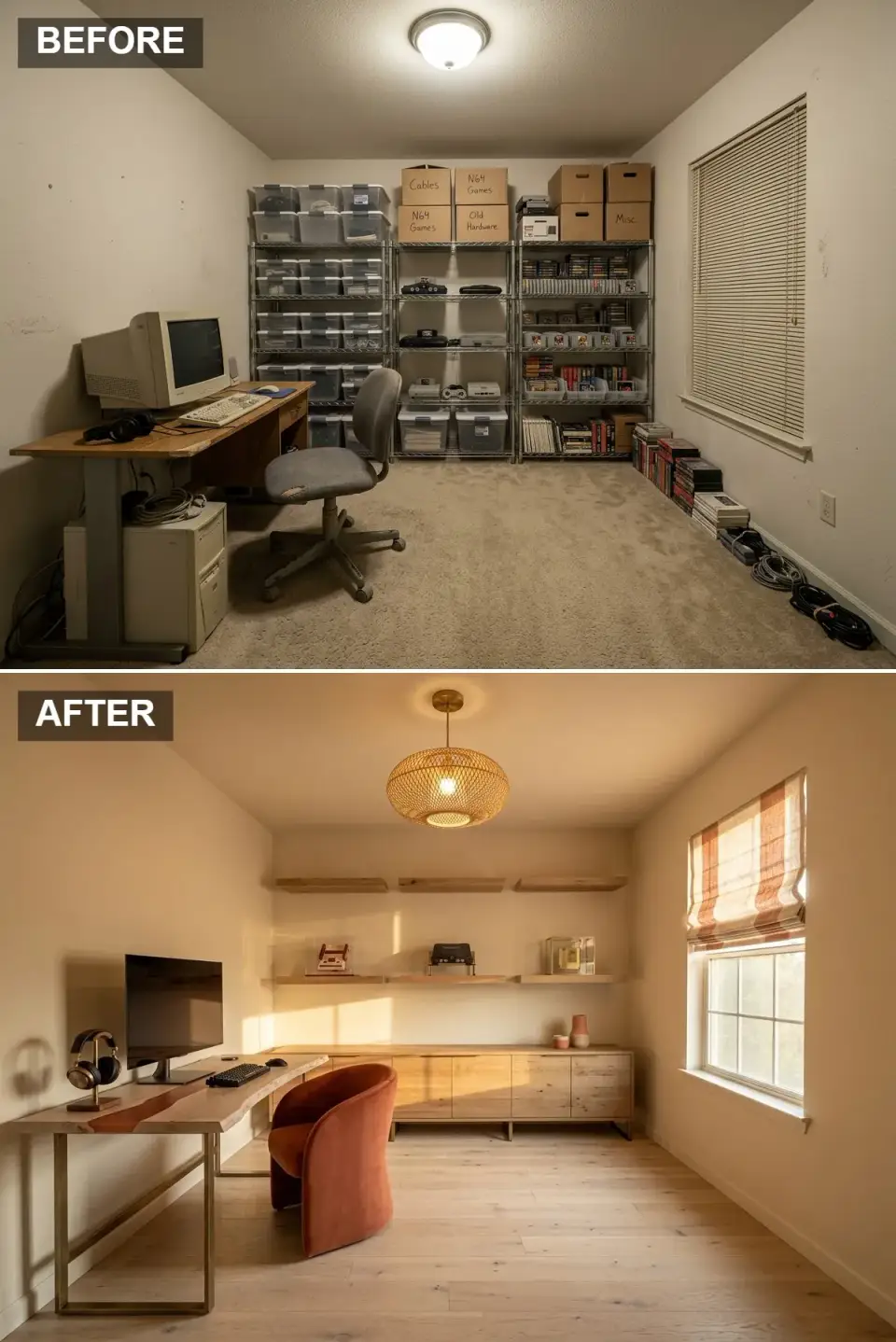
The Before's pile of obsolete gear and mismatched storage gets cleared here for a warm Scandinavian-inspired room. Light oak plank floors and a pale wood desk keep the room buoyant. Three staggered oak floating shelves replace the towering wire units, displaying a chosen trio of vintage consoles. A low oak credenza beneath offers hidden storage. The window is dressed in a striped Roman shade catching the late-afternoon sun, while a woven rattan pendant glows overhead like a lantern. A rust-colored sculptural chair adds personality without visual weight, proving that minimalism and nostalgia can coexist.
One pale oak, Natural Oak in Light Wood (#DECDB6), is used for the floor, the shelves and the long credenza, which is why the wall reads as a single piece of joinery. Woven Rattan (#C4A882), a honey Natural Fiber, shows in the domed pendant.
Against the Linen White walls, a Soft Cream (#F7F2EA) that takes on an amber cast in the low sun, the chair in Rust Velvet (#B5523D), a Burnt Sienna, is the brightest object in the room. The same rust appears in the stripes of the Roman shade and in the resin seam of the desk top, so the accent shows up three times without the room ever looking busy.
Design Notes
Restraint drives this direction. Reduce visible storage to a single low credenza and a few floating shelves, which forces you to edit and removes visual noise. Matching the desk and shelf materials exactly gives a built-in look without the custom carpentry price tag, and a woven pendant with natural-fiber window shades layers texture into an otherwise smooth, minimal envelope.
Placement matters as much as purchase. Set the desk perpendicular to the window so you get side light without direct screen glare. Then choose a sculptural, boldly hued chair as the single statement piece, which injects personality into the restrained palette.
Amethyst After Dark: Purple Reign Gaming
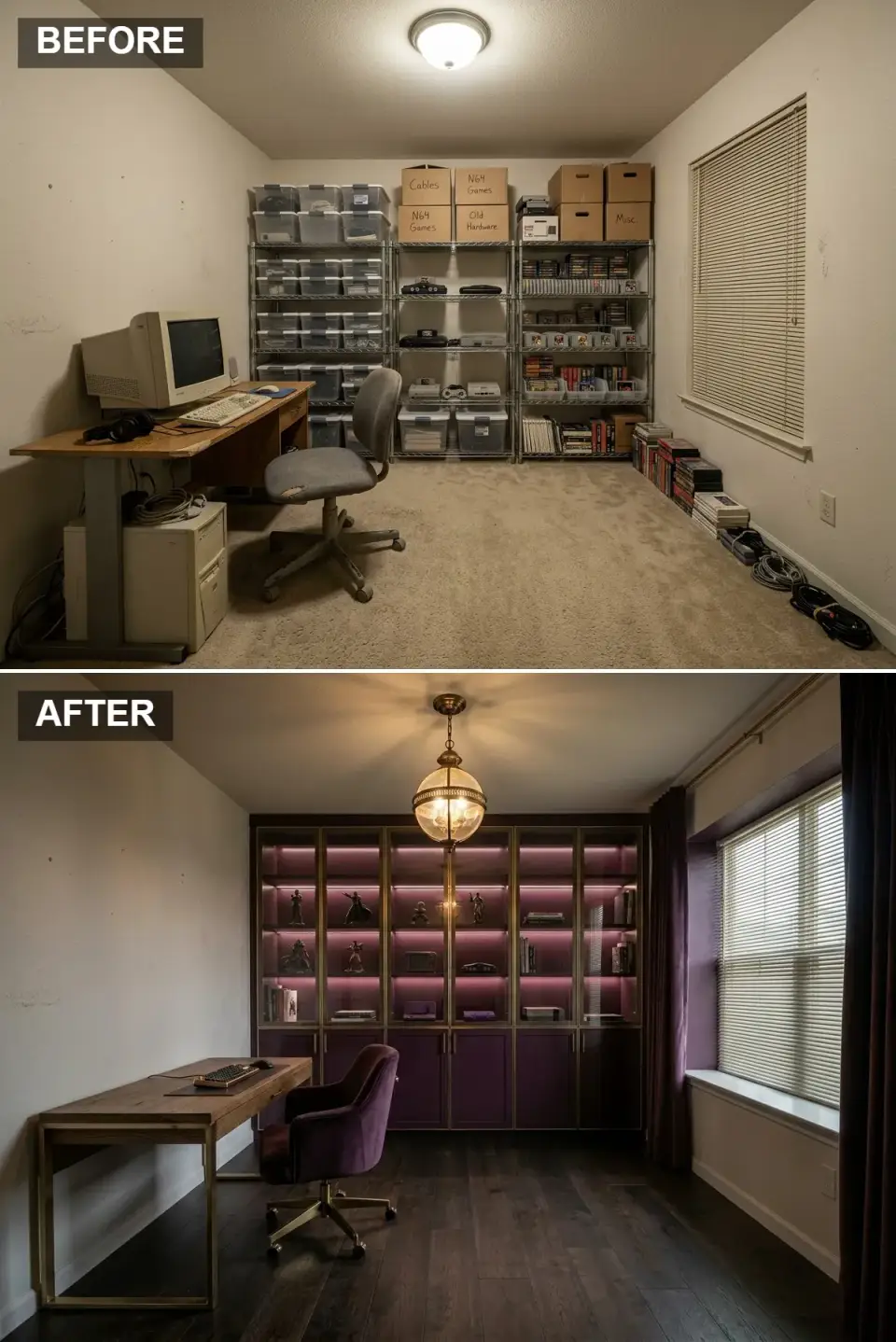
Where the Before offered only beige carpet and utilitarian metal, this After delivers a theatrical jewel-box experience. The back wall is dominated by floor-to-ceiling plum cabinetry with brass frames and glass doors, each cavity glowing with amethyst LED backlighting that turns figurines and game boxes into museum pieces. The side window wall is painted matching deep violet, draped in heavy plum velvet. A natural walnut desk with brass legs bridges the old and new, paired with a deep purple velvet chair. Dark hardwood floors absorb the colored light, while a vintage brass globe pendant and cove lighting overhead ensure the drama never dims.
The glass cabinets and the drapes share Deep Amethyst, a Dark Plum (#3D0C3D), and the window reveal is painted to match, while each cabinet door is framed in Brass Frame trim of Antique Gold (#B5943F) that catches the pink-violet strip light. Grounding all that colour are two browns: the desk in Natural Walnut, a Medium Brown (#5D3A21), and the Espresso Floor in Dark Brown (#2A1D15), which absorbs the glow instead of reflecting it.
Design Notes
The signature hue starts inside the cabinets. Color-tunable LED strips in the glass cabinets bathe the collectibles in tinted backlighting that reinforces the room's purple identity. Carry the accent color from the shelving onto an adjacent wall and into the textiles, so the room feels intentionally wrapped rather than randomly painted, and use velvet drapery in a matching tone to black out light and add acoustic softness for cinematic sessions.
Natural materials keep all that color from feeling synthetic. A natural wood desk surface balances the saturated cabinets with organic texture and visual relief, and a statement pendant in warm glass and brass counteracts the coolness of the purple LED lighting.
The Collector's Library: Vintage Dark Academia
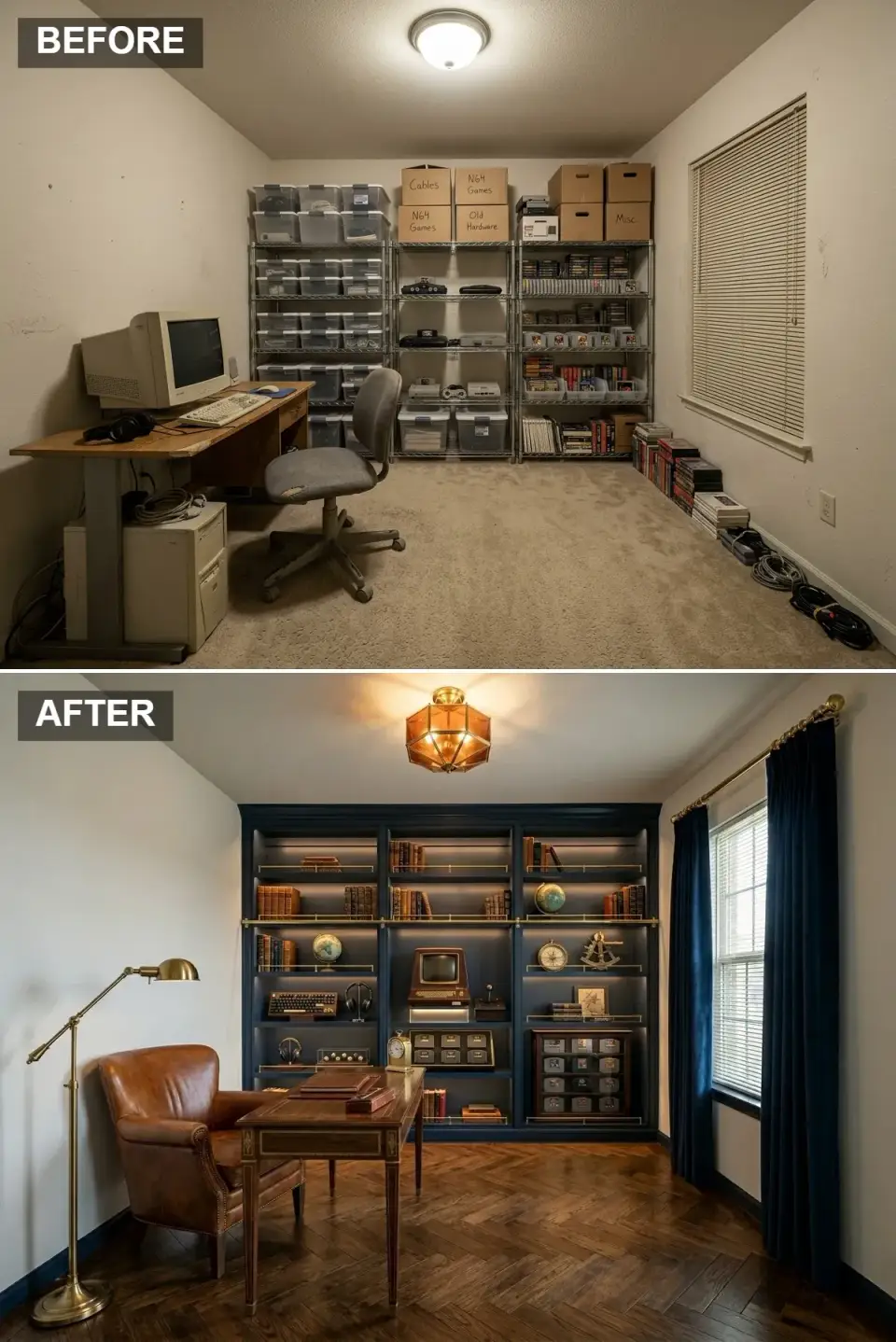
The Before's plastic bins and tangles of cord get replaced here by a scholarly, old-world study that treats gaming history as seriously as first editions. A massive built-in library in deep navy with brass rails and integrated lighting showcases vintage computers, globes, typewriters, and leather-bound books. Dark herringbone walnut flooring adds centuries of gravitas underfoot. A traditional mahogany writing desk with a tooled leather top pairs with a studded cognac leather club chair with no wheels at all. A brass pharmacy floor lamp provides task light, while navy velvet curtains and an amber glass ceiling fixture complete the time-travel effect.
Oxford Navy, a Deep Blue-Black (#1B263B), is the colour of the built-in library and of the velvet curtains, and it is dark enough that the leather book spines and the old computer on the middle shelf glow against it. Cognac Leather in Saddle Brown (#914C22) covers the club chair with its nailhead trim and the inset on the desk top.
The desk itself is a Mahogany Stain, a Dark Red-Brown (#4A2511) with a lighter inlaid border, and Burnished Brass in Aged Gold (#C5A059) links the pharmacy floor lamp, the gallery rails on the shelves, the curtain rod and the amber ceiling fixture.
Design Notes
The built-ins carry this room, so design them with varied shelf heights and a mix of open rails and closed storage to hold objects of wildly different scales. Real vintage items, such as old radios, globes and typewriters, displayed alongside the gaming gear give the library narrative its credibility.
Furniture choices hide the tech. A traditional writing desk with a leather inset, rather than a modern gaming desk, camouflages the equipment within classic furniture, and a stationary leather armchair in place of a rolling task chair reinforces the room's identity as a study rather than an office. Overhead, an amber glass ceiling fixture casts a warmer color temperature that mimics the candlelit libraries of the era.
Urban Forge: Industrial Loft Command Post
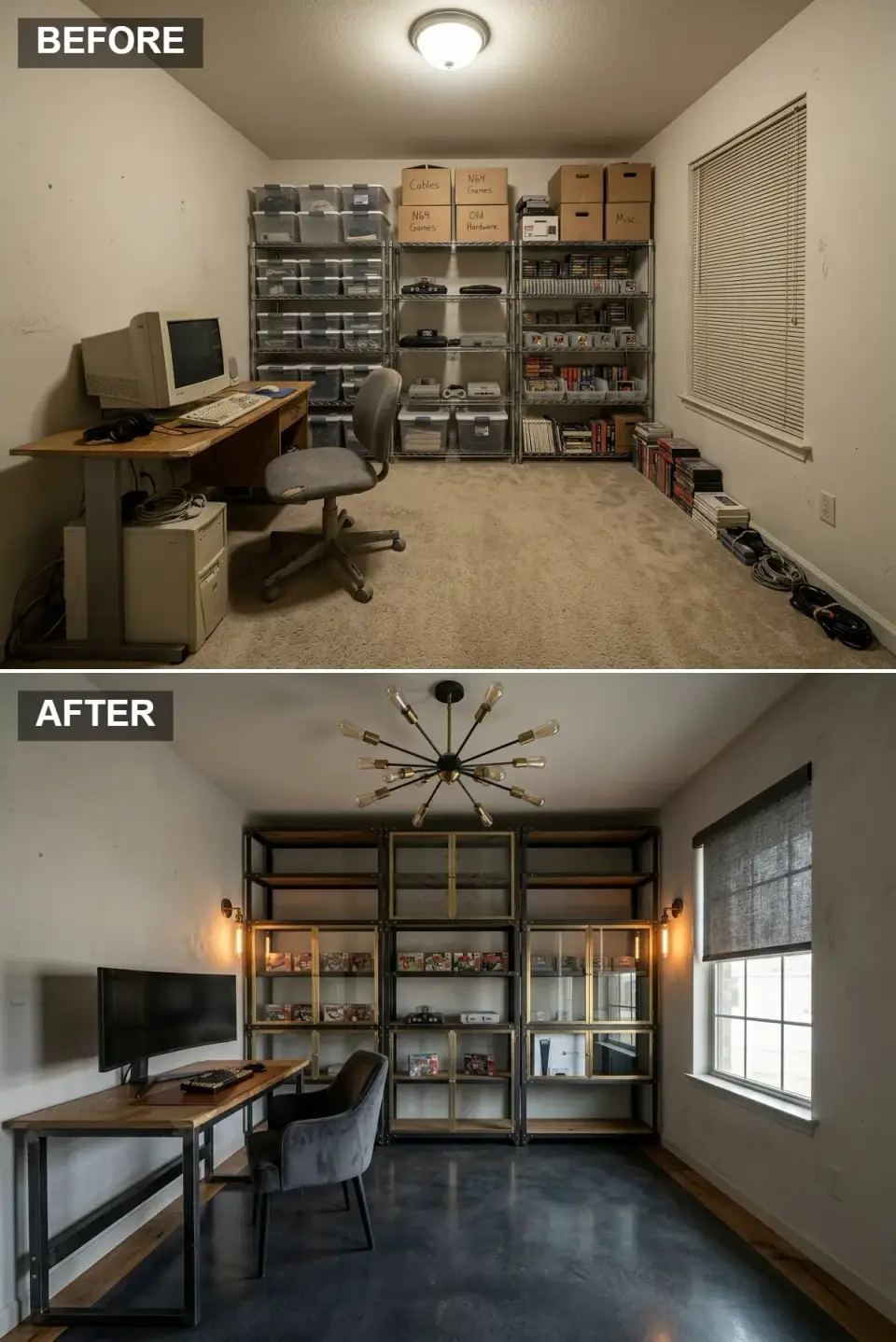
The Before's domestic beige carpet and flimsy wire racks trade here for the raw edge of a downtown loft. The floor turns polished concrete with a subtle blue-gray stain, reflecting an Edison-bulb sputnik chandelier and vintage pipe sconces. A massive industrial shelving unit in black iron, reclaimed wood, and brass mesh houses a riot of color from game boxes and cartridges, turning storage into a feature wall. A reclaimed wood desk on a black pipe frame lines one wall, paired with a charcoal upholstered chair. A dark canvas Roman shade keeps the loft vibe utilitarian and cool.
The floor is Polished Concrete stained Blue-Gray (#5A6570), cool and slightly mottled, and the same blue cast shows where light from the window hits it. Framing the storage is Gunmetal Iron, a Dark Gray (#2C2C2C) used for the uprights of the shelving units, the desk base and the arms of the bulb chandelier.
Warmth comes back through Reclaimed Pine, a Weathered Wood (#9C7D4D) used for the thick desk top and the shelf boards, and through Brass Mesh in Aged Gold (#A68A58), which here frames the glass doors on the middle bays and the backplates of the two pipe sconces.
Design Notes
The floor turns a suburban spare room into a loft. Pouring or polishing concrete gives the industrial character immediately and makes daily cleanup easy. For display, build or buy an industrial shelving unit in black pipe and reclaimed wood, which shows off colorful game boxes as graphic art, and choose a desk with a thick reclaimed wood top and pipe legs to merge utilitarian durability with warmth.
Metal finishes should mix rather than match: gunmetal pipe with brass mesh and Edison bulbs keeps the look considered rather than cold. Exposed-bulb sconces flanking the shelving create vertical symmetry and cast dramatic shadows on the wall.
Pro Tips & Styling Advice
Always start a game room renovation by auditing your collection and committing to closed storage for 70 percent of your gear. Visible clutter undermines the design intent regardless of which aesthetic you pick. With storage decided, layer the lighting in three levels: ambient ceiling fixtures, task lighting at the desk and accent lighting inside the display cabinets. It is the only way to avoid the flat, shadowy look of a single overhead bulb.
The floor comes next. Replace standard carpet with a hard surface (wood, concrete or tile) and add a rug only in the seating zone, which improves chair mobility and acoustic clarity for voice chat. Then invest in one statement piece per room, whether a sculptural chair, a marble desk or a custom light fixture, to anchor the design and pull attention away from the necessary tech.
Cables are the final detail and the easiest to get wrong. Route them through built-in channels, hollow desk legs or wall raceways painted to match the wall, because visible cords are the single fastest way to undermine an otherwise polished room.
Frequently Asked Questions
How much does a designed game room renovation realistically cost?
A meaningful game room renovation with new flooring, custom built-ins, layered lighting, and a coordinated furniture set runs $12,000 to $35,000 in the Southeast in 2026. Custom millwork and stone surfaces push the upper end higher, while peel-and-stick wallpapers, modular shelving units, and IKEA-base hacks can drop the total below $8,000 for someone willing to phase the work and DIY a few elements.
Which of the thirteen styles is easiest for a beginner to execute?
Scandi Serenity and Golden Hour Minimalism are the easiest to execute well because both rely on a tight neutral palette, off-the-shelf furniture from West Elm, Article, or CB2, and minimal custom carpentry. The moody, Art Deco, and dark academia versions require more architectural commitment, custom built-ins, paneling, or stone, which raises both cost and the risk of getting proportions wrong.
Will a dark game room feel claustrophobic in a small space?
Not if you handle lighting properly. A dark room reads as cinematic rather than claustrophobic when you layer three light sources: a perimeter cove or LED strip, accent lights inside display cabinets, and a sculptural pendant or chandelier. The most common mistake is a dark room with a single overhead bulb, which is what creates the cave feeling, not the wall color itself.
How do you handle screen glare on light-colored walls and desks?
Position the desk perpendicular to the window rather than facing or backing it directly, and add a sheer linen panel between you and the glass. On a white or pale wood desk, use a matte-finish desk mat under the keyboard and mouse, the matte surface reads more luxe than glossy and removes reflected screen glare during the day.
Are LED light strips inside cabinets safe to leave on for long hours?
Yes, modern low-voltage LED strips run cool enough to leave on continuously, they draw very little power and last 30,000 to 50,000 hours. The thing to specify is a strip rated for the cabinet temperature and a color temperature between 2700K and 3000K, which is the warm range that reads as flattering and museum-quality rather than cool retail.
Can these designs work in a smaller box room or a closet conversion?
Most of them adapt down to a smaller footprint with two modifications. First, drop the floor-to-ceiling built-ins to three-quarter height so the room does not feel tunnel-like, and second, use a curved or barrel chair instead of a wingback so the seating does not eat the floor plan. The Scandi, Golden Hour, Earthbound, and Cloud White schemes work especially well in compact spaces because their lighter palettes expand the room visually.
Sources & References
- Houzz 2026 US Home Renovation Trends Study: baseline benchmarks for home office and game room renovation spend and material preferences.
- Architectural Digest, AD Pro Materials Cost Index 2026: reference pricing for marble, concrete, walnut, and brass hardware specified in the room sketches above.
- West Elm, CB2, Article, and Crate & Barrel 2026 catalogs: mid-range retail pricing for the boucle, velvet, leather, and oak furniture configurations referenced throughout.
- Sherwin-Williams and Benjamin Moore 2026 color trend reports: reference data on navy, forest green, plum, burgundy, and charcoal as enduring saturated palettes.
- Lutron and WAC Lighting 2026 specification guides: technical reference for LED strip lighting, color temperature ranges, and integrated cabinet illumination.
- The Layered Homes editorial design notes: concept-level observations on home office and game room conversions, with the Charleston, Atlanta, and Nashville markets as reference points.
Choosing a Game Room Direction
These thirteen transformations all start in the same place, a spare room full of plastic bins and wire shelves, and end in radically different aesthetic destinations because the design language was chosen deliberately rather than defaulted to. Whether your taste leans toward the velvet-draped drama of an Art Deco salon, the calm restraint of Scandinavian minimalism, or the raw authenticity of an industrial loft, the journey always begins with curating the collection, committing to a coherent palette, and treating the lighting plan as architecture rather than an afterthought. If you want companion before-and-after reading, our eleven bedroom transformations from a single before applies the same disciplined approach to sleeping spaces, and the twelve bathroom makeovers feature covers the wettest room in the house. For style-led deep dives that pair well with the more formal directions above, our nine dining room design styles roundup and the quiet luxury kitchen guide both walk through the same architectural-detail-plus-color-discipline framework that runs through every room here.
Transformations Desk
The Layered Homes editorial teamThe Transformations Desk produces the before-and-after design studies: one imagined starting space (a room, a facade, a backyard) shown in several design directions, each with a palette and a cost estimate.
More from the Transformations Desk →
Reader notes