


I've spent the last seven years inside other people's houses across the Lowcountry — Charleston single-houses, Kiawah cottages, Summerville ranches, Asheville bungalows — and one pattern holds across every style: the house keeps telling on the person who lives in it, long after they've stopped curating for the visitor. The gallery wall arrangement, the color of the sofa they keep returning to, the single armchair that's clearly theirs alone. This essay is a slower read than my usual guides — less how-to, more why. I draw on the work of environmental psychologists and design writers who shaped how I walk into a room, and I share what I've observed in real homes here in the South. If you're interested in what your own space might be quietly saying back to you, keep reading.
What This Essay Covers
- The Psychology of Space: The "Why" Behind Your Choices
- The Gallery Wall as a Personal Timeline
- The Language of Color: Emotional Palettes
- The Comfort of Nostalgia: Ancestral Echoes in Decor
- The "Power Spot": Creating Your Sanctuary
- The Curated vs. The Cluttered: What Your Possessions Say
- Sensory Design: Engaging More Than Just Sight
- The Evolving Home: Adapting Your Narrative Over Time
- Questions Readers Often Ask
- Sources and Further Reading
- A Closing Thought
The Psychology of Space: The "Why" Behind Your Choices
Environmental psychology — the field launched in part by Harold Proshansky's 1978 work on "place identity" — starts from a simple premise: we do not just occupy our environments, we incorporate them into our sense of self. The way you arrange your living room is less a design decision than a disclosure. Proshansky argued that a person's identity is constituted in part by the physical settings they inhabit, the same way it's constituted by relationships and memory. An extrovert I worked with in Mount Pleasant two years ago rearranged her entire great room in a single weekend so the sofa faced the kitchen island instead of the TV — she told me afterward she hadn't realized until then that she'd spent a decade staging her home for a version of herself she didn't actually want to be. The furniture arrangement had been her husband's default. Her rearrangement was an identity correction. What looks like a decorating choice is frequently this: a subconscious sorting of who you are, made visible.
The Gallery Wall as a Personal Timeline
Russell Belk, in his 1988 paper "Possessions and the Extended Self," argued that what we keep and display becomes part of who we are — not symbolically, but functionally. A gallery wall is the most literal expression of this idea in a contemporary home. It is a curated autobiography pinned to drywall. What I've noticed walking into hundreds of homes: the first photograph eye-level, at the center of the arrangement, is nearly always the one the owner identifies with most strongly — a wedding, a child at a specific age, a parent who died. The frames can be eclectic or matching, but that center photograph rarely moves. When clients tell me they "don't know what to put on the walls," I ask them instead what story they want to be reminded of every time they walk past. The arrangement follows the answer, not the other way around. A gallery wall that photographs beautifully but tells no story feels empty within six months. One that's crooked but full of meaning stays up forever.
The Language of Color: Emotional Palettes
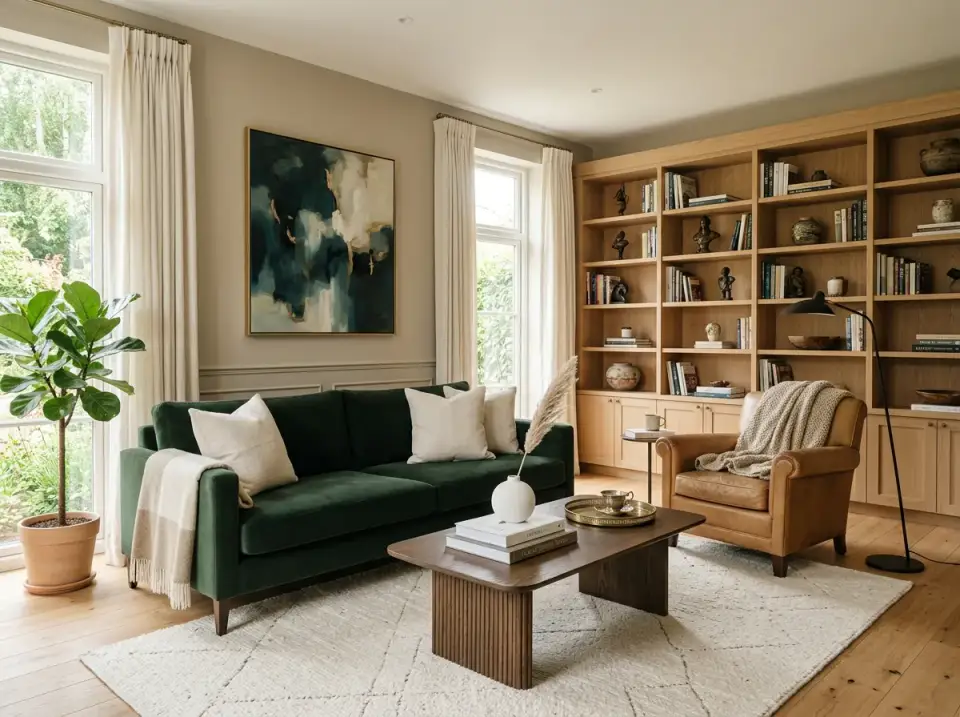
Color is not just perceived; it is felt. The research literature on color psychology is more cautious than the design magazines make it sound — effects are highly context-dependent, and individual response varies — but the pattern I've observed in Lowcountry homes is consistent. Deep greens (the emerald velvet sofa, the Farrow & Ball Calke Green dining room, the Benjamin Moore Salamander library) show up in homes of people who describe themselves as seeking balance after a period of turbulence. Warm ochres and terra cottas appear in homes of clients who grew up in the Southwest or spent years abroad and are trying to import a felt memory. Cool blues dominate in Charleston coastal cottages whose owners moved here for the water and want it echoed indoors. None of this is destiny — it's pattern. The useful question isn't "what does this color mean?" but "what feeling am I trying to be reminded of every day?" Pick the color that answers that.
The Comfort of Nostalgia: Ancestral Echoes in Decor
Clare Cooper Marcus, in her 1995 book House as a Mirror of Self, collected hundreds of interviews in which people described the objects in their homes that had traveled with them across moves, divorces, and decades. The objects were often unremarkable — a chipped ceramic bowl, a particular reading lamp, a small side table. What they had in common was that the owner could not get rid of them. Cooper Marcus argued these objects act as what she called "identity anchors" — physical tethers to prior selves that are still being integrated. In the Lowcountry, this often shows up as a grandmother's pine chest, a father's army-issue field desk, or a piece of Charleston ironwork that came from a family home on Legare Street. I had a Summerville client who kept a single rusted garden gate leaning against her potting shed — her grandfather had made it in 1952. She didn't want to repaint it. She didn't want it indoors. She just wanted it in her line of sight when she watered the camellias. That's an identity anchor. And the home that allows those anchors to stay visible is almost always one where the owner feels settled.
The "Power Spot": Creating Your Sanctuary
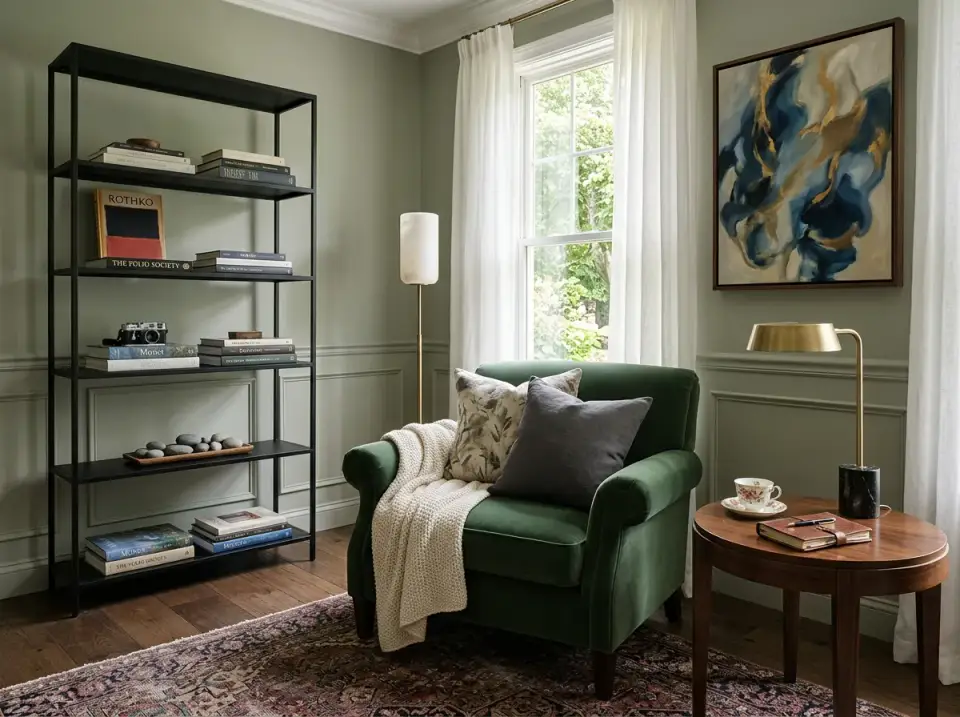
Gaston Bachelard, in The Poetics of Space (1958), wrote about the corner — the smallest architectural unit we can fully claim — as the nucleus of intimacy. "The corner becomes a negation of the Universe," he wrote. I don't quote this at clients because it sounds precious out of context, but I think about it every single time I design a reading nook. The "power spot" in a home is almost always a corner: a wingback by a fireplace, a window seat facing a garden, a breakfast chair at a particular end of a particular table. It doesn't need to be a separate room. It needs to be defensible — a place where your back is to something solid and your attention can contract inward without feeling exposed. Erving Goffman, in The Presentation of Self in Everyday Life (1959), called this "back-stage" space — where the performance of self paused and the private self was allowed to be. Every home needs a back-stage. The homes I've visited where there isn't one have, without exception, an owner who reports feeling "on" all day even at home.
The Curated vs. The Cluttered: What Your Possessions Say
Minimalism and maximalism are not opposing virtues; they are two coherent responses to the same underlying question — how many objects do I need around me to feel like myself? The research on clutter and mental load is reasonably robust. Rachel Hoskins and Darby Saxbe, in a 2009 UCLA study, found that women who described their homes using words like "cluttered" or "unfinished" showed measurably higher cortisol patterns across the day than those who described their homes as "restful" or "restorative." The mechanism isn't the stuff itself — it's the sense that the stuff is unfinished business. A minimalist home with one intentional object on a shelf and a maximalist home with fifty intentional objects on a shelf can both be restorative. What wears a person down is the pile of mail, the broken frame leaning against the wall, the box that's been waiting to be unpacked for three years. The question isn't "how much do I own?" It's "do these objects still feel like decisions, or do they feel like delay?"
Sensory Design: Engaging More Than Just Sight
Interior design is routinely discussed as a visual practice, but the homes people describe as "feeling like home" almost never got there through vision alone. Scent is the most primal of these layers — the olfactory bulb connects directly to the hippocampus and amygdala, which is why a single inhalation of cedar or wood smoke can return you to a place you haven't lived in for thirty years. Charleston homes often have a specific scent profile: aged pine floors, salt, the particular dampness of Lowcountry summer, occasionally pluff mud from an open window facing the marsh. Many of my clients spend money on the visual refresh and then wonder why the house still doesn't feel right. It's usually because they changed the scent cues without realizing. Tactile life matters too — the plush of a velvet sofa, the grain of a live-edge walnut table, the cool of encaustic cement tile underfoot in August. A home that engages sight alone is a stage set. A home that engages touch, scent, and acoustic decay is inhabitable.
The Evolving Home: Adapting Your Narrative Over Time
Witold Rybczynski, in Home: A Short History of an Idea (1986), traced how the Western concept of "home" has shifted dramatically across centuries — from medieval halls with no concept of private rooms, through the Dutch invention of domestic intimacy, to the present-day understanding of home as a site of individual expression. His argument, compressed: the home is always a moving target, and it moves with us. I have watched this happen in real time. An Awendaw couple I worked with in 2019 converted their dining room into a music room after the last child left for college — a baby grand, two worn leather chairs, no table at all. It was the first room in the house that felt entirely theirs. Seven years earlier, the same room had been wallpapered in a nursery print. Both versions of the room were honest. A home that refuses to evolve becomes a museum of who you used to be. A home that evolves with intention remains a partner. The work is noticing when a room has stopped serving the current chapter, and having the permission to let it change.
Questions Readers Often Ask
Is there real research behind "color psychology," or is it mostly marketing? Both. The scientific literature is more measured than design magazines — effects are context-dependent and culturally variable. The better framing comes from environmental psychology: people report more restorative experiences in spaces that use color cohesively rather than spaces that follow a specific "meaning" chart. Pick the color that consistently feels right to you; don't pick it because a chart said green means balance. My home feels disconnected from who I am — where do I start? Walk through it and note the three objects you would grab in a fire that isn't people or pets. Those are your identity anchors. Are they visible? Are they positioned in spaces you use daily, or are they stored? Most clients who describe their home as "disconnected" have hidden their anchors in closets and storage. Returning them to sight is often enough to shift the feeling within a week. How do I know when a room needs to change vs. when I'm just restless? A helpful test: is there a life event (a child leaving, a relationship ending, a career shift) that the current room doesn't reflect? If yes, the room is probably behind the narrative and needs editing. If the restlessness has no anchor event, the room is usually fine — the restlessness is pointing somewhere else. Redesign is an expensive way to treat an emotional question. Does minimalism really reduce stress, or is that oversold? Minimalism can reduce stress when it aligns with the inhabitant's native disposition. It does not reduce stress when imposed on a maximalist who feels alive among objects. The relevant research — Saxbe and Repetti's 2009 cortisol study is the one most often cited — points to unresolved visual clutter, not to object volume per se, as the stress correlate. A maximalist home that feels finished is not stressful. Can a home be "too curated"? Yes, and I see it most often in homes staged for photography or sale. A space that communicates nothing personal — no family photos, no worn book, no inheritance — reads to visitors as either temporary or defensive. Intimacy in a home requires some visible imperfection. Clare Cooper Marcus' interviews are full of clients describing the moment they "let the house become theirs" as the moment they stopped performing it for visitors. How important is scent to the feeling of home? More than most people realize. Olfactory memory is processed in the same brain structures that handle emotion and autobiographical memory — it bypasses conscious reflection. Homes that feel restorative usually have a stable scent signature (particular candles, wood, linens, cooking). Homes that have been recently renovated often feel "off" for six to twelve months because the scent cues have changed even though the visuals look right.Sources and Further Reading
- Proshansky, H. M., Fabian, A. K., & Kaminoff, R. (1983). "Place-identity: Physical world socialization of the self." Journal of Environmental Psychology, 3(1), 57–83.
- Belk, R. W. (1988). "Possessions and the Extended Self." Journal of Consumer Research, 15(2), 139–168.
- Cooper Marcus, C. (1995). House as a Mirror of Self: Exploring the Deeper Meaning of Home. Conari Press.
- Bachelard, G. (1958/1994 trans.). The Poetics of Space. Beacon Press.
- Goffman, E. (1959). The Presentation of Self in Everyday Life. Anchor Books.
- Rybczynski, W. (1986). Home: A Short History of an Idea. Viking Penguin.
- Saxbe, D. E., & Repetti, R. (2010). "No place like home: Home tours correlate with daily patterns of mood and cortisol." Personality and Social Psychology Bulletin, 36(1), 71–81.
- Gallagher, W. (2006). House Thinking: A Room-by-Room Look at How We Live. Harper Perennial.
- Herz, R. (2016). "The Role of Odor-Evoked Memory in Psychological and Physiological Health." Brain Sciences, 6(3), 22.
- Johan Martez consulting notes, 2018–2025 Lowcountry interviews and in-home walkthroughs — used for the pattern observations referenced throughout.
A Closing Thought
The most honest description I have of this work, after seven years of doing it, is that I am rarely choosing furniture for a client. I am translating. They have a felt sense of who they are and who they are becoming, and my job is to listen long enough to hear the shape of it and then help them build a room that holds that shape. The sofa, the color, the gallery wall arrangement — those are the vocabulary, not the message. The message is older and more private, and it sits in the corner of a room long before we arrive with swatches.
If you'd like to see how this same framework looks applied to specific project transformations, our piece on the builder-grade suburban home transformed into a modern farmhouse walks through how a family's identity shift reshaped the physical house. The red brick to Scandi modern transformation is another clean example of a home being brought into line with its owners' current chapter. And for the inverse — a small urban lot becoming a restorative outdoor space — our urban garden awakening shows the same principle applied to exterior space. For a more hands-on piece on transformation and identity, our eleven neglected-yard transformations essay complements this one well.
— Johan Martez, Charleston, SC

Rowan Whitaker
Styling & Living Editor · Charleston, South CarolinaRoom-by-room decor cost guides, outdoor and garden styling, celebrations, design solutions and the Home Files essays. Rowan writes the pages where the house gets lived in — with paint lines, fabric sources and paid-invoice figures for every room.
More from Rowan →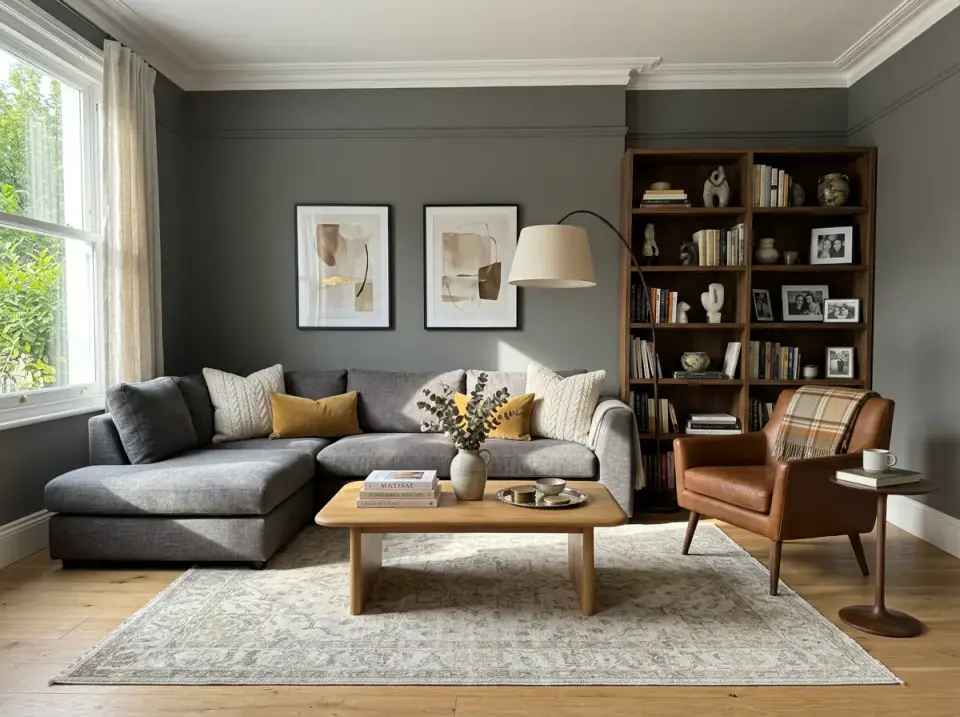
Reader notes